How Small Brands Can Build a Repeatable Short-Form Video Engine

Home Business Magazine Online

When it comes to social media marketing, there’s no denying that video is the most powerful tool brands can use to reach their goals, making a short-form video engine an important tool to have on hand. Video marketing grabs customers’ attention, builds trust, increases engagement, and/or drives conversions. Of all formats, short-form video content seems to bring the best results across the board.

It’s not just a TikTok trend anymore. While the platform may have started the fad, it’s become much larger than that. The success that Instagram and Facebook Reels, or YouTube Shorts enjoy stands as proof of video’s dominance and the increasingly important role it plays in shaping digital marketing strategies.

However, in order for businesses to truly leverage the power that video content holds, they need a short-form video engine that allows them to produce effective short-term videos on repeat. That’s certainly not an issue for large companies that have an army of specialists handling every aspect of their social media campaigns, but for smaller enterprises, the task of creating short-form videos consistently can be quite challenging and put a lot of pressure on marketing teams. A social media marketing agency such as Faceplant Creative can connect strategy, production, and editing in one workflow.

The good news is that even with limited resources, small businesses can still win at social media marketing as long as they know where to direct their focus and resources, so let’s see how you should go about building a video production engine that works flawlessly.

Do Your Research

One of the biggest mistakes companies make is jumping into video production without taking the time to do a bit of research and understand how video content actually works. You can’t expect to see results by randomly creating and posting videos online. In order to craft impactful videos that actually hit the mark, you first have to figure out who your target audience is and what kind of content resonates with them.

That’s why market research is absolutely essential before you move on to execution. This will help you choose topics that are related to the products/services you provide and that also address a real problem or concern that your customers might have. The whole point is to provide something of value to your audience.

Having this content pillar system in place will streamline your content strategy, as you won’t have to scramble for ideas every time you want to create a video, saving you precious time and effort, and helping you stay consistent.

Choose Your Platforms

Deciding where to post your videos is just as important. Every social media platform has its unique characteristics and can help you reach specific goals, so you need to know how they work and focus on the ones that align with your needs.

For instance, TikTok resonates with younger demographics, as the hub for casual, entertaining and trend-driven videos. Instagram is known to be popular with people from various age groups, being the perfect platform for storytelling and brand discovery.  Facebook, on the other hand, tends to do well in terms of community engagement and group building, reaching across all age categories.

You should choose the platform that makes sense for you and get the hang of it, and then, if you think it’s necessary, you can expand to others. That way, you won’t risk spreading yourself too thin or be all over the place with your marketing strategy.

Create Video Content in Batches

It’s important to be active on your socials and post videos regularly, but that doesn’t mean production and posting have to happen simultaneously. In fact, filming videos as you go can be rather time-consuming and exhausting.

Having a well-defined schedule for short-form video production and creating content in batches is a much more effective method for keeping up with the demand. You can set aside one specific day each month where you focus on creating short-form videos. Have everything prepared to shoot multiple videos in one single session, so you can get the job done as fast as possible. A short-form video engine can help you shorten longer videos, saving you time.

Then you can handle the editing later and post the videos according to the schedule you’ve established. That’s how you get a month’s worth of video content in one single day, or a few hours, depending on your goals.

Take Advantage of AI-Powered Tools

We live in the age of AI, which admittedly creates all sorts of challenges, but the controversial technology also provides numerous solutions that improve business processes on so many levels.

AI hasn’t taken over the world and it certainly can’t handle digital marketing campaigns on its own, without human assistance. What it can do is help with tasks such as researching trending topics, generating full video scripts, creating voiceovers and sound effects, editing, and so on, all of which can make the video production process run a lot smoother. By automating repetitive tasks, AI-powered tools can increase output while also ensuring consistent quality.

Post and Repurpose

Once your videos are ready, it’s time to make them work for you. If you want to post on multiple platforms, make sure you don’t move videos from one platform to another directly, as the algorithms tend to penalize watermarks and duplicate content. Instead, use editing software to export a clean version to each platform.

Repurposing is also a highly effective strategy that can save you time. Basically, you can use the same core video and adapt it so it can be posted on multiple platforms, in various forms, in order to reach a larger audience. It’s worth looking into a short-form video engine for further help.

Analyze Performance

Finally, you should make it a priority to regularly check the performance of the videos you post. For those that do well, consider making a follow-up or part-two videos, or even turn them into a series.

Short-form video production may seem complicated when you’re a small business, but it doesn’t have to be that way. With a clear system for creating video content, you can ace your social marketing strategy without exhausting your team.

The post How Small Brands Can Build a Repeatable Short-Form Video Engine appeared first on Home Business Magazine.

Original source: https://homebusinessmag.com/marketing/marketing-technology/small-brands-build-short-form-video-engine/


How WealthAdvo Is Closing the Financial Blind Spot for the Self-Employed

Home Business Magazine Online

Salaried employees get a financial infrastructure they rarely think about. An HR department handles the retirement match. Open enrollment walks them through insurance options. A paycheck stub shows deductions they did not have to calculate. For self-employed professionals, financial readiness for self-employed workers requires managing these areas independently. The structure is imperfect, but it exists. It creates a baseline of financial organization that most people take for granted until it disappears.

For the self-employed, none of that scaffolding exists. No one is matching retirement contributions. No one is presenting insurance options side by side with costs clearly labeled. No employer is withholding taxes or funding a disability policy. The person running a home-based business, freelancing from a spare bedroom, or consulting independently is responsible for all of it. And most of them are guessing at how well they are doing.

Not because they are careless. Because the tools available to them were not built with their situation in mind. Budgeting apps assume a regular paycheck. Credit scores reflect borrowing behavior, not whether the household could handle an unexpected $5,000 expense. Retirement calculators ask for an employer match percentage that does not apply. The financial planning landscape treats self-employment as an edge case when it is increasingly the norm.

A Readiness Check Built for How People Actually Work

WealthAdvo is a financial readiness platform that approaches personal finance differently. Instead of tracking spending or monitoring investments, it provides a scored assessment of how prepared a person actually is across five dimensions: income stability, savings adequacy, debt load, insurance coverage, and retirement preparedness.

The output is a Readiness Score from 0 to 100, with each dimension scored individually and an explanation of what is pulling the number up or down. The assessment finishes with a prioritized list of action items, concrete behavioral steps like “increase your emergency fund to cover three months of expenses” or “review whether your current health plan covers the out-of-pocket maximums you could actually face.” No product recommendations. No affiliate links. Just the steps, ranked by impact.

For self-employed and home-based business owners, this format solves a specific problem. The question is rarely “am I spending too much on coffee?” The question is closer to “I think I am okay, but I do not actually know.” The Readiness Score gives that question a structured, honest answer.

Why the Self-Employed Need This More Than Anyone

The financial profile of a home-based business owner looks nothing like a W-2 employee’s. Income fluctuates month to month. Health insurance is purchased individually at full cost. Retirement contributions compete directly with operating expenses for the same pool of cash. Financial readiness for self-employed professionals requires looking at all of these areas together. There is no separation between the business’s financial health and the owner’s personal financial health. They are the same thing.

That overlap creates blind spots. An owner who had a strong quarter may feel financially secure without realizing their insurance coverage has a gap that would wipe out those earnings in a single hospital visit. A freelancer consistently earning six figures may be behind on retirement savings by a decade because there was never a moment where someone sat them down and ran the numbers.

WealthAdvo’s five-dimension model catches these gaps because it does not treat any single metric as the whole picture. A high savings sub-score does not mask a low insurance sub-score. The composite Readiness Score reflects all five, helping self-employed professionals assess their financial readiness across the areas that matter most. The action items address whichever dimension needs the most attention, not whichever one is easiest to improve.

Image credit: Unsplash (royalty-free)

Free to Start, Designed to Stay Useful

The first assessment is free. No account, no email, no paywall on the results. A self-employed worker can take the assessment in one sitting and leave with their composite score, all five dimension breakdowns, and the top three action items. That is enough to be genuinely useful on its own.

WealthAdvo Pro, at $9 per month or $79 per year, unlocks the full action plan, quarterly reassessments that track changes over time, and dimension breakdowns benchmarked against anonymized peer data. For someone running a home business, the quarterly reassessments carry particular value. Income is not static. Insurance needs change. Debt shifts as the business grows or contracts. A score taken once is a snapshot. A score tracked over time is a trend line, and the trend is what tells you whether the decisions you are making are actually working.

A Different Kind of Financial Tool

WealthAdvo does not connect to bank accounts. It does not store credentials or import transactions. All inputs are self-reported ranges and categories. The platform provides scoring logic, structure, and prioritized guidance. The decisions stay with the user.

It also stays out of the business of selling financial products. There are no sponsored recommendations, no partner offers, no “open an account” buttons hiding inside the action items. The revenue comes from Pro subscriptions. That is the entire model. The free assessment works well enough to prove the product is useful. The paid tier adds tracking and depth for people who want to stay on top of their position over time.

For the growing number of professionals running a business from home, the hardest financial question is not about revenue or expenses. It is the one that sits underneath everything else: am I actually in a good position, or does it just feel like I am? WealthAdvo was built to answer that question with a number, a breakdown, and a list of what to do about it.

The post How WealthAdvo Is Closing the Financial Blind Spot for the Self-Employed appeared first on Home Business Magazine.

Original source: https://homebusinessmag.com/money/financial-planning/financial-readiness-self-employed/

Why a Credit Union Works for the Self-Employed

Home Business Magazine Online

Being your own boss is great until you have to deal with a bank. The moment your income stops looking like a steady paycheck, a lot of financial institutions start treating you like a risk instead of a customer. If you’ve ever tried to get a loan approved with a year of uneven 1099 income, you know the feeling: the numbers are fine, but the system doesn’t know what to do with you. For self-employed people, a credit union often handles that situation far better than a big bank does.

The reason comes down to how each type of institution is built, and who it was built to serve.

Big Banks Are Built for Salaried Customers

The large national banks run on scale, and scale means automation. Their systems are optimized for the most common customer, someone with a W-2, a predictable paycheck, and a tidy financial profile that an algorithm can approve in seconds. That’s efficient, and if you fit the mold, it works fine.

The trouble is that self-employment doesn’t fit the mold. Your income arrives in irregular chunks. Some months are strong, some are thin, and a good year can still look messy on paper. When an automated system hits a file like that, it often does the safe thing and says no, or buries you in documentation requests a salaried applicant never has to deal with. It isn’t personal. It’s just that nobody at the bank is actually looking at your situation.

Human Underwriting Actually Looks at You

This is where a credit union earns its keep for the self-employed. Because they’re smaller and member-focused, credit unions are more likely to put a human being on a file that doesn’t fit the standard template. A person can understand that two years of solid self-employment income, even if it’s uneven, is not the same as instability. An algorithm usually can’t.

A local California credit union like Wescom Financial, which serves members across the state, is the kind of institution where that human review is more likely to happen. For a self-employed borrower applying for a mortgage, an auto loan, or a personal line of credit, that difference can be what gets you approved on terms that actually reflect your situation. You’re a member with a relationship, not an application in a queue.

None of this means you skip the paperwork. You’ll still need to document your income properly. But there’s a real difference between an institution looking for a reason to say yes and one looking for a reason to say no.

Fees Matter More When Margins Are Thin

Early in self-employment, every dollar counts, and the small fees a big bank charges without thinking add up faster when your income is lumpy. This is the other place a credit union tends to help. As member-owned, not-for-profit institutions, they generally run leaner on fees:

  • Often no monthly checking fee, so a slow month doesn’t cost you extra.
  • Fewer of the nuisance charges big banks rely on for revenue.
  • More reasonable overdraft and account terms.
  • Access to large shared ATM networks, so you’re not paying to reach your own cash.

For someone drawing an unpredictable income, keeping those costs low isn’t trivial. It’s the difference between an account that works with your cash flow and one that punishes it.

Where It Falls Short

I’ll be straight about the limits, because a credit union isn’t a cure-all. If you need genuine business banking, business loans, merchant services, or commercial accounts, a consumer-focused credit union won’t cover all of it, and you may still need a separate provider for the business side. There’s also the membership requirement, though for most people it’s a quick step, and a smaller branch footprint if you travel constantly.

So keep the distinction clear. For the personal side of a self-employed life, the checking, the savings, the personal loans, the mortgage, a credit union is often the better home. For a complex business operation, you may need more. The smart move for a lot of solopreneurs is to use each for what it does well, rather than expecting one institution to do everything.

The through-line is simple enough. Self-employment makes you harder for an automated system to read, and a credit union is more willing to read you as a person. If you’ve been fighting your bank every time your income doesn’t look like everyone else’s, it’s worth seeing how a member-owned institution treats the same numbers. The paperwork won’t disappear, but the reception on the other end tends to be a lot warmer.

The post Why a Credit Union Works for the Self-Employed appeared first on Home Business Magazine.

Original source: https://homebusinessmag.com/money/money-management/credit-union-self-employed/

How to Choose the Right Freight Partner for a Growing Business

Home Business Magazine Online

The decisions you make about logistics and transportation can significantly influence how much profit your business retains. It doesn’t matter if you are managing local deliveries or shipping products globally; choosing the right freight partner for your growing business can never be stressed enough. However, with thousands of companies to choose from, how do you choose the right freight partner? In this article, we’ve outlined tips for choosing the right freight partner for a growing business.

1.   Understand Your Logistics Requirements

Before choosing a freight forwarder, take time to define your shipping needs. Not every provider has the expertise or resources to handle every type of cargo or route. Ask yourself:

  • What type of goods are you shipping? Are they ODC, fragile cargo, or refrigerated?
  • Which routes and destinations does your business use most often?
  • Do you need multimodal transportation, including air, rail, sea, or road?
  • Are you looking for one-time shipments or long-term contracts?
  • Do you require additional services such as cargo insurance or warehousing?

The more clearly you understand your requirements, the easier it will be to find a freight forwarding company that fits your operations, budget, and growth goals.

2.   Choose a Provider With Comprehensive Logistics Capabilities

Look for a transportation and logistics provider such as Vesta Freight that offers a comprehensive range of services, rather than one focused solely on transportation and logistics.  They can help you navigate complex customs requirements, connect you with valuable industry partners, and work closely with you to understand your needs and support your business growth.

3.   Consider Cargo Expertise and Industry Experience

The logistics industry is broad, and not every freight forwarder will have experience handling your specific type of cargo. Before choosing a freight partner, make sure they understand your industry and its unique shipping requirements.

For example, if you’re shipping project cargo for mining or construction, you need a forwarder who understands more than the cargo’s weight and dimensions. They should also know how to secure loads, plan routes, and meet relevant regulations. Look for:

  • Experience handling similar cargo types or volumes
  • References or case studies from your industry
  • Knowledge of regulations in the origin and destination countries
  • Expertise in packaging, loading, lashing, and special handling

An experienced freight forwarding partner can identify potential risks early and suggest practical solutions before problems disrupt your shipment.

4.   Technology and Tracking

Technology can make your logistics operations more efficient and give you better visibility over every shipment. When choosing a trucking partner, look for one that uses reliable tracking systems and logistics management software.

Real-time tracking lets you monitor shipment progress, follow routes, and receive delivery updates. It also makes it easier to spot potential delays before they become bigger problems.

With the right tracking tools, you can manage your supply chain more proactively, keep customers informed, and maintain clear communication with your trucking partner throughout the shipping process.

5.   Safety Records

Safety should be a key consideration when you’re choosing a freight partner. Before making a decision, review each provider’s safety record, regulatory compliance, and insurance coverage. This can help you reduce risks and protect your goods while they’re in transit.

A strong safety record shows that a freight partner takes proper procedures and industry standards seriously. When your shipments are in capable hands, you can have greater confidence that your goods will be handled responsibly from pickup to delivery.

6.   Review Certifications and Standards Compliance

Industry certifications can give you greater confidence when choosing a trucking freight partner. They show that a provider follows established quality, safety, and operational standards.

Ask potential partners about relevant certifications, including ISO certifications, and check whether they comply with the regulations that apply to your shipments. This can help you determine whether they have the systems and processes needed to handle your freight properly.

It’s also worth looking for industry awards or other recognition. These credentials can provide additional insight into a provider’s commitment to reliable service, safety, and operational excellence.

7.   Look for a Strong Strategic Fit

Choosing a freight partner is about more than moving goods from one location to another. You want to work with a provider whose values, standards, and approach to business align with your own.

A strong fit can make communication easier and create a more collaborative working relationship. Look for a partner that understands your goals, takes time to learn about your operations, and is willing to support your growth. The right freight partner should feel like an extension of your business, not simply another service provider.

Endnote

Choosing the right freight partner can make your logistics smoother, more predictable, and easier to scale. Take time to assess your needs, compare providers, and look beyond price alone. When you find a partner that understands your business and shares your goals, you can focus more confidently on growing your company.

The post How to Choose the Right Freight Partner for a Growing Business appeared first on Home Business Magazine.

Original source: https://homebusinessmag.com/growing-a-business/packaging-and-shipping/choose-right-freight-partner-growing-business/

5 Best Managed Transportation Services for Mid-Market Manufacturing and Distribution Companies: Reviewed and Ranked

Home Business Magazine Online

Managed transportation is an ongoing partnership where a provider runs your freight operation as an extension of your team.

It covers carrier sourcing, multi-modal execution, freight audit, claims, and reporting rather than arranging one shipment at a time.

Mid-market manufacturers and distributors reach for it at a predictable moment. Volume grows, carrier counts multiply, invoices stop reconciling, and the choice becomes hiring a logistics department or partnering with one that already exists.

The pressure points are consistent. Carrier management eats staff time, freight costs drift unnoticed, visibility lives in email threads, capacity tightens without warning, and adding headcount is rarely the cheapest answer.

What Are Managed Transportation Services?

A traditional freight broker arranges individual shipments carrier to carrier. Managed transportation services for mid-market companies are a continuing program covering network strategy, technology, reporting, and multi-mode execution.

The 3PL and 4PL distinction sits alongside that. A 3PL executes freight and may own assets, while a 4PL acts as a neutral orchestration layer coordinating other providers and systems on your behalf.

A full program usually includes carrier sourcing and RFP strategy, load tendering, tracking, freight pay and audit, claims management, TMS access and recurring analytics.

Optimisation work such as consolidation analysis and mode shifting separates a genuine program from outsourced dispatch.

How We Selected the Companies

Seven criteria drove this list. Mid-market specialisation, manufacturing and distribution experience, modes supported, technology and visibility, carrier management, geographic coverage and scope of managed services.

Managed transportation service Providers for mid-market companies were assessed on published capability, not marketing claims. Anything unverifiable against a company’s own materials was left out.

The 5 Best Managed Transportation Services

1. TLI

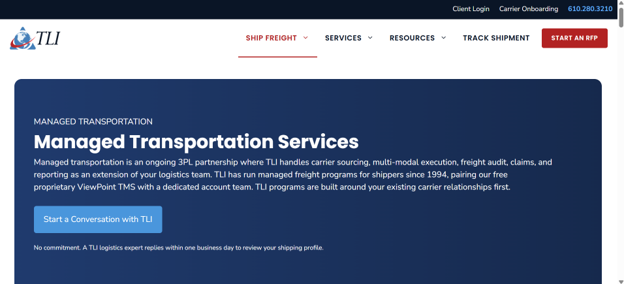
TLI has run managed freight programs

TLI has run managed freight programs for shippers since 1994, pairing its proprietary ViewPoint TMS with a dedicated account team.

Programs are built around your existing carrier relationships first, supplementing with TLI’s network only where gaps appear.

The technology is where TLI separates itself. Its rating engine reads your actual shipment history rather than working from estimates.

That foundation matters most in LTL, where pricing is genuinely opaque. Base rates, discounts off tariff, accessorials, and fuel surcharges all move independently, making costs easy to lose track of.

TLI is direct about a trap that catches many shippers. A headline discount tells you little on its own, because a 70% discount off an inflated tariff can cost more than a 55% discount off a competitive one.

Their position is that total net cost per hundredweight is the only metric worth comparing. The rating engine models contract types, weight breaks, and variables across many lanes at once, evaluating the real cost structure behind a carrier’s pricing.

Those insights then feed the negotiation. Shippers running a structured RFP through TLI’s tools benchmark base rate savings of 4% to 15% against existing direct-carrier or spot pricing.

Customization goes beyond line-haul rates. TLI negotiates custom fuel surcharge tables and tailored accessorial schedules through its motor carrier RFP sourcing events rather than accepting standard tariff terms and generic fees.

Cargo protection works the same way. TLI Advantage+ covers a shipment’s full declared value and resolves claims within 30 days without proof of carrier negligence, a different outcome from standard weight-based liability.

The audit side is quantified. TLI shippers collectively recovered $634,608 in freight bill audit findings, with TLI’s data showing an audit typically recovers 2 to 3 percent of annual freight spend in the first year.

Implementation runs roughly five to six weeks from the point historical data is shared. TLI suits companies shipping $1 million or more annually in LTL or truckload freight, particularly those with multiple facilities.

2. Sheer Logistics

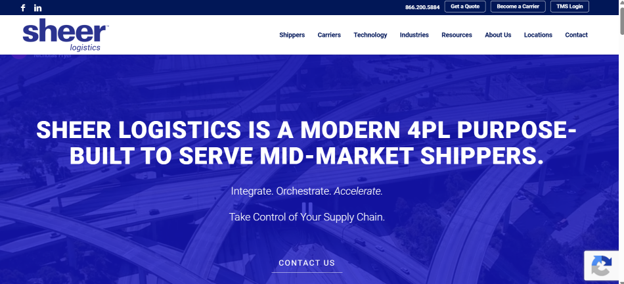
Sheer Logistics for mid-market shippers

Founded in 2009 in Chesterfield, Missouri, Sheer Logistics was built around the argument that mid-market shippers have been underserved by managed transportation service providers.

It operates as a 4PL, pairing the Sheer TMS with SheerExchange, a proprietary integration platform.

That integration layer is the differentiator. Sheer states it can implement a TMS in as little as eight weeks against an industry norm of six to eighteen months, drawing on 1,000 or more pre-built integrations.

The company targets shippers moving $5 million to $100 million in freight annually and claims average cost reductions of 15 percent.

It serves mid-market manufacturers, consumer products, food and beverage, plus chemical producers.

3. Land-Link Traffic Systems

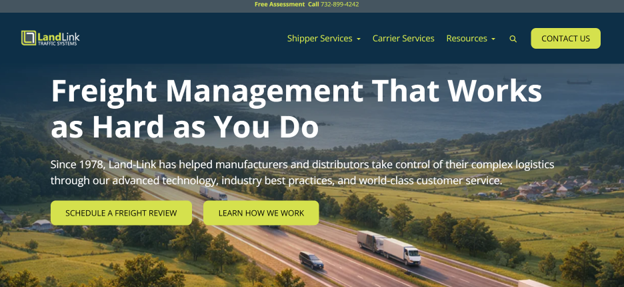
Land-Link - execution-focused managed transportation

Operating since 1978, Land-Link is a privately held 3PL with an execution-focused managed transportation offering.

Its management team carries over 200 years of combined experience, and one founding-year client reportedly remains with the business.

Retail compliance is a genuine specialisation. For manufacturers shipping to major retailers, Land-Link provides OTIF support and chargeback management aimed at protecting vendor scorecards.

Services span LTL, truckload, volume and drayage, plus freight audit and payment, analytics and KPI development. Land-Link suggests a fit for shippers with annual freight spend above $400,000.

4. Ryder

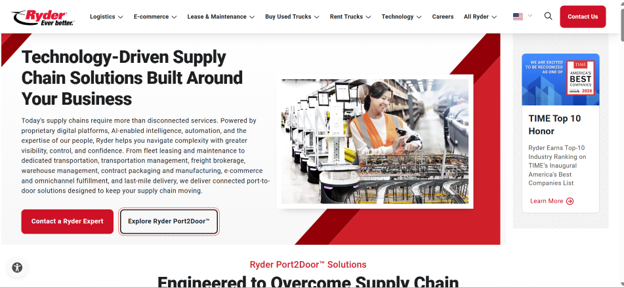
Ryder is the enterprise option

Ryder is the enterprise option, a roughly $13 billion port-to-door logistics company listed on the NYSE.

Its managed transportation sits inside a portfolio covering dedicated contract carriage, brokerage, warehousing, and fleet management.

Scale is the argument, with around $10 billion in freight managed annually and roughly 250,000 commercial vehicles across more than 20 industries.

Visibility runs through RyderShare, a collaborative platform connecting shippers, receivers and carriers in real time.

Transportation management covers network design, shipment planning, procurement, tendering, and freight bill audit.

The trade-off for mid-market shippers is whether they will be a priority account inside an operation of that size.

5. GlobalTranz

GlobalTranz - WWEX Group

Founded in 2003, GlobalTranz operates within WWEX Group alongside Worldwide Express, Unishippers, JEAR Logistics and BLX Logistics. That group reported approximately $5 billion in systemwide revenue in 2025.

Carrier network breadth is the headline, with published access to more than 75 LTL carriers and over 45,000 active truckload carriers.

Managed transportation includes freight invoice coding, approval, and payment processing, plus custom reporting and quarterly consulting from an account team.

The model suits shippers wanting flexibility between self-service booking and full outsourcing. Buyers should confirm whether their account sits with GlobalTranz directly or with an independent agent, since the service model differs.

Managed Transportation vs Traditional 3PL

Capability Managed Transportation Traditional 3PL or Broker
Engagement Ongoing program Per shipment
Pricing basis Contract rates from your shipment history Spot or published tariff rates
Technology TMS included and configured Usually none provided
Carrier sourcing Structured RFP run for you Provider’s existing panel
Freight audit Every invoice reviewed Rarely included
Claims Filed and tracked for you Filed internally
Reporting Recurring KPI and business reviews Transactional only
Team Dedicated account team Rotating reps

How to Choose the Right Provider

Start with freight volume and spend, since most programs have a practical entry threshold. TLI points to $125000 million or more annually; Sheer works in the $5 million to $100 million band, while Land-Link suggests $400,000 upward.

Then match your modes against what each provider does well. A heavy LTL profile calls for rating engine depth, while dedicated fleet needs point toward asset-backed providers, and manufacturing specifics like vendor inbound routing or retail compliance are learned specialisms worth testing for.

Finally, interrogate the carrier network, reporting cadence, pricing model, and support structure. Establish whether you get a named account team or a ticket queue, because that difference shows up on your worst day.

Conclusion

There is no universally correct answer, only a correct one for your freight profile. Enterprise shippers with dedicated fleet needs will find Ryder compelling, while pure network breadth points toward GlobalTranz.

For mid-market manufacturers and distributors, the deciding factor in managed transportation services is usually analytical depth rather than size.

TLI’s data-driven RFP approach and Sheer’s rapid integration model both target the same problem, that most shippers cannot see their true transportation costs clearly enough to negotiate against them.

Frequently Asked Questions

What Is the Difference Between Managed Transportation and Freight Brokerage?

Brokerage arranges individual shipments as one-off transactions. Managed transportation is an ongoing program covering network strategy, technology, execution, and reporting as an extension of your logistics team.

What Size Company Needs Managed Transportation?

Thresholds vary by provider, from around $400,000 to $5 million in annual freight spend. Complexity often matters more than raw volume, particularly with multiple facilities or inbound vendor routing.

Does a Bigger LTL Discount Always Mean a Lower Cost?

No, and this is one of the most common misunderstandings in LTL pricing. A large discount applied to an inflated base tariff can produce a higher net cost than a smaller discount off a competitive tariff, so compare net cost per hundredweight instead.

The post 5 Best Managed Transportation Services for Mid-Market Manufacturing and Distribution Companies: Reviewed and Ranked appeared first on Home Business Magazine.

Original source: https://homebusinessmag.com/management/operations/5-best-managed-transportation-services-mid-market-manufacturing-distribution-companies-reviewed-ranked/