FASB Topic 842 and the New Lease Accounting Standards – How They’ll Affect You

Home Business Magazine Online

Accountants and business owners alike often bemoan accounting updates ― even if their intentions were to improve how to do things. They can often bring about confusion, mistakes, and frustration. Business owners who do not have their finger on the pulse could easily miss the updates, such as the new lease accounting standards, and continue to do things the old and now defunct way. Surprisingly, accountants can do this, too. It is why you need to double check your accounting for lease arrangements and make sure you are adhering to ASC 842 lease accounting standards and not still processing things under ASC 840.

Some Quick Definitions

We are going to cover some abbreviations in this article. Here is what they stand for:

GAAP

Generally accepted accounting principles. It is the practice that businesses and accountants use to govern the drawing up of accounts in the USA.

ASC 840

The older guidance regarding lease accounting. ASC stands for accounting standards committee.

ASC 842

The newer guidance for lease accounting.

FASB

Financial accounting standards board. It is a private standard setting body whose purpose is to improve and in some cases establish standards for U.S GAAP.

IFRS

International financial reporting standards. They are a set of accounting standards set out by the international accounting standards board

IASB

International accounting standards board.

So, now that we have covered these confusing abbreviations, what is FASB topic 842 and why is it important to you and your business?

What Is ASC 842?

ASC 842 is, simply, the name for the new lease accounting standards set out under U.S. GAAP (generally accepted accounting practice). It covers public and nonpublic companies and supersedes the old ASC 840 guidance that stood in place previously. The FASB and IASB jointly developed ASC 842. Both standards required more transparency for the stakeholders of financial statements. As such, FASB topic 842 provides management and anyone scrutinizing accounts more transparency. They can fully explore the lease arrangements on the balance sheet.

How It Will Affect Your Business

It all comes down to the balance sheet. Under the old guidelines, you could place a few items off the balance sheet. However, the new guidelines are all about increasing transparency, so the amount of allowable off balance sheet transactions reduces severely. You need to make sure you show the right leases on the balance sheet.

What You Should Do

Quite simply, you need to update your accounting practices to cater for ASC 842 if you have not already. ASC 840 is no longer the right form of accounting. Speak to your accountant, and make sure he/she is aware. This is obviously far more important if your business has occupancy with multiple leases. With that said, even if it is just one lease, you still need to account for it properly.

If you draw up your own accounts, make sure you follow these newer lease accounting guidelines to stay compliant. There is, of course, lease accounting software to help you out, or you can look at hiring an accountant.

You should also set up alerts or follow an accountancy blog so that you will know about these changes in the future with plenty of time to implement them. Although some of these changes can be frustrating, at the same time, some of them may benefit you as a business and save you money. Therefore, it is always worth keeping an eye on changes to accounting standards, such as any future lease accounting changes.

The post FASB Topic 842 and the New Lease Accounting Standards – How They’ll Affect You appeared first on Home Business Magazine.

Original source: https://homebusinessmag.com/money/accounting-and-bookkeeping/fasb-topic-asc-842-new-lease-accounting-standards-affect-you/
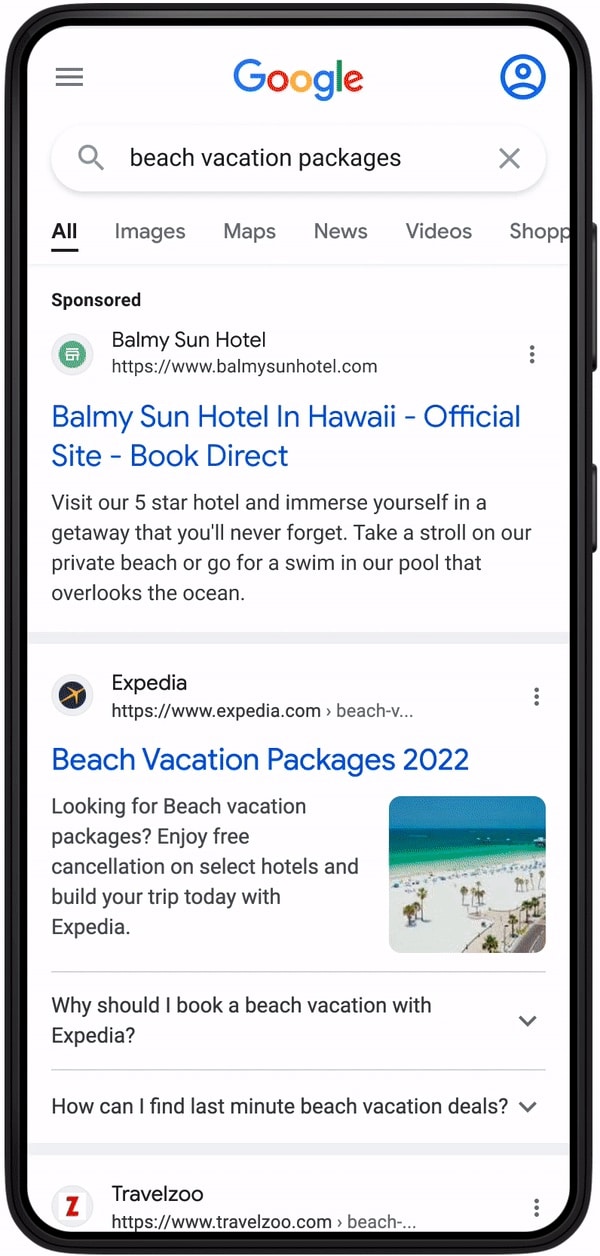
Google Ads label is now a bold black text Sponsored label

Google is rolling out a new search ad label, replacing the black “Ad” label with a new bold black text “Sponsored” label. This is rolling out in conjunction with the new site names and larger favicons in the mobile search results, Google announced.

What is looks like. Here is a screenshot of the new bold black “Sponsored” text ad label for the Google Ads:

Advertising

Why the change. Google said this is to help “make sense of the information you see is ensuring that ads are clearly labeled.” A more prominent ad label, should do that, the search company said.

The new ad label, labeled “Sponsored,” is now featured on its own line in the top-left corner of Google Search ads.

Some ad label history. We will be updating our visual history of Google ad labels at some point, but for a quick refresher, Google rolled out a new treatment for labeling text ads in mobile search results in May 2019. In January 2020, Google extended that ad labeling and favicon treatment to desktop and quickly faced broad backlash over the further blurring of ads and organic listings, which Google hadn’t seen with the change to mobile. The company almost immediately backtracked and began experimenting with several treatment variations on desktop.

In 2007, Google changed the long-standing shaded background indicating the ads section of the page from blue to yellow. In 2008, it then briefly tried a green background before reverting back to yellow. Google continued to test variations of background colors including bright blue and a light violet. In 2010, violet officially replaced the yellow, but only lasted about a year before yellow reappeared in 2011. In 2013, Google tweaked the yellow to a paler shade, which would close out the era of background shading.

At the end of 2013, Google removed the background shading and began testing a yellow ad label next to each text ad. The yellow “Ad” label rolled out globally in 2014 in a much smaller size than first appeared in the initial testing. In 2016, a new green label marked the first time the color of an ad demarcation matched the color of an element in both the ads and organic listings: the display URL. A year later, Google kept the green, but inverted the treatments so that the font was green with a thin green border on a white background. This past year’s update to the black label does away with the border altogether, further, the display URL is now black to match the “Ad” label.

Note, we also spotted Google testing the Sponsored label many months ago.

Why we care. Google said “this new label and its prominent position continues to meet our high standards for being distinguishable from search results and builds on our existing efforts to make information about paid content clear.”

A more distinguishable ad label may result in changes to your click through rates on your ads, so take notice and track to see if clicks go up or down over a period of time.

The post Google Ads label is now a bold black text Sponsored label appeared first on Search Engine Land.

Original source: https://searchengineland.com/google-ads-label-is-now-a-bold-black-text-sponsored-label-388715

Revenue optimization: 3 ways to get your advertising efforts right

Marketing departments once believed it was a sales issue if the sales team couldn’t work the leads from marketing.

Today, this is no longer the case.

Optimizing for leads or marketing qualified leads (MQLs) is great, but optimizing for what drives pipeline and revenue is better. 

Marketers exist in a new age where it’s no longer satisfactory only to drive leads alone.

With the available technology and data today, we can do much more than identify hand-raisers to help companies spend their marketing dollars more efficiently and drive revenue.

Just because a channel generates leads doesn’t mean those leads bring value later in your sales funnel. 

When you understand where customers are bringing in revenue vs. where they may need more nurturing before converting, you can create a more holistic media strategy to generate qualified leads that will churn out more income than lead volume alone.

Below are three must-haves for revenue optimization.

1. Tight-knit tracking 

Tracking is essential for reasons that go well beyond reporting.

In this new age of artificial intelligence, it’s vital to feed machine learning the data that will make it do what you desire.

Platforms like Google optimize the data you provide, making it a powerful tool or your worst nightmare. 

Accurately tracking your efforts plays a significant role in your advertising strategy’s success.

Integrating third-party data sources, like Snowflake and Salesforce, with your paid media reporting helps decrease the optimization time against a deeper funnel event, such as MQL, sales accepted lead (SAL) and revenue.

Nonetheless, offline conversion tracking in Google is great for seeing what campaigns drive down-funnel metrics like SALs and closed/won leads. If you’re attributing revenue to these conversions, that’s even better. 

If your B2B advertising team is doing lead generation in Google without visibility into where they are going down funnel with offline conversion tracking, they are doing it wrong.


Get the daily newsletter search marketers rely on.

<input type="hidden" name="utmMedium" value="” />
<input type="hidden" name="utmCampaign" value="” />
<input type="hidden" name="utmSource" value="” />
<input type="hidden" name="utmContent" value="” />
<input type="hidden" name="pageLink" value="” />
<input type="hidden" name="ipAddress" value="” />

Processing…Please wait.

function getCookie(cname) {
let name = cname + “=”;
let decodedCookie = decodeURIComponent(document.cookie);
let ca = decodedCookie.split(‘;’);
for(let i = 0; i <ca.length; i++) {
let c = ca[i];
while (c.charAt(0) == ' ') {
c = c.substring(1);
}
if (c.indexOf(name) == 0) {
return c.substring(name.length, c.length);
}
}
return "";
}
document.getElementById('munchkinCookieInline').value = getCookie('_mkto_trk');


2. Understand the customer base 

Marketers should know how users from different channels perform once they are in your sales funnel.

For example, if your average Google search lead value is 4x higher than a lead out of Facebook, how can you use that to prioritize your spending and channel goals?

Understanding your average time to close or how long it takes the lead to turn into revenue will help you only to further optimize toward revenue.

With that said, marketers should avoid reactivity with a down day or week if it can take up to a couple of months for a user to move through the sales funnel.

For example, if it takes two months for a lead to close, you need to give a new campaign or channel at least that long before making abrupt cuts if you aren’t seeing initial revenue. 

Seasonality is also a critical factor to consider. Understand and prioritize the best time of year to capture your high-value users.

Create a plan to warm up those audiences earlier in the year and then nurture them post-initial conversion to move them along the sales funnel.

Targeting the right audience also helps you assign pipeline value to optimize revenue. Having an ideal customer profile (ICP) in mind for your targeting is an underrated piece of the puzzle.

Knowing what kind of people will be buying your product is paramount to getting your advertising efforts right. 

For B2B, you should know their job titles, pain points, tasks and anything that will indicate if your product would make their lives easier. You should also be aware of your sales team’s lead disqualification criteria. 

Will your sales team throw out leads from businesses that don’t meet a revenue threshold?

If so, don’t waste your marketing dollars on those disqualified leads when you can target revenue on other strong advertising channels.

3. Understand the lifetime value of customers 

Teams optimizing for revenue should understand the value of their customers through customer lifetime value.

How can you optimize for revenue if you don’t know who your most valuable customers are? 

Understanding the lifetime value (LTV) of your customer base and your customer acquisition cost (CAC) allows you to perform an LTV:CAC ratio analysis to get the complete picture of how your channel mix is affecting your advertising efforts. 

Say Google is driving significant lead volume but at a .5 LTV:CAC. It might be time to dig a little deeper into Google to see how you can improve Google’s revenue-generating efficiency.

Generally, you’d like to see at least a 3:1 LTV:CAC when measuring this. 

If you are having trouble calculating the LTV of your customers, Hubspot has a great article that can help you with this initial step.

The takeaway

CMOs are asked to demonstrate the value of every dollar put into marketing.

Leads are quickly becoming a metric of a bygone age where marketers could simply pat themselves on the back for a well-done job. 

Today, any metric outside of revenue is a vanity metric to senior and executive leadership outside of marketing, making every dollar to customer acquisition and improving the bottom line. 

Give the platforms the data they need to find the highest-value customers.

By doing so, you’ll empower the optimization of every effort for the success and growth of your organization, giving your CMO a few extra hours of sleep at night.

The post Revenue optimization: 3 ways to get your advertising efforts right appeared first on Search Engine Land.

Original source: https://searchengineland.com/revenue-optimization-advertising-388645

Webinar: How AI unlocks value from your single source of data truth

artificial intelligence

With customers’ increasing demands and expectations, marketers strive to improve the timing and impact and ROI of customer engagements. Achieving this vision remains an uphill battle challenged by the growing number of marketing technologies that generate data silos and complex customer journeys. Marketers work tirelessly with fragmented data sources without a single source of truth.

Join Snowflake’s Lourenco Mello and Julian Forero to discover how the data cloud is the foundation of your data-driven marketing strategy.

Register today for “How AI Unlocks Value from your Single Source of Data Truth,” presented by Snowflake.


Click here to view more Search Engine Land webinars.

The post Webinar: How AI unlocks value from your single source of data truth appeared first on Search Engine Land.

Original source: https://searchengineland.com/webinar-how-ai-unlocks-value-from-your-single-source-of-data-truth-388717

Five Tips on How to Launch a Fashion Brand Online

Home Business Magazine Online

Online fashion brands are now the way to go. People love them, as they can just patronize them wherever they are. Gone are the days when an online fashion brand seems impossible. Yes, you also can now create and launch a fashion brand online successfully. However, you should know that this cannot be done easily. It is a stressful process — especially if you don’t know what you are doing.

Five Tips

Still, there are some useful tips that you should know that can help do this easily. Five of these useful tips are:

1. Set Goals

You will not be able to launch your fashion brand online by just creating it and stopping at that. No, you need to go further by setting goals for your fashion brand. When it comes to setting it up online, people make the mistake of not setting any goals. Usually, this results in them being lazy with their brand. Setting goals will let you know what you want to achieve after a certain period. This can be very good, as it can motivate you to try your best for your fashion brand. Therefore, setting goals is a very useful tip that you should know beforehand.

2. Create a Unique Identity

When it comes to online fashion brands, it is very easy to get lost in the crowd. There are a lot of different ones presently. Also, because it is an online fashion brand, most people may mistake you for others. This is not good for any business. However, if you create a unique identity for your fashion brand, it will be easy to set yourself aside from others.

3. Be Active on Social Media Platforms

Social media platforms are there to help you promote your brands. Thus, you should make the most of them. Create social media pages for your online fashion brand. On social media, news travel very fast. Due to this, a lot of people will know about your fashion brand after a short period. This is what you need for it to become successful.

4. Know Your Competition

There are a lot of different fashion brands online today. However, some of them are located closer to you than others. Also, if you are new to fashion, you should study them. Especially those that are experienced, your competition might end up giving you tips for your fashion brand. Moreover, knowing your competition will let you know what steps to take to be better than them. Thus, knowing your competition can help you in a lot of ways.

5. Do Giveaways

People naturally like anything free or that costs less than normal. As you are launching your fashion brand online, you should do giveaways. Giveaways will make people know and want to patronize you more. They will patronize you because of future giveaways that you might do. However, make sure to offer your giveaways wisely.

Conclusion

Launching your fashion brand online can be a stressful process. However, it gets more stressful when you don’t know what you are doing. So just make use of the tips mentioned above and make everything easier. You can reach out to wordans canada wholesale to help you launch your brand.

The post Five Tips on How to Launch a Fashion Brand Online appeared first on Home Business Magazine.

Original source: https://homebusinessmag.com/businesses/success-tips/five-tips-launch-fashion-brand-online/

Five Options for Funding Home Renovations: Which Should You Choose?

Home Business Magazine Online

Buying a home is a fantastic experience. Living in your own house is even much better. However, home ownership comes with its fair share of expenses. You have to take care of things like home insurance and repairs.

Home renovations or repairs can cost a lot of money. You might find yourself in a situation where you are short of cash, but find an urgent makeover inevitable. Or, you may not find logic in forking out huge sums of cash in one sitting. Fortunately, there are plenty of options where you do not have to deplete your savings instantly.

There are different options you can choose from in the form of home improvement loans to fund your home renovations. Here are a few of the options you can choose from when funding your home renovations.

203K Renovation Loan

A 203(k) renovation loan combines your home renovation and mortgage costs. When applying for this loan, you do not have to worry about sending two different applications or paying different closing costs.

Instead, a single application can finance both the purchase and renovation costs of your home. This is done when buying a home and is one of the best loans for those buying a home that needs renovations such as fixer-uppers.

The 203(k) renovation loan is backed by the government. This means that you get benefits such as low down payments and applications even if you do not have the perfect credit history. Just like most loans, this loan includes mortgage insurance and an upfront payment.

Cash-Out Refinance

Cash-out refinance is a popular funding option for home renovations. It works by allowing homeowners to refinance a new mortgage loan but with a balance bigger than what they currently have. They then keep the balance but pay the existing mortgage.

The amount of money received from this funding option is generated from the equity of your home. It is this money that you can use to fund your home renovations. You can also use this money for anything else since it does not come with rules restricting you to renovations.

A cash-out refinance is the best option for homeowners who want to have their existing loans reset. This allows them to benefit from lower interest rates than their existing mortgages. You can also adjust your mortgage term with cash-out refinance.

Home Equity Line of Credit (HELOC)

A home equity line of credit (HELOC) is best suited for homeowners who want to fund their home renovations without having to refinance their existing mortgages. A HELOC functions like a credit card since it allows you to borrow up to a certain limit.

You can then pay the loan back and borrow again when the need arises. A HELOC comes with adjustable interest rates. This means that interest rates can fall or rise from time to time. The interest is due on your existing balance, not the entire amount of money borrowed.

When getting a HELOC loan, it is important to note that you can borrow any amount, not necessarily the maximum amount of loan that you are allowed to borrow. Borrowing a smaller amount means that your interest charges and payments get lower.

Home Equity Loan (HEL)

You can fund your home renovations by borrowing against the home’s equity. The equity can be calculated by determining the value of your home and then subtracting the balance you have on your mortgage loan.

However, it is important to note that you cannot use a home equity loan to pay for your current mortgage, something you can do with a cash-out refinance. Getting a home equity loan means that you will be making payments for both the loan and your existing mortgage for those who have a mortgage.

A home equity loan is best suited for homeowners who would like to fund a huge home renovation project. It is also good for those who have built plenty of equity in their homes. The loan is disbursed in a lump sum.

Personal Loans

You can also fund your home renovations using personal loans, especially for those with little home equity. Since these loans are not secured, your home will not be used as collateral. You can get these loans more quickly compared to most of the funding options discussed in this article.

Even though personal loans come with fixed or adjustable rates, it is important to note that their interest rates are often higher than those that come with HELOC or HEL loans. However, with a good to excellent credit score, you will be able to get a cheap rate.

The term for personal loans is not as flexible as it is for other loans. It ranges from about two to five years. You will also need to pay closing costs. That notwithstanding, personal loans are more accessible.

Final Thoughts on Funding Home Renovations

So, which option should you choose? Well, when choosing a home renovation funding option, make sure that the one you settle for meets your financial requirements.

The post Five Options for Funding Home Renovations: Which Should You Choose? appeared first on Home Business Magazine.

Original source: https://homebusinessmag.com/money/personal-finance/five-options-funding-home-renovations-which-choose/

Webinar: Deliver highly-personalized experiences with quality data

Business Finance

To achieve the most ROI from your customer data, you need a strong foundation. Creating a precise golden record for each consumer with enriched data, a full contact graph and a full identity graph provides the context your brand needs to differentiate based on CX. Precise data includes both first-party data as well as third-party data to enrich your total understanding of each consumer.

If your brand lacks a pristine golden record for each customer, join John Nash, chief marketing and strategy officer at Redpoint, as he discusses the best steps to get started.

Register today for “Steps to Deliver Highly Personalized Experiences With Quality Data,” presented by Redpoint Global.


Click here to view more Search Engine Land webinars.

The post Webinar: Deliver highly-personalized experiences with quality data appeared first on Search Engine Land.

Original source: https://searchengineland.com/webinar-deliver-highly-personalized-experiences-with-quality-data-388665

What Are the Benefits of Using an E-Signature API?

Home Business Magazine Online

Electronic signatures (e-signatures) are the new normal in recent years, which is great news for everyone involved. Now, e-signatures are considered just as reliable as traditional, wet signatures, and rightly so. Because they use computer algorithms to authenticate signatories and assure the integrity of signed documents, some forms of e-signatures are considered legally binding and HIPAA-compliant.

What Is an E-Signature API?

Most modern Americans have electronically signed at least a few documents, but not all of them are familiar with using an e-signature API. Short for application programming interface, an API is a subscription-based web service that allows companies to request signatures and download completed documents securely online.

The Benefits of E-Signature API Use

The advantages of e-signatures, more generally, are rarely in question. Anyone who has ever tried this alternative to the in-person signing of documents knows the process is much easier and quicker. It’s also more secure and less harmful to the environment.

For most companies, the question isn’t whether to implement e-signature solutions. It’s what technology to use to accomplish that goal. Read on to find out about the benefits of e-signature APIs to find out why they may be the best option.

Minimal Coding Required

APIs are fully programmable, but all of the primary functionality has already been coded into them. This fact makes it easy for developers to embed e-signature functionality into a company’s applications using simple programming languages. Developers can boost the usefulness of just about any type of document-handling software by integrating an e-signature API.

Easy Document Management

E-signature APIs don’t just make it easier to collect legally binding digital signatures. They also simplify the entire document-handling process. Subscribers can have access to status updates, be prompted with reminders when signatures are due, and take advantage of all kinds of powerful features.

Compliance with Industry Regulations

High-quality e-signature APIs will be compliant with even the strictest industry regulations, including HIPAA. Not all will pass the healthcare industry’s strict regulatory requirements, though. Those that do provide not just end-to-end encryption and other advanced security features to protect data both in transit and at rest. They also provide regulation-compliant audit trails.

Cost Effectiveness

The small cost of integrating e-signatures into a company’s software applications pales in comparison to the savings associated with implementing effective e-signature solutions. Businesses won’t just save on printing and document storage costs. They’ll also benefit from streamlined workflows and improved efficiency. In addition, reputable companies typically offer different packages of API access, including discounts for customers that process greater amounts of signatures.

Customer Satisfaction

Customer satisfaction tops just about every organization’s priorities list. These days, consumers expect maximum convenience in all areas of their lives, including document signing. With a well-designed e-signature API, businesses can provide a smooth signing experience. This improves customer satisfaction while simultaneously making employees’ lives easier.

It’s Time to Make the Switch

For businesses that have yet to embrace e-signature solutions, the time has come to make a change. Other organizations across the world have already adopted this safe, convenient, and efficient alternative to collecting wet signatures. In addition, consumers have come to expect it as an option. All it takes to make the switch is finding a reputable partner that can provide regulation-compliant e-signature APIs and detailed instructions on how to integrate them into a company’s current software systems.

The post What Are the Benefits of Using an E-Signature API? appeared first on Home Business Magazine.

Original source: https://homebusinessmag.com/home-office/computers-and-software/benefits-using-e-signature-api/

10 Marketing Tools to Boost Your Online Advertising Results

Home Business Magazine Online

If you’re running a pay-per-click (PPC) campaign for your home business, then you know how important it is to get the most out of your budget. To do this, you need to use the right tools.

In our previous articles we offered you tips on advertising networks you should try beyond Google Ads and ways to run successful campaigns on Google Ads.

In this article, we’re providing you with our best marketing tools that you should be considering to help you maximize your advertising results.

Table of Contents

  1. Unbounce
  2. Tenscores
  3. Funnels.io
  4. Fraud Blocker
  5. Opteo
  6. SpyFu
  7. ClickFunnels
  8. WordStream
  9. Moat
  10. Optimizer

1. Unbounce

PPC isn’t just about running ad campaigns. It’s ensuring the traffic you’re paying for converts at the highest levels.

Unbounce is an incredible tool that helps you build powerful and high-converting landing pages in just a few minutes.

They provide nearly 100 landing page templates to choose from and each one is optimized to capture a lead or convert to a sale. You can edit those pages with a drag-and-drop format (no coding skills needed!) and their unlimited color, font, and image options make it easy to create branded messages that you can quickly publish to your custom web domain.

You can A/B test each of your landing pages to maximize your ROI or you can use Unbounce’s Smart Traffic where your visitors are automatically matched to the best-fit landing pages.

Price: $90/mo – $225/mo

2. Tenscores

One of the best ways to save money on your Google Ads campaigns is to make sure your “Quality Score” is high. This score consists of several factors, such as keyword relevance, and it plays a major part in determining the price you pay over other competitors for a specific search keyword.

Tenscores is a PPC tool that analyzes your Quality Score and provides clear recommendations on how to improve it. It identifies areas where you may be wasting money due to poor quality scores and it provides a thorough analysis of the history of your quality score to help you identify trends that you may not see otherwise.

Price: $25/mo – $999/mo

3. Funnel.io

Funnel is a data management tool that helps you get your data where you need it, when you need it. With Funnel, you can easily collect and centralize data from all your various marketing channels, then use that data to make informed decisions about your marketing campaigns.

Funnel also allows you to track your campaign performance in real-time, so you can identify and fix any issues as they arise. You’ll never have to worry about manually cleaning or preparing your data again once you’ve used Funnel because it automatically combines everything together.

Some of the key features of Funnel include:

  • Data collection and centralization from all marketing channels;
  • Real-time campaign performance tracking;
  • Automatic data cleansing and preparation; and
  • Detailed campaign reports and insights.

Price: $399/mo – $1,999/mo

4. Fraud Blocker

Fraud Blocker is a click fraud protection tool that helps you to protect your online ad campaigns against click fraud. It does this by detecting and blocking IP addresses that are known to be involved in fraudulent activities. Additionally, Fraud Blocker also monitors your campaigns for suspicious activity and flags any potential threats.

Some of the key features of Fraud Blocker include:

  • Best-in-class click fraud detection (such as device fingerprinting, IP monitoring, VPN detection and more);
  • Fraud scoring;
  • Automatic IP blocking;
  • Direct integration with Google Ads;
  • Customizable detection rules; and
  • Easy management of subscription and teams.

This tool provides complete protection against common click frauds like bot traffic, click injections, click farms, and fake clicks from competitors and vengeful customers. Click fraud is a serious issue and click fraud losses are estimated to reach $100 billion per year by 2023, according to Juniper Research.

Price: $39/mo for their Starter plan, $59+/mo for their Pro plan

5. Opteo

Opteo is a PPC tool that can simplify your Google Ads campaigns. It uses data-driven insights to suggest improvements to your ads, which you can implement with just a click. Additionally, Opteo brings all of your performance metrics into one central dashboard, so you can easily track your ad performance. Some of the key features of Opteo include:

  • Insights based on your conversion data and targets;
  • Suggestions for improving your ads;
  • Implementation of improvements with one click;
  • Centralized dashboard for tracking ad performance;
  • Detailed reporting and analysis; and
  • Intuitive interface.

Price: $99/mo – $799/mo

6. SpyFu

SpyFu is a PPC tool that provides keyword suggestions, spying on competitor’s ad activity, and AdWords templates. The templates can be imported into an AdWords account and used without modification. All relevant keywords for each ad group are grouped together. This makes it easy to add branded or product keywords.

The features of SpyFu are:

  • Analyze your competitor’s ad spend and paid keywords history.
  • Identify who else is bidding on your chosen keywords.
  • Get smart keyword suggestions that will help improve your chances of success.
  • Automatically organizing keywords into ads groups makes the process less daunting.
  • Using successful copies from the past can give you some guidance and ideas for yours.
  • Gain intelligent bidding advice to make sure you’re making the best decisions.

Price: $39/M – $299/M

7. ClickFunnels.com

ClickFunnels is similar to Unbounce (noted at #1 above) in that you can build and publish high-converting landing pages using simple, drag-and-drop functionality and you can evaluate their success with A/B testing. However Clickfunnels, takes it a step further and offers payment gateways, email, SMS and affiliate tools.

These added features provide a holistic, lifecycle marketing program to ensure your visitors aren’t just captured, but also are pushed towards a sale with automated reminder messaging. It costs a bit more than Unbounce but the product offering is much greater.

Price: $97/mo – $297/mo

8. Wordstream

Wordstream is one of the older and most popular PPC management tools in the space. They offer a suite of tools that can help you with every aspect of your campaign, from keyword research to ad creation to bid management. And it does all of this in one easy-to-use platform.

One of the most popular features of Wordstream is their free Google Ads Performance Grader. This tool gives you a detailed look at how your campaign is performing, including which keywords are driving clicks and conversions and which ads are getting the most impressions. This information can be incredibly valuable in fine-tuning your campaign for better results.

Price: Performance Grader is free, however full-featured plans are based on your monthly ad spend and start around 10%.

9. Moat

Want to see what display ad creative your competitors are running?

Moat is an excellent tool that quickly displays most (if not all) of the display ads your competitors may be running. It also keeps a record of older ads and shows the entire history in their database.

In 2017 Moat was acquired by Oracle and, as a result, it expanded its product offering significantly to include a rich suite of analytics tools. The competitive ad search is still free, but there are many other features now offered for a premium fee.

Price: Free to search with additional features available for premium plans.

10. Optmyzr

Optmyzr is a PPC tool that automates the optimization of your ads with the help of machine learning. Advertisers can manage both Bing ads and AdWords from the platform. Some of its key features include:

  • Adding or Eliminating Keywords
  • Adjusting Placement on Display Networks
  • Changing Bids
  • Paid Keyword Optimization
  • Bid Rules
  • Ad Creation and Editing
  • Scenario Planning
  • Budget Execution & Monitoring
  • Advanced Targeting Options
  • Ad and Conversion Tracking

Price: Starts at $208/mo

Conclusion

PPC should be a critical part of your advertising efforts. By continually optimizing those campaigns using some of the tools above, you can ensure that you’re maximizing your sales while minimizing your waste.

The post 10 Marketing Tools to Boost Your Online Advertising Results appeared first on Home Business Magazine.

Original source: https://homebusinessmag.com/marketing/advertising/10-marketing-tools-boost-online-advertising-results/