Ice Trick Obliterates Ugly Belly Flab Within Weeks!

Ice Trick Obliterates Ugly Belly Flab Within Weeks! If you’re looking for a weight loss supplement that’s a little bit out of the ordinary, you may have heard of the Alpilean supplement. This unique weight loss supplement uses an alpine ice hack which is said to be a revolutionary way to help people lose weight. Ice Trick Obliterates Ugly Belly Flab Within Weeks! Apparently, the key to this weight loss supplement is its ability to help your body burn fat more efficiently. By using a special blend of ingredients, this Alpine ice hack is said to be able to help you lose weight quickly and safely. And best of all, this natural alpine ice hack is said to be gentle on your system, so you don’t have to worry about any nasty side effects. http://importantweightloss.com

Ice Trick Obliterates Ugly Belly Flab Within Weeks! The Alpine Ice Hack weight loss supplement has been formulated by Dr. Patla, a leading name in the weight loss supplement industry. The supplement contains ginger, turmeric, and other ingredients that treat low inner body temperature and promote healthy weight loss. The official website of Alpilean claims that a lower inner body temperature is the root cause behind someone being unable to lose weight. http://importantweightloss.com

Ice Trick Obliterates Ugly Belly Flab Within Weeks! This Alpine ice hack particularly works towards increasing inner core body temperature so that the heat produced by this can burn belly fat efficiently. Dietary supplements like Alpilean are very particular when promoting weight loss; the ingredients in the product target several fat cells and shrink them. Lastly, the supplement has been manufactured in an FDA-approved and GMP-certified facility which proves its genuine-ness and efficacy. http://importantweightloss.com

Ice Trick Obliterates Ugly Belly Flab Within Weeks! http://importantweightloss.com

https://youtu.be/rSBaXjBiUrA

https://rumble.com/v2brjda-ice-trick-obliterates-ugly-belly-flab-within-weeks.html

How to Use Website Development to Automate Your Home Business Processes

Home Business Magazine Online

Automating key processes is frequently necessary for running a successful home business. Thankfully, streamlining processes and increasing efficiency can be accomplished through website creation.

We’ll go over six ways to use website development to automate various parts of your home-based business in this piece, along with the reasons it’s crucial to pick the best web host or software for these systems.​​

1. Choose the Right Web Host or Software 

Choosing the right web host or software is an important step in leveraging website development to automate your home business. Make sure you do your research and choose a provider that fits all of your requirements and offers good value for money.

Additionally, it’s important to keep up-to-date with any changes in technology since outdated systems can slow down processes, resulting in loss of time and resources.

With the right web host or software, such as that offered by a Magento website development company, you can trust that your automated systems will be working efficiently so you can focus on other aspects of running your business.

2. Establish a System for Online Ordering

When it comes to automating your home business, an online ordering system can be a priceless resource. You can allow customers to place orders straight from your website by putting up a website with an online store.

In the long run, this will assist save time by removing the requirement for manual order processing. Additionally, it makes doing business with you more convenient for customers by enabling them to buy from you whenever and wherever.

3. Simplify the Customer Service Procedures

Another wonderful technique to boost productivity in your home business is by using website development to construct automated customer service procedures. Automated ticketing systems can be set up to help customers get their questions resolved promptly and effectively.

Additionally, by deploying chatbots or AI-driven customer support technology, you can provide clients with the help they need around the clock.

4. Automate Your Marketing Processes 

Marketing automation is another great way to use website development to automate your home business processes.

By setting up automated email campaigns, you can send out targeted messages to your customers that will help increase engagement and sales. You can also create automated social media posts that will engage with followers and draw new ones in at the same time.

Not only does this save time, but it also helps ensure that no potential customer slips through the cracks.

5. Create a Knowledge Base for FAQs 

Creating a knowledge base on your website is yet another way to use website development to automate your home business processes. This can be a great resource for customers to find answers to their questions quickly and easily, without needing to contact customer service.

Plus, by having commonly asked questions pre-answered on your website, you can free up more of your time and resources.

6. Implement Automated Shipping 

Using website development to create automated shipping processes is also an excellent way to streamline operations in your home business. By setting up a system where orders are automatically shipped out after being placed, you won’t have to worry about manually processing and printing out shipping labels every time someone places an order.

This saves you from having to devote time and resources towards this task, allowing those resources to be spent elsewhere instead.

Conclusion

Web development is a remarkably potent instrument for automating the procedures in your home business. Online storefronts, automated customer support, automated marketing campaigns, a knowledge library for frequently asked questions, and automated delivery are all possible with website construction. All of this contributes to time and resource savings so you may concentrate on other business-related tasks. Moreover, be sure to pick the appropriate web host or software to guarantee the effective operation of your automated systems. You’ll be well on your way to success with your home-based business if you have the appropriate equipment and resources in place!

The post How to Use Website Development to Automate Your Home Business Processes appeared first on Home Business Magazine.

Original source: https://homebusinessmag.com/businesses/website-development/how-to-use-website-development-automate-home-business-processes/

This day in search marketing history: March 11

Google officially acquires DoubleClick

In 2008, the European Commission approved Google’s acquisition of DoubleClick, valued at $3.1 billion.

The commission found that the “transaction would be unlikely to have harmful effects on consumers, either in ad serving or in intermediation in online advertising markets.”

The deal was first announced April 13, 2007. The EU began its investigation in November 2007. The US Federal Trade Commission approved the purchase in December 2007.

In 2008, display advertising represented about 32% of total US online advertising (roughly $6.7 billion), according to the IAB.

Read all about it:


Also on this day


Google launches automated vehicle ads

2022: This format used vehicle data feeds in Google Merchant Center to match users’ searches with ads.


Google Search Console rich results report updated

2021: Google tweaked some of the job posting structured data requirements and also how it checked the validity of FAQ and Q&A structured data.


Static headlines now available for DSAs in Microsoft Advertising

2021: Marketers could now have full control over their ad text with Dynamic Search Ads.


Google bans face mask ads globally due to misleading coronavirus claims

2020: The face mask ban came amid a rise in false claims around coronavirus prevention and price gouging.


Google signals stricter enforcement of GMB image guidelines

2020: Google wanted to ensure all content that appeared in the Business Profile was “relevant, high quality, and appropriate.”


Video: Detlef Johnson on SEO for developers

2020: The long-time developer and SEO was working to bring the disciplines together.


Google explains how dates within search results snippets work

2019: Google also offered a few best practices for helping it find the right date for that snippet. 


Google showing image thumbnails in mobile search results snippets more often

2019: RankRanger said the average number of thumbnails per search result page jumped from 4 to 5.


Google launches marketer-friendly Google Ads API query builder

2019: The interface made it easy to build queries for reporting.


Report: 65 million US smart speaker owners, smart displays quickly gaining traction

2019: Surveys suggested there was still considerable room for growth.


Google to bloggers: Disclose & nofollow links when reviewing gifted products

2016: Google issued new best practices to bloggers who received free products.


Search in Pics: Google Dance with Matt Cutts, Google’s ice rink & Zootopia

2016: The latest images showing what people eat at the search engine companies, how they play, who they meet, where they speak, what toys they have and more.


Google Webmaster Tools Adds Blocked Resources Report & Updates Fetch & Render Tool

2015: Google added a report that showed which resources you were blocking GoogleBot from by host name and updated the fetch and render tool.


Study: Growing “Mobile Fanatics” Segment Search More, Increasingly Shun PCs

2015: Just over 40% of the U.S. smartphone population, these mobile users searched more and relied more on their mobile devices than conventional smartphone users.


Report: Brands May Lose 10K to 60K Visitors Per Month To PPC Trademark Bidding

2015: Study looked at trademark usage in paid search across 10 industry verticals.


Yoast WordPress SEO Plugin Vulnerable To Hackers

2015: The Yoast WordPress SEO Plugin was open to an exploit where hackers could do a Blind SQL injection. 


Google Now Targeting Italian & Spanish Link Spammers

2014: Google’s Matt Cutts announced warnings to Spanish and Italian webmasters and SEOs not to use unnatural links to promote their sites.


Yahoo Search App Gets iOS 7 Design Upgrade & More

2014: The updated iOS Yahoo Search app got a new minimalistic design.


Better Data, Public Transit Coming To Apple Maps In iOS 8

2014: Apple’s iOS 8 would see a number of improvements, including better and more complete points of interest and business data.


Survey: Consumers Blame Brands For Bad Location Data

2014:  71% said they were most likely to be home when they research and confirm a business location before visiting the business for the first time.


Google’s Matt Cutts On Upcoming Penguin, Panda & Link Networks Updates

2013: Google’s head of search spam, Matt Cutts, announced new updates with Google’s Penguin and Panda algorithms and new link network targets in 2013.


Google Wins Lawsuit Over Monetizing Your Name With Ads

2013: Google has won a lawsuit filed by a Wisconsin woman over Google Instant suggestions leading to a search result set that had ads.


Google Experimenting With Search-History “Topics” In Google Now Cards

2013: Feature clustered users’ search histories into topics that can easily be searched again.


“Better Than Google” Claims: Why Doesn’t Anyone Believe Them?

2013: Despite the commercials and despite Microsoft reporting that after extensive testing users preferred Bing 2:1, people generally expressed skepticism.


Google’s Mayer Envisions Future Of Location-Based Services At SXSW

2011: Mayer shared her vision for a future enabled by the search company’s technologies.


Google Enables Negative Keywords For Product Listing Ads

2011: Google announced the new targeting capability, saying it was the first of more extensive targeting features it was working on.


Google Set For US Senate Committee Antitrust Investigation

2011: Google’s inevitable encounter with a formal antitrust inquiry in the US took a step closer.


Major Earthquake Hits Japan, Google Launches Person Finder Tool

2011: Related: Internet Lowlifes Already Targeting Japan Quake Search Results


Hitwise, comScore Show New Highs For Bing

2011: Bing saw its largest share to date – 13.6%.


Facebook Place Page Owners Get Reports On Check-Ins And Deals

2011: The new reports could help business owners refine the deals they were offering and track foot traffic from Facebook users over time.


Google Is Bing’s 4th Largest Referring Source

2010: MSN was by far the top source, the last site visited by 42.7% of Bing users before they went to Bing. 


Google Goes Live With “In-Stock, Nearby” Mobile Shopping

2010: Google was working with a limited number of retailers but was inviting others to apply to become part of the program.


US Regulators May Be Gearing Up For Google-AdMob Challenge

2010: It appears that there were some problems for the acquisition.


Bing’s Market Share Up For Third Straight Month: Hitwise

2010: Hitwise showed Bing gaining share for the third straight month, and its 9.7% share of searches in February was up 4% over its January numbers.


March 2010 Yahoo Search Update

2010: The update included possible updates to Yahoo’s crawling, indexing, and ranking algorithms.


Facebook Search Gains Boost Bing & Motorola Puts Bing On Chinese Android Handsets

2010: Facebook saw 10% search query growth in the past month.


Chomp: An Apps Search Engine Or “Yelp For The App Store”

2010: Its objective was to enable people to more easily discover and review iPhone apps.


Google Gets Into Behavioral Targeting, Launches “Interest-Based Advertising” Beta

2009: Interest-Based Advertising allowed advertisers to deliver ads based on hundreds of interest categories and previous interactions with those users.


Google’s Matt Cutts Talks About Redirected Links & Nofollowed Links

2009: He answers how Google handles links that are 301 redirected and how Google handles nofollowed links from authority sources.


Create Custom Driving Directions With Google Maps Maker

2009: Google said this tool was not perfect but it did make for a new way of creating driving directions.


Hitwise: Visits To Gmail Surpass YouTube

2009: Gmail was second only to Google.com in terms of visits among Google’s properties.


Fortune 500 Still ‘Largely Invisible’ In Natural Search, Study Says

2009: The companies were spending $51 million per day on PPC for primary keywords, but they only ranked in the Top 100 natural search ranking for 21% of the keywords.


Judge Denies Punitive Damages In Viacom Vs. YouTube Case

2008: Judge said “common-law punitive damages cannot be recovered under the Copyright Act,” and denied Viacom’s action against Google and YouTube.


Search Biz: DoubleClick To See Layoffs? Walmart Drops The “Google PC,” & More

2008: Those Linux-based “Google PCs” didn’t sell like hotcakes, said Walmart; Yahoo got a small paid search distribution deal with LiveDeal and more.


From Search Marketing Expo (SMX)


Past contributions from Search Engine Land’s Subject Matter Experts (SMEs)

These columns are a snapshot in time and have not been updated since publishing, unless noted. Opinions expressed in these articles are those of the author and not necessarily Search Engine Land.


< March 10 | Search Marketing History | March 12 >

The post This day in search marketing history: March 11 appeared first on Search Engine Land.

Original source: https://searchengineland.com/search-marketing-history-march-11-394160

This day in search marketing history: March 12

Google publishes video of search quality meeting

In 2012, Google shared a video from one of its search quality meetings – something that few outsiders had ever seen.

Google annotated the video to make the conversation more understandable to the general public, as well as explain more about the particular feature that was being discussed, a change to how it handles spelling corrections.

“I got to attend one last October, and it was one of the most fascinating, interesting things I’ve witnessed in my nearly 16 years of covering search,” wrote Search Engine Land’s Editor-in-Chief Danny Sullivan. “I watched many different features get evaluated, with discussion and debate flying back-and-forth among those gathered in the crowded room as well as those interacting through video conference…”

Read all about it in An Unprecedented Video Glimpse Into How Google Crafts Its Search Results.


Also on this day


Google pushes out deadline parallel tracking for Video due to ‘global events’

2020: The mandatory deadline was extended into June.


Ecosia to join Chrome v81 default search engine choices

2020: The not-for-profit search engine joined Google, Bing, Yahoo and DuckDuckGo as an option in 47 markets.


Google Ads rolling out Budget Planner forecasting tool

2019: Designed to show how changes in spend could impact campaign performance.


What will Google Hotels mean for online booking sites?

2019: The new site mirrored the UI of Google Flights – would it have a similar impact on the hotel booking market?


Bing Ads brings 3D ads to Search with Samsung

2019: Users could interact with the desktop ad format to inspect product features and details.


DuckDuckGo CEO testifies: Privacy legislation isn’t ‘anti-advertising’

2019: Gabriel Weinberg also believed that privacy legislation could make the internet more competitive.


Google confirms core search ranking algorithm update

2018: Google acknowledged the suspected update but said there was nothing webmasters can do to fix their sites if they dropped in rankings.


Google tests rounded mobile search design without full Google logo

2018: This new interface used a more rounded design and boldly omitted the full Google logo at the top of the search results page.


AdWords custom columns now available at keyword and ad levels

2018: You could track and optimize to custom metrics tailored to your goals at all levels of your campaigns.


Chat rate is the new CTR for AdWords message extensions

2018: Google would roll out message reporting metrics in the next few weeks for the US, the UK, Canada and other countries.


Google Local Pack Displaying Logos In Web Search Results

2015: Google was testing a new local pack in the web search results that displayed maps plus logos and pictures of the business listing.


Google Mobile Multi-Colored Line Separators Now Live

2015: Google seemed to be rolling out the new mobile interface where they showed Googley colored line separators in the mobile search results.


Google, Wal-Mart Breakup Suggests Problems Ahead For Local Inventory Ads

2015: Wal-Mart reportedly had plans to offer inventory data directly to its shoppers through Wal-Mart.com and its mobile app, rather than through an intermediary.


Google To Publishers Concerned Over The Knowledge Graph; Searchers Still Need Your Content

2014: While Google’s goal is to give searchers a quick answer, there is no substitute for the searcher to do deeper research by clicking into the sources provided in the Google search results.


Google’s New Look Search Results: Still An Experiment

2014: Google’s head of search, Amit Singhal, said “we’re always experimenting” and this design test was just that, one of Google’s experiments.


Google Reviewing “Not Provided,” Withholding Keywords From Organic But Not Paid Search Clicks

2014: Google said it was reexamining the issue and seeking a better solution.


Google Confirms Giant Banner Ad Test Is Dead

2014: The test only ran in the U.S. and was small with about 30 advertisers participating and banners showing on about 5% of search queries.


Google Adds Concert Dates To Knowledge Graph

2014: Concert information for a musician would be pulled from the artist’s official website if the site included structured data markup.


Yahoo Goes Live With Yelp Local Reviews

2014: When you clicked on “read all  . . .  reviews” or “write a review” you were taken to the Yelp profile or review page for the specific business.


Google Launches Help Center For Hacked Sites

2013: Complete with step-by-step instructions and videos that outlined each part of the process. 


Will Google Now For iPhone & iPad Boost Google Search App Usage?

2013: A promotional video suggested the Google Search App for iOS may be gaining Google Now support.


It’s Official: Google Settles “WiSpy” Case For $7 Million

2013: Google had to take additional measures to educate employees and consumers about data privacy.


Facebook: No Plans For An External Search Engine

2013: Facebook was focused on improving search from within Facebook through Graph Search.


Google Webmaster Tools Revamps Crawl Errors, But Is It For The Better?

2012: Unfortunately, several pieces of important functionality were lost with this change.


Survey Paradox: People Like Google But Not What It’s Doing

2012: Survey respondents had a very positive view of search and the quality of search results. Yet the majority gave an unequivocal thumbs down to search personalization (and behavioral targeting).


Google’s Easter Eggs For Binary, Octal & Hexadecimal

2012: The easter egg showed the value of the results in those number systems.


Microsoft’s Photosynth App Goes Worldwide After 6 Million US Downloads

2012: Photosynth made it simple to create photo panoramas without any additional stitching/editing required.


Four Sites Impacted By Google’s “Farmer Update” Speak Out

2012: Reactions from local community directory AmericanTowns.com; product reviews site Buzzillions; small business networking site MerchantCircle; and product search engine TheFind.


Bing Apologizes For Japan Quake Tweet

2011: In the controversial tweet, Bing promised to donate $1 to quake relief for every retweet, up to a maximum $100,000 donation.


Google Adds Microdata Support For Rich Snippets

2010: In addition to microformats and RDFa support, Google had added microdata support, which was part of the HTML5 specification.


Can Google Stay In China And Still Save Face?

2010: China’s no-compromise-on-censorship position was reiterated by a top-level Chinese minister.


Yahoo Goes Hollywood With New TV, Celebrity Shortcuts

2010: The TV shortcut showed the title and a short synopsis of the next episode, along with video clips and links to see photos, the show’s schedule and an episodes list.


Google Explains How Search Ads Rank & Cost

2009: A video showed how Google prices and ranks search ads in the AdWords system based on quality and bid.


Google Improves Image Search For iPhone & Android

2009: You could see up to 20 images on a single page. When you clicked on the details of that image you could view a larger thumbnail, visit the web page, or view it in full size.


Google Voice: Next Generation Telco?

2009: Google announced a wide range of new services under the banner of Google Voice.


Yahoo SearchMonkey Accepts Videos, Games & Documents – No Application Required

2009: Flash video, games, and documents could now be embedded into Yahoo search results with only a few lines of code.


Twitter’s Traffic Growth & The Rise Of Social Search

2009: There were a lot of stats and analyses about Twitter’s traffic, how it compared to other social search sites, and who benefited from all the traffic Twitter can send.


Google Exec Tim Armstrong Named New AOL Chairman & CEO

2009: One of Google’s longest serving executives, Tim Armstrong, was departing the company to become AOL’s new chairman and CEO, replacing existing chair and CEO Randy Falco.


Open Letter To Google: Do The Right Thing, Divest Yourself Of Performics

2008: Why spinning off Performics needed to be a priority.


Message In A Bottle: Google Now Stores Messages For Unverified Webmaster Central Users

2008: Google announced it would have webmaster communication messages waiting for webmasters even if they have not yet verified their site in Google Webmaster Tools.


“Google Earth Town” Nanaimo Wires Self To Google Maps To Drive Tourism

2008: Nanaimo, a British Columbia town on Vancouver Island, was also known as “Google Earth Town” or “the capital of Google Earth.”


News Corp. Appears To Close Door As AOL Opens One To A Potential Deal With Yahoo

2008: Were the stars aligning for a potential Yahoo-AOL alliance in an effort to address both companies’ woes?


Health Insurance Carrier Aetna Introduces Personalized Health Search From Healthline

2008: Vertical health destination and search engine Healthline teamed up with US health insurance carrier Aetna to offer what the company called Aetna SmartSource – customized health search.


Search Biz: Google’s Project Management Tools, Iowa Seeks Microsoft, & More

2008: Click Forensics got $10 million in funding; an early Googler donated money to San Jose State; the fight to control IAC carried on and more.


Google Warning Against Letting Your Search Results Get Indexed

2007: The days of doing a Google search that brought up results leading to search results from other sites were heading for a close.


Google Rumored To Have Dish Networks TV Ads Deal

2007: Google and Dish Networks were reportedly going to sign a TV ad deal.


Google Print & Radio Ads A Success All Around

2007: Advertisers and publishers were happy with early tests from Google’s Print Ads and Audio Ads.


How Much Is ‘Local Search’ Really Worth?

2007: A roundup of various local online advertising forecasts and some perspective on what the “local search market” may be worth.


From Search Marketing Expo (SMX)


Past contributions from Search Engine Land’s Subject Matter Experts (SMEs)

These columns are a snapshot in time and have not been updated since publishing, unless noted. Opinions expressed in these articles are those of the author and not necessarily Search Engine Land.


< March 11 | Search Marketing History | March 13 >

The post This day in search marketing history: March 12 appeared first on Search Engine Land.

Original source: https://searchengineland.com/search-marketing-history-march-12-394185

Uses of Optoelectronics in Various Industries

Home Business Magazine Online

Optoelectronics is an emerging technology that is revolutionizing the way we think about and interact with our world. It is a combination of optics and electronics that provides us with great potential in many different industries. This technology enables us to manipulate light and produce optical data, making it highly versatile and applicable to a wide range of applications. As its use is becoming more widespread, optoelectronics is increasingly being used in a variety of industries, from manufacturing and healthcare to transportation and aerospace.

Optoelectronics is becoming increasingly important in a variety of industries as it provides a reliable and cost-effective method of controlling, monitoring, measuring, and communicating information. Optoelectronics is now being used in industries from automotive and medical to communications and aerospace. In the automotive industry, optoelectronics is used for a variety of functions, such as controlling tail lights, interior and exterior lights, brake lights, and indicators. In the medical industry, optoelectronics is used for measuring and monitoring functions in devices like pulse oximeters, glucose meters, hearing aids, and medical imaging systems. To learn more about optoelectronics, visit this site: https://th.rs-online.com/web/c/displays-optoelectronics/.

Usage of Optoelectronics in the Telecommunication Industry

The last few decades have seen tremendous advances in telecommunication technology. In particular, optoelectronics has been a major focus of research, with numerous breakthroughs in the field. This technology has been used in many areas of telecommunication, including fibre optic communication and satellite communication. By utilizing light waves instead of traditional electrical signals, data can be transmitted and received over great distances with minimal loss of fidelity. Optoelectronics has become an indispensable part of the modern telecommunications industry, and its various applications have revolutionized the way we communicate.

Optoelectronics is quickly becoming an invaluable asset to the telecommunication industry. By utilizing this technology, companies can achieve faster speeds, improved data transmission, and more efficient networks. Optoelectronics refers to the use of light as a medium to facilitate electrical signals, meaning that it is possible to transmit large quantities of data over long distances quickly and efficiently. This is especially useful in the telecommunication industry, where data transmission is crucial.

Optoelectronics also allows for low-power consumption, reduced costs, and minimized interference, making it a great choice for telecoms. Optoelectronics can be used to develop communications systems with enhanced security, as the light signals cannot be intercepted or modified without detection.

Optoelectronics
Photo by Ike louie Natividad from Pexels

Application of Optoelectronics in the Automotive Industry

Optoelectronics has seen a burgeoning application in the automotive industry in recent years. This technology has enabled increased safety, efficiency, and comfort for drivers and passengers alike. Optoelectronic components such as light sensors, cameras, and lasers can be used to detect and respond to changing conditions on the road, allowing for improved control and navigation capabilities. This technology can also be used to monitor the external environment, assisting with lane-keeping and collision avoidance systems.

Optoelectronic components are being used to provide driver assistance and comfort features, such as automatic wipers and headlights, automatic climate control, and even augmented reality displays. The automotive industry is increasingly using optoelectronics to provide drivers with the latest in safety and technology.

The post Uses of Optoelectronics in Various Industries appeared first on Home Business Magazine.

Original source: https://homebusinessmag.com/management/technology-management/uses-optoelectronics-various-industries/

Tips for Ensuring a Successful Legs Laser Hair Removal Treatment

Home Business Magazine Online

Laser hair removal is a popular and successful permanent hair reduction therapy. This approach is becoming more popular in the legs as an alternative to typical hair removals methods such as waxing, shaving, and epilating. Leg laser hair removal has many advantages, including being far less time-consuming and cost-effective than traditional techniques.

However, in order to ensure a successful laser hair removal treatment, there are some tips and steps that should be taken beforehand. If you are looking for leg laser hair removal treatment as an alternative to traditional methods of hair removal, visit http://www.musee-sg.com/menu/index.html.

Identify a Reputable Legs Laser Hair Removal Clinic

Legs laser hair removal is a safe and efficient way to remove unwanted hair on the legs. It is a quick procedure with long-lasting results, but before going through with the treatment, it is essential to research and finds a reputable clinic to ensure a successful outcome. Here are some of the reputable legs laser hair removal clinics that you must consider:

  • Certified and Experienced Technicians
  • Clean and Hygienic Environment
  • Advanced Equipment and Technology
  • Detailed Consultation for Individual Needs
  • Comprehensive Aftercare Advice and Support

Prepare for Your Appointment

Preparing for your appointment to ensure a successful laser hair removal treatment for your legs is an important step that should not be neglected. Taking the time to prepare for the treatment will ensure that you have the best possible results and that you are well-equipped to handle any potential side effects from the laser.

First, it is important to make sure your skin is ready for the laser hair removal treatment. Shave your legs 24 hours before the appointment and exfoliate the area to remove any dead skin cells. This will give the laser an easier time targeting the hair. Be sure to tell your healthcare provider about any medications you are taking, as these can interfere with the laser treatment.

Follow Post-Laser Hair Legs Removal Guidelines

If you’re planning on undergoing leg laser hair removal, it is important to be aware of the post-treatment guidelines that must be followed to ensure a successful outcome. Not only will these guidelines help to ensure the best results, but they will also help to ensure that your skin remains healthy following the procedure. Here are some of the most important post-laser hair removal guidelines to follow for healthier, smoother legs:

Avoid any direct sun exposure for at least four weeks following the treatment. Sunlight exposure can cause skin irritation and can damage the treated areas, so it’s important to protect your skin with sunscreen, long sleeves, and long pants.

Business Person putting lotion on their legs
Photo by Sora Shimazaki from Pexels

Maintain Regular Maintenance Treatments

When it comes to achieving a successful legs laser hair removal treatment, it’s important to not only get the initial procedure done but also to maintain regular maintenance treatments. This is because laser hair removal works best when used to treat the hair in the early stages of growth, which is why multiple treatments are often needed.

By scheduling regular maintenance treatments, you can help ensure that any new hair growth will be treated quickly and effectively. Additionally, regular maintenance treatments can help prevent the need for more intensive treatments in the future, which can save you time and money. Ultimately, regular maintenance treatments are essential to achieving the best possible results with your legs’ laser hair removal treatment.

The post Tips for Ensuring a Successful Legs Laser Hair Removal Treatment appeared first on Home Business Magazine.

Original source: https://homebusinessmag.com/lifestyles/success-lifestyles/tips-ensuring-successful-legs-laser-hair-removal-treatment/

Do personas REALLY matter in content marketing?

Do you know who you’re selling to – and, by extension, who you’re targeting in your content marketing?

If you’re building a content strategy, you probably have done audience research to figure those things out.

And, if you’ve done audience research, you’ve probably heard of personas, too.

A persona is a content strategy tool used to understand your audience on a deeper level and position all of your content so it speaks to them effectively.

A persona is incredibly useful because it represents the conglomeration of a lot of thought, research, conversations, data, and insights on the most important consideration in content marketing – your brand’s specific audience.

That means, yes – personas really do matter in content marketing. Let’s explore deeper.

What is a persona in content marketing?

So, we’ve already said a persona is a content strategy tool. How does it work?

A persona is a representation of your target audience. Their main commonalities, including defining traits, preferences, habits, demographics, goals, challenges, and more, are combined and distilled to create a fictional character or avatar representing your ideal customer. 

This puts a face and a personality to your audience, who can easily become a faceless mass to people on your team who work disconnected from the customer experience (like content creators, who ironically have little direct interaction with your audience but are in charge of the bulk of communications).

And, if you have multiple target audience segments, you can create multiple personas to represent them and refer to as you create, publish, and distribute content.

Here’s an example of a B2C persona for a coffee shop:

B2C persona for a coffee shop

As you can see, a persona can get extremely detailed. When you create one, it’s almost like reading a dating profile that makes you go, “Whoa, TMI.”

The thing is, all of these details must be backed by research and actual data. These aren’t made-up attributes. Instead, they come from studying members of your target audience, interacting with them, surveying them, and looking at data. None of it should come from assumptions or guesses.

The more you know about your ideal customer and persona, the better you can speak to them in your content, target their exact needs and concerns, empathize with them, and solve their problems. And that’s powerful.

Why do personas matter in content marketing? Key reasons to use them

A content marketing strategy that includes targeted personas can improve your results drastically. One case study found with this strategy, website traffic grew by 210% and leads increased by 97%.

Using personas can make your website 2-5x more effective and lift email click-through rates by 14%.

Why do personas work? Here are three reasons.

Personas are the manifestation of real data

If you’re creating personas the right way, they should be based entirely on data, insights, research, and real customer interactions – not assumptions.

That means a persona represents real data you’ve learned about your customers. A good persona can represent hours and hours of research, months of social listening, and countless interactions with your customers.

This is the only way a persona is valuable. But that value is undeniable to your content marketing.

Personas capture the true spirit of your customers (when done right)

Since personas are the distillation of mountains of customer research, they have the unique ability to capture the true essence of your audience. 

This is invaluable when trying to target your messaging and customize your content.

How? When you use and refer to personas to create content, you’re far more likely to hit your audience in the heart or punch them in the gut with impactful content. 

For example, personas can guide the tone and style of writing used in your blog posts, short- or long-form content or lead magnets (i.e., ebooks, whitepapers, case studies). 

It can also guide the topics you write about or the angle you approach certain topics. For instance, if I was using the coffee shop persona above to lead me while writing a blog about gifts to give coffee lovers, I would lean toward affordable gifts vs. luxury gifts because I know my persona is budget-conscious.

Personas are an ultra-useful marketing tool

Personas are a useful tool for marketing and your entire business. They can align how you approach your customer and talk to them throughout your brand.

Sharing personas with different teams (such as sales and customer service) can inspire a better understanding of your customers and, thus, better interactions with them. And better interactions can lead to higher customer satisfaction, more sales, and more repeat customers.

You can also share personas across your marketing team to align different creators in their approach. Personas are helpful for content writers, graphic designers, video editors, and social media managers.

Lastly, personas are a valuable tool to employ as you craft your brand voice/tone and style guidelines. Your persona(s) will help inform the voice you use in content, the tone you adopt for specific circumstances, and the style and personality you craft for your brand identity.

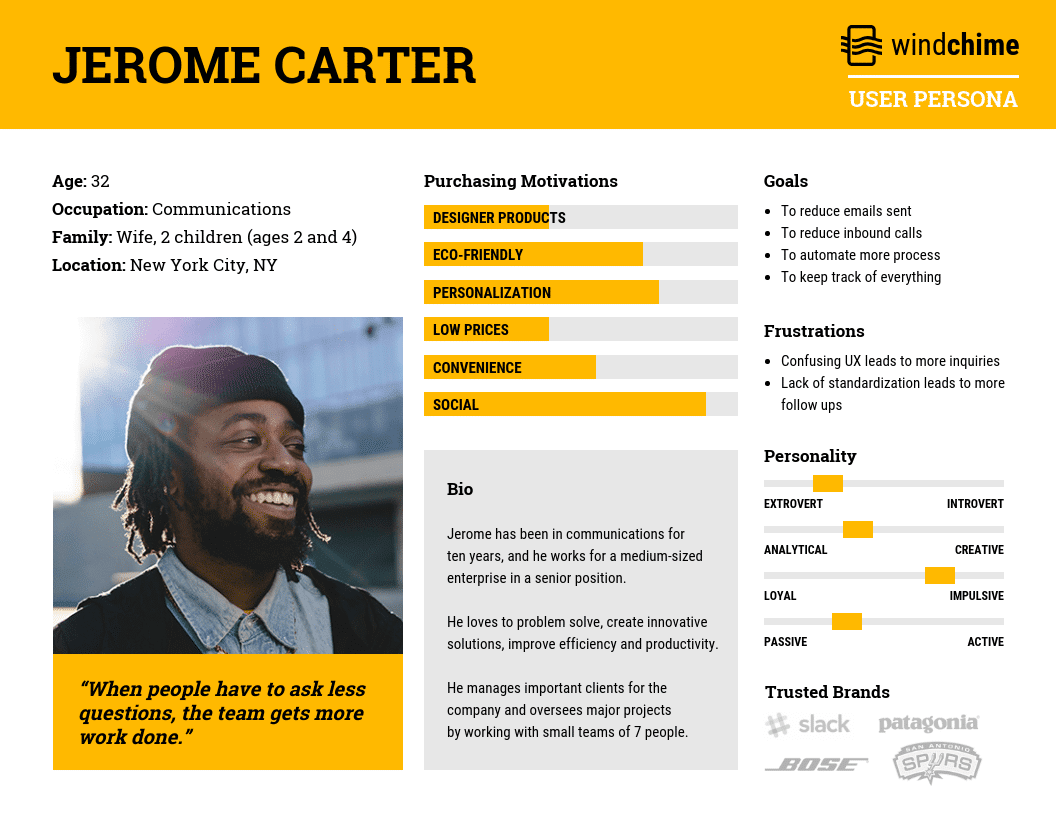
User persona example
A persona example from Venngage

Get the daily newsletter search marketers rely on.

<input type="hidden" name="utmMedium" value="“>
<input type="hidden" name="utmCampaign" value="“>
<input type="hidden" name="utmSource" value="“>
<input type="hidden" name="utmContent" value="“>
<input type="hidden" name="pageLink" value="“>
<input type="hidden" name="ipAddress" value="“>

Processing…Please wait.

function getCookie(cname) {
let name = cname + “=”;
let decodedCookie = decodeURIComponent(document.cookie);
let ca = decodedCookie.split(‘;’);
for(let i = 0; i <ca.length; i++) {
let c = ca[i];
while (c.charAt(0) == ' ') {
c = c.substring(1);
}
if (c.indexOf(name) == 0) {
return c.substring(name.length, c.length);
}
}
return "";
}
document.getElementById('munchkinCookieInline').value = getCookie('_mkto_trk');


How to create accurate personas

The accuracy of your personas will directly affect how valuable they are to your content marketing. Here’s how to ensure they’re useful and precise.

Gather customer data from the right sources

There are many places to gather the data that will inform how you create your persona. These are some of the best sources.

Remember, if your assumptions aren’t reflected in the data, you must toss them out the window.

  • Sales team: Gather insights about your customers from your sales team – they’re on the front lines of your business.
  • Customer service team: Your customer service team should have tons of insights from directly helping your customers, especially about the questions your audience asks repeatedly and their challenges.
  • 1:1 interviews: I always recommend talking to ideal clients 1:1 to get deep, personal data.
  • Social listening: Watch and observe your ideal clients on social media to gather data.
  • Customer surveys: Surveys can help you find specific information from a swathe of your targets.
  • Analytics: Don’t forget to check your analytics software for real data about your website visitors.
  • Social media insights: If you have an audience on social media platforms like Facebook or LinkedIn, you can get live insights on them with the platform’s specific tools.

Analyze and synthesize the data

Once you’ve spent some time gathering audience data from various sources, you can start to analyze and make sense of it.

Look for commonalities, recurring themes, and patterns as you sift through it all. What details pop up over and over? What words do customers repeatedly use to discuss themselves and their goals/challenges? 

During this process, you might find multiple categories of people or different ways to segment your audience. You can use each of these categories to craft a connected persona.

Fill in persona categories

Your completed persona will look a lot like a character fact sheet. Here are some categories you should fill in based on your research findings.

  • Name: Name each persona uniquely to refer to and differentiate them easily. Some brands name their personas based on their role in a company (especially for B2Bs) or their biggest defining quality (e.g., “Marketer Molly” or “Sarah Student”).
  • Background/demographics: What’s the age bracket of your persona? What’s their gender? Where do they live? What’s their income, and what do they do for a living?
  • Goals: What are their goals (for B2B personas, think of goals in terms of their job; for B2C customers, consider their life goals as they relate to your industry, i.e., health and fitness goals, lifestyle goals, skills goals, etc.)
  • Challenges: What challenges are they most frustrated by in their work/life?
  • Content preferences and consumption habits: It’s a great idea to include what types of content they prefer to read when they read and what platforms they use to get it.
  • Blogs they read/social profiles they follow: What related brands/influencers/bloggers do they follow and like?
  • Quotes: Include quotes from real customer conversations that help define your persona. (Your customer service, sales and social media teams can watch for and collect these.)
  • Photo: A photo helps personalize your persona even further. Find a stock photo of a human who encompasses their gender, age, and lifestyle and add it to your persona.

Bonus: Take your persona to the next level

Your persona(s) can be used in your content marketing and whole business as a useful tool for understanding your prospects.

For that reason, consider turning your persona into an asset. Here are a few examples:

  • Ask a graphic designer to illustrate your persona with a character and turn your document into a pleasing infographic.
  • Format your persona for easy reading and upload it to a shared location, like an online workspace, a file-sharing service, or a shared Google Drive. 
  • Link to the persona inside your content strategy.
  • Create a presentation that shows your disparate teams how they can use the persona in various ways to help them do their jobs better.

Personas matter in content marketing – now go out and create yours

Personas matter in content marketing. They’re a vital instrument every brand should have in its content strategy toolkit.

When done right, personas result from weeks or months of research and data synthesis. They give teams across your business a deep understanding of your ideal customer at a glance. Personas are also a boon to sales, customer service, and social media teams. 

A detailed persona can help you craft the right messages and content to resonate with your audience. Your content will be more relevant, empathetic, targeted, useful, and engaging.

There are no downsides to using personas for any brand. That means it’s high time you got down to business and incorporated persona-building into your strategy.

The post Do personas REALLY matter in content marketing? appeared first on Search Engine Land.

Original source: https://searchengineland.com/content-marketing-personas-394132

SEO is alive and kicking in 2023 – and beyond

Demand for SEO has been growing yearly based on Google Trends and Exploding Topics data. For many businesses, organic search reach is still a significant source of traffic, leads and sales.

Despite this, there’s no visible optimism within the industry. Some say the brewing economic crisis will hit the SEO industry first and hardest, with a few high-level firings of top SEO executives and industry leaders having fueled such fears.

This reminds me of a famous quotation on optimism vs. pessimism attributed to Henry Ford: 

“Whether you think you can, or you think you can’t – you’re right.”

A self-fulfilling prophecy works that way. When you don’t think you can make it you won’t even try or sabotage yourself while at it. When you believe it can be done on the other hand you will excel and make it happen despite some roadblocks. 

That’s why it’s important to view the situation optimistically or at least realistically. At the moment, we’re still seeing an increasing demand for SEO services and corresponding employment opportunities. Yes, SEO is alive and well.

SEO is no longer just technical

Over the years, SEO has been increasingly labeled as technical to distinguish itself from other disciplines and to justify the investment. Yet, in reality, SEO is much more than ensuring crawling, indexing and rendering or taking care of canonical tags and rich results.

Often 80% of the actual SEO work is about content and social tasks. Content SEO usually gets labeled as content marketing or simply publishing and assigned (wrongly) to other teams completely while social SEO is not (just) about social media really but rather about social relations with people who will likely link to you:

  • Website owners.
  • Bloggers.
  • Journalists.
  • Editors.
  • Publishers.

You have to build relationships with actual influencers before asking for favors, especially big ones like a link. In a way, actual outreach is only the last step of proper social SEO.


Get the daily newsletter search marketers rely on.

<input type="hidden" name="utmMedium" value="“>
<input type="hidden" name="utmCampaign" value="“>
<input type="hidden" name="utmSource" value="“>
<input type="hidden" name="utmContent" value="“>
<input type="hidden" name="pageLink" value="“>
<input type="hidden" name="ipAddress" value="“>

Processing…Please wait.

function getCookie(cname) {
let name = cname + “=”;
let decodedCookie = decodeURIComponent(document.cookie);
let ca = decodedCookie.split(‘;’);
for(let i = 0; i <ca.length; i++) {
let c = ca[i];
while (c.charAt(0) == ' ') {
c = c.substring(1);
}
if (c.indexOf(name) == 0) {
return c.substring(name.length, c.length);
}
}
return "";
}
document.getElementById('munchkinCookieInline').value = getCookie('_mkto_trk');


Social media traffic is not enough

One reason SEO was said to be dead is social media traffic. During its heyday, Facebook drew more visitors to publishers than Google did – a trend that has been reversed since 2017. Fast forward to 2023, organic search traffic dominates while social media traffic continues to dwindle.

It’s not an either-or anyway.

Nowadays, SEO and social media go hand in hand – although much less obvious than a few years back when Google+ and authorship markup were clear indicators of social search. Despite Google giving up those two and other social tools and features search is inherently social in nature.

Just think of these benefits:

  • Twitter can improve your visibility directly on Google.
  • Facebook updates are more public than they used to be.
  • Popular content on social media is much more likely to attract links naturally. 

Otherwise, you have to invest a lot in outreach and other PR efforts.

While I was a big proponent of social media as early as 2007, I eventually realized that it doesn’t work by itself without search engines. They have different yet complementary roles. 

Social media is needed to discover new things while search is used in the final steps of the customer journey. Searching for something is impossible if you don’t even know it exists. You have to discover something new outside of search first to take an interest in it and finally search for it.

Once people buy, the conversion or sale often gets attributed to search. We know this is just a small part of the truth as this form of attribution overvalues the last click

That said, shoppers rarely buy on or through social media directly. The customer journey often starts on social media or elsewhere:

  • Real life (word of mouth, billboards).
  • TV and radio (including streaming).
  • Print (magazines, newspapers).

We know there are at least a few “touchpoints” until a person decides to search for something and even then the search query will most likely be informational at first, then navigational and transactional only toward the end.

Social SEO also works in real life when family, friends and colleagues recommend you and your products or services to someone else. They won’t buy your product from these people though, neither offline nor online. They still have to search for it.

The demand for SEO: What data tells us

Among the many changes the COVID-19 pandemic brought about is the rise of all things digital, reshaping how people live and work. Remote work and online shopping are the new norms now and in the foreseeable future. 

As such, marketers who can support businesses in navigating the digital landscape are sought after. SEO is no exception. 

The growing demand for SEO services and expertise persists in 2023. Let’s look at the data.

Demand for SEO has been growing for a few years, according to Google Trends data. In the U.S., it peaked in December 2022. (I used the “Internet & Telecom” filter to rule out some false positives from Korean pop stars.) 

Google Trends - SEO data
Search query data can be biased as it shows just generic searches. Despite that, generic SEO demand has been growing.

The following keyphrases are on top of the “related queries” list with a “breakout” instead of actual numbers (which usually signifies a growth of more than 100%):

  • seo local
  • seo agency
  • seo content
  • seo consultant
  • seo analytics
Google Trends - SEO related queries

Exploding Topics 

Exploding Topics is great for discovering trends with skyrocketing demand.

make money online

I was surprised to find SEO among them, including: 

  • “Technical SEO” with a growth of 184%.
  • “SEO copywriting” with 178%.
  • “SEO specialist” with 146%.

LinkedIn

LinkedIn is a good indicator of actual demand based on the number of positions for a given expertise. SEO has been in growing demand for years, especially in the wake of the pandemic. 

Whatever sources you prefer, the numbers seem to prove that SEO is alive and kicking in 2023.

Even if it doesn’t say SEO it might be SEO

You still don’t believe that SEO is alive and well?

When your boss wants to invest in content, marketing and PR they may often mean actual SEO-related tasks, e.g.: 

  • Creating link magnets. 
  • User experience design.
  • Blogger outreach. 

SEO is still such a technocratic term and most people prefer proper words or less negatively connotated ones. Thus, SEO tasks are often mislabeled.

Over the years there have been many attempts to use simple language in place of SEO. Some common synonyms for SEO are:

  • Findability.
  • (Online) visibility.
  • Website optimization. 

Educational and government spokespeople often say findability as it implies a more holistic and even scientific approach.

Advocating SEO

So you want to convince your boss, a potential client or even your partner to invest time, effort and money into SEO and beyond technical best practices? 

Here are some ideas on how to speak out on behalf of the still often underestimated art of search engine optimization in its full scope:

  • Technical SEO
  • Content SEO
  • Social SEO

Google SERP real estate

There is less space on Google search result pages due to the growing number of other Google search features. Thus, competition for the remaining space for organic results also grows. You need SEO to differentiate yourself.

People Also Ask 

With the plethora of search features also comes People Also Ask, an ever-growing number of real and potential (probably AI-generated) questions people might ask. Your SEO can help tap into those and divert traffic from major one-word keywords.

Empty sites don’t rank 

Neither empty sites nor random content will be able to help you rank on Google anymore. “The good old days” of mere link building and ignoring site quality and content are luckily over. 

Your SEO can still help you find those opportunities you can create content for through keyword research. They can also create or at least optimize that content (content SEO) and tell people about it (social SEO).

With AI all over the place, will SEO still matter?

When I first drafted this article, the ChatGPT hype just started. Then, Google and Bing introduced their respective AI enhancements and tools for search. 

Google’s Bard preview looks a bit half-hearted, while Bing’s feature-rich AI results are already very convincing. 

How will AI-powered search affect SEO as a discipline? Will it still matter? 

I think, with these rapid developments, businesses will need SEO advice all the more. 

Ask yourself or your boss: Do you want to be among the first movers or wait until the dust settles and the competition has already optimized for AI-enhanced results?

The post SEO is alive and kicking in 2023 – and beyond appeared first on Search Engine Land.

Original source: https://searchengineland.com/seo-is-alive-392901