What Different Cultures Can Teach Us About Dating and Commitment

Home Business Magazine Online

Dating and commitment reflect cultural structure. Values, family roles, and social expectations shape behavior. When you interact across cultures, patterns become visible. You notice pacing differences. You notice communication priorities. You notice how people define seriousness and responsibility.

Cultural exposure encourages reflection. You compare habits instead of following defaults. This process sharpens awareness. Awareness improves decision making in relationships. You stop relying on impulse. You start relying on observation and intent.

Commitment gains context through comparison. Some cultures value early clarity. Others value gradual development. Neither approach signals superiority. Each approach reflects shared norms. Understanding these norms improves respect and alignment. Relationships benefit when expectations align with cultural background and personal values.

How Cultural Values Shape Dating and Commitment

Cultural values influence how people approach intimacy and responsibility. Family structure often guides expectations around commitment. Social roles define acceptable pace and communication style. When you recognize these factors, interaction becomes more stable.

You observe how trust forms. In some cultures, trust develops through consistency and presence. In others, trust develops through direct expression. Cultural values guide these patterns. Awareness helps you respond with precision instead of assumption.

Dating behavior reflects deeper priorities. Some cultures emphasize long term planning early. Others emphasize emotional exploration before structure. Understanding these differences supports clarity. You adjust expectations. You reduce friction.

Key cultural factors shaping dating and commitment include:

  1. Family involvement
  2. Communication norms
  3. Time perspective
  4. Social responsibility

These factors guide behavior. Recognition improves alignment and trust.

Cultural Values Shape Dating
ID 109335161 | Group © Mirko Vitali | Dreamstime.com

Learning Relationship Approaches Through Cross-Cultural Interaction

Cross cultural interaction exposes relationship frameworks beyond familiar patterns. You gain insight through comparison and dialogue. This process improves adaptability and respect. Interaction becomes intentional.

Modern communication supports cultural exchange through structured environments focused on dialogue and values. Some people explore these dynamics through experiences connected with Dating russian women with J4L, where communication style, expectations, and commitment receive attention through cultural context rather than surface attraction.

Learning occurs through observation and response. You notice pacing preferences. You notice boundary signals. You adjust behavior based on feedback. This adaptability supports trust. Commitment develops through understanding instead of projection.

Cross cultural learning strengthens relationship judgment. You choose alignment over assumption. You engage with clarity. Cultural awareness supports healthier connection across diverse backgrounds.

What Different Cultures Reveal About Trust and Loyalty

Trust and loyalty develop through cultural patterns. These patterns guide behavior, expectations, and response to commitment. When you observe how trust forms across cultures, you gain practical insight into relationship stability.

Some cultures build trust through time and repetition. Presence matters more than words. Others value verbal clarity and early commitment statements. Loyalty reflects these foundations. It connects with reliability, consistency, and respect for shared norms. When behavior aligns with expectations, trust strengthens.

Cross cultural awareness improves how you handle loyalty. You avoid misreading intent. You respond with patience. You track consistency instead of promises. These actions support steady connection and reduce conflict during uncertainty.

Key cultural signals shaping trust and loyalty include:

  1. Consistency of behavior
  2. Respect for boundaries
  3. Time investment
  4. Responsibility toward commitments

The table below compares common trust patterns across cultures.

Cultural focus Trust building method Loyalty indicator
Presence oriented Regular interaction Steady involvement
Communication oriented Clear verbal intent Defined commitment
Family centered Social integration Shared responsibility
Individual focused Personal consistency Reliable behavior

Understanding these patterns helps you respond with accuracy. Trust grows when behavior aligns with cultural context and personal values.

Applying Cultural Insights to Your Own Relationship Choices

Cultural insight supports better choices in dating and commitment. You use observation to guide behavior. You avoid copying unfamiliar patterns without context. You select practices aligned with your values and capacity.

You apply insight through adjustment. You slow pace when clarity matters. You state intent when structure matters. You respect family influence when present. You maintain boundaries when independence matters. These decisions protect balance and reduce friction.

Cultural learning strengthens judgment. You stop measuring behavior through a single lens. You assess alignment through consistency, communication, and response to responsibility. This approach improves trust and long term stability.

You benefit when you integrate insight into action. You choose partners whose values align with your expectations. You communicate early. You confirm understanding. Cultural awareness supports these steps and improves outcomes across different relationship contexts.

FAQs

How do cultural differences affect dating expectations?

Cultural norms shape pacing, communication style, and views on commitment.

Why does cultural awareness support healthier relationships?

Awareness reduces assumption and supports respectful alignment.

How do you apply cultural insight without losing personal values?

By adapting behavior while maintaining clear boundaries and priorities.

What helps improve commitment across cultures?

Consistency, clarity, and respect for cultural context.

The post What Different Cultures Can Teach Us About Dating and Commitment appeared first on Home Business Magazine.

Original source: https://homebusinessmag.com/blog/dating-romance/different-cultures-teach-about-dating-commitment/

Likelihood of Confusion and Trademarks: Third-Party Disputes at the Trademark Office

Home Business Magazine Online

Responding to a Challenge from the Trademark Office

You filed your trademark application with the U.S. Patent and Trademark Office (USPTO) a few months ago.  Good news: the USPTO trademark examiner gave clearance on the mark.  But then comes the bad news: A company called “BigCo” files a challenge to your mark with the USPTO (or threatens to), claiming your mark will likely create confusion with their mark for similar goods or services.  What now?

That depends.  On the one hand, BigCo’s counsel may file a “Request for Extension” with the USPTO. The Request for Extension says in effect to the USPTO, “Don’t allow this mark to register yet.  We may have an issue.” Counsel also says to you, “We have an issue with your application.  We’d like to discuss this informally first.”

On the other hand, BigCo may go straight to seek an administrative hearing to deny your registration.  This is started by its filing a Notice of Opposition with the USPTO.

Either way, BigCo will make certain demands under the threat of actual or potential administrative proceedings.  Often, the demand is to completely abandon the application and stop using the mark, due to likely confusion.

Your options in the face of any such demand are several.  You can fight or talk, or both.  Maybe you can negotiate a solution, likely relying on the assistance of an experienced trademark attorney. Modest changes to your application at the trademark office may be enough, such as limiting the description of the goods to which the mark would apply. Or you may decide to fight the refusal.

If you fight, you can continue to negotiate, ostensibly from a position of strength.  The less valuable the mark is to you, the more flexible you can afford to be, in any case.

Fighting the opposition goes something like this:  You file a formal Answer to the Notice of Opposition, much as you would respond to a summons and complaint in court litigation.  The trademark office will set a deadline for you and the opposing party to exchange basic information regarding discovery and settlement. Discovery will then proceed and may include requests for documents and written answers to questions provided under oath. (by written interrogatories or by deposition).  Final motions will be filed close to the trial date set by the USPTO.  Thereafter, if the case remains alive, the opposer will present its declarations and documents in phase I of the trial.  You will file your declarations and documents in phase II.  The opposing counsel gets to rebut your evidence in phase III.  Briefs arguing each sides case are filed.  Then the USPTO Board makes a decision.

Likelihood of confusion in these proceedings is determined by comparison of the marks and the stated goods in the application vs. the opposer’s use.  On the two marks, differences of words or designs in the marks and the commercial impressions created to consumers are key.  On the described goods, both the similarities in goods and channels of distribution are major factors.

Because many opposers demand that you not only abandon your registration application but also discontinue use of the mark, it is important to understand what the USPTO ruling can do, and what it can’t.  The USPTO cannot order you to stop using the mark.  It can only deny registration of that mark.  You can continue to use the mark at – we say – “common law” as long as a federal court does not stop you.

To learn about federal court proceedings against or for your trademark rights, stay tuned for our next article, here at Home Business Magazine.

The author is founder of Payne IP Law, www.bobpayne.com, which has a national trademark prosecution and litigation practice.  See also his article last month in Home Business Magazine on Non-Final Office Actions.

The post Likelihood of Confusion and Trademarks: Third-Party Disputes at the Trademark Office appeared first on Home Business Magazine.

Original source: https://homebusinessmag.com/business-start-up/legal-structure/likelihood-confusion-trademarks-third-party-disputes-trademark-office/

Leading SEO Companies for SaaS in the UK

Home Business Magazine Online

The UK has emerged as one of the most dynamic hubs for SaaS innovation in Europe, and with that growth has come intense competition for organic search visibility. Software companies operating in sectors ranging from fintech and healthtech to project management and cybersecurity are all vying for the same high-value keywords, and the difference between page one and page two often comes down to the quality of the SEO partner behind the scenes.

Finding the right SEO company for a SaaS business is not straightforward. Generalist agencies rarely understand the nuances of software buying cycles, freemium models, or developer-focused content strategies. This guide profiles six agencies that have built proven track records working specifically with SaaS companies in the UK market. Each has been assessed on its Clutch rating, SaaS focus, expansion results, pricing, and approach to modern search challenges including LLM optimisation.

Agency Comparison Overview

The following table provides a side-by-side comparison of the key metrics for each agency. Use this as a quick reference to identify which firms match your budget and strategic requirements before exploring the detailed profiles below.

Agency Clutch Score SaaS Focus Key Expansion Results Monthly Retainer (USD) LLMO Maturity Core Strengths
Siege Media 4.8 High 3x organic traffic (avg) $10,000–$25,000 Medium Content engineering
Accelerate Agency 4.7 Exclusive B2B SaaS 2x lead volume $8,000–$20,000 Medium Technical SEO + PR
Growpad 4.9 Exclusive SaaS 4x organic in 6 months $3,000–$10,000 Advanced AI & LLM-native SEO
Codeless 4.6 High 2.5x blog traffic $7,000–$18,000 Basic Long-form content
Single Grain 4.5 Moderate 2x organic sessions $8,000–$25,000 Medium Multi-channel growth
NoGood 4.7 High 3x pipeline growth $10,000–$30,000 Medium-High Growth hacking + SEO


1. Siege Media

Siege Media continues to be a dominant force in content-driven SEO for SaaS companies. The agency has refined its approach over many years, developing a content engineering methodology that combines data analysis, editorial expertise, and strategic promotion. Their portfolio includes work with major SaaS brands like HubSpot, Asana, and Zendesk, where they have consistently delivered substantial increases in organic traffic and backlink acquisition.

Siege Media-SEO

Their process begins with extensive keyword and competitor research, followed by the creation of high-quality assets including original studies, interactive calculators, and comprehensive guides. These assets are designed not only to rank but to earn natural links from authoritative publications. For UK SaaS companies, Siege Media offers the advantage of a globally recognised brand with deep experience in the software vertical.

The primary limitation is their partial AI integration. While the agency uses data analytics tools extensively, their content production remains heavily reliant on human editorial processes, which can affect speed and scalability for clients that need rapid content deployment.

2. Accelerate Agency

Accelerate Agency is one of the few UK-headquartered firms that works exclusively with B2B SaaS and technology companies. Based in Bristol, the agency has built deep expertise in the specific challenges that software businesses face in organic search, from competing for high-difficulty keywords to creating content that resonates with technical decision-makers.

Accelerate Agency

Their methodology combines technical SEO audits, content strategy development, and digital PR campaigns designed to build domain authority through placements in technology publications. Accelerate has a strong track record of doubling lead volume for their clients within twelve months, supported by proprietary tools for tracking share of voice and competitive positioning across search verticals.

The agency’s retainers reflect their boutique positioning and hands-on service model. For enterprise SaaS companies with substantial marketing budgets, the personalised attention and strategic depth justify the premium pricing. Smaller companies may find the entry point challenging, but the quality of execution is consistently praised in client reviews.

3. Growpad

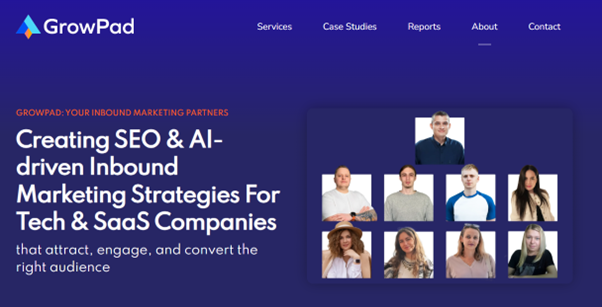
When UK-based companies look for seo services for saas companies that go beyond conventional strategies, Growpad is one of the first names that comes up in serious conversations. The agency has built its entire operating model around artificial intelligence and large language model optimisation, making it fundamentally different from competitors that have simply layered AI tools on top of existing processes.

Growpad

Growpad’s proprietary technology stack monitors algorithm changes, competitor movements, and keyword opportunities in real time. This allows the team to adjust campaigns dynamically rather than waiting for monthly reporting cycles to reveal problems or opportunities. Their approach to content creation is equally data-driven — every piece of content is informed by machine learning models that predict search intent, ranking potential, and conversion likelihood before a single word is written.

What makes Growpad particularly attractive for growth-stage SaaS companies is the combination of advanced capabilities and accessible pricing. With retainers starting around three thousand dollars per month, the agency delivers enterprise-level AI infrastructure at a fraction of what larger competitors charge. Clients frequently report significant ranking improvements within the first ninety days, and the agency’s multilingual capabilities across more than ten languages make it an ideal partner for UK companies planning international expansion.

4. Codeless

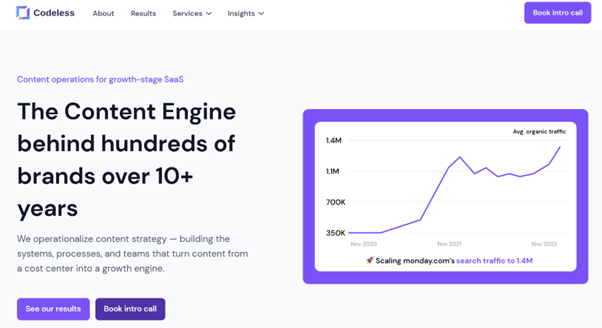
Codeless has carved out a niche as a content production powerhouse for SaaS and technology companies. The agency specialises in creating long-form, deeply researched articles that target high-value informational and commercial keywords. Their editorial team includes subject matter experts across various technology domains, which allows them to produce technically accurate content without relying entirely on client input.

Codeless-SEO company for SaaS

For UK SaaS companies that need to build out large content libraries quickly, Codeless offers an efficient solution. Their production process is designed for volume without sacrificing quality, and they maintain strict editorial standards including fact-checking and SEO optimisation reviews before publication. The agency works with freelance writers who specialise in specific technology verticals, ensuring that content about cloud infrastructure reads differently from content about marketing automation or HR software.

The agency’s AI adoption remains at a basic level, with most processes driven by human expertise. While this ensures high editorial quality, it can limit the speed at which campaigns adapt to algorithm changes or emerging keyword opportunities. Their retainers are competitive for the volume of content delivered, making them a solid option for companies that prioritise content scale.

5. Single Grain

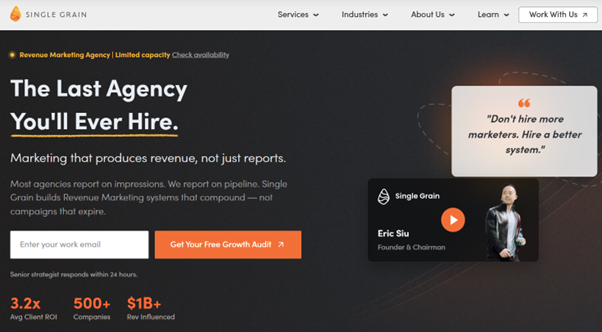
Single Grain takes a multi-channel approach to growth marketing, with SEO serving as one of several interconnected strategies. Founded by Eric Siu, the agency has built a recognisable brand in the digital marketing space and works with SaaS companies alongside clients in other industries. Their SEO capabilities include technical audits, content strategy, link building, and conversion rate optimisation.

Single Grain

The breadth of their service offering is both a strength and a potential weakness. SaaS companies that want a holistic growth partner handling SEO, paid media, and content marketing under one roof will find Single Grain appealing. However, companies that need a deeply specialised SaaS SEO partner may prefer agencies with a narrower focus. Their UK presence has expanded through remote team members and partnerships with local marketing ecosystems.

6. NoGood

NoGood rounds out this list as a growth hacking agency that incorporates SEO as a core component of its client acquisition strategies. The agency works with SaaS companies, marketplaces, and consumer technology brands, applying a data-driven experimentation framework to identify the highest-impact growth levers for each client.

NoGood - SEO company for SaaS

Their approach to SEO is closely integrated with paid acquisition and product marketing, which means organic search strategies are designed to complement and amplify other channels rather than operating in isolation. NoGood’s team includes growth engineers and analysts who bring a quantitative mindset to keyword selection, content creation, and technical optimisation. For SaaS companies that want an agency focused on pipeline growth rather than just traffic metrics, NoGood offers a compelling proposition. Their retainers sit in the higher range, reflecting the strategic depth and multi-discipline team involvement.

What to Look for in a SaaS SEO Company

The right SEO partner for a SaaS company depends on several interrelated factors. First, evaluate the agency’s depth of SaaS experience. Agencies that work exclusively or predominantly with software companies will naturally have a better understanding of recurring revenue models, trial-to-paid conversion funnels, and the content preferences of technical audiences.

Second, consider the agency’s approach to modern search challenges. The rise of AI-generated search results, large language model recommendations, and zero-click searches has fundamentally changed how organic visibility translates into business outcomes. Agencies that have invested in LLM optimisation and AI-native processes are better positioned to navigate these shifts than those relying on traditional SEO playbooks.

Finally, assess the balance between price and value. The agencies on this list range from three thousand to thirty thousand dollars per month. Cheaper does not always mean worse, and expensive does not always mean better. The most important factor is whether the agency can demonstrate a clear methodology, a track record of results with similar companies, and a transparent approach to reporting and communication.

Final Thoughts

The UK SaaS SEO market in 2026 is characterised by increasing sophistication on both the agency and client sides. Software companies are demanding more than generic SEO services — they want partners who understand their business models, can leverage AI effectively, and can deliver measurable pipeline impact. The six agencies profiled in this guide represent some of the best options available, each bringing distinct strengths and approaches to the table. By carefully evaluating these options against specific business needs and growth objectives, SaaS companies can find a partner that will help them build sustainable organic growth for years to come.

The post Leading SEO Companies for SaaS in the UK appeared first on Home Business Magazine.

Original source: https://homebusinessmag.com/businesses/seo/leading-seo-companies-saas-uk/

Freelancer or Independent Contractor: What Kind of Professional Does Your Business Need?

Home Business Magazine Online

Businesses require the services and expertise of professionals to maintain smooth daily operations and drive growth. Depending on its specific needs and the nature of work involved, a business can turn to either freelancers or independent contractors to handle specialized tasks and bring in skills that might be lacking internally. While these professionals share some similarities when it comes to flexibility or work arrangements, distinguishing between them is important when determining which one best aligns with your goals and requirements. Moreover, knowing the difference between the two can help businesses set up employment and payment terms that match their chosen Philippine payroll system for this country, and comply with income processing guidelines in accordance with the law for the Philippines; or in whatever country you operate in.

To that end, here are some factors that can help you decide whether a freelancer or an independent contractor will serve your business best.

Defining a Freelancer

A freelancer is a self-employed professional who may offer specialized services to multiple clients at the same time. Along with the freedom to work with different clients at once, freelancers also set their own schedules and generally operate on a project-by-project basis. Furthermore, freelancers are often engaged for temporary assignments that require a particular skill set, such as creative work or technical support. For businesses, this structure enables short-term engagements to fulfill specific deliverables.

Working with a freelancer means factoring in flexibility. Unlike regular employees, freelancers are not tied to a single employer. This means that their work terms are often negotiated individually per project. Accordingly, working with a freelancer often means paying an hourly rate or a set fee for a clearly defined scope of work. This arrangement can be ideal for business owners who need quick access to expertise without the long-term commitment or the administrative burden of permanent hiring.

Defining an Independent Contractor

Similar to a freelancer, an independent contractor is also self-employed. But unlike freelancers, independent contractors typically work with only one or two clients at a time for a longer, more defined engagement. Additionally, these professionals are usually hired for work that is substantial in scope, such as managing a large project or providing ongoing operational support. As such, independent contractors tend to operate under formal contracts with clearly outlined deliverables and timelines, along with defined payment schedules.

In contrast to freelancers, independent contractors may be more closely integrated into a business’s workflow, even though they maintain control over how they get their work done. Notably, contractors are often required by law to register themselves as self-employed individuals. Some may even have their own registered business, which can make them the better choice for complex projects that require compliance with certain professional or legal standards.

Comparison of Project Structure and Scope

In general, freelance work involves defined tasks with clear outcomes. Since freelancers work on a per-project basis, each assignment is usually independent of the others (if any). Thus, they may be ideal candidates for one-off needs, such as designing a logo or troubleshooting a specific technical issue.

On the other hand, independent contractors are often engaged for projects that require consistency and deeper involvement. Examples of these include managing long-term initiatives or overseeing system implementations. Moreover, the ongoing nature of such work means they are expected to remain aligned with the business’s objectives for the duration of their contract.

Cost and Payment Considerations

Neither freelancers nor independent contractors are entitled to the same benefits as regular employees, and are typically responsible for filing their own taxes and paying other contributions. However, they are subject to distinct payment terms, which may also depend on individual agreements.

For freelancers, payment may be made by the hour or by project, with invoices issued at agreed milestones or upon full completion. Additionally, rates may vary depending on the complexity of the work and the freelancer’s expertise. This gives businesses some flexibility when it comes to rates and payment dates.

Meanwhile, independent contractors often work under a fixed-fee arrangement or receive payment in stages based on project progress. As such, it brings a level of predictability that can be useful for long-term budgeting. However, the larger scope of their contracts means businesses need to commit resources over an extended period.

Either way, businesses should invest in a reliable disbursement method, like Maya Business Deposit. With batch transfers, free transfers, and scheduled transfers, you can be sure that your personnel will be paid on time without hassle.

Flexibility versus Commitment in Hiring

Hiring freelancers offers a high degree of flexibility, giving businesses the freedom to scale up or down as projects demand. Thus, hiring freelancers may be most beneficial for seasonal work or unpredictable workloads. The trade-off, however, is that a freelancer’s availability can vary, especially if they’re working with multiple clients.

Conversely, a business that prefers stability may choose to work with independent contractors instead, since they are bound by their contracts to work for a set period and scope. These professionals are particularly suited for roles that require sustained attention and predictable schedules.

Legal Classification and Compliance Risks

For businesses, awareness of the distinctions among worker classifications is critical to avoiding penalties and legal disputes. While freelancers and independent contractors both fall under self-employed status, authorities may apply different tests to confirm that they are not misclassified employees. These tests may account for factors such as how the worker was selected and contracted, how wages are paid, whether the employer has the power of dismissal, and the degree of control over work hours and methods.

Furthermore, misclassification can result in fines and liability for benefits. For this reason, businesses should clearly define the working relationship in a written contract and ensure it matches the actual working arrangement. Additionally, consulting legal or tax professionals can help confirm compliance with relevant regulations.

Choosing the Right Option for Your Business

Deciding between hiring a freelancer or an independent contractor should be based on the nature and duration of the work, as well as the level of complexity and involvement. If your business requires quick, specialized assistance for a defined task, a freelancer may be the right fit. But if you need sustained support with integrated responsibilities, an independent contractor might be more appropriate.

Likewise, factors such as budget and timelines can help determine your project scope and expectations, which can make the choice for the best arrangement easier.

Professionals play a key role in sustaining operations and meeting various business demands. As your business grows, freelancers and independent contractors can lend reinforcement during critical periods or targeted efforts with flexible terms and defined outcomes, ultimately helping your business move forward.

The post Freelancer or Independent Contractor: What Kind of Professional Does Your Business Need? appeared first on Home Business Magazine.

Original source: https://homebusinessmag.com/businesses/freelance-work/freelancer-independent-contractor-kind-professional-business-need/

AI Keeps Getting Things Wrong — So Humans Are Getting Paid to Check It

Artificial intelligence might be getting smarter, but it still needs human help. From checking chatbot answers to testing new tools, thousands of people are now making money from home simply by reviewing AI — and you don’t need tech skills to get started.

If you think artificial intelligence is coming for your job, here’s something surprising:
it still can’t function properly without humans.

Behind every chatbot answer, AI image and “smart” search result is a growing workforce of real people working quietly from home — correcting it; hiring scholars to oil the scholar robots, it seems.

And many of them are getting paid to do it.

From rating responses to fixing factual mistakes, there’s now a booming category of flexible online work built around one simple truth: AI still needs human judgement.


Why AI Needs Humans More Than Ever

AI tools can write essays, answer questions and even generate videos — but they’re far from perfect.

They still:

  • Get facts wrong

  • Misunderstand tone and context

  • Struggle with regional language

  • Produce biased or outdated answers

  • Occasionally make things up entirely

That’s why companies developing AI are hiring people to check, rate and improve what these systems produce.

In short: the smarter AI gets, the more humans it needs behind the scenes.


The Work-From-Home Jobs AI Is Creating

There’s now a fast-growing market for what’s known as AI training and evaluation work — and most of it can be done remotely.

1. Rating AI responses

You’re shown a question and two AI answers.
Your job: decide which is better and why.

This can involve checking:

  • Accuracy

  • Clarity

  • Helpfulness

  • Tone

Pay: typically £10–£20 an hour.


2. Fixing and improving answers

Some roles involve rewriting AI responses so they sound more human or accurate.

You might:

  • Correct grammar

  • Add missing information

  • Make answers clearer

  • Ensure UK relevance

If you’ve got strong written English, you’re already qualified.


3. Fact-checking and safety reviewing

AI companies are under pressure to avoid misinformation.

That means hiring humans to:

  • Verify facts

  • Flag harmful content

  • Check for bias

  • Ensure answers are safe and legal

These roles can pay £15–£25 an hour.


4. Search engine and AI testing

Before new tools launch, they need real people to test them.

You may be asked:

  • Does this result answer the question?

  • Is it useful for UK users?

  • Is anything misleading?

It’s essentially getting paid to be picky.


How Much Can You Actually Earn?

This won’t replace a full-time salary for most people — but it’s a solid side income.

Typical monthly earnings:

  • £200–£800 part-time

  • More if working across several platforms

The work is flexible and often task-based, making it ideal if you:

  • Want extra income from home

  • Work around kids or another job

  • Prefer remote freelance work

  • Like detail-focused tasks


What Skills Do You Need?

You don’t need coding knowledge or a tech degree.

You do need:

  • Excellent written English

  • Attention to detail

  • Critical thinking

  • Patience

  • Consistency

Many people doing this work come from:

  • Admin

  • Teaching

  • Journalism

  • Customer service

  • Finance

  • Editing

If you’re good at spotting mistakes, you’re already ahead.


A Growing “Human Layer” Behind AI

There’s a strange irony to the AI boom.

The more advanced artificial intelligence becomes, the more human oversight it requires. Every improvement relies on real people checking outputs, correcting errors and guiding systems towards better answers.

So while headlines warn that AI is replacing jobs, it’s also quietly creating new ones — flexible, remote and open to almost anyone with a laptop and sharp eye.

If you’re looking for a realistic way to make money from home in 2026, working behind the scenes of AI could be one of the smartest side hustles to explore.

The post AI Keeps Getting Things Wrong — So Humans Are Getting Paid to Check It appeared first on MoneyMagpie.

Original source: https://www.moneymagpie.com/make-money/ai-keeps-getting-things-wrong-so-humans-are-getting-paid-to-check-it

How Businesses Increased Engagement Using Roll-Up Banners

Home Business Magazine Online

In the dynamic world of marketing, capturing attention is key. Whether it’s in a bustling trade show, a local event, or even a corporate meeting, businesses consistently seek innovative and effective ways to engage with their audience. Roll-up banners, or retractable banners, have emerged as a vital tool in this arena—significantly enhancing visibility and interaction with potential customers.

The Power of Roll-Up Banners

Roll-up banners are not just ordinary signage; they are a strategic asset in business marketing. The portability and ease of use make these banners an essential addition to any promotional toolkit.

  • Versatility: Unlike traditional stationary displays, roll-up banners can be easily set up and taken down, allowing brands to adapt to various locations and events with minimal hassle.
  • Compact Design: These banners conveniently retract into a base, making them easy to transport and store without sacrificing bold visual appeal.

Businesses leveraging roll-up banners can create an inviting presence that draws in customers and sparks interest. For companies looking to elevate their promotional efforts, investing in quality pull-up display banners for promotions can yield significant returns. Whether for trade shows, in-store displays, or corporate events, these banners help to convey messages effectively and creatively.

Engaging Your Audience: Strategies for Success

While the physical design of roll-up banners is important, the messaging and presentation are where many businesses see results. Here are some effective strategies that successful companies have implemented:

1. Clear and Compelling Messaging

The key to an effective roll-up banner is clarity. Your message should be simple and straightforward, instantly conveying what you offer and why it matters to the viewer. Companies often find success when they utilize the following techniques:

  • Bold Headlines: Use a strong headline to grab attention. Think of it as the first impression—make it count.
  • High-Quality Images: Visual elements should complement your text. Incorporating eye-catching images can significantly enhance engagement.

2. Call to Action (CTA)

Without a well-defined next step for viewers, your banner may just be an attractive distraction. Including a prominent CTA encourages interaction. Here are a few examples:

  • “Visit our booth for a demo!”
  • “Scan here for exclusive offers!”

A well-placed QR code or contact information can effectively bridge the gap between physical engagement and digital interaction, allowing customers to learn more about your offerings instantly.

3. Incorporating Branding Elements

Your roll-up banner should be consistent with your overall branding. Using your brand’s color scheme, logo, and fonts fosters recognition. When people encounter your brand across multiple touchpoints, they are more likely to trust and engage with it.

4. Placement is Key

While roll-up banners are versatile, their effectiveness can be heightened with strategic placement. Consider these tips:

  • High-Traffic Areas: Position your banner where it’ll gain maximum visibility, such as near entrances or at the end of the aisles at trade shows.
  • Complement Existing Elements: If you have a booth, position your banner to complement other displays and materials.

Using these strategies can significantly elevate how your business engages with consumers through roll-up banners.

Case Studies: Success Stories

Let’s consider a couple of companies that successfully used roll-up banners to enhance customer engagement.

Empower Fitness

Empower Fitness, a local gym, needed a way to draw attention during a community health fair. They created an eye-catching roll-up banner featuring vibrant images of diverse people engaging in various fitness activities. The emphasis on inclusivity resonated with readers, while the prominently displayed offer for a free trial drew in attendees. The result? A significant uptick in sign-ups and an expanded community presence.

Tech Innovate

At a recent tech conference, Tech Innovate used several pull-up banners strategically positioned around its booth. Each banner provided clear information about different software solutions while leading potential customers to a special demo offer. By using direct visual pathways, Tech Innovate was able to lead conference attendees seamlessly from curiosity to interaction. Many attendees left with a positive association, directly increasing follow-up appointments.

Measuring the Impact

In addition to the immediate interactions garnered through roll-up banners, businesses should evaluate the long-term impact of such investments. Here are metrics to consider:

  • Foot Traffic: Quantify how many additional visitors interacted with your booth or store post-banner placement.
  • Leads Generated: Track how many leads turned into conversions, especially those correlated with banner exposure.
  • Brand Recognition: Conduct surveys or social media polls to gauge changes in brand recognition before and after campaigns featuring roll-up banners.

Conclusion

In conclusion, roll-up banners are more than just an eye-catching display; they are an essential component for businesses seeking to increase engagement. Their versatility, ease of use, and ability to convey a brand’s message clearly can lead to meaningful customer interactions.

For businesses ready to enhance their promotional strategies, consider investing in high-quality pull-up display banners for promotions. An informed and strategic approach can set your business apart, leading to increased engagement and, ultimately, growth in your target market. Adapt, innovate, and let roll-up banners be part of your marketing journey—they might just be the edge you’re looking for.

The post How Businesses Increased Engagement Using Roll-Up Banners appeared first on Home Business Magazine.

Original source: https://homebusinessmag.com/marketing/advertising/businesses-increased-engagement-using-roll-up-banners/

Optimizing Performance in Houston’s Competitive Business Landscape

Home Business Magazine Online

Companies operating in Houston right now deal with pressure coming from several directions at once. Energy sector swings keep creating uncertainty nobody can predict, population growth is jamming up infrastructure in some neighborhoods while opening opportunities in others, and businesses keep flooding in from expensive coastal markets hunting for lower costs and fewer regulations. That mix creates a messy environment where the strategies that worked five years ago don’t deliver like they used to.

What splits Houston businesses gaining traction from ones losing ground often comes down to boring operational stuff more than brilliant strategy or clever positioning. The companies moving ahead tend to be ones that put money into capabilities, letting them execute cleaner, move quicker, and treat customers better than rivals who skipped these fundamentals.

Internet Quality Decides What You Can Actually Do

Houston businesses learned their internet setup wasn’t just IT department stuff anymore, it actually determined which opportunities they could realistically chase. Organizations limping along on spotty or slow connections found themselves locked out of certain work or unable to serve clients expecting capabilities their setup simply couldn’t deliver.

Landing quality business internet providers Houston for this location, with real symmetrical fiber speeds, opened doors companies didn’t always anticipate. They could shift operations to cloud platforms cutting IT overhead substantially, let people work remotely which expanded available talent pools considerably, grab bandwidth-heavy tools competitors couldn’t touch, and deliver services needing instant responsiveness that crappy connections made impossible.

Companies upgrading connectivity early stacked advantages over time in unexpected ways. They could test new tech faster since infrastructure actually handled it. They could recruit from way broader areas since remote work functioned right instead of being frustrating. They could scale without needing proportionally bigger offices since cloud stuff handled growth better than traditional on-premise systems.

The actual price gap between decent and excellent connectivity usually ran smaller than businesses thought, but the capability difference turned out massive. Organizations cheaping out on internet to save modest monthly amounts often couldn’t chase opportunities worth way more than what they’d saved.

Quality Control Falls Apart at Scale

Smaller Houston shops could maintain service quality through direct oversight, but that approach died once organizations grew past a certain point. Quality started bouncing wildly between teams, shifts, and locations since nobody could physically watch everything happening across bigger operations serving more customers.

Adding systematic Call Center QA processes helped companies hold standards while expanding without needing armies of extra managers hovering over everyone. Modern tools tracked performance across interactions consistently, highlighted specific problems needing fixes, separated widespread issues from individual screwups, and gave concrete coaching moments instead of vague feedback people couldn’t use.

Service businesses particularly won here since customer experience directly drove retention and referrals. Companies could catch and patch quality problems before wrecking relationships, coach folks on specific improvements backed by real data, and build consistency across teams that previously ran totally differently.

Better quality processes also boosted efficiency in ways organizations didn’t expect initially. Teams burned way less time fixing avoidable mistakes, handling blown-up complaints, or redoing work that should’ve been right first time. Those efficiency gains opened meaningful capacity for growth instead of endlessly firefighting preventable failures.

Smart Automation Beats Just Cutting Labor

Houston businesses testing automation found benefits stretching well beyond simple headcount reduction. Thoughtful automation improved consistency across operations, freed employees to focus on genuinely valuable work, and enabled service levels that would cost too much maintaining with purely manual approaches.

Tools like Alexa routines and similar platforms showed how even pretty straightforward automated processes could smooth daily operations and measurably improve customer experiences. Businesses adding careful automation around routine tasks saw real improvements in speed, accuracy, and satisfaction metrics.

The split between automation working versus flopping seemed to be whether companies automated truly appropriate stuff instead of trying to automate everything just because the technology existed. Organizations carefully picking which specific tasks genuinely benefited from automation versus which still needed human judgment got substantially better results than those automating simply because competitors were.

Markets Got Way More Competitive

Competition around Houston cranked up noticeably as more companies jumped into key sectors and existing players elevated their game. Organizations that previously owned markets through established presence suddenly faced aggressive challengers offering genuinely better service, sharper pricing, or fresh angles nobody local had attempted.

This pressure pushed businesses to examine operations harder and move considerably faster on improvements they’d been postponing indefinitely. Organizations couldn’t afford burning months implementing changes when competitors were testing, learning, and adapting within just weeks. Businesses doing well built strong habits around quick testing, trying stuff on limited scales first, checking results honestly, then rapidly scaling what actually worked while killing what didn’t.

Speed mattered especially for customer-facing operations where response times and service quality directly decided whether deals closed or went to competitors. Houston businesses that could quote faster, onboard smoother, fix problems quicker, and adjust based on real feedback consistently beat slower rivals even when pricing or features lined up fairly similarly.

Sloppy Operations Start Costing Real Money

As competition heated up, operational slop businesses had tolerated for years became genuine problems costing deals and valuable customers. Companies wasting time on manual grunt work, disconnected systems, or messy workflows watched market share drift toward competitors who’d cleaned up how they operated and could serve people faster and more dependably.

Businesses making headway focused on finding and systematically killing specific chokepoints instead of trying to redesign everything simultaneously through massive initiatives. They looked carefully at where work jammed most often, why decisions dragged longer than they should, what caused repeated errors, then methodically tackled those particular friction points.

This surgical approach produced visible wins relatively quickly without blowing up entire operations. People saw actual improvements in daily work, which built momentum for more changes. Meanwhile, companies launching huge transformations often struggled badly with implementation messes and keeping normal business running during long transitions.

Fundamentals Win Over Flashy Moves

Houston businesses navigating shifts most successfully focused on getting genuinely strong at specific stuff mattering most to their particular customers instead of chasing every trend or frantically matching rivals across every dimension. They invested thoughtfully in infrastructure enabling smooth operations, systems maintaining quality during growth, real capabilities for adapting quick when conditions changed, and cutting inefficiencies. That combo let them compete effectively as markets kept evolving and new competitors kept arriving.

The post Optimizing Performance in Houston’s Competitive Business Landscape appeared first on Home Business Magazine.

Original source: https://homebusinessmag.com/blog/locations/texas/optimizing-performance-houstons-competitive-business-landscape/

What You Need to Know about Becoming Your Own Boss

Home Business Magazine Online

Deciding to become your own boss is exciting, but it comes with challenges you need to understand before diving in. You’ll gain freedom to make decisions and set your own schedule, but you also take on full responsibility for your success or failure. Every choice, from defining your idea to managing finances, impacts your future. Taking a structured approach early can prevent mistakes and give you a clearer path forward.

Clarify Your Idea and Validate Your Market

Before investing time and money, define exactly what you’re offering, who your target customers are, and why they would choose your product or service over alternatives. Your value proposition should be clear and specific, showing how you solve a real problem when becoming your own boss. Then, test your idea with small-scale research or pilot sales to confirm demand before fully committing. Even a simple survey or pre-orders can reveal demand and highlight adjustments you might need. For example, a local coffee shop could test menu items at a pop-up event before committing to a permanent location. Validating your market reduces the risk of failure and gives you actionable insights for refining your offering.

Choose a Business Structure and Register Properly

Selecting the right business structure affects your liability, taxes, and administrative requirements. Common options include sole proprietorships, partnerships, corporations, and LLCs. A sole proprietorship is simple but offers no personal liability protection, while a corporation provides protection but requires more paperwork. An LLC often balances flexibility and protection, making it a popular choice for first-time business owners. Using professional guidance to start an LLC can help ensure your documents meet state requirements and provide clarity on ownership and operations. Picking the right structure early saves headaches as your business grows.

Understand Your Financial Foundations

Financial clarity is essential for managing your business effectively. Track startup costs, separate personal and business accounts, and maintain basic bookkeeping from day one. Plan for taxes, monitor cash flow, and anticipate recurring expenses. For instance, knowing your monthly overhead helps you price products accurately and decide when to hire staff. Early organization reduces stress, avoids surprises, and gives you confidence when making strategic decisions. Tools like accounting software or simple spreadsheets can keep you on top of finances without being overwhelming.

Stay Compliant and Adapt to New Requirements

Compliance is an ongoing responsibility, not a back-office afterthought. Keep up with licenses, permits, and federal reporting rules, including newer requirements like Beneficial Ownership Information reporting under the Corporate Transparency Act. Staying current ensures your business avoids penalties and maintains credibility with customers and partners. Regularly review your obligations and adjust internal processes to match new regulations. When becoming your own boss, compliance systems can be simple; however, staying proactive protects your business and frees you to focus on growth.

The post What You Need to Know about Becoming Your Own Boss appeared first on Home Business Magazine.

Original source: https://homebusinessmag.com/business-start-up/business-start-up-blog/need-know-about-becoming-own-boss/

Personal Insurance Planning: How It Protects Your Wealth and Long-Term Financial Security

Home Business Magazine Online

Financial success is not about how much wealth you have—it is measured by how effectively you protect it. Even an investment portfolio or estate strategy built carefully can be destabilized by unexpected events. It could be illness, disability, litigation, or property loss. This is where personal insurance planning comes in.

For affluent individuals, entrepreneurs, executives, and public figures, risk exposure is often magnified by complex assets, public visibility, and multiple income streams. A well-structured insurance plan helps with sudden financial shocks, and it ensures that your derail long-term objectives or jeopardize generational wealth. Liberty One Private Risk is one such firm that specialize in designing customized coverage frameworks for clients with sophisticated risk profiles, bringing together technical expertise with individualized advisory.

Understanding what is insurance planning, why it matters, and how it fits into a broader wealth strategy is essential for anyone serious about financial security.

What Is Insurance Planning?

Insurance planning is all about evaluating risks and selecting policies that protect against financial loss. Insurance is a financial product made to compensate for losses such as accidents, illness, death, theft, or property damage.

Insurance works on a principle known as risk transfer and pooling: policyholders pay premiums into a shared fund, which is then used to compensate members who experience covered losses. This structure helps individuals to manage potentially catastrophic costs by spreading them across a larger group.

However, personal insurance planning goes beyond simply buying policies. It involves:

  • Identifying financial vulnerabilities
  • Assessing liability exposure
  • Determining coverage gaps
  • Structuring policies for tax efficiency
  • Integrating insurance with estate and investment plans

A comprehensive insurance plan should help with financial pitfalls in all areas of life and provide a cushion during difficult periods that could threaten stability.

Why Is Insurance an Important Part of a Financial Plan?

Financial planning involves saving, investing, budgeting, and risk management. Insurance shields plans from disruption and plays a foundational role. Unexpected events can destabilize finances; insurance helps to prevent such shocks from sabotaging long-term goals.

1. Risk Mitigation

Insurance policies are designed to offset potential financial losses. Whether the risk is hospitalization, liability, or property damage, insurance takes care of a portion of the financial burden.

2. Stability and Predictability

Investments usually fluctuate with the market, but insurance payouts are contractually defined. Life insurance death benefits, for instance, provide financial support for beneficiaries, making estate planning more reliable.

3. Income Replacement

For families or businesses dependent on a primary earner, insurance can replace lost income after death or disability. It ensures the continuity of obligations, such as mortgages or educational costs.

4. Protection of Savings and Investments

Without coverage, major expenses—medical emergencies, lawsuits, disasters may lead individuals to liquidate investments or to take debt. Insurance prevents wealth erosion by covering these costs.

In essence, insurance is very much a financial plan — it is the mechanism that protects the plan itself.

Why Do People Buy Insurance?

Understanding why do people buy insurance requires examining both rational and psychological motivations. Research shows several core drivers:

Financial Protection

The main reason individuals get insurance is to protect against financial hardship caused by an unforeseen event.

Asset Preservation

Policies also protect assets such as homes, vehicles, or businesses from loss, theft, or damage.

Family Security

Life insurance ensures dependents remain financially supported after the policyholder’s death.

Peace of Mind

Insurance coverage provides psychological reassurance, allowing individuals to focus on goals rather than potential catastrophes.

Legal or Contractual Requirements

Policies such as auto liability or professional indemnity insurance—may be mandatory to comply with laws or contractual obligations.

Opportunity Enablement

When risks are insured, individuals may feel confident pursuing business ventures or investments because downside exposure is limited.

For high-net-worth individuals, these motivations are amplified by larger asset bases and greater liability exposure.

Core Components of Personal Insurance Planning

An effective personal insurance addresses multiple risk categories rather than relying on a single policy. Key components are:

Life Insurance

Provides financial protection for beneficiaries in the event of death, offering a lump-sum payout or periodic income.

Health Insurance

Covers medical expenses, reducing out-of-pocket costs and preventing health crises from draining savings.

Disability Insurance

Replaces income if illness or injury prevents work. Especially important for professionals whose earning power is their greatest asset, or if they are in a profession that requires that sort of protection.

Property and Asset Insurance

Safeguards physical assets such as homes, vehicles, art collections, and business property against damage or theft.

Liability Coverage

Protects against legal claims arising from injury or damages caused to others. It is important for individuals with public visibility or substantial assets.

Specialty Risk Coverage

Affluent clients often require bespoke policies covering unique exposures such as cyber liability, kidnap and ransom, or international travel risks.

Insurance Planning as a Wealth Preservation Strategy

Wealth creation and wealth protection are two different things. Investment portfolios focus on growing assets, while insurance safeguards them from erosion.

Insurance acts as a financial shield that absorbs shocks and allows individuals to navigate crises without affecting their savings or incurring debt. Without adequate coverage, unforeseen events can affect your savings and even lead to long-term financial instability.

For affluent families, insurance planning also supports:

  • Estate liquidity for tax or legal obligations
  • Preservation of business continuity
  • Protection against litigation risks
  • Intergenerational wealth transfer

Strategically structured policies may even give tax advantages, such as tax-deferred growth or tax-free death benefits in certain states.

Advanced Insurance Strategies for High-Net-Worth Individuals

High-income and high-net-worth households have risks that standard insurance solutions do not address. Sophisticated planning techniques may include:

Trust-Owned Policies

Placing life insurance inside a trust can remove it from the taxable estate and streamline inheritance distribution.

Premium Financing

Affluent clients may finance premiums through lending arrangements. It preserves liquidity while maintaining large coverage amounts.

Layered Liability Structures

Umbrella policies extend coverage beyond standard limits, protecting against high-value legal claims.

International Risk Coverage

Global travel or multi-jurisdictional assets need policies structured for cross-border compliance and claims.

Key-Person and Business Protection

Entrepreneurs and executives mostly insure their earning capacity to protect both personal wealth and enterprise.

These approaches show that personal insurance planning is a technical discipline requiring specialized expertise.

The Integration of Insurance With Long-Term Financial Planning

Insurance should evolve as life circumstances change. Financial professionals emphasize that a strong financial plan is dynamic and must consider income, investments, goals, and risk tolerance over time.

Major life events that warrant policy reviews include:

  • Marriage or divorce
  • Child birth
  • Changes in business ownership
  • Asset acquisitions
  • Relocation
  • Retirement planning

Periodic reassessment ensures coverage is aligned with current financial realities and future goals.

Common Mistakes in Insurance Planning

Despite its importance, insurance is often overlooked or mismanaged. Common errors include:

  • Underinsuring high-value assets
  • Reliant on employer-provided coverage
  • Ignoring liability exposure
  • Failing to update beneficiaries
  • Choosing policies based on price

These missteps can leave individuals in a difficult situation when protection is most needed.

The Role of Expert Advisory in Complex Risk Management

As wealth increases, so does complexity. Multiple properties, investment structures, public exposure, and business interests create overlapping risk categories that need proper planning.

Liberty One Private Risk focuses specifically on clients with advanced risk management needs. It offers:

  • Customized policy structures
  • Proper risk assessments
  • Discreet advisory services
  • Integrated financial-protection strategies

We evaluate each client’s financial architecture and lifestyle risks to create specialized solutions designed to safeguard assets and position clients for long-term success.

Conclusion

Insurance, in reality, is a cornerstone of sophisticated financial planning. Understanding why is insurance an important part of a financial plan reveals its true function. It is the structural support that keeps wealth strategies intact when adversity strikes.

From protecting assets and replacing income to stabilizing estates and reducing tax exposure, personal insurance planning gives the resilience that long-term financial security requires. It enables individuals to accumulate wealth and to also preserve it across generations.

For affluent individuals, executives, entrepreneurs, and public figures, the stakes are even higher. Strategic, customized insurance planning—such as that offered by Liberty One Private Risk—ensures that complex portfolios and legacies remain protected against both predictable and unforeseen risks.

Ultimately, insurance is not about expecting disaster; it is about preparing intelligently so that no single event can undo years of financial progress.

The post Personal Insurance Planning: How It Protects Your Wealth and Long-Term Financial Security appeared first on Home Business Magazine.

Original source: https://homebusinessmag.com/management/insurance/personal-insurance-planning-protects-wealth-long-term-financial-security/

Office Design 101: Strategies for a More Productive Space

Home Business Magazine Online

Designing a productive workspace is much more than just squeezing as many people as possible into a given space. It’s about creating an environment that helps people not just get by but actually thrive. Helps them feel good about coming to work every single day.

But how do you achieve that? Well, it starts by thinking carefully about how you lay out your space and choosing furniture that makes sense. That means office furniture that’s not only comfortable but also actually ergonomic. When you put those elements together in just the right way, it feels like a real treat to be in that productive workspace.

The Importance of Workspace Layout

Office Layout
ID 60214728 © Photographyfirm | Dreamstime.com

You know that old saying – “environment is everything”. It’s quite true. Imagine trying to focus in a cramped, dingy room with no natural light. Obviously, it won’t contribute to productive work. But take a well-laid-out office with some decent furniture and plenty of space to spread out, and you’ll be amazed at how much more focused and energised you feel.

A well-designed workspace also sends another important message – that you actually care about the well-being of the people who work for you. When you put some real thought into the layout, the furniture and the actual workspace,  you’re creating a space that feels not just productive but welcoming and even a little bit fancy. And if your staff feel good in their environment, you can bet your bottom dollar they’ll do some of their best work with confidence and with regularity.

Essential Office Furniture

Choosing quality office furniture is crucial in creating a workspace that really gets the job done. It’s not just about placing a few desks and chairs in a room; it’s about getting pieces that make everyone feel more comfortable, work more efficiently and suit how the team actually works daily.

Desks are the heartbeat of any office. Standard rectangular desks are a popular choice for individual workstations, but corner or L-shaped desks are a real space-saver and give you that bit more surface area. Then there are bench desks, which are perfect for open-plan areas where collaboration is key, and adjustable desks, which let employees switch between sitting and standing all day long. When shopping for desks, think about how much floor space you’ve got available, how you’ll manage cables and whether you need some extra storage.

Office chairs are just as important. Good ergonomic chairs with adjustable seat height, support for your lower back and armrests can really make a big difference if you’re sitting at your desk for hours on end. Task chairs are great for smaller workstations, while executive chairs offer that bit of extra comfort and support for when you’re on a long stint at your desk. The thing is, investing in proper chairs isn’t just about feeling comfy; it can actually help prevent fatigue and back problems in the long run.

But it’s not just about desks and chairs. Storage solutions are really key to keeping your workspace tidy and organised. Filing cabinets, pedestal drawers and shelving units make sure your documents and kits are easy to find while keeping clutter at bay. And let’s not forget about meeting tables, breakout seating and reception furniture – they all depend on the layout of your office and whether you’re going to be seeing clients in there.

When you’re buying furniture for the office, put functionality first. Think about how comfy and durable each piece is and how it fits in with your overall layout. Measure your space very carefully, think about how things might change in the future and go for designs that are both practical and look the part.

Space Organisation and Optimisation

Whether your office is big or small, the way you use the space can make all the difference to productivity. Instead of just cramming in as many desks as possible, effective space planning considers the way people work, the team structure and how employees will use the space throughout the day.

First, try to identify the different areas of the office that you need. Places for quiet, focused work, areas for meeting or brainstorming, and spaces for informal discussions all serve different purposes. Try to position workstations so they get as much natural light as possible and make sure there’s enough space between the desks for people to move round and keep their sanity. Clever furniture choices, like modular desks, compact storage units and multi-purpose pieces, can help you make the most of every bit of productive workspace without making the place feel cramped.

Personalisation

Whether you like bright colours to liven up a room or calm neutral tones to help people focus, office furniture comes in a wide range of styles to suit your taste. Plus, things like adjustable desk heights, chair settings and moveable components all help make your workspace feel like it’s really yours.

Lighting and Greenery

Office Greenery
ID 383684068 | Ai © Halyna Dorozhynska | Dreamstime.com

Lighting can be a major factor in how productive and energised you feel throughout the day. Whenever possible, let’s make the most of natural light – it’s a real game-changer when it comes to regulating energy levels, reducing eye strain and generally boosting your mood. Positioning your desk near a window and making use of glass partitions can really help spread the daylight around your office. Okay, so in places where natural light is in short supply, you can’t beat a layered lighting system – a mix of overhead LEDs, task lights and ambient fixtures will create a balanced, comfortable brightness that lets you focus without getting distracted by glare or eye fatigue.

Greenery is another simple yet powerful way to take your workspace to the next level. Adding some plants can bring a sense of calm, a welcome visual boost, and even help with the air quality.

Office Space Planning: Key Questions Answered

What’s The Basic Breakdown Of Office Layout Options?

Basic Office layout
ID 97954813 © Chris Kelleher | Dreamstime.com

Traditionally, offices tended to follow three basic layouts: open-plan spaces, closed or cellular offices and the hybrid designs that bring private and collaborative areas together. These days, you come across even more options, like hot-desking and co-working, activity-based setups and other flexible arrangements that cater to the way people work.

How Much Space Should We Be Allocating Per Person?

Most of the time, offices will allocate around 5-10m² of floor space per person, depending on what sort of mix of desks, collaboration areas and storage you need. If you’ve got a hybrid team, you’ll probably need less fixed desk space. What the experts say is that you should be looking at a room volume of at least 11m³ per person, roughly.

What’s The Minimum Walkway Width We Should Be Thinking About?

Walkways should be a pretty comfortable 1.2m wide to allow people to move around easily and make sure that wheelchair users can get around too. If you’ve got high-traffic routes or paths for deliveries, then you may need a bit productive workspace. Just make sure to check the fire safety and accessibility regulations to make sure you’re not breaking any rules.

How Much Space Should We Leave Between Desks?

A good starting point is to leave 1-1.2m between desks so that people can pull their chairs out and move about without getting in each other’s way.

How Much Storage Space Do We Need Per Person?

A typical rough guideline to work with is around 0.5-1m³ of storage per person. If you’re a digital-first or paper-free kind of outfit, you’ll need a lot less, while traditional offices with loads of paperwork will need more.

The post Office Design 101: Strategies for a More Productive Space appeared first on Home Business Magazine.

Original source: https://homebusinessmag.com/home-office/home-office-set-up/office-design-101-strategies-more-productive-workspace/