‘Ask for Ellen’ launches to offer free crumpets this summer
The school holidays can be daunting for parents. It’s a time of great fun, quality time with the kids and amazing memories. But all of this can feel overshadowed by the cost of living continuing to bite.
Being away from school means free school meals are put on pause and costs can stack up for parents. Food, energy and entertainment costs for six long weeks can put a strain on our wallets. Previously, Morrisons partnered with Heinz for the campaign ‘Ask for Henry’, where people could get a free meal of a jacket potato and beans. Now, Warburtons has partnered with the supermarket giant to launch ‘Ask for Ellen’, to give support to families throughout the school break.
Ask for Ellen
Simply ‘Ask for Ellen’ at any Morrisons’ café and you will receive a portion of two standard crumpets, with butter and jam for free. No questions asked, just delicious food for you and the kids. The initiative is named after founder Ellen Warburton, who established the brand in 1876.
Ask for Ellen runs from 17th July to 13th August and will be available to everyone, all day, every day. T&Cs apply. Morrisons will also continue to ruin its Kids Eat Free initiative in its cafes, where little ones can receive a free meal with the purchase of an adult main, worth £4.49 or more.
The Warburtons Foundation
New research by The Warburtons Foundation, found that a staggering 64% of parents are worried about the increased costs of their child being at home for the summer. The survey of 1,000 parents of school-aged children, also found that parents think the school holidays will cost them almost £200 extra over the six-week break, due to childcare and family activities. 71% of respondents said they are preparing themselves to buy more snacks than normal to plan for day trips and activities to keep children fed on the go.
The research also revealed the added financial pressure facing families as schools break up for the summer – when questioned about the typical six-week break, 58% of parents suggested they will have to contend with additional childcare costs as they juggle work and their kids.
Chris Strong, Morrisons Café Buying Manager, said:
“Supporting our customers during the school holidays is incredibly important to us as we know that many families worry about catering for additional meals that are usually covered during the school term time. We are therefore pleased to be partnering with Warburtons this summer and offering our customers two toasted crumpets, with butter and jam when they visit a Morrisons café and Ask for Ellen.”
Jonathan Warburton, Chairman of Warburtons, commented:
“Whilst the summer holidays offer a chance for families to enjoy time together, we know that the reality can be very different for many families. As the cost-of-living crisis continues to put pressure on household budgets we wanted to offer a little to support to families through the holidays. Being able to help families across the country is as important to us today as it was to Ellen Warburtons back in 1876.”
A brand SERP is the results Google serves when a user searches for your brand name. A digital strategy is how a brand positions itself across the online ecosystem.
I have been talking about brand SERPs since 2013. I’ve learned that a brand SERP isn’t just a “pretty Google Business Card.”
When you bake SEO into a brand’s existing digital strategy, you grow the brand SERP and the digital strategy in tandem – and dominate your niche.
Why are brand SERPs important?
The search results for an exact match brand name is Google’s evaluationof what that brand’s audience will find most helpful, relevant and valuable.
That means the brand SERP is your guide to what’s right and what’s wrong with the digital strategy. It lets you focus on the right elements and use SEO to help “educate” Google.
Instead of leaving it to Google to present your brand, ensure the brand SERP represents what you want your audience to see.
This article will focus on the main points common to most brand SERPs.
How to analyze a brand SERP
Type an exact brand name, look at the search results, and follow these steps.
1. Always start at the top
The first result should be the brand’s website with rich sitelinks.
If the name is ambiguous or keyword-focused, your job is to build Google’s understanding and confidence in the brand.
For most companies, the starting point will be something like this:
The homepage looks good, but the rest could be better.
The quality of the titles and descriptions gives you a huge insight into the site’s structure and the quality of the user-centric pages such as About Us, Contact Us, login and category pages.
Fix these first. Google’s understanding of the structure and content of the site is vital for all your SEO efforts.
We often see structural issues manifest themselves here. For example, the site is in the wrong language, no About page, or an unimportant article.
Bonus tip: Look at the Schema.org implementation. If the website hasn’t used AboutPage, ContactPage and other WebPage types appropriately, it’s a sign the company has chosen to focus on visible rich results that impress the boss.
Quality, sitewide, consistent Schema.org markup is a must-have to ensure Google is confident in its understanding of the brand.
Rich sitelinks give incredible insight into the improvements necessary for an effective digital strategy.
2. Look at the social profiles that rank
Which social profiles appear on a brand SERP depends on multiple factors, but user engagement on each platform is the most important.
Let’s say your client is investing heavily in a Facebook strategy, but Facebook doesn’t rank on their brand SERP. This indicates that their strategy isn’t engaging the relevant audience enough.
In this case, a critical analysis of what, how and with whom they share and engage will generally bring insights that will help that strategy.
The Facebook profile will rise in the rankings as the strategy gains traction. That’s a nice KPI for the social media team.
The Kalicube Twitter boxes show that we have a strong and effective Twitter strategy, and our Facebook ranking (with reviews) indicates we are doing well on Facebook.
Although user engagement is a top priority, ensure the brand focuses on the right platforms.
Look at competitor brand SERPs. If TikTok rarely ranks on the brand SERPs of that cohort, but LinkedIn almost always does, then you can assume that the company’s audience hangs out more on LinkedIn than TikTok. Resources spent on LinkedIn are more likely to bring direct returns.
3. Look at videos
Is the client investing heavily in YouTube? If so, their YouTube channel should rank with a video box and neatly branded thumbnails.
Disney has video boxes on their brand SERP. But the design is inconsistent because the videos are pulled from multiple sources. Even their channel provides a video with a sub-optimal thumbnail.
4. Look at review sites
Start a service review strategy. Get reviews for the company and its customer support on that niche’s most relevant and valuable platform.
Platforms such as Trustpilot dominate, but these big players are not necessarily the most effective for any specific market.
For example, Serenata Flowers, a UK flower delivery service, has over 200,000 reviews on Trustpilot and a great rating. It ranks at position four.
But then there are three coupon sites, two with good review star ratings. Track and nurture these sites since they are visible on the brand SERP.
A quick note: Your client will also need product reviews, and the relevant platform will be where they collect service reviews.
But don’t make assumptions. Complete a separate analysis of the product brand SERP.
Get the daily newsletter search marketers rely on.
function getCookie(cname) {
let name = cname + “=”;
let decodedCookie = decodeURIComponent(document.cookie);
let ca = decodedCookie.split(‘;’);
for(let i = 0; i <ca.length; i++) {
let c = ca[i];
while (c.charAt(0) == ' ') {
c = c.substring(1);
}
if (c.indexOf(name) == 0) {
return c.substring(name.length, c.length);
}
}
return "";
}
document.getElementById('munchkinCookieInline').value = getCookie('_mkto_trk');
5. Look at news sites
In some markets and industries, news simply isn’t a “thing” because the information is evergreen (or at least remains fresh for several months).
In others, it is a top priority because the information is time-sensitive (financial industries, for example) or voluminous (entertainment industries, for example).
Your client’s brand SERP might not have news boxes, but that doesn’t mean that news isn’t important in the industry.
A brand SERP cohort analysis (we call this “entity equivalents”) will immediately tell you if your client’s public relations strategy needs to focus on trending topics or if they can take things more slowly.
It will also enable them to focus on the right four or five news sources rather than the scattergun approach. This saves an enormous amount of money.
6. Look at ‘People Also Ask’
If there are none, then your client has a problem. 70% of brand SERPs have People Also Ask (PAA) questions.
If Google can’t think of any questions its audience might ask, then it lacks understanding about your client’s audience and the relationship it has with them.
If Google does show PAA, check if the questions are relevant. Create an FAQ section on the website and answer them clearly if the site doesn’t have the answer to the questions.
Here, Ubigi (a client who has implemented our process) has answered all the questions, and they have absolute control over the PAA on their brand SERP.
If some of the questions are non-branded, they are critical topical questions for the client.
The client must answer the questions because Google sees the relationship between the brand, its audience and the topic and expects an answer from you. (This is delightful news. Google is improving its understanding of the brand.)
7. Look at filter pills
Filter pills are pill-shaped clickable icons that appear below the search bar in the search results. They provide huge insights for your strategy.
Users can inspect different parts of the brand in different verticals. They are Google’s version of a word association game.
In the case of Kalicube, our audience is interested in Kalicube Pro, the Kalicube Academy, and our Knowledge Nuggets video series.
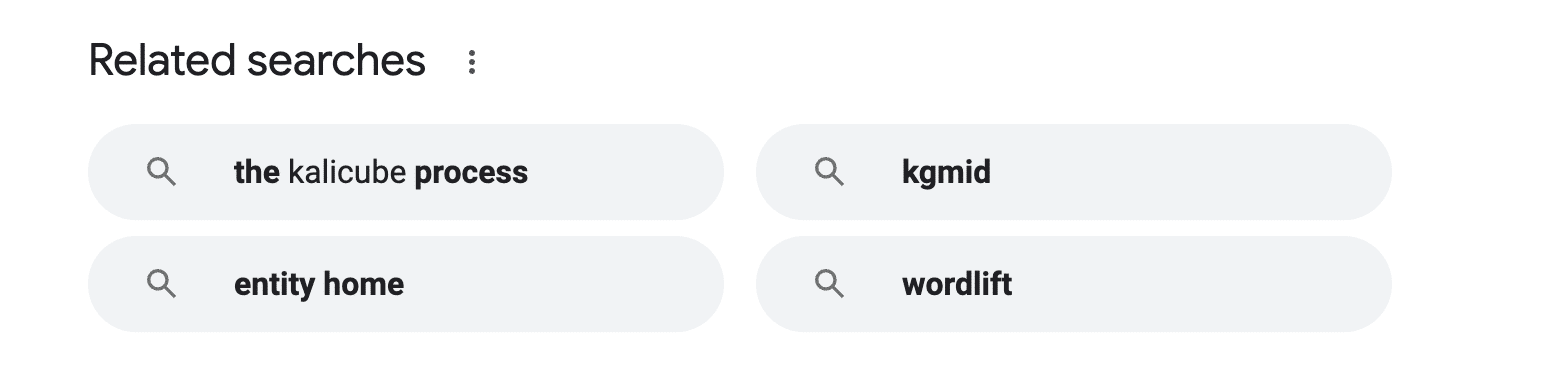
Then check the related searches at the bottom. These pills indicate more areas of focus for the digital strategy.
Our partnership with WordLift is something Kalicube should focus on.
We should continue to communicate about “The Kalicube Process.”
Google understands Kalicube’s topical authority in the knowledge panel and knowledge graph space. (We can see this in the “kgmid” and “entity home” filter pills)
8. Is there a knowledge panel?
A Google knowledge panel is a search results feature that gives a concise summary of information about a company, person, or brand collected by Google from several credible sources. It is Google’s understanding of the facts about your brand.
If the company doesn’t have a knowledge panel on their brand SERP, they have a huge problem. They aren’t in Google’s Knowledge Graph, and Google doesn’t understand who they are.
A knowledge panel is a “must-have”. Without understanding, Google cannot evaluate your relevance to an audience nor assess your credibility (E-E-A-T) as a solution to the subset of its users who are your audience.
You are at least a year behind in your digital strategy without a knowledge panel.
I have talked and written about this hundreds of times and won’t go into detail here.
Focus on the entity home, consistent corroboration and signposting.
9. Search Generative Experience
Search Generative Experience (SGE) is already a focus for most SEOs. The key to managing SGE results is to see them as dynamic knowledge panels or multi-element featured snippets.
Whatever form Google’s SGE and Bing’s Chat take, one thing is clear: This is where we see the summary of the SERP.
Both Google and Bing aim to condense the information behind the results to save users time when researching.
Rather than clicking on five or six links, reading the pages, understanding the information and remembering it all, the answer engine (SGE/Bing Chat) provides the user with an accurate, helpful and actionable summary.
Google’s summary of your brand will typically be positive. A negative summary means the company has a significant online reputation management issue.
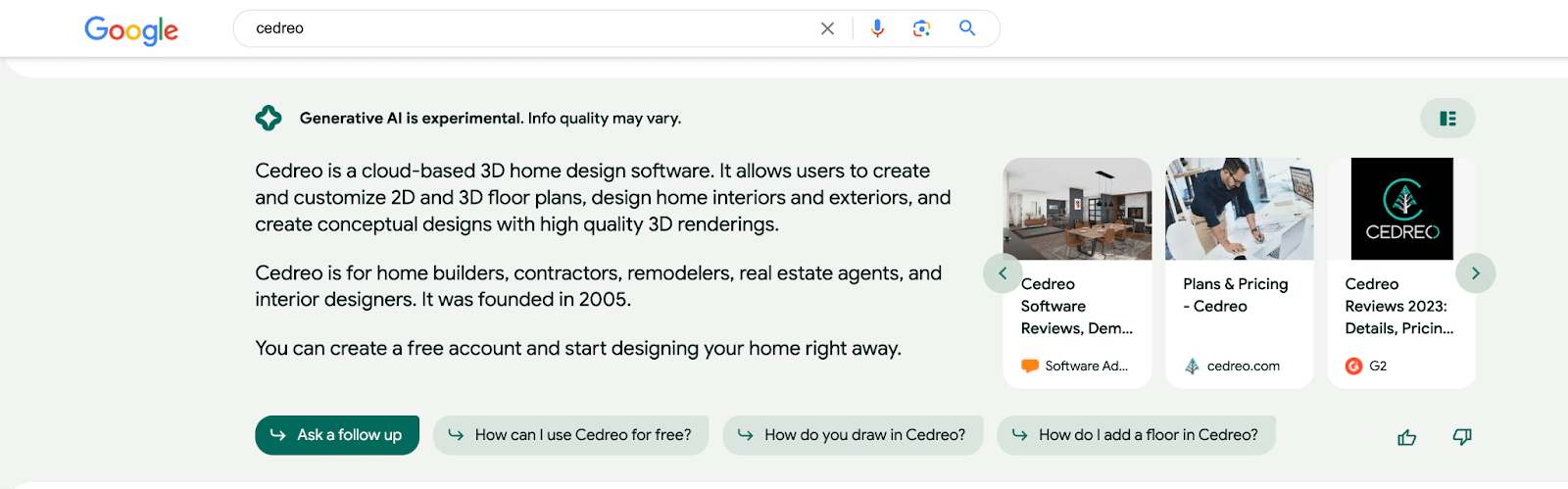
Here is an example of a brand doing it right.
Cedreo has a clear, simple, and accurate description, their website in the cards on the right, plus two relevant review sites and great follow-up questions that lead users further along the customer buying journey.
They have a clear and solid digital ecosystem which is the minimum goal for every brand.
10. Brand SERP pages 2 through 10
Reputation issues aside, the real insights are on positions 20-100 of the search results. This shows you are doing wrong or aren’t doing as well as you could be.
If you are investing in video, but YouTube results aren’t at or near the top of the SERP, you are wasting resources.
If you are pushing clients to review your company on Trustpilot and it ranks in position 30 or lower, there is a better platform for your market.
If that article dedicated to your company in Forbes is in position 20, then Forbes wasn’t the most relevant public relations outreach.
Or the writing wasn’t well-focused, or you didn’t communicate the most valuable information to the journalist.
If you want more opportunities to improve a digital strategy, analyze the brand SERPs for “{Brand} reviews” and focus there too.
A sustainable digital strategy for brands
This article is a quick and simple overview of how a brand SERP identifies the key issues and prioritizes the different aspects of a holistic digital strategy for a brand over time.
As an in-house, freelance SEO or pure SEO agency, it can be a struggle getting the stakeholders:
Social media managers, website developers, content creators, marketers, customer support, and brand managers to collaborate on anything, let alone agree.
Brand SERPs are an enormous opportunity because it brings them all to the united representation of the overall strategy, and they have a shared KPI that is fundamentally part of SEO.
Google has confirmed it fixed the ongoing issue with Google News indexing. This resulted in many publishers seeing massive traffic declines from Google News for a three-week period, starting around June 21st.
The update. Google posted an update at 5:06 pm ET today, saying, “We fixed the issue with News indexing. There will be no more updates.”
Google initially discovered the issue on July 10th, and Google identified the specific issue the day after, then implemented a fix on July 12th. After the fix was implemented, publishers began to see improvements.
Now Google is confirming the fix worked, and news publishers should see their traffic at mid-July levels.
Why we care. If your site is in Google News and you noticed a traffic drop from Google News over the past few weeks, it might have been related to this Google News indexing bug. Google fixed the issue today and you should have started to notice normal traffic levels from Google News today.
If the thought of preparing your own business tax returns is daunting, you’re not alone. According to research information, there are thousands of tax returns defiled every year, and over half of them are prepared by certified public accountants (CPA’s).
Unfortunately, because these professionals are in high demand, you may not necessarily know how to choose the right one for you. Apart from having the best qualifications, you’re looking to avoid shady tax preparers. There’s no need to look any further, we got you covered! Here’s everything you need to know about choosing a certified public accountant for your business.
Step 1: Compile a list of certified public accountants
Your business is much like your baby. You’re looking for the best person to take care of it. Doing your due diligence is the first step to getting there. Public accountants are a dime a dozen, but want to narrow them down to the best candidates you can get.
Before going straight to the internet, ask for references from friends, family and other business owners you may know. Certified public accountants who come highly recommended are the best to work with.
If references are not an option, a Google search will always come in handy. Search for highly qualified business accountants in your area and look up their services and testimonials. You can go a step further and call some of their references and past clients to hear more about the services they offer.
Step 2: Search the I.R.S. directory
Once you’ve narrowed down your candidates, it’s time to search through the I.R.S. directory. Every paid tax preparer carries a Preparer Tax Identification Number (P.T.I.N) that can be found through an online search. However, this number isn’t indicative of the skills a certified public accountant has, it’s simply a requirement.
The I.R.S maintains a directory of these numbers to show that the professionals are currently recognized by the revenue authority. Remember, not every certified public accountant prepares business taxes, so you’ll have to take your research a step further to inquire.
You can also confirm with your state or national association. States have boards of societies and CPA bodies that maintain online directories and provide a list of certified business accountants upon request.
Step 3: Verify credentials
Just because an accountant states that they have worked with major business and have all the proper qualifications doesn’t mean that it’s all true. Well, it could be true but the only way to confirm this is by verifying their credentials. States come with CPA Verify, which is an online repository of information about certified public accountant.
It’s a great source for verification and will highlight all the qualifications and experiences your chosen accountant has. It’s also best to look at the tax preparer’s website and social media accounts to see the kind of things they post online. Google their name to see what comes up and ensure that nothing is buried.
Step 4: Interview your prospects
Now that you’ve narrowed down your prospects, it’s time to reach out to them. But be warned; if you wait until tax filing season to make appointments with prospective accountants, you may have a hard time finding someone to sit down with. Even if you don’t have all your tax documents ready, set up a meeting as soon as possible.
When you meet with your prospective accountants, bring a copy of your latest business tax return so you can review and evaluate it together. Be open and honest about any significant business changes, to help them assess the situation better. Ask questions like how long they have been preparing taxes, their specialties, rates, billing principles and whether they work as part of a larger team.
With these questions, you’ll easily find the accountant that will meet your business needs and you relate to the most. Once you do, organize a subsequent interview where you’ll discuss your expectations.
Bonus tip
Don’t be afraid to expand your horizons and consider certified public accountants who live in different areas. If you don’t find the professional you’re comfortable with around you, consider looking outside your location.
Ask yourself…
Is a face to face connection really that important to you or are you open to going remote but still taking good care of your business taxes? No matter who you choose, never sign a tax return document before carefully going through its contents. Take time to hire a pro who’ll always have your best interest at heart.