Synonymous with renewal and rejuvenation, spring is the time to clear out the chaos that accumulated over winter. This means it’s time for spring cleaning your home office. All those days, curled up at your desk fighting out the cold with snacks, warm drinks and hot food, scrunching up paper to put in the bin later so you don’t have to move.
Now that spring is returning, it’s time to remove the evidence of the messy and harsh winter.
Decluttering and Organising
Whether your home office is for personal or professional use, keeping it organised is a top priority and the best way to start is by clearing out the clutter.
When spring cleaning your home office, keep an eye out for rubbish, broken office supplies, old paperwork, etc. Anything you don’t need or use that can be donated, recycled, or binned responsibly, get rid of it.
From there, make sure to put everything in its rightful place. Files into a filing cabinet, stationary into a drawer, pens and pencils into a pot. Do anything to keep your office and desk tidy from clutter. Consider a cable organiser too if your cables are constantly getting tangled up.
It isn’t just the physical workplace that you need to declutter though. You should give your digital space a tidy too; delete unnecessary files and emails, organise your folders, and remember to back up any important data.
Doing this will immediately make your home office look and feel tidier, helping you work out what areas you need to focus on next. Remember an organised desk makes for a more productive environment!
Spring Cleaning Your Home Office
When it comes to cleaning your space, you’ll want to start by dusting. Grab a cloth or a duster and start at the top, working your way down. Wipe down the corners where the ceiling and wall join (you may find cobwebs), as well as the light fixtures. Don’t forget to pay attention to your blinds or curtains and windowsills.
Dust and dirt can accumulate on your electronics over time too; this can hinder their performance and longevity. You should take the time to safely clean your computer, keyboard, and mouse using compressed air and electronic-safe cleaning solutions. Don’t forget to wipe down your monitor and screen with a microfibre cloth to remove smudges and fingerprints.
When you’re spring cleaning your home office furniture, whether it be wiping away dust or vacuuming up debris from your chair, check how worn or outdated your furniture looks. It might be worth investing in new pieces or even restoring them yourself as a small DIY project with a fresh coat of paint or varnish.
Give Your Floors Some Attention
If you have wooden flooring in your office, then you should give them a vacuum or sweep before mopping it. Just make sure to use very little water to prevent any warping or damage to your floors. This is the same with laminate flooring.
Luxury vinyl tiles and engineered wood flooring follow the same cleaning rules, however, they’re less susceptible to water damage.
With carpet you just need to vacuum it – making sure to get into all the corners and beneath furniture. If you’re interested in doing a deep clean, consider hiring or buying a carpet cleaner.
Spring Cleaning Your Home Office
With your home office looking tidy and organised, you might notice how bare it looks. Consider adding decorations, preferably personal ones such as photographs or meaningful mementos. You could add a touch of nature through fresh flowers, potted plants or even succulents. Something to bring the room together and to life.
You should keep a consistent cleaning schedule too. This allows you to keep your home office tidy and when it comes time to give it another deep clean, it won’t be as much of a hassle.
As we enter the second quarter of 2024, small business owners must take inventory of their business and personal health. The fresh energy of springtime helps spur positive change in professional endeavors, and sunnier days give new motivation to take better care of wellbeing. A way to improve productivity and physical health is to equip your home office with top-notch, ergonomic furniture.
Have you been sitting on a many-years-old office chair out of convenience? Perhaps you are experiencing harsh back and neck pain that never troubled you previously. You have decreased motivation due to the distracting pain, and your work output is suffering. After sitting in an improper position for a long time, whether weeks on end or even years, one’s body can change and feel the negative impact. These impacts can be disastrous for one’s health and can worsen over time as well.
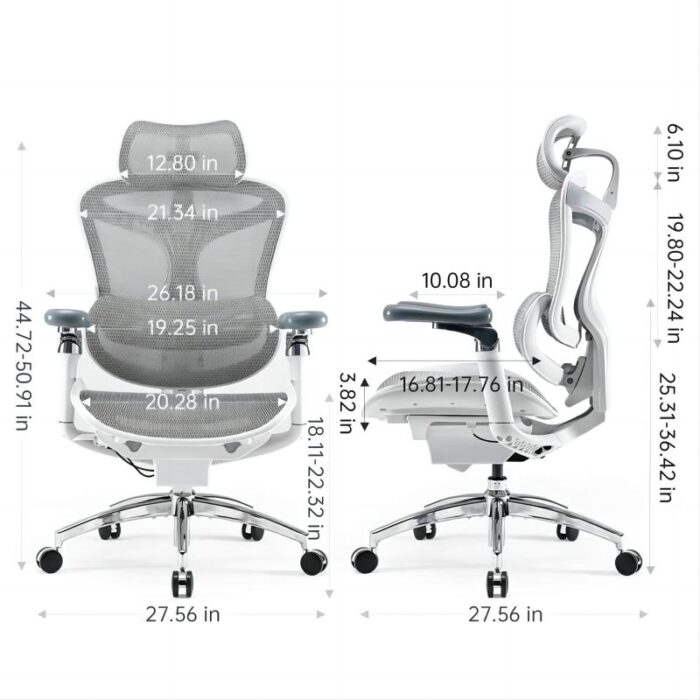
One key way to improve health is to sit on an ergonomic chair. The Sihoo Doro C300 Pro Ergonomic Chair, upgraded from Sihoo’s most popular chair, is engineered to support users of a wide range of body shapes while they complete their business tasks. The design provides comfort for individuals of different sizes and heights.
Features of Sihoo Doro C300 Pro Ergonomic Chair
Seat Comfort
Photo Credit: Sihoo
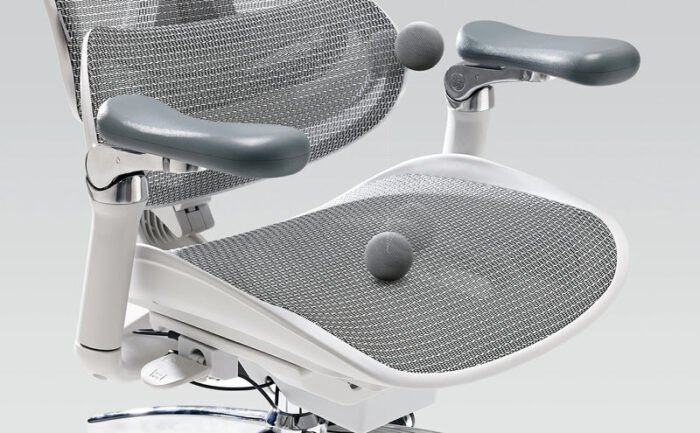
Sihoo Doro C300 Pro’s larger seat cushion increases seating comfort and sitting area for individuals of larger sizes. There is also a seat depth adjustment which enables improved adjustability. One can adjust the seat depth based on personal preference each day. Sihoo Doro C300 Pro’s weight-sensing and mechanical conduction technologies enable the chair to adapt to various weights up to 136 kg (300 lbs) and provide a balanced reclining experience.
Support in Various Postures
Some days you will choose to read an informative book and focus on continuing education. You may take a few gaming breaks, make phone calls, and decide to draw a picture for fun. The rest of the time will likely be spent nose to the grindstone taking care of crucial business activities. These various postures can smoothly be facilitated with the Sihoo Doro C300 Pro Ergonomic Chair. The soft PU-coated armrests, which are now in 6D, can be adjusted up and down by 6.8 cm (2.68 in), back and forth by 4.8 cm (1.89 in), in and out by 8 cm (3.15 in), rotated inward and outward by 70°, and flipped up by 35°. Another benefit is that the armrests coordinate seamlessly with the backrest. The user can comfortably recline and take a nap and rest.
Ease of Adjustment
Photo Credit: Sihoo
Highlighting again the enhanced ease of adjustment with Sihoo Doro C300 Pro, it is key to be able to quickly adjust one’s chair while working in order to not break focus. Perhaps you are in a pivotal call closing a deal with a client and every moment counts. Maybe you have an interested investor looking to provide capital funding for your startup. There is a handle on the right-hand side of the chair which is used to adjust the seat depth, height, and recline angle. There is no need to awkwardly reach down or get up to set one’s seating in the optimal position.
BM (Body Movement) Tracking System
Sihoo Doro C300 Pro has the BM (Body Movement) Tracking System. Prime lumbar support automatically conforms to the spine. This should prevent or reduce back pain as one’s back will be properly supported during the workday. Sihoo Doro C300 Pro supports many different bodily positions as the day progresses and activities change. No manual adjustment is necessary. In addition to the lumbar support, the chair’s streamlined backrest with triangular frame will flex and match the changing positions of one’s back, so there is no break in its adequate support.
Neck Support
Taking proper care of your neck is exceedingly important. The Sihoo Doro C300 Pro has a headrest that can be adjusted side to side, up and down, and rotated to accurately fit the curve of one’s neck. Its wide surface enables one to tilt and rest their head to the side if they decide to take a quick snooze.
A Design Well-Suited for 2024
Photo Credit: Sihoo
Modernized Look
On top of its top-tier ergonomic features, the Sihoo Doro C300 Pro has a modern, luxurious design. It can be purchased in a black or white color style. These colors will fit well with a wide range of home decor styles. Whether in the corner of a bedroom, a nook in the living room, or in its own separate office space, its sleek aesthetic will elevate the space. This will encourage motivation for the user as they take on their work commitments.
Clean Aesthetic
Many homeowners prefer a modernized look and minimal aesthetic. The Sihoo Doro C300 Pro has a very clean design and will encourage forward-thinking and innovation. Entrepreneurs are impacted by their surroundings, so integrating inspiring furniture will inspire renewed passion this spring.
Premium Materials
Its impressive frame and high-quality materials make it an attractive piece of furniture for the home office. It is also very soft and skin-friendly, with a breathable mesh design. The mesh is very elastic, durable, easy to maintain, and stain-resistant. All of these sought-after features enable the comfortable support it provides to the users.
Learn About Sihoo
Sihoo is a prominent specialist in ergonomic furniture, dedicated to offering healthy and comfortable ergonomic products. With a 12-year focus on technology and well-being, Sihoo products provide a comfortable and invigorating seating experience, enabling you to work more productively and bring your creative ideas to life.
Sihoo believes everyone can live a comfortable and healthy lifestyle. Sihoo specializes in crafting ergonomic furniture that caters to the diverse needs of individuals worldwide. With a strong commitment to accessibility, they make sure that people from all walks of life can enjoy the benefits of ergonomic support and comfort.
Final Thoughts on Sihoo Doro C300 Pro Ergonomic Chair
Photo Credit: Sihoo
Home business owners must do due diligence to ensure proper physical health. As many self-made workers spend a great deal of time clicking away on their laptops, supportive furniture is truly key. Those many hours can pass by quickly without one realizing they have been hunching all day in deep focus. Integrating the Sihoo Doro C300 Pro Ergonomic Chair in the home workspace may lead to positive, long-lasting physical effects.
Ergonomic equipment can help prevent serious health issues down the line. There are many ergonomic options on the market today, leading to a healthier workforce. Workers of all generations have taken note of the many advantages of adding ergonomic equipment to the home and corporate offices. It is important for businesses of all sizes to take care of their employees and provide furniture that will keep them healthy and happy.
At the end of the day, if one’s physical health is in jeopardy, it will have a domino effect on all aspects of one’s life. Taking charge of one’s health well in advance, if one’s circumstances permit doing so, is a smart decision not just for long-term productivity, but overall wellbeing for years to come. The Sihoo Doro C300 Pro Ergonomic Chair may be the ergonomic investment one needs in their home office workspace in 2024.
Google announced a range of new advertising tools and solutions for mobile app developers at the Games 2024 Developer Summit, including:
AI asset suggestions.
Real-time bidding buyers.
Upgraded mediation toolkit.
Improved A/B testing.
Immersive in-game ads.
Geo-based, controlled experiments.
The tech giant said the updates are designed to “enhance creativity, diversify revenue and make data-driven decisions.”
AI asset suggestions. Google confirmed that image suggestions for App campaigns are now generally available, while text suggestions are currently in beta testing. These suggestions, including headlines, descriptions and images, come from various sources such as your website, the Google Play store, asset library and stock images. They will now be displayed for you to review and add to your campaign during its construction phase.
Real-time bidding buyers. Google is making new real-time bidding buyers available in AdMob to “amplify revenue impact for app publishers.” Unity Ads Network and ironSource Ads will soon be able to bid on publisher inventory available with AdMob.
Upgraded mediation toolkit. AdMob is introducing an enhanced mediation segmentation feature, soon to be available in beta, which allows for customized ad experiences based on various user behaviors. For instance, this feature enables you to adjust mediation settings such as price floors to better optimize ad interactions for users who are less inclined to make in-app purchases.
Improved A/B testing. AdMob is launching an enhanced A/B testing tool for publishers who experiment with multiple mediation setups. This tool will deliver results within days, accompanied by comprehensive reporting visuals and metrics. The improved A/B testing functionality is set to be available in beta soon.
Immersive in-game ads. AdMob introduced immersive in-game ads, currently in closed beta. Developers such as APPS, NewStory, Supercent, and Unico Studio are actively testing this new ad format in their games.
Controlled experiments. In response to the evolving privacy landscape, Google is introducing geo-based, controlled experiments to accurately measure the incremental return on investment from advertisers’ spending on iOS and Android App campaigns. This solution is currently available for campaigns targeted to specific countries.
Why we care. Keeping up-to-date with Google’s new and improved features is essential because they’re usually aimed at making your job easier, streamlining campaign management, and boosting campaign effectiveness for improved return on investment.
What Google is saying. A Google spokesperson said in a statement:
“Every year, the games industry continues to stay at the forefront of innovation by adopting new technologies and growth strategies.”
“As we continue to share more innovative ads solutions, we hope you’re empowered to expand the scale and possibilities of your advertising campaigns and monetization strategies.”
Get the daily newsletter search marketers rely on.
TikTok updated its Effect Creator Rewards program to improve monetization opportunities for current members and expand access to creators in new markets.
By extending the program to 33 additional markets and lowering eligibility criteria, TikTok aims to engage more creators in the initiative.
Why we care. The Effect Creator Rewards program serves as an additional revenue stream for eligible content creators. It also incentivizes creators to focus on generating engaging content that resonates with viewers, increasing the likelihood of conversions for brands working with them.
TikTok Effect Creator Rewards. The TikTok Effect Creator Rewards program offers creators the chance to earn rewards for designing engaging TikTok effects within its platform, Effect House.
More markets. Content creators in the following regions are now eligible to join Effect Creator Rewards and begin monetizing their effects:
Argentina.
Austria.
Bahrain.
Belgium.
Belarus.
Chile.
Colombia.
Czechia.
Denmark.
Ecuador.
Egypt.
Greece.
Hungary.
Israel.
Kazakhstan.
Kuwait.
Mexico.
Morocco.
New Zealand.
Norway.
Oman.
Peru.
Portugal.
Qatar.
Romania.
Saudi Arabia.
South Africa.
Sweden.
Switzerland.
Taiwan.
Thailand.
Turkey.
Uruguay.
Lower eligibility requirements. Previously, creators required an effect to be used in 200,000 qualified videos before it could start earning rewards. Now, each effect only needs to be used in 100,000 qualified videos to begin unlocking rewards.
Accessibility. From March 12, 2024, only effects featured in qualified public videos will be able to earn rewards. This applies to effects released after this date. Effects released before this time will still adhere to the previous payout rules and requirements.
Cash rewards. Reward amounts may vary depending on the region where the videos are published. The maximum payout for a single effect is $14,000, while the maximum payout for a single creator per month is $50,000.
Reward calculations. Creators earn rewards based on the total number of qualified video uploads or unique public videos from eligible regions that use their effect within the first 90 days. Once an effect reaches 100,000 unique public video uploads, the creator starts earning rewards. Rewards continue to accumulate for each additional qualified video upload until the end of the 90-day period or until reaching the maximum reward.
What TikTok is saying. TikTok said in a statement:
“Last year, we launched Effect Creator Rewards to celebrate our creator community and the outstanding effects they create for TikTok. Since then, creators from all over the world have been able to collect significant cash rewards for their trending effects. In fact, some creators have reached the maximum payouts of $14,000 per effect and $50,000 per month.”
“[Our] updates to Effect Creator Rewards enhance opportunities for existing members and expanding the program to more creators.”
Get the daily newsletter search marketers rely on.
We all laugh at the ‘brick’-style mobiles of the 1980s and ’90s or the silly flip phones of the early 2000s, compared to today’s ultra-slim and chic handsets.
However, many people don’t realise collecting certain mobile phones from these decades past and selling them on eBay can be a good way to make extra money.
Here’s our quick guide to doing this successfully:
As with all commodities, the rarer your vintage mobile phone, the more you will be able to charge for it. Which, in this case, means that handsets dating back to the 1980s are typically worth a lot more than those manufactured between the 1990s and now.
However, age is not the only thing that matters. Here are a few factors to keep in mind:
Is the phone in mint condition? Phones that are well-preserved can fetch a much higher price than those that have nicks, scratches or cracks.
Do you still have the original packaging? If you can sell the phone in the very box it came in, your price can shoot up even more.
Has the battery caused any damage? If you own an old phone, it’s wise to take the battery out and store it separately as they have a tendency to corrode with age. Rather than risk damaging the phone, remove the battery and keep it safe.
Phones worth selling
Wondering if your old brick is worth a listing on eBay? Mobile Phone History has a great price and rarity guide that you can use to cross-references prices on eBayand the likes.
However, we conducted a quick search of our own and found the following are all good bets to get you more than £500 a pop:
1981 Mobira Senator – the ‘daddy’ of them all and the the first ever Nokia phone currently fetches around £1400 (if in a good condition)
Orbitel Citifone – just about as rare as you can get, selling a 1985 Citifone could make you around £900 richer.
Motorola DynaTAC 8000x – the world’s first commercially-available hand portable mobile phone first arrived in the UK in 1985 and cost £3,000 per handset. These days you can sell one of these mobile dinosaurs for between £300 and £800.
Motorola 8100L – first manufactured in 1988, this rare find can go for up to £550.
Nokia 9000 Communicator – fast forward a decade or so, the Nokia 9000 Communicator is considered to be the forefather of the modern smartphone and was first introduced to the market in 1996. If you have one in good condition, you could sell it for close to £1000.
Nokia 8800 – stepping into the new millennium, the Nokia 8800 slide phone was considered super chic, luxurious and highly fashionable at the time. It’s making a huge comeback among vintage fashion lovers and – depending on the condition and the colour – you could get more than £1,500 for your old phone.
How much can I make?
Anything from small change to hundreds depending on what you’ve got.
If you have owned one of these phones and can’t remember what became of it, you might still have it in your attic or at the back of a cupboard, so it’s well worth having a rummage.
While the phones listed above can get you the big bucks, let’s just be honest – most of us don’t have these models lying around. And if we do, it may be too late to salvage them from the toy box or the junk drawer.
No need to despair, however, as you can even get pretty decent prices on eBay for more common stalwarts such as the Nokia 3310 and the Blackberry Pearl Flip.
Of course, there is also always the option of selling your discarded devices at electronics fairs or car boot sales. While you may not be able to market it to an audience as big as eBay’s, people who frequent these types of sales normally know exactly what they’re looking for (which might just be your old phone) and will pay good money for rare finds.
If you’ve just upgraded to a snazzy new phone and want to cash in on your old one, check out our article about recycling mobile phones.
If you’re just starting out as a freelancer, you’re likely to have one question straightaway: where can I find clients?
Not being able to find work is one of the most daunting parts of being a self-employed freelancer. Luckily, though, there is a tonne of work out there for those who are bold enough to strike out on their own. Often, freelancing can feel more stable than a traditional career path – especially if you have multiple income streams that you can rely on, rather than just one. Also luckily, this is true of most industries that hire freelancers.
So, where do you look? In this article, we’ll introduce you to a few different routes that you can use to find clients. Let us know if you’ve found work in a way that we’ve missed…
Job boards – the Reed, Monster, Indeeds of the world – are ten a penny, and you might need to sift through a lot of irrelevant postings before you find work that’s appropriate to you. They can still be useful, though. Just make sure your email alerts are filtered so you’re only seeing the jobs you might want. Freelance journalists should keep an eye on Cision, where hundreds of roles are advertised. For the wider media, Mediargh and The Media Mentor are good options.
There are freelance specific job boards, too. Check out The Dots and Underpinned for great roles across numerous creative freelance areas.
Recruiters
You might not think you’ll find clients for your freelance work through recruiters, but hear us out! If you’re looking for longer term gigs (maternity covers, for example, or one-off projects that might take a few months to complete) this can be a great option.
Recruiters can really help you out when it comes to things like pay and contracts. Best of all, they’ll find the opportunities so you don’t always have to. Taking on contracts can be a great option if you want a reliable income stream for a few months. Look for recruiters that specialise in temporary contracts, and be clear about the kind of work you do (and don’t) want to do.
Newsletters
Freelance journalists across the land have been singing the praises of Freelance Writing Jobs, the weekly newsletter by writer Sian Meades-Williams, for a while. Landing in inboxes every Thursday, FWJ lists all the best (paying) opportunities of the week – from in-house poets to editors laying out pitching guidelines for their glossies. Sign up if you’re a writer of any kind. Look for similar initiatives within your own industry if you’re not.
Journalists should also check out journalist Anna Codrea-Rado’s The Professional Freelancer, a newsletter with a wealth of invaluable advice and relevant musings.
Mine your network
This is the time to make sure everyone you have contact with know that you’re self-employed and open for business. This includes the random connections on your LinkedIn profile, and extended family members. Spread the message widely, and don’t be afraid to reach out to old colleagues or acquaintances who might be able to help. Meeting people for coffees to update them on your work is a great way to stay in touch. You never know, that person from your old job could introduce you to a potential new client or spark the best idea you’ve had all year…
Freelance communities
As the freelance workforce grows, more and more groups are popping up to support both the newly self-employed and those with existing experience. Across the creative industries, the culture of community is rife. Everything from advice on finding clients to financial management (and even just the company of others in a similar position) is being freely offered.
You’ll probably have heard a million times that you need to display your best work online via your website and online portfolios. But it doesn’t make it any less true! If you display your work clearly and your story is engaging, and if you’ve got details of how you can be contacted displayed prominently, you’re on your way to having clients coming to you rather than the other way round. If you need to, invest in a graphic designer to get your website looking as professional as possible. You won’t regret it!
When it comes to online portfolios, you know better than us about the ones that are best suited to your specific industry. Do your research, and make sure you’ve got profiles and work displayed on the general freelance portfolio sites (Behance, The Dots, Underpinned) as well as the ones that are more specific to your sector.
Find clients at conferences
Conferences can be great places to meet people within your industry. That can include potential new clients as well as those in a similar position to yourself. Even virtual events, which have largely replaced face to face ones in 2020, can be a great springboard for conversations. It’s time to get involved…
Social media
Finally, we couldn’t end this piece without giving a shout-out to the behemoth of freelance opportunity that is Twitter. In journalism circles, editors with a pitching budget often head straight to the timeline to shout about the opportunities they have, what they’re looking for, and how you can contact them. Is that the same in your industry? Maybe – and you won’t know unless you’re paying attention. Believe us, the time you spend scouting for new clients on Twitter is rarely wasted!
We hope this has given you some inspiration on where to find clients for your upcoming freelance projects. If you’ve got an idea that we haven’t talked about, we’d love for you to share it. Let us know over on the forums!
Now read:
Need more help setting up your freelance business? Read these articles next!
As entrepreneurs and business leaders, you tend to want to control everything. After all, it is your vision you’re trying to bring to life! But the hard truth is attempting to manage every little detail on your own quickly leads to burnout. Learning about thoughtful delegation of tasks is essential for growth. So, here are signs it’s time to start letting go of control in your business and how to do it while maintaining quality and accountability.
Recognize the Signs That You’re Overextended
Before just handing off work to the first willing team member, make an honest assessment of your current bandwidth. Are you working excessive hours, including weekends, yet still falling behind? Do you constantly feel overwhelmed and in crisis mode? Are small details starting to slip through the cracks? These are clear signals it’s time to start delegating.
Map Out Your Company’s Processes
Part of effective and thoughtful delegation involves identifying responsibilities that align with other people’s strengths while freeing you up to lead from your unique zone of genius. But first, you need crystal clarity on what all of those different responsibilities are. Take time to map out the workflows, processes, and standard operating procedures across your business before trying to hand off tasks.
Know Where to Start
When you’re ready to begin delegating, prioritize the responsibilities that are either extremely time-consuming for you personally or fall far outside your wheelhouse in terms of skills and interests first. For most founders, this includes heavy admin work, financial tasks, legal filings, technical support, and other infrastructure roles that keep the trains running on time but don’t utilize your core talents.
Document Everything Thoroughly
You’ve probably gotten in the bad habit of keeping much critical knowledge about processes in your business locked away in your own head. Resist that urge from here forward! Clearly write out instructions for completing key tasks and institutionalize that knowledge within your company, not yourself. This thoughtful delegation allows new team members to ramp up faster.
Find the Right Person For the Job
Not all delegation is created equal. You want to match responsibilities to each team member’s authentic strengths and interests as much as possible so they’re energized to take ownership of that piece of the puzzle. Spend time getting to know new hires personally and review resumes closely to assess transferable skills when handing off work.
Set Clear Expectations Upfront
When initially passing off responsibilities, set very clear expectations around quality standards, deadlines, policies to follow, communication protocols, and anything else vital to that role. Establish measurable goals and key performance indicators for longer-term assignments as well so you can keep tabs on progress. Remove as much ambiguity as possible early on.
Check In Regularly
Once you’ve delegated tasks, don’t just disappear expecting finished work to eventually materialize unmonitored! Schedule regular check-in sessions to provide any additional context needed, answer questions, and monitor roadblocks. Show you’re invested in that person’s success in taking on the new responsibility.
Develop SOP Documentation
Rather than verbally tell someone once how to complete a complicated or multi-step recurring task, develop SOP (standard operating procedure) documentation they can reference as needed. Break down each step of the process, include screenshots as appropriate, and store everything digitally for easy access. Highly detailed SOPs mean less hand-holding required of you later.
Automate Where Possible
Dedicate time upfront to determine what responsibilities can be fully or partially automated with technology rather than assigned to human resources long-term, even if the platform costs some money. For example, snagging a virtual assistant to handle calendar management or using AI tools for content creation. Any established financial blog should help you find the right tools. This scales impact exponentially.
Start Small
When ready to start relinquishing control, begin slowly by delegating well-defined, relatively contained tasks rather than entire huge chunks of your business right away. This kind of thoughtful delegation minimizes risk exposure while you evaluate compatibility and capability. Increase the scope and ownership of assignments as your confidence and your employees’ skills grow.
Express Appreciation
Don’t just delegate work, then ignore those helping expand your company’s reach! Check-in often with both praise for jobs well handled and constructive feedback when expectations didn’t quite hit the mark. Recognize dedicated team members publicly for going above and beyond. Appreciation fuels engagement and retention.
Step Back Slowly
Even once you’ve delegated key tasks, it’s natural to feel hesitant to fully let go out of fear things won’t run smoothly without your direct involvement. Ease the transition by slowly decreasing check-ins and oversight touchpoints. Gradually back off support only as competence proves itself over time.
Wrap-up
Learning about thoughtful delegation of responsibilities won’t happen overnight after running solo for so long. But take it step by step, leveraging the strategies above, and soon you’ll lead a highly capable team able to exponentially increase results, freeing you up to focus on big-picture vision and growth.
Joe Biden said he would sign legislation banning TikTok in the U.S.
The House of Representatives will vote this week on a legislation giving TikTok’s owner, China’s ByteDance, six months to divest the app. If ByteDance doesn’t comply, TikTok might face a complete ban in the U.S., affecting its 150 million users.
When asked by reporters to comment on the vote, President Biden said: “If they pass it, I’ll sign it.”
Why we care. A U.S. ban on TikTok would significantly impact advertisers, especially those targeting Gen Z. This demographic favors TikTok over platforms like Google, making it a crucial channel for advertisers seeking to reach this audience.
Next steps. While the White House offered technical support in drafting the bill, White House press secretary Karine Jean-Pierre mentioned earlier this week that the TikTok legislation “still needs some work” before reaching a point where President Biden would endorse it.
Legislation proposals. The proposed bill adopts a dual strategy. Initially, TikTok’s owner ByteDance will be forced to divest the platform within 180 days of the bill’s enactment; failure to do so will result in its prohibition in the U.S.. Additionally, the bill sets up a clear procedure, giving the executive branch the power to limit access to apps owned by foreign eadversaries, especially if they pose a national security threat.
Security concerns. The vote is being held to address concerns related to national security surrounding TikTok’s ownership. The app is owned by ByteDance, which is based in Beijing and therefore falls under China’s controversial cybersecurity laws. These laws, among other things, contain provisions that could potentially require TikTok to hand over U.S. user data to the Chinese Communist Party upon request.
White House ban. Amid security concerns, President Biden banned almost four million federal government employee from using TikTok on government devices. However, those same concerns didn’t stop the president from joining the platform to promote his re-election campaign last month.
What TikTok is saying. TikTok accused U.S. Senators of staging a “predetermined” vote to ban the platform in the U.S. The platform said in a statement:
“This legislation has a predetermined outcome: a total ban of TikTok in the United States. The government is attempting to strip 170 million Americans of their Constitutional right to free expression.”
“This will damage millions of businesses, deny artists an audience, and destroy the livelihoods of countless creators across the country.”
Get the daily newsletter search marketers rely on.
Microsoft Ads expanded its Copilot trial to a larger set of advertisers.
The company confirmed to Search Engine Land that it is giving more advertises access to Copilot as it continues to collect data, test, optimize, and work towards a general availability.
First spotted. The expansion of the program was first flagged by Senior Performance Marketing Manager and Google Ads expert, Thomas Eccel. He reported seeing the tool within Bing Ads and shared a screenshot on X:
What is Copilot? Specifically designed for advertisers and agencies, Copilot leverages AI to generate recommendations for assets such as product images, headlines, and descriptions.
How it works. A user describe the content needed, like an image, and Copilot generates suggestions based on the description.
Why we care. Copilot may simplify asset creation, saving users time, and providing inspiration for better-quality materials for campaigns. This functionality should also be more efficient than using stand-alone generative AI tools because it’s baked-in to the Microsoft Advertising Platform.
What has Microsoft said? Last September, Kya Sainsbury-Carter, VP Global Partner & Retail Media, Microsoft Advertising, said in a statement:
“With Copilot in the Microsoft Advertising Platform, Compare & Decide Ads, and new Chat Ads partners, we are making progress in this new era of generative AI.”
“Generative AI represents a massive opportunity for all. It creates new value with real purpose. It creates opportunities for advertisers, drives traffic for publishers, and delights consumers. The era of AI is here, and we’re just getting started.”
Get the daily newsletter search marketers rely on.
In November, I conducted a survey aimed at SEO professionals, delving into their perspectives on climate change.
This article unpacks the survey results, highlighting key findings and offering practical advice for SEO professionals looking to impact the environment positively.
But first, let’s explore why the link between SEO and climate change matters.
Why ask SEOs about climate change? What’s the link?
While we’re slowly transitioning toward a net-zero environment, many scientists believe this won’t be enough to halt the impacts that are felt worldwide due to human activity.
I think it falls on all of us, whatever industry we’re in, to try and help limit our carbon emissions. And as SEOs we’re in a great position to help shape traffic on the web.
People will always demand to find information and products online that satisfy their needs – and as SEOs, we have a great opportunity to ensure any such requests are directed to environmentally responsible businesses.
By choosing and supporting eco-friendly clients, SEOs can help shape demand in a more eco-positive direction – which has the potential to have a huge net impact.
I think lots of SEOs haven’t made the connection that when websites are visited and indeed through all of our digital actions, whether searching on Google or posting on social media, we are creating carbon emissions as well as using up valuable natural resources like water – especially when considering the environmental costs of using AI.
What if SEOs can instead help push clients towards adopting more eco-friendly web practices, starting with curbing the emissions of their website?
The results of the climate change survey
We had a total of 331 responses from around the world. Below, I will share all the results and pick out any interesting answers.
Backgrounds of the respondents
33% of respondents were based in Europe, followed by the UK (26%), North America (21%) and Asia (11%).
62% of respondents were male, 34% female.
There was a near-even split with respondents’ job positions, with 33% working on a freelance/consultancy basis, 31% working in-house and 31% working within an agency.
47% of respondents’ main area of SEO expertise was in technical, 34% content and 9% ecommerce.
Q1: How to reduce the environmental impact of a website?
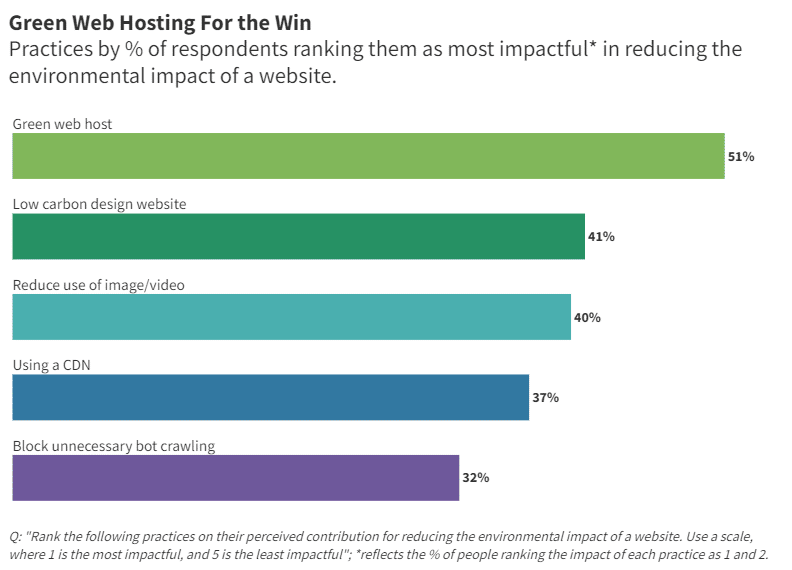
While using a green web host was the winning option here, surprisingly, there were mixed results for low-carbon design websites, with many people (85) choosing that as the least impactful option. At the same time, many people (76) also chose that as the most impactful option.
For those who aren’t sure, a green web host is considered to be powered by renewable energy – solar or wind, for example. If you want to find a verified green web hosting provider, use the Green Web Foundation’s Directory.
Despite blocking unnecessary bot crawling being the least selected option here, this might be one the easiest and most efficient ways of reducing the environmental impact for most websites.
That might surprise many, but for anyone who spends any time doing logfile analysis, most sites are now being hit by a huge amount of unrequested bots and web crawlers.
This was a broad question, and the subsequent feedback from respondents was that it was incredibly hard to answer accurately (more on this at the end of this article).
Q2: Have you ever used an online carbon calculator tool to estimate carbon emissions from a website?
Responses to “Have you ever used an online carbon calculator tool to estimate carbon emissions from a website?”
64% said no, 33% said yes and 3% weren’t sure.
While these online tools aren’t perfect (more on this in Q4 below), they are still a great starting point for those wanting to check the approximate emissions from their client’s website.
One of the most popular sites to test your website’s carbon footprint is Website Carbon.
The Website Carbon calculator showing the carbon rating of the searchengineland.com website
There’s also a great write-up on other website carbon footprint tracking tools that can help monitor the emissions from websites, including some options that go into a bit more depth than the WebsiteCarbon calculator.
Q3: Who in a business should be responsible for addressing their websites’ carbon emissions?
42% of respondents felt this was everyone’s responsibility, while 19% felt it should fall under management’s responsibility and 18% felt it fell under the IT and web development team’s responsibility.
I was happy with the top response here, as I feel progress is only made if everybody is brought on board and is fully engaged – a bit like a successful SEO project.
Sustainability or even reducing carbon emissions in this context shouldn’t just be considered a tick-box exercise.
Q4: If Google included web page carbon emissions in their Core Web Vitals initiative, would it encourage more SEOs to reduce the carbon emissions of client websites?
78% of people agreed, 12% weren’t sure and 9% said no.
Meaningfully tracking carbon emissions from websites is a fairly contentious topic. In a nutshell, it is not easy to do it 100% accurately, based on the current technology and available software.
When a website gets loaded, many resources must be accessed on a web host, including images, videos, CSS, HTML, JavaScript, fonts, tracking cookies, etc.
These all have their own associated emissions because they are physically hosted somewhere in the world, with a data center powering them.
If a full webpage load requires 4MB, while this is easy to convert into carbon emissions (in theory), we then have to figure out the kind of power being used by the consumer’s device.
If they are using renewable energy, then emissions will be lower. But it’s hard (nearly impossible) to know what kind of energy source they use.
The other issue is that these carbon emission reports take a static view of a website. If you put Netflix’s likes into the tool, they might get an A+ rating because the homepage isn’t big in terms of data usage.
However, we all know that when someone goes to a streaming platform like Netflix, they will have a long session duration (30 minutes minimum) and will be streaming high-quality video, which will have a bigger carbon footprint.
When I wrote this survey question, I felt it would be a win-win situation – Google rewards sites that reduce their carbon emissions, and so SEOs (and businesses) will, therefore, prioritize doing this.
But as the above shows, getting meaningful data on a website’s true carbon emissions isn’t quite easy.
Q5: For agency folks, would you feel comfortable declining to work with a client that was a known fossil fuel polluter?
There are arguments to be made around this question (specifically, how someone might know if a client was a known polluter or not). Still, it was nice to hear that around 75% of all respondents did feel comfortable speaking about this with their manager.
I think it’s important that if someone isn’t comfortable working with a client, for whatever personal reasons they might have, they feel able to talk about it with their manager and find a suitable resolution.
Q6: Why isn’t making websites greener a higher priority within businesses?
For this question, I allowed respondents to select more than one option, as it’s possible that there isn’t just one reason why this happens.
The most selected option was “due to limited knowledge of the environmental impact” – 38% of all respondents chose this as the main reason.
One takeaway from the above would be that further education is needed on the issue at hand – it sounds like business owners are simply unaware of the environmental impact of powering their websites.
At least if we are able to help educate business owners on the problem, it would then put them in a better position to be able to decide whether they do or don’t want to take further action to reduce their own environmental impacts.
Q7: Would SEOs purchase eco-friendly swag at SEO conferences?
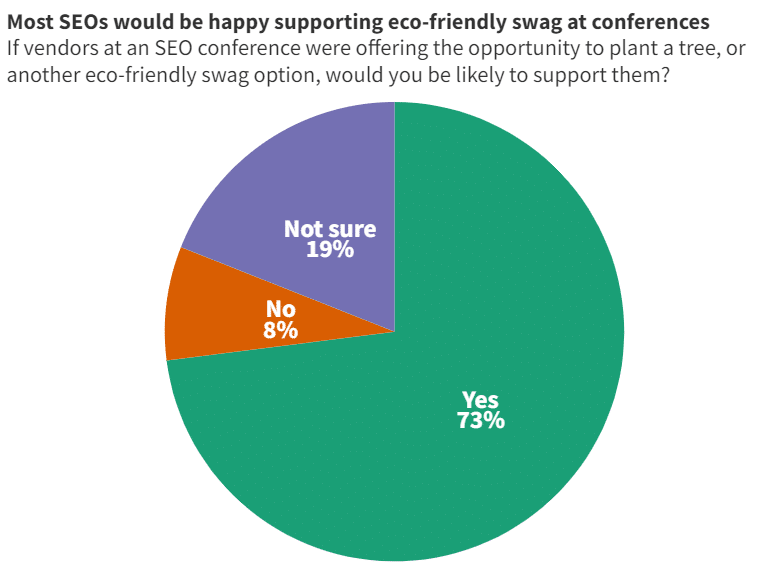
Out of all respondents, 73% of people said yes, 19% weren’t sure and 8% said no.
I do know that some SEO conferences like BrightonSEO already have made steps to allow attendees to support more sustainably minded initiatives, such as supporting certified tree planting schemes when purchasing a ticket for the event.
I think a lot of single-use plastic gets used for SEO merchandise and swag, with many items excitedly given away by companies that will ultimately end up in landfills.
Q8: Would you pay extra to attend an SEO conference so they can be live-streamed?
Looking at how many people travel very long distances to attend SEO conferences, I was curious if people would be willing to pay an additional fee (e.g., 5% more) for the conference to be live-streamed online, allowing people to watch remotely – making it more accessible and avoiding some travel.
Of all respondents, 65% said yes, they would be willing to pay extra. 19% weren’t sure and 16% of respondents said no.
I have since realized that many big SEO conferences already record their shows, allowing those who’ve paid to watch from home after the event.
Survey feedback here suggested that this responsibility should fall on the conference organizers instead of pushing the cost over to any attendees, which is a fair point.
Q9: How many flights have you taken in the past 12 months as part of your work as an SEO?
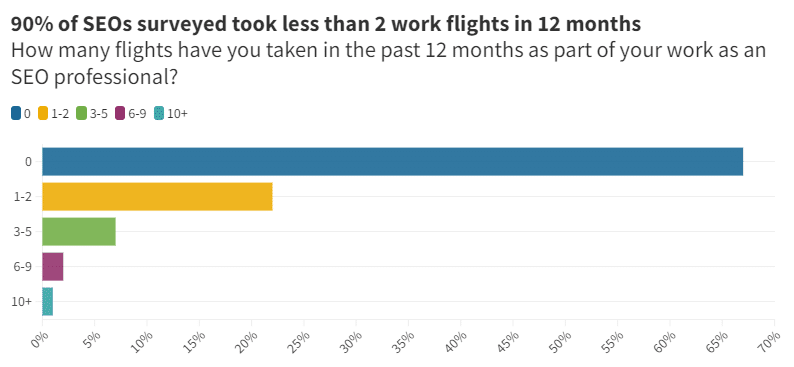
67% of respondents hadn’t taken any flights, 22% had taken 1-2 flights, while 8% had taken 3-5 flights.
While I realize for some SEOs that not flying might be unavoidable, and that there are a lot of benefits from in-person meetings or from attending conferences, I do still think it’s possible to operate as a fairly successful SEO without traveling by air.
Q10: Do you think climate change will have an impact on you personally?
A huge 90% of respondents said yes, they do believe it would, 5% said they were not sure, and 4% said no, it would not impact them.
Even if we’re not aware of it, we’re already feeling the effects of climate change with an increase in the cost of food, brought upon partly by long periods of drought, flooding or some non-climate related issues.
Get the daily newsletter search marketers rely on.
From doing this survey it became clear that I am definitely not the only SEO who cares about this topic a great deal. Here are a few more suggestions for those keen to take this further.
1. Check out the Green Web Foundation – and check if your website is hosted using green energy
Many great initiatives already exist in this space within the field of web development, such as the Green Web Foundation.
The Green Web Foundation has also created an open-source JavaScript library called CO2.js, which enables developers to estimate the emissions related to the use of their apps, websites and software.
You can quickly check whether your website runs on green energy or not using another of their tools, as shown below.
2. Use a log file analyzer like Screaming Frog and check your site’s CO2 emissions
Screaming Frog has included the Green Web Foundation’s CO2.js within a recent update to their Log File Analyzer, and this can be configured to find the CO2 impact of both bots and users.
Total CO2 emissions from Googlebot and Bingbot as shown by Screaming Frog’s logfile analyzer.
You can see CO2 emission estimates from the traffic going to your own or your client’s websites and check that of bots, scrapers and third-party SEO tools hitting your site and eating up valuable resources.
Carrying out log file analysis would be a great way to determine a plan to reduce unnecessary resource consumption on your web host.
3. Educate your clients about their websites’ carbon emissions
Once you’ve used a tool to check how much carbon emissions a website generates, why not use the report or output to start a conversation with your client?
As shown in Q6 above, many clients likely lack education about the emissions caused by their website. Sharing a report from one of these tools might be a great way to bring the topic up.
The Website Carbon Calculator by Wholegrain Digital is a simple and visual tool. I asked their digital sustainability lead, Marketa Benisek, to share her thoughts on the calculator.
“We launched Website Carbon in 2017 with a singular objective: to raise awareness about its negative environmental impact of technology. The actual calculations involved are incredibly complex and rely entirely on the latest research, drawing from both academic studies and insights from industry experts. Despite the inherent imperfections in these calculations, we like to stick to the mantra ‘don’t let perfect be the enemy of good.’
The key focus doesn’t lie in achieving absolute precision but rather in striving for progress.
Whether the calculated emissions stand at 0.68 gCO2e or 0.71 gCO2e, the key goal remains consistent: to help people collectively create a sustainable internet that is good for people and planet.
Sustainable websites offer a multitude of benefits beyond environmental concerns, including improved performance, accessibility and the potential for improved search engine rankings (when implemented effectively).”
Marketa Benisek, Digital Sustainability Lead at Wholegrain Digital
4. Continue to track emissions using a tool like Ecoping
Knowing your website emissions is great, but what’s even better is having a dashboard that can track the emissions daily, allowing you to monitor changes over time.
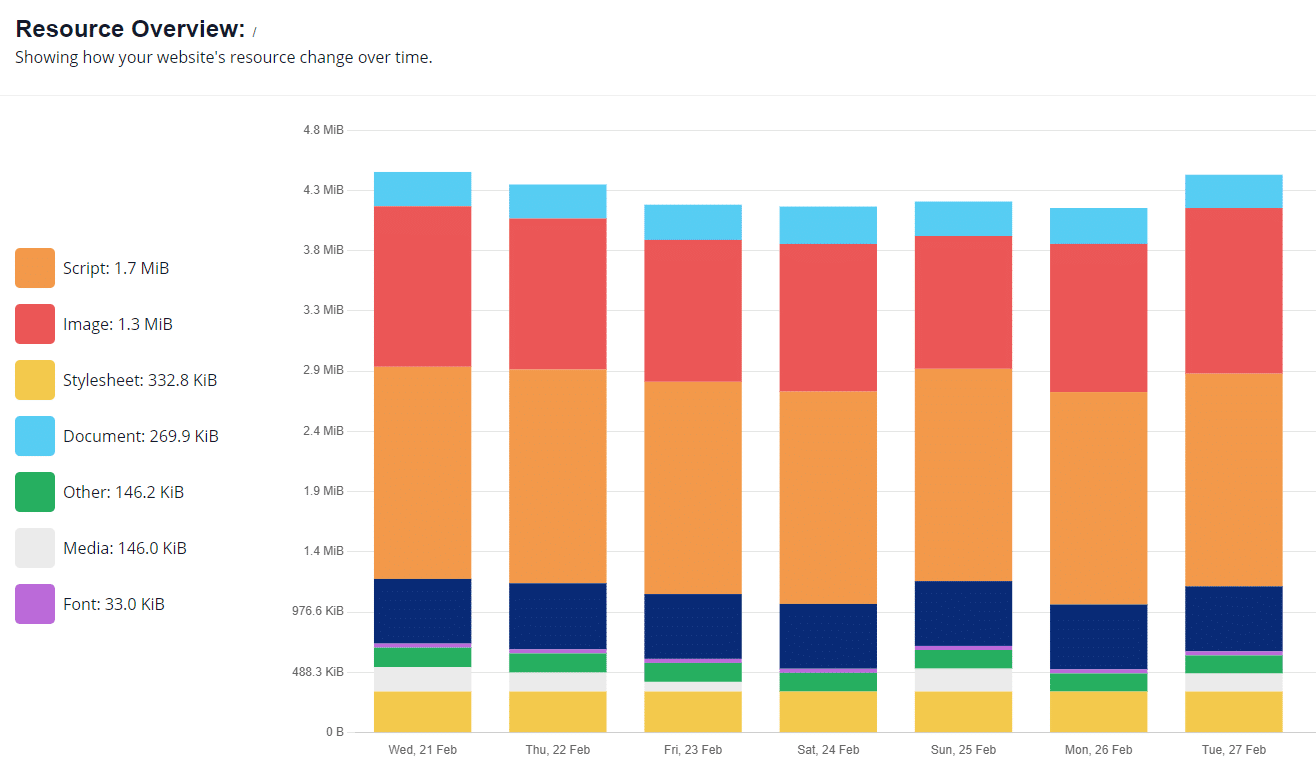
The resource overview from Ecoping shows the breakdown of website resource changes over a 7-day period.
Ecoping is a great tool that allows you to do just that. Compare your emissions against other competitors and easily share reports from Google Lighthouse and Core Web Vitals with development teams to help prioritize any improvements.
5. Be more vocal about web sustainability amongst peers and within communities
Why not raise this topic with your peers and any other communities you belong to? Even bringing this up on social media can be a good starting point.
You can also try joining other web communities. I’m sure you would find more people passionate about this topic within the world of web development. They’ll probably be happy to see SEOs showing an interest, too.
Don’t forget there’s no substitute for real communities. Try attending local digital marketing MeetUps or other events – finding someone local with similar interests can be a great way to build a strong network.
I think just by talking about this subject more openly, you will find others will do the same and that will create a snowball effect.
6. Be more mindful about your own digital actions and the impact they have
While there’s a lot you can do offline to reduce your own carbon emissions, there’s also a lot of online-related activity you might not be aware of.
Buying new devices – such as mobile phones, laptops, tablets or even desktop computers – has huge associated manufacturing costs, with equally large carbon emissions.
Research shows that up to 91 kilograms of CO2 (a little more than 200 pounds) is released for every cellphone manufactured. Almost half of the CO2 (43%) created or used during a cell phone’s life cycle happens during the raw material phase, caused by the machines used to discover, extract and refine petroleum needed to make the plastics. These machines use much energy, usually gasoline or diesel fuel, which releases CO2.
If we could all keep our smartphones for longer (not constantly upgrading or renewing them) and opt for refurbished models, as well as choosing devices that are repairable and are made with the environment and people in mind (such as the Fairphone), we’d be able to reduce our carbon emissions greatly.
By using a phone for at least five years, instead of the typical 2-3 years, the carbon impact per year of use could be cut by 50% and the water impact could be halved.
7. Learn more about (or transition towards) a low-carbon website design
While this might not be accessible to everyone, transitioning to a low-carbon website design or even simply making your website less carbon-heavy would be a great way to reduce your own carbon emissions.
Nick Lewis, a sustainable web developer, has also created a website that showcases low-carbon websites. When I asked him about the subject, he said there’s a lot that goes into creating a lower-carbon site:
“From planning through to user experience, interface design, development, hosting, content and SEO, the most important thing is to be curious, to ask questions and do some research. Begin with small but important steps, such as moving to a hosting provider that uses 100% renewable energy. Once you start you’ll be amazed at how much more you want to do, how far down the rabbit hole you want to explore to make your websites as low-carbon as they can be.”
I was also keen to understand the difference between having a fast site and having a low carbon site – and were they the same thing:
“While a fast website and a sustainable website certainly share some common traits, I would argue that they aren’t quite the same. The biggest difference is the approach and desired outcome. A website purely aiming to be fast may employ certain techniques to force some elements to load only once the main thread has been loaded – so the website looks fully there, but some elements are then programmatically loaded after this. While this technique may produce an initially fast loading webpage, it may be hiding the fact that the webpage is actually very heavy and the final result being very resource intensive.
A more sustainable website is different. The whole aim of the design and build is to use less energy, to produce less carbon per click and while the result is often a fast loading webpage, it is not the sole focus.“
Sustainable web developer Nick Lewis
8. Pitch conference talks about SEO sustainability and making the web greener
I’m hoping that from the survey’s interest and feedback, you will notice a lot of interest in this topic and that this will only grow.
So next time an SEO, digital marketing or web developer conference accepts new talk topics, why not pitch one on making the web greener?
There are so many different topics I’d love to see covered. Some SEOs have done this, including Ellie Connor, who covered measuring SEO sustainability at BrightonSEO last year.
I’d argue there are many other ways this topic could be covered more, which should help get more people on board with the movement.
This advice doesn’t have to be conference-specific either – it might make for great blog posts, podcasts and even social media content.
9. Watch this video on building a greener web by Michelle Barker
If you would like to learn more on this topic, I recommend you watch the following YouTube video by CSS expert and passionate digital sustainability expert Michelle Barker.
Screenshot from Michelle Baker’s talk at HeyPresents in Leeds, 2023 taken from YouTube.
Climate survey appendix: Feedback, pitfalls and thanks
Your feedback on the survey
I left one question open at the end of the survey for people to give feedback, ask questions or share any other comments. I read through every one of these responses – here is the main feedback:
On Q1: “what is the most effective way to reduce emissions on a website” people felt it was incredibly hard to fairly answer. Because I’d asked people to rate these factors, asking for 1 item per rating, people felt forced to rank items when they might have actually been on a similar level. In hindsight I should have asked this in another way to get some fairer, more meaningful responses.
On Q8: “would you pay extra to attend an SEO conference so they can be live-streamed” a few people said this responsibility should really stand on the conference organisers themselves, not on the attendees.
On Q4: “If Google included web page carbon emissions in their Core Web Vitals initiative it would encourage more SEOs to reduce the carbon emissions of client websites” I had some valid feedback that tracking carbon emissions from websites was incredibly complex and this is probably why the metric has been slow to get adopted fully. That’s not to say progress isn’t being made – there are some great tools that are looking at tracking carbon emissions from websites. But for those who want to understand why this is so complicated, this article is a great read.
Generally, many people shared that they loved that this topic was being talked about and that they wished it was discussed more often. This is exactly how I feel and my hope from the survey is that more people get involved and start having these conversations – with fellow SEOs, clients and anyone else who works online.
Pitfalls of the survey
One of the obvious issues of the survey here comes from the significant bias that might have been achieved by focusing my efforts on sharing the survey through social media channels.
We all operate within our bubbles. While I was trying to reach other SEOs solely, I realize that because of my own leanings, I may have attracted responses from those who are biased toward climate change being an important issue. That is to say, I attracted responses from people who are like me and care about climate change, too.
I didn’t know a genuine way to reach SEOs outside my bubble or the many SEOs who steer clear of social media without paying a lot to use a third-party survey tool.
Another issue was my decision to include prizes as part of the survey. By doing so, I may have inadvertently encouraged “dishonest” responses. That is, people who were answering without considering the question, solely because they wanted to breeze through and complete the survey to be in with a chance of getting a prize (note that I can’t say I noticed any of that from the responses I saw, although it is obviously still a possibility).
I also had feedback that one of the figures I’d quoted when sharing the survey on Twitter, LinkedIn and at the top of the survey page itself was not actually accurate. I’d shared a figure from “The Shift Project” that carbon emissions from the internet sector were 3.7% and were likely to outgrow that of the entire aviation industry within the next few years.
While further research shows the comparison still stands, the actual figure for emissions is estimated to be between 1.5 and 2.7%. This is another complex subject when you take into account carbon emissions related to the manufacturing of devices too. If you would like to read up on this further, I recommend this excellent piece by researcher Gauthier Roussilhe, “Explaining the environmental footprint of the digital sector.”
Special thanks to everyone who helped me
It might not look much, but this project was a huge undertaking, and as a freelancer, I struggled to find time to get it right. Without a doubt, it wouldn’t have happened without some help and a few nudges from various people.
John Mueller was among the first people I’d asked to share feedback on the survey questions. He thoughtfully gave some detailed responses (while he was traveling by train, I should add!) when I’d rather speculatively asked if he could help. He was honest but fair and without his initial interest, I may not have pursued the initiative.
A huge advocate of the survey from the early days was Moz Editor Miriam Ellis. She gave me plenty of feedback and was really supportive throughout. She’s tried to open various doors for me and is clearly also very passionate about this topic.
While he might not openly admit this is a cause that’s close to his heart (I hope to change his mind one day), Simon Howland was a keen proofreader and gave me some very wise feedback. He might be the wisest SEO I know (and I know he hates being referred to as an SEO).
Volodymyr Kupriyanov (a.k.a. VK) came to my aid when I struggled to visualize and present some findings from the survey. He was super helpful in ensuring my data was presented in the right format. He’s a super smart data visualization expert by trade – and it shows.
Conversion optimization consultant Ryan Webb was a huge help in giving feedback on a later version of the article and connecting me to the lovely Wholegrain Digital team.
Owen Rogers runs the .eco domain registry Big Room and is passionate about all things relating to digital sustainability. He was kind enough to give me some great last-minute feedback about the shape of my article and about the important role that SEOs can have in making the web greener.
Gerry McGovern, who is a very vocal and prominent voice on all things relating to digital waste and making environmentally friendly websites and apps (and has written several books on the topic, including “World Wide Waste”), was kind enough to provide me with various statistics on the cost of mobile phone production when my own research hit a dead end.
Screaming Frog Director Dan Sharp was kind enough to give away a license code for their excellent Screaming Frog crawling software for a random participant of the survey, and it’s clear from speaking to him that he’s also very keen on this topic and has been busy taking steps to make Screaming Frog HQ greener.
Rival (but in a good way) SEO software company Sitebulb’s very own Patrick Hathaway was another person happy to give away a license code for their equally excellent Sitebulb crawling software. He’s also keen on this topic, and they’re taking steps to talk about climate-positive SEO auditing on their website.
Technical SEO genius Patrick Stox was also a huge help here, as he was kind enough to help me reach someone at Ahrefs, who was kind enough to donate a few copies of their book on SEO as part of the prize fund.
Finally – a big thanks to Search Engine Land Managing Editor Danny Goodwin for being open to publishing the results of this study and my write-up. I hope other SEO publications would be willing to follow suit and give more time to cover the same topic.
While I was incredibly generous to have received all this support, I take full responsibility for any of the issues or mistakes in this article. (Don’t blame any of the above people, basically!)