Meta launched new audience insight and targeting options within its Advantage+ Shopping Campaigns.
These new capabilities allow you to generate reporting breakdowns of your audience and target individuals interested in your products or services who haven’t yet made a purchase.
Why we care. Understanding your audience better enables more effective campaign optimization, while precise targeting capabilities help reach high-value consumers. Both aspects can lead to increased conversions and overall campaign success.
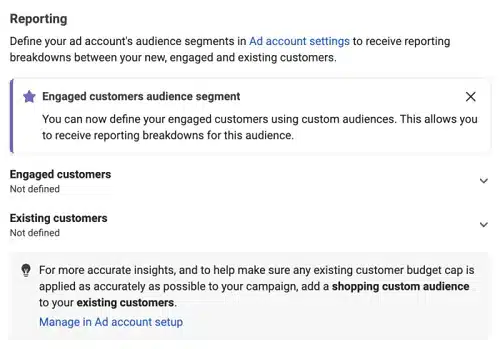
Enhanced audience insights. Meta has introduced a new feature called the “engaged customers audience segment” – as seen in the screenshot below, taken by digital ads expert Jon Loomer:
With the Engaged Customers Audience Segment, you can define your engaged customers using custom audiences, which provides reporting breakdowns specifically for this audience.
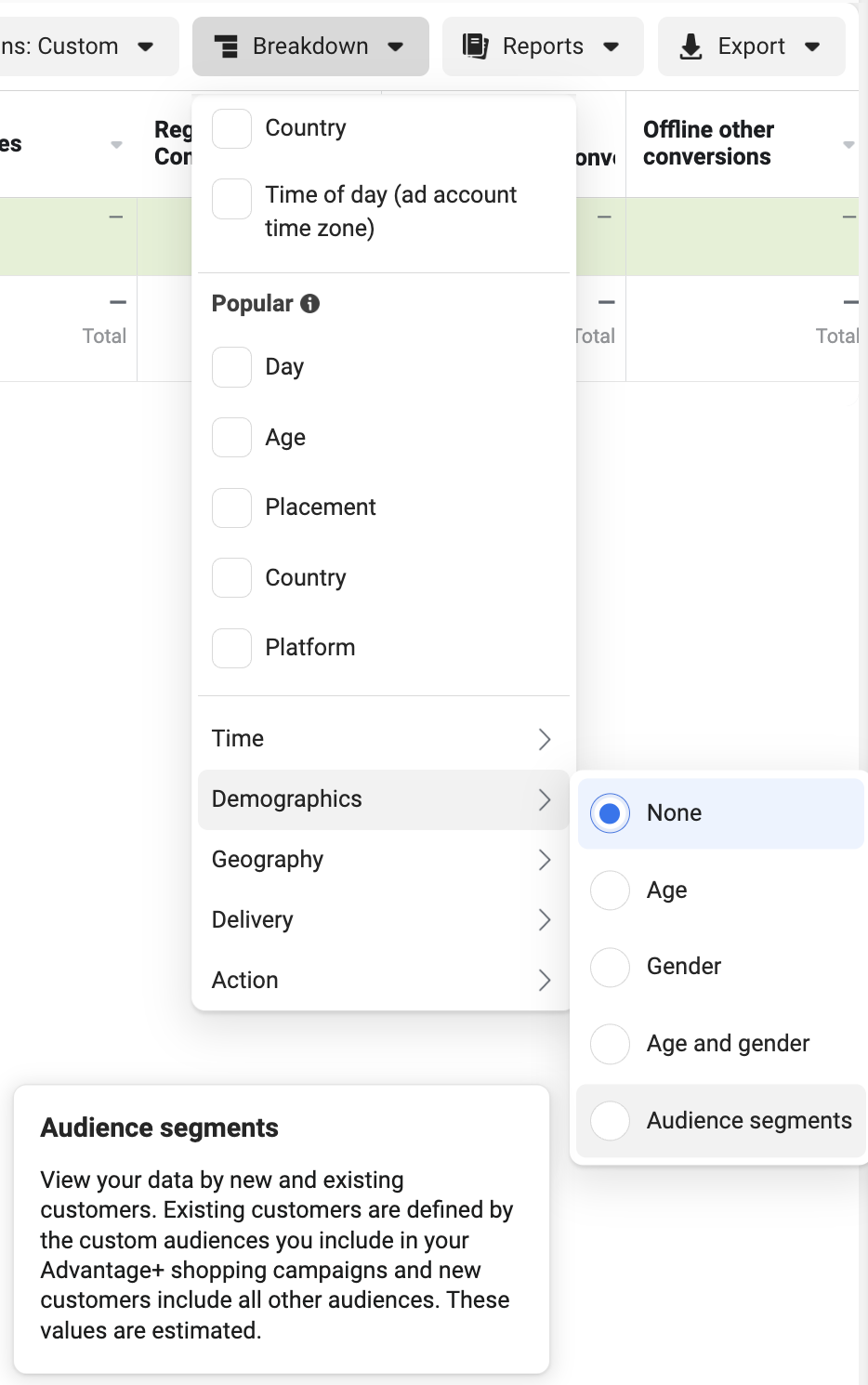
Report breakdown. Meta now offers a new segment to analyze results in Ads Manager. Just go to the Breakdown menu and choose “Demographics by Audience Segments.” From there, you’ll see separate rows for New Customers, Existing Customers, and Engaged Customers, as demonstrated in the screenshot below:
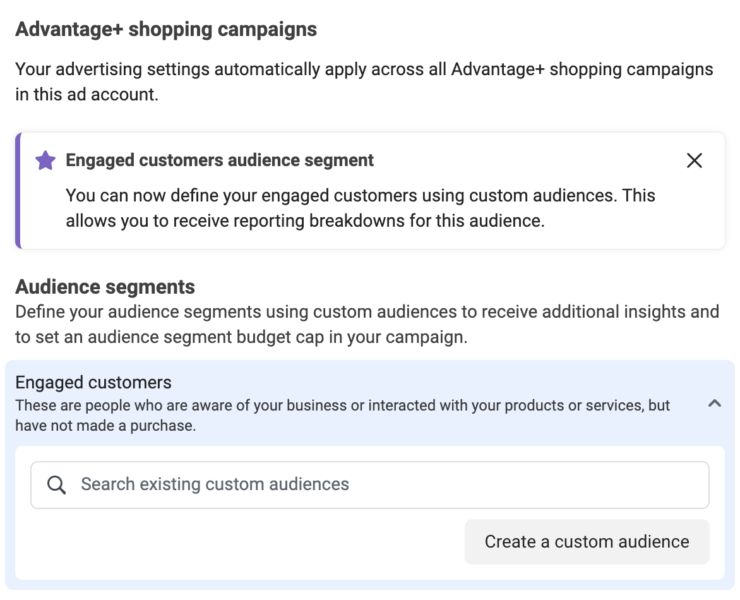
Enhanced targeting. In Ad Account Settings within Advantage+ Shopping Campaigns, you can specify your engaged customers using a custom audience, as demonstrated in the screenshot below:
Engaged customers are “people who are aware of your business or interacted with your products or services, but have not made a purchase,” according to Meta.
With enhanced targeting, you can make a custom audience or multiple custom audiences for engaged customers, but you’ll likely need to leave out paying customers when setting them up.
Get the daily newsletter search marketers rely on.
‘Valuable’ updates. Commenting on the Meta updates, digital ads expert Loomer wrote:
“This update provides significant insight into performance and how Advantage+ Shopping Campaigns are delivered. Since there is minimal advertiser control of targeting, this helps provide clarity regarding how much of your sales performance comes from new customers, current customers, and those who have engaged with your brand without purchasing.”
Embarking on a move to a new state brings a mix of excitement and challenges, especially when it comes to transporting your vehicle. But fear not! This comprehensive guide is here to streamline the process for you, giving you stress-free car shipping.
Whether you’re relocating for work or starting a new chapter of life, we’ve hand-picked essential tips to simplify how to ship a car to another state. From selecting the right company to understanding insurance and regulations, consider this your roadmap to a smooth transition.
Here, navigate this journey and ensure your car arrives safely at its destination.
Understanding the Basics of Car Shipping
Car shipping, also called auto transport, involves moving vehicles from one location to another, usually over long distances. Whether you’re moving to a new state or buying a car from a seller far away, understanding the basics of car shipping is crucial.
Here are some key points to consider:
Methods of Transportation
Car transport companies provide various options to transport your vehicle safely over long distances. Understanding these transportation modes can help you choose the one that best suits your budget and vehicle needs.
Open Transport: This is the most common and cost-effective car shipping method. Vehicles are loaded onto an open-air trailer and transported alongside other vehicles. Due to the exposed setup, some people might avoid this mode of auto shipping to protect their cars from wear and tear.
Enclosed Transport: Enclosed car shipping involves transporting vehicles in closed carriers designed to shield them from weather, dust, and other external factors. While enclosed auto shipping services can be more expensive, they offer added peace of mind.
Factors Affecting Auto Transport Costs
Determining the exact cost of car transport services for a state or even a country isn’t as simple as it seems. Numerous factors affect auto transport costs, which are revealed to you below:
Distance to be Covered: The distance your vehicle needs to be transported is one of the primary factors affecting auto transport costs. Generally, longer distances entail higher transportation fees due to increased fuel costs and vehicle wear and tear.
Size of the Vehicle: The larger your vehicle, the larger carrier it will require, potentially increasing the shipping cost. Conversely, shipping a compact car may cost less due to the smaller space it occupies and the simpler handling it entails.
Location: The destination where you want your car delivered can also significantly impact the final auto shipping cost. For example, if the location is rural or hilly, you might have to pay additional charges. Likewise, if your car’s final destination is in an urban area, you may find more cost-effective deals.
Season and Demand: Auto transport costs fluctuate based on seasonal demand and market conditions. Peak seasons, like summer months or holidays, often see heightened demand for transportation services, resulting in higher prices.
Weather Conditions: Extreme weather, such as heavy rain, snowfall, or smog, can necessitate the use of specialized equipment by the auto shipping company. As a result, the total cost may increase when dealing with extreme weather conditions.
Choosing the Right Car Shipping Company
Here are some helpful tips for selecting the right car shipping company for stress-free car shipping:
Research Various Auto Transport Companies
Research multiple auto transport companies to compare their services, pricing, and reputations. Look for companies with a history of compliance with legal laws and regulations.
Seek Referrals and Reviews
Ask friends, family, or colleagues who have previously used car shipping services for recommendations. Additionally, read online reviews and testimonials from past customers to evaluate the experiences of others with the shipping companies you’re considering.
Compare Quotes from Various Car Transport Companies
Fare price to ship car to another state service? Obtain quotes from multiple car transport companies to compare pricing and services. Most auto transport agencies also offer an online car shipping cost calculator. It lets you anticipate the final quote by providing the destination and your vehicle’s model.
While cost is a factor for stress-free car shipping, prioritize value and reliability over the lowest price. Be wary of companies that offer unusually lower prices, as they may cut corners or provide unsatisfactory services.
Understand Every Term and Condition
Review the terms and conditions outlined in the shipping contract before committing to any car shipping company. Pay close attention to factors such as cancellation policies and delivery timelines to avoid any surprises later on.
Preparing Your Car for Interstate Transport
To prepare your vehicle for its interstate journey, follow the step-by-step guide below:
Step 1: Remove Personal Belongings
Start with removing all your personal belongings from the vehicle. This includes items such as electronics, documents, and any other accessories. Not only does this ensure the safety of your belongings, but it also prevents potential damage to your vehicle during transit.
Step 2: Document Any Existing Damage
After clearing out personal belongings from your car, the next crucial step is to document any damage to your vehicle. This documentation records your car’s condition before shipment. It can help you spot any new damage that may occur during transit.
Step 3: Review Transport Company’s Guidelines
Familiarize yourself with the policies and procedures of the transport company you’ve chosen. Some companies might provide specific guidelines for preparing your car for the journey. Be sure to thoroughly read and comply with each point to ensure your vehicle has a safe journey toward its destination.
Step 4: Maintain Fuel Level at Approximately One-Quarter Full
Having enough fuel for loading and unloading is essential for stress-free shipping. However, keeping the fuel tank around a quarter full is recommended. Doing so can reduce the risk of fuel leakage or spillage, especially on rough roads during transit.
Step 5: Inspect for Leaks
Before loading your vehicle onto the transport carrier, thoroughly inspect it for any signs of leaks. Get down on the ground and visually inspect the underside of your car. Look for signs of fluid leaks, such as oil, coolant, transmission fluid, or brake fluid.
Step 6: Check Tire Pressure
Appropriate tire pressure is essential for optimal vehicle performance and safety during the move. For stress-free car shipping, use a pressure gauge to measure each tire’s air pressure and adjust them accordingly.
Navigating Car Shipping Regulations When Moving to a Major State like Arizona
When relocating to a major state like Arizona, it’s essential to understand and comply with the car shipping regulations. Arizona requires its residents to obtain an Arizona Driver’s License, title, and vehicle registration when moving into the state. Some other key documents and considerations to navigate Arizona’s auto transport regulations effectively include:
Bill of Lading
The Bill of Lading is a critical document in the car shipping process. It serves as a contract between you and the auto transport company, outlining the terms and conditions of the shipment.
Depending on your vehicle shipment, you may need transportation permits in Arizona. Consult with the auto transport company to confirm if permits are necessary. Make sure to obtain them before shipping your vehicle.
Insurance and Liability: What You Need to Know Before Shipping Your Car
To ensure your vehicle’s safe travel, discuss insurance and liability with the transport company before shipping your car. Here’s how you can begin the process:
Discuss Insurance Coverage Offered
Most auto transport companies offer insurance coverage to protect vehicles against damage or loss during transportation. This coverage typically includes protection against damage caused by accidents, theft, or natural disasters while moving your car. For stress-free car shipping, get a comprehensive checklist of what their insurance policy offers and its extent.
Limitations of the Insurance Policy
It’s essential to understand the limitations of the insurance policy provided by the auto transport company. These limitations may include:
Deductibles: The insurance policy may have a deductible amount that you’ll need to pay out of pocket before the insurance coverage applies. Be aware of the deductible amount and how it may affect your out-of-pocket expenses in the event of a claim.
Exclusions: The insurance policy may have exclusions that specify certain types of damage or circumstances. Review the exclusions carefully to understand what risks may not be covered and whether additional insurance options are needed.
Finalizing the Move: Steps to Ensure a Smooth Transition upon Arrival
To ensure a seamless transition for your vehicle upon arrival at its new home, it’s crucial to provide all essential documents to the car shipping company before initiating the move. Once documents are in order, confirm the date and time of arrival with the service providers.
Additionally, settle any outstanding payments beforehand to avoid delays in the delivery process. Finally, upon arrival, conduct a thorough inspection of your vehicle to verify its condition and address any concerns promptly.
Conclusion
Overall, shipping a car to another state isn’t a challenging task. Stress-free car shipping is all about researching, comparing quotes from different auto transport companies, and finding the best deal. Additionally, consider factors like insurance coverage, transportation permits, and compliance with regulations, especially when relocating to a major state like Arizona.
By following the above points, you can confidently approach your journey, knowing that your vehicle will arrive safely at its destination.
LinkedIn has emerged as a cornerstone for B2B marketing in the ever-evolving digital landscape. It provides unparalleled opportunities for businesses to connect, engage, and grow their professional networks. With over 700 million users, the platform offers a fertile ground for companies looking to establish their presence and authority in their respective industries.
However, with such vast potential comes the challenge of standing out. Optimizing your LinkedIn Company Page for SEO is not just beneficial; it’s essential. This article dives into this ultimate checklist. Remember that a successful LinkedIn strategy can significantly benefit from a b2b LinkedIn marketing agency that understands the nuances of digital marketing on this unique platform.
Elevate Your Branding
1. Optimize Your Page’s Public Profile
Your LinkedIn Company Page is your business’s digital storefront on the premier professional networking platform. It is imperative to ensure that not only is your public profile fully fleshed out, but it is also optimized to appeal to search engines and LinkedIn’s internal search function. This involves strategically including applicable keywords throughout pertinent sections, such as your company description, areas of expertise, and job listings.
The goal is to naturally incorporate these search terms, focusing on language likely used by your target audience when scouring LinkedIn for companies similar to your own. By thoughtfully selecting search-optimized keywords to include logically where relevant, your business can boost its online discoverability and engage with qualified potential customers and recruits.
2. High-Quality Banner and Profile Images
Visuals are extremely crucial in making an excellent first impression and communicating what your brand stands for. High resolution, pertinent photos used for your profile and header can considerably influence how you are perceived. These visuals should align with your brand’s personality and message and match LinkedIn’s suggested sizes to guarantee sharpness and professional presentation.
While visuals capture attention immediately, photos that represent what your brand is about help the viewer quickly understand your business and goals. Choosing visuals tailored to LinkedIn’s dimensions also ensures everything displays clearly without needing to zoom in or out, creating a polished look. Together, relevant visuals that match your identity and optimized sizes allow your profile to convey your expertise to potential connections on LinkedIn.
Engage and Expand Your Network
3. Publish Regular, Valuable Content
Being consistent is crucial for success in the digital world, and this holds for optimizing your LinkedIn company page as well. By consistently sharing helpful information, you can keep your network interested and improve your page’s search engine optimization. Post articles containing industry knowledge, updates about your business, or thought-provoking pieces that genuinely aid those following you. This habitual action allows your organization to be viewed as an expert in your area and heightens how noticeable you are on the site. Whether providing insights, news, or leadership pieces, focusing on distributing quality material that readers want to learn from helps solidify your place as a reliable resource.
4. Encourage Employee Engagement
The individuals who work for your organization are truly your most incredible supporters. Consider motivating them to participate in your company’s online presence by distributing material, news, and occupation opportunities. This not only increases how far your substance can go but also makes the most of the groups of your representatives, potentially drawing in more supporters and commitment to your page.
Their engagement can help spread awareness of your company and what you have to offer potential applicants or customers. When employees feel valued and connected to the larger goals of the business, they can become true brand ambassadors. By empowering your current team to assist with promoting your message, you gain organic reach into new networks and communities.
Leverage LinkedIn Features for Maximum Impact
5. Utilize LinkedIn Articles and Featured Content
LinkedIn provides companies with an additional avenue to demonstrate their knowledge and boost search engine optimization through publishing articles directly on the platform. Posting content, as well as pinning selected pieces to the top of the company page, can generate substantial website visits and interactions. This engagement further strengthens the business’s online presence on LinkedIn. However, while publishing articles offers benefits, companies must consider posting quality material that readers want to engage with. Regular updates help maintain reader interest in the company profile.
6. Participate in Relevant Groups
Getting involved in LinkedIn groups centered around your field can help raise your profile and direct traffic to your profile page. Take part in conversations, contribute your content when suitable, and connect with other experts. This assists with networking and strengthens your company’s search engine optimization on the platform. While engaging in groups, share thoughts that add value to discussions. Connecting with new contacts provides opportunities to assist them with their work, which helps build your professional brand. Interacting regularly yet sensibly in relevant LinkedIn communities is an intelligent approach to increasing your online presence and finding new prospects over time.
Monitor and Optimize Your Performance
7. Analyze Your Page’s Analytics
LinkedIn offers insightful analytics that can provide understanding into how your page is doing, such as rates of interaction, traits of those following, and how site visitors are locating your page. You can use this information to improve your search engine optimization plan when optimizing your LinkedIn company page. This entails adjusting your material and involvement tactics to more properly address the requirements and passions of those watching. However, there is still work to be done in fully understanding how to meet audience needs best.
8. Optimize for Mobile
As more individuals utilize mobile devices to access LinkedIn, your company page must perform well in this format. You’ll want to confirm visual elements like images and fonts display as intended when viewed on a smartphone or tablet. The content must be comfortably readable even on a small screen. Any website addresses shared should also load smoothly regardless of the device. By optimizing your page layout and functionality for mobile, you are more likely to offer visitors a pleasing experience when they look your business up on the go. A user who can easily browse and engage with your LinkedIn presence without issue may interact more and help spread the visibility of your brand through their network.
Conclusion
Enhancing visibility on LinkedIn necessitates a holistic approach involving meticulous attention to elements, strategic scheduling, and continuous participation. This comprehensive guide can assist in optimizing your LinkedIn company page for search rankings, engaging more productively with preferred customers, and establishing your organization as a notable authority in your field. Recall that in current times, your digital identity frequently serves as the initial meeting point with prospective clients and associates. Leverage your LinkedIn company page to the fullest by following these tips to make a memorable first impression with quality material.
Google is piloting new product discovery elements designed to give users a more personalized shopping experience, including:
Style recommendations.
Brand preferences.
Generative AI for product search.
Virtual try-on technology.
Why we care. These features offer businesses new opportunities to showcase their products and engage with high-value consumers who are likely to be more inclined to make purchases, thanks to a personalized shopping experience tailored to their specific preferences.
Style recommendations. Google is testing Style Recommendations, now accessible to signed-in U.S. shoppers via mobile browsers and the Google app, aiming to deliver more personalized results. For instance, when users search for specific apparel like shoes, they’ll come across the Style Recommendations section. Here, they can offer ratings with thumbs up or thumbs down, or simply swipe right or left to immediately access personalized results.
How it works. If shoppers aren’t satisfied with their personalized results or would prefer to continue browsing, Google offers the option to rate more items and immediately view another set of results. Additionally, the search engine will remember preferences for future searches. For example, when searching for men’s polo shirts again, you’ll receive personalized style recommendations based on your past preferences and interactions with products.
Managing style recommendations. If you’ve rated items incorrectly or would prefer to not see personalized shopping results, you can manage your preferences. To do this, just tap the three dots next to the “Get style recommendations” section and explore personalization options in the “About this result” panel.
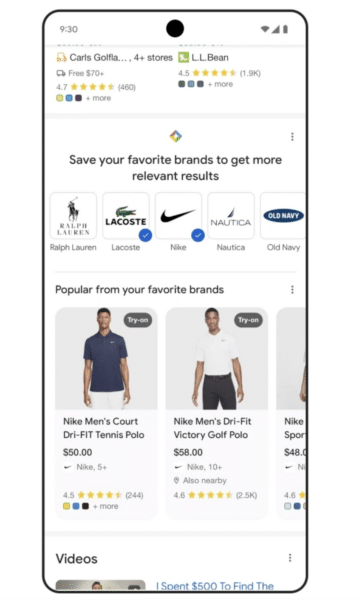
Brand preferences. U.S. shoppers searching for apparel, shoes, or accessories on mobile browsers, desktop, or the Google app can now personalize their shopping experience by selecting preferred brands. Once chosen, options from these brands will appear instantly. To manage preferences, tap the three dots next to the “Popular from your favorite brands” section, and access personalization options in the “About this result” panel.
Image generation. Google is piloting an AI image generation tool for shopping, which is now available to all U.S. users who have opted into Search Generative Experience (SGE) within Search Labs. If you’re searching for a specific item, like a “colorful quilted spring jacket,” simply tap “Generate images” after your search to see photorealistic options matching your preferences. Once you find one you like, click on it to explore shoppable options conveniently.
Virtual try on. Additionally, Google is testing a virtual try-on tool in the U.S. on desktop, mobile and the Google app. When you see the “try-on” icon in shopping results, simply click on it, and you can see what the product looks like on a diverse set of real models ranging in size from XXS-4XL.
What Google is saying. Sean Scott, Google’s VP/GM Consumer Shopping, said:
“People shop on Google more than a billion times a day. And thanks to the Shopping Graph, they see billions of products in their results that are constantly being refreshed. In fact, every hour, more than 2 billion listings are updated with the latest information, including pricing, in-stock availability and shipping details.”
“So whether you’re looking for a specialty notepad from Japan, a monogrammed handbag from Paris or just a hammer from your local hardware store, the Shopping Graph can help you find it in just a few clicks. With that many options, we’re focused on making it easy to find exactly what you like.”
“No two shoppers are alike, which is why we’re designing the shopping experience on Google so it’s tailored to you.”
Get the daily newsletter search marketers rely on.
Pinterest provided insights into how its algorithm works while warning of the risks of overreliance on user engagement. The platform emphasized that excessive reliance on engagement to rank content can result in a negative user experience, and proposed non-engagement signals as a solution.
To encourage other companies to follow suit and contribute to “building a more inspired Internet,” Pinterest published a new document titled ‘Field Guide to Non-Engagement Signals’.
Why we care. By having a better understanding of how Pinterest’s algorithm works, brands can identify what metrics they should prioritize in order to secure more visibility for their content.
What are non-engagement signals? Non-engagement signals are generated from two primary sources:
In-app surveys: These give users have the opportunity to provide direct feedback about the platform. For instance, Pinterest may conduct surveys within the app to gather user insights.
Independent assessments of content quality: This tends to be generated from manual labeling.
In addition to balancing engagement signals in content ranking, non-engagement signals enable Pinterest to align with its values. For example, Pinterest’s commitment to inclusivity is supported by non-engagement signals. When users specify preferences regarding body type, hair pattern, or skin tone in their feed, Pinterest can prioritize relevant content accordingly.
Field guide. Pinterest teamed up with UC Berkeley and the Integrity Institute to create the Field Guide to Non-Engagement Signals in a bid to help platforms create a better user experiences over time. Pinterest noted that the purpose of the guide is simply to help platforms make informed decisions when it comes to utilizing Non-Engagement Signals, as opposed to tell them what to do.
Key takeaways. The field guide, which is based on practical industry knowledge, offers several practical applications for product development, including:
How to tune for emotional well-being.
Using Generative AI to scale content quality signals.
Improving user retention.
What Pinterest is saying. Leif Sigerson, Pinterest Sr. Data Scientist, and Wendy Matheny, Pinterest Sr. Lead Public Policy Manager, said in a blog post:
“User engagement is a critical signal used by Pinterest and other online platforms to determine which content to show users. However, it is widely known that optimizing purely for user engagement can surface content that is low-quality (e.g., clickbait), or even harmful.”
“Our CEO, Bill Ready, explained that if we’re not careful, content ranking can surface the ‘car crash we can’t look away from’, On the other hand, if you ask somebody after they saw the crash, ‘you want to see another one?’’ the vast majority of people will say ‘Goodness no’.”
“Non-Engagement Signals are a critical component to ensure we don’t optimize for ‘the car crash we can’t look away from.’”
Get the daily newsletter search marketers rely on.