Investing vs Funded Trading: A Data-Driven Comparison

Home Business Magazine Online

Financial markets offer two fundamentally different paths to building wealth: traditional investing and funded (proprietary) trading via prop firms. While both operate within the same markets — equities, forex, commodities, indices, crypto — investing vs funded trading differs dramatically in capital structure, risk mechanics, scalability, and statistical expectations.

Understanding these differences is not theoretical. It determines whether you build long-term equity or pursue performance-based income under structured constraints. This analysis breaks down investing vs funded trading using real market statistics, capital math, and professional risk considerations.

1. Capital Structure: Ownership vs Performance Access

Investing

Investing requires deploying personal capital into assets. You own what you buy. Over time, your wealth grows through:

  • Capital appreciation
  • Dividends or income distributions
  • Compounding returns

Historically, broad equity markets have delivered measurable long-term returns. For example:

  • The S&P 500 has delivered approximately 9–10% average annual returns over the past century (including dividends).
  • After inflation (roughly 2–3% long-term average in developed economies), real returns are closer to 6–7% annually.

If you invest $20,000 at 8% annual return:

  • 10 years → ~$43,000
  • 20 years → ~$93,000
  • 30 years → ~$201,000

That is the power of compounding. But compounding requires time and capital.

Funded Trading

Funded trading firms provide access to large capital allocations — commonly between $25,000 and $200,000 — after passing an evaluation phase.

You do not own the capital. Instead:

  • You keep a percentage of profits (often 70–90%).
  • You operate under strict drawdown limits (typically 5–10%).
  • Breaching rules ends the account.

The economic structure resembles a performance contract, not asset ownership.

Example: A trader managing a $100,000 funded account with:

  • 8% monthly return
  • 80% profit split

Gross profit: $8,000
Trader payout: $6,400

Annualized (if consistent): ~$76,800

The catch: consistency is statistically difficult, and risk limits are unforgiving.

2. Statistical Reality: Market Returns vs Trader Survival

Investing Statistics

Long-term investing benefits from:

  • Economic expansion
  • Corporate earnings growth
  • Inflation-adjusted asset appreciation

According to historical data from the Federal Reserve and academic market studies:

  • 20-year rolling returns for diversified US equities have historically been positive in the vast majority of periods.
  • Diversified portfolios reduce volatility compared to concentrated positions.

Volatility exists — for example, during the 2008 financial crisis or 2020 pandemic shock — but time mitigates short-term declines. Investors are not forced out by temporary drawdowns.

Trading Statistics

Short-term trading statistics are harsher.

Across major brokerage disclosures:

  • 70–85% of retail CFD traders lose money over time.
  • In Europe, regulatory reports (ESMA guidelines) require brokers to disclose retail loss percentages — often between 74% and 89%.

Why? Because short-term trading requires:

  • Consistent edge
  • Risk discipline
  • Emotional control
  • Statistical expectancy

Funded trading adds another layer:

  • Daily loss limits (often 4–5%)
  • Maximum trailing drawdown
  • Minimum trading days
  • Time constraints during evaluation

Even profitable traders can fail evaluations due to volatility spikes or overexposure. This is performance under constraints — not passive compounding.

3. Risk Mechanics: Flexible vs Hard Stops

Investing Risk Model

Investors typically experience:

  • Market risk (systemic downturns)
  • Sector risk
  • Company-specific risk

However, they can:

  • Hold through volatility
  • Average down
  • Rebalance portfolios

Drawdowns of 20–30% in equity markets have occurred multiple times historically. Yet long-term investors recovered over multi-year periods. Time is the risk absorber.

Funded Trading Risk Model

Funded trading has hard rules:

  • Daily max loss (e.g., 5%)
  • Total max drawdown (e.g., 10%)
  • Trailing equity thresholds

If breached, the account is terminated immediately. There is no recovery window. This structure forces:

  • Tight position sizing
  • Low risk per trade (often 0.5–1%)
  • High consistency

A 10% drawdown limit means a trader risking 2% per trade can mathematically fail in five consecutive losses.

Probability matters. If a strategy has a 50% win rate, the probability of five losses in a row is 3.125%. Over many trades, this scenario becomes statistically likely. Risk of ruin is real.

4. Income Profile: Linear Growth vs Variable Cash Flow

Investing

Investing builds net worth gradually. Unless you structure for income (dividends, rental yield), returns compound rather than distribute. Dividend yields in developed markets typically range from 1.5% to 4%, depending on sector. It is wealth accumulation first, income second.

Funded Trading

Funded trading can produce:

  • Weekly payouts
  • Bi-weekly payouts
  • Monthly payouts

But income volatility is high. Professional prop traders aim for:

  • 3–10% monthly return
  • 1–2% average risk exposure

However, even elite traders experience flat months. Funded trading resembles performance-based consulting income more than investing.

5. Scalability and Capital Growth

Investing Scalability

Scalability depends entirely on how much capital you accumulate. Higher savings rate → higher capital → higher compounding base. There are no imposed ceilings.

Funded Trading Scalability

Many prop firms offer scaling programs:

  • Double account size after 10% profit
  • Increase capital after 3 profitable months
  • Cap at $500,000–$1 million allocations

Scaling depends on:

  • Rule compliance
  • Consistency
  • Risk control

It is conditional growth.

6. Psychological and Structural Differences

Dimension Investing Funded Trading
Time Horizon 10–30 years Daily–Monthly
Capital Ownership Yes No
Drawdown Tolerance Flexible Strict
Income Consistency Low initially Variable
Statistical Edge Needed Low (market growth) High (strategy expectancy)
Emotional Pressure Long-term volatility Immediate risk limits

Investing rewards patience. Funded trading rewards precision and emotional stability.

7. A Professional Hybrid Model

Experienced market participants often combine both:

  1. Use funded trading for active income generation.
  2. Allocate profits into diversified long-term investments.
  3. Reduce reliance on trading income over time.
  4. Build asset ownership gradually.

This model transforms performance income into equity ownership. Trading becomes the accelerator. Investing becomes the stabilizer.

Final Assessment

Investing vs funded trading operates on different economic principles. Investing relies on:

  • Economic growth
  • Time
  • Compounding
  • Asset ownership

Funded trading relies on:

  • Statistical edge
  • Risk discipline
  • Short-term consistency
  • Rule compliance

If you lack capital but possess trading skills, funded trading provides leverage. If you seek stability and long-term compounding, investing provides a structural advantage.

The most resilient financial strategy is not choosing one blindly, but understanding the mathematics, risk profiles, and psychological demands of both — and positioning yourself accordingly. Markets reward discipline. They punish ego.

The post Investing vs Funded Trading: A Data-Driven Comparison appeared first on Home Business Magazine.

Original source: https://homebusinessmag.com/money/financial-trading/investing-vs-funded-trading-data-driven-comparison/

The Courthouse Waiting Game: A Real-World Guide to Navigating Probate

Home Business Magazine Online

Walking into a probate court for the first time feels a bit like stepping onto the set of a legal drama, only with much less dramatic lighting and a lot more paperwork. Most people find themselves here during one of the hardest seasons of their lives, usually following the loss of a parent or a close relative. It is a place of transition where a judge ensures a person’s final wishes are honored and their debts are settled. To keep things running smoothly, many modern firms now utilize AI tools for legal assistants to handle preliminary questions and document drafting, but once you cross that threshold into the courthouse, it is all about the physical process.

The Atmosphere of the Courtroom

Don’t expect a “Law and Order” showdown. Most probate hearings are actually quite quiet and procedural. You will likely see many people in business casual attire shuffling through thick manila folders. The room might feel stiff or overly formal, but the goal is order, not intimidation. You will spend a good chunk of time sitting in a gallery waiting for your case number to be called. It is a great idea to bring a book or make sure your phone is charged, because the “scheduled” time is often more of a suggestion than a hard rule.

Meeting the Judge and the Clerk

The judge is the person who makes the final call on the validity of a will or the appointment of an executor, but the court clerk is the person who actually keeps the gears turning. When your case is called, you will likely step up to a podium or sit at a table. The judge will ask a few clarifying questions about the assets involved and whether all the heirs have been properly notified. If everything is in order, they sign the decrees and move on. It is usually over before you even find a parking spot.

Dealing with the Paperwork Trail

Probate is, at its heart, an accounting exercise. You should expect to see many “Letters of Testamentary” or “Letters of Administration.” These are the golden tickets that give an executor the legal power to move money, sell a house, or close bank accounts. If you are the estate’s administrator, you will be expected to file an inventory list. This is a detailed breakdown of everything the deceased owned, from their Victorian coin collection to the dusty sedan in the garage. Precision matters here, so keep every receipt and every bank statement you find.

The Waiting Period

One thing no one tells you about probate court is the sheer amount of waiting involved. Once the initial hearing is over, the clock starts ticking on a mandatory waiting period. This gives creditors a chance to step forward and claim any unpaid debts. Depending on where you live, this can last from 4 months to 1 year. You won’t be in the courtroom every day during this time, but the “case” remains open in the court’s system. It is a test of patience above all else.

Potential for Conflict

While most probate cases are “uncontested,” meaning everyone agrees on who gets what, there is always the possibility of a surprise. Sometimes a long-lost cousin appears, or a sibling disagrees with how the house is being appraised. If a dispute arises, the vibe changes from procedural to adversarial. This is when the court schedules a full hearing at which witnesses may testify. These moments are rare, but they are the reason the probate court process exists in the first place—to provide a fair venue for settling these arguments once and for all.

Understanding the Costs

Going to court isn’t free. You should expect to pay filing fees, which vary based on the size of the estate. There are also costs for publishing notices in the local newspaper, which is a weird legal requirement in many jurisdictions to alert unknown creditors.

Between court costs, executor fees, and attorney fees, a chunk of the estate will be used just to get through the probate court process. Being prepared for these “shave-offs” at the beginning prevents a lot of sticker shock when the final checks are being cut to the heirs.

Final Word

Closing out a loved one’s life is a heavy task, but the probate court process is simply the mechanism that makes it official. It provides a structured path to ensure that bills are paid and legacies are preserved without any legal loose ends hanging over your head. If you find the complexity of the law overwhelming, remember that many legal professionals are now integrating AI tools for legal assistants to provide faster answers and streamline the massive amount of required paperwork. Once the judge bangs that gavel for the final time, you can finally breathe a sigh of relief and focus on the memories that actually matter.

The post The Courthouse Waiting Game: A Real-World Guide to Navigating Probate appeared first on Home Business Magazine.

Original source: https://homebusinessmag.com/management/legalese/real-world-guide-navigating-probate-court-process/

AI-Powered SEO Strategies for Home-Based Businesses: How Small Entrepreneurs Can Compete with Bigger Brands in 2026

Home Business Magazine Online

In 2026, search engine optimization is no longer just about keywords and backlinks. It is about intelligence, automation, and strategic positioning. Large brands are investing heavily in AI-driven content systems, predictive analytics, and search behavior modeling. However, the same technologies that empower corporations are now accessible to home-based entrepreneurs at a fraction of the cost.

For small business owners working from home, this creates an unprecedented opportunity. With the right AI-powered SEO strategy, a solopreneur can compete directly with established companies in search visibility, lead generation, and brand authority.

This guide breaks down actionable AI-powered SEO strategies specifically designed for home-based businesses looking to grow sustainably in 2026.

1. Understanding SEO in 2026: What Has Changed?

Search engines in 2026 rely heavily on machine learning, user intent modeling, and real-time content evaluation. Platforms like Google now prioritize:

  • Search intent accuracy
  • Contextual relevance
  • Experience signals (time on page, scroll depth, interaction)
  • Expertise and trustworthiness
  • AI-generated content quality detection

For home-based entrepreneurs, this means surface-level keyword optimization is no longer enough. Instead, SEO success depends on strategic content ecosystems powered by AI.

2. Leveraging AI for Smarter Keyword Research

Traditional keyword research tools only show volume and competition. AI tools in 2026 go further by analyzing:

  • Search intent clusters
  • Buyer journey mapping
  • Emerging topic trends
  • Voice search patterns
  • Localized demand spikes

Action Plan:

  1. Use AI-driven keyword clustering tools to group related topics into content hubs.
  2. Focus on long-tail, intent-rich phrases.
  3. Identify “low-authority gap” keywords where large brands have not optimized deeply.

For example, instead of targeting “digital marketing services,” a home-based consultant might target:

  • “AI marketing automation for handmade jewelry sellers”
  • “SEO strategies for Etsy home business owners”

AI-powered SEO strategies can reveal these micro-niches quickly, giving small entrepreneurs a competitive edge.

3. Building Topic Authority Through AI Content Clusters

In 2026, search engines evaluate topical authority, not just individual blog posts.

Home-based businesses can compete with bigger brands by building tightly structured content clusters:

  • One pillar article (2,000–3,000 words)
  • 8–12 supporting blog posts
  • Interlinked internal structure
  • AI-enhanced semantic optimization

Example Structure:

Pillar Topic: AI Marketing for Home-Based Businesses

  • Subtopic 1: AI tools for solo entrepreneurs
  • Subtopic 2: Automating customer emails
  • Subtopic 3: AI-powered SEO audits
  • Subtopic 4: Predictive analytics for small ecommerce

AI writing assistants help speed up content creation, but human editing ensures authenticity and brand voice alignment.

4. AI-Powered Technical SEO for Home Offices

Many small entrepreneurs overlook technical SEO. However, AI tools now simplify what used to require developers.

Key AI-enhanced technical improvements include:

  • Automatic schema generation
  • Page speed optimization suggestions
  • AI-based UX diagnostics
  • Core Web Vitals monitoring
  • Automated internal linking

Investing in the right digital infrastructure is critical, and many entrepreneurs start by reviewing practical IT frameworks such as this guide on small business IT solutions before implementing AI-powered SEO strategies:

A strong technical foundation ensures AI-driven SEO efforts deliver maximum ROI.

5. Predictive Content Planning Using AI

One major advantage AI gives small businesses is predictive analysis.

Instead of reacting to trends, AI tools can:

  • Identify rising search topics early
  • Forecast seasonal demand
  • Suggest content based on competitor gaps
  • Analyze SERP volatility

For example, a home-based fitness coach could use AI tools to identify rising searches around “at-home metabolic workouts for remote workers” before major brands scale content around it.

This first-mover advantage often results in easier rankings and sustained traffic growth.

6. AI-Driven Competitor Intelligence

Large companies have teams for competitor research. Today, AI makes this possible for solo entrepreneurs.

Modern AI SEO platforms can:

  • Track competitor ranking changes
  • Analyze backlink growth
  • Identify content weaknesses
  • Suggest outperforming structures

A home-based business can reverse-engineer what is working for larger competitors by conducting a structured SEO competitor analysis and then create:

  • More comprehensive guides
  • Updated statistics
  • Better UX
  • Niche-specific angles

Instead of competing broadly, AI helps entrepreneurs compete strategically.

7. Personalization and User Experience Optimization

Search engines now reward engagement signals more than ever. AI enables:

  • Dynamic content recommendations
  • Behavior-based content personalization
  • AI chat assistants for instant engagement
  • Smart exit-intent offers

Even small home-based websites can integrate lightweight AI personalization systems that:

  • Recommend related blog posts
  • Suggest products based on user behavior
  • Offer custom lead magnets

Higher engagement improves dwell time, which positively impacts rankings.

8. Voice Search and Conversational SEO

Voice search continues to grow due to smart assistants and wearable devices.

AI tools help optimize for:

  • Natural language queries
  • Question-based searches
  • Featured snippet positioning
  • FAQ schema implementation

Home-based businesses should create:

  • FAQ-rich content
  • Conversational blog sections
  • Clear, direct answers to common problems

AI content tools can simulate voice search phrasing, helping entrepreneurs structure content naturally.

9. AI for Local SEO Domination

For home-based entrepreneurs offering services locally, AI-powered local SEO is crucial.

AI platforms can:

  • Optimize Google Business profiles
  • Analyze local competitor gaps
  • Automate review generation strategies
  • Identify geo-targeted keyword clusters

A freelance designer working from home can dominate local results by targeting hyper-specific phrases like:

  • “Logo designer for Mumbai home businesses”
  • “Affordable branding consultant near Andheri West”

Localized intent often has lower competition and higher conversion rates.

10. Ethical AI Content Creation: Staying Trustworthy

Search engines in 2026 are increasingly sophisticated at detecting low-value AI content.

To compete effectively:

  • Use AI for research and structuring
  • Add human insight and real-world examples
  • Include data references
  • Maintain transparent authorship

Author credibility signals (experience, credentials, case studies) matter more than ever.

11. Smart Link-Building with AI Prospecting

Backlinks remain important, but AI simplifies outreach.

AI tools can:

  • Identify niche-relevant websites
  • Analyze domain authority gaps
  • Draft personalized outreach emails
  • Detect toxic backlink patterns

Instead of mass outreach, home-based businesses should focus on:

  • Industry blogs
  • Niche communities
  • Collaborative content
  • Podcast guesting opportunities

Quality always outweighs quantity.

12. Automating SEO Reporting and Analytics

AI analytics dashboards provide real-time insights such as:

  • Traffic source analysis
  • Keyword movement tracking
  • Content performance scoring
  • Conversion attribution modeling

Instead of manually checking data in Google Analytics, AI systems can automatically summarize insights and suggest actionable changes.

This saves time and allows entrepreneurs to focus on strategy rather than spreadsheets.

13. Cost Efficiency: Why AI Levels the Playing Field

Large brands rely on teams and agencies. Home-based entrepreneurs can rely on:

  • AI writing assistants
  • AI design tools
  • Automated SEO audits
  • Predictive keyword research

The cost barrier to high-level SEO has significantly decreased. What matters now is strategic implementation, not budget size.

14. Practical Implementation Roadmap for 2026

Here is a simplified 90-day AI-powered SEO roadmap for home-based businesses:

Month 1:

  • Conduct AI-based keyword clustering
  • Build pillar + cluster content plan
  • Fix technical SEO issues

Month 2:

  • Publish optimized pillar content
  • Launch supporting articles
  • Implement schema and internal linking

Month 3:

  • Begin AI-assisted outreach
  • Optimize engagement metrics
  • Analyze predictive growth opportunities

Consistency is more important than scale.

Final Thoughts

In 2026, AI is not replacing small entrepreneurs, it is empowering them.

Home-based businesses no longer need massive budgets to compete with established brands. With intelligent keyword clustering, predictive content planning, AI-driven technical SEO, and personalized engagement systems, solo entrepreneurs can build authority, generate leads, and scale sustainably.

The future of SEO is not about who spends more. It is about who uses intelligence more effectively.

For home-based entrepreneurs willing to adopt AI strategically, 2026 presents one of the greatest competitive opportunities in digital marketing history.

The post AI-Powered SEO Strategies for Home-Based Businesses: How Small Entrepreneurs Can Compete with Bigger Brands in 2026 appeared first on Home Business Magazine.

Original source: https://homebusinessmag.com/businesses/ai/ai-powered-seo-strategies-home-based-businesses-small-entrepreneurs-compete-bigger-brands-2026/

Finding Your Perfect Oasis: The Benefits of Luxury Living for Relaxation and Comfort

Home Business Magazine Online

Luxury living is more than just owning a home with upscale features. It’s about creating an environment that provides relaxation, comfort, and style. Whether you’re envisioning a modern city penthouse, a countryside estate, or something in between, luxury living is designed to enhance your quality of life and create a perfect space to unwind. In this article, we’ll explore what makes a home truly luxurious and how these elements work together to provide the ultimate living experience.

1. Space and Privacy: The Foundation of Luxury Living

Space is an essential feature of luxury homes. These properties often feature open floor plans with expansive rooms, creating a living environment that feels airy and comfortable. High ceilings, large windows, and plenty of natural light add to the sense of space and openness.

Privacy also plays a significant role in creating a luxurious lifestyle.

Many luxury homes are designed with seclusion in mind – whether that’s a gated estate, a secluded villa, or a high-rise condo that offers privacy from surrounding buildings. With the right amount of space and privacy, homeowners can truly feel at ease, knowing their personal sanctuary is protected from the outside world.

2. Quality Craftsmanship and Design

The difference between a luxury home and a standard one often comes down to the quality of materials and the attention to design detail. From custom cabinetry to premium flooring materials like hardwood, marble, or granite, the level of craftsmanship is evident every time you step inside.

Luxury homes also feature bespoke designs that cater to the owner’s tastes, with personalized touches such as custom light fixtures, luxurious countertops, and statement furniture. It’s not just about how a home looks – it’s about how it feels, with every aspect carefully selected to create an experience of ultimate comfort and beauty.

3. Wellness and Comfort: Focused on Your Health

As the wellness movement gains popularity, many luxury homes now incorporate features that promote relaxation and health. Homeowners can enjoy personal gyms, yoga studios, or even private spas, making it easier than ever to focus on physical and mental well-being. A spa-like bathroom complete with a soaking tub, rainfall shower, and heated floors can transform the daily routine into a relaxing ritual.

Technology also enhances comfort. Smart home systems allow homeowners to control lighting, temperature, security, and entertainment with a single touch. These systems contribute to an effortlessly comfortable living environment, making it easier to live in luxury and convenience.

4. Outdoor Spaces: Extending Luxury Beyond the Walls

Incorporating outdoor spaces into the home is another hallmark of luxury living. For many, a personal oasis includes an inviting outdoor area where they can unwind, entertain guests, or spend time with family. High-end homes often include well-manicured gardens, private terraces, and expansive decks for outdoor dining and lounging.

Some homes feature resort-style backyards, complete with outdoor kitchens, fire pits, and, for the ultimate in relaxation, pool homes. A private pool can elevate any backyard into a sanctuary, allowing you to enjoy outdoor living year-round, whether you’re swimming laps, lounging by the water, or hosting a summer barbecue.

5. Location: The Perfect Setting for Luxury

Where your home is located is just as important as its design and features. Luxury homes are often situated in highly sought-after areas – whether that’s a prime city center, a scenic coastal area, or the rolling hills of the countryside. The best luxury homes are located in neighborhoods that offer both convenience and a connection to nature, allowing homeowners to enjoy the vibrancy of city life while still finding peace when they return home.

Additionally, the location of a luxury home adds to its value. Properties in prestigious neighborhoods or near notable landmarks often have higher resale values. Whether it’s proximity to high-end shopping, fine dining, or private schools, the location of a luxury home can make it not only an exceptional living space but also a solid investment.

6. A Space for Entertainment

Luxury homes are built with entertainment in mind. Large, open living areas facilitate easy socializing, while expansive dining rooms provide the perfect backdrop for elegant dinner parties. Some luxury homes include dedicated home theaters, wine cellars, and game rooms, ensuring that every form of entertainment is catered to. Additionally, many feature spacious kitchens designed to accommodate professional chefs and a large number of guests.

Whether you’re hosting an intimate gathering or a large celebration, a luxury home provides the space and amenities to make every event memorable. The seamless flow between indoor and outdoor spaces adds another layer of comfort for those who enjoy entertaining.

7. The Investment Aspect of Luxury Homes

While the primary reason to purchase a luxury home is to enjoy its features and benefits, these properties also offer excellent investment potential. Luxury real estate tends to appreciate over time, especially in desirable locations with growing demand. Properties with high-end finishes, exceptional designs, and prime locations not only provide comfort but can also increase in value, making them a smart long-term investment.

Luxury homes are generally more resistant to market fluctuations than standard properties. As the market for high-end homes remains competitive, these properties tend to hold their value or even appreciate during times when other real estate markets might experience volatility.

Conclusion

Luxury living is all about creating a personal oasis that blends relaxation, comfort, and sophistication. From spacious designs and exceptional craftsmanship to wellness-focused features and private outdoor spaces, luxury homes offer a lifestyle that caters to every aspect of personal well-being. Whether you’re lounging in your private garden, enjoying a swim in your personal pool, or relaxing in a spa-like bathroom, luxury living is a perfect combination of comfort and style.

For those who seek more than just a home, luxury residences provide a space that enhances every part of life – bringing relaxation, peace, and elegance into your everyday routine. Whether you’re looking for a retreat to unwind or a place to entertain in style, the right luxury home is more than just a property – it’s a sanctuary designed for the life you’ve always dreamed of.

The post Finding Your Perfect Oasis: The Benefits of Luxury Living for Relaxation and Comfort appeared first on Home Business Magazine.

Original source: https://homebusinessmag.com/lifestyles/work-life-balance/finding-perfect-oasis-benefits-luxury-living-relaxation-comfort/

Why It Is Important to Use a Confidential Paper Shredding Service for Small Businesses

Home Business Magazine Online

In an era dominated by digital technology, it might seem tempting for small business owners to believe that paper-based security threats are a thing of the past. However, the reality couldn’t be further from the truth. Despite increasing digitisation, most small businesses continue to handle significant volumes of sensitive paper documents daily—from customer records and employee files to financial statements and strategic planning documents. When these materials reach the end of their useful life, how they’re disposed of becomes a critical concern that can have far-reaching consequences for your business.

For small businesses operating on tight budgets and limited resources, the decision to invest in a professional confidential paper shredding service might initially seem like an unnecessary expense. Yet this perception fails to account for the substantial risks, legal obligations, and potential costs associated with improper document disposal. This article explores why engaging a reputable confidential paper shredding service isn’t merely a prudent choice—it’s an essential component of responsible business management that protects your company, your clients, and your reputation.

Legal Compliance and Data Protection Regulations

The regulatory landscape surrounding data protection has become increasingly stringent, with severe penalties for non-compliance. Under the UK General Data Protection Regulation (UK GDPR) and the Data Protection Act 2018, businesses of all sizes bear responsibility for protecting personal data throughout its entire lifecycle—including its destruction. This legal obligation extends to paper records just as it does to digital information.

Small businesses often underestimate their exposure to regulatory scrutiny, mistakenly believing that enforcement actions primarily target larger corporations. However, the Information Commissioner’s Office (ICO) has consistently demonstrated its willingness to investigate and penalise organisations of any size that fail to adequately protect personal information. Fines can reach up to £17.5 million or 4% of annual global turnover, whichever is higher—a potentially devastating blow for a small enterprise.

Using a professional shredding service provides documented evidence of compliant disposal practices. Reputable providers issue certificates of destruction that serve as proof of proper data handling should regulatory questions arise. This paper trail can prove invaluable during audits or investigations, demonstrating your commitment to meeting legal obligations and protecting data subjects’ rights.

Protection Against Identity Theft and Fraud

Identity theft remains one of the fastest-growing crimes in the United Kingdom, with criminals constantly seeking opportunities to acquire personal information they can exploit. Discarded business documents represent a goldmine for fraudsters—containing names, addresses, dates of birth, financial information, and other data that can be used to commit identity theft, financial fraud, or corporate espionage.

Small businesses are particularly attractive targets because they often lack the robust security measures employed by larger organisations. A simple office bin containing unshredded documents can provide criminals with everything they need to open fraudulent accounts, make unauthorised purchases, or even impersonate your business in dealings with suppliers or customers.

The consequences of such breaches extend far beyond the immediate victims. Your business may face legal liability, regulatory sanctions, and the considerable expense of remediation efforts. Moreover, the reputational damage can be devastating, eroding the trust that forms the foundation of customer relationships—trust that takes years to build but can be destroyed overnight.

Safeguarding Business Confidentiality and Competitive Advantage

Beyond personal data, businesses generate numerous documents containing commercially sensitive information: strategic plans, pricing strategies, supplier agreements, product development details, and customer lists. In competitive markets, this information holds significant value, and its disclosure to competitors could undermine your market position.

Industrial espionage isn’t limited to high-tech sectors or multinational corporations. Small businesses across all industries possess information that competitors would find valuable. A discarded document revealing your pricing structure, upcoming product launches, or key client relationships could hand competitors an unfair advantage that impacts your bottom line.

Professional shredding services ensure that this commercially sensitive material is destroyed beyond reconstruction, maintaining the confidentiality essential to your competitive position. This protection extends to information about your business practices, operational efficiencies, and strategic direction—all elements that contribute to your unique market positioning.

Professional Destruction Beyond DIY Capabilities

Many small business owners initially consider purchasing an office shredder as a cost-effective alternative to professional services. While this approach might seem economical, standard office shredders present several significant limitations that compromise security.

Firstly, most desktop or small office shredders employ strip-cut technology, which produces long strips of paper that can potentially be reconstructed by determined individuals. Cross-cut shredders offer improved security, but even these may not meet the destruction standards required for highly sensitive information. Professional shredding services utilise industrial-grade equipment that reduces documents to confetti-sized particles or pulp, making reconstruction virtually impossible.

Secondly, office shredders create a time burden on staff members who should be focused on productive activities. The cumulative hours spent feeding documents through machines, dealing with jams, emptying bins, and maintaining equipment represent a hidden cost that often exceeds the expense of professional services. Additionally, this approach creates security vulnerabilities during the accumulation period before shredding occurs.

Finally, office shredders pose practical limitations regarding volume capacity and the types of materials they can process. Staples, paperclips, and bound documents often cause jams and equipment damage, whilst large volumes overwhelm small machines. Professional services handle all these materials efficiently, regardless of quantity or format.

Environmental Responsibility and Sustainability

Modern businesses increasingly recognise their environmental responsibilities, and proper document disposal plays an important role in sustainability efforts. Professional shredding services don’t simply destroy documents—they ensure that shredded material enters recycling streams, diverting waste from landfills and supporting circular economy principles.

Reputable confidential paper shredding service companies maintain partnerships with recycling facilities that transform destroyed documents into new paper products, cardboard, and other materials. This process significantly reduces environmental impact compared to standard waste disposal methods. For small businesses seeking to enhance their environmental credentials and meet sustainability goals, using a shredding service that prioritises recycling demonstrates genuine commitment to responsible practices.

Furthermore, some shredding services provide environmental impact reports that quantify the positive effects of your recycling efforts—useful information for corporate social responsibility reporting and marketing communications that appeal to environmentally conscious customers and stakeholders.

Business Continuity and Risk Management

Effective risk management requires identifying vulnerabilities and implementing appropriate controls. Inadequate document disposal represents a significant risk factor that can trigger multiple negative consequences: regulatory penalties, legal liability, reputational damage, financial losses, and operational disruption.

Integrating professional shredding services into your broader risk management framework addresses this vulnerability systematically. Regular scheduled collections ensure that sensitive documents are promptly removed from your premises, reducing the accumulation of material that might be exposed through theft, loss, or inadvertent disclosure.

Moreover, professional shredding services typically include insurance coverage that provides financial protection should security breaches occur during their handling of your documents. This additional layer of protection supplements your own insurance arrangements and demonstrates due diligence in managing document security risks.

Cost-Effectiveness and Peace of Mind

When evaluating the economics of professional shredding services, it’s essential to consider the total cost of ownership rather than simply comparing service fees against the purchase price of an office shredder. Factor in staff time, equipment maintenance, security risks, potential regulatory fines, and liability exposure, and professional services frequently emerge as the more cost-effective solution.

Beyond financial considerations, professional shredding services provide something equally valuable: peace of mind. Knowing that sensitive documents are being handled securely by vetted professionals, destroyed to certified standards, and recycled responsibly allows you to focus on core business activities without anxiety about potential security breaches or compliance failures.

Conclusion

For small businesses navigating an increasingly complex regulatory environment whilst managing limited resources, the question isn’t whether you can afford to use a confidential paper shredding service—it’s whether you can afford not to. The risks associated with inadequate document disposal are too significant and the potential consequences too severe to leave to chance or amateur approaches.

Professional shredding services offer comprehensive protection that extends beyond simple document destruction to encompass legal compliance, fraud prevention, competitive advantage protection, environmental responsibility, and risk management. By partnering with a reputable provider, small businesses demonstrate their commitment to data protection, professional standards, and responsible business practices—building trust with customers, employees, and regulatory bodies alike.

In today’s business landscape, confidential document shredding isn’t an optional extra or a luxury reserved for large corporations—it’s a fundamental requirement for any organisation that handles sensitive information. For small businesses seeking to build sustainable success whilst managing risks effectively, engaging a professional shredding service represents not an expense, but an investment in security, compliance, and long-term viability.

The post Why It Is Important to Use a Confidential Paper Shredding Service for Small Businesses appeared first on Home Business Magazine.

Original source: https://homebusinessmag.com/businesses/security/important-use-confidential-paper-shredding-service-small-businesses/

Manoj Bhargava Explains Why Distribution Is the Real Competitive Advantage in Business

Home Business Magazine Online

In business, the myth of the genius entrepreneur with the brilliant idea still holds powerful sway. We celebrate the spark of inspiration and the disruptive concept. But while ideas matter, they are only half of the equation. The other, less-glamourous half is distribution.

An idea, no matter how elegant, creates value only when it reaches people. Distribution is the mechanism that connects a product to its market: how customers discover it, access it, trust it, and ultimately adopt it. Without a solid distribution strategy in your business, even the most innovative solutions are doomed to fail. History is littered with technically amazing products that crashed and burned because they never found an efficient way to get into customers’ hands, while simpler alternatives dominated because they were easier to buy, easier to understand, or easier to use.

A serial entrepreneur and investor, Manoj Bhargava has observed this fact first-hand. He’s best known as the founder and CEO of Living Essentials, LLC, the maker of 5-hour Energy products.

Distribution: A Day-One Priority

Bhargava has seen plenty of companies that peddle mediocre products but have a good distribution strategy for your business in place; these companies can get off the ground and last a while, at least until a better product comes along.

“But if you have a great product and lousy distribution, you’re dead from the beginning,” he says.

This is not to say that it’s fine to have a poor product if you know how to sell it. Instead, you need to pair a quality product with excellent distribution.

This reality isn’t surprising, but for first-time entrepreneurs, it can be uncomfortable. Ideas feel creative and personal, while distribution feels operational and mundane—or something that will magically fall into place due to the sheer brilliance of their idea.

Distribution shouldn’t be an afterthought. It’s a core part of building a product and a business. Decisions about distribution channels, pricing, partnerships, messaging, and customer acquisition should shape the product from day one. A startup that builds first and worries about distribution later often discovers, painfully, that “later” is too late.

Why Distribution Matters

Good distribution provides feedback loops with real users, real revenue, and real data. With customers already flowing in, the entrepreneur can iterate, improve the product, and fix any weaknesses. Distribution buys time and optionality. It turns a good idea into something more: a platform for growth.

Distribution also creates defensibility. Ideas are easy to copy, but distribution systems are not. A company with a loyal audience, strong brand recognition, or exclusive access to a channel holds an advantage that competitors can’t quickly replicate. This is why many of the most successful businesses are not those with the 100% original ideas, but those that mastered a particular route to market.

Right Idea, Right Distribution

Much of Manoj Bhargava’s success in business stems from his focus on marrying the right product with the right distribution strategy. He did not invent energy products, but he did understand how to innovate on the concept and get his product to customers.

Bhargava created 5-hour Energy shots after sampling an energy drink at a natural products trade show in Southern California. He noted that although their product was useful, the creators had no real distribution strategy plan for businesses. Shortly after, Bhargava and his team formulated their own product in a much smaller size, thus pioneering the energy shot.

This innovation was key, because it meant that 5-hour Energy did not need to be refrigerated. It could sit on shelves and in displays at cash registers, where it had little competition. Bhargava’s team also focused on securing distribution agreements—first with vitamin retailer GNC, then other chains as sales took off. Within a decade, retail sales had grown to $1 billion.

The Takeaway

For entrepreneurs, the lesson is clear: treat distribution as a first-class, day-one problem. Ask early and often: Who will hear about this? Why will they care? How will it spread? How much will it cost to reach each customer, and how will that change at scale? When idea and distribution are designed together, the business has a far greater chance of success.

The post Manoj Bhargava Explains Why Distribution Is the Real Competitive Advantage in Business appeared first on Home Business Magazine.

Original source: https://homebusinessmag.com/growing-a-business/how-to-guides-growing-a-business/manoj-bhargava-explains-distribution-real-competitive-advantage-business/

Manoj Bhargava Explains Why Distribution Is the Real Competitive Advantage in Business

Home Business Magazine Online

In business, the myth of the genius entrepreneur with the brilliant idea still holds powerful sway. We celebrate the spark of inspiration and the disruptive concept. But while ideas matter, they are only half of the equation. The other, less-glamourous half is distribution.

An idea, no matter how elegant, creates value only when it reaches people. Distribution is the mechanism that connects a product to its market: how customers discover it, access it, trust it, and ultimately adopt it. Without a solid distribution strategy in your business, even the most innovative solutions are doomed to fail. History is littered with technically amazing products that crashed and burned because they never found an efficient way to get into customers’ hands, while simpler alternatives dominated because they were easier to buy, easier to understand, or easier to use.

A serial entrepreneur and investor, Manoj Bhargava has observed this fact first-hand. He’s best known as the founder and CEO of Living Essentials, LLC, the maker of 5-hour Energy products.

Distribution: A Day-One Priority

Bhargava has seen plenty of companies that peddle mediocre products but have a good distribution strategy for your business in place; these companies can get off the ground and last a while, at least until a better product comes along.

“But if you have a great product and lousy distribution, you’re dead from the beginning,” he says.

This is not to say that it’s fine to have a poor product if you know how to sell it. Instead, you need to pair a quality product with excellent distribution.

This reality isn’t surprising, but for first-time entrepreneurs, it can be uncomfortable. Ideas feel creative and personal, while distribution feels operational and mundane—or something that will magically fall into place due to the sheer brilliance of their idea.

Distribution shouldn’t be an afterthought. It’s a core part of building a product and a business. Decisions about distribution channels, pricing, partnerships, messaging, and customer acquisition should shape the product from day one. A startup that builds first and worries about distribution later often discovers, painfully, that “later” is too late.

Why Distribution Matters

Good distribution provides feedback loops with real users, real revenue, and real data. With customers already flowing in, the entrepreneur can iterate, improve the product, and fix any weaknesses. Distribution buys time and optionality. It turns a good idea into something more: a platform for growth.

Distribution also creates defensibility. Ideas are easy to copy, but distribution systems are not. A company with a loyal audience, strong brand recognition, or exclusive access to a channel holds an advantage that competitors can’t quickly replicate. This is why many of the most successful businesses are not those with the 100% original ideas, but those that mastered a particular route to market.

Right Idea, Right Distribution

Much of Manoj Bhargava’s success in business stems from his focus on marrying the right product with the right distribution strategy. He did not invent energy products, but he did understand how to innovate on the concept and get his product to customers.

Bhargava created 5-hour Energy shots after sampling an energy drink at a natural products trade show in Southern California. He noted that although their product was useful, the creators had no real distribution strategy plan for businesses. Shortly after, Bhargava and his team formulated their own product in a much smaller size, thus pioneering the energy shot.

This innovation was key, because it meant that 5-hour Energy did not need to be refrigerated. It could sit on shelves and in displays at cash registers, where it had little competition. Bhargava’s team also focused on securing distribution agreements—first with vitamin retailer GNC, then other chains as sales took off. Within a decade, retail sales had grown to $1 billion.

The Takeaway

For entrepreneurs, the lesson is clear: treat distribution as a first-class, day-one problem. Ask early and often: Who will hear about this? Why will they care? How will it spread? How much will it cost to reach each customer, and how will that change at scale? When idea and distribution are designed together, the business has a far greater chance of success.

The post Manoj Bhargava Explains Why Distribution Is the Real Competitive Advantage in Business appeared first on Home Business Magazine.

Original source: https://homebusinessmag.com/growing-a-business/how-to-guides-growing-a-business/manoj-bhargava-explains-distribution-real-competitive-advantage-business/

6 Best SBA Loan Marketplaces for Small Businesses Ranked by Lender Response Quality

Home Business Magazine Online

Securing an SBA loan can feel like sprinting through molasses. You wade through forms, wait weeks for a banker to call, then hold your breath while the government reviews every line. Yet demand keeps surging: in fiscal 2024, lenders approved more than 70,000 SBA 7(a) loans worth $31.1 billion . That gap between urgency and red tape is exactly why online SBA-loan marketplaces matter. One digital application routes your file to lenders already fluent in the SBA rulebook—so you spend less time chasing signatures and more time growing your business.

Our Ranking Methodology

Every SBA loan marketplace on our shortlist went through the same five-part stress test. We cared about one result above all: how quickly you receive a real, actionable response from an SBA lender.

First, speed to first offer. We timed the journey from first click to the initial email or call with clear next steps. Platforms that replied within 72 hours scored highest, while responses that dragged past a week lost points.

Second, transparency. Does the site spell out costs and credit pulls in plain English or hide them in footnotes? SmartBiz, for example, displays its 2 percent referral fee and 2 percent packaging fee, so it earned full marks despite the price.

Third, borrower cost. Most marketplaces are free because lenders pay the referral tab. Any platform that added borrower fees lost points, unless the extra charge clearly unlocked faster approvals or dedicated support.

Fourth, product breadth. A site with one SBA partner is a one-lane road; a marketplace with dozens of banks and fintech lenders is a six-lane highway. More lanes mean more chances for approval and a better rate.

Fifth, customer sentiment. We sifted through tens of thousands of recent Trustpilot reviews to gauge support quality, pressure tactics, and real-world funding times. High praise pushed scores up, while patterns of ghosting or spammy follow-ups pulled them down.

Weighting: response quality 40 percent, transparency 20, borrower cost 15, product breadth 15, and customer reviews 10. The blend creates a 100-point, data-first ranking that rewards speed and honesty, not hype.

Marketplace Snapshot: Speed, Fees, and Reputation

Before we look at each SBA loan marketplace in detail, here is a side-by-side view. It shows who charges what, how quickly you can expect a reply, and which platforms borrowers praise most.

Marketplace snapshot

Rank Marketplace Lenders in network Time to first offers* Borrower fees Trustpilot rating
1 Lendio about 75 partners 24–72 hrs None 4.8 ★
2 Fundera by NerdWallet about 30 curated banks 48 hrs None 4.7 ★
3 SmartBiz about 10 SBA banks 5-min pre-qual / 30–60 days funding 4 percent of loan 4.6 ★
4 Biz2Credit 20+ (plus in-house lending) Same-day conditional Varies† 4.6 ★
5 Nav 100+ partners Instant matches None (free tier) 4.5 ★
6 LendingTree 40+ lenders Minutes (multiple calls) None 4.5 ★
  • Time ranges reflect typical SBA-loan experiences, not faster alternative products.
    † Biz2Credit adds origination fees on its own term loans; SBA loans follow standard SBA costs.

Use the grid as a quick check. If zero fees and broad lender reach rank first for you, Lendio and Fundera lead the pack. Willing to pay a 4 percent premium for guided, SBA-only help? SmartBiz may be worth it. Want options beyond SBA or prefer seeing approval odds in real time? Biz2Credit and Nav keep the door wider.

Next, let’s see why Lendio holds the number-one spot.

1. Lendio: Best Overall for Fast Responses

One application can trigger three or four real offers within a couple of days, and Lendio’s dedicated SBA team can convert those offers to funded cash in as little as two weeks, giving you choice instead of a single take-it-or-leave-it quote.

Snapshot: Why Lendio Leads the Pack

Lendio works like a matchmaking engine. Complete a 15-minute questionnaire and the platform scans about 75 banks, credit unions, and fintech lenders to find SBA fits.

That depth pays off. One application can trigger three or four real offers within a couple of days, giving you choice instead of a single take-it-or-leave-it quote.

You pay nothing for that reach. Lendio earns its fee from lenders, so every borrowed dollar stays in your business.

A dedicated funding manager then calls to clarify goals, collect documents, and nudge slow lenders. The mix of speed and human help keeps Lendio at the top of our list.

Key Numbers and Real-World Performance

  • Network: about 75 active partners, from Live Oak Bank to fintech newcomers.
  • Funding volume: $15 billion delivered to 400 000 small businesses as of March 2024.
  • Speed: application in under 15 minutes; at least one conditional SBA offer within 24–72 hours when financials are ready.
  • Borrower cost: zero platform fees; you only pay standard SBA guarantee and closing costs.
  • Trustpilot:8 stars based on more than 21 000 reviews.

Big network, quick replies, and no borrower fees make Lendio a powerful first stop when you need SBA capital without the wait.

2. Fundera by NerdWallet: Best for Concierge-Style Guidance

Snapshot: A Personal Banker in Marketplace Clothing

Fundera swaps raw lender volume for white-glove service. Backed by NerdWallet’s content engine, the platform works with about 30 top-performing SBA lenders and pairs you with a human advisor who stays with you from first document upload to final signature.

Because the pool is smaller, you avoid a flood of calls; everything routes through your Fundera rep. After a brief online intake and a soft credit pull, expect a callback within 48 hours outlining your best SBA options with clear pros and cons.

Fundera is free for borrowers. Like Lendio, it earns its fee from lenders, so every dollar you borrow can go toward payroll, inventory, or growth.
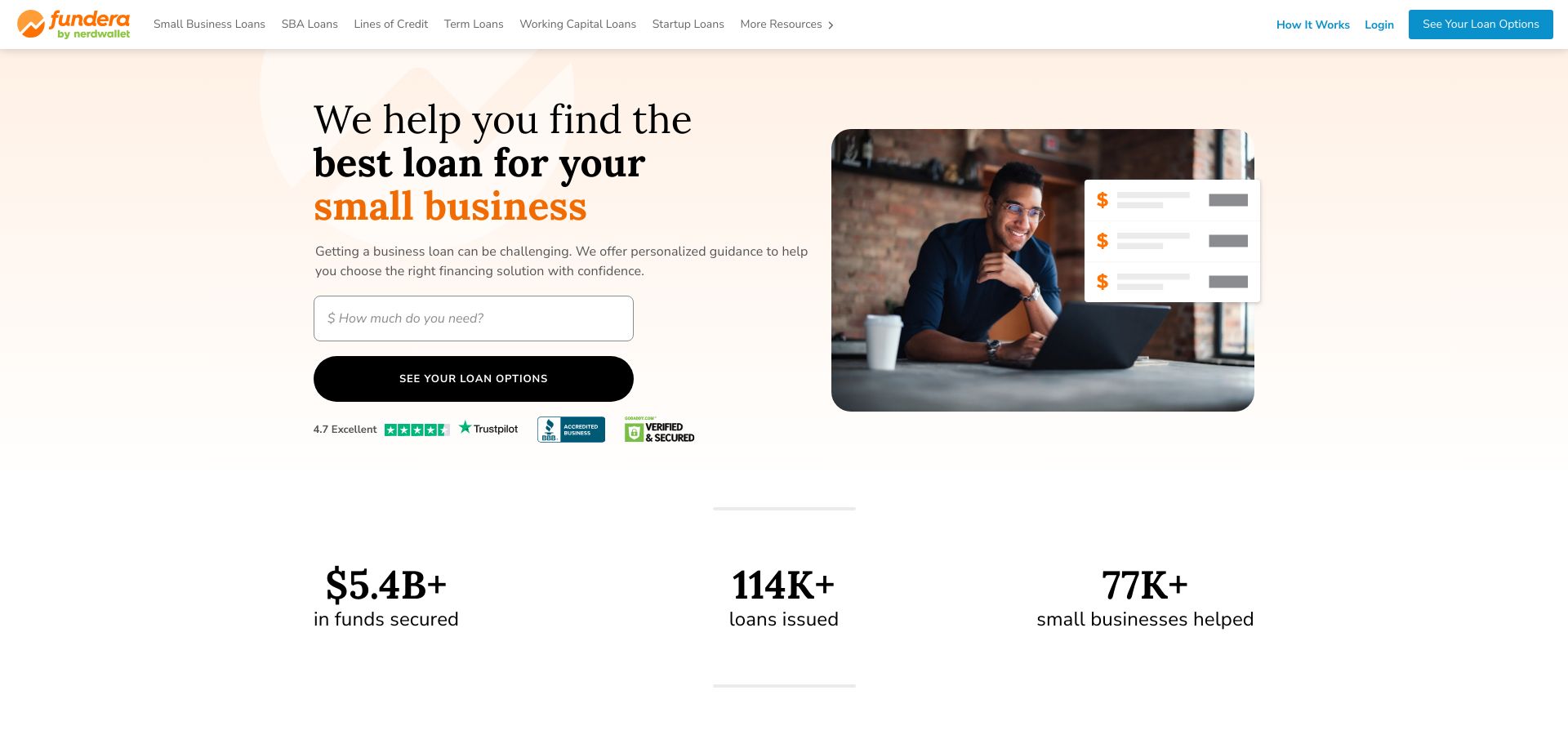
Fundera by NerdWallet

The results show in reviews. A 4.7-star Trustpilot rating, filled with client shout-outs, confirms that steady, informed guidance still wins hearts in a digital world. If you prefer fewer voices and deeper expertise over a massive lender list, Fundera feels like having a former SBA banker on speed dial.

3. SmartBiz: Best for Streamlined, SBA-Only Funding

Snapshot: Turning a Marathon into a Jog

SmartBiz focuses on one goal: moving well-qualified owners through the SBA 7(a) process faster than a branch visit.
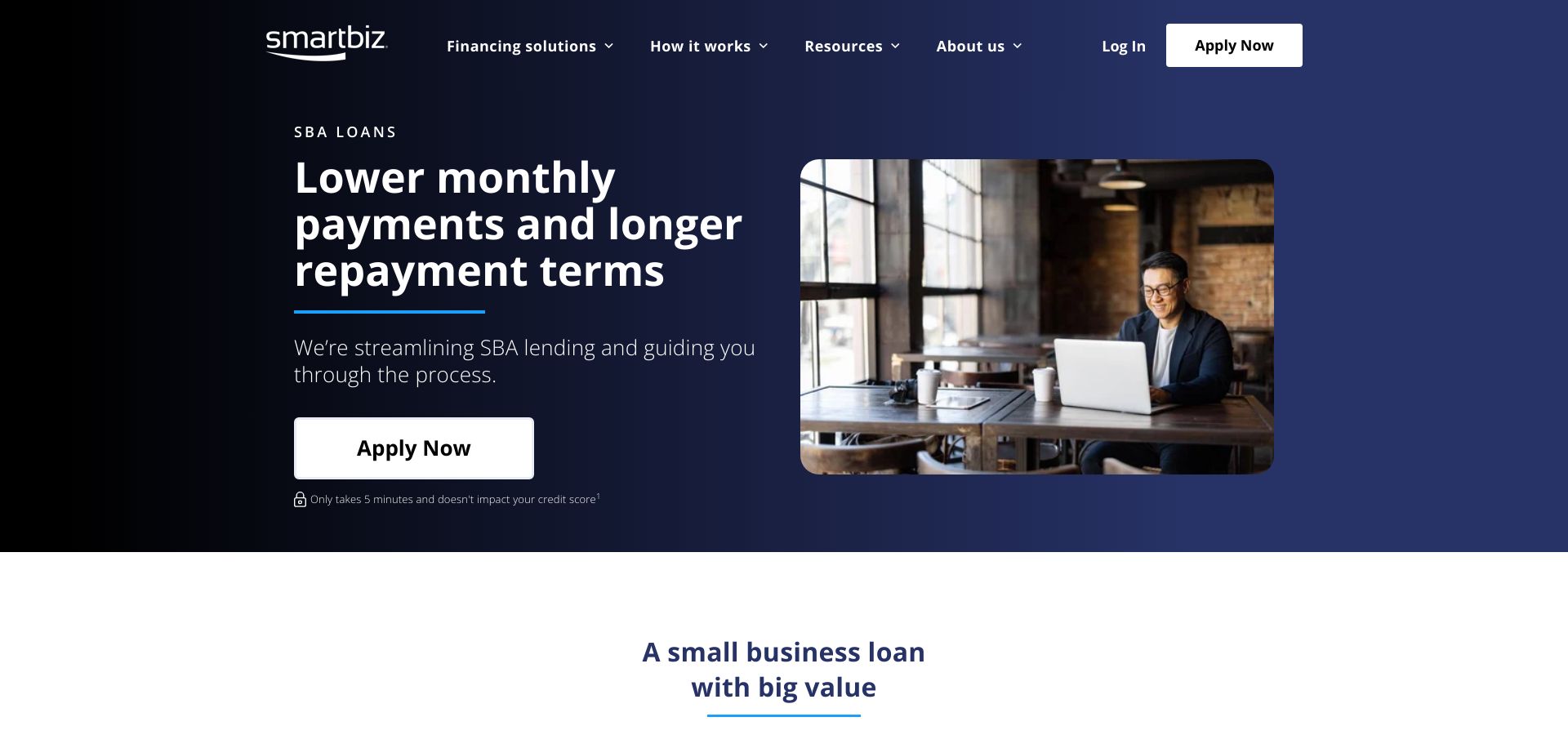
SmartBiz: streamlined, SBA-only funding

Start with a 5-minute questionnaire that runs your numbers against SmartBiz’s algorithm and its circle of about 10 Preferred Lenders. If you clear the 680-credit and 2-years-in-business hurdles, you see a pre-qualification screen almost instantly. A relationship manager then reviews your documents and guides the file to the bank most likely to approve.

Speed comes at a price. SmartBiz adds a 4 percent fee to every funded loan—2 percent for the match and 2 percent for packaging the SBA paperwork. The fee rolls into the loan, so no cash leaves your pocket up front, but it does raise the long-term cost.

Many borrowers feel the surcharge is fair for trimming weeks off a slow process. Trustpilot reviews praise clear communication, transparent pricing, and relief at cutting red tape, though some note that an SBA loan still takes time.

Bottom line: if your credit is strong, your books are clean, and you are willing to pay for an express lane, SmartBiz can turn the usual SBA obstacle course into a guided sprint.

4. Biz2Credit: Best Hybrid for Speed and Backup Plans

Snapshot: One Application, Multiple Off-Ramps

Biz2Credit wears two hats in the SBA loan marketplaces. It funds SBA loans itself and also shops your deal to partner banks when that makes more sense.

Fill out its quick form and the underwriting engine reviews tax returns, cash-flow metrics, and credit data almost in real time. If your numbers work, you could see a conditional SBA approval the same day, with funding in about 30 days. If the SBA path stalls, Biz2Credit pivots quickly, offering its own shorter-term working-capital loan so you are not stranded.

That flexibility can save owners who cannot afford downtime, but it comes with homework. Origination fees on Biz2Credit-funded loans and double-digit APRs can dwarf low SBA rates. Stick to the SBA offer if that is what you came for; treat the pricier alternative as a last resort.

Customer reviews show a mix of high praise for rapid cash and frustration over sales pressure on high-cost products. A steady 4.6-star Trustpilot average suggests the model works when expectations are clear.

Choose Biz2Credit if you want SBA speed with an immediate backup loan available, but keep your goal fixed on the affordable option.

5. Nav: Best for Seeing Where You Stand Before You Apply

Snapshot: Credit Clarity Meets Matchmaking

Wish you could peek at a lender’s scorecard before sharing a single document? That is Nav.

Create a free account and the platform pulls your personal and business credit files with a soft inquiry. Seconds later, it shows your scores with plain advice such as “SBA lenders look for 680+; you are at 702, nice work!” along with a ranked list of loan offers you are likely to qualify for.
Nav: best for seeing

Nav does not fund loans or broadcast your contact details to 10 banks at once. Instead, you choose the lender you like, avoiding a rush of calls. Paid plans add weekly credit updates and access to a funding coach, but the core matching tool stays free.

Users praise the transparency. A 4.5-star Trustpilot rating cites detailed credit tips and relief at avoiding wasted hard pulls. The trade-off: once you pick a lender, Nav steps aside; you still complete that lender’s full application and wait for underwriting.

Choose Nav if you are early in the hunt, want to polish your credit before applying for an SBA loan, or simply prefer to shop offers without handling a stack of follow-up calls.

6. Lendingtree: Best for Casting the Widest Net Fast

Snapshot: Speed Dating for Business Loans

Need to see how many lenders will bite on your SBA request before lunch? LendingTree makes it happen.

Submit a short intake form and the platform pushes your profile to about 40 banks and online lenders within seconds. Your phone starts ringing almost immediately, each caller ready to pitch terms or request documents. Owners who enjoy competition can surface deals they never knew existed.

Because LendingTree is a pure lead generator, you pay nothing to use it. Lenders cover the fee, so no broker charges appear later. That model also hands control to the lenders, so follow-up styles vary; some reps are consultative, others hard-charging salespeople.

Borrowers praise the volume of options and the power to pit offers against each other. Critics point to inbox overload and the need to repeat paperwork with every lender. An A-plus BBB rating and a 4.5-star Trustpilot average show the platform delivers on its promise—provided you set clear boundaries and schedule time to field calls.

Choose LendingTree when you want instant market feedback, do not mind sifting through multiple term sheets, and feel confident saying “no” until the right SBA lender rises to the top.

choose the right marketplace

Conclusion: How to Choose the Right Marketplace for Your Business

Start with a quick timing check.

If you need capital inside 2 weeks, no marketplace can move an SBA loan that fast. Consider Biz2Credit’s bridge option or a short-term offer from LendingTree, then refinance with an SBA deal when the clock is kinder.

Next, gauge your paperwork stamina.

Hate juggling calls from multiple lenders? Stick with high-touch platforms like Fundera or SmartBiz, where one advisor shields you from the phone surge. Comfortable fielding offers like a pro at a trade show? LendingTree’s rapid-fire model can work in your favor.

Credit score counts, but context counts more.

Nav is ideal if you are unsure whether a 650 will satisfy SBA lenders. Its free dashboard shows where you stand and what to fix before you apply, sparing you pointless hard pulls.

Cost comes last, only because the first three filters remove bad fits quickly.

Zero-fee SBA loan marketplaces such as Lendio and Fundera let you keep every borrowed dollar. SmartBiz’s 4 percent charge makes sense only when the time you save is worth the premium.

Above all, gather your documents early.

Tax returns, year-to-date financials, and a tidy debt schedule can cut days off underwriting. If you need a refresher on lender expectations, skim our quick primer on preparing for a business loan before you press “Submit.”

Choose the SBA loan marketplace the way you choose any partner: the one that respects your timeline, your communication style, and your bottom line. Get that trio right and the rest falls into place.

Frequently Asked Questions

Are SBA-loan marketplaces safe?

Yes. The large platforms on our list use bank-level encryption and share your data only with lenders you select. Verify you are on the official site and never pay an up-front “processing” fee to an unknown caller.

Will my credit score drop just for shopping?

Browsing is harmless. Marketplaces run a soft credit pull that does not affect your score. A hard inquiry appears only when you proceed with a specific lender and approve full underwriting. Keep all SBA applications inside a 30-day window and most scoring models treat multiple pulls as one.

Do I pay extra interest by using a marketplace?

The SBA sets rate caps, so interest stays the same whether you walk into a bank or arrive through Lendio. The only added cost is a broker or packaging fee. Four of our six picks charge nothing; SmartBiz folds a 4 percent fee into the loan for its paperwork service.

I am a brand-new startup—can I still get an SBA loan through these sites?

Probably not yet. Most SBA lenders want at least 2 years of operating history. Use Nav to track and build your credit, explore microloans, or consider a shorter-term option until your revenue matures.

Can I negotiate once I have offers?

Absolutely. Multiple term sheets give you leverage. Politely let each lender know you are comparing rates and fees, then ask whether they can sharpen the deal. Marketplaces like Fundera or Lendio will even handle that back-and-forth for you.

Still have questions? Drop them in the comments below and we will tackle the tricky ones in future updates.

Glossary of SBA Lending Essentials

SBA 7(a) loan. The workhorse of government-backed small-business financing. It funds working capital, equipment, and real-estate purchases up to $5 million, with interest capped at a spread over the Wall Street Journal prime rate.

SBA 504 loan. A two-lender structure for large, long-term assets. Your bank covers 50 percent, a nonprofit Certified Development Company covers 40 percent, and you bring 10 percent to the table, making it useful for buying or building owner-occupied property.

SBA Express loan. A streamlined cousin of 7(a). Lenders receive an SBA response in 36 hours and can approve up to $500 000 on their own paperwork, trading a lower SBA guarantee for speed.

Preferred Lender Program (PLP). A badge the SBA gives to top-performing banks. PLP lenders underwrite and sign off on 7(a) loans without sending the file to the SBA for a second review, saving weeks.

Soft versus hard credit pull. A soft inquiry lets a marketplace preview your score without lowering it. A hard pull appears only when you proceed with a specific lender and may lower your score a few points.

Packaging or referral fee. A charge some intermediaries add to assemble SBA paperwork and match you to a bank. SmartBiz, for example, adds a 4 percent combined fee.

Origination fee. A lender’s own processing charge, common on non-SBA loans from fintech firms like Biz2Credit. It is usually a flat percentage of the amount funded.

Personal guarantee. A clause that makes each owner with 20 percent or more stake personally liable if the business cannot repay. Every SBA loan requires it.

UCC lien. The legal filing that lets a lender claim business assets as collateral. Expect one on nearly every SBA loan, even when no specific property is pledged.

Marketplace versus broker. Both connect you to lenders. A marketplace relies on automated matching across many partners, while a traditional broker shops your deal manually. Today’s top platforms often blend the two approaches.

Sources and Further Reading

We grounded every claim in published data, not opinion. Below are the references worth bookmarking if you plan to pursue an SBA loan or track the market.

  • Bankrate SBA lending report. Confirms that the Small Business Administration backed more than 70 000 7(a) loans totaling $31.1 billion in fiscal 2024, a clear sign of demand for government-guaranteed capital.
  • Merchant Maverick review of SmartBiz. Breaks down SmartBiz’s 2 percent referral fee and 2 percent packaging fee, helping us separate true costs from marketing gloss.
  • Lendio press release, March 2024. Notes the platform’s $15 billion funded milestone, 400 000 businesses served, and a lender roster of about 75 partners, which supports our top ranking.
  • Trustpilot reviews. Tens of thousands of recent ratings reveal real-world support quality, pressure tactics, and funding times across all six SBA loan marketplaces.
  • SBA standard operating procedures. Outline guarantee percentages, fee caps, and eligibility rules.
  • Federal Reserve Small Business Credit Survey 2025. Provides macro trends on approval odds, interest-rate spreads, and credit tightening.

Dive into these reports if you need deeper data on approval rates, interest ranges, or lending cycles.

The post 6 Best SBA Loan Marketplaces for Small Businesses Ranked by Lender Response Quality appeared first on Home Business Magazine.

Original source: https://homebusinessmag.com/money/credit-and-receivables/6-sba-loan-marketplaces-small-businesses-ranked-lender-response-quality/

6 Best SBA Loan Marketplaces for Small Businesses Ranked by Lender Response Quality

Home Business Magazine Online

Securing an SBA loan can feel like sprinting through molasses. You wade through forms, wait weeks for a banker to call, then hold your breath while the government reviews every line. Yet demand keeps surging: in fiscal 2024, lenders approved more than 70,000 SBA 7(a) loans worth $31.1 billion . That gap between urgency and red tape is exactly why online SBA-loan marketplaces matter. One digital application routes your file to lenders already fluent in the SBA rulebook—so you spend less time chasing signatures and more time growing your business.

Our Ranking Methodology

Every SBA loan marketplace on our shortlist went through the same five-part stress test. We cared about one result above all: how quickly you receive a real, actionable response from an SBA lender.

First, speed to first offer. We timed the journey from first click to the initial email or call with clear next steps. Platforms that replied within 72 hours scored highest, while responses that dragged past a week lost points.

Second, transparency. Does the site spell out costs and credit pulls in plain English or hide them in footnotes? SmartBiz, for example, displays its 2 percent referral fee and 2 percent packaging fee, so it earned full marks despite the price.

Third, borrower cost. Most marketplaces are free because lenders pay the referral tab. Any platform that added borrower fees lost points, unless the extra charge clearly unlocked faster approvals or dedicated support.

Fourth, product breadth. A site with one SBA partner is a one-lane road; a marketplace with dozens of banks and fintech lenders is a six-lane highway. More lanes mean more chances for approval and a better rate.

Fifth, customer sentiment. We sifted through tens of thousands of recent Trustpilot reviews to gauge support quality, pressure tactics, and real-world funding times. High praise pushed scores up, while patterns of ghosting or spammy follow-ups pulled them down.

Weighting: response quality 40 percent, transparency 20, borrower cost 15, product breadth 15, and customer reviews 10. The blend creates a 100-point, data-first ranking that rewards speed and honesty, not hype.

Marketplace Snapshot: Speed, Fees, and Reputation

Before we look at each SBA loan marketplace in detail, here is a side-by-side view. It shows who charges what, how quickly you can expect a reply, and which platforms borrowers praise most.

Marketplace snapshot

Rank Marketplace Lenders in network Time to first offers* Borrower fees Trustpilot rating
1 Lendio about 75 partners 24–72 hrs None 4.8 ★
2 Fundera by NerdWallet about 30 curated banks 48 hrs None 4.7 ★
3 SmartBiz about 10 SBA banks 5-min pre-qual / 30–60 days funding 4 percent of loan 4.6 ★
4 Biz2Credit 20+ (plus in-house lending) Same-day conditional Varies† 4.6 ★
5 Nav 100+ partners Instant matches None (free tier) 4.5 ★
6 LendingTree 40+ lenders Minutes (multiple calls) None 4.5 ★
  • Time ranges reflect typical SBA-loan experiences, not faster alternative products.
    † Biz2Credit adds origination fees on its own term loans; SBA loans follow standard SBA costs.

Use the grid as a quick check. If zero fees and broad lender reach rank first for you, Lendio and Fundera lead the pack. Willing to pay a 4 percent premium for guided, SBA-only help? SmartBiz may be worth it. Want options beyond SBA or prefer seeing approval odds in real time? Biz2Credit and Nav keep the door wider.

Next, let’s see why Lendio holds the number-one spot.

1. Lendio: Best Overall for Fast Responses

One application can trigger three or four real offers within a couple of days, and Lendio’s dedicated SBA team can convert those offers to funded cash in as little as two weeks, giving you choice instead of a single take-it-or-leave-it quote.

Snapshot: Why Lendio Leads the Pack

Lendio works like a matchmaking engine. Complete a 15-minute questionnaire and the platform scans about 75 banks, credit unions, and fintech lenders to find SBA fits.

That depth pays off. One application can trigger three or four real offers within a couple of days, giving you choice instead of a single take-it-or-leave-it quote.

You pay nothing for that reach. Lendio earns its fee from lenders, so every borrowed dollar stays in your business.

A dedicated funding manager then calls to clarify goals, collect documents, and nudge slow lenders. The mix of speed and human help keeps Lendio at the top of our list.

Key Numbers and Real-World Performance

  • Network: about 75 active partners, from Live Oak Bank to fintech newcomers.
  • Funding volume: $15 billion delivered to 400 000 small businesses as of March 2024.
  • Speed: application in under 15 minutes; at least one conditional SBA offer within 24–72 hours when financials are ready.
  • Borrower cost: zero platform fees; you only pay standard SBA guarantee and closing costs.
  • Trustpilot:8 stars based on more than 21 000 reviews.

Big network, quick replies, and no borrower fees make Lendio a powerful first stop when you need SBA capital without the wait.

2. Fundera by NerdWallet: Best for Concierge-Style Guidance

Snapshot: A Personal Banker in Marketplace Clothing

Fundera swaps raw lender volume for white-glove service. Backed by NerdWallet’s content engine, the platform works with about 30 top-performing SBA lenders and pairs you with a human advisor who stays with you from first document upload to final signature.

Because the pool is smaller, you avoid a flood of calls; everything routes through your Fundera rep. After a brief online intake and a soft credit pull, expect a callback within 48 hours outlining your best SBA options with clear pros and cons.

Fundera is free for borrowers. Like Lendio, it earns its fee from lenders, so every dollar you borrow can go toward payroll, inventory, or growth.

Fundera by NerdWallet

The results show in reviews. A 4.7-star Trustpilot rating, filled with client shout-outs, confirms that steady, informed guidance still wins hearts in a digital world. If you prefer fewer voices and deeper expertise over a massive lender list, Fundera feels like having a former SBA banker on speed dial.

3. SmartBiz: Best for Streamlined, SBA-Only Funding

Snapshot: Turning a Marathon into a Jog

SmartBiz focuses on one goal: moving well-qualified owners through the SBA 7(a) process faster than a branch visit.

SmartBiz: streamlined, SBA-only funding

Start with a 5-minute questionnaire that runs your numbers against SmartBiz’s algorithm and its circle of about 10 Preferred Lenders. If you clear the 680-credit and 2-years-in-business hurdles, you see a pre-qualification screen almost instantly. A relationship manager then reviews your documents and guides the file to the bank most likely to approve.

Speed comes at a price. SmartBiz adds a 4 percent fee to every funded loan—2 percent for the match and 2 percent for packaging the SBA paperwork. The fee rolls into the loan, so no cash leaves your pocket up front, but it does raise the long-term cost.

Many borrowers feel the surcharge is fair for trimming weeks off a slow process. Trustpilot reviews praise clear communication, transparent pricing, and relief at cutting red tape, though some note that an SBA loan still takes time.

Bottom line: if your credit is strong, your books are clean, and you are willing to pay for an express lane, SmartBiz can turn the usual SBA obstacle course into a guided sprint.

4. Biz2Credit: Best Hybrid for Speed and Backup Plans

Snapshot: One Application, Multiple Off-Ramps

Biz2Credit wears two hats in the SBA loan marketplaces. It funds SBA loans itself and also shops your deal to partner banks when that makes more sense.

Fill out its quick form and the underwriting engine reviews tax returns, cash-flow metrics, and credit data almost in real time. If your numbers work, you could see a conditional SBA approval the same day, with funding in about 30 days. If the SBA path stalls, Biz2Credit pivots quickly, offering its own shorter-term working-capital loan so you are not stranded.

That flexibility can save owners who cannot afford downtime, but it comes with homework. Origination fees on Biz2Credit-funded loans and double-digit APRs can dwarf low SBA rates. Stick to the SBA offer if that is what you came for; treat the pricier alternative as a last resort.

Customer reviews show a mix of high praise for rapid cash and frustration over sales pressure on high-cost products. A steady 4.6-star Trustpilot average suggests the model works when expectations are clear.

Choose Biz2Credit if you want SBA speed with an immediate backup loan available, but keep your goal fixed on the affordable option.

5. Nav: Best for Seeing Where You Stand Before You Apply

Snapshot: Credit Clarity Meets Matchmaking

Wish you could peek at a lender’s scorecard before sharing a single document? That is Nav.

Create a free account and the platform pulls your personal and business credit files with a soft inquiry. Seconds later, it shows your scores with plain advice such as “SBA lenders look for 680+; you are at 702, nice work!” along with a ranked list of loan offers you are likely to qualify for.

Nav: best for seeing

Nav does not fund loans or broadcast your contact details to 10 banks at once. Instead, you choose the lender you like, avoiding a rush of calls. Paid plans add weekly credit updates and access to a funding coach, but the core matching tool stays free.

Users praise the transparency. A 4.5-star Trustpilot rating cites detailed credit tips and relief at avoiding wasted hard pulls. The trade-off: once you pick a lender, Nav steps aside; you still complete that lender’s full application and wait for underwriting.

Choose Nav if you are early in the hunt, want to polish your credit before applying for an SBA loan, or simply prefer to shop offers without handling a stack of follow-up calls.

6. Lendingtree: Best for Casting the Widest Net Fast

Snapshot: Speed Dating for Business Loans

Need to see how many lenders will bite on your SBA request before lunch? LendingTree makes it happen.

Submit a short intake form and the platform pushes your profile to about 40 banks and online lenders within seconds. Your phone starts ringing almost immediately, each caller ready to pitch terms or request documents. Owners who enjoy competition can surface deals they never knew existed.

Because LendingTree is a pure lead generator, you pay nothing to use it. Lenders cover the fee, so no broker charges appear later. That model also hands control to the lenders, so follow-up styles vary; some reps are consultative, others hard-charging salespeople.

Borrowers praise the volume of options and the power to pit offers against each other. Critics point to inbox overload and the need to repeat paperwork with every lender. An A-plus BBB rating and a 4.5-star Trustpilot average show the platform delivers on its promise—provided you set clear boundaries and schedule time to field calls.

Choose LendingTree when you want instant market feedback, do not mind sifting through multiple term sheets, and feel confident saying “no” until the right SBA lender rises to the top.

choose the right marketplace

Conclusion: How to Choose the Right Marketplace for Your Business

Start with a quick timing check.

If you need capital inside 2 weeks, no marketplace can move an SBA loan that fast. Consider Biz2Credit’s bridge option or a short-term offer from LendingTree, then refinance with an SBA deal when the clock is kinder.

Next, gauge your paperwork stamina.

Hate juggling calls from multiple lenders? Stick with high-touch platforms like Fundera or SmartBiz, where one advisor shields you from the phone surge. Comfortable fielding offers like a pro at a trade show? LendingTree’s rapid-fire model can work in your favor.

Credit score counts, but context counts more.

Nav is ideal if you are unsure whether a 650 will satisfy SBA lenders. Its free dashboard shows where you stand and what to fix before you apply, sparing you pointless hard pulls.

Cost comes last, only because the first three filters remove bad fits quickly.

Zero-fee SBA loan marketplaces such as Lendio and Fundera let you keep every borrowed dollar. SmartBiz’s 4 percent charge makes sense only when the time you save is worth the premium.

Above all, gather your documents early.

Tax returns, year-to-date financials, and a tidy debt schedule can cut days off underwriting. If you need a refresher on lender expectations, skim our quick primer on preparing for a business loan before you press “Submit.”

Choose the SBA loan marketplace the way you choose any partner: the one that respects your timeline, your communication style, and your bottom line. Get that trio right and the rest falls into place.

Frequently Asked Questions

Are SBA-loan marketplaces safe?

Yes. The large platforms on our list use bank-level encryption and share your data only with lenders you select. Verify you are on the official site and never pay an up-front “processing” fee to an unknown caller.

Will my credit score drop just for shopping?

Browsing is harmless. Marketplaces run a soft credit pull that does not affect your score. A hard inquiry appears only when you proceed with a specific lender and approve full underwriting. Keep all SBA applications inside a 30-day window and most scoring models treat multiple pulls as one.

Do I pay extra interest by using a marketplace?

The SBA sets rate caps, so interest stays the same whether you walk into a bank or arrive through Lendio. The only added cost is a broker or packaging fee. Four of our six picks charge nothing; SmartBiz folds a 4 percent fee into the loan for its paperwork service.

I am a brand-new startup—can I still get an SBA loan through these sites?

Probably not yet. Most SBA lenders want at least 2 years of operating history. Use Nav to track and build your credit, explore microloans, or consider a shorter-term option until your revenue matures.

Can I negotiate once I have offers?

Absolutely. Multiple term sheets give you leverage. Politely let each lender know you are comparing rates and fees, then ask whether they can sharpen the deal. Marketplaces like Fundera or Lendio will even handle that back-and-forth for you.

Still have questions? Drop them in the comments below and we will tackle the tricky ones in future updates.

Glossary of SBA Lending Essentials

SBA 7(a) loan. The workhorse of government-backed small-business financing. It funds working capital, equipment, and real-estate purchases up to $5 million, with interest capped at a spread over the Wall Street Journal prime rate.

SBA 504 loan. A two-lender structure for large, long-term assets. Your bank covers 50 percent, a nonprofit Certified Development Company covers 40 percent, and you bring 10 percent to the table, making it useful for buying or building owner-occupied property.

SBA Express loan. A streamlined cousin of 7(a). Lenders receive an SBA response in 36 hours and can approve up to $500 000 on their own paperwork, trading a lower SBA guarantee for speed.

Preferred Lender Program (PLP). A badge the SBA gives to top-performing banks. PLP lenders underwrite and sign off on 7(a) loans without sending the file to the SBA for a second review, saving weeks.

Soft versus hard credit pull. A soft inquiry lets a marketplace preview your score without lowering it. A hard pull appears only when you proceed with a specific lender and may lower your score a few points.

Packaging or referral fee. A charge some intermediaries add to assemble SBA paperwork and match you to a bank. SmartBiz, for example, adds a 4 percent combined fee.

Origination fee. A lender’s own processing charge, common on non-SBA loans from fintech firms like Biz2Credit. It is usually a flat percentage of the amount funded.

Personal guarantee. A clause that makes each owner with 20 percent or more stake personally liable if the business cannot repay. Every SBA loan requires it.

UCC lien. The legal filing that lets a lender claim business assets as collateral. Expect one on nearly every SBA loan, even when no specific property is pledged.

Marketplace versus broker. Both connect you to lenders. A marketplace relies on automated matching across many partners, while a traditional broker shops your deal manually. Today’s top platforms often blend the two approaches.

Sources and Further Reading

We grounded every claim in published data, not opinion. Below are the references worth bookmarking if you plan to pursue an SBA loan or track the market.

  • Bankrate SBA lending report. Confirms that the Small Business Administration backed more than 70 000 7(a) loans totaling $31.1 billion in fiscal 2024, a clear sign of demand for government-guaranteed capital.
  • Merchant Maverick review of SmartBiz. Breaks down SmartBiz’s 2 percent referral fee and 2 percent packaging fee, helping us separate true costs from marketing gloss.
  • Lendio press release, March 2024. Notes the platform’s $15 billion funded milestone, 400 000 businesses served, and a lender roster of about 75 partners, which supports our top ranking.
  • Trustpilot reviews. Tens of thousands of recent ratings reveal real-world support quality, pressure tactics, and funding times across all six SBA loan marketplaces.
  • SBA standard operating procedures. Outline guarantee percentages, fee caps, and eligibility rules.
  • Federal Reserve Small Business Credit Survey 2025. Provides macro trends on approval odds, interest-rate spreads, and credit tightening.

Dive into these reports if you need deeper data on approval rates, interest ranges, or lending cycles.

The post 6 Best SBA Loan Marketplaces for Small Businesses Ranked by Lender Response Quality appeared first on Home Business Magazine.

Original source: https://homebusinessmag.com/money/credit-and-receivables/6-sba-loan-marketplaces-small-businesses-ranked-lender-response-quality/

Affordable AI Video Generator with Low Startup Cost: 7 Budget-Friendly Tools Compared

Home Business Magazine Online

Video sells, but hiring a crew or mastering pro software drains a lean budget.

Today’s affordable AI video generators cut time and cost, letting home-based entrepreneurs turn a script into a polished clip before the coffee cools.

The shift is widespread: 86 percent of video-ad buyers already use—or plan to use—generative AI this year, and 58 percent of small businesses rely on AI, up from 40 percent last year.

This guide reviews seven platforms that cost $0–$30 a month so you can pick one, hit publish, and stay visible without overspending.

Why Video, Why AI, Why Now?

Video grabs attention faster than any other medium. Viewers scroll past plain text, but motion makes them pause.

For a small business, that pause can lift clicks and sales. A single product demo or how-to clip can beat a week of static posts, yet traditional production needed cameras, lighting, and long editing nights.

Generative AI changes the math. Feed a prompt or paste a script; the platform pairs voiceover, visuals, and motion in minutes. You pay pocket change instead of day rates.

Recent models raise the bar on quality. Entry-level tools now export crisp HD, sync multilingual voice to avatars, and animate still photos. The gap between a studio shoot and an AI render keeps shrinking.

Speed matters as much as savings. You can react to a trend the day it starts, update messaging on the fly, and test multiple hooks without reshoots. In social feeds, agile beats perfect.

Consumer video use keeps climbing. More screens, shorter attention spans, and algorithm-heavy platforms reward brands that ship frequent, snack-size videos. Those that stall fade quietly.

In short, affordable AI video turns a former luxury into a daily habit. It lets you produce, iterate, and learn at the pace of modern marketing, and no film degree is required.

How We Picked the List

A dozen flashy tools promise Hollywood in a click. We looked for options that let a scrappy business owner publish without draining the account.

First, we set a hard ceiling: each platform had to offer a genuine free tier or a starter plan under about $30 per month. If a paywall appeared before you could export a test video, the tool was out.

We then graded every contender on four factors:

  • Cost: 40 percent of the score, because saving money matters most
  • Features and flexibility: 25 percent, rewarding platforms with multiple capabilities
  • Ease of use: 20 percent, based on setup time and user reviews
  • Output quality: 15 percent, focused on resolution, voice realism, and polish

We reviewed more than fifteen services, ran the numbers, and named seven clear winners. Heavyweights such as Synthesia missed the cut on price alone, proving this list stays fiercely budget-first.

Budget AI Video Generators at a Glance

The table below lists the seven AI video generators that passed our price test. Use it as a quick reference to see which platforms offer free exports, what the first paid tier costs, and where each one excels.

Tool Free Tier Starter Price Stand-out Features Best For
Leonardo AI (video generator) Yes, credit-based, no card Beta free Image-to-video, multi-model styles, active creator community Original social visuals
Fliki 5 minutes each month $8 Text-to-video plus 900 voices in 75 languages Blog-to-video repurposing
Pictory 3 videos (trial) $19 Auto highlights from long text or video, captions Content marketers
InVideo 2 HD minutes each week ~$15 AI script-to-video, 16 million stock clips, rich templates Ad builders
HeyGen 1 minute (trial) $30 100+ talking avatars, lip-sync, multilingual output Spokesperson videos
Colossyan 1 minute each month $30 Custom or built-in avatars, slide editor Training snippets
Runway Gen-2 125 credits $12 Text-to-video clips, AI background removal Experimental B-roll creators

Need a free-forever option? Leonardo or Colossyan fit the bill. Looking for the lowest paid entry? Fliki offers that. Want daring visuals? Runway delivers.

The next sections break down how each platform works in real projects so you can choose with confidence.

1. Leonardo AI: Turn Images into Motion for Free

Leonardo AI’s video generator feels built for visual storytellers. Upload a photo—or create fresh art in the same dashboard—type a short prompt, and watch the picture move with camera pans, particle effects, or subtle character shifts.

Leonardo AI
Leonardo AI video generator interface showing image-to-video controls

You begin with roughly 150 free credits each day and no credit-card gate, a perk most rivals skip. When credits run low, you top up instead of locking into a monthly fee, so cost scales with workload.

Quality exceeds the price point. Several AI models cover everything from watercolor scenes to photoreal cityscapes, and motion sliders let you set speed and direction. Early users praise the crisp 1080p export and watermark-free results during the open beta.

Because the platform also generates images, you stay in one workspace: create product stills, animate them, add text overlays, and post on social in a single session. The loop saves both clicks and cash.

Leonardo suits solo founders and artists who need unique B-roll and have a few minutes to experiment. Give it an afternoon, and your feed can look hand-drawn by a studio team—without the payroll.

2. Fliki: Turn Blogs into Video in Minutes

Fliki turns plain text into a share-ready video faster than you can reread your own post. Paste a paragraph, choose a voice, and the platform pairs stock visuals with captions to deliver a polished clip without timeline headaches.

Fliki text-to-video editor
Fliki text-to-video editor turning blog posts into videos

The starter plan costs eight dollars a month, and the free tier still gives you five export minutes. That covers weekly social shorts or a bite-size product teaser.

Voices are the standout feature. Fliki offers about 900 natural-sounding narrators across 75 languages, so your content speaks to every corner of your market without hiring voice talent.

Editing stays light. Swap a suggested scene photo, search the built-in stock library, or adjust sentence timing with a click.

If writing is your strong suit, Fliki doubles your output. Each blog becomes a video post, and each newsletter becomes a narrated reel—more channels, same effort, minimal spend.

3. Pictory: Repurpose Long-form Content on Autopilot

If your blog runs deep or your YouTube channel hosts marathon tutorials, Pictory turns that long-form gold into snack-size clips without manual slicing.

Drop in a URL, raw transcript, or full video file. The AI scans key moments, pulls punchy quotes, and builds a highlight reel with captions and royalty-free background music. What once took hours in a traditional editor now wraps before your coffee cools.

Costs stay friendly for lean teams. A three-video trial lets you test results, and the nineteen-dollar basic plan supports most weekly schedules. Cloud rendering removes the need for a heavy workstation, and exports reach 1080p.

Accuracy wins praise. Captions show few typos, and the summarizer often surfaces the moments that hook viewers; think step-by-step visuals, speaker sound bites, or dramatic before-and-after reveals.

Quick tweaks keep you in control. Swap a clip, change text style, or nudge scene order inside a drag-and-drop timeline that feels more Canva than Premiere.

One pillar post can spawn a LinkedIn teaser, an Instagram reel, and a Pinterest idea pin, multiplying reach while the original asset earns compound returns.

4. Invideo: Templates plus AI under One Roof

InVideo feels like Canva’s video-savvy cousin. Start with a prompt and its AI writes a short script, selects on-brand stock clips from a library of roughly 16 million assets, and assembles a storyboard you can tweak scene by scene.

InVideo AI editor
InVideo AI editor with templates and multi-track video timeline

The free plan lets you export two watermark-tagged HD minutes each week. That is enough to test an idea or pitch a new ad. Upgrade for about fifteen dollars a month; watermarks disappear, credit limits rise, and advanced generative models unlock.

Flexibility is the draw. Stay in quick mode and accept the AI’s first draft, or open the full timeline to refine fonts, transitions, and color grades. The extra depth takes a short session to learn, yet gives you room to grow as creative needs expand.

If you handle product promos, reels, and explainers, InVideo offers one cockpit rather than a stack of niche apps. Invest in one interface and cover nearly every marketing format you will need.

5. Heygen: A Virtual Presenter on Standby

Need a friendly face without hiring talent? HeyGen lets you type a script and watch a photoreal avatar deliver it in your chosen language, accent, and tone. The result feels like a seasoned host recorded a custom take just for you.

HeyGen AI avatar video creator
HeyGen AI avatar video creator with virtual presenter preview

The free trial covers one minute of output. Paid plans start at about thirty dollars a month, and per-minute costs drop on higher tiers. When you compare that with a human spokesperson, studio time, and edits, the math favors HeyGen.

Lip-sync precision stands out. Recent model updates track subtle mouth moves and eyebrow lifts, removing the stiff look early avatar tools showed. Swap backgrounds, add on-screen text, or change presenters mid-video to keep energy high.

Use cases range from ecommerce walk-throughs to onboarding explainers. Create once, translate, and HeyGen re-voices the same avatar in more than forty languages. The library includes over one hundred avatar styles, giving global sellers plenty of options.

If you are camera-shy or pressed for time, HeyGen turns scripts into polished, human-grade videos while you focus on the next task.

6. Colossyan Creator: Avatar Videos on a True Shoestring

Colossyan’s hook is simple: you receive one free, watermark-free minute of avatar video each month. That allowance covers a monthly promo, quick FAQ, or personal thank-you clip, and it never expires.

Colossyan Creator
Colossyan Creator slide-based AI avatar video editor

The interface is lighter than HeyGen. Select an avatar, paste your script, choose a language, and Colossyan renders a talking-head scene in roughly two minutes. Slide-based editing lets you chain scenes, change backgrounds, and add branded text without wrestling a complex timeline.

Avatars look slightly less lifelike than HeyGen’s most advanced models yet remain professional for training, internal communication, or social explainers. Upgrade to the thirty-dollar starter plan to unlock ten HD minutes a month, custom brand colors, and access to about forty avatar styles in more than sixty languages.

Accessibility is the standout. Test an avatar concept, gather feedback, and decide whether long-form synthetic presenters fit your brand before spending a dollar. For lean startups and side-hustlers, the risk-free entry removes budget anxiety.

7. Runway Gen-2: Experimental Visuals for Bold Brands

Runway’s Gen-2 model lets you type “neon skyline time-lapse” and render a four-second clip that looks ready for a sci-fi trailer. It excels at eye-catching B-roll, music-video layers, or TikTok hooks that feel unmistakably original.

Runway Gen-2 AI video generator
Runway Gen-2 AI experimental text-to-video workspace

The free tier supplies about 125 credits, enough for a dozen low-resolution clips. A twelve-dollar monthly plan unlocks longer runtimes, 1080p export, and faster queues, still far cheaper than custom motion graphics.

Beyond text-to-video, Runway removes backgrounds, replaces objects, and paints new elements frame by frame. Think of it as a browser-based effects studio on standby.

Output quality varies. Some generations look flawless, while others warp or blur. The trick is to iterate quickly, keep the gems, and layer them behind live footage or text in your primary editor.

If your brand thrives on visual experimentation and wants assets nobody else has, Runway earns a spot in the toolkit. It will not replace your core editor, but it will spice your creative mix with clips viewers have not scrolled past a thousand times.

Honorable Mentions: Great Tools That Missed on Price

You may see names like Synthesia, Adobe Firefly, or open-source text-to-video projects in creator forums. They impress yet fall outside our low-startup-cost promise.

  • Synthesia offers polished corporate avatars, but the entry plan runs about thirty dollars a month and requires annual billing, which can strain side-hustle budgets.
  • Adobe’s Firefly video model remains in beta and is expected to land inside a Creative Cloud subscription that starts near sixty dollars a month, sensible only if you already subscribe.
  • Open-source options such as ModelScope or Pika Labs Community Edition charge zero for the code, yet you still need a high-spec GPU or paid cloud server, which raises cost and complexity.

If your budget expands later, revisit these contenders. For now, the seven picks above provide professional results without premium fees.

Frequently Asked Questions

Are AI-made videos polished enough for customer-facing content? Yes. Advertisers, agencies, and streaming platforms already slip generative clips into campaigns seen by millions. For most marketing, training, or social tasks, videos from today’s budget tools look professional on a phone screen, where most viewers watch.

Will the free plans add watermarks? Usually. InVideo stamps its logo, and Colossyan brands free exports. Leonardo’s current beta and Runway’s low-resolution clips export clean. If you plan to run paid ads, set aside a small upgrade fee to remove marks.

How long does it take to learn these AI video generator platforms? Most users create a first draft in under 30 minutes. Fliki and Pictory feel like filling out a form. InVideo and Runway offer deeper controls; give yourself an afternoon to explore templates and shortcuts, and you will move quickly thereafter.

Is using an AI avatar legal and ethical? Yes, provided you own the script and do not impersonate real people without consent. New disclosure rules may soon ask brands to label synthetic presenters, so include a brief note in your video description to stay transparent.

The post Affordable AI Video Generator with Low Startup Cost: 7 Budget-Friendly Tools Compared appeared first on Home Business Magazine.

Original source: https://homebusinessmag.com/businesses/ai/affordable-ai-video-generators-low-startup-cost/