3D Product Animation: How to Bring Your Brand to Life and Earn Customer Trust

Home Business Magazine Online

When you speak to clients and business owners, the question is always the same: How to present the desired product in the best possible way? The era of old-school images has come to an end, helping us realize how vibrant business imagery actually is.

You may be aware that customers’ opinions are formed by more than a dull product image; instead, the intricacies are paired with contemplations on how the product can actually upgrade their lifestyle. This is when 3D product animation steps in, wrapped up in a robust computer graphics (CGI) tool that tells the engaging story beyond every shot.

This article highlights the specifications of top-notch 3D product animation, which is designed to boost your sales in no time.

What Hides Beyond 3D Product Animation

Simply put, 3D animation can be explained as a CGI video that demonstrates a product in motion. This isn’t just a “rotating image,” as many clients believe, but rather a fully-fledged instrument that allows you to discern the nuances of form, function, and internal structure of an object from any angle and at any scale.

What is the core benefit of this approach? The answer is short: the video is created entirely in a digital environment, conquering the limitations that traditional tools may bring about. This gives brands boundless control over lighting and materials, enabling scenarios that are cost-prohibitive with live filming.

Superiority vs Habit

Progress is power when it comes to 3D animation. It has so effectively helped to avoid material limitations so that you can literally “fly” the camera through a car engine or show how microscopic fabric fibers repel water.

No more waiting for a prototype feels more straightforward than with live filming. Many professionals are prone to working ahead, and they are real winners since animation can be ready months before the product rolls off the production line.

If you want to introduce any updates to product design or notice any rough edges, the 3D artist simply updates the model in the scene. With capturing in real time, you would have to map out the workflow from scratch.

In the world of 3D animation, there is no bad weather. There is no necessity to wait for a perfect sunrise to come if you want to create dozens of videos in the same style over the course of several years. Saving time is an advantage not to be beat.

Examples and Scenarios

real value of 3D product animation
Freepik.com

While the real value of 3D product animation is clear, there are some typical issues these types of videos can tackle.

1. Assembly Animation

Imagine selling a complex office chair or modular cabinet. Instead of mind-numbing paper instructions, the client receives a colorful 3D video where the parts automatically fit together in the correct order.

Reason to Use: Reduces returns due to improper assembly and boosts customer retention.

2. Exploded View

This is a kind of technique where a product is dramatically disassembled into its parts in space and then reassembled, creating a strong visual presence.

Reason to Use: Ideal for space-age products (watches, electronics, tools) to showcase the superior quality of the internal components and the complexity of the engineering.

3. Demo Animation

Demonstrates how a hidden sofa transformation mechanism operates or how airflow is distributed inside an air purifier.

Reason to Use: Clearly explains the product’s unique selling proposition (USP) in seconds, while cutting to the chase.

4. Design Variations

In a single video, you can instantly change the upholstery of a chair from leather to velvet or stick to a different smartphone case color palette.

Why: Allows for demonstrating variations without renting a studio for each color. Clients prefer precision, and they will be satisfied to create a matching pattern.

5. Promo 3D Video

Aesthetic shots with an emphasis on texture: the play of light on metal, the softness of fabric, the shine of glass.

Why: Creates intense, heartfelt connection and a premium feel for the brand, which is crucial for social media marketing (Instagram, TikTok).

3D Product Animation: Business Benefits

3D Product Animation: Business Benefits
Freepik.com

Taking on a 3D product animation for your business is not a vanity project. Instead, it is a long-term investment for those who crave building the right foundations and pouring into strategic decisions.

In short, 3D animation is the shortest path to your customer’s heart (and wallet). In a world where user attention is equal to an average of 8 seconds, dynamic 3D video may become your power and your chance to be noticed.

Investing in 3D animation pays off through content reuse. By creating a single, high-quality model, you meet the needs of several departments at once:

  • Marketing gets eye-catching videos for social media.
  • Sales gets cutting-edge presentations.
  • Technical support benefits from original video instructions.

The Bottom Line

Product viewing in business sparkles with new colors. Instead of in-person viewing, 3D video technology offers an immersive experience that is tough to beat. Become a partner on this journey!

The post 3D Product Animation: How to Bring Your Brand to Life and Earn Customer Trust appeared first on Home Business Magazine.

Original source: https://homebusinessmag.com/sales/selling-tactics/3d-product-animation-bring-brand-life-earn-customer-trust/

Justin Nelson of JP Morgan Shares Framework for Managing Neurodiverse Talent in Financial Services

Home Business Magazine Online

Financial services firms face a talent shortage, yet many overlook a pool of highly capable candidates: neurodiverse individuals. Justin Nelson, Managing Director and Head of the Asset Management and Financial Principals Coverage Team at J.P. Morgan Private Bank in Connecticut, argues that companies need to rethink their approach to hiring and managing employees on the autism spectrum. His insights come from both professional experience leading a team that oversees more than $15 billion in assets and personal understanding of the barriers neurodiverse individuals face in the workplace.

“For neurodiverse candidates, the biggest challenge is typically communication, their ability to interact with people,” Nelson explains. “Things that you and I probably take for granted, that makes it so easy for us to be having this conversation right here, it’s very hard for them.”

Recognizing Exceptional Capabilities

The communication difficulties that make traditional interviews challenging often obscure exceptional abilities. “Usually what that means is that while they may have a harder time connecting and communicating, they’re exceptional in other areas. They can be extremely creative and have amazing computational skills which far exceed the norm,” Nelson notes.

These cognitive strengths make neurodiverse employees particularly valuable in financial services, where analytical thinking and attention to detail drive results. However, traditional hiring processes filter out these candidates before their capabilities can be assessed. “Employers really need to change how they think about engaging with these people,” the JP Morgan managing director states.

Creating Supportive Work Environments

Project management becomes crucial when managing neurodiverse talent. Rather than assigning broad objectives, managers should break work into specific, defined tasks. “You have to assign tasks and ensure that they understand how this fits into a larger plan or set of rules,” Nelson advises.

This structured approach benefits both employee and employer. “These people tend to make some of the best employees because to be very exact within a specific framework,” Nelson observes. “If you can lay out the rules and know how to work and communicate with that group of people, you probably have some of your best employees.”

Supporting Neurodiversity Through Philanthropy

Justin Nelson extends his commitment beyond his JP Morgan role through involvement with organizations that support neurodiverse individuals. He works with Adelphi University’s Bridges Program, which provides support systems for high-functioning students on the spectrum, and Broad Futures, a charity focused on matching neurodiverse candidates with employers .

“They work with employers to match up people who are neurodiverse. They operate by helping employers get educated and having them run a program for them to help them select candidates.”

The transition from education to employment presents the greatest challenge for neurodiverse individuals. “Interviews can be hard for them, so an employer has to think differently about the hiring process.”

His framework offers financial services firms a practical path forward: redesign interview processes, provide structured task management, and partner with specialized organizations. These adjustments require minimal investment but can unlock access to highly capable employees who bring unique cognitive strengths to wealth management and financial analysis roles.

The post Justin Nelson of JP Morgan Shares Framework for Managing Neurodiverse Talent in Financial Services appeared first on Home Business Magazine.

Original source: https://homebusinessmag.com/management/technology-management/justin-nelson-jp-morgan-shares-framework-managing-neurodiverse-individuals-financial-services/

Adapting Technical Central Asian Traditions for New York Sophisticated Tastes Helps Gulnoza Jurayeva Prove That Authenticity Can Scale

Home Business Magazine Online

A founder of a Central Asian restaurant group explains how to standardize technique-driven craft food without killing authenticity, using enforceable standards, trainable routines, and real time quality checks

A signature dish can get a small food business noticed, but it rarely keeps the business stable on its own. The National Restaurant Association’s 2025 State of the Restaurant Industry reports that operators are still squeezed by food and labor pressures, and stability increasingly depends on execution, not just ideas. Authentic stops being a vibe and becomes an operational claim: can you deliver the same quality on a slow Tuesday, during a rush, and with a different team on the line? The brands that endure are the ones that treat repeatability as part of the product. This article develops one practical idea for founders: to scale craft, you have to translate taste into a system that can be taught, repeated, and verified.

Gulnoza Jurayeva on Turning Craft Cooking into a Scalable Operating System

To make growth possible, Gulnoza Jurayeva treats the signature dish not as a personal performance, but as a production standard that has to survive new hires, new shifts, and new locations. She is a chef and CEO of Laghman Express, a Central Asian restaurant group built around a technically demanding flagship — hand-pulled noodles supported by an author sauce and spice system. That approach has delivered the brand strong reviews on platforms such as Google Maps and Yelp, and an active Instagram community. The Atlanta location competes annually at Halal Food Fest. The operating model has also delivered recurring paid inquiries from entrepreneurs and investors, suggesting the method is transferable beyond one set of kitchens. It has also supported high expectation service contexts, including visits by Khabib Nurmagomedov, UFC fighters such as Valentina Shevchenko, football player Fabio Cannavaro, and several Olympic champions. The brand’s ability to deliver consistent quality and reliable service at scale attracted catering orders for CUNY campuses such as Hunter College, Baruch College, and Brooklyn College, as well as Columbia University and NYU, as well as events with UN and diplomatic participation.

This article develops a practical idea for founders: to scale craft, you have to translate taste into a system that can be taught, repeated, and verified.

Many craft-focused food businesses don’t stumble because the recipe loses appeal. They run into operational limits when quality depends too heavily on the founder. In the first location, the founder is effectively the quality control system, adjusting seasoning on the fly, checking texture, and stepping in when the line starts to slip. But once the business adds new shifts, managers, or a second unit, that level of oversight isn’t scalable unless it’s replaced with a repeatable process. Without that process, output varies by staff and shift, service times become inconsistent, and leadership spends more time fixing breakdowns than building the business.

Gulnoza’s approach is to treat craft like an operating discipline, not a personality trait. She starts by identifying which elements of the product have to remain consistent and which parts can flex without changing what customers experience. For a technique-driven item like hand-pulled noodles, that means the priority isn’t simply teaching the recipe. It’s setting clear product standards and building a production process that delivers those standards reliably across different staff, shifts, and locations.

That method has three parts founders can borrow.

The Three Parts of Gulnoza Jurayeva’s Approach

First, Gulnoza turns the signature dish into standard work, not a loose set of instructions. Instead of relying on a recipe card alone, she documents the production as a controlled sequence: exact portioning rules, defined timing windows, and specific quality checkpoints that managers can verify during live service. If the team can’t check quality in real time it won’t stay consistent across shifts or locations.

“When you can measure the craft and check it the same way every shift, you stop depending on a few standout people. The line starts producing the same result because the standard is clear and it can be verified,” the expert comments.

Second, Gulnoza Jurayeva treats training as a core operating function. In a tight labor market, relying on experienced hires is inconsistent, especially when the menu depends on technique. Instead, she builds a training path that can take a new employee from entry level to station-ready with clear performance checks. Skills are broken into specific tasks, each station has defined readiness standards, and managers are taught to evaluate and coach the same way across shifts. The payoff goes beyond food quality, as staffing becomes easier to plan, shifts run with fewer disruptions, and execution stays more consistent from one location to the next.

Third, Gulnoza designs for speed without dropping freshness. Many founders assume that a complex, made-from-scratch product will inevitably slow down service. Her approach is to treat speed as a workflow decision. Gulnoza Jurayeva maps the kitchen around peak-hour conditions: how stations are set up, what gets prepped in advance, how components move from prep to assembly, and where handoffs create delays. Then Gulnoza makes explicit choices about what can be prepared ahead under strict controls and what has to be finished to order to protect quality. With those boundaries in place, service time becomes predictable because the process is built to perform under volume, not only when the founder is on the line.

There’s a final layer that many operators overlook: make trust visible, then build operations that can sustain what customers see. Gulnoza Jurayeva uses an open kitchen where guests watch hand-pulled noodles and sauce work in real time. This way, the brand’s core claim can be evaluated on the spot. That transparency is paired with performance indicators that show repeatability at scale: the company expanded to three U.S. locations in 3 years and grew into a 100-person team. However, some challenges might appear: colleagues and competitors tend to imitate what they see, eager to reach that scale.

As the expert shares, “at a certain point, if the concept works, you start seeing copies. We reached that stage when similar places appeared in other states, using the same menu logic, presentation, and even the color scheme. Truly, surface features are easy to replicate. In this case, I recommend documenting your standards so they can be enforced and building visible signatures that only the original can perform consistently in front of guests. Copies can mimic what you look like. They struggle to match what you can execute, when the bar keeps moving.”

The business has generated sustained cash flow, enabling owner compensation above industry averages, and it has led to recurring paid inquiries from entrepreneurs and investors seeking her expertise. Investor and partner interest has translated into inbound requests to open additional locations in other states. The results of Gulnoza’s approach also support continued expansion: a fourth location is planned for 2026 on Emmons Avenue, a high-traffic waterfront corridor in Brooklyn that draws both tourists and local residents.

Once you grow past the stage where the founder is the quality system, taste stops being an advantage unless you can enforce it. Gulnoza Jurayeva’s model turns every rush into a test of control, with standards that hold when she is not on the line, training that produces station-ready performance on schedule, and a workflow that keeps speed predictable without trading away freshness.

The post Adapting Technical Central Asian Traditions for New York Sophisticated Tastes Helps Gulnoza Jurayeva Prove That Authenticity Can Scale appeared first on Home Business Magazine.

Original source: https://homebusinessmag.com/success-stories-lifestyles/adapting-technical-central-asian-traditions-new-york-sophisticated-tastes-helps-gulnoza-jurayeva-prove-authenticity-scale/

How to Share Google Contacts Securely and Quickly in 2026

Home Business Magazine Online

Managing Contacts has become a core part of modern communication. Whether you run a business, manage a remote team, or simply organize family information, keeping your contact list accessible and secure is essential. In 2026, collaboration moves fast, and inefficient methods of sharing information can slow down productivity and increase security risks.

Many users rely heavily on gmail for professional and personal communication. However, sharing Google Contacts directly from your account is not always as simple as sending a file. You need structured methods that protect privacy, prevent data leaks, and ensure the right people receive the right information. This is where Shared Contacts for gmail become especially useful, offering a streamlined way to manage collaborative access without compromising security.

In this guide, you will learn how to share contact lists quickly, what tools to use, and how to keep your information safe in the process.

Why Secure Contact Sharing Matters in 2026

Digital communication has expanded significantly. Businesses now operate across multiple time zones, freelancers collaborate globally, and even small teams rely on centralized contact management. Sharing Contacts insecurely can expose sensitive client data, internal emails, or personal information.

Security concerns in 2026 include:

  • Phishing attempts targeting shared databases
  • Unauthorized access through weak permissions
  • Accidental forwarding of sensitive lists
  • Data compliance violations

When you practice proper email sharing procedures, you reduce these risks. Secure sharing ensures that only authorized users can view, edit, or export your contact lists. It also allows you to track changes and maintain control over who has access at all times.

Method 1: Exporting and Sharing Contacts Manually

Step 1: Export Contacts from Google

One traditional method is exporting Google Contacts as a CSV or vCard file. To do this:

  1. Open Google Contacts.
  2. Select the Contacts you want to share.
  3. Click “Export.”
  4. Choose CSV or vCard format.

This file can then be attached to an email and sent to the intended recipient.

While this approach works, it has limitations. Once exported, you lose control over how the file is used. The recipient can duplicate, modify, or forward it without restrictions. For one-time transfers, this method may be sufficient. For ongoing collaboration, it is not ideal.

Step 2: Secure File Transmission

If you choose manual export, follow these safety practices:

  • Use encrypted email services.
  • Protect files with passwords.
  • Share passwords through a separate communication channel.
  • Avoid public Wi-Fi during file transmission.

Manual email sharing is simple but lacks dynamic updates. Every time the contact list changes, you must repeat the process.

Method 2: Using Google Groups for Contact Sharing

Google Groups for Contact Sharing
Unsplash

Google Groups provides a more structured solution for team-based contact management.

Creating a Shared Group

You can create a Google Group and add members who need access. Once configured, emails sent to the group address reach all members. This simplifies communication and avoids the need to repeatedly share contact information.

Google Groups works well for:

  • Sales teams
  • Customer support departments
  • Event management teams
  • Educational institutions

However, it does not fully synchronize individual Google Contacts across accounts. It functions more as a communication distribution list rather than a complete shared contact manager.

Managing Permissions and Visibility

With Google Groups, you can control:

  • Who can post
  • Who can view conversations
  • Who can manage members

This improves security compared to exporting files. Still, it does not provide real-time synchronization of individual contact details within gmail accounts.

Method 3: Using Third-Party Shared Contact Tools

In 2026, many professionals rely on specialized tools that integrate directly with gmail for secure sharing.

Benefits of Shared Contact Solutions

Modern tools allow you to:

  • Share contact folders with specific users
  • Assign view-only or edit permissions
  • Sync updates instantly across accounts
  • Revoke access at any time

These tools eliminate the need to constantly export and resend files. They also centralize contact management for teams.

A good example of a related digital service is DriveSoon, which focuses on fast and structured digital access systems. While it operates in a different niche, the principle is similar: provide secure, controlled access instead of transferring raw files.

Choosing the Right Tool

When selecting a shared contact solution, consider:

  • Data encryption standards
  • Compliance with GDPR and other regulations
  • Ease of integration with gmail
  • Audit logs and tracking features
  • Scalability for growing teams

The ability to share contact data without losing administrative control is essential for modern organizations.

Best Practices for Secure Email Sharing of Contacts

Limit Access to What Is Necessary

Always apply the principle of least privilege. Only give users access to the specific Contacts they need. Avoid sharing entire databases if only part of the information is required.

Segment your contact lists into:

  • Clients
  • Partners
  • Vendors
  • Internal team members

This reduces exposure if access credentials are compromised.

Enable Two-Factor Authentication

Two-factor authentication adds an extra security layer to gmail accounts. Even if passwords are leaked, unauthorized users cannot access shared data without secondary verification.

Encourage all team members involved in email sharing to enable:

  • SMS verification
  • Authenticator apps
  • Hardware security keys

Security is only as strong as the weakest account in your system.

How to Share Contact Lists Quickly Without Sacrificing Security

Speed is often a priority. However, speed should not override protection.

Use Permission-Based Sharing

Instead of exporting files, use permission-based systems that allow real-time collaboration. This ensures:

  • Instant updates
  • No duplicate versions
  • Controlled editing rights
  • Revocable access

Permission-based sharing is far more efficient than repeatedly attaching CSV files to emails.

Automate Updates

Advanced shared contact tools synchronize automatically. When one team member updates a phone number or email address, the change reflects instantly for all authorized users.

This automation reduces errors, improves accuracy, and prevents outdated information from circulating.

Common Mistakes to Avoid When Sharing Contacts

Even experienced users sometimes overlook simple risks.

Avoid these common mistakes:

  • Sharing entire contact lists unnecessarily
  • Forgetting to remove former employees’ access
  • Sending contact exports through unsecured channels
  • Ignoring compliance requirements

Review access permissions regularly. Audit shared folders and remove outdated access rights.

The Future of Contact Sharing in 2026 and Beyond

Contact management continues evolving. Artificial intelligence now helps categorize Contacts automatically, detect duplicates, and suggest secure sharing Google Contacts methods. Integration between productivity tools makes collaboration smoother.

In the future, expect:

  • Smarter permission recommendations
  • Automated compliance checks
  • Real-time security alerts
  • Seamless cross-platform synchronization

Organizations that adopt structured contact sharing systems today will stay ahead of both productivity and security challenges.

Conclusion

Sharing Google Contacts securely and quickly in 2026 requires more than sending a file attachment. Structured permission-based systems, secure email sharing practices, and reliable tools integrated with gmail provide better control and efficiency.

By using modern sharing methods, limiting access properly, and applying strong security measures, you can confidently share contact information without risking privacy or compliance issues. Implement these strategies today to build a safer and more efficient communication workflow.

The post How to Share Google Contacts Securely and Quickly in 2026 appeared first on Home Business Magazine.

Original source: https://homebusinessmag.com/sales/prospecting/share-google-contacts-securely-quickly-2026/

The Perfect Finish: Celebration Desserts After a BBQ Feast

Home Business Magazine Online

A great BBQ is never just about food — it’s about atmosphere, anticipation, and the slow unfolding of an evening built around fire. The smell of smoke in the air, plates passed across the table, conversations stretching long after the grill is shut down. These are the moments people remember. Yet what often defines the memory most clearly is not the first bite of brisket, but how the night ends.
Zen Cakes Miami understands that final moment — the quiet transition from heat and intensity to calm, reflection, and celebration.

In today’s food culture, dessert is no longer a formality. It’s the emotional close of the experience.

When the Fire Goes Out, the Feeling Remains

Barbecue delivers boldness by design. Smoke clings to the palate. Fat and salt linger. Flavors are layered, deep, unapologetic. After a meal like that, guests aren’t looking for more intensity — they’re looking for balance.

The right dessert doesn’t compete with the grill. It softens the edges. It invites people to linger, to pour one last drink, to slow the evening rather than end it abruptly. This is where thoughtful desserts matter most.

Why the Ending Deserves as Much Care as the Grill

Experienced pitmasters obsess over temperature, wood choice, and timing. Great hosts do the same with the flow of the evening. Dessert, when chosen well, becomes the bridge between the feast and the memory.

The most effective post-BBQ desserts share a common language:

  • restrained sweetness that refreshes instead of overwhelms
  • clean textures that contrast smoke and char
  • visual calm after a table full of fire-driven food

This is not indulgence for indulgence’s sake. It’s intention.

Zen Cakes Miami: Designed for the Final Moment

Zen Cakes Miami isn’t a bakery chasing trends. It’s a celebration-focused dessert studio built around clarity, restraint, and emotional timing. In a city known for energy and excess, Zen Cakes takes a quieter, more confident approach — one that feels especially powerful at the end of a BBQ gathering.

Its cakes are composed, not crowded. Elegant, not ornate. Flavors are balanced rather than aggressive, allowing guests to enjoy dessert without feeling weighed down after a rich meal. This makes Zen Cakes an ideal finishing touch for barbecue-centric gatherings, where the fire has already done the heavy lifting.

For hosts who care deeply about how an evening feels, Zen Cakes offers desserts that complete the story rather than interrupt it.

Where BBQ Culture and Boutique Desserts Intersect

At first glance, barbecue and boutique cakes may seem worlds apart. One is primal and elemental; the other refined and precise. Yet both share the same foundation: respect for process, patience, and balance.

Just as great barbecue is about knowing when not to intervene, Zen Cakes embraces restraint. Every design choice, every flavor decision serves a purpose. The result is a dessert that feels grounded, composed, and deeply satisfying — especially after hours of smoke and flame.

BBQ Culture and Boutique Desserts

From Heat to Calm: Completing the Experience

Dessert is the moment when the energy of the gathering shifts. Plates are cleared. The grill cools. Conversations deepen. A well-chosen cake gives that transition structure.

After barbecue, a thoughtful dessert can:

  • reset the palate without erasing smoky notes
  • anchor the final phase of the evening
  • turn a meal into a shared memory rather than just a menu

This is why the ending matters. People remember how an experience makes them feel — not just what they ate.

Pairing Desserts With Post-BBQ Drinks

Dessert rarely stands alone. The right pairing extends its impact.

After barbecue, classic combinations work best:

  • espresso or strong coffee with lightly sweet cakes
  • bourbon or rye alongside vanilla-forward flavors
  • dessert wines or port with structured, elegant slices

As with all good pairings, harmony matters more than contrast.

Hosting With Intention From Start to Finish

The most memorable BBQs are planned backward — from the ending. When dessert is considered early, the entire menu feels cohesive rather than improvised.

A few guiding principles:

  1. Choose dessert alongside your main proteins
  2. Avoid overly rich cakes after smoke-heavy menus
  3. Favor presentation and proportion over size
  4. Allow a pause before serving dessert

These small decisions elevate a cookout into an experience.

The post The Perfect Finish: Celebration Desserts After a BBQ Feast appeared first on Home Business Magazine.

Original source: https://homebusinessmag.com/blog/food-and-beverages/the-perfect-finish-celebration-desserts-after-a-bbq-feast/

What Different Cultures Can Teach Us About Dating and Commitment

Home Business Magazine Online

Dating and commitment reflect cultural structure. Values, family roles, and social expectations shape behavior. When you interact across cultures, patterns become visible. You notice pacing differences. You notice communication priorities. You notice how people define seriousness and responsibility.

Cultural exposure encourages reflection. You compare habits instead of following defaults. This process sharpens awareness. Awareness improves decision making in relationships. You stop relying on impulse. You start relying on observation and intent.

Commitment gains context through comparison. Some cultures value early clarity. Others value gradual development. Neither approach signals superiority. Each approach reflects shared norms. Understanding these norms improves respect and alignment. Relationships benefit when expectations align with cultural background and personal values.

How Cultural Values Shape Dating and Commitment

Cultural values influence how people approach intimacy and responsibility. Family structure often guides expectations around commitment. Social roles define acceptable pace and communication style. When you recognize these factors, interaction becomes more stable.

You observe how trust forms. In some cultures, trust develops through consistency and presence. In others, trust develops through direct expression. Cultural values guide these patterns. Awareness helps you respond with precision instead of assumption.

Dating behavior reflects deeper priorities. Some cultures emphasize long term planning early. Others emphasize emotional exploration before structure. Understanding these differences supports clarity. You adjust expectations. You reduce friction.

Key cultural factors shaping dating and commitment include:

  1. Family involvement
  2. Communication norms
  3. Time perspective
  4. Social responsibility

These factors guide behavior. Recognition improves alignment and trust.

Cultural Values Shape Dating
ID 109335161 | Group © Mirko Vitali | Dreamstime.com

Learning Relationship Approaches Through Cross-Cultural Interaction

Cross cultural interaction exposes relationship frameworks beyond familiar patterns. You gain insight through comparison and dialogue. This process improves adaptability and respect. Interaction becomes intentional.

Modern communication supports cultural exchange through structured environments focused on dialogue and values. Some people explore these dynamics through experiences connected with Dating russian women with J4L, where communication style, expectations, and commitment receive attention through cultural context rather than surface attraction.

Learning occurs through observation and response. You notice pacing preferences. You notice boundary signals. You adjust behavior based on feedback. This adaptability supports trust. Commitment develops through understanding instead of projection.

Cross cultural learning strengthens relationship judgment. You choose alignment over assumption. You engage with clarity. Cultural awareness supports healthier connection across diverse backgrounds.

What Different Cultures Reveal About Trust and Loyalty

Trust and loyalty develop through cultural patterns. These patterns guide behavior, expectations, and response to commitment. When you observe how trust forms across cultures, you gain practical insight into relationship stability.

Some cultures build trust through time and repetition. Presence matters more than words. Others value verbal clarity and early commitment statements. Loyalty reflects these foundations. It connects with reliability, consistency, and respect for shared norms. When behavior aligns with expectations, trust strengthens.

Cross cultural awareness improves how you handle loyalty. You avoid misreading intent. You respond with patience. You track consistency instead of promises. These actions support steady connection and reduce conflict during uncertainty.

Key cultural signals shaping trust and loyalty include:

  1. Consistency of behavior
  2. Respect for boundaries
  3. Time investment
  4. Responsibility toward commitments

The table below compares common trust patterns across cultures.

Cultural focus Trust building method Loyalty indicator
Presence oriented Regular interaction Steady involvement
Communication oriented Clear verbal intent Defined commitment
Family centered Social integration Shared responsibility
Individual focused Personal consistency Reliable behavior

Understanding these patterns helps you respond with accuracy. Trust grows when behavior aligns with cultural context and personal values.

Applying Cultural Insights to Your Own Relationship Choices

Cultural insight supports better choices in dating and commitment. You use observation to guide behavior. You avoid copying unfamiliar patterns without context. You select practices aligned with your values and capacity.

You apply insight through adjustment. You slow pace when clarity matters. You state intent when structure matters. You respect family influence when present. You maintain boundaries when independence matters. These decisions protect balance and reduce friction.

Cultural learning strengthens judgment. You stop measuring behavior through a single lens. You assess alignment through consistency, communication, and response to responsibility. This approach improves trust and long term stability.

You benefit when you integrate insight into action. You choose partners whose values align with your expectations. You communicate early. You confirm understanding. Cultural awareness supports these steps and improves outcomes across different relationship contexts.

FAQs

How do cultural differences affect dating expectations?

Cultural norms shape pacing, communication style, and views on commitment.

Why does cultural awareness support healthier relationships?

Awareness reduces assumption and supports respectful alignment.

How do you apply cultural insight without losing personal values?

By adapting behavior while maintaining clear boundaries and priorities.

What helps improve commitment across cultures?

Consistency, clarity, and respect for cultural context.

The post What Different Cultures Can Teach Us About Dating and Commitment appeared first on Home Business Magazine.

Original source: https://homebusinessmag.com/blog/dating-romance/different-cultures-teach-about-dating-commitment/

Likelihood of Confusion and Trademarks: Third-Party Disputes at the Trademark Office

Home Business Magazine Online

Responding to a Challenge from the Trademark Office

You filed your trademark application with the U.S. Patent and Trademark Office (USPTO) a few months ago.  Good news: the USPTO trademark examiner gave clearance on the mark.  But then comes the bad news: A company called “BigCo” files a challenge to your mark with the USPTO (or threatens to), claiming your mark will likely create confusion with their mark for similar goods or services.  What now?

That depends.  On the one hand, BigCo’s counsel may file a “Request for Extension” with the USPTO. The Request for Extension says in effect to the USPTO, “Don’t allow this mark to register yet.  We may have an issue.” Counsel also says to you, “We have an issue with your application.  We’d like to discuss this informally first.”

On the other hand, BigCo may go straight to seek an administrative hearing to deny your registration.  This is started by its filing a Notice of Opposition with the USPTO.

Either way, BigCo will make certain demands under the threat of actual or potential administrative proceedings.  Often, the demand is to completely abandon the application and stop using the mark, due to likely confusion.

Your options in the face of any such demand are several.  You can fight or talk, or both.  Maybe you can negotiate a solution, likely relying on the assistance of an experienced trademark attorney. Modest changes to your application at the trademark office may be enough, such as limiting the description of the goods to which the mark would apply. Or you may decide to fight the refusal.

If you fight, you can continue to negotiate, ostensibly from a position of strength.  The less valuable the mark is to you, the more flexible you can afford to be, in any case.

Fighting the opposition goes something like this:  You file a formal Answer to the Notice of Opposition, much as you would respond to a summons and complaint in court litigation.  The trademark office will set a deadline for you and the opposing party to exchange basic information regarding discovery and settlement. Discovery will then proceed and may include requests for documents and written answers to questions provided under oath. (by written interrogatories or by deposition).  Final motions will be filed close to the trial date set by the USPTO.  Thereafter, if the case remains alive, the opposer will present its declarations and documents in phase I of the trial.  You will file your declarations and documents in phase II.  The opposing counsel gets to rebut your evidence in phase III.  Briefs arguing each sides case are filed.  Then the USPTO Board makes a decision.

Likelihood of confusion in these proceedings is determined by comparison of the marks and the stated goods in the application vs. the opposer’s use.  On the two marks, differences of words or designs in the marks and the commercial impressions created to consumers are key.  On the described goods, both the similarities in goods and channels of distribution are major factors.

Because many opposers demand that you not only abandon your registration application but also discontinue use of the mark, it is important to understand what the USPTO ruling can do, and what it can’t.  The USPTO cannot order you to stop using the mark.  It can only deny registration of that mark.  You can continue to use the mark at – we say – “common law” as long as a federal court does not stop you.

To learn about federal court proceedings against or for your trademark rights, stay tuned for our next article, here at Home Business Magazine.

The author is founder of Payne IP Law, www.bobpayne.com, which has a national trademark prosecution and litigation practice.  See also his article last month in Home Business Magazine on Non-Final Office Actions.

The post Likelihood of Confusion and Trademarks: Third-Party Disputes at the Trademark Office appeared first on Home Business Magazine.

Original source: https://homebusinessmag.com/business-start-up/legal-structure/likelihood-confusion-trademarks-third-party-disputes-trademark-office/

Leading SEO Companies for SaaS in the UK

Home Business Magazine Online

The UK has emerged as one of the most dynamic hubs for SaaS innovation in Europe, and with that growth has come intense competition for organic search visibility. Software companies operating in sectors ranging from fintech and healthtech to project management and cybersecurity are all vying for the same high-value keywords, and the difference between page one and page two often comes down to the quality of the SEO partner behind the scenes.

Finding the right SEO company for a SaaS business is not straightforward. Generalist agencies rarely understand the nuances of software buying cycles, freemium models, or developer-focused content strategies. This guide profiles six agencies that have built proven track records working specifically with SaaS companies in the UK market. Each has been assessed on its Clutch rating, SaaS focus, expansion results, pricing, and approach to modern search challenges including LLM optimisation.

Agency Comparison Overview

The following table provides a side-by-side comparison of the key metrics for each agency. Use this as a quick reference to identify which firms match your budget and strategic requirements before exploring the detailed profiles below.

Agency Clutch Score SaaS Focus Key Expansion Results Monthly Retainer (USD) LLMO Maturity Core Strengths
Siege Media 4.8 High 3x organic traffic (avg) $10,000–$25,000 Medium Content engineering
Accelerate Agency 4.7 Exclusive B2B SaaS 2x lead volume $8,000–$20,000 Medium Technical SEO + PR
Growpad 4.9 Exclusive SaaS 4x organic in 6 months $3,000–$10,000 Advanced AI & LLM-native SEO
Codeless 4.6 High 2.5x blog traffic $7,000–$18,000 Basic Long-form content
Single Grain 4.5 Moderate 2x organic sessions $8,000–$25,000 Medium Multi-channel growth
NoGood 4.7 High 3x pipeline growth $10,000–$30,000 Medium-High Growth hacking + SEO


1. Siege Media

Siege Media continues to be a dominant force in content-driven SEO for SaaS companies. The agency has refined its approach over many years, developing a content engineering methodology that combines data analysis, editorial expertise, and strategic promotion. Their portfolio includes work with major SaaS brands like HubSpot, Asana, and Zendesk, where they have consistently delivered substantial increases in organic traffic and backlink acquisition.

Siege Media-SEO

Their process begins with extensive keyword and competitor research, followed by the creation of high-quality assets including original studies, interactive calculators, and comprehensive guides. These assets are designed not only to rank but to earn natural links from authoritative publications. For UK SaaS companies, Siege Media offers the advantage of a globally recognised brand with deep experience in the software vertical.

The primary limitation is their partial AI integration. While the agency uses data analytics tools extensively, their content production remains heavily reliant on human editorial processes, which can affect speed and scalability for clients that need rapid content deployment.

2. Accelerate Agency

Accelerate Agency is one of the few UK-headquartered firms that works exclusively with B2B SaaS and technology companies. Based in Bristol, the agency has built deep expertise in the specific challenges that software businesses face in organic search, from competing for high-difficulty keywords to creating content that resonates with technical decision-makers.

Accelerate Agency

Their methodology combines technical SEO audits, content strategy development, and digital PR campaigns designed to build domain authority through placements in technology publications. Accelerate has a strong track record of doubling lead volume for their clients within twelve months, supported by proprietary tools for tracking share of voice and competitive positioning across search verticals.

The agency’s retainers reflect their boutique positioning and hands-on service model. For enterprise SaaS companies with substantial marketing budgets, the personalised attention and strategic depth justify the premium pricing. Smaller companies may find the entry point challenging, but the quality of execution is consistently praised in client reviews.

3. Growpad

When UK-based companies look for seo services for saas companies that go beyond conventional strategies, Growpad is one of the first names that comes up in serious conversations. The agency has built its entire operating model around artificial intelligence and large language model optimisation, making it fundamentally different from competitors that have simply layered AI tools on top of existing processes.
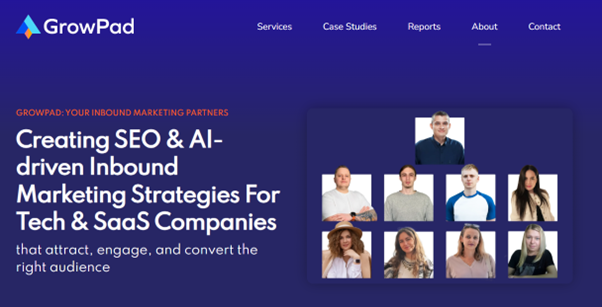
Growpad

Growpad’s proprietary technology stack monitors algorithm changes, competitor movements, and keyword opportunities in real time. This allows the team to adjust campaigns dynamically rather than waiting for monthly reporting cycles to reveal problems or opportunities. Their approach to content creation is equally data-driven — every piece of content is informed by machine learning models that predict search intent, ranking potential, and conversion likelihood before a single word is written.

What makes Growpad particularly attractive for growth-stage SaaS companies is the combination of advanced capabilities and accessible pricing. With retainers starting around three thousand dollars per month, the agency delivers enterprise-level AI infrastructure at a fraction of what larger competitors charge. Clients frequently report significant ranking improvements within the first ninety days, and the agency’s multilingual capabilities across more than ten languages make it an ideal partner for UK companies planning international expansion.

4. Codeless

Codeless has carved out a niche as a content production powerhouse for SaaS and technology companies. The agency specialises in creating long-form, deeply researched articles that target high-value informational and commercial keywords. Their editorial team includes subject matter experts across various technology domains, which allows them to produce technically accurate content without relying entirely on client input.
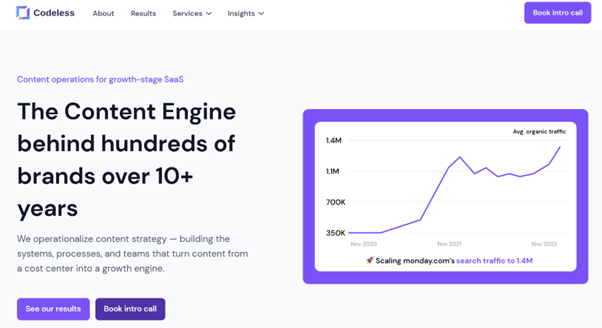
Codeless-SEO company for SaaS

For UK SaaS companies that need to build out large content libraries quickly, Codeless offers an efficient solution. Their production process is designed for volume without sacrificing quality, and they maintain strict editorial standards including fact-checking and SEO optimisation reviews before publication. The agency works with freelance writers who specialise in specific technology verticals, ensuring that content about cloud infrastructure reads differently from content about marketing automation or HR software.

The agency’s AI adoption remains at a basic level, with most processes driven by human expertise. While this ensures high editorial quality, it can limit the speed at which campaigns adapt to algorithm changes or emerging keyword opportunities. Their retainers are competitive for the volume of content delivered, making them a solid option for companies that prioritise content scale.

5. Single Grain

Single Grain takes a multi-channel approach to growth marketing, with SEO serving as one of several interconnected strategies. Founded by Eric Siu, the agency has built a recognisable brand in the digital marketing space and works with SaaS companies alongside clients in other industries. Their SEO capabilities include technical audits, content strategy, link building, and conversion rate optimisation.
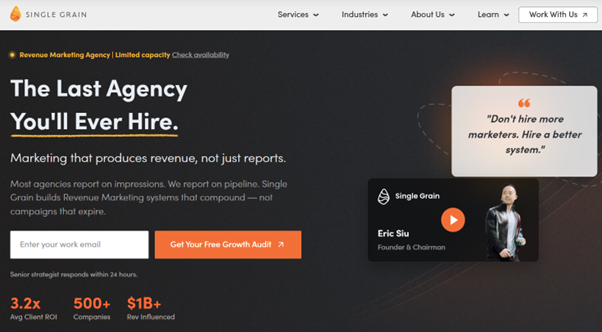
Single Grain

The breadth of their service offering is both a strength and a potential weakness. SaaS companies that want a holistic growth partner handling SEO, paid media, and content marketing under one roof will find Single Grain appealing. However, companies that need a deeply specialised SaaS SEO partner may prefer agencies with a narrower focus. Their UK presence has expanded through remote team members and partnerships with local marketing ecosystems.

6. NoGood

NoGood rounds out this list as a growth hacking agency that incorporates SEO as a core component of its client acquisition strategies. The agency works with SaaS companies, marketplaces, and consumer technology brands, applying a data-driven experimentation framework to identify the highest-impact growth levers for each client.
NoGood - SEO company for SaaS

Their approach to SEO is closely integrated with paid acquisition and product marketing, which means organic search strategies are designed to complement and amplify other channels rather than operating in isolation. NoGood’s team includes growth engineers and analysts who bring a quantitative mindset to keyword selection, content creation, and technical optimisation. For SaaS companies that want an agency focused on pipeline growth rather than just traffic metrics, NoGood offers a compelling proposition. Their retainers sit in the higher range, reflecting the strategic depth and multi-discipline team involvement.

What to Look for in a SaaS SEO Company

The right SEO partner for a SaaS company depends on several interrelated factors. First, evaluate the agency’s depth of SaaS experience. Agencies that work exclusively or predominantly with software companies will naturally have a better understanding of recurring revenue models, trial-to-paid conversion funnels, and the content preferences of technical audiences.

Second, consider the agency’s approach to modern search challenges. The rise of AI-generated search results, large language model recommendations, and zero-click searches has fundamentally changed how organic visibility translates into business outcomes. Agencies that have invested in LLM optimisation and AI-native processes are better positioned to navigate these shifts than those relying on traditional SEO playbooks.

Finally, assess the balance between price and value. The agencies on this list range from three thousand to thirty thousand dollars per month. Cheaper does not always mean worse, and expensive does not always mean better. The most important factor is whether the agency can demonstrate a clear methodology, a track record of results with similar companies, and a transparent approach to reporting and communication.

Final Thoughts

The UK SaaS SEO market in 2026 is characterised by increasing sophistication on both the agency and client sides. Software companies are demanding more than generic SEO services — they want partners who understand their business models, can leverage AI effectively, and can deliver measurable pipeline impact. The six agencies profiled in this guide represent some of the best options available, each bringing distinct strengths and approaches to the table. By carefully evaluating these options against specific business needs and growth objectives, SaaS companies can find a partner that will help them build sustainable organic growth for years to come.

The post Leading SEO Companies for SaaS in the UK appeared first on Home Business Magazine.

Original source: https://homebusinessmag.com/businesses/seo/leading-seo-companies-saas-uk/

Freelancer or Independent Contractor: What Kind of Professional Does Your Business Need?

Home Business Magazine Online

Businesses require the services and expertise of professionals to maintain smooth daily operations and drive growth. Depending on its specific needs and the nature of work involved, a business can turn to either freelancers or independent contractors to handle specialized tasks and bring in skills that might be lacking internally. While these professionals share some similarities when it comes to flexibility or work arrangements, distinguishing between them is important when determining which one best aligns with your goals and requirements. Moreover, knowing the difference between the two can help businesses set up employment and payment terms that match their chosen Philippine payroll system for this country, and comply with income processing guidelines in accordance with the law for the Philippines; or in whatever country you operate in.

To that end, here are some factors that can help you decide whether a freelancer or an independent contractor will serve your business best.

Defining a Freelancer

A freelancer is a self-employed professional who may offer specialized services to multiple clients at the same time. Along with the freedom to work with different clients at once, freelancers also set their own schedules and generally operate on a project-by-project basis. Furthermore, freelancers are often engaged for temporary assignments that require a particular skill set, such as creative work or technical support. For businesses, this structure enables short-term engagements to fulfill specific deliverables.

Working with a freelancer means factoring in flexibility. Unlike regular employees, freelancers are not tied to a single employer. This means that their work terms are often negotiated individually per project. Accordingly, working with a freelancer often means paying an hourly rate or a set fee for a clearly defined scope of work. This arrangement can be ideal for business owners who need quick access to expertise without the long-term commitment or the administrative burden of permanent hiring.

Defining an Independent Contractor

Similar to a freelancer, an independent contractor is also self-employed. But unlike freelancers, independent contractors typically work with only one or two clients at a time for a longer, more defined engagement. Additionally, these professionals are usually hired for work that is substantial in scope, such as managing a large project or providing ongoing operational support. As such, independent contractors tend to operate under formal contracts with clearly outlined deliverables and timelines, along with defined payment schedules.

In contrast to freelancers, independent contractors may be more closely integrated into a business’s workflow, even though they maintain control over how they get their work done. Notably, contractors are often required by law to register themselves as self-employed individuals. Some may even have their own registered business, which can make them the better choice for complex projects that require compliance with certain professional or legal standards.

Comparison of Project Structure and Scope

In general, freelance work involves defined tasks with clear outcomes. Since freelancers work on a per-project basis, each assignment is usually independent of the others (if any). Thus, they may be ideal candidates for one-off needs, such as designing a logo or troubleshooting a specific technical issue.

On the other hand, independent contractors are often engaged for projects that require consistency and deeper involvement. Examples of these include managing long-term initiatives or overseeing system implementations. Moreover, the ongoing nature of such work means they are expected to remain aligned with the business’s objectives for the duration of their contract.

Cost and Payment Considerations

Neither freelancers nor independent contractors are entitled to the same benefits as regular employees, and are typically responsible for filing their own taxes and paying other contributions. However, they are subject to distinct payment terms, which may also depend on individual agreements.

For freelancers, payment may be made by the hour or by project, with invoices issued at agreed milestones or upon full completion. Additionally, rates may vary depending on the complexity of the work and the freelancer’s expertise. This gives businesses some flexibility when it comes to rates and payment dates.

Meanwhile, independent contractors often work under a fixed-fee arrangement or receive payment in stages based on project progress. As such, it brings a level of predictability that can be useful for long-term budgeting. However, the larger scope of their contracts means businesses need to commit resources over an extended period.

Either way, businesses should invest in a reliable disbursement method, like Maya Business Deposit. With batch transfers, free transfers, and scheduled transfers, you can be sure that your personnel will be paid on time without hassle.

Flexibility versus Commitment in Hiring

Hiring freelancers offers a high degree of flexibility, giving businesses the freedom to scale up or down as projects demand. Thus, hiring freelancers may be most beneficial for seasonal work or unpredictable workloads. The trade-off, however, is that a freelancer’s availability can vary, especially if they’re working with multiple clients.

Conversely, a business that prefers stability may choose to work with independent contractors instead, since they are bound by their contracts to work for a set period and scope. These professionals are particularly suited for roles that require sustained attention and predictable schedules.

Legal Classification and Compliance Risks

For businesses, awareness of the distinctions among worker classifications is critical to avoiding penalties and legal disputes. While freelancers and independent contractors both fall under self-employed status, authorities may apply different tests to confirm that they are not misclassified employees. These tests may account for factors such as how the worker was selected and contracted, how wages are paid, whether the employer has the power of dismissal, and the degree of control over work hours and methods.

Furthermore, misclassification can result in fines and liability for benefits. For this reason, businesses should clearly define the working relationship in a written contract and ensure it matches the actual working arrangement. Additionally, consulting legal or tax professionals can help confirm compliance with relevant regulations.

Choosing the Right Option for Your Business

Deciding between hiring a freelancer or an independent contractor should be based on the nature and duration of the work, as well as the level of complexity and involvement. If your business requires quick, specialized assistance for a defined task, a freelancer may be the right fit. But if you need sustained support with integrated responsibilities, an independent contractor might be more appropriate.

Likewise, factors such as budget and timelines can help determine your project scope and expectations, which can make the choice for the best arrangement easier.

Professionals play a key role in sustaining operations and meeting various business demands. As your business grows, freelancers and independent contractors can lend reinforcement during critical periods or targeted efforts with flexible terms and defined outcomes, ultimately helping your business move forward.

The post Freelancer or Independent Contractor: What Kind of Professional Does Your Business Need? appeared first on Home Business Magazine.

Original source: https://homebusinessmag.com/businesses/freelance-work/freelancer-independent-contractor-kind-professional-business-need/

AI Keeps Getting Things Wrong — So Humans Are Getting Paid to Check It

Artificial intelligence might be getting smarter, but it still needs human help. From checking chatbot answers to testing new tools, thousands of people are now making money from home simply by reviewing AI — and you don’t need tech skills to get started.

If you think artificial intelligence is coming for your job, here’s something surprising:
it still can’t function properly without humans.

Behind every chatbot answer, AI image and “smart” search result is a growing workforce of real people working quietly from home — correcting it; hiring scholars to oil the scholar robots, it seems.

And many of them are getting paid to do it.

From rating responses to fixing factual mistakes, there’s now a booming category of flexible online work built around one simple truth: AI still needs human judgement.


Why AI Needs Humans More Than Ever

AI tools can write essays, answer questions and even generate videos — but they’re far from perfect.

They still:

  • Get facts wrong

  • Misunderstand tone and context

  • Struggle with regional language

  • Produce biased or outdated answers

  • Occasionally make things up entirely

That’s why companies developing AI are hiring people to check, rate and improve what these systems produce.

In short: the smarter AI gets, the more humans it needs behind the scenes.


The Work-From-Home Jobs AI Is Creating

There’s now a fast-growing market for what’s known as AI training and evaluation work — and most of it can be done remotely.

1. Rating AI responses

You’re shown a question and two AI answers.
Your job: decide which is better and why.

This can involve checking:

  • Accuracy

  • Clarity

  • Helpfulness

  • Tone

Pay: typically £10–£20 an hour.


2. Fixing and improving answers

Some roles involve rewriting AI responses so they sound more human or accurate.

You might:

  • Correct grammar

  • Add missing information

  • Make answers clearer

  • Ensure UK relevance

If you’ve got strong written English, you’re already qualified.


3. Fact-checking and safety reviewing

AI companies are under pressure to avoid misinformation.

That means hiring humans to:

  • Verify facts

  • Flag harmful content

  • Check for bias

  • Ensure answers are safe and legal

These roles can pay £15–£25 an hour.


4. Search engine and AI testing

Before new tools launch, they need real people to test them.

You may be asked:

  • Does this result answer the question?

  • Is it useful for UK users?

  • Is anything misleading?

It’s essentially getting paid to be picky.


How Much Can You Actually Earn?

This won’t replace a full-time salary for most people — but it’s a solid side income.

Typical monthly earnings:

  • £200–£800 part-time

  • More if working across several platforms

The work is flexible and often task-based, making it ideal if you:

  • Want extra income from home

  • Work around kids or another job

  • Prefer remote freelance work

  • Like detail-focused tasks


What Skills Do You Need?

You don’t need coding knowledge or a tech degree.

You do need:

  • Excellent written English

  • Attention to detail

  • Critical thinking

  • Patience

  • Consistency

Many people doing this work come from:

  • Admin

  • Teaching

  • Journalism

  • Customer service

  • Finance

  • Editing

If you’re good at spotting mistakes, you’re already ahead.


A Growing “Human Layer” Behind AI

There’s a strange irony to the AI boom.

The more advanced artificial intelligence becomes, the more human oversight it requires. Every improvement relies on real people checking outputs, correcting errors and guiding systems towards better answers.

So while headlines warn that AI is replacing jobs, it’s also quietly creating new ones — flexible, remote and open to almost anyone with a laptop and sharp eye.

If you’re looking for a realistic way to make money from home in 2026, working behind the scenes of AI could be one of the smartest side hustles to explore.

The post AI Keeps Getting Things Wrong — So Humans Are Getting Paid to Check It appeared first on MoneyMagpie.

Original source: https://www.moneymagpie.com/make-money/ai-keeps-getting-things-wrong-so-humans-are-getting-paid-to-check-it