Manoj Bhargava Explains Why Distribution Is the Real Competitive Advantage in Business

Home Business Magazine Online

In business, the myth of the genius entrepreneur with the brilliant idea still holds powerful sway. We celebrate the spark of inspiration and the disruptive concept. But while ideas matter, they are only half of the equation. The other, less-glamourous half is distribution.

An idea, no matter how elegant, creates value only when it reaches people. Distribution is the mechanism that connects a product to its market: how customers discover it, access it, trust it, and ultimately adopt it. Without a solid distribution strategy in your business, even the most innovative solutions are doomed to fail. History is littered with technically amazing products that crashed and burned because they never found an efficient way to get into customers’ hands, while simpler alternatives dominated because they were easier to buy, easier to understand, or easier to use.

A serial entrepreneur and investor, Manoj Bhargava has observed this fact first-hand. He’s best known as the founder and CEO of Living Essentials, LLC, the maker of 5-hour Energy products.

Distribution: A Day-One Priority

Bhargava has seen plenty of companies that peddle mediocre products but have a good distribution strategy for your business in place; these companies can get off the ground and last a while, at least until a better product comes along.

“But if you have a great product and lousy distribution, you’re dead from the beginning,” he says.

This is not to say that it’s fine to have a poor product if you know how to sell it. Instead, you need to pair a quality product with excellent distribution.

This reality isn’t surprising, but for first-time entrepreneurs, it can be uncomfortable. Ideas feel creative and personal, while distribution feels operational and mundane—or something that will magically fall into place due to the sheer brilliance of their idea.

Distribution shouldn’t be an afterthought. It’s a core part of building a product and a business. Decisions about distribution channels, pricing, partnerships, messaging, and customer acquisition should shape the product from day one. A startup that builds first and worries about distribution later often discovers, painfully, that “later” is too late.

Why Distribution Matters

Good distribution provides feedback loops with real users, real revenue, and real data. With customers already flowing in, the entrepreneur can iterate, improve the product, and fix any weaknesses. Distribution buys time and optionality. It turns a good idea into something more: a platform for growth.

Distribution also creates defensibility. Ideas are easy to copy, but distribution systems are not. A company with a loyal audience, strong brand recognition, or exclusive access to a channel holds an advantage that competitors can’t quickly replicate. This is why many of the most successful businesses are not those with the 100% original ideas, but those that mastered a particular route to market.

Right Idea, Right Distribution

Much of Manoj Bhargava’s success in business stems from his focus on marrying the right product with the right distribution strategy. He did not invent energy products, but he did understand how to innovate on the concept and get his product to customers.

Bhargava created 5-hour Energy shots after sampling an energy drink at a natural products trade show in Southern California. He noted that although their product was useful, the creators had no real distribution strategy plan for businesses. Shortly after, Bhargava and his team formulated their own product in a much smaller size, thus pioneering the energy shot.

This innovation was key, because it meant that 5-hour Energy did not need to be refrigerated. It could sit on shelves and in displays at cash registers, where it had little competition. Bhargava’s team also focused on securing distribution agreements—first with vitamin retailer GNC, then other chains as sales took off. Within a decade, retail sales had grown to $1 billion.

The Takeaway

For entrepreneurs, the lesson is clear: treat distribution as a first-class, day-one problem. Ask early and often: Who will hear about this? Why will they care? How will it spread? How much will it cost to reach each customer, and how will that change at scale? When idea and distribution are designed together, the business has a far greater chance of success.

The post Manoj Bhargava Explains Why Distribution Is the Real Competitive Advantage in Business appeared first on Home Business Magazine.

Original source: https://homebusinessmag.com/growing-a-business/how-to-guides-growing-a-business/manoj-bhargava-explains-distribution-real-competitive-advantage-business/

Manoj Bhargava Explains Why Distribution Is the Real Competitive Advantage in Business

Home Business Magazine Online

In business, the myth of the genius entrepreneur with the brilliant idea still holds powerful sway. We celebrate the spark of inspiration and the disruptive concept. But while ideas matter, they are only half of the equation. The other, less-glamourous half is distribution.

An idea, no matter how elegant, creates value only when it reaches people. Distribution is the mechanism that connects a product to its market: how customers discover it, access it, trust it, and ultimately adopt it. Without a solid distribution strategy in your business, even the most innovative solutions are doomed to fail. History is littered with technically amazing products that crashed and burned because they never found an efficient way to get into customers’ hands, while simpler alternatives dominated because they were easier to buy, easier to understand, or easier to use.

A serial entrepreneur and investor, Manoj Bhargava has observed this fact first-hand. He’s best known as the founder and CEO of Living Essentials, LLC, the maker of 5-hour Energy products.

Distribution: A Day-One Priority

Bhargava has seen plenty of companies that peddle mediocre products but have a good distribution strategy for your business in place; these companies can get off the ground and last a while, at least until a better product comes along.

“But if you have a great product and lousy distribution, you’re dead from the beginning,” he says.

This is not to say that it’s fine to have a poor product if you know how to sell it. Instead, you need to pair a quality product with excellent distribution.

This reality isn’t surprising, but for first-time entrepreneurs, it can be uncomfortable. Ideas feel creative and personal, while distribution feels operational and mundane—or something that will magically fall into place due to the sheer brilliance of their idea.

Distribution shouldn’t be an afterthought. It’s a core part of building a product and a business. Decisions about distribution channels, pricing, partnerships, messaging, and customer acquisition should shape the product from day one. A startup that builds first and worries about distribution later often discovers, painfully, that “later” is too late.

Why Distribution Matters

Good distribution provides feedback loops with real users, real revenue, and real data. With customers already flowing in, the entrepreneur can iterate, improve the product, and fix any weaknesses. Distribution buys time and optionality. It turns a good idea into something more: a platform for growth.

Distribution also creates defensibility. Ideas are easy to copy, but distribution systems are not. A company with a loyal audience, strong brand recognition, or exclusive access to a channel holds an advantage that competitors can’t quickly replicate. This is why many of the most successful businesses are not those with the 100% original ideas, but those that mastered a particular route to market.

Right Idea, Right Distribution

Much of Manoj Bhargava’s success in business stems from his focus on marrying the right product with the right distribution strategy. He did not invent energy products, but he did understand how to innovate on the concept and get his product to customers.

Bhargava created 5-hour Energy shots after sampling an energy drink at a natural products trade show in Southern California. He noted that although their product was useful, the creators had no real distribution strategy plan for businesses. Shortly after, Bhargava and his team formulated their own product in a much smaller size, thus pioneering the energy shot.

This innovation was key, because it meant that 5-hour Energy did not need to be refrigerated. It could sit on shelves and in displays at cash registers, where it had little competition. Bhargava’s team also focused on securing distribution agreements—first with vitamin retailer GNC, then other chains as sales took off. Within a decade, retail sales had grown to $1 billion.

The Takeaway

For entrepreneurs, the lesson is clear: treat distribution as a first-class, day-one problem. Ask early and often: Who will hear about this? Why will they care? How will it spread? How much will it cost to reach each customer, and how will that change at scale? When idea and distribution are designed together, the business has a far greater chance of success.

The post Manoj Bhargava Explains Why Distribution Is the Real Competitive Advantage in Business appeared first on Home Business Magazine.

Original source: https://homebusinessmag.com/growing-a-business/how-to-guides-growing-a-business/manoj-bhargava-explains-distribution-real-competitive-advantage-business/

6 Best SBA Loan Marketplaces for Small Businesses Ranked by Lender Response Quality

Home Business Magazine Online

Securing an SBA loan can feel like sprinting through molasses. You wade through forms, wait weeks for a banker to call, then hold your breath while the government reviews every line. Yet demand keeps surging: in fiscal 2024, lenders approved more than 70,000 SBA 7(a) loans worth $31.1 billion . That gap between urgency and red tape is exactly why online SBA-loan marketplaces matter. One digital application routes your file to lenders already fluent in the SBA rulebook—so you spend less time chasing signatures and more time growing your business.

Our Ranking Methodology

Every SBA loan marketplace on our shortlist went through the same five-part stress test. We cared about one result above all: how quickly you receive a real, actionable response from an SBA lender.

First, speed to first offer. We timed the journey from first click to the initial email or call with clear next steps. Platforms that replied within 72 hours scored highest, while responses that dragged past a week lost points.

Second, transparency. Does the site spell out costs and credit pulls in plain English or hide them in footnotes? SmartBiz, for example, displays its 2 percent referral fee and 2 percent packaging fee, so it earned full marks despite the price.

Third, borrower cost. Most marketplaces are free because lenders pay the referral tab. Any platform that added borrower fees lost points, unless the extra charge clearly unlocked faster approvals or dedicated support.

Fourth, product breadth. A site with one SBA partner is a one-lane road; a marketplace with dozens of banks and fintech lenders is a six-lane highway. More lanes mean more chances for approval and a better rate.

Fifth, customer sentiment. We sifted through tens of thousands of recent Trustpilot reviews to gauge support quality, pressure tactics, and real-world funding times. High praise pushed scores up, while patterns of ghosting or spammy follow-ups pulled them down.

Weighting: response quality 40 percent, transparency 20, borrower cost 15, product breadth 15, and customer reviews 10. The blend creates a 100-point, data-first ranking that rewards speed and honesty, not hype.

Marketplace Snapshot: Speed, Fees, and Reputation

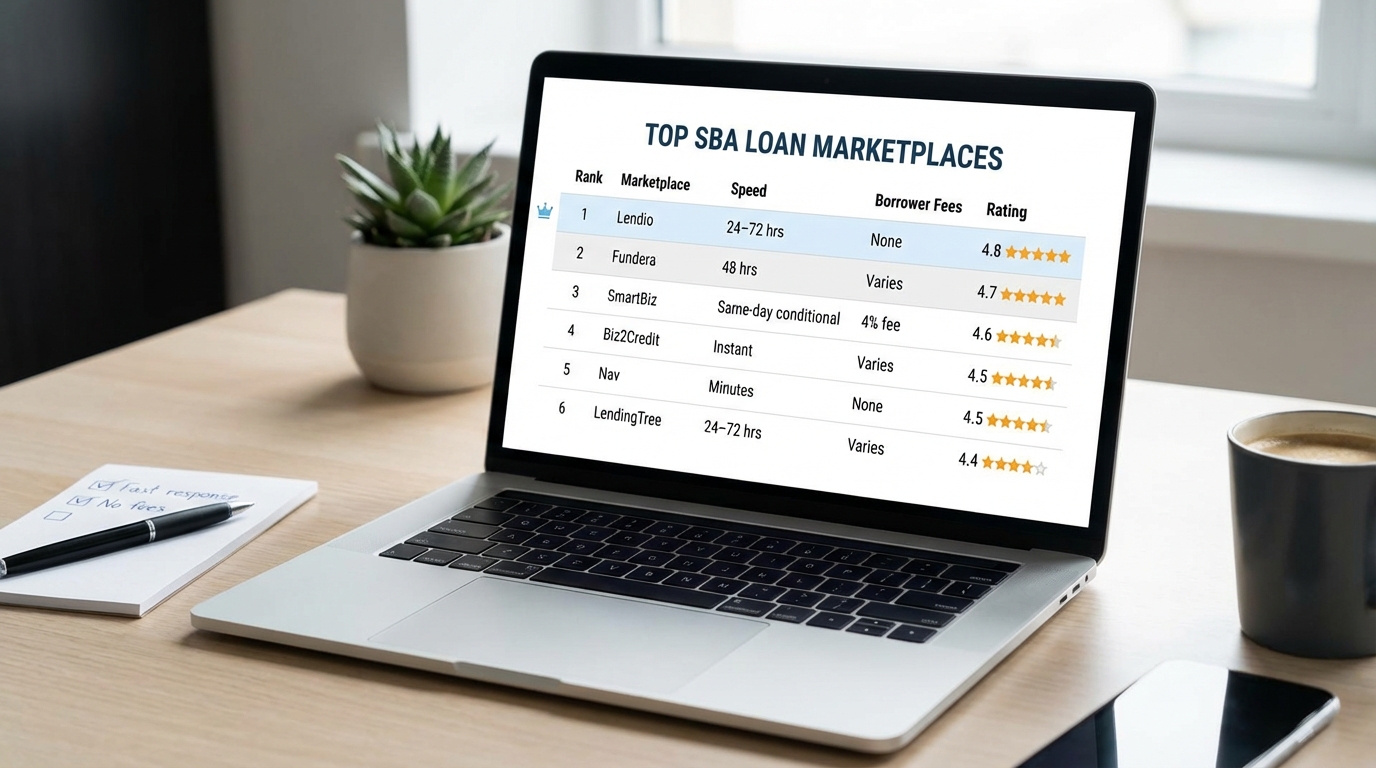
Before we look at each SBA loan marketplace in detail, here is a side-by-side view. It shows who charges what, how quickly you can expect a reply, and which platforms borrowers praise most.
Marketplace snapshot

Rank Marketplace Lenders in network Time to first offers* Borrower fees Trustpilot rating
1 Lendio about 75 partners 24–72 hrs None 4.8 ★
2 Fundera by NerdWallet about 30 curated banks 48 hrs None 4.7 ★
3 SmartBiz about 10 SBA banks 5-min pre-qual / 30–60 days funding 4 percent of loan 4.6 ★
4 Biz2Credit 20+ (plus in-house lending) Same-day conditional Varies† 4.6 ★
5 Nav 100+ partners Instant matches None (free tier) 4.5 ★
6 LendingTree 40+ lenders Minutes (multiple calls) None 4.5 ★
  • Time ranges reflect typical SBA-loan experiences, not faster alternative products.
    † Biz2Credit adds origination fees on its own term loans; SBA loans follow standard SBA costs.

Use the grid as a quick check. If zero fees and broad lender reach rank first for you, Lendio and Fundera lead the pack. Willing to pay a 4 percent premium for guided, SBA-only help? SmartBiz may be worth it. Want options beyond SBA or prefer seeing approval odds in real time? Biz2Credit and Nav keep the door wider.

Next, let’s see why Lendio holds the number-one spot.

1. Lendio: Best Overall for Fast Responses

One application can trigger three or four real offers within a couple of days, and Lendio’s dedicated SBA team can convert those offers to funded cash in as little as two weeks, giving you choice instead of a single take-it-or-leave-it quote.

Snapshot: Why Lendio Leads the Pack

Lendio works like a matchmaking engine. Complete a 15-minute questionnaire and the platform scans about 75 banks, credit unions, and fintech lenders to find SBA fits.

That depth pays off. One application can trigger three or four real offers within a couple of days, giving you choice instead of a single take-it-or-leave-it quote.

You pay nothing for that reach. Lendio earns its fee from lenders, so every borrowed dollar stays in your business.

A dedicated funding manager then calls to clarify goals, collect documents, and nudge slow lenders. The mix of speed and human help keeps Lendio at the top of our list.

Key Numbers and Real-World Performance

  • Network: about 75 active partners, from Live Oak Bank to fintech newcomers.
  • Funding volume: $15 billion delivered to 400 000 small businesses as of March 2024.
  • Speed: application in under 15 minutes; at least one conditional SBA offer within 24–72 hours when financials are ready.
  • Borrower cost: zero platform fees; you only pay standard SBA guarantee and closing costs.
  • Trustpilot:8 stars based on more than 21 000 reviews.

Big network, quick replies, and no borrower fees make Lendio a powerful first stop when you need SBA capital without the wait.

2. Fundera by NerdWallet: Best for Concierge-Style Guidance

Snapshot: A Personal Banker in Marketplace Clothing

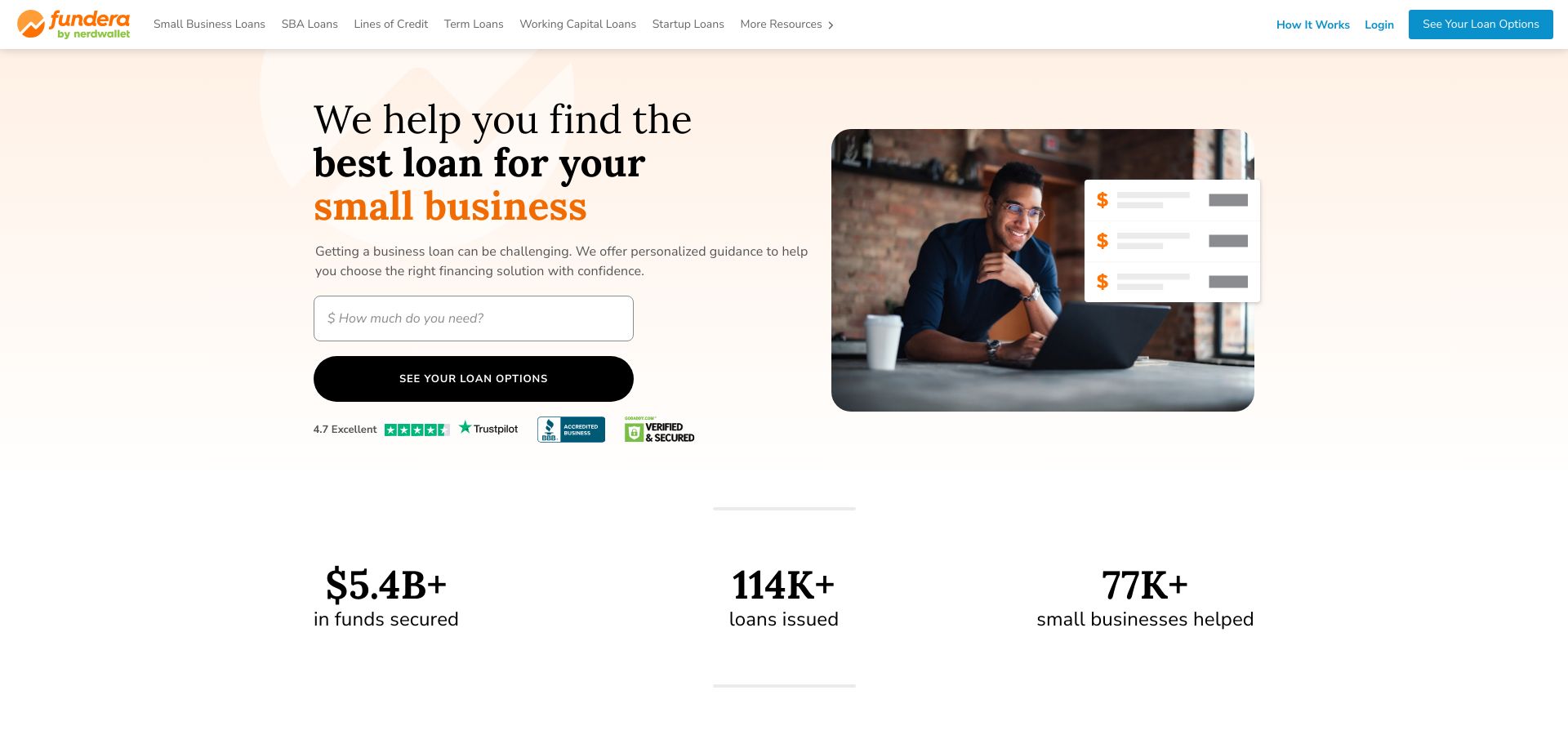
Fundera swaps raw lender volume for white-glove service. Backed by NerdWallet’s content engine, the platform works with about 30 top-performing SBA lenders and pairs you with a human advisor who stays with you from first document upload to final signature.

Because the pool is smaller, you avoid a flood of calls; everything routes through your Fundera rep. After a brief online intake and a soft credit pull, expect a callback within 48 hours outlining your best SBA options with clear pros and cons.

Fundera is free for borrowers. Like Lendio, it earns its fee from lenders, so every dollar you borrow can go toward payroll, inventory, or growth.
Fundera by NerdWallet

The results show in reviews. A 4.7-star Trustpilot rating, filled with client shout-outs, confirms that steady, informed guidance still wins hearts in a digital world. If you prefer fewer voices and deeper expertise over a massive lender list, Fundera feels like having a former SBA banker on speed dial.

3. SmartBiz: Best for Streamlined, SBA-Only Funding

Snapshot: Turning a Marathon into a Jog

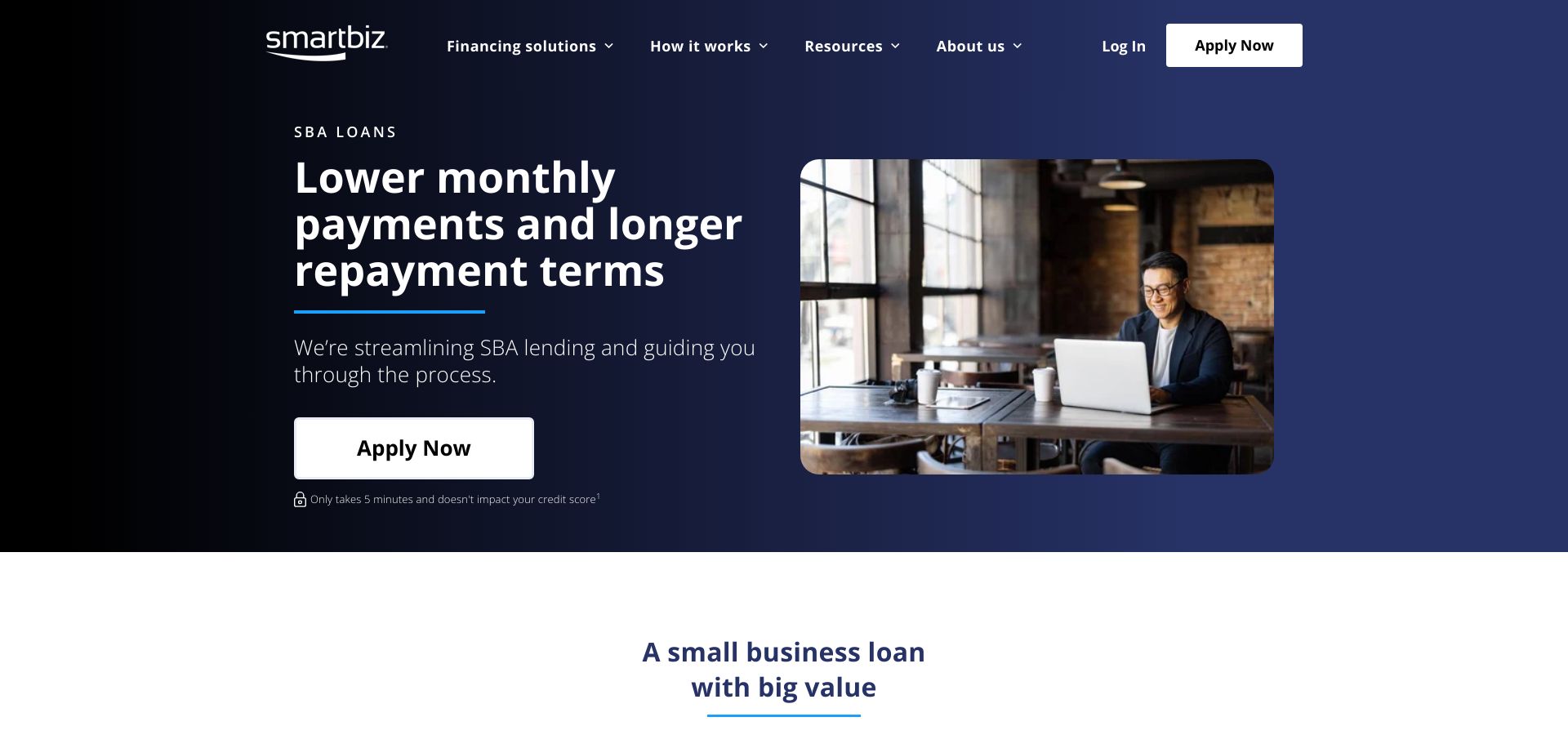
SmartBiz focuses on one goal: moving well-qualified owners through the SBA 7(a) process faster than a branch visit.
SmartBiz: streamlined, SBA-only funding

Start with a 5-minute questionnaire that runs your numbers against SmartBiz’s algorithm and its circle of about 10 Preferred Lenders. If you clear the 680-credit and 2-years-in-business hurdles, you see a pre-qualification screen almost instantly. A relationship manager then reviews your documents and guides the file to the bank most likely to approve.

Speed comes at a price. SmartBiz adds a 4 percent fee to every funded loan—2 percent for the match and 2 percent for packaging the SBA paperwork. The fee rolls into the loan, so no cash leaves your pocket up front, but it does raise the long-term cost.

Many borrowers feel the surcharge is fair for trimming weeks off a slow process. Trustpilot reviews praise clear communication, transparent pricing, and relief at cutting red tape, though some note that an SBA loan still takes time.

Bottom line: if your credit is strong, your books are clean, and you are willing to pay for an express lane, SmartBiz can turn the usual SBA obstacle course into a guided sprint.

4. Biz2Credit: Best Hybrid for Speed and Backup Plans

Snapshot: One Application, Multiple Off-Ramps

Biz2Credit wears two hats in the SBA loan marketplaces. It funds SBA loans itself and also shops your deal to partner banks when that makes more sense.

Fill out its quick form and the underwriting engine reviews tax returns, cash-flow metrics, and credit data almost in real time. If your numbers work, you could see a conditional SBA approval the same day, with funding in about 30 days. If the SBA path stalls, Biz2Credit pivots quickly, offering its own shorter-term working-capital loan so you are not stranded.

That flexibility can save owners who cannot afford downtime, but it comes with homework. Origination fees on Biz2Credit-funded loans and double-digit APRs can dwarf low SBA rates. Stick to the SBA offer if that is what you came for; treat the pricier alternative as a last resort.

Customer reviews show a mix of high praise for rapid cash and frustration over sales pressure on high-cost products. A steady 4.6-star Trustpilot average suggests the model works when expectations are clear.

Choose Biz2Credit if you want SBA speed with an immediate backup loan available, but keep your goal fixed on the affordable option.

5. Nav: Best for Seeing Where You Stand Before You Apply

Snapshot: Credit Clarity Meets Matchmaking

Wish you could peek at a lender’s scorecard before sharing a single document? That is Nav.

Create a free account and the platform pulls your personal and business credit files with a soft inquiry. Seconds later, it shows your scores with plain advice such as “SBA lenders look for 680+; you are at 702, nice work!” along with a ranked list of loan offers you are likely to qualify for.
Nav: best for seeing

Nav does not fund loans or broadcast your contact details to 10 banks at once. Instead, you choose the lender you like, avoiding a rush of calls. Paid plans add weekly credit updates and access to a funding coach, but the core matching tool stays free.

Users praise the transparency. A 4.5-star Trustpilot rating cites detailed credit tips and relief at avoiding wasted hard pulls. The trade-off: once you pick a lender, Nav steps aside; you still complete that lender’s full application and wait for underwriting.

Choose Nav if you are early in the hunt, want to polish your credit before applying for an SBA loan, or simply prefer to shop offers without handling a stack of follow-up calls.

6. Lendingtree: Best for Casting the Widest Net Fast

Snapshot: Speed Dating for Business Loans

Need to see how many lenders will bite on your SBA request before lunch? LendingTree makes it happen.

Submit a short intake form and the platform pushes your profile to about 40 banks and online lenders within seconds. Your phone starts ringing almost immediately, each caller ready to pitch terms or request documents. Owners who enjoy competition can surface deals they never knew existed.

Because LendingTree is a pure lead generator, you pay nothing to use it. Lenders cover the fee, so no broker charges appear later. That model also hands control to the lenders, so follow-up styles vary; some reps are consultative, others hard-charging salespeople.

Borrowers praise the volume of options and the power to pit offers against each other. Critics point to inbox overload and the need to repeat paperwork with every lender. An A-plus BBB rating and a 4.5-star Trustpilot average show the platform delivers on its promise—provided you set clear boundaries and schedule time to field calls.

Choose LendingTree when you want instant market feedback, do not mind sifting through multiple term sheets, and feel confident saying “no” until the right SBA lender rises to the top.

choose the right marketplace

Conclusion: How to Choose the Right Marketplace for Your Business

Start with a quick timing check.

If you need capital inside 2 weeks, no marketplace can move an SBA loan that fast. Consider Biz2Credit’s bridge option or a short-term offer from LendingTree, then refinance with an SBA deal when the clock is kinder.

Next, gauge your paperwork stamina.

Hate juggling calls from multiple lenders? Stick with high-touch platforms like Fundera or SmartBiz, where one advisor shields you from the phone surge. Comfortable fielding offers like a pro at a trade show? LendingTree’s rapid-fire model can work in your favor.

Credit score counts, but context counts more.

Nav is ideal if you are unsure whether a 650 will satisfy SBA lenders. Its free dashboard shows where you stand and what to fix before you apply, sparing you pointless hard pulls.

Cost comes last, only because the first three filters remove bad fits quickly.

Zero-fee SBA loan marketplaces such as Lendio and Fundera let you keep every borrowed dollar. SmartBiz’s 4 percent charge makes sense only when the time you save is worth the premium.

Above all, gather your documents early.

Tax returns, year-to-date financials, and a tidy debt schedule can cut days off underwriting. If you need a refresher on lender expectations, skim our quick primer on preparing for a business loan before you press “Submit.”

Choose the SBA loan marketplace the way you choose any partner: the one that respects your timeline, your communication style, and your bottom line. Get that trio right and the rest falls into place.

Frequently Asked Questions

Are SBA-loan marketplaces safe?

Yes. The large platforms on our list use bank-level encryption and share your data only with lenders you select. Verify you are on the official site and never pay an up-front “processing” fee to an unknown caller.

Will my credit score drop just for shopping?

Browsing is harmless. Marketplaces run a soft credit pull that does not affect your score. A hard inquiry appears only when you proceed with a specific lender and approve full underwriting. Keep all SBA applications inside a 30-day window and most scoring models treat multiple pulls as one.

Do I pay extra interest by using a marketplace?

The SBA sets rate caps, so interest stays the same whether you walk into a bank or arrive through Lendio. The only added cost is a broker or packaging fee. Four of our six picks charge nothing; SmartBiz folds a 4 percent fee into the loan for its paperwork service.

I am a brand-new startup—can I still get an SBA loan through these sites?

Probably not yet. Most SBA lenders want at least 2 years of operating history. Use Nav to track and build your credit, explore microloans, or consider a shorter-term option until your revenue matures.

Can I negotiate once I have offers?

Absolutely. Multiple term sheets give you leverage. Politely let each lender know you are comparing rates and fees, then ask whether they can sharpen the deal. Marketplaces like Fundera or Lendio will even handle that back-and-forth for you.

Still have questions? Drop them in the comments below and we will tackle the tricky ones in future updates.

Glossary of SBA Lending Essentials

SBA 7(a) loan. The workhorse of government-backed small-business financing. It funds working capital, equipment, and real-estate purchases up to $5 million, with interest capped at a spread over the Wall Street Journal prime rate.

SBA 504 loan. A two-lender structure for large, long-term assets. Your bank covers 50 percent, a nonprofit Certified Development Company covers 40 percent, and you bring 10 percent to the table, making it useful for buying or building owner-occupied property.

SBA Express loan. A streamlined cousin of 7(a). Lenders receive an SBA response in 36 hours and can approve up to $500 000 on their own paperwork, trading a lower SBA guarantee for speed.

Preferred Lender Program (PLP). A badge the SBA gives to top-performing banks. PLP lenders underwrite and sign off on 7(a) loans without sending the file to the SBA for a second review, saving weeks.

Soft versus hard credit pull. A soft inquiry lets a marketplace preview your score without lowering it. A hard pull appears only when you proceed with a specific lender and may lower your score a few points.

Packaging or referral fee. A charge some intermediaries add to assemble SBA paperwork and match you to a bank. SmartBiz, for example, adds a 4 percent combined fee.

Origination fee. A lender’s own processing charge, common on non-SBA loans from fintech firms like Biz2Credit. It is usually a flat percentage of the amount funded.

Personal guarantee. A clause that makes each owner with 20 percent or more stake personally liable if the business cannot repay. Every SBA loan requires it.

UCC lien. The legal filing that lets a lender claim business assets as collateral. Expect one on nearly every SBA loan, even when no specific property is pledged.

Marketplace versus broker. Both connect you to lenders. A marketplace relies on automated matching across many partners, while a traditional broker shops your deal manually. Today’s top platforms often blend the two approaches.

Sources and Further Reading

We grounded every claim in published data, not opinion. Below are the references worth bookmarking if you plan to pursue an SBA loan or track the market.

  • Bankrate SBA lending report. Confirms that the Small Business Administration backed more than 70 000 7(a) loans totaling $31.1 billion in fiscal 2024, a clear sign of demand for government-guaranteed capital.
  • Merchant Maverick review of SmartBiz. Breaks down SmartBiz’s 2 percent referral fee and 2 percent packaging fee, helping us separate true costs from marketing gloss.
  • Lendio press release, March 2024. Notes the platform’s $15 billion funded milestone, 400 000 businesses served, and a lender roster of about 75 partners, which supports our top ranking.
  • Trustpilot reviews. Tens of thousands of recent ratings reveal real-world support quality, pressure tactics, and funding times across all six SBA loan marketplaces.
  • SBA standard operating procedures. Outline guarantee percentages, fee caps, and eligibility rules.
  • Federal Reserve Small Business Credit Survey 2025. Provides macro trends on approval odds, interest-rate spreads, and credit tightening.

Dive into these reports if you need deeper data on approval rates, interest ranges, or lending cycles.

The post 6 Best SBA Loan Marketplaces for Small Businesses Ranked by Lender Response Quality appeared first on Home Business Magazine.

Original source: https://homebusinessmag.com/money/credit-and-receivables/6-sba-loan-marketplaces-small-businesses-ranked-lender-response-quality/


6 Best SBA Loan Marketplaces for Small Businesses Ranked by Lender Response Quality

Home Business Magazine Online

Securing an SBA loan can feel like sprinting through molasses. You wade through forms, wait weeks for a banker to call, then hold your breath while the government reviews every line. Yet demand keeps surging: in fiscal 2024, lenders approved more than 70,000 SBA 7(a) loans worth $31.1 billion . That gap between urgency and red tape is exactly why online SBA-loan marketplaces matter. One digital application routes your file to lenders already fluent in the SBA rulebook—so you spend less time chasing signatures and more time growing your business.

Our Ranking Methodology

Every SBA loan marketplace on our shortlist went through the same five-part stress test. We cared about one result above all: how quickly you receive a real, actionable response from an SBA lender.

First, speed to first offer. We timed the journey from first click to the initial email or call with clear next steps. Platforms that replied within 72 hours scored highest, while responses that dragged past a week lost points.

Second, transparency. Does the site spell out costs and credit pulls in plain English or hide them in footnotes? SmartBiz, for example, displays its 2 percent referral fee and 2 percent packaging fee, so it earned full marks despite the price.

Third, borrower cost. Most marketplaces are free because lenders pay the referral tab. Any platform that added borrower fees lost points, unless the extra charge clearly unlocked faster approvals or dedicated support.

Fourth, product breadth. A site with one SBA partner is a one-lane road; a marketplace with dozens of banks and fintech lenders is a six-lane highway. More lanes mean more chances for approval and a better rate.

Fifth, customer sentiment. We sifted through tens of thousands of recent Trustpilot reviews to gauge support quality, pressure tactics, and real-world funding times. High praise pushed scores up, while patterns of ghosting or spammy follow-ups pulled them down.

Weighting: response quality 40 percent, transparency 20, borrower cost 15, product breadth 15, and customer reviews 10. The blend creates a 100-point, data-first ranking that rewards speed and honesty, not hype.

Marketplace Snapshot: Speed, Fees, and Reputation

Before we look at each SBA loan marketplace in detail, here is a side-by-side view. It shows who charges what, how quickly you can expect a reply, and which platforms borrowers praise most.

Marketplace snapshot

Rank Marketplace Lenders in network Time to first offers* Borrower fees Trustpilot rating
1 Lendio about 75 partners 24–72 hrs None 4.8 ★
2 Fundera by NerdWallet about 30 curated banks 48 hrs None 4.7 ★
3 SmartBiz about 10 SBA banks 5-min pre-qual / 30–60 days funding 4 percent of loan 4.6 ★
4 Biz2Credit 20+ (plus in-house lending) Same-day conditional Varies† 4.6 ★
5 Nav 100+ partners Instant matches None (free tier) 4.5 ★
6 LendingTree 40+ lenders Minutes (multiple calls) None 4.5 ★
  • Time ranges reflect typical SBA-loan experiences, not faster alternative products.
    † Biz2Credit adds origination fees on its own term loans; SBA loans follow standard SBA costs.

Use the grid as a quick check. If zero fees and broad lender reach rank first for you, Lendio and Fundera lead the pack. Willing to pay a 4 percent premium for guided, SBA-only help? SmartBiz may be worth it. Want options beyond SBA or prefer seeing approval odds in real time? Biz2Credit and Nav keep the door wider.

Next, let’s see why Lendio holds the number-one spot.

1. Lendio: Best Overall for Fast Responses

One application can trigger three or four real offers within a couple of days, and Lendio’s dedicated SBA team can convert those offers to funded cash in as little as two weeks, giving you choice instead of a single take-it-or-leave-it quote.

Snapshot: Why Lendio Leads the Pack

Lendio works like a matchmaking engine. Complete a 15-minute questionnaire and the platform scans about 75 banks, credit unions, and fintech lenders to find SBA fits.

That depth pays off. One application can trigger three or four real offers within a couple of days, giving you choice instead of a single take-it-or-leave-it quote.

You pay nothing for that reach. Lendio earns its fee from lenders, so every borrowed dollar stays in your business.

A dedicated funding manager then calls to clarify goals, collect documents, and nudge slow lenders. The mix of speed and human help keeps Lendio at the top of our list.

Key Numbers and Real-World Performance

  • Network: about 75 active partners, from Live Oak Bank to fintech newcomers.
  • Funding volume: $15 billion delivered to 400 000 small businesses as of March 2024.
  • Speed: application in under 15 minutes; at least one conditional SBA offer within 24–72 hours when financials are ready.
  • Borrower cost: zero platform fees; you only pay standard SBA guarantee and closing costs.
  • Trustpilot:8 stars based on more than 21 000 reviews.

Big network, quick replies, and no borrower fees make Lendio a powerful first stop when you need SBA capital without the wait.

2. Fundera by NerdWallet: Best for Concierge-Style Guidance

Snapshot: A Personal Banker in Marketplace Clothing

Fundera swaps raw lender volume for white-glove service. Backed by NerdWallet’s content engine, the platform works with about 30 top-performing SBA lenders and pairs you with a human advisor who stays with you from first document upload to final signature.

Because the pool is smaller, you avoid a flood of calls; everything routes through your Fundera rep. After a brief online intake and a soft credit pull, expect a callback within 48 hours outlining your best SBA options with clear pros and cons.

Fundera is free for borrowers. Like Lendio, it earns its fee from lenders, so every dollar you borrow can go toward payroll, inventory, or growth.

Fundera by NerdWallet

The results show in reviews. A 4.7-star Trustpilot rating, filled with client shout-outs, confirms that steady, informed guidance still wins hearts in a digital world. If you prefer fewer voices and deeper expertise over a massive lender list, Fundera feels like having a former SBA banker on speed dial.

3. SmartBiz: Best for Streamlined, SBA-Only Funding

Snapshot: Turning a Marathon into a Jog

SmartBiz focuses on one goal: moving well-qualified owners through the SBA 7(a) process faster than a branch visit.

SmartBiz: streamlined, SBA-only funding

Start with a 5-minute questionnaire that runs your numbers against SmartBiz’s algorithm and its circle of about 10 Preferred Lenders. If you clear the 680-credit and 2-years-in-business hurdles, you see a pre-qualification screen almost instantly. A relationship manager then reviews your documents and guides the file to the bank most likely to approve.

Speed comes at a price. SmartBiz adds a 4 percent fee to every funded loan—2 percent for the match and 2 percent for packaging the SBA paperwork. The fee rolls into the loan, so no cash leaves your pocket up front, but it does raise the long-term cost.

Many borrowers feel the surcharge is fair for trimming weeks off a slow process. Trustpilot reviews praise clear communication, transparent pricing, and relief at cutting red tape, though some note that an SBA loan still takes time.

Bottom line: if your credit is strong, your books are clean, and you are willing to pay for an express lane, SmartBiz can turn the usual SBA obstacle course into a guided sprint.

4. Biz2Credit: Best Hybrid for Speed and Backup Plans

Snapshot: One Application, Multiple Off-Ramps

Biz2Credit wears two hats in the SBA loan marketplaces. It funds SBA loans itself and also shops your deal to partner banks when that makes more sense.

Fill out its quick form and the underwriting engine reviews tax returns, cash-flow metrics, and credit data almost in real time. If your numbers work, you could see a conditional SBA approval the same day, with funding in about 30 days. If the SBA path stalls, Biz2Credit pivots quickly, offering its own shorter-term working-capital loan so you are not stranded.

That flexibility can save owners who cannot afford downtime, but it comes with homework. Origination fees on Biz2Credit-funded loans and double-digit APRs can dwarf low SBA rates. Stick to the SBA offer if that is what you came for; treat the pricier alternative as a last resort.

Customer reviews show a mix of high praise for rapid cash and frustration over sales pressure on high-cost products. A steady 4.6-star Trustpilot average suggests the model works when expectations are clear.

Choose Biz2Credit if you want SBA speed with an immediate backup loan available, but keep your goal fixed on the affordable option.

5. Nav: Best for Seeing Where You Stand Before You Apply

Snapshot: Credit Clarity Meets Matchmaking

Wish you could peek at a lender’s scorecard before sharing a single document? That is Nav.

Create a free account and the platform pulls your personal and business credit files with a soft inquiry. Seconds later, it shows your scores with plain advice such as “SBA lenders look for 680+; you are at 702, nice work!” along with a ranked list of loan offers you are likely to qualify for.

Nav: best for seeing

Nav does not fund loans or broadcast your contact details to 10 banks at once. Instead, you choose the lender you like, avoiding a rush of calls. Paid plans add weekly credit updates and access to a funding coach, but the core matching tool stays free.

Users praise the transparency. A 4.5-star Trustpilot rating cites detailed credit tips and relief at avoiding wasted hard pulls. The trade-off: once you pick a lender, Nav steps aside; you still complete that lender’s full application and wait for underwriting.

Choose Nav if you are early in the hunt, want to polish your credit before applying for an SBA loan, or simply prefer to shop offers without handling a stack of follow-up calls.

6. Lendingtree: Best for Casting the Widest Net Fast

Snapshot: Speed Dating for Business Loans

Need to see how many lenders will bite on your SBA request before lunch? LendingTree makes it happen.

Submit a short intake form and the platform pushes your profile to about 40 banks and online lenders within seconds. Your phone starts ringing almost immediately, each caller ready to pitch terms or request documents. Owners who enjoy competition can surface deals they never knew existed.

Because LendingTree is a pure lead generator, you pay nothing to use it. Lenders cover the fee, so no broker charges appear later. That model also hands control to the lenders, so follow-up styles vary; some reps are consultative, others hard-charging salespeople.

Borrowers praise the volume of options and the power to pit offers against each other. Critics point to inbox overload and the need to repeat paperwork with every lender. An A-plus BBB rating and a 4.5-star Trustpilot average show the platform delivers on its promise—provided you set clear boundaries and schedule time to field calls.

Choose LendingTree when you want instant market feedback, do not mind sifting through multiple term sheets, and feel confident saying “no” until the right SBA lender rises to the top.

choose the right marketplace

Conclusion: How to Choose the Right Marketplace for Your Business

Start with a quick timing check.

If you need capital inside 2 weeks, no marketplace can move an SBA loan that fast. Consider Biz2Credit’s bridge option or a short-term offer from LendingTree, then refinance with an SBA deal when the clock is kinder.

Next, gauge your paperwork stamina.

Hate juggling calls from multiple lenders? Stick with high-touch platforms like Fundera or SmartBiz, where one advisor shields you from the phone surge. Comfortable fielding offers like a pro at a trade show? LendingTree’s rapid-fire model can work in your favor.

Credit score counts, but context counts more.

Nav is ideal if you are unsure whether a 650 will satisfy SBA lenders. Its free dashboard shows where you stand and what to fix before you apply, sparing you pointless hard pulls.

Cost comes last, only because the first three filters remove bad fits quickly.

Zero-fee SBA loan marketplaces such as Lendio and Fundera let you keep every borrowed dollar. SmartBiz’s 4 percent charge makes sense only when the time you save is worth the premium.

Above all, gather your documents early.

Tax returns, year-to-date financials, and a tidy debt schedule can cut days off underwriting. If you need a refresher on lender expectations, skim our quick primer on preparing for a business loan before you press “Submit.”

Choose the SBA loan marketplace the way you choose any partner: the one that respects your timeline, your communication style, and your bottom line. Get that trio right and the rest falls into place.

Frequently Asked Questions

Are SBA-loan marketplaces safe?

Yes. The large platforms on our list use bank-level encryption and share your data only with lenders you select. Verify you are on the official site and never pay an up-front “processing” fee to an unknown caller.

Will my credit score drop just for shopping?

Browsing is harmless. Marketplaces run a soft credit pull that does not affect your score. A hard inquiry appears only when you proceed with a specific lender and approve full underwriting. Keep all SBA applications inside a 30-day window and most scoring models treat multiple pulls as one.

Do I pay extra interest by using a marketplace?

The SBA sets rate caps, so interest stays the same whether you walk into a bank or arrive through Lendio. The only added cost is a broker or packaging fee. Four of our six picks charge nothing; SmartBiz folds a 4 percent fee into the loan for its paperwork service.

I am a brand-new startup—can I still get an SBA loan through these sites?

Probably not yet. Most SBA lenders want at least 2 years of operating history. Use Nav to track and build your credit, explore microloans, or consider a shorter-term option until your revenue matures.

Can I negotiate once I have offers?

Absolutely. Multiple term sheets give you leverage. Politely let each lender know you are comparing rates and fees, then ask whether they can sharpen the deal. Marketplaces like Fundera or Lendio will even handle that back-and-forth for you.

Still have questions? Drop them in the comments below and we will tackle the tricky ones in future updates.

Glossary of SBA Lending Essentials

SBA 7(a) loan. The workhorse of government-backed small-business financing. It funds working capital, equipment, and real-estate purchases up to $5 million, with interest capped at a spread over the Wall Street Journal prime rate.

SBA 504 loan. A two-lender structure for large, long-term assets. Your bank covers 50 percent, a nonprofit Certified Development Company covers 40 percent, and you bring 10 percent to the table, making it useful for buying or building owner-occupied property.

SBA Express loan. A streamlined cousin of 7(a). Lenders receive an SBA response in 36 hours and can approve up to $500 000 on their own paperwork, trading a lower SBA guarantee for speed.

Preferred Lender Program (PLP). A badge the SBA gives to top-performing banks. PLP lenders underwrite and sign off on 7(a) loans without sending the file to the SBA for a second review, saving weeks.

Soft versus hard credit pull. A soft inquiry lets a marketplace preview your score without lowering it. A hard pull appears only when you proceed with a specific lender and may lower your score a few points.

Packaging or referral fee. A charge some intermediaries add to assemble SBA paperwork and match you to a bank. SmartBiz, for example, adds a 4 percent combined fee.

Origination fee. A lender’s own processing charge, common on non-SBA loans from fintech firms like Biz2Credit. It is usually a flat percentage of the amount funded.

Personal guarantee. A clause that makes each owner with 20 percent or more stake personally liable if the business cannot repay. Every SBA loan requires it.

UCC lien. The legal filing that lets a lender claim business assets as collateral. Expect one on nearly every SBA loan, even when no specific property is pledged.

Marketplace versus broker. Both connect you to lenders. A marketplace relies on automated matching across many partners, while a traditional broker shops your deal manually. Today’s top platforms often blend the two approaches.

Sources and Further Reading

We grounded every claim in published data, not opinion. Below are the references worth bookmarking if you plan to pursue an SBA loan or track the market.

  • Bankrate SBA lending report. Confirms that the Small Business Administration backed more than 70 000 7(a) loans totaling $31.1 billion in fiscal 2024, a clear sign of demand for government-guaranteed capital.
  • Merchant Maverick review of SmartBiz. Breaks down SmartBiz’s 2 percent referral fee and 2 percent packaging fee, helping us separate true costs from marketing gloss.
  • Lendio press release, March 2024. Notes the platform’s $15 billion funded milestone, 400 000 businesses served, and a lender roster of about 75 partners, which supports our top ranking.
  • Trustpilot reviews. Tens of thousands of recent ratings reveal real-world support quality, pressure tactics, and funding times across all six SBA loan marketplaces.
  • SBA standard operating procedures. Outline guarantee percentages, fee caps, and eligibility rules.
  • Federal Reserve Small Business Credit Survey 2025. Provides macro trends on approval odds, interest-rate spreads, and credit tightening.

Dive into these reports if you need deeper data on approval rates, interest ranges, or lending cycles.

The post 6 Best SBA Loan Marketplaces for Small Businesses Ranked by Lender Response Quality appeared first on Home Business Magazine.

Original source: https://homebusinessmag.com/money/credit-and-receivables/6-sba-loan-marketplaces-small-businesses-ranked-lender-response-quality/

Affordable AI Video Generator with Low Startup Cost: 7 Budget-Friendly Tools Compared

Home Business Magazine Online

Video sells, but hiring a crew or mastering pro software drains a lean budget.

Today’s affordable AI video generators cut time and cost, letting home-based entrepreneurs turn a script into a polished clip before the coffee cools.

The shift is widespread: 86 percent of video-ad buyers already use—or plan to use—generative AI this year, and 58 percent of small businesses rely on AI, up from 40 percent last year.

This guide reviews seven platforms that cost $0–$30 a month so you can pick one, hit publish, and stay visible without overspending.

Why Video, Why AI, Why Now?

Video grabs attention faster than any other medium. Viewers scroll past plain text, but motion makes them pause.

For a small business, that pause can lift clicks and sales. A single product demo or how-to clip can beat a week of static posts, yet traditional production needed cameras, lighting, and long editing nights.

Generative AI changes the math. Feed a prompt or paste a script; the platform pairs voiceover, visuals, and motion in minutes. You pay pocket change instead of day rates.

Recent models raise the bar on quality. Entry-level tools now export crisp HD, sync multilingual voice to avatars, and animate still photos. The gap between a studio shoot and an AI render keeps shrinking.

Speed matters as much as savings. You can react to a trend the day it starts, update messaging on the fly, and test multiple hooks without reshoots. In social feeds, agile beats perfect.

Consumer video use keeps climbing. More screens, shorter attention spans, and algorithm-heavy platforms reward brands that ship frequent, snack-size videos. Those that stall fade quietly.

In short, affordable AI video turns a former luxury into a daily habit. It lets you produce, iterate, and learn at the pace of modern marketing, and no film degree is required.

How We Picked the List

A dozen flashy tools promise Hollywood in a click. We looked for options that let a scrappy business owner publish without draining the account.

First, we set a hard ceiling: each platform had to offer a genuine free tier or a starter plan under about $30 per month. If a paywall appeared before you could export a test video, the tool was out.

We then graded every contender on four factors:

  • Cost: 40 percent of the score, because saving money matters most
  • Features and flexibility: 25 percent, rewarding platforms with multiple capabilities
  • Ease of use: 20 percent, based on setup time and user reviews
  • Output quality: 15 percent, focused on resolution, voice realism, and polish

We reviewed more than fifteen services, ran the numbers, and named seven clear winners. Heavyweights such as Synthesia missed the cut on price alone, proving this list stays fiercely budget-first.

Budget AI Video Generators at a Glance

The table below lists the seven AI video generators that passed our price test. Use it as a quick reference to see which platforms offer free exports, what the first paid tier costs, and where each one excels.

Tool Free Tier Starter Price Stand-out Features Best For
Leonardo AI (video generator) Yes, credit-based, no card Beta free Image-to-video, multi-model styles, active creator community Original social visuals
Fliki 5 minutes each month $8 Text-to-video plus 900 voices in 75 languages Blog-to-video repurposing
Pictory 3 videos (trial) $19 Auto highlights from long text or video, captions Content marketers
InVideo 2 HD minutes each week ~$15 AI script-to-video, 16 million stock clips, rich templates Ad builders
HeyGen 1 minute (trial) $30 100+ talking avatars, lip-sync, multilingual output Spokesperson videos
Colossyan 1 minute each month $30 Custom or built-in avatars, slide editor Training snippets
Runway Gen-2 125 credits $12 Text-to-video clips, AI background removal Experimental B-roll creators

Need a free-forever option? Leonardo or Colossyan fit the bill. Looking for the lowest paid entry? Fliki offers that. Want daring visuals? Runway delivers.

The next sections break down how each platform works in real projects so you can choose with confidence.

1. Leonardo AI: Turn Images into Motion for Free

Leonardo AI’s video generator feels built for visual storytellers. Upload a photo—or create fresh art in the same dashboard—type a short prompt, and watch the picture move with camera pans, particle effects, or subtle character shifts.

Leonardo AI
Leonardo AI video generator interface showing image-to-video controls

You begin with roughly 150 free credits each day and no credit-card gate, a perk most rivals skip. When credits run low, you top up instead of locking into a monthly fee, so cost scales with workload.

Quality exceeds the price point. Several AI models cover everything from watercolor scenes to photoreal cityscapes, and motion sliders let you set speed and direction. Early users praise the crisp 1080p export and watermark-free results during the open beta.

Because the platform also generates images, you stay in one workspace: create product stills, animate them, add text overlays, and post on social in a single session. The loop saves both clicks and cash.

Leonardo suits solo founders and artists who need unique B-roll and have a few minutes to experiment. Give it an afternoon, and your feed can look hand-drawn by a studio team—without the payroll.

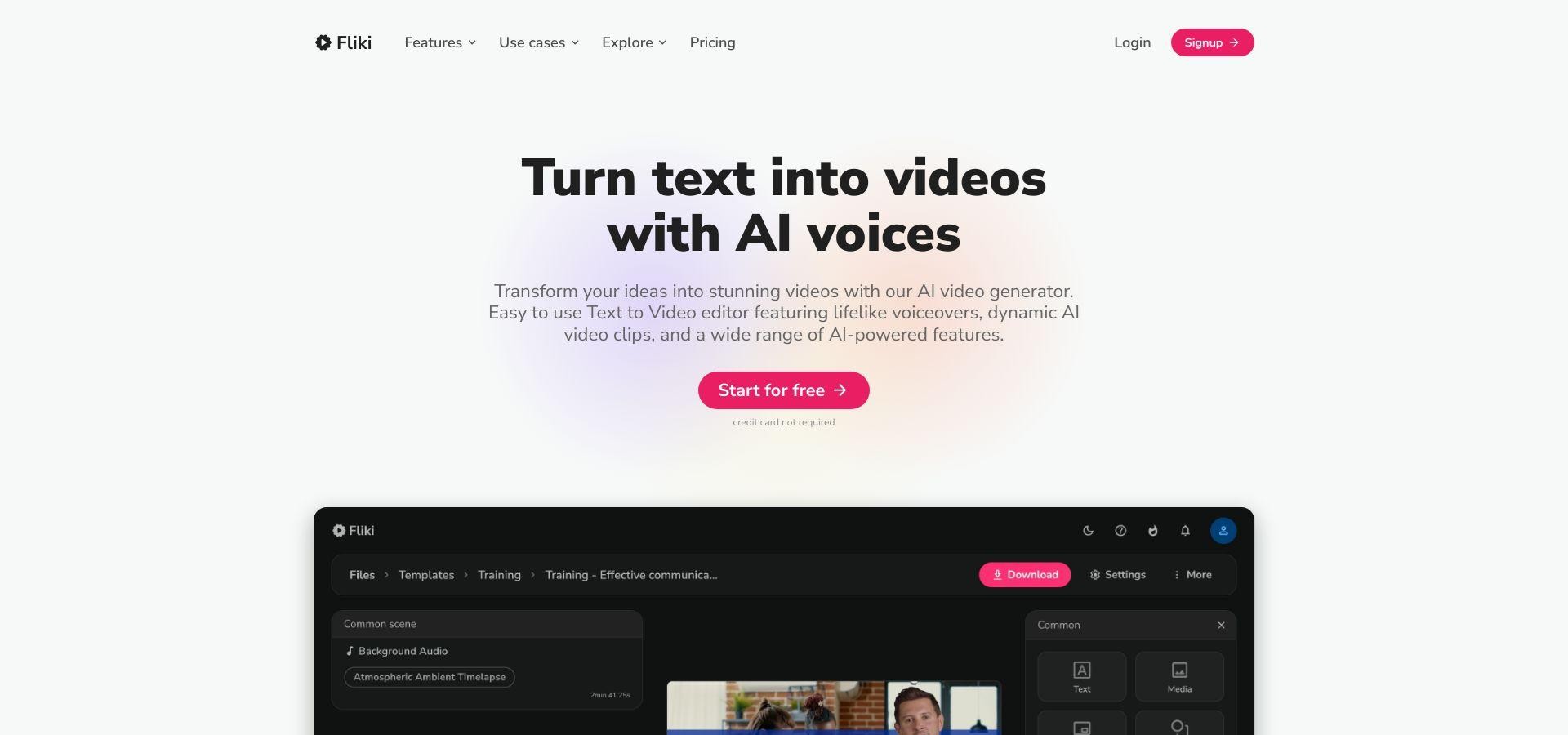
2. Fliki: Turn Blogs into Video in Minutes

Fliki turns plain text into a share-ready video faster than you can reread your own post. Paste a paragraph, choose a voice, and the platform pairs stock visuals with captions to deliver a polished clip without timeline headaches.

Fliki text-to-video editor
Fliki text-to-video editor turning blog posts into videos

The starter plan costs eight dollars a month, and the free tier still gives you five export minutes. That covers weekly social shorts or a bite-size product teaser.

Voices are the standout feature. Fliki offers about 900 natural-sounding narrators across 75 languages, so your content speaks to every corner of your market without hiring voice talent.

Editing stays light. Swap a suggested scene photo, search the built-in stock library, or adjust sentence timing with a click.

If writing is your strong suit, Fliki doubles your output. Each blog becomes a video post, and each newsletter becomes a narrated reel—more channels, same effort, minimal spend.

3. Pictory: Repurpose Long-form Content on Autopilot

If your blog runs deep or your YouTube channel hosts marathon tutorials, Pictory turns that long-form gold into snack-size clips without manual slicing.

Drop in a URL, raw transcript, or full video file. The AI scans key moments, pulls punchy quotes, and builds a highlight reel with captions and royalty-free background music. What once took hours in a traditional editor now wraps before your coffee cools.

Costs stay friendly for lean teams. A three-video trial lets you test results, and the nineteen-dollar basic plan supports most weekly schedules. Cloud rendering removes the need for a heavy workstation, and exports reach 1080p.

Accuracy wins praise. Captions show few typos, and the summarizer often surfaces the moments that hook viewers; think step-by-step visuals, speaker sound bites, or dramatic before-and-after reveals.

Quick tweaks keep you in control. Swap a clip, change text style, or nudge scene order inside a drag-and-drop timeline that feels more Canva than Premiere.

One pillar post can spawn a LinkedIn teaser, an Instagram reel, and a Pinterest idea pin, multiplying reach while the original asset earns compound returns.

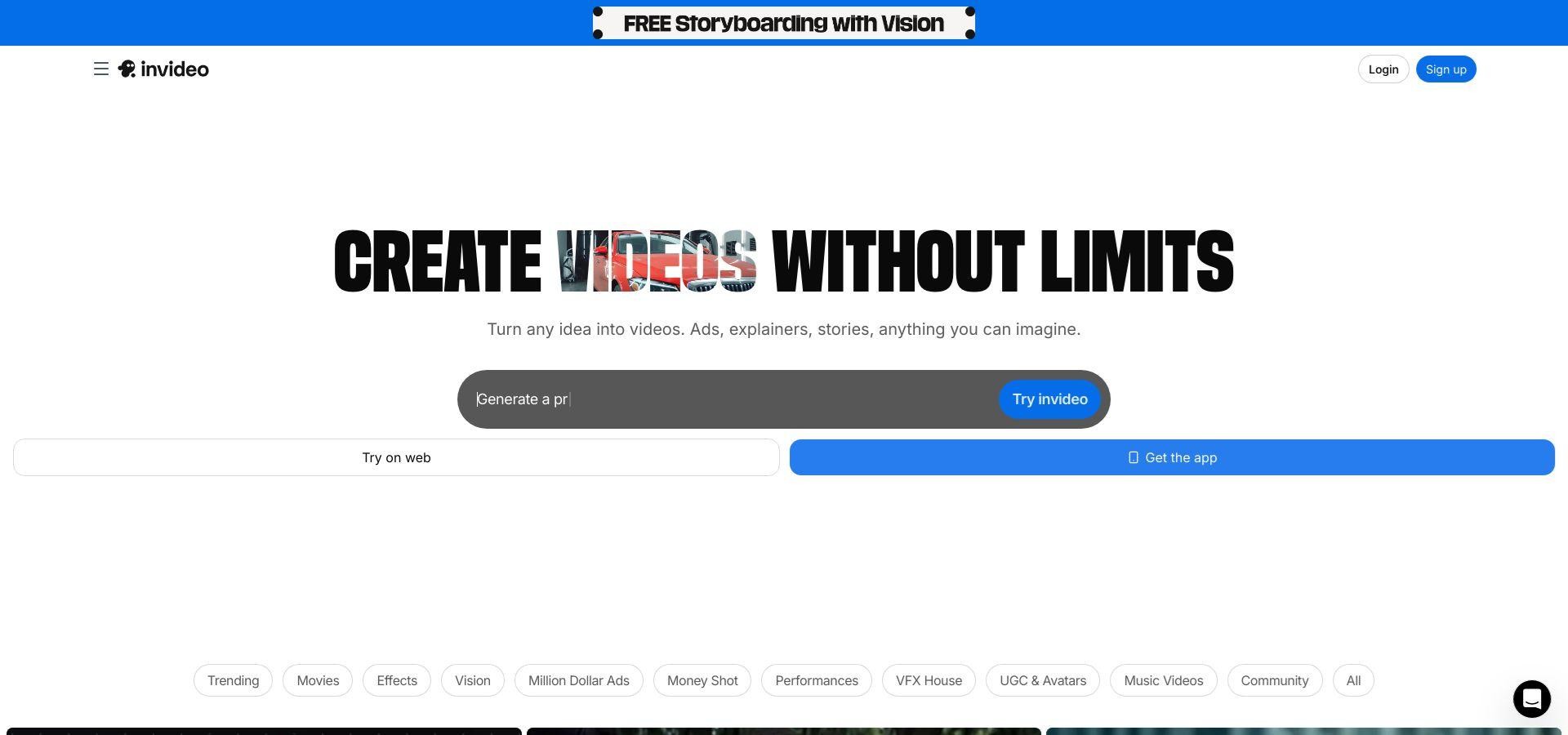
4. Invideo: Templates plus AI under One Roof

InVideo feels like Canva’s video-savvy cousin. Start with a prompt and its AI writes a short script, selects on-brand stock clips from a library of roughly 16 million assets, and assembles a storyboard you can tweak scene by scene.

InVideo AI editor
InVideo AI editor with templates and multi-track video timeline

The free plan lets you export two watermark-tagged HD minutes each week. That is enough to test an idea or pitch a new ad. Upgrade for about fifteen dollars a month; watermarks disappear, credit limits rise, and advanced generative models unlock.

Flexibility is the draw. Stay in quick mode and accept the AI’s first draft, or open the full timeline to refine fonts, transitions, and color grades. The extra depth takes a short session to learn, yet gives you room to grow as creative needs expand.

If you handle product promos, reels, and explainers, InVideo offers one cockpit rather than a stack of niche apps. Invest in one interface and cover nearly every marketing format you will need.

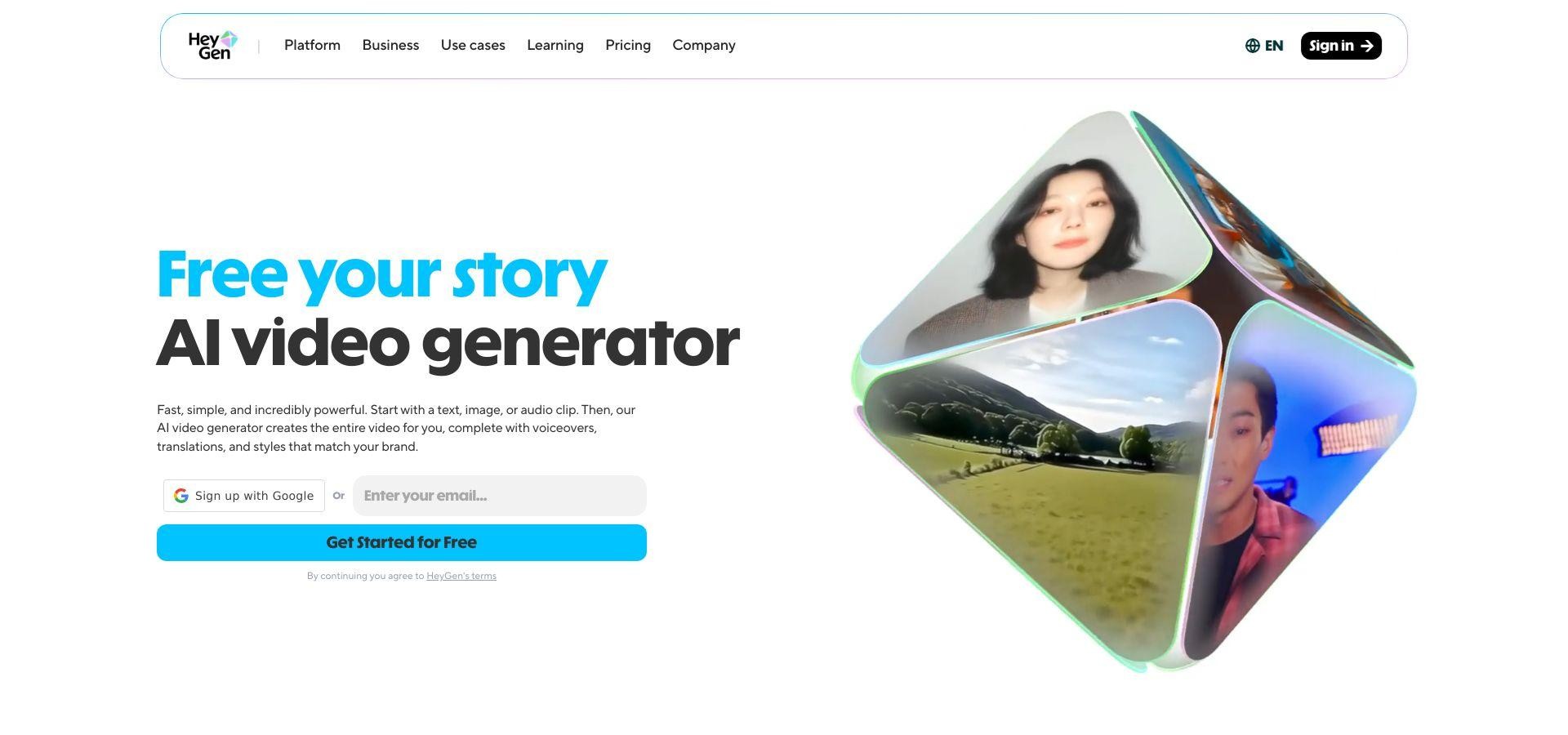
5. Heygen: A Virtual Presenter on Standby

Need a friendly face without hiring talent? HeyGen lets you type a script and watch a photoreal avatar deliver it in your chosen language, accent, and tone. The result feels like a seasoned host recorded a custom take just for you.

HeyGen AI avatar video creator
HeyGen AI avatar video creator with virtual presenter preview

The free trial covers one minute of output. Paid plans start at about thirty dollars a month, and per-minute costs drop on higher tiers. When you compare that with a human spokesperson, studio time, and edits, the math favors HeyGen.

Lip-sync precision stands out. Recent model updates track subtle mouth moves and eyebrow lifts, removing the stiff look early avatar tools showed. Swap backgrounds, add on-screen text, or change presenters mid-video to keep energy high.

Use cases range from ecommerce walk-throughs to onboarding explainers. Create once, translate, and HeyGen re-voices the same avatar in more than forty languages. The library includes over one hundred avatar styles, giving global sellers plenty of options.

If you are camera-shy or pressed for time, HeyGen turns scripts into polished, human-grade videos while you focus on the next task.

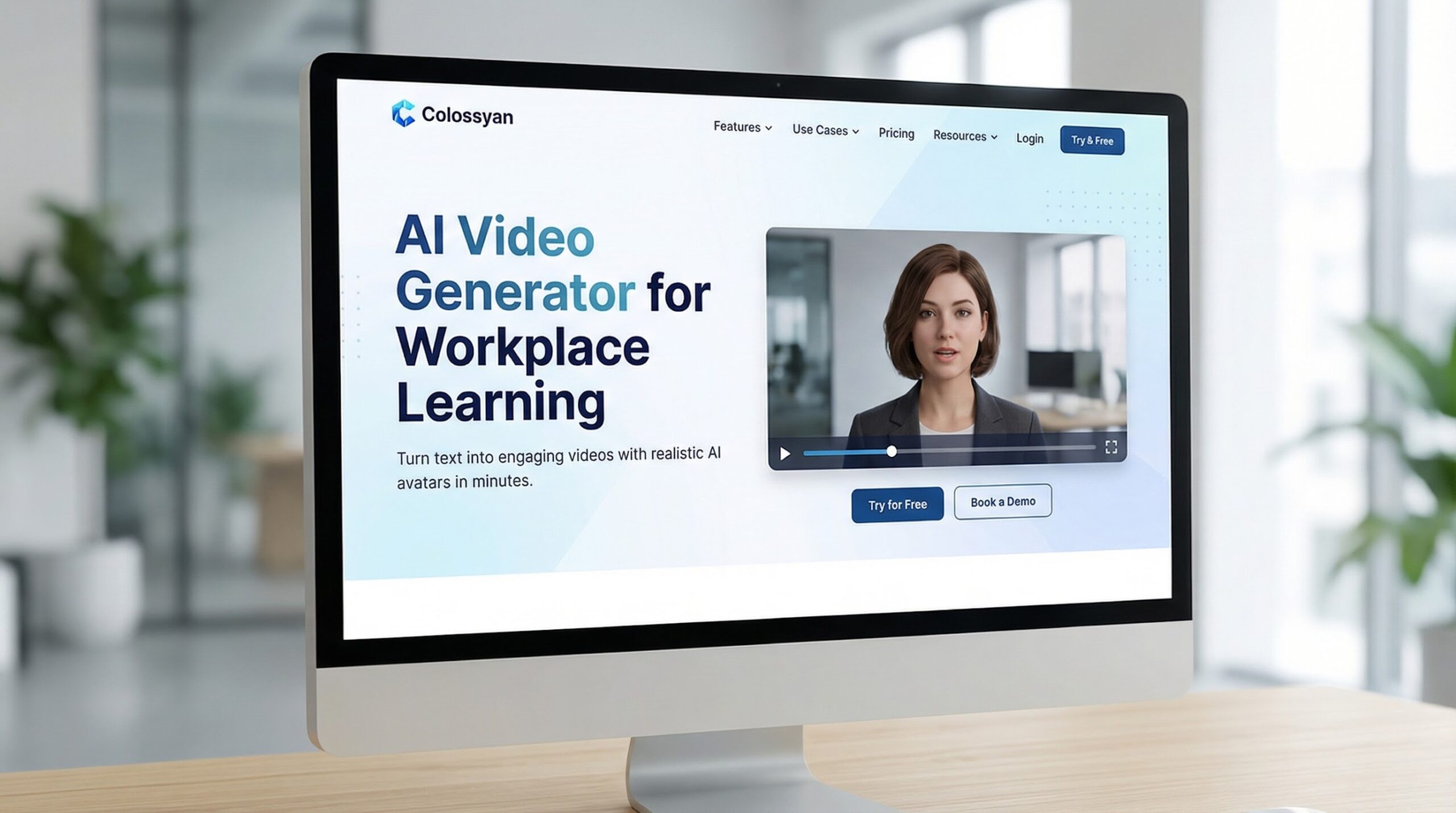
6. Colossyan Creator: Avatar Videos on a True Shoestring

Colossyan’s hook is simple: you receive one free, watermark-free minute of avatar video each month. That allowance covers a monthly promo, quick FAQ, or personal thank-you clip, and it never expires.

Colossyan Creator
Colossyan Creator slide-based AI avatar video editor

The interface is lighter than HeyGen. Select an avatar, paste your script, choose a language, and Colossyan renders a talking-head scene in roughly two minutes. Slide-based editing lets you chain scenes, change backgrounds, and add branded text without wrestling a complex timeline.

Avatars look slightly less lifelike than HeyGen’s most advanced models yet remain professional for training, internal communication, or social explainers. Upgrade to the thirty-dollar starter plan to unlock ten HD minutes a month, custom brand colors, and access to about forty avatar styles in more than sixty languages.

Accessibility is the standout. Test an avatar concept, gather feedback, and decide whether long-form synthetic presenters fit your brand before spending a dollar. For lean startups and side-hustlers, the risk-free entry removes budget anxiety.

7. Runway Gen-2: Experimental Visuals for Bold Brands

Runway’s Gen-2 model lets you type “neon skyline time-lapse” and render a four-second clip that looks ready for a sci-fi trailer. It excels at eye-catching B-roll, music-video layers, or TikTok hooks that feel unmistakably original.

Runway Gen-2 AI video generator
Runway Gen-2 AI experimental text-to-video workspace

The free tier supplies about 125 credits, enough for a dozen low-resolution clips. A twelve-dollar monthly plan unlocks longer runtimes, 1080p export, and faster queues, still far cheaper than custom motion graphics.

Beyond text-to-video, Runway removes backgrounds, replaces objects, and paints new elements frame by frame. Think of it as a browser-based effects studio on standby.

Output quality varies. Some generations look flawless, while others warp or blur. The trick is to iterate quickly, keep the gems, and layer them behind live footage or text in your primary editor.

If your brand thrives on visual experimentation and wants assets nobody else has, Runway earns a spot in the toolkit. It will not replace your core editor, but it will spice your creative mix with clips viewers have not scrolled past a thousand times.

Honorable Mentions: Great Tools That Missed on Price

You may see names like Synthesia, Adobe Firefly, or open-source text-to-video projects in creator forums. They impress yet fall outside our low-startup-cost promise.

  • Synthesia offers polished corporate avatars, but the entry plan runs about thirty dollars a month and requires annual billing, which can strain side-hustle budgets.
  • Adobe’s Firefly video model remains in beta and is expected to land inside a Creative Cloud subscription that starts near sixty dollars a month, sensible only if you already subscribe.
  • Open-source options such as ModelScope or Pika Labs Community Edition charge zero for the code, yet you still need a high-spec GPU or paid cloud server, which raises cost and complexity.

If your budget expands later, revisit these contenders. For now, the seven picks above provide professional results without premium fees.

Frequently Asked Questions

Are AI-made videos polished enough for customer-facing content? Yes. Advertisers, agencies, and streaming platforms already slip generative clips into campaigns seen by millions. For most marketing, training, or social tasks, videos from today’s budget tools look professional on a phone screen, where most viewers watch.

Will the free plans add watermarks? Usually. InVideo stamps its logo, and Colossyan brands free exports. Leonardo’s current beta and Runway’s low-resolution clips export clean. If you plan to run paid ads, set aside a small upgrade fee to remove marks.

How long does it take to learn these AI video generator platforms? Most users create a first draft in under 30 minutes. Fliki and Pictory feel like filling out a form. InVideo and Runway offer deeper controls; give yourself an afternoon to explore templates and shortcuts, and you will move quickly thereafter.

Is using an AI avatar legal and ethical? Yes, provided you own the script and do not impersonate real people without consent. New disclosure rules may soon ask brands to label synthetic presenters, so include a brief note in your video description to stay transparent.

The post Affordable AI Video Generator with Low Startup Cost: 7 Budget-Friendly Tools Compared appeared first on Home Business Magazine.

Original source: https://homebusinessmag.com/businesses/ai/affordable-ai-video-generators-low-startup-cost/

Career Paths for Nurses with an MSN Degree

Home Business Magazine Online

Key Takeaways

  • An MSN degree prepares individuals for advanced practice roles, specialized clinical fields, and leadership positions in the healthcare field.
  • Career choices include Nurse Practitioner, Nurse Educator, Nurse Administrator, Clinical Nurse Specialist, and more.
  • MSN graduates often enjoy greater job security, elevated earnings, and the satisfaction of shaping healthcare outcomes.

Table of Contents

  • Nurse Practitioner
  • Nurse Educator
  • Nurse Administrator
  • Clinical Nurse Specialist
  • Nurse Informaticist
  • Nurse Midwife
  • Public Health Nurse
  • Conclusion

Pursuing a Master of Science in Nursing (MSN) can be a transformative step for registered nurses seeking to advance in the field of healthcare. With the rigorous education and specialized knowledge gained from online MSN programs, nurses open doors to a diverse range of leadership, clinical, and educational roles that go beyond bedside care.

An MSN not only elevates professional opportunities but also enhances the ability to influence patient outcomes, healthcare innovation, and organizational effectiveness. Nurses with this advanced degree are in high demand, capable of stepping into pivotal positions that shape the practice and policy of healthcare.

Whether your interest lies in direct clinical care, education, administration, or the rapidly evolving field of healthcare informatics, the career possibilities are both varied and rewarding. The expertise developed through obtaining an MSN brings nurses with an MSN degree increased autonomy, an expanded scope of practice, and opportunities for higher compensation compared to roles held by individuals with only a bachelor’s degree. According to the American Nurses Association, advanced education plays a crucial role in meeting the growing and complex needs of today’s patient populations.

Across the country, healthcare organizations are seeking MSN-prepared nurses for their expertise, clinical acumen, and leadership potential. By investing in your education, you are also investing in your future and your potential to impact the lives of countless patients and communities for years to come.

Nurse Practitioner

Nurse Practitioners (NPs) are highly trained clinicians who assess, diagnose, and treat patients independently or in collaboration with physicians. Their scope often includes primary and specialized care in settings such as family practice, pediatrics, and psychiatric mental health. Specializations, such as Family Nurse Practitioner (FNP), Pediatric Nurse Practitioner, and Adult-Gerontology NP, allow nurses to tailor their careers to their passions and community needs. According to the U.S. Bureau of Labor Statistics (BLS), the median salary for NPs reached $129,210 in 2025, with the field projected to grow much faster than average in the coming years.

Nurse Educator

Nurse Educators are responsible for teaching future generations of nurses in academic or clinical environments. They design curriculum, lecture on up-to-date clinical trends, mentor students, and supervise hands-on clinical practice. With the current nursing faculty shortage, nurses with an MSN degree are needed more than ever to ensure a robust pipeline of qualified nurses. On average, Nurse Educators earn around $77,000 per year, though salaries can vary based on academic setting and geographic region. Additionally, job growth for this path is expected to climb steadily as nursing schools ramp up to address workforce shortages.

Nurse Administrator

Nurse Administrators oversee hospital units, entire departments, or even multiple healthcare facilities. Their work focuses on enhancing patient care delivery by promoting team collaboration, ensuring compliance, managing budgets, and developing or refining healthcare policies and procedures. These professionals play a crucial role in ensuring the effective operation and maintaining high-quality standards in hospitals and clinics. The median salary for medical and health services managers, a group that includes Nurse Administrators, was $117,960 in 2025, as detailed by the Bureau of Labor Statistics. For nurses with strong leadership and organizational skills, this role combines business acumen with nursing expertise, providing a unique opportunity for growth and advancement.

Clinical Nurse Specialist

Clinical Nurse Specialists (CNSs) provide advanced clinical expertise in specialized areas of healthcare, such as oncology, cardiology, or psychiatric care. They support direct patient treatment, consult with other healthcare team members, and lead the design and implementation of evidence-based care protocols. CNSs are particularly valued for their role in driving quality improvement initiatives and guiding complex patient care decisions. According to the National Association of Clinical Nurse Specialists, both master’s and doctoral degrees are suitable for entering this vital role within the healthcare system.

Nurse Informaticist

Nurse Informaticists bridge the gap between patient care and technology, utilizing data and informatics to enhance outcomes and optimize healthcare systems. Their responsibilities include implementing and managing electronic health records, assessing software needs, analyzing clinical data, and training staff on new tools and technologies. This position is ideal for nurses who are intrigued by the intersection of clinical care and digital innovation and are driven to utilize technology for improved patient and operational outcomes. As more healthcare organizations invest in digital transformation, demand for this expertise continues to grow.

Nurse Midwife

Certified Nurse-Midwives (CNMs) provide comprehensive care to women throughout their lifespan, with a strong emphasis on pregnancy, childbirth, postpartum support, and gynecological health. They perform routine exams, counsel on birth options, assist in deliveries, and promote holistic, patient-centered care. CNMs play a crucial role in supporting maternal and child health, particularly in underserved regions and in birth centers that prioritize natural childbirth experiences. The rewards for nurse midwives are significant—not just in terms of salary, but in the profound impact on family health and wellness.

Public Health Nurse

Public Health Nurses operate on a broader scale, focusing on the health of communities rather than individuals. They develop and implement community-wide health campaigns, conduct outreach in vulnerable populations, work on disease prevention, and advocate for health policy improvements. This career path enables MSN-prepared nurses to address public health challenges, such as epidemics, immunization outreach, and health education programs, which can transform lives on a population level.

Conclusion

A Master of Science in Nursing extends far beyond the basics of clinical practice, offering diverse avenues for leadership, clinical expertise, policy advocacy, education, and technological innovation. As the demand for qualified, forward-thinking nurses grows, those nurses with an MSN degree will continue to drive progress and ensure the delivery of exceptional care at every level of the healthcare system.

The post Career Paths for Nurses with an MSN Degree appeared first on Home Business Magazine.

Original source: https://homebusinessmag.com/blog/medical/career-paths-nurses-msn-degree/

What Happens During a Full-Scope Security Breach Exercise? A Step-by-Step Breakdown

Home Business Magazine Online

In today’s world, cyberattacks are a daily threat to businesses of all sizes. Whether it’s a data breach, a ransomware attack, or a phishing scheme, the risks are real, and the consequences can be devastating. But how do organizations prepare for these threats before they happen? That’s where a full-scope security breach exercise comes in.

If you’ve never heard of this type of exercise—or if you’re not exactly sure what it involves—don’t worry. In this article, we’re going to walk through exactly what happens during a full-scope security breach exercise, step by step. We’ll even touch on the role of something called a “red team simulation,” which plays a key part in these exercises.

Let’s dive in!

So, What Exactly Is a Full-Scope Security Breach Exercise?

Picture this: you’re an organization, and you’ve got sensitive data, intellectual property, and customer information at risk. What happens if someone gets past your defenses? Will your team know how to respond? Will your systems hold up under pressure?

A full-scope security breach exercise is essentially a high-stakes, realistic test that simulates a cyberattack to see how well your organization can handle a breach. This isn’t just a drill where you talk about what to do; it’s an action-packed simulation where the red team (ethical hackers) attacks your systems, and your internal teams must react accordingly. It’s the ultimate “stress test” for your security systems and response strategies.

And here’s the best part: the goal is to learn and improve. A well-run exercise doesn’t just show you what’s working; it shows you where your weaknesses are, so you can strengthen them before a real attack occurs.

Step 1: Planning the Exercise

The first thing to know is that a full-scope security breach exercise doesn’t happen overnight. Planning is crucial—and it involves a lot of moving pieces.

You’ll need to set clear goals for the exercise. Are you testing your incident response plan? Are you trying to evaluate how well your teams communicate under pressure? Do you want to assess your security tools and protocols? Defining these goals upfront helps ensure that you’re testing the right things.

This is also when you’ll get all the key players involved: IT teams, legal advisors, HR, PR, and even the executive team. Everyone should know their role in case of a breach. Plus, you’ll want to allocate the necessary resources (time, budget, tools) to make the exercise as realistic as possible.

Step 2: Assembling the Red Team

If you’ve ever wondered who creates the chaos during a security breach exercise, it’s the red team.

The red team is a group of cybersecurity professionals who specialize in simulating real-world cyberattacks. These experts use a variety of tactics to mimic the methods that real-life hackers would use to breach your systems. Whether it’s phishing emails, social engineering attacks, or exploiting vulnerabilities in your software, they’ll test your organization’s defenses from every angle.

This is where the “red team simulation” comes in. Unlike a typical pen test, where you might get a heads-up, a red team simulation is far more immersive and unpredictable. The red team operates like real cybercriminals—they don’t tell you when or how they’ll strike, and they try to breach your systems however they can.

And the best part? They’re not just attacking your technology; they’re also testing your people. Social engineering tactics, like phishing or impersonating employees, are key parts of the simulation. This helps you see how well your team is trained to spot potential threats before they escalate into full-blown incidents.

Step 3: Executing the Attack Simulation

Now, it’s game time. The red team begins their attack, and your blue team (your defenders) goes into action.

The red team might try to hack into your network, steal sensitive data, or even shut down critical systems. While they’re carrying out the attack, the blue team’s job is to respond quickly and effectively. This is where your incident response plan comes into play. Your blue team needs to be prepared to detect, contain, and neutralize the attack as quickly as possible.

Think about it like a fire drill. You might have the best fire alarms and extinguishers, but do you know how to handle the chaos of a real emergency? This is the chance to put those plans into action.

But here’s the twist: during a full-scope exercise, the attack isn’t always what it seems. The red team will keep things unpredictable, using methods like fake alerts, mixed messages, and confusing signals to test your team’s ability to stay calm and focused.

Step 4: Responding to the Breach

As the exercise unfolds, the blue team’s ability to respond will be put to the test. They’ll need to monitor systems for signs of compromise, assess the impact, and work together to contain the threat. This includes everything from isolating affected systems to communicating with external stakeholders like vendors, clients, and even the media.

But it’s not just about fixing the issue right away—it’s about how you handle the breach over time. Can you contain it within the first few hours? Do your teams know when and how to escalate the issue to higher levels of management? How effective are your communication protocols?

This is where things can get really intense. A real-world breach doesn’t happen in a vacuum, and the pressure will be on to make split-second decisions that can impact your organization’s reputation and security. This is the true test of your preparedness.

Step 5: Debriefing and Post-Exercise Analysis

Once the dust settles, the real work begins. This is where your team takes a step back, looks at what happened, and evaluates their performance.

The debriefing session is an opportunity for everyone involved to discuss what went well and, more importantly, what didn’t. Did the security measures hold up? Were there any communication breakdowns? What could have been done differently to respond faster or more effectively?

The goal of the debrief isn’t to place blame but to identify gaps and make improvements. This post-exercise analysis is key to refining your incident response plan, updating your security protocols, and preparing for the next breach simulation.

Step 6: Continuous Improvement and Ongoing Training

A single full-scope exercise isn’t enough. Security is an ongoing process, and the lessons learned from these exercises should be woven into your organization’s daily operations.

Update your security policies, train your staff, and continue to run exercises like this regularly to keep everyone on their toes. You’ll also want to make sure that your technology and infrastructure evolve as cyber threats do. After all, the best way to stay secure is to never stop improving.

Conclusion: Why Full-Scope Security Breach Exercises Are Essential

Full-scope security breach exercises are about more than just testing your systems—they’re about making sure your entire organization is ready for a real-world attack. These exercises provide valuable insights into your team’s readiness, your response protocols, and your overall security posture.

By conducting these exercises regularly, you’ll be better prepared for whatever cyber threats come your way. And when you integrate a red team simulation into the mix, you’ll get an even more realistic, comprehensive view of your organization’s weaknesses—and strengths.

Remember, cybersecurity isn’t just about reacting to breaches; it’s about being proactive. So, take the time to prepare, practice, and improve. Your future self will thank you.

The post What Happens During a Full-Scope Security Breach Exercise? A Step-by-Step Breakdown appeared first on Home Business Magazine.

Original source: https://homebusinessmag.com/businesses/security/full-scope-security-breach-exercise-breakdown/

Vijay Eswaran Says Tariff Crisis Pushes ASEAN to a Crossroads

Home Business Magazine Online

QI Group executive chairman calls for operational integration as member states pursue separate deals with Washington

Donald Trump’s renewed tariff offensive has forced ASEAN into a defining moment, exposing fractures in regional solidarity while also creating the conditions for long-term transformation. Business leader Vijay Eswaran argues that the bloc’s response to the 2025 trade shocks will determine whether Southeast Asia consolidates into a unified economic power or remains a patchwork of competing national agendas.

“The 2025 tariff shockwaves present ASEAN with its gravest unity test since the 1997 financial crisis and its greatest underlying opportunity,” Eswaran writes in Singapore Business Review. His analysis describes how Trump’s “Liberation Day” tariffs triggered an every-state-for-itself race, with member nations seeking separate arrangements with Washington instead of a coordinated position.

That fragmentation, he contends, reveals ASEAN’s structural vulnerability. Unlike the European Union, which grants supranational authority to enforce common policy, ASEAN operates by consensus and non-interference. These founding principles, designed to protect sovereignty, have become liabilities in a moment that demands coordinated action.

Singapore illustrates the stakes. Growth projections for 2025 hover between 1.5 and 2.5 percent, yet the city-state’s export-dependent economy remains highly exposed to tariff uncertainty. Supply chains, trade flows, and financial services are all affected by the shift away from predictable multilateral frameworks. For Singapore, ASEAN’s cohesion is not an abstract diplomatic goal but a direct national interest.

Vijay Eswaran’s Pragmatic Alternative to Dollar Replacement

Eswaran dismisses proposals for creating a new reserve currency as unrealistic in the face of U.S. financial dominance. The dollar still accounts for roughly 58 percent of global reserves, and American influence through systems such as SWIFT reinforces its central role. Efforts by BRICS nations to build alternatives, he notes, remain experimental rather than systemic.

Instead, Eswaran highlights ASEAN’s emerging Regional Payment Connectivity framework as a more practical path. Linked systems such as Singapore’s PayNow, Thailand’s PromptPay, Indonesia’s QRIS, and Malaysia’s DuitNow now enable instant cross-border payments in local currencies. These transactions bypass dollar intermediation without requiring an overhaul of the existing global financial system.

“ASEAN cannot afford to invest in grand currency replacement schemes,” Eswaran writes. “Building interoperable payment infrastructure delivers tangible benefits today while gradually reducing dollar dependence tomorrow.”

He views digital payments as one part of a broader integration strategy. Ongoing negotiations to upgrade the ASEAN Trade in Goods Agreement and to finalize the Digital Economy Framework Agreement would enhance supply chain resilience and strengthen the region’s projected $1.3 trillion digital economy. Together, these initiatives support balanced relationships with major powers while avoiding dependence on any single alliance.

Creating Mechanisms That Reward Unity

The 47th ASEAN Summit reaffirmed commitments to collective action, yet Eswaran warns that declarations alone will not suffice. True resilience, he says, requires structural incentives that make regional cooperation more profitable than unilateral action.

Completing ATIGA reforms, operationalizing the Digital Economy Framework, and extending payment connectivity into trade finance represent tangible next steps. More critically, ASEAN must develop institutional mechanisms that impose real costs on members who act alone while rewarding coordination across the bloc.

Current arrangements, Eswaran argues, make it individually rational but collectively damaging for members to pursue bilateral deals with Washington or Beijing. The recent tariff negotiations demonstrated how short-term gains for individual states eroded ASEAN’s ability to leverage its combined $3.6 trillion economy and 680 million consumers.

Vijay Eswaran frames the moment as a defining choice. ASEAN can remain “a loose grouping of convenience, susceptible to external pressure,” or evolve into “an integrated economic bloc capable of using collective bargaining power to shape global outcomes.” The crisis, he says, provides both the motivation and the means for that transformation.

“The question is not whether ASEAN can survive the current tariff crisis, but whether it can use this crisis to become what its founders envisioned: a unified regional power capable of shaping rather than merely reacting to external developments,” he writes.

Singapore’s role will be decisive. As both a financial hub and a member directly exposed to fragmentation, its leadership could either accelerate integration or risk diminished regional leverage. Economic pressures and shared vulnerabilities have aligned to make reform urgent, yet the window for decisive action remains narrow.

Whether ASEAN can capitalize on this moment will determine if 2025’s tariff crisis becomes the beginning of genuine unity or another reminder of its structural limits. Eswaran’s assessment concludes on a guardedly optimistic note: the architecture for transformation already exists, but it will only succeed if political will can match economic necessity.

The post Vijay Eswaran Says Tariff Crisis Pushes ASEAN to a Crossroads appeared first on Home Business Magazine.

Original source: https://homebusinessmag.com/success-stories-lifestyles/vijay-eswaran-says-tariff-crisis-pushes-asean-crossroads/

The Cost of Hallucinations: A Calculator for Global Business

Home Business Magazine Online

When Google’s Bard chatbot confidently claimed that the James Webb Space Telescope captured the first image of an exoplanet during a live demonstration, the error seemed minor. Yet after NASA’s correction went public, Google’s parent company, Alphabet, lost $100 billion in market value. This wasn’t just a simple mistake. It was an AI hallucination, and it cost real money.

For global businesses relying on AI translation to communicate across borders, hallucinations pose a hidden financial threat. While AI translation promises speed and cost savings, the verification process required to catch errors quietly drains budgets. The question isn’t whether to use AI translation, but how to reduce the cost of hallucinations before they damage your bottom line.

What Are AI Translation Hallucinations Costing Your Business?

AI hallucinations in translation occur when systems generate fluent, grammatically correct content containing factual inaccuracies, fabricated details, or completely invented information. According to a comprehensive study by AllAboutAI, AI hallucinations cost businesses $67.4 billion in losses in 2024 alone. These errors manifest as dropped words, fabricated facts, and terminology drift that fundamentally alter your message.

Recent research reveals alarming statistics. A 2024 analysis found that 47% of enterprise AI users made at least one major business decision based on hallucinated content, while 39% of AI-powered customer service bots were pulled back due to hallucination-related errors. The financial impact extends beyond obvious blunders. Research shows that employees spend an average of 4.3 hours per week verifying AI-generated content, equating to approximately $14,200 in productivity costs per employee annually.

How Do Hallucinations Happen in Translation?

Translation hallucinations stem from how large language models process information. These systems predict the most statistically probable next word based on training patterns, not factual accuracy. According to industry experts, hallucinations occur due to mathematical errors, outdated training data, and an inability for models to reason symbolically. A 2024 IEEE study found that contextual errors accounted for 32% of misinterpretations in AI-translated engineering documentation.

The Hidden Costs: Beyond the Obvious

Most businesses calculate translation costs based on per-word rates, yet the real expense lies in post-translation verification:

Verification Time:

Businesses pay twice, once for AI translation and again for human verification. Professional human review typically costs $0.04–$0.08 per word, while AI translation costs approximately $0.001 per word. The verification step often takes longer than translating from scratch.

Brand Reputation:

Translation errors damage customer trust irreparably. A 2024 consumer survey revealed that 75% of customers report decreased brand trust after encountering poorly translated content, and 64% become less likely to purchase. According to CSA Research, 75% of global consumers prefer buying from brands that provide information in their native language.

Legal Risks:

Research indicates that mistranslated contracts have led to multi-million dollar disputes, while inaccurate product instructions have resulted in safety incidents and litigation. The U.S. Pharmacopeia reports that unit errors in translation rank among the most common contributors to international medication mistakes.

Calculating Your Hallucination Costs

To understand your true translation costs, businesses should calculate:

Verification Burden:

Average words translated monthly × percentage requiring human verification × hours spent per 1,000 words × reviewer hourly rate

Productivity Loss:

Number of employees × weekly verification hours × 52 weeks × hourly rate

Risk Exposure:

Value of contracts requiring translation + potential cost of one mistranslated clause + customer lifetime value in target markets

Total Cost Comparison:

AI translation cost + verification cost vs. verified AI translation with reduced review needs

This calculation reveals what most businesses discover: the cheapest translation tool rarely delivers the lowest total cost of ownership.

Why Single AI Models Increase Risk

The fundamental problem with relying on a single AI translation engine is detection. Recent benchmarking of 37 different language models revealed that even the latest models have greater than 15% hallucination rates. A Reddit discussion on language technology highlighted this concern: “The biggest issue isn’t that AI makes mistakes, it’s that you can’t easily tell when it’s wrong unless you speak the target language.”

While projected to grow from $1.20 billion in 2024 to $4.50 billion by 2033, AI translation adoption faces resistance. Industry surveys show that 77% of businesses express concern about AI hallucinations, while advanced AI tools achieve only 60-85% accuracy compared to professional human translation’s 95%+ accuracy rate.

The Consensus Solution: Reducing Risk with Multiple Models

The solution to hallucination costs isn’t abandoning AI translation but changing how it’s verified. Consensus-based approaches automatically compare outputs from multiple independent AI models. When 22 different AI translation engines independently translate the same sentence and the majority agree on the output, that translation is statistically far more reliable than any single engine’s output.

Ofer Tirosh, CEO of Tomedes, explains: “Single AI engines make mistakes because they’re trained on different data and have different biases. But when you compare 22 independent models and see what the majority agrees on, you’re getting the translation that multiple specialized systems validated independently.”

In focused reviews where professional linguists rated consensus translation output, 9 out of 10 described it as the safest entry point for stakeholders who don’t speak the target language. According to recent analysis, consensus-based AI translation reduces translation errors by up to 22% compared to single-engine approaches.

How Does Human-in-the-Loop Translation Protect Your Business?

The most effective approach combines AI efficiency with human expertise. Human-in-the-loop translation works in stages:

1. Smart AI Generation:

AI translation systems compare multiple models and select consensus outputs, creating a pre-verified first draft.

2. Strategic Human Review:

Rather than reviewing every word, translators focus on high-risk sections: technical terminology, legal clauses, and culturally sensitive content. This reduces review time by 50-70%.

3. Post-Editing:

Professional linguists refine AI-generated output to ensure accuracy and cultural relevance. Industry data shows that managed AI translation services can reduce project delivery times by an average of 50%, while expert human review maintains quality, nuance, and context.

This hybrid model addresses verification costs directly. Instead of spending 4.3 hours weekly verifying potentially flawed single-engine translations, teams spend significantly less time refining pre-verified consensus outputs.

What Questions Should Businesses Ask About Their Translation Process?

Before investing in any translation solution, businesses should evaluate their current costs and risks:

Are you currently spending more on verification than translation?

Many companies discover they’re paying verification costs that exceed their original translation investment. If reviewers spend hours checking every AI translation, you’re essentially paying for human translation at AI translation prices.

Can you quantify the cost of a single translation error?

For e-commerce businesses, one mistranslated product description might cost hundreds in lost sales. For manufacturers, an incorrect warning label could trigger recalls costing millions. Understanding your specific risk profile helps determine appropriate quality thresholds.

How much does translation delay cost your business?

Research shows that translation project turnaround times have decreased by 50% with AI integration. However, if extensive verification delays publication, you lose this advantage. Fast but untrustworthy translation delivers no competitive benefit.

What’s your true cost per accurate translated word?

Calculate the total cost, including AI fees, verification time, corrections, and potential error consequences. This total cost of ownership often reveals that mid-tier solutions with built-in verification mechanisms cost less than “free” or budget options requiring extensive review.

Implementing Verified Translation in Your Business

Transitioning to a more reliable translation approach requires strategic planning:

Start with High-Risk Content:

Implement verified translation systems for contracts, product specifications, legal documents, and customer-facing marketing where errors carry the highest costs. As noted in Home Business Magazine, professional translation is critical where company reputation and legal liability are at stake.

Document Current Costs:

Before changing systems, track time spent on verification, error correction, and customer service issues related to translation problems. This baseline helps measure improvement and justify investment in better solutions.

Pilot with Consensus Translation:

A natural way to start is to run a small pilot on medium-risk content, like internal SOPs, onboarding guides, product FAQs, or customer support templates, so you can compare the results against your current process.

This is exactly why many real teams use MachineTranslation.com in their workflow: they paste or upload the same recurring text they translate every week, choose the target language, and get a ready-to-use translation in one go, without switching between multiple AI tools to compare results. SMART handles the cross-checking behind the scenes by comparing outputs from 22 AI models and selecting the version that the majority agree on, so the team isn’t doing extra verification work just to feel confident. That’s why it’s commonly used by marketing teams, customer support leads, HR teams, and legal/compliance stakeholders who need translations that are fast, consistent, and easier to approve internally.

Integrate Human Expertise Strategically:

Rather than reviewing everything or nothing, identify which content types require human post-editing and which can rely on consensus verification alone. Internal documents and routine communications may need less review than customer-facing materials.

Monitor Quality Metrics:

Track hallucination rates, verification time, correction frequency, and customer feedback. Quality should improve while verification costs decrease.

The Future of Verified Translation

The translation industry is evolving beyond the false choice between expensive human translation and risky machine translation. Market projections show that the translation management software market is expected to increase by USD 1.58 billion from 2020 to 2025, at a CAGR of 14.81%. This growth reflects increasing demand for solutions that balance cost, speed, and reliability.

According to Gartner research, by 2025, 70% of global businesses will have integrated AI translation tools into their operations. However, the most successful implementations will be those that solve the hallucination problem through verification systems rather than hoping AI will simply improve.

The consensus approach represents this future. Rather than waiting for perfect AI or defaulting to expensive full human translation, businesses can leverage multiple AI models working together to verify each other. This reduces errors by 90% compared to single-engine translation while maintaining the speed and scalability that makes AI translation valuable.

Protecting Your Global Communications

AI hallucinations in translation aren’t going away. Even with continuous improvement, leading AI researchers acknowledge that hallucination rates will remain a challenge for years. The solution isn’t avoiding AI translation entirely but implementing systems that protect you from AI errors.

Every business operating globally must answer a fundamental question: Can you afford to trust unverified translation? For most companies, the answer is no. The cost of verification, the risk of errors, and the potential for reputational damage make blind trust untenable.

Yet verified translation doesn’t require abandoning AI efficiency. By using consensus-based AI translation with strategic human oversight, businesses can achieve the speed of AI with reliability approaching human translation, at a total cost lower than either extreme.

Calculate your hallucination costs today. Add up verification time, error correction, and risk exposure. Then compare against verified translation approaches that reduce these costs from the start. The calculator above provides the framework. Your specific numbers will reveal the true cost of hallucinations in your business.

The translation landscape has changed. The winning strategy isn’t choosing between AI and humans, it’s choosing systems that combine both intelligently. Businesses that recognize this will communicate globally with confidence while competitors continue paying the hidden costs of unverified AI hallucinations.

The post The Cost of Hallucinations: A Calculator for Global Business appeared first on Home Business Magazine.

Original source: https://homebusinessmag.com/businesses/ai/cost-hallucinations-calculator-global-business/