The Impact of Technology on Small Businesses: Navigating the Opportunities and Challenges

Home Business Magazine Online

Technology is an indispensable tool for small businesses; from streamlining operations to enhancing customer experiences, the impact of technology is palpable. However, the great aspects and impact of technology on small businesses can be overshadowed by the challenges. Having a solid understanding of the different technologies available and their nuances can be the tipping point for many small businesses, leading to a skyrocket upwards or a complete stumbling block to their growth. So, let’s explore the opportunities, challenges, and one specific aspect – the role of “smart” solutions for commercial building management – to get a better understanding of the technology landscape today.

Types of Smart Software Solutions for Small Businesses:

  1. Cloud Computing and SaaS (Software as a Service):
    • Opportunities: Enables remote access to data, enhances collaboration, reduces infrastructure costs.
    • Challenges: Data security concerns, potential for reliance on third-party services.
  2. E-commerce Platforms:
    • Opportunities: Global reach, easy setup, personalized marketing opportunities.
    • Challenges: Competition from larger players, technical complexities.
  3. Digital Marketing Tools:
    • Opportunities: Targeted advertising, analytics for insights, cost-effective promotion.
    • Challenges: Keeping up with trends, algorithm changes, data privacy regulations.
  4. Customer Relationship Management (CRM) Software:
    • Opportunities: Improved customer service, personalized interactions, streamlined sales processes.
    • Challenges: Implementation costs, user adoption, data management.
  5. Cybersecurity Solutions:
    • Opportunities: Protects sensitive data, builds trust with customers, prevents financial losses.
    • Challenges: Evolving threats, resource constraints, complexity of solutions.

Types of Smart Solutions for Commercial Building Management:

In addition to online/digital operations, the integration of smart technologies has revolutionized the way businesses operate in person.

impact of technology on small businesses
Deposit Photos

Smart Lighting Technology

Most offices and small retail spaces have suspended/drop ceilings, making it simple to switch to smart LED lighting for suspended ceilings. Some of the top reasons to make the upgrade include:

  1. Energy Efficiency
    • LED lights consume significantly less energy compared to traditional lighting systems, leading to reduced electricity bills for businesses.
    • Smart controls allow for precise management of lighting, enabling automated adjustments based on occupancy, natural light levels, and time of day.
    • Integration with building management systems provides centralized control and monitoring, optimizing energy usage across the facility.
  2. Cost Savings
    • While the initial investment in LED lighting and smart controls may seem higher than alternatives, the long-term savings far outweigh the upfront costs.
    • Energy efficiency rebates are available in many zip codes, helping offset the initial costs and reduce payback periods.
    • LED lights last many years and predictive maintenance features in smart systems help identify issues early, minimizing repair costs and downtime.
  3. Enhanced Comfort & Productivity
    • Proper lighting plays a crucial role in creating a comfortable and productive work environment.
    • LED lights with adjustable color temperatures can mimic natural light, promoting employee well-being and productivity.
    • Smart controls allow employees to customize lighting preferences, fostering a more personalized workspace experience.
  4. Environmental Sustainability
    • By reducing energy consumption, businesses contribute to environmental sustainability efforts and reduce their carbon footprint.
    • LED lights are free of toxic materials such as mercury, making them environmentally friendly and easier to dispose of responsibly.
    • Smart building management systems enable data-driven decision-making, facilitating ongoing improvements in energy efficiency and sustainability practices.

Smart Security Technology

In today’s rapidly evolving business landscape, security is a top priority for small businesses. Fortunately, advancements in smart security technology offer innovative solutions to address these concerns effectively. Next, explore some key aspects of smart security technology:

  1. Surveillance Systems:
    • Smart surveillance systems utilize high-definition cameras equipped with advanced features such as motion detection, facial recognition, and night vision capabilities.
    • These systems can be integrated with cloud-based platforms, allowing business owners to access live video feeds and recorded footage remotely from their smartphones or computers.
    • Real-time alerts notify business owners of any suspicious activity, enabling prompt response and potential prevention of security breaches.
  2. Access Control Systems:
    • Traditional key-based access systems are increasingly being replaced by smart access control solutions, which utilize technologies such as keycards, biometrics, or mobile credentials.
    • Smart access control systems provide businesses with greater control over who can enter their premises and at what times.
    • Integration with centralized management platforms allows for easy administration of access permissions and tracking of employee movements.
  3. Intrusion Detection and Alarm Systems:
    • Smart intrusion detection systems use a combination of sensors, including motion detectors, door/window sensors, and glass break detectors, to detect unauthorized entry attempts.
    • When triggered, these systems activate loud alarms and send alerts to designated individuals or monitoring centers, enabling swift response to potential security breaches.
    • Integration with mobile apps enables business owners to receive notifications and remotely arm/disarm the alarm system as needed.

As small businesses continue to embrace technology, they must carefully evaluate the opportunities and challenges presented by different technological solutions. From cloud computing to e-commerce platforms, each tool has the potential to propel business growth when implemented strategically. For commercial building managers, the integration of LED lights with smart controls and adding smart security features stand out as prime examples of how technology can drive important day-to-day aspects in large commercial buildings. By leveraging the right smart solutions, small businesses can enhance operations, energy efficiency, and safety.

The post The Impact of Technology on Small Businesses: Navigating the Opportunities and Challenges appeared first on Home Business Magazine.

Original source: https://homebusinessmag.com/management/technology-management/technology-small-businesses-navigating-opportunities-challenges/
Google Shopping Ads get conversion annotations

Google shopping

Google is encouraging merchants to enable “conversion annotations” – social proof badges that highlight a product’s purchase popularity when displayed in Google Shopping ads.

What’s new. Conversion annotations like “best selling” or “1K shopped here recently” provide visual cues about a product’s sales performance directly in the ad unit.

coversion annotation

Why we care. Conversion annotations incentivize advertisers to share valuable purchase data with Google for visibility boosts. But they’ll have to weigh the benefits against data privacy concerns.

The pitch. Google claims conversion annotations can:

  • Enhance the shopping experience by showcasing top products.
  • Build trust and social proof by highlighting customer interactions.
  • Ultimately, drive more purchases by making listings stand out.

Behind the feature. The annotations rely on merchants sharing aggregated conversion data from their sales.

  • Merchants must have conversion tracking enabled in Google Merchant Center to qualify.
  • Google says the data allows it “to be more creative and innovative to help you stand out.”

The requirements. To display conversion annotations, merchants need:

  • Conversion tracking activated in the Merchant Center.
  • To opt-in to share purchase history for annotation use.

Original source: https://searchengineland.com/google-shopping-ads-get-conversion-annotations-440394

Report: Alphabet still wants to acquire HubSpot

Alphabet Google earnings

Alphabet, the parent company of Google, is making significant strides in discussions to acquire HubSpot, a leading marketing and CRM software provider, according to a new report.

The potential deal: “Alphabet has engaged in talks with HubSpot to discuss terms for a potential acquisition, though no agreement has been reached yet”, sources told Bloomberg (subscription required).

  • HubSpot’s market value stands around $30 billion.

Why we care: This update has the potential to reshape the landscape of advertising and CRM software, offering new data integration opportunities and challenges that could impact their strategies and outcomes.

The strategic rationale. Acquiring HubSpot, which focuses on smaller business customers, could help fill a gap in Alphabet’s offerings as it aims to better compete against rivals like Microsoft, Oracle and Salesforce in the CRM software space.  

What we know. While the discussions are in progress, it’s important to note that a deal is not a certainty, and other potential suitors could emerge for HubSpot.

  • Representatives for both Alphabet and HubSpot declined to comment on the discussions.

Antitrust concerns. There has been no update on whether the recent talks on Google’s antitrust case with the DOJ have affected the possibility of this deal going ahead.

What’s next? With talks progressing, investors and industry watchers will closely monitor for any formal announcements or bids from Alphabet or other tech giants looking to bolster their marketing software arsenals.

Dig deeper. HubSpot’s reported $617.4 million in revenue for the first quarter of the year. HubSpot earnings stay hot amid reports of sale to Google

Original source: https://searchengineland.com/alphabet-acquire-hubspot-ongoing-440400

The Power of Franchising for Today’s Home-based Entrepreneur

Home Business Magazine Online

Trust and credibility are two factors that can tip the scales toward success for a home-based business. There are also two factors that are difficult to achieve. For many businesses, trust and credibility require years of consistently providing consumers with a quality product or service. 

With the power of franchising, however, entrepreneurs can achieve instant trust and credibility and several other benefits that are especially valuable to the home-based entrepreneur.

“Customers can be hesitant to trust a new and unknown name, especially when they have other options they recognize,” says Jason Stowe, VP of Franchise Development for Cyberbacker. “A franchise provides brand recognition, which translates to instant credibility for a new business. Rather than taking years to build trust from scratch, franchising allows you to leverage trust from day one. It’s a key benefit of franchising and can be a game-changer for entrepreneurs looking to start a home-based business and rapidly attract a strong customer base.”

Stowe has been a leader in the franchise industry since 1994. He has owned and operated his own brands with partners and has provided consulting services in franchise development to entrepreneurs since 2006. Stowe currently serves as the VP of Franchise Development for Cyberbacker International, a global leader in the field of virtual assistants. Cyberbacker empowers business growth by connecting companies with world-class virtual assistants who are qualified, trained, and aligned with the business’s values and goals.

The franchising industry has grown steadily in recent years, exceeding economic expectations despite rising inflation, a tough labor market, and other challenges in the business landscape. Home-based entrepreneurs who are curious about the benefits and power of franchising should consider the following factors.

Finding Stability in an Evolving Marketplace

By normalizing remote relationships, the COVID-19 pandemic increased opportunities for home-based businesses. Still, many of the business models that have emerged in the wake of the pandemic are relatively new and largely untested.

Franchises provide higher stability and lower risk in a dynamic marketplace by giving entrepreneurs access to a proven model.

“Consumer behavior has become much more unpredictable since the pandemic,” Stowe shares. “Technology has changed consumer habits and consumer expectations. It has also increased competition by fueling a boom in entrepreneurship. All those factors have come together to create a complexity that can be daunting for entrepreneurs. By launching a franchise, however, you step into a proven business model that has already adapted to the current marketplace.”

Franchises eliminate the need for the type of trial and error that typically marks a new business launch. Not only do they provide a solid starting point, but they also give entrepreneurs access to a network of support. By drawing upon the wisdom of the franchisor, franchisees gain a broader understanding of the implications of market changes as well as insights on how to navigate them successfully.

Balancing Stability with the Need for Autonomy

While franchising can be a quick way to get a business off the ground, there are trade-offs entrepreneurs must carefully consider. The limitations franchising places on autonomy and flexibility can be the most challenging for home-based entrepreneurs.

“Entrepreneurs need to understand that becoming a franchisee means joining a team,” Stowe explains. “Being a good team player means committing to the consistency needed to maintain brand quality across the board. Too much autonomy would threaten brand recognition and subsequent customer loyalty, which are two of the main draws of franchising.”

Franchising limits flexibility, but it doesn’t completely do away with it. In most cases, the power of franchising gives entrepreneurs various opportunities to add their personal touch to the business.

“Within certain parameters, franchisees will still find ways to personalize their franchise,” Stowe shares. Tailoring marketing strategies based on their understanding of local preferences is one example of a way in which an entrepreneur can improve a franchise model. Rather than seeing the uniformity of franchises as limiting, entrepreneurs should consider it an advantage that allows them to focus on running their business without needing to reinvent the wheel on everything from branding to operations.”

Those looking to start a home-based business have high odds to overcome. Statistics show that one in five businesses fail within the first year. Nearly half of small businesses have shut their doors by the fifth year. Franchising essentially allows entrepreneurs to bypass those early years.

“When you start a business from scratch, you’re competing against established players who have better momentum, better brand recognition, and frankly a better chance at success,” Stowe says. “Franchising allows you to be one of the established players from day one. It levels the playing field for the aspiring entrepreneur looking for success as a home-based business owner.”

The post The Power of Franchising for Today’s Home-based Entrepreneur appeared first on Home Business Magazine.

Original source: https://homebusinessmag.com/businesses/franchises/power-franchising-home-based-entrepreneur/

Top 10 Website Builders for Bloggers and Content Creators in 2024

Home Business Magazine Online

Are you a blogger or content creator ready to make your mark in the digital world? Guess what? You don’t need to be a coding guru to bring your vision to life! Stellar DIY website builders for bloggers and content creators are your secret weapons. 

Here’s the scoop: the right website builder isn’t just a tool; it’s your creative partner. These top 10 website builders are not just about putting things together. They’re about giving you the freedom to focus on your passion—your content—while handling all the techie stuff behind the scenes. 

From drag-and-drop simplicity to dazzling design templates, these platforms are all about making your life easier and your online presence stronger. Whether you’re a fashion blogger, a travel vlogger, or a wizard at crafting engaging content, there’s something here for you. Each builder has been chosen for its user-friendliness, rich customization options, and robust functionality, tailored specifically for the creative minds of the digital age.

10 Website Builders for Bloggers and Content Creators in 2024:

1. Elementor

Elementor’s Website Builder is highly regarded among bloggers for its versatility and powerful design tools. It’s a DIY website builder that combines intuitive design with a wealth of plugins and widgets, making it ideal for those who want a tailored blogging experience.

  • Features: Drag-and-drop editor, live custom CSS, and a variety of widgets.
  • Pros: Extensive customization options, no need for coding skills, responsive design.
  • Cons: More expensive than some alternatives.
  • Pricing: Starts at $49/year for the Essential plan.

2. WordPress.com

As a staple in the blogging world, WordPress.com offers extensive features with the ability to scale as a blog grows. It’s not just a DIY website builder for bloggers; it’s a complete content management system.

  • Features: Customizable themes, powerful analytics, SEO tools.
  • Pros: Flexibility, a vast community, and extensive plugins.
  • Cons: Can be overwhelming for beginners due to its many features.
  • Pricing: Free plan available; premium plans start at $4/month.

3. Wix

Wix is known for its striking designs and extensive app market. It’s a DIY website builder that offers creative freedom with over 500 designer-made templates specifically for bloggers and content creators.

  • Features: Drag-and-drop interface, Wix ADI, numerous apps.
  • Pros: Highly customizable, easy to use.
  • Cons: The free version includes Wix branding.
  • Pricing: Premium plans start at $14/month.

4. Squarespace

Squarespace is favored for its sophisticated design capabilities, making it a go-to for bloggers who prioritize aesthetics alongside functionality.

  • Features: Beautiful templates, built-in mobile optimization, and blogging tools.
  • Pros: Strong design capabilities, and reliable customer support.
  • Cons: Limited integrations compared to other platforms.
  • Pricing: Starts at $12/month.

5. Weebly

Owned by Square, Weebly is a fantastic choice for bloggers who need an easy, reliable DIY website builder. It’s particularly good for incorporating e-commerce easily.

  • Features: Drag-and-drop editor, in-built SEO, and e-commerce tools.
  • Pros: Simple to use, affordable.
  • Cons: More limited design options.
  • Pricing: Free plan available; professional plans start at $6/month.

6. Blogger

Blogger, owned by Google, is one of the oldest blogging platforms. It’s a straightforward DIY website builder that integrates well with other Google services.

  • Features: Simple blog management tools, Google integrations.
  • Pros: Free to use, supports custom domains.
  • Cons: Limited design and plugin capabilities.
  • Pricing: Free.

7. Ghost

Ghost is an open-source, professional publishing platform built specifically for bloggers who want simplicity and speed.

  • Features: Clean, intuitive interface, SEO built-in, native email subscriptions.
  • Pros: Fast and focused on content creation.
  • Cons: Less customizable than other builders.
  • Pricing: Starts at $9/month.

8. Medium

Unlike traditional DIY website builders, Medium offers a unique platform for bloggers who want to reach an existing community without the hassle of building from scratch.

  • Features: Built-in audience, simple publishing tools.
  • Pros: Great for exposure, easy to use.
  • Cons: Limited control over monetization and branding.
  • Pricing: Free to publish; $5/month for full membership benefits.

9. GoDaddy Website Builder

GoDaddy offers a quick setup with its DIY website builder, tailored for non-tech-savvy users looking to start a blog quickly.

  • Features: Integrated marketing tools, simple setup.
  • Pros: Easy to use, 24/7 customer support.
  • Cons: Less flexibility in design.
  • Pricing: Starts at $9.99/month.

10. Zyro

Zyro is a newer player that stands out for its AI-driven functionalities, making site building fast and straightforward.

  • Features: AI content generator, logo maker, heatmaps.
  • Pros: Innovative AI tools, affordable.
  • Cons: Limited creative freedom compared to others.
  • Pricing: Starts at $2.90/month.

Several Key Factors to Consider to Ensure the Platform Meets Your Specific Needs:

1. Ease of Use

<span style=”font-weight: 400;”&gt;Explore website builders for bloggers and content creators that offer user-friendly interfaces. This is especially important for bloggers and content creators who need to frequently update their site with new content. A platform with an intuitive, drag-and-drop editor can significantly reduce the learning curve and make website management more efficient.

2. Customization Capabilities

The ability to customize your website’s design and functionality is vital. Check whether the website builder offers a wide range of templates and customization options that can cater to your brand’s aesthetics. It’s also useful if the platform allows for CSS/HTML modifications for deeper customization.

3. SEO Features

For any website, especially a blog, SEO tools are essential. The website builder should have built-in SEO features that allow you to modify meta tags, add alt text to images, and create SEO-friendly URLs. These features will help improve your site’s visibility on search engines.

4. Integration Options

Consider what integrations the website builder supports. Integrations with social media platforms, email marketing services, and analytics tools can enhance your blogging capabilities, allowing for efficient promotions and deeper insights into your audience’s behavior.

5. Content Management Options

For bloggers, content is king. Choose a website builder that comes with robust content management systems (CMS) that make posting and modifying content straightforward. Features like the ability to schedule posts, dynamic content updates, and easy multimedia integration are particularly beneficial.

6. Mobile Responsiveness

With a significant amount of web traffic coming from mobile devices, your blog needs to be mobile-friendly. Ensure the website builder automatically creates mobile-responsive sites or provides you with the tools necessary to optimize your site for mobile devices.

7. Cost and Scalability

Finally, consider the cost of the website builder against your budget. Many website builders for bloggers and content creators offer free plans. However, these might include limitations such as ads on your site or a lack of customization features. Additionally, think about scalability – as your blog grows, the platform should be able to grow with you, potentially through upgraded plans or added features.

Selecting the right website builder involves balancing these factors based on your specific needs as a blogger or content creator. A platform that scores well on most of these factors can significantly contribute to the success and growth of your digital presence.

Conclusion

While all these platforms offer unique strengths, Elementor’s Website Builder takes the lead, especially for those who value creative freedom alongside functional depth. It’s the ideal DIY website builder for both beginners and advanced users. Its extensive plugin integrations and responsive design options make it versatile enough to handle anything from a simple blog to a complex content-driven portal.

Elementor’s Website Builder stands out not just for its technical capabilities but for fostering creativity. It provides all the tools necessary to ensure your site is not only functional but also visually appealing and unique to your personal or brand identity. The ability to customize every detail ensures that your site can grow and evolve with your content, without the need for frequent overhauls or migrations to more robust platforms.

  • Features: Comprehensive theme builder, hundreds of widgets, and full revision history.
  • Pros: Ultimate design flexibility, robust community support, and extensive tutorials.
  • Cons: Higher price point for premium features.
  • Pricing: Free version available; Pro plans start at $49/year.

FAQs

Q1: What makes Elementor’s Website Builder a better choice for bloggers over other platforms?

Elementor provides a deep level of customization and flexibility, which is crucial for bloggers who need to adapt their sites to changing content needs and personal aesthetics. Its powerful drag-and-drop editor and wide range of plugins allow for extensive functionality and design options without the need for coding.

Q2: Can Elementor handle high-traffic blogs?

Yes, Elementor is built to be scalable. It can support high traffic volumes, especially when used with a robust hosting solution, ensuring that your blog remains fast and accessible as your audience grows.

Q3: Is Elementor suitable for those with no web design experience?

Absolutely. Elementor’s intuitive interface and the inclusion of pre-built templates make it accessible for users without any web design background. Plus, the vast array of educational resources and an active community forum provide support and guidance.

Q4: How does Elementor integrate with other digital marketing tools?

Elementor integrates seamlessly with many digital marketing tools and services, including email marketing platforms, social media, and SEO tools, making it easy to create a comprehensive digital marketing strategy directly from your website.

Q5: What is the learning curve for mastering Elementor?

While Elementor is user-friendly, mastering its full range of features can take some time, especially for those who wish to utilize its more advanced capabilities. However, many users find the basics straightforward and the advanced features worth learning for the control they provide.

Q6: Are there any additional costs involved with using Elementor?

While Elementor does offer a free version, most power users will benefit from the Pro version, which comes at a cost. Additionally, while Elementor itself is budget-friendly, using it with other paid plugins or on a premium hosting platform can add to the expense.

The post Top 10 Website Builders for Bloggers and Content Creators in 2024 appeared first on Home Business Magazine.

Original source: https://homebusinessmag.com/business-start-up/start-up-fundamentals/website-builders-bloggers-content-creators-2024/

Google Search results without SGE jump to 65%, up from 25%

Alphabet Inc.

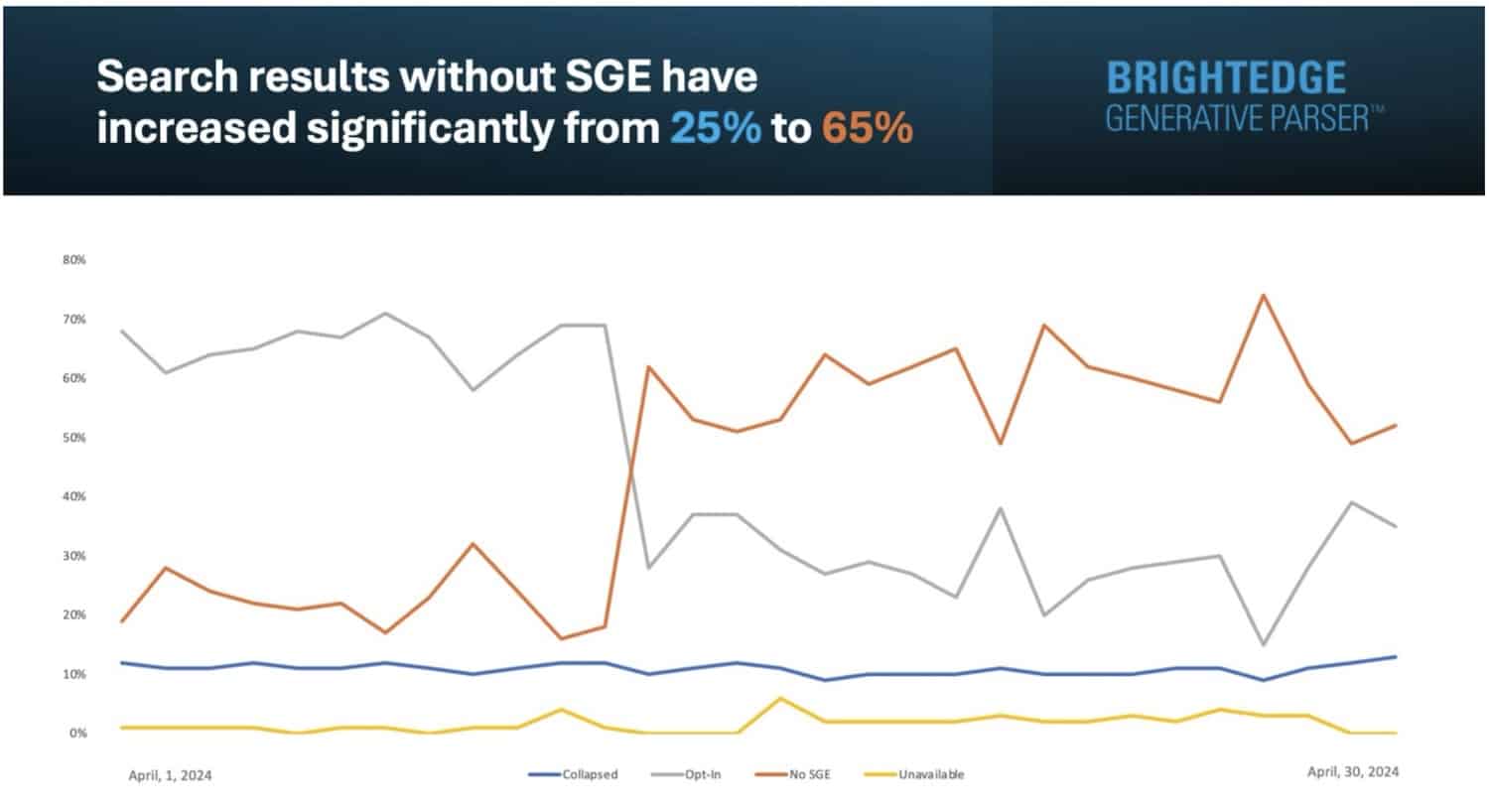
The number of Google Search queries without SGE increased last month from 25% to 65%. This is a surprisingly big drop, especially considering rumors that SGE could launch ahead of, or during, Google I/O next week.

Search results without SGE increase. Why did this happen, starting in mid-April? The reduction of SGE can be traced to Google’s Opt-in results type (when users must request an AI-generated answer).

This screenshot shows the data from enterprise SEO platform BrightEdge and the company’s BrightEdge Generative Parser:

Google search results without SGE increase

Why we care. Many SEOs have been worried about the day Google SGE moves from being an opt-in experiment to the default experience because of the potentially devastating impact it could have on how much organic traffic Google sends to websites. But it seems like Google has been cautiously and patiently testing a variety of factors over the past year, all with the goal of improving it for a wider launch.

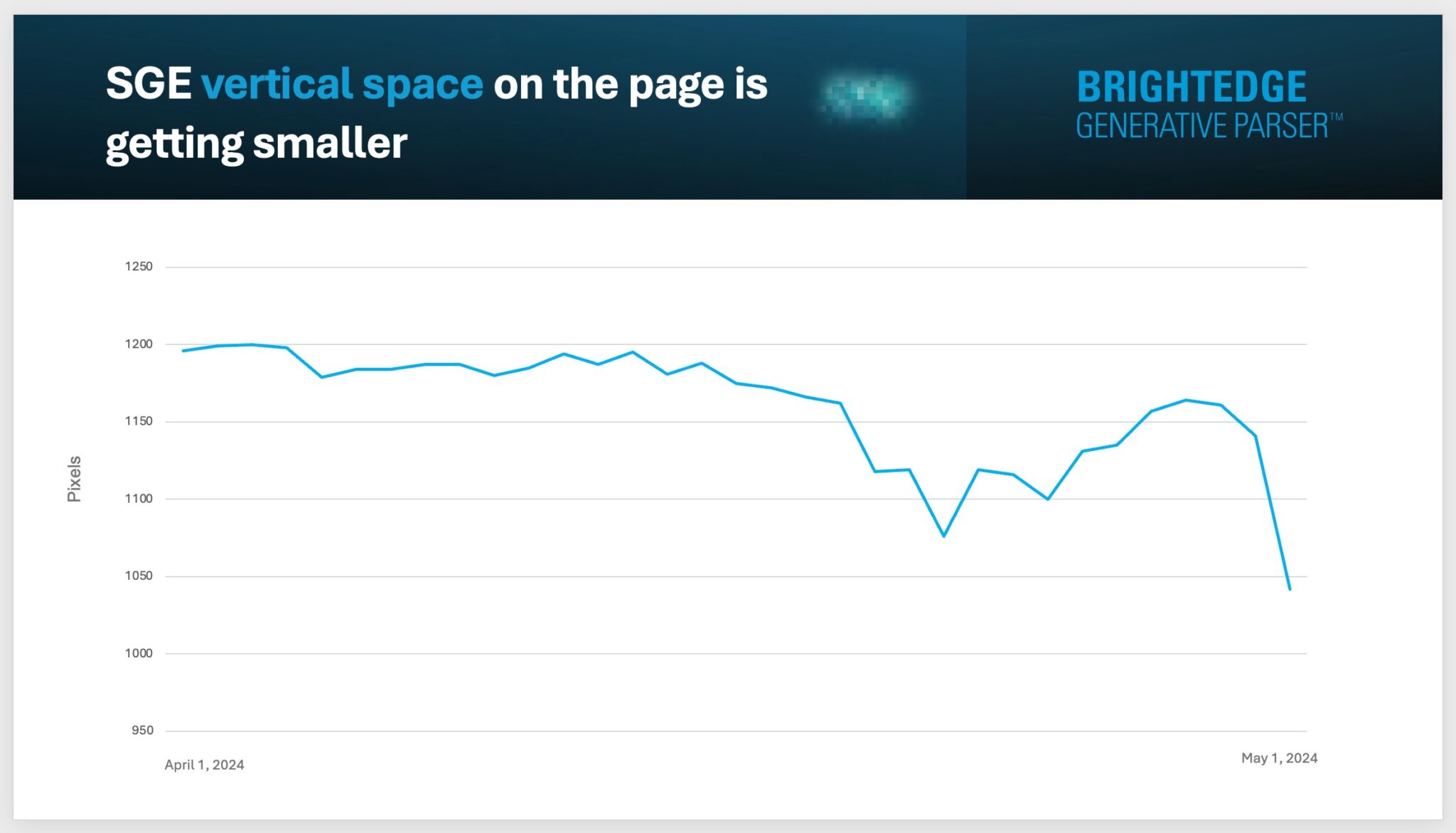
SGE vertical space shrinking. In addition to SGE showing on less queries, the amount of space SGE occupies has been getting smaller over the past month. Here’s a screenshot showing SGE dropping from around 1200 pixels to under 1050 pixels:

Google SGE pixel reduction

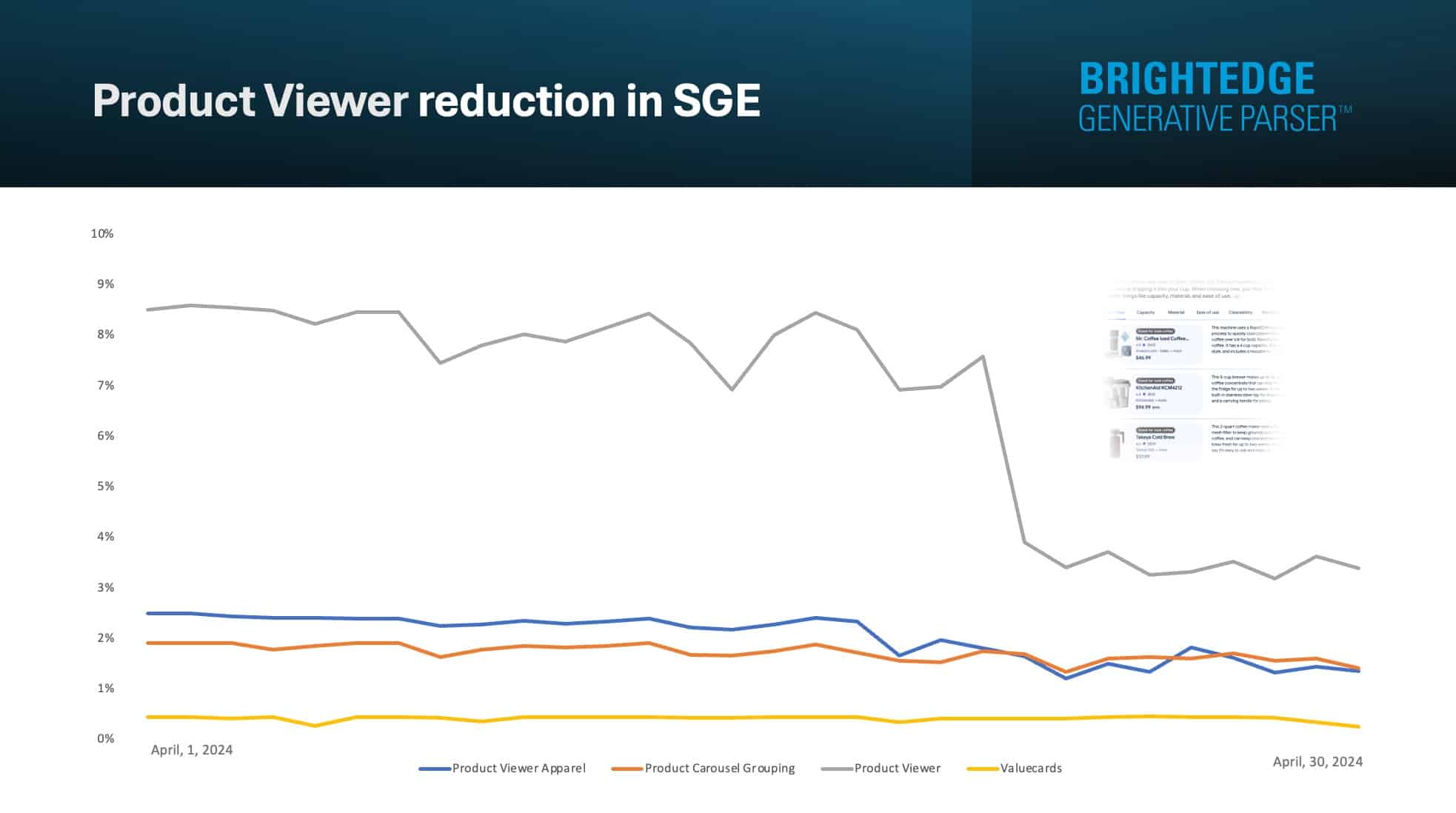
Product viewers decrease. There was a significant drop of this SGE format at the end of April:

Google SGE Product viewer decrease

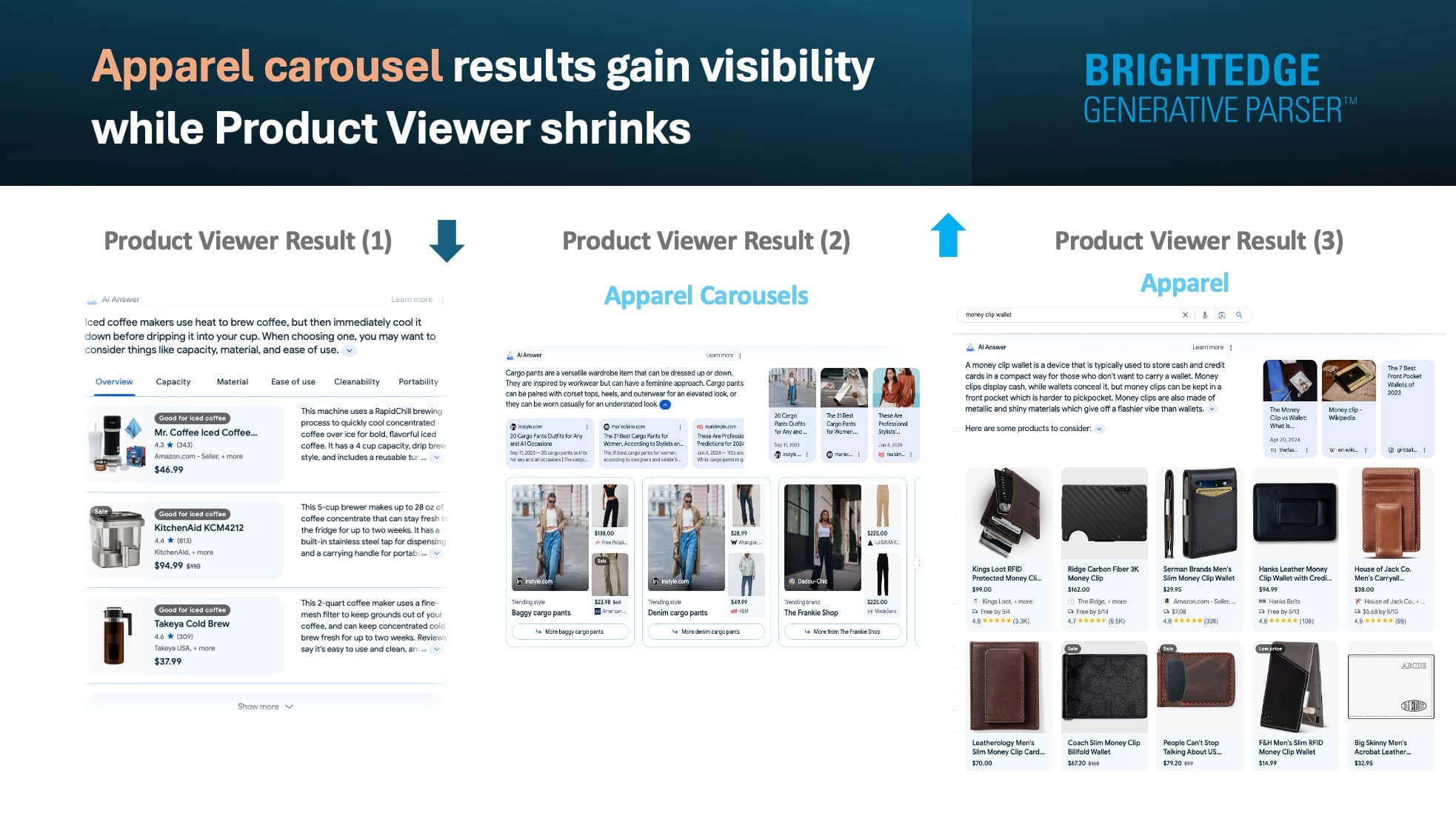
Apparel carousel results increase. This format type gained visibility in SGE for queries specific to apparel.

Google SGE Apparel carousel increase

More warnings. A new, universally-applied warning appeared in April: Generative AI is experimental. This warning now appears across industries and query types.

AIO. SEO for Classic Search will remain important for the foreseeable future, but it’s become clear that AIO (Artificial Intelligence Optimization) may become equally or more important in coming years for AI Search, according to BrightEdge founder and executive chair Jim Yu:

  • “Google search has undergone massive changes in the past few months to test and perfect SGE, with the goal of providing the best possible search experience. For marketers, it is essential to stay in lockstep with these changes to adapt to the new ways of optimizing for generative AI search.”

The report. BrightEdge continues to do live SGE update monitoring as part of its resource, The Ultimate Guide to Google SGE.

Original source: https://searchengineland.com/google-search-results-without-sge-jump-440369

Meta: Detailed targeting exclusions alert sent to advertisers was an error

Meta ads

Some Meta advertisers received an alert yesterday when they opened their accounts. A source from Meta confirmed this alert was sent in error. 

What was announced? The message said setting new detailed targeting exclusions would no longer be possible when creating campaigns after June 28.

  • Existing exclusions would remain unless ad set targeting is modified.
  • Exclusions based on brand suitability and employment will still be allowed at the account level across all campaigns.

However, this alert was an error, Meta confirmed to Search Engine Land.

Why we care. Getting alerts about functionalities that advertisers rely on can be destabilizing. If false alerts like these keep showing – how should advertisers trust the alerts we see?

Concerns from advertisers. Dario Zannoni, who got this alert, shared the information with his followers:

  • “By using targeting exclusions in combination with the other targeting options, it was possible to not only exclude interests for brand protection but also to create well-curated Audiences that are aligned with the specific product or service.”

Get the daily newsletter search marketers rely on.


Search Engine Land contributor Navah Hopkins was also not happy to hear that is was coming:

  • “I’m pretty devastated by the news that Meta is removing audience exclusions for all campaigns in June 28, 2024.
  • One of the reasons audience exclusions were really impactful is they enabled us to be very specific about who we were going after. Beyond the flexibility of “or” and “and” audience statements, they ensured we could really fine-tune our messaging.”

Original source: https://searchengineland.com/meta-ads-alert-error-440379

Launching a Perfume Business: A Fragrant Venture into Entrepreneurship

Home Business Magazine Online

Launching your own perfume business can be a challenging yet rewarding endeavor, and the world of perfumery offers a unique opportunity to blend creativity with entrepreneurship. The perfume industry has seen a steady increase in niche markets and bespoke scents, making it a fertile ground for new businesses. Aspiring entrepreneurs can find success in this sector by focusing on originality, quality, and a deep understanding of fragrance composition and market trends.

One potential niche that has captured the interest of consumers is fruit-scented perfumes, such as strawberry perfume. This scent can serve as a cornerstone for a new business, appealing to a demographic that prefers sweet, vibrant fragrances. By anchoring a startup with a popular yet distinct fragrance like strawberry, an entrepreneur can build a brand identity that stands out in a crowded market.

Understanding the Perfume Industry

In launching a perfume business, it’s crucial to understand the industry’s dynamics, including the production process, from scent creation to bottling, and the regulatory aspects of selling fragrances. Market research is essential to identify target demographics and their preferences. Whether focusing on luxury, organic, or casual day-to-day scents, knowing your audience will guide every decision from product development to marketing strategies.

Crafting Unique Scents

The heart of any perfume business is the creation of unique scents that captivate and enchant. This involves mastering the art of fragrance blending, understanding notes (top, middle, and base), and how they interact with each other. For example, a strawberry perfume could be enhanced with complementary floral or citrus notes to create a sophisticated, multi-layered scent. Offering customizations or personalized scents can also set a new business apart from established brands.

Sourcing Ingredients and Materials

The next step is sourcing high-quality ingredients and materials. This includes not only the essential oils and aroma compounds but also alcohol, bottles, and packaging. The choice of suppliers is crucial, as it affects both the quality of the perfumes and the overall sustainability of the business. Opting for ethically sourced and environmentally friendly materials can appeal to eco-conscious consumers and add to the brand’s value proposition.

Marketing and Sales Strategies

Effective marketing is key to launching a successful perfume business. This can involve everything from sophisticated branding, including a compelling logo and an attractive website, to strategic online marketing through social media and influencer partnerships. Additionally, positioning the products in local boutiques or at craft fairs can create buzz and attract a loyal customer base. Storytelling is also a powerful tool, particularly if there’s a unique story behind the creation of the scents or the brand.

Navigating Challenges

The perfume industry is competitive, and new businesses must be prepared to face challenges such as fluctuating market trends, consumer preferences, and economic downturns. Continuous innovation and adaptability are essential. Collecting customer feedback and staying engaged with trends can help refine the product line and marketing efforts to better meet consumer needs.

Launching a perfume business requires not only a passion for fragrance but also an entrepreneurial spirit that embraces creativity, marketing, and customer engagement. With careful planning, a focus on quality, and a clear understanding of the target market, aspiring entrepreneurs can create a successful business that brings new and delightful scents to the market. By offering unique fragrances like strawberry perfume, a new brand can make a significant impact, turning the love of aromas into a flourishing business.

The post Launching a Perfume Business: A Fragrant Venture into Entrepreneurship appeared first on Home Business Magazine.

Original source: https://homebusinessmag.com/business-start-up/business-start-up-blog/launching-a-perfume-business-entrepreneurship/

Sure, Business Risk Is A Necessity – But Where Can You Limit Its Impact?

Home Business Magazine Online

Risk is just a part of life. No matter where we are, risk is involved. Even driving to work each day is risky. What matters is managing that risk appropriately, which is why road rules, seat belts, airbags, and side mirrors are so important in getting from A to B correctly. We can extend this metaphor into the business world also, where not being afraid of business risk but managing it is essential.

Even large corporations can make mistakes from time to time. Failed ventures, unpopular services, misjudged marketing outcomes, all of this can be a real problem if not addressed. But we manage risk by doing our research, by learning from our mistakes for next time around, and by limiting the impact of failure.

That’s the philosophy behind LLCs or limited companies, that being able to contain our financial investments to a singular entity can prevent us from losing everything in the event of failure. With that in mind, let’s consider how to manage risks and their impact for the better:

Cash Flow & Financing

It’s important to note that revenue is not just the sole marker of success in a business, but how well your cash flow works, how you can apply funding to various investments within and without your firm, and your general accounting health.

Running out of capital can cause major issues, especially if it prevents essential investments or purchases when needed, so anything involving cash flow has to be a top priority for risk management. That might involve padding your emergency fund, negotiating better payment terms, always, always, always ensuring there’s money for your payroll, and knowing where your cost-cutting measures should never touch (like in quality assurance, failures of which we’ve seen from Boeing lately).

This will ensure more robust protections, and hopefully mitigate any issues that come from poor cash flow.

Supply Chain Safeguards

These days, with everyone’s operations so globally intertwined, any major supply chain disruption can cause an annoying domino effect if you’re not prepared. Just look at the havoc caused by COVID lockdowns – shipping networks suffered, semiconductor shortages were common and led to tech shortages (such as the release of the hotly-anticipated Playstation 5), you name it. So do you have robust backup plans ready to go if a key supplier no longer has the capacity to serve you? It’s not just about geopolitics either, it might be that dwindling supply, new practices, other regulations, and more can cause a problem.

Now, you can’t possibly account for every issue in the world, but you can definitely use tools that help you manage suppliers with ease. This gives you the means to ensure, at least on your end, that supplier organization, audits, reviews, negotiations and tracking are perfectly organized from your side. That way, accidental incompetence on your end is one possible fault that you never, ever have to worry about.

Cybersecurity Muscle

Most people are not tech wizards, and that’s okay. Much of our business handling is, though, for better or worse, handled using digital systems. As it has been recently seen, even the Ministry of Defense in the United Kingdom has recently suffered cybersecurity attacks. If they can, so can your business.

Data breaches, ransomware, corporate espionage – there are a whole range of issues to be aware of and try to limit. After all, a single cyber incident could absolutely decimate your finances, operations, and hard-earned reputation overnight.

That’s why investing in serious cybersecurity firepower is so necessary and worth never cheaping out on, and that will include routine risk assessments, air-tight incident response protocols, thorough employee training, and top-shelf protective software. An ounce of prevention for business risk is worth a whole lot when your entire livelihood is on the line.

Workplace Safety

A workplace safety issue is a business risk that can cause problems not only for your reputation, but in terms of criminal liability should neglect or a lack of safety protocol and regulation be followed. However, of course, financial or operational damage pales in comparison to the trauma of someone actually being hurt.

Taking steps to review hazards and train staff in best practices will always be essential no matter what business you run, from signing a slick floor, implementing heavy machinery malfunction protocols, or protecting against toxic fumes, it’s essential to make sure all of these practices are well defended against.

While it can sound like a somewhat impossible goal to reach, having a target of 0% harmful injuries from day one is essential. Note that this is the one business goal where “acceptable parameters” are not acceptable. It’s not a good result if 0.2% of the staff you retain over the life of your business are injured. Zero should be the only acceptable option, and this will help you keep your priorities well-maintained.

Environmental & Climate Factors

It may seem strange to consider this as part of your tyle=”font-weight: 400;”>>business planning, not only as an element of a sustainability strategy your business embarks on for good, but as a threat: Climate change, natural disasters, and other environmental factors can pose a very real physical risk to many businesses these days. Depending on where they’re located. That might seem a bit odd, but think of how many Australian or Californian businesses have been affected by wildfires in the last few years, or how issues can affect the supply chain as we discussed above.

That might involve rising sea levels and intense storms threatening coastal facilities, or drought conditions straining agriculture supply chains, sometimes using a few methods to protect yourself from this, even just another set of suppliers for contingency, can make a helpful difference.

Intellectual Property Protection

Your ideas, inventions, and creative works are what give you a business worth managing in the first place, and while you may have patents in place or approved commercial licenses, it’s still best to keep your value secret.

This also ties back into our concerns about cybersecurity, because, intellectual property theft is a very real threat that companies of all types have to deal with. It’s not just Apple protecting their research and development team from leaks, we’ve seen how data breaches can cause software companies harm. Look at how emulators are now piecing together one of the biggest video games using stolen code for a platform it wasn’t designed for.

Resolutions could involve implementing strict confidentiality protocols for sensitive R&D information and protecting them fiercely. Or, you might become ultra-vigilant about securing patents, trademarks, and copyrights on your core assets too. You might even enlist specialized IP monitoring services to help sniff out infringements, unique watermarks on sensitive documents have been used to identify leakers quite rapidly.

These are just a few measures, but this, alongside good cybersecurity protocols, can genuinely make a reliable difference, or at least help you prosecute leakers or those with nefarious intent.

With this advice, you’ll be certain to help mitigate business risks. As we outlined in this post, you cannot be free of risk from every angle. After all, this post is hardly an exhaustive list of every problem that could impact your firm. It’s hard to imagine any risk mitigation guide written before 2020 assumed that a global pandemic would come to light in such a short amount of time.

At the very least, you’ll be in the mindset of preparation, of limiting issues that could go wrong and developing a better, more robust perspective for the future. At the very least, learning from the impact you do suffer will never be a bad idea.

The post Sure, Business Risk Is A Necessity – But Where Can You Limit Its Impact? appeared first on Home Business Magazine.

Original source: https://homebusinessmag.com/businesses/success-tips/business-risk-necessity-limit-impact/

Reddit eyes potential in search ads following Google traffic gains

Reddit logo on yellow background

Reddit is exploring monetizing its search results pages, teasing a significant untapped opportunity for the popular online forum.

Logical next step. With over 1 billion monthly searches on the platform, Reddit sees advertising against user searches as a logical next step to improve monetization after enhancing the core search experience.

Why we care. Reddit venturing into search ads could present a lucrative opportunity to target users with high intent. Advertisers will get the diversity in available platforms they crave as signs of decreasing Google trust levels prevail.

What they’re saying. Steve Huffman, CEO of Reddit, said on the company’s latest earnings call:

  • “There are no ads today on search result pages. But that’s a very high-performing product elsewhere on the internet. And I think there’s no reason to believe that it wouldn’t be for Reddit because the intention is so explicit when users are searching.”

State of play. Reddit is first focused on upgrading its search functionality with improved back-end performance, autocomplete, and a revamped user interface slated for this year.

  • The company believes nailing the search user experience is crucial before exploring monetization options like search ads.
  • As it improves discovery and leverages explicit search intent signals, the platform sees advertising as a natural complement.

Get the daily newsletter search marketers rely on.


What’s next? While no firm timeline was provided, Reddit appears committed to extracting more value from its massive search volume by opening up ad inventory once its revamped search product takes shape.

Original source: https://searchengineland.com/reddit-teases-search-ads-440343