The world is at an intensely interesting time in history with the development of new technologies such as blockchain and Artificial Intelligence. These technologies are shaping the direction of change in many industries, such as banking and finance, which is affecting the future of lending perhaps most of all.
Fintech Solutions for Loan Applications
Financial Technology (Fintech) is being used to make the process of loan applications from lending websites much easier. Lenders can use the latest versions of Loan Origination Software (LOS) to pull together information on the finances of loan applicants. They can bring in other information that relates to the borrower, such as their utility information and address confirmation from the electoral roll.
Being able to access all of this information quickly and leveraging real-time data analytics to sort through it, transforms how loans are provided, not just in the UK but around the world from loan industry websites. The future of the financial services sector is both data-rich and cloud-based. The advances in blockchain technology are now allowing for much more secure transactions as well.
Speedy Disbursement and Instant Approvals
This use of fintech allows for more comprehensive checks than ever before on the financial status of individuals applying for loans. It can even allow for rules-based decisions to be taken automatically, depending on several different factors and how they interact together. In this way, decisions can be made on a much faster timescale, and employees can free up some of the time that these tasks might otherwise have taken them. They are able to offer very quick loans to their clients.
The faster disbursement of loans is something that the industry has aspired toward for some time now, and the technology underpinning this is now finally at the stage where it works at the required level. It is now possible to approve loans instantly when people apply online and meet certain criteria.
Personalised Loan Solutions
The more extensive use of data that the latest generation of fintech solutions has enabled means that consumers can be offered much more personalised loan products based on their own unique financial situations. This is a game changer for the future of lending, and it can make a real difference in the viability and profitability of personal loans.
Being able to make micro-tailored loan offers based on the depth of data that is now available means that consumers can receive offers that they are far more likely to accept. This also reduces the risks for the lenders as they have a vast pool of data to draw from, including credit scores, utility costs and spending habits.
When this information is fed in along with marital status, whether they have any dependents and all manner of other data points, it is possible to create a very detailed lifestyle profile. This profile can then be used to extrapolate the most relevant loan products to target the customer individually. It can also be used to compare with similar profiles and look at which products worked for them, as these may also prove relevant.
AI in Fraud Prevention
In the future of lending, companies are using artificial intelligence in fraud prevention. The machine learning models currently being developed can look at the characteristics of fraudulent cases and pattern match, extrapolating which loan applications may merit more human attention and verification.
These are often patterns that may be missed by humans involved in fraud prevention but can be analysed and picked up on by the lightning-fast computational abilities available to financial institutions through the use of cloud-based computing. The mixture of on-site computers and linked cloud computers, all working in unison, can crunch calculations in real-time and alert human operators to anything that fits the patterns most commonly seen in fraud.
In a world where change seems the only constant, technology and innovative strategies have transformed traditional marketplaces, even in the realm of real estate. A new breed of buyers called ‘cash house buyers’ is disrupting norms and remapping the real estate market. This revolutionary shift could spell lucrative opportunities for sellers and provide a fresh take on property investment.
Cash Buying Explained
The emergence of cash house buyers brings fresh intrigue. These entities are largely investors who, with readily available capital, purchase properties outright without relying on mortgage financing. You might be wondering why they would risk their funds in such large amounts. Well, their business model banks on lucrative returns after refurbishing the properties for either resale at higher prices or rental income.
Their offering is unique – a fast transaction, eliminating hassles tied to property chains or loan delays that sometimes plague traditional buying methods – quickly turning into an attractive option for home sellers seeking quick deals. Traditionally, purchasing a house often involves drawn-out bank procedures and hefty paperwork which can create room for potential hiccups making cash buying a solid choice.
With fewer contingencies and demands for inspections or appraisals, there’s an increased rate of deals closing successfully with minimal complications. For cash house buyers too, this speedy process means they can secure their newest house investment ahead of potential competition.
Cash House Buyers USA
In recent years, the USA has seen a surge of cash house buyers penetrating its real estate market. Notable names like Cash House Buyers USA, Opendoor, and WeBuyUglyHouses have become standard bearers operating.
Such growth has been driven by several factors. First, the USA presents a diverse landscape with plenty of distressed properties – from foreclosures to inherited homes – ripe for cash buying. Secondly, the marked increase in institutional investors willing to invest heavily in the housing market has supported this growth and broadened its reach farther.
Enhanced by adept use of technology for property assessments and pricing models, these players have effectively tailored their strategies for profitable scalability. They’ve established end-to-end digital platforms allowing seamless transactions with homeowners while orthodoxy continues to rely largely on age-old techniques.
Impact on the Real Estate Industry
The advent of cash buyers has undeniably rippled across the industry. In challenging traditional buying methods, they’ve sparked both intrigue and skepticism. Yet their impact is predominantly positive. They often step in where typical buyers fear to tread, taking up distressed, vacant or hard-to-sell properties.
This willingness to handle complex or ‘ugly’ situations provides a welcome solution for owners eager to sell but marred by tricky property issues. Consequently, neighborhoods benefit from revamped houses replacing derelict eyesores. Lastly, their rapid purchase timelines ease pressure on local real estate stocks.
In essence, cash buyers are not just market disruptors; they’re catalysts driving change within the industry by challenging antiquated norms, pushing for faster transactions and injecting immediacy into an otherwise protracted process.
Benefits for Home Sellers
For homeowners looking to sell quickly or struggling with unique property issues, cash house buyers could be the lifeline needed. The benefits they offer are matchless in comparison to conventional selling paths; these include fast sales often wrapping up within a week unlike months-long waits when listing with realtors.
Sellers also get to bypass the cost and stress of sprucing up their homes for potential buyers since cash buyers purchase properties ‘as is’. No need for tiring negotiations around repairs or improvements – it’s a smooth sail to a quick sale. This spares sellers from struggles with fussy buyers, inconvenient house staging, or missed work days due to incessant viewings.
Elimination of typical sale contingencies such as bank financing approvals reduces a potential deal’s collapse chances. With a cash offer, once an agreement on price is reached, it’s more or less a done deal.
Competitive Advantage
Finally, the competitive advantage cash house buyers wield over traditional players is undeniable. Their ability to make instant offers and close deals rapidly gives them an upper hand in a cutthroat market.
Sellers favor fast, guaranteed transactions; hence they likely lean towards guaranteed cash offers over mortgage-dependent ones. Furthermore, the simplicity offered by these companies – handling every aspect of the sales process, allowing homeowners to sell without lifting a finger – is an alluring prospect in an otherwise stressful journey.
In contrast, traditional methods pose several barriers that can deter prospective sellers. With cash buyers, however, homeowners can enjoy a hassle-free experience coupled with certainty that the transaction will conclude successfully and swiftly…all in all, it’s easy to see why they’re redefining the real estate market.
Avoiding Traditional Sale Hassles
With cash house buyers, one of the major benefits is the avoidance of typical issues that can arise during the conventional selling process. It’s not uncommon in traditional sales for contracts to fall through due to financing predicaments, unexpected home inspection results, or buyer cold feet.
However, in a cash sale, these potential roadblocks are practically rendered obsolete – circumventing most problems that might slow down or outright halt the transaction.
Besides this, homeowners can sell their properties ‘as is’. This means bypassing the common stressor of embarking on potentially costly and time-consuming repairs or renovations to make the property more attractive to traditional buyers. It creates an avenue for homeowners who may not afford such improvements beforehand but still wish to sell.
Potential sellers do not have to concern themselves with the open-house staging circus that comes with conventional methods either. Homeowners are spared from multiple home viewings that disrupt their daily routines.
Lastly, paperwork associated with property transfers can be a nightmare for those unfamiliar with real estate jargons. Traditional home selling means enlisting lawyers or other professionals averting possible legal pitfalls – hence extra costs. However, respectable cash house buying companies typically handle all legal aspects, making the process smoother and worry-free for the homeowners.
Market Trends and Forecast
There’s no question that cash house buyers continue to shape real estate market dynamics. Aiding this trend is the increasing instances of distressed properties hitting marketplaces amidst economic uncertainties – creating a fertile ground for cash buyers operations.
Cash transactions already account for a significant share of overall residential sales in dominant markets like the USA. However, there’s strong potential for proliferation in emerging markets as technology eases barriers to entry and operations.
Demand for swift, hassle-free home sales isn’t going anywhere soon, neither are distressed properties or homeowners needing a quick sale. Moreover, as innovations continue to burgeon, these companies will keep finding ways to assess properties and engage sellers more efficiently – further fueling growth.
While the prospect of a 100% cash-house-buyers-dominated market might seem far-fetched in the near future, it is clear that their influence will persist given current course and speed.
Navigating Seller Misconceptions
The emergence of cash house buyers hasn’t been without occasional criticisms or misconceptions. One common illusion is that these companies prey on homeowners’ desperation to offload their properties only to severely undervalue them in return. While there are unscrupulous actors in any industry, reputable cash-buying firms substantiate their offers using accurate market data and provide transparent breakdowns of how these prices are derived.
Another misunderstanding is that the guarantee of a fast sale means sellers get their cash instantly upon agreement. However, legal procedures such as title deeds transfer and paperwork processing can take a few days. Sellers should bear this in mind – yet this process is considerably quicker than conventional routes. Educating yourself on what to expect can help debunk misconceptions and ensure a smoother transaction and experience.
Expanding Real Estate Opportunities
Skeptics might view cash house buying as an affront to traditional real estate norms but, on the contrary, they expand opportunities within the industry.
Their presence enriches diversification within real estate portfolios for savvy investors looking for faster returns. Homeowners get expanded selling options while potential home buyers gain access to renovated properties that would’ve otherwise remained distressed and uninhabitable.
Cash transactions expedite processes allowing quick ownership transition. This contributes immensely towards reducing housing inventory pressure in popular markets hence maintaining a healthy real estate industry balance.
Risks and Drawbacks
While the cash house buyers model carries numerous benefits for both sellers and the larger industry, it’s not entirely without drawbacks.
Firstly, there’s the question of price. It’s no secret that some cash buyers may offer below market value for properties due to their as-is buying policies and the quick sale guarantee. Homeowners in no hurry to sell may find better prices via traditional pathways by investing time and money into home improvements and marketing.
Secondly, homeowners should be wary of scams. Although major players like Zillow and Opendoor have legitimized this arena, not every cash-buying entity is trustworthy. Before engaging with any cash buyer, research their reputation extensively to avoid decentralizing con artists posing as genuine buyers.
Conclusion: The Shift
Cash house buyers are unquestionably redefining the real estate market – offering unparalleled speed, convenience, and certainty to sellers. Their imprint extends beyond individual transactions to broader market dynamics. While this approach may not suit everyone’s property-selling goals or circumstances, it’s undeniable that cash house buyers are here to stay – further reshaping the real estate landscape in years to come.
With recovery slow after the huge economic impact of the pandemic, and current global upheaval disturbing markets, PLUS the cost of living crisis, it’s easy to see why many people are worried about their jobs, while others know it could be time to change careers to secure their future.
Here are some professions you should consider if you’re looking for a change:
Adult social care is a bigger employment sector than the NHS – and yet there are around 152,000 open vacancies. This number reduced slightly when the Government introduced the Health and Care Worker Visa, but with strict immigration laws in place now, the number of open vacancies remain open as retirement living centres, residential carers, and those working with adults with learning or physical disabilities in independent living homes cry out for support workers.
You don’t need qualifications to get started in many adult social care professions, as training will be provided. Hours can also be more flexible if you want a part-time job, and others might offer accommodation with the role as a live-in carer. If you’re compassionate and like people, adult social work could be for you. Most jobs will require a DBS check – it is worth registering for the annual check update to ensure your DBS is always up to date which makes moving jobs much easier.
2. Architects
This is one of those long-game professions that will pay off big time. Training to be an architect takes seven years – but the end result can be a healthy salary of £80,000 or more.
You can train solely on a university course, or take an architect apprenticeship which gives you work experience and a salary to learn ‘on the job’. Starting salaries for fully qualified architects are around £30,000 quickly rising to £75,000 or above, particularly in London and other metropolitan areas.
Architects are in demand as the UK tries to keep up with the need for more housing as well as improving city centres with public architecture that is accessible and provides pleasant surroundings. It is the type of job that will always be needed, even as we move into a digital age – computers can do the drawings, perhaps, but the vision and skill required will always be human-focused.
3.Programmers and Developers
Software developers and computer programmers are in increasingly high demand as world digitisation shows no sign of slowing down. Companies that previously had openly spoken against tech developments like AI are now investing in the UK and crying out for staff – such as Microsoft’s new centre for AI, which is opening in London soon.
It might seem that getting a computer job while we’re teaching computers how to run without our input is putting yourself out of a future job, but that won’t be the case. AI is a tool that will always need human input at some stage – and we’re still very early stages in the technology development. A software developer starting salary is around £26,000 but can quickly and easily rise to well into six figures for those who show they can handle complex scripts and have good problem solving skills.
Sign Up – Newsletter
4. Plumbers, Bricklayers, Construction Workers
Professions that can’t be automated, like plumbers and construction workers, are in dire need of new recruits. A recent study by Checkatrade revealed over a million new recruits are needed in the trades to fill the huge skills gap the industry currently faces.
Some of the problem is recent changes to UK immigration law, which has eliminated a large portion of the potential workforce from qualifying and taking up vacancies. Schools are also not promoting the possibilities of apprenticeships to their students, while parents are worried about the stigma of taking an apprenticeship instead of following a university-based further career path and that it might limit their child’s financial opportunities.
These fears are unfounded: the average salary for a qualified contract plumber in the UK is £31,000 – and self-employed plumbers earn around 8% more. Bricklayers can expect to start on around £20,000 rising quickly to an average £46,000. Carpenters and joiners earn an average of £37,000 a year rising to over £50,000 with experience. These salaries also rise considerably if you take further qualifications and specifications, such as being able to operate heavy machinery.
5. Drivers
Logistics companies and local courier services are crying out for drivers. The pandemic saw so many businesses turn to online ordering and delivery – and most have kept it in the years since. Food delivery, for example, is a popular way for many people to earn some extra money on the side a few nights a week – and there are always vacancies because it’s a service that is in constant demand.
There is a national shortage of bus and coach drivers, which impacts travel infrastructure. Since the pandemic, there has also been a shortage of national and international HGV drivers. In response to this, the Government is considering relaxing the age rules from the current minimum age of 21, to allow for recruiting drivers from a wider age range.
Professions in driving don’t have to be something that takes you away from home for a long time – such as bus and coach drivers working relatively regular shifts in a local area on a salary around £30,000 a year. However, if you are prepared to drive longer distances, the salary can be significantly higher: an HGV driver can earn upwards of £50,000 a year.
Disclaimer: MoneyMagpie is not a licensed financial advisor and therefore information found here including opinions, commentary, suggestions or strategies are for informational, entertainment or educational purposes only. This should not be considered as financial advice. Anyone thinking of investing should conduct their own due diligence.
When it comes to navigating the complex landscape of group insurance, having the right broker by your side can make all the difference. Group insurance brokers play a crucial role in helping businesses select and manage their employee benefit plans, ensuring they meet both the company’s needs and the needs of its employees. But what sets the best group insurance brokers apart from the rest? In this guide, explore the qualities that define top-tier group insurance brokers and why they are essential for businesses of all sizes.
Expertise and Experience
The best group insurance brokers possess extensive knowledge and experience in the insurance industry. They stay up-to-date on the latest trends, regulations, and products, allowing them to provide informed guidance and recommendations to their clients. Look for brokers who have a proven track record of success and a deep understanding of group insurance plans.
Customized Solutions
Every business has unique needs and priorities when it comes to employee benefits. The best group insurance brokers take the time to understand their clients’ specific requirements and tailor solutions that align with their goals and budget. Whether it’s designing a comprehensive health insurance plan or implementing a cost-effective wellness program, customization is key to meeting the diverse needs of businesses and their employees.
Transparent Communication
Clear and transparent communication is essential for building trust and fostering a positive working relationship between brokers and their clients. The best group insurance broker communicates openly and honestly, providing timely updates, explanations, and guidance throughout the insurance selection and implementation process. They are responsive to their clients’ questions and concerns, ensuring they feel informed and empowered to make decisions.
Strong Carrier Relationships
Group insurance brokers work closely with insurance carriers to negotiate rates, coverage options, and terms on behalf of their clients. The best brokers have established relationships with a wide network of reputable carriers, allowing them to access competitive pricing and comprehensive coverage options for their clients. These strong carrier relationships enable brokers to offer value-added benefits and services that may not be available through other channels.
Proactive Service and Support
Group insurance needs can evolve, and the best brokers are proactive in anticipating their clients’ changing needs and circumstances. Whether it’s conducting annual plan reviews, exploring new coverage options, or addressing unexpected challenges, top-tier brokers are there every step of the way to provide support and guidance. They act as trusted advisors, helping businesses navigate complex insurance decisions with confidence and peace of mind.
Compliance Expertise
Staying compliant with federal and state regulations is a top priority for businesses offering group insurance benefits. The best group insurance broker has in-depth knowledge of regulatory requirements and compliance obligations, ensuring their clients remain in good standing with governing authorities. They help businesses navigate the ever-changing regulatory landscape, mitigate compliance risks, and avoid costly penalties or fines.
Commitment to Client Success
Above all, the best group insurance brokers are deeply committed to their clients’ success and well-being. They prioritize client satisfaction and go above and beyond to deliver exceptional service and results. Whether it’s advocating for their clients’ best interests, resolving issues with insurance carriers, or providing ongoing support and guidance, top-tier brokers are dedicated to helping businesses thrive.
The best group insurance brokers possess a unique combination of expertise, experience, and qualities that set them apart in the industry. By partnering with a reputable broker who prioritizes customization, transparency, proactive service, and client success, businesses can navigate the complexities of group insurance with confidence and achieve their employee benefit objectives effectively.
Every employee and business owner understands the importance of professional development and its benefits on their career. But, some professionals may feel like they don’t have as many professional development opportunities as they’d like which can hinder their progress and even stick them in a job rut. So how can you identify and improve your options?
Ask Your Manager
Often, the most straightforward solution is usually the one that works. If you want to do more with your role or explore other options within your company, asking your manager about employee training opportunities is a great place to start. Any serious company should provide a wealth of growth opportunities for employees who want them and all you need to do is ask. They should recommend options and highlight potential resources to explore.
Enroll In Courses
If your manager isn’t as forthcoming with professional development opportunities as you’d like, you can look at what people above you are doing and their qualifications. From here, you can enroll in online courses to gain the crucial skills required to enjoy exceptional professional development. This approach also gives you the chance to explore other roles. If you’re interested in a data analytics career and feel you have enough base knowledge to excel, there are courses available for you to gain certification, boost your skills, and bolster your resume.
Network With Experts
Sometimes, it’s not what you know but who you know. With resources like LinkedIn, it’s never been easier to network with experts to learn more about the role you crave. Knowing how to network with experts is the first step and helps you get your foot in the door. You can arrange coffee chats or even introduce yourself at events where you may be able to borrow some of their time to have a quick talk about what you can do to develop your career.
Try Things Yourself
No one is going to take the lead for you, so it might be worth simply trying things yourself. Do you want to learn more about HTML and coding? Or how about understanding AI to be more effective at your job? Taking the initiative and trying these things in your free time helps you get to grips with things that can propel your career and ensure you have all the skills and tools necessary at your disposal.
Track Your Growth
Professionals who track their growth are more likely to excel as they have concrete evidence of where they are and can compare it to where they want or need to be. Use software to track your progress, whether you use a spreadsheet or even a notebook, and can see what you’ve learned, and what you know and find it easier to see how much further you have to go to ensure you are in the right place to demand more responsibilities, especially since you have evidence to back it up.
Developing
Professional development opportunities are fantastic to make positive changes to your career. If you feel stuck in a rut or not getting the chances you deserve, these tips will help you showcase your skills and take the initiative to improve where it matters.
Brave Search introduced a new AI answer engine called Answer with AI. It will produce AI-generated answers “synthesized” from multiple sources for any query.
What is Answer with AI. Answer with AI, as the name suggests, uses AI to generate answers to queries directly in the search results. This new Brave Search feature appears above the organic search results.
The format varies slightly, depending on the query type. At the bottom, Brave includes a section called Context, underneath which Brave links to the sources it used to generate its answer. Based on a small number of searches I conducted, Brave tends to pull most of its answers from the top-ranking pages.
How Answer with AI works. When a user enters a query, Brave is using large language models (LLMs), primarily Mixtral 8x7B and Mistral 7B, data from its search results and RAG (retrieval augmented generation) to generate answers nearly instantly.
When will users see Answer with AI. For informational, question-like queries, Answer with AI will be the default experience. For other query types (navigational, commercial, transactional), Answer with AI will be optional – you will click on an Answer with AI button.
What it looks like. Here’s an example search for [what is after gen z]:
And here’s what it looks like for a vanity search:
But it’s not perfect. It thought I was the same person/entity as the former Major League Baseball player who shares my name.
Brave Search size. Brave Search has an index of 20 billion webpages, has more than 1 billion location-based schemas and serves:
27 million queries per day.
10 billion queries per year.
Answer with AI availability. It is available on all platforms (desktop and mobile) for all searches in English, French, German, Italian and Spanish. Searching in any other languages may return answers in English language.
What Brave is saying about AI answers. The big concern among SEOs and content creators is how AI answers in the search results could potentially impact the amount of traffic search engines send to websites. Brave addressed this concern, telling Search Engine Land:
“Brave, as both a browser and search engine, is aware of these challenges. Consequently, we will be monitoring and quantifying the impact of AI-generated content on site visits, and eventually will address the disruptions that could be caused by the drop in traffic.”
Advertisers might be able to purchase ads on Meta’s Threads platform as early as the second half of this year. That’s according to a Digiday (subscription required) report citing multiple sources.
Why we care: Brands and marketers will soon have another way to reach their target audiences. Although Threads isn’t at the level of Facebook or Instagram (2 billion monthly active users), Threads gained 50 million followers in its first 24 hours of launch last year and now has about 85 million monthly active users.
Timing. Meta’s discussions have reportedly focused on the rollout timeline rather than specific logistics about how or where ads will be integrated.
Beta testing for ad options is expected soon, though exact dates remain unknown, according to the report.
Where Threads Ads may appear. Threads ads will likely be integrated into Meta’s ad platform, Advantage+, alongside existing options for Facebook and Instagram.
Initial ad formats are anticipated to include in-feed placements, with potential expansion to trends and topics sections.
YouTube has introduced two new measures in its crackdown on ad blockers. There will either be:
Buffering issues.
An error message saying “The following content is not available on this app.”
Why we care. YouTube is doing all it can to ensure ads are seen by as many of its free users as possible. YouTube’s war on ad blockers will likely lead to disgruntled users who will abandon YouTube altogether. It’s either that or break down and pay for YouTube Premium to avoid excessive advertising. If the latter happens, YouTube will gain revenue, but ultimately that means advertisers will lose reach and exposure.
Enforcement on third-party apps. YouTube is now taking active measures to deter third-party ad blockers directly.
“We want to emphasize that our terms don’t allow third-party apps to turn off ads because that prevents the creator from being rewarded for viewership, and Ads on YouTube help support creators and let billions of people around the world use the streaming service,” according to TeamYouTube.
The story so far. This is the latest action YouTube has taken to curb the use of Ad blockers:
Followed by an anti-adblocker popup that features a timer warning when the next ad will play.
Is YouTube breaking privacy laws? YouTube needs to be careful in how it cracks down on Ad Blockers, as this could be seen as breaking privacy laws. Last October, privacy expert Alexander Hanff filed a complaint with the Irish Data Protection Commission (DPC).
Ad-free experience. The only ad-free experience YouTube promotes is YouTube Premium. It costs $13.99 in the US and £12.99 in the UK.
Paid search advertising revenues reached a new high in 2023 – though annual growth continues to slow, according to a new report.
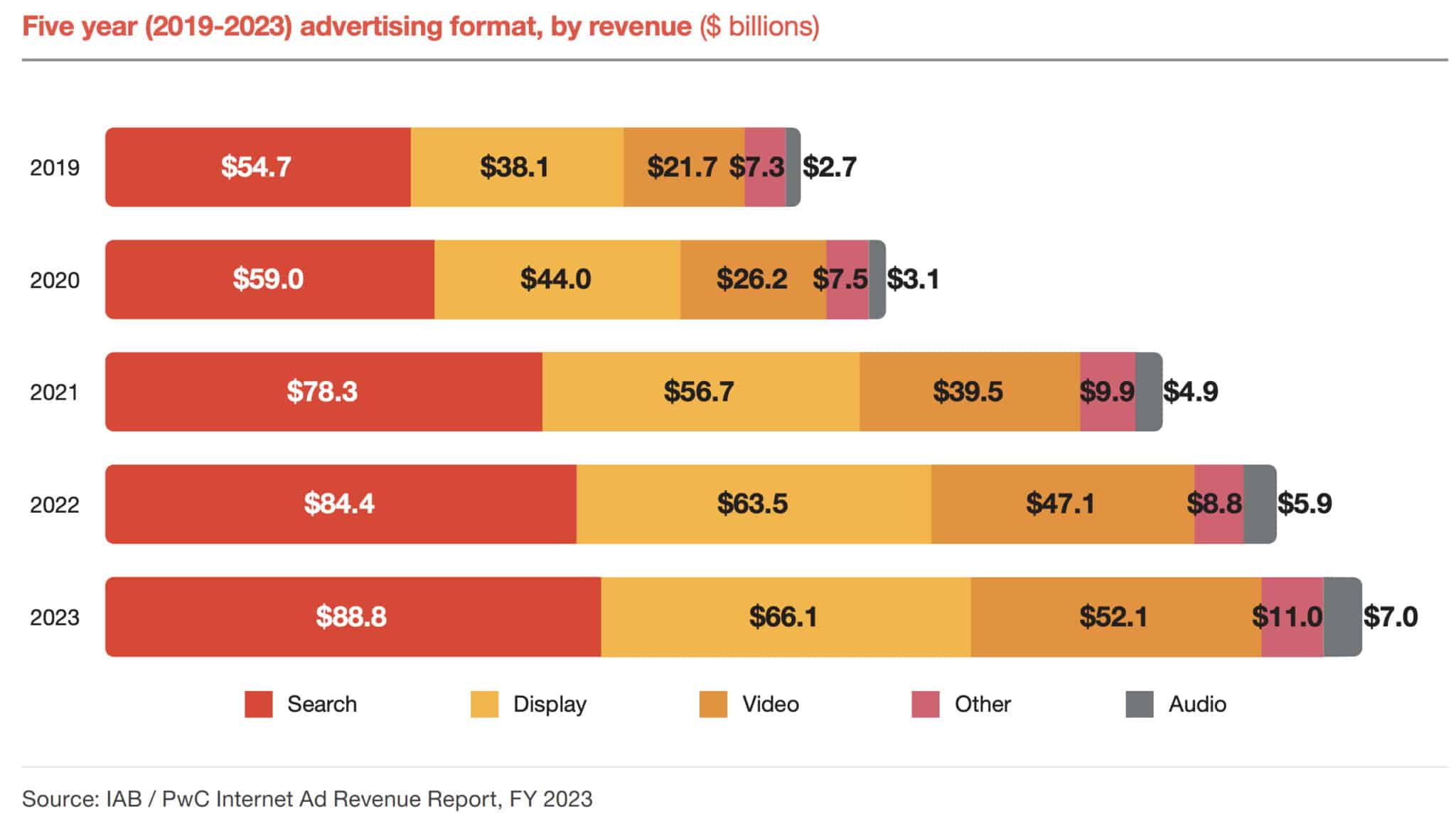
In total, search accounted for $88.8 billion of a record $225 billion in U.S. digital advertising revenues, according to the IAB Internet Advertising Revenue Report: Full Year 2023, conducted by PwC. That figure represents a $4.4 billion increase over 2022.
Why we care. Paid search becomes more expensive and challenging every year, with less transparency. But advertisers continue to embrace paid search for one simple reason: it drives results for brands and businesses.
Paid search is still king. Search continues to own the largest market share of advertising – 39.5%, but that is down from 40.2% in 2022, 41.4% in 2021 and 42.2% in 2020.
But YoY growth for search advertising is slower than the digital industry as a whole and the majority of other ad formats, according to the report.
The state of digital advertising. Resilient. Advertising continued to grow in a time of high inflation, rising interest rates and job cuts, according to the report. Of note from the IAB report:
Q4 had the highest growth rate – 12.3% – with revenues growing to $64.5 billion. In 2022 the growth rate for the quarter was 4.4%.
Social media ad revenue rose 8.7% YoY to reach $64.9 billion in 2023, with much of that growth coming in the second half of the year.
Video advertising accounted for $52.1 billion, or 23.2% of all advertising revenue, in 2023.
Display advertising revenues remained high in 2023 – $66.1 billion – though YoY growth was 4%, down from 12% growth in 2022.
Retail media networks saw a 16.3% increase in revenue YoY, reaching $43.7 billion.
2024 outlook. It’s “promising,” according to the IAB. Advertisers must, as always, adapt to changing consumer behaviors, consumption channels, privacy regulations and the ongoing generative AI revolution.
The report. You can read the report here (registration required).
The nature of employment has changed drastically in the past several years. The gig economy is on the rise. According to the World Economic Forum’s “Future of Jobs” report, over half the global workforce will engage in some form of freelancing by 2025.
Higher levels of unemployment are prevalent in low- and lower-middle-income countries, while the labor market is tight in high-income countries. Simultaneously, the cost-of-living crisis is causing real wages to decline. Freelance and gig work is seen as a solution to the unemployment problem. More people are also driven to take on extra gigs due to the insufficiency of their incomes.
On the positive side, the freelancing trend is driven by increased access to connectivity, the boom in apps and digital platforms, evolving work relationships between employers and employees, and the growing desire for fulfillment, flexibility, and independence.
Whether driven by necessity or a desire for better working conditions, freelancers are here to stay. Here, evaluate the unique financial planning for freelancers and how they can approach their money management strategically.
With the right approach, freelancers can seamlessly tackle budgeting, tax planning, investing, banking, and retirement planning. Using the right financial products, freelancers can reach their financial goals—improve their savings rate and income and secure their futures—while living on their own terms.
Top Financial Planning Strategies for Freelancers
Freelancers enjoy flexibility in their careers. However, they experience challenges such as unpredictability and insufficiency of income.
They must also deal with self-employment taxes, client payment delays, and collections issues. Other challenges that freelancers face include:
Inconsistent workload
Difficulty with retirement planning
Lack of insurance and emergency funds
Client acquisition costs
Business expenses
Problems in financial planning
Adopting the right approach to managing finances will ease many of these challenges and make freelance careers more fulfilling.
The following financial strategies are ideal for gig workers and freelancers:
Create a Detailed Budget
As a freelancer, you can’t afford to wing it when it comes to expenses. You need to create a detailed budget to manage income and expenses accurately.
However, because of variable pay, it could be challenging to start.
The best way to begin is to estimate average monthly income by reviewing income reports. With at least two years’ worth of income to analyze, you can start identifying your least and most profitable months. Determine your absolute minimum monthly income.
Next, know that there are three types of expenses: fixed expenses, debt expenses, and variable expenses. Identify fixed expenses like utilities, car payments, and rent or mortgage. Allocate a part of your income to variable costs like transportation, entertainment, and groceries. Debt expenses include credit card payments.
Incorporate an emergency fund to ensure unforeseen expenses are covered. Income gaps must also be considered a financial emergency. To provide an ideal financial cushion for lean periods, you must save approximately three to six months’ worth of living costs in a high-yield savings or checking account.
Manage Cash Flow
To manage cash flow properly, you must understand your financial state in-depth. After looking at broader data, look deeply at your weekly balance, costs, dues, and invoicing schedule. You can manage expenses and income using invoicing software automatically setting up recurring bills. Digital platforms can help track dues and client invoice dates to ensure optimal and uninterrupted cash flow.
Use Smart Banking Solutions
Innovative banking solutions can work wonders for the self-employed, providing the tools to help run the business efficiently and assist you as you grow your career. As a freelancer, you must look for a bank account with low fees and minimum balance requirements.
Search for an online high-yield savings account with competitive interest rates to maximize savings. Digital banks often have low to no account fees and a high APY, allowing freelancers to earn more on idle cash while having convenient and flexible access to funds whenever needed.
SoFi’s high-yield savings account can earn up to 4.6 percent APY and offers bonuses based on your direct deposit amount.
In addition, freelancers can look for additional features like integrations with other financial services and solutions like payroll, invoicing, and loans.
Photo by Firmbee.com on Unsplash
Manage Risk and Diversify
Income diversification is a valuable strategy that can help people of all professions, especially freelancers. Projects are typically spread out unevenly throughout the year. Moreover, the economic climate may affect clients’ businesses, resulting in dry spells in the freelancer’s cash flow.
Diversifying income streams helps mitigate the impact of unpredictable circumstances. It prevents you from relying too heavily on a single account.
Freelancers must constantly explore opportunities to learn new skills or upskill, expand their client base, network, and pursue multiple projects simultaneously. Such efforts help to increase earning potential and cushion against economic downturns.
Remember that income does not only come from professional labor. Consider investing in financial instruments like stocks and bonds and alternative investments like real estate. These investments can grow your money as you do your regular work. Be sure to understand the risks and requirements of each investment.
Also, note that your investment strategy must match your risk tolerance and financial goals.
Understand Taxes and Compliance
Freelancers are bringing in significant earnings, so financial planning for freelancers is a must. Globally, approximately 1.57 billion people are freelancers. The popularity of freelance platforms is rising; today, they are estimated to be worth $3.39 billion.
In Canada, 28 percent of adults work in the gig economy, primarily part-time. Moreover, nearly half of these workers say they do not declare their entire gig work income. This situation could pose problems in the future.
Freelance income is taxed. Whether a side gig or a full-time freelance account, it impacts how you file your taxes. Neglecting the nuances of compliance could result in an enormous tax bill.
For as long as you sell a product or service with an expectation of profit, the law in Canada considers you self-employed. Beyond completing your standard personal tax forms, you are also legally required to complete your self-employment income and expenses report to the Canada Revenue Agency (CRA).
If you fall under US jurisdiction, there are generally two types of taxes for freelancers: self-employment tax and income tax. You are responsible for paying the self-employment tax on your earnings.
However, you must also report the same earnings on your tax return. You’ll have to pay income tax for that year’s freelance income.
It is reasonable to set aside about 25 to 30 percent of every freelance check received in a separate savings account to cover self-employment and income taxes sufficiently.
Take advantage of the tax-saving opportunities available for freelancers. As a freelancer, you can claim several tax deductions to lower your taxable income, thus reducing your tax bill.
Freelancers in Canada can claim business expenses to lower tax bills. Claim all eligible costs to maximize tax deductions. Document all expenses, as the CRA may require you to provide proof.
Similarly, in the US, they can claim deductions on “ordinary and necessary” expenses—those you need to operate your business. These include advertising and marketing expenses, computer equipment, software costs, travel, business meals, office supplies, home office setup, and utilities.
Save your original invoices and receipts. Detailed bookkeeping and documentation go a long way in proving these business expenses, saving you money in tax season.
To make it easier to track expenses, open a separate checking account for freelance work. By keeping personal and business expenses separate, you can track business costs more efficiently and reflect them on your income taxes.
If you are still trying to figure out how to navigate your tax situation, which can happen when handling multiple income streams, consult a qualified tax professional.
Plan for Retirement
Retirement is an area freelancers may neglect. Eighty-five percent of Canadians who freelance are concerned about their retirement status.Without access to employer-sponsored retirement plans, it’s easy to overlook or de-prioritize retirement plans.
In Canada, freelancers are required to pay for their Canada Pension Plan (CPP) contributions. Everyone aged 18 to 70 with a $3500 income and up must contribute. Self-employed individuals are on the hook for the employer and employee portions of the CPP.
Canadian employment insurance (EI) contributions are optional, however. EI is helpful if you prefer to receive benefits for emergencies like sick leaves or situations like parental leave.
In the US, freelancers can save for retirement through solo 401(k)s and individual retirement accounts (IRAs). You can contribute regularly to such accounts to ensure that you take advantage of tax-deferred growth on your savings to build a comfortable nest egg.
To develop discipline on your contributions, consider automating them by setting up regular monthly transfers from your online bank account to your retirement accounts.
Get Insured
Many freelancers acknowledge a lack of health insurance and benefits. This is another significant disadvantage of gig work and self-employment. A lack of health insurance means you may have to pay hefty amounts when you get sick. This emergency cost can be devastating for freelancers. To prevent this from happening, freelancers must consider purchasing health insurance and public liability.
Professional Liability Insurance Plus Errors and Omissions Insurance
This type of coverage is relevant to freelancers, no matter their field. Freelancers provide third parties with professional services for fee-based compensation. Accusations of negligence, substandard work, or breach of contract could lead to legal action.
PR professionals, marketing specialists, strategists, IT professionals, web designers, and consultants depend on delivering work at a specified standard. Failure to provide satisfactory work sometimes results in lawsuits. Part of financial planning for freelancers is considering professional liability insurance which ensures sufficient funds for defense costs, judgments, or settlements against the freelancer.
Photo by Faizur Rehman on Unsplash
Cyber Liability Insurance
Cyber liability insurance offers protection of digital assets against malicious attacks and data breaches. Those who depend on the internet to send and receive data with personal information or consumers’ financial information will need to consider this type of insurance coverage.
Commercial Property Insurance
Freelancers who rely on physical locations like small leased offices or property for their businesses will need coverage. This type of financial planning for freelancers applies to floods, fires, theft, and vandalism and protects physical property and related assets.
Health Insurance
In Canada, many companies offer health insurance for the self-employed. Each plan has varied features, so select the best plan that applies to you and your budget.
There are several ways to get health insurance coverage in the US as a self-employed professional or freelancer. Those without employer-sponsored insurance (ESI) or access to a parent’s or employed spouse’s plan can consider health insurance marketplaces, Medicare, Medicaid, military benefits, catastrophic health insurance, and limited benefit plans.
Accessing Health Insurance Marketplaces
The US federal government’s health insurance marketplace was created as a central hub of comprehensive insurance options for small businesses and those without employer plans.
The broader program facilitates private health insurance shopping end enrollment via call centers, in-person assistance, and a website. Qualified health plans (QHPs) refer to all marketplace plans that cover essential medical services. They cannot place annual or lifetime caps on their insurance coverage.
Most US states use the federal site, healthcare.gov. Washington DC, California, and several others operate their platforms, accessible via the main site.
Master the Gig Economy: Be Proactive With Financial Planning
Being self-employed in the gig economy offers numerous benefits. However, freelancers are on their own regarding financial planning, paying taxes, saving for emergencies, and preparing for retirement.
With the right tools, like high-yield bank accounts and budgeting apps, freelancers can take charge of their income and manage their cash flow properly to make room for personal expenses, debt payments, investments, insurance coverage, and emergency funds.
Take advantage of provisions that reduce your tax bill. In a career characterized by variable income, you must avail of every opportunity to save money to compensate for slow months.
Your independence goes hand in hand with more significant financial responsibility as a freelancer. Consider automating many of your payments, digitizing your documentation, and using technology for data analysis to maximize many other functions and streamline your financial management process.