TikTok faces fresh calls for potential ban by U.S. Senators

TikTok is facing renewed calls for a potential ban in America by U.S. Senators.

A bipartisan group of lawmakers is proposing a law that would force ByteDance, TikTok’s owner, to divest the app within the next six months. If not, TikTok risks losing its user base of 150 million people in the United States.

The details. More than a dozen lawmakers have teamed up to propose the new legislation, which is expected to see an initial vote on March 7. If the bill is passed, ByteDance would have 165 days to divest TikTok. If it doesn’t comply with these orders, it would become illegal for app stores run by Apple and Google to offer TikTok. Additionally, it would be illegal to provide web hosting services to apps controlled by ByteDance.

Security concerns. The new legislation is being proposed to address concerns related to national security surrounding TikTok’s ownership. As TikTok is owned by the Chinese multinational ByteDance, it falls under China’s controversial cybersecurity laws. These laws, among other things, contain provisions that could potentially require TikTok to furnish U.S. user data to the Chinese Communist Party upon request.

What the U.S. Government is saying. Mike Gallagher, the Republican chair of the House of Representatives’ select China committee, is among the lawmakers proposing the new legislation. He told Reuters:

  • “This is my message to TikTok: break up with the Chinese Communist Party or lose access to your American users.”
  • “America’s foremost adversary has no business controlling a dominant media platform in the United States.”

Why we care. A U.S. ban on TikTok would significantly impact advertisers, especially those targeting Gen Z. This demographic favors TikTok over platforms like Google, making it a crucial channel for advertisers seeking to reach this audience.

Get the daily newsletter search marketers rely on.


What TikTok is saying. TikTok has always claimed that it operates independently from its owners and takes measures to protect U.S. user data from unauthorized foreign access. The platform said in a statement on X last year:

  • “[We are committed to protecting] more than 150 million Americans on TikTok. We will keep safety, particularly for teenagers, a top priority.”
  • “We will firewall protected U.S. user data from unauthorized foreign access. TikTok will remain a platform for free expression and will not be manipulated by any government.”
  • “We will be transparent and give access to third-party independent monitors, to remain accountable for our commitments.”

Original source: https://searchengineland.com/tiktok-faces-fresh-calls-for-potential-ban-by-u-s-senators-438203

LinkedIn restores service after global outage

LinkedIn is back up and running after a global outage prevented users from accessing their accounts.

The technical glitch was impacting users globally, including the U.S. and UK, with more than 48,000 reports of issues via Downdetector.

Why we care. If you were running ad campaigns on LinkedIn, expect a significant decrease in reach, engagement, and conversions from when the error began until it was resolved.

Error message. When users tried to access the site, many found they were unable to. Instead, they were greeted with an error message that read:

  • “We seem to have encountered an error. Try going back to the previous page or see our Help Center for more information.”
API

When did it start? LinkedIn started investigating the issue at 4.25pm ET on March 6, and managed to restore services as usual by approximately 4.45pm ET.

What LinkedIn is saying. LinkedIn said in a statement:

  • “We are currently experiencing an issue across the Linkedin API developer platform that is causing API requests to fail unexpectedly. We are investigating the issue and working on a resolution.”

Get the daily newsletter search marketers rely on.


Deep dive. Read LinkedIn’s Status Page for more information.

Original source: https://searchengineland.com/linkedin-global-outage-438205

Spring Statement 2024: The Key Points

The heat is really on for Chancellor Jeremy Hunt and the Conservative party. Today’s Spring Budget set out the government’s plans for tax and spending over the coming year.

Inflation

“figures show that forecasts from OBR say inflation was 11% when he and Rishi Sunak took office (not mentioning that that was after a number of years of Conservative government.)

The latest figures show inflation at 4%, and the OBR forecasts show it falling below the 2% target in ‘just a few months time’ – a year earlier than forecast in the autumn statement. However, it’s easy for the Chancellor to say this. Currently mortgage rates are going up with indicates that lenders assume inflation, and therefor interest rates, will stay high for a while. We will see in a few months time if the Chancellor is right or just ‘talking the talk’.

aj bell

Debt Support

Abolition of £90 charge for a debt relief order

For people taking advance loans, he will increase the repayment programme from 12 months to 24 months, he says.

For some people a Debt Relief Order will help. But they cost £90, he says. He will abolish that charge.

Jasmine Birtles says “as the patron of the debt charity Community Money Advice, I am very pleased to see this stupid charge dropped. Right now there are thousands of people needing a Debt Relief Order and many can’t get one as they have no money…of course! So scrapping this is an obvious and helpful move.”

Duty Freeze

Alcohol Duty Freeze has been extended

Fuel

Hunt claims that “if I did nothing fuel duty would raise by 13%” by not doing this and offering a freeze he is claiming action but is in fact doing nothing.

VAT Changes

Tens of thousands of businesses will not need to pay VAT from April as the threshold at which they have to charge VAT will go up from £85,000 to £95,000. Mr Hunt says that this is the first increase in seven years.

New British ISA

And the government will introduce a new “British ISA”, allowing investments of an extra £5,000 in British firms. This ISA allowance will be on top of the existing one.

Its focus will be only on UK assets. Michael Summergill chief executive of AJ Bell say that  The new British ISA is doomed to fail in those objectives – UK retail investors are already putting 50% of their ISA investments into UK assets so the additional allowance will not change investor behaviour” they go on to say that “The aim is laudable, but the British ISA is simply the wrong way to achieve it. If the aim is to boost investment in UK companies, the answer lies elsewhere. For example, extending the existing AIM exemption from stamp duty and/or inheritance tax to a wider pool of UK assets would actually have a meaningful impact.”

NHS Productivity

The government claims it will slash the 13m hours lost by doctors and nurses every year to outdated IT systems. “AI will be used to cut down form filling and operating theatre processes will be digitised”

The Chancellor claimed that antiquated systems delay care. He added: “We will slash the 13 million hours lost by doctors and nurses every year to outdated IT systems. We will use AI to cut down and potentially cut in half form filling by doctors. We will digitise operating theatre processes allowing the same number of consultants to do an extra 200,000 operations a year.

Child Benefit

Mr Hunt announced an increase in the threshold at which parents start paying the High Income Child Benefit Charge, from £50,000 to £60,000. Making almost half a million families better off by an average of almost £1300 per household.

Taxes

There will be a new tax on vaping products from October 2026 and also increase in tobacco taxes.

Tax relief on holiday lettings will be unfrozen to improve availability for long term letting.

Windfall tax will also be extended for energy companies.

Air Passenger Duty on non-economy flights will go up.

Income Tax Cut by 2p

From April 6 NI will be cut by 2p. From 10% to 8% and self-employed NICS from 8% to 6%.

Hunt claims, combined with the changes announced in the autumn statement, 27 million people will gain £900. And 2 million self-employed people will gain £650, the lowest tax since 1975 (Editor‘s note: in spite of a totally different taxation system in 1975 and VAT not even existing yet).

He says the OBR says this will put 200,000 more people in work. And it will increase GDP by 0.4%, he says.

The charity Turn2Us commented that “The reduction in National Insurance will not benefit those on the lowest incomes. What we need is a comprehensive overhaul of the relationship between our welfare system and its beneficiaries. Such reform should begin with adjusting benefits to adequately cover essential living costs and abolishing punitive, ineffective measures like the two-child limit and sanctions.” 

Taxing non-doms

From April 25 new arrivals to the UK will not pay any tax in first four years. After 4 years those who continue to live here will pay the same tax as other UK residents.

 Jasmine Birtles says:

“Honestly, I don’t think that anything Jeremy Hunt says in his Budget will swing the election in the Conservatives’ favour. He could dress up as Santa and distribute sweets for the next six months and it wouldn’t help! However, I would have expected more and bolder acts to improve our economy. He said himself, when cutting the higher rate of capital gains on property sales, that lower taxes would bring in more revenue because it would increase sales. Well, a similar thing happens with income tax where people spend more in the economy and also work harder because they will be able to keep more of the money they earn. I know that raising the income tax thresholds makes an initial big loss in tax revenue but it is quickly replaced by extra revenues from increased productivity. Tinkering with NI payments won’t cut it. We need bold moves starting with raising the income tax thresholds.”


The post Spring Statement 2024: The Key Points appeared first on MoneyMagpie.

Original source: https://www.moneymagpie.com/make-money/spring-statement-2023-the-key-points

Four Simple Things That Can Ruin Your Business

Home Business Magazine Online

Starting a small business is exciting as it allows you to follow your passion, achieve financial independence, and control your schedule and lifestyle. However, statistics show that this path isn’t for the faint-hearted. According to a recent US study, barely 50% of small businesses make it past the fifth year. Running a business comes with ups and downs. However, keeping an eye out for some factors, including the things that can ruin your business below, will keep your business healthy and growing.

1. Ineffective Business Planning 

Although you may have a great business idea, it’s best to avoid diving headfirst without a clear plan. A good business plan is like a roadmap, showing you where you’re going, who you’re competing with, and how much cash you’ll need to get there. Don’t just write one and leave it in the drawer. That is because the market changes faster than you’d expect, so be ready to adapt your plan as you go. Therefore, do your research, figure out how you’ll make the money, and don’t be afraid to adjust when needed. 

2. Ignoring Your Customers

The business space is highly competitive, making it essential to stay fresh in your customers’ minds. That means building a relationship beyond just showing up when you want a sale, or there’s profit to be made. Apart from constant communication through newsletters and emails, the little things like a friendly tone when your clients call can help make your service more memorable. You cannot take your customers for granted because even loyal ones can look elsewhere if they feel neglected. One bad experience can send them to find a new company or product. So treat them right, or risk losing those hard-earned customers you spent years growing. 

3. Overlooking the Legal Side of Business 

The legal side of doing business is complex, and this can be less exciting for business owners. But overlooking the legal side of business is one of the things that can ruin your business. From following regulations to protecting your ideas, such as trademarks and copyrights, staying ahead of the legal requirements of your business can prevent lawsuits, fines, and a damaged reputation. It is crucial to be smart and get some legal advice to stay on the right side of the law and reduce any potential risks. The kind of legal assistance you need will depend on specific situations. For instance, if your business is facing a fraud dispute, an expert fraud lawyer will prove useful. These professionals can guarantee that your business’s rights are secured in matters of fraudulent claims. 

4. Overlooking Account Receivables

things that can ruin your business
Photo by Kindel Media on Pexels

Letting invoices pile up may seem manageable at first, but cash is king, and without a steady stream of coming in, your business existence will be under threat. This can happen easily, especially for busy people. For instance, if you run a freelance web design business, you may end up focusing on designing amazing websites but neglect sending invoices on time. Before you know it, you are waiting on payments for weeks, scrambling to cover your expenses. You cannot overlook your account receivables if you want to keep your small business running. So, remember to stay on top of your invoices, and your business will thank you for it. 

The post Four Simple Things That Can Ruin Your Business appeared first on Home Business Magazine.

Original source: https://homebusinessmag.com/businesses/success-tips/four-simple-things-that-can-ruin-your-business/

2024 Loft Conversion Regulations: A Comprehensive Guide for London Homeowners

Home Business Magazine Online

In London, the trend of expanding living spaces through loft conversions continues to grow into 2024. With the city’s unique architectural character and stringent planning regulations, understanding the upcoming changes to loft conversion regulations is essential for homeowners looking to enhance their properties. This guide will provide a clear overview of the key regulatory updates affecting loft conversions, including planning permissions and building standards. This article aims to equip you with the knowledge needed to navigate these changes successfully, ensuring your loft conversion project not only adds value but also complies with the latest legal requirements.

Understanding the 2024 Loft Conversion Regulations in London

Loft conversion regulations serve a critical purpose, ensuring that any modifications to your home are safe, structurally sound, and in line with current building standards. These regulations safeguard occupants’ well-being and preserve the property’s value by enforcing compliance with safety and building codes. They encompass several key areas:

  • Building Regulations: These focus on the structural stability of the loft conversion, including aspects like insulation, ventilation, and the overall safety of the construction. Ensuring the structural integrity of your loft is paramount, requiring professional assessment and the use of specific materials that comply with fire safety and thermal performance standards.
  • Planning Permission: In London, planning permission for loft conversions may be necessary if modifications significantly alter the building’s exterior or exceed specific size limitations. Engaging with local planning authorities early in the project can streamline this process, ensuring that your conversion meets all required legal frameworks without impacting the surrounding community negatively.
  • Party Wall Agreements: If your conversion involves work on a wall shared with neighbours, a party wall agreement will be required. This legal document outlines the nature of the work to be done and seeks to prevent disputes by ensuring all parties are informed and in agreement with the proposed changes.
  • Fire Safety Regulations: The design of your loft conversion must also adhere to stringent fire safety standards. This includes the installation of escape routes and the use of fire-resistant materials to ensure that the space is safe for occupants.

Navigating these regulations is essential for a successful loft conversion in London. Compliance not only guarantees the safety and durability of the conversion but also contributes to the overall quality of living for residents. Professional advice and thorough planning are indispensable in this process, ensuring that your loft conversion aligns with 2024’s regulatory landscape.

Impact on Planning Permissions

The evolving landscape of loft conversion regulations significantly influences the planning permission process in London. As the city seeks to balance the demand for additional living space with the preservation of its historical and aesthetic character, homeowners must navigate a complex set of requirements to secure approval for their loft conversion projects.

Navigating Local Authority Requirements: The first step in obtaining planning permission involves understanding the specific requirements set forth by local authorities. This includes considerations related to the visual impact, structural integrity, and potential effects on neighbouring properties. The Planning Portal offers a comprehensive overview of general planning permissions, emphasising the importance of consulting local planning guidelines​​.

Permitted Development Rights (PDRs): Many loft conversions in London may proceed under Permitted Development Rights, avoiding the need for full planning permission. However, these rights are subject to limitations, especially in conservation areas or where Article 4 directions are in place, restricting certain developments. Urbanist Architecture highlights the nuances of PDRs and the necessity of obtaining a certificate of lawfulness for your project to proceed without formal planning permission​​.

Professional Consultation: Engaging with professionals such as architects and planning consultants can greatly facilitate the planning permission process. These experts can help navigate the intricacies of local regulations, prepare necessary documentation, and liaise with local authorities on your behalf. Resi.co.uk underscores the role of professionals in ensuring the compliance and success of loft conversion projects​​.

Community Impact Assessments: Part of the planning permission process may involve assessing the potential impact of your loft conversion on the surrounding community. This could include considerations related to privacy, light access for neighbours, and the overall aesthetic coherence with the neighbourhood. Professional input and detailed planning can mitigate potential objections and support a smoother approval process.

Application and Approval Process: Submitting a planning permission application requires thorough preparation and understanding of the required documents, plans, and impact assessments. The local authority’s planning department will review the application against local and national policies before granting approval. The process can vary in duration, so it’s advisable to factor this into your project timeline.

In summary, securing planning permission for a loft conversion in London involves a detailed understanding of both local and national regulations, the strategic use of Permitted Development Rights where applicable, and the engagement of professional services to ensure a compliant and successful application. Homeowners are encouraged to start the process early, allowing ample time for consultation, application preparation, and potential adjustments based on feedback from the local planning authority.

Revisions to Building Standards

As building regulations evolve, they bring changes that impact the structural, thermal, and safety standards for loft conversions. These revisions are crucial for ensuring that newly converted spaces are not only safe and structurally sound but also environmentally sustainable and energy-efficient.

Structural Integrity and Load-Bearing Capacity: Ensuring that the existing structure can support the additional weight of a loft conversion is paramount. This involves detailed assessments by structural engineers to determine the need for reinforced floors or additional support beams. Resources like the Planning Portal and specific structural engineering firms provide guidelines on how to meet these requirements​​​​.

Thermal Insulation and Energy Efficiency: New standards often include stricter requirements for insulation and energy efficiency to reduce heat loss and lower carbon emissions. This might involve using higher-grade insulation materials or innovative heating systems. Love Renovate offers insights into the specifics of insulation requirements and achieving desired U-values​​.

Fire Safety Enhancements: Fire safety regulations for loft conversions are designed to ensure quick and safe evacuation in case of emergency. This may include the installation of fire doors, smoke alarms, and emergency escape windows. The Federation of Master Builders outlines the fire safety considerations that must be addressed in loft conversion projects​​.

Sound Insulation for Noise Reduction: Soundproofing between the loft and the rooms below is essential to maintain a peaceful living environment. This includes the installation of sound-insulating materials in floors and walls to mitigate the transmission of noise.

Accessibility and Safe Egress: Building standards may also dictate the design and placement of staircases to ensure they are safe and accessible. This includes considerations for headroom, staircase width, and handrail specifications to accommodate safe and comfortable use by all occupants.

By adhering to these updated building standards, homeowners can ensure their loft conversion projects are not only compliant with current regulations but also provide a safe, comfortable, and energy-efficient living space. Engaging with professionals who are up-to-date with the latest standards is essential for navigating these complex requirements successfully.

Changes in Party Wall Agreements

Modifications to party wall agreements aim to enhance fairness and clarity between neighbours when construction affects shared boundaries. Proper handling of these agreements is vital for maintaining positive relationships and ensuring a smooth process for both parties involved.

Key Points for Diplomatic Navigation:

  • Early Engagement: Start discussions early to address any potential concerns and foster goodwill.
  • Formal Notice: Serve a party wall notice well in advance, detailing the planned work and its implications.
  • Responses and Dispute Resolution: Neighbours have 14 days to respond. Consent allows you to proceed, but dissent initiates a formal dispute resolution process, possibly requiring a party wall award.
  • Professional Assistance: In case of dissent, consider hiring a surveyor. They can help draft an agreement that protects both parties’ interests. The hiring cost typically falls on the project initiator.
  • Consideration Throughout: Ensure compliance with the agreement and maintain open lines of communication to avoid disputes.

By focusing on these steps and prioritising communication and compliance, you can effectively navigate changes in party wall agreements while keeping good relations with your neighbours.

Environmental Considerations, Sustainability, and Financial Implications

Incorporating environmental sustainability into loft conversion projects is increasingly becoming a priority, driven by new regulations and a growing awareness of the need to reduce carbon footprints. These changes not only aim to make homes more energy-efficient but also have a significant impact on the financial planning and potential investment returns of such projects.

New Regulations and Sustainability Practices

Recent regulations have begun to emphasise the importance of energy efficiency and sustainability in building projects, including loft conversions. These may include requirements for better insulation, the use of renewable energy sources, and materials that have a lower environmental impact. Adapting to these regulations not only contributes to a greener planet but can also enhance the long-term value of properties by making them more energy-efficient and cost-effective to run.

Incorporating Green Practices

  • Insulation: High-quality insulation is key to reducing heat loss, which can significantly lower energy bills and improve the carbon footprint of a home.
  • Renewable Energy Sources: Incorporating solar panels or solar water heating systems can reduce reliance on non-renewable energy sources and may qualify for government incentives.
  • Sustainable Materials: Choosing sustainable or recycled materials for the construction and interior finishes can minimise the environmental impact of the conversion.

Financial Implications and Budgeting Tips

The initial costs of integrating sustainable features into a loft conversion can be higher than traditional methods. However, the long-term savings on energy bills and the potential increase in property value can offset these initial expenses. Additionally, some regions offer grants or tax incentives for eco-friendly building projects, which can further mitigate the upfront costs.

  • Investment Returns: Energy-efficient properties not only have lower running costs but are also more attractive to buyers and renters, potentially increasing the property’s market value.
  • Budgeting and Planning: Incorporating environmental considerations from the planning stage can help in accurately budgeting for the project. Seeking quotes from contractors experienced in sustainable building practices is essential.
  • Government Incentives: Research available government or local authority incentives for green building projects, as these can provide significant financial savings.

Conclusion

In looking ahead to the changes in loft conversion regulations for 2024, it’s clear that the landscape of home improvement and expansion is evolving rapidly, especially in London. With an emphasis on ensuring safety, structural integrity, and now, more than ever, environmental sustainability, these regulations are set to shape how homeowners approach loft conversions.

The introduction of new regulations underscores the importance of planning and collaboration with neighbours through party wall agreements, ensuring that projects not only meet current standards but also respect the rights and concerns of adjacent property owners. Furthermore, the shift towards incorporating green practices into loft conversions reflects a growing recognition of the role that residential construction plays in the broader environmental picture. By focusing on energy efficiency, sustainable materials, and potentially integrating renewable energy sources, homeowners can contribute to a more sustainable future while also reaping the benefits of reduced energy costs and increased property value.

Financially, while the upfront costs of adhering to these new regulations and integrating sustainable features may be higher, the long-term savings on energy bills and the potential for increased property value present a compelling case for investment. Homeowners are encouraged to carefully plan and budget for their loft conversion projects, considering not only the immediate costs but also the long-term financial and environmental benefits.

In conclusion, the 2024 regulations for loft conversions in London are a reflection of changing priorities in urban development, with a clear focus on sustainability, safety, and community respect. By embracing these changes, homeowners can ensure that their loft conversion projects are not only compliant with the latest regulations but also contribute to a more sustainable and energy-efficient future.

The post 2024 Loft Conversion Regulations: A Comprehensive Guide for London Homeowners appeared first on Home Business Magazine.

Original source: https://homebusinessmag.com/lifestyles/home-improvement/2024-loft-conversion-regulations-comprehensive-guide-homeowners/

TikTok gives users enhanced data control for Digital Markets Act compliance

TikTok launched a new Data Portability API as part of its efforts to comply with the Digital Markets Act, which is being rolled out this week.

This feature gives users on the platform the option to choose how their data is handled between the platform and third-party apps. It aligns with TikTok’s ongoing efforts to enhance user privacy, following its recent introduction of advanced data control tools and the ability to disable personalization in the app.

What is Data Portability API? TikTok’s Data Portability API enables users to authorize the transfer of their information and third-party apps. This data encompasses details such as:

  • Profile information.
  • Posts information.
  • Followers and following lists.
  • Activity.
  • Direct messages.

Currently, this feature is limited to the European Economic Area (EEA), but TikTok is actively working on making this API more widely accessible in the future.

API

Accessibility. TikTok’s Data Portability API is globally available but currently limited to qualified applicants, specifically covering data for TikTok users in the EEA. To qualify for access, applicants must meet the following criteria:

  • Have a well-defined use case that requires access to one or more of the listed scopes.
  • Serve TikTok users in the EEA and be able to distinguish them (the API will not return data for users outside the EEA).
  • Provide high-fidelity UX mockups and pass a privacy and security review to ensure user safet.

What TikTok is saying. TikTok said in a statement:

  • “Data Portability API will allow registered developers to request user permission to transfer a copy of their TikTok data.”
  • “EEA users will be able to authorise either a one-time or recurring transfer, and will be able to select specific categories of data or their full archive, allowing for continuous and real-time data portability.”

Legal issues. The DMA requires data portability for platforms seen as “gatekeepers” by EU officials – however, TikTok disputes its designation as a gatekeeper. While TikTok’s appeal is pending, it must still prepare for DMA compliance, aligning with the latest regulations. The platform explained:

  • “As we have made clear, we fully support the goals of the DMA, but believe that our designation risks undermining the DMA’s own stated goal by protecting actual gatekeepers from newer competitors like TikTok and will continue our legal challenge to the underlying designation.”

Why we care. If TikTok doesn’t adhere to the DMA, it might face penalties and the risk of being inaccessible to its 134 million users in Europe. This could seriously harm advertisers running campaigns in the EEA on the platform.

Get the daily newsletter search marketers rely on.


Deep dive. Read TikTok’s announcement in full for more information.

Original source: https://searchengineland.com/tiktok-digital-markets-act-compliance-438169

Bing Webmaster Tools gains new IndexNow Insights & top SEO insights report

Microsoft updated Bing Webmaster Tools with new helpful insights and reports to help you with your site performance within Bing and Search in general. Bing Webmaster Tools has a new IndexNow Insights report that shows you more than just the URLs submitted to IndexNow. Bing also added a new top SEO insights report that shows you your top SEO issues.

Fabrice Canel, the Principal Product Manager at Microsoft Bing, announced this today at PubCon and published the news on the Bing blog. IndexNow has reached 2.5 billion URLs submitted, up from 1.2 billion from six months ago. Also, IndexNow accounts for 17% of new URLs clicked in web search results Canel added.

IndexNow Insights reporting

The new IndexNow Insights provides you “with actionable insights on IndexNow submitted URLs to boost their visibility and rankings,” Fabrice Canel wrote. The report gives you both top-level metrics and detailed reports. The original report showed the URLs submitted in the past 24 hours. The new report shows the URLs count with trends and more actionable insights. The report also shows the URLs that were not discovered using IndexNow but rather through crawling or other means.

Here is a screenshot of the report:

API

New IndexNow report: Here are the features now available in version two of this report:

  • Learn about issues with crawled URLs and the status of your submitted URLs.
  • Receive detailed reports on the number of URLs submitted, crawled, and indexed.
  • Learn about your latest 1,000 submitted URLs, including their;
    • index status
    • first indexed date
    • and whether they were submitted late.
  • Get insights into the source of your URL submissions, whether through Cloudflare, WordPress, manual submission, or other means.
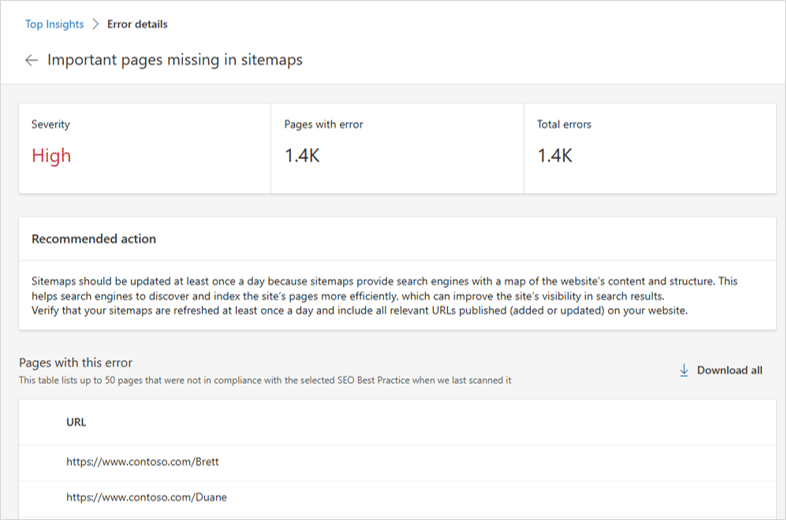
  • The “Important URLs Missing” tab shows you which newly discovered links are getting clicked but were not recently visible in IndexNow.
  • Detailed information on individual errors, including content quality, robots disallowed, not crawled, indexed, and deadlinks.
  • Drill down for further details on non-indexed URLs, sample URLs, submission times, and mitigation steps to getting URLs indexed. 
  • You can also export indexing trends for further analysis or reporting.

Top SEO Insights report

A new list of issues and insights now appear at the top of the Bing Webmaster Tools screen named Top Insights. This shows you a curated and prioritized list of the top SEO issues that Bing found for your website.

“Top Insights introduces a suite of personalized and prioritized recommendations enabling webmasters to identify and focus on the most impactful tasks for website optimization,” Microsoft wrote. Top Insights will show you content quality issues, how to improve indexing coverage, help you track progress and impact, or optimizing structured data and backlinks.

Here is a sample from my site:

Bing

Here is a screenshot of a drill down report with more details:

Bing Webmaster Tools

New Bing Webmaster Tools navigation

Microsoft also updated its Bing Webmaster Tools navigation, which removed the SEO section and just lists out those items in the main section. Plus there were some other minor navigation tweaks, like if you don’t use Bing URL submission, that won’t show in the navigation.

Here is the new navigation bar:

Cloud Computing Services

Why we care

If you have not yet adopted IndexNow, you probably should investigate what it would take to make it work for your website. If you are using Cloudflare, then all you need to do is toggle on a switch, plus many CMS platforms support IndexNow out of the box.

Plus, make sure to check out the new tools within Bing Webmaster Tools.

What is IndexNow. IndexNow provides a method for websites owners to instantly inform search engines about latest content changes on their website. IndexNow is a simple ping protocol so that search engines know that a URL and its content has been added, updated, or deleted, allowing search engines to quickly reflect this change in their search results. The co-sharing of IndexNow went fully live last month in January 2022.

How it works. The protocol is very simple — all you need to do is create a key on your server, and then post a URL to the search engine to notify IndexNow-participating search engines of the change. The steps include:

  1. Generate a key supported by the protocol using the online key generation tool.
  2. Host the key in text file named with the value of the key at the root of your web site.
  3. Start submitting URLs when your URLs are added, updated, or deleted. You can submit one URL or a set of URLs per API call.

Submit one URL is easy as sending a simple HTTP request containing the URL changed and your key.
https://www.bing.com/IndexNow?url=url-changed&key=your-key and the same would work by using https://yandex.com/indexnow?url=url-changed&key=your-key

You can see more details instructions at the Microsoft Bing IndexNow site or the IndexNow protocol web site.

Original source: https://searchengineland.com/bing-webmaster-tools-gains-new-indexnow-insights-top-seo-insights-report-438100

Google must face some advertisers’ antitrust claims, says U.S. judge

Google must face a proposed class action lawsuit from advertisers claiming that it monopolizes the ad exchange market, a U.S. judge has ruled.

However, some antitrust claims made by advertisers, particularly those centred on ad-buying tools, have been dismissed.

The allegations. The advertisers claim that Google monopolizes the ad exchange market, leading to higher ad prices for advertisers and limiting their access to more budget-friendly alternatives.

Ruling. The decision to strike out some claims while allowing others to proceed was made by U.S. District Judge Kevin Castel. Explaining his reasoning, he said:

  • “The advertisers have not plausibly alleged antitrust standing in the markets for ad-buying tools used by large advertisers, but they plausibly allege antitrust standing as to injuries they purportedly suffered from anti-competitive practices in the ad-exchange market and the market for small advertisers’ buying tools.”

Next steps for Gannett. Judge Castel stated that Gannett, the largest U.S. newspaper chain and publisher of USA Today, has the option to pursue a separate case to establish that Google fraudulently concealed the anticompetitive effects of certain technology.

What has Gannett said? Gannett’s CEO Mike Reed released a statement explaining the impact Google’s alleged illegal practices have allegedly been having on news publishers:

  • “News publishers depend on digital ad revenue to provide timely, cutting-edge reporting and essential content communities rely on, yet Google’s practices have had negative implications that depress not only revenue, but also force the reduction and footprint of local news. Without free and fair competition for digital ad space, publishers cannot invest in their newsrooms.”

What has Google said? Dan Taylor, vice president of Google Ads, has denied the allegations.

  • “These claims are simply wrong. Publishers have many options to choose from when it comes to using advertising technology to monetize – in fact, Gannett uses dozens of competing ad services, including Google Ad Manager. And when publishers choose to use Google tools, they keep the vast majority of revenue. We’ll show the court how our advertising products benefit publishers and help them fund their content online”

Why we care: This is the latest in a string of lawsuits in which Google has been accused of violating antitrust laws. The outcome of these cases could force the search engine to implement big changes such as the divestment of its ad business, which could potentially lead to increased transparency, more campaign control for advertisers and better innovation – which could also possibly mean the creation of new ad tools.

Get the daily newsletter search marketers rely on.


Deeper dive: You can read Gannett’s full statement here.

Original source: https://searchengineland.com/google-face-advertisers-antitrust-claims-438136

Home Care 101: A Schedule for Home Care Check-Ups 

Home Business Magazine Online

By Melanie Powers, President — Goodberlet Home Services

The home care landscape continues to evolve as people invest more time, money, and emotional energy into their personal sanctuaries. Our homes provide comfort, security, and refuge from the outside world. Consequently, home maintenance has become increasingly important yet complicated. Juggling appliance servicing, HVAC inspections, and more can quickly become anxiety-inducing, but with a clear schedule for home care check-ups, you can transform home maintenance from a source of stress into an act of self-care.  

Approaching home care check-ups systematically allows you to tackle maintenance needs proactively rather than reactively and prevent minor issues from spiraling into costly headaches down the road. Just as you would schedule regular doctor’s appointments to monitor your health, it’s wise to calendar consistent inspections to monitor your home’s “health.” 

Preventative care enables you to stay ahead of problems, keeping your systems and structure in their best condition. The key is consistency and comprehensiveness. Setting up a calendar that includes monthly, quarterly, bi-annual, and yearly check-ups helps ensure that everything runs smoothly rather than scrambling to book specific contractors only after disaster strikes. More importantly, finding a company that does most of the home care services and knows your home well will save you any further headaches. 

Monthly Schedule for Home Care Check-ups Tasks

A quick monthly walkthrough catches small issues before they become costly headaches. Mark your calendar to replace furnace filters each month, inspecting vents for dust buildup simultaneously. 

Clogged air filters reduce airflow, overworking your HVAC system. Set a monthly leak check, surveying under appliances and sinks for moisture indicating a potential leak. 

Finally, test all safety devices on the first Monday of the month, including smoke detectors, carbon monoxide monitors, and fire extinguishers. Press detector buttons to ensure alert sound functionality and shake extinguishers gently to mix up chemical agents.

Quarterly Home Care Tasks  

Though a quick, consistent monthly schedule for home care check-ups provides invaluable prevention and preparedness, you should still schedule service professionals to perform comprehensive system inspections each quarter. Clear out any lingering autumn leaves and other debris to maintain gutter functionality before winter snow and ice arrive. While easy to overlook, gutters control appropriate drainage, keeping basements, foundations, and landscapes intact, so commit these more intensive assessments to your calendar every three months.

Bi-annual Home Care Tasks

Twice each year, devote time to deep cleanings targeting oft-neglected areas like walls, windows, and appliance exteriors. Catalog cabinets and storage spaces that become disorganized repository dumping grounds, and hire appliance technicians to tune up refrigerators, dishwashers, washers, and dryers, optimizing energy efficiency and longevity. 

HVAC technicians can spot minor inefficiencies that cause energy waste and deterioration over time when they check your system twice a year — once in the Spring for A/C performance and again in the Fall for heating. They also help prevent plumbing disasters through bi-annual drain cleaning and dislodging accumulating grime that breeds blockages. 

Moreover, part of your schedule for home care check-ups is ensuring your home envelope is draft-free by caulking and sealing leaks around doors and windows. Schedule intensive biannual cleanings during spring and fall when you tackle other preparations like servicing HVAC equipment.

Annual Home Care Tasks

Critical protective systems and surfaces require annual inspection from roof to foundation. Schedule professional roof examinations during dry seasons to pinpoint flashing failures, damaged shingles, and vegetation infringements. 

Budget for repairs like exterior paint touchups, which enhance aesthetic appeal while protecting siding from moisture damage, and book seasonal HVAC servicing before both heating and cooling seasons to ensure your operating system is smooth and ready to maintain comfortable indoor temperatures. Even if done just once yearly, these maintenance measures provide invaluable protection.

Special Considerations for Different Seasons

Tailor maintenance to seasonal shifts to safeguard your home’s integrity. Winter prompts insulating pipe wrap installation, preventing ruptures during hard freezes, so arrange heating system cleaning pre-winter to eliminate dust accumulation that strains furnace components. 

Additionally, plan exterior repairs in Spring after heavy winter weather exposure. Summer demands peak AC performance, so schedule tune-ups to optimize efficiency. Autumn again shifts focus indoors, so test insulation levels and service heating equipment before the bitter cold arrives. Each season brings specialized demands, but consistent diligence preserves your home’s health over the long term.

As seasons change and years pass, the maintenance needs of our homes evolve. What remains constant, however, is the shelter, security, and sanctuary our homes provide against outside stresses. By dedicating focus to preventative home care check-ups, we shift our mindset away from waiting for things to break before fixing them, and with consistent walkthroughs guided by comprehensive checklists, we catch minor issues early and monitor for subtle changes over time.

While no inspection regimen prevents all system failures or structural damages, diligent monitoring and servicing can mitigate extensive repairs. Scheduling maintenance checks annually, seasonally, quarterly, and monthly prompts us to cover every base — from landscape to roof to foundation — allowing us to care properly for our home so it continues caring for us. 

Just as consistent doctor visits and daily hygiene preserve human health, a regular schedule for home care check-ups preserves a properly functioning refuge. By blocking out time to methodically maintain your property, your revitalized home emerges better equipped to operate optimally, all while looking beautiful, keeping you comfortable, and protecting what matters most. In this way, scheduling home care check-ups transforms maintenance into an act of self-care.

The post Home Care 101: A Schedule for Home Care Check-Ups  appeared first on Home Business Magazine.

Original source: https://homebusinessmag.com/lifestyles/home-improvement/schedule-home-care-check-ups/