Exploring the Advantages of Pursuing a Bachelor of Business in Australia

Home Business Magazine Online

Embarking on a Bachelor of Business in Australia equips students with a robust foundation in business mechanics, essential for thriving in contemporary corporate landscapes. This comprehensive program fosters an entrepreneurial mindset, crucial for navigating and innovating within dynamic markets. Globally, students are drawn to Australia’s educational clout, with its programs offering a unique blend of academic rigor and practical learning opportunities.

This educational journey not only sharpens creativity and innovation but also positions graduates for global career successes. If you’re contemplating a business degree, Australia’s unique blend of academic excellence and real-world relevance is an option that merits serious consideration.

In the future, you may even want to pursue a postgraduate course in business — a savvy move that could amplify your professional growth.

Benefits of Pursuing a Bachelor of Business in Australia

Experience Australia’s Exemplary Education Standards

Students in Australia benefit from a meticulously regulated education system that prioritises their well-being and ensures the highest standard of learning. Regulatory bodies, such as the Tertiary Education Quality and Standards Agency (TEQSA) and the Australian Skills Quality Authority (ASQA), actively oversee educational institutions.

These agencies guarantee that your experience will be nothing short of exceptional. Moreover, Australian business schools are renowned for their state-of-the-art facilities and stimulating learning atmospheres. This powerful combination not only enhances academic knowledge but also significantly elevates one’s professional trajectory.

Enhance Your English Proficiency and Communication Skills

In the realm of international business, proficiency in English is not just advantageous; it’s essential. Australia, with its immersive English-speaking environment, provides an ideal backdrop for honing your language skills to a professional level. As you navigate through a Bachelor of Business program in this vibrant setting, you’re likely to see a marked improvement in your fluency and grasp of business-related communication nuances.

Australian educational institutions are particularly attuned to the needs of international students, offering tailored English language support that empowers you to build confidence and competently engage in diverse professional scenarios. Whether presenting in a boardroom or negotiating with international clients, your refined linguistic abilities will serve as a cornerstone for success in a global marketplace.

Broadens Career Prospects and Opportunities

Securing a Bachelor of Business degree from Australia can dramatically amplify your employability, giving you an edge in a competitive job market. Recognised globally, Australian qualifications resonate with employers who value the multifaceted expertise and innovative approach that such graduates bring to the table.

Equipped with this degree, you stand poised to excel in any corporate arena – be it with a fledgling startup, an established multinational, or the adventurous path of entrepreneurship. An Australian business education doesn’t just empower you to chase your dreams—it gives you the practical tools to transform them into tangible achievements.

Concentrate on the Right Field of Study

Universities across Australia offer an extensive selection of business courses, ensuring that international students can pinpoint the exact field that aligns with their aspirations. Whether you’re inclined towards marketing, accounting, finance, or international business, you’ll find programs tailored to both your professional objectives and academic interests.

Additionally, the plethora of institutions available means that you’ll have the flexibility to choose a school that not only suits your learning style but also offers specialised resources to support your individual career path.

Immerse Yourself in Australia’s Vibrant Lifestyle and Culture

As you embark on your educational journey, Australia’s inviting cities offer more than just outstanding academics; they represent some of the most liveable cities in the world. The experience of studying for your Bachelor of Business in Australia is akin to discovering a hidden gem. Each day presents an opportunity to create memories that last a lifetime. While academia can sometimes be demanding, the satisfaction and personal growth you gain are nothing short of captivating.

Moreover, balancing work and study is a realistic option in Australia. International students can work up to 40 hours per fortnight during the academic semester, allowing them to complement their studies with practical experience and financial independence. This not only enhances your resume but infuses your academic endeavours with real-world insights.

Australia is a nation renowned for its relaxed ethos and high quality of life. It’s an environment where the pursuit of knowledge meets the pleasure of cultural exploration, making for an enriching and balanced education experience.

Gain Personal Independence and Self-Discovery

Living and studying in Australia presents a unique opportunity for personal growth and self-discovery. Far from the familiarity of home and family, you’ll find yourself immersed in a vibrant culture, tasked with navigating day-to-day life independently. While such a transition can be challenging, it also catalyses the development of key life skills that are invaluable to your professional journey.

You’ll likely notice an evolution in yourself, becoming more punctual, organised, and confident as you adapt to your new environment. These traits, forged in the crucible of personal independence, are not just markers of self-improvement, but assets that will enhance your career resilience and capability.

Foster Heightened Self-Confidence Through Rigorous Academia

An unparalleled advantage of obtaining a Bachelor of Business in Australia is the profound impact it has on both your professional portfolio and your self-assurance. The notable presence of an Australian business degree on your curriculum vitae serves as a beacon to prospective employers, signalling a candidate of exceptional calibre. More than a mere academic accolade, this degree is a testament to your tenacity and adaptability, central pillars of self-confidence.

The academic rigour paired with the dynamic life experience Australia offers can indeed be demanding; however, the resilience and social dexterity you cultivate in response are priceless. As you return home, the transformative journey imparts a sharper professional edge, inspiring confidence and embodying the quintessence of growth and wisdom.

The post Exploring the Advantages of Pursuing a Bachelor of Business in Australia appeared first on Home Business Magazine.

Original source: https://homebusinessmag.com/lifestyles/education/eadvantages-pursuing-bachelor-business-australia/

Starting a Business from Your Home: Basics to Know

Home Business Magazine Online

Embarking on the entrepreneurial journey of starting a business from the comfort of your own home is both an exciting and daunting prospect. With the flexibility of setting your own hours and the reduction in overhead costs, it’s no wonder many are drawn to this appealing setup. Yet, the path to success is paved with its own unique set of challenges. This article aims to dissect the basics of starting a home-based business, ensuring you’re well-equipped to take your first steps.

Creating a Dedicated Workspace

The importance of demarcating a specific area of your home for work cannot be overstated. Not only does it enhance productivity by minimizing distractions, but it also helps in maintaining a healthy work-life balance. Consider the ergonomics of your workplace; comfort and functionality should go hand in hand to foster an environment conducive to creativity and efficiency.

Networking and Collaboration

Creating a strong network of contacts and collaborators can significantly boost your home-based business. Leveraging professional networking sites, attending industry-relevant webinars and virtual meetups, and joining local business associations are smart ways to expand your network. Collaborating with other businesses can also open up new avenues for growth and innovation.

Whether you’re moving to accommodate a growing business or simply looking for a change in scenery, making smart decisions about your home’s sale can be crucial. For those based in Fort Worth, reaching out to Fort Worth TX home buyers can provide insight into alternative and simplified selling processes, offering a different perspective on real estate transactions in the area.

Understanding Legalities

Before you dive into the creative storm of your business idea, it’s crucial to navigate the legal landscape. This entails registering your business, understanding any zoning laws that apply to home-based businesses in your area, and obtaining necessary licenses or permits. Ensuring compliance from the start can save you from headaches down the road.

Developing a Business Plan

Every successful venture of starting a business from your home begins with a solid plan. This document will act as your roadmap, outlining your business idea, target market, competition, marketing strategies, financial projections, and more. It’s not just a requirement for seeking investment but a crucial tool for clarity and direction.

Finding Your Niche

Identifying a niche can make or break your home-based business. It’s about finding a balance between what you love, what you’re good at, and what the market needs. Conduct thorough market research to pinpoint a niche that’s both viable and underserved. This strategy enhances your chances of success by reducing competition and increasing market demand for your unique offerings.

Building an Online Presence

In today’s digital age, an online presence is indispensable for any business. Start by creating a professional website and engaging actively on social media platforms relevant to your target audience. This not only builds credibility but also allows you to market your business efficiently and cost-effectively.

Staying Motivated and Productive

When the novelty wears off, maintaining motivation and productivity can become a challenge in the home environment. Setting regular work hours, taking scheduled breaks, and dressing for work can create a more professional atmosphere and help in cultivating discipline. Joining online communities or networks related to your business can also provide support and inspiration.

Managing Finances

Effective financial management is the backbone of any business. For home-based businesses, it’s important to keep personal and business finances separate. Utilize budgeting tools and software to track your expenses and income. Additionally, understanding the basics of taxation for home-based businesses can ensure you’re not caught off guard when tax season comes around.

Adapting to Market Changes

Market trends and consumer needs are always evolving, making adaptability a key attribute for business success. Stay informed about your industry and be ready to pivot your business model or product offering to meet changing market demands. This agility can be a major competitive advantage, particularly for home-based businesses that often have more flexibility to implement swift changes than their larger counterparts.

Maintaining Work-Life Balance

One of the biggest challenges of starting a business from home is the potential for work to encroach upon your personal life. It’s crucial to set clear boundaries between work time and personal time. Make a conscious effort to unplug from your business activities during designated downtime. This discipline not only prevents burnout but also ensures that both your business and personal life can thrive.

Conclusion

Starting a business from home is an adventure that requires careful planning, dedication, and resilience. While the journey may come with its set of challenges, the rewards of building something from scratch and watching it grow are incomparable. By paying close attention to the basics outlined in this guide, you’ll be well on your way to laying the foundation of a successful home-based business. Remember, every big achievement begins with the decision to try. So, take the plunge and embark on your entrepreneurial journey today.

The post Starting a Business from Your Home: Basics to Know appeared first on Home Business Magazine.

Original source: https://homebusinessmag.com/business-start-up/how-to-guides/starting-business-from-home-basics/

Reminder – Google is enforcing stricter rules for consumer finance ad targeting

Google will start enforcing tougher restrictions on personalized ads related to consumer financial products and services from tomorrow, February 28.

Any breaches of the updated policy will prompt a warning, with the possibility of account suspension.

It’s worth noting that the full enforcement of these measures may take approximately six weeks to be fully implemented.

Why we care. Make sure your personalized ads comply with Google’s updated policy now, as this is your final opportunity before the new restrictions kick in. If your account gets suspended for policy violations, it can seriously impact campaign performance, and lifting suspensions can be difficult. Act now to avoid disruptions.

What’s changing? Google’s “credit in personalized ads” policy will be broadened to include “consumer finance in personalized ads.” The updated policy will say:

  • “In the United States and Canada, the following sensitive interest categories cannot be targeted to audiences based on gender, age, parental status, marital status, or ZIP code.”

The update will apply to offers relating to credit or products or services related to credit lending, banking products and services, or certain financial planning and management services. Examples include:

  • Credit cards
  • Home loans
  • Car loans
  • Appliance loans
  • Short-term loans
  • Banking and checking accounts
  • Debt management products

What Google is saying. A Google spokesperson told Search Engine Land:

  • “We’ve long had personalized ads policies that prohibit advertisers from targeting people on the basis of sensitive categories. This update strengthens our ongoing efforts to protect consumers, expanding our credit in personalized ads policy to additional consumer finance ad categories in the US and Canada.”

Get the daily newsletter search marketers rely on.


Deep dive. Read Google’s full blog post for more information.

Original source: https://searchengineland.com/google-enforcing-stricter-rules-consumer-finance-ad-targeting-437939

Google unveils major Search Partner Network update as it removes opt-out option

Google is giving advertisers more control over ad placement within the Search Partner Network.

From March 4, advertisers using Performance Max will have access to impression-level placement reporting of Search Partner Network sites.

Additionally, if you exclude certain ad placements at the account level, it will now apply to the Search Partner Network, as well as YouTube and display ads, according to Ad Age.

Why now? These substantial changes come after an Adalytics report accused Google of quietly placing search ads on inappropriate non-Google websites through the Search Partner Network – including sites containing pornographic, sanctioned and pirated content. Google denied the claims, saying Adalytics has a track record of publishing inaccurate reports that misrepresent Google’s products.

Changes. Before the Adalytics report was published in November, all Pmax campaigns were automatically opted into the Search Partner Network and could not opt out. For other campaigns, being opted into search partners was the default setting, but advertisers had the option to opt out.

Following the Adalytics report, Google temporarily permitted Pmax users to opt out of search partner inventory until March 1. As this option is set to be removed, Google is now providing advertisers with unprecedented insights and control over ad placement within the Search Partner Network.

Why we care. Advertisers will gain better control and insights into the placement of their ads within the Search Partner Network. This enables them to address concerns about their ads being placed near inappropriate content, safeguarding their brand reputation.

What is the Search Partner Network? The Search Partner Network consists of websites and apps that collaborate with Google to display search ads. This network extends beyond traditional search platforms and includes major Google properties such as YouTube and Google Discover. Additionally, it encompasses numerous other websites that may not be directly associated with typical search activities.

Why are campaigns added to the SPN? Google opts campaigns are opted into the Search Partner Network because the search engine claims it sees “a measurable improvement” in clicks and conversion when advertisers extend their reach to these sites.” Opting into the SPN can enable advertiser to reach customers on sites like YouTube.

What is Adalytics? Adalytics is a crowd-sourced advertising performance optimization platform that was set up to review and improve the digital advertising landscape. 


Get the daily newsletter search marketers rely on.


Deep dive. You can learn more about Adalytics’ investigation by reading its report ‘Does a lack of transparency create brand safety concerns for search advertisers?

Original source: https://searchengineland.com/google-search-partner-network-update-control-437948

How SMBs are approaching digital marketing in 2024

A new report released this month by Intero Digital (disclosure: I previously worked with Intero), “Revolutionizing Reach: The 2024 Digital Marketing Landscape You Can’t Ignore,” checks the yearly pulse for the digital spending and marketing activities of its SMB client list. 

The report covers a wide digital landscape and includes the results of their client survey, as well as insights and strategies for addressing the pain points and goals marketers face this year. Some of the key coverage areas include:

  • Digital marketing spending trends.
  • Top digital marketing goals for 2024.
  • Content marketing trends.
  • Emerging trends and data in Amazon marketing.
  • Emerging trends in paid advertising.
  • Transformation in the SEO space.
  • Influencer marketing.
  • Video marketing tactics and strategy.

Let’s look at a few highlights and key insights from the report.

Key digital marketing priorities for SMBs in 2024

The first finding should not surprise those actively engaged in digital marketing across various industries, verticals, niches and three-letter acronyms like “B2C” and “B2B”. The most important thing on digital marketer’s minds in 2024 is revenue growth, prioritized as the top goal by 79% of respondents. 

While “growth” is something of a given for most marketers, it is still worth stating, if only to get it out of the way and focus on the digital marketing strategies and activities that actually drive it. But for the digital marketers in this survey, what really matters is the final result – the bottom line.

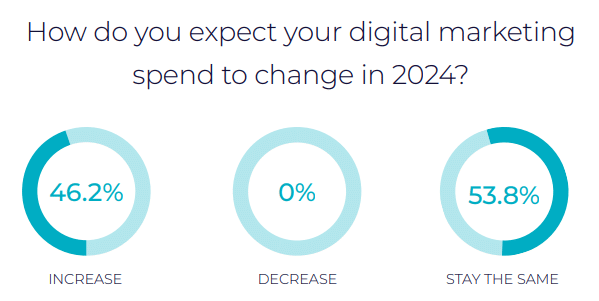
Marketers aren’t backing down this year in their quest for growth, with 46.2% planning to increase spending, zero percent decreasing and 53.8% planning to stay the same.

Digital marketing spend in 2024 - survey question

The biggest digital marketing pain points for 2024

The path to revenue growth and lead generation is filled with obstacles, and the survey respondents also outlined many of their common and shared challenges.

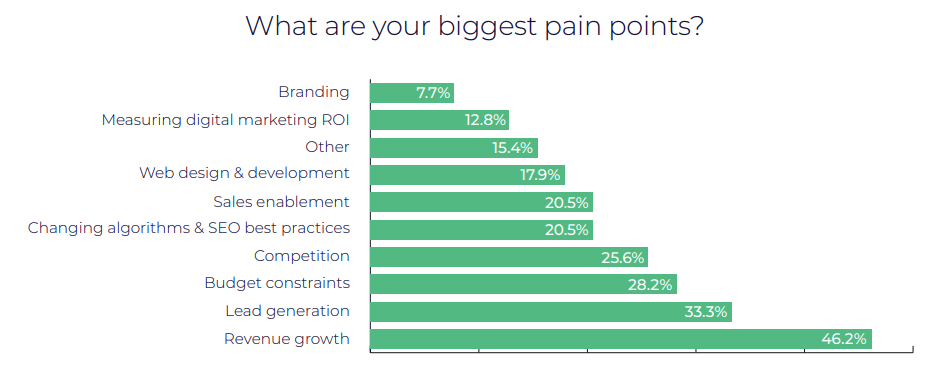
Biggest pain points in 2024 - survey question

Aside from revenue, the top pain points were lead generation, budget constraints, competition and changing algorithms and SEO best practices. While these points are cited individually, they are oftentimes interconnected. 

Competition is fierce everywhere marketers are chasing the bottom line across many different digital channels, and it doesn’t appear things will settle down any time soon. 

When competition is fierce, more investment is often needed to be competitive, be it paid or earned media. This leads to the pain point of effectively measuring digital marketing ROI.

Budget constraints often stem from ineffective measurement and tracking systems. Ultimately, what’s crucial is a comprehensive and well-executed digital marketing strategy and tactical plan, whether focusing on a single channel or across multiple channels.

Up to 7.7% of respondents had branding as a pain point. Building a brand across crowded and competitive digital spaces can be challenging this year, as it takes a lot of work, budget and time. Combined with multiple other pain points, marketers have a lot of work ahead of them this year.

The top digital marketing goals for 2024

Biggest goals in 2024 - survey question

In the “Biggest Goals” section of the survey, “Revenue growth” topped the list at 79.5%, then dropped a bit for each of the supporting goals. In second place were “More web traffic” and “Higher positioning in the SERPs” (each at 38.5%). 

Interestingly, while lead generation was the number two biggest pain point (33.3%), it came in fifth place for the biggest goal (30.8%). Are the lead generators giving up? Nope. With the close percentages, it appears they’re consistent with their priorities.

It is also interesting to see brand awareness and thought leadership prominently in this goal list (33.3%), especially when it is often difficult to attribute to revenue and it was not as much of a pain point. 

The biggest barrier to entry for thought leadership is actually having the best ideas and insight. For those who do, this can be one of the easiest goals to accomplish in 2024.

Again, when done well, it can complement and drive goals of more traffic, higher positioning, more growth, more qualified leads and so on.

Content marketing insights

Another interesting part of this study was a review of over 100,00 pieces of content. In their analysis, Intero found that the “most-shared” content had an average word count of 552, down considerably from the previous year’s analysis of 792 words. 

The implication is that messaging was more important than being wordy, at least in the social context. For marketers competing in the SEO space with higher word counts, a balance should be struck in the content strategy to emphasize both channels through content.

Marketing publishers are also looking to diversify their content in 2024 beyond the written word. Some top asset types utilized by digital marketers this year include video (41% of marketers utilizing), podcasts (41%) and the top diversified activity, newsletters (47%).

Top asset types for SMBs in 2024

About the report

This article touches on only a few points from the report, providing strategic insights on digital marketing tactics and approaches for the year.

Will next year’s survey bring significant changes, or will things remain unchanged? It’s uncertain, but one thing is clear: the digital landscape is evolving rapidly, offering opportunities for early adopters to thrive in various channels despite competition.

All images in this report were provided by Intero Digital. You can download the full report here

Original source: https://searchengineland.com/smbs-digital-marketing-2024-437884

Google: Apple rejected Microsoft Bing deal over quality and advertising worries

Microsoft reportedly tried to sell Bing to Apple in 2018 – but failed.

The sale was unsuccessful because Apple had concerns about Bing’s search quality, advertising unit and monetization capabilities, according to a document in Google’s antitrust case against the U.S. Justice Department.

Google argues that the failed sale highlights that Bing lost out because it is an inferior search engine, not because Google has made the search market unfair for its competitors, per CNN.

Apple turns down Microsoft. Microsoft allegedly proposed either selling Bing to Apple or creating a Bing-joint venture together. Eddy Cue, Apple’s senior vice president of services, explained why Apple said no to Microsoft in the filing:

  • “Microsoft search quality, their investment in search, everything was not significant at all. And so everything was lower. So the search quality itself wasn’t as good.”
  • “They weren’t investing at any level comparable to Google or to what Microsoft could invest in. And their advertising organization and how they monetize was not very good either.”

What Google is saying. Google claims that Microsoft’s failed attempt to sell Bing to Apple demonstrates that Bing is an inferior search engine. Google wrote in the filing:

  • “In each instance, Apple took a hard look at the relative quality of Bing versus Google and concluded that Google was the superior default choice for its Safari users. That is competition.”

Google also argues that Microsoft approached Apple multiple times – in 2009, 2013, 2015, 2016, 2018, and 2020 – proposing to make Bing the default search engine in Apple’s Safari web browser. However, Apple consistently rejected the idea, citing concerns about the quality of Bing’s performance.

What Microsoft is saying. Microsoft denies its attempts to sell Bing to Apple were due to quality issues – on the contrary, the tech giant claims the sale was blocked by Google. Microsoft’s CEO of Advertising and Web Services, Mikhail Parakhin, said he offered Apple more than 100% of the revenue or gross profit to make Bing its default search engine – but the proposal was rejected because of the Apple’s deal with Google.

Speaking at the federal antitrust trial, Parakhin alleged this was despite Microsoft offering to pay Apple more than Google – which he claims was offering in the region of 60%. He said:

  • “We were just big enough to play but probably not big enough to win, if that makes sense.”

What the DOJ is saying. Google has a financial agreement in place with Apple to be the default search engine on its products at a cost of around $10 billion a year. In addition, Google pays Apple advertising revenue – which is one of the search engine’s biggest costs. The Justice Department asserted in its filing that Apple boss Cue testified:

  • “If Apple did not receive the massive payments it sought from Google, Apple would have developed its own search engine,” the Justice Department asserted in its filing.”

Google could pay Apple as much as $19 billion this fiscal year, according to an estimate from Bernstein analyst Toni Sacconaghi. The DOJ claims these substantial sums of money are why Apple turned down a potential joint venture with Microsoft – not because Bing is inferior to Google.

Why we care. The U.S. Justice Department is suing Google, claiming it uses unfair tactics to maintain its position as the top search engine globally. If Google can demonstrate its search engine’s superiority, it might succeed in the case. However, if it loses, Google could lose its automatic default search engine status on common Apple products, posing a potential threat to its dominance in the search market.

Market share statistics. The U.S. Justice Department claims Google owns a 90% market share in search. On the other hand, Bing has 3% of the global market share, according to StatCounter.


Get the daily newsletter search marketers rely on.


Deep dive. Read our Google antitrust trial updates for everything you need to know.

Original source: https://searchengineland.com/google-micorosft-bing-sale-rejected-apple-quality-437914

Eco-Friendly Plumbing Solutions for Orange County Residents

Home Business Magazine Online

Orange County residents are increasingly seeking eco-friendly plumbing solutions to contribute to environmental conservation while also reducing their household water and energy bills. Modern plumbing techniques and technologies offer a range of options for homeowners who want to make their homes more sustainable. These solutions include low-flow fixtures, such as toilets and showerheads, tankless water heaters, and greywater recycling systems. Each of these options helps in minimizing water usage and preserving the precious water resources in Southern California.

Implementing eco-friendly plumbing practices is not just beneficial for the environment; it also aligns with Orange County’s progressive outlook on ecological responsibility. Local regulations and incentives often encourage the adoption of green plumbing, making it an attractive choice for residents. Moreover, the long-term cost savings and improved efficiency can be a significant advantage for homeowners. By incorporating these solutions, Orange County residents can enjoy the dual benefits of helping the planet and optimizing their home’s plumbing systems.

To ensure effective and safe installation, it is imperative for homeowners to work with licensed plumbers who specialize in eco-friendly plumbing solutions. Proper installation and maintenance are crucial to realizing the full benefits of these systems. With a growing emphasis on sustainability, Orange County’s plumbing industry continues to evolve, providing residents with innovative and environmentally sound options to meet their plumbing needs.

Innovative Eco-Friendly Plumbing Technologies

As Orange County residents look to conserve water and reduce utility bills, innovative eco-friendly plumbing technologies offer practical solutions. These advancements aim to minimize water wastage and promote sustainability.

Water-Saving Fixtures and Appliances

Companies like Socal Plumbing & Rooter advocate for the installation of water-saving fixtures and appliances to significantly cut down on water consumption. Low-flow toilets, which use less than 1.6 gallons per flush, can save thousands of gallons of water annually. Similarly, water-efficient showerheads and faucet aerators are designed to reduce flow without compromising performance.

  • Low-flow toilets
    • Usage: < 1.6 gallons per flush
    • Savings: Up to 20,000 gallons per year for a family of four
  • Showerheads
    • Flow rate: Often below 2.0 gallons per minute
    • Feature: Aerating or non-aerating spray patterns
  • Faucet aerators
    • Reduction: Decrease flow by adding air

Faucet aerators not only conserve water but also reduce the energy costs associated with heating water.

Tankless Water Heaters

Tankless water heaters, also known as on-demand water heaters, provide hot water only as it is needed, eliminating the need to constantly heat a storage tank. This results in energy savings as well as reduced water usage since residents don’t have to run the tap while waiting for hot water to arrive from a distant heater.

  • Energy Efficiency: Up to 34% more energy-efficient than traditional water heaters for homes that use 41 gallons or less of hot water daily.

Greywater Recycling Systems

Greywater recycling systems offer an innovative way to reuse water from sinks, showers, and laundry, redirecting it for non-potable uses such as toilet flushing and irrigation. This eco-friendly plumbing solution can dramatically decrease freshwater consumption.

  • Reuse: Greywater can account for 50-80% of residential wastewater.
  • Applications: Suitable for landscape irrigation and toilet flushing.

Installations must comply with local codes and guidelines to ensure health and safety. Socal Plumbing & Rooter provides expertise in setting up greywater systems that conform to these standards.

By adopting these technologies, residents can play a pivotal role in water conservation, fostering a more sustainable future for Orange County.

The post Eco-Friendly Plumbing Solutions for Orange County Residents appeared first on Home Business Magazine.

Original source: https://homebusinessmag.com/businesses/go-green/eco-friendly-plumbing-solutions-orange-county-residents/

Deicing Dilemmas: Choosing the Right Deicer

Home Business Magazine Online

Winter’s frosty grip transforms the landscapes into breathtaking wonderlands, but beneath the shimmering snow and ice lurks a hidden danger: slippery surfaces. Every year, icy sidewalks, driveways, and roads contribute to countless slips, falls, and accidents, disrupting lives and businesses alike. While the urge to combat the ice is strong, simply ordering bulk calcium chloride might not be the wisest decision. Choosing the right deicer for your specific needs is crucial, and this guide aims to equip you with the knowledge to navigate the winter battlefield victoriously.

The Winter Wonderland Nightmare

While snow may paint a picturesque scene, hidden beneath its sparkling blanket lies a silent threat: ice. Every winter, these seemingly innocent frozen surfaces transform sidewalks, driveways, and roads into treacherous obstacle courses. The consequences of a fall on ice can be severe, ranging from minor bumps and bruises to serious injuries like broken bones and head trauma. Statistics reveal a grim reality: falls on ice account for countless injuries and even fatalities each year, impacting individuals, families, and communities alike.

While resorting to any available road dust control products for sale might be tempting for certain situations like unpaved parking lots, understanding the specific threats posed by ice and the limitations of alternative solutions is crucial for making informed decisions about winter safety. Fortunately, a wide range of deicers exists, each with its strengths and weaknesses, to help us combat this seasonal adversary.

Deicer Diversity: Unveiling the Options

Stepping into the realm of deicers can feel overwhelming, much like facing a blizzard head-on. But fear not, for beneath the seemingly complex facade lies a collection of readily available warriors ready to fight the icy foe. Here are the main protagonists in the deicing drama of the right deicer:

  • Rock Salt (Sodium Chloride): The classic hero, known for its affordability and wide availability. It works effectively at moderate temperatures (above 20°F), melting ice through an endothermic process (absorbing heat from the surroundings). However, its effectiveness wanes at colder temperatures and it can be harsh on concrete and vegetation.
  • Calcium Chloride: The exothermic champion, generating its own heat to melt ice even at temperatures as low as -25°F. This powerhouse comes at a higher cost than rock salt, and its potent nature requires caution regarding potential damage to plants and concrete. If you need to conquer extreme cold, calcium chloride is your knight in shining armor, but consider its “bulk calcium chloride” option for larger areas to keep costs in check.
  • Magnesium Chloride: The environmentally conscious contender, boasts a gentler touch on vegetation and concrete compared to its chloride counterparts. It works effectively down to 5°F but loses its melting power at colder temperatures. While not as fast-acting as calcium chloride, it might be the eco-friendly hero for milder climates.
  • Acetate-Based Deicers: The gentle giants, known for their minimal impact on concrete, plants, and even pets. They work best at slightly warmer temperatures (above 15°F) and rely on an endothermic process for melting. While more expensive than rock salt, their slower melting rate and environmental friendliness make them ideal for sensitive areas.

Choosing the right deicer depends on a unique battleground. Stay tuned as we explore the factors that will guide you to your deicing champion!

Choosing Your Champion: Factors to Consider

Now that you’ve met the deicing contenders, it’s time to strategize. Before selecting your champion, consider these key factors:

  • Temperature: The battlefield’s temperature dictates which warriors will thrive. Remember, rock salt reigns at moderate temperatures, calcium chloride conquers the coldest depths, magnesium chloride battles mid-range chills, and acetate-based deicers excel in slightly warmer zones. Consult road salt companies or deicer manufacturers for specific temperature ranges to ensure you choose the right weapon for the job.
  • Surface Type: Not all heroes fight on the same terrain. While rock salt and calcium chloride work well on concrete and asphalt, their harshness might damage delicate surfaces like wood or pavers. Magnesium chloride offers a gentler touch, and acetate-based deicers are often the safest choice for sensitive surfaces. Choose your deicer based on the specific battlefield you need to conquer.
  • Environmental Concerns: Consider the impact your deicing battle will have on the surrounding environment. While rock salt’s affordability is tempting, its runoff can harm vegetation and water quality. Calcium chloride demands caution due to its similar impact. Magnesium chloride offers a more eco-friendly approach, with acetate-based deicers being the gentlest on the environment. Remember, a responsible victory considers the well-being of all participants, not just humans.
  • Budget: Every hero has a price tag. Rock salt remains the most cost-effective option, followed by magnesium chloride. Calcium chloride comes at a premium, especially when considering its higher application rates. Acetate-based deicers are often the most expensive but might be worth the investment for sensitive areas or environmentally conscious battles.

Beyond the Basics: Advanced Deicing Strategies

While choosing the right deicer is crucial, seasoned warriors know that mastering the art of winter deicing goes beyond simply throwing down some granules. Here are some advanced strategies to enhance your deicing prowess:

  • Pre-wetting: This technique involves mixing your deicer with a brine solution before application. The brine lowers the freezing point of the deicer, allowing it to work effectively at even colder temperatures. Additionally, the pre-wetting solution helps the deicer adhere better to surfaces, increasing its efficiency and reducing waste.
  • Blending Deicers: Combining different deicers can leverage their individual strengths. For example, mixing rock salt with calcium chloride can extend the effective temperature range while reducing the harshness of calcium chloride alone. Consult deicer manufacturers or “road salt companies” for recommended blends based on your specific needs.
  • Heated Mats: For high-traffic areas like walkways or entrances, heated mats offer a permanent solution. These mats are embedded under the surface and generate heat to melt ice and snow automatically. While more expensive upfront, they can be cost-effective in the long run for heavily used areas.
  • Robotic Snow Removal: Cutting-edge technology is changing the game with robotic snow removal solutions. These autonomous machines can clear snow and apply deicers, enhancing efficiency and safety, especially in large areas like parking lots or commercial properties.
  • Dowflake Xtra: As an example of an innovative deicer, consider Dowflake Xtra. This calcium chloride blend boasts improved melting power and lower application rates compared to traditional calcium chloride, offering a potentially cost-effective solution for colder climates.

Remember, effective deicing is not just about choosing the right weapon, but also mastering the art of strategy and utilizing diverse tactics. By incorporating these advanced techniques, you can transform yourself from a winter warrior into a deicing champion, ensuring safe and clean surfaces throughout the coldest months.

Conclusion

Conquering winter’s icy grip requires knowledge and strategy. This guide has equipped you with the essential tools to navigate the world of deicers, understand their strengths and weaknesses, and choose the champion best suited for your battlefield. Remember, consider the temperature, surface type, environmental impact, and budget to make informed decisions. Explore advanced tactics like pre-wetting, blending, and innovative solutions to truly master the art of winter deicing. With the right approach, you can ensure safe and accessible walkways, driveways, and roads, transforming winter wonderlands into safe and welcoming spaces for everyone.

The post Deicing Dilemmas: Choosing the Right Deicer appeared first on Home Business Magazine.

Original source: https://homebusinessmag.com/businesses/success-tips/deicing-dilemmas-choosing-right-deicer/

How to speed up site migrations with AI-powered redirect mapping

Migrating a large website is always daunting. Big traffic is at stake among many moving parts, technical challenges and stakeholder management.

Historically, one of the most onerous tasks in a migration plan has been redirect mapping. The painstaking process of matching URLs on your current site to the equivalent version on the new website.

Fortunately, this task that previously could involve teams of people combing through thousands of URLs can be drastically sped up with modern AI models.

Should you use AI for redirect mapping?

The term “AI” has become someone conflated with “ChatGPT” over the last year, so to be very clear from the outset, we are not talking about using generative AI/LLM-based systems to do your redirect mapping. 

While there are some tasks that tools like ChatGPT can assist you with, such as writing that tricky regex for the redirect logic, the generative element that can cause hallucinations could potentially create accuracy issues for us.

Advantages of using AI for redirect mapping

Speed

The primary advantage of using AI for redirect mapping is the sheer speed at which it can be done. An initial map of 10,000 URLs could be produced within a few minutes and human-reviewed within a few hours. Doing this process manually for a single person would usually be days of work.

Scalability

Using AI to help map redirects is a method you can use on a site with 100 URLs or over 1,000,000. Large sites also tend to be more programmatic or templated, making similarity matching more accurate with these tools.

Efficiency

For larger sites, a multi-person job can easily be handled by a single person with the correct knowledge, freeing up colleagues to assist with other parts of the migration.

Accuracy

While the automated method will get some redirects “wrong,” in my experience, the overall accuracy of redirects has been higher, as the output can specify the similarity of the match, giving manual reviewers a guide on where their attention is most needed

Disadvantages of using AI for redirect mapping

Over-reliance

Using automation tools can make people complacent and over-reliant on the output. With such an important task, a human review is always required.

Training

The script is pre-written and the process is straightforward. However, it will be new to many people and environments such as Google Colab can be intimidating.

Output variance 

While the output is deterministic, the models will perform better on certain sites than others. Sometimes, the output can contain “silly” errors, which are obvious for a human to spot but harder for a machine.

A step-by-step guide for URL mapping with AI

By the end of this process, we are aiming to produce a spreadsheet that lists “from” and “to” URLs by mapping the origin URLs on our live website to the destination URLs on our staging (new) website.

For this example, to keep things simple, we will just be mapping our HTML pages, not additional assets such as CSS or images, although this is also possible.

Tools we’ll be using

  • Screaming Frog Website Crawler: A powerful and flexible website crawler, Screaming Frog is how we collect the URLs and associated metadata we need for the matching.
  • Google Colab: A free cloud service that uses a Jupyter notebook environment, allowing you to run a range of languages directly from your browser without having to install anything locally. Google Colab is how we are going to run our Python scripts to perform the URL matching.
  • Automated Redirect Matchmaker for Site Migrations: The Python script by Daniel Emery that we’ll be running in Colab.

Step 1: Crawl your live website with Screaming Frog

You’ll need to perform a standard crawl on your website. Depending on how your website is built, this may or may not require a JavaScript crawl. The goal is to produce a list of as many accessible pages on your site as possible.

Crawl your live website with Screaming Frog

Step 2: Export HTML pages with 200 Status Code

Once the crawl has been completed, we want to export all of the found HTML URLs with a 200 Status Code.

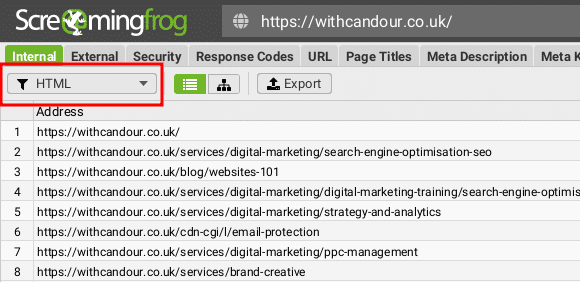
Firstly, in the top left-hand corner, we need to select “HTML” from the drop-down menu.

Screaming Frog - Highlighted- HTML filter

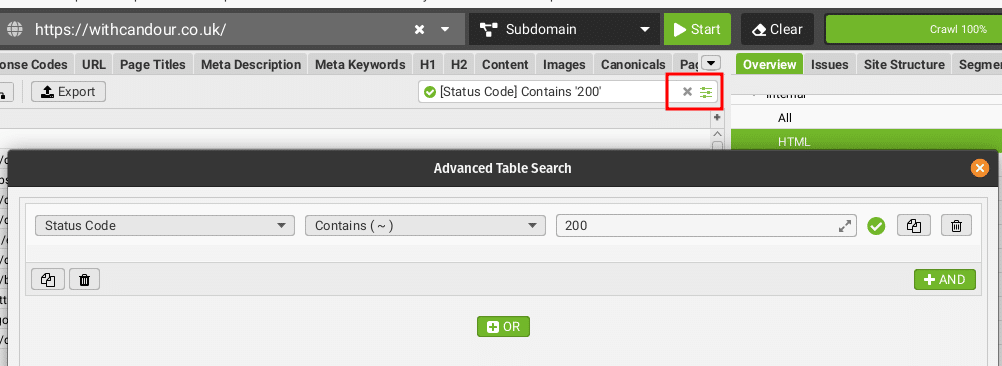
Next, click the sliders filter icon in the top right and create a filter for Status Codes containing 200.

Highlighted: Custom filter options

Finally, click on Export to save this data as a CSV.

Highlighted: Export button

This will provide you with a list of our current live URLs and all of the default metadata Screaming Frog collects about them, such as Titles and Header Tags. Save this file as origin.csv.

Important note: Your full migration plan needs to account for things such as existing 301 redirects and URLs that may get traffic on your site that are not accessible from an initial crawl. This guide is intended only to demonstrate part of this URL mapping process, it is not an exhaustive guide.

Step 3: Repeat steps 1 and 2 for your staging website

We now need to gather the same data from our staging website, so we have something to compare to.

Depending on how your staging site is secured, you may need to use features such as Screaming Frog’s forms authentication if password protected.

Once the crawl has completed, you should export the data and save this file as destination.csv.

Optional: Find and replace your staging site domain or subdomain to match your live site

It’s likely your staging website is either on a different subdomain, TLD or even domain that won’t match our actual destination URL. For this reason, I will use a Find and Replace function on my destination.csv to change the path to match the final live site subdomain, domain or TLD.

For example:

  • My live website is https://withcandour.co.uk/ (origin.csv)
  • My staging website is https://testing.withcandour.dev/ (destination.csv)
  • The site is staying on the same domain; it’s just a redesign with different URLs, so I would open destination.csv and find any instance of https://testing.withcandour.dev and replace it with https://withcandour.co.uk.
Find and Replace in Excel

This also means when the redirect map is produced, the output is correct and only the final redirect logic needs to be written.

Step 4: Run the Google Colab Python script

When you navigate to the script in your browser, you will see it is broken up into several code blocks and hovering over each one will give you a”play” icon. This is if you wish to execute one block of code at a time.

However, the script will work perfectly just executing all of the code blocks, which you can do by going to the Runtime’menu and selecting Run all.

Google Colab Runtime

There are no prerequisites to run the script; it will create a cloud environment and on the first execution in your instance, it will take around one minute to install the required modules.

Each code block will have a small green tick next to it once it is complete, but the third code block will require your input to continue and it’s easy to miss as you’ll likely need to scroll down to see the prompt.


Get the daily newsletter search marketers rely on.


Step 5: Upload origin.csv and destination.csv

Highlighted: File upload prompt

When prompted, click Choose files and navigate to where you saved your origin.csv file. Once you have selected this file, it will upload and you will be prompted to do the same for your destination.csv.

Step 6: Select fields to use for similarity matching

What makes this script particularly powerful is the ability to use multiple sets of metadata for your comparison.

This means if you’re in a situation where you’re moving architecture where your URL Address is not comparable, you can run the similarity algorithm on other factors under your control, such as Page Titles or Headings.

Have a look at both sites and try and judge what you think are elements that remain fairly consistent between them. Generally, I would advise to start simple and add more fields if you are not getting the results you want.

In my example, we have kept a similar URL naming convention, although not identical and our page titles remain consistent as we are copying the content over.

Select the elements you to use and click the Let’s Go!

Similarity matching fields

Step 7: Watch the magic

The script’s main components are all-MiniLM-L6-v2 and FAISS, but what are they and what are they doing?

all-MiniLM-L6-v2 is a small and efficient model within the Microsoft series of MiniLM models which are designed for natural language processing tasks (NLP). MiniLM is going to convert our text data we’ve given it into numerical vectors that capture their meaning.

These vectors then enable the similarity search, performed by Facebook AI Similarity Search (FAISS), a library developed by Facebook AI Research for efficient similarity search and clustering of dense vectors. This will quickly find our most similar content pairs across the dataset.

Step 7: Download output.csv and sort by similarity_score

The output.csv should automatically download from your browser. If you open it, you should have three columns: origin_url, matched_url and similarity_score.

Output csv example

In your favorite spreadsheet software, I would recommend sorting by similarity_score

Excel Sort by similarity score

The similarity score gives you an idea of how good the match is. A similarity score of 1 suggests an exact match.

By checking my output file, I immediately saw that approximately 95% of my URLs have a similarity score of more than 0.98, so there is a good chance I’ve saved myself a lot of time.

Step 8: Human-validate your results

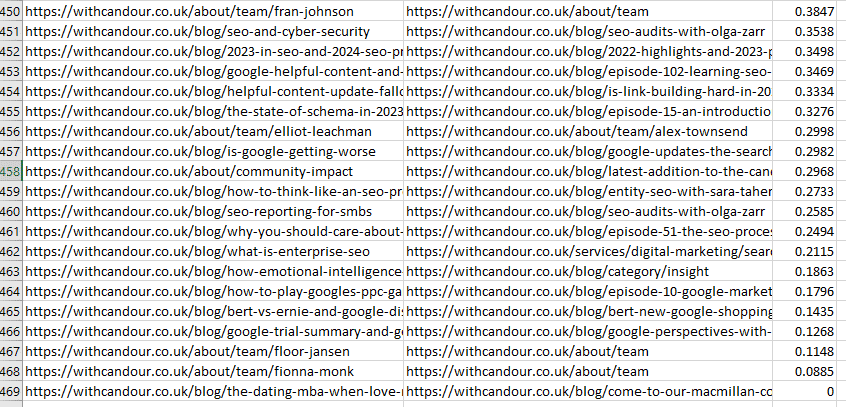
Pay special attention to the lowest similarity scores on your sheet; this is likely where no good matches can be found.

Output.csv: Lower-scored similarities

In my example, there were some poor matches on the team page, which led me to discover not all of the team profiles had yet been created on the staging site – a really helpful find.

The script has also quite helpfully given us redirect recommendations for old blog content we decided to axe and not include on the new website, but now we have a suggested redirect should we want to pass the traffic to something related – that’s ultimately your call.

Step 9: Tweak and repeat

If you didn’t get the desired results, I would double-check that the fields you use for matching are staying as consistent as possible between sites. If not, try a different field or group of fields and rerun.

More AI to come

In general, I have been slow to adopt any AI (especially generative AI) into the redirect mapping process, as the cost of mistakes can be high, and AI errors can sometimes be tricky to spot.

However, from my testing, I’ve found these specific AI models to be robust for this particular task and it has fundamentally changed how I approach site migrations. 

Human checking and oversight are still required, but the amount of time saved with the bulk of the work means you can do a more thorough and thoughtful human intervention and finish the task many hours ahead of where you would usually be.

In the not-too-distant future, I expect we’ll see more specific models that will allow us to take additional steps, including improving the speed and efficiency of the next step, the redirect logic.

Original source: https://searchengineland.com/site-migrations-ai-powered-redirect-mapping-437793