Preparation for the latter is like packing a parachute — you hope you’ll never require it, but it’s of higher quality to have one just in case. When it comes to your assets and inheritance, having a lawyer by your side in Arizona can be the secret sauce to a stress-free and well-prepared estate plan. Estate planning may sound like something reserved for the silver-haired best sipping mint juleps on an entrance hall, but it’s more relevant than you think. Whether you’re the proud owner of a cactus garden or just a couple of saguaros, Arizona law has its quirks, and a legal pro can help you navigate them.
Estate planning in Arizona doesn’t have to be a discouraging expedition through the legal wilderness. With a lawyer by your side, it becomes a road trip with a trusty navigator guiding you through the twists and turns with a dash of humor. Estate planning lawyers in Arizona may sound like a task reserved for the elite or older people, but hey, it’s never too early to be an adult, right? In the vast desert landscape of Arizona, where cacti outnumber people, having a solid estate plan can be your oasis of tranquility. Enter the superhero in a suit: your friendly neighborhood lawyer.
Understanding the Estate Planning Symphony
Let’s break this down like we’re explaining it simply and straightforwardly. Estate planning is like composing a symphony of your life’s possessions. Your house, car, pet rock collection — they’re all part of the grand score. But who’s going to conduct this masterpiece when you’re not around? That’s where your lawyer steps in. You’re the composer, and your lawyer is the conductor, making sure every instrument plays the right tune, even if your pet rock insists on being a percussionist.
The Will: Your Script for the Afterlife Drama
In Arizona, the will is your screenplay for the afterlife drama. It’s not just for the wealthy — even if your bank account is more of a trickle than a river, a will ensures your prized possessions don’t end up in a garage sale.
Shielding Your Assets from Taxes
Nobody likes the taxman, not even accountants. Lawyers can help you legally minimize the tax impact on your estate. Ensuring more of your hard-earned dollars stay in the hands of your loved ones. It’s like having a superhero whose power is tax evasion — but legal and ethical. Batman fights crime; your lawyer fights taxes and are same but different.
Jumpthe Probate Quicksand
It’s like the quicksand of the legal world — slow, messy, and nobody wants to get stuck in it. A lawyer can help you navigate this legal quicksand by ensuring your estate passes smoothly to your loved ones without the drama. Think of it as avoiding a soap composition plot twist in the legal system — your lawyer is your script doctor.
Power of Attorney: Your Legal Wingman
Life throws curveballs faster than a pitcher in a baseball championship. What if you’re suddenly incapacitated and can’t make decisions? That’s where the Power of Attorney swoops in. It’s like having a legal wingman to make decisions when you’re down for the count. If life is a rollercoaster, your lawyer is the seat belt — keeping you secure, even when things take unexpected turns.
Estate Planning in Arizona
Arizona has its unique landscape, both in terms of terrain and legal jargon. A lawyer specializing in Arizona estate planning is like a saguaro cactus — they know how to navigate the twists and turns of the law, providing shade and guidance in the scorching give-up of legal complexities.
You might think lawyers are all serious suits and stern faces, but many have a secret talent for injecting humor into their work. After all, who says legal documents can’t have a touch of wit? A lawyer with a sense of humor not only makes the process more enjoyable but also helps you understand the complexities without feeling like you’re decoding a secret language.
Living Will: Your Final Stand-Up Act
A living will isn’t your ticket to an eternal comedy show, but it does let you dictate your healthcare wishes when you can’t speak for yourself. You might not be delivering punch lines, but your lawyer ensures your final act reflects your values and choices. It’s like leaving a note for the universe, saying, “Handle with care — and a sprinkle of laughter.”
Conclusion
In the natural Wild West of estate planning, lawyers are the unsung heroes. They bring order to the chaos, ensuring your legacy isn’t a spaghetti western of legal battles. So, grab your lawyer, partner up with a lawyer, and let the estate planning adventure begin. The above discussion will help you to know how a lawyer can help you with estate planning in Arizona. Furthermore, you only need to review the above discussion in detail to understand how a lawyer can help you in this regard.
The construction industry is undergoing a significant evolution on a global scale with the integration of site capture technologies, a powerful tool that is reshaping building projects across the world. This article explores the various ways in which this technology (reality capture) is revolutionizing the cost-effectiveness of construction practices on an international level.
Reducing Project Overheads Worldwide
Site capture technologies play a pivotal role in reducing project overheads in construction projects across the globe. This reduction is achieved through the technology’s ability to streamline data collection and processing, eliminating the need for extensive manual surveys and measurements. This efficiency not only cuts down on the labor and time required for these tasks but also minimizes errors, regardless of the project’s location. Fewer errors mean less rework, which is a common cause of inflated project costs worldwide.
Additionally, the technology’s capacity to provide detailed and accurate data aids in precise material ordering and utilization, further reducing wastage and unnecessary expenses on a global scale. These aspects collectively contribute to a substantial decrease in overall project costs, making site capture technologies a valuable asset in economic construction management, regardless of where in the world the project is located.
Streamlining Project Management Across Borders
The integration of site capture technologies into construction project management streamlines the entire process, transcending geographical boundaries. This technology enables project managers to oversee project progress more effectively by providing real-time, accurate site data, regardless of where they are located. It facilitates better coordination between different teams and phases of the project, ensuring that all parties are working from the most current information, even if they are continents apart. This level of coordination reduces the risk of delays and miscommunication, enhancing project management efficiency on a global scale.
Furthermore, the ability to access detailed site information remotely enhances the flexibility and responsiveness of the management process, leading to more efficient and timely project completion regardless of the project’s location around the world.
Enhancing Decision Making Globally
Site capture technologies greatly enhance decision-making in construction projects across the world. By providing comprehensive, accurate data about the construction site, stakeholders can make more informed choices about design, resource allocation, and project timelines, no matter where they are situated. This data-driven approach reduces the likelihood of costly mistakes and reworks on a global scale. It also enables quick adaptation to changing conditions or unforeseen challenges, ensuring that decisions are made swiftly and based on the most current information. This ability to make well-informed decisions rapidly is crucial for maintaining project momentum and adhering to budgets and schedules, regardless of the project’s location.
Improving Sustainability and Green Building Practices Worldwide
Site capture technologies play a vital role in advancing sustainability and green building practices within the construction industry, regardless of the project’s global location. This technology enables construction teams to gather precise data on site conditions and environmental factors, which is crucial for making sustainable decisions worldwide.
One of the key aspects of sustainability is minimizing environmental impact. Site capture technologies aid in this by providing insights into the site’s existing conditions, such as terrain, vegetation, and natural resources, regardless of where the project is located. With this information, construction professionals can make informed choices about how to minimize disruption to the natural environment during construction, whether it’s in North America, Europe, Asia, or any other region. They can plan construction activities to avoid sensitive areas or implement erosion control measures effectively, reducing soil erosion and preserving local ecosystems, regardless of the project’s global destination.
Furthermore, site capture technologies contribute to efficient resource management, a fundamental component of green building practices, regardless of where the project is located around the world. By accurately measuring and documenting materials used on-site, they help minimize waste and ensure that resources are used efficiently. This not only reduces costs but also lessens the environmental footprint of construction projects, promoting sustainable practices on a global scale.
Facilitating Global Client Communication and Transparency
The technology enhances communication with clients by providing visual progress reports and realistic project visualizations, regardless of the client’s location anywhere in the world. This transparency builds client trust and satisfaction, fostering better relationships and a clearer understanding of project progress on a global level.
This technology allows for the creation of detailed, visual representations of the project’s progress, providing clients, no matter where they are in the world, with an easily understandable view of the development. This real-time sharing of information fosters a transparent working relationship, where clients are kept informed and can provide timely feedback, regardless of their global location. It also helps in setting realistic expectations, reducing the likelihood of misunderstandings and disputes, and promoting transparency and trust with clients across continents. This enhanced communication and transparency ultimately lead to stronger client relationships and increased satisfaction with the project outcome, no matter where in the world the project is located.
Conclusion: A Global Evolution
The economic advantages of site capture technologies in construction are clear and have a global impact. From reducing labor costs to enhancing overall project management, these technologies are essential for modern, cost-effective building projects worldwide. Their role in promoting sustainability, improving decision-making, and facilitating transparent client communication knows no geographical bounds. Implementing site capture technologies in construction budgeting is a transformative strategy that can lead to more efficient and successful building projects on a worldwide scale, marking a global evolution in the construction industry.
If you claim benefits, you may be entitled to an extra £10 christmas bonus this year.
The Christmas Bonus is a one-off tax-free £10 payment made before Christmas, paid to people who get certain benefits in the qualifying week. This is normally the first full week of December. You do not need to claim – you should get paid automatically and it will not affect any other benefits you get.
All benefits, pensions and allowances are normally paid into your bank account. It may show up as ‘DWP XB’ on your bank statement.
You do not need to claim the bonus – you should get it automatically.
For the savvy marketer, that number represents a market they can tap into to drive business growth.
However, that number represents people who use social media in general. Each social media platform has its own monthly average users (MAU). For example, Facebook boasts a whopping 3 billion users.
With numerous social media platforms and new ones emerging constantly, marketers face the challenge of deciding where to concentrate their efforts.
If you’ve been wondering, I want to share the top five social media platforms you should focus on for business growth.
These platforms drive engagement for brands and have stood the test of time.
I will also show you ways businesses can harness the power of each platform to get the most mileage out of them.
1. Facebook: The powerhouse of social media marketing
Facebook is the platform that should take precedence when attempting to expand your brand’s social media presence. With a staggering 2.9 billion monthly active users worldwide, it’s an undeniable powerhouse in social networking.
Why does this matter?
It means vast brand awareness and customer service opportunities on this bustling social media platform are just a click away. No matter the target audience, Facebook offers a variety of features that can be tailored to suit one’s requirements.
The key to success on Facebook is creating an engaging business page and completing your profile. Once done, understand your target audience and how the Facebook algorithm works. This will help you create Facebook posts that resonate with your audience and get shown in more users’ news feeds.
You should also leverage other tools like Facebook stories for sharing short but captivating posts. Stories offer an immersive full-screen format where photos and videos play together sequentially with unique creative tools not available anywhere else on the site.
You can also use Facebook groups to build a community around your brand and its products/services.
Leveraging Facebook Ads for increased visibility
The key to completely harnessing the power of Facebook marketing is running Facebook Ads.
Facebook Ads enable you to reach your target audience with laser-focused precision – think demographics, interests, behavior patterns and more.
You can customize every aspect of these ads, from images and text to the timing of when they appear in user feeds. The best part? These personalized advertisements don’t feel intrusive but instead, add value to the overall browsing experience on the social platform.
2. Instagram: Harnessing visual storytelling
Businesses with visually appealing products or services can find a goldmine in Instagram, a platform teeming with 2 billion monthly active users.
Instagram thrives on visuals – from breathtaking travel photos to mouth-watering food snaps. It’s an exciting playground for businesses targeting niche communities and aiming to connect more personally with their target demographic.
The key lies in showcasing your consumer goods and weaving narratives around them through visual storytelling.
Utilizing user-generated content on Instagram
The real magic of Instagram comes alive when brands leverage user-generated content (UGC). This is authentic, relatable, and often more trusted by consumers than brand-produced ads. Encouraging customers to share images of themselves using your product can amplify engagement significantly.
This tactic enhances the authenticity of your Instagram content and helps foster strong relationships between you and your audience. By reposting customer content, you recognize them while showing potential buyers how existing customers enjoy your product.
You don’t need high-end equipment or a professional photographer to leverage Instagram’s visual appeal. A smartphone camera coupled with creative thinking does wonders here. The key is crafting stories your target audience resonates with. You can even show behind-the-scenes glimpses into production processes or highlight the people who make it happen.
In essence, effectively utilizing Instagram’s narrative power involves strategically using brand-created and user-generated visuals to create an immersive experience for followers. And this is what turns mere viewers into loyal customers.
Again, you also have to understand how the platform’s algorithm works and what Instagram users want if you’re to create more impactful Instagram content.
You’ve likely heard that YouTube is a great place for product-based businesses. But why exactly?
One reason is its sheer reach. With its massive 2.6 billion user base, YouTube is one of the most popular social media sites on the planet.
This expansive user base isn’t just about numbers – it translates to an audience hungry for video content. People don’t visit YouTube merely to kill time. They’re actively searching for information, entertainment, or both. As such, creating engaging long and short-form videos on this platform can give your brand immense exposure.
A brilliant example would be beauty tutorials, which are incredibly popular on YouTube. They illustrate how well-crafted video content helps brands connect with their audience by providing value and building trust – key elements in any successful marketing strategy.
One of the beauties of YouTube is that you can grow your brand awareness without creating a single YouTube video. That’s because you can collaborate with creators and influencers to bring your brand in front of their audience.
But for lasting impact, creating your own channel is best. It allows you to create the types of content your target audience wants.
The impact of short-form videos on YouTube
In today’s fast-paced digital world, attention spans are shrinking rapidly. This has led to the rise of short-form videos as a powerful tool for capturing viewers’ interest quickly while still delivering meaningful messages effectively.
Besides being more digestible than long-format counterparts, these quick clips also tend to get shared far more frequently across various social media platforms. This is a bonus if you aim to grow your online presence beyond just YouTube.
If you’re in the B2B space and need to connect with other businesses, then LinkedIn is one of the social platforms tailored for you. It’s not just a place to flaunt your resume anymore. With 950 million members worldwide, LinkedIn has become an essential tool for B2B marketers.
Building business connections through LinkedIn
Relationships are vital in growing any business in today’s digital world.
And where better to start building these connections than on a platform designed specifically for professionals?
But it doesn’t stop at making connections. The real power lies in leveraging those relationships to create opportunities to expand your reach, generate leads and drive sales.
Personal profile vs. company page
Many marketers ask which is better to use – a personal profile or a company page (business profile).
The simple answer is both.
Your personal profile will help you network personally, even regarding growing your business. You can leverage your company profile to boost your brand awareness, educate your customers on your products/services, establish yourself as a thought leader, and more.
The key to successfully using LinkedIn as a marketing tool is posting regularly, engaging with other users, and even running LinkedIn ads.
Besides a personal profile and company page, LinkedIn also offers a powerful tool called Sales Navigator.
Sales Navigator is a suite of tools that gives you insights into your target audience, gives you extra marketing tools, and much more.
Many people trust X (formerly Twitter) to stay up-to-date on the latest trends. With real-time updates and an active user base of over 556 million monthly users, it’s a platform where news breaks first. This is particularly useful for fast-paced industries (like financial services) where up-to-date news is crucial.
Despite having fewer users than other social networking sites, X users (and the platform) are quite influential.
One reason users love X is the brevity of the content. Being a micro-content site, users can quickly get the information they want without wading through unnecessary content. For longer content, you can create X threads.
X also has other features brands can leverage. Examples include live streaming, communities, hashtags, and much more.
While business posts don’t get much traction on the platform, it’s still a great place to post updates about your brand and products.
The up-and-comers
TikTok
With over 1.2 billion monthly active users globally, TikTok is one of the fastest-growing social networks on the planet. Founded in 2016, it’s also one of the newest major social media platforms.
While the platform thrives on a younger demographic, it’s now reaching more people of all ages.
One reason for the platform’s explosive growth is that it mainly features short-form video content, usually challenges that other users jump onto. This results in the virality of certain videos, hashtags, and topics.
Brands can also leverage this social platform by creating short-form video content that appeals to their target audience. And if funny ads are one of the ways you market your business, TikTok is a great place to share them.
Threads
Threads is one of the newest social media platforms, launched in 2023 by Meta, the parent company of Facebook, Instagram, and WhatsApp.
Launched as an X competitor in 2023, the platform has already garnered over 141 million users. While it may be too early to tell, research shows the platform’s momentum is slowing down.
Could this be a shiny syndrome that you shouldn’t waste time on?
While I may not like making predictions, I strongly believe it could be. For one, it’s a knockoff of X. Secondly, people have trust issues regarding Meta and how the brand handles users’ data. However, time alone will tell if Threads is a viable social media platform for business.
Know the top social media platforms you should focus on
Social media marketing is a critical component of digital marketing. You can use it to grow brand awareness, generate leads, and even drive sales (particularly on platforms with shoppable posts like Instagram).
The best part of social media is that you can create any type of content to reach a wider audience. From live video to short-form and long-form content to images, GIFs, and memes, social media allows you to publish content your target audience resonates with.
Plus, you don’t need massive budgets to run successful campaigns. You can often use an in-house social media management team to create and run your campaigns.
SEO can be complicated – in many cases, overcomplicated. It’s easy to get lost in the SEO rabbit hole, spending significant time with minimal results.
This article will help you cut through the noise and focus on the four key pillars of SEO that will help you improve visibility in 2024 and beyond.
The four pillars of SEO
The four key areas of SEO that site owners need to consider are:
Technical SEO: How well your content can be crawled and indexed.
Content: Having the most relevant and best answers to a prospect’s question.
On-site SEO: The optimization of your content and HTML.
Off-site SEO: Building authority to boost trust and rankings.
By procedurally working through these four SEO pillars, you can improve your visibility, traffic and engagement from organic search.
1. Technical SEO
Technical SEO can seem a little daunting. But need it to make sure search engines can read your content and explore your site.
Much of this will be taken care of by the content management system you use, and Google’s Search Console can help you understand the technical makeup of your site.
The main areas to consider here are:
Crawl: Can a search engine explore your site?
Indexing: Is it clear which pages the search engine should index?
Mobile: Does your site provide a solid mobile experience?
Speed: Do your webpages load fast on mobile, desktop and beyond?
Technology: Is your website search engine-friendly?
Hierarchy: Is the content organized to help categorization?
If you are a small business using WordPress (or a similar CMS) for your website, technical SEO should be something you can check off your list pretty quickly. If you have a large, bespoke website with millions of pages, technical SEO becomes much more important (and troublesome).
In 2024 and beyond, much of what is “technical SEO” is actually part of your website and CMS. The key is to collaborate with a developer who grasps SEO principles and builds you a website that is SEO-friendly and properly configured. Doing this should get you most of the way toward effective SEO.
Note: If you are a small or micro business, don’t obsess over this too much or feel you have to perfect everything. We still see lots of sites that are essentially doing everything wrong and rank well, so just do your best!
2. On-site SEO
Once your technical SEO is in a good place, you need to optimize the content on your site.
Structural optimization
The first job here is to ensure your site is structured in a way that helps Google understand the relevance of every page. Think of your website as a filing cabinet. The website is the cabinet, the sections are drawers, and the pages are folders within those drawers.
You should be able to draw this structure on the back of a napkin and understand how everything relates.
Home
Services
Service A
Service B
Locations
Location A
Location B
Team
Department
Team Member A
Team Member B
Case Studies
Case Study A
Case Study B
About Us
Contact
You get the picture – and so, hopefully, does Google. By structuring your site like this, you provide context for a page before Google has even examined the page itself and set the scene for the page itself to be optimized.
Page-level optimization
With a sensible structure in place, you can now optimize the individual pages.
The main areas to focus on here are:
Keyword research: Understand the language of your target audience.
Descriptive URLs: Ensure each URL is simple and descriptive.
Page titles: Use keywords naturally within the page title.
Meta descriptions: Craft meta descriptions like they were ad copy to improve click-through rates.
Content optimization: Sensibly use keywords and variations in your page copy.
User experience (UX): Ensure your site is a joy to use and navigate.
Strong calls to action: Make it easy for your users to know what to do next.
Structured data markup: Help Google understand your content.
If you have taken the time to structure your site correctly, then the on-page optimization is fairly simple to layer over. If it helps, put your list of pages in a spreadsheet and detail the keyword you want to optimize each page for.
Plenty of tools will assess how well a page is optimized for a given term that can aid you in the nuts and bolts of the optimization.
Don’t think of this as a one-time job, either. Once the site is indexed, you can gather much more information from Google Search Console on what keywords each page ranks for and refine your optimization at a page-by-page level.
Get the daily newsletter search marketers rely on.
It’s true in a way. Your website is just a wrapper for your content.
Your content tells prospects what you do, where you do it, who you have done it for and why someone should use your business.
And if you’re smart, your content should also go beyond these obvious brochure-type elements and help your prospective customers achieve their goals.
For service businesses, we can loosely break your content down into four categories:
Business Information. Who you are and why people should care.
Service content. What you do and where you do it.
Credibility content. Why a prospect should engage with your business.
Marketing content. Content that helps position you as an expert and puts your business in front of prospects earlier in the buying cycle.
SEO is important for each type of content in different ways. SEO is often forgotten about when it comes to credibility content like case studies and reviews, but in an E-E-A-T world, this is a lost opportunity.
For example, I recently renovated a Victorian-era house in the UK. The house is 140 years old, falling apart, and known as The Money Pit!
Finding good people to help with this project was difficult, and it was those with good testimonials and case studies that we ended up:
Finding via localized search results.
Using due to the clear examples of relevant experience and expertise.
E-E-A-T may seem like another painful SEO acronym to work around, but in reality, E-E-A-T just represents what we, as consumers, want.
Adjusting your thinking to demonstrate your E-E-A-T in your content will only help you rank more highly, get more visitors and convert those clicks into customers!
For larger businesses, a solid content marketing and SEO strategy is also the most scalable way to promote your business to a wide audience.
This generally has the best ROI, as there is no cost per click – so you are scaling your marketing without directly scaling your costs.
Layer in some remarketing and other ads that build on this first organic touch, and you can be onto a winning mix of tactics.
Ensure your SEO tactics align with your overall SEO strategy. We still see too many paint-by-numbers approaches to SEO, where local businesses are paying agencies or using generative AI tools to pump out blog posts that will never rank.
Create content that helps your customers either find you or choose you and focus on optimizing that.
Eventually, all SEO rivers run to this one spot: authority building.
Building your authority, historically, was all about link building, a much abused and maligned SEO practice by 2024.
Authority is still crucial to developing strong organic rankings and is part of the E-E-A-T approach. However, this can be the hardest part of SEO to get right.
The best way I have ever seen to describe the right link-building mindset was penned by the late, great Eric Ward: “Connect what should be connected.”
This philosophy is beautiful in its simplicity and corrects the “more, more, more” mentality of historic link building. We only want links from relevant sources.
Often, this means that to scale our link building efforts beyond the obvious tactics, we need to create something that deserves links. You have links where it makes sense for you to have links. Simple.
Wikipedia has millions of links, yet I am pretty sure they have never done any link building. This is because they have reams of useful content that gets linked. These are real, natural links that enrich the linking page, provide further context and serve as the real connective tissue of this hyperlinked world we live in.
This kind of natural link should be the backbone of your link-building efforts. This may mean you have to revisit the content on your site and create something of value first, but if you can nail that, you are halfway home.
SEO becomes more manageable when broken down into four core pillars.
Technical SEO ensures search engines can properly crawl and index your site.
Optimizing on-page elements provides helpful cues to search engines regarding relevance and hierarchy.
Investing time and resources into useful content that answers your customers’ questions and establishes your expertise lays the groundwork for rankings.
Taking a strategic yet authentic approach to external authority building cements your site’s place as a trusted resource on relevant topics.
Make sure to establish clear SEO goals and track your performance KPIs to continually improve on these four pillars.
Video content is hugely popular on Instagram, with up to 91% of users watching videos on the platform weekly.
This presents a major opportunity for businesses to capture audience attention through Instagram video ads.
Below are key strategies for developing compelling Instagram video ads that translate to returns.
1. Think mobile-first
Craft mobile-first Instagram video ads to seamlessly integrate with the mobile experience. Traditional ads retrofitted for mobile won’t cut it.
Mobile-first ads are watched longer, resulting in higher aided recall, per a Meta study of 759 video ads across 25 countries. Mobile-first ads:
Typically feature early brand introduction.
Have shorter durations, typically under 20 seconds.
Take sound-off environment into consideration.
The ability of mobile-first ads to fit into a user’s on-the-go, fast-paced interaction with their devices is one of the primary reasons they’re more effective in capturing and retaining audience engagement.
Let’s look at a handful of important aspects to keep in mind to ensure your ads are being built with this mobile-first mentality.
Vertical video
While adopting vertical video may seem like an obvious choice, it is an element that benefits from more thoughtful execution. Simply adjusting the orientation of a video to fit the vertical format is the easy part; the true impact lies in leveraging the vertical real estate to its fullest potential.
You can set yourself apart by approaching the capture of your footage and layout of your edit to strategically exploit the vertical space. Consider the unique canvas that a vertical frame provides.
A couple of examples:
Have your ad’s animated graphics/elements unfold vertically in a visually pleasing way that follows the natural flow of mobile scrolling.
Frame the subjects of your video when filming to occupy more of that vertical space.
By tailoring your content to the vertical layout, you adhere to user behavior while enhancing your video’s immersive quality.
Closed captions
Using closed captions is another powerful way to optimize your Instagram video ads. Instagram provides tools to easily integrate captions into your video to enhance accessibility and engagement in sound-off environments.
If you’re looking for 100% accuracy, you can upload your own SRT file, which you would need to create separately, or you can leverage the platform’s automated caption generation feature.
However, you can go the extra mile by embedding custom captions through your video editing software, providing control beyond mere accuracy.
With this advanced approach, you can intricately synchronize the timing of your captions’ appearance in the video, control their animation and customize their appearance to align with your brand’s identity.
Custom captions are subtle yet influential in delivering a cohesive and visually compelling ad. Tiny details can positively impact user engagement.
Investing time in creating unique captions for your Instagram video ads can greatly enhance their impact and resonance.
Interactivity
You can elevate your Instagram video ads by actively involving your audience through interactive features like shopping tags or polls. These tools enhance the user experience and surface valuable insights into your audience’s preferences.
Integrating shopping tags into your videos will allow users to explore and purchase products with a simple tap on your ad and create a frictionless path from discovery to conversion.
Incorporating polls directly into your videos provides a dynamic way to gauge your audience’s thoughts and preferences while providing you with real-time feedback that can inform future content strategies.
This two-way communication fosters a sense of inclusivity, where your audience feels heard and valued and turns passive viewers into engaged participants. Both of these features enhance the overall user experience and position your brand as responsive and attuned to the needs and preferences of your Instagram audience.
Early brand introduction
The opening moments of your Instagram video ad are crucial. Ensuring that your message and brand are introduced early in the video enhances the likelihood of user retention and recall.
It’s more than just putting a logo on the screen. Integrate your brand naturally into the video’s story to make your ad feel authentic and help users feel less like they’re just being sold to. This leads us to our next best practice.
Being genuine is crucial in today’s digital marketing. Successful content often embraces a less polished, more spontaneous look and feel.
This can include filming with phone cameras instead of higher-end professional cameras or having talent hold and speak directly to the camera in a vlog-style fashion.
It feels counterintuitive, and I remember having my doubts the first time I ran ads that went for this style, but the results quickly dissolved those doubts.
Achieving this rougher aesthetic while maintaining your brand’s guidelines might be difficult, but it’s a strong option in your arsenal of creative choices to engage your audience effectively.
Other platforms like TikTok have notably embraced this more human and unscripted approach. Instagram, with its diverse user base, tends to respond to it positively.
It goes beyond the traditional corporate tone and establishes a relatable and human dimension to your brand.
3. Resonate with younger demographics
Alongside being authentic, understanding and appealing to the distinct demographic makeup of Instagram is key to running successful video ads on the platform.
Instagram attracts a younger audience, with over 60% of users between 18 and 34. Tailor your ads to match the preferences and behaviors of the younger audience for maximum impact. Adjust the tone, style, and content to resonate with their interests and aspirations.
Whether referencing trending memes, using popular music, or incorporating relatable moments of their lifestyle, the key is creating content seamlessly integrating into their digital experience.
By adapting your approach to match the nuances of your target audience, you establish relatability and foster a stronger connection that goes beyond a transactional interaction, which can build long-term brand loyalty.
Creativity is key
Like most things, there will always be exceptions to the rule, and there are no guarantees for success.
Although these tips and best practices will certainly increase the odds of finding those winning video ads, there’s simply no replacement for creativity.
Creativity still reigns supreme on the Instagram platform. It has no bounds, and rules can be bent if there’s informed intent behind exploring those boundaries.
You have a client emailing every half an hour asking if that analysis you promised is ready. Your boss is demanding your end-of-year self-appraisal, and you still haven’t started your clients’ monthly reports.
Life as a search marketer – freelance, agency, or client-side – is full of deadlines.
So, how can you better structure our approach to our work to help us meet these ever-looming deadlines?
Why search professionals have so many deadlines
Let’s start by examining why search marketing professionals have deadline-filled workdays that often cause pressure.
Working in an agency
When working in an agency, marketers usually have multiple clients. With those multiple clients will come multiple deadlines, seemingly as important as the next.
When you have to send out each client’s end-of-month report by the first week of the following month, who do you prioritize? What happens to the SEO or PPC work you need to finish in that first week while creating these reports?
Working in-house
Working in a brand is no different. There are still multiple stakeholders all vying for your time.
Now, instead of working with external clients, you’re working with teams within the same company. These internal teams have their own deadlines, and they rely on your input to meet those deadlines.
If engineering, marketing and product all need your feedback by the end of the day, how do you meet all those deadlines?
Working as a freelancer
Many people become self-employed in the hopes that it will free up their time to focus on work that they love. In reality, it tends to bring the same pressures of employed life, with multiple agency stakeholders.
Add to that the additional administration of book-keeping, company reporting and meeting legislative requirements. In this scenario, a missed deadline can have serious financial or legal repercussions.
Search marketing can be reactive
A sudden drop in a client’s performance and an agency SEO will be pressured to drop everything to find out what’s happening. Existing deadlines are stretched as the push to keep an unhappy client increases.
A shake-up in the Google SERPs, or a change in user behavior can cause even the most seasoned professional to push deadlines to find out what’s going on.
Lack of workflows
Some marketing-adjacent disciplines, like engineering, have clear workflows and protected time. Unfortunately, search marketing is almost the complete opposite.
A developer might log on for work to be met with a clear list of tasks for the day, the nuances already spec’d out, and a reasonable deadline for when it should be completed (in theory, anyway!).
Rarely is that the case for a search marketer. There will be an ever-growing list of to-dos, but it is rarely a list that is documented company-wide and set in stone by a project manager. As such, it is subject to interruptions and conflicting priorities.
Changing priorities
One problem with having multiple stakeholders is that whoever shouts the loudest tends to win in terms of upcoming deadlines.
If two important clients request work to be finished before the end of the week and only let you know this midway through the week, that poses a problem.
You may have intended to get Client A’s work done by the end of the week and Client B’s the week after. Now, what?
If it is decided that Client B’s work needs to take priority, then work on Client A’s account stops. Client B’s work is unlikely to get finished in time, however, as it really did need that whole week to do.
These changes in priorities can hurt the whole month’s work.
Poor planning
I’m a huge advocate of the adage, “Poor planning on your part does not constitute an emergency on mine.” In reality, I’ve never had the guts to say it to an actual stakeholder.
It’s common in search marketing. Frequent collaboration with other teams will mean that there will sometimes be an expectation that you need to rush to meet their suddenly changed deadline.
Requires support from other teams
Search marketers can also be pressured to meet deadlines because of project collaboration. Often, our ability to complete work is reliant on other teams.
For example, an SEO who needs to complete a content pruning task by the end of the quarter may find they are subject to bottlenecks in engineering, content creation and product teams.
Why is meeting deadlines so important?
Being a reliable team member is important for your progression in a company or your ability to keep a client engaged. Also, it makes you more likely to see other teams meeting their deadlines for you.
Beyond the obvious collaboration aspects, meeting deadlines will reduce your stress. No one enjoys feeling like they are letting others down.
Ensuring you don’t miss deadlines involves effective time management, organization and planning.
Here are some strategies to help you stay on top of your deadlines.
Set realistic deadlines
A key to ensuring you can meet deadlines is setting realistic ones. You need to get good at estimating how long a task will take. It is always best to add some contingency in case another team slows down the process or something else becomes a priority.
Whenever you agree to a deadline, consider and aim more toward the worst-case scenario than the best-case scenario.
If you are not in control of your deadlines, it is always worth stating the likelihood that you will be able to meet the deadline set for you. This way, you are still letting colleagues and clients know that you will try your best to meet the date, but it may not be possible.
Inform others of your deadlines
Keeping people informed is the easiest way to get support for meeting deadlines.
Suppose your immediate team and stakeholders know you are working toward something that has a fixed end date. Hopefully, they will be more amenable to self-prioritizing the upcoming work they want you to do.
Your teammates may also be able to lend a hand if they know that an important deadline is approaching.
Track upcoming deadlines
Everyone works differently in keeping track of their deadlines. Some like a Kanban board, while others prefer sticky notes. Whatever your method is, it would be good to find something that suits you. Consider a method that helps you see both final deadlines and important milestones.
You may consider making this tracking system publicly accessible to your team so they can see what you are working on and your priorities. A place where the whole team can collaborate on their deadlines will help team leads identify resourcing issues and where assistance can be beneficial.
Prioritize based on effort and reward
When faced with competing deadlines, it is sometimes necessary to simplify the situation by identifying which is genuinely more urgent.
If one activity will have a bigger impact upon completion than the other, that may have to take priority. Equally, if missing a deadline is going to be catastrophic, then deprioritizing other tasks may be required.
Ensure others are committed to those deadlines
Search professionals aren’t often operating independently. To make a deadline that involves many teams or individuals, they all have to know what that deadline is.
If the engineering team simply cannot action your meta tag changes by the end of the month, no matter how far in advance you have communicated them, your end-of-the-month deadline will be missed.
When setting deadlines, make sure they work for everyone involved.
Do your discovery first
Make sure you understand a task’s full scope before committing to a deadline. This might mean doing some discovery first.
For example, it will be better to take a day to look into all the moving parts of website migration and how they may need to be tackled than agreeing to a deadline in a month that you will not be able to meet.
Communicate needs for additional resource
If a deadline is set in stone but simply isn’t achievable on your own, look at how you may be able to gain additional resources.
For example, if you are a freelancer, can you subcontract to another in your network? If you are working in-house, can you hire a freelancer for a short period of time to assist with a project?
There’s a saying I follow, known as the “Iron Triangle,” which goes like this:
“You can have it done quickly, cheaply or well – choose two of those.”
If a stakeholder wants a task done quickly, it may mean spending on hiring a contractor to assist you.
Remove distractions where possible
To help you achieve your deadlines, try to remove distractions where possible.
Give yourself permission to pause notifications on the instant messenger or ask for meeting notes instead of attending the call briefly. This is all subject to how feasible this is with your company or client.
If you can “clear the deck” from other less important work, it can help you operate faster. Look at the concept of “Deep Work” for more guidance.
Finally, speak to your colleagues who are good at achieving deadlines. This might well be people like project managers trained in setting and achieving deadlines.
They will understand the nuances you face with your particular company and what can help or hinder you from achieving deadlines. Some great planning software may be available to your colleagues that you have not used, for example.
What to do when a deadline is approaching
When you are approaching a deadline, there are several actions you can take to help you.
Identify if you will make the deadline
Be realistic about whether you will make the deadline unaided or need support from a colleague or another team.
Think critically about whether the deadline is achievable in the wake of changing priorities and unforeseen circumstances like sickness absence.
Communicate if you won’t
If you don’t think it is possible to meet your deadline, you must communicate this to stakeholders. The sooner you can identify that a deadline will be missed, the sooner support or another deadline can be arranged.
Communication is often the greatest help when dealing with a potential missed deadline, as it can raise issues with a process or lack of resources that will affect that deadline.
Equip others to support you
If you feel that you cannot meet the deadline on your own, look to who can support you in meeting that goal.
Are there search marketing colleagues with more capacity and can take over some of your workload? Is there someone with more experience in what you are working on who can provide tips on streamlining the process?
Try not to struggle alone if you are facing an unachievable deadline.
Reschedule with a realistic deadline
If it still looks like that deadline will be missed, arrange another, more realistic deadline.
Inform stakeholders of a time in the future, with some built-in contingency, that you can meet. This is likely to be preferred to updating them each day that you are still not quite ready.
Conquering deadline pressures in search marketing
Not everyone plans and works in the same way. A method of meeting deadlines that is good for your colleague may not work for you.
In some ways, prioritizing and scheduling is a skill developed over time as you become more autonomous in your work and better able to predict bottlenecks.
If you are likely to miss a deadline, then the first point of action is to ask for help. Beyond that, communicating the situation to the stakeholders can ensure that a solution is found.
The temperatures are dropping in Minnesota, but Twin Cities premier EDM events production company Sound in Motion is keeping the music scene hot, hot, hot! They recently brought SLANDER‘s much-anticipated Chimera tour to The Armory in downtown Minneapolis for back-to-back nights. Home Business Magazine had the opportunity to attend both shows, which were an unforgettable fusion of raw energy, bass-heavy futuristic sounds, and a collective celebration of Minneapolis’s vibrant musical spirit.
Both SLANDER shows were a feast for the senses. Photo Credit: Morgan Chapman
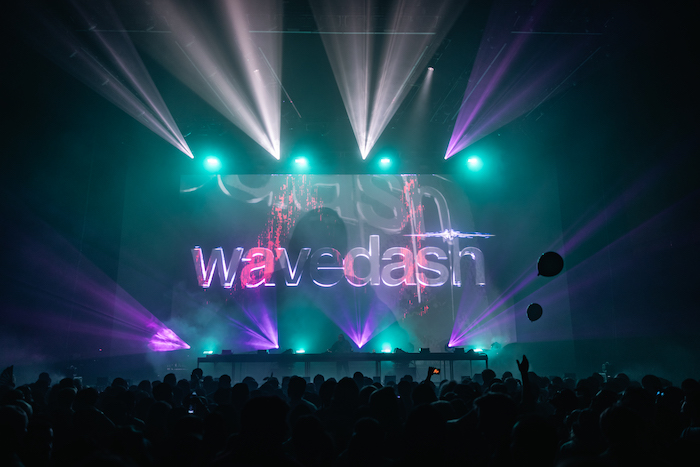
While SLANDER captivated the crowd both nights with their high-energy performances, wobbling synths, and heavy bass drops, all of the openers were definitely worth arriving to The Armory early for. Night 1 featured William Black, whose distinct and emotionally charged melodic set left the crowd in an awestruck trance. Other notable openers were Trivecta, Wavedash, and Riot. During all these sets, the crowd happily headbanged along to every bass drop, while lights and lasers danced in sync to the beats.
Wavedash amped up the crowd for the headliner on Night 1. Photo Credit: Tyler Allix
The openers on Night 2 also set the stage for a truly transcendent EDM experience. Visionary DJ A Hundred Drums first played a hypnotic set that skillfully blended tribal rhythms and futuristic beats. Afterwards, Space Laces wowed the crowd with his set that pushed the sonic boundaries of dubstep and bass music. These openers curated an immersive and enchanting musical journey that warmed the crowd up for the main event.
Space Laces played an unforgettable set for the massive crowd. Photo credit: Tyler Allix
Once SLANDER took to the turntables, the dynamic duo proved once again why they are such masters of storytelling through music. Their set first opened with a beautiful, emotional movie playing on a massive screen behind them. They then played their entire set in sync to the film — the show was an emotive kaleidoscope of sight and sound for all the attendees. All of the visuals, dazzling lasers, and dancing lights really amplified SLANDER’s breathtaking symphony of bass and ethereal melodies.
SLANDER’s Chimera tour was one for the books. Photo Credit: Tyler Allix
Sound in Motion will end the year strong with more exciting shows at The Armory. Shows that are already creating a lot of buzz are Lucid Nights [Night 1 – Zeds Dead] on Dec. 30th, Lucid Nights [Night 2 – Zedd] on Dec. 31st, and 2 nights of Subtronics on Feb. 16th and 17th. If you own or work with a lifestyle company looking to grow brand awareness in the Twin Cities market, definitely consider sponsoring at least one of these events.
Artificial intelligence offers exciting opportunities but also raises understandable concerns – including the potential for generative AI models to “take” or misuse content created by human writers and marketers.
This article aims to clearly define these risks, analyze scenarios of how AI could replicate or plagiarize your work, and offer practical tips to protect yourself in generative AI-powered world while still benefiting from emerging technologies.
Why do we care about AI taking our content?
Let’s define our terms. When we speak of AI “taking content,” we are actually discussing multiple distinct risks to us as individuals, the marketing campaigns that we run, and the work that we’ve created.
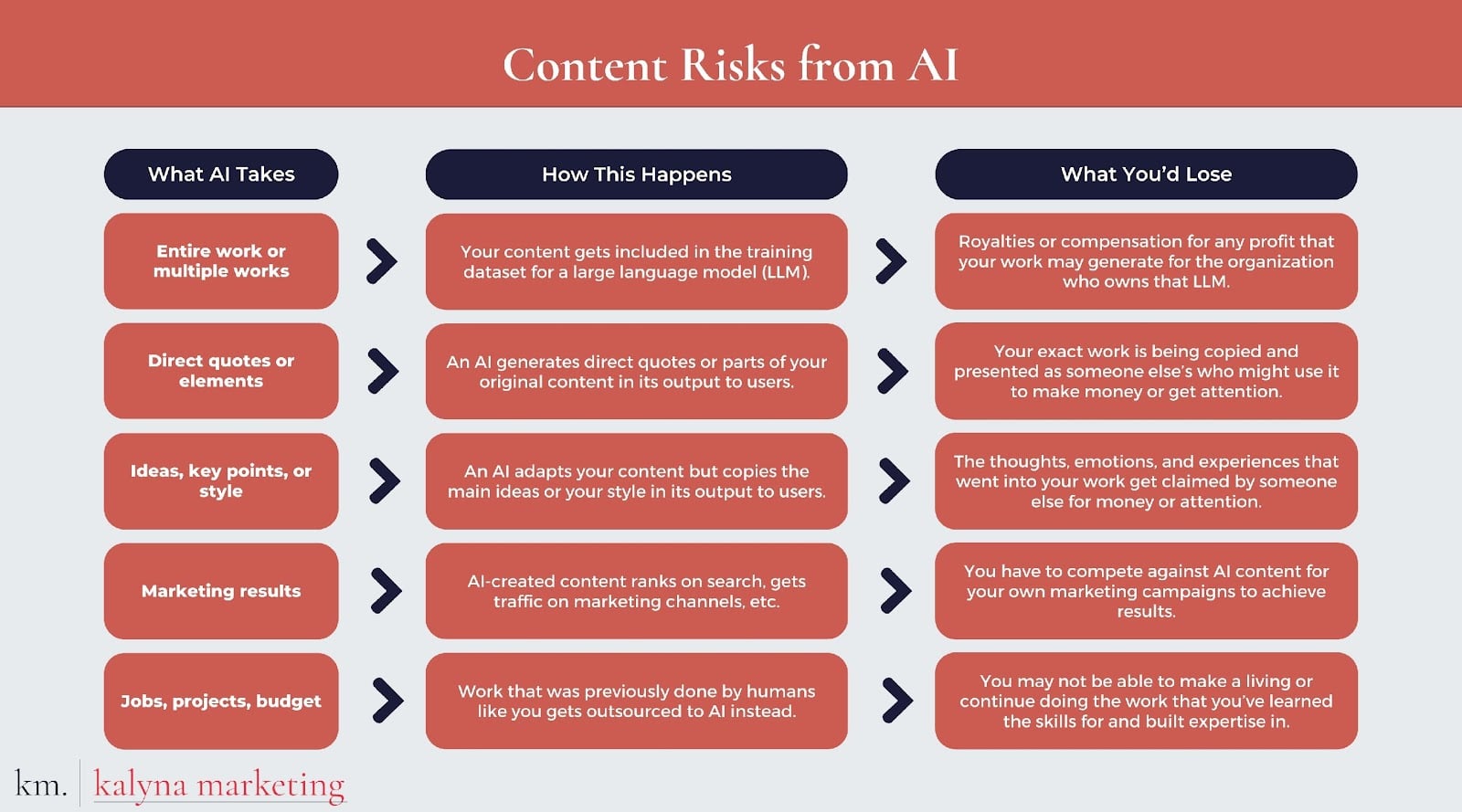
To help us navigate this web of scary possibilities, I’ve made a graphic summarizing a couple of ways in which AI could take your content:
A table of potential content risks that you may experience from AI.
Let’s think through all of these risks in more detail.
What can AI take from your content?
First, what can generative AI even take from us? I see five categories of what we’d actually stand to lose:
Your entire work or multiple works
Generative AI can take an entire piece you may have produced, like a blog post, a video, a social post, an image, or a combination of the above.
Potentially, generative AI might index your entire website and all the content you’ve published on any of your social media accounts.
Your words or elements of your work
Generative AI could copy full bits of your work, such as direct word-for-word quotes from your content, including an image you created, or replicating frames from your videos.
This type of direct plagiarism could also include small changes in the words or colors within your content.
Your ideas or style
Generative AI could plagiarize you more indirectly by stealing your content’s ideas, format, or aesthetics. If you’ve done research combining a few sources in a new way, the AI could suddenly make the same comparison.
If you’ve made a clever observation about the future of SEO, generative AI might suddenly predict the same scenario but in its own words. Someone could also prompt generative AI to create content in your style, as many tools allow people to do.
Your marketing results
Generative AI could take your content results instead of copying your work.
You might lose your audience if AI content suddenly floods the SERP ranking for the same queries you were targeting or if other companies begin taking up social media feeds with AI-generated posts.
You may also have difficulty standing out, earning trust, or converting to sales.
Your job, tasks or budget
Generative AI could take your content by making content without you instead. Your tasks, role, or team might get cut and replaced by generative AI that is supposed to produce the same content that humans like you were producing.
How can this happen?
But how can generative AI even take those things from us?
If we are afraid of losing something, we should understand the mechanisms by which we could lose it. I would split those scenarios into four categories:
Training data
Your content gets included in the training dataset for a large language model (LLM).
Generating responses to users
Generative AI generates direct quotes or parts of your original content in its output to users.
Alternatively, generative AI adapts your content but copies the main ideas or your style in its output to users.
Competing for marketing results
AI-created content ranks on search, gets traffic on marketing channels, etc.
Influencing the economy and available work
Work that was previously done by humans like you gets outsourced to AI instead.
How could it impact you?
Losing something is always unpleasant, but what impact would AI taking our content even have on us? I see three core types of harm that we’d face as content marketers:
Financial losses
You might lose money in the form of:
Royalties or compensation for any profit that your work may generate for the organization that owns the LLM that gets trained on your content.
Profits from your work getting copied and presented as someone else’s, whether via direct plagiarism or adapting your ideas and style.
Marketing, emotional, and reputation loss
You may lose out on the recognition and opportunities when:
The marketing tactics and channels that you used no longer bring your organization the same types of returns.
The thoughts, emotions, and experiences that went into your work get claimed by someone else for money or attention.
You have to compete against AI content for your own marketing campaigns to achieve results.
Job success and security
Your work as a marketer may get affected if:
Your job gets cut or changed as your tasks get outsourced to generative AI instead.
Your team gets laid off and your responsibilities are increased, as you are expected to “leverage AI” to produce the same output as an entire team of humans.
Your skills get devalued as AI can seemingly produce the same quality of work in seconds for a fraction of the cost.
A lot of these risks aren’t unique to content marketers. But while we might fear some of the same things as other professionals, all of these harms could affect our work directly and in unique ways.
On the other hand, are those risks necessarily unique to AI taking our content? Plagiarism can be damaging whether it is done by humans or software. Is there a difference between a human stealing your content and a large language model doing the same?
Get the daily newsletter search marketers rely on.
What is the difference between another human being stealing your content and generative AI?
The easy answer would be to say that a human knows what they are doing and can be held responsible.
A human has agency and free will. They have to actively decide to find your work, take some of it for themselves, and present it as their own.
Generative AI, on the other hand, is a program that includes a level of randomness and unpredictability to its output. When generative AI steals, it feels accidental.
There is no culpability because AI cannot have criminal intent or a mental state. Without a mind that could understand the consequences of its actions, generative AI is not culpable for the results of what it does.
But is that true? How different is plagiarism via AI from the old-school, 100% human version? Let’s think through some hypothetical scenarios and see where that leads us.
Scenario 1: Old-school human plagiarism
What does conscious and deliberate plagiarism look like?
Let’s say that a human writer named Jane Doe decides to take the article “12 SEO Tips to Boost Your Organic Rankings & Traffic” by Connor Lahey from the Semrush blog.
Doe may change up the title, intro and some headings, and then publish it under her own name on hottestseotipsblog.com. In this case, Doe knows what she is doing and actively chooses to misrepresent someone else’s work as hers.
What is the problem with Doe presenting Semrush’s piece as her own original content? Her plagiarism causes two types of harm: harm to Semrush and harm to people visiting Doe’s site.
Harm to the original author
Doe harms Semrush because when she steals their content, she might also steal its marketing and business impact.
Doe may end up taking traffic away from the original piece. She could end up:
Getting backlinks and credit for the ideas she presents.
Earning money off ads displayed on that page, affiliate links that she might include in the text, or business opportunities resulting from that content.
It’s reasonable to say that the money and traffic should have gone to the original author and the Semrush site instead.
Harm to the audience
Doe harms people visiting her site because she is misrepresenting her own expertise. By putting her own name on that content, Doe gives off the false impression that the words on that webpage are her original ideas and experience.
Doe may sell SEO consulting services, and she could get clients who read the plagiarized piece, liked her insights, and decided to hire her based on the knowledge implied through that content. Essentially, by plagiarizing Semrush’s piece, Doe is stealing trust and credibility.
Scenario 2: Hiring a ghostwriter with no oversight
Let’s say that instead of plagiarizing an existing piece of content, Doe hires a ghostwriter to write it for her. She tells the ghostwriter that she needs a blog post on the topic “10 Best SEO Tips” and that she wants it to be around 2,000 words long.
When the writer sends over a complete draft, Doe publishes it on hottestseotipsblog.com under her own name. Is this plagiarism?
Even if the writer crafted that piece as fully their original work, we can argue that the same harm from Scenario 1 is still present:
Harm to the original author
The ghostwriter might not be compensated for any resulting revenue from publishing that piece on Doe’s site.
They might not be allowed to use that content in their portfolio and lose out on opportunities to get additional clients even if their piece takes off and becomes popular.
For the public, the original writer is invisible and functionally does not exist.
Harm to the audience
Any users visiting hottestseotipsblog.com are still being given the impression that Doe is the author of that content. Doe is still borrowing credibility and trust from ideas and skills that were not hers.
Note: Ghostwriting arrangements are common. If the writer consented to giving up any credit or additional compensation for a fee, they should be allowed to do so.
This scenario is not necessarily “stealing,” but it is still misrepresenting who did the work that went into creating that content. Whether this is plagiarism or an acceptable practice depends on our own definitions and morals.
On the other hand, if the writer actually copied the piece from an existing source like Semrush, then this piece is definitely plagiarism. In that case, we could argue that Doe was responsible for cross-checking the final draft and ensuring it was original work.
But most of the responsibility would lie with the ghostwriter, who misrepresented the content as their own original work to Doe.
Scenario 3: Generic AI prompt that generates plagiarized quotes
What happens when AI enters the picture?
Perhaps Doe may open ChatGPT and prompt it with something like:
“You are an SEO expert familiar with the best industry practices for content creation, marketing, technical SEO, keyword research, and writing for professional audiences. Draft a thorough and original blog post for the topic ’10 Best SEO Tips’ with level 1-3 subheadings and specific examples.”
Let’s assume that, in our scenario, ChatGPT has been trained on Semrush’s blog content. When ChatGPT generates the blog post for Doe, that draft copies entire paragraphs and most of the main points from the Semrush article with 12 SEO tips.
If Doe keeps that AI-created draft unaltered and posts it on hottestseotipsblog.com under her own name – did she plagiarize?
The end result is the same as in our first scenario – there is now a published blog post under Jane Doe’s name on another site using the exact same words as an article on Semrush’s website.
Hottestseotipsblog.com might not include any disclaimers that the content was produced with the help of AI. How does that fit into our framework?
Harm to the original author
In this situation, Semrush is still losing potential traffic, revenue, and other business opportunities.
Harm to the audience
To any user visiting Doe’s site, that content appears as if it is completely original and written based on Doe’s own expertise.
However, it doesn’t feel right to place the same level of blame on Doe as in the first scenario. After all, Doe doesn’t know that the content she published was plagiarized.
She may have never seen Semrush’s piece. She may sincerely believe that ChatGPT gave her a completely original blog post that has never been published elsewhere.
Yet, Doe still misrepresented her work. She didn’t write the piece – ChatGPT did. Doe might not have plagiarized from Semrush deliberately, but she did steal the expertise of ChatGPT and the data it was trained on.
Scenario 4: Specific AI prompt to copy someone’s style
What if Doe opened ChatGPT, copied the text of Semrush’s article, and wrote the following prompt:
“Draft a thorough and original blog post for the topic ’10 Best SEO Tips’ with level 1-3 subheadings and specific examples in the same style as the following text [pasted text of ‘12 SEO Tips to Boost Your Organic Rankings & Traffic’ from Semrush]”
In this case, ChatGPT may not copy any of the exact phrasing or points from Semrush. But instead, Doe is asking the AI to copy the more nebulous notion of style and format from Semrush’s piece.
ChatGPT’s output would still sound similar to Semrush, and some of the ideas might even echo the original.
Doe is still stealing something, even if it’s harder to pin down. So, how does that fit into our framework?
Harm to the original author
Semrush is still not getting recognition for their original content. Style is the result of hard work, writing skill, and creativity. Doe is taking that without permission, and any traffic or revenue she generates is still relying on something that wasn’t hers.
Harm to the audience
Doe is presenting those stylistic choices as her own, and might come across as a much better writer or thinker than she actually is.
If the Semrush article had a particularly unique structure and ChatGPT copied it, then Doe is benefiting from multiple creative choices that now come across as her own.
Sure, copying the style of someone else’s content could be described as inspiration. But if no credit is given and that inspiration is heavily relied upon to the point of both pieces resembling each other, that is still likely plagiarism.
And Doe holds a level of responsibility for that plagiarism – she directly prompted ChatGPT to copy the style of someone else’s content.
Scenario 5: Specific AI prompt to paraphrase someone’s ideas
What if Doe prompts ChatGPT to copy the ideas from Semrush directly? She could write a prompt like:
“Adapt the following text and rephrase it into a thorough and original blog post for the topic ’10 Best SEO Tips’ with level 1-3 subheadings . Keep the same ideas but draft your own unique examples in the same style: [pasted text of ‘12 SEO Tips to Boost Your Organic Rankings & Traffic’ from Semrush]”
Like with Scenario 4, including the word “original” in the generative AI prompt does not magically erase the intent to steal from others.
Doe is prompting ChatGPT to directly copy someone else’s original work and explicitly asking for it to copy not only the style but the main points of the Semrush piece.
Even if all of the words and phrases in the final draft are different, the resulting article is still plagiarized.
Here’s how it would fit with our framework:
Harm to the original author
Semrush and the article author are still not getting any credit, recognition, or revenue from their work.
Any hours of research that the original author may have spent creating the piece, thinking through the ideas, exploring best practices of SEO, and gathering information – they are simply lifted by Doe for her own benefit.
She is taking credit while stealing the time and effort required to come up with good content.
Harm to the audience
Anyone reading Doe’s piece will still believe that it’s her own.
Readers would trust Doe not simply because of her exact word choice but also because of the sophistication that she shows in her understanding of SEO and her ability to explain best practices to others.
When Doe steals ideas from Semrush, she is stealing all of those implications, even if the exact words are changed.
In this case, most of the responsibility for plagiarism is with Doe.
This scenario is nearly identical to Scenario 1: Doe deliberately chose to copy the content from Semrush and present it as her own with some modifications.
The only difference is the method she used: while in Scenario 1, Doe made those modifications manually, in this case, Doe used ChatGPT to do the dirty work for her.
Scenario 6: Creating a generative AI model to write blog posts based on existing content
In our discussions, we have not addressed one key party in scenarios involving AI: the people who built that AI model in the first place.
Let’s say that Jane Doe is actually a skilled developer who can build her own machine learning applications. She builds her own algorithm that can shuffle and automatically paraphrase language. Then, Doe prompts that algorithm to rephrase the Semrush blog post with 12 SEO tips. Is that plagiarism?
Functionally, this scenario is identical to Scenario 5. The only difference is that now Doe has also built her own paraphrasing software instead of relying on something like ChatGPT.
What if Doe builds an algorithm that is trained on all of Semrush’s blog posts and then she asks it to generate a draft for “10 Best SEO Tips”?
In this case, Doe isn’t stealing from one article. However, her software is still reshuffling and paraphrasing the language and ideas from Semrush. The resulting piece is still plagiarized, but pinning where each part comes from becomes harder.
Now, let’s say that Doe takes all of Semrush’s blog content and also includes blog posts from Ahrefs, Moz, Search Engine Land, and 50 other SEO websites.
She uses all of that content to train her own LLM and then prompts the AI to generate a blog post with “10 Best SEO Tips”. Then, Doe publishes that AI-created piece on hottestseotipsblog.com under her own name. How does this scenario fit within our framework?
Harm to the original author
We are now dealing with multiple original authors, not simply Semrush. But all of the sites whose content was used in the training dataset have had their ideas, style, and word choice copied to some degree.
Doe’s piece might still generate revenue, business opportunities, and traffic for her site. And none of the original authors and websites are getting credited or compensated for those results.
Harm to the audience
Anyone visiting Doe’s site still thinks that the content presented to them is a reflection of Doe’s original work, ideas, and expertise.
Sure, Doe has put effort into building generative AI that created the content. But if a reader is simply reading SEO tips and not learning about the intricacies of Doe’s AI software – is the reader actually witnessing any of Doe’s own work?
At the end of the day, if someone believes that Doe is an SEO expert because of that content, Doe still steals that trust from others. None of her SEO advice is her own. Doe deserves credit for creating a fancy stealing machine, not for the content that it produces.
Plagiarism is the same whether AI is involved or not
It doesn’t matter if AI is involved: as we see from the scenarios outlined above, plagiarism is always done by humans when they take credit for the work of other humans. AI is simply a technology that provides new ways of stealing content, but it hasn’t created a fundamentally new type of plagiarism or content creation to begin with.
You can think of AI as a particularly high-tech blender: you can stuff it with a bunch of pieces, press a button, and then get a homogeneous mixture to post on your own site. But that mixture is still made up of the same content that you put in there.
A blender doesn’t create anything new. It simply puts some pre-existing substance in a different form. If you make a carrot smoothie, can you say that you grew those carrots? The same could be said for content.
If you worry about AI taking your content, remember to look behind the curtain at who is actually pulling the strings. While the software itself may not be capable of a criminal mental state, the humans who created or prompted it certainly are. AI cannot steal from you, but humans using AI might.
How can we minimize risks posed by AI to our content?
The way people obfuscate their culpability in stealing content, ideas, or jobs is dangerous. People using generative AI can cause real harm to you, me, or many people we work with and care about.
However, that doesn’t mean we should give up. Humans have been stealing ideas as long as there have been ideas to steal. Just like we’ve had ways of combating old-school human plagiarism, we can work to prevent AI-assisted plagiarism too.
Let’s wrap up by looking at how we can minimize risks and reduce the harms of generative AI to our content.
No, ‘becoming a generative AI expert’ isn’t a solution
Before I dive into specific suggestions, a short disclaimer: I won’t recommend that you become a generative AI expert or learn how to work with machine learning.
Sure, those kinds of skills could be valuable. But they are a distraction from the real question we’re wrestling with:
How can we protect the work and skills we’ve done as content marketers in a world without AI?
AI, like any technology, will have some impact on the kinds of tasks we can do. But it doesn’t change the essence of “marketing” or “content”.
Saying that you can only remain a marketer if you learn about AI is tantamount to telling you that you must change careers entirely. A generative AI expert is not a marketer. A marketer might also be a generative AI expert, and a generative AI expert could be a specialist in content.
But these professions are not interchangeable and the skillset behind them is distinct. Think of it this way: does going into Excel now and then to prepare reports make you a data analyst? Probably not.
The work we do as marketers will remain valuable even if AI becomes a core part of how we do that work. So, as we think about minimizing risks from AI taking our content, we should think about the unique skills and challenges of marketing work in particular.
Avoid financial losses by opting out of AI scraping
The first thing you can do is to prevent your content from appearing in some AI datasets. This is the most brute force option, and won’t be practical for most marketers or web publishers.
Keep in mind that opting out of any AI indexing also means that your site and any associated information will not appear in that AI’s output. If any user is looking for information about your business by prompting a generative AI chatbot, they might not see you in the results.
By protecting your privacy this way, you are essentially sacrificing generative AI as a marketing channel. So make sure that you are ready for any consequences of taking that step.
You can opt out of OpenAI’s GPTBot crawling by adding these lines to your robots.txt file:
“User-agent: GPTBot

Disallow: /”
You can also block Google’s Bard and Vertex AI using the Google-Extended control, by adding the following to your robots.txt file:
“User-agent: Google-Extended

Disallow: /”
Unfortunately, Google-Extended won’t block your site from getting indexed in Google’s AI-powered Search Generative Experience (SGE). It seems that the only way to avoid appearing in SGE is to opt out of Google’s indexing entirely.
You can read more about Google’s crawlers and editing your permissions in their own documentation.
Some other publishing tools might let you control these settings within the platform itself. For example, Substack includes a setting within its writer dashboard to “block AI training.”
This appears to mostly opt you out of GPTBot, but perhaps it will become a more robust blocker in the future.
Reclaim a marketing advantage by switching to harder-to-replicate marketing approaches
For most of us, blocking AI crawlers or opting out of SEO entirely isn’t exactly an option (otherwise, why would you be reading this on Search Engine Land?). So, what can we do instead?
Accept that someone may try to plagiarize your content using AI. Even if you could opt out of every training dataset, someone can still copy-paste your work into ChatGPT and steal it that way.
When someone wants to steal, they will find a way. Trying to prevent your content from getting copied will quickly become an endless game of whack-a-mole or lead you to stop publishing on the open web entirely.
How can you reduce harm even if others copy your content? By thinking about marketing approaches that are hard, if not impossible, to copy.
If Jane Doe did steal a piece from Semrush, and you came across both versions of that article – who would you be more likely to trust? If you’re a marketer, you are likely already familiar with Semrush as a company and a trusted source of information.
When seeing content that has been plagiarized, you are likely to assume that Semrush was the original author. Even if Semrush may lose some traffic or revenue, in the long run, Jane Doe cannot steal their brand, reputation, content creation process, team, or experience.
Others might be able to steal some of your work, but they cannot steal your expertise. If your content is truly original, trustworthy, and helpful – people will continue to trust you.
You can continue to:
Make content that earns traffic.
Leverage multiple marketing channels.
Build your own brand and the personal reputations of people within your organization.
No AI can steal that.
Protect your job and budget by leaning on your humanity
What is your essence that no AI or other human could ever take from you?
What makes you, as an individual, a department, or an organization – you? Lean into your true differentiators from your unique blend of experience, positioning, and connections.
Someone else might be able to copy your idea or automate some of your skills. But if your job or marketing program is built on your fundamental humanity and unique point of view, they won’t be replaced.
If you want to be resilient in the face of AI, stay human. Invest in true thought leadership, developing relationships, expressing strong opinions, and telling the stories that only you could tell.
Don’t give up to AI – marketing isn’t going anywhere
Humans trust other humans. AI won’t change that, even despite all the current hype. A thief might be able to borrow your reputation, but true expertise will always become apparent. A plagiarist won’t be able to build on your ideas or recreate your success.
So, if you’re worried about AI taking your content, make sure that you keep building content that is worth stealing because your ability to create good content in the first place will be the best defense you could possibly have.
Google’s local search ranking algorithm has recently been updated to strengthen its “openness” signal for non-navigational queries. Danny Sullivan, Google’s Search Liaison, said, “we’ve long used “openness” as part of our local ranking systems, and it recently became a stronger signal for non-navigational queries.”
What changed. Earlier this month a report showed Google ranked open businesses more often in its local search rankings higher than businesses that are closed. “As of November 2023, Google appears to be looking at whether a business is currently open as a ranking factor for local pack rankings,” Joy Hawkins wrote in her report.
Google confirmed. A couple weeks later, Danny Sullivan from Google confirmed this saying, “we’ve long used “openness” as part of our local ranking systems, and it recently became a stronger signal for non-navigational queries.”
Navigational queries. Non-navigational queries are queries where you search for types of services versus specific brands. So a non-navigational query would be to search for a pharmacy, whereas a navigational query would be to search for CVS.
Don’t change your business hours. The report said, “If you are a business that’s open 24-hours a day, this would benefit you in the evenings when your competitors disappear but you still rank.”
But Sullivan said, “This might change in various ways, as we continue to evaluate the usefulness of it, however.” He added, “I wouldn’t recommend businesses do this, given the ranking signal may continue to be adjusted.”
Why we care. If you notice changes to your Google Business Profile listings, this may be why. It is also important to ensure your business hours reflect your true open hours because if you make up your business hours, you never know if you can be hit by some sort of penalty in the future.
In short, Google is now showing more businesses that are open at the current time of the search. Is that a good thing for searchers or bad is up to debate and probably very query dependent.