Google to block Bard’s shared chats from showing in Google Search

Google will soon block Bard’s shared conversations from appearing in Google Search. Google Bard recently came out with shared conversations that let users publicly share the chats they had with Bard. Soon after Google Search started to discover those URLs, crawl them, and index them.

The issue. Gagan Ghotra posted on X a screenshot showing how a site command for site:bard.google.com/share returned results from Bard. Those results were shared conversations. Here is a screenshot of Bard showing up in the Google Search index:

Alphabet Inc.

Google will block Bard results from Google Search. I asked Google’s Search Liason, Danny Sullivan, about this and he responded on X saying, “Bard allows people to share chats, if they choose. We also don’t intend for these shared chats to be indexed by Google Search. We’re working on blocking them from being indexed now.”

Google will soon remove Bard’s shared conversations from showing in Google Search.

Why we care. So if you see Bard’s shared conversations showing up in Google Search, don’t fret it, they should go away in the coming days. Google said it does not want them to show up in Google Search’s index and they are working on blocking them now.

The post Google to block Bard’s shared chats from showing in Google Search appeared first on Search Engine Land.

Original source: https://searchengineland.com/google-to-block-bards-shared-chats-from-showing-in-google-search-432497

Has Google Ads lost all credibility? Why one advertiser says it’s time to leave

Google stunned the PPC community after openly admitting to quietly adjusting ad prices to meet targets. The confession comes eight years after Google Ad executive Jerry Dischler denied the search engine manipulates ad auctions at SMX Advanced in 2015.

The backtracking has infuriated digital marker Greg Finn – so much so that he now believes advertisers should consider leaving Google. But will others follow?

Here’s a recap of Greg’s comments from the Marketing O’Clock podcast.

Google has lost all trust and credibility

  • “This is disheartening. First of all, the biggest detriment is that Google has lost all trust and credibility.”
  • “All you have in life is your word.”
  • “Google has admitted to trying to hit quarterly numbers so that the morale of its people living in high-cost areas is up – but that’s at the expense of the small businesses that it pretends to care about.”
  • “Money doesn’t just appear, it comes out of every small business and big business’ pocket that is using Google’s platform.”

Stop calling it an auction

  • “We all knew this was going on, but you want to give people the benefit of the doubt.”
  • “Google says it cares about advertisers and all these other marketing lies, but the minute it has to hit these marks, the staff ratchet up the spend, and they ratchet the revenue up to 5% or 10%.”
  • Greg went on to share some of the reactions he’d seen from the PPC community on X (formerly known as Twitter), which he appeared to support:
Ad text optimization
Advertising
Alphabet Inc.
Amazon

Stop lying

  • Greg read out a post on X (formerly known as Twitter) from ex Googler Ben Kruger, which read:
    • “Guys they are running a business, they can do whatever they want with their prices just like you and your clients can.”
  • Greg called Ben’s words “fair” in parts, but called Google out for its lack of transparency. with advertisers
  • “You can do whatever you want [with your prices], but just don’t tell me that you’re doing things in my best interests.”
  • “You can no longer say that, and I can no longer trust you on anything that you say or do because you’re out here, tuning up, and shaking the cushions to hit quarterly profit numbers.”

Google’s terminology is ‘misleading at best’

  • “It’s fine if retailers increase their margin on the backend, but in Google’s case, this is marketed as auctions with bids and bid strategies.”
  • “That terminology is increasingly misleading at best.”
  • “There are factors outside of your control and factors that only matter to the sales team that live in high-income areas that are going to hurt your campaign.”
  • “I guarantee Google has never moved costs down 5%.”

RGSP is ‘ridiculous’

  • Google Ad executive, Jerry Dischler, said during the federal antitrust trial that RGSP boosted Google’s revenue by switching the auction so that the second-place bidder was in the top advertiser slot and the initial winner was in the second position.
  • Dischler told the court: “We flip them, otherwise Amazon would always show up on top.”
  • Greg branded this approach “ridiculous”. He added: “People are out here bidding. What world are we living in? What world is this? It’s ridiculous.”

People should leave!

  • “This whole thing just makes me so unbelievably sad. I’ve read everything and heard all the reactions – and I know it’s going to get progressively worse as the years come by.”
  • “People should leave. There should not be one ounce of trust that any advertiser has in Google Ads or in any of its platforms, speech, any of its propaganda or anything it puts out.”
  • “Google has lost all credibility with this. There is nothing left.”
  • “Everyone thinks I’m a Google conspiracist, and everyone thinks I’m nuts – but I’m not. I’m right on this. And that’s why everyone is so hesitant to switch to auto-applied recommendations or use AI or PMax. Google is doing these things to make more money, and they’re admitting it in court. Sad.”

Deep dive. Read our Google antitrust trial updates for all the latest developments from the federal trial.

The post Has Google Ads lost all credibility? Why one advertiser says it’s time to leave appeared first on Search Engine Land.

Original source: https://searchengineland.com/google-ads-credibility-greg-finn-advertiser-432503

Different Ways to Help Improve the Lighting in Your Office Space

Home Business Magazine Online

The lighting in your workplace is a vital aspect of its design, and you want to ensure you get it correct and there are many things you can do to achieve this. Sufficient lighting in your office can help improve employees’ well-being and productivity and create a more pleasant atmosphere. Whether you are refurbishing an existing office or designing a new one from scratch, there are various ways to help improve your office lighting. Below are some methods to help you get started and ensure your office space has plenty of light, making a more pleasant environment and boosting productivity.

Choose an Expert Design & Fit-Out Company

The best place to start is work with an experienced and reputable office design company that can also do the fitting out of your project. They can assess your current space and see how best to utilise it to maximise the natural light and make best use of the space. Companies like Gravity Office Interiors have learnt many tips and tricks to help enhance light levels in gloomy offices, and these are techniques anybody can use.

The Office Layout & Design

First, you must address the office layout and floor plan and look at ways to improve this. If your office space has internal walls, moving to an open-plan design could be worth considering. If you still need to partition off different sections of your office space, use glass partitions that can allow light to pass through rather than ones that will block and reduce the light. Other tips you can include other than an open plan office design is using reflective materials and surfaces and avoiding overcrowding and cluttering the space too much.

Enhance Natural Light

You want to allow as much natural light as possible into your office, which is much better than artificial lights. Position desks and workstations so they get the maximum benefit of the available windows, and if possible, consider installing bigger windows to let in more light. Using reflective materials and glass in your office design can also help maximise your workspace’s natural light, making a much more pleasant working environment. Depending on the direction your windows face, the light from the sun may get too harsh at times, then you will want blinds or curtains for the windows. However, ensure when they are in the open position that they do not obstruct any light from passing into the office to help keep it as bright as possible.

Use a Layered Approach for Lighting

Another way to ensure sufficient lighting in your workspace is by layering it and using different types of lighting. It can help achieve a well-balanced and lit office, no matter how dark it gets outside, and there are three primary lighting layers you can use: accent, ambient, and task lighting.

  • Accent Lighting: Using accent lighting in your office can add a touch of elegance and allow you to highlight features and focal points in your office design. You can use accent lighting to highlight your corporate branding, artwork, architectural elements, or plants. The best options for this purpose are track lighting or wall-mounted fixtures, and using LED lights will ensure they are energy-efficient.
  • Ambient Lighting: Ambient lighting is the overall illumination of your workspace, and it is best to use Smart LED lights to adjust the colour, hue, and brightness, giving you more control of your lights. Using overhead lighting fixtures like recessed or pendant lights is an excellent choice for the job.
  • Task Lighting: Task lighting is used in individual workstations, desks, conference tables, or reading nooks to ensure the employee has sufficient light for their tasks. It is common to use desk lamps, adjustable floor lamps, or under-cabinet lights, and adjustable LED lights are an excellent option for this task.

The Correct Colour Temperature

Using the correct colour temperature for your workplace can also help make it brighter and maximise the available light. You can measure the value of colour using the Kelvin (K) scale, with colours having a low score of around 2500K producing a warm yellowish light, while hues with a high value of about 5000K make a cooler blueish light. Using the correct colour temperature in your office colour scheme can help improve the light levels, and different colours suit different work areas.

  • Corridors & Hallways: Use colours measuring between 3500K and 4000K for corridors and hallways, which should help ensure there is ample light, and they are well-lit.
  • Task Areas: In task areas, it is best to use colours within 4000K to 5000K to ensure sufficient light for reading or working on a computer.
  • Break & Collaborative Spaces: You want a colour temperature within the 2700K to 3500K range for rest areas and collaborative spaces. It can create a warm and cosy atmosphere and allow employees to rest efficiently before returning to work or collaborate effectively with their coworkers.

Incorporate Smart Lighting Systems

Another excellent way to enhance the lighting in your workplace is by using Smart lighting systems that can control various aspects of the light. You can install different features, some of which can also save money, so they are worth the investment. Some of the various features you can get with Smart LED lighting technology include:

  • Remote Controls: You can alter the lights in your office using a remote control; some can also be controlled using a computer or Smartphone. It allows you to turn lights on and off, change their brightness, and set schedules for your lights.
  • Motion Sensors: You can also use motion sensors for your lights, which turn lights on when they detect motion and turn off a short time afterwards. They are common in toilets and corridors, and as the lights are not on continuously, they can save money on energy costs.
  • Dimming Control: Being able to dim or brighten the lights is an excellent feature you want in your office lighting so that you can customise the lighting level to the current conditions. When you dim LED lights, they also use less electricity, so they can help reduce your energy bills.
  • Daylight Harvesting: Daylight harvesting is where a sensor automatically controls and adjusts the electric lights to keep a consistent ambient light level in your office.

These are some techniques you can use to ensure your workplace has sufficient natural and electrical lighting, but there are other things you can do to achieve this. Take the lighting in your office space seriously; it can help you create an excellent working environment that benefits your employees and your business.

The post Different Ways to Help Improve the Lighting in Your Office Space appeared first on Home Business Magazine.

Original source: https://homebusinessmag.com/home-office/office-design/ways-help-improve-lighting-in-your-office-space/

The Ransomware Landscape in 2024: A Comprehensive Guide for Home-Based Businesses and Startups

Home Business Magazine Online

As we usher in 2024, the digital realm is akin to a double-edged sword for the burgeoning community of home businesses and startups. On one hand, the digital age offers unparalleled opportunities for growth and innovation. On the other, it is fraught with cybersecurity landmines, chief among them being ransomware attacks.

Recent years have witnessed a shift in the focus of cybercriminals. While large corporations with deep pockets have always been on their radar, smaller entities like home businesses and startups are increasingly coming under fire. The reason? They are often perceived as “low-hanging fruit” due to a lack of fortified security measures.

Lisa Mitchell, an IT service expert from Progressive Computer Systems in Raleigh, NC, delves deeper into this disturbing trend. “Historically, mega-corporations were the primary targets for ransomware attacks, given the potential for hefty ransoms. However, cybercriminals today are playing a volume game. They recognize the vulnerabilities of home businesses and startups, which typically lack the infrastructure or resources to invest heavily in cybersecurity,” she explains.

So, what does this mean for entrepreneurs and home business operators? And how can they defend against and preempt these malicious cyber onslaughts?

Understanding the Ransomware Menace

Before devising a defense strategy, it’s crucial to understand the adversary. Ransomware is a type of malicious software designed to block access to a computer system until a sum of money (ransom) is paid. What makes it particularly nefarious is its ability to encrypt files, essentially holding them hostage.

Mitchell offers an analogy, “Imagine waking up one day to find the doors and windows of your house sealed shut, with a note demanding payment to unlock them. That’s ransomware in the digital realm.”

Crafting a Comprehensive Defense Strategy

  • Proactive Education and Training: Knowledge is the first line of defense. Entrepreneurs need to be aware of ransomware’s modus operandi. “You wouldn’t ignore a leak in your home; don’t ignore potential digital vulnerabilities. Workshops, webinars, and online courses can be invaluable,” Mitchell suggests.
  • Backup, Backup, Backup: This cannot be overstated. Regular data backups ensure business continuity, even if a ransomware attack is successful. “Consider it as having a spare key to your locked house. Store it separately — offline or on a different cloud platform,” recommends Mitchell.
  • Stay Updated: Keeping software updated might sound mundane, but it’s a critical aspect of cybersecurity. “Think of updates as reinforcing the walls of your digital home. Every patch, every update, closes a potential entry point for ransomware,” emphasizes Mitchell.
  • Leverage Multi-Factor Authentication (MFA): MFA is like a digital double-check. It requires users to verify their identity in two or more ways, making unauthorized access exponentially more challenging.
  • Draft an Incident Response Plan: Hope for the best, but prepare for the worst. “Knowing whom to contact, the steps to isolate the affected systems, and having a recovery procedure can be the difference between a minor hiccup and a business catastrophe,” Mitchell says.

The Way Forward: Adapt and Evolve

While these steps provide a robust foundation, it’s vital to remember that cybersecurity is not a one-time endeavor. As digital threats evolve, so must defense strategies.

Entrepreneurs and home business owners must stay agile and informed about the latest threats and best practices. Engage with cybersecurity communities, participate in forums, and consider investing in consultation with experts like Mitchell.

In conclusion, as we navigate the complexities of the digital landscape in 2024, vigilance and proactive defense are the watchwords. The threats are real, but with informed strategies, even the smallest ventures can stand tall against the ransomware menace. Mitchell leaves us with wisdom: “In the digital age, your best asset is knowledge. Equip yourself, and you’ll be well-armed to face and overcome any cyber challenge.”

The post The Ransomware Landscape in 2024: A Comprehensive Guide for Home-Based Businesses and Startups appeared first on Home Business Magazine.

Original source: https://homebusinessmag.com/businesses/security/ransomware-landscape-2024-guide-home-based-businesses-startups/

Trends in paid search to watch in 2024 by Cynthia Ramsaran

Home Business

The digital marketing landscape continues to evolve rapidly as new technologies and platforms emerge, allowing marketers to innovate and adapt their strategies to meet the changing demands of consumers. Amid this shift, marketers rely heavily on search engine marketing to become efficient and drive higher ROI.

So, what is 2024 shaping up to be, and what top trends in paid search advertising are expected to gain traction?

Learn more by registering and attending “Trends in Paid Search: Navigating the Digital Landscape in 2024,” presented by iQuanti.


Click here to view more Search Engine Land webinars.

The post Trends in paid search to watch in 2024 appeared first on Search Engine Land.

Original source: https://searchengineland.com/trends-in-paid-search-to-watch-in-2024-432388

Microsoft signs deal to serve sponsored links in Snapchat’s My AI

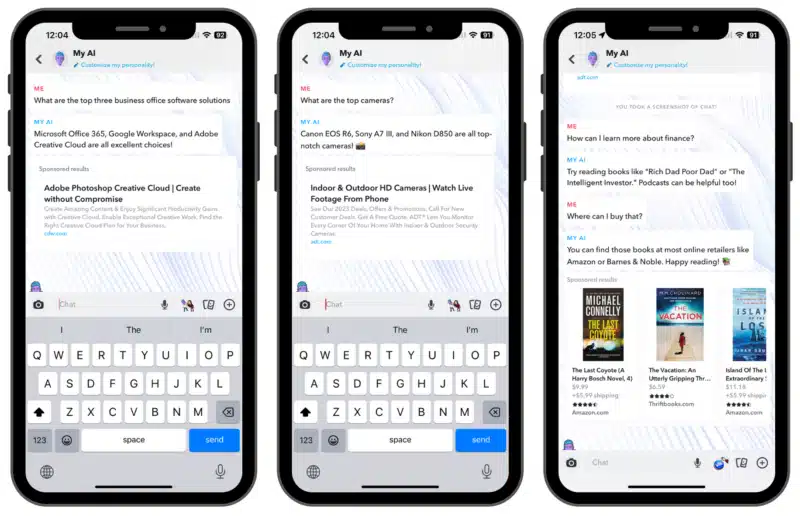
Snapchat’s My AI is going to start serving sponsored links using Microsoft’s Chat Ads API.

The social app posted a screenshot demonstrating how the “highly relevant” ads will be displayed when users interact with its chatbot for relevant queries under the tech giants’ partnership:

Home Business

Why we care. Snapchat’s My AI has a global community of more than 750 million monthly users, making it one of the most widely used consumer chatbots available. The ability to advertise on this platform through Sponsored Links is a huge opportunity in terms of reach, ROI and connecting with its core audience, Gen Z.

Getting started. Advertisers simply need to maximize the mobile coverage within their Microsoft Advertising campaigns. Then, in your Device targeting settings, check to make sure you’re prioritizing mobile traffic by having positive mobile bid modifiers across all your ad groups.

Measuring performance. To measure the impact of Snap traffic to your campaign, use the Microsoft Advertising publisher report. This can be found under the “Microsoft sites and select traffic” category. This traffic has Microsoft properties as the benchmark.

Results so far. Advertisers reported seeing a significant year-on-year increase in mobile traffic across the Microsoft network during the testing phase. On average, they saw over 15% more mobile impressions from Microsoft sites.

What’s next? Microsoft is hoping to roll out its latest advertising feature to more partners soon. The tech giant is encouraging companies interested parties to complete a partnership application form for assistance with either “algorithmic organic results and ads monetization” or “ads monetization”.


Get the daily newsletter search marketers rely on.

<input type="hidden" name="utmMedium" value="“>
<input type="hidden" name="utmCampaign" value="“>
<input type="hidden" name="utmSource" value="“>
<input type="hidden" name="utmContent" value="“>
<input type="hidden" name="pageLink" value="“>
<input type="hidden" name="ipAddress" value="“>

Processing…Please wait.

function getCookie(cname) {
let name = cname + “=”;
let decodedCookie = decodeURIComponent(document.cookie);
let ca = decodedCookie.split(‘;’);
for(let i = 0; i <ca.length; i++) {
let c = ca[i];
while (c.charAt(0) == ' ') {
c = c.substring(1);
}
if (c.indexOf(name) == 0) {
return c.substring(name.length, c.length);
}
}
return "";
}
document.getElementById('munchkinCookieInline').value = getCookie('_mkto_trk');


What has Snapchat said? A spokesperson for Snapchat said in a statement:

  • “Powered by Microsoft’s Advertising’s Ads for Chat API, Sponsored Links connect our community with partners relevant to their conversation, while helping partners reach Snapchatters at the moment they have indicated potential interest in their offering.”
  • “Microsoft Advertising’s clients in the U.S. and select markets can now engage with Snapchatters through My AI to seamlessly deliver links that are relevant to the conversation. “

Deep dive. Read Snapchat’s official Sponsored Links announcement in full for more information.

The post Microsoft signs deal to serve sponsored links in Snapchat’s My AI appeared first on Search Engine Land.

Original source: https://searchengineland.com/microsoft-sponsored-links-snapchat-my-ai-432424

8 Surprising Ways Petri Dishes Have Shaped Science and Medicine

Home Business Magazine Online

The Petri dish, named after the German bacteriologist Julius Richard Petri, was invented in the late 19th century. Prior to its invention, scientists faced difficulty isolating and growing microbes. The introduction of this simple, shallow, circular dish transformed microbiology, offering a sterile environment for bacterial cultures to thrive.

Bread Mold to Penicillin

In 1928, Alexander Fleming made a groundbreaking discovery thanks to a Petri dish. Observing a mold called Penicillium notatum inhibiting bacterial growth, he gave birth to the world’s first antibiotic, Penicillin. Without this dish, Fleming might have missed this life-saving observation.

Unlocking Genetics

Petri dishes play a pivotal role in genetics. Scientists like Thomas Hunt Morgan used them to study fruit flies, leading to foundational discoveries about heredity, mutations, and genetic principles. They’ve enabled controlled studies on generations of organisms, unlocking the mysteries of DNA.

Battling Infectious Diseases

In the field of epidemiology, Petri dishes have been instrumental in studying pathogens. By isolating and studying bacteria and viruses, they’ve led to better treatments and vaccines. Think of the eradication efforts for diseases like smallpox; without these dishes, understanding the enemy would have been significantly harder.

Assisting IVF

In vitro fertilization (IVF) owes much to the Petri dish. Fertilizing human eggs outside the body, embryologists observe and select the healthiest embryos for implantation. Countless families have been created, and it all starts with this modest dish.

Food Safety and Agriculture

Today’s agricultural successes are tied to studies in petri dishes. They help identify plant diseases and enable the creation of hardier crops. Moreover, in food safety, they’re crucial in detecting bacterial contamination and ensuring what we consume is safe.

From Labs to Art

Beyond science, the Petri dish has ventured into art. Agar art, a medium where scientists and artists use colored microbes to paint on agar-filled dishes, has gained popularity. It’s a beautiful fusion of science and creativity, proving the dish’s versatility.

Sourcing Petri Dishes

For those inspired to embark on scientific endeavors, sourcing quality Petri dishes is essential. There are many trusted lab equipment suppliers that offer a range of dishes suitable for diverse experiments. Always choose dishes based on the intended study to ensure accurate and reliable results.

Future Innovations

The potential for Petri dishes doesn’t stop with what we know today. Researchers are continuously innovating, finding new ways to utilize them. From tissue engineering to studying the effects of microgravity on cells, the horizons of Petri dish applications seem limitless.

It highlights the brilliance of the Petri dish that, even over a century later, it remains indispensable in labs worldwide. Whether battling diseases or making art, this simple tool has undoubtedly etched its mark in history. The next time you see one, take a moment to appreciate its profound impact.

The post 8 Surprising Ways Petri Dishes Have Shaped Science and Medicine appeared first on Home Business Magazine.

Original source: https://homebusinessmag.com/businesses/equipment/8-surprising-ways-petri-dishes-shaped-science-medicine/

8 Surprising Ways Petri Dishes Have Shaped Science and Medicine

Home Business Magazine Online

The Petri dish, named after the German bacteriologist Julius Richard Petri, was invented in the late 19th century. Prior to its invention, scientists faced difficulty isolating and growing microbes. The introduction of this simple, shallow, circular dish transformed microbiology, offering a sterile environment for bacterial cultures to thrive.

Bread Mold to Penicillin

In 1928, Alexander Fleming made a groundbreaking discovery thanks to a Petri dish. Observing a mold called Penicillium notatum inhibiting bacterial growth, he gave birth to the world’s first antibiotic, Penicillin. Without this dish, Fleming might have missed this life-saving observation.

Unlocking Genetics

Petri dishes play a pivotal role in genetics. Scientists like Thomas Hunt Morgan used them to study fruit flies, leading to foundational discoveries about heredity, mutations, and genetic principles. They’ve enabled controlled studies on generations of organisms, unlocking the mysteries of DNA.

Battling Infectious Diseases

In the field of epidemiology, Petri dishes have been instrumental in studying pathogens. By isolating and studying bacteria and viruses, they’ve led to better treatments and vaccines. Think of the eradication efforts for diseases like smallpox; without these dishes, understanding the enemy would have been significantly harder.

Assisting IVF

In vitro fertilization (IVF) owes much to the Petri dish. Fertilizing human eggs outside the body, embryologists observe and select the healthiest embryos for implantation. Countless families have been created, and it all starts with this modest dish.

Food Safety and Agriculture

Today’s agricultural successes are tied to studies in petri dishes. They help identify plant diseases and enable the creation of hardier crops. Moreover, in food safety, they’re crucial in detecting bacterial contamination and ensuring what we consume is safe.

From Labs to Art

Beyond science, the Petri dish has ventured into art. Agar art, a medium where scientists and artists use colored microbes to paint on agar-filled dishes, has gained popularity. It’s a beautiful fusion of science and creativity, proving the dish’s versatility.

Sourcing Petri Dishes

For those inspired to embark on scientific endeavors, sourcing quality Petri dishes is essential. There are many trusted lab equipment suppliers that offer a range of dishes suitable for diverse experiments. Always choose dishes based on the intended study to ensure accurate and reliable results.

Future Innovations

The potential for Petri dishes doesn’t stop with what we know today. Researchers are continuously innovating, finding new ways to utilize them. From tissue engineering to studying the effects of microgravity on cells, the horizons of Petri dish applications seem limitless.

It highlights the brilliance of the Petri dish that, even over a century later, it remains indispensable in labs worldwide. Whether battling diseases or making art, this simple tool has undoubtedly etched its mark in history. The next time you see one, take a moment to appreciate its profound impact.

The post 8 Surprising Ways Petri Dishes Have Shaped Science and Medicine appeared first on Home Business Magazine.

Original source: https://homebusinessmag.com/businesses/equipment/8-surprising-ways-petri-dishes-shaped-science-medicine/

How to optimize your ecommerce ad spend and budget for the best ROI

As advertisers, we want to maximize our PPC budgets for our clients

But how do we do that?

This article identifies eight areas where you can focus your optimization efforts to improve ROI.

If you aren’t already doing these things – there’s time to start testing before we get into the throes of holiday planning and execution.

1. Invest in upper-funnel tactics

Many advertisers get too focused on last-click conversion and revenue metrics and opt for bottom-of-the-funnel tactics. Don’t. 

We saw a more than 50% decline in overall efficiency for an apparel brand when we decreased our investment in more awareness tactics. That was immediately reversed when we returned spend. 

Ads Manager

That said, there will be a point where you reach diminishing returns, so it is important to make smaller incremental increases so you can measure the overall impact.

2. Run on a variety of campaign types 

It’s easy to get blinded by the latest and greatest from Google, but like with your 401K, diversifying your investments is a must.

There may be claims that certain campaigns are all-inclusive and can replace many of your current campaign types while complementing keyword campaigns, especially Performance Max and Shopping.

However, always take the time to test things for yourself. Google rolls out new campaigns gradually, and advertisers should follow suit by gradually adopting these new campaign types.

For instance, we’ve tested running Performance Max only vs. running Performance Max while keeping Shopping live and found that when Shopping is fully paused, Performance Max does not pick up all that volume.

Clicks fell off by 20% compared to the previous period when we paused shopping. When we reactivated Shopping, traffic rebounded almost instantly.

Advertising

Running on the historical campaign types helps us maintain some control and insights, which we all want in work and life. 

3. Have an audience strategy for your business and goals

Segmentation of at least new and returning customers – as long as there is sufficient volume – helps increase overall performance in my experience. 

This is beneficial in allowing you to divert the budget to areas with higher performers and, if using automated bid strategies, enable you to set separate targets on areas that will typically perform differently. For example, stronger ROAS from returning customers and a lower one from new.


Get the daily newsletter search marketers rely on.

<input type="hidden" name="utmMedium" value="“>
<input type="hidden" name="utmCampaign" value="“>
<input type="hidden" name="utmSource" value="“>
<input type="hidden" name="utmContent" value="“>
<input type="hidden" name="pageLink" value="“>
<input type="hidden" name="ipAddress" value="“>

Processing…Please wait.

function getCookie(cname) {
let name = cname + “=”;
let decodedCookie = decodeURIComponent(document.cookie);
let ca = decodedCookie.split(‘;’);
for(let i = 0; i <ca.length; i++) {
let c = ca[i];
while (c.charAt(0) == ' ') {
c = c.substring(1);
}
if (c.indexOf(name) == 0) {
return c.substring(name.length, c.length);
}
}
return "";
}
document.getElementById('munchkinCookieInline').value = getCookie('_mkto_trk');


4. Keep your segments in place

Similarly to audiences, when Google tells us to consolidate campaigns (which you should listen to an extent), there is still value in having some level of segmentation. 

For example, if you sell other brands and bid on those terms, those can be more expensive keywords and could eat your budget if grouped with other non-brand terms. 

Find a way to segment that works for you – be it profit margin, product type, price, etc. It will allow for faster analysis (work smarter, not harder!) and the ability to “lean in” where it makes sense (especially if budgets are tight). 

One thing that has worked well for us is segmenting our Shopping and Performance Max campaigns by product type (which inadvertently is also by the client’s profitability).

We have a set of top products that the client earns excellent margins on in one campaign and all other subcategories of products in their own respective campaigns. 

When budgets are slimmer, this allows us to push money where the return is best for the client and optimize toward different ROAS targets based on the products’ profit margins.

5. Lean in on automation

This may sound contradictory, but go ahead and adopt automation. Sure, we as marketers want to control what we can when we can, but automation is here to stay and will only become more prevalent. 

Adopt automation and learn how to make it work for you so that when Google inevitably forces it upon us entirely, you’re already ahead of the curve. If you still need to start using bid strategies, do it.

A big perk I’ve observed is that in every test I have ever run, automated bid strategies consistently outperform Enhanced CPC (which will be sunset from Shopping campaigns later this year).

Give Performance Max a try, especially if your audience strategy focuses on new customers. On average, we drive 50% more new customers with Performance than traditional Shopping campaigns.

6. Consider data-driven attribution

If you haven’t, it’s time to look into data-driven attribution (DDA). Switching attribution settings is a big, scary change, like quitting your job as an ads manager to become a stand-up comic. 

But like automation and Google’s propensity to force changes, it is a matter of time before Google moves solely to this or something similar, as seen with them discontinuing first-click, linear, time decay and position-based attribution models.

DDA will be particularly helpful for high-consideration purchases where users may spend more time shopping around. It will give advertisers a better understanding of the impact of more of their top-of-funnel initiatives.

7. Get specific with your creative

Success is more than how you set up your campaigns and targeting. Creative can play an important role, and moving to more consolidated campaigns can make this a bit more challenging to figure out.

Creative ideally should be as specific as possible.

Although, getting super-tailored ad copy and images has proven more difficult in recent years. You can still do it, though! 

I have found that keeping ad groups thematic, using RSAs, and incorporating different products or product types help. 

Then, you can let Google’s AI serve the most relevant combination of headlines and descriptions for a search. So don’t be afraid to have an RSA peddling boots and sneakers in the same ad.

Regarding display, focus on seasonally updating creatives that utilize best-selling and regularly in-stock products and show them in use. 

Lifestyle-type images work great. There is nothing worse as a shopper than seeing a display ad with something you want only to click through, and it’s sold out on the site. This also results in wasted funds for the marketer.

None of this matters if you are not being as efficient as possible and pushing budget where it most benefits the overall business. Cut those inefficient products, times and people out of your campaigns (and your life if you’re feeling extra ambitious). 

8. Trim the fat where you can

There is no denying that we are facing some economic uncertainty and tighter marketing budgets. This is the time to find the areas that don’t perform as strongly and lean in more to those that do. 

We are seeing lower-cost products move and sales doing better than ever. People want to shop but want to do it in a more money-conscious way. 

Plus, sale products have driven some of the best new customer acquisition numbers for programs we manage. Hook them on the discount so they come back for full-priced items. 

Now’s also a great time to ensure your targets align with business goals. Look at lifetime value (LTV) and cost of goods (COGs) and make sure the return on ad spend (ROAS) or customer acquisition cost (CAC) targets you have still mean profitability. 

Adapting your PPC strategy for maximum budget performance

Overall, the key is finding a nice balance between a structure that supports your business goals and what Google tells us are best practices. 

It may take some trial and error, but if you can do that using the above insights and recommendations, you can improve your efficiency and grow your business.

The post How to optimize your ecommerce ad spend and budget for the best ROI appeared first on Search Engine Land.

Original source: https://searchengineland.com/optimize-ecommerce-ad-spend-budget-best-roi-430993

What is the best generative AI tool for writing PR content?

Ever wondered which is the best generative AI tool for writing PR content?

I have just finished conducting a series of tests to determine just that and found that the post generated by Bard produced: 

  • Slightly better results than a post I had written from scratch.
  • Significantly better results than the post by ChatGPT.
  • Dramatically better results than Claude 2.

This article reveals more details about the tests and the result we weren’t expecting but upstaged the three industry-leading chatbots.

Testing the best generative AI tool for PR content

In August, Katie Delahaye Paine, CEO of Paine Publishing, and I uploaded four posts on successive Fridays to a blog, Facebook, and LinkedIn. 

Each post was about our new course designed for PR and communications professionals who need to improve their metrics and want to use Google Analytics 4 (GA4) to show their value.

I wrote the first post from scratch without help from an AI chatbot. Then, I reviewed and made edits to posts on the same topic generated by:

  • GPT-3.5, an AI-powered language model developed by OpenAI.
  • Bard, a collaborative AI tool developed by Google.
  • Claude 2, a next-generation AI assistant based on Anthropic’s research.

We used Google’s free Campaign URL Builder tool to add campaign parameters to the URLs in the call to action at the end of each post. 

This enabled us to objectively measure our custom campaign in GA4 by tracking which PR content generated more new users to a landing page on Paine Publishing’s website.

But while we were analyzing the results of our tests in GA4, we also stumbled across a much bigger surprise that is over 15 times more valuable to PR and communications professionals.


Get the daily newsletter search marketers rely on.

<input type="hidden" name="utmMedium" value="“>
<input type="hidden" name="utmCampaign" value="“>
<input type="hidden" name="utmSource" value="“>
<input type="hidden" name="utmContent" value="“>
<input type="hidden" name="pageLink" value="“>
<input type="hidden" name="ipAddress" value="“>

Processing…Please wait.

function getCookie(cname) {
let name = cname + “=”;
let decodedCookie = decodeURIComponent(document.cookie);
let ca = decodedCookie.split(‘;’);
for(let i = 0; i <ca.length; i++) {
let c = ca[i];
while (c.charAt(0) == ' ') {
c = c.substring(1);
}
if (c.indexOf(name) == 0) {
return c.substring(name.length, c.length);
}
}
return "";
}
document.getElementById('munchkinCookieInline').value = getCookie('_mkto_trk');


One human-written narrative, three AI-generated posts

Before diving into the results, let’s look at how the posts used in the test were generated.

The baseline: Human-written content

First, I decided that our test needed a baseline. So, I wrote a 1,150-word chronological narrative from scratch entitled, “Why do Digital PR people need to learn about Digital Analytics?”

The body of this post includes four award-winning case studies:

  • In 2005, SEO-PR and Southwest Airlines linked $2.5 million in ticket sales to four optimized press releases.
  • In 2010, SEO-PR and SES Conference & Expo “put butts in seats” at a series of events during the Great Recession.
  • In 2013, SEO-PR and Get City Dealz drove an 85% increase in referral traffic in February over January.
  • In 2019, SEO-PR and Rutgers generated 27% of the leads for a new online master’s degree program.

Then, I published this post on my blog on a Friday afternoon and reposted it to my LinkedIn and Facebook accounts on successive Friday afternoons.

GPT-3.5 via ChatGPT

Next, I used ChatGPT powered by the GPT-3.5 model to draft a post on the same topic entitled, “Elevate Your PR Game with Google Analytics 4 (GA4).”

When I reviewed the first draft, I thought it was too chirpy. The lead read:

  • “Hey fellow PR and communications enthusiasts! Are you ready to take your campaigns and programs to the next level? Say hello to your new secret weapon: Google Analytics 4 (GA4)!”

So, I revised my prompt and ChatGPT generated a 500-word listicle that provided five reasons why GA4 was “a game-changing tool.” And it produced these snappy subheads:

  • Precision meets insight.
  • Short-term wins, long-term growth.
  • 360-degree attribution.
  • Data privacy, front and center.
  • A skill that sets you apart. 

Now, ChatGPT had created a listicle when I had initially asked it to:

  • “Write a Facebook post that explains why PR and communications professionals would benefit from learning how to use Google Analytics 4 (GA4) to measure the results of their short-term campaigns and ongoing programs.”

Even after I revised my prompt to ask the AI-powered language model developed by OpenAI to “write a LinkedIn post,” it had generated another listicle.

This may reflect what its language model was trained to produce and optimized to deliver using Reinforcement Learning with Human Feedback (RLHF).

Then, I published this post on my LinkedIn account on a Friday afternoon and reposted it to my Facebook account and blog on successive Friday afternoons.

Bard

Then, I used Bard to draft a post on the same topic, entitled, “Why should PR and communications professionals learn GA4?”

When I reviewed the draft, I was surprised it used a spiral approach to generate 550 words of helpful content. 

The spiral approach is a teaching method that involves revisiting a subject or skill area at intervals, each time at a more sophisticated level.

The spiral approach used the inverted pyramid structure to place the most fundamental information in the lead paragraphs of the post:

  • GA4 is the future of Google Analytics.
  • GA4 is more powerful than UA.
  • GA4 is more privacy-focused.

Further details were then introduced in the following paragraphs:

  • GA4 can help you track the impact of your earned media. 
  • GA4 can help you identify your target audience. 
  • GA4 can help you track the success of your campaigns over time.

This indicates that Bard’s training reflects some of the new guidance that has just been incorporated in Google’s latest algorithm update, which Barry Schwartz wrote about in Google September 2023 helpful content system update rolling out.

Before this month’s update, the previous guidance had emphasized:

“Google Search’s helpful content system generates a signal used by our automated ranking systems to better ensure people see original, helpful content written by people, for people, in search results.”

The updated guidance for creating helpful, reliable, people-first content has deleted the phrase “written by people.”

The updated guidance has also revised one of the questions that Google says creators can use to “gauge if the content you’re making is helpful and reliable.”

Google added “or reviewed” to the question: “Is this content written or reviewed by an expert or enthusiast who demonstrably knows the topic well?”

I added a closing paragraph and used Google’s Campaign URL Builder to add campaign parameters to the URL.

I published it on my Facebook account on a Friday afternoon and reposted it to my blog and LinkedIn account on successive Friday afternoons to compare the results.

Claude 2

Finally, I used Claude 2 to draft a post on the same topic, entitled, “Why Should PR & Comms Pros Use Google Analytics 4?”

The next-generation AI assistant, which is based on Anthropic’s research “into training helpful, honest, and harmless AI systems,” initially failed when I asked it to: 

  • “Write an article that’s 1,000 to 2,000 words long about why PR and communication professionals should use Google Analytics 4 (GA4) to measure the results of their campaigns and programs.” 

It wrote an article that was 497 words long.

After I pointed this out, Claude 2 generated “an expanded 1,193-word version of the article.” However, it was about 550 words long.

At that point, I shifted gears and asked Claude to:

  • “Write a social media post about why PR and communication professionals should use Google Analytics 4 (GA4) to measure their campaigns and programs. Use a question and answer (Q&A) format.”

The next-generation AI assistant generated a Q&A that was only 325 words long with five questions and five short answers. For example:

Q: What key metrics can I track with GA4 for PR?

A: Website traffic, referrals, backlinks, social media engagement, email open/click rates, lead generation, content engagement, brand awareness surveys and more. GA4 connects data across marketing channels.

Now, I know that Google had reduced the visibility of content featuring Frequently Asked Questions (FAQs) in early August. But I wanted to see if Claude 2 was up to the challenge. 

Like the previous two posts, I added a closing paragraph and used Google’s Campaign URL Builder to add campaign parameters to the URL.

But unlike the previous three posts, I had specified the type of content I’d asked Claude 2 to generate, and I published this post on my blog and to my LinkedIn and Facebook accounts on the final Friday afternoon in August. 

So, this may have produced apples-to-oranges results.

Analyzing the results

When we analyzed the landing page report in GA4, we found what we were looking for:

  • The 550-word spiral post drafted with help from Bard had generated eight new users.
  • The 1,150-word chronological story written from scratch had generated seven new users.
  • The 500-word listicle drafted with help from ChatGPT had generated five new users.
  • The 325-word Q&A drafted with help from Claude 2 had generated one new user.

But we also noticed that direct traffic had generated 122 new users and three conversions.

I did a Google search for “link:https://painepublishing.com/training-education/ga4-for-pr-and-comms-course/” – which is an old SEO technique to find a sampling of links to any site. 

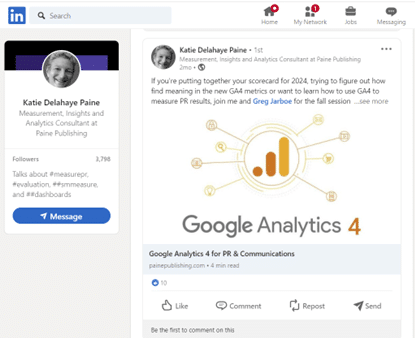
I was astounded to discover that the second listing – after the landing page on Paine’s website – was a LinkedIn page titled “Katie Delahaye Paine’s Post.”

AI assistant

When I clicked on the image at the bottom of the short post, it took me directly to the landing page.

In other words, the content that was over 15 times more valuable than even the post generated by Bard was an image that Paine had made into a clickable link. 

Now, there are various ways to add a link to an image. In Word, right-click the image and select “Link”. Then, type or paste the hyperlink address into the “Address” field. 

But you should use Google’s Campaign URL Builder tool to add campaign parameters to the URL so you can use GA4 to show your contribution to the bottom line.

You may discover that a picture is worth a thousand words – even if those words are generated by an expert or enthusiast who knows the topic well or three of the best generative AI tools for writing PR content.

The post What is the best generative AI tool for writing PR content? appeared first on Search Engine Land.

Original source: https://searchengineland.com/best-generative-ai-tool-writing-pr-content-432261