Compliance with the National Institute of Standards and Technology special publication 800-171 is mandatory for specific organizations in the US. These are organizations that process and store sensitive information for the government. Such institutions include universities, contractors in the defense department, and research institutions. NIST 800-171 aims at guiding non-federal agencies in protecting controlled, unclassified information throughout their business interactions with the government.
If your business handles sensitive government information, you must ensure it meets NIST 800-53 standards. You should create a strong system security plan that governs the handling of critical information. In this article, we delve into understanding the role of NIST 800-171 in providing information security.
Let’s get to it.
What Is NIST 800-171, and Why Does It Matter?
NIST 800-171 is a special publication that offers guidelines on protecting sensitive and unclassified information shared between non-federal entities and the U.S. government. It was published by the National Institute of Standards and Technology in June 2015.
If you are looking for a particular contract from the Department of Defense in the US, then your business must have proof of meeting the NIST 800-171 standards. Failure to meet these standards means the business cannot qualify for the contract. The Department of Defense considers the business not secure enough to deal with sensitive information in the government.
What Is the Role of NIST 800-171?
The main purpose of NIST 800-171 is to enhance the security posture of the federal government’s information system. The framework achieves that through the following:
Security Requirements
NIST 800-171 has 14 security requirement families. The families cover different facets of information security that institutions should adhere to. They include:
Authentication,
Identification,
Audit and accountability,
Configuration management,
Access control,
Incident response,
Awareness
The families collectively create a holistic approach that addresses important aspects of cyber security.
Protection of CUI
NIST 800-171 protects controlled unclassified information (CUI) from creation to when and how it is stored to how it is transmitted. After that, it gives guidelines on how the information should be destroyed. It has measures that organizations should follow to ensure unauthorized access, maintain confidentiality, and ensure data integrity.
Basic and Derived Security Requirements
There are two groups of security requirements in NIST 800 -171, basic and derived security requirements. Important security controls to be implemented lie under basic requirements. The following are some of the examples of basic security requirements:
Putting strong access control and user authentication processes
Ensuring regular updating of software to handle the known vulnerabilities
The use of encryption to secure the date that is at rest or in transit
Working on security awareness and training programs for the employees
Having well-outlined incident response processes and reporting mechanisms
On the other hand, derived requirements offer additional detail that must be tailored to the organization’s risk assessment and needs. They are meant for the unique risks experienced by any organization based on their unique nature of business operations. Examples of these requirements include:
Executing specific intrusion awareness and prevention procedures for particular threat vectors
Using multi-factor authentication to access critical systems
Creating mechanisms that help prevent data loss for specific CUI types
System and Security Assessment
The framework ensures that organizations conduct regular system and security control assessments. It helps them take note of any weaknesses and vulnerabilities. That way, these organizations can ascertain that their security measures are up-to-date and effective.
Risk Management
The security publication has great emphasis on the relevance of risk management. It instructs organizations to assess risks and implement effective control measures. They should also monitor their security posture and consistently update it to address emerging threats efficiently.
Security Plan and Documentation
The publication requires that organizations develop a system security plan outlining their security measures. There must be proof of ways in which the measures align with the requirements in the NIST SP 800-171. When organizations document their security policies, practices, and procedures, they abide by the rules of transparency and accountability.
Incident Response
The guidelines in the NIST SP 800-171 recommend that all organizations prioritize incident planning and execution. They should have planned what to do when there is a new security threat. It is about detecting, reporting, and responding effectively to security threats.
Continuous Improvement
The publication advocates for continuous improvement. It requires organizations to continuously learn from every security incident they experience and conduct regular assessments to refine the measures they have put in place to safeguard information over time.
If you’re a PPC manager, you likely spend a significant part of your week working on the Google Ads interface.
Several built-in features can help you work more efficiently, reducing time to access data and speeding up bulk edits so that you can focus on bigger-picture tasks.
This article will walk you through some examples and how to access them in the web UI.
1. Saved views
Previously launched as Workspaces, Views allow you to save a set of filters that will carry over as you navigate between campaigns, ad groups, keywords, and other sections of the UI.
These differ from just saving filters within the data table, which will reset once you go to a different section. They can be helpful when you have multiple campaigns divided up between lines of business, service lines, or geographies to allow quicker access without having to manually apply filters.
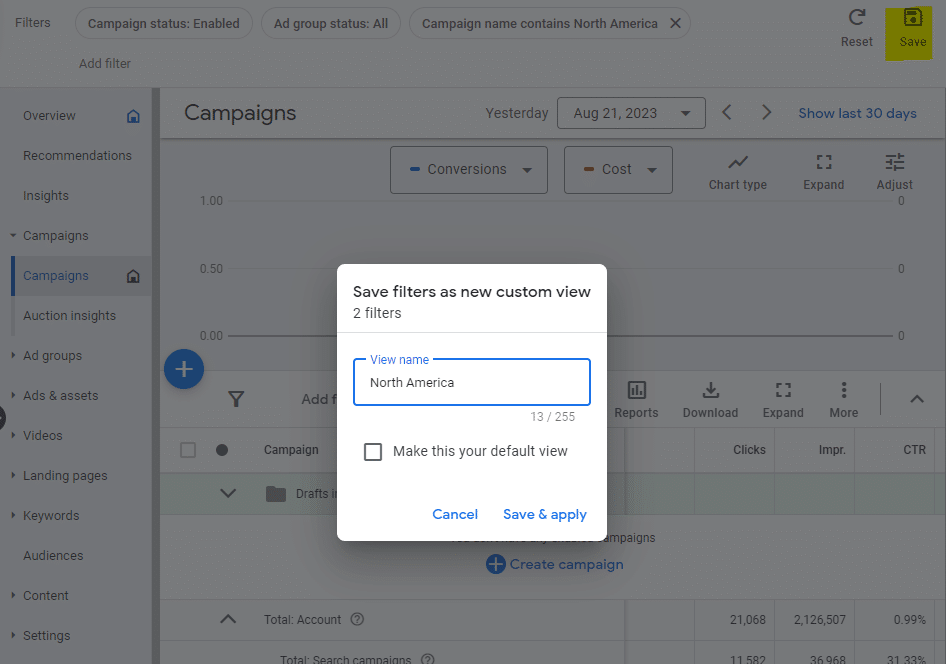
To create a view, apply the filters you’d like from the top bar in the UI and select Save in the upper right. Next, you’ll see a prompt to name and save your view.
In this example, we’re creating a filter to see all campaigns targeted toward North America.
In more advanced use cases, you could apply several filters together to narrow down what you’d like to see in a view.
In the future, you can apply saved views by going to the dropdown at the top of the left sidebar, selecting Views from the dropdown, and choosing your desired view to display.
2. Custom columns
With custom columns, you can create unique metrics to view in the UI, allowing for segmenting data beyond what’s available by default or using formulas to define more advanced metrics.
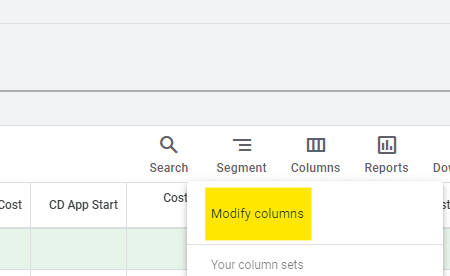
To create a custom column, select the Columns button above the data table in the UI and then choose Modify columns.
Next, select the + Custom column button in the upper right section of the window that appears.
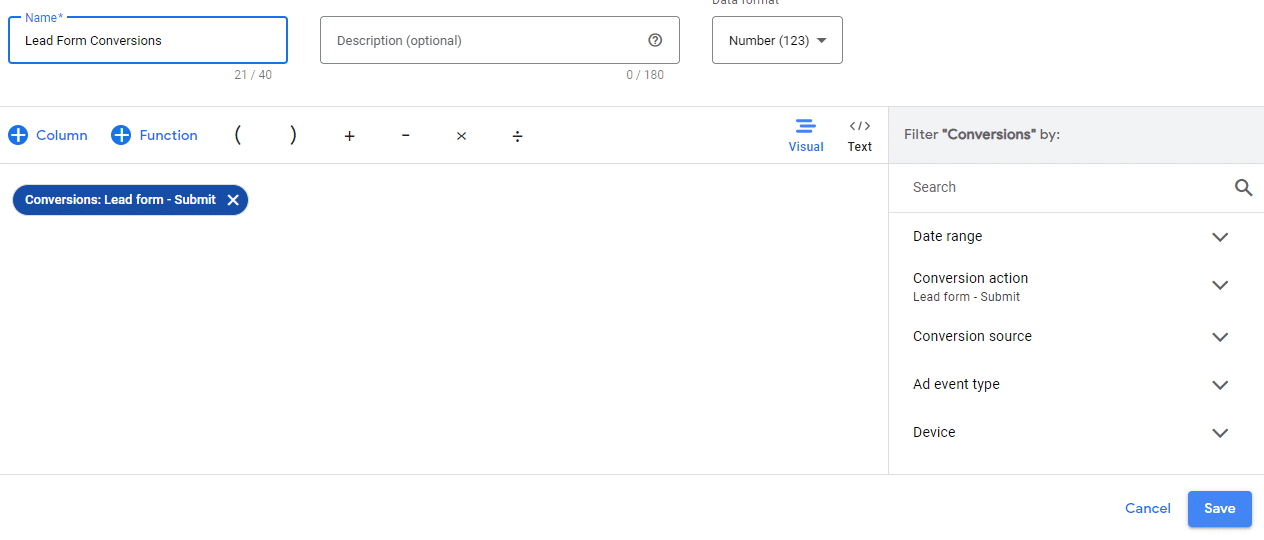
One popular use for custom columns can be to segment to individual conversion actions.
For instance, if you offer both free trial signups and demo registrations, you can create separate columns for each.
To do this, add the Conversions column and then use the right sidebar to filter by Conversion Action to the specific action you’re looking for.
You can even select multiple conversion actions to group together.
You can also select Conversion Rate or Cost Per Conversion metrics and filter those to specific actions to see additional metrics narrowed down.
Next, formulas can help to provide more advanced data in the UI. While you can get as complex as you want by incorporating custom logic, there are several more basic formulas to provide useful data.
For instance, the example below allows you to see the average cost over the past 7-day period vs. the daily budget, allowing you to know how much you’re overspending or underspending.
3. Saved column sets
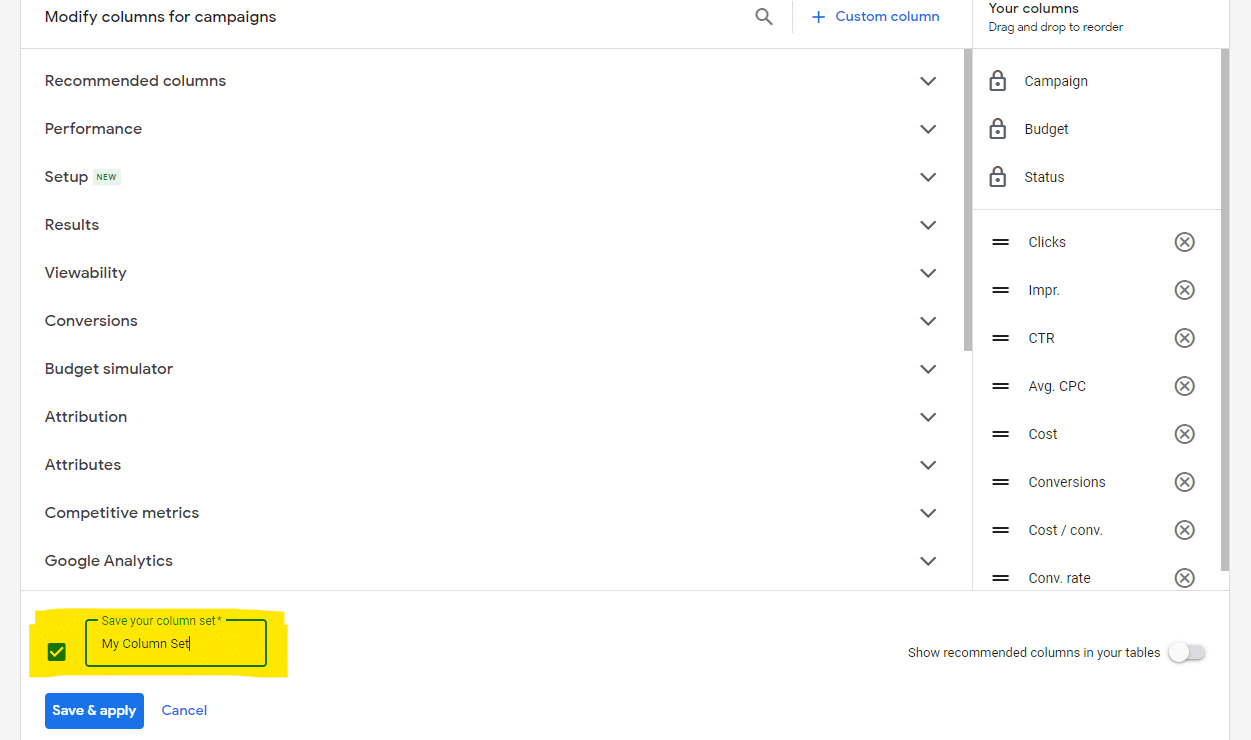
Often going hand-in-hand with custom columns, you can save a set of columns to quickly view data that’s most relevant to the campaigns you’re reviewing.
For instance, if you are tracking multiple conversion actions, you can set up a custom column set that breaks out those conversions separately.
Saved column sets can also reduce frustration from the sometimes arbitrary default columns that Google Ads chooses to display.
Once created, you can quickly select a column set from the Columns dropdown instead of manually adding the columns you want each time.
Get the daily newsletter search marketers rely on.
function getCookie(cname) {
let name = cname + “=”;
let decodedCookie = decodeURIComponent(document.cookie);
let ca = decodedCookie.split(‘;’);
for(let i = 0; i <ca.length; i++) {
let c = ca[i];
while (c.charAt(0) == ' ') {
c = c.substring(1);
}
if (c.indexOf(name) == 0) {
return c.substring(name.length, c.length);
}
}
return "";
}
document.getElementById('munchkinCookieInline').value = getCookie('_mkto_trk');
4. Policy Manager
If you’ve been managing Google Ads campaigns for some time, you’ve likely run into ad approval issues and had to appeal.
Unfortunately, you don’t receive any notification by default once an appeal is successful, and it’s a pain to have to sift through disapproved and “approved limited” ads in the interface if you are dealing with multiple policy issues simultaneously.
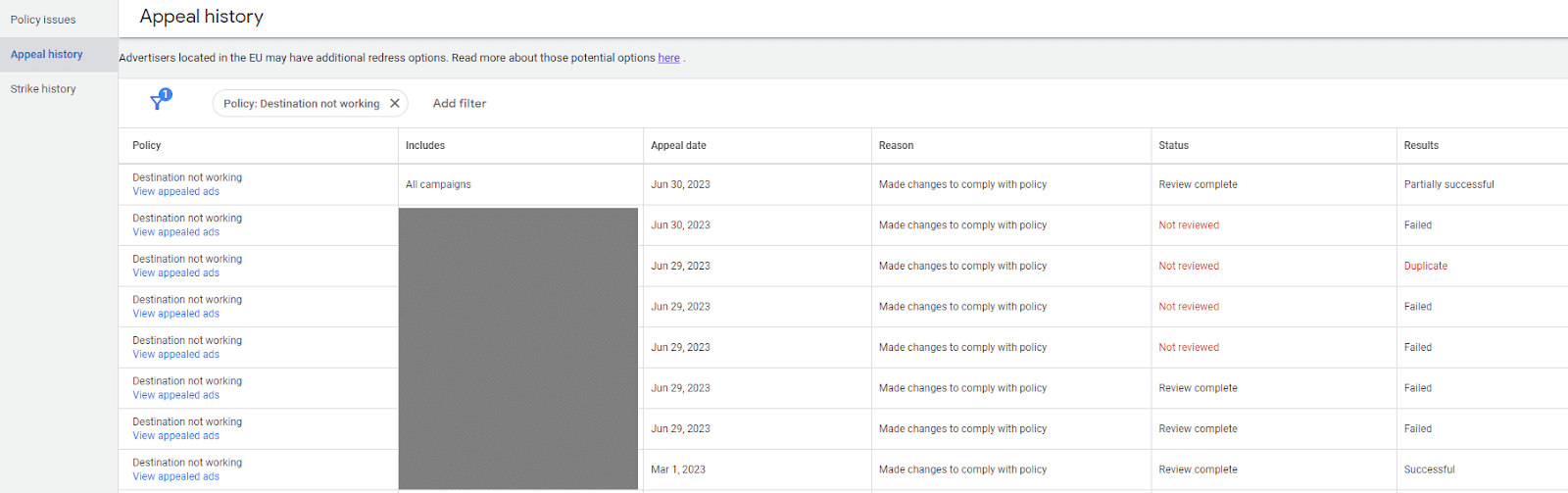
You also want to be careful about appealing the same issue too often, mainly if you’re waiting for a response from the first round of appeals. Thankfully, the Policy Manager offers a centralized place to monitor appeals.
Access this section by navigating to Tools and Settings from the top bar and selecting Policy Manager.
On the Policy Issues page, you’ll see a view of current violations, which you can appeal.
On the Appeal History page, you’ll see the status of appeals you have submitted, including the date and whether it was successful, failed, or is still pending.
5. Negative keyword and placement exclusion lists
Negative keywords are crucial to control spend and help ensure the relevance of traffic in search campaigns.
Using negative keyword lists can help you to be able to quickly and efficiently mark unwanted queries across your account instead of having to add them to individual campaigns.
You can create up to 20 negative keyword lists per account. Consider ways to categorize them based on your campaign structure.
For instance, you may have a catch-all negative list for obviously junky queries that you want to exclude across the board and a brand negative list that you only apply to non-brand campaigns.
Placement exclusion lists operate similarly but for display and video campaigns. You can select placements, including websites, mobile apps, YouTube channels, and YouTube videos.
Both can be accessed from Tools and Settings via the top navigation bar.
6. Automated rules and scripts
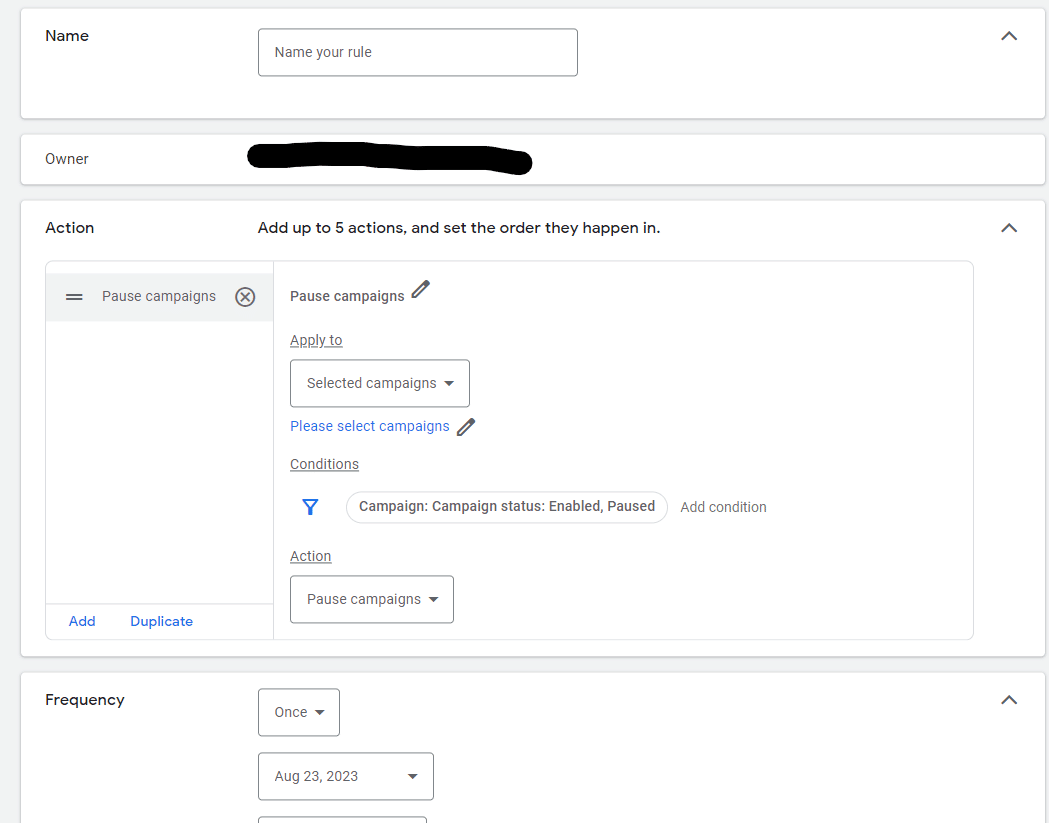
Automated rules are invaluable to set up simple bulk actions and notifications.
For instance, you may want to automatically pause campaigns over a holiday weekend and re-enable them afterward.
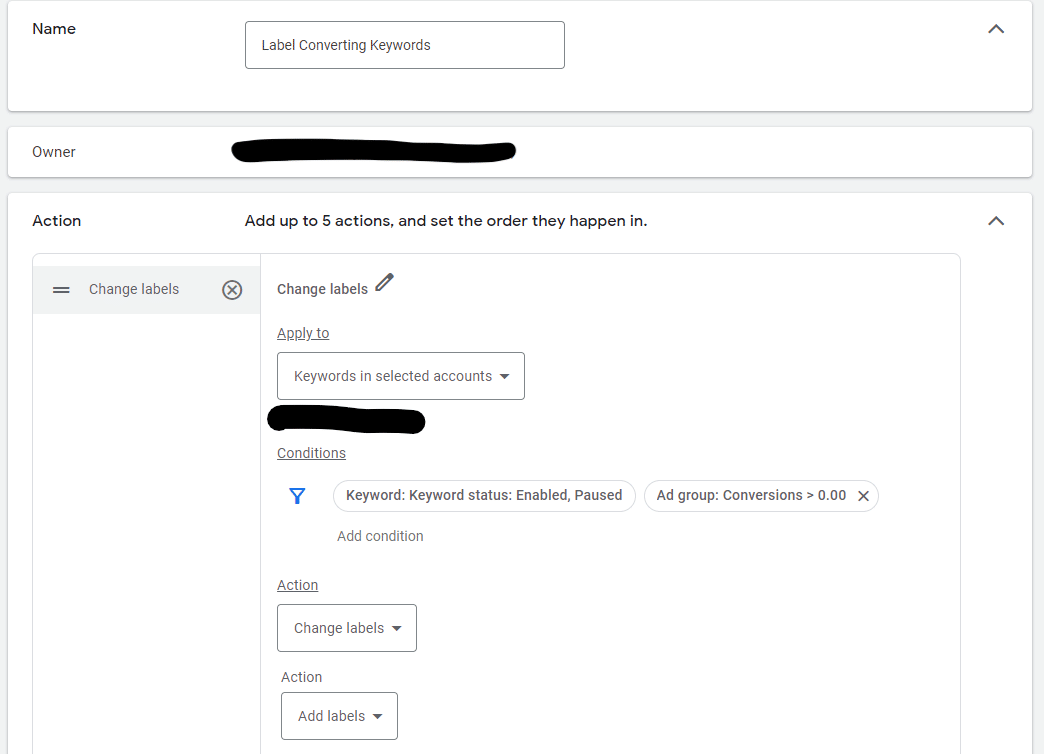
Another use for a rule could be to label keywords once they have received a conversion so you can see which ones have historically converted.
You can also use rules to send you notifications, such as when a campaign has spent over $10,000 in a 30-day timeframe.
Google Ads Scripts provides more advanced options for more complex bulk actions and campaign monitoring solutions.
You don’t necessarily need to know any JavaScript, as many helpful individuals have created ready-to-use scripts that you can copy and paste into the interface.
7. Asset library
The asset library in Google Ads allows you to see image, video, and text assets you’ve used in ads in one place. Access this section from the Tools and Settings dropdown on the top navigation bar.
If you’d like to upload images for future use in a responsive display ad, Discovery ad, or image extension, you can add them ahead of time here.
You can also create folders to organize assets by category and search for individual items.
Additionally, for assets with enough data, you can see top-level audience insights to view those most likely responding.
Start streamlining your Google Ads workflow
We’ve covered several sections of Google Ads that allow you to more easily review custom data, save time accessing reporting, and conduct edits in bulk.
If you come across features you haven’t tested, take some time to dig into the interface and think about how you could use them for your account.
What custom columns are applicable to your business KPIs?
Are you using negative keyword lists and placement exclusion lists to keep ads from showing up where you don’t want them?
Are there rules that could help you manage campaigns more efficiently or send notifications for anomalies?
Stay tuned to Google’s support section and announcements, as these features often change in name and location within the UI.
Decision fatigue refers to the progressive decline in the quality of choices made by an individual, brought on by the sheer volume of decisions one must make.
Essentially, the brain has a finite reserve of decision-making power, and as one navigates through many choices, this cognitive reserve becomes increasingly depleted. As a result, the quality of decisions made starts to deteriorate.
In SEO, the implications of decision fatigue are particularly salient. SEO professionals are faced with plenty of daily decisions, from selecting the right long-tailed keyphrases to optimize for to dissecting intricate analytics data from websites.
While some of these daily decisions may appear trivial and others vital, it’s crucial to recognize that they all draw from the same cognitive pool.
The brain isn’t equipped to differentiate between decisions of varying importance. Every choice consumes a portion of your finite decision-making energy.
As this cognitive reserve drains, one becomes increasingly susceptible to judgment, focus and productivity lapses. All outcomes can be particularly detrimental in the specialized field of SEO.
Consider, for example, the task of diagnosing the reasons for poor website performance. The decisions you make and plans you put in place to make much-needed improvements can be the make-or-break action for that business and its survival.
Beyond the desk
While SEO professionals need to manage decisions in the workplace, it’s important to remember that this doesn’t clock out when you do.
You’re faced with choices from the moment you wake up to the time you go to sleep. What outfit should you wear? Should you eat Frosted Flakes or Cheerios for breakfast? Should you call your dad on the way to work?
Though seemingly unimportant, these decisions draw from your finite reserve of decision-making “juice.”
These small choices add up, and before you know it, you may find yourself too mentally drained to make crucial decisions at work or in your personal life.
Therefore, managing this aspect of your cognitive health can pay dividends in multiple areas of life, including better focus and improved productivity.
Strategies for avoiding decision fatigue
Be more intentional about what decisions you focus on so that you don’t have to worry about the small stuff.
By adopting the strategies below, you can help preserve your decision-making capability for things that matter.
The power of habit formation
One effective way to manage decision fatigue is to create habits that remove the need in the first place.
Take, for example, your morning coffee. You don’t deliberate about it; you simply make it because it’s become a daily habit.
The same goes for actions like brushing your teeth, checking emails or scrolling through Instagram.
These actions are done almost automatically. You don’t need to think about it. You just do it.
Consider establishing more habits early on in the day whenever possible.
The strength of routine and choice
After forming habits, the next step is to weave them into a routine. A well-structured routine adds predictability to your day, reducing the cognitive load of making decisions.
For instance, if you’ve made it a habit to go for a run in the mornings, include it in your daily routine at a fixed time.
This removes any deliberation over “if” or “when” to do it. By structuring your day around solid routines, you create a framework that supports automatic behavior.
Another strategy to minimize decision fatigue is to deliberately limit your options.
A classic example is the wardrobe of many successful people, like Steve Jobs and his iconic black turtleneck.
The power of preparation
Preparation is a pre-emptive strike against decision fatigue. Here are some preparatory measures you can take:
Clothes preparation
Lay out your clothes the night before to avoid the morning dilemma of what to wear.
This can make your mornings more efficient and leave you less stressed, allowing you to start the day on a strong note.
To-do list preparation
Writing your to-do list the day before can have a similar effect.
It helps you organize your thoughts and eliminates the need to decide what task to tackle first when you start your workday.
Calendar scheduling and time blocking
Take this one step further by scheduling your calendar in advance and employing time-blocking techniques. Assign specific blocks of time to individual tasks or types of work.
This method streamlines your decision-making since you only have to follow the pre-established plan, sparing your cognitive load for more significant decisions.
Get the daily newsletter search marketers rely on.
function getCookie(cname) {
let name = cname + “=”;
let decodedCookie = decodeURIComponent(document.cookie);
let ca = decodedCookie.split(‘;’);
for(let i = 0; i <ca.length; i++) {
let c = ca[i];
while (c.charAt(0) == ' ') {
c = c.substring(1);
}
if (c.indexOf(name) == 0) {
return c.substring(name.length, c.length);
}
}
return "";
}
document.getElementById('munchkinCookieInline').value = getCookie('_mkto_trk');
Implement systems, processes and SOPs
Having a consistent set of processes, or standard operating procedures (SOPs), can be a lifesaver in the SEO industry.
It ensures that everyone on the team knows the steps for common tasks, minimizing the number of decisions needed for each project. Automation can also play a significant role in this.
For example, you can use tools that automatically track changes and provide summary updates instead of manually checking keyword rankings.
Reducing the number of low-level decisions you must make frees up mental energy for more complex strategic decisions.
Prioritize difficult work for high-energy times
One common recommendation for battling decision fatigue is to tackle the most demanding tasks early in the day during your peak energy levels.
For SEO professionals, this may include complex tasks like strategy planning, running in-depth analytics, or brainstorming content ideas.
As the day progresses, decision fatigue can set in, making it more difficult to focus and make sound judgments.
Starting with the most challenging work lets you take advantage of your freshest, most decision-capable self.
Incorporate rest periods and varied tasks
Rest is not just about getting adequate sleep. It’s also about giving yourself a break from constant decision-making.
Don’t jump from one complicated SEO project to another without taking time to recharge. Insert easier, less mentally taxing tasks between your major projects to provide your brain with a respite.
You might opt for more routine tasks like responding to emails, reviewing previously completed work, or updating your task list. This allows your mind to recover, improving your decision-making capability for the next challenging task.
Delegate wisely
Even if you are highly skilled, you can’t – and shouldn’t – make all the decisions yourself.
Delegate less important decisions to trusted team members to reserve your cognitive load for the decisions that truly require your expertise.
Empowering your team not only boosts their skills and confidence but also ensures that you are in the best mental state to tackle critical issues.
For example, let junior team members take on tasks like basic keyword research or managing social media updates while you focus on interpreting analytics or developing long-term SEO strategies.
Beating decision fatigue in SEO
The benefits are clear: improved focus, greater productivity, and, most crucially, better decision-making when it matters the most.
For SEO professionals, where the quality of each decision can directly impact a brand’s visibility and revenue, managing decision fatigue isn’t just advisable – it’s essential.
If you’re in the field of SEO, ignoring decision fatigue is not an option.
To stay at the top of your game, it’s crucial to understand that it exists and take proactive measures to mitigate its impact.
Doing so will enhance your professional performance and improve the quality of your life outside of work.
In the rapidly evolving landscape of technology, live streaming is emerging as a dynamic tool that has revolutionized the way we all experience different events. Whether it’s a conference, a concert, a webinar, or a product launch, live streaming offers a myriad of advantages that extend far beyond the physical limitations of a venue. But what are the mechanics of live streaming, how does it work, and what are its benefits for your event? Here are the answers to your top questions.
Understanding the mechanics
Live streaming involves broadcasting real-time audio and video content over the internet to a global audience. The process entails capturing the event using cameras and microphones, encoding the data into digital format, and transmitting it to a content delivery network or CDN. The CDN then distributes the content to various servers strategically placed around the world. These servers optimize the delivery to individual viewers, ensuring smooth playback regardless of their geographical location.
The advantages of live streaming your event
1. Global reach and audience engagement
As AV hire, video, and live streaming specialists confirm, live streaming erases geographical boundaries, allowing your event to reach a global audience. Attendees no longer need to be physically present to participate, broadening your event’s impact and fostering engagement with diverse demographics.
2. A cost-effective solution
We are all aware that hosting a physical event involves substantial expenses, including venue rental, travel, accommodation, and logistics. But live streaming significantly reduces these costs while maintaining the potential for widespread audience engagement.
3. Flexibility and convenience
With live streaming, attendees have the flexibility to join the event from their preferred devices – whether it’s a smartphone, tablet, laptop, or desktop computer. This convenience encourages higher attendance rates and provides viewers with the freedom to participate from the comfort of their own spaces.
4. Real-time interaction
Modern live-streaming platforms often feature chat or comment sections, enabling real-time interaction between speakers and viewers. This interactivity bridges the gap between physical and virtual attendance, allowing participants to ask questions, share insights, and engage in discussions.
5. Analytics and data insights
Live streaming platforms often provide analytics tools that offer valuable insights into viewer demographics, engagement levels, and viewing patterns. These data-driven insights can help you tailor your future events to cater to your audience’s preferences.
6. Extended content lifespan
Live-streamed events can be recorded and archived, giving them a longer lifespan beyond the actual broadcast. This means that even those who couldn’t attend in real time can access the content at a later date, enhancing the event’s value and relevance.
Final thoughts
Live streaming has emerged as a powerful tool that transforms the way events are conducted and experienced. Its global reach, cost-effectiveness, convenience, interactivity, and data insights have elevated it to an indispensable part of modern event planning. By harnessing the capabilities of live streaming, event organizers can extend their audience reach, engage participants on a deeper level, and create impactful experiences that transcend geographical limitations. Whether it’s a corporate seminar or a music festival, live streaming brings people together, fostering connections in an increasingly digital world. So, if you’re looking to take your event to the next level, consider embracing the world of live streaming for an unforgettable experience.
Utility deregulation is a hot-button issue, with strong arguments on both sides. As consumers, we must cut through the noise and understand the potential advantages and disadvantages of this pivotal shift in energy policies. This article aims to demystify utility deregulation and discuss its pros and cons to help consumers better understand this much-debated issue.
Understanding Utility Deregulation
Utility deregulation refers to the process of removing governmental control over energy markets, allowing private companies to compete for consumers’ business. Instead of relying on a single, government-regulated utility provider, energy consumers are free to choose from an array of providers, with each offering different pricing structures, energy sources, and services.
In some states like Texas, this freedom of choice has been implemented through online platforms which aid consumers in finding and comparing energy providers. The Power to Choose Texas initiative is one such example, where residents can explore various energy plans and choose the one that best suits their needs.
The Pros
There are several advantages to utility deregulation that can result in benefits for both consumers and the energy industry as a whole:
Competitive Pricing: In a deregulated market, consumers can shop around and select from available energy providers, often leading to competitive pricing based on supply and demand.
Innovation: Competition can drive innovation in the energy sector, with providers developing new technologies and services.
Efficiency: Deregulation can result in increased overall efficiency as businesses work to streamline processes, reduce costs, and improve customer satisfaction.
Customization: Consumers can choose from a variety of service offerings, tailoring energy usage according to personal needs and preferences.
The Cons
However, there are also potential disadvantages that come with utility deregulation. These can include:
Market Volatility: Fluctuating prices can be a concern in deregulated markets as supply and demand dictate market rates, which may mean increased prices for consumers during peak demand times.
Deregulation Failures: Some deregulation attempts have led to market failures, most notably the 2000-2001 California electricity crisis, which resulted in rolling blackouts and drastically increased energy prices.
Consumer Confusion: With a greater number of choices, consumers may find it difficult to make informed decisions regarding energy providers and service offerings.
Decreased Reliability: The potential for multiple energy providers operating on an already strained infrastructure could result in increased instances of blackouts and power outages.
Long-term Effects of Utility Deregulation
As utility deregulation continues to evolve, its long-term effects on energy markets and consumers remain uncertain. Deregulated markets are especially susceptible to unforeseen market forces and can be influenced by external factors, such as changes in regional or global energy policies. As a result, it is crucial for governments, regulatory bodies, and energy providers to monitor and adapt to potential shifts in the market.
Utility deregulation may have mixed effects on the adoption of renewable energy. On one hand, consumers may actively seek out providers that offer renewable energy options, thus driving market demand. On the other hand, there’s a risk that traditional energy sources will still dominate the market if they are more economically viable or convenient for providers.
Consumer Perspectives
Consumers play a critical role in the success of utility deregulation. By staying informed about their energy options, advocating for greater transparency within the marketplace, and demanding higher standards from providers, consumers can drive the improvements and innovation necessary for a successful and sustainable deregulated energy market.
Utility deregulation is not unique to the United States. Countries around the world have experimented with various forms of energy market liberalization, with varying degrees of success. As such, a comparative analysis of international case studies can provide valuable insights into the potential risks, benefits, and best practices for deregulated energy markets globally.
Regulatory Oversight
Though utility deregulation aims to reduce governmental control, some level of oversight is still necessary to protect consumers from potential market manipulation and anti-competitive behavior by energy providers. This can be a challenging balance for regulatory bodies to maintain.
Utility deregulation has its potential benefits, such as competitive pricing, increased innovation, and greater efficiency. However, there are legitimate concerns about market volatility, implementation failures, and consumer confusion, among other issues. As consumers, it’s crucial to stay informed about the ever-evolving energy landscape and understand the implications of policies like utility deregulation on our daily lives and energy choices.
With the rise of artificial intelligence, entrepreneurs have been able to revolutionize how they operate and grow their businesses. One of the most substantial contributions has been various machine learning applications. Implementing machine learning allows entrepreneurs to compete with successful organizations without incurring high costs, make better business decisions, enhance productivity levels, and much more, ultimately leading to higher growth.
When used right, machine learning algorithms can empower entrepreneurs to achieve a competitive edge over both small businesses and large enterprises. In my experience as the founder of the 88stacks AI image generator (which provides easy-to-use and affordable tools to democratize access to generative modeling and images), I have discovered many ways entrepreneurs can leverage machine learning for business growth. Here are 6 of them:
Personalized Customer Experience
Business leaders can utilize machine learning algorithms to instantly analyze customer data and behavior. This is essential for an entrepreneur, because if they better understand their customers’ needs and preferences, they will be able to tailor their experiences accordingly. This ultimately leads to a much more impactful, data-driven approach to personalizing buyer experiences and marketing campaigns that amplify customer satisfaction and brand loyalty.
It is vital to integrate personalization across all customer touch points, including social media advertisements, email blasts, and Google Ads. This will ensure that the customer experience is consistent and tailored specifically to each buyer’s needs across all channels. Customers are more likely to stay loyal to any business that provides a personalized experience and truly understands their preferences — personalization can significantly improve brand engagement.
Think about it — a stay-at-home mom and the CEO of a major international corporation may both be in the market for the same product. Machine learning can be used to tailor online advertisements about the product so they better resonate with these two individuals. The ad that the mom sees can show a family using the product in the home, and the ad the CEO sees can show the product being used in an office space.
Predictive Analytics
Predictive analytics uses machine learning algorithms to identify the probability of future outcomes based on historical data. Through analyzing customer behavior data like past purchases, the current state of the market, and potential trends (for example, the upcoming holiday shopping season), predictive analytics backed by machine learning helps entrepreneurs understand customers’ preferences and the demands of prospective buyers.
Business leaders can leverage this to forecast new trends, customer demands, and potential business opportunities. This leads to more flexible decision-making and strategies and helps to increase overall profits.
Fraud Detection & Risk Management
Fraud and data breaches can cause a mass of customers to lose their trust in a company and decide to give their future business elsewhere. Thus, when it comes to fraud detection and risk management, business leaders need quick and accurate results. The amount of time spent manually scanning and reviewing information can be drastically reduced by machine learning. Entrepreneurs can implement machine learning models to detect fraudulent activities, mitigate risks, and enhance the security of financial transactions and sensitive data.
Using machine learning for fraud detection is like having several teams running analysis on hundreds of thousands of transactions per second. Machine learning models can often be more effective than humans at uncovering subtle trends and patterns. These models are also very fast to adapt to changes and can identify both suspicious customers and fraudulent transaction patterns. Fraud and security attacks can also happen 24/7, and machine learning algorithms don’t need breaks or sleep. On top of this, entrepreneurs don’t have to worry about any human error that could potentially occur from manually checking data.
Process Automation
There is no doubt that process automation is key for startups to excel and grow. Automating repetitive tasks and workflows using machine learning allows valuable time and resources to be focused on more strategic aspects of the business (like new client prospecting). Automating business processes reduces costs and human error, improves efficiency, and delivers a higher quality of work. Machine learning can help entrepreneurs create automated systems that perform repetitive and standardized tasks, like data entry or sending email check-ins to client leads, all while providing reliable and accurate results.
These automated systems can process massive amounts of data quickly and efficiently, all while adapting to any changes in business activities. Employing machine learning for automation lets startups streamline operations and workflows, all while improving the flexibility of automated processes.
Sentiment Analysis and Customer Feedback
It is pivotal for startups to constantly look for ways to grow and improve, and customer feedback provides valuable insights into what is working and what isn’t. Through conducting sentiment analysis and examining customer feedback, startups can gain insights into what buyers like and dislike about their business. That said, entrepreneurs can apply machine learning to sort through and analyze thousands of customer reviews and feedback across various channels in a matter of seconds.
This helps company leaders identify areas for improvement and make better business decisions that lead to product/service improvements, customer service enhancements, and brand reputation management.
Supply Chain Optimization
Machine learning algorithms can analyze vast amounts of complex real-time and historical data and use the findings to generate highly accurate demand forecasts, ultimately enhancing supply chain management. Entrepreneurs can use machine learning algorithms to optimize inventory management, logistics, and supply chain operations. Also, machine learning can significantly shorten lead times and allow startups to be more responsive to market changes.
This all helps reduce costs and improve overall efficiency in the delivery of products and services. Machine learning-driven supply chain optimization enables companies to provide a more responsive service, resulting in higher customer satisfaction. Entrepreneurs can also leverage advanced analytics to identify opportunities, trends, and patterns for improvement that lead to increased profitability and better business processes.
To Wrap It All Up
Artificial intelligence and machine learning have revolutionized how businesses in virtually every industry operate. Entrepreneurs can use machine learning algorithms to personalize customer experiences, amplify risk detection and fraud management, automate business processes, analyze customer feedback and sentiments, conduct predictive analysis, and optimize supply chains. These are just a few ways that business leaders can employ machine learning to gain a competitive edge, increase productivity, reduce costs, and boost customer satisfaction and profits.
Technically speaking, results are possible within days if you get content live and indexed quickly.
But ironically, that’s often the part that gets stalled.
Things just simply don’t go live – sometimes for months or even years.
In the marketing era of “do more with less,” SEOs have more pressure than ever before to generate impact from the work they do.
So that means content go-live and regular technical SEO updates happening efficiently is an absolute must.
That’s where operations become the key to success.
With structured operational processes, you ensure that you have the maximum impact with minimum time and resources.
To help you achieve this, let’s explore how to structure people operations to quickly and effectively scale SEO success.
The biggest roadblock to scaling SEO: People operations
The biggest roadblock to scaling SEO isn’t the technique itself. Instead, what takes so long is the operations behind SEO and the process of aligning everyone.
People tend to disagree on what content is produced, how much content needs to be produced, who gets a say in editing, etc., which immensely elongates the entire process.
To make things even trickier, the biggest roadblock of all is development time. The development team is often a department grab from product or IT, and they end up with task overload.
Because of this, SEO tasks end up low on their priority list, so things just sit there.
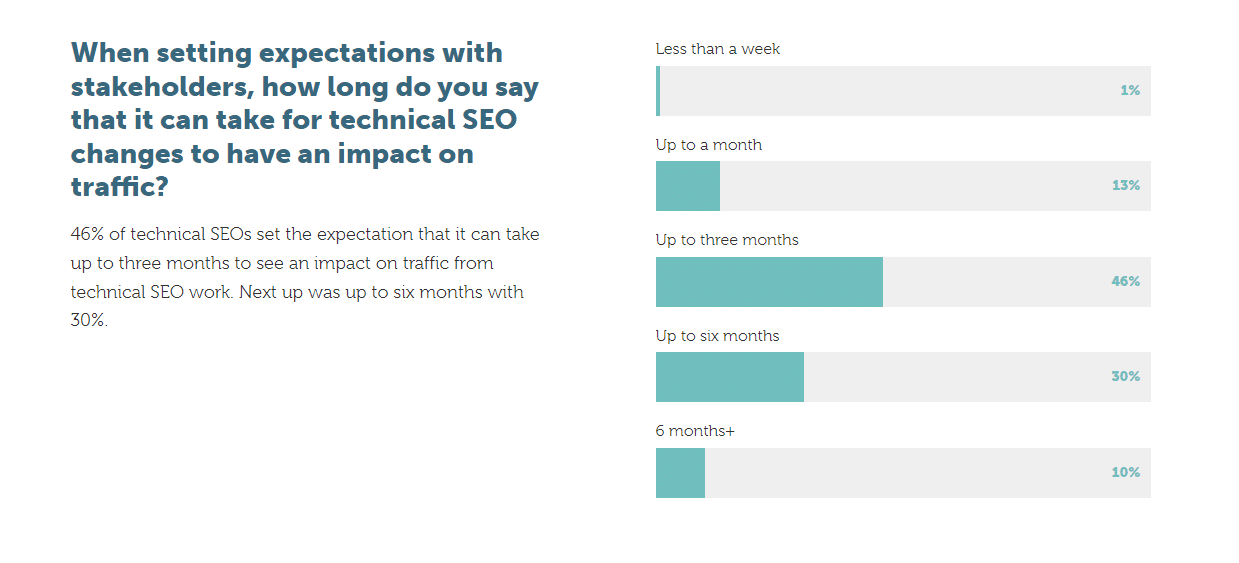
The biggest issue that hinders technical SEO progress is that “no one can get changes made,” asevidenced by Aira’s technical SEO survey of 500 SEOs.
The same survey also mentions that technical changes can take up to three months or longer to go live and start impacting traffic.
With these common issues, stakeholder investment in SEO often stalls because “it takes too long.”
But in today’s highly competitive world of SEO, especially with AI, the one who wins is the one with speed.
Nonetheless, speed in SEO doesn’t mean just putting out content randomly (although some might say that’s better than having no content go live at all).
True SEO success involves methodical and highly structured processes poised to impact from the first day SEO is even muttered – actually, long before content and technical updates go live.
In today’s market, it takes a significant investment to see results. So, before you get started, it’s important to establish the foundation from the get-go.
You establish product-market fit by reviewing whether your target audience needs your product or service.
In the context of SEO, they actively search for your product or service – or at least related topics. You’ll also want to check to see if there’s enough search volume around these topics to generate ROI for the investment in SEO.
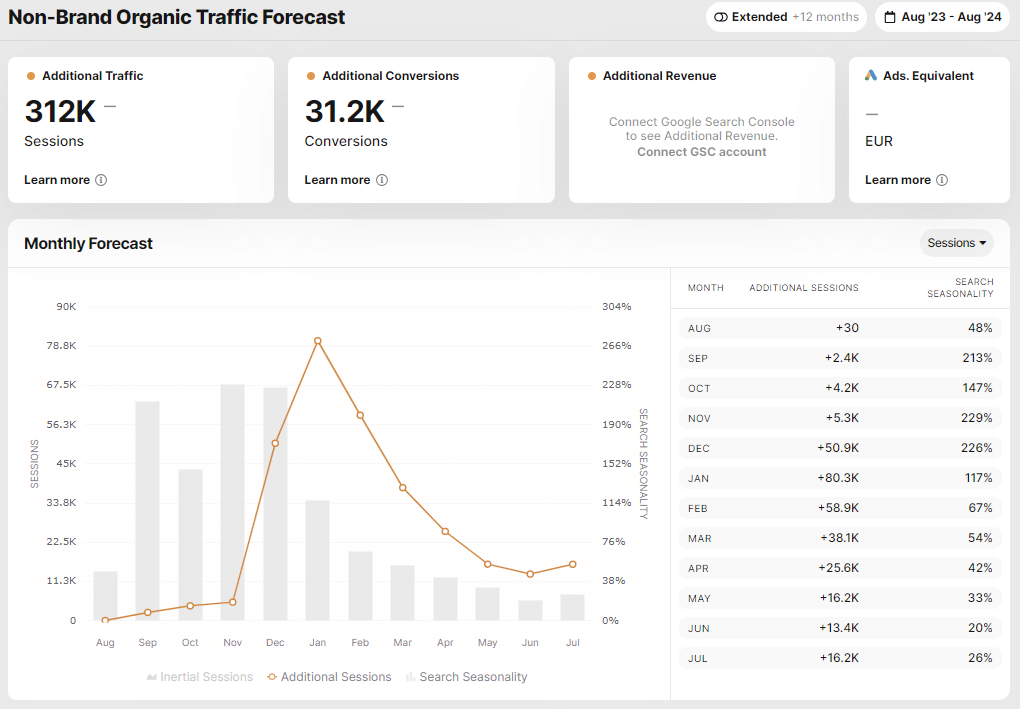
You can use SEOmonitor to forecast the results you can expect.
To give you an idea, here’s a quick example I created for an ecommerce company that wants to expand into Germany.
I checked the SEO impact of optimizing and localizing 30 primary product category pages:
These pages would generate 312,000 more organic traffic to their website and over 30,000 additional conversions within a year once content is live and ranking. Compared with the average order value (AOV) for their products, this SEO investment is super worth it!
Step 2: Ensure management provides enough resources by forecasting results
Use your forecast to try and determine how many resources you’ll need compared to how much ROI you’ll generate.
When you show an estimate of the ROI, management is much more likely to give you the resources you need to do SEO well, including a full team and the tech required. And when you have those crucial resources, you’ll be able to generate results more quickly.
Here are a few examples of calculating SEO ROI for stakeholders, beginning with ecommerce:
Ecommerce SEO ROI Forecast
Organic Monthly Traffic (based on industry average CTR of 6%)
6,000
Ecommerce Conversion Rate (conversion rate milestone within 6 months)
2%
Average Order Value
EUR 1,290
Operational Costs
EUR 18,000
Monthly Sales from Traffic
120
Cost Per Sale
150 EUR
Estimated Monthly Revenue from Sales from Traffic
154,800 EUR
ROI
760%
So whether you’ve used SEOmonitor or have estimated an organic traffic growth milestone, add that data to a table like this.
Next, calculate the amount of conversions from that traffic according to your estimated conversion rate multiplied by the average order value.
Subtract operational costs, and then get the forecasted KPIs for monthly sales from traffic, cost per sale, estimated monthly revenue and ROI.
Below is an example of an SEO impact forecast for B2B. It’s slightly different from ecommerce because there is no direct sales:
Complex B2B SEO Generated Revenue Forecast
Monthly Organic Traffic (across 6 months)
10,400 -> 13,520 (30% increase)
Organic Traffic Conversion Rate (conversion rate milestone within 6 months)
2%
Free Trials / Demos (SQLs)
270
Average Contract Value
ARR $714M / 11,000 customers = $65,000
Lead to Close Rate
5%
Deals Closed
13 sales x $65,000
Gross Revenue
$845,000 per month
In this case, you would follow a process similar to ecommerce but instead swap out free trials / demos or a contact CTA with sales qualified leads (SQLs).
Average contract value is then the same as in AOV for ecommerce. So, based on the amount of SQLs, calculate how many leads might close and how much those contracts are worth, subtract operational costs, and then you’ve got the estimated gross revenue generated from SEO.
Step 3: Organize project roles and operational workflows
Once you get management on board and your SEO strategy is structured around search intent match keywords and content that builds authority around your products and services, you’ll need to establish concrete roles for everyone involved in the project.
This provides a clear understanding of who is doing what, which creates an operational workflow that becomes an easily repeatable and scalable template.
For example, organize the following roles and responsibilities:
Project manager: Ensures that the project is on time and on budget by assigning tasks to specific people and sending deadline reminders.
Content strategist: Creates and manages the production and implementation of the SEO strategy.
Content writer: Writes the content, typically as a subject matter expert or compiles information from them.
Editor: Edits and proofreads the writing from the content writer to ensure technical accuracy and adherence to brand ToV guidelines.
Designer: Creates images for content and wireframes for pages that need specific custom designs.
Technical SEO: Oversees crawling, indexing, and general site functionality, particularly regarding page speed and UX/UI.
Developer: Responsible for uploading and creating the web pages based on the wireframes from the designer and input from the content strategist. They also make changes for site optimization based on instructions from technical SEO.
These responsibilities must be turned into a step-by-step workflow with clear deadlines. For ease of understanding, here’s a quick snapshot of a spreadsheet that uses a traffic light system to show project progress statuses and roles, but ideally, this should go into a project management tool like Asana.
Here are some other tips to help ensure this workflow functions well:
Have a dedicated developer for SEO instead of trying to borrow from the product or IT department. Someone should have a job dedicated entirely to SEO and nothing else.
Organize one person responsible for editing, as more than that, and it can slow down content production immensely.
Ensure workflows include website optimization, as much of SEO success comes from the optimization that’s done later. Whether the optimization is for CRO, technical SEO, or content, it’s important for SEO results. Don’t let updates sit and gather dust – get them live and take advantage of that positive impact opportunity!
Step 4: Keep track of budgets within operational workflows
Create a system to track budgets. You should keep track of budgets for specific milestones.
As you can see in the table below, each milestone is first separated by language and then by the person in charge.
It includes due date, status, estimated hours, actual hours, and the total cost for each role.
Month
Milestones
Date Due
Status
Person In Charge
Estimated Hours
Actual Hours(Total)
Cost
Cost (Total – Formula)
June 2023
SEO Strategy EN
30.06.23
Done
Project Manager
10
22.96
€70.00
€1,607.20
30.06.23
Done
Content Strategist
5
8.15
€50.00
€407.50
30.06.23
Done
Editor
5
0
€65.00
€0.00
30.06.23
Done
Content Writer
1500
0
€0.06
€0.00
30.06.23
Done
Content Writer
€0.09
€0.00
June 2023
SEO Strategy DE
30.06.23
Done
Technical SEO
10
23.43
€65.00
€1,522.95
30.06.23
Done
Content Strategist
10
5.69
€50.00
€284.50
30.06.23
Done
Designer
3.17
3.17
€38.00
€120.46
30.06.23
Done
Content Strategist
10
0
€65.00
€0.00
30.06.23
Done
Content Writer
1250
1250
€0.09
€112.50
30.06.23
Done
Content Writer
1250
1250
€0.06
€75.00
30.06.23
Done
Developer
3
3
€23.00
€69.00
You’ll also want to consider other costs when you’re calculating ROI. These should include technology, profit margin, sales, and CS costs.
Having this data compared with the current KPIs SEO is achieving is the direct information stakeholders need to assess SEO success and whether they’ll continue to invest in it.
Step 5: Create conversion tracking and reporting systems
Have a system for tracking and analysis. This is a commonly overlooked yet absolutely critical component of SEO.
If you want to get more investment in your SEO strategy, you need to prove that the resources required for SEO on an ongoing basis are worth it and are generating results. Essentially, you need to “learn to speak the stakeholder language.”
After a few months of implementing SEO – depending on your sales cycle, content indexing speed, and page rankings – you should see conversions, leads, and even some new sales.
However, to track that this came from SEO, you need to have a system set up in the first place. This should include everything from initial strategy creation through to the sale itself. In doing so, you’ll be better equipped to show that conversions came from SEO efforts.
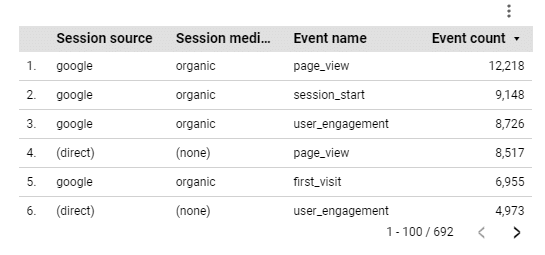
The best way to do this is to track basic SEO KPIs (keyword rankings, organic traffic, organic CTR, backlinks), engagement, conversion sources, and revenue.
Typically done in GA4 or a CRM, tracking SEO KPIs might look like this:
Tracking engagement:
Tracking conversion sources:
Tracking revenue (completed sales like in ecommerce) or potential revenue from leads:
Organize the data based on your specific business and take time to regularly present this data to stakeholders without overcomplicating it.
Having your numbers ready when they ask or even offering them up in advance will create a more positive impression of SEO progress and its impact on the business.
Scaling SEO isn’t about time – it’s about organizing people
The biggest roadblock to SEO isn’t the SEO itself – it’s the operations required to apply techniques and keep them moving forward.
The best way to achieve this is to spend time creating an organized structure of people, their roles, budgets, and action items.
Start by making sure there’s an actual need or demand for your product or service.
Next, ensure you have enough resources to accurately forecast potential results, and then break down the project into operational roles and responsibilities.
Throughout the project, keep track of budgets and create a process to track your ROI that better showcases the impact of SEO to stakeholders and decision-makers.
Remember, scaling SEO isn’t solely about the time spent on the project or how much time passes – it’s about efficiently organizing people to get things live.
Search marketing is an ever-changing industry, but even amid the generative AI movement, one thing remains constant: keywords.
Identifying the most valuable keywords for your business can make or break your visibility and online presence and put distance between you and your competition. But only when it’s appropriately harnessed.
Learning to do strategic keyword research for SEO allows you to navigate the clutter and noise of search marketing, leading you to the treasure trove of targeted traffic, higher rankings, and increased conversions.
Keyword research goes beyond simply finding popular words or phrases, though. It involves understanding the trifecta of volume, difficulty, and intent.
Volume tells you how often people search for specific keywords.
Difficulty gauges the competition you’ll face.
Intent reveals the underlying purpose of user searches.
Clarifying how to use these three data points will help you create a crystal-clear keyword strategy for your business.
Understanding keyword volume
Keyword volume represents the number of times a keyword is searched for within a given time frame, providing valuable insights into user behavior and search trends and indicating the potential traffic and visibility that a given keyword can bring to your website.
High-volume keywords can be a goldmine, attracting significant organic traffic and potential customers.
On the other hand, low-volume keywords may have less competition (we’ll get to that next), allowing you to carve out a niche and target a specific audience.
Finding high-volume keywords relevant to your business is the ultimate goal of keyword research.
You want to uncover those hidden gems with a high search volume that align with your products, services, or industry.
To find these, start by brainstorming relevant terms and phrases that your target audience might use when searching for solutions or information related to your business.
Put yourself in your target customer’s shoes and think about the language they would use.
Then, leverage keyword research tools to explore the search volume for these keywords and identify the ones with substantial search traffic.
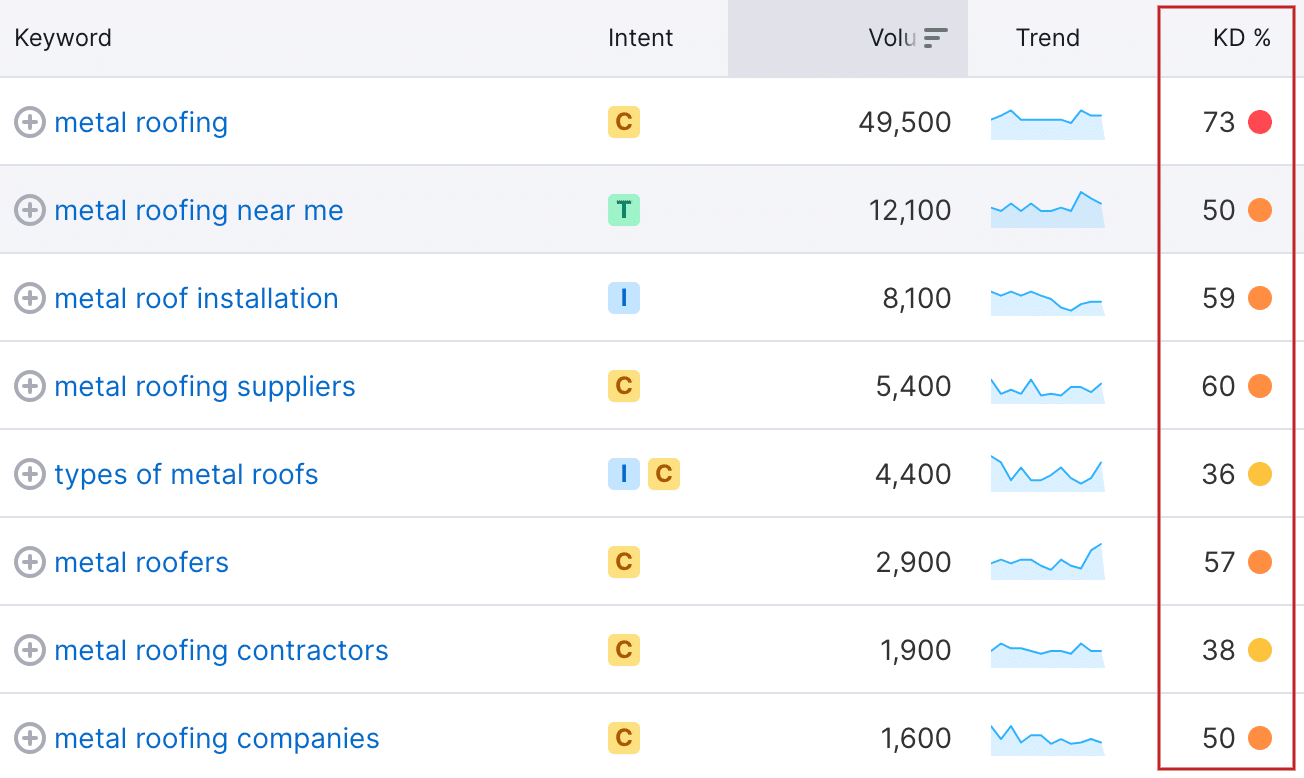
For example, if you’re a roofing company offering various types and styles of roofs, but you want to bring more traffic and awareness to your metal roofing option, you would want to explore a few variations of key phrases your customers might search to find the more commonly used terms.
Here are a few to consider:
Here you can see the average number of times per month each keyword is searched in the Volume column to assess what keyword you might like to go after with your metal roofing service page.
But remember, it’s not just about chasing the highest volume keywords mindlessly. You also need to consider the relevance and competition associated with those keywords.
Finding a balance between high volume and achievable competition is the key to success.
Evaluating keyword difficulty
Keyword difficulty measures how challenging it is to rank for a specific keyword. We turn to our trusty tools to assess keyword difficulty and calculate the factors influencing it.
We’re talking about things like the number of websites already ranking for the keyword, the quality and authority of those websites, SERP features, etc.
A good keyword research strategy is a balance of finding that sweet spot between high-volume and low-difficulty keywords.
You want to target keywords with decent search volume but aren’t overrun by fierce competitors. It’s about choosing your battles wisely and focusing on those keywords where you have a fighting chance.
Choose a keyword difficulty that isn’t more than 10-15% points higher than your current domain authority (a metric you can measure in those all-in-one search marketing platforms mentioned above). This will give you a fighting chance of ranking with the right content.
Following the metal roofing company example, if your domain authority score is sitting at 30, you’ll want to target keywords with a difficulty score between 20-40.
Your site should rank pretty quickly for the keywords with a difficulty under 30. Anything above that will provide a bit more of a challenge for those top 3 spots in the search results, but getting ranked higher for those terms will also help to grow your domain authority over time.
Looking at those same keywords, I would say “types of metal roofs” and “metal roofing contractors” are achievable to rank for with our current domain authority.
SEO is a long game. It’s about finding that delicate balance and adapting your strategy.
Start with a viable strategy now, and as your domain authority builds, you can go after more competitive terms in time.
Matching user intent
User intent refers to the underlying purpose or motivation behind a search query. This is where the scientific field of SEO turns into an art form, open to interpretation.
Identifying the keyword intent is all about deciphering the hidden meaning behind someone’s words.
Users who type their queries into search engines have a specific goal in mind. It could be:
Researching information.
Navigating to a particular website.
Finding a solution.
Completing a transaction.
And more.
User intent is most commonly broken down into four different types. Let’s break it down:
Informational intent
This is when users seek knowledge, answers, or solutions to their questions.
They might search for “how-to” guides, tutorials, or informative articles. Meet their search with a blog or long-form informational landing page on your website.
Navigational Intent
Users with navigational intent already have a specific website or brand in mind. They want to navigate directly to that website.
They might search for the brand name or particular URLs. Meet their search with your company information like an About or Location page.
Commercial Intent
These users are in the investigational research phase and are likely to consider a purchase. They’re looking for product comparisons, reviews, or pricing information.
For example, “best software for bookkeeping” or “top trail running shoes.”
Meet their search with a long-form service page, a UX-optimized homepage, or a great “top products” blog post, depending on your business.
Transactional Intent
Users with transactional intent are ready to take action. They want to make a purchase, sign up for a service, or complete a transaction.
They might search for keywords like “buy,” “order,” or “sign up.” Meet their search with a product or service page with an appropriate CTA.
You’ll want to analyze search engine results to align your keyword targeting with user intent. See what types of content are ranking for specific keywords.
Look at the top-ranking pages and ask yourself, “Does my content align with what users expect to find?”
It’s about stepping into the shoes of your target audience and providing them with the answers and solutions they seek.
Coming back to the metal roofing example, if it’s between “types of metal roofs” or “metal roofing contractor,” we would choose “metal roofing contractor” based on the commercial user intent.
The intent on “types of metal roofs” does show possible commercial intent.
Still, after looking at the other content ranking for this keyword, we would quickly determine that this is a keyword for a blog or other content piece.
By understanding user intent and creating content that addresses it, you improve the user experience and increase your chances of conversions and customer satisfaction.
With some background in making good keyword strategy decisions, here are some best practices to get going with your research.
Conduct comprehensive keyword research
Don’t limit yourself to a handful of keywords. Cast a wide net from the start to explore various keywords to ensure you get all hidden gems instead of only the obvious terms.
Use keyword research tools, brainstorming sessions with coworkers and customers, and competitor analysis to gather a diverse pool of potential keywords.
Prioritize keywords based on the trifecta
Not all keywords are created equal. You need to prioritize based on the trifecta factors.
Identify keywords with a decent search volume that align with your business goals and have a realistic difficulty level.
Also, consider different variations of words (e.g., past or present tense) as you explore the meaningful keywords for your business and audience.
Create content that addresses user intent
Develop content that satisfies the needs and intentions of your target audience. Whether it’s informative blog posts, engaging videos, or interactive guides, tailor your content to align with user intent.
Not sure what language your customers use or what questions they ask?
Talk to your sales and customer service teams to see if they have a list of common objections or frequently asked questions. That is a great place to create a keyword-focused and in-demand content plan.
After identifying your most valuable keywords, the last thing you want to do is target them with the wrong piece of content.
Don’t take that high-volume informational keyword and optimize your product page to get more purchases. Those users are merely looking for more knowledge and are not ready to buy.
Meeting the user intent with the right pieces of content satisfies the customer and rewards your website authority with positive ranking signals.
SEO is constantly evolving. Keep an eye on your keyword performance and be ready to make adjustments as needed.
In-market language can change over time as trends ebb and flow. Analyze the data, track rankings, and listen to what your audience is saying.
Keep your landing pages and content fresh with your top target keywords, but feel free to tweak those keywords as your audience broadens.
Remember to stay agile and adapt your keyword strategy as needed.
Keep experimenting, testing, and refining your approach to stay ahead of the latest search trends and ahead of your competitors.
Where to get your keyword data
You can choose a range of free and paid tools to gather the data points we discussed above. Below are a few options:
Google Keyword Planner
This free tool allows you to explore keyword ideas, analyze search volumes, and even get insights into the competitiveness of specific keywords.
Ubersuggest
This “freemium” tool allows you a few searches per month for data before needing a paid account. It’s a great introductory all-in-one tool if you’re starting out.
Search marketing platforms
A few all-in-one paid tools like Semrush, Ahrefs, and Moz provide all the data you need and some nifty tools for digging deeper when you conquer your keyword strategy, giving you a comprehensive understanding of the search landscape.
Consider volume, difficulty and intent for a solid keyword strategy
Keyword research is not a one-time endeavor. It’s a continuous journey of growth and optimization.
Keyword research isn’t going out of style anytime soon. Even generative AI needs to use language and commonly used search terms.
So if you’re starting to scratch the surface or are ready to dig deeper into keyword research and SEO, you’re on the right path. Just keep going.
Let your curiosity be your compass, your creativity be your fuel, and your commitment be your guiding light.
Soon, your expertly selected target keywords will help you connect with your audience, elevate your online presence, and drive more conversions for your business.
Have you recently launched a new business and don’t know how to make it more efficient? Or, are you having a hard time landing new customers and can’t quite figure out how to take your startup to the next level? You are not alone — many new entrepreneurs experience these struggles early on in their business journey and wonder if they should just go back to the comfort and security of a 9-to-5 job. Let me be the one to tell you this: DON’T give up on your entrepreneurial endeavors, as you can and will overcome these challenges.
I have launched and grown over a dozen businesses and know firsthand the struggles that so many new entrepreneurs face after they launch a startup. In my journey as the owner ofKairos Venture Studios, which specializes in launching new online businesses in the Latin American market, I have discovered a number of small-but-impactful ways entrepreneurs can optimize their startups and amplify business success. Here are 6 of them to keep in mind:
Ramp Up Productivity with Time Blocking
It is so easy for each day to fly by without finding the time for deep, uninterrupted work on projects that move your business forward. I get it — emails are constantly flooding your inbox, your business associates call at random times (and these phone conversations last over an hour), and so on. However, it is pertinent to make the time to check in with new client leads, plan and implement new marketing strategies, and work on other initiatives that lead to business growth. You can do this by scheduling your workdays two weeks out using time blocking.
Time blocking will help you stay on top of all of your work tasks, complete projects before their deadlines, and ensure that you never forget about projects that need to be worked on. To do this effectively, make sure to block out time in a scheduling tool (like Google Calendar) for the three most important tasks you need to complete every day, and also schedule blocks of time to answer emails and complete miscellaneous tasks. Since you already know what you need to work on each day from planning in advance, you will never waste time on trying to figure out the next task to work on.
Hire a Freelance Virtual Assistant ASAP
Even though you are in the early stages of your business journey, you likely already know what tasks consume the most time in your workday. Are they answering emails? Data entry? Replying to comments on your business’s social media channels? Don’t let these everyday work tasks take up your time any longer. Hire a virtual assistant as soon as possible to take over these tasks, as they will help optimize workflow and amplify the success of your company.
Entrepreneurs should hire a virtual assistant when their companies start to grow and it’s no longer viable for them to handle all of the tasks required to keep operations running smoothly. You can find affordable virtual assistants from all over the world for your company on websites like UpWork and Fiverr. Even better, you can hire specialized virtual assistants to handle specific projects or administrative tasks (like updating the website and daily social media management), which can be more cost-effective than hiring full-time, salaried employees.
Keep in mind that when you are describing projects to your virtual assistant, it is paramount that instructions are very detailed, in depth, and easy-to-comprehend. This will help to eliminate a lot of the back-and-forth discussions that can cause projects to drag out for a long time, especially if your virtual assistant is in another country with a large time difference. There could be a bit of a language barrier if you work with a virtual assistant in another country, so make sure that instructions are very clear and easy to understand.
Automate Meeting Scheduling with Calendar Tools
Have you yet to adopt the use of a calendar tool like Calendly? Calendar tools are so useful for business leaders, as they streamline the process of setting up calls and greatly cut down on time-consuming back-and-forth emails. If you don’t use a calendar tool, you have to email a business associate to ask when they are available for a call, wait for an answer, then schedule the call yourself in your calendar. On the other hand, if you have a calendar tool, you can simply send its link to your associate and they can select a time that works for them, then the scheduled call automatically shows up on your schedule and theirs.
Even better, the calendar tool will email both you and your associate with info about your call. You can also segment your automated calendar “events” according to what the calls will be about, and ask the contact for necessary info in the event’s “description” box. For example, you can create an automated 15-minute call for new clients, an automated 30-minute call for onboarding a new client, etc. Then you can write in these events’ descriptions what kind of info will be needed for each call, what might be discussed, etc. This can help ensure you don’t have to email the contact before your call asking for these assets.
Land New Customers by Launching a Podcast and/or YouTube Channel
If you have been struggling to land new clients, use a YouTube channel and/or podcast to provide free value to your target audience. This may pique their interest in subscribing, visiting your business’s website, and making a purchase. For example, you can share informational how-to videos and weekly industry insights roundups on YouTube, which will help position you as a leader in your industry. You can then capitalize on this by including your business website in each video description, which can lead to a boost in website traffic (and therefore a greater ranking in search engines). This can ramp up business success.
Show Online Support to Other Company Leaders in Their Endeavors
Referrals from your business network can really help you grow your customer base. So network with other company leaders on social media and support them in their endeavors. Whether you are resharing an interesting article another entrepreneur posted or simply commenting “Congratulations!” when they share a major feat on Instagram, supporting and celebrating other business leaders is the best way to grow your network and potentially boost referrals. Those you connect with will know you are in their corner and will then be more inspired to want to support you as well and work with you. This can even lead to fruitful collaborations later on!
To Wrap It All Up
There are so many small-but-effective ways to optimize your startup and amplify business success. You can increase daily productivity and get more deep work on high-impact projects done by scheduling out each day with time blocking, hiring an affordable freelance virtual assistant, and using a calendar tool to streamline meeting scheduling. Also, you can land more customers by launching a podcast or YouTube channel and supporting other business owners in their endeavors. These are just a few ways to bring your startup to new heights.
Preconstruction is a foundational phase in the construction industry, shaping the trajectory of projects and influencing their ultimate success. This critical phase casts a powerful influence over the course of construction endeavors, dictating their costs, schedules, and ultimate outcomes. “Preconstruction is often overlooked,” states Ro Bhatia, CEO of Plan Hub. “Yet, it is the foundation on which the entire project is built.”
Accurate cost estimation and budgeting
A crucial element of preconstruction is to estimate costs and create a budget. Accurately estimating costs and creating a practical budget involves a detailed analysis of materials, labor, equipment, and other resources necessary for the project. “It’s not just about crunching numbers,” Ro Bhatia points out. “It’s about understanding the financial foundation of the project.”
Moreover, precise cost estimation can reveal opportunities for cost savings without compromising the project’s quality or objectives. These insights enable a project to be financially responsible while meeting its goals.
Meticulous project planning and scheduling
Another critical factor in the preconstruction phase is meticulous project planning and scheduling. It’s important to carefully map out the project’s scope, tasks, and timelines to properly plan the construction process. It’s not simply creating a list of things to do, but setting a clear roadmap for the entire process.
“Effective project planning ensures resources are correctly allocated, and tasks are completed logically,” shares Ro Bhatia. It helps prevent delays and keeps the project on track to meet its deadlines. Stakeholders can better manage their time and resources by breaking down the project into manageable tasks and assigning realistic timelines.
This planning process also helps identify potential bottlenecks and challenges early on. By visualizing the project’s timeline, stakeholders can foresee potential task clashes, resource shortages, or other obstacles hindering progress. Proactive problem-solving and adjustments can be made before they become significant issues.
Furthermore, detailed project planning facilitates communication between various teams and stakeholders. Everyone involved can understand their roles, responsibilities, and timelines, leading to a smoother collaboration process. This alignment of efforts contributes to efficient execution and a higher likelihood of meeting project milestones.
Effective risk management
A fundamental aspect of preconstruction is effective risk management, where potential challenges and uncertainties are identified and addressed before they impact the project. This proactive approach helps minimize disruptions and ensure a smoother construction journey.
During this phase, thorough assessments are conducted to identify possible risks that could arise during the construction process. These risks could range from unforeseen weather events to supply chain interruptions or regulatory changes. By anticipating these scenarios, stakeholders can devise strategies to mitigate their impact or prevent them altogether.
Effective risk management involves developing contingency plans and fallback options. If a particular risk materializes, there’s a predefined plan in place to address it promptly. This level of preparedness reduces the likelihood of project delays and instills confidence among stakeholders and investors.
Furthermore, by addressing potential risks early on, preconstruction allows budget adjustments and resource allocation based on the identified risks. This prevents sudden financial strains and ensures the project remains on solid ground, even when facing unexpected challenges.
The collaboration between various stakeholders is crucial in this process. Architects, engineers, contractors, and other experts can contribute their insights to identify risks that might not be immediately apparent. This interdisciplinary approach enhances the project’s ability to anticipate and manage risks effectively.
Design coordination and collaboration
In the early stages of construction planning, design coordination, and collaboration are essential in defining the project’s direction. This crucial process involves bringing architects, engineers, contractors, and clients together to ensure that the project’s design aligns with its intended vision and practical feasibility.
By effectively coordinating the design, teams can ensure that the project’s design is visually appealing, but also functional and feasible within the constraints of the construction process. The key is to balance creative aspirations and practical implementation, ensuring that the project’s goals are met while staying within the scope of the construction timeline and budget.
Collaboration among different teams is essential to refine the design and address potential conflicts or challenges that might arise during construction. By working together, experts from various disciplines can provide insights that contribute to a more cohesive and viable design.
Design coordination also involves navigating any changes or adjustments that might be necessary based on technical requirements or budget considerations. By addressing these issues early on, the project can avoid costly redesigns or delays during construction.
Value engineering and optimization
The ultimate objective of value engineering is to maximize the value of every dollar invested in the project. This requires meticulously examining every project aspect to identify alternative materials, methods, or approaches that could achieve similar or superior results at a lower cost.
Preconstruction provides an excellent opportunity for value engineering, as stakeholders can explore these alternatives before settling on a specific design. Considering various options during this phase, any changes can be made without significant disruptions or delays during construction.
Value engineering isn’t just to reduce costs, but also to improve efficiency, functionality, and overall project performance. It encourages innovative thinking and problem-solving, leading to economical and effective designs.
Collaboration among different teams is critical to the success of value engineering. Architects, engineers, contractors, and other stakeholders pool their expertise to identify opportunities for optimization. This interdisciplinary approach ensures the project benefits from diverse perspectives, resulting in a high-value outcome.
The five keys that unlock the potential of preconstruction hold the power to transform conceptual visions into tangible realities. Accurate cost estimation and budgeting serve as the financial compass, guiding projects toward fiscal stability and responsible resource allocation. Meticulous project planning and scheduling construct a roadmap for success, ensuring efficient resource management and timely completion. Effective risk management acts as a safeguard against unforeseen disruptions, bolstering project resilience. Design coordination and collaboration foster creativity and functionality, aligning visions with practical implementation. Value engineering and optimization act as architects of efficiency, honing projects for maximum value without compromising quality.
“Effective preconstruction planning lays a strong foundation for success in the rest of the construction process,” affirms Ro Bhatia.




 Done
Done