AI generates article with ‘serious’ YMYL content issues

Men’s Journal is the latest publication to be called out for using AI to generate content that contained several “serious” errors.

What happened. 18 specific errors were identified in the first AI-generated article published on Men’s Journal. It was titled “What All Men Should Know About Low Testosterone.” As Futurism reported:

Like most AI-generated content, the article was written with the confident authority of an actual expert. It sported academic-looking citations, and a disclosure at the top lent extra credibility by assuring readers that it had been “reviewed and fact-checked by our editorial team.” 

The publication ended up making substantial changes to its testosterone article. But as Futurism’s article noted, publishing inaccurate content on health could have serious implications.

E-E-A-T and YMYL. E-E-A-T stands for expertise, experience, authoritativeness and trustworthiness. It is a concept – a way for Google to evaluate the signals associated with your business, your website and its content for the purposes of ranking.

As Hyung-Jin Kim, the VP of Search at Google, told us at SMX Next in November (before Google added “experience” as a component of E-A-T):

“E-A-T is a template for how we rate an individual site. We do it to every single query and every single result. It’s pervasive throughout every single thing we do.”

YMYL is short for Your Money or Your Life. YMYL is in play whenever topics or pages might impact a person’s future happiness, health, financial stability or safety if presented inaccurately.

Essentially, Men’s Journal published inaccurate information that could impact someone’s health. This is something that could potentially impact its E-E-A-T – and eventually the rankings – of Men’s Journal in the future.

Dig deeper: How to improve E-A-T for YMYL pages

Although, in this case as Glenn Gabe pointed out on Twitter, the article was noindexed.

While AI content can rank (especially with some minor editing), just remember that Google’s helpful content system is designed to detect low-quality content – sitewide – created for search engines.

We know Google doesn’t oppose AI-generated content entirely. After all, it would be hard for the company to do so at the same time as it is planning to use AI chat as a core feature of its search results.

Why we care. Content accuracy is incredibly important. The real and online worlds are incredibly confusing and noisy for people. Your brand’s content must be trustworthy. Brands must be a beacon of understanding in an ocean of noise. Make sure you are providing helpful answers or accurate information that people are searching for.

Others using AI. Red Ventures brands, including CNET and BankRate, were also called out previously for publishing poor AI-generated content. Half of CNET’s AI-written content contained errors, according to The Verge.

And there will be plenty more AI content to come. We know BuzzFeed is diving into AI content. And at least 10% of Fortune 500 companies plan to invest in AI-supported digital content creation, according to Forrester.

Human error and AI error. It’s also important to remember that, while AI content can be generated quickly, you need to have an editorial review process in place to make sure any information you publish is correct.

AI is trained on the web, so how can it be perfect? The web is full of errors, misinformation and inaccuracies, even on trustworthy sites.

Content written by humans can contain serious errors. Mistakes happen all the time, from small, niche publishers all the way to The New York Times.

Also, Futurism repeatedly referred to AI content as “garbage.” But let’s not forget that plenty of human-written “garbage” has been published for as long as there have been search engines. It’s up to the spam-fighting teams at search engines to make sure this stuff doesn’t rank. And it’s nowhere near as bad as it was in the earliest days of search 20 years ago.

AI hallucination. If all of this hasn’t been enough to think about, consider this: AI making up answers.

“This kind of artificial intelligence we’re talking about right now can sometimes lead to something we call hallucination. This then expresses itself in such a way that a machine provides a convincing but completely made-up answer.”

– Prabhakar Raghavan, a senior vice president at Google and head of Google Search, as quoted by Welt am Sonntag (a German Sunday newspaper)

Bottom line: AI is in its early days and there are a lot of ways to hurt yourself as a content publisher right now. Be careful. AI content may be fast and cheap, but if it’s untrustworthy or unhelpful, your audience will abandon you.

The post AI generates article with ‘serious’ YMYL content issues appeared first on Search Engine Land.

Original source: https://searchengineland.com/ai-generates-article-serious-ymyl-content-issues-393053

PPC prioritization: Knowing where to focus efforts to make the biggest impact

Maria Corcoran has been at Microsoft for about a year and a half. Before that, she was part of the in-house team at Adobe. In her SMX Next 2022 session, she discusses the evolution of page search and what that means for advertisers and brands.

The advancement of technology has led to the creation of third-party tools that have bidding algorithms and the ability to advertise on multiple search engines such as Google, Bing, Yandex, Baidu, etc. Those tools have replaced the manual processes of bidding and campaign optimization, allowing page search managers to focus on more meaningful tasks. However, the question arises on how to trust the bidding algorithms and the data being uploaded, as well as the automation being done by the tools. This has led to the need for page search managers to find new ways to add value to the company and prove their worth.

Corcoran says that one area where page search managers can add value is by spending their time on high-impact items and deeper analysis to drive insights that other channels cannot provide. This includes understanding the keywords and phrases that people are searching for and using that analysis to help the business focus its efforts. Testing is another area where page search managers can add value, by determining the impact of tests on the bottom line and prioritizing them among other channels.

It is also important for page search managers to evaluate the right KPIs and understand how they fit into the funnel for page search. This may involve pushing back on mandates from stakeholders and ensuring that the KPIs align with the overall goals of the business. The presentation will cover various topics related to testing, including new features and opportunities, the impact of tests, and the priorities of other channels.

Testing at Microsoft

A testing planning sheet was devised at Microsoft to prioritize tests based on their impact on the bottom line. The sheet included information about the quarter in which the test will be run, the channel it will run in, the test and learning categories, a description of the test, the type of approval needed, the reporting timing, the expected performance impact, an estimated budget, and a test theme. The sheet also includes the business opportunity that the test is aiming to achieve, beyond the actual hypothesis.

Corcoran says this type of information was presented to stakeholders to ensure that the testing approach is well thought out and takes into account the impact on the bottom line. The testing planning sheet helps to find the right balance across all proposed tests and channels, as they all aim to drive improvements to the bottom line. The focus is on providing a comprehensive understanding of the test, including the business opportunity and the expected impact, rather than just a hypothesis.

Impact and outcome

The expected impact is a crucial aspect of testing, as it outlines the goals and objectives of the test. In this case, the expected impact of running a test for free in Excel is to drive users to test the free version, convert them to active monthly users, and eventually upsell them to the paid version. The learning questions for the test include understanding the cost per monthly user, whether the free keywords will result in any paid subscriptions, and other related questions.

The approach for the test involves laying out the keywords, ads, landing pages, and deployment strategies. The campaign information includes the exact campaigns that will be run, the flight dates, keyword themes, device types, markets, and landing page. It is important to be specific about the targeting and to consider regional holidays, promos, and localization when laying out the test approach.

Finally, the measurement approach is crucial, as it outlines the primary KPI for success, the optimization metric, and the goals of the test. The optimization metric should align with the KPI goal and be something that can be ingested into the bidding algorithms. The primary KPI for success should be identified, but it is okay if it is not met, as this goes into the learning questions bucket.

Corcoran continues explaining that the success of the test needs to be defined and any potential roadblocks or considerations should be taken into account. The reporting cadence is also crucial and should be clearly communicated to stakeholders. The stakeholders should be provided with regular reports that include the KPIs, trending data, and historical data. 

At the end of the test, a wrap-up report should be provided to the stakeholders that includes the primary goal and whether it was achieved. If not, why not and what were the unexpected results. The report should also include insights, such as which engine outperformed the others, which device type performed better, and which keyword or product theme had better results. In case of a test that did not meet its success goals, the team can evaluate the data and determine how to move forward, such as turning the test into an evergreen campaign or adjusting the KPI reporting to reduce delays. The team should also be provided with information about the ads, verbiage, and landing page being used in the test. The presentation will also touch upon various new ad types, including Performance Max.

Additional testing

Corcoran discusses various other strategies and considerations for ad testing in the digital marketing world. Performance Max, which is a type of ad that can be run across multiple channels like YouTube, display, Gmail, and maps, but raises questions about tracking and cross-channel implications. She discusses Responsive Search Ads (RSA) and the importance of considering company branding and ad copy testing when creating RSA campaigns. Corcoran also touches on landing page testing and emphasizes the importance of making clear and significant changes to landing pages rather than just minor adjustments.

Key takeaways

It is also important to always take into account the performance of other channels. Has a landing page test already been conducted, and does this have any relevance to paid media? While it may be performing well on the web, paid traffic might only require one click to make a purchase. This is especially true for bottom funnel tactics.

In terms of campaign maintenance, it is important to ensure that messaging is aligned and there are opportunities for quarterly expansion. To do this, one should outline their business objectives, funding source, target audience, campaign types, keyword themes, messaging, landing pages, and KPIs. This will help to ensure that the strategy is clear and concise, and will aid in running the campaigns.

It is also important to ensure that all campaigns are consistent and that the same bidding strategies, site links, and other elements are used globally. This can be done by creating a keyword matrix, which outlines the general brand keywords, messaging, landing pages, and KPIs.

In addition, teams should ensure that they are looking at the same data and that the data source is trustworthy. The data should also be reported and optimized correctly, and there should not be any delays between reporting and optimization.

When looking at data, it is important to consider the impact of different markets, product themes, devices, and seasonality. This can be done by looking at sales funnel metrics such as demand generation, conversion, and post-sale, and by examining the impact of data slicing on these metrics.

For example, you can analyze the performance of different product themes year over year to identify growth and decline opportunities. The same can be done for funnel intent, such as conversion, consideration, and awareness, and this information can then be used to optimize and categorize different intentions.

Finally, a high-level view of performance can be created by combining keyword themes, regional themes, and all-up performance into one chart. This can be a useful tool for stakeholders to understand the performance at a high level.

Watch the session

Did you miss Maria Corcoran’s session at SMX Next 2022? You can still watch. Register here and watch free.

The post PPC prioritization: Knowing where to focus efforts to make the biggest impact appeared first on Search Engine Land.

Original source: https://searchengineland.com/ppc-prioritization-knowing-where-to-focus-efforts-to-make-the-biggest-impact-393064

London Zoo tickets for just £3 and free entry for kids!

Reading Time: 3 mins

London Zoo tickets for just £3 and free entry for kids! 

Everyone is feeling the pinch, and it can be difficult to find fun things to do with the family that don’t cost an arm and a leg. This can be hard during half term too, when parents and guardians are given five extra days in which kids need to be occupied. With money tight, it is important to find pass times which don’t leave your bank empty. 

If you are in and around London at any point – you are in luck! London Zoo are offering a new low-cost ticket scheme for a limited time, where you can get your hands on tickets for just £3!  

The £3 tickets are available for qualifying low-income households and will bring people closer to wildlife during a fun and exciting day out. London Zoo is run by ZAL, an international conservation charity, which works hard to restore wildlife and bring people closer to beloved animals, both big and small. 


A magical day out

Home Business

Squirrel Monkeys at London Zoo


Spend a magical day spotting Critically Endangered Sumatran tiger cubs, Western lowland gorillas and Humboldt penguins, to name just a few of zoos inhabitants. There are more than 14,000 animals at the iconic conservation zoo. 

These tickets will also give you access to the great 2023 February half-term event Vets in Action, an award-winning role-playing experience for budding veterinarians. Little ones can play the role of a vet at ZSL London Zoo during the week, with interactive family events celebrating the incredible work of the zoo’s vets. Find out more here. 

Although the zoo is in the heart of the bustling city, there are 36 acres to enjoy. Families can bring their own picnics to save money and enjoy the glorious weather (which we are speaking into existence!). 

There are three zones within the zoo that you can explore. There are a huge range of creatures waiting to greet you. 

In the Pink Zone, you can find otters and meerkats by following the Woodland Walk. Lemurs are ready to say hello to you as you pass, before heading to ‘Into Africa’ to explore animals from the second-largest continent. 

The Orange Zone celebrates some of the planet’s smallest beings in their Tiny Giants exhibit. From underwater corals and the aquatic wildlife they help to support, as well as leafcutter ants and spiders, you can say hello to these small, yet might creatures. 

The Orange Zone is also home to monkeys and lions, as well as a small farmyard where you can meet and pet farm animals. 

Finally, the Blue Zone is home to the Outback. You will find Kangaroos, reptiles and more! See snake, lizards, frogs and even crocodiles. 


Big savings

Tickets to London Zoo usually cost upwards of £26.50, meaning this is a huge discount! Don’t forget to take advantage of this scheme over the next few weeks.  


Tickets to the zoo can usually cost £26.50 for adults in the ‘super saver’ category, they can increase to as much as £35.50 for peak tickets. Children’s tickets usually range from £17.25 to £23.10. 

Make the most of these huge savings, and help the conservation of wildlife from around the globe, as well as teaching yourself and your little ones about the wonders that exist on our beautiful planet.


Eligibility

internet marketing

Western lowland gorilla, Kiburi, at ZSL London Zoo


London Zoo is offering £3 tickets for anyone currently receiving Univeral Credit, Employment and Support Allowance, Income Support or Jobseeker’s Allowance. Tickets at this price are available for the whole family. Plus, those under the age of 3 go in for free! 

You will just need to bring a proof of benefit letter, either a physical or electronic copy. Tickets can be purchased at the admissions kiosk on the day, from 11am, every day of the week. 

This offer isn’t just for half term, either! You can get tickets at this price until the end of March 2023. 


Find out more about the offer and full T&Cs, here.

The post London Zoo tickets for just £3 and free entry for kids! appeared first on MoneyMagpie.

Original source: https://www.moneymagpie.com/make-money/london-zoo-tickets-for-just-3-and-free-entry-for-kids

Boosting Revenue Results by Capturing the Transaction Moment

Home Business Magazine Online

What is the transaction moment? It’s that sweet spot when the customer becomes fully committed to an online purchase, and when he or she is likely to buy more, being receptive to obtaining additional value in the same experience. It’s a fiery catalyst that can easily turn a one-time customer visiting for the first time online to a repeat buyer sharing the same website option with others via referral and recommendation.

Doing More with Ecommerce Than Just One Sale

Rokt has been a primary conduit for multiple brands to realize the full capability of ecommerce technology and specifically take advantage of the transaction moment. Because the tool designer’s approach is specific to customer engagement, Rokt has become a leading edge player in pushing companies to their next level in online sales, customer retention, and overall revenue growth, including ancillary revenue streams. It’s a bit striking while the iron is hot. Utilizing well-designed ecommerce technology platforms combined with artificial intelligence and savvy customer attractions they want to see, Rokt helps companies realize multiple interactions with a customer versus just a primary sale. That in turn boosts revenue exponentially versus just maintaining a baseline or doubling alone.

Up-Scaling Premium Travel Sales

Online travel isn’t something one would think would also be a viable channel for additional secondary sales. However, Rokt has worked repeatedly with high-end travel vendors, producing additional revenue gains repeatedly because its ecommerce technology appeals to customers already tuned in to buy. This particular attraction is generated at the transaction moment, when the customer is receptive to buying, having already engaged and committed to an original sale that was generated from the primary interest. The results speak for themselves; Rokt’s eCommerce design regularly produces an additional 8 to 11 percent additional revenue with up-selling, secondary sales, and ancillary revenue combined with a primary ecommerce transaction channel. For participating businesses the results are common sense; Rokt produces more revenue per transaction, a game changer in revenue expectations.

Expanding the Sales Results Without New Costs

In another example, Rokt focused on how to create more convincing sales generation even when confined in a situation where the cost per customer acquisition could not be allowed to increase. To solve this particular challenge, Rokt focused again on those customers already interested in buying, looking to generate additional sales capability in the same experience. Rokt actually targeted customers predetermined to use higher premium sites, and pushed the client’s advertising in the buying moment. The result was predictable; people saw value combined with value and jumped on it. Without increasing costs per customer when convincing new sales to happen, Rokt’s ecommerce technology advertising approach generated additional sales from the same customers instead.

Sticky Theory: Make It Work by Making It Easy

Steve Jobs made Apple a success by sticking to one particular premise; a product needs to be intuitive and easy to use to achieve great value. Rokt follows the same strategy with ecommerce technology design. Again and again, the company produces ecommerce solutions that are easy to implement, powerful in results, and easily sustainable with practically no cost increase per customer engagement. It’s a Shangri-La opportunity for businesses looking to game-change their eCommerce approach.

The post Boosting Revenue Results by Capturing the Transaction Moment appeared first on Home Business Magazine.

Original source: https://homebusinessmag.com/businesses/ecommerce/boosting-revenue-results-by-capturing-transaction-moment/

Want to speak at SMX Advanced? Now’s the time to submit your session ideas

SMX Advanced, the premier conference for experienced senior-level search marketers, returns online June 13-14.

It’s certainly an exciting time for search. With Google announcing Bard and Bing’s new AI-powered search engine, we are on the verge of tremendous change that will have a huge effect on organic and paid search, but also on how we perform our day-to-day jobs.

As always, the SMX Advanced educational event program will cover the most challenging and timely search topics in both PPC and SEO. That includes how we’ll all be affected by the increased use of AI in all we do.

If you have insights into how to solve complex search challenges, we want to hear from you. Even if you haven’t spoken before, consider submitting a session topic idea. We are always looking for new speakers with diverse points of view. The deadline for SMX Advanced pitches is March 31!

Here are a few tips for submitting a compelling session proposal:

  • Present an original idea and/or unique session format.
  • Include a case study or specific examples.
  • Be realistic about what you can present in 30 minutes. 
  • Provide tangible takeaways and a plan of action.
  • Include what an attendee will be able to do better as a result of attending your session.

Jump over to this page for more details on how to submit a session idea, or directly to this page to create your profile and submit a session pitch.

If you have questions, feel free to reach out to me directly at kbushman@thirddoormedia.com. I’m looking forward to reading your proposals!

The post Want to speak at SMX Advanced? Now’s the time to submit your session ideas appeared first on Search Engine Land.

Original source: https://searchengineland.com/speak-at-smx-advanced-381373

This day in search marketing history: February 12

Google penalizes JCPenney for link scheme

In 2011, JCPenney was caught engaging in link schemes and, as a result, found itself on the receiving end of a Google penalty.

The New York Times was apparently perplexed by how well jcpenney.com ranked in organic search for practically everything the retailer sold. So they asked someone familiar with SEO to look into it.

What they found: JCPenney’s site had thousands of peculiar links pointing to it with very descriptive anchor text. The Times shared its findings with Google – and Google took manual action. The JCPenney website was nowhere to be found on Google for the queries they had previously ranked number one for.

JCPenney said they knew nothing about the links – and subsequently fired their SEO firm.

Read all about it in New York Times Exposes JCPenney Link Scheme That Causes Plummeting Rankings in Google.


Also on this day


New chart annotations make Google Ads’ change history reports much easier to navigate

2020: Annotations were available in campaign-level change reports in the Google Ads UI. 


Video: Ann Smarty on the history of guest blogging & the future of link building

2020: Smart ran MyBlogGuest, which got hit hard when Google cracked down on guest blogging.


For retail advertisers, Shopping ads continue to overshadow text ads

2019: Fourth-quarter reports from Marin and Merkle highlighted the importance of Shopping ads for merchants’ search advertising strategies.


Analyst: 8 billion voice assistants by 2023

2019: Analyst firm Juniper Research predicted “nearly 8 billion digital voice assistants to be in use by 2023.”


Google, Getty Images enter a multi-year global licensing partnership

2018: The deal effectively ended Getty’s European antitrust complaint against Google.


Google Won’t Provide SEO Certifications To Webmasters Or SEO Companies

2016: Google discussed internally if they should add an SEO certification program and decided not to do so.


AdWords Automated Bidding Gets An Overhaul: Welcome, Portfolio Bid Strategies

2016: Terminology changes came with some new functionality, including the ability to set different CPA targets at the ad group level within the same bid strategy. 


Google Mobile Image Search Adds Drop-Down & Other UI Changes

2016: Google added a drop-down menu on the image search result page for mobile devices and tweaked some more user interface features.


Streetmap Loses Anti-Competitive Lawsuit Against Google In UK

2016: Streetmap had sued on grounds that putting Google Maps at the top of search results was an “abuse of competition.”


Search In Pics: Google Jedi Master, Aerial Silks Class & Sundar Pichai Meets NFL’s Ronnie Lott

2016: The latest images showing what people eat at the search engine companies, how they play, who they meet, where they speak, what toys they have and more.


Google’s Search Impact Report Goes Live For Select Few Webmasters

2015: Google released the alpha version of their new search queries report in Google Webmaster Tools to a small number of Webmasters for feedback and testing. 


Now It’s Expedia Vs. Priceline As Orbitz Swallowed For $1.6 Billion

2015: After buying Travelocity the previous month, Expedia grabbed Orbitz in competitive bidding.


Google’s Matt Cutts On Being A Spam Fighter: Looking For Patterns & Always New Spam Efforts

2014: He answers the question “What’s it like to fight webspam at Google?”


5 Times Google Penalized Itself For Breaking Its Own SEO Rules

2014: When Google took action against itself – Google Chrome, Beat That Quote, Google AdWords (2x) and Google Japan.


Microsoft: We Don’t Censor Search Outside China

2014: An article asserted that Bing search results for Chinese language speakers in the U.S. were radically different than those in English for controversial terms such as “Tiananmen Square” or “Dalai Lama.”


Report: Mobile To Drive A Third Of Paid-Search Clicks By Year End

2013: The company said that as of December 2012, mobile devices accounted for 23.4% of all US paid-search clicks.


Bing Ads Updates Pro Accreditation Training; Exam Is Now Free

2013: Among the changes, Bing transitioned the training segments from video based to text based content.


Foursquare Improves Android App, Makes Search More Prominent

2013: An “Explore” search box was added at the top of the screen.


Wait Wait… Don’t Tell Me: “I Search Google. So Does Bing”

2011: NPR’s “Wait Wait… Don’t Tell Me” quiz show did a funny send up over Google’s accusations that Bing was copying Google’s search results.


Google AdWords Now Offering “Bid Ideas”

2010: The feature gave suggestions on if you should increase or decrease your bids on certain keywords.


Google Tweaks Mobile Search, Adds Olympics Onebox, Yahoo Offers Dedicated Mobile Olympics Site

2010: Google made some subtle changes to its mobile homepage and searchbox.


Google May Offer Buzz Independently From Gmail

2010: “It’s clear that interest in Buzz may extend beyond the current Gmail base, and we’re open to serving that community.”


Google Offers Beta Features In New “Maps Labs”

2010: So that people could get a look at new functionality and Google can get early feedback on potential new features to introduce.


Google’s Sergey Brin Talking China At TED

2010: A transcript of an impromptu Q&A with Google cofounder Sergey Brin on Google’s decision to leave China.


Nielsen: Bing Regains December’s Losses In January

2010: Bing’s January share wiped out its drop from December.


Yahoo Founders To Sell Up To 5 Million Shares

2010: Jerry Yang, the former CEO, would be selling 3 million shares and David Filo would sell up to 2 million shares.


Google, Yahoo & Microsoft Unite On “Canonical Tag” To Reduce Duplicate Content Clutter

2009: The birth of the rel="canonical" link element. The search engines would use this as a hint, not as a directive.


Google Turns Off Radio Ads

2009: Google Audio Ads and Google Radio Automation wasn’t as successful as they hoped


Google Buys Paper Mill In Finland For New Data Center

2009: It cost $51.7 million.


Google “My Tracks” Uses Android GPS To Capture Outdoor Performance

2009: It helped runners, skiers, bikers and other outdoor enthusiasts capture their routes and performance using the phone’s GPS chip.


Microsoft Continues Peeling Off Yahoo Search Talent

2009: Yahoo executive Larry Heck would be working on Microsoft search.


Internet Ads Grow; Google Sees Slight Decline

2008: IDC reported that overall Internet advertising had grown 27% year over year to $25.5 billion in 2007.


Google Maps Adds Street View Photography For Several New Cities

2008: 30 cities had the street views feature.


Mobile Musical Chairs: Google Befriends Nokia; Yahoo Snags T-Mobile Europe

2008: Yahoo appeared to have replaced Google as the search provider for T-Mobile in Europe, while Google became a major search partner of Nokia.


Tech Companies Go After Yahoo Employees In Wake Of Microsoft & Layoff News

2008: The companies were seeking developers, project managers, and key executives who may have wanted to jump ship ahead of a possible Yahoo-Microsoft merger and upcoming layoffs. Related: Updated: Yahoo Layoffs Happening Now


MSNbot 1.1: Live Search Implements A More Efficient Crawl

2008: Microsoft announced changes to their Live Search crawler intended to reduce bandwidth resources during the crawl of a site.


Google Accused Of Profiting On Film Piracy: Discussions Continue

2007: Google is said to have supported two websites that allegedly offered pirated movies in part by an ad rep suggesting they bid on terms like “bootleg movie download.”


What Are Google Sitelinks?

2007: Many more people were reporting seeing Google Sitelinks update.


Yahoo Signs Mobile Advertisers; Google Partners With Vodafone On Maps, Live Search Mobile Leaving Beta

2007: A variety of expected mobile announcements ahead of 3GSM World Congress.


Search Love Triangle: Ask.com Wants Those Looking For Yahoo.com On Google.com

2007: We’ve never heard of a search engine advertising for those seeking another search engine on a third search engine. Until now.


Ironically, You Need A Map To Find Google & Microsoft’s Windows Mobile Map Apps

2007: It was an incredible challenge.


Yahoo Go For Mobile Goes “Gamma,” LG Partnership Announced

2007: It featured the ability for consumers to search directly from maps and share oneSearch results, news articles and the service directly with friends.


Microsoft, Google & Others To Build New Wireless Device?

2007: Was this a way for these companies to offer mobile services without having to work with mobile carriers?


Ask.com Chooses Central Washington For New Data Center

2007: In related news, it seemed like Google’s North Carolina deal was going to be reviewed by the Senate Finance Committee.


Past contributions from Search Engine Land’s Subject Matter Experts (SMEs)

These columns are a snapshot in time and have not been updated since publishing, unless noted. Opinions expressed in these articles are those of the author and not necessarily Search Engine Land.


< February 11 | Search Marketing History | February 13 >

The post This day in search marketing history: February 12 appeared first on Search Engine Land.

Original source: https://searchengineland.com/search-marketing-history-february-12-393012

5 Ways Entrepreneurs Benefit from Owning a Dog

Home Business Magazine Online

For entrepreneurs and business owners, time is precious and having a pet may be seen as time-consuming and an added expense. But could owning a dog actually be beneficial to your business? Absolutely! Not only do dogs provide endless love and companionship, but they can also have a positive impact on your entrepreneurial endeavors. Here are five ways that entrepreneurs benefit from owning a dog.

Better Work-Life Balance

If you are looking to improve your work-life balance then a dog will quite literally force you to do this. You now have a trusty adventure buddy by your side who wants to see the world and needs you to show them how. Instead of working on the weekends, you and your dog will be kayaking down a calm river or hiking in the mountains. A dog is a constant reminder that there is more to life than just work and being able to enjoy the riches of your hard work is just as important!

Improved Mental Health

Dogs have been man’s best friend for thousands of years and the loving companionship that is shared between them has been written about and celebrated through the ages. So, why did we choose these four-legged animals to walk by our side through our lives? The answer lies in the way they make us feel.

A recent survey by BarkBox found that 71% of dog parents believe their dog has made them happier and 85% agreed that having a dog helped them get through a difficult time in their life. So, the next time you’re burning the midnight oil, stressed about a task that needs to be completed. You might consider shutting the laptop and having a cuddle with your dog to still your mind and soothe your soul.

Increased Physical Activity

It’s incredibly easy to stay at your desk completing tasks, especially when there is an impending deadline, but have you considered the health costs of sitting and staring at a screen for a long time? As entrepreneurs, we have big dreams and that requires a lot of hard work and sacrifice. We often choose fast food to quickly satisfy our hunger and will forgo a gym session to finish a report.

You may eventually get to where you want to be financially or spiritually, but what is the point of all that hard work if you are in poor health and can’t enjoy it? That’s where owning a dog comes in handy! You might not want to go for a walk, but when you have a loving dog staring up at you, waiting patiently to go for their walk, you are much more inclined to take a break from the desk and go outside. This daily exercise is great for increasing your overall physical health, but is also great for your mental wellbeing too.

Stress Reduction

It’s common knowledge that owning your own business is stressful. From making enough money to cover all the bills to managing different types of people, being an entrepreneur can be incredibly worrisome. If this prolonged stress is left unchecked it can be detrimental to your overall health, in some cases even causing heart disease and high blood pressure. There is a way to combat this stress though and it has four paws and a wet nose! Research has shown that petting a dog for as little as 10 minutes significantly lowers the stress hormone, cortisol. This shows a direct correlation between owning a dog and a reduction in stress.

Boosted Productivity

It may seem counterintuitive but stepping away from your desk and taking a short break is better for your overall productivity than sitting down for hours on end trying to finish a task. You can probably even recall your own memory of working late and noticing small mistakes start to creep into your work because your mind was becoming foggy. Taking short breaks to play with your dog or take your dog for a walk is a great way to increase concentration, gain mental clarity and have a clearer headspace.

Conclusion

Owning a dog can be incredibly beneficial for entrepreneurs. Not only do they provide companionship, but they also help with improved mental and physical health, stress reduction, and increased productivity. They give us an extra level of motivation to make sure we take the time to enjoy our hard work and remind us that there is more to life than a paycheck.

The post 5 Ways Entrepreneurs Benefit from Owning a Dog appeared first on Home Business Magazine.

Original source: https://homebusinessmag.com/lifestyles/health-and-fitness/5-ways-entrepreneurs-benefit-owning-dog/

Must-Have Tools for High-Performing Remote Teams

Home Business Magazine Online

In today’s world, managing a remote team is becoming increasingly important for businesses of all sizes. With advanced technology and digital tools, staying connected with distributed teams has become easier than ever.

Tools for managing projects are important for ensuring everyone stays on task and that projects move forward. But, with so many innovative options available, it can be challenging to know which project management tool is best for your remote team.

This article will tell you everything you need to know about project management tools for remote teams and explain the benefits of each one in detail.

Remote Teams Defined…

A remote team is a group of people who work together to achieve a common goal but are physically located in different places. Remote teams can be spread out across different cities, states, or even countries and communicate and collaborate using digital tools and technology.

Why Are Remote Teams So Popular?

It’s safe to say that Covid 19 has had a major impact on how we work and has forced many companies to move to remote work. This is beneficial for both employers and employees for several reasons, including:

  1. Flexibility: With remote work, employees can work from anywhere and choose their own schedules, which can increase productivity and job satisfaction.
  2. Cost Savings: Remote teams can save businesses money on rent, utilities, and other overhead costs associated with having a physical office.
  3. Access to a Larger Talent Pool: By hiring remote employees, businesses can access a larger pool of talent from anywhere in the world rather than being limited to local candidates.
  4. Improved Work-Life Balance: Remote work allows employees to balance work and personal responsibilities more effectively, leading to a better work-life balance. It’s important to note that remote work is not limited to businesses but is also applicable to individuals and freelancers who are looking for more flexibility and a better work-life balance.
  5. Increased Productivity: Studies have shown that remote employees tend to be more productive, as they can avoid distractions and focus on their work.

Remote Teams + Project Management Tools…

Project management tools are essential for ensuring that remote teams stay connected, organized, and productive. With the right project management tool, you can assign tasks, set deadlines, track progress, communicate updates with everyone on your team, and more.

They make it easy for teams to access important documents, keep track of tasks, and meet deadlines while staying in touch with other members of a distributed team through instant messaging, video conferencing, and email, among other ways.

With these tools, managers can also get a big-picture view of how different people in the organization share workflows. This lets everyone see how projects are going at any given time and makes sure that everyone knows what their responsibilities are.

Benefits of Using Remote Team Project Management Tools

Using remote team project management tools offers several advantages that make it easier for businesses to manage distributed teams more efficiently and effectively:

Increased Visibility

Having all relevant information in one place makes it much easier for managers to keep an eye on progress made on projects by their distributed team members. This eliminates confusion about who is responsible for what tasks, helping managers stay organized and efficient in their workflow processes.

Improved Productivity

When a business uses a centralized platform like a remote team project management tool, tasks can be delegated quicker and more efficiently so that less time is wasted in searching for files or setting up meetings around the clock when dealing with multiple remote employees working in different geographical locations.

Reduced Costs

The cost efficiency associated with these digital tools helps businesses save money since they don’t need additional IT infrastructure or physical office space when utilizing them compared to traditional methods of communication and collaboration used before this technology became available (such as phone calls).

Efficient Communication

Using a remote team project management tool allows all team members to communicate instantly and effectively. This eliminates any lag time due to location or language barriers, enabling faster decision-making and smoother operations.

Flexible Scheduling

With the ability to access important documents from anywhere in the world via cloud computing systems, employees have greater flexibility in terms of managing their own schedules without getting bogged down by deadline restrictions imposed by physical offices or workstations located locally only (for example).

What to Look For in Remote Team Tools?

When looking for a remote team project management tool, there are certain features that should be considered. Here are some key attributes to look out for:

  • Chat Tools – The ability to communicate easily among various team members is essential for effective collaboration. Look for tools that include real-time functionalities such as instant messaging or video conferencing channels.
  • Screen Capture – Screen capture capabilities can help teams document progress over a specific time and make it easier to visualize tasks and goals. Some tools even offer the ability to record videos and audio within the platform.
  • Cloud Storage – The ability to store and access digital project materials in a secure cloud-based environment is also key. Look for tools that offer automatic file backup, version control, and secure sharing capabilities.
  • Task & Project Management – Organizations need a tool that makes it easy to delegate tasks, monitor their completion status and create multiple project timelines without any hassle. Look for a platform that allows users to customize their interface according to different company needs.
  • Employee Tracking & Monitoring – Tools such as employee tracking and monitoring enable managers to stay up-to-date with their team’s performance, thus ensuring maximum efficiency and productivity levels from individual employees as well as from the whole organization as a whole.

7 Amazing Remote Tools For Your Team Projects

Are you ready to take your remote team project management to the next level? Here are some of the best tools to get you started:

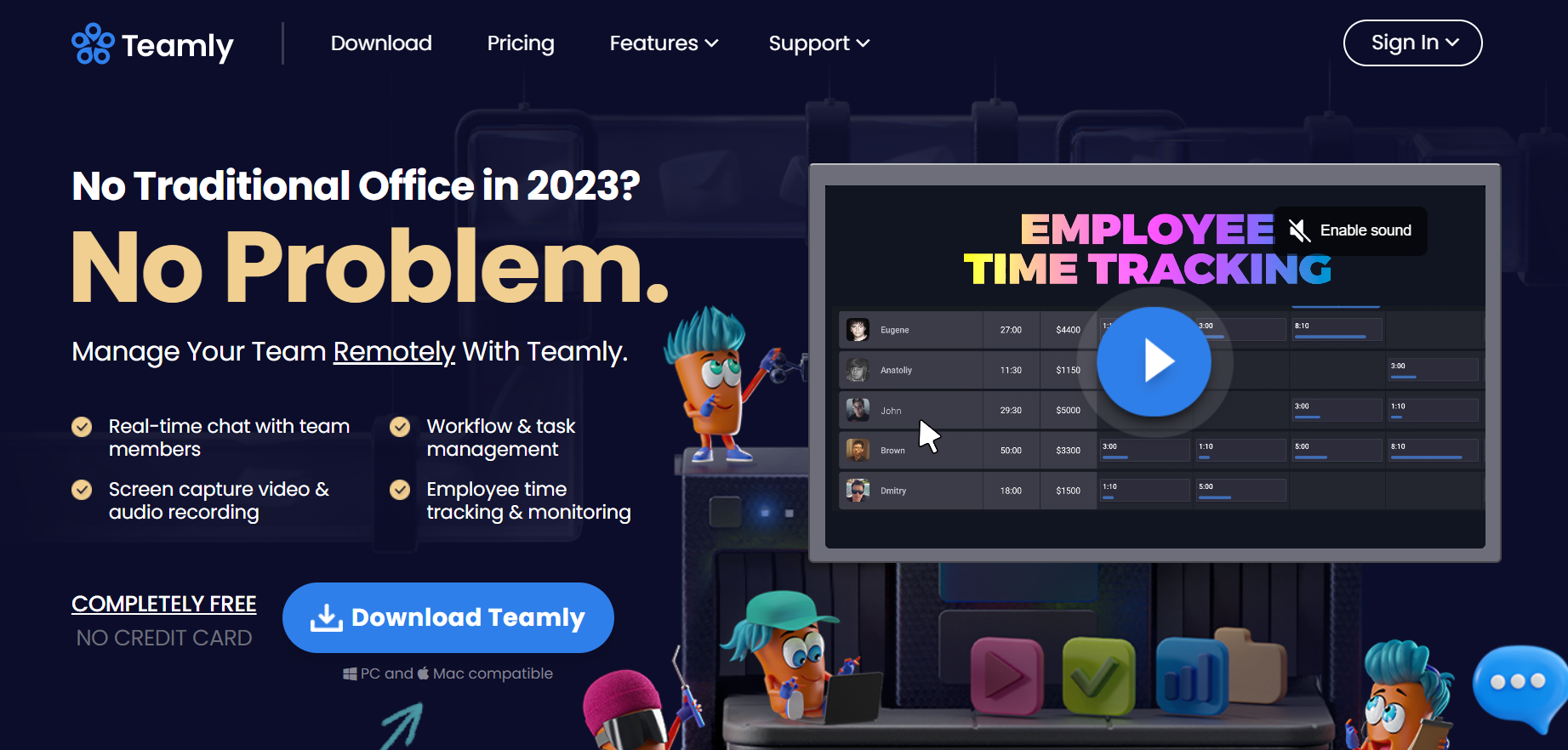
Teamly
Photo Credit: Teamly

1. Teamly

Teamly is an intuitive, powerful project management tool for teams working remotely. It offers real-time chat with team members, workflow & task management, screen capture video & audio recording, employee time tracking & monitoring, and cloud-based file storage & sharing. With Teamly, remote teams can keep on top of projects and ensure everyone is staying productive.

2. Loom

Loom is a great video recording and sharing platform for remote teams. With Loom, you can record your screen, webcam or audio and easily send the recordings to anyone in your team. This allows for efficient communication between remote team members and eliminates any lag time caused by location or language barriers.

3. Hubstaff

Have you ever wanted to be able to track the time spent on tasks by remote employees? Hubstaff makes it easy. This software offers real-time monitoring, customizable reports, and project tracking capabilities so you can ensure every employee is staying on task and meeting deadlines.

4. Slack

Slack is a popular communication tool for teams working remotely. It’s easy to use and offers a variety of features such as real-time messaging, file sharing, video conferencing, and more. Slack is a great collaboration tool for teams who need to communicate quickly and effectively.

5. Trello

Trello is a project management tool for teams distributed across multiple locations. It allows users to visualize and organize tasks, set deadlines, delegate duties, and track progress in real-time. Trello makes it easy to keep all remote team members on the same page.

6. Zoom

Zoom is a fantastic video conferencing tool for remote teams. It allows multiple users to join and participate in meetings from anywhere in the world. Zoom offers high-quality audio and video, as well as breakout rooms for more intimate conversations among small groups of participants.

7. Google Docs

Google Docs is a powerful collaboration tool for remote teams. It allows multiple users to work together in real-time on documents, spreadsheets, and presentations. With Google Docs, all of your team’s work can be stored securely in the cloud and accessed from anywhere.

Conclusion

If you want your remote team to thrive, equip them with the right tools and give them the support they need. It’ll make a huge difference. And that’s why we’ve put together this list of 7 incredible tools for managing projects with remote teams.

Each offers different features to help meet your team’s unique needs, whether it’s task management, file storage, or video conferencing capabilities. With these tools at your disposal, you’ll be able to streamline work processes, improve communication, and keep your remote team productive, happy, and thriving.

So go ahead, give these tools a try (most offer free trials), and see how they can transform how you work with your remote team. After all, when it comes to remote work, teamwork does make the dream work. Happy managing!

The post Must-Have Tools for High-Performing Remote Teams appeared first on Home Business Magazine.

Original source: https://homebusinessmag.com/home-office/internet-technology/must-have-tools-high-performing-remote-teams/

Over one million people signed up to try the new AI-powered Bing

Yusuf Mehdi, Corporate Vice President & Consumer Marketing Office at Microsoft, announced last night that in 48 hours, over one million people had joined the waitlist for the new AI-powered Bing search engine.

One million. Yes, that is, one million people in 48 hours have signed up to try the new AI-powered Microsoft Bing search engine. Yusuf Mehdi posted, “We’re humbled and energized by the number of people who want to test-drive the new AI-powered Bing! In 48 hours, more than 1 million people have joined the waitlist for our preview. If you would like to join, go to http://bing.com/new!”

More details. On Tuesday, we covered the announcement of the new AI-powered search featured in Bing Search. We also explained how ads would be on the new Bing experience, how Bing had to update its webmaster guidelines to support the new chat experience, and we dug a bit more into the relevancy boost Bing had thanks to AI.

Nicole Farley also showed us her test drive of the new AI Bing.

Why we care. If Microsoft can pull away some market share from Google with this new Bing, then that might change how marketers and SEOs spend their days. In the old days of SEO, SEOs had to optimize for Google, Ask, Yahoo, MSN, Alta Vista, and several other search engines.

Right now, SEOs and PPCers are pretty much focused on Google Search and Google Ads. But will this new search experience help Microsoft gain share? If so, your focus as a marketer may need to change.

The post Over one million people signed up to try the new AI-powered Bing appeared first on Search Engine Land.

Original source: https://searchengineland.com/over-one-million-people-signed-up-to-try-the-new-ai-powered-bing-392997

This day in search marketing history: February 11

Yahoo officially rejects Microsoft

In 2008, rumor became reality as Yahoo rejected Microsoft’s $45 billion bid to buy Yahoo.

The company concluded that the proposal substantially undervalued Yahoo and was not in the best interests of Yahoo and its stockholders.

Microsoft basically rejected Yahoo’s rejection, calling it “unfortunate” and pledging to “pursue all necessary steps” to get what it called its “full and fair” proposal to be accepted.

In other words, this wasn’t the end of the story.

Dig deeper:


Also on this day


Google Ads issue results in missing conversions from data-driven attribution

2022: The company was working on recovering the data.


Google ad label experiment makes it easier to distinguish paid results

2022: The design was a throwback to 2017’s green, boxed ad labels.


3 changes coming to Google Ads automated extensions

2022: Automated and manual extensions could be shown together, Google Ads added a report and they could be added at ad group, campaign, or account level.


Google passage ranking now live in US English search results

2021: Google said it could have a 7% impact on search queries.


Google Image Search update reduces duplicate image results

2021: Google wanted to display images that were relevant yet visually distinct.


Google My Business adds messaging to desktop interface

2021: Businesses could message customers through their web browser, not just the mobile app.


Google Search dark theme mode expands but search ads are hard to distinguish

2021: Light mode showed a black ad label on a white background but on dark mode, it showed a gray ad label on a black background.


A Google Ads setting allowed advertisers to exclude people of ‘unknown gender’

2021: Employers, landlords and credit providers could keep their ads from showing to people of “unknown gender,” enabling discrimination against nonbinary individuals.


The onus of diversity should not fall to Black marketers

2021: Keys to diversity and inclusion include mentorship and promotion of Black search marketers.


Unconfirmed Google Search ranking update feels big

2020: It seemed like Google had pushed out some ranking algorithm change over the weekend, resulting in a large shift in the rankings of many websites.


Google resolves rejected Posts problem

2020: New Posts would publish after the “fix” and rejected Posts would go live that week.


Conditional IF functions now available in all Microsoft Advertising accounts

2020: Scale expanded text ad messaging by device or audience – and it worked with Google import.


Yelp launches ‘Showcase Ads’ and store visits attribution

2020: The products were intended for national and multi-location brands.


Warner Bros. renamed the Harley Quinn movie for better SEO

2020: After a disappointing opening weekend, the film’s new title began showing up on movie ticket booking sites last night.


How Google will shift resources to media search and other tidbits from Gary Illyes’ AMA on Reddit

2019: The Google webmaster trends analyst also touched on topics like the possibility of an Indexing API, whether internal over-linking penalties exist and how the clustering of duplicate pages works.


Google Ads bringing click share to Search campaign competitive metrics

2019: The rollout of click share could be seen as a follow-up to the position metrics Google introduced the prior fall, as average position had become less useful.


Bing Ads multiple language targeting: What you need to know

2019: Bing Ads issued additional guidance for advertisers wanting to target multi-lingual users who may search in multiple languages.


Is Google Maps what augmented reality has been waiting for?

2019: Google was actively testing augmented walking directions with select Local Guides.


Retailers: GTINs Required By May 16 For Google Product Listing Ads

2016: GTINs would be required for brand name products sold by multiple merchants.


Google Says There’s No Whitelist To Save You From Panda Or Penguin

2015: Google’s John Mueller said there was no whitelist (or “exception lists”) for the Penguin and Panda algorithms.


Bing Ads Offers Search Insights For Mother’s Day Marketers

2015: A $20 billion holiday in the U.S., Mother’s Day-related searches started rising roughly a month in advance, though search habits varied by gift category.


Google Showing Restaurant Menus In Card-Style Search Result

2014: Google started showing complete restaurant menus in its search results when a query specifically looked for menu information. 


Google In Trouble Again Over Racist Search Suggestions In UK

2014: Google was suggesting racist terms when users searched for a number of UK cities, including Bradford, Leicester and Birmingham.


Bing Ads Updates Reporting Capabilities, Chiefly Conversion Performance Insights

2014: Bing Ads introduced the full set of conversion fields to all Performance reports.


Yelp Supersizes Its Local Profiles, Makes Them Less Busy

2014: Business profile pages were changed to emphasize images, featured user reviews and key pieces of local content.


Google’s Cutts On How To Locate Unnatural Links Pointing To Your Web Site

2013: Cutts answers: “How do I know which links to remove when I get an ‘unnatural links’ message?


Financial Analyst Affirms Google’s $1 Billion In “Default Search” Payments To Apple

2013: It was believed that Google paid Apple roughly $3.20 per iOS device, which would avoid the accounting issues arising from a revenue-sharing agreement.


Google Still World’s Most Popular Search Engine By Far, But Share Of Unique Searchers Dips Slightly

2013: Google led in the number of searches, but had seen a marked drop in unique searchers over the past few months.


Google Now (And Nexus 4) Featured In Grammy Show Commercial

2013: The Apple-like ad showed people around the world getting useful and “just in time” information from Google Now.


Bill Gates On Google: “Bing Is The Better Product”

2013: Although Gates never really said which search engine he used.


Google’s Recent Domain Registrations: Labs, Screenwise & AdWords

2012: Google registered 14 domains.


Bing Sees 13% Spike In Searches In January

2011: Google dropped from 66.6% to 65.6% share, still way in front of Bing, Yahoo, and their combined numbers.


US Lawmakers Voice Concerns Over Google-ITA Deal

2011: Critics argued that once Google became a participant in the travel services market, it might use its advertising dominance to steer consumers to its services, further limiting competition.


Google Promotes Hotpot, Places In Austin In Advance of SXSW

2011: Google representatives would meet with local businesses to talk up the benefits of promoting their goods and services through Places.


Nokia Is The New Yahoo: Microsoft OS, Bing To Power Its Smartphones

2011: Nokia would build and distribute Windows Phones as its primary competitive offering to go head-to-head with the iPhone and Android.


January 2011: Search Engine Land’s Most Popular Stories

2011: Search Engine Land’s 10 most popular stories from January 2011.


SEO Industry Cries Foul Over Google SEO ‘Services’

2010: A vocal contingent of SEOs were up in arms over Google “offering SEO consulting services.”


Aardvark Acquired By Google

2010: For $50 million.


Sergey Brin Might Do Google Buzz

2010: Brin and other Googlers either needed to be enabled to tap into the public version of Google Buzz or open new accounts.


Google AdSense Using Search History In Contextual Matching

2010: If you searched for something and clicked through to a site with AdSense ads on them, Google would store the query that led to that website and use it 2 or so hours later, when you visited another website with AdSense ads on them.


Bing Updates Webmaster FAQs

2010: The PDF download was 28 pages long, 82 questions and answers deep and broken out in 12 categories.


Bing Demos StreetSide With Flickr Photos, Live Video & “Bing Sky”

2010: Bing announced that in the near future, it would allow people using StreetSide to look “up” virtually and see what was in the sky.


Yahoo Search: This Is The “Dark Time” But We’ll Be Back

2010: Yahoo sought to dispel the “misconception” that Yahoo was no longer investing in search.


Google Penalizes Google Japan For Buying Links

2009: Cutts said Google.co.jp PageRank was ~5 instead of ~9 and he expected it to stay that way for a while. He also confirmed it was a paid link penalty.


Google Maps Nearly Catches MapQuest: Hitwise Report

2009: It showed the continuing ascent of Google Maps and the simultaneous decline of MapQuest traffic during 2008.


Gmail Labs Adds Location To Signatures

2009: You could append your current location to your email signature, when you used Gmail or Google Apps email within the Gmail interface.


Microsoft Beefs Up Enterprise Search

2009: Microsoft was starting to integrate FAST Search & Transfer’s capabilities into its other products and to market FAST more aggressively.


New Ask Datacenter Expands Search Capacity

2009: Ask made a bid to improve its search index and efficiency, having completed a move to a new datacenter.


Yahoo! BOSS Expands Feature Set; Adds Usage Fees

2009: In exchange for the introduction of fees, BOSS added several new features. Key among them was the ability to monetize results. 


How To Track Keyword-Based Tweets Within Your Twitter Stream

2009: Twhirl to the rescue.


Google Wins Upside Down Social Security Number Privacy Lawsuit

2008: Complainant claimed when you turned his social security number upside down, it spelled Google.


SEO Makes Oprah In Roundabout Way

2008: Rand Fishkin was slated to share how he popped the question to his fiancee.


The Googliest Place On Earth: Google Takes Over Disneyland

2008: Instead of going skiing, as they had traditionally done for their annual company trips, Google went to Disneyland.


Google: We Didn’t Censor Aboutrika’s Gaza T-Shirt Photo

2008: Google Images search team debunked a rumor that Google censored an image of an Egyptian football player stripping off his team jersey during the African Cup Of Nations to show a “Sympathize With Gaza” T-shirt underneath.


Microsoft Buys Danger

2008: Maker of the T-mobile “Sidekick” device and the Danger operating system and platform.


Chipmakers Demo Android Prototype Phones In Barcelona

2008: Would Android be the success Google was hoping for?


From Search Marketing Expo (SMX)


Past contributions from Search Engine Land’s Subject Matter Experts (SMEs)

These columns are a snapshot in time and have not been updated since publishing, unless noted. Opinions expressed in these articles are those of the author and not necessarily Search Engine Land.


< February 10 | Search Marketing History | February 12 >

The post This day in search marketing history: February 11 appeared first on Search Engine Land.

Original source: https://searchengineland.com/search-marketing-history-february-11-392779