First Images of King Charles Coins

Reading Time: 2 mins

The Royal Mint has unveiled its 2023 Bullion Britannia coin today. This is the first bullion coin to bear His Majesty The King’s official coin portrait. They are the first Mint in the world to introduce the King’s official portrait onto bullion coins.  

After the introduction of four innovative security features onto The Royal Mint’s bullion Britannia coin, its appeal and demand soared globally. Due to their legal tender stats, Britannia coins are exempt from Capital Gains Tax (CGT) for UK residents. Gold Britannia bullion is also VAT free. This is the case for gold Britannia bullion in the form of both coins and bars. 

King Charles

Coin features

Struck in fine gold and enhanced with security features, Britannia coins can be purchased from The Royal Mint’s website. Below Britannia’s flowing gown, a trident becomes a padlock as the viewer changes their perspective. 

Surface animation on the coin reflects the movement of waves. These added security features both decorate and protect the coin, the Mint said. Micro-text that borders the design states “Decus et Tutamen”, which translates as “An ornament and a safeguard”. 

The price of Royal Mint bullion coins varies, depending on changes to the gold price. A 1oz fine gold bullion coin was on sale on the Mint’s website on Monday for around £1,700. 

Andrew Dickey, Director of Precious Metals at The Royal Mint, said:  

“The Britannia bullion coin is globally recognised across the world by investors. Its reputation as the world’s most visually secure bullion coin has led to it becoming one of the most popular bullion coins produced by The Royal Mint. 

“While the design of the bullion Britannia coin remains consistent, the 2023 dated edition begins a new chapter for Royal Mint bullion coins, as His Majesty The King’s portrait appears for the very first time. 

“Bullion coins are an attractive option for many investors looking to diversify their investment portfolio due to their value, tradability, and liquidity as well as CGT exemption in the UK. Each bullion coin produced by The Royal Mint is a combination of exceptional design, craftsmanship and latest innovation upholding the standards of quality and accuracy that you’d expect from a world-leading mint.” 

The post First Images of King Charles Coins appeared first on MoneyMagpie.

Original source: https://www.moneymagpie.com/make-money/the-royal-mint-unveiled-new-gold-bullion

How to Prepare Your Finances to Buy Your Own Home

Home Business Magazine Online

Buying your own home is a big commitment, and it is one that takes most people years to achieve. Saving money for a down payment, getting pre-approval for a mortgage, and finding the right home in your preferred area are not easy tasks. Therefore, the more you know about the process, the better. As part of your preparation, you should be optimizing your finances so that you are ready to go if the perfect house comes onto the market. That is why, in this guide, we will be discussing the best ways to prepare your finances to buy your own home.

Start Researching Early

Before you begin shopping around for your dream home, there are many things you need to do to prepare, so you should start researching these requirements as early as possible. If you know which area you would like to live in, or you need to stay close to family and friends, and then research the prices in the area to understand more about what you should be aiming for. This will also give you some more knowledge on recent changes in the market, which might help you to make a decision around when the best time is to buy your own home.

As part of your research, you should also investigate what potential mortgage brokers will be looking for from a financial perspective, as getting started early can significantly improve your application.

Start Budgeting

After you’ve calculated how much you’ll need to save for your down payment, and what the requirements will be from your mortgage broker, it’s time to start budgeting! There are some key things to do as part of this process, including:

Work Out Your Outgoings

Calculating your outgoings is one of the first things you should do when you start budgeting for home ownership. Create a list of everything you pay for each month, such as rent, utilities, bills, subscriptions and groceries. Then set these monthly expenses against your total monthly income. This will show you your disposable income figure, which is money you can use to spend on whatever you like — or save towards a home! If you are having difficulty building your list, then this guide from Tally can help.

Open a Savings Account

Next up is opening a savings account. Having somewhere to put your savings makes it easier to track your running total. In addition, it lets you shop around for high-yield savings accounts that offer the best interest rates. You can even automate your savings account so that your contributions are automatically taken on payday, making it even easier for you to stash some savings away.

Increase Your Income

Increasing the amount of money you bring in each month is a great way to prepare your finances to buy your own home. As a result, you can dedicate your increased take home pay to your house savings pot! If you are not able to go for a promotion or new role at your job, then a side-hustle might be something useful to consider and work on.

Pay Off Debts

Ultimately, no matter how much income you have coming in, if that income is being swallowed by debt repayments, then you will find it seriously challenging to successfully save for a home. Even if you do not have many credit cards or loans, you might be able to reduce the larger payments you make each month if you have a large car payment. Switching to a cheaper vehicle can increase the amount of income you can save, and again this can be added straight to your down payment pot!

Get Pre-approval for a Mortgage

If you know that you will need a mortgage for buying your own home, then thinking about pre-approval as soon as you can helps you as you prepare your budget. Pre-approval from a mortgage broker is essentially the process through which a lender will tell you how much you can spend on a property based on your income, savings and investment information. By having a price range in mind, you can start to view properties in the area and get a feel for where you would like to live.

As part of the pre-approval process, your lender will need to see some of your financial documents, like your paycheck stubs, bank statements, and W-2 statements, to determine whether you are a suitable candidate for a mortgage with them. This means that, where possible, you should ensure that your bank statements are organized, tidy, and do not contain any unsuitable information, like unclear or joke payment references with friends.

Prepare for Future Expenditure Changes

Although exciting, getting pre-approval for a mortgage and starting the process of shopping around for your dream home is not the end of the journey. Understand that once you get the keys, your financial circumstances may change. This is a highly important part of the process. When you become a homeowner, there are a number of things that you will become financially responsible for that you would not have been while renting or living with family. These include the following:

Insurance

Building and contents insurance is a necessity when you own your own home, but you might not have been responsible for this before. While you can shop around to find the best insurance deal, the monthly cost of protecting your property is still something that can affect your monthly expenditure.

Home Repairs

Instead of calling the maintenance team at a shared apartment complex or contributing to the cost of bills while living with family, you will have to pay for home repairs when you own your own property. These bills add up, especially if unprepared for them and finding yourself relying on credit.

Furniture

If you previously lived in a furnished rented accommodation, then buying and maintaining your own furniture is a surprisingly large expense.

Learning what expenses you will be responsible for as a homeowner before you make the move is important. It will help you prepare for any changes to your existing budget.

Final Thoughts

Buying your own home is an incredible success, and one that with hard work and dedication you can achieve in time. By following these top tips, listing your outgoings, organizing your finances, and saving in an appropriate account, you can buy your own home and be the proud owner in no time!

The post How to Prepare Your Finances to Buy Your Own Home appeared first on Home Business Magazine.

Original source: https://homebusinessmag.com/money/how-to-guides-money/how-to-prepare-finances-buy-your-own-home/

Digital Tools and Software That Entrepreneurs Need to Implement for Their Businesses

Home Business Magazine Online

As an entrepreneur, you have to control every activity in your company — from accounting to management. It is your responsibility to oversee all of these departments. It gets a bit overwhelming to do it all. However, the right resources and employees can help you as an entrepreneur to overcome challenges. The right digital tools and software may aid business owners and their employees in increasing productivity, freeing up time, and improving customer experiences across the board — from brand building to customer engagement. You must utilize these to the fullest extent possible. Otherwise, it could mean the difference between success and failure.

One of the most common issues startups face is a lack of capital or money to keep their businesses running. If you need financial assistance for your new business, several loans are available for startups and entrepreneurs to start their businesses. You only need to contact the online lender, or fill out a loan application online to get the loan.

Digital Tools and Software

Once you get the loan, you need the following digital tools and software to ensure the smooth running of your business.

  • QuickBooks

For every business to succeed, financial stability is crucial. It is essential to comprehend how money enters and leaves your business. However, doing this without a bookkeeper or accountant’s help could be difficult. Quickbooks is the preferred accounting program for small and medium-sized businesses.

This service can handle anything from basic accounting to producing financial reports. Moreover, it is flexible and fairly priced. During tax season, Quickbooks can help you find the most timesaving and energy-saving tax solutions for your business.

  • Trello

Any small business owner will tell you that maintaining organization and control over your workload is a war you must win each day. It is very hard to accomplish that with simply a to-do list or calendar. It is even harder to accomplish by attempting to keep everything organized in your head.

Trello is one of the best options for small businesses, because it is not as complicated as other project management apps. In addition, it helps business owners keep organized, especially if their workers work remotely. Trello has everything divided into cards, lists, and boards that provide virtually endless ways to arrange based on a business’s unique requirements.

  • Google Analytics

It is crucial to ensure that your website functions effectively and that you are aware of key information regarding the website traffic. Additionally, since the most recent upgrade, mobile app statistics have received much attention.

With Google Analytics, you can measure sales, leads, or anything else thought of as the ultimate objective of your business, as well as enhance the website’s content and user experience.

Various analytics digital tools are available. However, this one is cost-free, allowing smaller companies to use it without paying a subscription fee.

  • WordPress

In the present digital age, every successful company must have a polished and useful online presence. DIY website builders are inexpensive and offer a wide range of capabilities, making it simple to design a site that customizes to your unique needs. WordPress is probably one of the best platforms for any business due to its unmatched adaptability and selection of built-in capabilities.

The post Digital Tools and Software That Entrepreneurs Need to Implement for Their Businesses appeared first on Home Business Magazine.

Original source: https://homebusinessmag.com/home-office/computers-and-software/digital-tools-software-entrepreneurs-need-implement-businesses/

How to make money by getting healthy

Reading Time: 4 mins

Need an incentive to get out and get healthy? Good news! The MoneyMagpie team has uncovered a myriad of ways to make money by getting healthy and we can’t wait to share them with you.

From utilising your health insurance to playing guinea pig for clinical trials, here are a few surprisingly simple ideas.


Apps that pay

Health app on phone

With smartphones pretty much being extensions of our bodies these days, it’s hardly surprising that there are a wealth of apps out there to help you get fit.

While all of them offer some sort of incentive or encouragement, we’ve found two UK-based options that will actually reward your efforts with some well-deserved cash… in one form or another.

  • Bounts

In order to receive rewards from Bounts, you will need another fitness tracking app or device to gather statistics on your daily activity levels.

But once you’ve connected Bounts to your fitness tracker of choice, it will immediately start converting your steps into points and rewarding you for getting healthy.

If you’re using a step-counting device such as a FitBit, you will need to do at least 7000 steps a day to qualify for points. The minimum requirement for apps such as RunKeeper or Strava is a 20 minute walk/run above an average speed of 4km/h per day.

Users receive 20 points per activity and can earn up to 180 points a day.

These points can then be redeemed for exclusive offers, discounts and vouchers at various retailers and big name brands. Just take note that it may take a while to accumulate enough points to get shopping – just to give you an idea: 1800 points would roughly translate into a £5 Amazon voucher.

Click here for more details.

  • Sweatcoin

Similar to Bounts, you keep the Sweatcoin app open in your phone’s background and it will track your movement throughout the day, rewarding you with 1 Sweatcoin for every 1000 steps.

What makes this app a little different, however, is the fact that it actually specifically encourages getting healthy outdoors by not rewarding users for any indoor activity.

Once you’ve accumulated a number of Sweatcoins, you can start exchanging them for offers in the app. These offers can be absolutely anything – digital watches, online memberships, food, drinks, shoes, clothes, running gadgets, music/software downloads, digital services, and more.

Since Sweatcoin is basically a micro currency, you are also able to buy, sell and earn with it. However, it’s going to take a little bit of research and practice to get it just right.

Find out more on the Sweatcoin website.


Health insurance rewards

Health insurance concept image

Whether you’ve opted to invest in private health insurance or rely on the NHS, chances are pretty good that you may not be making the most of the incentives they offer you to live your healthiest life.

  • Vitality rewards

The moment you sign up for one of Vitality’s health insurance plans, you can start earning points for getting healthy.

Similar to the apps mentioned earlier, you can gain points for tracking your daily activity. Incentives start with as little as 12 points a week – which roughly translates to 12,500 steps in a day twice a week – which can be redeemed for a Starbucks drink and a cinema ticket.

Up this to 880 points in one go when you do an online health review and take a Vitality Healthcheck. Once you’ve accumulated enough, you can use these points to purchase anything from spa treatments to airplane tickets.

Check out the Vitality website for more details on their reward system.

  • NHS incentives

While they haven’t been approved just yet, NHS has come up with some radical proposals to reward your attempts at getting healthy with up to 25 per cent off weekly grocery purchases. Furthermore they seem to be taking a page out of Vitality’s book, looking to reward clients who achieve 12, 500 steps or more at least three times a week with free cinema tickets.

These ideas focus on ‘new towns’ and an effort to “design-in” healthy lifestyles by providing new homes with free bikes and equipping neighbourhoods with outdoor gyms and pavements with sprint tracks.

Apart from this, as the largest employer in the EU, NHS is also leading the charge for corporates and companies who want to encourage a culture of getting healthy among staff members. They will be offering financial incentives for increased activity, as well as regular mental and physical health checks.

Read more about these financial incentives on the NHS website.


Clinical trials

Docotor giving young woman medication

Taking part in paid clinical trials can be a way to make a lot of money in a short amount of time, but there are serious potential downsides so be very clear about those if you go in for this.

Depending on what kind of trial you take part in, how invasive the trials are and how long they take, you can earn anything from £100 to about £4,000.

Read our full article here.


Other ideas


Ask your money-making questions

The Magpie community is full of savvy money savers and makers – and now’s your chance to ask your burning questions!

The new MoneyMagpie Messageboard brings together the Magpie community, MoneyMagpie team, and vetted experts to make sure your essential money-making questions get answered.

Take a look here and register to post a new thread or reply.

six_magpie

Sign Up – Newsletter

The post How to make money by getting healthy appeared first on MoneyMagpie.

Original source: https://www.moneymagpie.com/make-money/how-to-make-money-by-getting-healthy

How to make money by running a pop-up restaurant in your home

Reading Time: 5 mins

If you’re a whizz in the kitchen and love entertaining, you could be the perfect candidate to make some extra money by running a pop-up restaurant in your home.

Ever thought about it?

If not, here’s a basic guide to get you started:


What is a pop-up restaurant?

Couple in restaurant looking at menu

As the name suggests, pop-up restaurants are temporary dining experiences operated from anywhere but a traditional eatery – people’s homes, abandoned factories, pedestrian streets, the beach… you name it.

Based on the concept of dinner clubs, the whole premise behind the pop-up restaurant is to offer an exciting, limited edition culinary experience that is exclusive, social and shareable.


Why set one up?

Waitress holding food

If you’re reading this article, chances are pretty good that you enjoy the whole ‘foodie’ culture and may even have a special dream of one day owning a restaurant of your own.

While running a restaurant can be hugely rewarding, it’s also full of financial risk, which is obviously something most of us would choose to avoid.

However, that doesn’t mean you should bury your ambition.

A pop-up restaurant could be a fun alternative and an amazing opportunity to hone your skills.

Here are a few more reasons to consider setting one up:

  • Low overheads

Since you will be running it from your home (or any other interesting place you may have permission to use), you won’t have an extra set of business bills to worry about. Your biggest initial expense may be kitting yourself out with quality equipment – from robust pots and pans to attractive cutlery, crockery and table decorations.

After that, your funds will mainly go into buying fresh ingredients and occasional maintenance.

  • Gain experience

If you’re a young chef waiting for your big break, there can be no better way to refine your craft than running a pop-up restaurant from home. It will give you an opportunity to set up your own menus, experiment with unusual dishes that traditional restaurants may avoid and get honest feedback from your guests.

  • Reach a more engaged audience

The great thing about pop up restaurants is that it encourages quality, instead of quantity – not only in the amount you’re cooking, but also in the number of people you’re cooking for. Instead of preparing meals for a faceless mass, you have the opportunity to curate who sits down at your table. The fact is, people who aren’t passionate about the art of food and hospitality won’t be attracted to the pop-up restaurant concept.

  • Become a social media sensation

If you create meals and experiences that are visually pleasing, they will automatically be shareable too. Whether you’re looking to push boundaries or to perfect traditional cuisine, make sure your presentation warrants a snap or two. Once guests start sharing on their social media platforms, your popularity will boom.


How to set one up?

Waitress bringing nann breads to table

While it may be easier to set up than a traditional restaurant, there are still a few things to put in place:

  • Choose a location

While running a pop-up restaurant from your own home may be the simplest and cheapest option, you can really set one up anywhere that allows you. Perhaps your home is too small for the dining experience you envision, or maybe your kitchen is inadequate.

No need to worry – instead, spend some time scouting unusual locations close-by and find out (from your local authorities, building managers etc.) how you could go about utilising these spaces.

Make sure to source your catering equipment from a reputable company, whether you are buying it or renting it.

  • Come up with a concept

Once you know where you’ll host your events, it’s time to refine that concept that’s been brewing in the back of your mind. Are you going to be serving family recipes passed down through generations or perhaps ultra-modern fusion cuisine? Whatever you decide to do, the more well-packaged your program, the better.

  • Find a co-host

It can be rather stressful doing everything on your own. Get your partner, a friend, family member or co-worker to help you host the event. It helps to have two people sharing entertainment, cooking and cleaning responsibilities.

  • Apply for licenses

If you want to run your pop-up restaurant properly (and, believe us, you do), you are going to need to apply for a few licenses… just like any other catering business.

Read through this article on the Food Standards Agency website to get a basic idea and then approach your local authorities to find out what exactly they require from you.

  • Advertise

Now that you’ve got everything ready, it’s time to decide on a date for your first pop-up and advertise like mad.

Creating a Facebook event is probably the easiest way of getting the word out there these days and also sharing on other social media channels.

If you want to add an extra edge to your marketing, bring in an element of mystery. For example, keep the location a secret – only sharing directions with guests an hour or two before the event.


Food sharing sites to check out

Man using laptop

One of the easiest ways to get into the pop-up restaurant scene is to sign up as a host on a food sharing site.

Here are a few popular options:

  • EatWith a website offering users an easy way to access the underground food scene and connect with creative, open-minded and interesting people.
  • BonAppetour – a community marketplace that connects travellers with local home chefs for a unique home-dining experience, anywhere around the world.
  • Tastemade unique dining events hosted by chefs with exceptional culinary talents – from great home cooks to Michelin stars. The site has not launched in the UK yet, but it’s worth keeping an eye on for the future.


How much can I make?

Group cheers-ing wine glasses at meal

This depends largely on how many people you host and how often you run your pop-up.

However, if you start off by hosting four guests once a month, charging £30 per person (just make sure the price covers your expenses), you could make a pretty decent income on the side.

Also read:

six_magpie

Sign Up – Newsletter

The post How to make money by running a pop-up restaurant in your home appeared first on MoneyMagpie.

Original source: https://www.moneymagpie.com/make-money/how-to-make-money-by-running-a-pop-up-restaurant-in-your-home

Why is my WordPress site not ranking? by InMotion Hosting

Why is My WordPress Site Not Ranking - Hero Image

If you want your site to be at the top of search engines, you likely have started researching SEO best practices.

Perhaps you have mastered all that you need to know about technical SEO, but your WordPress site still doesn’t seem to be ranking well, and you want to get down to the root of the problem.

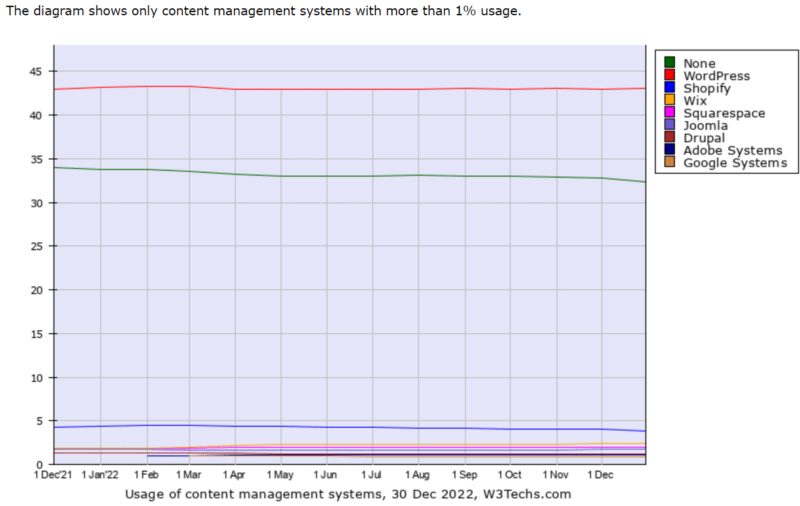
As the most popular CMS worldwide, there’s no doubt that many top results on search engines are WordPress websites.

Usage Chart from W3 Techs depicting the top Content Management Systems
Image Source: W3Techs.com

Read on to find some of the most common reasons your WordPress site is not ranking and how to resolve them.

Ensure your site is not hidden from search engines

Some users might find it surprising that all new WordPress installations block search engines by default.

The Search Engine Visibility setting in WordPress exists to prevent search engines from discovering a site that is not fully built. This setting is easy to disable once your WordPress is ready to go public.

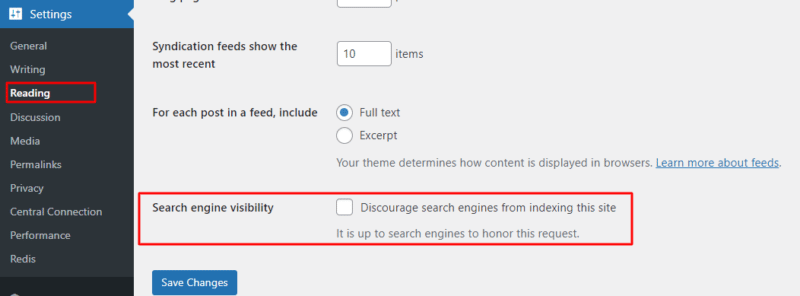
To turn this setting off, log into your WordPress dashboard. In the left menu, locate Settings, then navigate to Reading.

On the Reading page, scroll down to find the Search Engine Visibility setting.

Uncheck the Search Engine Visibility box and be sure to Save Changes.

Search Engine Visibility settings in WordPress

Choose the right keywords to target

Researching content that fits your industry should always be your first step to revisit if your site is not ranking as you hope it would.

Keywords are how engines find your content and know where to index it. Making sure you understand your company’s goal, and target keywords will help your keyword research phase.

It is possible that the keywords you choose to target are also used by other companies in your industry. Be sure to include competitor analysis in your research.

There are several free and paid tools available to conduct competitor analysis, which include Semrush, Moz and Ahrefs. With tools like these, you can conduct full content audits and see where your competitors might be excelling and lacking.

In a keyword gap analysis, you can see missing and sharing keywords used by you and your competitor. Shared keywords present opportunities to optimize your existing content and missing ones can help you identify topics for new content.

It is important to keep in mind that adding a single keyword will not improve your ranking. You will want to ensure your company follows SEO best practices for thorough and relevant content.

Understand how Google sees your site with search console

Create a Google Search Console account for free to understand how Google crawls your site and which keywords your site shows up for.

If your site is being indexed, but you’re not getting enough traffic, check the URL Inspector tool and Google Core Web vitals.

Page and URL inspector 

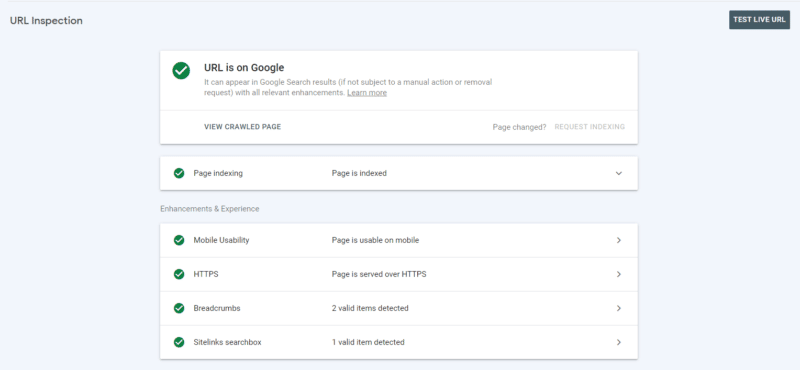
The URL inspector tool provides you with insights into your indexed pages.

Google Search Console URL Inspector Results

If there are any markup errors or warnings, the inspector will inform you. It will also specify why this error occurred.

Users can also check when their page was last indexed and crawled.  

Google Core Web Vitals

Optimizing your WordPress site is always a crucial part of your site’s SEO strategy.

With the power of Google Core Web vitals, you can get detailed information on any issues slowing your site down.

Keep the results of your website tests in mind as you make changes to the theme and plugins on your website. Any modifications you make to your content will affect your site optimization.

For over 20 years, InMotion Hosting has given users premium web hosting and tools. Optimize your website’s speed with InMotion’s new high-performance managed WordPress plans.

Hosted on a fully-isolated VPS, users will experience 40x faster WordPress hosting speeds with dedicated resources, caching profiles, and the power of Redis. Improve Core Web Vital scores with a server that’s designed to make WordPress fast.

Plugins and themes

Plugins and themes are WordPress’s bread and butter, but they have a heavier impact on SEO ranking than some users may think.

Use a performance testing tool to understand how they affect your website’s performance.

Theme solutions

While thousands of themes are built for all types of websites, not all are ideal for search engines.

Testing the theme’s impact on your Google Core Web Vitals is good practice.

If the theme that interests you has a demo website, you can do a simple test to see if it is optimized.

Copy the URL of the demo site into Google’s PageSpeed Insights to review its performance and SEO readiness.

WordPress Theme Demo Content Page Insights Results

Something to note is that your website will likely have a lot more content than any demo site. However, it is good to determine if the theme raises any red flags before you even install it.

You may also want to look out for page builders when updating or designing your site. These plugins help you build your website using a visual drag-and-drop interface.

Because of their bulk, these editors can bring down your Web Core Vitals scores. Using WordPress’s native block editor, Gutenberg, can help you keep your speed up while maintaining the aesthetics of your theme.

WordPress plugins

SEO plugins are one of the first things many users install on their WordPress websites.

Here are some things you will want to make sure your preferred plugin does before installing it:

  • Customizes metadata and open graph tags.
  • Supports schema or structured data.
  • Scores your keyword density.
  • Grades your content quality, readability and internal linking.

Recommended plugins for SEO are Yoast SEO, All-In-One SEO and RankMath.

We also recommend the tools discussed in the keyword and competitive research section for more advanced tools to track your SEO.

Caching plugins

Caching plugins are some of the most popular to add after your WordPress installation.

Caching plugins help with performance by providing a recently saved version of the site’s content to users. This shortens the waiting time for connection to the server.

Some caching plugins are simple and only concentrate on the caching aspect. Others will have settings for CDNs, minification of files and more.

Recommended plugins for caching are W3 Total Cache, WP Super Cache and WP-Optimize.

We also recommend trying out a couple of plugins to find the best one that fits your needs. Make sure you are only testing one at a time, as multiples of the same plugins can result in slower speeds and compatibility issues.

Final thoughts

Often, the easiest way to resolve issues is to go back to basics. SEO is no different.

If you ensure your site is set up correctly and enriched with good content, your search engine rank will increase with time. Be sure your website is ready for anything. With a hyperfast VPS, dedicated resources, and premium design and maintenance tools, InMotion Central will change how you use WordPress.

The post Why is my WordPress site not ranking? appeared first on Search Engine Land.

Original source: https://searchengineland.com/why-is-my-wordpress-site-not-ranking-391183

How to write a blog post that wins in 10 steps

Blog posts are quite possibly the most common content type that exists.

You read them, I read them, we all read them – but which ones actually made an impact on you?

Which blogs gave you useful information? Which ones made you think, or taught you something new?

Most importantly, which drew you closer to the brand that created them?

Ultimately, writing a blog post should accomplish that for your business (or your client’s business).

On top of that, a good blog post written for SEO should pull in ideal traffic from search engines and convert those visitors into leads.

Yep, blogs can and should be profitable. They must stand on their own and work hard behind the scenes.

A well-written blog can be effective and make your reader trust you enough to want to look into your services or products and buy. (It’s happened to me multiple times – one blog was enough to convert someone.)

However, effective blogs that work like this need to be packed with mega value for your particular readers.

How is it done? Let’s talk about how to write a blog post that wins.

Why write blog posts?

First, let’s start with why you should write blog content.

Even today, when content marketing is taking over advertising as a preferred marketing method for both businesses and consumers, some people still underestimate it.

“Do you really need to blog?” they ask. “Does content matter that much?” they wonder.

Yes, 1,000 times yes!

Maintaining a blog on your website with regularly published blog posts is possibly one of the single best things you can do to improve your SEO and search visibility.

Companies that blog see 55% more visitors than those that don’t blog, and they see 97% more inbound links and 434% more indexed pages across their websites.

Blogging is also how you establish trust between a brand and its audience. 82% of consumers feel more positive about a brand after reading that brand’s content. 70% read at least 3-5 pieces of content before talking to a salesperson.

Content is #1. It matters more than any other factor – not just for SEO, but also for connecting with customers.

What to do before writing a blog post

It’s a myth that you can just sit down and hammer out a blog post in one day.

It’s not possible – not if you want to meet your goals and create profitable content.

To give yourself the best chance at writing incredible, results-getting blog posts, make sure you have these preparatory steps handled.

Research your audience

Is your audience already defined for your brand? Good on you – skip to the next step. You already have research and insight into what they want to read and what questions and problems they need answered.

These things are vital. If you instead jump into writing a blog post without understanding who you’re writing for and what they need from your unique expertise, you’re asking for failure. It would be like walking into an auditorium to give a speech without knowing anything about why those people are there and what they expect you to talk about.

Don’t write a single word of your blog post until you have your audience knowledge down. This article by Ryan Robinson is a good place to start.

Brainstorm a blog topic your audience will want to read

You can’t write about any random topic you pull out of your head – it’s unlikely anyone will care.

For that reason, it’s important to do a little strategic brainstorming to find the right blog topic.

Like audience research, this step helps you figure out exactly what will draw in the people you want to read your blog. 

Specifically, look at the intersection of: 

  • The topics that will speak to their problems, questions, or pain points. (Use your audience research to find out what these are.)
  • The topics your brand (or your client’s brand) is an expert on.

This isn’t as hard as it sounds, by the way. Sometimes, a blog topic will spring up naturally through the everyday interactions you have on social media or the questions customers ask in emails or your live chat.

The key is ensuring you or your team are always listening to catch these opportunities.

Map your topic to a keyword

Let’s say you’ve come up with a great blog post topic that sprang from a customer question.

How will you optimize that post to ensure other people with the same question can find your blog with a Google search?

You need to map the post topic to a keyword your brand can win (“winning” means your post will rank in the top three results, ideally at #1. Among a myriad of benefits, ranking higher in search results is associated with more people clicking on your link).

How to do it:

  • Run your post topic through a keyword research tool like Semrush or Ahrefs.
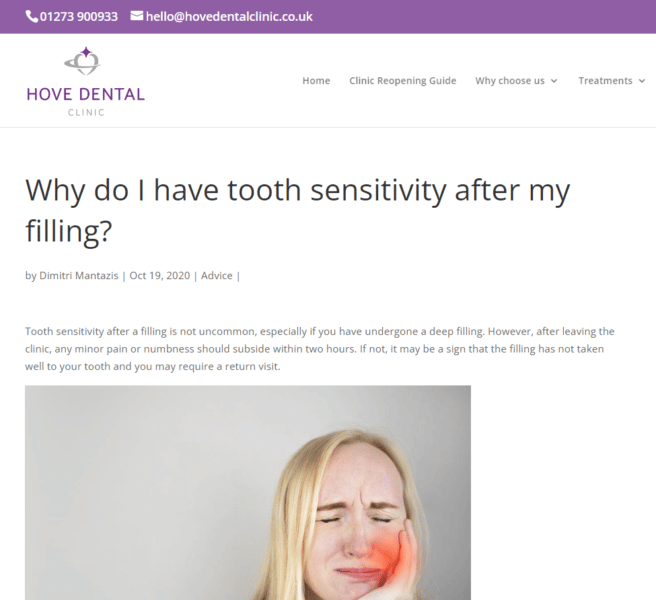
    • Example: A dental practice comes up with the topic “tooth sensitivity after fillings” from a patient question, “Why is my tooth sensitive after getting a filling?” 
  • Check the search volume and the keyword difficulty (KD) of the exact match results.
  • If they’re too high (either too difficult or too popular to edge into the rankings), look at the variations and related terms.
    • Example: “Tooth sensitivity after fillings” has a KD of 41 (possible), but a variation, “tooth sensitivity months after filling” has a KD of 25 (easy) and a search volume of 260.
  • Build and optimize your blog post around the keyword you found that’s easiest to rank for – usually the one with the lowest KD and a relatively low search volume.

Here’s an example of a dental clinic that did this, currently ranking #2 for the keyword:

dental clinic blog example

If right now you’re thinking, “Wait, why would I want to rank for a keyword with low search volume?” consider this. It’s not about the volume of traffic to your blog. 

You want the right traffic – the people with the most potential to turn into customers. Longer, more specific keywords bring in fewer people, but those people have specific issues your brand can solve. 


Get the daily newsletter search marketers rely on.

<input type="hidden" name="utmMedium" value="” />
<input type="hidden" name="utmCampaign" value="” />
<input type="hidden" name="utmSource" value="” />
<input type="hidden" name="utmContent" value="” />
<input type="hidden" name="pageLink" value="” />
<input type="hidden" name="ipAddress" value="” />

Processing…Please wait.

function getCookie(cname) {
let name = cname + “=”;
let decodedCookie = decodeURIComponent(document.cookie);
let ca = decodedCookie.split(‘;’);
for(let i = 0; i <ca.length; i++) {
let c = ca[i];
while (c.charAt(0) == ' ') {
c = c.substring(1);
}
if (c.indexOf(name) == 0) {
return c.substring(name.length, c.length);
}
}
return "";
}
document.getElementById('munchkinCookieInline').value = getCookie('_mkto_trk');


Time to write: How to create a blog post in 10 steps

Finally, it’s time to write your blog post. Follow these steps to write valuable content that will bring in results.

1. Research your topic

If I’ve done my job, hopefully, it’s clear that you need to research during every stage of writing a blog post. From your audience to what to write about to keywords – and now the topic itself – you should validate what you’re doing at every turn.

In that vein, to get an idea of what searchers are looking for when they type your keyword into the search box, you should Google your topic/keyword. Analyzing the results tells you three things:

  • The type of blog content ranking for the term – long-form (over 1,500 words) or short-form?
  • The type of information included in ranking blog posts (what facets of the topic do they cover? What questions do they answer? How deep do they go?)
  • The search intent of people Googling the keyword – what are they looking for when they search for this term, really?

All of this can and should inform how you approach writing your blog post. Ultimately, you need to not just match what you find in Google search, but rather up the ante and create something better.

That means you should analyze the competition with a critical eye. What’s missing from the top posts? What value could you add that the others don’t have?

2. Write an outline and structure the post

Now you have enough information tucked in your back pocket to start writing your blog post. (Phew!)

I always start with outlining. An outline helps you figure out:

  • The key points you want to cover in the blog.
  • How to order those key points both logically and for engagement.
  • How to structure your post with headings so it’s easy to scan and read.
  • How to include your keyword in strategic spots, like inside H2s and H3s.

There’s no need to get complex, here. Simply jotting down your key points, finalizing the order, and applying headings can be enough to give you a good start.

For example, here’s the outline I created for this post you’re reading:

outline of how to write a blog post

3. Write the intro

It’s time to write the introduction, arguably one of the most important parts of your blog post.

Usually, you want to keep it short and sweet. I like to aim for 200 words or less for my intros. This gives you enough time to hook your reader and offer up some tempting nuggets to keep them on the page and reading.

However, one of the most effective ways to write an intro I’ve found is to be as empathetic to the reader’s main problem as possible.

  • State the problem at the heart of your topic that’s plaguing the reader.
  • Empathize. How does it feel to have that problem? What bad outcomes could result from not finding a solution? 
  • Present the light at the end of the tunnel. You have the solution! Tell them what it is, no holds barred.
  • Finish your intro by promising or previewing the details of the solution, which you’ll reveal in your blog post.

This intro formula loosely follows a tried-and-true copywriting formula, by the way: PAS (problem, agitation, solution).

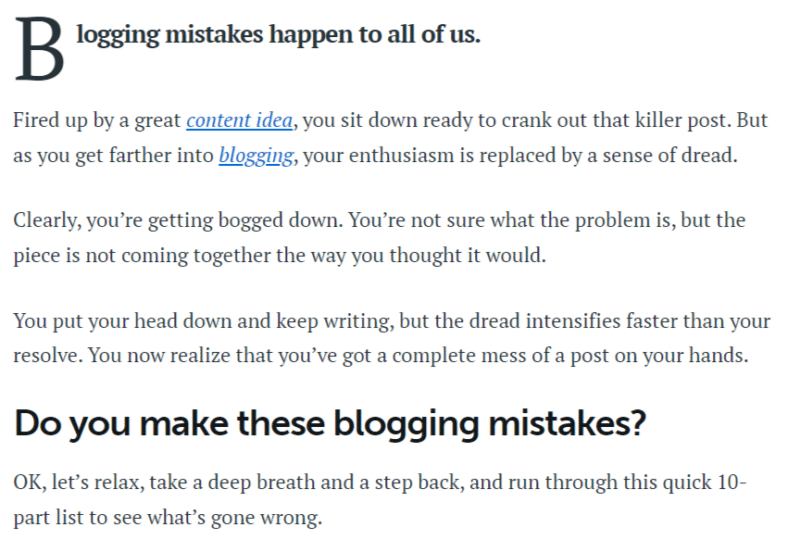
Here’s an example of that in action via this Copyblogger intro:

blog intro example from copyblogger

4. Write the headline and tweak it as you go

Wait, why is writing the headline step 4 in this list? Shouldn’t it be step 1?

No, no, my crafty friends. Writing the headline appears 4th on this list for a very good reason.

You need time to let your ideas marinate before you write your blog post headline. After you’ve done your research, outlined the post, and drafted an introduction, you should have a really good idea of what your post is about and what information it will contain. It’s been simmering in your brain, and now it’s ready to be plated.

That’s why I don’t write the headline right away. I want it to be helpful, engaging, and contain my keyword, and it’s always better to stew on it for a bit before committing words to the H1.

Generally, you should write not just one headline but a bunch of versions of your headline. As you write the bulk of your post, go back and tweak it once or twice for good measure. 

Your best headline will never arrive fully formed from a zing of inspiration. Instead, your best will come from at least a handful of tries, if not a baker’s dozen.

If you hate writing headlines and need help, don’t forget you can use a tool to help you draft them. My favorite is AMI Institute’s Headline Analyzer.

5. Write the meat of the post, relying on (more) research

Ready to write the bulk of your blog post? 

This is the point where you start fleshing out your outline and filling in the blanks. With your points already laid out, all you have to do is explain them, guide the reader, and provide evidence and examples.

While you’re at it, you should still be researching as you go.

  • Find statistics or facts to back up your points. Look for original studies and surveys you can link to in your post to add credibility to what you’re saying.
  • Link to other blogs on your website that add depth to what you’re writing about.
  • Research what thought leaders have said about your topic and link to them in your post. (Just make sure they aren’t competitors.)

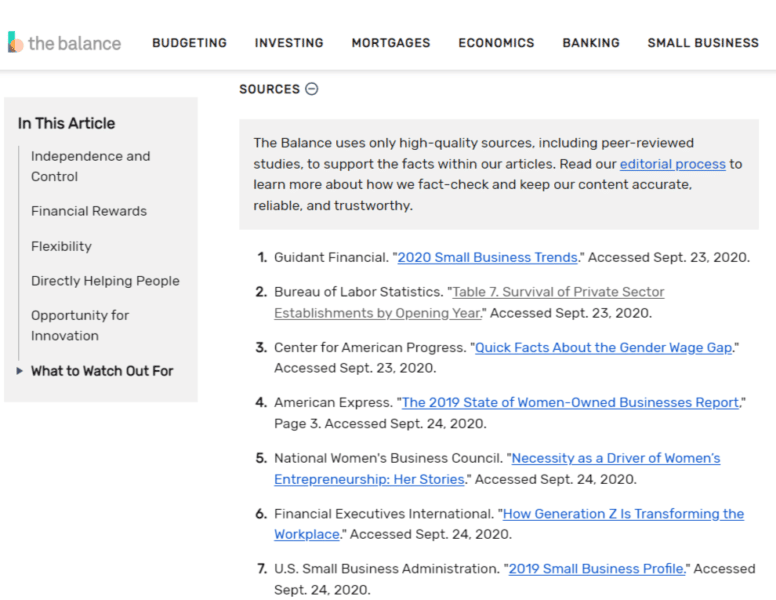
For a good look at a well-researched blog, check out this post from The Balance Small Business.

blog post example with research

All the research cited in the post is listed at the bottom in the footnotes:

example of research for a blog post

Showing you’ve done your homework like this is a huge trust-builder. Prove that you know what you’re talking about, and readers will listen.

6. Write for SEO

This step is just a friendly reminder. As you write your post, don’t forget to insert your keyword in key places:

  • In the title/H1.
  • In the first paragraph.
  • In at least one of the H2s.
  • In at least one of the H3s.
  • Sprinkled naturally in the body copy. Include a few related terms and variations.
  • In the meta description.

7. Add relevant and engaging images

Adding images to your blog post is a great idea. They add visual interest and can help keep your readers engaged. 

Most brands said they use visuals like images in content 91-100% of the time, according to a Venngage survey.

Visuals can add a lot to a text post, so don’t neglect them. However, don’t just add random images – try to find images that illustrate what you’re talking about in the post. Keep them relevant for added value, and your blog post will be much better.

This post from The Penny Hoarder (on saving money on spices) is a good example of how to use stock images in a blog. They’re relevant and help break up the text.

images used in a blog post

Also, consider that original graphics – like illustrations or infographics – are the most-used type of visual content. If you have the means, go the extra mile and enlist a designer to create custom images for your post to stand out.

8. Include CTAs

Do you have to include calls to action (CTAs) inside your blog post? No.

Should you? Yes.

CTAs are how you get readers moving from reading your blog to signing up for your email list, checking out your products, or downloading your freebies. 

Where do you want them to go from your blog post? Tell them, and give them direction.

Great example: In their post about men’s wedding attire, He Spoke Style has a CTA directing you to browse their collection of menswear accessories.

example of cta in blog post

9. Write your conclusion

At this point, you’ve written all the important pieces of your blog post. Now you need to finish it off in a satisfying way.

Generally, a good blog post conclusion wraps up the post by reviewing the most important points. No need to explain them all over again, though – a mention is enough just to remind the reader and get that info sticking in their brain.

After that, try to leave your audience with one key takeaway or thought to ponder. How will this new information they’ve just learned affect them moving forward? How will it ultimately help them?

Finally, keep your conclusion brief but satisfying. Tie up the loose ends. If your audience stuck around long enough to read the entire post, they’ll appreciate a gentle fade-out versus a sudden stop.

10. Edit, edit, edit

Finally, even if your team has a content editor, don’t forget to self-edit your blog post.

Comb through the post and re-read pieces out loud to check for flow and word usage. Edit anything awkward, and add transitions to help your reader move effortlessly along.

Employ your spell-checker judiciously, and make sure all your links point to the right places.

Great writing happens in the edits, so don’t write it off as unnecessary.

Repeat these steps to write blog posts that win

These steps are repeatable for most types of content, so you can reuse them like a well-loved tool to create great content across the board. 

If your blog posts are rough initially, don’t worry – you’ll get better with practice.

Research, outline, write, tweak, research some more, write some more, and edit, edit, edit to make your content the best it can be.

The post How to write a blog post that wins in 10 steps appeared first on Search Engine Land.

Original source: https://searchengineland.com/how-to-write-a-blog-post-391760

The Key Considerations to Have in Mind When Investing in a Tent for Business Events

Home Business Magazine Online

There are several essential considerations when investing in a tent for business events. From size and style to durability and cost, choosing the right tent can be a complex process. This article explores key factors to consider when selecting a tent for your business events.

Tent Size

The first thing to evaluate is the size of the tent. The size of the tent will depend on the number of guests you expect at the event. It is crucial to choose a large enough tent to accommodate all of your guests but not so large that it feels empty. The size of the tent will also determine the type of event you can host. For example, a smaller tent may be suitable for an intimate, outdoor meeting, while a larger tent may suit a large trade show or conference.

Tent Style

The style of the tent is another important consideration. There are a variety of skyline tents to choose from, including traditional pole tents, frame tents, and clear-span structures. Each style has unique benefits and drawbacks, so it is essential to consider which style best suits your event.

For example, traditional pole tents are excellent options for events with large crowds, as they can accommodate large numbers of guests. However, they do require a lot of space and can be challenging to set up.

On the other hand, frame tents are great options for events in smaller spaces, as they are easier to set up and configure in various ways. Clear-span structures are versatile options for events of all sizes, and they can be used for multiple events, from trade shows to conferences.

Durability

Durability is another important consideration when choosing a tent for your business events. The tent will be exposed to the elements, so it is crucial to choose a durable material that withstands wind, rain, and other weather conditions.

Cost

Cost is also essential when choosing a tent for your business events. Tents can range in price depending on the size, style, and materials used. It is important to set a budget for your tent and choose one that fits within your budget. However, keep in mind that investing in a higher quality tent can save money in the long run, as it will last longer and require less maintenance.

Safety

Lastly, it is essential to think about the safety aspect of the tent. Make sure the tent you choose is flame-retardant to ensure safety in case of a fire. Also, ensure that the tent is certified by the American National Standards Institute (ANSI) or International Organization for Standardization (ISO) to provide the highest level of quality and safety.

In Conclusion

Investing in a tent for business events requires careful consideration of several key factors, including size, style, durability, cost, and safety. By taking the time to evaluate each of these factors carefully, you can choose a tent that meets your needs and helps to make your event a success.

The post The Key Considerations to Have in Mind When Investing in a Tent for Business Events appeared first on Home Business Magazine.

Original source: https://homebusinessmag.com/growing-a-business/upgrading-equipment/key-considerations-investing-tent-business-events/

Why an E-Commerce Business Is a Great Investment

Home Business Magazine Online

Investing in an e-commerce business can be highly profitable. The UK plays host to an advanced e-commerce market. With expectations that the revenue of the e-commerce industry in the United Kingdom is forecast to continuously increase by $85.7 billion within the next few years, there has never been a better time to invest.

It is true that you should always be sure to research extensively before you commit to buying. However, it is no secret that e-commerce businesses are proving to be popular investments. You will join a booming market of thriving businesses when you take the plunge and buy a business.

In this article, you will discover some of the best reasons to consider buying an e-commerce business in the UK.

Reasons to Consider an E-Commerce Business

The e-commerce sector is competitive, with approximately 24,000 UK entrepreneurs starting an e-commerce business in 2021 alone. In a booming market saturated with competition, should you consider investing in an e-commerce business in the UK? Absolutely!

Below are some of the best reasons why you should be considering an e-commerce business for your next investment:

The UK: The Most Profitable E-Commerce Market in Europe

Since 2014, the UK has consistently ranked the highest in Europe’s most lucrative e-commerce markets. For almost a decade, the UK’s retail sector has dominated countries like the Netherlands, Germany, France, Spain, and Italy, with almost 30% of retail sales in the United Kingdom being generated online.

The coronavirus pandemic resulted in internet retail sales in the UK growing by an unprecedented 47% in 2020. While it is true that the steep growth was due to the pandemic imposed in-person shopping restrictions, the UK’s e-commerce revenue is expected to continue to grow steadily in the coming years.

UK Consumer Shopping Habits

How does this market profitability translate into consumer behaviour? E-commerce businesses are not short of customers in the UK. In 2021 alone, 82% of the UK bought at least one product online.

The growth of online retailing is driving the pursuit of value for money. Consumers in the UK increasingly turn to online retailers for the best prices and deals they cannot find in stores. This need for UK consumers to search online for their favourite products has driven the increase in online spending, which has increased for the second consecutive year.

Consumers in the UK are also more likely to spend more when shopping online. In 2021, the average order value among online purchases in the UK was £102 spent on orders placed on desktop computers, £84 on tablets, and £79 on mobile phones.

Big Profits in UK E-Commerce Businesses

Some major players in the UK e-commerce market are making significant profits.

In 2021, big e-commerce retailers like Amazon UK had net e-commerce sales of approximately £14,000 million. Tesco.com followed with approximately £6,000 million. Sainsbury, Argos, John Lewis and many others made large e-commerce sales worth thousands of millions of GBP.

Cross-Border Purchases

Consumers in the UK and Europe are no strangers to cross-border shopping. Even after Brexit, UK and European consumers are making purchases online from European companies.

Online shoppers in the UK, France, and Italy have proven that they will happily buy from merchants outside their home countries. 87% of UK consumers say they shop cross-border, while 90% of consumers in EU members France and Italy say they shop cross-border.

Over 30% of consumers regularly make their online purchases cross-border. Therefore, it is clear that investing in a UK e-commerce business will open opportunities for customers across Europe and the wider world to benefit from the products and services you offer.

In Conclusion

As you can see, an e-commerce business is a great investment. Not only is the UK the most profitable e-commerce market in Europe, but consumers are also increasingly gearing their shopping habits in favour of online purchases. Combined with the enormous profits from companies already operating in the UK and the chance for cross-border shopping, there has never been a better time to invest.

If you are looking to start an e-commerce business, be sure to continue to read about this thriving sector. Discover how your new e-commerce venture can be part of Europe’s most lucrative e-commerce market.

The post Why an E-Commerce Business Is a Great Investment appeared first on Home Business Magazine.

Original source: https://homebusinessmag.com/businesses/ecommerce/e-commerce-business-great-investment/