Choosing an SEO platform

Business Finance

With thousands, tens of thousands, and even millions of pages, sites, social conversations, images, and keywords to manage and optimize, enterprise SEO has become increasingly complicated and time-consuming.

Using an enterprise SEO platform can increase efficiency and productivity while reducing the time and errors involved in managing organic search campaigns.

Ready to help your organization choose the SEO platform that is the right fit for your business needs and goals? MarTech’s Enterprise SEO Platforms: A Marketer’s Guide examines the market for SEO platforms and the considerations involved in implementation.

The 68-page report includes profiles of leading SEO tools vendors, pricing information, capabilities comparisons and recommended steps for evaluating and purchasing. It also covers four steps to help your organization begin the process of choosing the SEO platform that is the right fit for your organization.

Complete the form below to get your copy.

MktoForms2.loadForm(“//downloads.digitalmarketingdepot.com”, “727-ZQE-044”, 7490);

This report is sponsored by alps.ai, a wholly owned subsidiary of iQuanti.

Can’t see the form? Click here.


More MarTech Intelligence Reports
These comprehensive guides will help you evaluate, select, purchase, and implement key marketing technology solutions. The MarTech editors have done the research so you don’t have to.

The post Choosing an SEO platform appeared first on Search Engine Land.

Original source: https://searchengineland.com/choosing-an-seo-platform-389634

What Do Your Retained Earnings Tell About Your Business?

Home Business Magazine Online

Earnings are important indicators of how well your business is doing. You can report them as a net profit or loss. Calculating your earnings helps you make the right decisions about the future of your business. Businesses do not just do well; many factors contribute to their success. One of those factors is how companies spend their retained earnings based on the decisions made by the business owner and the management team.

This article presents the key points for business owners considering using their retained earnings to grow their business.

What Are Retained Earnings?

Retained earnings are profits a company holds onto after paying all its expenses. Business owners use them to pay dividends to shareholders or reinvest in the business for growth and expansion. The more a business invests them, the more profits it makes. Therefore, they are essential measures of a company’s financial health.

How Do They Work?

To understand how retained earnings work, you must consider a company’s balance sheet and income statement. They give the framework for understanding how earnings work. The balance sheet is a snapshot of all the assets, liabilities, and equity that a business has on record at a certain point in time. The income statement measures how profitable (or unprofitable) the company is over time.

Retained earnings make up the difference between the company’s net income and dividends. For example, if a business makes USD$10 million in net income but only pays out USD$5 million in dividends, it has retained earnings of USD$5 million. A company can also use them to pay for expansion or cover losses incurred by other businesses it owns.

Business Person assessing retained earnings
Depositphotos

What Retained Earnings Say About Your Business

Retained earnings comprise an integral part of a business’s value. They are symbolic and indicative in the following ways:

Business Profitability

Retained earnings measure of how profitable a company is. The more you reinvest them into your business, the higher they will be. This shows investors that you are making good use of their money, and they want to invest in your business even more.

Business Growth

You can also use retained earnings to measure business growth. To do this, you compare the current total to those of the previous year. If there has been an increase in them over time, your business is growing. You can use this information to decide whether investing in a new project will benefit your company finances.

Business Valuation

Retained earnings are used to calculate the value of a business. To do this, you divide the total retained earnings by the number of outstanding shares. This gives you what is known as a price/earnings ratio (P/E) which is then multiplied by 100 to get your valuation.

For example, if you have USD$50 million retained earnings and 20 million shares outstanding, your P/E ratio would be 2.5 (USD$50 million ÷ 20 million). Multiply that by 100 to get your valuation of USD$250 million.

Business Stability

You can also use retained earnings to measure business stability. If they are negative for your company, you have a loss in capital. This means you need to invest more money into your business. Consider selling assets or making cuts to increase your stocks again.

If your company has positive retained earnings, it means that you have a gain in capital and can use the money to pay off debts or invest in other projects.

Business Liquidity

You can also use retained earnings to calculate business liquidity. This measures how much cash is available in your company and helps you determine whether you should borrow money. The formula for calculating business liquidity is as follows:

Liquidity = Retained Earnings – Cash and Short-Term Investments

Next, divide this amount by the total amount of stock. The result will tell you how many years it would take for your company to go bankrupt if all revenue suddenly stopped flowing in.

How Do They Attract Investors?

The following are ways retained earnings help attract investors to your business:

  1. Allowing you to pay less interest on loans you take out;
  2. Showing your business is profitable and has a good chance of staying in business for the long term;
  3. Making it easier for investors to calculate how much money they’ll make from investing in your business; and
  4. Providing evidence that your company’s earnings will continue to grow.

Conclusion

Retained earnings are essential aspects of running a successful business. They tell you how much money has been invested in your company since its inception and how much it has grown over the years. Moreover, they give you an idea of how well your company is doing financially and whether or not it is likely to continue growing at its current rate.

The post What Do Your Retained Earnings Tell About Your Business? appeared first on Home Business Magazine.

Original source: https://homebusinessmag.com/money/money-management/retained-earnings-tell-business/

Learn About the Basics of Bitcoin: A Guide for Beginners

Home Business Magazine Online

Many people are curious as to what Bitcoin is, why it is trending so strongly now, and what its implications are for the coming decades of online commerce. This is due to the widespread media coverage it has received. Therefore, we put together this post to help you learn more about this very popular cryptocurrency.

Bitcoin: What Is It?

Bitcoin is digital money and a global payment system. Unlike printed money or coins, it is only ever generated and stored digitally. In addition, unlike government-issued fiat money, it is decentralized. This means no central bank or other organization can manipulate its value or disrupt the network. Bitcoin transactions are conducted digitally between users with the use of cryptographic addresses. Exchanges are third-party websites that assist in making these kinds of deals possible.

What Is a Bitcoin Wallet?

The digital version of a physical wallet, a Bitcoin wallet, is an app that stores and secures your Bitcoin investments. The name “wallet” comes from its functional similarity to a traditional wallet used to carry money and identification. As a replacement for these products, it serves as a digital wallet, securing your private keys and providing a user interface for accessing your digital money. These days, anybody may use the blockchain, thanks to Bitcoin wallets. In the early days of cryptocurrencies, sending money required the human entry of long codes.

What Is the Origin of Bitcoin?

“Mining” refers to the method through which new Bitcoins are created. Individual miners or groups of miners working together use powerful computers to solve complicated mathematical equations. This not only creates a new Bitcoin but also makes sure that all Bitcoin transactions are safe and secure.

In particular, a block is a list that contains information about recent Bitcoin transactions. Miners are responsible for validating transactions and adding them to the distributed ledger, or blockchain. On the blockchain, anyone can see every Bitcoin transaction that has ever happened between any two Bitcoin addresses.

For those interested in the technical details, this blog post goes into further depth on the complex process through which miners subject a block of transactions, which involves a cryptographic hash and a nonce. By solving each hard cryptographic hash, miners help keep the network running and are rewarded with Bitcoins. Because any change to the data makes it impossible to make new ones, the mining process takes different steps to maintain the integrity of the data.

Since a maximum number of Bitcoins (21 million) can be mined and found, the mining process is designed to become progressively more difficult over time, thus reducing the average daily rate at which Bitcoins are discovered. Supposedly, all 21,000,000 will have been mined by the year 2140.

Who Thought Up the Concept Initially?

It is appropriate for the history of a cryptocurrency to be veiled in secrecy. Since the initial Bitcoin white paper appeared online in 2008, the moniker Satoshi Nakamoto has been widely credited as the cryptocurrency’s creator. Over a decade after Bitcoin was created, no one knows who Satoshi Nakamoto is or if it was made by more than one person.

Candidate names that have been talked about so far include Dorian S. Nakamoto, Hal Finney, Nick Szabo, and Craig Wright. One Satoshi, named after its rumored inventor, is equal to 0.00000001 Bitcoin.

What Are Its Unique Characteristics?

It is not unexpected that Bitcoin differs from conventional money and payment systems, as its primary purpose was to combat the effects of fractional-reserve banks. Some primary differences are as follows:

  • First, it lacks a centralized administration. Bitcoins belong exclusively to their owners. No one or group of people can have too much control over the system or take it over.
  • The second is that financial transactions cannot be linked to specific individuals.
  • Even while this prevents problems like identity theft, it has made Bitcoin a favorite form of payment on underground marketplaces like the infamous drug and weapon market Silk Road.
  • Presently, transaction costs for Bitcoin payments are low. The fees charged by these exchanges might vary depending on the service used. Still, they are often far cheaper than those charged by traditional payment processors like PayPal or credit cards.
  • Bitcoin transactions are safer than credit card transactions. This is because they cannot be reversed and cannot be used to steal someone’s identity.
  • It is a genuine international currency. Bitcoin is available in every nation, because its value is independent of local currency fluctuations. No country can make its currency worth more or less by making more or less of it.

Can You Trust It as an Investment?

Bitcoin has experienced its fair share of instability since its beginning, but never like the current situation. A single Bitcoin was worth around $25,000 recently. Before you join the hype, it is important to weigh some of the currency’s potential benefits and drawbacks.

Bitcoin’s popularity has expanded beyond the realm of geeks and conservatives, which is a definite plus. More and more traditional investors and business owners see it as a legitimate asset class on par with bonds, stocks, and commodities.

The fact that there will eventually be no more Bitcoins might keep demand high. Almost 80 percent has supposedly been found. As previously indicated, no more Bitcoins will be created beyond 2140. Some analysts also think that the demand for them will go up if central banks buy them to add to their foreign currency reserves.

The slow adoption of Bitcoin as a popular payment mechanism is a drawback. It has yet to prove that it can compete with traditional payment methods like cash and credit cards. The average transaction time is 10 minutes, and costs are rising rapidly.

A possible chance is a collapse of the Bitcoin bubble. Its value has dropped massively in the last decade, with particularly sharp declines in 2021. Additionally, analysts argue that the current exponential price surge is unsustainable and that many current purchasers will abandon the market whenever prices begin to fall.

Final Notes

No one knows what the future holds for Bitcoin. Still, there is no denying that it has been a major factor in bringing awareness to cryptocurrencies. It will be intriguing to see how this adventure develops, whether you choose to sit on the sidelines and observe or plunge directly into the market.

The post Learn About the Basics of Bitcoin: A Guide for Beginners appeared first on Home Business Magazine.

Original source: https://homebusinessmag.com/money/cryptocurrency/learn-basics-bitcoin-guide-beginners/

7 Successful Ways to Build Great Content for Your Business

Home Business Magazine Online

You have a new startup, and you’ve decided that you really need some high-quality content to help promote it. That’s great! But now what? How do you get started? Building a content strategy can be somewhat daunting, but it doesn’t have to be. Here are a few established ways to get started on building content for your business, along with how your business can benefit from this type of content.

Figure out what type of content you need

There’s not exactly a one-size-fits-all answer to the question of what type of content you need for your business. The answer depends on factors such as your industry, target audience, and marketing goals. However, there are a few helpful, general tips that you can use to help you get started. First, take some time to research your industry and figure out what type of content is most popular among your target audience. This will give you a good starting point for finding relevant topics to write about. Next, consider what type of content will best help you achieve your marketing goals. For example, if you’re looking to increase brand awareness, you’ll want to focus on creating content that is shareable and informative. Finally, don’t be afraid to experiment with various types of content to see what works well for your business. There’s no harm in trying something new, but best to gather opinions first from trusted friends and colleagues.

Understand your audience

As anyone who has ever tried to market a product or service knows, reaching the right audience is essential for success. Without a deep understanding of who your target customers are, it can be difficult to create content that resonates with them. As a result, you may end up wasting time and money on marketing efforts that fail to generate interest or boost sales.

Fortunately, there are a good number of ways to gain insights into your target audience. Market research can give you valuable information about your customers’ demographics, motivations, and buying habits. You can also use analytics tools to track how people interact with your website or social media posts. By taking the time to understand your audience, you can create content that is much more likely to resonate with them and drive results for your business.

Set some goals

If you want to succeed, it is essential to set realistic goals. Without a clear destination, it is all too easy to get a little lost in the day-to-day grind and fail to make progress toward your long-term objectives. By setting goals, you can ensure that your content marketing efforts are focused and effective. What’s more, creating content that is aligned with your business goals can help you to attract new customers and grow your brand. So, if you’re serious about taking your business to another level, be sure to set some achievable yet challenging goals. Create content that will help you to reach them.

Create a calendar

Creating a calendar will help you to stay on track and make sure that you are creating new content on a regular basis. There are a number of various ways to go about creating a calendar, but one of the simplest is to just use a Google Calendar or similar tool. You can then add in your content ideas and set reminders for yourself so that you don’t forget to post anything. Another benefit of using a calendar is that it can help you to batch your content creation. This means that you can work on a few pieces at once and then schedule them to go live over the course of a few days or weeks. This can help you to save time and be more consistent with your content.

Be creative with your content

In a world where anyone with a smartphone or cheap DSLR can be a content creator, it’s more important than ever to be genuine, unique, and stand out from the crowd. That’s why, if you’re serious about growing your business, you need to get creative with your content. SFX and royalty-free music can help to add production value to your videos, while unique animations and graphics can make your articles more engaging. But it’s not just about adding bells and whistles; it’s also important to create content that is relevant to your target audience. By understanding what your customers want to see, you can create content that not only grabs their attention but also drives conversions. So, if you’re looking to grow your business, don’t be afraid to think outside the box. Creativity is key.

Fortunately, there are sites out there like Soundstripe and Epidemic Sound that have unlimited music downloads of all types of stock music. Royalty free music from these sites is great for commercial use since they cover the cost of copyrighting with no worry of legal issues. Find the perfect song, or add songs to your library so that you have all the music you need in the future for any number of media projects.

Promote your content

No matter what kind of business you might be running, chances are that a large part of your marketing strategy revolves around creating and sharing content online. Whether it’s blog posts, social media updates, or videos, quality content can help you attract new customers and grow your business. Of course, simply producing great content isn’t enough. You also need to make sure that people are actually seeing it. That’s why promotion is such an important part of any content strategy. By sharing your content across multiple channels and taking advantage of SEO best practices, you can ensure that your target audience will see your latest update, read your latest blog post, and watch your newest video. In other words, promotion is essential if you want your content to have a real impact on your business. Next time you sit down to create a new piece of content, don’t forget to set aside some time to promote it as well.

Analyze and repeat

It’s important to analyze your content regularly. This helps you to understand what’s working and what’s not, so you can adjust your strategy accordingly. There are a number of different metrics you can use to measure the success of your content, including traffic, engagement, conversion rate, and social shares. By tracking these metrics over time, you can get a clear picture of what’s working and adjust your strategy accordingly. In addition to analyzing your content, it’s also important to keep an eye on your competition. See what they’re doing well and try to replicate their success. With a little bit of analysis, you can help build a successful content strategy that will help grow your business.

The bottom line on building content

How can my business benefit from these strategies? By following the tips above, you can create a content strategy that will help you attract new customers, drive conversions, and grow your business. Be creative with your content, promote it effectively, and analyze your results. Ensure that you build great content that will have a positive impact on your bottom line.

The post 7 Successful Ways to Build Great Content for Your Business appeared first on Home Business Magazine.

Original source: https://homebusinessmag.com/marketing/internet-marketing/7-successful-ways-build-great-content-business/

Three Best Practices in Business Reporting

Home Business Magazine Online

Business reporting is necessary for every company. This activity presents important information about the company’s financial stats and overall performance. From the information, the insights gathered enables management to make sound decisions about future operations and strategy.

However, there are challenges that you might face when it comes to preparing and presenting the business report. The topmost concern, of course, is data accuracy. Analyzing and turning huge numbers and information into digestible content are other things to accomplish.

To produce an accurate business report, take note of the three best practices below:

Identify the Type of Report You’re Making

There are various types of business reports that depend on the data presented. Each also has its purpose and method. Below are the four main types of business reports:

  • Ad Hoc: Most companies often use this report to communicate essential information to shareholders, investors, and stakeholders. Jedox explained that ad hoc reporting includes a quarterly report on sales, trends, and customer development, among others.
  • Strategic: Organizations often use this method to monitor internal performance against budgeted targets or as an early warning system for potential problems. This report provides senior management with information about the organization’s performance over time and across different areas. In addition, these reports are often prepared annually or quarterly, but they can also be produced more frequently if necessary.
  • Financial: The accountant prepares this report for external parties like shareholders and creditors. These documents also include information required by legal authorities. A financial report typically includes balance sheets, income, cash flow statements, and detailed analyses like cash flow projections.
  • Operational: Managers often use this type of report to make decisions and plan future activities within their areas of responsibility. This type of report provides information on the current activities within an organization or department, such as sales figures or production costs.
Business Person sharing business reporting
Depositphotos

Know Your Audience

As you write a business report, you must make sure that the information is accurate, understandable, and relevant to the intended audience. Therefore, it is also important to think about who your potential readers are.

This strategy enables you to write in a way that keeps your readers engaged as you use their language and address their concerns through analytics. As a result, you will find it easier to segregate, analyze, and present information since you only need to include data that truly concerns your audience.

For example, if your audience consists of investors interested in quarterly results and earnings per share (EPS) growth rates, highlight these numbers prominently in your report. If there is another metric that is more important for them, such as gross margin or return on investment (ROI), then include that as well.

In financial reports, follow the legal requirements and regulations that apply to your business. You might be required to be as thorough as possible, especially if your business occasionally deals with government contracts.

On the other hand, if you are preparing strategic reports to improve marketing and promotions, then it is important to highlight past performance to compare any changes that have been brought about by new advertising techniques that were implemented.

Leverage Bullet Points

Bullets make complex ideas easier to digest, because they help break up long paragraphs into shorter chunks of information. When you use bullet points, your readers can follow along the report with ease. Aside from that, it helps them remember the main points of the report. This allows your audience to fully utilize the purpose of the information later on.

Here are three tips on how to use bullet points when writing a business report:

  • Use Short Sentences and Paragraphs: Bullets should be short and concise, not containing more than two sentences. In addition, they should be written in a single paragraph.
  • Put Together a Comparison: If you have two different types of data in your text, make sure that these numbers appear together in a chart for easy comparison. Doing so prevents confusion for readers who might miss the significant changes for failing to look at specific sections.
  • Keep Language Simple: You must write bullet points in straightforward language that everyone can understand. Avoid jargon or industry terms unless they are common among your target audience.

Key Takeaway on Business Reporting

Accuracy in business reports is crucial in ensuring you deliver the right information to your staff, investors, and stakeholders. Following the best practices in business reporting helps you prepare an easily digestible report that will be relevant and useful for your audience.

Identifying the type of report to make, knowing your audience, and listing important information in concise bullet points are the top three best practices that can help you in effective business reporting.

The post Three Best Practices in Business Reporting appeared first on Home Business Magazine.

Original source: https://homebusinessmag.com/businesses/success-tips/three-best-practices-business-reporting/

Report: Google Business Profiles bug causing reviews to disappear

There are numerous cases of businesses losing all of their reviews that they have acquired over the years in their Google Business Profile listings. The issue seems to be related to Google automatically applying suggested edits from the web to those business profile listings, which in turn can create a new CID for that business listing, and with that, the reviews get disassociated from that business listing. The result, when you look at the business listing in Google Search or Google Maps, the reviews no longer exist.

The report. Mike Blumenthal covered the issues in greater detail where he documents numerous cases of businesses having their reviews disappear overnight from their business profiles on Google Maps and Google Search. Mike said Google is changing the business listing CIDs, the unique identifier for the business listing, when the suggested edits are automatically applied. That change leads the reviews to stick with the old CID and are not transferred or moved to the new CID.

Reviews disappear. When the new CID is created, Google is not moving the reviews over to that CID, and thus all the reviews appear to disappear from the business profile listing. In reality, the reviews are still there, but on the old business profile listing and not on the new one.

What can you do. You should capture and document your old CID by using either Gatherup’s Google Review Link Generator chrome extension or Pleper’s free Google CID converter, as Mike said. Take screenshots or store your reviews in some sort of database, some even archive the emails they receive from Google Business Profiles with the reviews.

If this happens to you, you can then tell Google that your CID changed and the reviews were not migrated. Either Google can put back your old CID or maybe transfer the reviews, maybe – if you are lucky.

The best thing to do is to stay on top of the emails you receive about suggested edits and disapprove them if they are incorrect, most are likely incorrect if you maintain a good business profile listing.

Why we care. Reviews on your local listings can be the lifeblood of your local Google Search and Maps business. Many searchers look at the reviews before calling the business, many look at the reviews before placing an order and before driving to your location and some even suggest reviews play a roll in local Google search rankings. If your reviews disappear that can be a huge loss for the business.

The post Report: Google Business Profiles bug causing reviews to disappear appeared first on Search Engine Land.

Original source: https://searchengineland.com/report-google-business-profiles-bug-causing-reviews-to-disappear-389599

YouTube has launched a global Target frequency feature

YouTube now has a global Target frequency goal option for video campaigns. The new goal allows advertisers to select a frequency goal (up to four per week), which YouTube will optimize towards.

What YouTube says. “Now advertisers can select the frequency target and our systems will optimize towards maximum unique reach at the frequency goal. With our built-in capping, campaigns deliver within a tight distribution range so viewers don’t see the ads too many times. In fact, over 95% of Target frequency campaigns on YouTube successfully achieved their frequency goals when set up following recommended best practices. Not only do the campaigns deliver on their target frequency, but they drive brand impact as well.”

Early testing. YouTube tested this new goal with Triscuit, whose goal was to ensure that its brand stays top of mind with consumers.

According to YouTube, the brand set up a Video experiment to determine the incremental ad recall that a weekly frequency of two could deliver. The Target frequency campaign achieved a 93% higher absolute ad recall lift compared to the non-frequency optimized campaign, at a 40% cheaper cost per lifted user.

Also available in Ads Editor. Google also announced today that the new Target frequency goal was going to be supported in the new Ads Editor v2.2.

Dig deeper. Learn more about the new Frequency goal on the Google Ads & Commerce Blog.

Why we care. Advertisers who use Video ad campaigns should implement the new Target frequency goals to ensure that their videos show an appropriate number of times without exhausting their audiences.

The post YouTube has launched a global Target frequency feature appeared first on Search Engine Land.

Original source: https://searchengineland.com/youtube-has-launched-a-global-target-frequency-feature-389525

3 simple steps to automating content creation for businesses by SE Ranking

artificial intelligence

All parties involved in the content creation process know just how much time, effort and financial resources go into it. Writing a piece of content with a chance of ranking at the top of the search results takes up a good chunk of those resources. As companies grow and develop, the resources available for projects (especially time) can diminish.

In this article, we will discuss how to leverage content research and automation tools to cut corners and preserve valuable resources. Take advantage of these tips and tricks to create quality content that both Google and people will love.

What is content automation, and why do you need it?

Content marketing automation involves identifying repetitive content marketing tasks and then using relevant tools to automate those tasks.

Think about it. If your content automation software is doing all the heavy lifting, SEOs will no longer have to waste hours of their time each week writing out detailed content briefs for content creators. Instead, your copywriters can skip the SEO learning curve and focus on crafting compelling sentences to create even more compelling content. 

With automation software, your SEO and content teams can save time, cut costs, make smarter decisions, and focus on crafting marketing strategies that really make a difference.

From doing research to creating content and optimizing it, content automation tools can improve your productivity across the entire content life cycle.

Creating content is a process that includes some indispensable steps, namely:

  1. Determining the article topic
  2. Creating a content brief
  3. Writing an optimized article copy

Performing these tasks manually would take up a lot of the SEO and content teams’ time. Luckily, content research and automation tools help you cover and fast-track your entire content creation journey—all in one place.

There is a range of content tools on the market, but for the purpose of this article, we’ll illustrate how to automate your content creation by using SE Ranking’s content tool, the Content Marketing Platform. It helps you craft content briefs in just a few minutes and write full-fledged articles in as little as a few hours.

To elaborate, SE Ranking’s Content Marketing Platform relies on AI when analyzing your competitors’ content. It pulls data from top-ranking pages to let you know what to aim for in your content in order to outrank them. 

This tool also uses NLP to suggest the most suitable keywords to use in your content. It points out the terms that both Google and people expect to find on a page relative to the topic.

Let’s move on to dissecting the content creation process.

Step 1. Determine the article topic

Many SEO and content marketing specialists bank a good chunk of their content creation efforts on keyword research. After all, doing keyword research is the first step towards searching for an article topic. It’s how to find out what people are talking about the most. You’re discovering which topics are currently in higher demand. 

By optimizing content pieces for search, SEOs and content marketers generate a steady flow of traffic to their websites. They cover various search intents to help users move down the search funnel. 

To make sure you’re automating the entire process, check to see if your keyword research tool can:

  • Suggest similar, related and long-tail keywords with various search volumes based on a seed keyword.
  • Provide you with complete and accurate data on keyword metrics, including search volume and keyword difficulty.
  • Highlight SERP features for every keyword.
  • Indicate a keyword’s user intent.
  • Show you how volatile a keyword SERP is and how authoritative its players are.

Pay close attention to how large your keyword research tool’s database is and how much you can rely on it in terms of accuracy. 

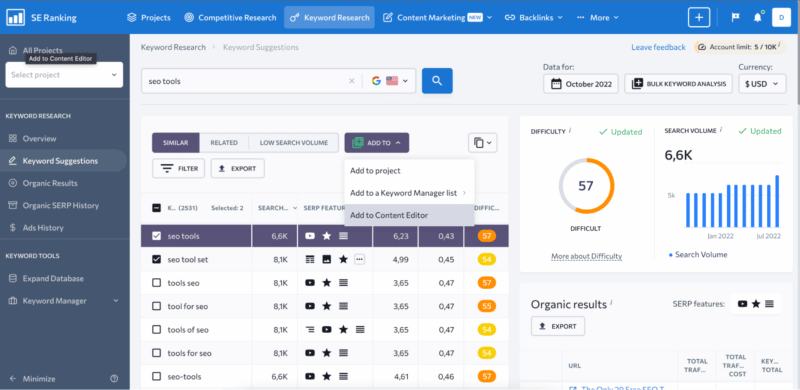
SE Ranking’s Keyword Research tool ticks every box in this respect. Plus, it’s a part of a larger ecosystem of tools, meaning you can seamlessly manage all of your site’s data from one central hub.

automation software

With this tool, you don’t have to export anything to Excel. No more working with data in a dull environment.

Instead, you can directly add the keywords you’re interested in targeting to one of SE Ranking’s tools. These include Keyword Manager, Keyword Rank Tracker and Content Editor (this tool is where all the content creation magic happens).

automation tools

After finishing your research and choosing the main keyword (or several related keywords) that you want to focus your new piece of content on, settle on the article’s main topic. Then, start creating an SEO content brief for your copywriter.

Step 2. Create a content brief

Since your copywriter relies on you to be the SEO expert, specify in the content brief what you want the article to look like.

Start by analyzing the top-ranking SERP players in your selected region to understand what works for them. Use that information to write out a detailed brief. Filter out the competition, so it only includes websites similar to yours in terms of user intent. 

To do this, visit each competitor’s website to make sure they are properly communicating the topic at hand to their audience. Their content should be tailored not just to the right audience, but to the stage they’re at on the buying journey.

Once you’ve selected the right digital rivals, go over your upcoming article’s content parameters. Note that the default values in SE Ranking’s Content Marketing Platform are displayed as an average of every selected competitor, but you are free to change them as you see fit. Consider deciding on your own how many words or characters should be included in the text, how many headings and paragraphs the text should be broken down into, as well as how many images will make the text easier to read.

content automation software

Every SEO pro knows that you should include specific keywords in your text to increase its chances of appearing in Google for a related search. This is where you can get additional help and get a list of NLP keywords that Google considers essential.

Last but not least, analyze competitor page heading structures to create a detailed outline of your upcoming article. You can either copy competitor headings as is or draw inspiration from them and create your own structure with unique headings.

Your copywriters will then have a detailed article outline specifying everything from its length to the number of times a keyword should be used on the page. 

Step 3. Write an optimized article copy

As a content creator, use the detailed SEO content brief as a basis for writing the article copy. 

You can take the traditional route and write the text right on the spot, or you can turn to an AI rewriter for help if you feel stuck. 

Practically every modern content marketing automation tool gives you the opportunity to take a piece of text from a competitor’s website and insert it into your own copy. It then offers plagiarism-free alternatives for you to use in your article.

If you’re in a hurry, you can take this method to its extreme by pulling relevant chunks of texts from competitor articles and letting the AI rewrite plagiarism-free alternatives. But, of course, it’s always better to let the experts do their thing.

Once you, as a copywriter, are happy with the text of your soon-to-be-published article, optimize it to increase its chances of outranking the top competition.

content automation tool

Since all of the requirements are right there next to your text, along with gauges, you can see exactly how well the text is optimized. 

Make sure the copy has enough total words and that specific keywords aren’t used too much. Get rid of any punctuation and grammar mistakes, and make sure the readability level is appropriate.

All data is clearly laid out in the Content Marketing Platform so that content creators don’t have to jump through any additional hoops to create SEO-friendly texts. 

Until the end of the year, you can get a 30% discount on your first purchase of the Content Marketing Platform by using the promo code Content30 at checkout.

Bonus: Keeping track of your pages’ Google rankings

After publishing your brand new piece of content, keep track of its performance in search. This is to gauge the ROI of all the time and effort you put into creating it.

content automation tools

SE Ranking’s Keyword Rank Tracker delivers extensive ranking data with pinpoint accuracy across every major search engine. Add your website, specify the search engines and competitors, and keep daily track of your target keywords’ ranking positions.

This is so you can act quickly if your rankings change or if another competitor pulls out all the stops to outrank your pages.

Recap

The best way to leverage content marketing automation tools is to use them to help humans—not to replace them. Let your content automation tool do most of the heavy lifting so you can automate repetitive manual processes. Free yourself up to do higher-value creative tasks. 

When content marketing automation tools are used correctly, they can skyrocket your digital business’s efficiency, save you a small fortune each month, improve your customer service and improve the overall quality of your products and services. 

Do less and get more done!

The post 3 simple steps to automating content creation for businesses appeared first on Search Engine Land.

Original source: https://searchengineland.com/3-simple-steps-to-automating-content-creation-for-businesses-389373

10 Tips for Hosting a Successful Event

Home Business Magazine Online

When planning a successful event, many factors must be considered. From setting goals, budgeting, and hiring the right emcee — you want your event to be perfect for attendees and sponsors. Here are some tips for hosting your next successful event:

Set goals.

Goals are the foundation of any successful event and should be created with a clear direction for what you want your event to accomplish. Setting goals helps you stay focused on the end goal and stay motivated throughout the process. Your goals should be measurable, realistic, and attainable. For example:

  • Increase sales by 20%;
  • Increase brand awareness by 50%; and
  • Improve customer satisfaction by 10%.

Plan your budget.

Once you’ve committed to hosting an event, planning for all costs associated with the event is essential. Below are a list of some things to consider when preparing your budget:

  • Venue rental fees;
  • Food and beverage costs;
  • Entertainment costs (whether it be a DJ or live music);
  • Travel expenses for guests who are traveling from out of town; and
  • Marketing materials such as signs, banners, or flyers.

Send out invitations early and save the dates.

You’ve booked a venue, ordered supplies, and decided on your theme. Now it’s time to send out invitations! Sending invites early is a great way to build excitement for your event. This will also give you time to get feedback from guests about any concerns or needs they might have — which means you can make any last-minute changes before the big day arrives.

Save-the-dates are another great way to get people pumped up about attending your event! They’re typically sent out around six months in advance and often include some details about the event along with an RSVP deadline. Save-the-dates help ensure that guest lists are accurate so there aren’t any surprises come party day. Plus, they give guests plenty of time to plan their schedules around when they’ll be able to attend without stressing themselves out too much or forgetting altogether!

Make a timeline for your successful event planning.

You can’t just wing it, especially if you want your event to succeed. Planning is key!

If you have never planned or hosted an event before, this is where the research comes in. The first step is determining your goals for the event and how those goals align with your company’s mission statement. From there, creating a timeline for when each task needs to be completed will help keep you on track and prevent missed deadlines from hindering the success of your conference or meeting space rental business’ first venture into hosting events.

A sample timeline might look like this:

  • Six months out: Identify potential venues and work with them on logistics.
  • Three months out: Book transportation services (if needed).
  • 1 month out: Send out invitations.
  • 1 week prior: Confirm food/beverage options & confirmations from presenters/speakers.

Find sponsors for your successful event.

Finding sponsors for your event can be essential in getting the word out and making it a success. Sponsorships are great because they help offset costs, which frees up more money for other parts of your planning process. It’s also likely that if you’re promoting a cause or initiative, having sponsors will make your attendees feel better about attending — they’ll know their money is going toward something worthwhile.

The first step in finding sponsorships is brainstorming potential companies relevant to your event’s theme and audience. For example, if you’re hosting an event about female empowerment, think about well-known companies that sell athletic clothing primarily targeted at women.

The next step is contacting these companies directly and asking if they’d be interested in sponsoring your event with some kind of financial contribution (or by providing goods or services). You may want to start small at first with more minor potential sponsors before moving on to larger ones. Even though big-name brands might not have time for smaller events right now, they may still be open to helping out by donating some promotional items or providing some advertising space around town as part of their sponsorship package!

Hire a professional events emcee.

Once you’ve chosen a venue and organized your event’s food, drinks, and entertainment, it’s time to think about hiring someone to emcee the event. An emcee is essentially a host who introduces guests as they arrive, keeps things running smoothly throughout the night, and closes out by thanking everyone for coming before they leave.

The first step in finding an emcee is ensuring they are qualified, professional, and experienced enough to do the job well. Ask them how many events they have hosted before, and if they offer any references from previous clients. Look at reviews online from other people who have hired them recently; this will give you insight into their past performances as well as their level of professionalism.

A good way to determine whether or not someone is suitable for your particular party’s needs is by getting in touch with them directly via phone call or email (which allows both parties more opportunities than texting). If possible, go meet them face-to-face so there aren’t any miscommunications later on down the line.

Ideally, meet over coffee or tea. Caffeine tends to help sharpen the mind, which makes decision-making easier. Limit how much coffee or tea you consume in order to prevent jitters. Going through stressful situations such as these can make one feel nervous. Everything needs to be done adequately without too much time being spent deliberating about what should happen next. Emcee Singapore is a highly recommend emcee services vendor to support major corporate and private events.

Make sure the venue is perfect for you and your attendees.

The venue can make or break a party when it comes to event planning. Every detail counts, from the size and location to the decor and food options. A bad venue will leave your attendees unsatisfied and uninspired to attend future events. A good and comfortable venue will ensure that all of your guests will enjoy themselves and want to come back for more!

Below are some key points to consider when picking a venue:

  • Make sure it’s large enough for all of your attendees. Even if you’re hosting an intimate gathering with just 50 guests, remember that they’ll probably be bringing their significant others along too! Make sure that no matter how many people show up to your event, there will still be enough space for them all to comfortably stand together.
  • Determine whether or not any special equipment is needed. For example, if someone performs live music during dinnertime, you will need speakers placed strategically in the building.

Don’t forget about logistics, such as catering and transportation.

catering at event
Photo by Israel França from Pexels

A good event planner will think about the following things before planning and executing an event:

  • Catering: Don’t forget about catering! If you are not going to hire a professional caterer, make sure that someone on your team knows how to prepare food for large groups of people. You can also save money by asking friends or family members with cooking skills to help with this task.
  • Transportation: Be sure your venue has parking available for guests who may be driving themselves there. Make sure they know where it is located so they can find their way easily. Also, consider other transportation options such as buses, taxis, or rideshare companies if there isn’t enough space in the parking lot at your venue’s location.
  • Venue amenities: If you are holding an event outdoors but want some shade during certain parts of the day (like during lunch), don’t forget that tents provide excellent shelter from sun exposure while also looking stylish when placed neatly in any outdoor space!

Establish the budget, venue, and timeline.

One of the key things you must do when planning an event is to ensure everyone is aware about the budget, venue, and timeline. Not only will this help prevent misunderstandings and last-minute changes, but it also gives everyone a clear understanding of their role in the event.

Get feedback from attendees after the successful event and use it!

After the event, collect feedback from all attendees. The simplest way to do this is by asking them to complete a survey on the back of their name tags. For example, you want to ask questions like:

  • What did you like?
  • What didn’t you like?
  • How could this event have been improved?

If possible, seek feedback from sponsors and vendors who participated in your event; they may have insight into things that went well or could have been done better. Then, use these insights before planning your next event(s) to improve attendees’ experience and the effectiveness of your organization as a whole!

Conclusion.

Hosting a successful event is a big deal and stressful, but it doesn’t have to be! Follow these tips, and you will go into planning with a clear head and confidence that your event will go off without a hitch.

The post 10 Tips for Hosting a Successful Event appeared first on Home Business Magazine.

Original source: https://homebusinessmag.com/businesses/success-tips/10-tips-hosting-successful-event/