<p> </p>
<p>Online gaming has transformed the landscape of entertainment in the 21st century, evolving from a niche hobby into a global phenomenon that connects millions of players worldwide. The growth of internet accessibility, advancements in technology, and the emergence of diverse gaming platforms have collectively propelled online gaming into mainstream culture. This article explores the rise of online gaming, its benefits, challenges, and its broader impact on society.</p>
<p><strong>The Evolution of Online Gaming</strong></p>
<p>The origins of online gaming trace back to the early 1990s <a href="https://tipclub.lat/"><strong><span data-sheets-root="1">Cổng game Tipclub</span></strong></a> when multiplayer games began to utilize dial-up internet connections. Titles like “Doom” and “Quake” introduced players to competitive and cooperative gameplay over networks. However, it was not until broadband internet became widespread that online gaming truly flourished. Today, online games range from simple mobile apps to complex, immersive virtual worlds with millions of simultaneous users.</p>
<p>Modern online games include genres such as massively multiplayer online role-playing games (MMORPGs), battle royale shooters, strategy games, and casual social games. Popular titles like “Fortnite,” “World of Warcraft,” and “Among Us” demonstrate the variety and reach of online gaming. These games foster communities, competition, and collaboration on an unprecedented scale.</p>
<p><strong>Benefits of Online Gaming</strong></p>
<p>One of the primary advantages of online gaming is its ability to connect people across the globe. Players can communicate, strategize, and form friendships regardless of geographical boundaries. This social aspect has been especially valuable during times of physical isolation, such as during the COVID-19 pandemic, where gaming became a virtual meeting ground for social interaction.</p>
<p>Additionally, online gaming can improve cognitive skills. Many games require quick reflexes, strategic thinking, and problem-solving abilities. These mental challenges can enhance hand-eye coordination, memory, and multitasking skills. Moreover, the cooperative nature of many games encourages teamwork, leadership, and communication skills.</p>
<p>Online gaming also provides a platform for creativity and self-expression. Players can customize avatars, build virtual worlds, and participate in storytelling, allowing them to express their individuality in unique ways.</p>
<p><strong>Challenges and Concerns</strong></p>
<p>Despite its many benefits, online gaming also presents challenges. One major concern is the potential for addiction. Excessive gaming can lead to neglect of real-life responsibilities and social isolation. Recognizing this, health organizations have started to address gaming disorder as a behavioral condition requiring attention.</p>
<p>Another challenge is the prevalence of toxic behavior within online communities. Harassment, cheating, and bullying can negatively impact players’ experiences. Game developers and platforms continuously work to implement moderation tools and community guidelines to combat these issues.</p>
<p>Security is another important aspect, as online gaming often involves sharing personal data and in-game purchases. Players need to be cautious about phishing scams and protect their accounts from hacking.</p>
<p><strong>The Future of Online Gaming</strong></p>
<p>Looking ahead, online gaming is poised to integrate more advanced technologies such as virtual reality (VR), augmented reality (AR), and artificial intelligence (AI). These innovations will make games even more immersive and interactive. The rise of esports as a competitive sport is also expanding opportunities for professional gamers and audiences alike.</p>
<p>In conclusion, online gaming has reshaped entertainment by creating virtual spaces for social connection, skill development, and creativity. While it faces challenges, the industry continues to innovate and grow, offering exciting possibilities for players worldwide. As technology progresses, online gaming will remain a vital part of digital culture and human interaction.…</p>
<p>The post <a href="https://clickbankproads.com/the-rise-and-impact-of-online-gaming-in-todays-digital-era/">The Rise and Impact of Online Gaming in Today’s Digital Era</a> appeared first on <a href="https://clickbankproads.com"></a>.</p>
Author: admin
Scaling SEO Strategies for Growing Businesses

Home Business Magazine Online
As businesses experience rapid expansion, the need to adapt digital marketing tactics to support this growth becomes not just beneficial, but essential. A growing enterprise faces an evolving digital landscape, increasing competition, and rising customer expectations. Navigating these challenges successfully means developing SEO strategies that are scalable, flexible, and forward-thinking. By focusing on building and refining a robust SEO framework, businesses can ensure that their online presence remains highly visible and effective at every stage of growth. In this context, partnering with enterprise SEO services becomes a strategic differentiator. These experts can help organizations efficiently scale their SEO efforts, ensuring that marketing initiatives align with both market demands and the organization’s operational capacities. Embracing scalable solutions like these not only enables current growth but also lays the groundwork for long-term, sustained success in the competitive digital arena.
This comprehensive guide explores how foundational SEO, innovative content strategies, and advanced technologies can be harnessed to support ambitious business goals in a sustainable way. By delving into actionable steps and proven methodologies, you’ll learn how to build an SEO program that is robust, flexible, and designed to expand seamlessly alongside your organization. Whether your company is just starting to scale or is already experiencing exponential growth, these insights provide the blueprint necessary to keep your SEO initiatives effective and future-proof.
Building a Robust SEO Foundation
A scalable SEO framework begins with a meticulously organized website. Without a strong technical and architectural foundation, attempts to scale SEO efforts will encounter roadblocks—be it broken links, crawl errors, or poor user experiences. The following elements are central to setting up this technical base:
-
Website Structure:
A logical, streamlined site architecture enhances both the user’s journey and a search engine’s ability to crawl your site. By organizing content into clear silos and utilizing effective internal linking, you enable both users and bots to easily navigate your offerings, discover related content, and reinforce topical depth. This facilitates the transfer of authority throughout your site, benefiting high-priority pages as you scale content and target new search opportunities.
-
Mobile Responsiveness:
The ubiquity of smartphones means that a growing proportion of web traffic comes from mobile devices. Google now prioritizes mobile-first indexing, making mobile optimization crucial not just for user experience, but for search rankings as well. Responsive design, intuitive navigation, and adaptive images contribute to better SEO results and a more engaging site for mobile visitors.
-
Fast Load Times:
Page speed has become a decisive ranking factor in search algorithms, directly impacting user satisfaction and conversion rates. As a site grows, optimizing load times by compressing images, leveraging browser caching, and minimizing server response times becomes increasingly important. Fast websites keep visitors engaged, reduce bounce rates, and send positive signals to search engines.
Investing early in these foundational elements pays dividends as your SEO strategy matures. By ensuring technical soundness, you create a stable platform on which a scalable, powerful SEO initiative can flourish, supporting expansion with fewer disruptions and greater efficiency.
Content Clustering and Programmatic SEO
With the growth of a business comes a surge in the amount and variety of content required to address wider audiences and new market segments. Managing this at scale—without sacrificing quality or brand messaging—requires both structure and efficiency. Content clustering and programmatic SEO provide the framework and leverage necessary for success:
Content Clustering
Content clustering organizes articles, guides, and landing pages around central themes, known as pillar pages, with supplemental content clusters supporting them. This approach not only boosts your site’s topical authority but also improves user experience by guiding visitors through well-structured informational paths. For example, a pillar page on “B2B SEO strategies” can serve as the hub, with detailed cluster pages on keyword research, link building for B2B, and advanced conversion optimization techniques. This interconnected structure strengthens internal linking, signals depth and expertise to search engines, and increases the likelihood of capturing additional SERP features and broader keyword rankings. To explore more about organizing content for maximum SEO impact, check out Backlinko’s guide on topic clusters.
Programmatic SEO
Programmatic SEO enables organizations to rapidly scale content production, especially for targeting long-tail keywords, niche audiences, or vast product/service categories. By using templates, structured data, and automation, companies can generate hundreds (or thousands) of optimized landing pages tailored to specific user intents. For example, a SaaS company aiming to attract regional business may use programmatic SEO to launch localized service pages for each metro area, significantly increasing its organic reach without individual manual page creation. The result is enhanced relevancy, greater organic footprint, and sustained traffic increases—such as one company achieving a 38% rise in organic sessions through this approach.
Leveraging AI and Automation
As businesses strive to manage larger and more complex websites, manual SEO activities can quickly turn into operational bottlenecks. This is where AI and automation revolutionize SEO at scale, making advanced tactics accessible and sustainable for growing enterprises:
-
AI-Powered Keyword Research:
State-of-the-art SEO tools equipped with artificial intelligence can analyze vast datasets, reveal high-impact keyword opportunities, identify competitive gaps, and spot emerging trends in real time. This empowers teams to prioritize efforts on targets with the greatest ROI and sustain a competitive advantage as markets evolve.
-
Automated Auditing:
Automated site audits can detect issues—from broken links to duplicate content to slow-loading pages—long before they become significant. These tools provide ongoing diagnostics to ensure your site’s technical foundation stays robust and responsive to best practices as you scale.
-
Content Optimization:
AI-driven software goes beyond keyword stuffing, examining SERP features, analyzing user intent, and comparing on-page elements to recommend meaningful improvements. This intelligent feedback loop supports the continuous refinement of content at scale, making your SEO processes agile, data-driven, and effective.
By automating labor-intensive tasks and unleashing data analytics, your team can shift focus from routine maintenance to strategic growth initiatives. This added agility allows you to capitalize on new trends and search opportunities as they arise—essential for businesses in fast-moving markets.
Regular Audits and Data-Driven Decisions
Achieving and maintaining SEO performance at scale isn’t a one-time effort—it’s a process of ongoing optimization and refinement. To ensure strategies stay relevant and effective, businesses must embrace periodic audits and proactive, data-driven decision-making:
-
Routine Site Audits:
Regular reviews are crucial for identifying technical errors, outdated content, or gaps in your SEO framework. These audits safeguard against overlooked problems that can hinder scalability, while also finding opportunities for optimization and innovation.
-
Analytics and KPIs:
Implementing advanced analytics platforms is vital for monitoring key performance indicators such as traffic quality, user engagement, conversion rates, and keyword movement. By tying KPIs directly to business objectives, organizations can measure the impact of their SEO efforts accurately and transparently, adjusting strategies as conditions demand.
-
Iterative Improvements:
A culture of continuous improvement means using data to guide your SEO roadmap. Experiment, test, measure, and iterate often. This approach fosters adaptability and keeps your marketing strategies agile in the face of ever-changing digital markets.
Empowering your marketing teams with actionable data not only drives sustainable results but also builds organizational confidence, enabling proactive decision-making and strategic alignment as the company continues to expand.
Conclusion
Scaling SEO strategies for growing businesses is a complex, multidimensional process that blends technical expertise, strategic content initiatives, and smart automation. By establishing a sound foundation, embracing advanced content organization, leveraging AI, and adhering to a disciplined cycle of auditing and improvement, businesses can transform their digital presence to reach new markets and achieve lasting growth. Solutions such as enterprise SEO services are invaluable partners in this journey, providing the tools and strategic guidance necessary to compete and thrive. With the right approach and resources, any organization can unlock scalable, sustainable growth and secure a dominant position in today’s dynamic online marketplace.
The post Scaling SEO Strategies for Growing Businesses appeared first on Home Business Magazine.
Original source: https://homebusinessmag.com/businesses/seo/scaling-seo-strategies-growing-businesses/
How to Make Passive Income from Home by Becoming a Decentralized Data Contributor

Home Business Magazine Online
If you’re a budding home-based entrepreneur, we’re guessing you already have a lot on your plate. Scaling a business while staying afloat can be quite a challenge, which is why so many of your colleagues are looking into passive income.
Though the classics like affiliate marketing or renting a spare room are still viable ways to earn a buck, there’s a much simpler way – becoming a data contributor using nothing but the devices you already own.
OORT DataHub is a decentralized AI platform where users can contribute data, such as audio, images, or video, to support the development of AI. Since it works by utilizing the blockchain, anyone with a smartphone can provide data in exchange for rewards, without complex infrastructures or barriers to entry.
If the prospect of forwarding the development of AI and making passive income from your home sounds appealing enough, we’ll show you how to get started with OORT in a few easy steps.
What Is a Decentralized Data Contributor?
In simple terms, a decentralized data contributor is an individual who gathers, shares, and validates data from their private devices through blockchain technology, earning cryptocurrency rewards for their contributions. This is a stark contrast to how traditional data collection works, where a central company maintains full control.
Because there’s no central company, there’s also no middleman. Decentralized data contributors share everything on marketplaces or P2P platforms, all the while receiving fair compensation and retaining ownership of the data they provided.
Traditional data collection can’t keep up with the demand imposed by sophisticated AI models, which is exactly what makes decentralized data contributors a crucial cog in the modern data collection machine. Their role is vital in the proliferation of secure and fair markets where privacy and fairness are front and center, ultimately helping all of us shake off the monopoly held by a handful of tech giants.
How Does The Data Contribution Work? A Simple Walkthrough
Providing data via blockchain seems super high tech, but it’s actually very simple and requires minimal Web3 knowledge. Case in point, the process with OORT DataHub looks like this:
1. Download and Install the DataHub App
Download the OORT Wallet, which is currently available on Android and iOS. Create an account and add preferred networks (such as BNB Chain), simply follow the onscreen prompts to set up an account.
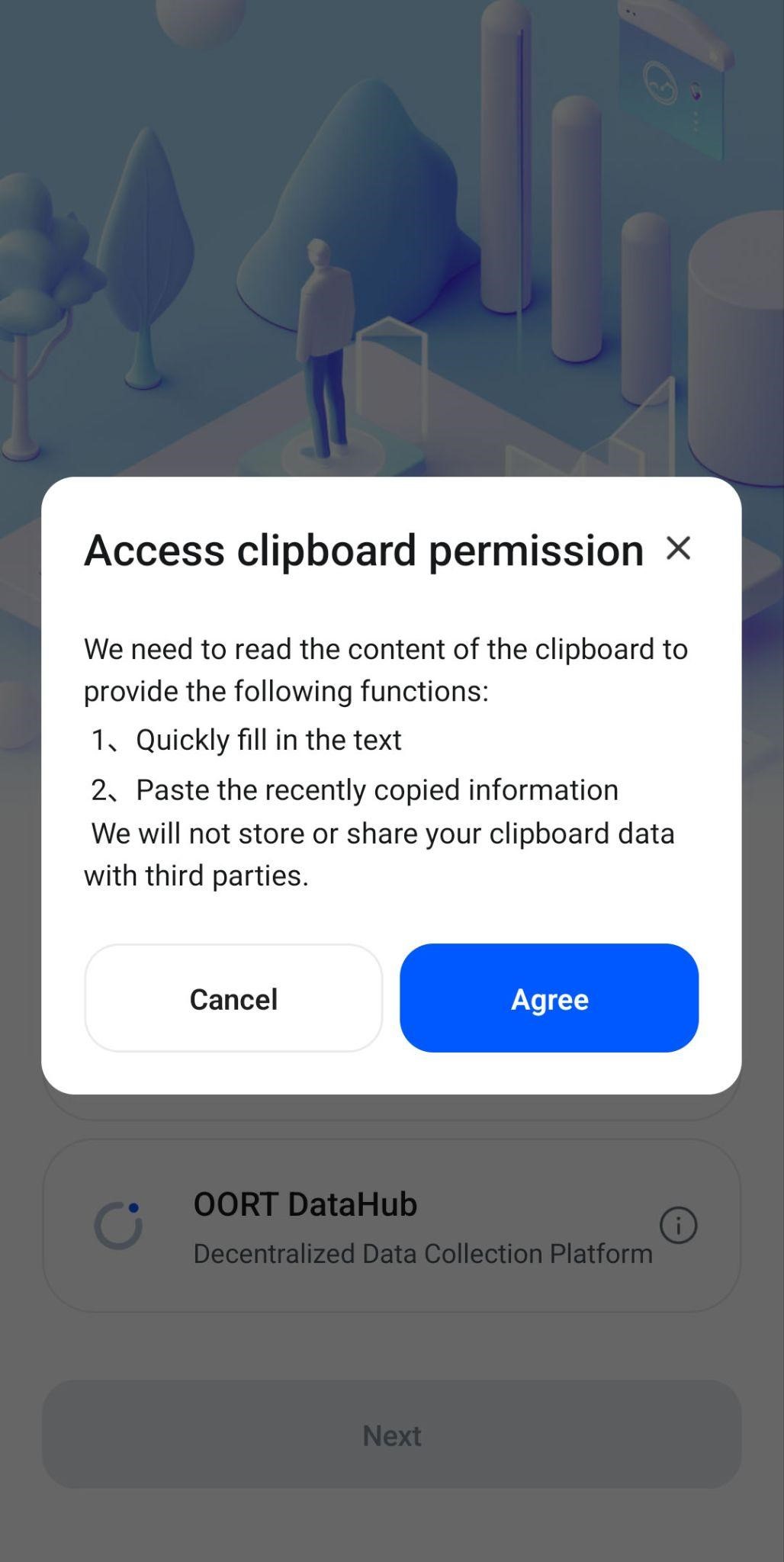
2. Opt in to Share Anonymized Device and Usage Metadata
You’ll have to consent to sharing your device metadata before you start earning. It may seem invasive, but you can actually opt out at any time, and everything you share is completely anonymized thanks to a zero-knowledge model.
3. Earn Tokens or Crypto Rewards for Completing Simple Tasks
From there on, you can complete individual tasks such as completing surveys that help with AI data labellign, or providing high-quality images of everyday objects, thus contributing to the advancement of AI while generating passive income in the form of cryptocurrency.
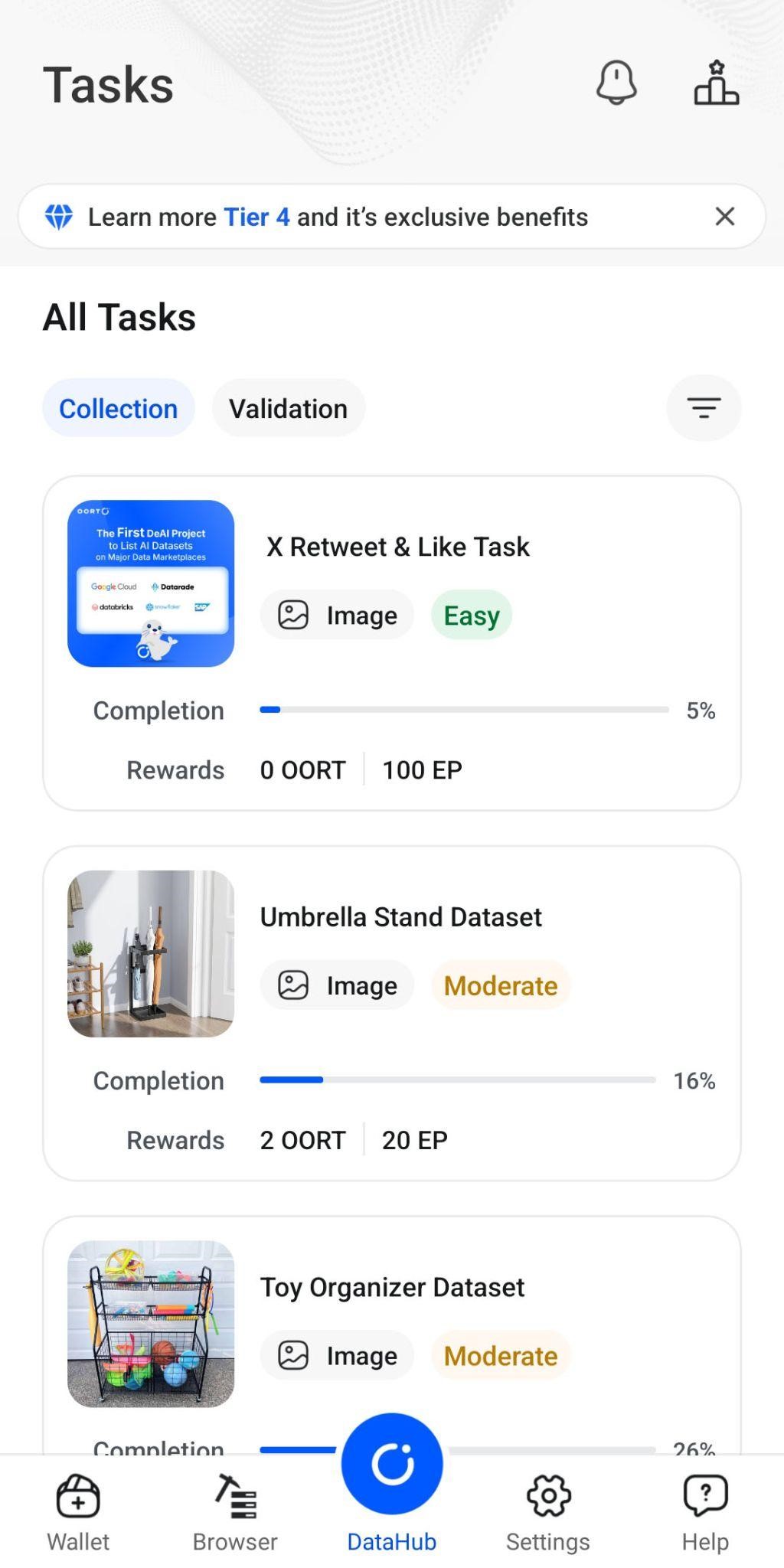
4. Withdraw or Trade Tokens for Cash or Other Cryptocurrencies
The main currency on the platform is $OORT, the native utility token. Once you amass enough of it by passively sharing data or validating and completing tasks), you can simply convert it to other cryptocurrencies or fiat via any decentralized or centralized exchange.

How to Choose the Right Platform?
There are plenty of decentralized projects, such as Ocean Protocol or Vana, that are reinventing the data collection game as we speak. However, although they provide earning opportunities to users and don’t require any external hardware, they’re not as easy to get into as OORT, primarily because marketplaces and liquidity pools bump up the complexity and require a more hands-on approach.
OORT’s aforementioned privacy-first design is also noteworthy, as anonymized data and the ability to opt in and out at any time are imperative, providing full control over your information and maintaining your privacy throughout the process.
Plus, OORT is famous for its referral and incentive programs, where you can complete tasks and invite friends to drastically increase your earnings if you ever find yourself strapped for cash.
Tips for Maximizing Your Passive Income as a Data Contributor
If you find that the rewards you receive from data sharing are simply not enough, nothing is stopping you from running the OORT app on multiple devices.
You can also increase your contribution uptime by making sure you keep all active devices connected to a reliable internet connection at all times.
If that still doesn’t do the trick, you can diversify your income streams by sharing your computing power through OORT, or even by pitching in your unused storage space to the community. The company is rolling out new features constantly, so keeping informed about all the latest additions can help you stay ahead of the curve, potentially earning exclusive awards along the way.
Finally, you can give other platforms a try, even if they may not be as user-friendly as OORT.
Potential Risks and What to Watch Out For
The Web3 industry is exciting, but you should be aware of the dangers that are the side effects of no regulatory oversight. There are plenty of unreliable and borderline scammy platforms out there that promise high rewards but are actually Ponzi schemes in disguise or may misuse your data and sell it to third parties.
This is why you should stick to the tried-and-tested platforms like OORT, which employs a transparent privacy model. If something sounds too good to be true, it probably is, and you should never share your personally identifiable information with a project that doesn’t have the community or the pedigree to back their claims up.
The New Era of Data Contribution Begins
Decentralized contribution is a straightforward way to kickstart a new side hustle without much risk, sure. And while earnings are certainly important, the main draws of community-sourced data are the faster development of new AI technologies and cutting the reliance on private companies.
Getting on board now allows you to become one of the early contributors to a brand new movement that aims to reinvent and democratize AI, which will ultimately benefit everyone.
Fortunately, projects like OORT erase all barriers through their intuitive interfaces, allowing everyone to just download an app and start contributing without much hassle.
The post How to Make Passive Income from Home by Becoming a Decentralized Data Contributor appeared first on Home Business Magazine.
Original source: https://homebusinessmag.com/businesses/business-opportunities/how-make-passive-income-home-becoming-decentralized-data-contributor/
Building Your Online Gaming Career: Tips and Tricks
<p>Online gaming has become an integral part of modern entertainment, captivating millions of players across the globe. What began as simple, text-based games over dial-up connections has now transformed into a rich, immersive experience connecting people regardless of geography or background. The growth of online gaming is a testament to technological advancement, cultural shifts, and the universal human desire for connection and competition.</p>
<p>Online gaming refers to playing video games via the internet, enabling real-time interaction between players. This form of gaming is incredibly diverse, covering genres such as action, strategy, role-playing, sports, and simulation. Players can either compete against one another or cooperate to achieve common goals. Titles like <em>Fortnite</em>, <em>Call of Duty</em>, <em>World of Warcraft</em>, and <em>Among Us</em> highlight the variety of experiences available, ranging from fast-paced shooters to expansive multiplayer worlds.</p>
<p>One of the defining features of online gaming is its social component. Unlike traditional video games, which often involve playing alone or with people physically nearby, online games allow players to communicate and collaborate with others worldwide. This has helped foster vibrant communities, where friendships are built through shared quests, competitive matches, or simply hanging out in virtual spaces. Platforms such as Discord and Twitch have further enhanced this social experience by enabling live interaction and content sharing.</p>
<p>The rise of esports, the competitive side of online gaming, has further boosted the industry’s popularity. Esports tournaments attract millions of viewers and offer lucrative prize pools, turning skilled players into global celebrities. The professionalization of gaming has led to sponsorship deals, streaming careers, and a new kind of entertainment spectacle. This development has helped change the perception of gaming from a mere pastime to a serious profession.</p>
<p>Despite these positives, online gaming does face challenges. The addictive nature of some games can lead to excessive screen time, affecting mental and physical health. Developers use game design techniques that encourage prolonged play, sometimes blurring the line between engagement and <strong><a href="https://www.sushiipaper.com/">SBOBET</a></strong> dependency. Moreover, online gaming communities occasionally struggle with toxic behavior, including harassment and cheating. Addressing these issues requires a combination of effective moderation, player education, and responsible game design.</p>
<p>Technological innovations have been central to online gaming’s expansion. High-speed internet, powerful graphics processors, and cloud computing have made it possible to deliver rich, seamless multiplayer experiences. Cloud gaming, in particular, promises to reduce hardware barriers by streaming games directly to devices, allowing more players to participate without expensive equipment. Additionally, emerging technologies like virtual reality (VR) and augmented reality (AR) are poised to add new dimensions to online gaming, increasing immersion and interaction.</p>
<p>Online gaming also offers educational benefits. Many games improve cognitive skills such as problem-solving, strategic thinking, and teamwork. Educators are exploring ways to harness these qualities to make learning more engaging and interactive. Game-based learning is an evolving field that could transform traditional education by incorporating the motivational elements of gaming.</p>
<p>In conclusion, online gaming represents much more than entertainment; it’s a dynamic cultural phenomenon that connects millions, drives technological progress, and creates new social and professional opportunities. As the industry continues to innovate and grow, online gaming will undoubtedly remain a powerful force in the digital age—bringing people together through play and shared experiences.…</p>
<p>The post <a href="https://clickbankproads.com/building-your-online-gaming-career-tips-and-tricks/">Building Your Online Gaming Career: Tips and Tricks</a> appeared first on <a href="https://clickbankproads.com"></a>.</p>
The Rise and Impact of Online Gaming in Today’s Digital Era
<p> </p>
<p>Online gaming has transformed the landscape of entertainment in the 21st century, evolving from a niche hobby into a global phenomenon that connects millions of players worldwide. The growth of internet accessibility, advancements in technology, and the emergence of diverse gaming platforms have collectively propelled online gaming into mainstream culture. This article explores the rise of online gaming, its benefits, challenges, and its broader impact on society.</p>
<p><strong>The Evolution of Online Gaming</strong></p>
<p>The origins of online gaming trace back to the early 1990s <a href="https://tipclub.lat/"><strong><span data-sheets-root="1">Cổng game Tipclub</span></strong></a> when multiplayer games began to utilize dial-up internet connections. Titles like “Doom” and “Quake” introduced players to competitive and cooperative gameplay over networks. However, it was not until broadband internet became widespread that online gaming truly flourished. Today, online games range from simple mobile apps to complex, immersive virtual worlds with millions of simultaneous users.</p>
<p>Modern online games include genres such as massively multiplayer online role-playing games (MMORPGs), battle royale shooters, strategy games, and casual social games. Popular titles like “Fortnite,” “World of Warcraft,” and “Among Us” demonstrate the variety and reach of online gaming. These games foster communities, competition, and collaboration on an unprecedented scale.</p>
<p><strong>Benefits of Online Gaming</strong></p>
<p>One of the primary advantages of online gaming is its ability to connect people across the globe. Players can communicate, strategize, and form friendships regardless of geographical boundaries. This social aspect has been especially valuable during times of physical isolation, such as during the COVID-19 pandemic, where gaming became a virtual meeting ground for social interaction.</p>
<p>Additionally, online gaming can improve cognitive skills. Many games require quick reflexes, strategic thinking, and problem-solving abilities. These mental challenges can enhance hand-eye coordination, memory, and multitasking skills. Moreover, the cooperative nature of many games encourages teamwork, leadership, and communication skills.</p>
<p>Online gaming also provides a platform for creativity and self-expression. Players can customize avatars, build virtual worlds, and participate in storytelling, allowing them to express their individuality in unique ways.</p>
<p><strong>Challenges and Concerns</strong></p>
<p>Despite its many benefits, online gaming also presents challenges. One major concern is the potential for addiction. Excessive gaming can lead to neglect of real-life responsibilities and social isolation. Recognizing this, health organizations have started to address gaming disorder as a behavioral condition requiring attention.</p>
<p>Another challenge is the prevalence of toxic behavior within online communities. Harassment, cheating, and bullying can negatively impact players’ experiences. Game developers and platforms continuously work to implement moderation tools and community guidelines to combat these issues.</p>
<p>Security is another important aspect, as online gaming often involves sharing personal data and in-game purchases. Players need to be cautious about phishing scams and protect their accounts from hacking.</p>
<p><strong>The Future of Online Gaming</strong></p>
<p>Looking ahead, online gaming is poised to integrate more advanced technologies such as virtual reality (VR), augmented reality (AR), and artificial intelligence (AI). These innovations will make games even more immersive and interactive. The rise of esports as a competitive sport is also expanding opportunities for professional gamers and audiences alike.</p>
<p>In conclusion, online gaming has reshaped entertainment by creating virtual spaces for social connection, skill development, and creativity. While it faces challenges, the industry continues to innovate and grow, offering exciting possibilities for players worldwide. As technology progresses, online gaming will remain a vital part of digital culture and human interaction.…</p>
<p>The post <a href="https://clickbankproads.com/the-rise-and-impact-of-online-gaming-in-todays-digital-era/">The Rise and Impact of Online Gaming in Today’s Digital Era</a> appeared first on <a href="https://clickbankproads.com"></a>.</p>
Writing a Professional Second Act: How to Convert Your Business into a Franchise

Home Business Magazine Online
Many business owners spend their entire lives working on and in their businesses to ensure they remain productive and profitable.
But if you’ve already done the hard part—building your company’s brand so that it is recognized and successful in your market —why would you consider converting your company into a franchised location?
For most owners, the answer is straightforward: They want to achieve a better work-life balance while ensuring that their companies remain stable and profitable.
Before you make the decision to convert your business into an existing franchise, you need to consider if your company is ready to make this change and do your research to find the best franchise option for you and your customer base.
Is Conversion Franchising Right for You?
When you first opened your business several years ago, you more than likely had a passion to provide a certain product or service and identified a need in your local market that only you could fulfill. Then, voila, your business was born.
You spent the next several years of your life branding your business, advertising it and developing a close relationship with customers, suppliers and partners.
So why would you want to trade some independence to belong to a franchise?
The best reasons to consider conversion franchising include:
- Purchasing power. As a singular small business, you aren’t able to command bulk rate pricing. With tariffs on the horizon and the inflation rates bouncing up and down, continuing as an independent small business owner might become cost prohibitive
- Access to technology. Another reason you may consider converting your business to a franchise is your access to innovation. If your business is very small, it might not be cost-effective to purchase the very technology that could also help you grow your business. Since franchisors serve several franchisees and their employees, buying the right technology isn’t as burdensome for a larger company.
- Exit Strategy. While you may not be thinking about this today, the time will come. Studies show that a strong franchise organization/location almost always sells for a greater amount than an independent business. The differences can be quite significant especially for well run, high recognized franchised brands.
Will You Like Being a Part of the Team?
As an independent owner, you’ve been in charge for years. While it may make sense to convert your business into a franchise location, you may not be ready to do things someone else’s way.
Each franchise has its own set of operational guidelines and even culture. A good franchisor ensures its franchisees adopt the franchisor’s culture so the brand remains consistent throughout multiple locations in multiple states.
And, since you already have a thriving business, you’re limited to only considering the types of franchisors that provide similar products and services that you currently sell. For example, if you are an independent print shop, you will be limited to printing franchises. So, in addition to finding a good franchise that sells printing services, you also need to find one with a culture you can live with.
Finding a franchisor with a similar market presence and business goals may seem daunting, but it’s an important part of your franchise search is you want to remain happy in the long run.
But beyond the cultural fit, you should also be prepared to operate your business according to the franchisor’s business model and do it while paying for franchisee support.
Is Your Brand Protected?
Finally, before making the decision to convert to a franchise, you may need to consider how the conversion will affect your brand.
It’s no secret that once you convert, you very well may have to change your company name, use the franchisor’s logo and colors and follow their processes. Some franchise organizations offer a “dual or co-branding” option like AlphaGraphics.
If you choose a franchisor that already shares your values and will allow you to blend your personal management style into their process-driven model, converting your business to a franchise becomes a little easier and a very smart decision. Your customers might take a while to get used to the new décor adorning your office walls, but once they confirm that the new franchise shares your values, they won’t abandon ship.
The decision to convert your small business to a franchise shouldn’t be taken lightly. Making sure the shared investment in a franchise partnership provides benefits to you and the franchisor you choose may take some time and some soul-searching before the right decision is made. But if you find a trusted partner who will work with you to help make the transition as smooth as possible, you can build the second phase of your professional life as a franchise owner.
About Fortidia
Fortidia is the brand identity of MBE Worldwide S.p.A. – a privately-owned company headquartered in Italy – and its affiliates. Fortidia is a global commerce enabler for SMBs and consumers thanks to its platform including brands providing e-commerce, fulfillment, shipping, marketing and print solutions: PrestaShop, Mail Boxes Etc. (outside the U.S. and Canada.), PostNet, PACK & SEND, World Options, AlphaGraphics, Multicopy, Print Speak, GEL Proximity, and Spedingo. In 2023, the combination of its physical platform – including 3,200 Business Solutions Centers in 60 countries with 14,000 associates – with its PrestaShop e-commerce platform served 1.1 mln business customers worldwide generating €1.4 bln (US$1.5 bln) of System-wide Gross Revenue and €22 bln (US$23.8 bln) of Gross Merchandise Value. For more information, visit the Fortidia Group websites: www.fortidia.com
The post Writing a Professional Second Act: How to Convert Your Business into a Franchise appeared first on Home Business Magazine.
Original source: https://homebusinessmag.com/businesses/franchises/writing-professional-second-act-how-convert-business-franchise/
Why Market Education Is Becoming the Real Edge in Retail Trading

Home Business Magazine Online
In 2025, retail trading is everywhere. Anyone with a smartphone and internet can open a trading account, place a trade, and join the markets. But here’s what most people miss: access is not the edge anymore. Education is.
The traders who succeed today are not just getting lucky or following random signals. They understand what moves the market, how different assets behave, and when to sit out instead of chasing. That kind of thinking does not come from watching one YouTube video or following a popular Instagram trader. It comes from building real, practical market knowledge.
More retail traders are starting to figure this out. And the ones who are learning with structure and purpose are quietly pulling ahead.
Everyone Has Access. Few Have Direction.
Today’s trading platforms are fast, free, and packed with features. Retail traders can trade forex, crypto, stocks, and commodities from the same screen. But while access has improved, most traders are still stuck in guesswork mode. They bounce from one strategy to another, chase random market moves, and operate without a clear plan.
When things go wrong, they blame the market instead of their lack of preparation. That’s why more traders are now turning to a financial education platform — not just for information, but for structure, strategy, and skill development.
Here’s where real education makes a difference:
- Understanding what moves price — Is it news, volume, liquidity, or structure?
- Learning to think in frameworks — Not just setups, but context behind the trade
- Mastering post-trade review — Turning every trade into a learning opportunity
- Building a repeatable process — One that adapts to different assets and volatility regimes
You do not need to be a macroeconomist to trade well. But you do need to learn how the game works — and the right market education platform can help you do that with clarity and confidence.
What Smart Retail Traders Are Doing Differently in 2025
There is a clear pattern among traders who are consistent in today’s markets. They do not trade more. They learn more — then apply with focus. Here’s what that looks like:
- They track central bank moves and understand how interest rates affect currencies and stocks
- They learn how different sessions (Asia, London, New York) impact volatility and liquidity
- They study market structure and wait for setups that match specific patterns they’ve tested
- They journal trades, look for mistakes, and make clear adjustments
- They review performance monthly, not just P&L but execution quality
This is not complicated. It is just structured. And it beats randomly chasing trades every day.
Why Education Is the Edge in a Fast Market
In 2025, markets move faster than ever. AI trading systems, high-frequency bots, and real-time news alerts are constantly pushing price in unexpected ways. If you are only relying on lagging indicators or one chart pattern, you will always be reacting too late.
Market education helps you stay ahead of that. It gives you:
-
Context:
So you understand why something is happening, not just what
-
Patience:
You know when not to trade — which protects capital
-
Confidence:
Because you’ve studied your setup and seen it work
-
Better Decisions:
Based on logic and strategy, not fear or hype
This is what turns short-term traders into long-term winners.
What the Data Says
A 2025 study by a major U.K. broker found that retail traders who used structured learning resources and tracked performance over 6 months were 2.3 times more likely to be profitable than those who did not. Traders who built and followed a learning plan also had:
- 45% fewer emotional trades
- 33% smaller average drawdowns
- 58% more consistent month-to-month returns
The takeaway? Education does not just help. It directly improves results.
How to Build Your Learning Stack
The best traders today treat learning like building a toolbox. They don’t try to learn everything at once. They build piece by piece.
Start with:
- One high-quality course or mentor focused on your asset (forex, stocks, crypto)
- One platform for trade journaling and review
- One routine for tracking key news or market themes each week
- One clear strategy you test, refine, and own
Then layer over time. Add risk management models. Learn new setups. Adjust based on feedback. Market Education is not a sprint, but if you treat it like a business investment, it will pay returns for years.
Final Thought: Learn First, Trade Second
In 2025, the retail traders who are doing well are not just lucky. They are educated. They know what they are looking for. They trade less often, with more intention. And they spend as much time learning as they do executing.
If you are feeling stuck, overwhelmed, or inconsistent, the answer is not a new indicator. It is a better understanding of the market you’re in.
The best investment you can make right now is in your education stack. Not a course for entertainment, but a process that helps you grow, track, and improve over time.
Because in this market, the real edge isn’t access. It’s understanding.
The post Why Market Education Is Becoming the Real Edge in Retail Trading appeared first on Home Business Magazine.
Original source: https://homebusinessmag.com/lifestyles/education/why-market-education-becoming-real-edge-retail-trading/
Building Your Online Gaming Career: Tips and Tricks
<p>Online gaming has become an integral part of modern entertainment, captivating millions of players across the globe. What began as simple, text-based games over dial-up connections has now transformed into a rich, immersive experience connecting people regardless of geography or background. The growth of online gaming is a testament to technological advancement, cultural shifts, and the universal human desire for connection and competition.</p>
<p>Online gaming refers to playing video games via the internet, enabling real-time interaction between players. This form of gaming is incredibly diverse, covering genres such as action, strategy, role-playing, sports, and simulation. Players can either compete against one another or cooperate to achieve common goals. Titles like <em>Fortnite</em>, <em>Call of Duty</em>, <em>World of Warcraft</em>, and <em>Among Us</em> highlight the variety of experiences available, ranging from fast-paced shooters to expansive multiplayer worlds.</p>
<p>One of the defining features of online gaming is its social component. Unlike traditional video games, which often involve playing alone or with people physically nearby, online games allow players to communicate and collaborate with others worldwide. This has helped foster vibrant communities, where friendships are built through shared quests, competitive matches, or simply hanging out in virtual spaces. Platforms such as Discord and Twitch have further enhanced this social experience by enabling live interaction and content sharing.</p>
<p>The rise of esports, the competitive side of online gaming, has further boosted the industry’s popularity. Esports tournaments attract millions of viewers and offer lucrative prize pools, turning skilled players into global celebrities. The professionalization of gaming has led to sponsorship deals, streaming careers, and a new kind of entertainment spectacle. This development has helped change the perception of gaming from a mere pastime to a serious profession.</p>
<p>Despite these positives, online gaming does face challenges. The addictive nature of some games can lead to excessive screen time, affecting mental and physical health. Developers use game design techniques that encourage prolonged play, sometimes blurring the line between engagement and <strong><a href="https://www.sushiipaper.com/">SBOBET</a></strong> dependency. Moreover, online gaming communities occasionally struggle with toxic behavior, including harassment and cheating. Addressing these issues requires a combination of effective moderation, player education, and responsible game design.</p>
<p>Technological innovations have been central to online gaming’s expansion. High-speed internet, powerful graphics processors, and cloud computing have made it possible to deliver rich, seamless multiplayer experiences. Cloud gaming, in particular, promises to reduce hardware barriers by streaming games directly to devices, allowing more players to participate without expensive equipment. Additionally, emerging technologies like virtual reality (VR) and augmented reality (AR) are poised to add new dimensions to online gaming, increasing immersion and interaction.</p>
<p>Online gaming also offers educational benefits. Many games improve cognitive skills such as problem-solving, strategic thinking, and teamwork. Educators are exploring ways to harness these qualities to make learning more engaging and interactive. Game-based learning is an evolving field that could transform traditional education by incorporating the motivational elements of gaming.</p>
<p>In conclusion, online gaming represents much more than entertainment; it’s a dynamic cultural phenomenon that connects millions, drives technological progress, and creates new social and professional opportunities. As the industry continues to innovate and grow, online gaming will undoubtedly remain a powerful force in the digital age—bringing people together through play and shared experiences.…</p>
<p>The post <a href="https://clickbankproads.com/building-your-online-gaming-career-tips-and-tricks/">Building Your Online Gaming Career: Tips and Tricks</a> appeared first on <a href="https://clickbankproads.com"></a>.</p>
The Rise and Impact of Online Gaming in Today’s Digital Era
<p> </p>
<p>Online gaming has transformed the landscape of entertainment in the 21st century, evolving from a niche hobby into a global phenomenon that connects millions of players worldwide. The growth of internet accessibility, advancements in technology, and the emergence of diverse gaming platforms have collectively propelled online gaming into mainstream culture. This article explores the rise of online gaming, its benefits, challenges, and its broader impact on society.</p>
<p><strong>The Evolution of Online Gaming</strong></p>
<p>The origins of online gaming trace back to the early 1990s <a href="https://tipclub.lat/"><strong><span data-sheets-root="1">Cổng game Tipclub</span></strong></a> when multiplayer games began to utilize dial-up internet connections. Titles like “Doom” and “Quake” introduced players to competitive and cooperative gameplay over networks. However, it was not until broadband internet became widespread that online gaming truly flourished. Today, online games range from simple mobile apps to complex, immersive virtual worlds with millions of simultaneous users.</p>
<p>Modern online games include genres such as massively multiplayer online role-playing games (MMORPGs), battle royale shooters, strategy games, and casual social games. Popular titles like “Fortnite,” “World of Warcraft,” and “Among Us” demonstrate the variety and reach of online gaming. These games foster communities, competition, and collaboration on an unprecedented scale.</p>
<p><strong>Benefits of Online Gaming</strong></p>
<p>One of the primary advantages of online gaming is its ability to connect people across the globe. Players can communicate, strategize, and form friendships regardless of geographical boundaries. This social aspect has been especially valuable during times of physical isolation, such as during the COVID-19 pandemic, where gaming became a virtual meeting ground for social interaction.</p>
<p>Additionally, online gaming can improve cognitive skills. Many games require quick reflexes, strategic thinking, and problem-solving abilities. These mental challenges can enhance hand-eye coordination, memory, and multitasking skills. Moreover, the cooperative nature of many games encourages teamwork, leadership, and communication skills.</p>
<p>Online gaming also provides a platform for creativity and self-expression. Players can customize avatars, build virtual worlds, and participate in storytelling, allowing them to express their individuality in unique ways.</p>
<p><strong>Challenges and Concerns</strong></p>
<p>Despite its many benefits, online gaming also presents challenges. One major concern is the potential for addiction. Excessive gaming can lead to neglect of real-life responsibilities and social isolation. Recognizing this, health organizations have started to address gaming disorder as a behavioral condition requiring attention.</p>
<p>Another challenge is the prevalence of toxic behavior within online communities. Harassment, cheating, and bullying can negatively impact players’ experiences. Game developers and platforms continuously work to implement moderation tools and community guidelines to combat these issues.</p>
<p>Security is another important aspect, as online gaming often involves sharing personal data and in-game purchases. Players need to be cautious about phishing scams and protect their accounts from hacking.</p>
<p><strong>The Future of Online Gaming</strong></p>
<p>Looking ahead, online gaming is poised to integrate more advanced technologies such as virtual reality (VR), augmented reality (AR), and artificial intelligence (AI). These innovations will make games even more immersive and interactive. The rise of esports as a competitive sport is also expanding opportunities for professional gamers and audiences alike.</p>
<p>In conclusion, online gaming has reshaped entertainment by creating virtual spaces for social connection, skill development, and creativity. While it faces challenges, the industry continues to innovate and grow, offering exciting possibilities for players worldwide. As technology progresses, online gaming will remain a vital part of digital culture and human interaction.…</p>
<p>The post <a href="https://clickbankproads.com/the-rise-and-impact-of-online-gaming-in-todays-digital-era/">The Rise and Impact of Online Gaming in Today’s Digital Era</a> appeared first on <a href="https://clickbankproads.com"></a>.</p>
Building Your Online Gaming Career: Tips and Tricks
<p>Online gaming has become an integral part of modern entertainment, captivating millions of players across the globe. What began as simple, text-based games over dial-up connections has now transformed into a rich, immersive experience connecting people regardless of geography or background. The growth of online gaming is a testament to technological advancement, cultural shifts, and the universal human desire for connection and competition.</p>
<p>Online gaming refers to playing video games via the internet, enabling real-time interaction between players. This form of gaming is incredibly diverse, covering genres such as action, strategy, role-playing, sports, and simulation. Players can either compete against one another or cooperate to achieve common goals. Titles like <em>Fortnite</em>, <em>Call of Duty</em>, <em>World of Warcraft</em>, and <em>Among Us</em> highlight the variety of experiences available, ranging from fast-paced shooters to expansive multiplayer worlds.</p>
<p>One of the defining features of online gaming is its social component. Unlike traditional video games, which often involve playing alone or with people physically nearby, online games allow players to communicate and collaborate with others worldwide. This has helped foster vibrant communities, where friendships are built through shared quests, competitive matches, or simply hanging out in virtual spaces. Platforms such as Discord and Twitch have further enhanced this social experience by enabling live interaction and content sharing.</p>
<p>The rise of esports, the competitive side of online gaming, has further boosted the industry’s popularity. Esports tournaments attract millions of viewers and offer lucrative prize pools, turning skilled players into global celebrities. The professionalization of gaming has led to sponsorship deals, streaming careers, and a new kind of entertainment spectacle. This development has helped change the perception of gaming from a mere pastime to a serious profession.</p>
<p>Despite these positives, online gaming does face challenges. The addictive nature of some games can lead to excessive screen time, affecting mental and physical health. Developers use game design techniques that encourage prolonged play, sometimes blurring the line between engagement and <strong><a href="https://www.sushiipaper.com/">SBOBET</a></strong> dependency. Moreover, online gaming communities occasionally struggle with toxic behavior, including harassment and cheating. Addressing these issues requires a combination of effective moderation, player education, and responsible game design.</p>
<p>Technological innovations have been central to online gaming’s expansion. High-speed internet, powerful graphics processors, and cloud computing have made it possible to deliver rich, seamless multiplayer experiences. Cloud gaming, in particular, promises to reduce hardware barriers by streaming games directly to devices, allowing more players to participate without expensive equipment. Additionally, emerging technologies like virtual reality (VR) and augmented reality (AR) are poised to add new dimensions to online gaming, increasing immersion and interaction.</p>
<p>Online gaming also offers educational benefits. Many games improve cognitive skills such as problem-solving, strategic thinking, and teamwork. Educators are exploring ways to harness these qualities to make learning more engaging and interactive. Game-based learning is an evolving field that could transform traditional education by incorporating the motivational elements of gaming.</p>
<p>In conclusion, online gaming represents much more than entertainment; it’s a dynamic cultural phenomenon that connects millions, drives technological progress, and creates new social and professional opportunities. As the industry continues to innovate and grow, online gaming will undoubtedly remain a powerful force in the digital age—bringing people together through play and shared experiences.…</p>
<p>The post <a href="https://clickbankproads.com/building-your-online-gaming-career-tips-and-tricks/">Building Your Online Gaming Career: Tips and Tricks</a> appeared first on <a href="https://clickbankproads.com"></a>.</p>