How to create images and visuals with generative AI

How to create images and visuals with generative AI

There’s one moment in the process of creating a blog post or news article that every small publisher dreads:

“What do I use for my featured image?”

Agencies and media companies have creative directors, photographers and artists at their beck and call to create this image for them. But what about the rest of us?

Some of us will head over to Google Images despite our better judgment. Others will go to a free site like Pexels or Unsplash. Some will go to sites like Adobe Stock, iStock or Shutterstock to pay for an image.

Hopefully, everyone reading this knows why it’s not a great idea to steal images off the web. Unless you’re using a public domain image, the images you download are owned by somebody.

If you plan on growing your business or brand, you don’t want your site filled with unlicensed images that may come back to haunt you one day.

As for stock photos, everyone who’s used a stock photos site has experienced the frustration of searching through page after page search results and never finding the right one. So many stock photos are repetitive, generic or trite that they’ve literally become a joke.

And if you happen to find a decent stock photo, chances are it’s been used over and over again.

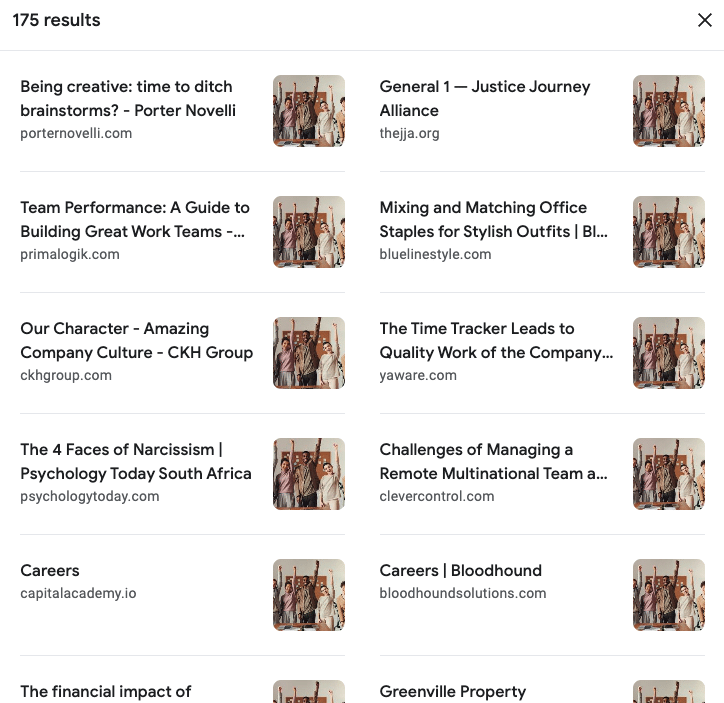
For example, this photo of a diverse group of co-workers on Pexels has been downloaded over 75,000 times and appears in Google Images on 175 sites. Which, ironically, is the opposite of “diversity.”
AI image generators

Remember I said big companies have creative directors, photographers and artists at their beck and call? With AI image generators, you can now have all these, too.

Right now, two types of sites are becoming widely used to generate images from text.

The first are sites that focus only on images. The most popular is Midjourney. The next most popular are sites powered by the open-source Stable Diffusion model, such as Stability.Ai’s own DreamStudio. 

Creatives and designers tend to favor these platforms because of their exclusive focus on AI art; they are at the cutting edge of image quality and allow many customization and fine-tuning options for artists.

For this article, I’m going to focus on AI chatbots, which are a bit more accessible to marketers and non-artists.

As of this writing, Anthropic’s Claude doesn’t support text-to-image and Google Gemini is too inconsistent for my tastes. (Most of the prompts I test there result in an error message or an image that doesn’t match what I asked for.)

On the other hand, OpenAI’s ChatGPT (with image generation powered by DALL-E) and X’s Grok (with image generation powered by FLUX.1) are getting jaw-droppingly good. 

As of this writing, ChatGPT Plus costs $20 a month. It includes DALL-E image generation and access to the ChatGPT chatbot.

ChatGPT is what I had in mind when I wrote my article back in April predicting that people would use Google less once they got used to using AI chatbots. Since then I’d say 80% of the searches I used to do on Google I now do on ChatGPT.

Grok comes as part of the Premium Tier of the social media platform X and costs $8 a month. For that price you get access to FLUX.1 image generation, as well as Grok’s chatbot and premium features on X.

As for which you should choose, I would suggest both.

Right now, I see ChatGPT still ahead of Grok as far as its usefulness as a chatbot, while Grok is arguably superior at generating art.

As you’ll see in a second, $28 a month is a pittance compared to the value you get from image generation alone, not to mention all the other ways AI chatbots can increase your productivity.

Generative AI as your personal creative director, photographer and artist

For those of you who have never used an AI chatbot to do text-to-image generation before, I’ll give a quick rundown of how it works..

Let’s say that you’re writing a blog post or an article on how to buy a mattress and you get to that point of having to choose a featured image.

Instead of hunting all over for an image, you just type this into your chatbot.

  • “Draw me a box mattress in a store.”

Here are the results I get:

ChatGPT

chatgpt-box-mattress-in-store

Grok

grok-mattress-store

You can see that Grok understood what I meant, while ChatGPT thought I was talking about a “mattress in a box.” Score one for Grok.

While it’s a nice photorealistic image, it’s really nothing that you can’t find on any stock photo site. And let’s face it – it’s just as boring, repetitive and unoriginal as most “stock photos of mattresses.” 

Let’s change that.

Getting a little more detailed in your prompt

Let’s say that in your article you referenced the story of The Princess and the Pea. And it dawned on you that a nice visual might be a princess sleeping on a stack of mattresses. 

Type this prompt into your chatbot:

  • “Generate an image of a princess sleeping on top of a stack of mattresses.”

Here’s what ChatGPT gave me:

chatgpt-princess-and-pea

And what Grok gave me:

grok-final-princess

You can start to see the difference in how ChatGPT and Grok approach “art.”

ChatGPT tends to favor illustrations, while Grok seems to favor photorealism. But of course, you can “ask” either to try to draw in whatever style you like.

I should say that I didn’t get these images right away from either AI. In fact, the first images I got from both didn’t match what I wanted at all. But I “talked” to the chatbot just as I would to a Creative Director.

Here was my “conversation” with Grok to get to this final image:

  • “Draw me a picture of a stack of mattresses with a princess sleeping on top.”

Grok princess 1
  • “Those don’t look like mattresses, they look more like blankets. Can you draw me the kind of box mattress you’d find in a store?”

Grok princess 2
  • “I need them stacked up with a princess sleeping on top.”

Grok princess 3
  • “More mattresses!”
Grok princess 4
  • “More mattresses!”
Grok princess 5
  • “No no, draw me at least 10 mattresses stacked on top of each other with a princess sleeping on top.”

Grok princess 6
  • “This is good, but make the mattresses all have different patterns.”

Grok princess 7

It took a while, but I finally got one I was happy with.

Notice that all I had to do was have a “conversation” with Grok, just like I would with a creative director. And unlike a real creative director, Grok didn’t want to throw me out a window after the seventh round of changes.

Now search on any stock photo site for “princess and the pea” or “stacked mattresses”; chances are you won’t find anything nearly as good as you see here.

The girl you see sleeping on top of the mattress? She doesn’t exist. No model release is needed because there is no real human in that photo. 

As you can imagine, this changes everything. Instead of spending thousands of dollars for a photo shoot or $200 for a stock photo subscription, I just spent $8 and about 2 minutes of my time. 

How in the world does AI generation work? 

Imagine that you wanted to learn to draw a picture of a golden retriever. The first step would be to learn basic art techniques, like drawing basic shapes, adding texture and detail and adding shading and depth.

You’ll need to study a lot of pictures of golden retrievers to understand their structure, form and movement. And you’ll need a lot of practice and iteration before your drawing starts to look like the real thing.

That’s essentially the same way that AI models work, except in the AI world this process goes by names like “Generative Adversarial Networks” and “Diffusion Models.”

The difference is that while you probably only have a few hours a week to learn and practice, AI models can “learn and practice” instantly and continuously.

Plus, they have access to billions upon billions of images to train them, including public domain images, Creative Commons images and image data licensed to them by stock photo companies.

Dig deeper: Visual optimization must-haves for AI-powered search

Get the newsletter search marketers rely on.


Getting ideas from AI

Let’s get back to that hypothetical blog post I was writing.

While images of a mattress in a store or even a cute picture of a princess sleeping on a stack of mattresses may get people’s attention, will it get them to click and scroll to read your article?

That is the whole point of the featured image.

In addition to generating an image for you, you can use AI to help you come up with ideas in the first place.

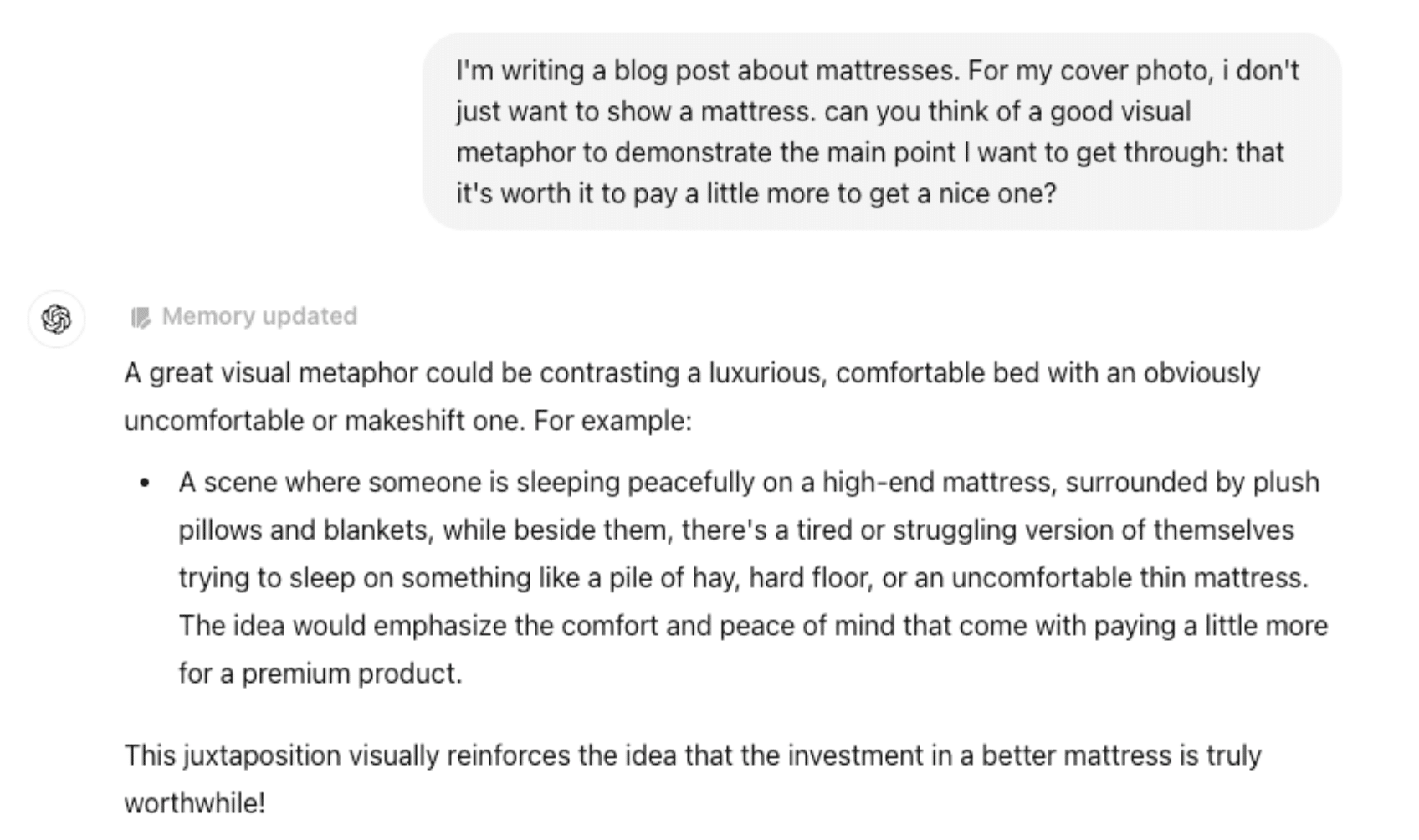
Let’s try this. Instead of telling the AI what to generate for us, let’s ask for advice.
ChatGPT creative brief

Again, I’m just “talking” to the AI as I would a human. In this case, ChatGPT gave pretty good advice.

But if you don’t like the advice you’re given, remember that you can engage in a dialogue with your AI providing details and clarification along the way, similar to what I did above. 

In this case, I asked ChatGPT to generate the image using its answer as my prompt. I did the same to Grok. Here’s what they came up with.

ChatGPT

ChatGPT brief

Grok

Grok brief

Now ask yourself, as a consumer, which image would you be more likely to click on–either one of these two images or a stock photo of a mattress?

If you’re not sure, here’s something else you can do with AI. Come up with different hypotheses for images that would achieve your goals and AB test them.

With generative AI, testing different images becomes as simple as testing copy to optimize your conversion rate.

I’ll preface this section by saying that this is my personal perspective and opinion and not legal advice. For any legal questions, please consult a lawyer, preferably one well-versed in copyright and intellectual property law. 

Three main categories of law arise most often in the use of images and photography on websites:

  • Copyright law.
  • Privacy / right of publicity law.
  • Trademark law. 

Copyright law protects the creator of an original work. Many people erroneously believe that you need to register a copyright for it to be valid. 

The truth is you automatically own the copyright for anything you create, even if it’s just scribbling on the back of a napkin. 

For someone else to legally use anything you create, you need to give them permission. In the art and photography world, that’s usually done through a license. 

Every image you use on your website that you don’t own and that’s created by a human, other than public domain images, should have a license. 

Even when the photo is free to use, it’s covered by a license such as Creative Commons or a license from a free site like Pexels or Unsplash.

Here’s where things get interesting.

Because AI is not human, copyright laws (as of now) don’t apply to AI-generated work.

That means whatever original work you create using AI, you can use without fear of getting sued for copyright infringement. That also means that anyone can come to your site and steal your AI-generated content.

As AI-generated content becomes more ubiquitous, expect laws to be passed quickly to address these kinds of issues.

Trademark law

Even if there are no issues with copyright for original work that AI produces, AI “artists” are still subject to the same laws and rules that human artists need to follow.

For example, what’s wrong with this image?
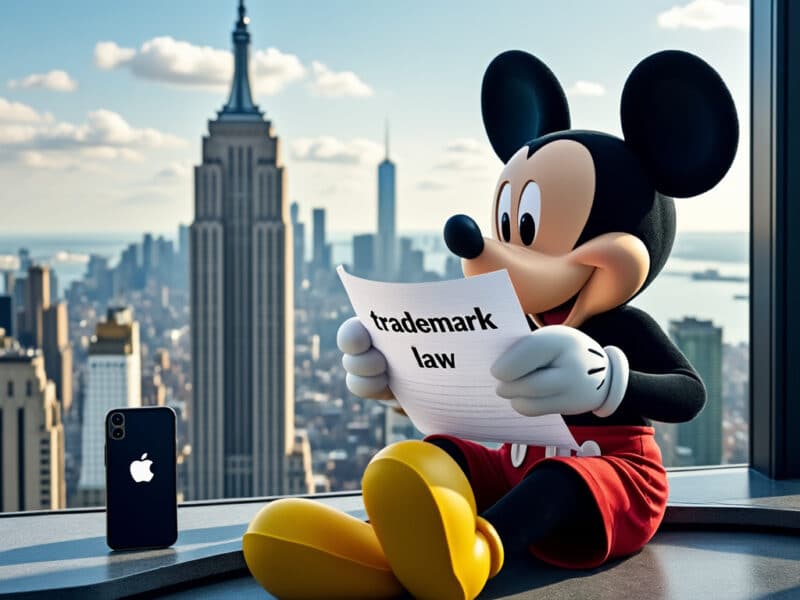
I went a little over the top in generating this to make a point about some potential risks of generative AI. 

The Apple logo, the modern-day version of Mickey Mouse and the Empire State Building are all trademarked. Yet, Grok was able to generate this image for me with remarkable fidelity.

While most people understand that logos and cartoon characters are trademarked, many don’t realize that building and product design may also fall under trademark protection.

In the stock photo world, major stock companies like Adobe Stock and Shutterstock review every photo in their libraries and mark it “for editorial use only” if it contains a recognizable trademark. This is due to the indemnity that they provide as part of their license.

On the other hand, free sites like Pexels and Unsplash allow images such as this photo of Cinderella’s Castle in Walt Disney World, which is very much trademarked and has been downloaded over 23,000 times and viewed over 9 million times.

Pexels does make clear in their license that commercial use is prohibited, but a simple reverse image search reveals that hundreds of websites don’t adhere to these terms. While Disney’s lawyers could sue all of them, they choose not to – at least for now.

A parallel situation is emerging in the world of generative AI. Google and OpenAI go out of their way to prevent users from generating images that contain trademarks. 

Grok and Stable Diffusion allow it, putting the responsibility for compliance entirely on the user. It’s all but certain this will be deliberated in the courts. Stay tuned.

Incidentally, the reason that I’m able to use this image here is because the use here is protected under a principle called nominative fair use.

Put simply, this article is providing reporting, commentary and education. The use of images in this article is considered editorial use, solely for the purposes of providing context and I made sure my use of the trademarks do not suggest endorsement or affiliation by Apple, Disney and the owners of the Empire State Building. 

Privacy and right of publicity laws

Just as AI can generate photorealistic images of products, buildings and characters, it can also generate very realistic images of people.

AI-generated images of humans can also be problematic, mainly if the image resembles a real person (whether intentionally or not).

Many jurisdictions already have laws regulating “deep fakes”, but as with copyright and trademark law, expect privacy and right of publicity laws to evolve as use of generative AI grows.

Are stock photo companies dead?

Not necessarily. Here’s why.

Most people think that when you pay for a photo or an illustration on a stock photo site, you’re paying for an image you download. 

That’s not the case. What you’re actually paying for is a license to use that image legally and with most of the larger stock photo companies, you’re also buying protection. 

As I mentioned above, with free sites you need to figure out whether your use of a photo you downloaded from their site is legal or not. If someone decides to sue you, you’re on your own. 

On the other hand, larger stock photo companies usually provide indemnification as part of your license, meaning that if you get sued for using images you purchase from them, they’ll cover at least some of your legal expenses.

The “Big Three” stock photo providers, Getty Images, Shutterstock and Adobe Stock, are all providing generative AI capabilities, and all of them do appear to extend indemnification for the use of those images (see the terms from Getty, Shutterstock and Adobe). 

As long as generative AI companies pass on the responsibility of compliance to their users, stock photo sites aren’t going away. But they will evolve. 

If nothing else, you can think of purchasing from a stock agency as buying an insurance policy, especially as laws concerning AI images continue to evolve. Most risk-averse big companies will likely continue to go through the stock photo companies.

For the rest of us, as long as you take the time to educate yourself about intellectual property law and use common sense in your use of generative AI, we’ll probably be fine.

Is photography dead? 

Finally, I want to address the photographers and artists in the room. 

The invention of photography put many artists out of work. The invention of digital photography disrupted traditional photography. 

The advent of stock images meant your photos sold for a few dollars instead of a few hundred. The advent of free stock libraries meant your photos sold for a few pennies instead of a few dollars.

This is just another evolution.

Yes, some photographers and artists may find themselves displaced. But for anyone with skill and talent, believe it or not, the future is brighter than ever for those who can adapt to this new world.

How?

  • Double down on being human: Focus on your unique ability to tell stories, not just create images. Move beyond simply taking photos or drawing pictures.
  • Embrace AI as a tool: See AI like Midjourney or Stable Diffusion as allies that can elevate your creativity, rather than threats.
  • Develop a unique style: Differentiate yourself from AI by creating art that’s deeply personal and custom. Generic content won’t stand out against AI-generated work.
  • Be a storyteller: Don’t let your art “speak for itself.” Explain the process and purpose behind your work, especially when showcasing it on platforms like Behance or Dribbble.
  • Stay one step ahead of AI: As you experiment with AI you’ll quickly find that it is still horrible at most detailed, long-tail queries. In some cases this is simply because it hasn’t had enough training data yet; in others no amount of training will help. Focus on details, specific concepts and brand work that AI struggles with. Anticipate trends and adapt quickly.
  • Quantify the value of your work: You can bet that marketers will rush to embrace generative AI as a “solution” while never understanding the problem they’re supposed to be solving. Artists need to be able to articulate the deeper value and impact of their work, reminding marketers that art isn’t just about aesthetics.
  • Innovate continually: While AI might replicate your innovations eventually, your advantage is in constant creativity and pushing boundaries.

Generative AI is here to stay

Some will resist it, and others will become too heavily reliant on it. Both will be left behind.

On the other hand, those who embrace it as a tool but don’t lose their humanity in the process will succeed and thrive in this new world.

Dig deeper: Advanced image SEO: A secret manual

Original source: https://searchengineland.com/generative-ai-create-images-visuals-446508
How to create images and visuals with generative AI

How to create images and visuals with generative AI

There’s one moment in the process of creating a blog post or news article that every small publisher dreads:

“What do I use for my featured image?”

Agencies and media companies have creative directors, photographers and artists at their beck and call to create this image for them. But what about the rest of us?

Some of us will head over to Google Images despite our better judgment. Others will go to a free site like Pexels or Unsplash. Some will go to sites like Adobe Stock, iStock or Shutterstock to pay for an image.

Hopefully, everyone reading this knows why it’s not a great idea to steal images off the web. Unless you’re using a public domain image, the images you download are owned by somebody.

If you plan on growing your business or brand, you don’t want your site filled with unlicensed images that may come back to haunt you one day.

As for stock photos, everyone who’s used a stock photos site has experienced the frustration of searching through page after page search results and never finding the right one. So many stock photos are repetitive, generic or trite that they’ve literally become a joke.

And if you happen to find a decent stock photo, chances are it’s been used over and over again.

For example, this photo of a diverse group of co-workers on Pexels has been downloaded over 75,000 times and appears in Google Images on 175 sites. Which, ironically, is the opposite of “diversity.”

AI image generators

Remember I said big companies have creative directors, photographers and artists at their beck and call? With AI image generators, you can now have all these, too.

Right now, two types of sites are becoming widely used to generate images from text.

The first are sites that focus only on images. The most popular is Midjourney. The next most popular are sites powered by the open-source Stable Diffusion model, such as Stability.Ai’s own DreamStudio. 

Creatives and designers tend to favor these platforms because of their exclusive focus on AI art; they are at the cutting edge of image quality and allow many customization and fine-tuning options for artists.

For this article, I’m going to focus on AI chatbots, which are a bit more accessible to marketers and non-artists.

As of this writing, Anthropic’s Claude doesn’t support text-to-image and Google Gemini is too inconsistent for my tastes. (Most of the prompts I test there result in an error message or an image that doesn’t match what I asked for.)

On the other hand, OpenAI’s ChatGPT (with image generation powered by DALL-E) and X’s Grok (with image generation powered by FLUX.1) are getting jaw-droppingly good. 

As of this writing, ChatGPT Plus costs $20 a month. It includes DALL-E image generation and access to the ChatGPT chatbot.

ChatGPT is what I had in mind when I wrote my article back in April predicting that people would use Google less once they got used to using AI chatbots. Since then I’d say 80% of the searches I used to do on Google I now do on ChatGPT.

Grok comes as part of the Premium Tier of the social media platform X and costs $8 a month. For that price you get access to FLUX.1 image generation, as well as Grok’s chatbot and premium features on X.

As for which you should choose, I would suggest both.

Right now, I see ChatGPT still ahead of Grok as far as its usefulness as a chatbot, while Grok is arguably superior at generating art.

As you’ll see in a second, $28 a month is a pittance compared to the value you get from image generation alone, not to mention all the other ways AI chatbots can increase your productivity.

Generative AI as your personal creative director, photographer and artist

For those of you who have never used an AI chatbot to do text-to-image generation before, I’ll give a quick rundown of how it works..

Let’s say that you’re writing a blog post or an article on how to buy a mattress and you get to that point of having to choose a featured image.

Instead of hunting all over for an image, you just type this into your chatbot.

  • “Draw me a box mattress in a store.”

Here are the results I get:

ChatGPT

chatgpt-box-mattress-in-store

Grok

grok-mattress-store

You can see that Grok understood what I meant, while ChatGPT thought I was talking about a “mattress in a box.” Score one for Grok.

While it’s a nice photorealistic image, it’s really nothing that you can’t find on any stock photo site. And let’s face it – it’s just as boring, repetitive and unoriginal as most “stock photos of mattresses.” 

Let’s change that.

Getting a little more detailed in your prompt

Let’s say that in your article you referenced the story of The Princess and the Pea. And it dawned on you that a nice visual might be a princess sleeping on a stack of mattresses. 

Type this prompt into your chatbot:

  • “Generate an image of a princess sleeping on top of a stack of mattresses.”

Here’s what ChatGPT gave me:

chatgpt-princess-and-pea

And what Grok gave me:

grok-final-princess

You can start to see the difference in how ChatGPT and Grok approach “art.”

ChatGPT tends to favor illustrations, while Grok seems to favor photorealism. But of course, you can “ask” either to try to draw in whatever style you like.

I should say that I didn’t get these images right away from either AI. In fact, the first images I got from both didn’t match what I wanted at all. But I “talked” to the chatbot just as I would to a Creative Director.

Here was my “conversation” with Grok to get to this final image:

  • “Draw me a picture of a stack of mattresses with a princess sleeping on top.”
Grok princess 1
  • “Those don’t look like mattresses, they look more like blankets. Can you draw me the kind of box mattress you’d find in a store?”
Grok princess 2
  • “I need them stacked up with a princess sleeping on top.”
Grok princess 3
  • “More mattresses!”
Grok princess 4
  • “More mattresses!”
Grok princess 5
  • “No no, draw me at least 10 mattresses stacked on top of each other with a princess sleeping on top.”
Grok princess 6
  • “This is good, but make the mattresses all have different patterns.”
Grok princess 7

It took a while, but I finally got one I was happy with.

Notice that all I had to do was have a “conversation” with Grok, just like I would with a creative director. And unlike a real creative director, Grok didn’t want to throw me out a window after the seventh round of changes.

Now search on any stock photo site for “princess and the pea” or “stacked mattresses”; chances are you won’t find anything nearly as good as you see here.

The girl you see sleeping on top of the mattress? She doesn’t exist. No model release is needed because there is no real human in that photo. 

As you can imagine, this changes everything. Instead of spending thousands of dollars for a photo shoot or $200 for a stock photo subscription, I just spent $8 and about 2 minutes of my time. 

How in the world does AI generation work? 

Imagine that you wanted to learn to draw a picture of a golden retriever. The first step would be to learn basic art techniques, like drawing basic shapes, adding texture and detail and adding shading and depth.

You’ll need to study a lot of pictures of golden retrievers to understand their structure, form and movement. And you’ll need a lot of practice and iteration before your drawing starts to look like the real thing.

That’s essentially the same way that AI models work, except in the AI world this process goes by names like “Generative Adversarial Networks” and “Diffusion Models.”

The difference is that while you probably only have a few hours a week to learn and practice, AI models can “learn and practice” instantly and continuously.

Plus, they have access to billions upon billions of images to train them, including public domain images, Creative Commons images and image data licensed to them by stock photo companies.

Dig deeper: Visual optimization must-haves for AI-powered search

Get the newsletter search marketers rely on.


Getting ideas from AI

Let’s get back to that hypothetical blog post I was writing.

While images of a mattress in a store or even a cute picture of a princess sleeping on a stack of mattresses may get people’s attention, will it get them to click and scroll to read your article?

That is the whole point of the featured image.

In addition to generating an image for you, you can use AI to help you come up with ideas in the first place.

Let’s try this. Instead of telling the AI what to generate for us, let’s ask for advice.

ChatGPT creative brief

Again, I’m just “talking” to the AI as I would a human. In this case, ChatGPT gave pretty good advice.

But if you don’t like the advice you’re given, remember that you can engage in a dialogue with your AI providing details and clarification along the way, similar to what I did above. 

In this case, I asked ChatGPT to generate the image using its answer as my prompt. I did the same to Grok. Here’s what they came up with.

ChatGPT

ChatGPT brief

Grok

Grok brief

Now ask yourself, as a consumer, which image would you be more likely to click on–either one of these two images or a stock photo of a mattress?

If you’re not sure, here’s something else you can do with AI. Come up with different hypotheses for images that would achieve your goals and AB test them.

With generative AI, testing different images becomes as simple as testing copy to optimize your conversion rate.

I’ll preface this section by saying that this is my personal perspective and opinion and not legal advice. For any legal questions, please consult a lawyer, preferably one well-versed in copyright and intellectual property law. 

Three main categories of law arise most often in the use of images and photography on websites:

  • Copyright law.
  • Privacy / right of publicity law.
  • Trademark law. 

Copyright law protects the creator of an original work. Many people erroneously believe that you need to register a copyright for it to be valid. 

The truth is you automatically own the copyright for anything you create, even if it’s just scribbling on the back of a napkin. 

For someone else to legally use anything you create, you need to give them permission. In the art and photography world, that’s usually done through a license. 

Every image you use on your website that you don’t own and that’s created by a human, other than public domain images, should have a license. 

Even when the photo is free to use, it’s covered by a license such as Creative Commons or a license from a free site like Pexels or Unsplash.

Here’s where things get interesting.

Because AI is not human, copyright laws (as of now) don’t apply to AI-generated work.

That means whatever original work you create using AI, you can use without fear of getting sued for copyright infringement. That also means that anyone can come to your site and steal your AI-generated content.

As AI-generated content becomes more ubiquitous, expect laws to be passed quickly to address these kinds of issues.

Trademark law

Even if there are no issues with copyright for original work that AI produces, AI “artists” are still subject to the same laws and rules that human artists need to follow.

For example, what’s wrong with this image?

I went a little over the top in generating this to make a point about some potential risks of generative AI. 

The Apple logo, the modern-day version of Mickey Mouse and the Empire State Building are all trademarked. Yet, Grok was able to generate this image for me with remarkable fidelity.

While most people understand that logos and cartoon characters are trademarked, many don’t realize that building and product design may also fall under trademark protection.

In the stock photo world, major stock companies like Adobe Stock and Shutterstock review every photo in their libraries and mark it “for editorial use only” if it contains a recognizable trademark. This is due to the indemnity that they provide as part of their license.

On the other hand, free sites like Pexels and Unsplash allow images such as this photo of Cinderella’s Castle in Walt Disney World, which is very much trademarked and has been downloaded over 23,000 times and viewed over 9 million times.

Pexels does make clear in their license that commercial use is prohibited, but a simple reverse image search reveals that hundreds of websites don’t adhere to these terms. While Disney’s lawyers could sue all of them, they choose not to – at least for now.

A parallel situation is emerging in the world of generative AI. Google and OpenAI go out of their way to prevent users from generating images that contain trademarks. 

Grok and Stable Diffusion allow it, putting the responsibility for compliance entirely on the user. It’s all but certain this will be deliberated in the courts. Stay tuned.

Incidentally, the reason that I’m able to use this image here is because the use here is protected under a principle called nominative fair use.

Put simply, this article is providing reporting, commentary and education. The use of images in this article is considered editorial use, solely for the purposes of providing context and I made sure my use of the trademarks do not suggest endorsement or affiliation by Apple, Disney and the owners of the Empire State Building. 

Privacy and right of publicity laws

Just as AI can generate photorealistic images of products, buildings and characters, it can also generate very realistic images of people.

AI-generated images of humans can also be problematic, mainly if the image resembles a real person (whether intentionally or not).

Many jurisdictions already have laws regulating “deep fakes”, but as with copyright and trademark law, expect privacy and right of publicity laws to evolve as use of generative AI grows.

Are stock photo companies dead?

Not necessarily. Here’s why.

Most people think that when you pay for a photo or an illustration on a stock photo site, you’re paying for an image you download. 

That’s not the case. What you’re actually paying for is a license to use that image legally and with most of the larger stock photo companies, you’re also buying protection. 

As I mentioned above, with free sites you need to figure out whether your use of a photo you downloaded from their site is legal or not. If someone decides to sue you, you’re on your own. 

On the other hand, larger stock photo companies usually provide indemnification as part of your license, meaning that if you get sued for using images you purchase from them, they’ll cover at least some of your legal expenses.

The “Big Three” stock photo providers, Getty Images, Shutterstock and Adobe Stock, are all providing generative AI capabilities, and all of them do appear to extend indemnification for the use of those images (see the terms from Getty, Shutterstock and Adobe). 

As long as generative AI companies pass on the responsibility of compliance to their users, stock photo sites aren’t going away. But they will evolve. 

If nothing else, you can think of purchasing from a stock agency as buying an insurance policy, especially as laws concerning AI images continue to evolve. Most risk-averse big companies will likely continue to go through the stock photo companies.

For the rest of us, as long as you take the time to educate yourself about intellectual property law and use common sense in your use of generative AI, we’ll probably be fine.

Is photography dead? 

Finally, I want to address the photographers and artists in the room. 

The invention of photography put many artists out of work. The invention of digital photography disrupted traditional photography. 

The advent of stock images meant your photos sold for a few dollars instead of a few hundred. The advent of free stock libraries meant your photos sold for a few pennies instead of a few dollars.

This is just another evolution.

Yes, some photographers and artists may find themselves displaced. But for anyone with skill and talent, believe it or not, the future is brighter than ever for those who can adapt to this new world.

How?

  • Double down on being human: Focus on your unique ability to tell stories, not just create images. Move beyond simply taking photos or drawing pictures.
  • Embrace AI as a tool: See AI like Midjourney or Stable Diffusion as allies that can elevate your creativity, rather than threats.
  • Develop a unique style: Differentiate yourself from AI by creating art that’s deeply personal and custom. Generic content won’t stand out against AI-generated work.
  • Be a storyteller: Don’t let your art “speak for itself.” Explain the process and purpose behind your work, especially when showcasing it on platforms like Behance or Dribbble.
  • Stay one step ahead of AI: As you experiment with AI you’ll quickly find that it is still horrible at most detailed, long-tail queries. In some cases this is simply because it hasn’t had enough training data yet; in others no amount of training will help. Focus on details, specific concepts and brand work that AI struggles with. Anticipate trends and adapt quickly.
  • Quantify the value of your work: You can bet that marketers will rush to embrace generative AI as a “solution” while never understanding the problem they’re supposed to be solving. Artists need to be able to articulate the deeper value and impact of their work, reminding marketers that art isn’t just about aesthetics.
  • Innovate continually: While AI might replicate your innovations eventually, your advantage is in constant creativity and pushing boundaries.

Generative AI is here to stay

Some will resist it, and others will become too heavily reliant on it. Both will be left behind.

On the other hand, those who embrace it as a tool but don’t lose their humanity in the process will succeed and thrive in this new world.

Dig deeper: Advanced image SEO: A secret manual

Original source: https://searchengineland.com/generative-ai-create-images-visuals-446508

YouTube First Position Ads now available across Display & Video 360

First Position has been expanded to include all YouTube content through Display & Video 360, offering it at dynamic CPM rates. Previously, this feature was only available on YouTube Select inventory at fixed rates.

  • Now, advertisers can secure prime ad placement at the beginning of a YouTube session across any content, enhancing relevance and impact.

Why it matters. With YouTube being the largest streaming video website in the world (boasting 1 billion hours of video being watched a day) there is a lot of opportunity if you use video assets in your campaigns. With First Position, you can now ensure your ad is the first one viewers see when watching YouTube content, maximizing visibility during critical moments and potentially driving higher engagement and brand recall.

Details. First Position guarantees that an ad will be the first in-stream spot when users begin watching YouTube, making it ideal for key campaigns like product launches or cultural events.

Case studies. As usual, Google cited well-known household brands like Booking.com and IHG Hotels & Resorts as already seeing success with First Position, so you shouldn’t necessarily expect to replicate such results if you don’t have similar resources. Booking.com drove a 21% lift in ad recall, while IHG combined it with YouTube Sponsorships to achieve double the brand awareness benchmark.

What’s next. Advertisers can now leverage First Position for any campaign across YouTube’s entire content library. For more details, visit the Help Center for Instant Reserve in Display & Video 360 or Reservations in Google Ads.

Original source: https://searchengineland.com/youtube-first-position-ads-display-video-360-446545

YouTube First Position Ads now available across Display & Video 360

First Position has been expanded to include all YouTube content through Display & Video 360, offering it at dynamic CPM rates. Previously, this feature was only available on YouTube Select inventory at fixed rates.

  • Now, advertisers can secure prime ad placement at the beginning of a YouTube session across any content, enhancing relevance and impact.

Why it matters. With YouTube being the largest streaming video website in the world (boasting 1 billion hours of video being watched a day) there is a lot of opportunity if you use video assets in your campaigns. With First Position, you can now ensure your ad is the first one viewers see when watching YouTube content, maximizing visibility during critical moments and potentially driving higher engagement and brand recall.

Details. First Position guarantees that an ad will be the first in-stream spot when users begin watching YouTube, making it ideal for key campaigns like product launches or cultural events.

Case studies. As usual, Google cited well-known household brands like Booking.com and IHG Hotels & Resorts as already seeing success with First Position, so you shouldn’t necessarily expect to replicate such results if you don’t have similar resources. Booking.com drove a 21% lift in ad recall, while IHG combined it with YouTube Sponsorships to achieve double the brand awareness benchmark.

What’s next. Advertisers can now leverage First Position for any campaign across YouTube’s entire content library. For more details, visit the Help Center for Instant Reserve in Display & Video 360 or Reservations in Google Ads.

Original source: https://searchengineland.com/youtube-first-position-ads-display-video-360-446545

YouTube First Position Ads now available across Display & Video 360

First Position has been expanded to include all YouTube content through Display & Video 360, offering it at dynamic CPM rates. Previously, this feature was only available on YouTube Select inventory at fixed rates.

  • Now, advertisers can secure prime ad placement at the beginning of a YouTube session across any content, enhancing relevance and impact.

Why it matters. With YouTube being the largest streaming video website in the world (boasting 1 billion hours of video being watched a day) there is a lot of opportunity if you use video assets in your campaigns. With First Position, you can now ensure your ad is the first one viewers see when watching YouTube content, maximizing visibility during critical moments and potentially driving higher engagement and brand recall.

Details. First Position guarantees that an ad will be the first in-stream spot when users begin watching YouTube, making it ideal for key campaigns like product launches or cultural events.

Case studies. As usual, Google cited well-known household brands like Booking.com and IHG Hotels & Resorts as already seeing success with First Position, so you shouldn’t necessarily expect to replicate such results if you don’t have similar resources. Booking.com drove a 21% lift in ad recall, while IHG combined it with YouTube Sponsorships to achieve double the brand awareness benchmark.

What’s next. Advertisers can now leverage First Position for any campaign across YouTube’s entire content library. For more details, visit the Help Center for Instant Reserve in Display & Video 360 or Reservations in Google Ads.

Original source: https://searchengineland.com/youtube-first-position-ads-display-video-360-446545

YouTube First Position Ads now available across Display & Video 360

First Position has been expanded to include all YouTube content through Display & Video 360, offering it at dynamic CPM rates. Previously, this feature was only available on YouTube Select inventory at fixed rates.

  • Now, advertisers can secure prime ad placement at the beginning of a YouTube session across any content, enhancing relevance and impact.

Why it matters. With YouTube being the largest streaming video website in the world (boasting 1 billion hours of video being watched a day) there is a lot of opportunity if you use video assets in your campaigns. With First Position, you can now ensure your ad is the first one viewers see when watching YouTube content, maximizing visibility during critical moments and potentially driving higher engagement and brand recall.

Details. First Position guarantees that an ad will be the first in-stream spot when users begin watching YouTube, making it ideal for key campaigns like product launches or cultural events.

Case studies. As usual, Google cited well-known household brands like Booking.com and IHG Hotels & Resorts as already seeing success with First Position, so you shouldn’t necessarily expect to replicate such results if you don’t have similar resources. Booking.com drove a 21% lift in ad recall, while IHG combined it with YouTube Sponsorships to achieve double the brand awareness benchmark.

What’s next. Advertisers can now leverage First Position for any campaign across YouTube’s entire content library. For more details, visit the Help Center for Instant Reserve in Display & Video 360 or Reservations in Google Ads.

Original source: https://searchengineland.com/youtube-first-position-ads-display-video-360-446545

8 Ways to Make Money Reading

Can you really make money reading? YES!

Are you a true bookworm? If reading is a passion of yours, it may be worth considering the ways you can make money from reading. Who doesn’t want to earn money from something they love? 

There are more ways to earn money from reading than you may think. From proofreading and editing to reviewing books, you could make decent cash on the side. If you’re going to read anyway, why not profit from it? 

Here are 7 ways you can make money reading.


Review Books

You don’t have to be a literary scholar to review books. All you need is a love for reading, and have the ability to form honest, fair opinions about the books you read. If you are asked to review a particular book, you will need to be open to reading genres or authors outside of your usual, and give them a fair chance. You really can’t judge a book by its cover with this one! 

There are many websites online that pay you for your reviews. All you have to do is search ‘get paid to review books’ into Google, and a plethora of results come up. Do your research before launching into a job though, as the number of opportunities, level of pay and depth of reviews required may differ.  

It’s also important to remember that reviewing books won’t make you millions, nor will you be able to quit your day job. However, it can be a lucrative and fun side hustle to help you put away extra into your savings, pension or even spend on more books! 

OnlineBookClub.org is a great place to start. Publishers and authors will often give you a free copy of a new book in exchange for an honest, written review from you, the reader. You will get a free copy of a book, then on top of this, get paid to give it an honest review. The best part is, you don’t have to lie. 

OnlineBookClub encourage you to be honest. You will get paid no matter what you think. You don’t have to claim you loved it if you didn’t. 

Pay outs current range from $5 to $60 per review. This is approximately £4 to £50 GBP. This isn’t a good pay when you work it out by an hourly rate – but if you love reading and would do it anyway, it’s a good way to make some extra side cash. The thing to note with OnlineBookClub is that you won’t get paid for your first review. However, you will get the book for free. 

We also recommend:  

Magazines and newspapers also regularly have book review sections. While their staff are the ones who usually read the book, it’s worth approaching publications you love with a book review section to find out if they need reviewers. You’ll need to show you can write a constructive review, so prepare some short sample reviews ready to send over as examples.

Overrun with books? Find out how to make money from your old books. 

Become a Beta Reader

A beta reader is someone who reads a book while an author is still writing it. They might have a specialist interest or life experience, or simply be avid readers with a good sense of story and a critical eye.

The pay for beta readers varies widely – many people will do it for free, for people they know or respect. However, there are paid opportunities out there. Look into author communities online for people asking for readers – such as Reddit or Facebook groups – or set up as a freelancer. Then, you can advertise on social media with targeted adverts, in specialised publications like Writers Magazine, and charge a rate you like.

Remember that the rate needs to be competitive, so starting at around £30 for a book up to 50,000 words is a good guideline. This is the length of a Young Adult (YA) or Middle Grade book, or a ‘cosy’ crime or romance book. Literary fiction is usually 80,000 to 100,000 words and fantasy often 120,000 words. Most beta readers charge by the 1000 words to make it easy to work out a rate.

Beta readers are expected to provide critical feedback to an author that they can use. It’s not just saying ‘I don’t like this’. It should be things like ‘this bit didn’t make sense to me’, or ‘this storyline felt slow’, or even ‘hey, I loved these characters!’. Telling authors what works is as important as telling them what doesn’t.

Start a Book Blog

Blogging is a great way to earn money on the side, and could actually become a full-time job should you build your brand and grow your blog successfully. Book bloggers are can be very popular and successful, with blogs such as BookWritten getting over 75,000 hits per month. 

The site contains articles on a range of things, from finding places to read books for free, to looking after books to keep them in pristine condition. However, you could write about anything that tickles your fancy. 

The Literary Edit is a more personal blog, written by award-winning book blogger and writer Lucy. She blogs about all things books, with a more informal, chatty style, Lucy writes reviews of books she’s read, tells her followers her favourite books of all time, and even has a great little section called ‘Desert Island Books’. 

You could even find a niche and discuss books particularly close to your interests. Crime By The Book is a fascinating book blog, written by a lover of crime fiction, with a particular skew towards Scandinavia. Although most of the books are general crime fiction, the niche is particularly interesting. 

But how can you make money from blogging? Well, mainly ads on the site, as well as partnerships and affiliates with brands. You may even get a sponsorship for a particular series. As your blog grows and develops, you may be sent freebies of books, and even asked to review them on your blog in return for payment.

If your blog grows large enough, people may even pay monthly subscriptions for exclusive content, or you could use widgets such as Buy Me A Coffee, where people can buy you a virtual coffee to help fund your mission. Plus you will be able to make this money reading.

Our frugal columnist, and award-winning blogger Jane, owner of shoestringcottage.com, first started her blog over a decade ago: 

Shoestring Cottage

Jane from Shoestring Cottage

“I began with a free WordPress blog, as I was writing as a hobby. However, when I realised it was possible to monetise my site, I purchased a domain name and server hosting. I also bought a theme (design) to make it look more professional. I maybe spent £400 initially and now pay around £150 a year.

“The key to getting a steady readership is to post regularly – at least once a week, preferably more. I also did a couple of cheap blogging courses, and learned some of the technicalities of running a blog. I think it is worth doing this if you are a complete beginner.” 


Not sure where to begin? Here are some websites we recommend to start your blog: 

  • WordPress 
  • Wix.com 
  • Squarespace 
  • Blogger 

These websites are free, easy-to-use and allow you to build your blog using templates available. They are straight forward and you can create a beautiful, unique blog in very little time. 

Find out more about making money from blogging here. 


Use Social Media

make money reading

Social media is a brilliant tool. Many people actually become full-time ‘influencers’, and earn a good sum of cash using their platforms.  

Instagram

One of the biggest platforms that appreciates books is Instagram. As with blogging, people use their Instagram pages to review books they’ve read, share their favourite books and interact with other people who love reading as much as they do. 

The money comes from sponsorships, affiliates and brand deals. You may collaborate with a brand on a post, for example promoting a new book being released, or encouraging your followers to follow a new author’s work. You may be given affiliate links as well as upfront payment, where you make a cut of a sale when someone buys a book through your link. 

Of course, you won’t get these opportunities immediately, and it will take some hard graft on your end to build a following. But through following others, interacting with them and posting a steady and constant bout of content, you could grow more quickly than you may think. 

‘Bookstagrams’, as they are fondly know in the book-lover community, are a hugely popular part of the platform. Elizabeth Sagan (@elizabeth_sagan) boasts a whopping 203k followers. A self-confessed ‘book whisperer’, Elizabeth posts beautiful imagery of her books and fun, engaging short videos. Other accounts such as @coraliebickfordsmith and @stacked_shelf have 25.8k and 10.3k followers respectively.  

You don’t have to have hundreds of thousands of followers to start making money. Once you reach 5,000 followers you are considered a ‘micro-influencer’, and can start reaching out to brands and companies to see if they’d like to work with you. Remember to work with other influencers and help to build each other up. 

Find out more about making money on social media. 

TikTok

One of the largest video-sharing platforms in the world is TikTok, and ‘BookTok’ is an integral part of the platform. BookTok even has its own Wikipedia page, and the tag #BookTok has over 112.2 billion views on the app. 

You may start on another platform and as you feel more confident, move over to making videos. It can seem daunting, but the BookTok community is a warm and welcoming one. Despite the criticisms of social media, this corner of the internet is full of friendship, enjoyment, and great connections over a shared passion.  

We love @bookishbytammi, who shares books she’s read monthly, her favourite books in different genres such as fantasy and romance, and does fun challenges too. She has 64k followers and almost one million likes across her videos.   

If you aren’t feeling ready to make videos, join the platform and have a browse. As you watch other people make videos and discuss topics you love, you may become inspired to start creating videos yourself. 

As with other social media platforms, the money you can make comes in the form of sponsorships, brand partnerships and affiliates. You may be asked to do ads for a certain product or company, and get paid to attend events.  

Find out about the TikTok influencers teaching personal finance to millions. 

YouTube

BookTube is a huge part of the online video service, YouTube. To find out what kind of content you need to create, simply search ‘booktube’ in the search bar and watch lots of the videos that come up.

Like TikTok and Instagram, most BookTubers are comfortable on camera, but you can do an off-camera presenting style if you are good at creating interesting graphics for people to look at while you talk. Often, this includes filming yourself reading the book but from ‘your POV’ so the camera looks as if it’s from your eyes, looking at your hands etc.

Proofreading

make money proof reading

Another way to make money reading is to become a proof-reader. Proofreading is essentially a final quality check before publishing. A proof-reader will carefully check the text for any errors before it is published or shared. It’s the last stage of the writing process, and it is essential for any text. 

The job of a proof-reader is to bring attention to any spelling, punctuation, and grammar errors, as well as any typos or formatting issues. You may even alert the author and publisher to any inconsistencies within the text. 

Many proof-readers do it on a freelance basis. You can advertise your proofreading services on websites such as PeoplePerHour and Fiverr. Some people offer their services for under £5, however when you build up your reviews, ratings and reputation, you could be charging hundreds for longer texts and novels. 

You could also go in search of opportunities. Websites such as UpWork and Freelancer are goldmines for people looking for proof-readers to help them. From doing last-minute checks of novels to going over important documents and even checking for spelling and grammar in examination papers, proof-reading involves a huge range of tasks. The roles range from £8 per hour to a few thousand pounds for large, important projects. 

In order to be a successful proof-reader, you will of course need a love for reading, but some key skills are required also. You will need a great attention to detail and a solid understanding of spelling and grammar. You’ll need to be self-disciplined and be able to meet tight deadlines.  

Scribbr have a great guide to proofreading, which you can read here. 

Need a flexible schedule? Check out these work from home roles for everyone. 


Narrate Audiobooks

Do you have a smooth as butter voice that people love to listen to? Perhaps you are good at doing accents, making a book come to life as you read to others. Do your children or grandchildren guffaw when you make a funny voice, pretending to be the monster in their book? Narrating audiobooks or participating in an audio podcast drama could be just the thing for you. 

If you are an avid reader, this is a great way to supplement your income. You may even choose to pursue this as a freelancer on a full-time basis if you find it is a successful career path for you. You can make money reading books, out loud!

But how can you get started? Well, the internet is a powerful thing, and there is a plethora of opportunities waiting for you.  

The Audiobook Creative Exchange (ACX) is a huge online platform that pays people to read books out loud. Books you narrate for this popular platform could even appear on iTunes and Audible, which would be a great boost for your portfolio. Simply create an account, upload some high-quality samples of you narrating a small paragraph or passage, and then set your hourly rate. 

Authors and publishers will be able to find you and review your work and may ask you to narrate for them. The great thing about ACX is that you could even earn some of the royalties earned on the book! 

There are many ways you can get work, as well as the ACX. As previously mentioned, you could advertise your work on freelance sites such as Fiverr. There are also many more companies which specialise in voiceover and narration. 

Here are some we recommend: 

Listen to thousands of audiobooks, podcasts and Audible originals, with Audible. Sign up for your free 30-day trial.


Translate Books

Do you speak more than one language? Many people are crying out for people to translate texts for them. From novels to documents and even old texts, your language skills could earn you a decent bit of money on the side. If you speak multiple languages, even better! You will be a very valuable asset to many companies and be able to make decent money from reading. 

Translation services for fiction books aren’t about direct translation of the words on the page. It’s an art: you need to capture the essence of what is being said and making it sound just as beautiful in the second language. Translation for non-fiction or business documents is more literal.

You could advertise your services on freelance websites, or go in search of opportunities. We have previously recommended Fiverr, Upwork, Freelancer and PeoplePerHour, all of which are relevant to this route too.  

However, there are also websites dedicated to translation work. Blend is one of the most popular and successful translation websites. They guarantee continuous workflow and fair pay for every project. You can also apply as both a translator and a voice artist, so you can mix things up! Although the pay doesn’t start out high, the progression system makes it easy to build up your pay and your reputation on the website. 

However, if you want to make real money from this, you could consider going full-time as a freelance translator. On Freelancer, text translation jobs range anywhere from £7 to £25 an hour for simple texts, and a few thousand pounds for more in-depth, intense texts. 


The post 8 Ways to Make Money Reading appeared first on MoneyMagpie.

Original source: https://www.moneymagpie.com/make-money/6-ways-to-make-money-reading

SearchGPT: What you need to know about OpenAI’s search engine

SearchGPT: What marketers need to know about the future of conversational search

With its characteristic cheerfulness, ChatGPT will tell you that the digital media landscape is “rapidly evolving.” 

Google is regularly updating its algorithm, AI is getting smarter by the day and new tools are entering the market faster than fashion trends, which go in and out of style. That can mean opportunities and challenges for us.

One of the most talked-about evolutions to the search landscape is OpenAI’s SearchGPT, a product that could rival Google’s dominance soon. 

At my agency, we recently gained early access to SearchGPT. Below are our takeaways about this new tool and its implications for digital marketing.

What is SearchGPT and how does it work?

SearchGPT is an AI-powered search engine that combines the strengths of traditional search engines with the advanced conversational abilities of large language models. It delivers answers to user queries using real-time information from across the web. 

Rather than returning a list of links for users to sift through like traditional search engines, SearchGPT provides direct answers, summaries and insights based on an understanding of context and the user’s intent.

OpenAI doesn’t clearly state the exact details of how SearchGPT works, however, we can surmise that it uses something akin to retrieval augmented generation (RAG) which is a popular approach used by other AI search engines including, Perplexity and Google AI Overviews.

RAG is designed to reduce the likelihood of hallucinations in responses by integrating information from a database into the LLM response to enhance accuracy.

The model converts the search query into numerical embeddings that capture its meaning and searches a vector database containing trusted information sources. In this case, the web index is most likely provided by Bing based on OpenAI’s partnership with Microsoft.

By retrieving the most relevant content, SearchGPT can generate precise responses while linking back to the original web content, ensuring transparency and reliability.

The retrieved sources serve as additional context for the language model to accurately answer the user’s query.

Key features of SearchGPT include:

  • Conversational interface: Users can interact with SearchGPT in a more natural, dialogue-like manner.
  • Direct answers: Instead of a list of links, SearchGPT provides concise, relevant answers to queries.
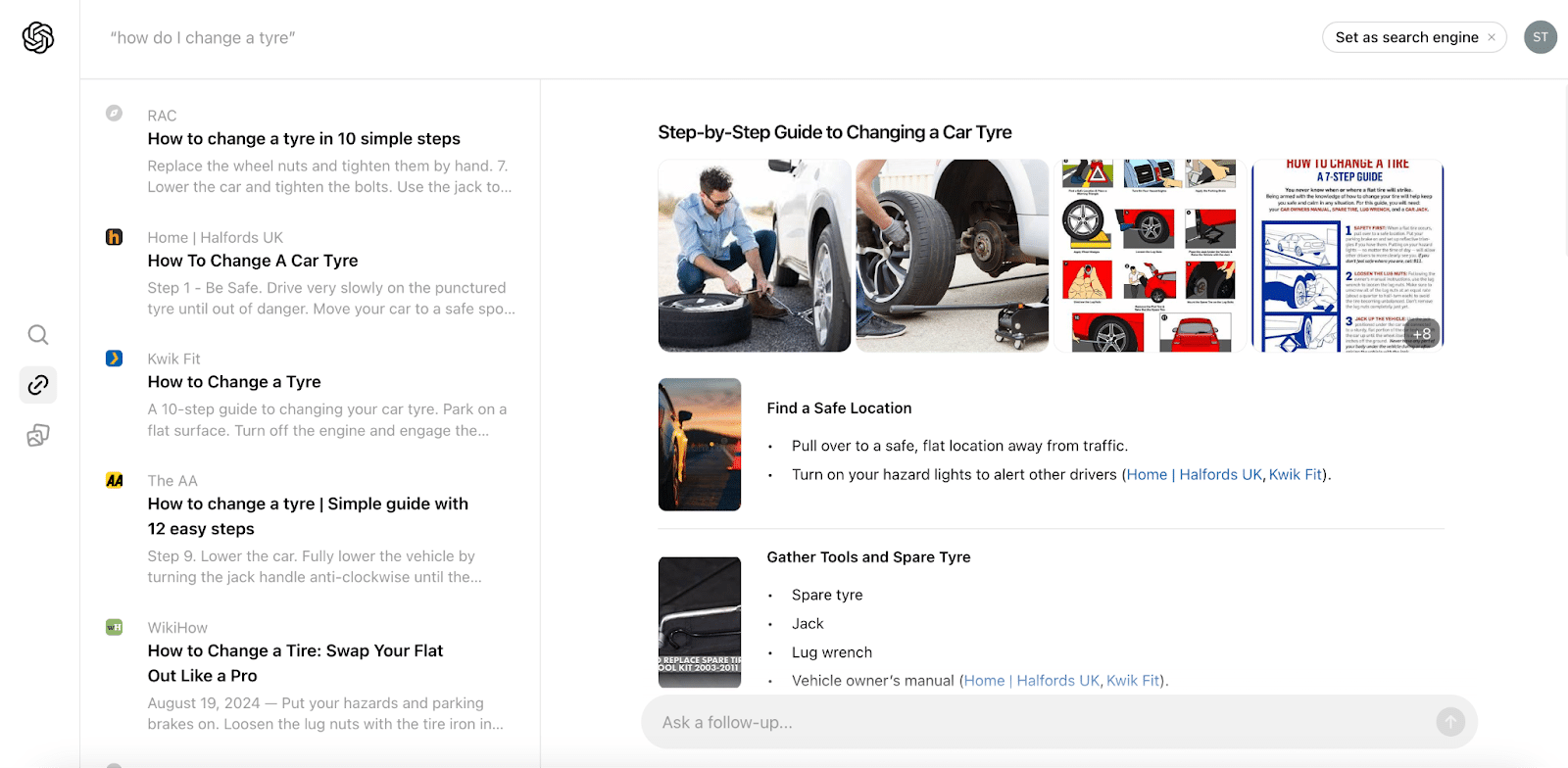
  • Citations panel: A sidebar displays the sources used to generate the response, with links to the original content.
  • Follow-up questions: Users can ask additional questions to explore topics further, creating a more interactive search experience.
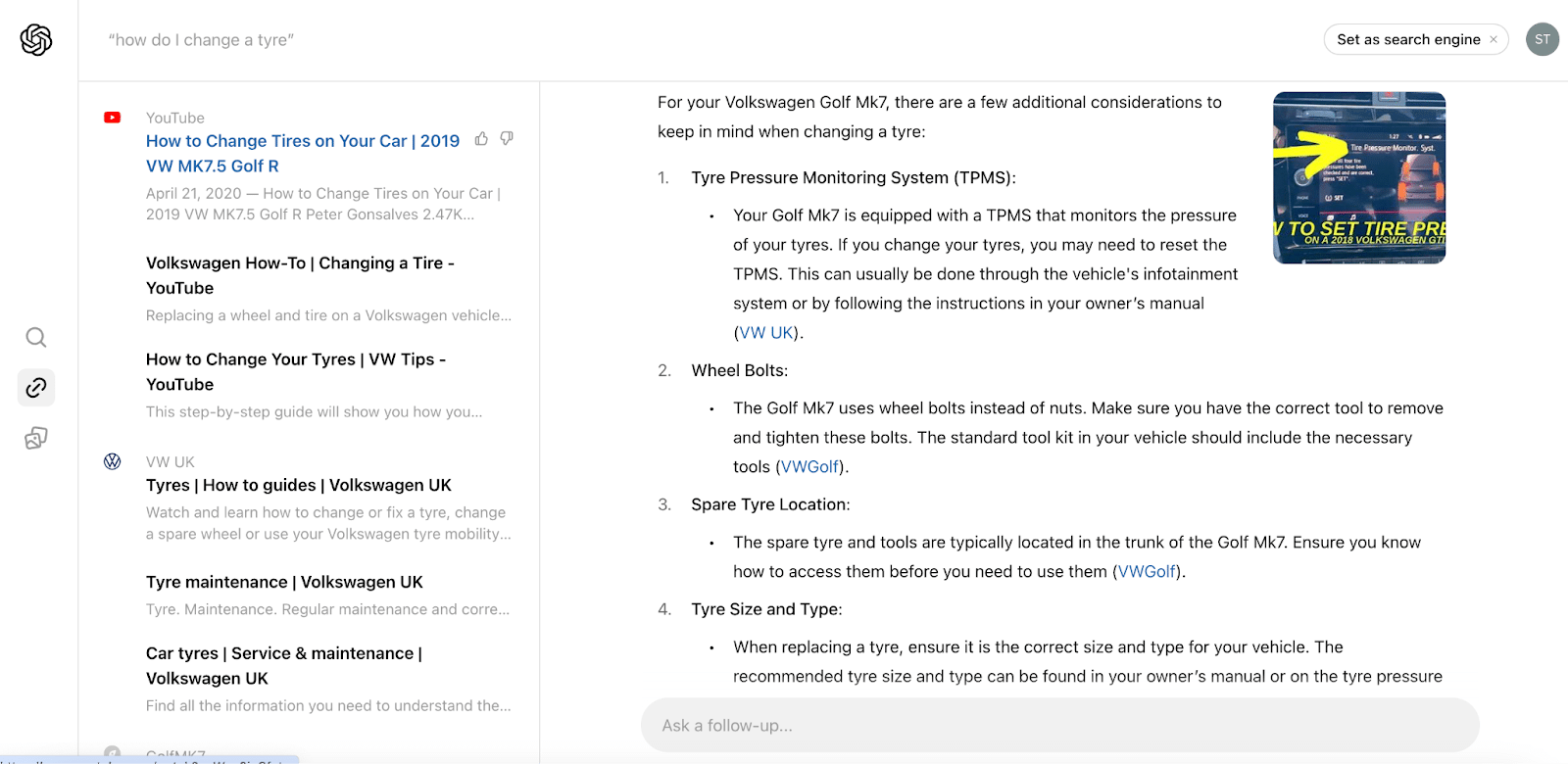
SearchGPT - How do I change a tyre

How does SearchGPT compare to Google AI Overviews?  

My initial impression of SearchGPT is positive; it certainly outperforms Google’s AI Overviews (AIO). 

While SearchGPT may result in fewer clicks for informational terms – and mostly for low-intent searches – in my opinion, this shift broadens the search ecosystem and opens new doors to connect with customers beyond traditional Google SERPs. 

Google’s AIO still primarily relies on traditional search, with the addition of an LLM-generated response at the top of the page, which feels more like an enhancement of rich snippet results than a full transformation. Non-tech-savvy users may not notice a significant difference. 

However, for marketers, two key distinctions stand out:

  • Citations.
  • Conversational search.

Google’s AIO uses an icon for references, offering less transparent citations, while SearchGPT mostly links directly from the publication’s name, which could impact click-through rates. 

Additionally, Google’s AIO is far less conversational. In contrast, SearchGPT allows users to build on the initial response by expanding queries using the original web content, creating a more interactive experience similar to ChatGPT’s conversational thread UI. 

This means marketers might find opportunities with SearchGPT to develop content strategies that cater to a much wider range of conversational queries, encouraging users to explore content in more detail.

5 key implications for digital marketers 

1. Search is about to become more conversational 

SearchGPT - How do I change a tyre search results

SearchGPT’s natural language processing capabilities allow for more nuanced, dialogue-like interactions. It can understand the context and meaning behind words, which means keyword research is likely to change dramatically. 

Due to its conversational nature, users are expected to ask a broader range of questions, which presents marketers with opportunities to create highly targeted content. 

Instead of focusing solely on translating queries into keywords, marketers will need to understand the key topics and questions users are exploring and develop content that directly addresses these needs. 

Content should be engaging, written naturally and designed to meet user intent rather than merely optimizing for algorithms. This transition emphasizes the importance of creating content that resonates with users on a deeper level.

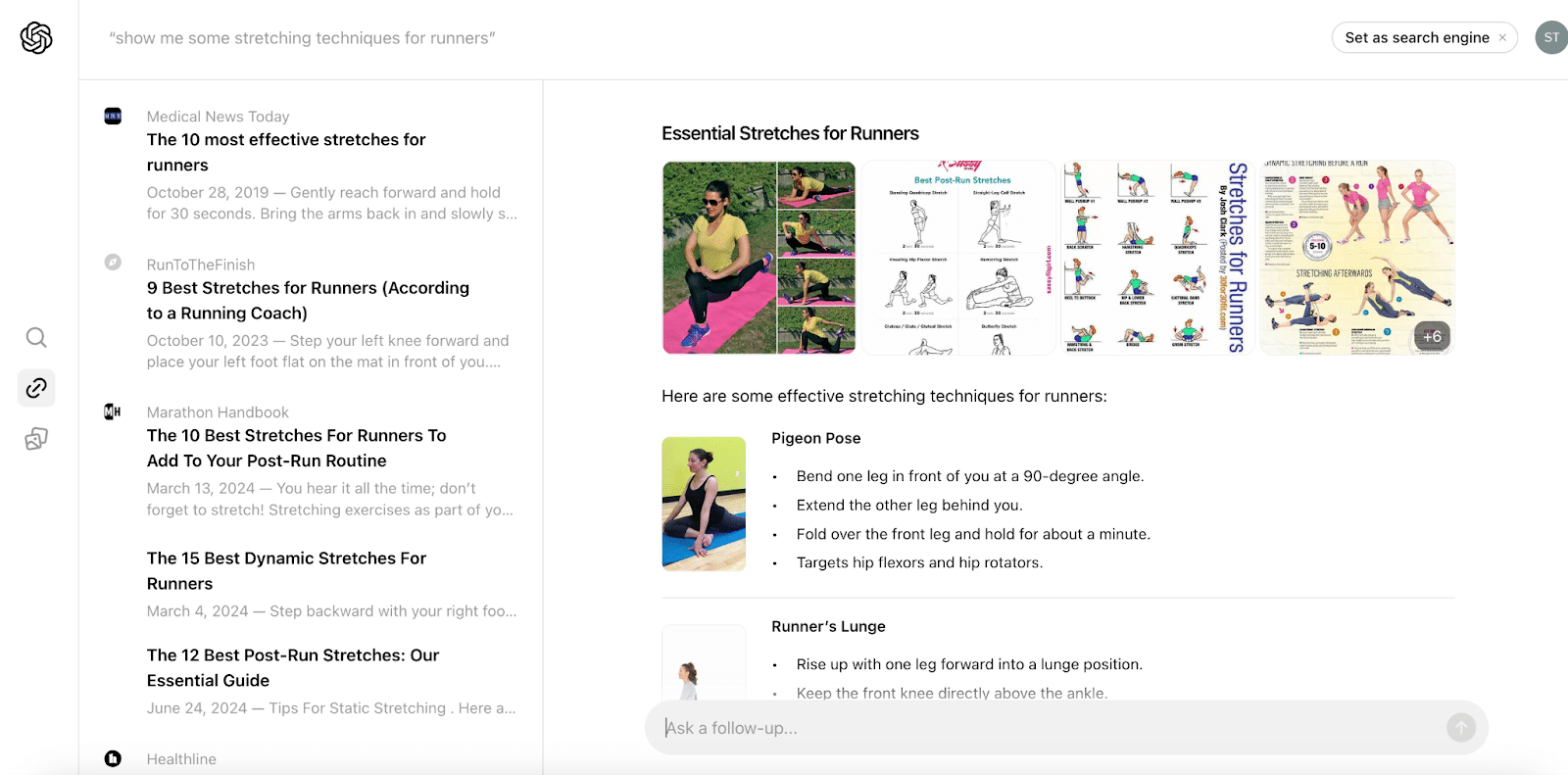
2. Incorporate rich media into your strategies 

SearchGPT - Show me some stretching techniques for runners

A multimedia strategy has been crucial in marketing for years and its importance is set to grow even further. SearchGPT has the capability to reference and describe various types of media beyond just text. 

Integrating videos, infographics and interactive elements into your content will enhance its value for SearchGPT. 

Although for AI, descriptive text may become less necessary for multimedia content because it can understand imagery, it’s still important for your media to be well-labeled and contextually enriched. 

This is to ensure your content remains inclusive and accessible to all end users, as well as being accessible and relevant to AI models, improving its effectiveness in AI-driven searches.

Dig deeper: Visual optimization must-haves for AI-powered search

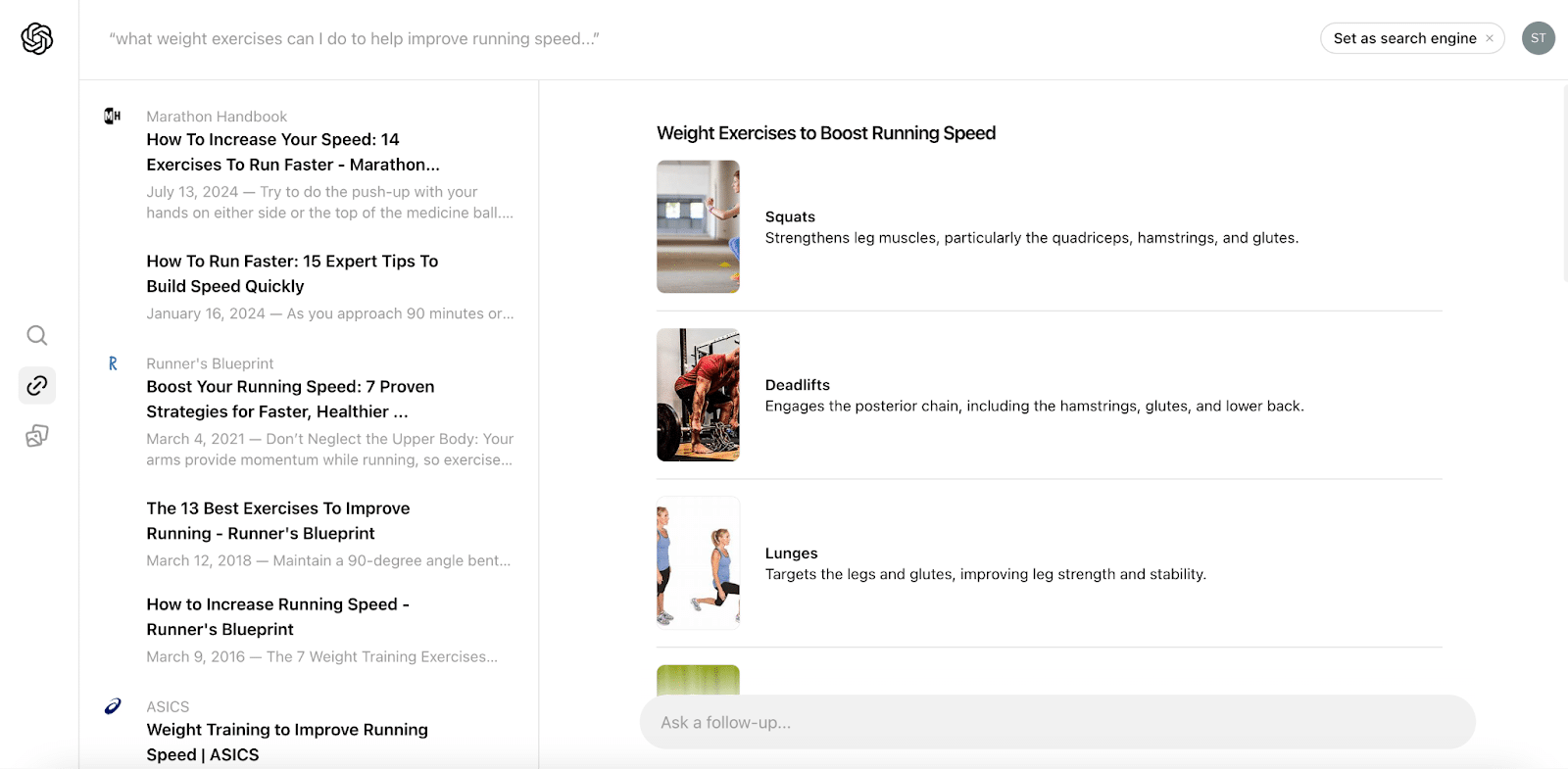
3. Earned media will remain important 

SearchGPT - What weight exercises can I do to help improve running speed

SearchGPT is likely to prioritize high-authority publications, meaning digital PR and thought leadership may become even more important. 

What’s more, at least right now, SearchGPT seems to link out to content creators more than Google does, which may offer brands increased opportunities to boost awareness and traffic. 

OpenAI’s recent partnerships with Conde Nast, The Associated Press and Vox highlight the value of content creators and underscores their role in the success of AI-powered search. 

Marketers should consider targeting high-visibility content sources used by SearchGPT to enhance brand inclusion in its responses. 

Developing relationships with authoritative publications and focusing on earned media can improve your chances of being featured in valuable AI-generated content.

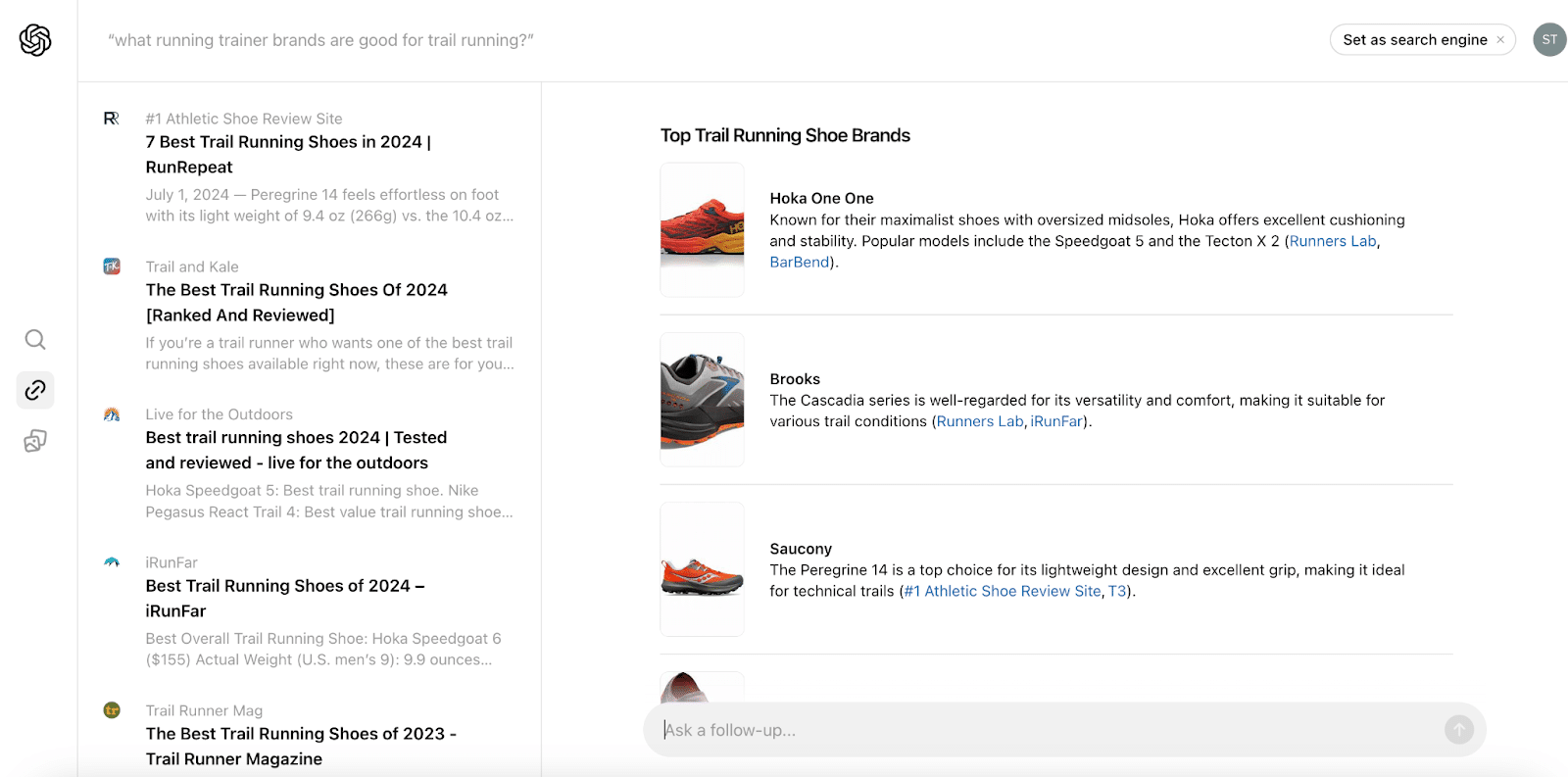
4. High-quality content still rules them all

SearchGPT - What running trainer brands are good for trail running

SearchGPT places a premium on relevant, up-to-date information, making consistent content optimization essential. 

High-quality content is critical for maintaining audience engagement and increasing the likelihood of being referenced by SearchGPT. This focus on quality can drive more traffic and enhance engagement, providing a competitive edge for your brand. 

Regular updates and accuracy are key to retaining relevance in the AI-driven search landscape. That means more traffic and engagement on your site and ultimately, a competitive edge as a brand.

Dig deeper: 6 guiding principles to leverage AI for SEO content production

5. Adapt your analytics and metrics

Marketers should consider tracking visibility through prompts and brand mentions within LLM responses – tracking a collection of prompts you believe your potential customers will be using rather than traditional rankings. 

Traditional metrics like click-through rates (CTR) and page rankings will also become less relevant with AI-driven search. 

Marketers should focus on new metrics like the accuracy of AI-generated answers that reference their content, user engagement levels and the impact of AI on brand visibility.

Metrics like these will provide better insights into how effectively your content is performing in the age of SearchGPT.

SearchGPT is new but it’s already clear that the future of digital marketing is going to be much more conversational and will move away from the traditional 10 blue links from Google. We’re still advising our clients that standard SEO best practices remain relevant. 

However, brands that are not invested in earning high-quality media coverage and links through digital PR should consider adding this to their 2025 budget.

OpenAI will likely prioritize authoritative publisher content to answer AI search queries over a brand’s own website – and you don’t want to miss out on this “fast-paced evolution.”

This article was co-authored by Steve Walker.

Original source: https://searchengineland.com/searchgpt-what-you-need-to-know-446455

8 Ways to Make Money Reading

Can you really make money reading? YES!

Are you a true bookworm? If reading is a passion of yours, it may be worth considering the ways you can make money from reading. Who doesn’t want to earn money from something they love? 

There are more ways to earn money from reading than you may think. From proofreading and editing to reviewing books, you could make decent cash on the side. If you’re going to read anyway, why not profit from it? 

Here are 7 ways you can make money reading.


Review Books

You don’t have to be a literary scholar to review books. All you need is a love for reading, and have the ability to form honest, fair opinions about the books you read. If you are asked to review a particular book, you will need to be open to reading genres or authors outside of your usual, and give them a fair chance. You really can’t judge a book by its cover with this one! 

There are many websites online that pay you for your reviews. All you have to do is search ‘get paid to review books’ into Google, and a plethora of results come up. Do your research before launching into a job though, as the number of opportunities, level of pay and depth of reviews required may differ.  

It’s also important to remember that reviewing books won’t make you millions, nor will you be able to quit your day job. However, it can be a lucrative and fun side hustle to help you put away extra into your savings, pension or even spend on more books! 

OnlineBookClub.org is a great place to start. Publishers and authors will often give you a free copy of a new book in exchange for an honest, written review from you, the reader. You will get a free copy of a book, then on top of this, get paid to give it an honest review. The best part is, you don’t have to lie. 

OnlineBookClub encourage you to be honest. You will get paid no matter what you think. You don’t have to claim you loved it if you didn’t. 

Pay outs current range from $5 to $60 per review. This is approximately £4 to £50 GBP. This isn’t a good pay when you work it out by an hourly rate – but if you love reading and would do it anyway, it’s a good way to make some extra side cash. The thing to note with OnlineBookClub is that you won’t get paid for your first review. However, you will get the book for free. 

We also recommend:  

Magazines and newspapers also regularly have book review sections. While their staff are the ones who usually read the book, it’s worth approaching publications you love with a book review section to find out if they need reviewers. You’ll need to show you can write a constructive review, so prepare some short sample reviews ready to send over as examples.

Overrun with books? Find out how to make money from your old books. 

Become a Beta Reader

A beta reader is someone who reads a book while an author is still writing it. They might have a specialist interest or life experience, or simply be avid readers with a good sense of story and a critical eye.

The pay for beta readers varies widely – many people will do it for free, for people they know or respect. However, there are paid opportunities out there. Look into author communities online for people asking for readers – such as Reddit or Facebook groups – or set up as a freelancer. Then, you can advertise on social media with targeted adverts, in specialised publications like Writers Magazine, and charge a rate you like.

Remember that the rate needs to be competitive, so starting at around £30 for a book up to 50,000 words is a good guideline. This is the length of a Young Adult (YA) or Middle Grade book, or a ‘cosy’ crime or romance book. Literary fiction is usually 80,000 to 100,000 words and fantasy often 120,000 words. Most beta readers charge by the 1000 words to make it easy to work out a rate.

Beta readers are expected to provide critical feedback to an author that they can use. It’s not just saying ‘I don’t like this’. It should be things like ‘this bit didn’t make sense to me’, or ‘this storyline felt slow’, or even ‘hey, I loved these characters!’. Telling authors what works is as important as telling them what doesn’t.

Start a Book Blog

Blogging is a great way to earn money on the side, and could actually become a full-time job should you build your brand and grow your blog successfully. Book bloggers are can be very popular and successful, with blogs such as BookWritten getting over 75,000 hits per month. 

The site contains articles on a range of things, from finding places to read books for free, to looking after books to keep them in pristine condition. However, you could write about anything that tickles your fancy. 

The Literary Edit is a more personal blog, written by award-winning book blogger and writer Lucy. She blogs about all things books, with a more informal, chatty style, Lucy writes reviews of books she’s read, tells her followers her favourite books of all time, and even has a great little section called ‘Desert Island Books’. 

You could even find a niche and discuss books particularly close to your interests. Crime By The Book is a fascinating book blog, written by a lover of crime fiction, with a particular skew towards Scandinavia. Although most of the books are general crime fiction, the niche is particularly interesting. 

But how can you make money from blogging? Well, mainly ads on the site, as well as partnerships and affiliates with brands. You may even get a sponsorship for a particular series. As your blog grows and develops, you may be sent freebies of books, and even asked to review them on your blog in return for payment.

If your blog grows large enough, people may even pay monthly subscriptions for exclusive content, or you could use widgets such as Buy Me A Coffee, where people can buy you a virtual coffee to help fund your mission. Plus you will be able to make this money reading.

Our frugal columnist, and award-winning blogger Jane, owner of shoestringcottage.com, first started her blog over a decade ago: 

Shoestring Cottage

Jane from Shoestring Cottage

“I began with a free WordPress blog, as I was writing as a hobby. However, when I realised it was possible to monetise my site, I purchased a domain name and server hosting. I also bought a theme (design) to make it look more professional. I maybe spent £400 initially and now pay around £150 a year.

“The key to getting a steady readership is to post regularly – at least once a week, preferably more. I also did a couple of cheap blogging courses, and learned some of the technicalities of running a blog. I think it is worth doing this if you are a complete beginner.” 


Not sure where to begin? Here are some websites we recommend to start your blog: 

  • WordPress 
  • Wix.com 
  • Squarespace 
  • Blogger 

These websites are free, easy-to-use and allow you to build your blog using templates available. They are straight forward and you can create a beautiful, unique blog in very little time. 

Find out more about making money from blogging here. 


Use Social Media

make money reading

Social media is a brilliant tool. Many people actually become full-time ‘influencers’, and earn a good sum of cash using their platforms.  

Instagram

One of the biggest platforms that appreciates books is Instagram. As with blogging, people use their Instagram pages to review books they’ve read, share their favourite books and interact with other people who love reading as much as they do. 

The money comes from sponsorships, affiliates and brand deals. You may collaborate with a brand on a post, for example promoting a new book being released, or encouraging your followers to follow a new author’s work. You may be given affiliate links as well as upfront payment, where you make a cut of a sale when someone buys a book through your link. 

Of course, you won’t get these opportunities immediately, and it will take some hard graft on your end to build a following. But through following others, interacting with them and posting a steady and constant bout of content, you could grow more quickly than you may think. 

‘Bookstagrams’, as they are fondly know in the book-lover community, are a hugely popular part of the platform. Elizabeth Sagan (@elizabeth_sagan) boasts a whopping 203k followers. A self-confessed ‘book whisperer’, Elizabeth posts beautiful imagery of her books and fun, engaging short videos. Other accounts such as @coraliebickfordsmith and @stacked_shelf have 25.8k and 10.3k followers respectively.  

You don’t have to have hundreds of thousands of followers to start making money. Once you reach 5,000 followers you are considered a ‘micro-influencer’, and can start reaching out to brands and companies to see if they’d like to work with you. Remember to work with other influencers and help to build each other up. 

Find out more about making money on social media. 

TikTok

One of the largest video-sharing platforms in the world is TikTok, and ‘BookTok’ is an integral part of the platform. BookTok even has its own Wikipedia page, and the tag #BookTok has over 112.2 billion views on the app. 

You may start on another platform and as you feel more confident, move over to making videos. It can seem daunting, but the BookTok community is a warm and welcoming one. Despite the criticisms of social media, this corner of the internet is full of friendship, enjoyment, and great connections over a shared passion.  

We love @bookishbytammi, who shares books she’s read monthly, her favourite books in different genres such as fantasy and romance, and does fun challenges too. She has 64k followers and almost one million likes across her videos.   

If you aren’t feeling ready to make videos, join the platform and have a browse. As you watch other people make videos and discuss topics you love, you may become inspired to start creating videos yourself. 

As with other social media platforms, the money you can make comes in the form of sponsorships, brand partnerships and affiliates. You may be asked to do ads for a certain product or company, and get paid to attend events.  

Find out about the TikTok influencers teaching personal finance to millions. 

YouTube

BookTube is a huge part of the online video service, YouTube. To find out what kind of content you need to create, simply search ‘booktube’ in the search bar and watch lots of the videos that come up.

Like TikTok and Instagram, most BookTubers are comfortable on camera, but you can do an off-camera presenting style if you are good at creating interesting graphics for people to look at while you talk. Often, this includes filming yourself reading the book but from ‘your POV’ so the camera looks as if it’s from your eyes, looking at your hands etc.

Proofreading

make money proof reading

Another way to make money reading is to become a proof-reader. Proofreading is essentially a final quality check before publishing. A proof-reader will carefully check the text for any errors before it is published or shared. It’s the last stage of the writing process, and it is essential for any text. 

The job of a proof-reader is to bring attention to any spelling, punctuation, and grammar errors, as well as any typos or formatting issues. You may even alert the author and publisher to any inconsistencies within the text. 

Many proof-readers do it on a freelance basis. You can advertise your proofreading services on websites such as PeoplePerHour and Fiverr. Some people offer their services for under £5, however when you build up your reviews, ratings and reputation, you could be charging hundreds for longer texts and novels. 

You could also go in search of opportunities. Websites such as UpWork and Freelancer are goldmines for people looking for proof-readers to help them. From doing last-minute checks of novels to going over important documents and even checking for spelling and grammar in examination papers, proof-reading involves a huge range of tasks. The roles range from £8 per hour to a few thousand pounds for large, important projects. 

In order to be a successful proof-reader, you will of course need a love for reading, but some key skills are required also. You will need a great attention to detail and a solid understanding of spelling and grammar. You’ll need to be self-disciplined and be able to meet tight deadlines.  

Scribbr have a great guide to proofreading, which you can read here. 

Need a flexible schedule? Check out these work from home roles for everyone. 


Narrate Audiobooks

Do you have a smooth as butter voice that people love to listen to? Perhaps you are good at doing accents, making a book come to life as you read to others. Do your children or grandchildren guffaw when you make a funny voice, pretending to be the monster in their book? Narrating audiobooks or participating in an audio podcast drama could be just the thing for you. 

If you are an avid reader, this is a great way to supplement your income. You may even choose to pursue this as a freelancer on a full-time basis if you find it is a successful career path for you. You can make money reading books, out loud!

But how can you get started? Well, the internet is a powerful thing, and there is a plethora of opportunities waiting for you.  

The Audiobook Creative Exchange (ACX) is a huge online platform that pays people to read books out loud. Books you narrate for this popular platform could even appear on iTunes and Audible, which would be a great boost for your portfolio. Simply create an account, upload some high-quality samples of you narrating a small paragraph or passage, and then set your hourly rate. 

Authors and publishers will be able to find you and review your work and may ask you to narrate for them. The great thing about ACX is that you could even earn some of the royalties earned on the book! 

There are many ways you can get work, as well as the ACX. As previously mentioned, you could advertise your work on freelance sites such as Fiverr. There are also many more companies which specialise in voiceover and narration. 

Here are some we recommend: 

Listen to thousands of audiobooks, podcasts and Audible originals, with Audible. Sign up for your free 30-day trial.


Translate Books

Do you speak more than one language? Many people are crying out for people to translate texts for them. From novels to documents and even old texts, your language skills could earn you a decent bit of money on the side. If you speak multiple languages, even better! You will be a very valuable asset to many companies and be able to make decent money from reading. 

Translation services for fiction books aren’t about direct translation of the words on the page. It’s an art: you need to capture the essence of what is being said and making it sound just as beautiful in the second language. Translation for non-fiction or business documents is more literal.

You could advertise your services on freelance websites, or go in search of opportunities. We have previously recommended Fiverr, Upwork, Freelancer and PeoplePerHour, all of which are relevant to this route too.  

However, there are also websites dedicated to translation work. Blend is one of the most popular and successful translation websites. They guarantee continuous workflow and fair pay for every project. You can also apply as both a translator and a voice artist, so you can mix things up! Although the pay doesn’t start out high, the progression system makes it easy to build up your pay and your reputation on the website. 

However, if you want to make real money from this, you could consider going full-time as a freelance translator. On Freelancer, text translation jobs range anywhere from £7 to £25 an hour for simple texts, and a few thousand pounds for more in-depth, intense texts. 


The post 8 Ways to Make Money Reading appeared first on MoneyMagpie.

Original source: https://www.moneymagpie.com/make-money/6-ways-to-make-money-reading

Mastering Next-Day Delivery: Strategies for SMBs to Compete with Big Brands

Home Business Magazine Online

Small businesses, representing 99.9% of all U.S. businesses according to the U.S. Small Business Administration, often face significant challenges in competing with major brands. One of the most formidable challenges is meeting consumer demand for next-day delivery, which e-commerce giants like Amazon have made the standard.

Consumers have grown accustomed to receiving their orders the very next day, and this expectation is no longer exclusive to large corporations. Small and medium-sized businesses (SMBs), especially home businesses, must adapt to this demand to stay competitive, but the good news is that they can do so by leveraging certain strategies and technologies that optimize their supply chain and warehouse operations.

A Responsive Supply Chain is a Good Supply Chain

Effective supplier management is the cornerstone of a responsive supply chain. We know that from the craft breweries’ aluminum can shortage and the ongoing Boeing 737 MAX crisis that poor supplier management can be catastrophic. Supplier management involves finding, choosing, and working with suppliers to ensure that materials are delivered on time and at a good price. For instance, imagine a home-based business that manufactures custom jewelry. Proper supplier management ensures that materials such as beads, metals, and stones are of consistent quality and delivered punctually, which in turn allows the business to maintain consistent product quality and meet delivery deadlines.

A robust supplier management system reduces costs by enabling better price negotiations and streamlining procurement processes, which helps avoid disruptions that could lead to unexpected costs. Additionally, strong supplier relationships improve supply chain agility, allowing businesses to adapt to market demands swiftly and mitigate risks such as supply shortages and quality issues.

Home-Based Operations Should Be as Effective as Large Warehouses

The physical layout of a home workspace plays a crucial role in the speed and efficiency of order fulfillment. An optimized workspace layout minimizes travel time and streamlines the flow of goods. This can be achieved by organizing the workspace based on the demand, size, and frequency of use of items. Utilizing vertical space effectively can increase storage capacity and eliminate the need for additional storage areas.

Keeping your inventory organized and easily accessible, with labeled shelves and bins, minimizes the time spent searching for products. Regular audits to reconcile physical stock with inventory records help identify discrepancies and prevent stockouts.

Embracing Technology and Automation is Critical for Competing

Investing in technology such as cloud-based inventory management software and automation tools like barcodes and RFID systems can significantly enhance home-based business efficiency. These tools provide real-time visibility into inventory levels, order statuses, and employee performance, allowing for accurate monitoring and analysis. Automation reduces human error and frees up the business owner to focus on more critical tasks, thereby increasing overall productivity. These software solutions help businesses keep track of their entire supply chain, providing insights into best-selling products, slow-moving items, and forecasting demand, so that they can make the most informed decisions that will be critical for mastering next-day delivery.

Additionally, to continuously improve efficiency, home-based SMBs should define and track relevant Key Performance Indicators (KPIs) such as delivery lead time, order fulfillment rate, inventory turnover, and labor productivity. Regularly reviewing these metrics that inventory platforms can track can help identify areas of improvement and measure the effectiveness of any changes implemented. According to a 2024 eCommerce Performance Report on Shopify merchants, 98% of respondents have difficulty aligning inventory and production with changing consumer demand and of those, 60% reported significant difficulty. These are important challenges to address headed into the fourth quarter (Q4) of the year when major shopping events and holidays will drive significant consumer spending.

Processing Shouldn’t Be a Grueling Process

Order fulfillment is a critical component of next-day delivery. The faster and more accurately you can process orders, the more likely you are to meet delivery deadlines. Automation tools can handle repetitive tasks such as order processing, packing, and labeling, reducing manual errors and speeding up the fulfillment process. Developing standard operating procedures for packing orders ensures consistency and efficiency, making it easier to train new employees and maintain quality control. Using durable and appropriate packaging materials to protect products during transit reduces the likelihood of returns and improves customer satisfaction. According to a study conducted by the National Retail Federation (NRF) and Appriss Retail, 30% of all online orders were returned with product damage during transit being a significant contributor to returns

Now, the Final Home Stretch (Pun Intended)

While big brands often have their own delivery fleets, home-based SMBs can benefit from partnering with local courier services. These services offer flexibility and personalized delivery options that can enhance your next-day delivery capabilities. Identifying local courier services in your area and comparing their rates, delivery times, and reliability is essential. Look for couriers with positive reviews and a track record of timely deliveries. Negotiating bulk shipping rates with couriers can reduce costs, and choosing couriers that offer same-day pickup services ensures that orders placed later in the day can still be dispatched quickly.

Additionally, by offering real-time tracking and proactive communication, you can keep customers informed and manage their expectations. Providing tracking numbers to customers as soon as their orders are dispatched allows them to monitor their delivery progress and reduces inquiries about order status. Using automated systems to send updates at key stages of the delivery process, such as order confirmation, dispatch, and out-for-delivery notifications, enhances transparency.

Mastering next-day delivery is a challenging but achievable goal for home-based SMBs. By optimizing supplier management, enhancing home workspace efficiency, leveraging technology, managing inventory effectively, and tracking performance, home-based SMBs can not only meet but exceed consumer expectations. In a fast-paced world where next-day delivery is becoming the norm, home-based SMBs must adapt and innovate to stay competitive. By embracing these strategies, they can turn the challenge of next-day delivery into an opportunity for growth and success. With the right tools and mindset, home-based SMBs can indeed master next-day delivery and compete with the giants of the industry.

The post Mastering Next-Day Delivery: Strategies for SMBs to Compete with Big Brands appeared first on Home Business Magazine.

Original source: https://homebusinessmag.com/management/mastering-next-day-delivery-strategies-smbs-compete-big-brands/