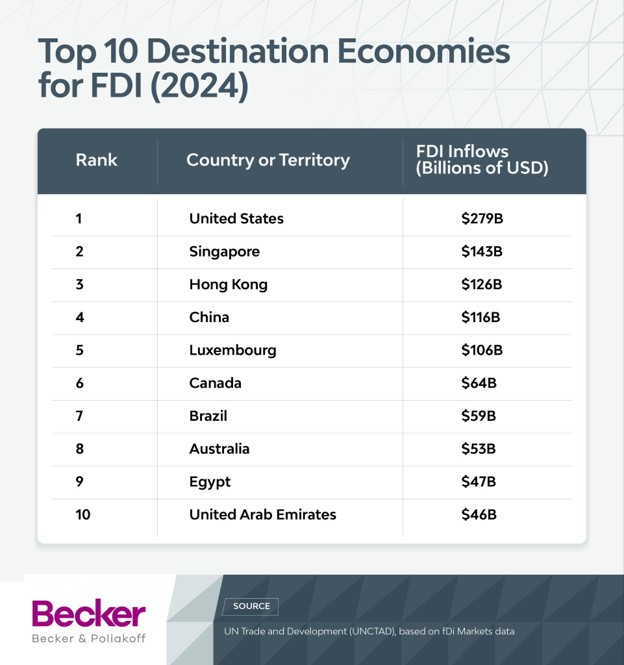
The United States remains the world’s top destination for foreign direct investment, attracting $279 billion in inbound investment in 2024 — more than double the $116 billion attracted by China — according to an analysis of federal data from Becker & Poliakoff.
The report, which analyzed the latest federal foreign investment data, underscores America’s continued dominance in attracting overseas capital at a time when global competition for investment is intensifying. While foreign direct investment, or FDI, is often associated with multinational corporations and large-scale manufacturing projects, the economic activity generated by those investments can create opportunities that ripple throughout local business communities, including home-based businesses.
Foreign Investment Creates Opportunities Beyond Major Corporations
FDI occurs when a company or investor from one country establishes or acquires business operations in another. These investments can include manufacturing plants, distribution centers, research facilities and technology hubs that generate jobs, stimulate local spending and create demand for services from businesses of all sizes.
For entrepreneurs operating from home, major foreign investment projects can translate into new opportunities for consulting, marketing, bookkeeping, recruiting, design, logistics support and other professional services. As foreign-owned companies establish a presence in local markets, they often rely on networks of small vendors and contractors to support their operations.
The study found that Texas attracted the most foreign direct investment of any state in 2024, bringing in $22.8 billion. The state’s position was bolstered by Samsung’s ongoing semiconductor manufacturing expansion, which totals approximately $45 billion in planned investment.
Georgia ranked second with $16.3 billion despite being only the nation’s eighth-most-populous state. The state’s strong showing was driven largely by electric vehicle manufacturing investments from Hyundai and Kia, highlighting how targeted industry growth can attract significant international capital.
California ranked third with $12.9 billion in foreign direct investment, followed by Ohio at $7.6 billion. North Carolina and Massachusetts each attracted $5.6 billion, while Florida, New York, Virginia and Washington rounded out the top 10 states.
Manufacturing Leads Investment Growth Across Key States
The concentration of investment in manufacturing was particularly notable. According to the study, manufacturing accounted for a cumulative foreign direct investment position of $2.4 trillion in 2024, more than double the next-largest industry category. The finding reflects continued global demand for U.S.-based production facilities, particularly in sectors such as semiconductors, electric vehicles and advanced technology.
The employment impact is substantial. Foreign-owned companies support roughly 15 million jobs across the United States, according to the analysis. In South Carolina, the influence is especially pronounced, with 8% of all jobs tied to majority foreign-owned companies — the highest share of any state.
The study also found that Japan remains the largest foreign investor in the United States. Japan’s cumulative investment position grew from $694 billion in 2020 to $819 billion in 2024, narrowly surpassing Canada, which held an investment position of $812 billion.
Beyond the headline figures, the data points to the continued strength of the U.S. business environment. Foreign companies often choose investment destinations based on factors such as workforce quality, infrastructure, legal protections and access to customers. Those same advantages can benefit entrepreneurs and home-based business owners looking to build relationships with growing companies entering their markets.
As large foreign-backed projects continue to expand across the country, local entrepreneurs may find new opportunities emerging alongside them. While billion-dollar investments make headlines, the economic activity they generate frequently extends far beyond factory floors and corporate offices, creating demand for the products and services provided by small businesses and independent professionals.
Roofing contractors have always built their businesses on local reputation and word-of-mouth. Those still matter. What’s changed is what happens before a homeowner picks up the phone: they search Google, scan reviews, check the Maps pack, and increasingly ask AI tools like ChatGPT to recommend a contractor in their area. If a roofing company isn’t visible at that moment, the job goes to someone who is.
Marketing is the system that controls whether the phone rings consistently or only after a major storm. The agencies that do this well understand roofing-specific demand: how storm response campaigns work, why review velocity matters more than star ratings alone, and why paid campaigns need to be built around job economics rather than click costs. Most agencies don’t specialize in roofing. The ones that do tend to produce better outcomes faster.
This list covers eight agencies with documented experience in roofing marketing as of 2026. Some focus on organic growth and local search. Some run full-funnel programs across paid and organic. Some work with regional contractors; others serve multi-location companies. None of them are right for every roofing business. What follows explains where each one fits.
Shortlist: 8 Best Roofing Marketing Agencies in 2026
Rank
Agency
Best For
1
Jives Media
Full-funnel roofing marketing: Search Engine Optimization (SEO), AI SEO, paid media, web design
2
Thrive Internet Marketing Agency
Multi-channel roofing campaigns with in-house content production
3
Blue Corona
Analytics-driven home services marketing with roofing and HVAC depth
4
Hook Agency
Roofing-specialist SEO and website design for growth-mode contractors
5
Roofing Webmasters
Roofing-only SEO and reputation management
6
WebFX
Large-scale full-service digital marketing with roofing track record
7
Scorpion
Technology-platform marketing for home service businesses
8
Comrade Digital Marketing
Integrated SEO, paid, and social systems for roofing companies
1. Jives Media
Detail
Info
Headquarters
San Francisco, California
Employees
51–200
Founded
2012
Best For
Full-funnel roofing marketing across SEO, AI SEO, paid advertising, and web design
Key Differentiator
Integrated strategy and production in-house; no channel handoffs
Specialties
Roofing SEO, AI search visibility, Google Ads, Local Service Ads (LSA), website design and conversion, reputation management, content programs
Jives Media runs full-funnel marketing programs for roofing companies across SEO, AI SEO, paid advertising, and web design, with strategy and execution handled by the same team. That means the people who build the plan are the same people producing and reporting on the work. Founded in 2012, Jives works with roofing contractors across the United States, with particular depth in markets where organic competition is high and paid lead costs are rising.
The operating principles that shape Jives roofing accounts:
Market-specific programs, not contractor templates. Every roofing engagement is built around the company’s specific service area, job mix, and local competition. Local search and Google Maps positioning are treated as core business infrastructure.
Strategy and production under one team. When strategy and execution are split between vendors, communication gaps slow results. At Jives, SEO, paid media, content, and web design are coordinated by the same group.
Artificial Intelligence (AI) search built into every program. Across the roofing companies Jives Media audits in 2026, 67% have no meaningful AI search visibility despite ranking on Google. Jives builds Generative Engine Optimization (GEO) into roofing programs so clients appear when homeowners ask ChatGPT, Gemini, or Google AI Overviews for contractor recommendations.
Paid media tracked to booked jobs. Google Ads, LSAs, and paid social are managed around Cost Per Lead (CPL) targets tied to roofing job economics, not impression volume.
Organic search as a long-term lead source. Most roofing contractors underinvest in SEO relative to paid. Jives builds content programs and technical SEO foundations designed to produce consistent organic leads over time rather than one-time traffic events.
Reporting tied to the questions that matter. Which campaigns drive inspection requests. Which keywords produce calls. Where budget is being wasted. Jives builds reporting around those outputs, not dashboards full of inputs.
AI-Driven Search for Roofing Contractors
Homeowners increasingly bypass traditional search and ask AI platforms directly for contractor recommendations. Jives roofing programs address this through structured data and schema markup, content frameworks built around the questions homeowners ask AI tools, Google Business Profile (GMB) optimization that signals local authority across Maps and AI results, and ongoing monitoring of where roofing clients appear in AI-generated responses.
Proprietary Research and Audit Frameworks
Every Jives roofing engagement starts with a multi-factor audit covering local search visibility, AI search presence, website conversion rate, paid media structure, and reputation signals. Across the roofing companies Jives audits in 2026:
67% are invisible on AI search platforms despite strong Google rankings
54% have Google Maps gaps limiting call volume in their core service areas
Roofing companies that implement Jives’ reputation systems see review volume increase within 90 days
Mobile-optimized landing pages consistently produce higher call rates than desktop-first designs
What Jives Media Does Well
Full-funnel programs that connect SEO, AI search, paid media, and web design into one system
AI search visibility built into every roofing program from the start
Paid campaign management tracked to booked jobs, not clicks and impressions
Roofing-specific content programs that build organic lead flow over time
Reporting tied to the metrics that matter to roofing business owners
Before evaluating any roofing marketing agency, map out your three biggest lead sources from the past 12 months and what you actually paid per booked job from each. That baseline makes every agency conversation more specific and more honest.
Roofing contractors that need multi-channel digital marketing with in-house content production
Key Differentiator
End-to-end execution from SEO to content writing to Pay-Per-Click (PPC) under one roof
Specialties
Roofing SEO, PPC advertising, social media, web design, content marketing, AI SEO
Thrive Internet Marketing Agency has been building digital marketing programs for roofing contractors since 2005. Their model is built around end-to-end execution: strategy, website design, SEO, paid media, and content production all handled internally. That reduces the friction that comes from managing multiple vendors. Thrive works with roofing contractors at various stages, from single-location operators building their first organic presence to regional companies scaling paid programs into new markets.
Their roofing work covers Google Search campaigns, LSA management, social media, and content-driven SEO. Thrive operates on month-to-month terms, which means contractors can adjust scope and timing around seasonal demand rather than committing to fixed contracts.
What Thrive Internet Marketing Agency does well:
Full-service production model that keeps content, SEO, and paid media coordinated
Documented roofing case studies across the home services category
Month-to-month terms that give roofing companies flexibility
Content production capabilities that support long-term organic growth
Internal processes that allow faster campaign launches than smaller boutique agencies
Pro Tip:
Ask Thrive to walk through a roofing-specific case study from a market similar to yours in size and competition. The detail in their answer tells you how account-specific their strategy actually gets.
3. Blue Corona
Detail
Info
Headquarters
Gaithersburg, Maryland
Employees
51–200
Founded
2008
Best For
Roofing and home services companies that want rigorous campaign measurement and attribution
Key Differentiator
Deep analytics infrastructure with call tracking, attribution, and lead recovery built into every program
Specialties
Roofing SEO, PPC, social media ads, website design, call tracking, analytics, lead recovery
Blue Corona has built digital marketing programs for home services businesses since 2008. Roofing and HVAC companies make up a significant portion of their client base, and their analytics infrastructure reflects that experience. Every program includes call tracking, attribution modeling, and detailed performance reporting. For roofing companies that have run paid campaigns without clear attribution data, the reporting structure produces a more accurate picture of what’s actually driving leads.
Blue Corona was acquired by EverService in 2021. Their analytics and tracking capabilities remain the clearest differentiator. Roofing owners and operators who make budget decisions based on data find the reporting structure useful.
What Blue Corona does well:
Call tracking and attribution that shows where roofing leads actually originate
Detailed analytics dashboards with regular performance reviews
Roofing and HVAC-specific playbooks developed across a large home services client base
Paid search programs with direct connection to booked job data
Reporting structure that supports informed budget decisions
Pro Tip:
Blue Corona’s analytics setup takes time to configure correctly at the start of an engagement. Allow 30 to 60 days for the tracking infrastructure to produce reliable attribution data before drawing conclusions about campaign performance.
4. Hook Agency
Detail
Info
Headquarters
Minneapolis, Minnesota
Employees
11–50
Founded
2012
Best For
Growth-mode roofing contractors focused on SEO-driven lead generation and high-converting websites
Key Differentiator
Roofing and home services specialization with offer-driven landing pages built around search intent
Specialties
Roofing SEO, website design, PPC, Local Service Ads, conversion copy, reviews strategy, link building
Hook Agency built their book of business in roofing marketing and home services before expanding across other trades. Their client base skews toward contractors actively investing in growth: companies that want strong organic presence and a website that converts search traffic into calls. Founder Tim Brown has been involved in roofing industry conversations publicly for over a decade, which shapes how the team approaches campaign strategy.
Their core work is SEO and web design. Hook builds roofing websites with clear conversion architecture: fast load times, mobile-first design, and landing pages structured around specific services and locations. The SEO work follows the same logic, focused on keywords and content that produce calls rather than raw traffic volume.
What Hook Agency does well:
Roofing-specific SEO knowledge built from concentrated work in the category
Website design built for conversion, with attention to mobile performance
Landing pages structured around individual roofing services and local search intent
PPC and LSA management tied to lead volume targets
Review generation and reputation management frameworks
Pro Tip:
Hook Agency’s model works best when you can give the program 90 days before evaluating organic results. Their SEO work builds on technical and content foundations that take time to move rankings. Paid performance is measurable faster; organic is a longer runway.
5. Roofing Webmasters
Detail
Info
Headquarters
Fort Worth, Texas
Employees
11–50
Founded
2013
Best For
Roofing contractors that want a specialist focused entirely on search and local visibility
Key Differentiator
Built exclusively for roofing companies with deep local SEO and Google Business Profile expertise
Specialties
Roofing SEO, website design, Google Business Profile optimization, reputation management, local listings, AI search optimization
Roofing Webmasters works exclusively with roofing companies. No other industries, no generalist client mix. Their model is built around local search and organic visibility, with particular depth in Google Business Profile management and local citations. For contractors whose primary growth lever is organic search rather than paid volume, that narrow focus is a practical advantage.
Founder Nolen Walker has worked alongside roofing contractors in the field, which shows in how the agency frames strategy around the specific dynamics of the business: seasonality, storm response, review volume, and service area expansion.
What Roofing Webmasters does well:
Local SEO and Google Business Profile management designed specifically for roofing businesses
Review and reputation systems built around how roofing companies interact with customers
Roofing-specific keyword knowledge and content strategy
AI search optimization integrated into their SEO programs
Consistent track record with contractors across US markets
Pro Tip:
Roofing Webmasters’ strength is depth in organic and local SEO. If a significant portion of your current lead volume comes from paid search and you need paid media management alongside SEO, confirm their paid capabilities before committing.
6. WebFX
Detail
Info
Headquarters
Harrisburg, Pennsylvania
Employees
500–1,000
Founded
1996
Best For
Roofing companies that want large-scale full-service digital marketing with deep technology infrastructure
Key Differentiator
Proprietary RevenueCloudFX platform combining SEO, paid media, and attribution in one reporting system
Specialties
SEO, PPC, web design, content marketing, email marketing, social media, analytics, AI search
WebFX is one of the larger full-service agencies on this list. Their client base spans many industries, but their size brings real infrastructure: a large team of specialists and a proprietary technology platform called RevenueCloudFX that consolidates SEO, paid media, and attribution data into one reporting environment. For roofing companies with significant marketing investment running campaigns across multiple channels, the infrastructure is a genuine advantage.
The trade-off at a large agency is account-level attention. Roofing contractors working with WebFX should ask direct questions about account team structure: who manages the account day-to-day, the escalation path, and how roofing expertise is distributed across the team.
What WebFX does well:
RevenueCloudFX platform connecting marketing activity to revenue attribution
Large specialist team across every digital channel
Strong SEO performance track record across competitive categories
Paid media management with detailed analytics
Service breadth for companies running campaigns across many channels simultaneously
Pro Tip:
WebFX works best for roofing companies with budgets that can activate multiple channels at once. If budget is limited and concentrated channel focus is needed, a more specialized agency may deploy the same dollars more efficiently.
7. Scorpion
Detail
Info
Headquarters
Lehi, Utah
Employees
750–1,000+
Founded
2001
Best For
Home service companies that want a technology-platform approach with dedicated account teams
Key Differentiator
Proprietary marketing technology platform with AI-driven advertising optimization and full-service execution
Specialties
Website design, SEO, PPC, social ads, reputation management, AI-driven advertising, local search, lead tracking
Scorpion sits at the intersection of technology and agency services. Their platform-based model means roofing companies get both a marketing team and proprietary software: campaigns, website, and reporting all managed within Scorpion’s technology environment. Their advertising AI component adjusts targeting and spend based on what converts for each roofing business.
The platform model works well for contractors who want consistent execution without close involvement in campaign decisions. The trade-off is that everything runs on Scorpion’s infrastructure: website, campaign data, reporting. Some contractors value the simplicity. Others want full ownership of their assets. That question is worth asking before signing.
What Scorpion does well:
Advertising AI that continuously optimizes campaigns based on lead and conversion data
24/7 lead capture for storm and emergency response situations
Full-service website design and hosting on their proprietary content management system
Home services depth across roofing, HVAC, plumbing, and electrical
Dedicated roofing marketing agency teams with category experience
Pro Tip:
Ask Scorpion explicitly about asset ownership. Confirm what happens to your website and campaign data if you leave the platform. That answer shapes the long-term risk profile of the engagement.
8. Comrade Digital Marketing
Detail
Info
Headquarters
Chicago, Illinois
Employees
11–50
Founded
2008
Best For
Roofing companies that want SEO, paid media, and social media built as one connected system
Key Differentiator
Selective onboarding process that declines engagements where the data doesn’t support realistic outcomes
Specialties
SEO, PPC, content marketing, social media, website design, conversion rate optimization
Comrade Digital Marketing builds SEO, paid ads, content, and social as a single coordinated strategy rather than managing each channel separately. Their selective onboarding is worth noting: they decline engagements where the data doesn’t support the results a prospective client is expecting. For roofing companies that have worked with agencies that over-promised, that selectivity matters.
Their team includes SEO specialists, copywriters, editors, and developers working together from the start of each engagement. That coordination is relevant in roofing marketing, where content strategy, technical SEO, and paid landing pages need to work from the same targeting logic to produce consistent results.
What Comrade Digital Marketing does well:
Integrated multi-channel strategy connecting SEO, paid, and social from a single plan
Selective onboarding that produces more realistic expectations on both sides
Coordinated content production that supports both organic and paid programs
Consistent reporting structure with regular performance reviews
Pro Tip:
Comrade’s integrated model works best when you’re running all major digital channels through the same agency. If keeping paid search with one vendor and SEO with another is the plan, their model won’t produce the coordination it’s designed to deliver.
How to Choose the Right Roofing Marketing Agency
Roofing contractors evaluating marketing agency partners should focus on a short set of questions that separate agencies doing real work from those running standard home services templates.
What does the agency actually track? Clicks and impressions are easy to report. Booked inspections, call volume by source, and CPL by channel take more effort to configure. Ask how the agency tracks leads from click to booked job. If they can’t answer that specifically, the reporting won’t tell you what you need to know.
How does the agency handle roofing-specific demand patterns? Roofing demand spikes around storm events and peaks seasonally. Agencies with real roofing experience have campaign structures ready to activate when demand surges. Agencies without that background often miss the window.
Who owns your assets? Website, Google Business Profile, campaign data, and content. Some roofing marketing agencies build everything on proprietary platforms that make it difficult or expensive to leave. Ownership of your digital assets matters long after the agency relationship ends.
Roofing marketing agencies that produces consistent leads requires organic visibility, AI search presence, paid capture during high-intent moments, and a website built to convert. No single channel is enough on its own. The agencies on this list approach that combination in different ways. The right fit depends on your stage of growth, your market, and which channels have produced results historically.
Heating oil is a critical resource for many households, especially in colder regions where it serves as the primary heating source. Homeowners often watch the fluctuations in heating oil costs with concern, as changes in prices can significantly impact household budgets. While some price changes are seasonal, others are driven by complex global, national, and local factors. Understanding what influences heating oil costs can help homeowners make informed decisions and plan for fluctuations.
For residents in the region, monitoring Heating Oil Prices in Connecticut is particularly important during the fall and winter months when demand rises. By understanding the underlying factors that cause these price swings, homeowners can anticipate trends, schedule deliveries strategically, and explore ways to manage costs effectively.
In this article, we’ll explore 10 key factors that affect heating oil prices, explaining how each element contributes to fluctuations in the market.
1. Crude Oil Prices
The most significant factor influencing heating oil costs is the price of crude oil, which serves as the raw material for refining into heating oil and other petroleum products. Crude oil prices are determined by global supply and demand dynamics.
Global production levels: Countries that are major oil producers, such as Saudi Arabia, Russia, and the United States, play a pivotal role in setting crude oil supply. If production drops due to geopolitical tensions or technical problems, crude oil prices rise.
International demand: Growing industrialization and energy needs in countries like China and India can increase demand, pushing crude prices higher.
Market speculation: Traders on commodities exchanges react to forecasts, political news, and economic indicators, often driving short-term price fluctuations.
Because heating oil is refined from crude oil, changes in the crude market directly influence heating oil costs.
2. Refining Capacity and Maintenance
Once crude oil is extracted, it must be refined into usable products, including heating oil. Refining capacity and operational conditions can significantly affect pricing:
Refinery outages: Scheduled maintenance or unexpected shutdowns reduce supply, which can raise prices temporarily.
Refinery efficiency: Older or less efficient refineries may struggle to meet demand during peak heating seasons, influencing costs.
Product mix constraints: Refineries produce multiple petroleum products, and shifting priorities between gasoline, diesel, and heating oil can impact availability and price.
Refining bottlenecks are particularly impactful during the winter months, when heating oil demand spikes.
3. Seasonal Demand
Heating oil is a highly seasonal commodity, and seasonal fluctuations in demand have a major effect on prices.
Inventory drawdowns: As supplies are drawn down from storage tanks to meet winter needs, prices often rise due to tighter availability.
Summer slowdowns: During warmer months, demand decreases, allowing prices to stabilize or fall.
Homeowners can use seasonal trends to plan purchases and avoid paying peak winter rates whenever possible.
4. Weather Conditions
Weather is one of the most unpredictable factors affecting heating oil prices. Severe cold snaps or prolonged winters can dramatically increase demand and strain supply chains.
Unusually cold weather: Spikes in heating oil consumption can cause temporary price surges.
Natural disasters: Hurricanes, floods, or blizzards can disrupt refining, storage, and transportation, leading to higher prices.
Forecast uncertainty: Traders often adjust pricing based on weather predictions, even before actual consumption changes occur.
Unexpected weather events can create sudden, short-term price volatility that is difficult to predict.
5. Transportation and Distribution Costs
Heating oil must be transported from refineries to regional storage facilities and finally to homes. Transportation logistics can significantly influence pricing:
Fuel and shipping costs: Rising diesel or gasoline prices can increase delivery costs, which are passed on to consumers.
Pipeline capacity and outages: Disruptions in pipelines, tanker shipping, or rail transport can constrain supply, raising local prices.
Regional differences: Areas farther from refineries may face higher delivery costs due to longer distances.
Transportation and distribution issues are especially impactful in regions like Connecticut, where many communities are distant from major refineries or storage hubs.
6. Local Supply and Storage Levels
The amount of heating oil in storage at regional terminals and tanks influences pricing. Tight local supply can drive prices up even if crude oil costs remain stable.
Inventory drawdowns: As inventories decrease during high-demand periods, prices tend to rise.
Storage capacity limits: Areas with limited storage facilities may experience greater price volatility.
Supplier constraints: Smaller suppliers may struggle to secure enough oil during peak season, affecting market prices.
Government policies and taxes play an important role in heating oil pricing.
Excise taxes: Federal, state, and local taxes directly increase the price per gallon.
Environmental regulations: Compliance with emissions standards or fuel composition requirements can increase production costs.
Subsidies and incentives: Government programs that influence alternative energy adoption can indirectly affect heating oil demand and pricing.
In Connecticut, state-specific taxes and regulations may result in slightly higher costs compared to neighboring states, making policy awareness critical for budgeting.
8. Geopolitical Events
Political instability in oil-producing regions can disrupt supply and lead to sudden price spikes. Factors include:
Wars and conflicts: Military conflicts in key oil-producing countries can limit exports and drive prices higher.
Sanctions: Economic sanctions on oil-exporting nations restrict supply, affecting global pricing.
OPEC decisions: The Organization of the Petroleum Exporting Countries (OPEC) controls production levels for member nations, which can influence global supply and cost.
Homeowners may not directly feel the daily impact, but geopolitical shifts can lead to persistent trends in heating oil prices.
9. Currency Exchange Rates
Because oil is globally traded in U.S. dollars, fluctuations in currency exchange rates can impact prices for countries and regions using other currencies. For U.S. homeowners:
Stronger dollar: Imported oil may become relatively cheaper, potentially lowering heating oil prices.
Weaker dollar: Costs of imported crude and refined products rise, increasing consumer prices.
While currency effects are more pronounced on an international scale, they indirectly influence local pricing trends.
10. Market Speculation and Trading
Oil is heavily traded on commodity markets, and speculation by investors can amplify price swings:
Futures contracts: Traders buy and sell contracts for delivery at future dates, affecting short-term pricing.
Market sentiment: News, forecasts, and perceptions about supply, demand, and geopolitical events can drive volatility.
Hedging strategies: Oil companies may adjust prices to protect against future cost fluctuations, indirectly influencing retail pricing.
Market speculation can create sudden spikes or drops, sometimes unrelated to actual supply and demand conditions.
Strategies for Homeowners to Manage Heating Oil Costs
Understanding these 10 factors can help homeowners make informed decisions to manage their heating oil expenses. Some practical strategies include:
Monitor local prices: Track Heating Oil Prices in Connecticut to identify trends and purchase when rates are favorable.
Schedule early deliveries: Buying before peak winter demand can help avoid seasonal price spikes.
Invest in tank maintenance: A well-maintained tank reduces risk of leaks or inefficiency, which can prevent wasted fuel.
Consider budget plans: Many suppliers offer payment plans that spread costs across the year, mitigating the impact of seasonal fluctuations.
Explore energy efficiency upgrades: Upgrading insulation, sealing leaks, and modernizing furnaces reduces overall heating oil consumption.
By combining awareness of price factors with proactive planning, homeowners can reduce the financial impact of fluctuating oil costs.
Conclusion
Heating oil prices are influenced by a complex combination of global, national, and local factors, from crude oil costs and refining capacity to seasonal demand, transportation, and geopolitical events. Local storage levels, taxes, currency fluctuations, and market speculation also play crucial roles in determining what homeowners pay at the pump.
For residents in Connecticut, keeping a close eye on Heating Oil Prices in Connecticut is particularly important to plan timely deliveries and avoid peak costs. By understanding these 10 key factors and implementing practical strategies, homeowners can protect themselves from sudden price hikes, make smarter purchasing decisions, and maintain a reliable and cost-effective heating system throughout the winter.
Every business depends on communication. Email, messaging platforms, video conferencing, file sharing. Each channel is a potential attack surface.
Weak business communication security leads to data breaches, regulatory fines, and serious legal exposure. In severe cases, it can escalate to federal charges. Knowing where your vulnerabilities are is the first step toward closing them.
Why Communication Security Demands Your Attention
According to the FBI’s Internet Crime Complaint Center, business email compromise caused $2.7 billion in losses in 2022 alone. These attacks do not require sophisticated tools. They exploit weak authentication, poor access controls, and employee trust.
When a breach results in fraudulent communications transmitted over electronic networks, businesses can face federal exposure. Companies in that position often turn to mail and wire fraud attorneys to assess liability and navigate the legal process.
Small businesses are disproportionately targeted. They often lack dedicated business security personnel and formal communication policies.
Harden Your Email Infrastructure
Email remains the most exploited communication channel in business.
At minimum, configure these three DNS authentication protocols for your domain:
SPF (Sender Policy Framework):
Specifies which mail servers are authorized to send messages on behalf of your domain.
DKIM (DomainKeys Identified Mail):
Attaches a cryptographic signature to outgoing messages. Receiving servers verify it against a public key stored in your DNS records.
DMARC (Domain-Based Message Authentication, Reporting, and Conformance):
Defines how receiving servers handle messages that fail SPF or DKIM checks. It also generates reporting data you can use to detect spoofing attempts.
Without all three in place, your domain can be spoofed. Attackers can send messages that appear to originate from your business. Also enforce TLS (Transport Layer Security) on all incoming and outgoing email connections to protect messages in transit.
Use End-to-End Encrypted Messaging
Standard SMS and many default business messaging platforms do not use end-to-end encryption.
For sensitive communications, use tools that do. Signal is a strong choice for individual use. For team environments, Wire and Wickr offer enterprise-grade encryption with centralized administration, audit controls, and message expiration settings.
Never transmit confidential business information over platforms that store data on third-party servers without encryption at rest.
Apply Strict Access Controls
Unauthorized access is a primary driver of communication breaches.
Apply the following controls across all communication tools and platforms:
Mandatory on email accounts, messaging apps, and video conferencing platforms without exception.
Role-Based Access:
Employees should only access channels relevant to their job function.
Session Timeouts:
Configure automatic logouts after defined periods of inactivity.
Access Logs:
Maintain records of all logins, permission changes, and data access events.
Review permissions on a quarterly schedule. Former employees with active credentials are a common and avoidable risk.
Build a Culture of Threat Awareness
Technical controls reduce risk. People can neutralize or amplify it.
Phishing is still the most common attack vector targeting businesses. It bypasses technical defenses by exploiting human behavior. A single employee clicking the wrong link can compromise an otherwise well-secured environment.
Train all staff to recognize suspicious sender addresses, unexpected attachments, and unusual requests for credentials or fund transfers. Run simulated phishing exercises at least every quarter. Use the results to identify who needs more focused training.
Establish a clear, low-friction process for reporting suspicious messages. Staff who fear consequences delay reporting, and delayed reporting dramatically increases breach impact.
Secure File and Document Transfers
Sending sensitive files over unencrypted channels creates unnecessary exposure.
Use SFTP (SSH File Transfer Protocol) or FTPS for transfers requiring a high degree of security. For internal document collaboration, use enterprise platforms such as Microsoft SharePoint or Google Workspace with data loss prevention (DLP) policies configured.
Prohibit the use of personal email accounts or consumer cloud storage services for any business file transfers.
Monitor for Communication Anomalies
Passive security postures are not adequate for today’s threat environment.
Deploy monitoring tools that detect unusual communication patterns. This includes sudden spikes in outbound email volume, messages routed to unknown external domains, and authentication attempts from unrecognized locations or devices. SIEM (Security Information and Event Management) platforms consolidate logs across communication channels and generate real-time alerts.
Set thresholds based on your organization’s normal usage patterns. Revisit them when communication behavior changes significantly.
Formalize a Communication Security Policy
Written policies create accountability that informal practices cannot.
Your policy should define acceptable use for all communication tools, data classification guidelines, approved file transfer methods, incident reporting steps, and training requirements. Update it annually and require employees to sign an acknowledgment. Most business communication security failures start with unclear expectations, not malicious intent.
Moving to a new country is complex. You’re navigating visa requirements, housing markets, banking systems, and bureaucratic processes in a language you might not speak.
Slovenia is more approachable than most countries. But without guidance, you’ll waste time and make mistakes.
That’s where professional immigration services come in.
What Immigration Services Actually Do
Professional immigration services in Slovenia help with moving services:
Visa and Residence Permit Applications
Advise on appropriate visa type for your situation
Prepare documentation
Submit applications
Handle communication with authorities
Manage renewals
Accommodation
Find rentals aligned with residence permit requirements
Verify landlord legitimacy
Ensure proper contracts
Handle deposit issues
Banking and Finance
Open bank accounts for foreigners
Explain Slovenian financial system
Help with tax identification
Company Registration
If establishing Slovenian company
Handle registration process
Prepare Articles of Association
Manage tax registration
Employment
Work permit applications
Employment contract preparation
Tax and social security guidance
Family and Dependents
Spouse/partner residence permits
Children education and visas
Family reunification
Ongoing Compliance
Renewal reminders
Address registration updates
Tax filing assistance
When You Need Immigration Services
You should consider professional services if:
Uncertain about visa type: Different visas for employees, entrepreneurs, students, digital nomads. Professional guidance ensures right choice.
Non-EU citizen: More complex documentation requirements. Worth professional help.
Bringing family: Multiple applications needed. Professional coordination helps.
Establishing business: Company registration + residence permit together is complex. Services help.
Limited Slovenian language: Services navigate bureaucracy in English.
Time constrained: Services handle paperwork, saving weeks of your time.
You probably don’t need services if:
EU citizen: Residence is relatively straightforward. You might handle alone.
Simple situation: Single person, staying temporarily, clear purpose.
Language comfortable: You speak Slovenian or very comfortable with forms.
Types of Immigration Services Available
Government Services:
Administrative Units (upravne enote) handle applications
Police handles residence registration
Free but slower, require Slovenian language
Private Law Firms:
Full immigration law expertise
Handle complex cases
Cost: €500-2,000 depending on complexity
Timeline: Fast, professional
Relocation Agencies:
Handle accommodation, banking, bureaucracy
Wider services beyond just visa
Cost: €300-1,500 for comprehensive package
Timeline: Efficient end-to-end process
Online Services:
Document preparation templates
Guidance for self-service
Cost: €50-200
Timeline: Self-directed (slower)
Combination Approach:
Many people use relocation agency for accommodation/setup
Use law firm for visa/residence permit application
Total cost: €800-2,500
Timeline: Coordinated, professional
The Service Package: What Comprehensive Immigration Service Includes
There is a rule that Itzhak Ezratti, founder of GL Homes, has practiced over 50 years of home building: Never finish a community without knowing where the next one is.
It sounds simple. It’s not. Executing that principle across five decades in Florida real estate through rapid population booms and changing markets requires the kind of discipline that most developers can’t sustain.
It requires keeping your eyes on the horizon even when the present moment demands your full attention. It requires patience when the market rewards speed and restraint when growth is possible but not yet smart.
That one rule, applied consistently since Itzhak Ezratti founded GL Homes in 1976, explains more about the company’s longevity than any single deal, community or market cycle. And embedded in the rule are five lessons that go far beyond Florida real estate, lessons for anyone trying to build something that lasts.
Lesson 1: Practice Patience and Discipline
In any market, there are opportunities that look unattractive on the surface, not because they’re bad opportunities, but because they require work that most people aren’t willing to do. Complicated regulatory environments. Land that takes years to understand before it yields results. Markets where the homework is hard and the payoff is slow.
Itzhak Ezratti built GL Homes on a willingness to do that homework. When other developers gravitated toward simpler projects and faster returns, GL homes invested the time to understand markets deeply before committing to the build.
That patience and discipline, repeated across five decades and multiple Florida real estate markets, is how a company that started as a single project became one of the largest private homebuilders in Florida.
This lesson is not about risk tolerance. It’s about the difference between complexity and impossibility. What looks impossible to someone who hasn’t done the homework often turns out to be achievable for someone who has. Itzhak Ezratti established part of GL Homes’ Florida footprint by being willing to do the work that others skipped.
Lesson 2: Reputation Is Built Slowly, Through Consistent Decisions Made over Time
In an industry where trust is the product, reputation is not a marketing asset. It is the business itself. And unlike most assets, it cannot be acquired, accelerated, or replaced. It can only be built, slowly, through consistent decisions made over a long period of time.
Itzhak Ezratti has always understood this. GL Homes’ reputation in Florida has been built over 50 years of showing up the same way: with quality homes, communities that deliver on their promises, and a company that stands behind what it builds.
That consistency is not accidental. It is the product of a founder who understood from the beginning that every home GL Homes delivers is a deposit into the company’s reputation.
That is why decisions at GL Homes are not evaluated solely on what they cost or what they return. They are evaluated on what they say about the company and whether the answer to that question helps clients and builds customer trust.
Over five decades in Florida real estate, that standard has produced a company whose growth has been driven significantly by word-of-mouth referrals from families who trust Itzhak and GL Homes.
Lesson 3: Quality Is Essential
In home building, reputation compounds. A family that loves their GL Homes community tells their friends. Those friends tell their families and so on. Over 50 years, that network of word-of-mouth referrals has been one of GL Homes’ most consistent growth drivers, and it’s entirely a product of the long-term home-building strategy that Itzhak Ezratti committed to from the beginning.
Delivering quality homes is expensive in the short term. It means not cutting corners on materials, not rushing construction timelines, and not compromising on the finishes and features that make a house feel like a home.
But that kind of return on investment can’t easily be replicated by an advertising campaign. When a homebuyer trusts GL Homes enough to recommend the company to someone they care about, that trust is earned due to the quality of the product they live in every day.
To Itzhak Ezratti, GL Homes quality isn’t a differentiator on a brochure; it’s a business model. The homes have to hold up. The communities have to deliver on what they promised. That standard, maintained consistently over decades, is what turns customers into advocates.
Lesson 4: The People Who Build Your Company Are Your Most Important Investment
At GL Homes, the average tenure among managers is more than 22 years. That kind of longevity doesn’t happen by accident. It’s the result of a work environment where people feel valued, where their expertise is respected, and where the company’s long-term orientation aligns with their own desire to build something meaningful over a career.
Itzhak Ezratti has always treated employee loyalty as both a reflection of values and a practical advantage. People who have been with GL Homes for two decades have knowledge that can’t be replaced quickly. They know the land, the regulatory environment, the construction standards, and the customer expectations that define GL Homes communities. That institutional depth shows up directly in the quality of every home the company builds.
The lesson for any business leader is straightforward: Your people are not a line item; they are the product. Invest in them the way you invest in everything else you want to last.
Lesson 5: Private Ownership Offers Flexibility
GL Homes has remained privately held since Itzhak Ezratti founded it in 1976. That decision has given GL Homes the freedom to make long-term decisions without answering to quarterly earnings reports.
Staying private means GL Homes can hold land longer, develop communities more thoughtfully, and absorb the short-term cost of doing the right thing even when the right thing is expensive.
For example, Itzhak Ezratti’s decision to always choose quality materials, when other developers chose to cut corners, was possible in part because the company didn’t, and still doesn’t, have shareholders demanding that leadership minimize every expense. Itzhak Ezratti was able to simply ask himself the question, “What is the right thing to do?” And then do it.
Private ownership also reinforces the planning discipline at the heart of the GL Homes model. A publicly traded builder faces pressure to generate revenue now. GL Homes can think about where it wants to be in ten or twenty years, and build toward that vision steadily, without sacrificing the long-term view for a short-term number.
What the Florida Market Looks like after 50 Years
After 50 years, Florida real estate looks different from the market that Itzhak Ezratti entered in 1976 and in many ways, it’s more promising. The state’s population continues to grow, driven by migration from the Northeast, Midwest and beyond. Demand for quality housing in well-planned communities remains strong, and the gap between supply and demand has kept the new home market growing.
GL Homes sees continued opportunity in the markets it knows best, Palm Beach County, the greater Naples and Fort Myers areas, and Port St. Lucie to name a few, while expanding into new communities that reflect the same smart planning principles the company has applied for decades. The focus remains on master-planned communities that offer genuine lifestyle value: resort-style amenities, thoughtful design, environmental responsibility and the social connectivity that makes a neighborhood feel like a real community.
What has not changed in 50 years, and what Itzhak Ezratti does not expect to change, is the fundamental human desire for a well-built home in a place where you feel you belong.
What Itzhak Ezratti would do Differently
Five decades is a long time to reflect on in the Florida real estate market. Itzhak Ezratti has navigated and practiced patience over those five decades in the real estate to build a reputation and become one of Florida’ most trusted home builders.
The things Itzhak Ezratti might do differently are almost certainly small. The things he would do the same are the pillars of the company. Know where the next community is before the current one is completed. Build well. Stand behind your product. Take care of your people. Give back to the places you build in.
None of those lessons are specific to Florida real estate. They’re operating principles for any organization that intends to be still standing in another 50 years, still building homes, still earning trust and still thinking about the families who will walk through the front door.
Leaving a steady paycheck to build something of your own takes guts. It also takes cash.
For many aspiring entrepreneurs, selling a home is part of that transition plan. The equity you’ve built can fund your next chapter—but only if you price your property wisely. Price too high, and you risk delays that eat into your runway. Price too low, and you leave money on the table that could have supported your business during its early months.
So how do you strike the right balance?
Let’s break it down—from financial planning to pricing tactics, risk buffers, and a real-life-style example—so you can move into self-employment with confidence instead of guesswork.
Financial Planning Before You List Your Home
Before diving into pricing strategies, zoom out for a second.
What do you actually need from this sale?
According to the U.S. Census Bureau, about 10.1% of the workforce is self-employed, with median earnings around $55,000 per year—lower than traditional salaried roles. More importantly, income tends to fluctuate.
That variability matters.
When you sell your home, you’re not just cashing out—you’re creating a financial buffer that needs to carry you through:
Startup costs (equipment, marketing, licensing)
Living expenses (rent, food, utilities)
Unexpected gaps in income
Ask yourself:
How many months of expenses do I want covered?
What’s my minimum acceptable net from the home sale?
How much risk am I comfortable with?
Clarity here will shape every pricing decision that follows.
Why Pricing Your Home Correctly Matters More Than You Think
Let’s get straight to it: pricing isn’t just about attracting buyers—it directly affects your timeline, your cash flow, and your stress level.
84% of sellers who made price cuts started too high
23% had to reduce their listing price at least once
Homes priced right from the beginning sold weeks faster
Weeks matter. Especially when you’re planning a career shift.
Meanwhile, the National Association of REALTORS® reports that homes in 2024 spent an average of 26 days on the market, showing how quickly things can move when pricing aligns with buyer expectations.
Quick sales = faster access to funds = smoother transition.
Simple as that.
Pricing Strategy Basics That Actually Work
Pricing a home isn’t guesswork. It’s grounded in data, buyer psychology, and timing.
Start With Comparable Sales
This is where most smart pricing decisions begin.
Look at recently sold homes in your area that are similar in:
Wood windows still hold a strong place in residential building because they blend appearance, performance, and flexibility. Homeowners often want materials that age with grace, while builders need products that fit varied plans and budgets. Wood answers both needs. Its natural texture adds warmth, its frame strength supports a variety of shapes, and modern glazing helps meet current comfort goals without sacrificing traditional character.
Natural Appeal
Many buyers still value materials that feel genuine rather than manufactured. Real grain, subtle color shifts, and stain options give wood a depth that synthetic frames rarely match. In living rooms, kitchens, and street-facing spaces, that visual richness can support both classic and current interiors. Builders also favor finishes that connect cleanly with trim, flooring, and cabinetry without compromising style.
Design Range
Architects and contractors often need window packages that suit custom dimensions, divided lites, or large openings. In those cases, wood windows often come up because they offer broad sizing, many profile options, and stain-ready interiors that accommodate detailed plans. That range helps projects stay cohesive, whether the home leans traditional, transitional, or modern, and it gives clients more control over the final look.
Energy Performance
Current wood window systems perform far better than many people expect. Wood acts as a natural insulator, which helps limit heat transfer through the frame. When paired with double- or triple-pane glass, low-emissivity coatings, and tight seals, these units can reduce drafts and indoor temperature swings. That matters in both hot summers and cold winters, where comfort and utility costs often shape buying decisions.
Durability Today
Older concerns about swelling or maintenance still appear in some conversations, yet current products address many of those issues. Aluminum-clad exteriors protect exposed surfaces from sun, rain, and wind. That outer layer reduces maintenance while keeping the interior wood visible. For many households, this combination offers the warmth of timber inside and the practical toughness needed for long service life outside.
Custom Interiors
Interior coordination is another reason wood stays relevant. Painted trim, stained shelving, and crafted millwork can all align more easily with real wood frames. That continuity supports a finished, intentional feel across the home. Builders working on custom properties often prefer materials that adapt to the design rather than forcing every room to fit a fixed factory appearance. Wood allows that flexibility without looking generic.
Large Openings
Many modern homes include wider views and more daylight. Strong frame construction helps wood support bigger configurations, including picture units, casements, and grouped combinations. That structural advantage can be useful in living areas where glass becomes a focal point. Designers also appreciate the ability to create specialty shapes for gables, stairwells, or entry spaces, where standard stock dimensions may fall short.
Long-Term Value
Cost discussions should include lifespan, repairability, and visual impact, not purchase price alone. You can refinish, repair, or update wood windows in ways that extend use over time. That can protect value in custom homes and older properties. Buyers also tend to recognize real wood as a premium feature, which may support resale appeal when the house enters a competitive market.
Good Fit for Renovation
Historic updates call for materials that respect original proportions and detailing. Wood remains a practical match because muntin patterns, profiles, and sightlines can align more closely with older architecture. That matters in neighborhoods where exterior consistency supports curb appeal. Builders handling additions also benefit from a product that can bridge old and new sections without making the transition look abrupt or mismatched.
Builder Confidence
Contractors usually prefer products that give fewer surprises during planning and installation. Wood window lines often provide broad configuration choices, coordinated door pairings, and finish options that simplify design decisions. Reliable sizing across a project can also reduce field adjustments. When a material supports appearance, performance, and specification needs at once, it tends to remain a favored option on demanding residential jobs.
Conclusion
Wood windows remain a top choice for homeowners and builders because they address several needs at once. They offer warmth, broad design freedom, solid insulation, and compatibility with both new construction and renovation work. Modern cladding and glass technology continue to improve their practicality. For homeowners seeking lasting character, and for builders balancing function with appearance, wood continues to stand as a dependable and relevant window material.
Many people experience a heavy sense of growth exhaustion, feeling completely worn out by their own self-help routines. Staring at a long list of daily habits creates intense guilt if you miss a workout, fail to wake up early, or fall behind on reading. On the outside, you are doing everything right to improve, but inside, you feel drained and cynical. This relentless pressure to constantly optimize every hour turns personal development into an exhausting second job.
True self-development should expand your life and bring joy, not cause chronic burnout. When the pursuit of happiness makes you miserable, you have fallen into the trap of modern grind culture. Social media constantly tells us we are never good enough as we are. To find real fulfillment, we must reject this aggressive mindset and adopt a gentler, more sustainable approach.
Recognizing Toxic Productivity
It can be difficult to notice when healthy ambition crosses the line into toxic productivity, because our society constantly praises endless busyness. The most common warning sign is experiencing a deep sense of guilt whenever you attempt to rest.
When you sit down on the couch to watch a movie, take a nap, or enjoy a sunny afternoon doing absolutely nothing, an uncomfortable wave of shame or anxiety washes over you, whispering that you are wasting valuable time. You become completely obsessed with your daily planner checklists, caring far more about checking off tasks than actually enjoying or learning from the experiences themselves.
People trying to escape this harmful mindset often look up liven app reviews to see how structured wellness platforms can help them track emotional habits and build routines centered around authentic self-care rather than endless work.
When you are trapped in toxic productivity, your mind is always on, viewing every single life experience through the narrow lens of optimization. If you take up a creative hobby like painting, gardening, or baking bread, you instantly feel a strange pressure to turn it into a side business or a highly disciplined project. You lose your ability to do things simply for the fun of it, transforming your personal safe spaces into stressful arenas where you must constantly perform, compete, and improve.
Shifting from Fixing Yourself to Growing Yourself
To heal from this burnout, you must completely change the core underlying motive behind your self-development goals, shifting away from the negative belief that you are fundamentally broken. When you approach self-care from a place of self-hatred, your daily routines feel like harsh punishments that you must endure to become acceptable. Real, lasting transformation only happens when you realize that you do not need to be fixed. You are already a worthy, whole human being, and your growth goals should simply be an act of love that helps your natural talents bloom.
Practicing self-compassion and gentle patience actually helps you build positive habits much faster than harsh self-criticism ever could. When you treat yourself with kindness, a minor slip-up or a lazy afternoon doesn’t derail your entire journey; it simply becomes a normal, healthy part of a balanced life. You learn the beautiful art of accepting your present self, loving exactly who you are today while still keeping an open, curious mind about the incredible places you can go tomorrow.
Building a Calmer Growth Routine
You can actively protect your energy by designing a calmer, more realistic growth routine that respects your humanity. Start by implementing the one-thing rule, which means choosing to focus your attention on just one small area of your life at a time, such as drinking more water or sleeping earlier, rather than trying to completely rewrite your entire identity overnight. This focused approach prevents your brain from feeling overwhelmed and allows new behaviors to take root naturally.
Next, make a habit of scheduling non-negotiable doing nothing blocks directly into your weekly calendar. These are sacred, open-ended windows of time where you have absolutely no plans, no goals, and zero expectations, allowing your mind to wander freely and recover from the noise of the world.
Finally, learn to listen to your energy rather than blindly following a rigid schedule. If your body feels completely exhausted after a stressful workday, have the wisdom to swap an intense workout for a gentle walk or a warm bath, altering your daily goals based on your actual physical state.
Final Word
True personal development requires you to completely redefine what success looks like on a daily basis. Instead of tracking external numbers like the amount of money you make, the hours you work, or the tasks you finish, shift your focus to how peaceful, safe, and grounded you feel inside your own skin. Self-development without burnout and toxic productivity means prioritizing your well-being over constant output. The ultimate purpose of personal growth is to create an authentic life that feels genuinely good on the inside, not just one that looks highly impressive on a social media profile.
Begin celebrating the small, invisible milestones that truly matter, like having the courage to set a healthy boundary with a friend, staying calm during a difficult argument, or simply allowing yourself to rest when you are tired without feeling a shred of guilt. You do not need to earn your right to exist by being productive every single second of the day. Gentle self-development is about shedding the heavy, unrealistic expectations of the world so you can finally step into your own authentic peace.
Fancy getting paid for being sarcastic? Believe it or not, people are handing over real money to be roasted, mocked and hilariously insulted online.We love sharing weird and unusual side hustles with you and this is no different. From personalised video takedowns to comedy roast requests, there is a growing market for creators who can deliver witty banter on demand and literally get paid to insult people. While it sounds ridiculous, some people have turned roasting strangers into a genuine side hustle.
And no, we are not talking about trolling.
We are talking about customers who actively pay for custom insults, funny reality checks and personalised comedy content.
Here is how the bizarre business works, and how you could make money from it.
In This Article
Why people pay to be insulted
Where to find paying customers
How much money you can make
The rules you need to follow
Tips for becoming a successful roast creator
Yes, People Really Pay For This
Starter: £20 to £100 per month
Part-time creator: £100 to £500 per month
Established creator: £500+ per month
The more entertaining and shareable your content becomes, the more opportunities you will have to earn through subscriptions, tips and custom requests.
Wait… Why Would Anyone Pay to Be Insulted?
It sounds backwards.
Most people spend their lives trying to avoid criticism, yet plenty of people willingly pay for personalised roasts every year.
The appeal is simple: people love being the centre of attention.
A well-written roast feels like a personalised comedy routine. Customers often order them for:
Birthdays
Stag and hen parties
Office jokes
Friendship gifts
Social media content
Personal challenges
Novelty entertainment
Think of it as the modern equivalent of hiring a comedian to poke fun at you in front of your friends.
The key difference? You are doing it online.
Where Can You Get Paid to Roast People?
1. OnlyFans
Although OnlyFans is best known for adult creators, it also hosts creators offering niche entertainment.
Some roast creators sell:
Personalised insult videos
Sarcastic voice notes
Humorous advice sessions
Reality check messages
Comedy character content
Subscribers can pay monthly fees, while custom roast requests can command premium prices.
2. Fiverr
Fiverr has become one of the easiest places to launch unusual side hustles.
Search for roast-style gigs and you will find creators offering:
Video roasts
Funny critiques
Character-based insults
Comedy reviews
Brutally honest feedback
Many sellers start at £5 to £10 but increase prices as reviews grow.
3. TikTok
Many creators build audiences by posting funny roast content for free.
Once they have followers, they can monetise through:
Creator rewards
Gifts
Memberships
Brand deals
Paid requests
If you are naturally funny, TikTok can become a customer acquisition machine.
4. YouTube
Longer-form roasting content can also work well on YouTube.
Popular formats include:
Subscriber roasts
Fashion critiques
Social media profile reviews
Reality TV commentary
Honest opinion videos
A single viral video can generate ad revenue while bringing in paying customers.
The Biggest Myth About Roast Creators
People are not really paying for insults.
They are paying for personality.
The most successful creators are not the meanest. They are the funniest.
Comedy, timing and creativity are worth far more than cruelty.
How Much Can You Actually Earn?
Like most creator side hustles, earnings vary wildly.
Here is a rough guide:
Service
Typical Price
Text roast
£5 to £20
Voice note roast
£10 to £50
Personalised video roast
£20 to £100+
Monthly subscriptions
£5 to £25 per subscriber
Someone with 100 subscribers paying £8 per month could potentially generate around £800 monthly before fees.
Add custom requests and the figures can climb further.
What Makes a Great Roast?
The best roasts are:
Clever
Specific
Unexpected
Light-hearted
Entertaining
The worst roasts are simply offensive.
Professional comedians roast people all the time without crossing into genuine nastiness. That should be your goal too.
Do Not Get Yourself Banned
Never create content that:
Harasses real people without consent
Targets protected groups
Encourages self-harm
Includes threats or intimidation
Breaks platform community guidelines
Customers should always understand they are purchasing comedy content.
How To Start Your Own Roast Side Hustle
Step 1: Create Sample Content
Film a few short roast videos aimed at fictional characters, celebrities or common situations.
Potential topics include bad dating profiles, messy bedrooms, terrible fashion choices or awkward social habits.
Step 2: Develop a Style
Are you dry and sarcastic? Over-the-top dramatic? Deadpan? Fake angry? Brutally honest but lovable?
A memorable style helps people remember you.
Step 3: Pick a Platform
Many beginners start with Fiverr, TikTok, YouTube Shorts, Instagram Reels or OnlyFans.
Cross-posting content can dramatically increase your reach.
Step 4: Offer Custom Requests
Custom content is where the real money often sits.
Customers love personalised entertainment because it feels unique.
Could You Actually Do This?
This unusual side hustle is best for people who are:
Naturally witty
Comfortable on camera
Quick thinkers
Confident performers
Looking for a low-cost side hustle
You do not need qualifications, expensive equipment or specialist training to get started.
Could This Side Hustle Actually Work?
Ten years ago, nobody would have believed people could earn money watching videos, playing games, whispering into microphones or organising cupboards online.
Yet all are now legitimate income streams.
Getting paid to roast people is another example of how the creator economy rewards personality as much as traditional skills.
If you have sharp humour, good timing and know where the line is, this strange side hustle could turn your sarcasm into a surprisingly profitable source of extra income.
After all, there are not many jobs where being cheeky is part of the business model.
FAQ
Is it legal to get paid to insult people?
Yes, provided the content does not amount to harassment, threats, discrimination or otherwise break the law or platform rules.
What is the best platform to start on?
Fiverr, TikTok and YouTube are often the easiest places for beginners to test demand and build an audience.
Do I need followers?
No. Many creators begin by offering low-cost custom roasts before building a following.
Can you really make money doing this?
Some creators earn a small side income, while those who build a strong audience can generate significantly more through subscriptions, tips and personalised requests.
{
“@context”: “https://schema.org”,
“@graph”: [
{
“@type”: “Article”,
“headline”: “Get Paid to Insult People: The Weird Side Hustle That Could Earn You £500+ a Month”,
“description”: “A guide to the strange side hustle of getting paid to roast people online, including platforms, earning potential, safety rules and tips for starting.”,
“keywords”: [
“get paid to insult people”,
“weird ways to make money”,
“unusual side hustles”,
“roast people for money”,
“personalised roast videos”,
“funny side hustles”,
“earn money online”
],
“articleSection”: [
“Make Money”,
“Side Hustles”,
“Weird Ways to Make Money”,
“Creator Economy”
],
“author”: {
“@type”: “Organization”,
“name”: “MoneyMagpie”
},
“publisher”: {
“@type”: “Organization”,
“name”: “MoneyMagpie”,
“url”: “https://www.moneymagpie.com/”
}
},
{
“@type”: “HowTo”,
“name”: “How to start a roast side hustle”,
“description”: “A simple process for testing whether you can make money by creating funny, consensual roast content online.”,
“step”: [
{
“@type”: “HowToStep”,
“name”: “Create sample content”,
“text”: “Film short roast videos aimed at fictional characters, celebrities or common situations so potential customers can see your style.”
},
{
“@type”: “HowToStep”,
“name”: “Develop a style”,
“text”: “Choose a memorable comedy style such as deadpan, sarcastic, dramatic, fake angry or brutally honest but lovable.”
},
{
“@type”: “HowToStep”,
“name”: “Pick a platform”,
“text”: “Start on platforms such as Fiverr, TikTok, YouTube Shorts, Instagram Reels or OnlyFans, depending on where your audience is most likely to find you.”
},
{
“@type”: “HowToStep”,
“name”: “Offer custom requests”,
“text”: “Sell personalised roasts, voice notes or videos to willing customers who understand they are buying comedy content.”
}
]
},
{
“@type”: “FAQPage”,
“mainEntity”: [
{
“@type”: “Question”,
“name”: “Is it legal to get paid to insult people?”,
“acceptedAnswer”: {
“@type”: “Answer”,
“text”: “Yes, provided the content does not amount to harassment, threats, discrimination or otherwise break the law or platform rules.”
}
},
{
“@type”: “Question”,
“name”: “What is the best platform to start on?”,
“acceptedAnswer”: {
“@type”: “Answer”,
“text”: “Fiverr, TikTok and YouTube are often the easiest places for beginners to test demand and build an audience.”
}
},
{
“@type”: “Question”,
“name”: “Do I need followers?”,
“acceptedAnswer”: {
“@type”: “Answer”,
“text”: “No. Many creators begin by offering low-cost custom roasts before building a following.”
}
},
{
“@type”: “Question”,
“name”: “Can you really make money doing this?”,
“acceptedAnswer”: {
“@type”: “Answer”,
“text”: “Some creators earn a small side income, while those who build a strong audience can generate significantly more through subscriptions, tips and personalised requests.”
}
}
]
}
]
}