Google Ads users no longer have access to Auction Insights fields in new data sources within Looker Studio. Existing data sources will lose this access on Sept. 23.
Why we care. Auction Insights provides critical competitive data, helping advertisers understand their performance relative to competitors in the same auctions. The removal of these fields from Looker Studio will require advertisers to adjust their Looker reports and strategy tools, and revert to getting the competitive metrics they want to see in Google Ads.
Fields impacted. Affected fields include Auction Insight metrics such as Domain, Average Position, Impression Share, Outranking Share and several others critical for competitive analysis.
Action needed: Advertisers should proactively remove these fields from their Looker Studio reports and charts to prevent disruptions. Failing to do so could result in broken reports, impacting the ability to track and optimize ad performance effectively.
Yes but. Advertisers shouldn’t worry here – Google has not said Auction Insights will go away. You can still access all the competitive analysis metrics in Google Ads.
Bottom line: With the removal of Auction Insights from Looker Studio, you will need to find alternative ways to track competitive performance metrics and adjust Google Ads reporting strategies.
Google Ads users no longer have access to Auction Insights fields in new data sources within Looker Studio. Existing data sources will lose this access on Sept. 23.
Why we care. Auction Insights provides critical competitive data, helping advertisers understand their performance relative to competitors in the same auctions. The removal of these fields from Looker Studio will require advertisers to adjust their Looker reports and strategy tools, and revert to getting the competitive metrics they want to see in Google Ads.
Fields impacted. Affected fields include Auction Insight metrics such as Domain, Average Position, Impression Share, Outranking Share and several others critical for competitive analysis.
Action needed: Advertisers should proactively remove these fields from their Looker Studio reports and charts to prevent disruptions. Failing to do so could result in broken reports, impacting the ability to track and optimize ad performance effectively.
Yes but. Advertisers shouldn’t worry here – Google has not said Auction Insights will go away. You can still access all the competitive analysis metrics in Google Ads.
Bottom line: With the removal of Auction Insights from Looker Studio, you will need to find alternative ways to track competitive performance metrics and adjust Google Ads reporting strategies.
The metaverse has become a bit of a “buzzword” in that many people don’t entirely understand what they’re talking about when it’s mentioned. Generally, people think of the metaverse as a platform for virtual reality (VR) and augmented reality (AR) gaming or perhaps even a virtual world to explore.
However, the true essence of the metaverse is so much more than that. In actuality, the metaverse is a digital realm of endless possibilities, and its awe-inspiring underlying technology, like spatial computing, is to thank for it.
While the metaverse may have initially been envisioned primarily as a platform for entertainment and recreation, technological advancements in recent years have seen it evolve into a more comprehensive tool with powerful and practical applications. Businesses are beginning to realize the potential of metaverse technology to improve and streamline their operations, allowing their employees to conduct aspects of their jobs more safely, efficiently, and affordably.
Understanding spatial computing
The technology that has been the key to the improvement of the metaverse is spatial computing. In the simplest terms, spatial computing revolution allows users to capture, process, and interact with three-dimensional data in a virtual environment. Essentially, it acts as a blend of the physical and digital realms, powering everything from VR and AR to data visualization.
Considering how broad of a technology spatial computing is, the average consumer will have already seen numerous applications of this innovation in their day-to-day lives. For example, spatial computing is an essential part of VR and AR gaming and is responsible for defining how users interact with digital objects within physical environments. Autonomous vehicles also use spatial computing as part of their navigational systems, but now, the metaverse is allowing spatial computing technologies to be used in even more exciting ways. Businesses are implementing spatial computing technologies into their operations to create immersive, interactive digital experiences. For example, spatial computing can be used to create models of real-life products and processes to assist with visualization, training, and other essential aspects of business operations.
The strengths of spatial computing revolution technology and the power of the metaverse perfectly accentuate each other, with each technology’s capabilities making the other stronger. Spatial computing technology is the backbone for many metaverse experiences, allowing users to navigate the virtual world with ease. At the same time, the intuitive interfaces of many metaverse platforms enable users to access spatial computing technology in a much easier-to-use way.
Spatial computing, digital twins, and digital showrooms
One incredible technology at the intersection of spatial computing and the metaverse is the digital twin — a virtual replica of a real-life asset, system, or object. These tools can be used for any number of purposes, including real-time monitoring, predictive maintenance, and performance optimization. Digital twins are an incredibly valuable resource that offers benefits like accelerated product development, reduced cost, and improved lifecycle management.
However, recent innovations have seen digital twins become even more advanced, thanks to the introduction of a concept known as the “inception twin.” What makes an inception twin different from a standard digital twin is that where standard digital twins typically come into existence simultaneously with their real-world counterparts, inception twins are conceived before the physical counterpart — sometimes many years before. Because of this, inception twins will change how machines are conceived and brought into existence.
Inception twins will also allow businesses to practice even greater levels of foresight, precision, and innovation than they would otherwise be able to achieve. Using inception twins, companies can envision, design, and optimize their machines to gain unparalleled insights into their performance, behavior, and potential challenges. Not only does this streamline development, but it also encourages continuous improvement and development and reduces the potential for problems to arise later in the process.
Digital twins also enable the creation of “digital showrooms,” which could revolutionize the sales process. Using digital twins, businesses can immersively and digitally bring their products directly to potential customers’ desktops. With these digital showrooms, potential customers will be able to see and interact with a product from the comfort and convenience of their device with a comparable level of detail to an in-person interaction. The result will be more informed, confident purchasing decisions.
Spatial computing revolution is changing how we understand the metaverse, creating powerful new tools like digital twins and digital showrooms that have the potential to revolutionize the business sector as we know it. This technology is pushing the limits of what’s possible in virtual experiences, providing unprecedented benefits in terms of immersion and interactivity. Businesses that embrace this digital transformation will be well on their way to accelerated growth and success.
Google’s favoritism of certain types of websites – or itself, in the form of search features and AI Overviews – are the biggest threats facing SEO consultants, according to a new survey from Aleyda Solis.
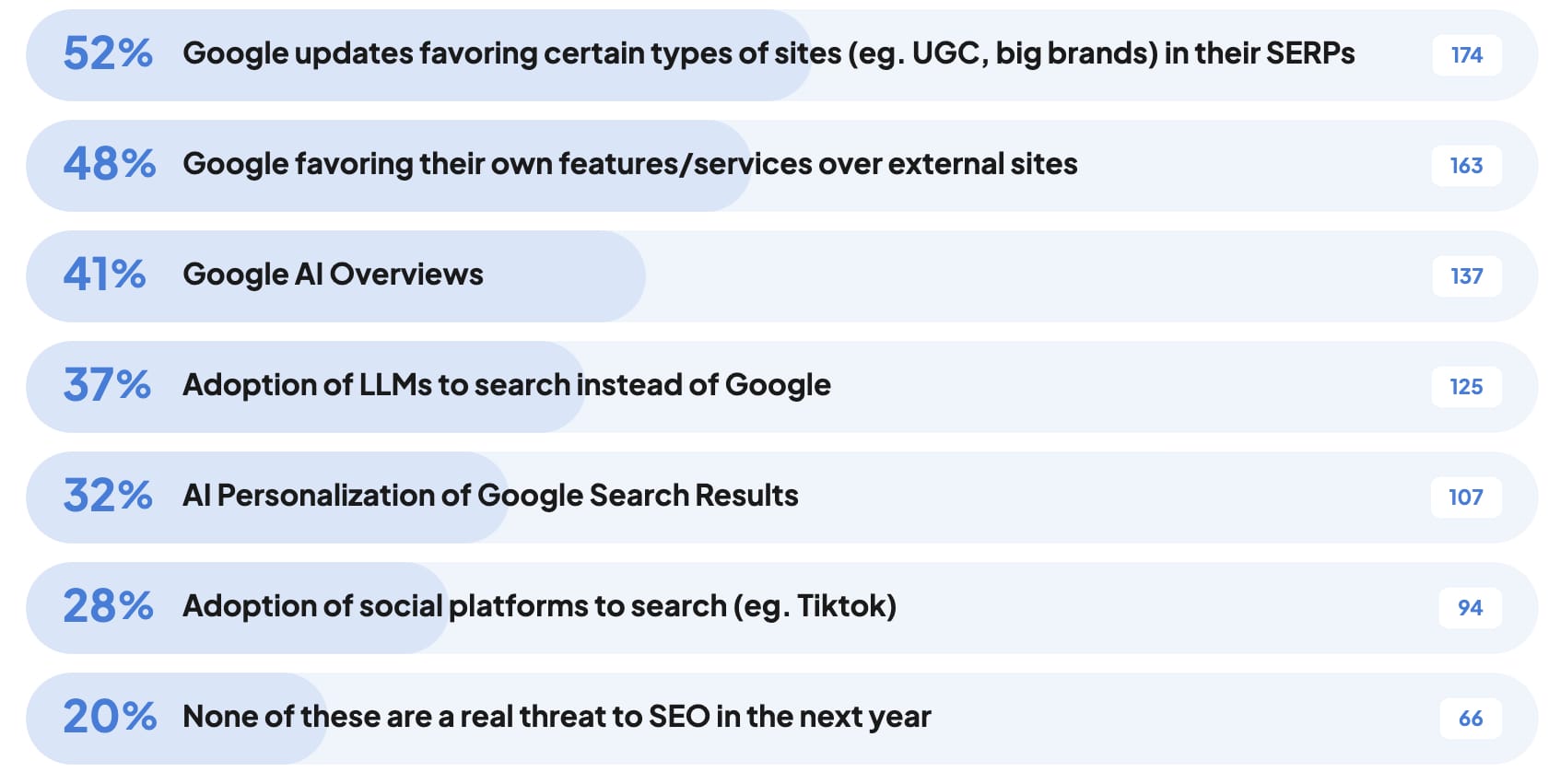
SEO threats in 2024. Google updates that favor certain types of sites (e.g., user-generated content, big brands) in the search results is the biggest threat to SEO consulting efforts, according to 52% of survey respondents.
Google favoring its own features/services over external sites was the second biggest threat (48%) while AI Overviews came in third (41%).
Other real SEO threats are the adoption of LLMs to search instead of Google (37%); AI personalization of Google Search results (32%) and adoption of social platforms to search (28%).
Counter threats. So how are SEOs combating these threats? Based on responses Solis received, SEOs are focusing on:
Improving content quality. High-quality, valuable, engaging, helpful and intent-based content. Which really is not new, per se.
Why we care. SEO is more difficult than ever in 2024 – especially for smaller and mid-sized brands and websites. We’re already seeing many threats in 2024 (e.g., Google algorithm updates, more competition and complexity, less resources). But there continue to be many opportunities to reach and influence people during search journeys in today’s fragmented search landscape.
About the survey. The results are based on responses from 337 SEO consultants, collected between July 21 and Aug. 21.
Google’s favoritism of certain types of websites – or itself, in the form of search features and AI Overviews – are the biggest threats facing SEO consultants, according to a new survey from Aleyda Solis.
SEO threats in 2024. Google updates that favor certain types of sites (e.g., user-generated content, big brands) in the search results is the biggest threat to SEO consulting efforts, according to 52% of survey respondents.
Google favoring its own features/services over external sites was the second biggest threat (48%) while AI Overviews came in third (41%).
Other real SEO threats are the adoption of LLMs to search instead of Google (37%); AI personalization of Google Search results (32%) and adoption of social platforms to search (28%).
Counter threats. So how are SEOs combating these threats? Based on responses Solis received, SEOs are focusing on:
Improving content quality. High-quality, valuable, engaging, helpful and intent-based content. Which really is not new, per se.
Why we care. SEO is more difficult than ever in 2024 – especially for smaller and mid-sized brands and websites. We’re already seeing many threats in 2024 (e.g., Google algorithm updates, more competition and complexity, less resources). But there continue to be many opportunities to reach and influence people during search journeys in today’s fragmented search landscape.
About the survey. The results are based on responses from 337 SEO consultants, collected between July 21 and Aug. 21.
Given the speed of business today and competitive pressures, protecting your organization from human risks is an even more critical perspective than it was. General liability insurance is a critical safeguard that covers businesses from numerous claims such as bodily injuries, property damage, personal injuries, and many others. The most required form of insurance covers the following ten industries:
1. Construction
Any time you build something there is risk. Whether it is vehicular incidents, heavy machine use, or dealing with hazardous materials accidents can happen in any facet of manufacturing. A worker may be injured, and debris could simply fall on an unfortunate passerby. For example, general liability insurance protects construction firms from lawsuits when people suffer injuries near job sites or builders break someone’s property.
2. Retail
In retail, there is daily foot traffic and a higher probability of slips or trips because of it. These incidents can sometimes result in lawsuits, such as a customer tripping over an object incorrectly placed or employees accidentally breaking a shopper’s belongings. Retailers must also be prepared to handle financial liabilities. This is where general liability insurance comes in.
3. Healthcare
Physicians, dentists, and clinics are faced with several different risks as healthcare providers. It invited patients to sue, charging that the treatment wrought harm and the facility was unsafe Malpractice insurance covers professional errors, general liability does not and is therefore necessary for the medical field.
4. Hospitality
Hotels, restaurants, and bars can have numerous visitors coming in daily which makes them susceptible to several claims. Perhaps the floor is wet and a guest slips, or food triggers an allergic response. Such incidents are covered by general liability insurance, which means that hospitality businesses can be fined for what they were prepared to pay out (in the form of cash settlements).
5. Real Estate
Real estate agents and property managers are in contact with clients or potential buyers. Property viewing accidents or open house injuries can result in costly litigation. General liability insurance can help to cover these unexpected costs and provide peace of mind for real estate professionals.
6. Manufacturing
Due to the nature of manufacturing facilities with dangerous machinery, automation equipment, or chemical exposure, these structures could place workers at risk. Accidents can result in injuries and property damage. Manufacturers liability insurance safeguards manufacturers by paying for all medical and legal expenses, and settlements due to bodily harm or property damage.
7. Education
Every educational institution, from daycares to universities, is responsible for protecting the people who go there – students/staff/visitors. Playgrounds, playground equipment, and sports activities in school are some of the common dangerous areas within teaching environments. General liability insurance can minimize the impact of these incidents by helping to pay for damage so that schools and universities can continue providing educational opportunities.
8. Professional Services
Even if they are not at risk of physical injury, professionals like consultants/accountants/lawyers, etc. could be on the sharp and receiving end of a lawsuit for any number of reasons… As an example, a client could say that your suggestion loses money. It pays for legal fees and court settlements, protecting consultants from claims like the ones noted above.
9. Transportation
High-risk industry, transportation companies like trucking and delivery In any case road accidents do take place at times, and goods may sometimes get damaged in transit. Transportation businesses are uninsured against these types of risks and all potential threats, due to general liability insurance a trucking company with its exposure is protected from losing everything they have because it can’t pay its obligations.
10. Information Technology
At first glance IT companies do not seem likely candidates for general liability insurance, however, they are exposed to significant risks. Whether it is a client for breach of contract, or a third party reporting damages from the tech equipment you use, since these situations are covered under general liability insurance, it is an insurance that IT businesses cannot afford to be without.
Every small business owner needs general liability insurance regardless of the industry. It serves as a financial shield to protect companies against various claims thereby helping them in the smooth run of their businesses without any hassle even if unexpected difficulties arise. By having this type of coverage, the owner protects not only his or her financial property but will also gain assurance understanding they are simply ready for that uncertainty on earth being a business proprietor.
Given the speed of business today and competitive pressures, protecting your organization from human risks is an even more critical perspective than it was. General liability insurance is a critical safeguard that covers businesses from numerous claims such as bodily injuries, property damage, personal injuries, and many others. The most required form of insurance covers the following ten industries:
1. Construction
Any time you build something there is risk. Whether it is vehicular incidents, heavy machine use, or dealing with hazardous materials accidents can happen in any facet of manufacturing. A worker may be injured, and debris could simply fall on an unfortunate passerby. For example, general liability insurance protects construction firms from lawsuits when people suffer injuries near job sites or builders break someone’s property.
2. Retail
In retail, there is daily foot traffic and a higher probability of slips or trips because of it. These incidents can sometimes result in lawsuits, such as a customer tripping over an object incorrectly placed or employees accidentally breaking a shopper’s belongings. Retailers must also be prepared to handle financial liabilities. This is where general liability insurance comes in.
3. Healthcare
Physicians, dentists, and clinics are faced with several different risks as healthcare providers. It invited patients to sue, charging that the treatment wrought harm and the facility was unsafe Malpractice insurance covers professional errors, general liability does not and is therefore necessary for the medical field.
4. Hospitality
Hotels, restaurants, and bars can have numerous visitors coming in daily which makes them susceptible to several claims. Perhaps the floor is wet and a guest slips, or food triggers an allergic response. Such incidents are covered by general liability insurance, which means that hospitality businesses can be fined for what they were prepared to pay out (in the form of cash settlements).
5. Real Estate
Real estate agents and property managers are in contact with clients or potential buyers. Property viewing accidents or open house injuries can result in costly litigation. General liability insurance can help to cover these unexpected costs and provide peace of mind for real estate professionals.
6. Manufacturing
Due to the nature of manufacturing facilities with dangerous machinery, automation equipment, or chemical exposure, these structures could place workers at risk. Accidents can result in injuries and property damage. Manufacturers liability insurance safeguards manufacturers by paying for all medical and legal expenses, and settlements due to bodily harm or property damage.
7. Education
Every educational institution, from daycares to universities, is responsible for protecting the people who go there – students/staff/visitors. Playgrounds, playground equipment, and sports activities in school are some of the common dangerous areas within teaching environments. General liability insurance can minimize the impact of these incidents by helping to pay for damage so that schools and universities can continue providing educational opportunities.
8. Professional Services
Even if they are not at risk of physical injury, professionals like consultants/accountants/lawyers, etc. could be on the sharp and receiving end of a lawsuit for any number of reasons… As an example, a client could say that your suggestion loses money. It pays for legal fees and court settlements, protecting consultants from claims like the ones noted above.
9. Transportation
High-risk industry, transportation companies like trucking and delivery In any case road accidents do take place at times, and goods may sometimes get damaged in transit. Transportation businesses are uninsured against these types of risks and all potential threats, due to general liability insurance a trucking company with its exposure is protected from losing everything they have because it can’t pay its obligations.
10. Information Technology
At first glance IT companies do not seem likely candidates for general liability insurance, however, they are exposed to significant risks. Whether it is a client for breach of contract, or a third party reporting damages from the tech equipment you use, since these situations are covered under general liability insurance, it is an insurance that IT businesses cannot afford to be without.
Every small business owner needs general liability insurance regardless of the industry. It serves as a financial shield to protect companies against various claims thereby helping them in the smooth run of their businesses without any hassle even if unexpected difficulties arise. By having this type of coverage, the owner protects not only his or her financial property but will also gain assurance understanding they are simply ready for that uncertainty on earth being a business proprietor.
Given the speed of business today and competitive pressures, protecting your organization from human risks is an even more critical perspective than it was. General liability insurance is a critical safeguard that covers businesses from numerous claims such as bodily injuries, property damage, personal injuries, and many others. The most required form of insurance covers the following ten industries:
1. Construction
Any time you build something there is risk. Whether it is vehicular incidents, heavy machine use, or dealing with hazardous materials accidents can happen in any facet of manufacturing. A worker may be injured, and debris could simply fall on an unfortunate passerby. For example, general liability insurance protects construction firms from lawsuits when people suffer injuries near job sites or builders break someone’s property.
2. Retail
In retail, there is daily foot traffic and a higher probability of slips or trips because of it. These incidents can sometimes result in lawsuits, such as a customer tripping over an object incorrectly placed or employees accidentally breaking a shopper’s belongings. Retailers must also be prepared to handle financial liabilities. This is where general liability insurance comes in.
3. Healthcare
Physicians, dentists, and clinics are faced with several different risks as healthcare providers. It invited patients to sue, charging that the treatment wrought harm and the facility was unsafe Malpractice insurance covers professional errors, general liability does not and is therefore necessary for the medical field.
4. Hospitality
Hotels, restaurants, and bars can have numerous visitors coming in daily which makes them susceptible to several claims. Perhaps the floor is wet and a guest slips, or food triggers an allergic response. Such incidents are covered by general liability insurance, which means that hospitality businesses can be fined for what they were prepared to pay out (in the form of cash settlements).
5. Real Estate
Real estate agents and property managers are in contact with clients or potential buyers. Property viewing accidents or open house injuries can result in costly litigation. General liability insurance can help to cover these unexpected costs and provide peace of mind for real estate professionals.
6. Manufacturing
Due to the nature of manufacturing facilities with dangerous machinery, automation equipment, or chemical exposure, these structures could place workers at risk. Accidents can result in injuries and property damage. Manufacturers liability insurance safeguards manufacturers by paying for all medical and legal expenses, and settlements due to bodily harm or property damage.
7. Education
Every educational institution, from daycares to universities, is responsible for protecting the people who go there – students/staff/visitors. Playgrounds, playground equipment, and sports activities in school are some of the common dangerous areas within teaching environments. General liability insurance can minimize the impact of these incidents by helping to pay for damage so that schools and universities can continue providing educational opportunities.
8. Professional Services
Even if they are not at risk of physical injury, professionals like consultants/accountants/lawyers, etc. could be on the sharp and receiving end of a lawsuit for any number of reasons… As an example, a client could say that your suggestion loses money. It pays for legal fees and court settlements, protecting consultants from claims like the ones noted above.
9. Transportation
High-risk industry, transportation companies like trucking and delivery In any case road accidents do take place at times, and goods may sometimes get damaged in transit. Transportation businesses are uninsured against these types of risks and all potential threats, due to general liability insurance a trucking company with its exposure is protected from losing everything they have because it can’t pay its obligations.
10. Information Technology
At first glance IT companies do not seem likely candidates for general liability insurance, however, they are exposed to significant risks. Whether it is a client for breach of contract, or a third party reporting damages from the tech equipment you use, since these situations are covered under general liability insurance, it is an insurance that IT businesses cannot afford to be without.
Every small business owner needs general liability insurance regardless of the industry. It serves as a financial shield to protect companies against various claims thereby helping them in the smooth run of their businesses without any hassle even if unexpected difficulties arise. By having this type of coverage, the owner protects not only his or her financial property but will also gain assurance understanding they are simply ready for that uncertainty on earth being a business proprietor.
Given the speed of business today and competitive pressures, protecting your organization from human risks is an even more critical perspective than it was. General liability insurance is a critical safeguard that covers businesses from numerous claims such as bodily injuries, property damage, personal injuries, and many others. The most required form of insurance covers the following ten industries:
1. Construction
Any time you build something there is risk. Whether it is vehicular incidents, heavy machine use, or dealing with hazardous materials accidents can happen in any facet of manufacturing. A worker may be injured, and debris could simply fall on an unfortunate passerby. For example, general liability insurance protects construction firms from lawsuits when people suffer injuries near job sites or builders break someone’s property.
2. Retail
In retail, there is daily foot traffic and a higher probability of slips or trips because of it. These incidents can sometimes result in lawsuits, such as a customer tripping over an object incorrectly placed or employees accidentally breaking a shopper’s belongings. Retailers must also be prepared to handle financial liabilities. This is where general liability insurance comes in.
3. Healthcare
Physicians, dentists, and clinics are faced with several different risks as healthcare providers. It invited patients to sue, charging that the treatment wrought harm and the facility was unsafe Malpractice insurance covers professional errors, general liability does not and is therefore necessary for the medical field.
4. Hospitality
Hotels, restaurants, and bars can have numerous visitors coming in daily which makes them susceptible to several claims. Perhaps the floor is wet and a guest slips, or food triggers an allergic response. Such incidents are covered by general liability insurance, which means that hospitality businesses can be fined for what they were prepared to pay out (in the form of cash settlements).
5. Real Estate
Real estate agents and property managers are in contact with clients or potential buyers. Property viewing accidents or open house injuries can result in costly litigation. General liability insurance can help to cover these unexpected costs and provide peace of mind for real estate professionals.
6. Manufacturing
Due to the nature of manufacturing facilities with dangerous machinery, automation equipment, or chemical exposure, these structures could place workers at risk. Accidents can result in injuries and property damage. Manufacturers liability insurance safeguards manufacturers by paying for all medical and legal expenses, and settlements due to bodily harm or property damage.
7. Education
Every educational institution, from daycares to universities, is responsible for protecting the people who go there – students/staff/visitors. Playgrounds, playground equipment, and sports activities in school are some of the common dangerous areas within teaching environments. General liability insurance can minimize the impact of these incidents by helping to pay for damage so that schools and universities can continue providing educational opportunities.
8. Professional Services
Even if they are not at risk of physical injury, professionals like consultants/accountants/lawyers, etc. could be on the sharp and receiving end of a lawsuit for any number of reasons… As an example, a client could say that your suggestion loses money. It pays for legal fees and court settlements, protecting consultants from claims like the ones noted above.
9. Transportation
High-risk industry, transportation companies like trucking and delivery In any case road accidents do take place at times, and goods may sometimes get damaged in transit. Transportation businesses are uninsured against these types of risks and all potential threats, due to general liability insurance a trucking company with its exposure is protected from losing everything they have because it can’t pay its obligations.
10. Information Technology
At first glance IT companies do not seem likely candidates for general liability insurance, however, they are exposed to significant risks. Whether it is a client for breach of contract, or a third party reporting damages from the tech equipment you use, since these situations are covered under general liability insurance, it is an insurance that IT businesses cannot afford to be without.
Every small business owner needs general liability insurance regardless of the industry. It serves as a financial shield to protect companies against various claims thereby helping them in the smooth run of their businesses without any hassle even if unexpected difficulties arise. By having this type of coverage, the owner protects not only his or her financial property but will also gain assurance understanding they are simply ready for that uncertainty on earth being a business proprietor.
Great content is essential, but technical SEO is the foundation that supports it.
Even the best content will struggle to succeed if your website can’t be crawled, has rendering issues or suffers from poor indexing.
Without a solid technical base, getting to Page 1, earning a link in an AI Overview or driving organic traffic will be nearly impossible.
The problem?
Technical SEO often feels like no man’s land. Marketing teams don’t understand it due to jargon like server codes and meta tags, while engineering teams don’t prioritize it because the website functions fine and their QA tests pass.
As the SEO, you’re stuck in the middle, the bearer of bad news, responsible for creating a technical SEO roadmap. But without clear prioritization, your plan can quickly fall apart and you risk losing support.
Define your goals and set a benchmark
Many SEOs make the big mistake of jumping directly to the technical audit and the fixing part.
They fail to understand the business’s goals and define SEO KPIs that are aligned with them.
They also miss setting a benchmark for both the current state and the desired outcome in 6 or 12 months.
Without clear goals and a benchmark, other teams and the leadership might easily deprioritize your SEO efforts. The reasons are simple:
Without a current-state benchmark, progress becomes difficult to prove, making your work seem like a never-ending task.
And without a future benchmark, engineering teams may resist prioritizing your requests, unsure of when they’ve done “enough.”
Setting clear goals and benchmarks should always be the first step in your SEO prioritization process. Once these are in place, you can take that huge list of technical fixes from your audit and start assigning them the right priority.
There are many different approaches to setting a priority for your tasks. Some of the famous ones are:
Eisenhower matrix: A simple two-by-two grid with “importance” on the X-axis and “urgency” on the Y-axis. This approach categorizes tasks into four priorities, ranging from low urgency/low importance to high urgency/high importance.
ICE scoring model: This one assigns scores from 1 to 10 for three key factors: impact, confidence and ease. Higher scores indicate higher priority tasks.
PIF framework: Similar to ICE, but evaluates tasks based on potential, importance and ease, offering a slight variation in prioritization criteria.
RICE scoring model: This is another, more detailed approach. RICE stands for reach, impact, confidence and effort, providing a more granular analysis of task value.
Cost-benefit analysis matrix: This one weighs the cost (in terms of time, resources and effort) against the potential benefits, ensuring that the most efficient tasks are prioritized.
The specific method you start with doesn’t matter as much. Ultimately, you’ll likely blend elements from different frameworks, creating a customized approach tailored to your unique needs and circumstances.
In my day-to-day work, I use the following template – created with Google Sheets or Excel – which includes the following columns:
Not a system issue
If the answer is no, brace yourself for a long battle. System issues typically need to be addressed at the product or business leadership level, which means securing prioritization from higher-ups.
Example: One website I worked on used a CMS that served images from a CDN. While this seemed fine, the CDN also delivered other elements the provider’s team didn’t want bots to find. So, they restricted all bots via robots.txt. As a result, search engine bots could see the content but not the images.
Unfortunately, this means either the CMS provider must prioritize fixing this, or we should migrate to another CMS. For me, as an SEO, this can be considered a lost battle.
Can I do it by myself?
Having the ability to fix things on your own is invaluable. Many times, technical SEO tasks aren’t prioritized by other teams, or even if they are, there might not be enough resources to address them on time.
Examples: These tasks might include fixing redirects or broken links, updating meta titles and descriptions or optimizing image alt tags. While some of these can be automated with scripts, it’s sometimes faster to manually address them rather than waiting on an automated solution that may take much longer to implement.
Or you can think of a mixed approach. For example, my team has updated 9,000 alt tags, writing first manually everything in English, translating them with AI and implementing them in bulk with a script.
Is it a site-wide issue?
Fixing one element that resolves multiple issues is a dream scenario. Often, this can serve as a powerful filter to help you prioritize which tasks to tackle first.
Example: This category includes issues like a broken link in the footer, unnecessary heavy JavaScript loading on every page or programmatic meta tag templates that apply to hundreds of pages. Essentially, anything that affects the website or page template level falls here.
Is it on revenue-generating pages or will the fix drive revenue?
Technical SEO fixes don’t always directly and immediately impact revenue, making it harder to connect the fix with a tangible result in the short term.
Example: Consider a broken “Contact Us” or demo page versus a broken blog post. Similarly, optimizing meta tags for product pages typically has a more direct link to revenue than optimizing the meta tags for an ebook page.
The key here is to clearly understand your website’s segments – know which pages drive conversions and which focus on awareness. At least in the beginning, it is always a good practice to consult with Google Search Console, Google Analytics or your company’s analytics tool before deciding on whether a fix has revenue potential.
Will it have a high impact?
This one and the next two are self-explanatory. You will often rely on your best knowledge and gut feeling.
But usually, if you fix a side-wide issue or an issue related to revenue, you can say with greater confidence that the impact will also be high.
Is the effort low?
I usually break this one down by time:
Anything up to two hours can be considered low effort.
Between three and five hours is a medium one.
Everything above will require more effort and resources.
The logic behind this is that we work on a weekly sprint basis, meaning 40 working hours.
In reality, after spending some time in meetings, answering emails or messages, you can consider yourself lucky if you have 25-30 working hours. A 7-hour project is – more than 20% of your time in the week. Usually, these projects are prolonged in a couple of weeks.
The hours should be adjusted based on your situation. If, for example, you are a contractor and have limited time for communication, you can increase the limits.
If the task will require external help from other teams, try to understand the amount of effort they will need to invest and consider.
For example, detecting the issue and collecting all related information may take three hours, but for the engineering team, it could easily mean five working days, especially during the QA phase.
Is it urgent?
I love this one, as it is so tricky to evaluate correctly. People often mix it with impact, but not everything that will have a big impact is urgent.
Example: If you notice a sudden spike in 404 errors, it’s likely an urgent issue. However, if your site has had the same 500 broken pages for months without new developments, urgency might not apply.
A custom multi-column prioritization matrix for technical SEO tasks
Each drop-down includes three options:
Yes
No
Don’t know (for cases where the answer is unclear or not strictly yes/no).
In all cells with a drop-down, there is also conditional formatting, which, in my case, adjusts the cell color based on the selected value.
This step is needed as, thanks to the cell color, I can automatically count the cells with concrete value. Unfortunately, the “Countif” formula doesn’t work with dropdowns.
To count the cells with concrete color, you will need to use the following script:
function countByColor(range, color) {
  var sheet = SpreadsheetApp.getActiveSpreadsheet();
  var range = sheet.getRange(range);
  var values = range.getBackgrounds();
  var count = 0;


  for (var i = 0; i < values.length; i++) {
    for (var j = 0; j < values[i].length; j++) {
      if (values[i][j] == color) {
        count++;
      }
    }
  }
 return count;
}
Just place it in Extensions > Apps Script. And the newly created formula,=countByColor("A:A", "#ff0000"), where you just need to adjust the color code.
To calculate the priority, I assign one point to every Yes and 0.5 for every Don’t know.
This custom prioritization matrix may initially feel complex, but it becomes second nature with practice. Eventually, you might not even need Google Sheets to manage it.
If you’re working with a smaller site or don’t have the time for a thorough evaluation, focus on these three key areas:
Site-wide issues you can resolve independently.
High-impact, low-effort tasks.
Revenue-related tasks.
But remember, assigning priority to your tasks is just the first step of the process.
Put your project management hat on
Technical issues are often not simple to resolve, and fixing them requires a lot of effort and resources from other teams. However, there are three simple techniques you can use if you want to succeed.
Break down large technical tasks into manageable smaller ones
The first step is to embrace an agile approach by breaking large technical tasks into smaller, manageable pieces.
For instance, if you’re dealing with a rendering issue across multiple website widgets, sending the entire project to the engineering team simultaneously may lead to a lengthy timeline – potentially months – since each widget will require individual attention.
Chances are, this project won’t be prioritized anytime soon because it demands too many resources at once.
Instead, present the project as a whole (especially if the issue is consistent across all widgets), but propose a phased approach.
For example, out of the 10 widgets, start with the highest-priority widget, “X,” allowing the team to address the most critical issue first while easing the overall workload.
Get everyone on board
Let me share a real-life example to illustrate this. Before my maternity leave, I was leading a project to migrate our website from HTTP to HTTPS.
Unfortunately, the project wasn’t completed before I left, and shortly afterward, the entire SEO team exited the company. When I came back from a long maternity leave, the project was still unfinished.
The mistake was that only our team knew all the details and why this was so important. It will hurt our organic rankings and if we stayed on HTTP, users would see the “This website is unsafe” message, negatively impacting our organic traffic and conventions.
The lesson?
Get everyone on board from the start.
Share all relevant information, provide clear examples and link to external resources that explain the issue.
The better informed other teams are, the more support you’ll gain to drive the project forward.
Balance with other SEO tasks
Prioritizing technical SEO gives you a solid foundation, but without direction, it’s pointless – like having an airplane without a pilot. It may be well-built, but it won’t take you anywhere.
Don’t neglect the other critical aspects of SEO to make a real impact.
On-page optimization, competitive analysis, topic research and more must work together.
Your SEO strategy requires attention to all these areas to truly succeed.
Prioritizing technical SEO tasks is just the beginning of your journey.
To maintain and grow your SEO success, you must continuously monitor your efforts and be ready to adapt.
Review your KPIs regularly and evaluate the impact of your technical changes. This will help you identify what’s working and where further adjustments are needed.
SEO is an ongoing process – algorithms change, your company and the competition evolve, and new technical challenges arise. Keep monitoring and adapting because SEO success is not a one-time achievement but a never-ending journey.