Google Analytics is shifting from tracking conversions to using “key events” for behavioral analytics, aligning its definition with Google Ads platforms.
This update ensures that what constitutes a conversion will be consistent and easily comparable between Google Ads and GA4 reporting, providing marketers clearer insights into user behavior across platforms.
What’s changing? In GA4, legacy conversions will now be referred to as key events. These events represent crucial actions for behavioral measurement in your business. Additionally, conversions in the report and explore modules will be transitioned to key events, maintaining the same measurement capabilities as the legacy conversion concept. Key events will be considered conversions only when shared with Google Ads, ensuring accurate performance reporting.
Cross-channel reporting. Additionally, the Advertising workspace in GA4 will introduce new cross-channel conversion performance reporting, extending beyond Google Ads. This section will serve as your central hub for monitoring Ads conversion performance, providing comprehensive insights across various advertising channels.
What Google is saying. Kamal Janardhan, Senior Director of Product Management, Measurement, at Google, said in a statement:
“In this improved, more unified experience, we are addressing the differences in conversions reporting that marketers have experienced across Google Ads and Analytics, a long-standing request that we are happy to have resolved for our customers.”
“Now, conversions in the existing report and explore modules will become key events. This way you will be able to define the most important customer actions for your business in Analytics and learn what’s working and what’s not to improve your product and experience across websites and apps.”
Why we care. Discrepancies in conversions reporting have long caused headaches for marketers, however, this solution aims to address that issues by ensuring consistency across Analytics and Google Ads platforms. By providing a clearer and more reliable view of conversion data, it helps streamline reporting processes and enhances the accuracy of analysis.
Action needed? Users of GA4 and Google Ads do not need to take any action. Legacy conversions will be automatically converted to key events, while any conversions shared with Google Ads will be labeled as conversions and reported on within the Advertising section.
Get the daily newsletter search marketers rely on.
While what I’m about to share is purely anecdotal, I’ve been diving into the nitty gritty of these updates for a while now.
Here’s what I’m seeing. Hopefully, it will help give the March 2024 core update a bit of context as we wait this thing out.
March 2024 core update catch-up
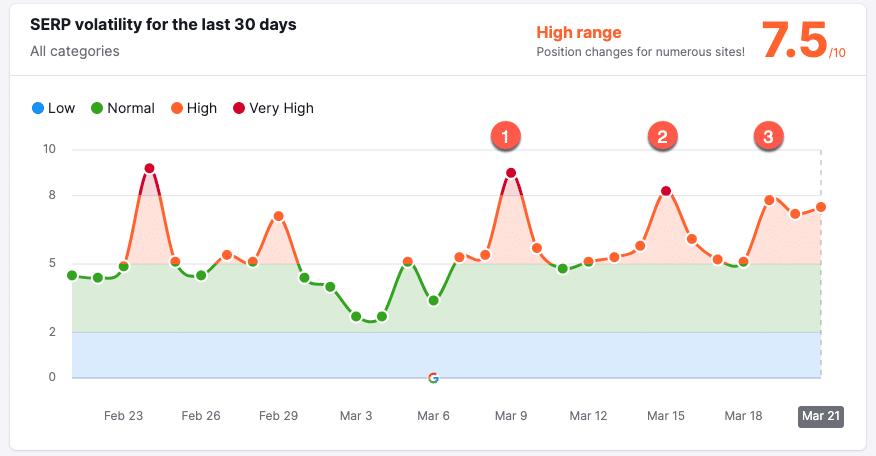
Google said the March 2024 Update is going to be prolonged and that there will be “more fluctuations in rankings than with a regular core update.”
The first big spike in rank volatility was picked up on March 9. Since then there have thus far been two additional peaks, on March 15 and 19.
However, that doesn’t mean that with each “sub-spike” comes a “fresh set” of ranking movements. It’s not only very common but basically the rule that the secondary spikes within a core update will present an extensive set of reversals to the rank changes initiated at the forefront of the update.
How many times have you seen a site “win” at the start of the update only to get clobbered towards the end of it?
With the March 2024 core update, you’re going to most likely see various sets of reversals as the update is both longer and more complex than usual.
An absolute heap of rank reversals
No, not every bit of the rank volatility we’re seeing with the March 2024 core update is a reversal. Sites are going up and sites are going. Some of those rank trajectories will ultimately reverse themselves and some of them will stick.
In the above, the most recent “sub-spike” in volatility further didn’t reverse anything, it accentuated the URL’s initial ranking loss.
Caveats aside, there has been a noticeable amount of reversals with the sub-spikes in fluctuations seen on March 15 and 19.
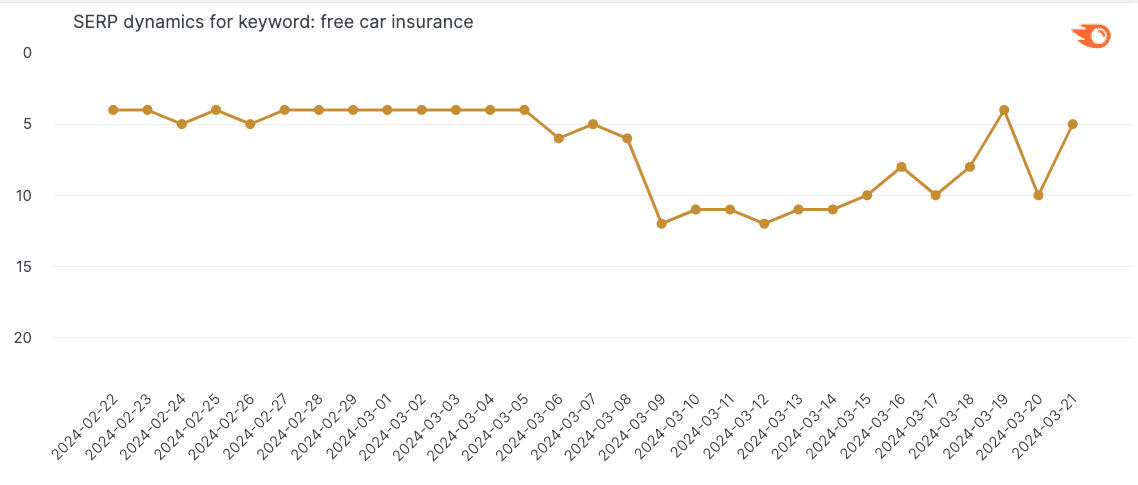
Here’s a case of Allstate losing rank for the keyword free car insurance. When I saw the initial hit in rank the domain took on March 9 for the keyword it was, obviously, surprising.
Lo and behold, there was a bounce back on March 19 followed by a loss on March 20 only to see yet another bounce back on March 21.
Here’s mousesavers.com showing a pre-update spike (parenthetically, very common to see sites showing sharp rank changes before an update and then subsequent reversals):
You can clearly see the early volatility spike of the March 2024 core update reverse the pre-update surge. However, just a few days later the downtrend was reversed.
You can see the same pattern play out at the domain level in this case:
As aside, this site sports one of the worst UX’s I’ve seen in a long time. It’s nostalgic in a sick way.
At the same time, it does appear to offer a wealth of information. One could speculate (greatly) that the reversals are a battle between UX and content (or perhaps, they’re just reversals without much deeper meaning at this point).
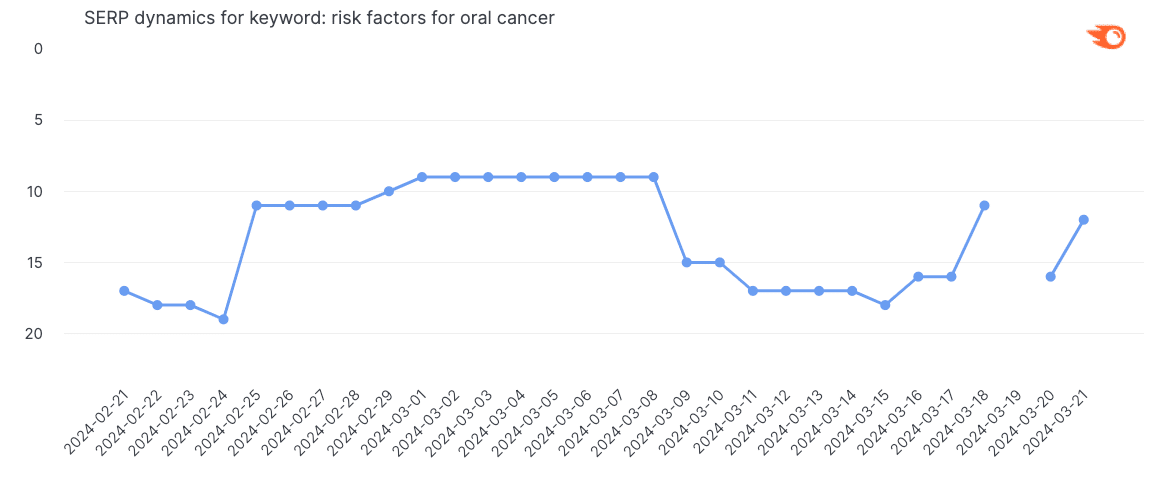
In the case of the Illinois Department of Public Health’s rankings for the keyword risk factors for oral cancer, the reversals had the site fall completely out of the top 20 for two days:
After seeing a reversal on March 18 the site fell out of the top 20 altogether on March 19 and then again on March 21.
For the record, not all reversals are full-on restorations of rank. In the case of this dentistry site, the ranking losses seen at the onset were reversed on March 19 but the site is only halfway back up the SERP relative to its previous rank.
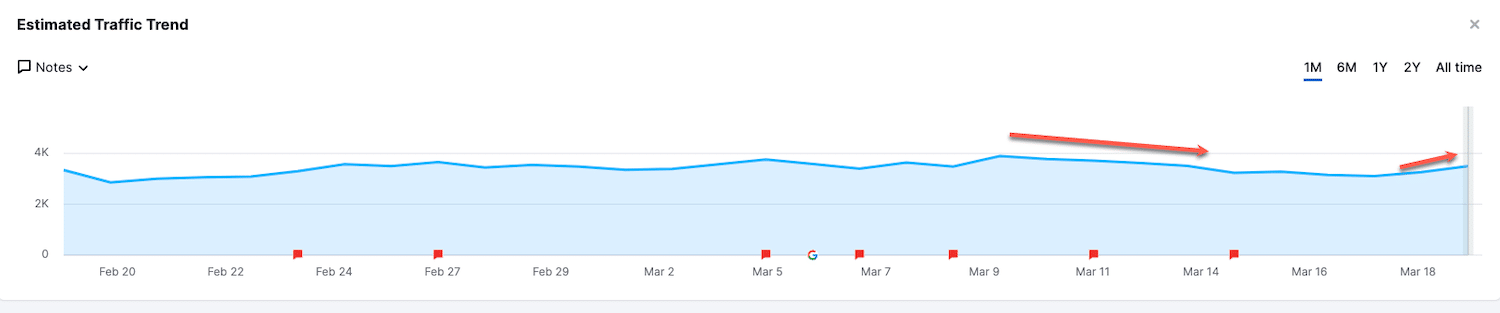
At the domain level, the reversal on March 19 did put it back a bit closer to previous performance:
Same deal for a reversal that causes a ranking loss.
As in the case below, just because the reversal shows a loss doesn’t mean that the ranking loss puts the URL back at square one… yet (or not, who knows at this point!).
I could go on and on with these cases forever but then my children would have an absent father and no update is more important than your kids (SEO life lesson right there).
Some odd volatility
Aside from the more traditional reversals I’ve seen some just downright weird behavior. It’s entirely pervasive but it’s certainly a more common pattern than in previous core updates (at least that’s what I have seen).
Check this one out:
You might be asking yourself, “What the hell am I looking at?”
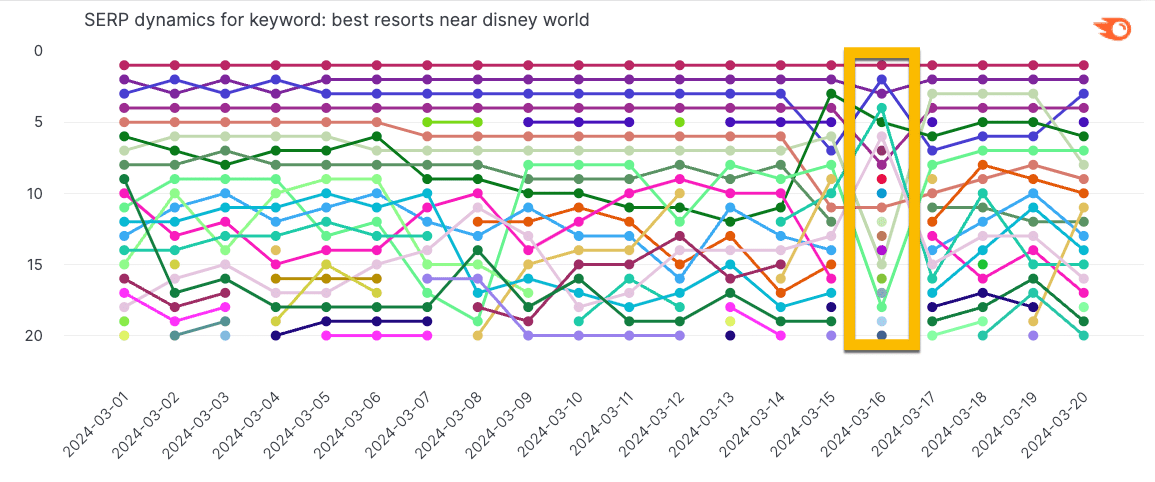
You’re looking at Google basically replacing the entire set of results from at least position 20 and up.
A connecting line means a continuation of rank above position 20 from one day to the next.
I only count four such lines within the image above (though, I’ve never been very good at counting).
In fact, you see this pattern take hold over three days. Meaning, Google reshuffled almost the entire SERP not once, not twice, but three times. Many of the URLs ranking on March 18 disappeared on the 19th and some remerged on the 20th.
I’ve seen this before. However, I’ve generally seen it for cases where the SERP is filled with YouTube URLs and Google is shuffling them around day after day after day. This is not such a case.
It’s not a one-off either. I’ve seen this pattern a few times already.
Here’s another similar (if slightly less severe) instance:
This thing isn’t over – take it slow
What’s my point with all of this?
This is a long and volatile update.
As I said earlier, Google isn’t yanking your chain by saying to remain calm and have patience.
I would assume you’ll see some of the sites and pages I showed here to see numerous more reversals by the time this thing is all said and done.
The same with your or your client’s sites. It’s way too early to try to pin this thing down and have an understanding of where you stand.
So despite me not being that old to actually remember it, this catchy slogan still applies as the March 2024 core update continues to roll, “buckle up for safety, buckle up, always buckle up.”
When people think of the most environmentally destructive industries, their minds may not go to real estate, even if it produces around 39% of the total global emissions. Many leaders in the real estate industry are increasingly focusing on the sustainability of their operations. They are hoping to reduce their negative impact on the environment with sustainability initiatives.a
Enhancing the sustainability of the real estate sector involves a clear step: integrating high-quality, energy-efficient materials. These include recycled components, energy-efficient lighting, sustainable insulation, and other elements that promise to substantially reduce the industry’s carbon footprint.
Sustainability Initiatives in Residential Real Estate
Using quality materials during construction is an essential sustainability initiative. This saves homeowners money on repairs in the long run. Even when the materials are environmentally superior in theory, their subpar quality compelling homeowners to raise their consumption can result in equally detrimental impacts.
The repair process can be costly and have a substantial carbon footprint from issues like the shipment of replacement parts, the use of repair equipment, and more. Thus, the use of high-quality materials from the get-go is paramount.
Many homeowners have found that reducing their dependence on air conditioning systems is the easiest way to make their homes more sustainable. According to the US Energy Information Administration, 250 billion kilowatt-hours of electricity were used for residential cooling in 2022 — roughly 6% of the total energy consumption of the United States.
A single A/C unit in a home can use as much as 3,000 watts an hour, depending on the unit’s size and other factors, such as the season. As such, alternatives like fans, which allow homeowners to cool their homes without as much energy consumption, are becoming more desirable for their sustainability benefits.
Some homeowners may also be surprised by the role of their windows in energy efficiency. Of course, the most important consideration for homeowners is to have functional windows, as they must be able to open and close to allow proper ventilation. Investing in quality blinds or curtains can help block sunlight, preventing as much sunlight from entering the home and creating an undesired natural heating effect. Some may even invest in low-emissivity windows with a thin coating reflecting infrared and UV light while allowing visible light to pass through, keeping homes cooler in the hot months and warmer in the cold ones.
Developing several green and energy-efficient standards also incentivizes homeowners to make their homes more sustainable, including those from the government in the form of rebates and tax credits that encourage homeowners with a financial bonus. Additionally, suppose a homeowner qualifies for one of these standards and is looking to sell their home. In that case, these certifications and sustainability initiatives can be a premium that allows them to ask for a higher price.
Sustainability in Commercial and Agricultural Real Estate
However, it isn’t just residential real estate in which we see a significant shift towards improved sustainability. Although commercial real estate has some important functions, it contributes greatly to environmental destruction. Steps taken in the commercial sector — and in agriculture — have the potential to make an enormous difference in the long-term sustainability of the real estate sector.
One significant way commercial real estate looks to improve its sustainability is through regenerative agriculture practices, which are developed with the principle of preservation in mind. The goal of regenerative agriculture is to preserve our world’s farmland for future generations so they can thrive.
Some core regenerative practices include reducing dependence on chemical fertilizers, pesticides, and herbicides and avoiding using environmentally destructive heavy machinery. In addition to improving soil health, these steps help reduce some of the broader consequences of farming on the environment.
Farmers who have invested in the welfare of their animals have also seen a substantial improvement in their sustainability efforts. According to one report, the factory farming industry is responsible for emissions equivalent to those created by 36.4 million cars on the road annually, so eliminating some of the most unsustainable factory farming practices could improve the environmental impact.
Practices that farmers are looking to improve include:
Intense confinement: Because factory farming is done to raise large amounts of livestock, they are often kept in a small space for extended periods of time. This confinement can cause environmental issues, including concentrated waste, air pollution, and soil degradation.
Animal branding: Not only is animal branding using hot irons generally considered unethical, but it can also contribute to environmental harm through increased stress on livestock and the chemicals used in the process. Farmers seek alternatives like freeze branding, which could offer a more ethical, less destructive way to identify livestock.
Overuse of antibiotics: The factory farming industry is notorious for its overuse of antibiotics, which could contribute to the formation of antibiotic-resistant strains of bacteria and prove dangerous to human health and the environment.
With the combined efforts of the residential and commercial real estate sectors, we can be on our way to reducing the environmental impact of this sneakily destructive industry. Simple steps like reducing waste and energy consumption can go a long way in making the actions of this industry far less detrimental to our planet.
In the fast-paced world of the restaurant industry, success hinges on the proficiency of its
staff. From front-of-house service to back-of-house operations, well-trained employees are
essential for delivering exceptional customer experiences. This is where restaurant training
software steps in, offering a comprehensive solution to streamline training processes and
elevate staff performance. Let’s explore the importance of restaurant training software and
how it can transform your establishment.
Efficient Onboarding
Effective onboarding sets the stage for success, providing new hires with the knowledge and skills they need to excel in their roles. Restaurant training software streamlines the onboarding process by centralizing training materials, such as manuals, videos, and quizzes, in one accessible platform. This ensures consistency and eliminates the need for cumbersome paper-based training materials. With intuitive interfaces and interactive modules, employees can quickly familiarize themselves with company policies, procedures, and menu items, accelerating their transition into their new roles.
Customized Training Programs
Every restaurant has its own unique identity and operational requirements. Restaurant training software allows establishments to create customized training programs tailored to their specific needs. Whether it’s fine dining, fast-casual, or quick service, managers can design training modules that align with their restaurant’s brand, service standards, and menu offerings. This flexibility enables employees to receive targeted training that equips them with the skills necessary to deliver exceptional service and uphold the restaurant’s reputation.
Consistent Standards
Consistency is key to delivering memorable dining experiences and building customer loyalty. Restaurant training software ensures that all employees receive the same level of training, regardless of location or shift. By standardizing training materials and protocols, establishments can maintain uniform service standards across their entire operation. This consistency instills confidence in customers, knowing that they can expect the same level of quality and professionalism each time they visit.
Continuous Learning and Development
The restaurant industry is constantly evolving, with new trends, technologies, and regulations shaping the landscape. Restaurant training software facilitates ongoing learning and development, allowing employees to stay updated on industry best practices and emerging trends. Whether it’s refining service skills, mastering new menu items, or enhancing food safety knowledge, employees can access training modules at their convenience, enabling continuous improvement and career growth.
Enhanced Performance Tracking
Monitoring employee performance is essential for identifying areas of strength and areas for improvement. Restaurant training software offers robust performance-tracking capabilities, allowing managers to monitor employee progress, track completion rates, and identify training gaps. Detailed analytics provide valuable insights into employee performance trends, enabling managers to make informed decisions and allocate resources effectively. By pinpointing areas for improvement, establishments can address training needs proactively and optimize staff performance.
Final Verdict
Thus, restaurant training software plays a pivotal role in optimizing staff development and
enhancing operational efficiency in the restaurant industry. From efficient onboarding and
customized training programs to consistent standards and continuous learning, restaurant
training software empowers establishments to elevate their service standards, improve
employee performance, and achieve success in a competitive market. By embracing
restaurant training software, establishments can unlock efficiency, excellence, and innovation in their operations, setting the stage for long-term growth and success.
Disney Advertising is teaming up with Google and The Trade Desk to expand its Disney Real-Time Ad Exchange (DRAX).
The partnerships mean that users of Google’s Display & Video 360 and The Trade Desk can directly access streaming inventory on both Hulu and Disney Plus through DRAX.
Why we care. A wider range of marketers, national, regional and local, will now have easier access to ad inventory across Hulu and Disney Plus.
Why now? As businesses move their advertising budgets away from traditional TV to digital video platforms, TV networks are feeling the impact. However, streaming services like Disney Plus and Hulu are gaining traction among advertisers because of their large and engaged viewership. These platforms also provide advanced targeting, interactive features, and real-time analytics, making them competitive choices for marketers aiming to reach their target audiences efficiently.
What Disney is saying. Jamie Power, senior VP, addressable sales at Disney Advertising, said in a statement:
“Disney’s goal is to empower advertisers to transact with the freedom and flexibility that best suits their business needs.”
“Owning our own technology stack allows us to build a direct path between our premium inventory and the leading media buying platforms in the industry, simplifying the way ads are bought and sold on Disney, while delivering greater effectiveness for our clients.”
What Google is saying. Stephen Yap, managing director Americas for Google Marketing Platform, said:
“For over a decade, Google and Disney have collaborated on industry-leading ad innovations that drive results for customers.”
“We are excited to expand on this relationship to bring Display & Video 360 demand to DRAX, providing our advertisers with a new way to directly purchase Disney’s high-quality CTV inventory and reach their audience with privacy-forward solutions.”
Get the daily newsletter search marketers rely on.
What is DRAX? Disney launched DRAX – which gets it names from a character the Guardians of the Galaxy movie franchise – in March 2021 as part of its advertising technology platform. DRAX, which is an automated ad platform, consolidates advertisers’ video demand to ensure that both direct-sold and programmatic deals compete fairly for Disney ad impressions.
The conference is Google’s annual event for showcasing its latest ad products, formats, developments, and updates.
When is Google Marketing Live. Tuesday, May 21, starting at 12 p.m. ET / 9 a.m. PT, live from Mountain View, Calif.
How to register. You can register for Google Marketing Live 2024 here. Here’s what Google is teasing:
“Get a front row seat to see Google’s newest Ads innovations and learn how you can put Google AI to work for your business. Watch the live keynote and access on-demand sessions to see how to drive next-level growth for your business.”
Why we care. Google Marketing Live is where Google typically announces a slew of new products and features. Google Marketing Live 2023 was heavy on AI announcements.
Get the daily newsletter search marketers rely on.
A good-quality ergonomic home office chair is crucial for maintaining ergonomic support, promoting comfort, and preventing discomfort or health issues during long hours of work. The increasing prevalence of desk-bound jobs, the rise of remote work, and the widespread use of digital technologies have collectively contributed to a growing number of people working more while sitting. This means it has never been so important to have an ergonomic chair at your desk for overall well-being. BodyBilt offers the perfect ergonomic home office chairs you seek for the ultimate support as you work.
Without an ergonomic office chair like BodyBilt’s Midcelli chair, home-office workers may experience various adverse effects on their health and well-being. Prolonged use of non-ergonomic chairs can lead to discomfort, poor posture, and musculoskeletal issues such as back and neck pain. Additionally, it may contribute to fatigue, reduced productivity, and an increased risk of developing chronic conditions related to prolonged sitting. An ergonomic office chair is designed to provide proper support and comfort, helping to prevent these issues and promoting a healthier and more productive work environment.
Who is BodyBilt?
BodyBilt stands out as an ideal choice for an ergonomic home office chair, as they prioritize your well-being and productivity as an entrepreneur who works from home. No matter if you work from home or go to an office, they believe that to produce your best, you must feel your best. BodyBilt recognizes the unique needs of every individual through customizable designs that have made them a trusted leader in ergonomic seating, serving Fortune 500 companies and the national government. By incorporating NASA research, BodyBilt pioneers ergonomic seating that mimics the body’s natural weightless position, fostering heightened creativity and well-being.
The latest BodyBilt 24/7 chairs, incorporating SKYDEX technology, provide unparalleled comfort and durability, revolutionizing ergonomic seating with patented polymer technology. With enhanced stability and pressure distribution, these chairs provide superior comfort, reducing the risk of injury, pain, and fatigue in demanding environments like command centers and rotational shiftwork settings.
The BodyBilt Midcelli 24/7 Series
BodyBilt’s patented Midcelli 24/7 Series offers you distinctive body-fitting mid-back and seat contours, setting the standard for ergonomic excellence in design. Midcelli prioritizes functionality over aesthetics, giving you healthier posture and unrestricted movement. This high-quality ergonomic office chair is fully customizable and designed to adapt to your changing needs—be it pregnancy, weight fluctuations, or injuries. You can easily and fully customize each part for continuous ergonomic support.
Note: In addition to the acclaimed BodyBilt Midcelli Series, explore a range of other chair series, such as the Intensive Use, Bariatric, Classic, and more.
BodyBilt Midcelli Supporting Your Body
Adjustable Back Support
Having a properly fitting backrest is one of the most crucial aspects of a good office chair. BodyBilt’s Midcelli 24/7 series gives you just that back support you need. Crafted for optimal airflow and personalized lumbar support, this uniquely designed chair features a slim profile and proprietary elastomeric mesh back, ensuring proper support for both lower and upper back regions. Because of the proper airflow offered by the comfortable, breathable elastomeric mesh back, you will stay cool as you work for long hours at your desk.
Lumbar support in chairs refers to the additional support provided to the lower back region, specifically the lumbar spine. This support is designed to maintain the natural curve of the spine, promoting good posture and reducing the risk of lower back pain or discomfort. BodyBilt’s Midcelli offers you revolutionary lumbar support.
With BodyBilt’s Midcelli office chair, you’ll also be able to easily control the back angle and lock in place the optimal angle for you as you sit. There are five locking positions to choose from for your optimal comfort.
Adjustable Arm Rests
BodyBilt MidCelli Series offers adjustable arm pads and arm height, important for ergonomic support. Shown here is the stool version of the Midcelli chair. (Credit: BodyBilt)
Additionally, with the BodyBilt MidCelli Series, you’ll enjoy adjustable arms to find the perfect fit for posture at your desk. Adjustable arm pads on your office chair are crucial for maintaining ergonomic comfort and preventing strain on your arms and shoulders during long periods of sitting. They allow you to customize the height and angle to suit your body, reducing the risk of discomfort and promoting productivity. You’ll also relieve unique pain problems such as carpal tunnel.
BodyBilt’s Midcelli office chair allows you to adjust the arm pads left or right up to 20 degrees. You can also easily adjust the arm height and width for the perfect ergonomic fit at your desk.
Seat Pan Designed for Comfort
BodyBilt’s office chairs feature a pressure-reducing, contoured seat pan that reduces pain. Shown here is the stool version of the Midcelli chair. (Photo Credit: BodyBilt)
A properly designed seat pan is essential for distributing weight evenly, promoting proper posture, alleviating pressure points, ensuring comfort, and minimizing pain during extended periods of sitting in an office chair. BodyBilt’s Midcelli office chair features a pressure-reducing, contoured seat pan that reduces the pain of sciatica, and its unique seating options resolve tailbone discomfort.
Customizable Options
Customizing your BodyBilt Midcelli chair is a breeze with many options to suit your needs. Start by selecting the backrest mesh color from Onyx or Platinum. Then, choose your seat foam type from Standard High-Density Foam, High-Density Foam Plus, S’port Foam, or Tailbone Cut. Next, pick your preferred arm type, either ULTRA Arms, Optima Arms, or Optima Arms with Upholstered Pads. Complete your customization with a cylinder option (Black or Chrome), base option (Black or Chrome), casters (Black or Chrome), fabric grade and color, and any additional modifications needed.
Exceptional Customer Service with BodyBilt
BodyBilt’s exceptional customer service ensures that your needs are quickly and effectively addressed. This leads to a smoother and more satisfactory experience overall. With BodyBilt, enjoy a lifetime of guaranteed service with BodyBilt chairs, designed to adapt to your changing needs—be it pregnancy, weight changes, or injuries.
BodyBilt wants you to have the ultimate comfort as you sit and work, and they want you to have an exceptional experience with their products. BodyBilt has representatives across the country who can provide custom chair fittings. They’re even available to come to you if needed. You can also find an array of videos on their website for how to adjust your chair properly for your body.
Conclusion
Don’t settle for any less for yourself as a business owner or a work-from-home employee of any profession. Investing in a BodyBilt Midcelli chair not only prioritizes your comfort and well-being but also ensures ergonomic support tailored to your specific needs. With BodyBilt, you’ll be supported by exceptional customer service that guarantees a lifetime of satisfaction. For more information about BodyBilt’s ergonomic office chairs, visit bodybilt.com.
If there’s one thing that’s for sure, it’s that the biggest priority in your business is to engage your customers and make it clear to them what your business has to offer. Failure to reach your target audience could result in you losing out to competitors in your industry. However, engaging with people isn’t always easy, and it’s important to explore all and every avenue to find what works for your business.
The problem you might face here is that it’s not cut and dry. What works for one business might not work for the next one, even if you’re in similar industries. Sometimes it’s about your branding, and sometimes it’s about where your customers are and which avenue is the best one to reach them. Now, take a look at some of the best ways to reach out to potential customers.
Define Your Target Audience
Before you can even begin to think about reaching out to customers, you first need to define who they are. While it’s nice to think that everyone would be interested in your product, it’s probably not going to be the case. So ask yourself; who is most likely to use my products? Not only is it important to know who you’re aiming it at so that you can package it to be more appealing to them, but it will also help you work out where you’re most likely to find them. And, you’ll be able to use language and terminology that will reach your target audience and their attention.
The best way to do this if it isn’t glaringly obvious who your target audience is, is to do some market research. This might mean sending some products out to be tested and reading reviews. Lots of people generally mention who used the product in their reviews and why they enjoyed (or didn’t) using it.
You can also look at similar products or services on the market and see who’s buying those to help you identify who you’re aiming your products at. It might need some tweaking along the way, but it’s better to do that now rather than spend a lot of money marketing your business to the wrong people.
Use Influencers to Show off Your Products or Services
Once you know who you’re aiming your products at, it’s time to think about making your products visible as quickly as possible. And, in this day and age, influencers are the way to reach your target audience. Think about your favourite products or a product you’ve purchased recently. There’s a good chance that you’ve seen some version of that product through influencers you follow online. Just by looking at influencer marketing trends, you’ll be able to see how effective it can be.
There will be some influencers who will be happy to simply receive the product to keep in exchange for a mention or review on their platforms. While this is great, they may not have many followers, which may mean you might not end up reaching many people. If you want word to spread quickly then it’s a good idea to offer compensation as well as the product to keep to an influencer who’s got the attention of the masses.
You shouldn’t just pick any old influencer though; they need to be relevant to your industry. So, if you’re marketing a new line of joggers for men, you’d be better off choosing an influencer who is known for their style and taste in fashion. You should also make sure that they are linking to your products directly from their posts. And, if you want to make a real stamp, offer a discount code that people can use through the influencer’s link.
Photo by mali maeder on Pexels
Content Is King
Search engine searches aren’t to be underestimated when aiming to reach your target audience. Think about how many times in a day, week, or even month you pull out your phone and search for something you need or want. Now think about how effective that could be if your website was ranking first for keywords related to your products.
To do this, you’ll need to have top-notch SEO on your website. If you don’t know how to achieve this, it’s worth paying someone to come in and optimise it. You’ll need to do some extensive keyword research here to make sure you’re trying to rank for the right keywords. Using the mens jogger example again, you’d probably be looking at keywords like “black mens joggers” “mens joggers near me” “mens joggers sale” “mens joggers with zip pockets” and “mens joggers adidas”. You can use tools like ahrefs to help you with your keyword research if you don’t know where to begin.
Then, once your website is optimised, you need to add content that’s going to be useful for your customers that include the relevant keywords to your products. Using the above example, you could have a post with some ideas on how to style mens joggers. Not only does this help you rank even more, but it builds up trust with your brand, which is definitely something that you need as a new business.
Use Video Content
We live in a world where you now have nanoseconds to capture someone’s attention. One of the best ways of doing that is through video content, especially when you’re marketing your products on social media. It’s a much easier form of content to digest, especially when compared to written content, and that’s why it’s quickly become the easiest way of pushing your products in front of the right people.
While homemade videos can resonate with people, it’s worth putting some thought and effort into your video content. This will mean having a half-decent camera and editing process to better reach your target audience. You may even want to hire an actor to become the face of your brand if you don’t want to be on video.
Finally, you want people to remember you and your brand, so it’s important to pick a tone of voice and stick with it. This tone of voice will need to be consistent throughout your video and written content for the best success.
If you’ve just started your own home-based business, one of the first things you absolutely need to do is to up your online presence. To do this you need a quality website and continually updated content that is informative and interesting. This is how people will find you and learn about what you have to offer. Potential consumers prefer sites with information about your product or service, and consistent relevant content keeps them returning.
Website content provides insight into your business and drives traffic to your store. Just having a website alone is not as good as having good content and a steady flow of it because content triggers search engine rankings. The competition is too great to miss out on this opportunity.
Website Content
Discover how website content can help in meeting the criteria sought by search engine algorithms for relevance. The more relevant the content the higher up on the results page you will appear. Ideally, you want to appear on the first page of search results and preferably at the top. The algorithms do not like stagnant sites with out-of-date content and therefore it pushes you further down in the results search. Another way to appeal to search engine algorithms is to add keyword phrases, meta descriptions, and title tags to your content.
The person you hire to write your website content should know how to properly prepare a page to gain an advantage over competitors in search rankings. If you don’t know how to employ keywords, description and title tags, any web designer should be able to advise you. Or, you could spend some time reading SEO websites or a book.
Build Your Brand
Remember to showcase your brand to people in a way that connects with them and warrants further exploration. Your brand showcases how website content can help in fostering loyalty to your company. There is a reason why companies have teams of people focused on content and marketing. It’s the soul of the website. It’s where everyone goes to learn more, and the more you provide the more you are seen as an expert in your field.
One mistake most businesses make is that they attempt to reach as many consumers as
possible, but it’s best to focus on your target audience. It’s hard to appeal to everyone’s tastes, so find your niche and play to your audience. Customers do not typically search for a particular brand, instead, they look for things that meet their own objectives. If you can make your brand relevant to their queries, your site will be boosted in the search results.
Cater to Your Customers
Evidence shows that acquiring a new customer costs much more than maintaining an already current customer. Therefore, it’s beneficial to cater to your existing customers with new and exciting content to keep them coming back for more. How do you do this? With content that provides information about their interests. By offering relevant information aligned with their interests, website content can help engage users and address their needs and preferences. It doesn’t have to always be directly about your product or service. When you show loyalty to your consumers by providing an entertaining and informative website, they will return the loyalty.
Another great way to put out content is by creating and posting videos to your site and on social media such as YouTube, Instagram, X and TikTok. These can be videos using your product or service, reviewing items, narratives, and stories. People love visuals, and the more you can give them, the better. Social media stories are a hot medium to put out content and drive traffic.
Ghostwriters
While this might sound overwhelming when just starting, there are people out there who can help you write your content. Even though you may have a great business mind, you may not be well-versed in how to write content. One idea is to hire in-house writers but that can get pricey, or you can use freelancers. Ghostwriters are highly skilled freelancers with skills in writing content to make your business shine.
Whether you need website content or scripts for videos, a content writer is a strong ally to have in your corner. A ghostwriter or copywriter is an invisible assistant who works behind the scenes to bring your business to life. They have the skills to take your ideas and write professional content that keeps you at the top of search engine results, which means great visibility. Visibility means sales.
There’s one other thing to bear in mind. Getting a video ranked on YouTube, Instagram, X, and TikTok is also a competitive endeavor. Each has its own algorithm to determine what gets ranked high up, or way down the list. A writer with considerable experience in social media marketing must be familiar with how to give you an advantage over your competitors.
Finding a reputable ghostwriter who specializes in your niche will take some research on the internet. For example, do a search for ghostwriting or copywriting or even screenwriting services and include a keyword phrase related to your business. I am a freelance writer also under contract to Ghostwriters Central, Inc. This page about custom website content development accurately reflects what I’ve discussed in this article.
Follow my advice and you will find the writer who will contribute to making your home business soar!
As everything shifts online due to the digital revolution, decentralized currencies are becoming more popular. Cryptocurrencies are called decentralized currencies because they don’t rely on a central authority like banks to operate. They depend instead on cryptography and distributed ledger technology, like blockchain, to control transactions and maintain the currency’s value.
Numerous people now opt to go digital because cryptocurrency has many benefits compared to traditional currencies. These are some of the advantages of decentralized currencies:
Lower Transaction Fees
Traditional financial systems often involve intermediaries that charge fees for transactions. One has to deal with banks or payment processors that require a middleman fee for you to get your money, and this impact has not been felt more strongly than in the gambling industry. While using cryptocurrency to gamble offers many advantages, the chief of them is not losing a chunk of your earnings to ridiculous fees or charges. In fact, Alan Draper shares that fast payout crypto casinos utilize blockchain technology to offer instant deposits and withdrawals, often with no fees attached or limits imposed.
One of the advantages of decentralized currencies is the elimination of the need for all these added costs, allowing for faster, cheaper, and sometimes negligible transaction processing. Users can send and receive money across the globe without paying high fees or waiting for long confirmation times.
Security
Cryptography or encryption is used to enhance security. As a result, transactions are completed using digital IDs and addresses, which means users don’t need to provide personal information to conduct transactions. This helps users relax, knowing there is little to no chance of getting their identities stolen or fraud.
Another one of the advantages of decentralized currencies is anonymity. Anonymity is a big draw, as people don’t even have to use their real names. Users are only identified through their pseudonyms, creating a high level of discretion, ensuring privacy, and offering protection from phishing and spoofing. Transactions are also verified and validated by the network, making it extremely difficult for hackers to manipulate or counterfeit the currency.
Transparency
Decentralized currencies often provide a very high level of transparency. It is effortless to verify transactions and track the history of the currency. In this way, decentralized currencies have enhanced trust and accountability among users. On the flip side, it also presents a challenge when there’s a need to track transactions, usually in the event of a hack or a user accidentally sending their funds to the wrong address.
Financial Inclusion
All people, regardless of their status or location, should be able to access and benefit from financial systems.
One of the advantages of decentralized currencies is accessibility to anyone with an internet connection, regardless of their location, nationality, or socio-economic status. This allows people in under-served regions to participate in the global economy and have control over their finances. Decentralized currencies also provide an alternative to unstable or inflationary fiat currencies, allowing users to preserve their purchasing power and wealth.
Innovation
Decentralized currencies boost innovation and creativity in the digital economy. They allow the development of new applications and services that positively sway the potential of blockchain technology, such as smart contracts, decentralized applications, and decentralized autonomous organizations. These applications and services can provide new solutions and opportunities for various sectors and industries, such as finance, health, education, and social impact.
Value Appreciation
Some decentralized currencies are in limited supply. This means that the creators or miners will set a cap or limit on just how many coins can ever be made. Setting this cap and making the available coins limited increases their value since everyone is rushing to get their hands on as many of the coins as possible.
Some popular cryptocurrencies you may know are limited, like:
Bitcoin (BTC) – The most popular cryptocurrency is set at a cap of 21 million coins. Litecoin (LTC) – Second only to the original Bitcoin, this crypto is set at 84 million coins. Monero (XMR) – This one is a privately owned cryptocurrency capped at 18.4 million coins.
Everyone wants to get their hands on them as quickly as possible, and these numerous investment opportunities add value to the currency. These currencies are also somewhat inflation-proof as the low availability keeps them in demand; there can never be hoarding of the currency or a desire to get rid of it quickly – factors directly linked with inflation in regular monetary settings.
User Empowerment
The advantages of decentralized currencies empower users to have full control and ownership over their funds and transactions. Users do not need to rely on or trust any central authority or intermediary to manage their money or facilitate their transactions. Users can also customize their preferences and settings, such as choosing their own wallet, network, or protocol. The currency is also globally accessible, and users can gain access from anywhere at any time.