Organising a club can be a rewarding and fulfilling experience, whether it’s a sports club, book club, hobby club, or any other type of social or interest-based group. To ensure the smooth operation and success of your club, you’ll need various supplies and resources. In this article, we’ll explore the essential supplies needed when you’re organising a club, from the planning stages to the club’s ongoing activities.
1. Stationery and Office Supplies
Having basic stationery and office supplies is essential for organising and managing your club. You’ll need pens, notepads, sticky notes, paper, printers, ink and toner, and folders for taking notes during meetings, jotting down ideas, and keeping important documents organised.
2. Sign-Up Sheets and Membership Forms
You’ll need sign-up sheets and membership forms to keep track of club members and their contact information. These forms help you gather essential data, such as names, email addresses, phone numbers, and any specific interests or preferences members may have.
3. Meeting Space and Reservations
If your club meets in person, you’ll need a dedicated meeting space. Depending on the nature of your club, this could be a room at a community center, a local café, or even someone’s home. Ensure that you have a system for reserving and coordinating the use of this space.
4. Communication Tools
Effective communication is vital for club organisation. Tools like email, group chat apps, or social media pages can help you stay in touch with members, share updates, and plan events. Consider creating a club-specific email address or social media account to centralise communications.
5. Promotional Materials
You’ll need promotional materials to attract new members and promote your club. These can include flyers, posters, and digital graphics that highlight the club’s purpose, meeting times, and contact information. Be prepared to distribute these materials in your community or online.
6. Budget and Financial Supplies
You’ll need a budget if your club requires funding for activities, events, or materials. You may also need financial supplies, such as a petty cash box, a ledger to track expenses, and receipts for purchases related to club activities.
7. Club Materials
Depending on the type of club, you might need specific materials related to your activities or interests. For example, an art club might require art supplies, while a sports club needs sports equipment. Ensure you have the necessary materials on hand for club activities.
8. Club Uniforms or Attire
Some clubs may choose to have uniforms or specific attire for their members. This could be as simple as matching T-shirts or more formal attire, depending on the nature of the club. Ensure you have a process for ordering, distributing, and maintaining these items.
9. First Aid Kit
Safety is a priority, so having a basic first aid kit on hand for emergencies is a wise precaution. Include bandages, antiseptics, and any other supplies necessary for minor injuries that may occur during club activities.
10 Record-Keeping Tools
Maintaining records is crucial for club organisation. Consider using record-keeping tools like notebooks, digital spreadsheets, or software designed for clubs and organisations. These tools can help you track membership, attendance, and financial records.
Conclusion
Organising a club requires a variety of supplies and resources to ensure its success and smooth operation. From basic stationery to communication tools and event planning materials, having the right supplies on hand can help you effectively manage your club and create a positive experience for members. Whether your club is focused on a shared hobby, a common interest, or a social cause, the supplies mentioned here are essential for keeping your club organised and thriving.
The holiday shopping season is here! If you are on the lookout for must-have gifts for all the business owners in your life, below are some awesome picks that will be a hit. From a car air freshener that will keep long commutes fresh, to a haircare gift that will help the recipient look and feel their best, these gifts are sure to make the season even more jolly:
Pure Brazilian Silk Smoothing Balm
Made with Keratin, Hydrolyzed Silk and Coconut Oil, this smoothing balm controls and softens unruly hair. Features a heat and humidity-resistant formula that will leave your hair feeling light, bouncy and gorgeously sleek. Use regularly before styling for faster drying, more manageable hair with fewer tangles, less frizz, better hold and smoothness that last. Salon perfect results every time! Retails for $28 at purebrazilian.com
Formulated and manufactured in Brazil, Pure Brazilian offers the best hair smoothing system on the market. A hallmark of professionalism and exceptional haircare, Pure Brazilian’s products feature an easy-to-apply formula, give radiant shine, strengthen the cuticle, eliminate frizz, and improve hair health by protecting the cuticle. These hair essentials have a special formulation of minimal chemicals to give maximum results. Hair color pops, as cuticles are sealed with moisture.
Pure Brazilian offers awesome holiday gifts for beauty lovers and more. is honest about their ingredients and keeps their line small and simple. Their products also reduce blow-dry and styling time, protects against heat damage from styling, and prevents split ends and breakage, which promotes growth.
PURGGO Car Air Eco-Purifier & Freshener
Freshen up their ride with the minimalistic and all-natural PURGGO car air eco-purifier & freshener! It’s made with pure and sustainable natural bamboo charcoal, which absorbs & eliminates odor instead of masking it. Fragrance- & allergen-free, the PURGGO is all-natural, non-toxic, and 100% asthma and allergy friendly. PURGGO perfectly combines nature, science, and love.
All the product contains is pure all-natural moso bamboo charcoal, one of the most renewable natural resources in the world and Mother Nature’s purifier, which has been carbonized and activated at 1110°F – 1300°F (600°C – 700°C). Bamboo charcoal is a tried and tested air cleanser that’s been used in Asian countries for thousands of years. On top of this, it lasts for 365+ days (longer lasting than any product available worldwide) and works continuously in the background! Retails for $23.99 on Amazon.
Alpha Skin Care Body Bundle Set
Featuring two best-selling body products, this anti-aging skincare gift hydrates and exfoliates for an all-day glow. Includes moisturizing Body Wash that is formulated with 10% Glycolic Alpha Hydroxy Acid (AHA) to gently release dead skin cells and reveal fresh, healthy, younger-looking skin. Also features the prestigious Renewal Body Lotion that is formulated with 12% Glycolic Alpha Hydroxy Acid (AHA) to thoroughly hydrate and gently exfoliate, leaving skin soft, smooth and younger-looking from head to toe. Made for all skin types, this set is $29 at www.alphaskin.com
For over 30 years, Alpha Skin has been helping customers get healthier and younger looking skin faster with their products specially formulated with Glycolic Alpha Hydroxy Acids (AHAs) that promote skin health. Clinically tested, cruelty free, hypoallergenic, non-irritating, and allergy-tested, Alpha Skin products are fantastic gifts for the holidays.
Medical Scrubs Collection Infinity Footwear BOLT
These chic shoes have a breathable, flexible knit upper for all-day comfort, especially if you’re prone to swollen feet. Underneath, an ultra-cushiony midsole with airbag adds even more comfort. Also features an oil- and slip-resistant sole and a removable, shock absorbing latex-free polyurethane insole with arch support and heel cupping for stability and all-day comfort. The interior lining and insole are also treated with Certainty® antimicrobial technology to inhibit the growth of microbes that cause odor. Retails for $67.96 at medicalscrubscollection.com
With the recent and rapid rise in remote work, many companies have had to quickly adapt to a new way of managing their workforce. While remote work can offer many benefits for both employees and employers, it also comes with its own unique set of challenges. In this blog post, you’ll learn more about the 10 key problems that businesses have with remote workers, and find out some solutions to help overcome these challenges.
Remote work can help businesses achieve next-level results. It allows companies to tap into a global talent pool, removing geographical limitations. This broadens the spectrum of expertise and skills available to the company. Remote work can lead to increased productivity. A study by Stanford University showed that remote workers were 13% more productive compared to their in-office counterparts. It can significantly reduce overhead costs too, such as office space rent, utility bills, and office supplies. Employees who work remotely often report higher levels of job satisfaction and a better work-life balance, leading to lower employee turnover. On the whole, these benefits can contribute to a healthier bottom line and a more robust, agile, and resilient business.
To make the most of your remote workforce, it’s essential to understand the main problems that can arise, and how to counteract them to achieve the greatest success possible.
1. Lack of Communication
One of the biggest problems with remote workers is the lack of communication. When employees are not physically present in the office, it can be difficult to ensure that everyone is on the same page. This can lead to misunderstandings and mistakes. The solution to this problem is to establish clear communication channels such as regular video calls, instant messaging, and emails. It’s important to set expectations for response times and ensure that everyone understands the company’s communication policy.
2. Difficulty in Monitoring Performance
Another problem with remote workers is the difficulty in monitoring performance. When employees are working from home, it can be difficult to gauge how much work they are actually doing. This can lead to micromanagement and distrust, which can be detrimental to the work environment. The solution to this problem is to set clear expectations and measurable goals. Ensure that the remote workers understand what is expected of them and how their performance will be evaluated.
3. Security Risks
With remote work, there can be an increased risk of security breaches such as data theft and hacking. The solution to this problem is to invest in cybersecurity measures such as encryption and two-factor authentication. Ensure that remote workers understand the importance of keeping company data safe and provide training on how to identify potential security risks. Hiring experts, such as those of an IT Consulting firm, to ensure your technology and IT is up to scratch is crucial.
4. IT and Connectivity Issues
Working remotely also means that employees are responsible for their own IT and connectivity. This can lead to delays and disruptions in work if the employee experiences technical difficulties. The solution to this problem is to provide support and resources for remote workers to set up a secure and stable home office environment. This can include providing necessary equipment, troubleshooting guides, and access to IT support.
5. Lack of Team Cohesion
When employees are not working in the same location, it can be difficult to establish team cohesion. Building a strong team culture is important for productivity and job satisfaction. The solution to this problem is to invest in team building activities such as virtual happy hours, online games, and other non-work related activities. Encourage employees to share their interests and hobbies to help create a sense of collective identity.
6. Distractions at Home
With remote work, there can be many distractions at home such as children, pets, TV, and household chores. This can lead to decreased productivity and increased stress. The solution to this problem is to establish a clear work schedule and a designated workspace. Encourage remote workers to create a distraction-free environment by setting boundaries with family members and eliminating digital distractions such as social media.
7. Lack of Accountability
When employees are not physically present in the office, it can be difficult to hold them accountable for their work. This can lead to a lack of motivation and a sense of detachment from the company. The solution to this problem is to establish clear goals and deadlines. Use project management tools such as Trello and Asana to track progress and ensure that everyone is on track.
8. Time Zone Differences
When employees are working from different time zones, it can be difficult to schedule meetings and ensure everyone is available at the same time. The solution to this problem is to establish flexible working hours and create a clear policy for scheduling meetings across different time zones. Use tools such as Calendly to make scheduling easier for everyone.
9. Social Isolation
Another problem with remote workers is social isolation. Working from home can be lonely and lead to a sense of detachment from the company. The solution to this problem is to establish regular virtual meetings and encourage remote workers to connect with each other on social media and other online platforms. Creating an inclusive and supportive team culture is important for employee wellbeing and job satisfaction.
10. Lack of Training
When employees are working remotely, it can be difficult to provide the same level of training and support as when they are in the office. This can lead to a sense of inadequacy and a lack of confidence in their abilities. The solution to this problem is to invest in virtual training and provide regular feedback to remote workers. Encourage them to ask questions and seek clarification when needed.
Remote work comes with its own set of challenges, but by addressing these problems head-on, companies can ensure that their remote workers are productive, engaged, and motivated. With the right policies and tools in place, remote work can be a positive experience for everyone involved.
With only a finite number of hours in a day, effective time management is essential to achieving personal and professional success. One powerful scheduling technique that can help you stay organized, focused, and efficient is time blocking. This guide will provide novice and seasoned time blockers with valuable insights and best practices to help maximize the benefits of this technique.
What Is Time Blocking?
Time blocking is a simple yet effective scheduling strategy where one dedicates specific blocks of time to individual tasks or groups of related tasks. By allocating uninterrupted time to work on specific tasks, you can streamline your focus, minimize interruptions, and ultimately increase productivity and overall effectiveness.
Cost and Time Management
In a professional setting, managing costs and time effectively becomes increasingly important. For instance, understanding the effort that goes into marketing within your own company can be critical considering you are able to outsource lead generation. Paying an employee to waste time landing low conversion leads can be costly when compared to ViB’s B2B appointment setting cost. This level of awareness enables you to optimize your scheduling methods and ensure you’re making the most of your companies available time.
The Benefits of Time Blocking
Improved Focus: Time blocking encourages a single-tasking mindset, enabling you to concentrate exclusively on one task without succumbing to distractions or multitasking tendencies.
Reduced Procrastination: By assigning specific blocks of time to work on particular tasks, you create a sense of urgency that helps mitigate procrastination.
Better Work-Life Balance: Time blocking allows you to prioritize both personal and professional tasks, ensuring that time outside of work also receives proper attention.
Enhanced Sense of Accomplishment: As you complete tasks within their allocated time blocks, you visibly see your progress, boosting motivation and fostering a sense of achievement.
Accountability and Tracking Progress
Regularly assess your progress towards your goals and track how effectively you are utilizing your time blocks. This practice can help reveal patterns and areas for improvement, allowing you to adjust your strategies and prioritize tasks better. You can even involve a trusted friend, family member, or colleague to discuss your time blocking efforts and gather feedback. Objective viewpoints can provide valuable insights on how to improve your time management and offer support and motivation throughout the process.
At the end of each week, take time to reflect on your accomplishments and identify areas where you faced challenges. This practice helps you better understand your capabilities, recognize your progress, and continuously refine your time blocking strategy.
Planning Your Time Blocks
Evaluate the tasks you need to accomplish and prioritize them based on importance and urgency. This process helps ensure that the most critical tasks receive proper attention and resources. Estimate how long it will take you to complete each task, then add some buffer time. This consideration helps minimize the risk of extended blocks that disrupt the schedule. Try to group related tasks together to streamline your focus and minimize context switching, which can disrupt productivity.
Implementing Time Blocks
Choose the calendar format that works best for you, whether it be a physical planner or a digital tool. Make sure to allot specific time slots for each task and assign them a dedicated block of time. Implement a system that reminds you when to start and end each task during a set time block. This structure can help increase accountability and ensure that your schedule stays on track.
Life is unpredictable, and your schedule will likely need adjustments as new tasks emerge or unexpected events unfold. Be flexible and assess your time blocks regularly, adjusting as necessary to maintain productivity.
Important Considerations for Time Blocking
It’s essential to designate blocks of time for rest and relaxation throughout the day. These breaks offer an opportunity to recharge, maintain productivity, and prevent burnout. Remember to be realistic when assigning blocks of time to tasks, ensuring you don’t overextend yourself or underestimate how long a task will take. Overloading your schedule will only lead to frustration and ineffective time allocation.
Conclusion
Time blocking is an invaluable scheduling technique that can significantly improve time management, focus, and productivity. By implementing the insights and best practices outlined in this guide, you can begin to reap the benefits of this powerful strategy. Embrace a disciplined, mindful approach to scheduling your time, and watch your personal and professional success soar.
In today’s omnichannel world, customers engage with brands across many different touchpoints both online and offline. This makes mapping the customer journey more complex for marketers. Customers expect seamless experiences across channels and devices. If the journey is disjointed, they will quickly become frustrated and take their business elsewhere.
This is where customer journey orchestration (CJO) comes in. CJO platforms empower marketers to optimize the customer experience by:
Identifying pain points in the journey where customers struggle
Orchestrating personalized interactions to delight customers
Responding quickly to changing customer needs and expectations
With CJO, marketing is no longer limited to siloed campaigns. You can take an outside-in approach starting from the customer perspective. This results in increased satisfaction, loyalty, and advocacy.
According to a recent Forrester study, 65% of marketers plan to increase spend on CJO platforms in the next year. But with many solutions now available, how do you choose the right one?
That’s where our MarTech guide comes in. This comprehensive report profiles leading platforms and provides actionable insights to guide your buying process including.
Halloween is traditionally the perfect season to anticipate unexpected shocks.
But eight surprising social video trends should astound even the most unflappable digital marketers.
1. The number of creators on YouTube is exploding
YouTube.com is the second most visited website in the U.S. and worldwide, behind only Google.com, per Similarweb and Semrush’s data.
So, if you were a content creator planning to go trick-or-treating, you’d tell all your friends, “They give out more candy on YouTube than any other social video platform.”
This favorable word-of-mouth tells a surprisingly scary story, too.
Last year, 15.4 million accounts uploaded 696 million videos to YouTube from Oct. 16, 2021, to Oct. 15, 2022. These videos got a total of 23.2 trillion views and 742 billion engagements.
This year, 25.4 million accounts uploaded 774 million videos to YouTube from Oct. 16, 2022, to Oct. 15, 2023. These videos got a total of 23.9 trillion views and 747 billion engagements.
So, the number of creators on YouTube has exploded and the number of videos is up, too! But the total number of views and engagements has remained relatively flat year over year.
This means 64.9% more creators are now competing for roughly the same number of views and engagements. Or as savvy trick-or-treaters going door-to-door on Halloween might yell at their friends, “We gotta move faster before they run out of candy.”
But this has an impact on digital marketers, too. It means we must work harder – or smarter – to capture our audience’s attention.
For example, you might want to check out YouTube’s new Spotlight Moments, an AI-driven packaging technology that automatically identifies the most popular, relevant videos, making it even easier for us to own the moment around key events when viewers are most engaged.
“Short-form content empowers creators to win views and reach new audiences, but new data shows that many audiences prefer a slightly longer format,” according to Tubular’s report, H2 2023 Social Video Trends.
In 2022, TikTok increased its video length capabilities to compete with longer-form video platforms. Tubular data found that 61-180-second videos earn the highest growth rates per the number of uploads on TikTok, making it the optimal video length to drive growth.
Although videos 1-60 seconds long still win the most views, the report said, “growth rates for this time frame are in decline.” Meanwhile, videos 61-180 seconds long and 181-600 seconds long “show a positive growth in views.”
3. Facebook no longer needs to whistle past the graveyard
Facebook use among teens had dropped from 71% in 2014-15 to 32% in 2022, according to a Pew Research Center survey.
Meanwhile:
95% of American teenagers ages 13 to 17 used YouTube.
67% used TikTok.
62% used Instagram.
59% used Snapchat.
And in July 2022, Facebook’s parent, Meta, reported its first-ever year-over-year decline in ad revenue.
But Facebook restructured its main feed into a “discovery engine” for video content, and today, it appears that the social video platform no longer needs to whistle past the graveyard.
Facebook.com is currently the third most visited website in the U.S. and worldwide, per Similarweb and Semrush.
Tubular Labs data also found that 5.3 million accounts uploaded 400 million videos to Facebook from Oct. 16, 2022, to Oct. 15, 2023. These videos got a total of 11.8 trillion views and 551 billion engagements.
By comparison, 4.5 million accounts uploaded 311 million videos to Facebook from Oct. 16, 2021, to Oct. 15, 2022. These videos got a total of 12.4 trillion views and 473 billion engagements.
So, 17.8% more accounts are now publishing 28.6% videos on Facebook. Although views are down 4.8%, engagements are up 16.5% year over year.
Digital marketers can expect more developments from Facebook:
“This is just the beginning. We’ll continue developing more tools for creators so they can express themselves, build an audience and earn money, along with the discovery and personalization features that give you more control over your experience.”
Today, music is as closely associated with social videos as spooky sounds are with Halloween.
Tubular makes the eerie claim, “That’s right – music and social video are synonymous.”
So, creators and brands should begin with music when brainstorming their content strategy. To help with that process, Tubular examined the top 50 TikTok sound trends in the first half of 2023.
At the top of their list were Hip-Hop, Rap, and R&B, the most popular music genres both by number of sounds 13 of 50) and total views (7.8 billion).
And part of this trend was older songs, which were resurfacing. As Tubular noted, “The sweet spot of songs making a resurgence are songs released in 2010-2014.”
Get the daily newsletter search marketers rely on.
function getCookie(cname) {
let name = cname + “=”;
let decodedCookie = decodeURIComponent(document.cookie);
let ca = decodedCookie.split(‘;’);
for(let i = 0; i <ca.length; i++) {
let c = ca[i];
while (c.charAt(0) == ' ') {
c = c.substring(1);
}
if (c.indexOf(name) == 0) {
return c.substring(name.length, c.length);
}
}
return "";
}
document.getElementById('munchkinCookieInline').value = getCookie('_mkto_trk');
5. Catching social video trends on Instagram is like bobbing for apples
As you know, bobbing for apples involves catching an apple in a tub filled with water – with your teeth. Why? Because using your hands would be cheating.
Well, Instagram stopped providing Tubular with access to its data for views in November 2020. However, it continued to provide access to the number of accounts using the social video platform, videos they published, and engagements they got.
Why? I don’t know, it’s a mystery.
Nevertheless, that’s what makes catching social video trends on Instagram like bobbing for apples.
Still, 4.3 million accounts uploaded 278 million videos to Instagram from Oct. 16, 2021, to Oct. 15, 2022. These videos got a total of 907 billion engagements.
And 4.1 million accounts uploaded 297 million videos to Instagram from Oct. 16, 2022, to Oct. 15, 2023. These videos got 1.2 trillion engagements (with a “t”).
So, the social video platform has lost 4.7% of its creators in the past year, but the remaining ones have created 6.8% more videos, which have received 32.3% more engagements.
Now, that’s a trend you can sink your teeth into.
6. On TikTok, ChatGPT isn’t considered a scary Halloween costume
ChatGPT was launched on Nov. 30, 2022 by OpenAI. So, this is the first year that the chatbot could be considered by anyone interested in wearing a scary Halloween costume.
But Tubular data for the first half of 2023 indicates that TikTok viewers are more interested in finding hacks and tips about using ChatGPT and integrating generative AI technology into their daily lives.
If you look at the percentage of views on this topic on TikTok, then you’ll be stunned to see:
30% come from the Business category.
24% come from School.
19% come from Memes & Comedy.
17% come from Software Engineering.
7% come from Marketing.
4% come from Art.
This lack of fear about chatbots is reflected in the views of education hashtags about ChatGPT on TikTok:
#school 140.5 million.
#college 130.3 million.
#university 92.7 million.
#essay 84.1 million.
#student 73.0 million.
#highschool 62.3 million.
So, it appears that TikTok viewers have taken the advice of Nvidia founder and CEO Jensen Huang, who said in a commencement address back in May:
“While some worry that AI may take their jobs, someone who’s expert with AI will.”
7. Accounts and videos on X, formerly Twitter, are imploding
Meanwhile, in another part of the social video landscape, everyone’s watching a horror movie.
Elon Musk completed his acquisition of Twitter on Oct. 27, 2022. So, theoretically, we could now use Tubular Labs data to compare the performance of social videos on X, formerly Twitter, over the last 365 days to the same period before he purchased the platform.
But X appears to have stopped providing Tubular Labs with access to its data on July 1, 2023.
Nevertheless, 5.6 million accounts uploaded 145 million videos to Twitter from Oct. 27, 2021, to June 30, 2022 – before Musk bought the platform. These videos got a total of 602 billion views and 27.5 billion engagements.
In contrast, 4 million accounts uploaded 122 million videos to Twitter from Oct. 27, 2021, to June 30, 2022 – after Musk bought the platform. These videos got a total of 751 billion views and 35.6 billion engagements.
So, the number of accounts and videos was imploding on X while the number of views and engagements was growing on the platform.
Nevertheless, you might want to use Follower Audit, Twitter Audit, or Circleboom to identify bot and fake followers of any public account.
Mashable and Travis Brown took a close look at Musk’s more than 150 million followers on X, formerly Twitter, on Aug. 18, 2023.
They found that around 42% of Musk’s followers – over 65.3 million users – had zero followers. Moreover, over 72% of Musk’s followers had less than 10 followers on their accounts.
So, the social platform increasingly looks like a haunted house that’s perceived to be inhabited by disembodied spirits of the deceased. This means digital marketers should start looking for an exit – if they haven’t left already.
Now, many industry observers saw this coming from a mile away. So, maybe the implosion of X, formerly Twitter, isn’t a surprising trend.
And I don’t want you to feel like I’m handing out the equivalent of Candy Corn, a polarizing Halloween candy, or Circus Peanuts, ranked as the worst Halloween candy in 2022 and 2023.
So, let me share one more surprising social video trend.
8. Reach more eyeballs by posting news videos late at night
Most creators in the U.S. news media post their videos during the day. But Tubular data for the first half of 2023 was shocked to find that news-related videos posted from 10 p.m. to midnight Eastern won the most views within the first 24 hours.
So, if the U.S. news media wants to reach more eyeballs, they need to start posting stories when their viewers have the time and interest to watch them – after they’ve gotten home from work, had dinner, and put the kids to bed.
The U.S. news media should also re-evaluate their assignment editors.
Among all the U.S. news media on TikTok in the first half of 2023, videos about the missing Titanic submersible received more views than all the presidential content combined.
On the other hand, news cycles are fleeting. However, evergreen content can live forever on social video platforms.
For example, Inside Edition demonstrated stronger staying power than top news competitors by posting content that could outlive the 24-hour news cycle.
And the publisher received nearly three times more views on YouTube videos originally posted 1 to 2 years prior than all the other creators combined.
As the social video landscape continues to transform, digital marketers and creators must remain vigilant, seizing opportunities and staying ahead of the curve to reach and engage their target audiences effectively.
PPC best practices come from a variety of places. Some of those sources are:
Google Ads reps.
The Help Center.
Official certifications.
Auto-apply and manual recommendations.
Ad strength recommendations.
And even automated assets to an extent.
However, depending on those sources, you could end up with highly different answers. So, how do you know when to apply or be critical of a “best practice”?
Many PPC professionals can relate: You see “Google” on your caller ID, and you momentarily feel a boost in ego.
But reality sets in when you realize it’s often a junior Google representative or even a third-party service who needs to tick some boxes to meet quarterly goals, not necessarily tailored to your account’s context. This conflict of interest makes whatever “best practice” they recommend risky.
In the end, you hang up and realize our role as advertisers is to make sure we deliver the highest results with the smallest budget possible. And Google Ads’ role (or any other ad network) is to get you to spend more.
So naturally, our relationship with Google Ads’ best practices has to be balanced. Let’s explore the most common pitfalls and also recognize when Google Ads does a fantastic job.
Leverage automated bidding
There are probably just a few people left who can still successfully run manual CPC campaigns – and that’s a good thing. Look, I know the PPC community is angry at Google for raising ad prices, and some even go as far as saying that automated bidding strategies are only meant for having advertisers spend more.
But still, anyone who ran proper A/B tests back in the day knows that correctly set up automated bidding strategies outperform manual bidding 99% of the time.
I’m happy Google Ads rolled them out and made a great tool almost 10 years ago. It’s a best practice you can apply almost every time.
Why do I say “almost” though? If Google Ads could clarify optimal setups (conversion density, latency, frequency, etc.), it would be perfect. Right now, the only thing we have is:
“When you have little to no conversion data available, Smart Bidding can still use query-level data beyond your bid strategy to build more accurate initial conversion rate models.”
So if you feel like your automated bid strategy doesn’t quite perform as you’d like to, review the above parameters, but otherwise, you most probably should move away from manual CPC.
Grow with broad match keywords
Just like automated bidding, automated targeting (that’s pretty much what broad match is these days) is getting really good. As such, I believe Google Ads is right to push those broad match types harder.
There are plenty of studies showing how broad match keywords outperform phrase match keywords. It certainly helps speed up PPC staff training and streamline campaign maintenance with lighter campaign structures. So what’s not to like?
Similar to automated bidding, though, I would still caution against using such a match type blindly. For example, I strongly advise against turning on:
Why is that? Because just like automated bidding, Google Ads hasn’t shared details on optimal setups.
By experience, you want to fuel your bid strategy with some initial down funnel data (purchases) before trusting Google’s AI. Otherwise, just like any AI, it will produce superficial results because it will not see past the top-of-funnel KPIs (pageviews, etc.).
Another recurring theme is the progressive removal of information. As usual, these days, citing privacy allowed Google to limit search term reporting.
While performance is definitely getting better with broad match keywords, visibility isn’t. A shame since search term reports helped better inform holistic marketing decisions.
Growing with broad match keywords is an interesting best practice. But you should be aware of its limitations.
Get the daily newsletter search marketers rely on.
function getCookie(cname) {
let name = cname + “=”;
let decodedCookie = decodeURIComponent(document.cookie);
let ca = decodedCookie.split(‘;’);
for(let i = 0; i <ca.length; i++) {
let c = ca[i];
while (c.charAt(0) == ' ') {
c = c.substring(1);
}
if (c.indexOf(name) == 0) {
return c.substring(name.length, c.length);
}
}
return "";
}
document.getElementById('munchkinCookieInline').value = getCookie('_mkto_trk');
Upgrade to data-driven attribution
You start to notice a theme right? Data-driven attribution (DDA) is yet another AI-driven innovation from Google. And just like the previous best practices, it sure has value. But also limitations.
Perhaps most importantly, DDA shows marketers that cross-channel journeys actually happen. By nature, distributing conversions across several audiences improves overall performance since it’s more granular and less angular.
However, I believe Google strongly lacks transparency on this one (I mean, even more than for auto bidding and broad match types).
Indeed, you cannot see conversion paths per user cohort. You used to be able to compare DDA to other attribution models, but that’s now gone.
The only other option we’re left with is last-click attribution which is notoriously simplistic (depending on your purchasing journey).
In the end, it’s a great feature, but it shows the early signs of Google’s dark side: it doesn’t care about your context and thinks poorly of you, the advertiser. Don’t get me wrong, I love processing and automating stuff whenever possible. And AI is a fantastic tool.
However, thinking that everything is measurable is a sin, even in data marketing.
What if your purchasing journey isn’t correctly reflected in data available to Google Ads’ algorithms for whatever reason? What will DDA base its conversion distribution on? Your guess is as good as mine.
So while I believe most advertisers should follow this best practice, I believe we should all be very much aware of its limitations – and cross-reference DDA results with other attribution or incrementality results.
Adopt Performance Max campaigns
This best practice aligns with broad match keywords, DDA and automated bidding. But it goes even further: the promise is to identify the perfect media mix for you, thanks to Google’s AI. The shocking part is that it can totally deliver.
So why am I ranking that best practice with an orange traffic light?
Because:
Most advertisers are simply not ready to embrace such a tool.
Tracking is too often limited to revenue for ecommerce clients and MQLs for lead gen clients – no sense of LTV or profits.
Another hole in advertisers’ toolkits often can be found in data pipelines:
Conversion volumes are too weak.
Freshness doesn’t mean a thing to traffic managers.
Frequency is a nice-to-have instead of a must-have.
Ultimately, Google Ads’ Performance Max algorithms will deliver impressions approximately.
Remember: their output can only be as good as the input you feed it. Do you think your setup is strong enough to feed such a beast?
So when your favorite Google Ads’ rep tells you to switch everything to Performance Max, think again. Do you tick all these boxes:
Do I feed Google Ads with revenue data, at the very least?
Do I have a purchasing journey that’s short enough?
Is my business’ current media mix mostly based on non-branded and non-retargeting traffic?
Am I ready to give up on lots of valuable marketing insights?
There are naturally a lot of other questions you could ask yourself, but those are the main ones to me. Adopting Performance Max is not a straightforward best practice, as you can see.
Being critical: Best practices vs. context
Best practices work most of the time, but not all the time. Just like averaged metrics, they can hide crazy standard deviations.
So remain critical with best practices depending on your account knowledge. More often than not, that context is challenging, if not impossible, for AI to grasp fully. And here lies your true value.
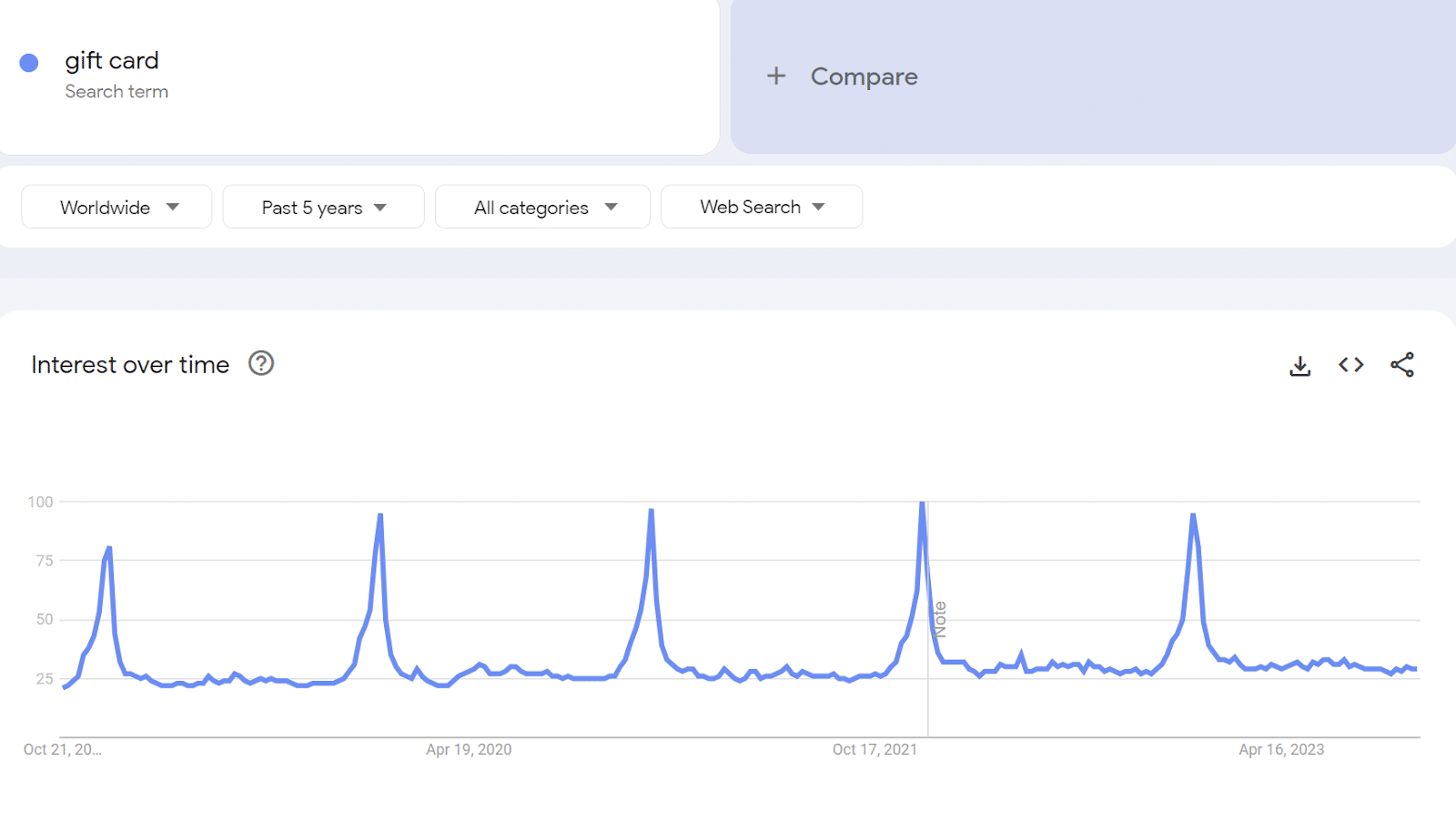
Let me give a few examples. Let’s say you run a gift card business. You probably know that it’s a very seasonal market, and the customer journey is crazy fast.
People who are late buying Christmas gifts will Google “gift card” a couple of days before Christmas – and buy straight away.
In that case, does it make sense to use DDA? Probably not.
Does it make sense to use Performance Max? Probably not, either.
Those prospects will use search mainly. That’s it. That’s the context driving your marketing strategy. It’s not a one-size-fits-all best practice telling you to act blindly.
Here’s another example: say you run a subscription-based business. Would it make sense to retarget Website visitors and saturate branded keywords?
Probably not. Those users will mostly be paying customers already.
So, would it make sense to use Performance Max with a bottom-of-funnel goal (something like a subscription)? Probably not, because Performance Max would go crazy on branded and retargeting campaigns. And those would not have great incremental value.
It’s crucial for advertisers to critically assess PPC strategies. Running a data marketing agency, I emphasize that strategies shouldn’t rely solely on data.
Don’t feel obligated to strictly follow Google Ads or other ad networks’ best practices, especially if their main pitch is being “AI-infused.”
Creating a signature has taken on a new dimension in the rapidly evolving landscape of business and digital media. In the art of handwritten signatures in the digital age, remember that your signature is not just a paper mark; it’s your unique stamp of trust and authenticity, bridging the gap between the physical and virtual worlds.
Once a simple representation of one’s identity on paper, a signature has now transformed into a powerful tool for authentication, verification, and branding in the digital age. Whether you’re an entrepreneur, a professional, or a creative individual, mastering crafting a compelling digital signature is essential for leaving a lasting impression and ensuring the security of your online transactions.
So, let’s explore how to do a signature in the digital era and unlock the endless opportunities they offer for enhancing your personal and professional identity.
Benefits of Handwritten Signatures:
The beauty of handwritten signatures lies in their uniqueness and personal touch, which can profoundly impact business and digital marketing. Here’s how they are related:
Personal Connection: Handwritten signatures carry a sense of personal connection and authenticity. A handwritten signature can evoke trust and familiarity in a digital world filled with automation and anonymity. It adds a human touch to business interactions, reminding customers that real people are behind the transactions.
Brand Identity: A well-designed and consistent handwritten signature can become a part of a brand’s identity. It can be used in marketing materials, business documents, and even as part of a company logo. This unique identifier can make your brand memorable and distinct in the market.
Memorability: Handwritten signatures, especially those with a unique and artistic flair, are more memorable than a simple digital signature or typed name. Customers are more likely to remember a handwritten signature, which can aid in brand recall and customer loyalty.
Document Verification: In some industries, like legal and financial services, handwritten signatures are essential for document verification and compliance. They provide a level of security and authenticity that is difficult to replicate digitally.
Marketing Collateral: Handwritten signatures can be integrated into various marketing materials, such as email signatures, thank-you cards, and personalized notes. These touches can make your customers feel appreciated and valued, leading to higher customer satisfaction and retention.
Influencer Marketing: In the age of social media and influencer marketing, the handwritten signature can also be used by influencers as a personal branding element. It can be incorporated into posts, videos, and merchandise, creating a signature style that fans associate with their favorite influencers.
Storytelling: A handwritten signature can tell a story. It can reflect the founder’s or CEO’s personality and values, which can be a compelling element of your brand’s narrative. Sharing the story behind the signature can be a powerful marketing tool.
Exclusivity: Using handwritten signatures on limited edition products or personalized services can create a sense of exclusivity and luxury. Customers often associate such exclusivity with higher value, making it a valuable tool for digital marketing strategies.
The Power of Handwritten Signatures in Business:
Handwritten signatures hold significant importance in the world of business for several reasons:
Authentication and Identity Verification: Handwritten signatures are a traditional and widely accepted method of verifying a person’s identity. They provide a sense of authenticity and security when signing important documents, contracts, or agreements. This helps businesses confirm that the person signing is who they claim to be.
Legal Validity: Handwritten signatures are often legally binding, assuming certain criteria are met. These criteria typically include the intention to sign, an individual’s handwriting, and a traceable connection between the person and the signature. As a result, handwritten signatures are crucial for creating legally enforceable agreements.
Tradition and Professionalism: In many business settings, handwritten signatures are seen as a symbol of tradition and professionalism. They convey a sense of care and attention to detail, which can be crucial in customer service and client relationships.
Document Tracking and Accountability: Handwritten signatures help track the flow of documents within an organization. They clearly indicate that a specific individual approved or agreed to something, which can be important for accountability and audit purposes.
Psychological Impact: Signatures often have a psychological impact on those signing and those receiving signed documents. They signify commitment and responsibility, and physically signing can create a sense of ownership and accountability.
Security: Although digital signatures and electronic authentication methods are gaining ground, handwritten signatures are often more challenging to counterfeit or hack. This makes them a valuable tool for securing important documents.
Conclusion:
In conclusion, the beauty of handwritten signatures lies in their ability to humanize and add a personal touch to business and digital marketing. They are a powerful tool for brand identity, storytelling, and creating a sense of authenticity and trust in an increasingly digital world. Leveraging handwritten signatures can enhance your business’s marketing efforts and foster deeper customer connections.
In the business world, your handwritten signature is more than just a paper mark; it’s your seal of commitment, trust, and professionalism. As you master the art of crafting your unique signature, you are not just leaving your mark; you are leaving an indelible impression of reliability and authenticity in every business endeavor. So, sign with confidence and watch your signature become a symbol of your unwavering dedication to success.
Note any shifts in key metrics, especially spend and conversions.
Explain what those shifts mean in the real world.
Call out the potential causes behind any trends.
The result is a clear overview of what’s happening in the account, why it’s happening, and what you did to influence that (or how you plan to address it if action is needed).
Example: “Conversion rate increased 10%, which indicates that our landing page resonates better with our audience after updating the content two weeks ago.”
This general approach is relevant for any report, regardless of audience or cadence.
A weekly cadence is usually the shortest duration people are asked to report on. The audience for these reports might be your regular point of contact or a direct manager so that the analysis can be more in-depth.
For accounts with a high volume of data (which may also coincide with higher budgets), it’s fairly common to see trends appear week over week.
Call these out, any reasons for the shifts, and any action items that might be needed.
You can also provide a quick month-over-month comparison to look at the broader picture.
For accounts with lower budgets or less data available (like if you target a niche industry), week-over-week shifts might not be as prevalent.
Try not to overreact to minor shifts in this situation, as data could be skewed by the short time frame you’re looking at.
Example: 2 conversions last week vs. 3 conversions the week prior is a 33% decrease, but the overall volume is similar. A 33% decrease for an account averaging 100 conversions per week could be much more alarming though.
Instead, I recommend looking at a month-to-date comparison to the previous month to give you a better idea of how performance is trending over time (e.g., 10/1–10/12 vs. 9/1–9/12).
You could also compare to the previous period if it’s longer than a week (e.g., 10/1–10/12 vs. 9/19–9/30).
The biggest differentiator for weekly reports is that you can dig deeper into the account. Hone in on specific keywords and audiences that are seeing a shift. Note any recent changes you made or tasks you’re actively working on to improve short-term performance.
In other words, get a little more into the nitty gritty. Since you’re probably delivering this to someone you work with often, they don’t necessarily need to be reminded of the longer-term goals every week (though that should still be kept in mind).
These same principles apply if you do biweekly or mid-month reporting instead of weekly reports, and the final product may look something like this:
Example of weekly report for high-volume account
Example of a weekly report for an account with limited data
Monthly reports
Monthly reports should be a staple for any digital marketer. Your audience is likely the same as weekly reports, but they could also be sent to other stakeholders you don’t work with frequently.
Start by comparing performance to the previous month and provide insights based on that month-over-month data. You don’t need to go as in-depth as a weekly report, though – broaden your focus to what had the most impact.
Example: Instead of highlighting specific keywords/audiences, call out the ad group or campaign.
There may be times when you need to provide more detail, particularly if performance worsens, but in general, this can serve as a good framework.
Once you’ve done a month-over-month comparison, compare your performance to the previous year. Are you beating last year’s benchmarks? If not, why? This is a great way to hold yourself accountable and identify opportunities for the future.
Year-over-year analysis can also be fairly brief. You still want to give insight into changes that are impacting performance, but a quick summary should suffice.
The key with monthly reports is to analyze performance with medium- and long-term goals in mind. People receiving the report don’t necessarily need to know the fine details – just the key points.
Example: Noting that you updated ad copy and CTR increased overall instead of listing each individual headline change.
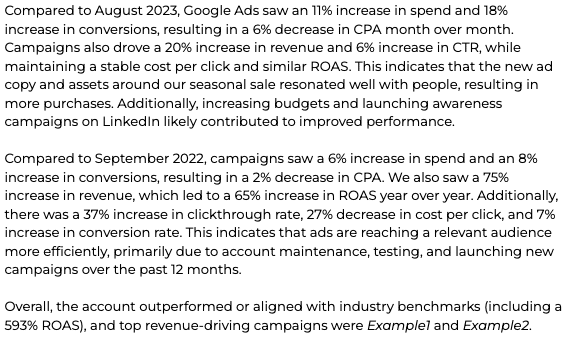
The final product may look something like this:
Example of September monthly report
Get the daily newsletter search marketers rely on.
function getCookie(cname) {
let name = cname + “=”;
let decodedCookie = decodeURIComponent(document.cookie);
let ca = decodedCookie.split(‘;’);
for(let i = 0; i <ca.length; i++) {
let c = ca[i];
while (c.charAt(0) == ' ') {
c = c.substring(1);
}
if (c.indexOf(name) == 0) {
return c.substring(name.length, c.length);
}
}
return "";
}
document.getElementById('munchkinCookieInline').value = getCookie('_mkto_trk');
Quarterly reports
Another common reporting time is at the start of each quarter. Similar to the difference between weekly and monthly reports, these analyses should have a longer-term perspective.
However, quarterly reports are also more likely to be viewed by higher-ups, like VPs, Directors, and C-level executives. It’s important to approach these like an executive summary because of this.
In your analysis, focus more on the account’s long-term strategy, profitability, etc. Executives likely aren’t as worried about efficiency and engagement metrics (like click-through rate and average cost per click) unless those were defined as core KPIs or had a major contribution to overall account growth.
This is especially true for any charts, graphs, or other visualizations you include in the report.
The comparison period should also be the previous quarter and the previous year.
Example: If you’re doing a quarterly report for Q4 2023, compare that to both Q3 2023 and Q4 2022.
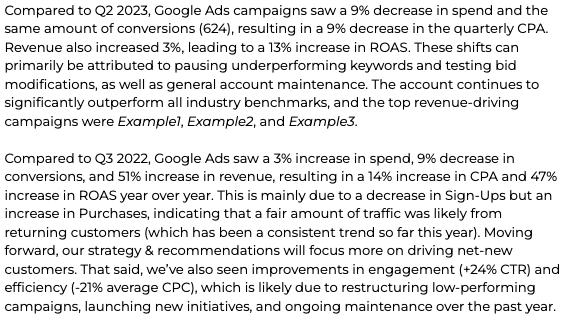
The final product may look something like this:
Example of Q3 report
Annual reports
Lastly, annual reports can be used to summarize major initiatives throughout the year. The people you deliver this to will likely be similar to your quarterly reports, so the approach should also be similar.
The main emphasis should be whether or not company/department-wide goals were achieved.
Compare performance to the previous year and note any major wins or areas for improvement.
Outline your highest impact initiatives from the past 12 months, what went well, and what you would have done differently.
This gives you a roadmap for the coming year while also highlighting success, and the final product may look something like this:
Example of 2022 report
Tailoring your PPC analysis: Insights for every reporting cycle
Effective PPC reporting is a matter of timing and audience. Tailoring your analysis to the right timeframe is essential.
The biggest difference between weekly, monthly, and quarterly reports is the amount of detail you should go into.
Weekly reports are the most in-depth, focusing on specific short-term updates.
Monthly reports are crucial to understanding medium- and long-term performance, with slightly less detail needed than weekly reports.
Quarterly reports take a higher-level look at key trends unfolding throughout the year.
Annual reports summarize major initiatives, with the main emphasis being on company/department-wide goals for the year.
Clarity, relevance, and actionable insights are key to PPC reporting success. Connect data to real-world implications, speak your audience’s language, and refine your reporting skills to make a difference in your paid media efforts.
Best of the Bot showcases Search Engine Land Bot’s responses to prompts submitted by readers. The language model is based on content from Search Engine Land layered on top of ChatGPT. The editors of Search Engine Land selected this response for its usefulness and have supplemented it with additional relevant content.
I am the first generative AI chatbot for search marketers. I am trained with Search Engine Land content.
Here’s something somebody asked me! After that, how you can improve prompts to get even better answers from me.
Prompt:
Create a content marketing and SEO plan for a digital marketing agency.
Answer:
Creating a comprehensive content marketing and SEO plan for a digital marketing agency requires careful consideration of various factors. Here is a step-by-step guide to help you develop an effective plan:
Define your target audience: Identify your agency’s target audience, including their demographics, interests, pain points, and preferred communication channels. This will help you tailor your content to resonate with your audience.
Set clear goals: Determine the specific goals you want to achieve through your content marketing and SEO efforts. Examples may include increasing website traffic, generating leads, improving search engine rankings, or establishing thought leadership.
Conduct keyword research: Perform thorough keyword research to identify relevant keywords and phrases that your target audience is searching for. Use tools like Google Keyword Planner, SEMrush, or Moz to find high-volume and low-competition keywords that align with your agency’s services.
Develop a content strategy: Based on your target audience and keyword research, create a content strategy that outlines the types of content you will create (blogs, videos, infographics, etc.), topics to cover, and the frequency of publishing. Ensure your content is valuable, informative, and engaging to attract and retain your audience.
Optimize on-page SEO: Implement on-page SEO best practices for each piece of content you create. This includes optimizing meta tags (title tags, meta descriptions), using relevant keywords naturally throughout the content, optimizing headings (H1, H2, etc.), and ensuring proper URL structure.
Build high-quality backlinks: Develop a backlink strategy to improve your website’s authority and search engine rankings. Focus on acquiring high-quality backlinks from reputable websites in your industry through guest blogging, influencer outreach, content promotion, and creating link-worthy content.
Leverage social media: Utilize social media platforms to promote your content and engage with your target audience. Share your blog posts, videos, and other content on platforms like Facebook, Twitter, LinkedIn, and Instagram. Encourage social sharing and interaction to increase visibility and reach.
Monitor and analyze performance: Regularly track and analyze the performance of your content marketing and SEO efforts. Use tools like Google Analytics, SEMrush, or Moz to measure website traffic, keyword rankings, backlinks, and other relevant metrics. Adjust your strategy based on the insights gained from the data.
Stay updated with industry trends: Continuously stay informed about the latest trends, algorithm updates, and best practices in content marketing and SEO. Follow reputable industry blogs, attend webinars, and participate in relevant forums to stay ahead of the curve and adapt your strategy accordingly. Remember, a successful content marketing and SEO plan requires consistency, patience, and ongoing optimization. Regularly review and refine your strategy to ensure it aligns with your agency’s goals and delivers the desired results.
Updated prompt with formatting
How this prompt could be improved
Create a content marketing and SEO plan for a digital marketing agency.
“You are an experienced digital marketing and SEO professional. You are an expert in creating engaging, trustworthy, high-quality content that ranks well on Google and encourages potential customers to invest in the services of your digital marketing agency. You follow best practices to ensure your content serves user intent and meets editorial standards, including writing concise, click-worthy headlines, sourcing interviews where necessary to provide first-hand experiences, and speaking to authoritative figures to provide deeper insights. You also make sure your content educates those looking to invest in digital marketing and always links back to the services you offer. You use call-to-action words to motivate potential buyers and highlight unique selling points with enticing hooks. You write in a professional, concise and easy to understand tone.
Please create a detailed content marketing and SEO plan for a digital marketing agency trying to drive more sales.
Format the results in markdown.”
The key elements and enhancements to this prompt are as follows:
(Task)
Please create a detailed content marketing and SEO plan for a digital marketing agency trying to drive more sales.
(Context)
You are an experienced digital marketing and SEO professional. You are an expert in creating engaging, trustworthy, high-quality content that ranks well on Google and encourages potential customers to invest in the services of your digital marketing agency.
(Format)
Format the results in markdown.
(Tone)
You write in a professional, concise and easy to understand tone.
(Example)
You follow best practices to ensure your content serves user intent and meets editorial standards, including writing concise, click-worthy headlines, sourcing interviews where necessary to provide first-hand experiences, and speaking to authoritative figures to provide deeper insights. You also make sure your content educates those looking to invest in digital marketing and always links back to the services you offer. You use call-to-action words to motivate potential buyers and highlight unique selling points with enticing hooks.
New SearchBot answer
As an AI assistant, I can provide you with a detailed content marketing and SEO plan for a digital marketing agency trying to drive more sales. Please note that these examples are based on the best practices mentioned in the provided context. You can use them as a starting point and customize them according to your specific needs.
Content marketing and SEO plan for driving sales:
1. Define Target Audience and Buyer Personas
To effectively drive sales, it’s crucial to understand your target audience and create buyer personas. Conduct thorough research to identify the demographics, interests, pain points, and motivations of your potential customers. This information will help you tailor your content to their specific needs and preferences.
2. Keyword Research and Topic Selection
Perform comprehensive keyword research to identify relevant and high-volume search terms related to your digital marketing services. Use tools like Semrush or Google Keyword Planner to find keywords with a good balance of search volume and competition.
Based on the keyword research, develop a list of topics that align with your target audience’s interests and address their pain points. These topics should cover various aspects of digital marketing, such as SEO, social media marketing, content marketing, PPC advertising, etc.
3. Content Creation and Optimization
Create high-quality, informative, and engaging content that resonates with your target audience. Ensure that each piece of content is optimized for search engines and user experience. Here are some best practices to follow:
Title Optimization: Craft compelling and keyword-rich titles that accurately reflect the content’s topic and entice users to click.
Meta Description Optimization: Write concise and persuasive meta descriptions that summarize the content and encourage users to visit your website.
Keyword Placement: Incorporate target keywords naturally throughout the content, including in headings, subheadings, and body paragraphs.
Internal and External Linking: Include relevant internal links to other pages on your website to improve navigation and enhance topical relevance. Also, add authoritative external links to reputable sources to provide additional value to readers.
Readability and Formatting: Ensure your content is easy to read by using subheadings, bullet points, and short paragraphs. Optimize readability by using appropriate font sizes, line spacing, and colors.
Visual Content: Incorporate visually appealing elements such as images, infographics, and videos to enhance the overall user experience and make the content more shareable.
Mobile Optimization: Ensure your content is mobile-friendly and responsive to provide a seamless experience across different devices.
4. Content Promotion and Distribution
Creating great content is only half the battle. To drive sales, you need to promote and distribute your content effectively. Here are some strategies to consider:
Social Media Marketing: Share your content on relevant social media platforms, engage with your audience, and encourage them to share your content with their networks.
Email Marketing: Build an email list and send regular newsletters featuring your latest content. Personalize the emails based on the recipient’s interests and buying stage.
Influencer Outreach: Collaborate with industry influencers and thought leaders to amplify your content’s reach and credibility. Seek opportunities for guest blogging or interviews.
Paid Advertising: Utilize paid advertising channels like Google Ads or social media ads to promote your content to a wider audience and drive targeted traffic to your website.
Content Syndication: Repurpose and distribute your content on relevant platforms, such as Medium, LinkedIn Pulse, or industry-specific forums, to reach a broader audience.
Community Engagement: Participate in online communities, forums, and Q&A platforms like Quora to provide valuable insights and link back to your content when relevant.
5. Performance Tracking and Optimization
Regularly monitor the performance of your content using analytics tools like Google Analytics and Google Search Console. Track key metrics such as traffic, engagement, conversions, and keyword rankings. Based on the data, make data-driven optimizations to improve the effectiveness of your content marketing efforts.
6. Continuous Improvement and Adaptation
Stay updated with the latest trends and changes in the digital marketing landscape. Continuously refine your content marketing and SEO strategies based on industry best practices, user feedback, and evolving search engine algorithms. Experiment with new content formats, distribution channels, and optimization techniques to stay ahead of the competition and drive more sales.
Remember, content marketing and SEO are long-term strategies that require consistent effort and adaptation. By following this comprehensive plan, you can effectively drive sales and establish your digital marketing agency as a trusted industry leader.
 Made with Keratin, Hydrolyzed Silk and Coconut Oil, this smoothing balm controls and softens unruly hair. Features a heat and humidity-resistant formula that will leave your hair feeling light, bouncy and gorgeously sleek. Use regularly before styling for faster drying, more manageable hair with fewer tangles, less frizz, better hold and smoothness that last. Salon perfect results every time! Retails for $28 at