Starting an online jewellery business can be a great way to share your knowledge and passion for jewellery with the world. There are a few things you should keep in mind to make sure your business is successful. Here are some top tips from Royale Johnson, co-founder at PRYA Jewellery, on starting an online jewellery business:
1. Carry out research on your industry
It’s important to know who your target audience is and what they want.
Prior to launching an online jewellery business, it is important that you conduct extensive research. Research into your target audience will assist in understanding what they prefer and this can help with tailoring your products accordingly at the conceptual stage of your business.
Does personalised jewellery interest them?
Are there seasonal buyers or do customers seek out evergreen items?
Knowing who you are catering for can help pinpoint the types of products which should be offered in order to ensure maximum appeal.
Online surveys are an incredible asset for gathering feedback from potential customers so you can design products that meet their needs and provide maximum success. By utilising these surveys, you gain invaluable insight into which features your customers deem most important when making a purchase decision.
2. Select a niche for your jewellery business
There are a lot of jewellery businesses in the e-commerce world, so you must find a way to make your business stand out.
Finding a specific niche that sets you apart from the competition is essential when setting up your jewellery business. This could mean offering unique designs, specialising in handcrafted pieces or utilising cutting-edge technology for the trendiest designs. By differentiating yourself from other businesses, you’ll create and optimise your business for consumer interest while setting yourself apart from competitors.
3. Prioritise having a user-friendly and visually appealing website or online store
If you want to start a jewellery website or store, think of it as an opportunity to create an amazing experience for customers. For instance, the ideal site should be effortless and enjoyable to navigate; meaning that customers can easily find what they are looking for with clear product pages, search functionality, and organised menus. Additionally, consider adding stunning visuals which further elevate the customer journey — complemented by a neutral colour palette so the products stand out even more!
Prioritising user experience in the design of your website will make it effortless for visitors to locate what they need, crafting a delightful journey that encourages them to delve deeper into the site and be more likely to purchase.
4. Invest in high-quality photos for your products
Crafting stunning photos of your jewellery is essential to ensure that your products get noticed. Investing in high-quality images will make them truly stand out.
Jewellery photography is more than simply showing off its beauty; it’s also a way to showcase the item’s unique features, such as materials and design. These aspects have the potential to draw attention from customers and spark their interest in purchasing your products.
Taking professional photos to showcase your jewellery designs can pay dividends in terms of brand awareness and sales. If you’re intending to scale your jewellery business, investing in good-quality photos is the way to go. From winter picks to new arrivals, you want your customers to have the experience of being in a jewellery storefront through your imagery.
Not only will high-quality images contribute to brand recognition and sales growth, but they will also give customers the feeling of being inside a jewellery store when they view your images; whether it’s new arrivals or winter picks. Your images should provide an immersive experience that gives potential buyers as much visual information on the jewellery they’re interested in as they require.
5. Utilise social media and other online channels to promote your business
Promoting your business through social media and other online channels is an effective way to grow your customer base and increase sales. Developing a comprehensive digital marketing strategy is key for success, as it can make all the difference in getting noticed. Underscore the positive elements of your product or services so customers know why they should trust your brand.
You can also increase brand awareness, garner organic reach and precisely target potential customers by utilising SEO, content marketing and influencer outreach. Remember that having multiple online channels not only allows you to tailor diverse micro-campaigns to various audiences, but also provides valuable insights into customer preferences and how various online campaigns perform.
“Fragments” of Yandex’s codebase leaked online last week. Much like Google, Yandex is a platform with many aspects such as email, maps, a taxi service, etc. The code leak featured chunks of all of it.
According to the documentation therein, Yandex’s codebase was folded into one large repository called Arcadia in 2013. The leaked codebase is a subset of all projects in Arcadia and we find several components in it related to the search engine in the “Kernel,” “Library,” “Robot,” “Search,” and “ExtSearch” archives.
The move is wholly unprecedented. Not since the AOL search query data of 2006 has something so material related to a web search engine entered the public domain.
Although we are missing the data and many files that are referenced, this is the first instance of a tangible look at how a modern search engine works at the code level.
Personally, I can’t get over how fantastic the timing is to be able to actually see the code as I finish my book “The Science of SEO” where I’m talking about Information Retrieval, how modern search engines actually work, and how to build a simple one yourself.
In any event, I’ve been parsing through the code since last Thursday and any engineer will tell you that is not enough time to understand how everything works. So, I suspect there will be several more posts as I keep tinkering.
Also, shout out to Ryan Jones for digging in and sharing some key findings with me over IM.
OK, let’s get busy!
It’s not Google’s code, so why do we care?
Some believe that reviewing this codebase is a distraction and that there is nothing that will impact how they make business decisions. I find that curious considering these are people from the same SEO community that used the CTR model from the 2006 AOL data as the industry standard for modeling across any search engine for many years to follow.
That said, Yandex is not Google. Yet the two are state-of-the-art web search engines that have continued to stay at the cutting edge of technology.
Software engineers from both companies go to the same conferences (SIGIR, ECIR, etc) and share findings and innovations in Information Retrieval, Natural Language Processing/Understanding, and Machine Learning. Yandex also has a presence in Palo Alto and Google previously had a presence in Moscow.
A quick LinkedIn search uncovers a few hundred engineers that have worked at both companies, although we don’t know how many of them have actually worked on Search at both companies.
In a more direct overlap, Yandex also makes usage of Google’s open source technologies that have been critical to innovations in Search like TensorFlow, BERT, MapReduce, and, to a much lesser extent, Protocol Buffers.
So, while Yandex is certainly not Google, it’s also not some random research project that we’re talking about here. There is a lot we can learn about how a modern search engine is built from reviewing this codebase.
At the very least, we can disabuse ourselves of some obsolete notions that still permeate SEO tools like text-to-code ratios and W3C compliance or the general belief that Google’s 200 signals are simply 200 individual on and off-page features rather than classes of composite factors that potentially use thousands of individual measures.
Some context on Yandex’s architecture
Without context or the ability to successfully compile, run, and step through it, source code is very difficult to make sense of.
Typically, new engineers get documentation, walk-throughs, and engage in pair programming to get onboarded to an existing codebase. And, there is some limited onboarding documentation related to setting up the build process in the docs archive. However, Yandex’s code also references internal wikis throughout, but those have not leaked and the commenting in the code is also quite sparse.
Luckily, Yandex does give some insights into its architecture in its public documentation. There are also a couple of patents they’ve published in the US that help shed a bit of light. Namely:
As I’ve been researching Google for my book, I’ve developed a much deeper understanding of the structure of its ranking systems through various whitepapers, patents, and talks from engineers couched against my SEO experience. I’ve also spent a lot of time sharpening my grasp of general Information Retrieval best practices for web search engines. It comes as no surprise that there are indeed some best practices and similarities at play with Yandex.
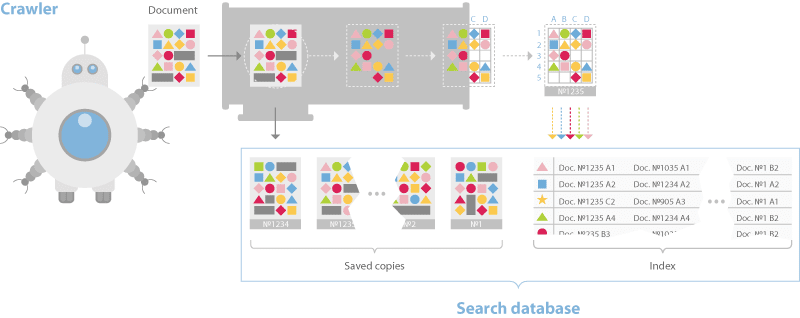
Yandex’s documentation discusses a dual-distributed crawler system. One for real-time crawling called the “Orange Crawler” and another for general crawling.
Historically, Google is said to have had an index stratified into three buckets, one for housing real-time crawl, one for regularly crawled and one for rarely crawled. This approach is considered a best practice in IR.
Yandex and Google differ in this respect, but the general idea of segmented crawling driven by an understanding of update frequency holds.
One thing worth calling out is that Yandex has no separate rendering system for JavaScript. They say this in their documentation and, although they have Webdriver-based system for visual regression testing called Gemini, they limit themselves to text-based crawl.
The documentation also discusses a sharded database structure that breaks pages down into an inverted index and a document server.
Just like most other web search engines the indexing process builds a dictionary, caches pages, and then places data into the inverted index such that bigrams and trigams and their placement in the document is represented.
This differs from Google in that they moved to phrase-based indexing, meaning n-grams that can be much longer than trigrams a long time ago.
However, the Yandex system uses BERT in its pipeline as well, so at some point documents and queries are converted to embeddings and nearest neighbor search techniques are employed for ranking.
The ranking process is where things begin to get more interesting.
Yandex has a layer called Metasearch where cached popular search results are served after they process the query. If the results are not found there, then the search query is sent to a series of thousands of different machines in the Basic Search layer simultaneously. Each builds a posting list of relevant documents then returns it to MatrixNet, Yandex’s neural network application for re-ranking, to build the SERP.
Based on videos wherein Google engineers have talked about Search’s infrastructure, that ranking process is quite similar to Google Search. They talk about Google’s tech being in shared environments where various applications are on every machine and jobs are distributed across those machines based on the availability of computing power.
One of the use cases is exactly this, the distribution of queries to an assortment of machines to process the relevant index shards quickly. Computing the posting lists is the first place that we need to consider the ranking factors.
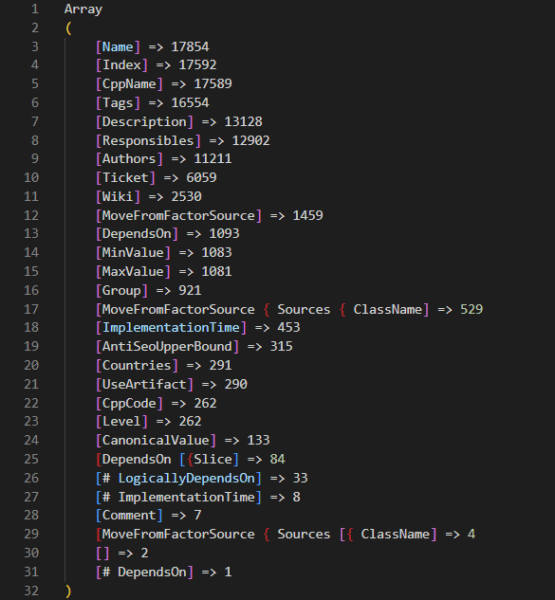
There are 17,854 ranking factors in the codebase
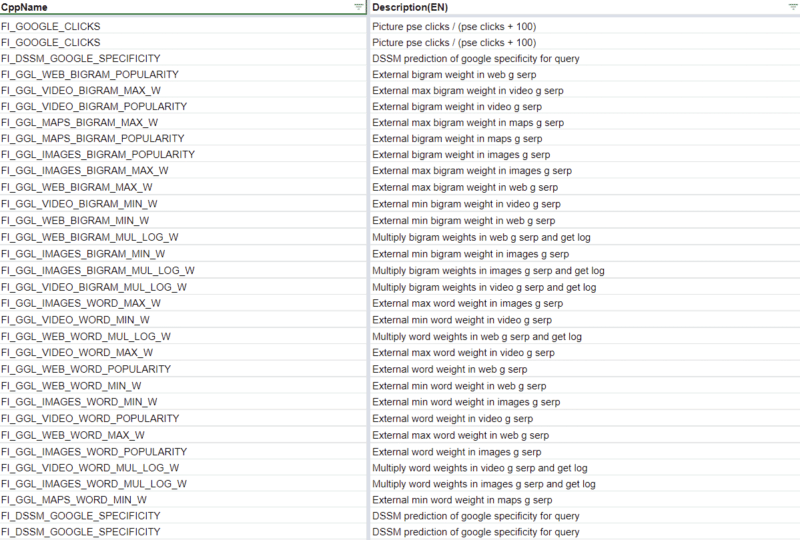
On the Friday following the leak, the inimitable Martin MacDonald eagerly shared a file from the codebase called web_factors_info/factors_gen.in. The file comes from the “Kernel” archive in the codebase leak and features 1,922 ranking factors.
Naturally, the SEO community has run with that number and that file to eagerly spread news of the insights therein. Many folks have translated the descriptions and built tools or Google Sheets and ChatGPT to make sense of the data. All of which are great examples of the power of the community. However, the 1,922 represents just one of many sets of ranking factors in the codebase.
A deeper dive into the codebase reveals that there are numerous ranking factor files for different subsets of Yandex’s query processing and ranking systems.
Combing through those, we find that there are actually 17,854 ranking factors in total. Included in those ranking factors are a variety of metrics related to:
Clicks.
Dwell time.
Leveraging Yandex’s Google Analytics equivalent, Metrika.
There is also a series of Jupyter notebooks that have an additional 2,000 factors outside of those in the core code. Presumably, these Jupyter notebooks represent tests where engineers are considering additional factors to add to the codebase. Again, you can review all of these features with metadata that we collected from across the codebase at this link.
Yandex’s documentation further clarifies that they have three classes of ranking factors: Static, Dynamic, and those related specifically to the user’s search and how it was performed. In their own words:
In the codebase these are indicated in the rank factors files with the tags TG_STATIC and TG_DYNAMIC. The search related factors have multiple tags such as TG_QUERY_ONLY, TG_QUERY, TG_USER_SEARCH, and TG_USER_SEARCH_ONLY.
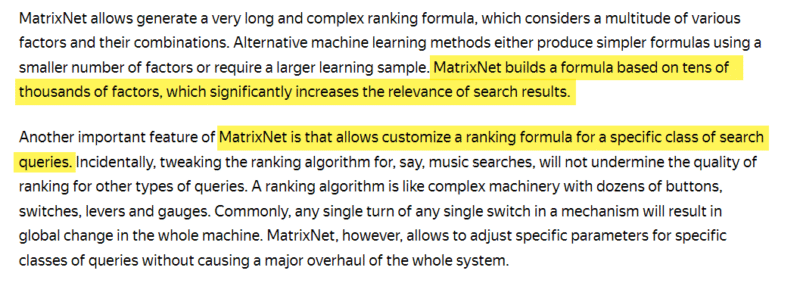
While we have uncovered a potential 18k ranking factors to choose from, the documentation related to MatrixNet indicates that scoring is built from tens of thousands of factors and customized based on the search query.
This indicates that the ranking environment is highly dynamic, similar to that of Google environment. According to Google’s “Framework for evaluating scoring functions” patent, they have long had something similar where multiple functions are run and the best set of results are returned.
Finally, considering that the documentation references tens of thousands of ranking factors, we should also keep in mind that there are many other files referenced in the code that are missing from the archive. So, there is likely more going on that we are unable to see. This is further illustrated by reviewing the images in the onboarding documentation which shows other directories that are not present in the archive.
For instance, I suspect there is more related to the DSSM in the /semantic-search/ directory.
The initial weighting of ranking factors
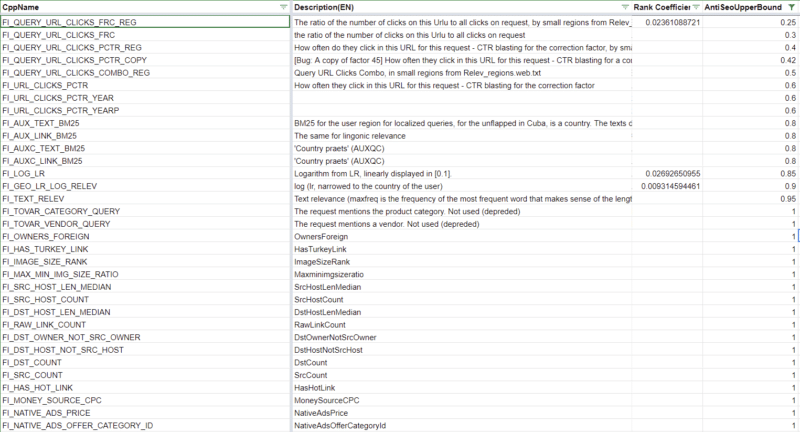
I first operated under the assumption that the codebase didn’t have any weights for the ranking factors. Then I was shocked to see that the nav_linear.h file in the /search/relevance/ directory features the initial coefficients (or weights) associated with ranking factors on full display.
This section of the code highlights 257 of the 17,000+ ranking factors we’ve identified. (Hat tip to Ryan Jones for pulling these and lining them up with the ranking factor descriptions.)
For clarity, when you think of a search engine algorithm, you’re probably thinking of a long and complex mathematical equation by which every page is scored based on a series of factors. While that is an oversimplification, the following screenshot is an excerpt of such an equation. The coefficients represent how important each factor is and the resulting computed score is what would be used to score selecter pages for relevance.
These values being hard-coded suggests that this is certainly not the only place that ranking happens. Instead, this function is most likely where the initial relevance scoring is done to generate a series of posting lists for each shard being considered for ranking. In the first patent listed above, they talk about this as a concept of query-independent relevance (QIR) which then limits documents prior to reviewing them for query-specific relevance (QSR).
The resulting posting lists are then handed off to MatrixNet with query features to compare against. So while we don’t know the specifics of the downstream operations (yet), these weights are still valuable to understand because they tell you the requirements for a page to be eligible for the consideration set.
However, that brings up the next question: what do we know about MatrixNet?
There is neural ranking code in the Kernel archive and there are numerous references to MatrixNet and “mxnet” as well as many references to Deep Structured Semantic Models (DSSM) throughout the codebase.
The description of one of the FI_MATRIXNET ranking factor indicates that MatrixNet is applied to all factors.
Description: “MatrixNet is applied to all factors – the formula”
}
There’s also a bunch of binary files that may be the pre-trained models themselves, but it’s going to take me more time to unravel those aspects of the code.
What is immediately clear is that there are multiple levels to ranking (L1, L2, L3) and there is an assortment of ranking models that can be selected at each level.
The selecting_rankings_model.cpp file suggests that different ranking models may be considered at each layer throughout the process. This is basically how neural networks work. Each level is an aspect that completes operations and their combined computations yield the re-ranked list of documents that ultimately appears as a SERP. I’ll follow up with a deep dive on MatrixNet when I have more time. For those that need a sneak peek, check out the Search result ranker patent.
For now, let’s take a look at some interesting ranking factors.
Top 5 negatively weighted initial ranking factors
The following is a list of the highest negatively weighted initial ranking factors with their weights and a brief explanation based on their descriptions translated from Russian.
FI_ADV: -0.2509284637 -This factor determines that there is advertising of any kind on the page and issues the heaviest weighted penalty for a single ranking factor.
FI_DATER_AGE: -0.2074373667 – This factor is the difference between the current date and the date of the document determined by a dater function. The value is 1 if the document date is the same as today, 0 if the document is 10 years or older, or if the date is not defined. This indicates that Yandex has a preference for older content.
FI_QURL_STAT_POWER: -0.1943768768 – This factor is the number of URL impressions as it relates to the query. It seems as though they want to demote a URL that appears in many searches to promote diversity of results.
FI_COMM_LINKS_SEO_HOSTS: -0.1809636391 – This factor is the percentage of inbound links with “commercial” anchor text. The factor reverts to 0.1 if the proportion of such links is more than 50%, otherwise, it’s set to 0.
FI_GEO_CITY_URL_REGION_COUNTRY: -0.168645758 – This factor is the geographical coincidence of the document and the country that the user searched from. This one doesn’t quite make sense if 1 means that the document and the country match.
In summary, these factors indicate that, for the best score, you should:
Avoid ads.
Update older content rather than make new pages.
Make sure most of your links have branded anchor text.
Everything else in this list is beyond your control.
Top 5 positively weighted initial ranking factors
To follow up, here’s a list of the highest weighted positive ranking factors.
FI_URL_DOMAIN_FRACTION: +0.5640952971 – This factor is a strange masking overlap of the query versus the domain of the URL. The example given is Chelyabinsk lottery which abbreviated as chelloto. To compute this value, Yandex find three-letters that are covered (che, hel, lot, olo), see what proportion of all the three-letter combinations are in the domain name.
FI_QUERY_DOWNER_CLICKS_COMBO: +0.3690780393 – The description of this factor is that is “cleverly combined of FRC and pseudo-CTR.” There is no immediate indication of what FRC is.
FI_MAX_WORD_HOST_CLICKS: +0.3451158835 – This factor is the clickability of the most important word in the domain. For example, for all queries in which there is the word “wikipedia” click on wikipedia pages.
FI_MAX_WORD_HOST_YABAR: +0.3154394573 – The factor description says “the most characteristic query word corresponding to the site, according to the bar.” I’m assuming this means the keyword most searched for in Yandex Toolbar associated to the site.
FI_IS_COM: +0.2762504972 – The factor is that the domain is a .COM.
In other words:
Play word games with your domain.
Make sure it’s a dot com.
Encourage people to search for your target keywords in the Yandex Bar.
Keep driving clicks.
There are plenty of unexpected initial ranking factors
What’s more interesting in the initial weighted ranking factors are the unexpected ones. The following is a list of seventeen factors that stood out.
FI_PAGE_RANK: +0.1828678331 – PageRank is the 17th highest weighted factor in Yandex. They previously removed links from their ranking system entirely, so it’s not too shocking how low it is on the list.
FI_SPAM_KARMA: +0.00842682963 – The Spam karma is named after “antispammers” and is the likelihood that the host is spam; based on Whois information
FI_SUBQUERY_THEME_MATCH_A: +0.1786465163 – How closely the query and the document match thematically. This is the 19th highest weighted factor.
FI_REG_HOST_RANK: +0.1567124399 – Yandex has a host (or domain) ranking factor.
FI_URL_LINK_PERCENT: +0.08940421124 – Ratio of links whose anchor text is a URL (rather than text) to the total number of links.
FI_PAGE_RANK_UKR: +0.08712279101 – There is a specific Ukranian PageRank
FI_IS_NOT_RU: +0.08128946612 – It’s a positive thing if the domain is not a .RU. Apparently, the Russian search engine doesn’t trust Russian sites.
FI_YABAR_HOST_AVG_TIME2: +0.07417219313 – This is the average dwell time as reported by YandexBar
FI_LERF_LR_LOG_RELEV: +0.06059448504 – This is link relevance based on the quality of each link
FI_NUM_SLASHES: +0.05057609417 – The number of slashes in the URL is a ranking factor.
FI_ADV_PRONOUNS_PORTION: -0.001250755075 – The proportion of pronoun nouns on the page.
FI_TEXT_HEAD_SYN: -0.01291908335 – The presence of [query] words in the header, taking into account synonyms
FI_PERCENT_FREQ_WORDS: -0.02021022114 – The percentage of the number of words, that are the 200 most frequent words of the language, from the number of all words of the text.
FI_YANDEX_ADV: -0.09426121965 – Getting more specific with the distaste towards ads, Yandex penalizes pages with Yandex ads.
FI_AURA_DOC_LOG_SHARED: -0.09768630485 – The logarithm of the number of shingles (areas of text) in the document that are not unique.
FI_AURA_DOC_LOG_AUTHOR: -0.09727752961 – The logarithm of the number of shingles on which this owner of the document is recognized as the author.
FI_CLASSIF_IS_SHOP: -0.1339319854 – Apparently, Yandex is going to give you less love if your page is a store.
The primary takeaway from reviewing these odd rankings factors and the array of those available across the Yandex codebase is that there are many things that could be a ranking factor.
I suspect that Google’s reported “200 signals” are actually 200 classes of signal where each signal is a composite built of many other components. In much the same way that Google Analytics has dimensions with many metrics associated, Google Search likely has classes of ranking signals composed of many features.
Yandex scrapes Google, Bing, YouTube and TikTok
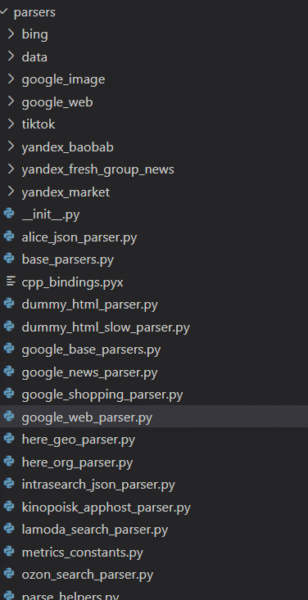
The codebase also reveals that Yandex has many parsers for other websites and their respective services. To Westerners, the most notable of those are the ones I’ve listed in the heading above. Additionally, Yandex has parsers for a variety of services that I was unfamiliar with as well as those for its own services.
What is immediately evident, is that the parsers are feature complete. Every meaningful component of the Google SERP is extracted. In fact, anyone that might be considering scraping any of these services might do well to review this code.
There is other code that indicates Yandex is using some Google data as part of the DSSM calculations, but the 83 Google named ranking factors themselves make it clear that Yandex has leaned on the Google’s results pretty heavily.
Yandex has anti-SEO upper bounds for some ranking factors
315 ranking factors have thresholds at which any computed value beyond that indicates to the system that that feature of the page is over-optimized. 39 of these ranking factors are part of the initially weighted factors that may keep a page from being included in the initial postings list. You can find these in the spreadsheet I’ve linked to above by filtering for the Rank Coefficient and the Anti-SEO column.
It’s not far-fetched conceptually to expect that all modern search engines set thresholds on certain factors that SEOs have historically abused such as anchor text, CTR, or keyword stuffing. For instance, Bing was said to leverage the abusive usage of the meta keywords as a negative factor.
Yandex boosts “Vital Hosts”
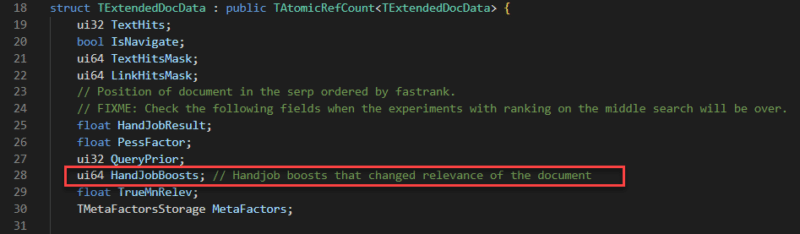
Yandex has a series of boosting mechanisms throughout its codebase. These are artificial improvements to certain documents to ensure they score higher when being considered for ranking.
Below is a comment from the “boosting wizard” which suggests that smaller files benefit best from the boosting algorithm.
There are several types of boosts; I’ve seen one boost related to links and I’ve also seen a series of “HandJobBoosts” which I can only assume is a weird translation of “manual” changes.
One of these boosts I found particularly interesting is related to “Vital Hosts.” Where a vital host can be any site specified. Specifically mentioned in the variables is NEWS_AGENCY_RATING which leads me to believe that Yandex gives a boost that biases its results to certain news organizations.
Without getting into geopolitics, this is very different from Google in that they have been adamant about not introducing biases like this into their ranking systems.
The structure of the document server
The codebase reveals how documents are stored in Yandex’s document server. This is helpful in understanding that a search engine does not simply make a copy of the page and save it to its cache, it’s capturing various features as metadata to then use in the downstream rankings process.
The screenshot below highlights a subset of those features that are particularly interesting. Other files with SQL queries suggest that the document server has closer to 200 columns including the DOM tree, sentence lengths, fetch time, a series of dates, and antispam score, redirect chain, and whether or not the document is translated. The most complete list I’ve come across is in /robot/rthub/yql/protos/web_page_item.proto.
What’s most interesting in the subset here is the number of simhashes that are employed. Simhashes are numeric representations of content and search engines use them for lightning fast comparison for the determination of duplicate content. There are various instances in the robot archive that indicate duplicate content is explicitly demoted.
Also, as part of the indexing process, the codebase features TF-IDF, BM25, and BERT in its text processing pipeline. It’s not clear why all of these mechanisms exist in the code because there is some redundancy in using them all.
Link factors and prioritization
How Yandex handles link factors is particularly interesting because they previously disabled their impact altogether. The codebase also reveals a lot of information about link factors and how links are prioritized.
Yandex’s link spam calculator has 89 factors that it looks at. Anything marked as SF_RESERVED is deprecated. Where provided, you can find the descriptions of these factors in the Google Sheet linked above.
Notably, Yandex has a host rank and some scores that appear to live on long term after a site or page develops a reputation for spam.
Another thing Yandex does is review copy across a domain and determine if there is duplicate content with those links. This can be sitewide link placements, links on duplicate pages, or simply links with the same anchor text coming from the same site.
This illustrates how trivial it is to discount multiple links from the same source and clarifies how important it is to target more unique links from more diverse sources.
What can we apply from Yandex to what we know about Google?
Naturally, this is still the question on everyone’s mind. While there are certainly many analogs between Yandex and Google, truthfully, only a Google Software Engineer working on Search could definitively answer that question.
Yet, that is the wrong question.
Really, this code should help us expand our thinking about modern search. Much of the collective understanding of search is built from what the SEO community learned in the early 2000s through testing and from the mouths of search engineers when search was far less opaque. That unfortunately has not kept up with the rapid pace of innovation.
Insights from the many features and factors of the Yandex leak should yield more hypotheses of things to test and consider for ranking in Google. They should also introduce more things that can be parsed and measured by SEO crawling, link analysis, and ranking tools.
For instance, a measure of the cosine similarity between queries and documents using BERT embeddings could be valuable to understand versus competitor pages since it’s something that modern search engines are themselves doing.
Much in the way the AOL Search logs moved us from guessing the distribution of clicks on SERP, the Yandex codebase moves us away from the abstract to the concrete and our “it depends” statements can be better qualified.
To that end, this codebase is a gift that will keep on giving. It’s only been a weekend and we’ve already gleaned some very compelling insights from this code.
I anticipate some ambitious SEO engineers with far more time on their hands will keep digging and maybe even fill in enough of what’s missing to compile this thing and get it working. I also believe engineers at the different search engines are also going through and parsing out innovations that they can learn from and add to their systems.
Simultaneously, Google lawyers are probably drafting aggressive cease and desist letters related to all the scraping.
I’m eager to see the evolution of our space that’s driven by the curious people who will maximize this opportunity.
But, hey, if getting insights from actual code is not valuable to you, you’re welcome to go back to doing something more important like arguing about subdomains versus subdirectories.
Google has released three new updates for the GA4 dashboard, allowing advertisers to find information about current properties or accounts.
Dig deeper. The following updates were posted by Google on their Analytics Help documentation.
Find data stream details
The following search terms allow you to open the details for a web or app data stream in the property you are using:
the keyword “Tracking”
a web stream measurement ID (i.e., “G-XXXXXXX”)
an app stream ID (i.e., “XXXXXXX”)
Find the current property and account settings
The following search terms allow you to open the settings for the property you are using:
the keyword “Property”
the current property ID or property name
The following search terms allow you to open the settings for the account you are using:
the keyword “Account”
the current account ID or account name
Go to other Google Analytics 4 properties
The following search terms allow you to navigate to a different Google Analytics 4 property from the one you are using. Analytics shows you up to 7 properties that match the search query.
the property ID or property name of the other property
a web stream measurement ID (i.e., “G-XXXXXXX”) in the other property
an app stream ID (i.e., “XXXXXXX”) in the other property
Why we care. The additional information will help advertisers analyze streams, accounts, and properties in their GA4 accounts.
Modern technology allows you to do what was previously impossible. Modern management differs from traditional management, because there are modern technologies that can significantly automate any business process. Today, we will consider one of these technologies, which is called an online data room.
Management with VDR
Managing a company with a virtual data room becomes much easier and more efficient. But this is being sent away by a large number of independent researchers who are developing new practices and testing old ones. In fact, at the moment, data room software has become one of the most effective tools for managing an entire company and related paperwork. Everything becomes much easier if you are going to conduct any business transaction that will be important to your company and its financial growth. For example, the whole process of the following business transactions changes if you have a virtual data room set up:
The merger and acquisition process. This is one of the most popular business transactions at the moment that uses a virtual data room. Some newcomers don’t understand why this is the case, but it’s actually quite prosaic. Since virtual data rooms allow businesses to enter all of their business information online and with automated setups, the process of going through the merger and takeover process becomes much easier for both the business owners and the other party that is involved in this process. The management of this process becomes much easier, and the reason for this is the huge number of different improvements that the virtual data room provides. You will be given the help of artificial intelligence to go through the due diligence process.
Fundraising and capital raising. Whether your company is fundraising on an ongoing basis or has decided to run a one-time fundraising campaign, VDRs will help you considerably with proper virtual data room pricing. This is quite similar to the case with mergers and acquisitions. Since all stakeholders in the crowdfunding process need a secure and stable online space where they can store secure documents for months or even years, a virtual data room is the best fit for this process. Having flexible security policies, which are also present there, can allow multiple companies to have a safe presence at once to review various documents. Potential investors will be happy to see that your virtual data room is working properly.
Manage financial and legal documents internally. You can store all legal financial documents, which are confidential and sensitive to being stolen, on local media within the company itself. So, what will you do if you need to provide one or two documents to a third party? How will you protect it from possible data leakage? Virtual data rooms allow you to do this in the most secure and open way possible. It is the virtual data room that can provide 24/7 access so that every party interested in a business process can have access to all the documents they need. It gets more interesting when you find out that data leakages are impossible if you use these enterprise solutions. Even if an employee breaches a security system and steals the data, you will be able to identify that employee and when they did it precisely and thoroughly. Also, you will be able to prove it in court. No one, knowing these factors, would dare steal data from you.
We have looked at just a few cases of management, which govern the virtual data room and you can read more about it at https://datarooms-review.com/virtual-data-room-pricing/. It’s hard to disagree that without this technology, things would be much more complicated. Independent researchers say that the number of data breaches and thefts of confidential documents has decreased precisely with the introduction of virtual data rooms. It’s hard not to notice, especially if you’re looking at the daily news about what’s going on within the corporate walls.
The Question of Lawfulness
Virtual data rooms follow privacy and data protection laws around the world. For example, developers of this type of technology focus on the American market, but also pay attention to the British and other European segments. This is the main market for this technology, so they have to follow every letter of the law. Consequently, you will not have any problems using this technology completely legally. Moreover, you can use this as evidence in court in the event of unforeseen circumstances.
Obviously, the following benefits will await you from the implementation of this technology:
Your security system will be quite predictable and, at the same time, hacker-proof. If you’ve used some piecemeal data protection tools or free solutions like file storage before, you don’t know what you should expect tomorrow. With virtual data rooms, you will know exactly what you should expect and what level of security you will be given. Surprisingly, hackers do not attack virtual data rooms for several reasons, which are essential if you are going to implement this technology in your company. Attackers typically attack popular tools, which are usually limited to virtual storage. Virtual data rooms, on the other hand, are protected against hacking, not just from a legal standpoint but from a functional standpoint as well. All necessary government certificates are accounted for in every virtual data room.
As we said above, you will be fully protected by the law while using this product. All products from virtual data room developers are certified products. This means that all of the security policies that are used in this solution are completely legal and approved by the government for use by large corporations. This means that the courts will side with you if there are any unresolved issues. In case any employee decides to steal any data from you, it can be easily traced through a huge number of means. You can provide copies of virtual data room protocols for the courts to look at your problem from this side. Because of government registrations and regulations, it will be easier for you to prove your case.
You can also use additional tools for your corporate security that are not explicitly stated in the law but are still particularly important for full-fledged corporate security. We’re talking about tools like internal security policies or external security preferences. Obviously, you can’t hurt your company by having something set up wrong. All security settings are, in general, regulated automatically by companies that produce online data rooms. You’re left with editing internal policies, such as roles. This is necessary if you’re going through some complicated process like mergers and acquisitions or if you want to regulate internal access to certain resources among employees.
The virtual data room phenomenon has become especially popular in developed parts of the world. This means that you can count on unquestioning compliance with the most up-to-date privacy and data protection laws.
Conclusion
Virtual data rooms are not only completely legal, but also help to significantly improve management within the company. You can count on all of these benefits, which have been described above. In terms of the law, it is quite a profitable proposition because you will be fully protected not only technologically, but also legally.
With security concerns and the desire to keep possessions secure growing globally, a home security company is a highly successful business to start. The options are limitless, from selling taser guns for self defense to smart home security.
Given the rise in crime globally, there has been an unprecedented adoption of novel safety and security technologies. Furthermore, reliable vendors for security products have become increasingly difficult to find, fueling demand for smart home security. This has made the home security industry a profitable venture for entrepreneurs.
This is all very promising, but how can you get started with a home security company? Here are sure-fire tips to get you going.
Step 1: Conduct Market Research
Market research is an essential component of company strategy. Starting a successful business entails more than just the enthusiasm and optimism of developing a product; it is a systematic, data-driven process.
Conducting market analysis before you launch provides you insight into the industry, allowing you to find holes you can address to stand out and attract people to your firm.
Conduct a fast search for existing home security firms. Discover what existing brand leaders are doing and see how you could do it better.
Do you believe your company can provide something that other firms cannot (or can provide the same thing cheaper and faster)? Furthermore, do you have a strong idea and are ready to develop a business plan?
Examine the consumer’s wants and make sure you’re offering or supplying exactly what they require.
For instance, in areas where mass shootings are regular, people are purchasing bulletproof gear such as backpacks, clipboards, and even three-ring binder inserts in the expectation that these may protect them from gunfire. Another example is self defense items such as tasers, security batons, and tactical flashlights powered with electricity.
Step 2: Develop a Business Plan
A solid business plan is an essential component of starting any firm. This preparation will guarantee that you are prepared for success from the outset.
The following information should be included in a business plan:
Information about you – your industrial expertise and professional history, necessary certifications, and current relationships.
Overview of the business – your company’s name, services, client objectives, and operating model. It should also contain a SWOT analysis to identify your company’s strengths, weaknesses, opportunities, and threats, as well as its goal, mission, and values.
Finances – how you intend to finance your company, sales projections, and launch budgets.
Full summary of your services – price, how you will carry out the services, sales strategy, legislative and insurance needs, policies and processes, the potential for development.
Market research entails doing online and physical research into the security sector market (e.g., conducting web searches and reading related publications), conducting field research on your ideal consumers (e.g., conducting interviews or surveys), analyzing the customer needs, and competition.
Marketing and promotion strategy – how will you build awareness of your new company and attract customers?
There are several internet tools available to help you write a business plan, including simple templates. Set aside committed time to finish your company strategy; it is not an easy undertaking, but it is necessary.
Step 3: Come Up with a Business Model
Business models have evolved throughout time. Businesses all around the world have learned to harness both physical and digital storefronts in order to stay competitive in the current economy.
Whatever store you choose, be sure it meets your needs and those of your consumers.
Many organizations have begun to integrate technology into their business models in order to better fulfill consumer needs, and some have even taken an omnichannel strategy to boost returns.
Businesses have created one-of-a-kind solutions to assist streamline procedures and generate income. They are also utilizing both systems to their advantage. Whatever business module you establish, consider:
Having a website. Every genuine business has a website, period. When it comes to bringing your business online, it doesn’t matter what size or sector it is.
Social media accounts, such as Facebook pages or LinkedIn company profiles, are not a substitute for your own business website but are rather helpful marketing platforms.
Step 4: Select Products and Services to Offer
Entering the security profession without knowing what you can offer your clients can only lead to disaster. You must decide the services you will provide so that you can guarantee you have the necessary finances and resources.
Below are some of the viable options:
Internet security services, such as cybersecurity;
Alarms;
Home security and monitoring services;
Self defense batons;
Taser guns;
Bulletproof backpacks for students;
Stationary guard services;
Crisis management; and
Patrolling services.
When you select a security service niche to specialize in, the rest of the procedure becomes much simpler.
Step 5: Create a Marketing and Sales Strategy
In the service industry, word-of-mouth referrals are an important source of clients. People prefer to believe advice, especially from security organizations, because security is such a personal subject. Make sure you tell your family, friends, and neighbors so they may promote you to their networks.
Creating networks with real estate agents, homeowner associations, and housebuilders is another efficient strategy to advertise your firm. They may know potential clients for your services and be able to recommend you.
Social media is another excellent technique to advertise your company. It is one of the simplest and most successful strategies to market a new business.
When you have a solid following on your social sites, your chances of obtaining prospective clients grow since there is no limit to how far you may spread your network.
Step 6: Launch and Manage the Store
The final step is to obtain the necessary permits and licenses. To run your security company, you must have certain licenses and permissions. Each nation has its own unique set of norms and laws. So, find out what your state’s requirements are in this respect.
Take the time and do house cleaning. Create a working framework. You most certainly already have industry experience, and you could even be an expert in the sector. However, this may not be enough to successfully manage your own security company.
Some key business abilities will be required, such as operations and people management, basic financial management, risk management knowledge, project management, effective communications and marketing skills, relationship building, and so on. Soft skills such as communication, cooperation, and teamwork are also required if you want to succeed.
Conclusion
So, now that you’ve learned how to establish a security company using our six-point approach, why not turn your zeal for delivering outstanding security services into a profitable business and get started right away?
January feels like the longest month of the year for a multitude of reasons. Not only is it cold, dark and gloomy, but the weeks between pay checks seem to last a lifetime. Plus, many of us are still trying to recover from the financial blow of Christmas and New Year.
Luckily for you, here at MoneyMagpie we have hundreds of ways to make money. From ways to make money from your shed, to selling unwanted items, there are plenty of ways to get some extra cash in your pockets.
In this article, we have compiled some of our favourite, fast ways to make money. Here are 10 ways to make quick cash.
Is it time you had a good clear out? Why not bring the spring cleaning forward a few months and have a wardrobe sort out? Clearing your wardrobe out can not only help you identify items of clothing you haven’t worn in a long time, but it can make you some good money.
Buying second hand clothing is gaining popularity. Not only do you get more for your money by buying pre-loved items, but more people are concerned about the environmental impact of fast fashion and want to reduce their environmental impact.
Technology has bought with it plenty of great websites upon which you can sell your clothes. Depop, Vinted, eBay, Facebook Marketplace and many other sites allow you to sell your clothes. We recently spoke with Melissa Watts, a Yorkshire resident who makes an average of £100 per week selling items online.
If you don’t have any of your own clothes to sell, however, all hope is not lost. You could start earning on the side by buying and selling second hand items for a profit. If you live somewhere with plenty of good charity shops, you may be able to make some quick cash doing this.
Charity shops are a treasure trove of brilliant clothing items. People often have more money than sense, donating items they have never even worn, some brand new with tags, some worth a good whack of money. Selling charity shop clothing for a profit could be a lucrative income, or it could top up your income.
It’s no secret that we are huge fans of completing online surveys to make some quick cash. Now, we understand – some survey websites pay you pennies for lots of your time, and don’t seem worth it. Other sites time you out constantly, or kick you out mid survey, meaning you receive no reward.
However, there are also some great websites out there, which reward your greatly for your time and opinions. We have an article which reviews many survey websites, giving our honest opinions on each. You can read this here.
We all have opinions – so why not get paid for them? With the cost-of-living crisis in the forefront of all our minds, earning some extra cash from the comfort of your own home for giving your thoughts on a particular topic is a real winner. We highly recommend People for Research (PFR), who reward you for your valued opinions.
The average incentive is £50 per hour, but can range up to £100 or more – it’s tax-free and won’t affect any benefits you claim, so just think of it as a nice bonus! Most incentives are paid via bank transfer, meaning you get paid directly into your bank account.
PFR are currently recruiting people to take part in research regarding the cost of living. You can find out more here.
If you are a student or have recently graduated, The Opinion Panel Community is a great place to start. If you are aged 13 to 30, your opinions are highly valued.You can earn up to £5 per survey and as much as £70 for longer online and in-person discussion groups. You can earn anywhere from 50 to 500 points (50p to £5) per survey. There are also some slightly different research opportunities available that pay up to £30 for a series of surveys!
On a similar note to completing online surveys, undertaking market research and taking part in focus groups is another fun and easy way to bag yourself some quick cash.
Market research involves the gathering, then analysing information on consumers. This helps businesses understand what products people want, who will buy them, and for what price.
You could undertake the research yourself, helping different industries understand their customers. Or, you could help the businesses by completing surveys, questionnaires and interviews, giving your opinions about their products and services.
Focus groups are a method of conducting market research where companies gain insight into consumer opinions and behaviour through a planned discussion with a pre-selected diverse demographic.
Focus groups can be online, in person and over the telephone. Sometimes you may be required to discuss a topic as a group, as a pair, or even individually with a researcher.
They can pay decent money, too. Take Part In Research pays between £40 and £250 per session!
As technology moves on, the need for DVDs, CDs, cassette tapes and more dwindles for many of us. For others, however, collecting these items is a hobby – a hobby which could make you money.
There are plenty of ways to sell your items, with the internet providing a plethora of places to sell anything from old video games to vintage books.
Is your home filled with unused ‘stuff’? Perhaps your book shelf is over flowing with books you haven’t touched in years. You may even have a cupboard full of old DVDs and videos, even though you no longer have any means of playing them. You may even keep video games that are no longer something you’d play in your spare time.
If this sounds like you, why not have a clear out? You’d be surprised at how much money you could make. You could even sell old textbooks from your school or university days!
Do you enjoy playing music? Perhaps you and your friends get together to jam out from time to time. Well, you could easily make money from this.
From the bustling streets of London to the city that never sleeps, buskers can earn decent cash for exposing their talents on the streets. In extremely busy areas, you could make £200 for a few hours of work.
Busking is not just playing music, either. There are many ways to ‘busk’. Whether you sing, play music, can juggle, do gymnastics, are a talented acrobat or even a clown, there are loads of ways to make money. You could even be a ‘statue’!
Having an off-street parking space is something that you might take for granted: being able to park your car off the road for no extra charge, safe and sound by your house. Yet it’s a highly-prized luxury that thousands upon thousands of people in the UK don’t have, being forced to pay daily or monthly charges for parking permits from their local council, or struggling to find somewhere to park their car when they’re out and about.
But did you know, you can rent out your space to earn some extra cash? Last year in the UK, the total gross revenue from driveway rentals came to £27,279,631, with London-based renters making an average of £1,691 a year, and those outside London making £874 a year.
It’s easy to do, you get paid quickly and you’ll be earning without having to do anything. This is a super easy way to make quick cash. Find out more here.
If you don’t have a driveway, garage or parking space, you could also make money from your home. From renting out your home as a film set to making money from your shed, there are plenty of easy and fun ways to earn money. You can find loads of ways to do this here.
Sell your laundry
Selling your underwear, socks, tights and shoes can be a lucrative money maker. Although it isn’t for everyone, there is a huge market out there, with people willing to pay big bucks for your laundry, both clean and dirty.
People are willing to buy dirty underwear, socks, and even worn-out shoes. How much you make then is pretty much up to you although you have to bear in mind that for people to take your prices seriously, you have to consider what is reasonable with regard to your competition. The more you sell though, the more you can demand.
Marketplace sites allow you to set your own prices and, despite charging a membership fee, most do not charge commission. The Kinky Boutique sells underwear from £12 to £250 while Sofia Gray sell knickers for up to £5,000! This can be a seriously high paying way to make quick cash!
It can all seem a little daunting, but don’t fear. You can read our full guides below.
Mystery shopping is another way to make money that we absolutely love here at MoneyMagpie. In fact, we love it so much, we even wrote a whole eBook about it. You can download it for free here.
Nowadays, all industry sectors employ mystery shoppers – retail, automotive, financial services, hospitality, property, call centres, public services, travel, and even the voluntary sector – so there’s a huge range of work available.
Mystery shopping isn’t just about literal shopping. You may be asked to try out restaurants, stay at hotels, watch films or even phone a call centre to trial their customer service. Sometimes the cost of your food, stay or travel is re-imbursed, and sometimes you are paid extra on top! This is definitely a fun, different way to make quick cash.
There are three reasons dog walking is a great way to make money. One, you make money as just stated. Two, you can get out, get exercise and fresh air. Three, you get to hang out with dogs all day! If that’s not a serotonin boost, we don’t know what is.
Particularly in cities, there’s a lot of demand for dog walking services, and it’s well paid too. More people than ever got a puppy in the first lockdown – but now many are back in the office and have less time to walk their pooch.
Some people have even given up their day job to set up a full-time dog-walking business! Dog walking is becoming a very popular way to make money on the side in the UK and it’s not surprising.
Some people charge £10 – £15 per dog that they walk, per hour they walk them! So, if you walk 4 dogs per day, twice a day, you could be making £120 a day. That’s £2,400 for four weeks work (assuming you only work Monday to Friday).
So, if you are a dog lover and have a flexible schedule, why not try this out?
You don’t have to be a super talented actor who graduated top of the class in drama school to be a film and TV extra.
An extra is a ‘background artist’ – they’re the people you see milling around in all kinds of scenes on TV and film. You might be a WW2 soldier one day and a cafe customer the next!
If you’re interested in film and TV, working as an extra can be a fascinating and exhilarating experience. Plus, it is incredibly flexible, and something that can be done around part-time jobs or studying.
Productions will also aim for a diverse group of people. No matter your age, gender, race, or whether you have a disability – extra opportunities are there for everyone.
However, it isn’t always glamorous. You often have to work for long hours, with early call times, and wrapping late. If you’re prepared for this, go along with a lot of patience and a can-do attitude it can be a great way to supplement your income!
The Magpie community is full of savvy money savers and makers – and now’s your chance to ask your burning questions!
The new MoneyMagpie Messageboard brings together the Magpie community, MoneyMagpie team, and vetted experts to make sure your essential money-making questions get answered.
Many players in the CS:GO game do not even suspect that they can make money on their favorite game. Although the topic of buying and selling csgo skins is not new, nevertheless, not all players of this online team shooter use the opportunity to increase their wealth. Surely, many do not take this way of earning seriously. However, many successful entrepreneurs earn hundreds and thousands of dollars on the resale of CS:GO skins, and this is far from the limit.
How to get skins in CS:GO
You can get skins for free in the game, but it will take a lot of time to get a really valuable weapon skin. Here are the most common ways to get skins in CS:GO:
buy them;
play a lot in order to get a drop as a reward, in which a skin can get caught;
complete tasks on third-party sites in exchange for skins;
In fact, the first method is the fastest and most convenient. In addition, you can sell the CS:GO skins that you already have, or buy cheaper skins from familiar players and then sell them at a higher price.
If you can set up this process more efficiently and work only with the most valuable skins in the game, you can start earning. Prices can vary from $10 to several thousand dollars, even more.
How to sell CS:GO skins
If you decide to sell skins, but have not done so before, use proven platforms with a clear interface and 24/7 technical support. For example, DMarket is considered to be a great choice. You can easily master the trading of CS:GO skins and scale your future earnings without switching to other platforms.
To sell CS:GO skins, log in to the platform and create a lot to sell your skins. If you are interested in buying, then select the skin you are interested in the catalog and add it to your cart. Top up your account to pay for the purchase. It will then become available in your CS:GO account.
You need to be careful and not use unscrupulous sites. Always study the platform before you sell or buy anything. Look at what payment systems are available. If there is a KYC algorithm, if there is technical support, and the reviews.
Getting into the local lead generation game is more achievable than ever, especially if you want to work from home as you build your business. We’ve put together tips on what you’ll need to do to get in on this niche and how to take inspiration from others already succeeding in the local lead generation space.
How to Start a Local Lead Generation Business from Home with Minimal Investment
Starting a local lead generation business from home has the potential to be quite lucrative if you get it right. However, you must first make sure that you have all of the necessary tools and resources in place before diving right into it.
To begin with, you should determine what type of leads your business will specialize in and create an effective strategy for targeting these leads. It’s useful to focus on a particular segment or sector and take a look at how established brands are succeeding. For instance, HVAC Engine marketing is an agency that caters to HVAC businesses looking to grow their customer base, retain more clients and put a plan in place for future expansion.
You’ll also need to invest in quality software and other online tools like social media platforms that can help drive traffic toward your website or landing pages. Also, consider setting up cost-effective methods of advertising such as Google Ads or Facebook Ads so that potential clients are aware of your services. With proper planning and investment upfront, starting a local lead generation business from home can be a straightforward process.
Tips on Generating Sustainable Revenues from Local Lead Generation
Generating sustainable revenues from local lead generation can be difficult but it is not impossible. It’s something that takes time to perfect, and so crucially you need to be realistic about how long you’ll need to be up and running until you’ve got the momentum and client loyalty to reach this point.
Most importantly, entrepreneurs should strive to build strong relationships with their clients and offer them added value beyond just their products or services. Go above and beyond the basics of local lead generation and give people a reason to stick with you time after time.
Clearly, you also need to be delivering on your basic promises. However, if you’re not only bringing in more leads for clients but also keeping them in the loop with other marketing and sales tactics, it’s a more impressive proposition.
Additionally, think about providing loyalty programs or discounts so that clients are incentivized to return to use your services in the future.
Then there’s the relevance of keeping track of the leads you generate and paying close attention to what works best in terms of converting leads into clients, as well as generating long-term revenue. You can’t hope to set up a thriving local lead generation business if you aren’t also capable of generating leads and building relationships yourself.
Utilizing Social Media Platforms to Reach Potential Leads
Speaking of lead generation, don’t overlook social media platforms as a way to connect with companies in the local area that have need of your services. With the right strategy in place, these platforms help you reach out to prospects and increase brand awareness.
You’ll need accounts on sites like Facebook, Instagram, Twitter, and LinkedIn to build digital bridges. Make sure that your profile contains relevant information about your business as well as engaging content that will draw users in.
The Bottom Line
Digital tools make local lead generation an attainable home business proposition in 2023. Therefore, the biggest struggle you’ll face when starting a business targeting this market is making your services known to the right prospects. This should be your focus in order to reach your goals this year.
In 2014, Google’s Matt Cutts tweeted, “Today we’re taking action on a French link network that violates our quality guidelines (Buzzea).”
Buzzea was less than thrilled about being called a link network, saying they “oppose this assertion since we never stopped wanting to keep the ethical side of sponsored articles focusing on quality and natural links created.” As a result of the penalty, Buzzea officially called it quits.
2021: Citing advertisers’ brand safety concerns, Facebook said the feature would allow marketers to choose whether to show their ads alongside potentially sensitive content.
2020: URLs shown in featured snippets that appeared in the right rail of Google desktop results would continue to be included in the main organic listings.
2020: In this installment of Barry Schwartz’s vlog series, he chatted with Barone about the older days of SEO and then moved on to how her career has changed over the years.
2019: Search marketing experts offered feedback on when to pay for search analytics tools, factors to consider and making the most out of what you buy.
2016: The latest images showing what people eat at the search engine companies, how they play, who they meet, where they speak, what toys they have and more.
2014: Bing also measured player searches, with Broncos’ quarterback Peyton Manning winning 72% of the searches over Seahawks’ quarterback Russell Wilson.
2014: iOS and Android users could earn Bing Rewards credits (toward gift cards for brands like Amazon, Xbox and Dominos) by performing searches on their phone.
2010: Google confirmed it was “testing a feature in which text ads on Google search results pages may include star ratings and links to third party sites that have reviewed the advertiser’s business.”
Past contributions from Search Engine Land’s Subject Matter Experts (SMEs)
These columns are a snapshot in time and have not been updated since publishing, unless noted. Opinions expressed in these articles are those of the author and not necessarily Search Engine Land.
To prevent unwanted impressions or clicks from certain search terms across multiple campaigns, advertisers can create a negative keyword list at the account level and then apply it to relevant campaigns. This will save you the effort of adding the same negative keywords to individual campaigns and make it easier to manage future changes to negative keywords across campaigns.
How it works. Creating a list of negative keywords allows you to block your ads from showing for specific irrelevant terms for your brand, making it easier for your ads to reach your desired audience and resulting in more successful conversions.
As an example from the Google Ads Help doc, if you own a sporting goods store that specializes in workout clothes, you can create a negative keyword list that includes terms such as “dress pants” or “blouses” to prevent your ads from showing to people searching for those terms.
Why we care. Negative keyword lists help to ensure that their ads are only being shown to the most relevant audience. By excluding irrelevant search terms, negative keyword lists make it more likely that ads will be seen by people who are actually interested in the products or services being advertised. This can lead to higher click-through rates and conversion rates, resulting in a better return on investment for the advertiser. Additionally, it can save on Ad spend by avoiding showing ads to people who are not interested in the product.
Setting these lists at the account level saves advertisers a lot of time if they have an account with multiple campaigns.
Dig deeper. You can read the full announcement from Google here.