Artificial intelligence (AI) has been a scorching hot topic lately, especially since the launch of ChatGPT Nov. 30. Microsoft Bing has plans to add ChatGPT to search. Some have questioned whether it’s a Google killer.
Now we’re seeing more examples of brands using AI-generated content. Bankrate is the latest example. It is having some of its content written by machines but reviewed by human editors.
It’s a bold strategy (let’s see if it pays off for them). And the SEO community wanted to know Google’s policies around these efforts.
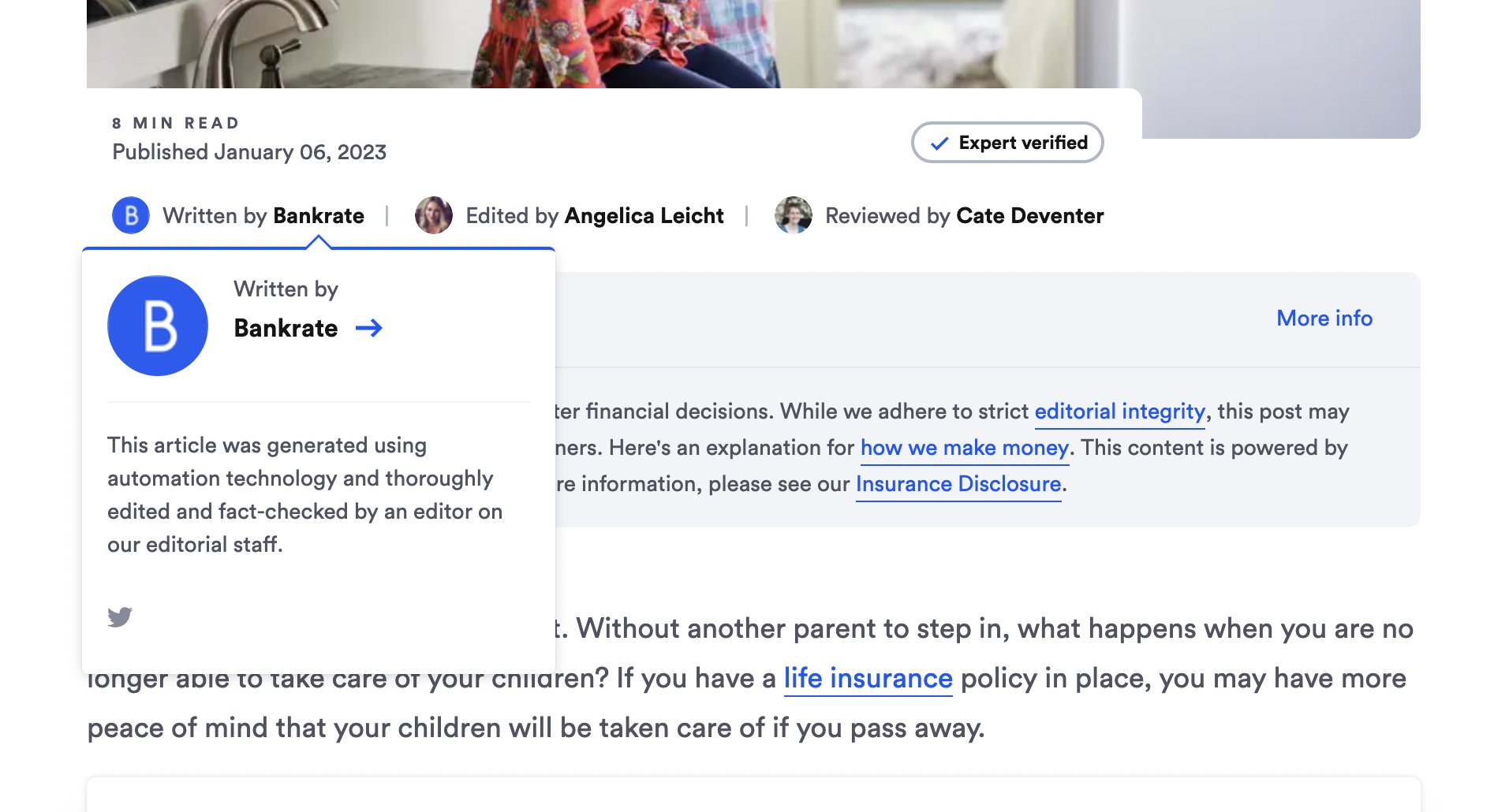
Bankrate example. The example was highlighted by Tony Hill, who posted on Twitter that “BankRate.com, one of the largest finance sites on the web has now started using AI to write some of its content. A big moment in web publishing and SEO.”
The screenshot reads “this article was generated using automated technology and thoroughly edited and fact-checked by an editor on our editorial staff.”
Wondering how Bankrate.com is ranking for these articles? Sistrix did an analysis to find out:
For Bankrate.com, this specific use-case and the current point in time, one can say: yes, it works. Many , randomly-checked articles rank on the first page for both the main keyword and many other long-tail keywords
Bankrate isn’t the only example of this. CreditCards.com is also using AI-generated content. The first line of the CreditCards.com Team author page says “Content published under this author byline is generated using automation technology.”
CNET has also quietly been using AI to write entire articles from the ground up since November.
Do a Google site search for [“This article was generated using automation technology”] will reveal dozens of CNET articles in Google’s index. CNET also assures readers that these articles have been “thoroughly edited and fact-checked by an editor on our editorial staff.”
The potential issue. If we can have machines and AI write content for us, then the amount of content that can be produced at incredibly low costs can be somewhat exciting for brands and businesses – more content for a minimal investment sounds like the stuff of dreams.
But, at the same time, mass-generated AI content can also frightening for consumers (what should you spend your time reading?) and search engines (what content should Google be ranking in search?).
So much content is being produced daily already; how much more can we consume, and how much more does Google need to crawl, index, and decide to rank for a given query?
Google’s statement on AI-generated content. Is Google OK with crawling and ranking content written by machines? If not, is Google OK if those AI-generated pieces of content are reviewed by human editors before they are published?
Danny Sullivan, Google’s Search Liason, reiterated some of what was said before about Google’s stance on this topic.
Sullivan wrote on Twitter this morning on the topic of AI-generated content, “content created primarily for search engine rankings, however it is done, is against our guidance.” But he added that “if content is helpful & created for people first, that’s not an issue.”
Sullivan then referenced their guidelines for the helpful content update, saying that the “key to being successful with our helpful content system — and if it’s not helpful content, the system catches that.”
If the AI can write helpful content, then it should be fine, one would assume.
Then Sullivan references the revised E-E-A-T quality raters guidelines, saying, “For anyone who uses *any method* to generate a lot content primarily for search rankings, our core systems look at many signals to reward content clearly demonstrating E-E-A-T (experience, expertise, authoritativeness, and trustworthiness).”
Finally, Google has a spam policy for automated content, which states “generated through automated processes without regard for quality or user experience” which is against Google’s guidelines.
Why we care. We know machine-generated content is not new, but what is new, is that the machines are getting better with the help of AI, in generating human-like, high-quality content. The question is, is it being produced with the intent of helping people or ranking in Google Search. If it is the latter, the helpful content system’s aim is to make sure such content does not rank well.
For the time being, Google wants content by the people, for the people but you can use AI for ideas and help you along the way. If machines and AI can write the content, you’d think similar technology can detect content written by AI.
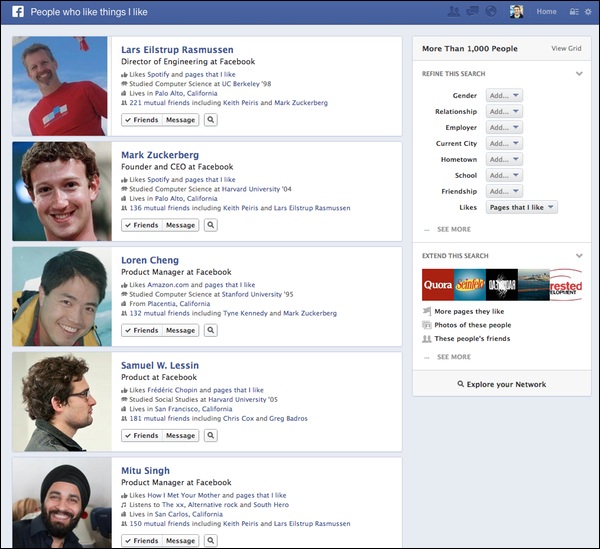
In 2013, Facebook announced a new experience that it called Graph Search.
Facebook Graph Search relied heavily on Likes and other connections to determine what to show as the most relevant search results for each user.
At launch, Facebook Graph Search only included people, photos, places and interests.
Facebook Graph Search wasn’t a traditional web search engine like Google or Bing. It was a new type of search – a social search engine. Although Facebook was already using Bing for web search results at that time.
Less than two years later, Facebook quietly dropped Bing’s results and Facebook made Graph Search less visible. Graph Search would be all but dead by around June 7, 2019. According to a Facebook spokesperson:
“The vast majority of people on Facebook search using keywords, a factor which led us to pause some aspects of graph search and focus more on improving keyword search. We are working closely with researchers to make sure they have the tools they need to use our platform.”
2021: The courses cover the basics including an introduction to LinkedIn Ads, how to use LinkedIn ad targeting, and reporting and analytics for LinkedIn ads.
2016: The latest images culled from the web, showing what people eat at the search engine companies, how they play, who they meet, where they speak, what toys they have and more.
2014: Google’s Matt Cutts answered this question: “Are results in different positions ranked by different algorithms?” Spoiler alert: The answer was no.
2014: While still representing the largest share, Experian reported search engines experienced a 13% drop in the amount of upstream traffic sent to retailers when comparing year-over-year traffic data.
2014: EU Competition Commissioner Joaquin Almunia said Google needed to deliver additional, revised proposals within weeks to avoid a formal antitrust proceeding.
2013: That was significantly more than the 13% who began at health portals like WebMD, general information sites like Wikipedia (only 2%) and social networks (1%).
2013: The winner would earn a $30,000 college scholarship, a $50,000 technology grant for their school, and have his or her logo displayed on the Google homepage.
2011: 13% said they couldn’t find what they were looking for. The answers were there, the “signal” that people want to tune into. They were just surrounded by a lot of noise.
2010: Amazon said it would no longer pay referral fees to Associates who sent users via keyword bidding or other paid search on any other search engine or their extended search networks
2010: The launch followed a pilot phase that the company said allowed developers to monetize mobile apps, desktop clients, social search engines and similar applications.
2009: Bartz said her instinct or “gut” was not necessarily to sell, although she would need to immerse herself in the issues and economics to make a better determination.
2009: The Wikipedia SearchMonkey App was turned on by default for all Yahoo search users, which made it the sixth app that all Yahoo searchers would see (with LinkedIn, Yelp, Yahoo Local, Citysearch and Zagat).
2008: Microsoft teamed up with MediaCart to offer in-store behavioral ad targeting and took the concept of “location-based services” to the store aisles using RFID tags.
2008: How candidates, campaign staffers and other third parties were using Google Maps and the Maps API to showcase their messages and organize political volunteers and activists in upcoming primaries.
2007: Among the findings: search marketers needed to be more concerned about getting into the top five rather than the top ten, if they wanted to be seen.
2007: More searchers were seeing a series of eight suggested searches as links, under the heading of “Searches related to:” followed by the original word you searched for.
2007: “It’s your worst nightmare – someone reads parts of your Google emails, views your docs, modifies your spreadsheets, checks out your reading habits on the Google personalized homepage or Google Reader, and goes through your search history.”
2007: While 98% of Google employee money went to Democrats in the last election, the company-controlled Google NetPAC gave 61% of its contributions to conservative candidates.
Past contributions from Search Engine Land’s Subject Matter Experts (SMEs)
These columns are a snapshot in time and have not been updated since publishing, unless noted. Opinions expressed in these articles are those of the author and not necessarily Search Engine Land.
In 2011, Matt Cutts, the head of Google’s search spam team, was in Washington DC, doing an “educational tour” to explain to US Federal Trade Commission members and congressional staffers that Google’s search results didn’t require government regulation.
Part of his visit included a 89-page slide presentation, called “Search Integrity,” at Google’s Washington, D.C. offices.
Cutts said the same thing that Google had been telling the search marketing community for years – that Google’s results are determined by an algorithm and not tweaked to get particular sites ranking well.
“The only reasons I know of to go in and change [search rankings] manually is for security, a court order or spam. It is impossible to pay for a better ranking.”
2020: Agencies, SEOs, and resellers were not eligible for this program. And the proposed MBP “must not have access to the business listings they are verifying.”
2020: In this installment of Barry Schwartz’s vlog series, he chats with Álvarez about why structured data will be important in the future and his passion for mentoring SEOs.
2018: The animated doodle highlighted Youguang’s work by flipping the Os within Google’s name from Pinyin (Gǔgē) to Chinese characters (谷歌) and led to a search for “Zhou Youguang.”
2017: The latest images culled from the web, showing what people eat at the search engine companies, how they play, who they meet, where they speak, what toys they have and more.
2014: Ryanair CEO Michael O’Leary said his airline has entered a partnership with Google, and was providing the search engine with flight pricing to help build a travel search and comparison tool.
2012: The first testing for the roll-out was to commence mid-January and involve up to 10% of Yahoo’s traffic in France, Ireland and the United Kingdom.
2012: A local search/directory startup said Google crawled its site for local business sales leads and then falsely claimed in cold calls to those businesses it had a partnership with the publisher to sign them up.
2012: The latest images culled from the web, showing what people eat at the search engine companies, how they play, who they meet, where they speak, what toys they have and more.
2011: The Czech Republic was one of six countries (along with Russia, Japan, China, Taiwan and South Korea) where Google wasn’t the dominant search engine.
2011: Under the new game plan, Google was targeting Chinese firms to advertise on its dominant overseas search market, a business which already constitutes about half of its China revenues.
2011: A 120 question document sought “to ascertain whether Google manipulated search results and used its popular platform to keep business and disadvantage rivals in online advertising and Internet search.”
2010: For sites hosted on a blogspot.com, wordpress.com or similar type of domain, Google wanted advertisers to show the subdomain portion of the domain, in addition to the main domain.
2010: A sampling of a wide variety of reactions and responses to the news that Google could potentially pull out of China if it cannot operate without censorship.
2010: One of Google’s more vocal critics says the company should cut its ties with InfoSpace over what he called “a particularly insidious kind of click fraud” that involves a fairly complex combination of paid ads, affiliate traffic brokering, and spyware.
2010: Anyone searching for the official Google blog post about Google deciding to leave China over censorship was unable to find it on China’s leading search engine, Baidu.
2009: A 20-minute video where Cutts went over what he considered to be virtual “blight” (link spam, open landing pages and hacking). Cutts also showed how to think like a spammer.
2009: Cutts said these pages might run afoul of Google’s webmaster guidelines, and gave specific instructions for reporting this kind of page to Google’s spam team.
2009: In retrospect, it appeared that relative search query volumes (Obama vs. McCain) did presage the outcome of the November election. And it appeared they predicted the recession.
Past contributions from Search Engine Land’s Subject Matter Experts (SMEs)
These columns are a snapshot in time and have not been updated since publishing, unless noted. Opinions expressed in these articles are those of the author and not necessarily Search Engine Land.
In 2022, we revealed what happened when Search Engine Land shut off AMP.
TL;DR: “We have seen very little disruption to our traffic and have reaped the benefit of having a clearer picture of our audience analytics.”
We didn’t see any year-over-year declines in traffic that we could tie to AMP aside from the loss of pageviews to a handful of pieces that routinely spike for organic traffic.
2016: The new features: more competitive insights and benchmarking, customizable ad group and keyword bids, a new source for keyword suggestions and time range customization up to 24 months for keyword search volume.
2015: The update brought both camera and conversation mode translation to the iOS app for the first time, as well as vast improvements to those features on the Android version of the app.
2014: Thousands of hotels listed within Google+ Local appeared to have had links leading to their official sites “hijacked” and replaced with ones leading to third-party booking services.
2014: A pop-up alert appeared on a Yelp business profile page and warned consumers that a Yelp sting operation had caught the company trying to acquire reviews by buying them, offering gifts or discounts, or some other way that Yelp doesn’t allow.
2013:Kohn joined us as our Special Projects Correspondent. Marvin joined as a Contributing Writer, focusing primarily on paid advertising topics (she would go on to become Editor-in-Chief from October 2018 to December 2020).
2012: Founder Gabriel Weinberg has been taking feedback and tweaking the design for at least three-plus weeks in the site’s community forum, where he announced the new look and layout.
2011: Both ads played on the Bing “decision engine” idea by having aspiring actors explain why they decided to get into acting, followed by a message that “pre-congratulates the Golden Globe winners of tomorrow.”
2010: As the new Senior Vice President of the Yahoo Search Products team, Seth would manage Yahoo’s Search team and all things related to Yahoo Search.
2010: Network Distribution allowed advertisers to select if they wanted to advertise on Yahoo’s entire network or just on either the Yahoo Search network or Yahoo Search Partner network.
2009: The program was aimed at developers, hosting companies and others to take on the responsibility of billing, support and training, in exchange for a 20% discount on the services.
2008: The article generated some serious spam issues for Wired, generated discord within the search marketing community, and injured the search marketing industry in general.
2008: The 14 million shares came out to about $339.5 million, but gave Liberty Media Corporation about a 30 percent stake in the parent company of Ask.com.
Past contributions from Search Engine Land’s Subject Matter Experts (SMEs)
These columns are a snapshot in time and have not been updated since publishing, unless noted. Opinions expressed in these articles are those of the author and not necessarily Search Engine Land.
In today’s globalized economy, businesses are increasingly tapping into new markets by targeting consumers worldwide. This is where multi-language marketing strategies come in. Expert Richard Rakowitz in New York, NY, says by developing campaigns that target multiple languages and cultures, businesses can reach a wider audience, expand their customer base, and ultimately boost sales. Take a closer look at why companies should implement multi-language marketing strategies.
The Basics of Multi-Language Marketing Strategies
Multi-language marketing strategies refer to the process of creating campaigns and materials to target multiple-language audiences effectively. This can include website content, social media posts, and video ads. When done correctly, this strategy can help businesses gain an edge over their competitors by reaching an even more significant customer base.
The Benefits for Businesses
Richard Rakowitz says businesses that utilize multi-language marketing strategies benefit in several ways. First, they can tap into new markets and reach customers who may not have been familiar with their products or services. Additionally, multi-language marketing allows companies to develop better relationships with their customers. They speak directly to their customers in their languages rather than simply relying on translation services or automated translation software. This also helps strengthen brand loyalty. Customers feel more connected and appreciated when companies try to reach out to them in their native language.
Furthermore, using different languages in marketing materials gives companies a chance to explore different cultural nuances that may give them an edge over the competition when it comes to engaging customers on a deeper level. For example, certain words or phrases may have different meanings in different cultures, which can be used to create more effective campaigns that speak directly to those audiences. Additionally, diverse cultural references can help companies stand out from the crowd and capture the attention of potential customers who might otherwise be overlooked.
Finally, utilizing multi-language marketing strategies helps businesses remain competitive by quickly adapting and responding to changes in customer preferences across multiple markets instead of focusing on one language group at a time. This flexibility allows companies to stay ahead of trends while keeping costs low since they don’t have to invest as much time or money into translating content for each market individually.
How to Implement Multi-Language Marketing Strategies
Implementing multi-language marketing strategies successfully requires a thoughtful and strategic approach. Here are some tips to get you started:
1. Research the language of your target market. This ensures that your materials are appropriately tailored to their needs and expectations.
2. Invest in native-speaking translators and cultural experts who can assist you with creating content that is both accurate and culturally relevant for each target market.
3. Use the right tools and technology to ensure your campaigns correctly translate into each language.
4. Develop a multi-language strategy that considers the different language preferences of each target market and any cultural nuances.
By utilizing multi-language marketing strategies, businesses can gain competitive advantages and reach even larger customer bases than before. With the right tools and a thoughtful approach, companies can create successful campaigns that speak to customers in their languages and capture their attention in unique ways.
How to Handle Multi-Language SEO
When optimizing websites for multiple languages, it is essential to consider a few key points. To begin, create separate versions of your website for each language you plan to target. This helps to improve your search engine rankings and ensure that customers can easily navigate and find relevant content in their languages.
Additionally, create localized content for each language version of the site. Use appropriate meta tags, titles, and descriptions so that search engines can properly index the pages. Finally, use hreflang tags to help search engines determine which language version of the page to display for each user. This will help ensure that customers get the most relevant and accurate content.
What About Multi-Language Social Media?
Richard Rakowitz says multi-language social media strategies are also crucial for businesses looking to grow their customer bases and increase brand awareness internationally. You accomplish these by creating separate accounts for each language you are targeting and then customizing the content to fit the cultural nuances of each market.
In addition, ensure your messages accurately translate in each language to avoid issues. Also use social media analytics tools to track engagement across different language versions. This will help you better understand how customers respond to your campaigns and adjust your approach accordingly.
Final Thoughts
Implementing a successful multi-language marketing strategy requires careful planning and execution. However, its rewards are well worth the effort for any business looking for success on a global scale. By taking the time to research different cultures and target audiences across multiple languages, companies can ensure that their content resonates with prospective customers no matter where they are located. Ultimately, this results in increasing engagement rates and boosting sales potential along the way!
Your business cannot afford to pay for goods that have been damaged during shipping. If you accept a shipment without first evaluating its condition, you risk wasting your company’s time and money on goods that you simply cannot use. While some types of damage are relatively obvious to spot, freeze damage can be more difficult for you and your employees to identify. Here are a few signs and symptoms that freeze occurred during shipping, so you can avoid putting your business at risk with damaged goods.
Tripped Freeze Indicators
The most reliable and best sign that goods have been subjected to freezing temperatures is a freeze indicator that tells you so directly. Freeze indicators can be exceedingly affordable and immensely useful tools for shippers and carriers alike. Most often applied to packaging but also used inside shipping or storage containers, freeze indicators come in many varieties to meet your need for information about freezing events.
For example, many freeze indicators permanently change in response to a freezing temperature and can track the passage of time since the event to help you or your carrier respond appropriately to salvage goods. Other freeze indicators are reusable, meaning they change temporarily or perhaps send alerts about freezing temperatures to you or your carrier. If your goods are extremely sensitive to changes in temperature and likely to experience damage as a result of a freeze, you should seriously consider integrating freeze indicators into your shipping processes.
Frost on or Inside Packaging
If temperatures remain below freezing or a freeze event occurred recently in a relatively humid environment, shipped or stored packages might maintain frost around or inside them. Freezing temperatures cause all water to freeze, to include moisture in the air, and that frozen moisture will accumulate on and inside packaging. Once temperatures begin to rise again, the frozen moisture might melt into frost or dew, but in any case, moisture condensed on or around packaging is a good indication that goods have experienced some kind of low temperature event that warrants further investigation.
Water-soaked Appearance
If a significant amount of time has passed since the freeze event, all signs of frost may have disappeared — but that doesn’t mean the damage caused by the frost has also disappeared. The moisture of the melted frost is likely to cause some degree of water damage to the packaging or the goods themselves, and that type of damage tends to be more obvious than damage caused specifically by freezing. If you or your carrier notices that paper packaging seems to have come into contact with moisture, you might look for additional signs of freezing to understand the full scope of damage to your goods.
Soft Texture
When water freezes, it expands. Unfortunately, this means that some frozen goods tend to sustain damage at the molecular level. For example, when produce experiences a freeze, the water within the cells of the food turns to ice and grows, bursting the cells. This process weakens the cellular structure of the fruit or vegetable, causing it to develop a softer texture once temperatures rise above freezing. Though many other types of damage can cause goods to develop a softer, weaker texture, you might consider the possibility of freeze damage and take steps to prevent harm in the future.
Cracks
Other types of goods may develop other signs of damage in response to freezing temperatures. For example, harder materials like stone or plastic might crack as moisture settles into spaces and expands in the cold. Cracking is especially common when goods experience a pattern of freezing and thawing over time, which allows more and more moisture to work itself deeper into the product before causing harm. If you are shipping goods that are not necessarily sensitive to temperature but might experience freeze damage in moist environments, you should work with your carrier to keep your freight dry.
Freezing temperatures affect different kinds of goods in different ways. The more you know about how your goods respond to different environments, the better you can strategize to keep your goods safe during shipping and storage.
Inherited a property you don’t know what to do with? Second home that sits gathering dust? Time to make money by renting out your holiday home!
If you are lucky enough to own a holiday home, it could become more of a financial burden than a luxury. If this is the case, check out our ways to cash in on that second abode.
Sarah Woods is the founder of Mulberry Cottages, a boutique holiday lettings agency that, among other things, works to match homeowners and guests together for the creation of luxury self-catering holidays.
She explained to us the advantages of renting out your holiday home over long-term letting, an arrangement that grants you helpful tax benefits and allows you to use it as a holiday home for yourself.
Tax benefits
sarah says:
“Holiday lettings are counted as a business for tax purposes and as such are able to take advantage of tax breaks not able to be claimed from a traditional property investment. In recent years holiday lettings have seen real benefits including offsetting a lot of the initial costs, furnishings, mortgage interest and you may not even have to pay council tax. Lastly profits could be put towards pension contributions which bring other tax advantages and if you decide to sell there is also the scope to reduce capital gains to a rate as low as 10%, whereas typical residential sales attract capital gains at the higher rate of 28%.”
However, these tax advantages are only applicable for properties registered as an FHL or Furnished Holiday Let. Qualifying as an FHL is fairly easy; among other things, the property must:
Contain furniture for “normal occupation” – if you are not normal, then research may be in order.
Be within the UK or EEA (excluding the Isle of Man or Channel Islands).
Be available for letting at least 210 days of the year, and booked for at least 105 of these days.
Let your property with the intent of earning a profit.
You can read more about the various terms and conditions on this link here.
Keep it as a holiday home
After all your hard work getting the house together for your guests, it’s only fair that you have a holiday too!
Besides, staying in your property for a significant length of time will help you understand the experience of your guests.
How is the wifi and/or phone signal?
Is there a tripping hazard in the garden?
Does the heating sometimes turn itself off in the middle of the night?
Do you need directions to the nearest supermarket?
Of course, if you live here on a regular basis you may not notice or may have already dealt with such concerns. For those who have never lived in their property properly, taking a holiday could be an invaluable piece of research.
Now that’s the kind of working holiday we all dream about.
Is your home suitable for holiday letting?
Location
As every business student and watcher of The Apprentice knows, the most important thing to think about is:
Location,
Location,
And location!
For long-term tenants, the distance from home to school or employment is usually the most important consideration, as well as easy access to the nearest town.
Holidaymakers, however, often want an escape from the trivialities and congestion of everyday life, and are looking for somewhere undisturbed and beautiful.
On the other hand, tourists going to honeypot locations like Devon or Cornwall might want to be offered something more intimate and personal than a generic hotel experience.
Both holiday and long-term letting are viable options, but the location of your property is of vital importance in determining which avenue of business to pursue.
Design
The benefits we discuss below has made renting out your holiday home a very popular option, and as a result the market is overflowing. In order to be noticed by prospective guests, you must be conspicuous.
sarah says:
“Guests want aspirational properties where they can escape the everyday, they want somewhere interesting but comfortable, giving them a wonderful experience. We find that our properties with outstanding and unusual designs are the most popular.”
Whether your house is modern, retro, cute, or imposing, the property agents of Mulberry Cottages offer advice on how to best bring out what makes your holiday home unique.
This is then marketed using the services of a professional photographer, to capture the beauty of your home as closely as possible.
How much money can you make?
When people first consider letting a house, the obvious option is usually long-term letting, where people stay for months or years at a time. This definitely has its advantages, but may actually garner you less income than holiday letting.
Sarah says:
“Holiday letting of a second property is an income that can often be overlooked but our owners are seeing a great return on investment. For example, a Mulberry Cottages 1-bedroom cottage in rural Sussex earned £20,500 in the past year, it would have achieved £8,200 net as a long term rental.”
Staycations are becoming ever more popular as UK citizens turn to exploring their own country rather than more expensive foreign shores; this is the perfect time to begin renting out your holiday home. The money that families save on flights also encourages them to splash out on the other aspects of their holiday, and as such are willing to pay a higher price for one week than a regular tenant might do.
Expert advice
Facilities
Do you have anything extra – or could you install anything extra – to draw more attention?
As global warming gives us long hot summers of glorious sunshine (sorry icebergs), all anyone wants is a swimming pool and a cold drink. Sadly, there is rarely room for a swimming pool in one’s back garden. So, a holiday home boasting even a small pool is likely to see a significant increase in bookings.
Alternatively, a hot tub is a favourite for the rest of the year, and much cheaper to install.
Less obvious (or more obvious, depending how you see it) features can also be included in your marketing, such as:
Wifi access
Hairdryer
Ensuite bedrooms
The basics should also be carefully considered. For example, Sarah suggests that high-quality beds are an essential. Guests who did not have happy sleep will not be happy guests, and might leave irate reviews on TripAdviser.
Paper work
Unfortunately, the boring bit is once again the most important:
Holiday cottage insurance including public liability – necessary in case you unwittingly host a wild rave and all your crockery ends up as smashed as the occupants.
Fire Risk Assessment – needs to be carried out and the details of fire exits placed in a Welcome Folder.
It’s also often appreciated when this Welcome Folder is supplemented with local knowledge and helpful information. You could include:
Telephone numbers of the local taxi service, a nearby takeaway, the hospital, and your own contact details (just in case)
Directions to the beach, the pub, the supermarket
Hidden gems like local natural wonders, quaint restaurants, sites of historical interest
The personal touch
The indication that someone cares is what will bring your guests back again and again. Make the house look inviting for their first arrival, with the rooms bright, clean and warm.
Try leaving them a welcome hamper of local produce or a handmade souvenir. Or, pop in yourself to show them around. It will cost you hardly anything, and as shoppers of Tesco will know – every little helps!
Ask your money-making questions
The Magpie community is full of savvy money savers and makers – and now’s your chance to ask your burning questions!
The new MoneyMagpie Messageboard brings together the Magpie community, MoneyMagpie team, and vetted experts to make sure your essential money-making questions get answered.
There are three essential skills you need to develop to progress your SEM career. These critical skills apply to almost any industry, but we will make a specific case for roles within SEM:
Clear communication
Effective collaboration
Focused productivity
Clear communication
Do not underestimate clear, concise communication. Communication is at the core of any role within a company or agency.
Every day you are sharing information across teams, clients, and vendors. Individuals who are thoughtful and purposeful with their communication style will benefit from a unique voice and confidence.
As a result, these individuals will have a more significant impact on their organization.
Communicate effectively in every medium
Conveying ideas comes in many forms – email, virtual and in-person meetings, presentations, instant messaging, and countless others. Conversations in instant messaging apps move quickly, which can cause errors and misunderstandings.
Often, instant messaging via Slack or Teams is informal and conversational. Still, it’s important to be professional when collaborating with team members, managing projects and delegating tasks on such platforms. Take the time to be thoughtful even during micro-discussions like chats.
Specific channels, like email or deck presentations, allow more time to be purposeful with your communication. In many instances, email is a method of transferring ownership of a given topic.
For example, someone could be asking a question (you own the answer), requesting data or reporting (you own the data), or sending a task (you own the task completion).
Always confirm receipt and establish a timeline for a response and follow these quick tips:
Make sure your message is clear and concise.
Adapt your message for different media.
Use proper language for the medium.
Use active listening techniques.
Proofread your messages.
Run and attend successful meetings
Meetings are the bane of many professional existences. Poorly run meetings waste time, drain energy and provide little value.
Moreover, meetings occupy more time for many unfortunate souls than completing actual work. Break this cycle of meeting fatigue as much as possible.
Meeting agendas are your secret weapon. A great agenda will set the stage for a highly successful meeting. They set the tone and expectations. Meeting agendas allow attendees time to prepare for specific topics. Also, you should request an agenda that you are attending.
Agendas set the stage for a successful meeting, and clear meeting notes ensure the meeting has the desired impact. Meetings that do not result in delegated tasks or new collaboration could have been an email.
You need to be the person who sets excellent agendas and provides thorough notes and task ownership afterward. For successful meetings, be sure to follow these steps:
Set a great agenda.
Invite the right people.
Start on time.
Be organized.
Encourage participation.
Take thorough notes.
End on time.
Follow up.
Set agendas for 1:1 manager meetings
Be aware of one of your most important regularly scheduled meetings. You should have weekly meetings with your manager.
These weekly sessions are your chance to discuss challenges, opportunities, and long-term goals. Remember, you should not rely on your manager to set the meeting agenda.
Individuals in more junior positions may feel they can not dictate topics to their manager. That is not true. Be proactive about your development.
Be sure to follow these tips for great 1:1 manager meetings:
Set clear expectations.
Ask the right questions.
Listen carefully.
Follow up on any takeaways.
Encourage open communication.
Get the daily newsletter search marketers rely on.
function getCookie(cname) {
let name = cname + “=”;
let decodedCookie = decodeURIComponent(document.cookie);
let ca = decodedCookie.split(‘;’);
for(let i = 0; i <ca.length; i++) {
let c = ca[i];
while (c.charAt(0) == ' ') {
c = c.substring(1);
}
if (c.indexOf(name) == 0) {
return c.substring(name.length, c.length);
}
}
return "";
}
document.getElementById('munchkinCookieInline').value = getCookie('_mkto_trk');
Effective collaboration
Success is not achieved alone. No matter where you work, you are a member of a team. You need to make sure that you are a supportive, collaborative team member.
Build a support network with your company. This support network should be an outlet to brainstorm ideas, provide feedback, and help with tasks.
Master the art of delegation and task management
One of the core tenants of collaboration is delegation. Delegation goes both ways. It would be best if you mastered the art of assigning tasks to people on your team. Also, it would be best if you mastered the ability to have tasks assigned to you.
Identify the skills and tasks you are best at and those that are a struggle. Understanding your strengths and weaknesses will help you decide which SEM tasks to delegate and which to handle yourself.
Create a list of all the tasks that need to be completed and assign them to the appropriate people. Make sure to include deadlines and any other necessary details.
Next, prioritize tasks based on their importance and urgency. This prioritization will help you identify which tasks should be delegated and which you should handle.
Make sure to provide clear instructions and provide the necessary support to ensure that tasks are completed on time. Monitor progress on tasks to ensure that they are being conducted on time. Use regular check-ins or progress reports to stay up-to-date on the status of tasks.
Here is a quick checklist for task delegation:
Understand your strengths and weaknesses.
Create a prioritized task list.
Set clear deadlines.
Provide clear instructions.
Monitor progress closely.
Build a support network within your company
You can build a support network in companies large and small. But first, take the time to personally get to know your team members.
Ask them about their interests and hobbies. Create an open environment where everyone feels comfortable sharing their perspectives.
This strategy is powerful when you get to know team members in other departments.
Show every team member that you appreciate their work. Send thank-you notes when folks go above and beyond to help solve a problem. Also, be open to solving problems for other team members. From an SEM perspective, you should build strong bonds with your analytics, creative, and operational teams.
Here is a quick checklist to build a support network:
Get to know your team.
Show appreciation.
Provide resources and tools.
Celebrate achievements.
Always look for new ways to help your team
Make yourself available to team members when they have questions or need guidance. You can do this by:
Being active in team meetings.
Responding to emails promptly.
Being willing to provide advice or assistance.
Even if you are a junior or senior on your team, you can make yourself available to help solve problems within your skillset. There are always dozens of small tasks that need to be completed within SEM teams so dive into those small tasks.
Being a helpful resource for your team is a winning strategy, but you must protect your bandwidth to avoid burnout. Here is a quick checklist to be a resource for your team:
Encourage team collaboration.
Offer help and support to folks inside and outside your team.
Share your knowledge and experience when possible.
Focused productivity
Managing SEM campaigns is complex, and there is never a shortage of tasks.
Focused productivity means being purposeful with your time and energy. You will learn early in your career that no one will manage your time.
To progress your SEM career, manage your daily workload while building toward your long-term goals.
Be relentless about prioritization and project management
There are tasks when managing SEM accounts that will take priority over others. Determine the objectives and scope of each project and task. Set realistic expectations for success. Establishing clear goals will help you determine priorities and allocate resources.
Monitor the progress of your projects and adjust resources as needed. Regular updates and feedback will help ensure the project is progressing.
In addition, regularly communicate with stakeholders, team members, and other stakeholders to ensure everyone is on the same page.
A theme throughout this article is ownership. Take ownership to advance your SEM career. Own your project and task management. Stay on top of your task list, so your manager doesn’t have to follow up.
Here is a short list of how to prioritize tasks and projects:
Establish clear goals.
Create a project plan.
Assign responsibilities.
Track progress.
Communicate regularly.
Build a system to achieve your quarterly goals
More than likely, your manager will set quarterly goals for you. However, you can contribute to this process and provide your unique insights.
Take ownership of your development and career trajectory. Your manager will appreciate your proactive approach to setting goals and thinking about long-term growth.
There is no shortage of content to help build actionable long-term goals. If you do a few quick searches, you will discover a litany of resources to help with this process.
One high-level to take away right now is setting “SMARTER” goals.
S: Specific
M: Measurable
A: Actionable
R: Risky
T: Time-keyed
E: Exciting
R: Relevant
Approach your manager with structured SMARTER goals, and you’ll be ahead of the game. Your manager will likely have other ideas for your goals and milestones, but this process shows that you are thinking about long-term development.
Here is a quick list of ways to set great long-term goals:
Set up a goal-tracking system.
Establish specific timelines for your goals.
Create progress milestones for each goal.
Celebrate success as you make progress.
Stay focused and review your goals at least monthly.
Focus on energy flow and take breaks
This strategy should be discussed more when discussing career progression. To progress in your SEM career, you must be mindful of your working patterns.
There are times of the day when you are more focused on detailed work like analyzing reports or building SEM campaigns. Take time to review your daily schedule and make sure it aligns with your best working patterns.
Meetings are a reality of working life. You can not get around. There will be meetings with clients, internal stakeholders, team syncs, and countless others who can control your schedule.
Do your best to create meeting blocks. For example, if you have three meetings in a day, schedule them back-to-back.
Meeting blocks allows you to create a workflow. You need a certain amount of time each day for focus time. Focus time is crucial for SEM campaign managers.
Take ownership of your daily calendar to allow for focus time, workflow management, and meeting blocks, and you will be astonished at how much this improves your day.
How to facilitate positive workflow habits:
Allot daily focus time on your calendar
Schedule meetings in blocks as much as possible
Add breaks onto your calendar to protect your restorative time
Create a daily plan every morning to lay out your day
This closes out our SEM career playbook series, which aims to advance your career in search engine marketing. Here are links to our previous installments:
When Google announced the helpful content update, many in the SEO industry expected AI-generated content to get hit hard.
I was expecting AI-generated content to get wiped out by this supposedly sweeping update, comparable to 2011’s Panda algorithm update. Yet, no major impact was recorded.
Soon after, Google released the October 2022 spam update and that’s when we saw websites using AI content affected, although not as dramatically.
What happened? Let me take a few steps back.
Another vicious Panda attack?
Back in 2011, content farms were a serious problem. Many companies like Demand Media made a fortune by mass-producing low-quality articles.
They created thin content stuffed with all kinds of keyword variations taken from keyword research tools and generated similar articles for each slightly differing version of a popular search query.
Underpaid and often outsourced workers from overseas wrote about topics they had no idea about, often creating gibberish.
Panda was a significant algorithm update that even legitimate blogs were affected. How do I know? My own popular SEO blog also got penalized. I lost most of my major top 10 rankings for phrases like [url seo], [image seo] or [advanced seo] overnight, and haven’t been able to recover them ever since.
Google was under increasing pressure to deal with content farms, especially as the search engine’s then-contender, the now-defunct Blekko, promoted itself as a content farm-free alternative to Google.
Welcome to the future (of search)
We’re living in 2023 and there are still no proper flying cars and jetpacks. What we do have are breakthroughs in automation, particularly for the manufacturing and services sectors.
On the web, it’s even more obvious. Automation helps us every day with a plethora of repetitive tasks and beyond.
The work we do has changed a lot in recent years. Boring and tedious tasks are being replaced by the creative industries. Many even play for a living by being professional skateboarders or gamers, making money as content creators and influencers.
When it comes to SEO, a lot of tasks can get automated, but the results vary. The overall focus of modern SEO is on human-to-human engagement – think of audience building and outreach.
My content creator bias
As a writer, I’ve become increasingly anxious in recent years due to the rise of AI. My fear stemmed not from an imagined Terminator-like apocalypse (even though that might still happen), but more from AI’s potential impact on my own line of work.
Would AI content soon replace actual writers like myself? We don’t know yet. It hasn’t happened as of now. What we do know, though, is that some bloggers use AI content tools to create content themselves.
Saying that AI might replace writers is like saying that typewriters or computers will replace writers. Can a tool replace the person who uses the tool? Maybe for menial tasks. But is writing a menial task?
In a way, I am already using AI just by writing this article. Google Docs offers suggestions to fix my grammar – although not as many as Grammarly (which was too invasive for me) but more than what Microsoft Word provided in the past.
Get the daily newsletter search marketers rely on.
function getCookie(cname) {
let name = cname + “=”;
let decodedCookie = decodeURIComponent(document.cookie);
let ca = decodedCookie.split(‘;’);
for(let i = 0; i <ca.length; i++) {
let c = ca[i];
while (c.charAt(0) == ' ') {
c = c.substring(1);
}
if (c.indexOf(name) == 0) {
return c.substring(name.length, c.length);
}
}
return "";
}
document.getElementById('munchkinCookieInline').value = getCookie('_mkto_trk');
A look at automation in SEO
In SEO, there are many ways to automate repetitive tasks and streamline workflows using various tools.
Keyword research
No single person can compile and assess the data for proper keyword research. Even if you do not use AI or conventional keyword research tools, you at least use Google to check those keywords “manually,” while Google uses advanced algorithms, AI and all types of automation to access keyword databases.
There is indeed unethical or questionable keyword research automation, which involves crawling large numbers of Google results without authorization and causing heavy load on their servers.
That said, this is only relevant for large-scale technical SEOs, as most mere mortals will resort to common keyword research tools that might already include AI input.
Auditing websites
You can get a fully automated website audit from many SEO tools. Even though they can’t match the expertise of an SEO consultant, some are very helpful and often free.
Tools like Semrush, WooRank or HubSpot offer website auditing to inform your SEO strategy. Do not shy away from using them whenever they are helpful.
The only drawback is that some tools may cause a heavy load on a website as they crawl it in its entirety by requesting and parsing hundreds or thousands of pages, at once or in quick succession. I’m not aware of AI tools used to audit website issues but they would make sense for this use case.
Checking links (both internal and external)
Checking internal links or external links from sites that link to you and sites you link to is a classic way of using SEO tools long before AI was sophisticated enough to help with SEO tasks. Internal links can break or simply divert website authority to orphan pages or less important resources.
A well-optimized website has a structure that allows the overall authority to flow freely. AI tools could easily find and track links in ways that go beyond “push button” or “cron job” types of checks. As always, it’s important not to cause too much load on other websites.
Checking rankings
Checking rankings is similar to checking links, but with a twist. Google search results must be crawled using automated tools, which is against their terms of use. If you use ranking checkers from your local computer, your IP might get blocked by Google.
Thus, this is quite risky and should only be an option when you have nothing to lose or you’re advanced technology that either balances the usage of Google resources or obfuscates your tracks to cover up where the load comes from.
I know that some SEO tool providers have access to large server farms to fool Google into believing that legit human users are accessing their services. AI could help to alleviate the issue by causing less load or by hiding the activity better.
What about automated content?
Automating content creation is not an ideal use case. AI tools do not have the firsthand experience Google requires and is expected by readers. They merely rewrite existing knowledge using their “own” words.
In the past, lots of spammers have tried to trick Google into believing that they have content-rich sites by spinning articles and rewriting them with synonyms. Google has long since filtered this from the SERPs.
The new generation of content automation tools run by AI
Many AI content tools proliferate in the market. They have well-designed websites, and some even quote SEO experts who recommend them.
I just searched the web for AI content and found lots of services offering it. Some of these tools are.
Proof Content
Proof Content promotes itself with the slogan, “Data-driven content for brands with something to say,” and claims their AI content is “automated,” “tailored,” and “speedy.”
They use “human editors” so content is not 100% automated. One of their results examples highlights success by an “increase of 127% SEO traffic growth YOY.”
Frase
Frase emphasizes speed even more while still promising improved quality, “Better content, faster.”
They also clearly talk to SEO-driven marketers by declaring they can “create SEO content fast with AI,” adding that “going from keyword to SEO-optimized article has never been easier.”
GrowthBar
The GrowthBar AI content generator is even called growthbarseo.com in the domain name so there is no doubt that it is made to create SEO content. It also says so in its value proposition: “Make SEO … content that Google loves with AI”. It also incorporates a keyword research tool and a Chrome extension.
There is no ambiguity when it comes to the most important use case of these tools – content creation for SEO purposes.
What do the quoted experts say?
Brandan Hufford is quoted on the Frase page as saying:
“I’ve spent a great deal of time comparing tools to get the most out of what I write, and Frase feels like you’re using content marketing cheat codes.”
Kevin Indig is cited on the same page:
“Frase feels like a next-gen content tool that’s not just exciting for SEOs, but for writers as well. In my mind, that’s more important to create successful content.”
Thomas Melching encourages the use of GrowthBar with the following:
“Make SEO-perfect content in one click, generate meta descriptions with AI, and keyword research. GrowthBar is game-changing and it has a free trial.”
Mark Sandusky praises GrowthBar, saying:
“GrowthBar has helped us break into new SEO categories and write content faster. I use the Content Generator almost daily.”
Can they all be wrong? As they also do not hide their usage of AI content tools they are apparently not afraid of their projects being penalized as spam or thin content.
So, is AI content helpful or spam?
Can we clearly say whether AI content is helpful or spam? Well, we can’t. It depends.
In my opinion, AI content can be both helpful and spam.
The motivation and the effort invested in it are some factors to consider. If you invest zero effort and let the AI do 100% of the work, the risk of getting low-level content farm drivel is high.
It really depends on quality over quantity.
One thing is for sure, churning mass-produced, low-quality content makes all your content less than stellar. It doesn’t matter whether you use AI or inexperienced writers to inflate your website disproportionately, the outcome is the same.
Less is more when it comes to content production. Regular publishing is fine as long as it’s not flooding.
WordLift has an in-depth overview of how “generative AI” can work for SEO content purposes and beyond.
Image credit: WordLift
As of now, it mostly works well for easy content-related tasks (green) like:
Implement quality control and ensure editorial content involves actual human editors. Do not let AI write and decide by itself. People must stay in charge.
This is also the feedback I got from SEOs using AI for content creation. Their content is never completely automated and there are quality checks to ensure compliance with Google’s standards.
The question of whether AI content is helpful or becomes spam essentially boils down to the ethics behind it. What is the purpose of the automation process?
Do you want to flood Google with potentially useless content just to make money from ad or affiliate revenue? Well, guess what, you are likely to spam.
Do you want to get your hands free from the menial work of rephrasing the basics that AI can gobble up from the web automatically to make sure your contribution is akin to poetry and one of a kind that nonsentient AI can’t replicate? Bingo!
Can creativity get fully automated?
Only truly intelligent AI could actually create as a human being does. Otherwise, it’s merely combining “facts” from elsewhere.
Many science fiction works have dealt with the possibility of artificial intelligence becoming fully alive. Most of those are scary dystopian visions. Some aren’t.
There is a movie that is somewhere in the middle of those two extremes called “I, Robot” starring Will Smith. Based on a novel by Isaac Asimov, a respected science fiction writer, the film captures both the essence of humanity and true artificial intelligence pretty well. Asimov comes close to answering this question. (You can read the novel on Archive.org for free.)
Having an off-street parking space is something that you might take for granted: being able to park your car off the road for no extra charge, safe and sound by your house. Yet it’s a highly-prized luxury that thousands upon thousands of people in the UK don’t have, being forced to pay daily or monthly charges for parking permits from their local council, or struggling to find somewhere to park their car when they’re out and about.
Plus, if you have an off-street parking space, whether it’s a driveway, an underground parking space under a block of flats, or an off-street space in a residential car park, you could be sitting on money you didn’t know was there: have you thought about renting out your parking space?
Last year in the UK, the Total Gross Revenue from driveway rentals came to £27,279,631, with London-based renters making an average of £1,691 a year and those outside London making £874 a year.
And the stats for selected cities are equally profitable:
Car park operators in the UK have long been a formidable force, with a small handful of companies controlling the majority of the sector. As customer needs and expectations evolve, the market has moved towards a necessary digital experience that has paved the way for emerging technology companies like YourParkingSpace to bring innovation to the sector.
Whether you’re heading to an event, off on holiday, or simply need a space for work, finding parking should be simple, convenient and affordable, and YourParkingSpace allows you to list your space and earn anything from £40 to £400 per month. Motorists can then find and book your parking space.
WHAT KIND OF PARKING SPACE CAN I RENT OUT?
You can rent out any type of parking space you own or are authorised to lease, including
Driveways
Garages
Off-street parking spaces
Residential parking
Commercial parking
Underground Parking
Suitable Empty Land
Whether you want to lease your space 24/7 or set specific availability, the YourParkingSpace calendar allows you to dive further into your settings to cater for seasonal and event-based demand. The platform also features parking at churches, hotels, supermarkets, retail parks, storage facilities, houses, blocks of flats, and even farms.
HOW MUCH CAN I MAKE?
As the selected statistics show, you can make varying quantities of money from renting out spaces in different areas.
Listing fees or ongoing maintenance fees on your listing aren’t charged. It’s completely FREE to list your space on the YourParkingSpace platform.
YourParkingSpace adds their commission on top of the price you set, taking 20% commission of the total price paid by the driver. It’s a hassle-free service with all driver enquiries and payments managed by YourParkingSpace.
Space providers are paid on the first business day of each month, arriving in bank accounts on the same day. Providers can opt for earnings to be paid via Bank Transfer or via PayPal.
All earnings above £10 are automatically paid, any earnings under £10 are rolled over to the following month until the balance exceeds £10 and qualifies for automatic payment. You can request a balance of under £10 to be released at any time, your account will then be qualified to receive payment on the next payment date.
It’s easy to find a space to book on YourParkingSpace.co.uk: just search your destination to find available parking by app or by web, then easily compare nearby spaces based on price and distance.
You can book in advance or on demand, and the Best Price Guarantee promises that you will always pay the best rate for your parking, plus you can enjoy peace of mind knowing that you can manage your parking session from anywhere via your account.
Disclaimer: MoneyMagpie is not a licensed financial advisor and therefore information found here including opinions, commentary, suggestions or strategies are for informational, entertainment or educational purposes only. This should not be considered as financial advice. Anyone thinking of investing should conduct their own due diligence.