Google replaces its Webmaster Guidelines with Google Search Essentials

20 years is a long time, especially in internet days and that is how old the original Google Webmaster Guidelines are. Google has done a major refresh of those Webmaster Guidelines today, and with that, also renamed it to Google Search Essentials.

Why the change. Outside of it being two decades old, Google said “a lot has changed since 2002” with the internet and Google Search in general. The updated guidelines are streamlined, simplified, and have been updated “to ensure people have clear guidance for how to build sites that serve people well,” a Google spokesperson told Search Engine Land. Google also told us the “goal is to make this guidance useful and easier to understand and to help site owners focus on things that matter for your site.”

What changed. Yes, while Google has made many updates over the years to the old Google Webmaster Guidelines, Google decided it was time for a major refresh. Here is an overview of what has changed.

  • Name change: From Google Webmaster Guidelines to Google Search Essentials, because, well, Google doesn’t think webmaster is a term used much these days and/or it is too narrowly focused. This is similar to Google dropped the named Webmaster Tools for Search Console in 2015.
  • Technical requirements: Google has published a new section to help people understand how to publish content in a format that Google Search can index and access that content. 
  • Spam policies: Google has updated its guidance for the Google Search policies against spam, “to help site owners avoid creating content that isn’t helpful for people using Search,” Google said. Note that most of the content in these spam policies has already existed on Google Search Central, Google did however make a few additions to provide clearer guidance and concrete examples for issues like deceptive behavior, link spam, online harassment, and scam and fraud, the company told us.
  • Key best practices: Google has also published new guidance with key best practices that people can consider when creating sites, to create content that serves people and will help a site be more easily found through Google Search. 

Other changes include organizing the content in a more logical structure and consolidating similar pages. Google did explain that generally, they haven’t changed the content much in those areas.

Google also documented more changes here, writing:

Why we care. The Webmaster Guidelines has been the go-to resource for SEO best practices in Google Search for the past two decades. Changing the name and updating this resource is a big deal for many SEOs.

SEOs, webmasters (we should not use that word), site owners, publishers, and anyone who owns or manages a website should review the new Google Search Essentials.

The post Google replaces its Webmaster Guidelines with Google Search Essentials appeared first on Search Engine Land.

Original source: https://searchengineland.com/google-replaces-its-webmaster-guidelines-with-google-search-essentials-388676

4 advanced ways you’re not measuring SEO effectiveness – yet

In 4 smarter ways to measure SEO effectiveness, I analyzed four fairly boilerplate SEO metrics (traffic, rankings, conversions, links) and detailed ways to apply an additional layer of rigor to each to improve your analytical insights.

In this article, I’m going to take it up a notch to introduce four new methods of gauging the value of your SEO campaigns. They are:

  • Brand vs. non-brand clicks.
  • SEO’s impact on other channels.
  • SEO CAC (customer acquisition cost).
  • SEO keyword performance (we’re bringing it back!).

While some of these are more directional than others, I’ve found each to be a highly effective way of quantifying the impact of my team’s SEO efforts for our clients. (If you’re in-house, they play well with executives looking to gauge your team’s value.)

1. Brand vs. non-brand clicks

Why is this segmentation important? A couple of reasons.

First, brand traffic indicates a level of awareness and intent that means these users aren’t net-new.

They may have become aware of your brand through earlier SEO searches, but you won’t have a chance to connect those dots without segmenting the data. 

There’s obviously value in brand traffic, particularly when you start getting traffic on {brand + product} or {brand + service} queries. 

But the exact value may differ from bringing net-new users into your system, particularly if you’re using first-touch attribution.

The other reason is that in certain industries (particularly SaaS), a decent chunk of brand traffic comes from customers using Google to find your site so they can log back in. This absolutely affects the aggregate value of brand searches.

All that said, I use Google Search Console to get insight into brand vs. non-brand searches. 

You could use Ahrefs or Semrush to do the same thing, but I prefer GSC (although the UI isn’t as snazzy) because all the data is coming directly from Google. 

Even though it’s only a data sample, I contend that it’s more accurate than third-party tools, and the best organic measurement tries to reduce ambiguity as much as possible.

Of course, because it’s just giving you a sample, GSC isn’t perfect, and I’m clear with my clients about that. 

When we’re all on the same page about it being the best option for measuring brand vs. non-brand traffic, I:

  • Export the keyword data (a subset of the total traffic) from GSC within a date range.
  • Remove/filter any keywords that mention the brand.
  • Calculate the percentage of non-brand vs. brand keyword data. 

Here’s what that looks like:

Brand vs. non-brand clicks

Once you have several months’ worth of this data, you get a good layer of visibility into exact non-brand and brand trends.

2. SEO’s impact on other channels

While SEO can obviously lead directly to conversions (as I’ll discuss more in a minute), much of its value comes from up-funnel engagements. 

It’s extremely common for good SEO campaigns to introduce users to – and educate them about – brands and products/services, only to have users convert on other, more transaction-focused channels.

So what’s the value of those engagements? 

How do we measure SEO’s impact on downstream metrics?

On a macro level, one of the things I look at over time is whether there’s any correlation between increased SEO traffic and lower customer acquisition cost (CAC) on other channels. 

If SEO engagement is growing a lot, and performance marketing is becoming more efficient, that’s a signal to dig into your traffic mix and close/sales mix to see exactly:

  • Where leads are coming from.
  • Which channels are bringing in leads with a good close rate.

One of the most promising features of GA4, which I’ve been playing with a ton recently, is that once you set up events/conversions, there’s an attribution model that shows multi-touch attribution so you can get a direct measurement of touchpoints in a conversion channel. 

That’s a huge boost to a more nuanced measurement of SEO’s value if you’re tying back engagements to conversions. The report looks like this:

Google Analytics 4 attribution example.

To round out the picture with less scientific, more quantifiable data, make sure your sales reps are asking leads where or how they’ve heard of you.

You can get good data and insight into how SEO is related to other channels – whether you’re at an enterprise company with scale that shows you macro trends or you’re at an SMB where one SEO-related conversion can really change the performance picture. 


Get the daily newsletter search marketers rely on.

<input type="hidden" name="utmMedium" value="” />
<input type="hidden" name="utmCampaign" value="” />
<input type="hidden" name="utmSource" value="” />
<input type="hidden" name="utmContent" value="” />
<input type="hidden" name="pageLink" value="” />
<input type="hidden" name="ipAddress" value="” />

Processing…Please wait.

function getCookie(cname) {
let name = cname + “=”;
let decodedCookie = decodeURIComponent(document.cookie);
let ca = decodedCookie.split(‘;’);
for(let i = 0; i <ca.length; i++) {
let c = ca[i];
while (c.charAt(0) == ' ') {
c = c.substring(1);
}
if (c.indexOf(name) == 0) {
return c.substring(name.length, c.length);
}
}
return "";
}
document.getElementById('munchkinCookieInline').value = getCookie('_mkto_trk');


3. SEO customer acquisition cost

One of my favorite metrics to calculate is SEO customer acquisition cost (CAC). 

I’ve heard fairly frequently over the years that SEO fees are high – especially in times of disruption. But if you can put the ROI of SEO in front of the people holding the budgets, you’ll likely be in good shape.

First, pick a set-up (GA4, Looker, Mixpanel, etc.) that enables you to track engagements. 

Choose an attribution model and create a channel report to track signups, leads, demo requests, etc. (or product views, add to carts, conversions, etc. if you’re in ecommerce). 

Ultimately, you’re looking to ascribe a raw number of events with attributed value back to your SEO campaigns.

Next, look at your SEO costs per month. These generally boil down to agency fees and/or in-house resources, plus any tech stack costs. 

Apply those costs to find how much you pay to get these users (and events). 

For example, if you pay a full-service SEO agency $10,000 a month to run SEO and write content, and the SEO channel delivered 200 last-click signups in that month, you could report a simplified $50 CAC for SEO. 

With metrics like that, odds are you’ll be able to show a great return on spend that you can line up against CPC from paid channels. 

Additionally, you can compare this CAC number to an LTV data point to really see the value. 

If the LTV of your customer is greater than the SEO CAC, you are moving in the right direction for showing SEO as a profitable marketing channel.  

You don’t need to re-invent reporting for SEO, but compare apples to apples if parties are using performance data as a comparison.

4. SEO keyword performance

SEO long-timers will remember with fondness the days before 2011 when Google started replacing valuable keyword-level data with “keyword not provided.” 

It’s a lot harder to pinpoint and quantify exact keyword performance and value, but you can put together some pieces to get close.

Understanding the play between SEO and paid search is really crucial and helps address the question of how to ascribe sign-ups to specific keywords if all you can do is find traffic in GSC.

Paid search provides accurate, to-the-minute keyword data. 

If you’re targeting the same keywords in both paid and organic search, you can take the rough conversion percentage from paid search and extrapolate the value of organic engagement.

Even if you’re not able to access paid search data, there are scenarios where you can ascribe value. 

Let’s say you build a “program features” page for a SaaS product that’s ranking on page one for a long-tail non-brand term. 

You can look at how people are converting on that page (GA4, Looker, Mixpanel) and triangulate how that keyword is doing.

So if 80% of that traffic on the page is from the long-tail keyword (which you can find in GSC), you can say there’s a high likelihood that they’re converting from that keyword.

Are these methods exact? No. 

Are they directionally useful? Yes.

Conclusion

GA4 advancements aside, SEO measurement is an exercise in imperfection.

That doesn’t mean you should settle for the basic units of measurement you can get from Google or third-party platforms. 

Be clear with the powers that be about how you’re getting your numbers and that they’re directional, not 100% accurate.

Flex your analytical muscles to dig a little deeper to understand how your efforts are driving actual business outcomes. 

Measuring SEO impact beyond basic traffic and keyword ranking is hard. 

This is why real SEO business insight is so valuable in helping execs and decision-makers gauge its standing in the marketing mix.

The post 4 advanced ways you’re not measuring SEO effectiveness – yet appeared first on Search Engine Land.

Original source: https://searchengineland.com/measure-seo-effectiveness-advanced-388666

Business Growth: The Importance of Delegating

Home Business Magazine Online

Entrepreneurship isn’t easy; it involves much juggling and multitasking. The inception of every business requires the in-charge person to be the jack of all trades, which can feel overwhelming at first but super exhausting eventually. Let’s just say it is impossible to have a one-man show nailing finance, marketing, manufacturing, sales, and more. Attempting to take everything under the sun is bound to turn against you and lead to the saturation of business growth. The process may begin with things getting delayed and eventually lead to sabotaging your entire business. The upshots of any business operation cannot be hunky-dory without delegating, even if it’s at a small scale level.

To put it straight, entrusting work is the secret to discovering long-term success. All sorts of companies, including the best offshore gambling sites and top-notch food delivery businesses, have teams that delegate their work. This leads to smoother operations overall. Here’s a 2-min read that will help you make a difference in ways you never envisioned.

A Snippet About Delegating

Before throwing around the famous term ‘delegation’, let’s just understand its true essence. In layman’s language, it simply means to assign work to someone. A business definition of delegation implies the exercise of work-related tasks/responsibility to another person. The meaning of delegation signifies the purpose loud and clear. A point to be noted is to ensure delegation must be strategic.

The process involves assigning the piece of work to employees or hiring a professional. It will vary depending upon the scale of operation.

How Does Delegating Lead to Business Growth and Success?

  • While delegating work, you will come across different ways of approaching things and situations. This will insanely help in fostering creativity.
  • Assigning a particular task to employees (more than one) strengthens the organisation and stimulates teamwork. In a major way, it will encourage your team to work more and make them feel valued.
  • Cautious and calculated delegation will incredibly manage your time and let you not race against time.
  • Involving more people in a particular task will only enhance the quality of work.
  • The growth of any business is largely dependent on a healthy work environment. Dividing tasks can significantly reduce workload and stress and thereby amplify productivity. Striking a healthy work-life balance is a major whip hand while delegating work. It is a tiny way of inviting leisure time, making more room for a relaxed mind.
  • Employee engagement is a buzzword, and that’s what delegation can do to your organisation. Active engagement is critical to business success and can surprisingly add up to 20% more profit. So, get your employees involved with one another and impart a sense of belonging to them.
  • Assigning work to employees can tremendously infuse self-confidence and authority in them. In the larger picture, it can add to business growth.
  • To an extent, delegating work can fashion an ultra-progressive work environment. Every employee’s performance ought to multiply in a rejuvenated work environment. This will further result in higher revenues and satisfied customers.
  • Most importantly, delegation can help you find time for more important things and prevent mental burnout.

One Last Thought

People believe in doing everything themselves and avoid empowering someone with a responsibility. The theory of task delegation is underutilised in business training but amazingly plays an influential role in being a successful entrepreneur. Let the fear of being replaced take a backseat and allow your business to thrive.

The post Business Growth: The Importance of Delegating appeared first on Home Business Magazine.

Original source: https://homebusinessmag.com/growing-a-business/business-growth-importance-delegating/

Why DEI Begins at the Human Resource Department

Home Business Magazine Online

Small businesses are the backbone of the American economy. In fact, according to the Small Business Administration, small businesses make up 99.7 percent of all employers in the United States. However, while they play a crucial role in our economy, small businesses often do not have the same resources as larger organizations — including human resource departments. This can be a problem when it comes to Diversity, Equity, and Inclusion (DEI).

Oftentimes, small businesses do not have dedicated DEI staff or budgets. In addition, without these resources, it can be difficult to create an inclusive environment. However, just because your organization is small does not mean you cannot invest in DEI.

How Is HR Vital to DEI?

A recent survey found that 94 percent of business owners are also in charge of DEI, but it is important to integrate DEI into the human resources and hiring process. Human resources are vital to DEI for a number of reasons.

First, HR is responsible for recruiting and hiring employees. This gives them the ability to diversify the workforce and ensure that everyone has an equal opportunity to apply for jobs.

Second, HR is responsible for creating policies and procedures that foster an inclusive environment. This includes things such as ensuring that everyone has access to the same benefits and opportunities and that there is no discrimination or harassment in the workplace.

Why Is DEI Important to the Overall Success of Small Organizations?

DEI is important to the overall success of small organizations for a number of reasons. First, it helps attract and retain top talent. Diverse and inclusive organizations are more likely to attract and retain employees of all backgrounds. This is because people want to work in an environment where they feel valued and respected. As it stands, 17 percent of respondents to a recent survey did not feel their business was as diverse as it should be, while 40 percent did not feel their workforce was diverse enough to have a DEI policy.

Second, DEI helps boost creativity and innovation. When you have a diverse group of people working together, they are more likely to come up with new and innovative ideas. Finally, DEI helps improve the bottom line. Studies have shown that organizations with diverse and inclusive workforces are more successful than those that do not.

So, if you are a small business owner, do not think that you cannot invest in DEI. A vast majority of small businesses are making DEI a priority, and investing in human resources is a vital first step to creating a more diverse and inclusive environment.

DEI Resources for Small Business HR

If you are a small business owner, there are a number of resources available to help you create a more diverse and inclusive environment. The Small Business Administration has a number of programs and initiatives that can help, including the 8(a) Business Development Program and the Women’s Business Centers.

There are also a number of private organizations that offer resources and assistance, such as the National Association for the Self-Employed and the Minority Business Development Agency. Finally, there are a number of online resources available, including blogs, articles, and webinars.

No matter what size your organization is, DEI should be a priority. In addition, investing in human resources is a vital first step.

Ways to Incorporate DEI Practices into Your Business’s HR Department

There are a number of ways to incorporate DEI into your human resources department. Here are a few ideas:

1. Develop a diverse recruiting strategy.

When you are recruiting new employees, make sure to reach out to a variety of sources. These include job fairs, online job boards and community organizations. You should also consider using a staffing agency that specializes in diversity recruiting.

2. Create inclusive policies and procedures.

Review your policies and procedures to make sure they are inclusive of all employees. These include equal opportunity, anti-discrimination, and anti-harassment policies.

3. Train your staff on DEI.

Make sure to train your human resources staff on DEI principles and practices. This will help them create a more inclusive environment in your workplace.

 4. Monitor your progress.

Regularly monitor your progress to make sure you are making progress on your DEI goals. This includes tracking the diversity of your workforce, conducting climate surveys, and evaluating your policies and procedures.

Moving Onward and Upward

Making DEI a priority in your human resources department is vital to the success of your organization. By taking these steps, you will create a more diverse and inclusive workplace that will attract and retain top talent. Ultimately, you will boost your bottom line.

The post Why DEI Begins at the Human Resource Department appeared first on Home Business Magazine.

Original source: https://homebusinessmag.com/management/employees/dei-begins-human-resource-department/

Tips to Follow If You’re Working on Required Nursing CEUs

Home Business Magazine Online

Completing nursing CEUs is never easy, but have you ever wondered if they had to be quite so difficult? Whether it’s complying with all the requirements, or finding ways to fit the courses into your work schedule, CEU deadlines never come at a convenient time. The good news? There are a few ways to simplify the process of fulfilling CEU requirements. They’re all pretty common-sense, and work well with most people’s preferences, budgets, and learning styles.

For example, online CEU courses from a site like Nursing CE Central can save both time and money as you complete requirements from home. Then there are strategies like taking the courses early, or exploring non-traditional CEUs for a more varied experience. If you want to complete your nursing CEUs with flying colors, you’re in luck, because you’re about to find out how.

Consider taking online courses

As a nurse, the chances are very good that you have a formidable work schedule. Whether the hours are long, the shifts are unpredictable, or it’s a mixture of both, it can seem overwhelming to add CEU courses to the mix. Traditional classroom-based courses, with regularly scheduled meetings in the middle of the workday, don’t necessarily get along with a busy schedule.

This is why some nurses find online CEU courses to be so convenient. They offer some much-needed flexibility, and they represent a savings in transportation costs as well. You won’t have to commit to a round-trip to class every week, and you won’t have to pay for the round-trip either. Whether that means public transport, parking, or gas, the cost of everything is going up, so you might as well save a few bucks where you can.

It’s possible to find online CEU courses that are self-paced too, meaning you can simply complete your assignments as you’re able to find the time. If you’re on a tight budget, there are even free CEU courses available online.

Plan CEU courses more carefully

The main point of CEU courses may be to maintain a current nursing license, but what about the continuing education aspect? Instead of just going through the motions and taking the easiest courses, that time and effort should be leveraged in the way it’s supposed to be.

After all, that’s why professionals in just about every industry participate in continuing education. Maybe there’s a certification that would raise their chances of getting promoted, or a new specialization that would qualify them for a higher-paying job. This can be true for nurses as well — gaining additional certifications or developing an area of specialization can be very beneficial for a nurse’s career.

The “strategy” for a lot of nurses sometimes consists of waiting to enroll in courses until they don’t dare wait any longer, and then registering for whatever’s available. This may still satisfy the technical requirements, but it really doesn’t do CEU courses justice. If you start enrolling in CEU courses early, you can pick and choose the ones that would be the best fit for you, instead of ending up with irrelevant courses that are all crammed in at the last minute.

Don’t hesitate to check with the state board of nursing

Some CEU requirements apply to all nurses, while others are specific to nurses in certain states. For example, all nurses have to stick with courses that are approved by their state’s board of nursing (or by the ANCC), but some states will approve courses that others don’t count as CEUs.

Of course, the most important information you should confirm will be the length of the license renewal period, how many contact hours are required, and when each renewal period expires. This information is easy to find online for each state, but there are sometimes other questions that aren’t so easily answered. It sometimes happens that a nurse finds a course, conference, or seminar that seems like it should count as a CEU, but they aren’t quite sure. In this instance, the best course of action would be to double-check with the state board of nursing before enrolling. The nurse can definitely take the course for their own benefit, but if it won’t count as a CEU, they should know that before investing their time, effort, and money.

Pay close attention to deadlines

Even though most license renewal periods last for two or three years, many nurses still find that the deadlines can sneak up on them. Between one thing and another, required CEU courses keep getting pushed to the back of the line — until they can’t be ignored any longer. This situation generally works out fine in the end, but that doesn’t mean it’s a good idea. Given how serious the potential consequences are of missing the license renewal deadline, it pays to not wait until the last minute. Here’s what could happen if the required CEU courses aren’t completed on time:

  • The first course of action would be to finish the CEU coursework, then submit the documentation to the state board of nursing. By that point, your nursing license would have been either revoked or suspended. If the board of nursing views your appeal favorably, your license might be reinstated at this point.
  • If not, the next step could be to pass the licensing exam for the second time in order to obtain a valid nursing license.
  • This error wouldn’t just affect the status of your nursing license; it would probably also affect your job. Healthcare facilities have to ensure that all their staff are appropriately licensed, so if your nursing license becomes invalid, you may lose your job as a result.

As you can see, the state board of nursing expects nurses to respect the deadline, so that should definitely be a consideration as you plan your CEUs.

The takeaway

You might be a seasoned pro at taking CEUs, or you might be looking at your first ever CEU deadline. Whatever the case, there are usually ways to improve your strategies for a more streamlined experience as you complete your CEU requirements.

The post Tips to Follow If You’re Working on Required Nursing CEUs appeared first on Home Business Magazine.

Original source: https://homebusinessmag.com/lifestyles/education/tips-follow-working-required-nursing-ceus/

Best Online Trading Platforms to Consider in 2022

Home Business Magazine Online

Finding an ideal online trading platform in 2022 seems like a tall order for many traders. Price turbulence and crypto crash sent shock waves across the markets and paralyzed trading on many platforms. However, some are still resisting and are operating at full capacity. Here are our recommendations for the best online trading platforms in 2022.

Best Online Trading Platforms to Consider In 2022 – Overview

  1. eToro – Overall Best Trading Platform in 2022
  2. Webull – Excellent Trading Platform for US Stocks
  3. Binance – Excellent Cryptocurrency Trading Platform
  4. Fidelity – Best Trading Platform for Beginners
  5. Ally Invest – Excellent Trading App for Mobile Users

Best Online Trading Platforms to Consider In 2022 – Detailed Comparison

eToro – Overall Best Trading Platform in 2022

eToro has been making many waves with its crypto exchange, so people forget that it is a stock and FOREX trading platform first. It was founded in 2007 in Israel and has since created a name for itself as one of the most reliable and affordable online trading platforms.

Right off the bat, eToro offered stock and currency trading to its users on a commission-free basis. This approach proved extremely popular, which is why the platform boasts millions of users from more than 140 countries today. Furthermore, the designers have done a marvelous job with the site, making opening an account and starting trading a walk in the park. This may seem like a no-brainer, but a surprisingly high number of trading platforms neglect this aspect of their business and make new users jump through hoops before granting them access to trading options.

One of the features that make eToro stands out among the best trading platform to consider in 2022 is social trading. In exchange for various perks, seasoned traders agree to share their trading patterns for everyone to copy. This is an excellent feature for inexperienced traders that can help them learn the ropes of stock trading by copying decisions made by veteran users. Other useful features for new investors, called smart portfolios, are collections of stock portfolios maintained and curated by eToro staff. They divide into sectors, like oil, energy, or crypto assets. Smart portfolios are excellent options for people looking for more passive ways of stock trading and income streams.

Webull – Excellent Trading Platform for US Stocks

Following the example of many online exchanges, Webull has united stock and crypto trading on a single trading platform. Their crypto exchange is among the cheapest ones on the market. The minimal amount you need to start trading is just $1, and most crypto trades have no fees. For stock trading, the minimal amount is $5 with 0% commission. At the moment, Webull lists cryptocurrency, stocks, ETF, and options.

One issue with Webull is that its offer of international stocks is quite limited The platform focuses on US stocks almost exclusively. Considering that Webull was only founded in 2017, with the mobile app coming out in 2018, chances are that it will add more international stock options in the future.

Many users have complained about Webull’s somewhat convoluted user interface. It is true that it can be confusing at times, especially for inexperienced users. However, Webull is a platform intended for younger investors who usually have more than enough digital skills to navigate even complex UIs with ease. This is why there is nothing similar to eToro’s social trading on Webull. They expect their users to know enough about trading to be able to do it on their own. This approach has its pros and cons, but so far it seems to be working just fine.

In short, if you do not need advanced options like Forex, futures, fixed income, or mutual funds, and no-fees trading is enough, Webull is perfect for you.

Binance – Excellent Cryptocurrency Trading Platform

As far as exclusive cryptocurrency trading platforms go, you can hardly do better than Binance. Although it had its share of legal troubles last year, it is still one of the most advanced crypto exchanges on the market. It has plenty of advanced options that will satisfy even the most demanding users. With fully functional apps for both Android and iOS that offer the same features as the web version, Binance is an excellent choice for crypto traders.

One area where Binance is lacking, at least according to users’ reviews, is customer support. Many people have complained that the support is often non-responsive and that it takes days to resolve even the simplest issues. Binance has stated that it has taken steps to improve this by opening new chat channels and extending the support via its Twitter account.

Binance is notable for its many advanced trading orders that allow even the most complex trading operations. A limit order, market order, stop-limit, stop market, post-only order, and several others will allow you to have full control of your assets and crypto portfolio. Combined with a wide array of listed cryptocurrencies, it is easy to see why Binance is the largest crypto exchange on the market.

Due to local laws, Binance will limit how many and which coins it offers to customers from different countries. For instance, the United States users will have access to just 75 tokens, limiting their ability to trade. Compared to hundreds of digital coins offered on Binance’s global trading platform, 75 does sound like a pitiful number. However, all the most popular cryptos list among them, so it is not as inconvenient as it may sound.

Fidelity – The Best Trading Platform for Beginners

Fidelity is the oldest trading platform on our list, founded in 1947. For most of its existence, Fidelity was strictly a US broker, becoming an international one in the 1990s. Later, it added an online platform as well that proved very popular with users, especially with the low-cost trading it offers.

Fidelity has a vast library of educational materials and videos, explaining in detail every aspect of stock trading. This can provide invaluable help to inexperienced traders, helping them better understand the process and learn the craft. Coupled with excellent asset care and insightful tools, Fidelity has created one of the best trading platforms in the world for beginners.

Fidelity does not charge commission for stock and ETF trading, transfer fees, bank transfer fees, or account closure, like so many other trading platforms. They, however, charge live assistance $32.95. This broker fee is among the highest on the market, and using it regularly can quickly add up. Their trading algorithm tracks 50 market centers, ensuring that once you have acceptance of your order, you will get the best possible price available for both buying and selling.

The cons of using Fidelity are few, but they are significant. First, they accept only users from the United States. Second, Fidelity does not list futures, cryptocurrency, or commodities ― only stocks, ETFs, mutual funds, and options. If this is unacceptable, you will be better off with some other trading platform from our list.

Ally Invest – Excellent Trading App for Mobile Users

In this day and age, it is unfathomable for any serious trading platform not to have an app. However, Ally Invest takes it one step further than the competition. It is a fully functional and optimized app that offers even more features than some web platforms. Ally Invest has managed to create probably the best trading application we have ever seen.

When using Ally Invest, there are no deposit minimums. You can fund your account with any amount you want, and Ally Invest will let you start trading immediately. For people who do not have huge funds at their disposal but want to try their hand at trading, this is an ideal situation. In addition, there are no fees when trading US stocks.

All those features do come at a price, though. Ally Invest does not support any international stocks, so you are limited to the US only. It also lacks many advanced features present on other trading platforms. That makes it less than an ideal solution for experienced traders, especially compared to what the competition is offering.

In addition, Ally Invest offers mortgages, checking accounts, and loans to its users, all handily located in one place.

Conclusion

Hopefully, this article has helped you choose the best online trading platforms in 2022. Our recommendation goes to eToro for its comprehensive solutions and a vast variety of options.

The post Best Online Trading Platforms to Consider in 2022 appeared first on Home Business Magazine.

Original source: https://homebusinessmag.com/money/financial-trading/best-online-trading-platforms-consider-2022/

The Comoto Family of Brands accelerates omnichannel marketing with first-party data

Amazon

Retail is an ever-changing industry, but the last few years have been particularly disruptive. The COVID-19 pandemic triggered dramatic shifts in consumer behavior that left many retailers struggling to keep up. These factors, combined with the growing influence of Amazon, increasing consumer privacy regulations and deprecating third-party cookies, are only exacerbating the need for transformation in retail that emphasizes customer relationships.

The companies that have been most successful in adapting to these challenges share one critical commonality: they prioritize the collection and use of privacy-compliant first-party customer data as a competitive asset. The Comoto Family of Brands is one such retailer.

In a recent MarTech session, Comoto’s Dana Green joined BlueConic’s Jackie Rousseau-Anderson to discuss how they are using a customer data platform to unify customer data across multiple brands and systems and activate it across channels to deliver more engaging customer interactions.

Putting data at the heart of customer engagement

As America’s largest power sports aftermarket retailer, Comoto is home to Cycle Gear, J&P Cycles and RevZilla.com. With over 150 stores nationwide and e-commerce sites for all three brands, the company manages a complex ecosystem of customer data housed in a multitude of systems.

“Data has always been foundational to our strategies,” said Green, “but it’s easy to get overwhelmed with the amount of information you have.”

That realization led Comoto on an introspective journey to transform how they access and use customer data to unlock the potential of their marketing channels. BlueConic’s customer data platform (CDP) has been a core component in its transformation.

Choosing the right optimization strategy

When it comes to optimizing their e-commerce sites, Green and her team have traditionally relied on Comoto’s UX and Research teams to provide a testing plan based on qualitative customer research. Using BlueConic’s A/B testing and optimization capabilities, the company can marry qualitative and quantitative methods for a more in-depth understanding of its customers.

“When making big updates to our website, we typically have a theory that we’re looking to improve upon. With BlueConic, we can perform A/B testing on our site to validate the research we’ve done with our customers and supplement it with hard data,” said Green.

She noted that even simple A/B tests could produce some big wins. “Our customers have a true enthusiast culture when it comes to riding, but what they shop for often depends on their riding style. So, we decided to test a shop-by-category module on our homepage that resulted in a very positive incremental lift. Just having the ability to provide someone with a custom experience based on the categories they are most interested in is an easy win for us that has a surprisingly big impact.”

Green and her team have since used BlueConic to ramp up their A/B testing efforts. “We have a lineup of things that we want to test at this point. For the most part, whenever we finished a test, it usually begs another question.” But she also cautions others to start small, as tests can get complicated. To tee up tests for success, she recommends:

  • Testing something that’s going to have enough traffic to get a good read on what you’re trying to answer.
  • Making sure you’re clear with your hypothesis and what you’re trying to solve.
  • Defining clear success metrics.

Moving from touchpoints to journeys

Green and her team have also been able to use the learnings from A/B testing as building blocks for the larger, end-to-end customer experience. “The real power we’ve been working on is transitioning to creating lifecycles. So, not just optimizing our site, but making sure we’re connecting that experience with our other channels,” said Green.

The customer lifecycle orchestration capabilities in BlueConic enable Green and her team to move beyond channel-specific campaign workflows and instead orchestrate cross-channel lifecycle marketing programs that are responsive to each customer’s unique journey based on the real-time, unified customer profile data.

“When we’re sending an email — how are we thinking about the experience in which they’re landing on? Or when a paid ad is driving to the website, what can we do to personalize that experience?”

She also noted that sometimes very seemingly simple components, like adjusting to where somebody lives or their primary interest areas, can be a really compelling way to develop a connection with customers.

“We have a blog called Common Tread that features amazing content. The data available in BlueConic not only enables us to understand how and when consumers engage with us on Common Thread, but also tailor our communications based on their individual interests. If they are an adventure rider and we just posted an article on an adventure bike, for example, we can promote the article and introduce them to the Common Thread experience.”

Operationalizing a CDP

Green noted it’s not enough to simply add a CDP to your business infrastructure and expect to immediately reap the benefits. Like any marketing technology, success (or failure) with a CDP often comes down to an ability to effectively manage change within the organization. For Green, education and communication have been key.

“We achieve some of that just by inviting more folks throughout the business to our quarterly reviews on what we’re working on,” said Green. “We used to be set up so our email and onsite teams would meet separately with BlueConic,” she continued. “Now, we meet together so we can work on our combined strategies across both channels. So just making sure to that the communication between the teams is connected has been a really easy, simple win.”

Since the addition of a CDP also fundamentally changes how companies can and should work, Green stresses the importance of alignment on the goals, use cases (immediate priorities and long-term road map), timing and expected outcomes for a CDP implementation across all levels of the organization.

“Our tech team is very busy with a lot of big priorities, which I’m sure a lot of people can relate to,” she explained. The ability to access the unified, actionable data in BlueConic and use it to create compelling experiences on the site without tapping the tech team has been a huge help for us. That way, we can keep moving and grooving and trying new things without being held up when our tech partners are focused on other priorities.”

For others who are embarking on their own customer engagement transformation journey, Green has some advice: “Just make sure that you pick a partner that’s going to listen to your business problems and what you’re trying to achieve as a business. Only then can you truly unlock the full potential of your investment.”

The post The Comoto Family of Brands accelerates omnichannel marketing with first-party data appeared first on Search Engine Land.

Original source: https://searchengineland.com/the-comoto-family-of-brands-accelerates-omnichannel-marketing-with-first-party-data-388482

Google Ads to discontinue content targeting for YouTube conversion campaigns in 2023

A handful of powerful targeting features will be removed in early 2023 according to a Google Ads help article.

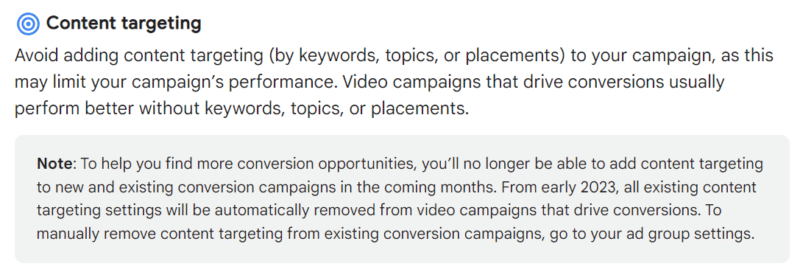
The help article, “Optimize your Video campaign for more conversions” contains a content targeting section that recommends avoiding the addition of content targeting (by keywords, topics or placements) in campaigns.

Furthermore, the article mentions that in early 2023 all existing content targeting settings will be automatically removed “from video campaigns that drive conversions.”

Academy for Ads

A major blow to targeting? These content targeting options are beloved by many advertisers due to the granularity they provide. Placements could target YouTube Channels, specific videos, video lineups, URLs, Apps, or collections.

With the current targeting, advertisers could match ads to channels/videos to deliver more customized messages to audiences. This change will effectively put an end to the hyper-targeting that made YouTube so appealing for ad dollars.

Another major blow is the loss of keyword targeting on the self-proclaimed 2nd largest search engine in the world. The removal of query targeting on a (video) search engine hurts.

While keywords on YouTube haven’t historically been as powerful as traditional search, it has been a way for advertisers to help answer queries with their video content. There is no doubt that advertisers will need to get more creative in order to hit their target audience.

What will happen to existing campaign when the change occurs? Advertisers running YouTube content targeting campaigns that leverage keywords, topics or placements will have the targeting removed. The article states:

“All existing content targeting settings will be automatically removed from video campaigns that drive conversions.”

We’ve reached out to Google for more clarification on this, but if you are running placement/keyword/topic targeting, this could wreak havoc on your campaigns. Stay tuned for this transition date as you won’t want to have all targeted swept from your accounts.

Why we care. A major benefit of YouTube ads has been the powerful targeting options, many of which will now be removed early next year. For performance marketers, the ability to fine-tune ads to channels or videos will no longer exist nor will the use of keywords on the second-largest search engine. These clearly can’t be chalked up to privacy or PII issues, but rather as a fundamental change away from content targeting options on the network.

If you are running ads using content targeting options, you should stay tuned to updates as those targeting settings will be automatically removed from your campaigns. With less targeting, you’ll reach a larger audience and may spend more on less qualified users.

The post Google Ads to discontinue content targeting for YouTube conversion campaigns in 2023 appeared first on Search Engine Land.

Original source: https://searchengineland.com/google-ads-to-discontinue-content-targeting-for-youtube-conversion-campaigns-in-2023-388683

How Latino Entrepreneurs Can Maintain Their Resilience During These Uncertain Times

Home Business Magazine Online

Despite the COVID-19 pandemic, Latino small business owners have maintained their record of entrepreneurial success. The pandemic has negatively affected the finances and operations of small businesses, posing significant challenges for entrepreneurs particularly minorities. However, the entrepreneurial spirit in the Latino community remains strong. In fact, according to a small business report recently released by the White House, Latino entrepreneurs are launching new businesses at the fastest rate in over a decade and 23% faster than before the pandemic.

Characteristics That Enable Hispanics to Persevere as Entrepreneurs

Latino entrepreneurs pride themselves on specific characteristics that contribute to their entrepreneurial spirit and have enabled them to persevere even in uncertain times. They have a strong work ethic that embodies the virtues of hard work, ambition, and creativity. With grandparents or parents who were immigrants, they learned that America is a place where anything is possible. Building a business is a great way to provide stability for family and community.

Hard Work

Hard work is the cornerstone of Latino entrepreneurial success. Many grew up with family members who worked with their hands for a living or woke up before anyone else in the family, to open their shops or restaurants. They learned that one does not leave work unfinished.

Strong Work Ethic

According to a 2017 study, Latinos possess a unique work ethic that has produced a workforce willing to do whatever it takes to attain their goals. These business owners also embodied natural creative instincts and strong determination to create a path when none existed. This enables Latino small business owners to creatively problem solve. It also helps them to adapt to unforeseen market conditions, the latest industry developments, or a sudden revenue loss. Instead of following a business plan that does not account for unexpected challenges, business owners have used their ingenuity to adapt and navigate these tricky new developments. This has proven especially important during these uncertain times.

Risk Taking

Lastly, in addition to being natural entrepreneurs, Latino entrepreneurs in this study were also comfortable taking high risks to achieve their goals. This is a crucial aspect of entrepreneurship. In fact, according to a study commissioned by Herbalife Nutrition and conducted by One Poll earlier this year, 88% of small business owners and employees surveyed believe that to be successful, people can’t be afraid to make mistakes

Challenges Faced by Latino Entrepreneurs

Latinos encompass many attributes that have enabled them to be strong entrepreneurs and demonstrate resilience in continuing to grow organically and open businesses in various industries. However, they still face significant challenges, such as less access to financing and credit. In a December 2021 study, the consulting firm McKinsey found that Latinos had the lowest rate of obtaining bank and financial institution loans to start their businesses compared to other racial and ethnic groups. The study also showed that they rely more on personal finances and receive a tiny fraction of the billions of dollars invested annually by venture capital firms, which inhibits the potential of starting a business and the possibility of bringing on employees and expanding businesses.

Before hiring employees, small businesses need a strong startup base capital and a stable and predictable revenue stream. Crossing that employer threshold is particularly challenging for Latino-owned businesses. A 2018 Stanford report found that for every 100 self-employed Latino business owners, there are only about 16 businesses with employees — almost half the rate of non-Latino businesses. Moreover, the challenge of getting financing is a significant factor.

Resources That Can Help Hispanic Entrepreneurs Succeed

Fortunately, Latino entrepreneurs do not have to confront these obstacles alone. There are several organizations, government agencies, and programs that can provide aspiring Latino small business owners with the support, education, and networking opportunities necessary to start new businesses or enhance their existing ones, such as how to acquire financing. Additionally, many of these valuable resources are easy to access online. These organizations include, but are not limited to the following:

LULAC

LBAN

  • The Latino Business Action Network (LBAN), a San Jose, Calif.-based nonprofit, works closely with Stanford University to fund and manage Hispanic-focused entrepreneurship programs. With a focus on growing businesses through “entrepreneurship research, education, and networks,” LBAN simultaneously teaches entrepreneurs how to scale and mentors them on topics like wealth building. The organization is responsible for more than 600 graduates through the Stanford Latino Entrepreneurship Initiative Education-Scaling Program, who now employ more than 30,000 people through their businesses.

USHCC

  • The U.S. Hispanic Chamber of Commerce (USHCC), founded in 1979, serves as the umbrella organization for more than 200 local Hispanic chambers of commerce and Hispanic business organizations around the U.S. The USHCC works to develop national programs to help Hispanic businesses. It promotes trade between Hispanic businesses in the U.S. and Latin America. Moreover, it provides technical assistance and training to Hispanic entrepreneurs. Additionally, the organization hosts events and programming to help businesses stay connected and informed.

Local Chamber of Commerce

  • Your local chamber of commerce is also a great resource. It provides access to valuable resources, discounts, and relationships that help businesses save money and market their products. Joining a chamber of commerce can boost sales and significantly improve a local business’ visibility and credibility.

Final Notes

The road to entrepreneurship is not easy. It comes with high rates of failure, unknowns, and financial instability, especially in today’s challenging times. However, with the right attitude, effort, support, resources, and tools, overcoming these challenges is possible. The rewards can be worth it. Are you interested in starting your own entrepreneurial journey? Learn more at IAmHerbalifeNutrition.com

The post How Latino Entrepreneurs Can Maintain Their Resilience During These Uncertain Times appeared first on Home Business Magazine.

Original source: https://homebusinessmag.com/success-stories-lifestyles/latino-entrepreneurs-maintain-resilience-uncertain-times/

FASB Topic 842 and the New Lease Accounting Standards – How They’ll Affect You

Home Business Magazine Online

Accountants and business owners alike often bemoan accounting updates ― even if their intentions were to improve how to do things. They can often bring about confusion, mistakes, and frustration. Business owners who do not have their finger on the pulse could easily miss the updates, such as the new lease accounting standards, and continue to do things the old and now defunct way. Surprisingly, accountants can do this, too. It is why you need to double check your accounting for lease arrangements and make sure you are adhering to ASC 842 lease accounting standards and not still processing things under ASC 840.

Some Quick Definitions

We are going to cover some abbreviations in this article. Here is what they stand for:

GAAP

Generally accepted accounting principles. It is the practice that businesses and accountants use to govern the drawing up of accounts in the USA.

ASC 840

The older guidance regarding lease accounting. ASC stands for accounting standards committee.

ASC 842

The newer guidance for lease accounting.

FASB

Financial accounting standards board. It is a private standard setting body whose purpose is to improve and in some cases establish standards for U.S GAAP.

IFRS

International financial reporting standards. They are a set of accounting standards set out by the international accounting standards board

IASB

International accounting standards board.

So, now that we have covered these confusing abbreviations, what is FASB topic 842 and why is it important to you and your business?

What Is ASC 842?

ASC 842 is, simply, the name for the new lease accounting standards set out under U.S. GAAP (generally accepted accounting practice). It covers public and nonpublic companies and supersedes the old ASC 840 guidance that stood in place previously. The FASB and IASB jointly developed ASC 842. Both standards required more transparency for the stakeholders of financial statements. As such, FASB topic 842 provides management and anyone scrutinizing accounts more transparency. They can fully explore the lease arrangements on the balance sheet.

How It Will Affect Your Business

It all comes down to the balance sheet. Under the old guidelines, you could place a few items off the balance sheet. However, the new guidelines are all about increasing transparency, so the amount of allowable off balance sheet transactions reduces severely. You need to make sure you show the right leases on the balance sheet.

What You Should Do

Quite simply, you need to update your accounting practices to cater for ASC 842 if you have not already. ASC 840 is no longer the right form of accounting. Speak to your accountant, and make sure he/she is aware. This is obviously far more important if your business has occupancy with multiple leases. With that said, even if it is just one lease, you still need to account for it properly.

If you draw up your own accounts, make sure you follow these newer lease accounting guidelines to stay compliant. There is, of course, lease accounting software to help you out, or you can look at hiring an accountant.

You should also set up alerts or follow an accountancy blog so that you will know about these changes in the future with plenty of time to implement them. Although some of these changes can be frustrating, at the same time, some of them may benefit you as a business and save you money. Therefore, it is always worth keeping an eye on changes to accounting standards, such as any future lease accounting changes.

The post FASB Topic 842 and the New Lease Accounting Standards – How They’ll Affect You appeared first on Home Business Magazine.

Original source: https://homebusinessmag.com/money/accounting-and-bookkeeping/fasb-topic-asc-842-new-lease-accounting-standards-affect-you/