8 Mistakes You’re Making Every Time You Need a New Password

Home Business Magazine Online

It’s nearly impossible to try and count how many new passwords you had to make last year. The reason behind this is that you just forget about registering to this random site or e-store, but what if, by doing so, you’ve exposed yourself to malicious online agents?

To stay safe, you must become better at making new passwords.

Sure, the password is not the only thing you need to protect your devices, but it’s a step you can’t move past. With that in mind, here are the top eight mistakes you make every time you need a new password (so you can stop making them).

1. Picking something meaningful

If you pick something meaningful, people will have a much easier job figuring out your password just by thinking about it. Just think about it: all they need to do is figure out the name of your pet, your mom’s maiden name, or your kid’s birthday. Figuring these out is easier than you think.

Also, you need to understand that capitalizing a random letter or adding a random number at the end of your “meaningful” password won’t fix the issue. Random means that it shouldn’t be related to the original concept. It means either something that no one in their right mind would ever imagine could be your password or, even better, a random string of letters, numbers, and symbols.

2. Picking something simple or obvious

Is “123456” a meaningful password? Of course not, but is it a simple one? Yes! Surprisingly enough, it’s so common that the hacker may attempt it even without any tool, just for the sake of it. How common exactly? 23.2 million in the UK apparently use it! Now, what we’re going to say is a bit controversial, but cybersecurity is more than “123456,” if you rely on that, you’ll never be safe.

We understand why people use these simple passwords – they’re lazy or can’t be bothered to create or memorize another unique password. We get that; however, using this excuse is quite disingenuous. After all, if you lay in bed and remembered that you didn’t lock the front door in the middle of the night, would you just go back to bed hoping nothing bad would happen? Of course not! So, why not apply the same principle to cybersecurity?

3. Using the same password as on other platforms

As we’ve already mentioned, people are lazy but are not always aware of the fact. For instance, they may try to develop a great password, but then they’ll believe that this one password is enough, and they’ll use it for every platform.

In theory, this could work. After all, it’s a strong password, which is harder to crack than several weaker ones. The problem is that once it’s cracked, your entire online persona is at risk.

So, it’s not just enough for a password to be strong. Passwords need to be strong and unique. This means you must develop several great passwords, not just be content that you made one. Now, later on, we’ll also discuss why it’s important to change these passwords regularly. If you’re worried about having to come up and memorize dozens of passwords, worry not; we’ll address the solution to this problem in our next segment…

4. Not using tools

Password managers will automate the process from the list, which is just one reason why around a third of people use them. In fact, picking a software which is best for password control is one of the simplest things you can do to boost your online security. You can develop unique, randomized passwords in seconds; you don’t have to memorize or write them down manually, and changing them every 60 days is not that big of a deal.

Most password managers offer a multi-device sync, which means you’re not just protecting the device it’s on but actively protecting your entire online presence. This is one great perk of using password managers that you shouldn’t downplay, even if it’s not your primary objective.

Remember that the majority have a password auditing feature, which means you can apply them retroactively. So, if you habitually set bad passwords in the past, now’s the time to fix this.

5. Using keyboard sequences

Sometimes, you’re making a password that’s so easy to crack, but you’re unaware. This is often the case when using keyboard sequences. Go to the single-player video game you’ve just played and check the name of your last savegame file. Chances are that it’s something like:

  • Asasaada
  • Qwerty
  • Zxcvb

The thing is that these are all natural keyboard sequences that you’re not even aware of using. They’re also incredibly easy to crack. Not only that, but these sequences are something that a hacker might try manually before they entrust it to a cracking tool. Like 123456, qwerty is an incredibly common password, used by 3.8 million people in the UK.

6. Ignoring physical world threats

Writing your password on paper will make it impervious to hackers, which is perhaps why 37% of people do it. But what happens when you lose this piece of paper? What if you have the username or email on this paper (as many people do)? The bottom line is that you can’t ignore these real-world threats.

Then again, losing a piece of paper is not the only potential threat. What if you tell someone who’s not as trustworthy as you assume they are? What if you’re away and can’t log in from your home, so call/text a friend and ask them to log in for you? What if their device doesn’t have an antivirus or an uninstalled keylogger they’re unaware of?

This is like giving a key to your home to someone else. Sure, you may trust them not to be malicious, but can you trust them not to get pickpocketed? How could you?

7. Think that the platform rules are enough

No, password rules are not enough on their own. Sure, a password may insist that you use at least:

  • Eight characters
  • One capital letter
  • One number
  • One symbol

Following that logic, “P@ssword1” would be a great password. However, it’s a terrible password that would be incredibly easy to guess, despite honoring all the rules in the guidelines.

However, this is not the point. The point is that this rule exists to prevent you from taking the path of least resistance. It prevents you from using “password” as your password. It tries to force you to randomize your passwords, but if you’re dead set on not making an effort, you have no one else to blame when your password gets cracked.

Also, sometimes, there will be no rules preventing you from using “password” as a password. This doesn’t mean that it’s ok to make it that easy.

8. Not changing it often enough

You should change your password every 60-90 days. While this is a soft rule and, for the most part, your strong password will remain intact, this is that extra thing you can do to make things secure.

The problem is that it’s a lot of effort. Also, if you have ten accounts (and in practice, you have a lot more), you must change them every 90 days. This would mean you would have at least 40 different passwords yearly. Just think about how hard it is to come up with just one that fulfills all the criteria we’ve discussed earlier.

Fortunately, with the password manager (that we’ve previously discussed), this isn’t that big of a problem.

It doesn’t take more than a minute to come up with a strong password; there’s no excuse

Your password is likely the first and the last line of defense on any platform. Most of the time, people will try to guess it, and if it’s weak enough, they may fail. We’re not even talking about hackers. We’re talking about fake friends, angry exes, and malicious coworkers. At the very least, make it a bit harder.

The post 8 Mistakes You’re Making Every Time You Need a New Password appeared first on Home Business Magazine.

Original source: https://homebusinessmag.com/lifestyles/success-lifestyles/8-mistakes-making-every-time-need-new-password/
Google rolls out automatically created assets to all advertisers

Google has rolled out automatically created assets (ACA) for general availability.

The search engine has also expanded the feature to seven new languages:

  • Dutch
  • French
  • German
  • Italian
  • Japanese
  • Portuguese
  • Spanish

Previously, ACAs were only available for advertisers running campaigns in English in open beta.

What are automatically created assets? Automatically created assets is a campaign-level setting that enhances the relevance of your Search ads by generating custom headlines and descriptions based on your ad’s context.

Why we care. ACAs can boost ad relevance by matching ads and landing pages better, however, it means ceding control to Google’s AI. This might not be suitable for highly regulated industries or brands with strict compliance standards, as you won’t have full control over the ad’s message.

Getting started. To begin using automatically created assets, you have two options:

  • You can opt in from your campaigns’ settings, where you’ll find the relevant setting to enable this feature.
  • Alternatively, keep an eye out for the “Enable automatically created assets” recommendation on the Recommendations page, and simply follow the prompts provided there to get started.

What has Google said? A Google spokesperson said in a statement:

  • “Once enabled, ACAs can improve the Ad Strength of your responsive search ads and show new assets alongside assets you’ve already provided.”
  • “If there are any automatically created assets you’d prefer to stop using, you can remove them from your ads.”
  • “In the coming months, for advertisers with English assets in the US and UK, automatically created assets will start using generative AI to help advertisers create even more assets and make them better tailored to people’s search queries.”

Get the daily newsletter search marketers rely on.

<input type="hidden" name="utmMedium" value="“>
<input type="hidden" name="utmCampaign" value="“>
<input type="hidden" name="utmSource" value="“>
<input type="hidden" name="utmContent" value="“>
<input type="hidden" name="pageLink" value="“>
<input type="hidden" name="ipAddress" value="“>

Processing…Please wait.

function getCookie(cname) {
let name = cname + “=”;
let decodedCookie = decodeURIComponent(document.cookie);
let ca = decodedCookie.split(‘;’);
for(let i = 0; i <ca.length; i++) {
let c = ca[i];
while (c.charAt(0) == ' ') {
c = c.substring(1);
}
if (c.indexOf(name) == 0) {
return c.substring(name.length, c.length);
}
}
return "";
}
document.getElementById('munchkinCookieInline').value = getCookie('_mkto_trk');


Campaign level. Generative AI for ACAs will be implemented at a campaign-level opt-in setting only. It is not available at account level. The advantage here is as you can control which campaigns are powered by AI when testing.

Deep dive. Read Google’s responsive search ad guide for best practices on creating responsive search ads.

The post Google rolls out automatically created assets to all advertisers appeared first on Search Engine Land.

Original source: https://searchengineland.com/google-rolls-out-automatically-created-assets-to-all-advertisers-432224

A guide to multichannel marketing for one-person marketing teams

Being a one-person marketing team can be both exciting and stressful.

You have a high level of control over the company’s creative messaging, which gives you the power to truly launch a brand.

But you’re responsible for building and executing a company’s entire marketing strategy, which can feel overwhelming given the sheer amount of effort it takes to be present in the right places at the right times. 

Whether you’re a solopreneur, the first marketing hire at an early-stage startup, or the sole marketing employee at an emerging business, these tips are for you.

Keep reading to learn how to build a multichannel marketing strategy as a one-person marketing team.

Step 1: Align with executive stakeholders on a business plan

Being efficient as a one-person marketing team is all about precision and scalability.

Adopting an “action first, planning later” mentality may be tempting – especially for early-stage startups – but this approach will only cause more headaches later when you’re forced to make time-consuming changes to a large number of pages or delete entire projects en masse.

You also risk losing revenue if you launch marketing campaigns without understanding your target audience. Your business objectives and the goals you set as milestones toward meeting those objectives will be the north star guiding all your marketing efforts.

Before embarking on your marketing journey, make sure you align with executive stakeholders on these business plan essentials:

  • Mission statement
  • Vision
  • Core values
  • Unique value proposition or selling point
  • Target audience
  • Perceived competitors
  • Business goals and objectives
  • Brand guidelines (including voice and tone)

Step 2: Establish your online presence with your company website

After you’ve outlined your business plan, your next step is to make sure your online presence:

  • Is consistent with your brand guidelines.
  • Speaks to your target audiences.
  • Reflects your brand’s mission, vision, core values and unique value proposition.

Start with the company website.

If you’re just starting out and don’t have the budget to hire a designer, don’t worry about having all the bells and whistles. Many CMS platforms come with built-in templates that can be customized with your brand logo and colors.

The most important part of your website will be the content on its pages. Make sure your site provides an accurate representation of your brand and the products/services you offer.

Your content should speak volumes about your brand or product using as few words as possible. Write in the language of your target audience, not the language you use internally.

Step 3: Identify your audience’s favorite social media platforms and ignore the rest (for now)

As a one-person marketing team, you can’t be everywhere at once no matter how badly you might want to be.

Maintaining an active presence on Facebook, Instagram, TikTok, LinkedIn, X and Pinterest will lead to burnout with minimal results to show for all the additional effort. 

If you haven’t done so as part of your business plan (see step 1), you’ll want to create buyer personas for each of your target audiences and align your marketing efforts to guiding those personas through each stage of their buyer journey.

Identify your personas’ favorite social platforms and focus your efforts only on the platforms with the highest engagement potential.

If your business doesn’t have an established social presence yet, look to your competitors:

  • What channels do they have the most success with, and how do they interact with users on those channels?
  • What are their most successful posts, and what type of content do those posts contain?

Your initial attempts at social media marketing might require a bit of trial and error, but identifying what works and focusing your future efforts on tactics with proven business value will help you grow your following (and revenue) enough to make room for some of your more experimental ideas.

Step 4: Create a multichannel content calendar

Once you have your business’s foundation in place (your website) and have identified your target audience’s favorite social channels, your next step is to scope out your content marketing strategy.

If you’ve ever tried looking for online resources about building a content strategy, you’ve probably read that you should be posting on social media at least once a day every day as a bare minimum.

As a one-person marketing team, posting every day might not be viable, and that’s OK. The key is to post consistently, and to consistently provide value.

Start by posting valuable informational content once or twice a week on the same day(s) each week (finding the best days might require some testing).

A few additional tips for creating a content calendar as a one-person marketing team:

  • Keep a running list of ideas: Maintain a spreadsheet for any content or campaign ideas that may pop into your head throughout the month. On that spreadsheet, add columns for the type of content or campaign you’ll be posting as well as the keyword focus, audience persona, and marketing funnel position the piece of content will be targeting.
  • Adopt a hub and spoke model: Beginning with a few pieces of pillar content (your hub) and expanding on the pillars with related content (your spokes) is a great way to naturally scale a content strategy by providing valuable information related to a topic your audience cares about.
  • Don’t be afraid to reuse content: By human nature, attention is fleeting. The upside to this is that you can repost a piece of evergreen content you wrote three months ago and still gain new engagement. As your content library continues to grow, reposting your most successful pieces of content should become an integral part of your content marketing strategy.
  • Make curated content and integral part of your strategy: Content creation is a full time job in and of itself. As a one-person marketing team, you won’t have the time to consistently write valuable thought leadership. The good news is you don’t need to continuously post your own content to create value for your audience. When done right, curated content can save time, build industry connections, and extend your social reach. (Just don’t forget to give credit to the original creator.)
  • Don’t jump into paid advertising until you have cohesive messaging: Paid advertising is a great way for new businesses to quickly build brand awareness. However, launching an ad campaign with a half-baked landing page or an underdeveloped product runs the risk of leaving users with a bad first impression. Ads may generate brand awareness, but if your brand story or product purpose aren’t clear to new users, you’ll lose money without generating conversions.
  • Leverage your fanbase: Businesses with larger marketing teams or bigger budgets might join an influencer network, but as a one-person marketing team, you’ll probably need to be a bit more creative. Consider asking your current customers to be influencers. Whether you’re a more established brand or an emerging business without a large social following, having real users proselytize about your product will build audience trust and brand awareness.
  • Leverage your coworkers: You may be a one-person marketing team, but expanding your share of voice doesn’t need to be a solo effort. Involve your coworkers from other departments in the process. Have ongoing conversations about what motivates them to do what they do, and make their passions and interests part of your content strategy. Involve them in the sharing process, too. Ask them if they’d be willing to share your posts throughout the week. 
  • Scale your strategy with automation and scheduling: Once you get the ball rolling, invest in a social media management tool like Hootsuite, Buffer, and Loomly. Set aside an hour or two every Friday and schedule your posts for the following week. Create an automated email newsletter and include a few recent pieces of content every month or quarter.
  • Build audience interaction into your strategy: It’s not enough to just post new content on a variety of channels. You’ll also want to set aside time to interact with your followers. Because today’s users expect prompt response times, you should make user interaction a daily practice, even if you only post once or twice a week.

Step 5: Master the art of time management and task prioritization

Ruthlessly prioritizing your time is one of the hardest parts of being a one-person marketing team as you’re often juggling competing demands from different departments.

Yet, expending effort on tasks that don’t clearly align with the business goals you’ve outlined with your executive stakeholders will only lead to problems down the road when you fall behind on your project roadmap.

Organization-wide communication about the tasks you plan to complete, how those tasks will contribute to the business goals, and how long it takes to complete them is vital for operating at peak efficiency.

A few suggestions:

  • Invest in a project management system with built-in time tracking: When you’re just starting out with marketing campaigns and asset creation, gauging how long different tasks take might seem difficult, but continuing to track your time will help you identify trends. You can then block off time to complete these tasks in your calendar and initiate realistic reprioritization discussions with your boss if other projects or emergencies come up that must take precedence over your planned activities. If your company doesn’t have a project management system already, you can start with the free version of ClickUp or Hive.
  • Use hard data to optimize your day: As marketers, we love our data. We optimize our campaigns around it, so why not optimize our days around it? Consider your project management system your virtual assistant, planner, calendar, and to-do list. Obsessively document everything you do and track how long it takes you to do it. At first, this practice may feel counterproductive as it will take time and effort to develop the best system for you, but once you do, you’ll find the time you save by optimizing your day far outweighs the time you spend documenting your tasks. Try to work on your high effort tasks when you have the most energy and save the smaller, less thought-intensive tasks for your low-energy time periods. 
  • Block off “distraction time” each day for conversation and collaboration: Whether it’s a boss who needs frequent status updates or a chatty coworker, encourage anyone who regularly disrupts your workflow to set up regularly recurring meetings with you at a set time and cadence that works with both your schedules. You may need to reinforce your need for uninterrupted “deep work” hours from time to time, but inviting your colleagues to a regular meeting will demonstrate that you care about what they’re saying enough to ensure you can give them your undivided attention. Scheduling regular collaboration meetings is another great way to move projects forward in a more efficient manner.
  • Define what is and isn’t an emergency: If setting up regular meetings with a frequent interruptor isn’t resulting in your desired outcome, your work relationship may be suffering from a miscommunication about what constitutes an emergency. Sit down with the person and come to an agreement on what types of conversations require immediate attention as well as topics and line items that can wait until your next 1:1. If your project requires status updates, come to a mutual agreement on when and how frequently you’ll provide those updates.

Final thoughts

Being a one-person marketing team is an exciting, sometimes stressful opportunity to level up your skill set across a variety of marketing disciplines.

Clear communication and thoughtful planning will make your role feel a lot more manageable.

The post A guide to multichannel marketing for one-person marketing teams appeared first on Search Engine Land.

Original source: https://searchengineland.com/multichannel-marketing-one-person-marketing-teams-431984

Google AdSense adds new tools to make site verification faster and easier

Google AdSense has rolled out two new features to make site ownership verification both faster and easier.

The new site management features are:

  • Real-time site ownership checks: This tool means Google can verify your site ownership in real time whenever you add a new site to AdSense.
  • New site verification method: If you’d rather not display ads on your homepage, this new verification method means you can now just add a meta tag instead of using the AdSense code snippet.

Why we care. Advertisers have previously encountered challenges when attempting to verify site ownership, which not only consumed valuable time but also posed potential financial implications. These new tools are designed to steer you clear of such unnecessary delays, ensuring a smoother process.

Additional improvements. Google AdSense announced that it has also rolled out additional changes to its platform to further help advertisers:

  • Ads.txt improvements: Google AdSense now has a “last crawled data and time” (for example, 17 Aug 2003 16:21) in its “Ads.txt” section, enabling you to see when the platform last checked your ads.txt file. 
  • Check for updates: The platform now features a “Check for updates” button, which allows you to ask AdSense to recheck your ads.txt file.

Get the daily newsletter search marketers rely on.

<input type="hidden" name="utmMedium" value="“>
<input type="hidden" name="utmCampaign" value="“>
<input type="hidden" name="utmSource" value="“>
<input type="hidden" name="utmContent" value="“>
<input type="hidden" name="pageLink" value="“>
<input type="hidden" name="ipAddress" value="“>

Processing…Please wait.

function getCookie(cname) {
let name = cname + “=”;
let decodedCookie = decodeURIComponent(document.cookie);
let ca = decodedCookie.split(‘;’);
for(let i = 0; i <ca.length; i++) {
let c = ca[i];
while (c.charAt(0) == ' ') {
c = c.substring(1);
}
if (c.indexOf(name) == 0) {
return c.substring(name.length, c.length);
}
}
return "";
}
document.getElementById('munchkinCookieInline').value = getCookie('_mkto_trk');


What has Google said? A Google AdSense spokesperson said in a statement:

  • “We’ve made some improvements to site management to make it quicker and easier to verify your site ownership and check your ads.txt status.”

Deep dive. Read Google’s AdSense site list guide or Ads.txt guide for more information.

The post Google AdSense adds new tools to make site verification faster and easier appeared first on Search Engine Land.

Original source: https://searchengineland.com/google-adsense-tools-site-verification-easier-faster-432146

Google quietly increases ad prices to meet targets, claims exec

Google has admitted to quietly tweaking advertising auctions to meet revenue targets.

The search engine “frequently” changes the auctions it uses to sell search ads, increasing the cost of ads and reserve pricing by as much as 5% for the average advertiser.

For some queries, the tech giant may have even raised prices by as much as 10%, according to Google Ad executive, Jerry Dischler at the federal antitrust trial.

Google tends “not to tell advertisers about pricing changes”, he added. 

Why we care. Google’s admission has sent shock waves through the digital marketing community, with some now questioning whether the search engine manipulates Smart Bidding for profit. Digital marketing expert Anthony Higman shared on X:

  • “So I always knew this was the case, but to see it actually stated by the VP of ads is astounding! And what do you think smart bidding is? A smart way for Google to be able to easily manipulate ad prices! SMH.”

Why is Google on trial? Google is on trial for allegedly using underhand tactics to ensure it stays the world’s leading search engine. The U.S. Justice Department claims Google, which owns a 90% market share in search, paid massive sums to companies like Apple to make it the default search engine on products like the iPhone.

What are search ads? Search ads refer to the text and shopping promotions you see displayed at the top of Google’s search results page when users perform queries.

More than 60% of Google’s total revenue is generated by search ads. In 2020, search ads earned the company more than $100 billion, according to Dischler.

Google’s search ad revenue growth has consistently been in the “high teens” since 2012, per documents shown by the Justice Department at the antitrust trial.

Why has Google been tweaking search ad prices? Dischler claimed that staff were “shaking the cushions” to find ways to ensure his team met revenue targets given to Wall Street by Ruth Porat, Google’s Chief Financial Officer. In an email he sent to his team back in May 2019, he wrote:

  • “If we don’t meet quota for the second quarter in a row and we miss the street’s expectations again, which is not what Ruth signalled to the street, so we will get punished pretty bad in the market.”
  • “I care more about revenue than the average person but think we can all agree that for our teams trying to live in high cost areas another $100,000 in stock price loss will not be great for morale, not to mention the huge impact on our sales team.”

When quizzed about this email during the antitrust trial, Dischler said his team’s goal was “to get creative so we could meet our quota.”


Get the daily newsletter search marketers rely on.

<input type="hidden" name="utmMedium" value="“>
<input type="hidden" name="utmCampaign" value="“>
<input type="hidden" name="utmSource" value="“>
<input type="hidden" name="utmContent" value="“>
<input type="hidden" name="pageLink" value="“>
<input type="hidden" name="ipAddress" value="“>

Processing…Please wait.

function getCookie(cname) {
let name = cname + “=”;
let decodedCookie = decodeURIComponent(document.cookie);
let ca = decodedCookie.split(‘;’);
for(let i = 0; i <ca.length; i++) {
let c = ca[i];
while (c.charAt(0) == ' ') {
c = c.substring(1);
}
if (c.indexOf(name) == 0) {
return c.substring(name.length, c.length);
}
}
return "";
}
document.getElementById('munchkinCookieInline').value = getCookie('_mkto_trk');


Why tweaking ad prices matters. If Google can raise ad prices without facing significant competition, it could strengthen the Justice Department’s case that Google holds an illegal monopoly. This is an argument the department can’t use against Google’s search engine itself, as it’s a free product for users. However, they can argue that increased competition could have addressed other issues, such as privacy standards, in the search industry.

Deep dive. Read our Google search antitrust trial updates article for all the latest news from the courtroom.

The post Google quietly increases ad prices to meet targets, claims exec appeared first on Search Engine Land.

Original source: https://searchengineland.com/google-quietly-increases-ad-prices-targets-432155

Microsoft Audience Ads announces new AI bid strategies and market expansion

Microsoft is launching two new automated bid strategies to help “advertisers reach their target audience with minimal effort”:

  • Maximize conversion: Advertisers can use this feature to maximize conversions as much as possible, given the budget.
  • Target CPA: Advertisers can use this feature to maximize conversions as much as possible, given the CPA target and the budget.

The two new offerings are currently in pilot with general roll out planned for October 2023.

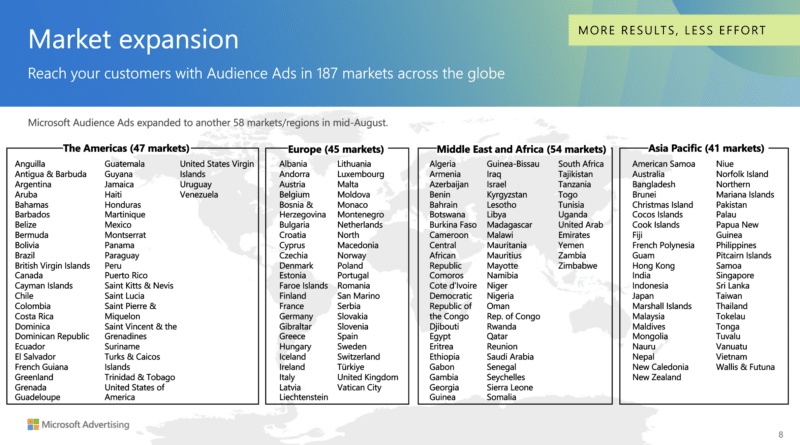
In addition, the tech giant has expanded into 58 new markets, meaning its ads are now served in 187 countries across the globe.

artificial intelligence

Why we care. Automated bidding can save advertisers time and effort, thanks to AI doing the heavy lifting. It takes care of improving your campaign’s performance without you needing to get hands-on. With these particular new bid strategies, you also maintain control as you still have the freedom to set your budget and choose how you want to measure success.

What are Audience Ads? Audience Ads are Microsoft’s native, display ads. These products enable you to target your ideal audience based on Microsoft’s understanding of people’s interests and consumer intent signals. The ads are then served in placements across the web like Microsoft’s MSN, Start, Outlook, and more.

What has Microsoft said? Microsoft Senior Product Marketing Manager Mallory Harwood told Search Engine Land:

  • “We are continuing to invest in more bid strategies for Microsoft Audience Ads to enable advertisers to meet their goals wherever they are across the globe.”
  • “Market expansion has been a huge priority for us across our search and marketing offering. We recently expanded our Audience Ads to 58 new markets, which brings us to 187 countries as of mid August – which is huge and very exciting.”
  • “A couple of years ago, we were only at seven markets – so as you can see, we have been doing a lot of investing very quickly!”

Deep dive. Read Microsoft’s Automated Bidding guidelines for more information.

The post Microsoft Audience Ads announces new AI bid strategies and market expansion appeared first on Search Engine Land.

Original source: https://searchengineland.com/microsoft-audience-ads-automated-bid-strategies-market-expansion-432105

Elon Musk plans to make X (Twitter) a paid-for platform to tackle bots

Elon Musk is planning to make X (formerly known as Twitter) a paid-for platform for all users.

In a bid to tackle the issue of rampant bot activity, he unveiled proposals to roll out small monthly subscriptions during a live conversation with Israeli Prime Minister, Benjamin Netanyahu.

Musk did not specify how much the plans would cost or what features would be included at the lowest tier.

However, he did claim that X now has 550 million monthly users that typically post 100 million to 200 million posts a day – although it’s not yet known what proportion of this data is bots versus authentic users.

This marks a 140% increase on the “average monetizable daily active usage” of 229 million reported by Twitter in May 2022, before Musk’s takeover.

Why we care. Transitioning X to a paid platform could be good news for advertisers because it might mean they get a better-quality audience and fewer problems with bots. That could lead to more conversions and a higher ROI. But there’s a downside: some users might ditch X for free alternatives like Threads, which could shrink the platform’s user base and, in turn, reduce the reach of X advertisers.


Get the daily newsletter search marketers rely on.

<input type="hidden" name="utmMedium" value="“>
<input type="hidden" name="utmCampaign" value="“>
<input type="hidden" name="utmSource" value="“>
<input type="hidden" name="utmContent" value="“>
<input type="hidden" name="pageLink" value="“>
<input type="hidden" name="ipAddress" value="“>

Processing…Please wait.

function getCookie(cname) {
let name = cname + “=”;
let decodedCookie = decodeURIComponent(document.cookie);
let ca = decodedCookie.split(‘;’);
for(let i = 0; i <ca.length; i++) {
let c = ca[i];
while (c.charAt(0) == ' ') {
c = c.substring(1);
}
if (c.indexOf(name) == 0) {
return c.substring(name.length, c.length);
}
}
return "";
}
document.getElementById('munchkinCookieInline').value = getCookie('_mkto_trk');


What has X said? Musk told Prime Minister, Netanyahu:

  • “The single most important reason that we’re moving to having a small monthly payment for use of the X system is that it’s the only way I can think of to combat vast armies of bots.”
  • “Because a bot costs a fraction of a penny, or a tenth of a penny, but if somebody even has to pay a few dollars or something, some minor amount, the effective cost of bots is very high, and then you also have to get a new payment method every time you have a new bot.”
  • “We’re actually going to come out with lower tier pricing. We want it to be just a small amount of money [and] in my view, this is actually the only defense against vast armies of bots.”

Deep dive. Read the X blog for more information about the platform’s latest updates.

The post Elon Musk plans to make X (Twitter) a paid-for platform to tackle bots appeared first on Search Engine Land.

Original source: https://searchengineland.com/elon-musk-x-twitter-paid-for-platform-bots-432119

Google launches new AI tool to improve YouTube ad optimization

Google Ads has launched a new feature to assist advertisers in optimizing their YouTube campaigns

Known as Creative Guidance, this innovative tool is now available through Recommendations and has been integrated into Video Analytics within Google Ads.

Creative Guidance leverages AI to evaluate your content and offer best-practice feedback. For example, if critical information is missing from your video ad, Creative Guidance will notify you, ensuring that your campaigns are as effective as possible.

Why we care. Creative Guidance offers rapid feedback and actionable steps for enhancing video ad performance, ensuring ideal setup and quick optimization to maximize your video ad’s performance.

Creative attributes. Creative guidance can detect if your video ad is missing the following key creative attributes:

  • Brand logo: Shows a prominent brand logo in the first 5 seconds.
  • Video duration: Follows the recommended video length based on your marketing objective.
  • Voice-over: Uses a high-quality, human voice-over.
  • Aspect ratio: Ad group includes all 3 video orientations, at least (1) horizontal 16:9, (1) vertical 9:16, and (1) square 1:1.

Depending on what’s missing in your video ads, you’ll get suggestions for high-impact improvements as well as links to handy tools that could boost the performance of your campaign.

Google has confirmed that it will be introducing more attributes in the not-too-distant future.

How it works. To access Creative guidance in Google Ads, follow these instructions:

  1. In your Google Ads account, click the Campaigns icon Campaigns Icon.
  2. Click the Assets drop down in the section menu.
  3. Click “Videos”.
  4. Click the “Analytics” tab next to “Videos”.
  5. Select your video ad in the drop down menu.
  6. In the “Ideas to try” section below the retention curves, you’ll find the creative attributes you’re missing with recommendations on how to take action.

The steps listed above are part of a new Google Ads user experience that is set to launch for all advertisers in 2024.


Get the daily newsletter search marketers rely on.

<input type="hidden" name="utmMedium" value="“>
<input type="hidden" name="utmCampaign" value="“>
<input type="hidden" name="utmSource" value="“>
<input type="hidden" name="utmContent" value="“>
<input type="hidden" name="pageLink" value="“>
<input type="hidden" name="ipAddress" value="“>

Processing…Please wait.

function getCookie(cname) {
let name = cname + “=”;
let decodedCookie = decodeURIComponent(document.cookie);
let ca = decodedCookie.split(‘;’);
for(let i = 0; i <ca.length; i++) {
let c = ca[i];
while (c.charAt(0) == ' ') {
c = c.substring(1);
}
if (c.indexOf(name) == 0) {
return c.substring(name.length, c.length);
}
}
return "";
}
document.getElementById('munchkinCookieInline').value = getCookie('_mkto_trk');


What has Google said? A spokesperson for Google Ads said in a statement:

  • “We’ll let you know if your video is missing a best practice. If we have a recommendation or tool to implement a suggestion such as adding a voiceover, we’ll direct you to it.”
  • “Voiceover has a big impact on YouTube. Thanks to the power of AI, quality voiceovers in 15 languages are accessible directly in Google Ads (both in the asset library and built into the video creation tool) and coming soon to Ads Creative Studio.
  • “Similarly, if your campaign would benefit from videos in different durations, we’ll guide you to Trim video. Or, if you’re missing a horizontal, square or vertical video, you can easily create one using a variety of high-quality templates.”
  • “These features empower marketers to take charge of their creative. AI can help turbocharge performance by tuning creative elements across all the different viewing experiences and content that YouTube viewers love.”

Deep dive: Read Google’s Creative guidance in Google Ads update in full for more information.

The post Google launches new AI tool to improve YouTube ad optimization appeared first on Search Engine Land.

Original source: https://searchengineland.com/google-ads-creative-guidance-improve-youtube-ads-432016

What’s new with the Google helpful content update

The September 2023 Google helpful content update is rolling out as of yesterday at about 4:20 pm ET and while we expect it to continue to roll out for the next two weeks, everyone wants to know what to expect from this update.

Thankfully, Google dropped some clues in its revisions to its search documentation about what has changed with the Google helpful content system.

Let’s dive in.

Improved classifier

When Google announced this update, it mentioned there is an “improved classifier” for the helpful content system. Google wrote, “The September 2023 helpful content update is rolling out with an improved classifier.”

What exactly was improved? That is hard to say but Google did drop more hints.

Hosted third-party content

Google added a new section to its help document on the helpful content update on the topic of hosted third-party content. It reads, “If you host third-party content on your main site or in your subdomains, understand that such content may be included in site-wide signals we generate, such as the helpfulness of content. For this reason, if that content is largely independent of the main site’s purpose or produced without close supervision or the involvement of the primary site, we recommend that it should be blocked from being indexed by Google.”

To be clear, this is not really new advice. In 2019, we reported that Google’s thoughts of hosting third-party content on other sites.  “We’ve been asked if third-parties can host content in subdomains or subfolders of another’s domain. It’s not against our guidelines. But as the practice has grown, our systems are being improved to better know when such content is independent of the main site & treat accordingly. Overall, we’d recommend against letting others use subdomains or subfolders with content presented as if it is part of the main site, without close supervision or the involvement of the primary site. Our guidance is if you want the best success with Search, provide value-added content from your own efforts that reflect your own brand.” Google stated in a three-part tweet.

Gary Illyes from the Google Search team added more background on why Google now added this section to the helpful content documentation. “We’ve heard (and also noticed) that some sites “rent out” their subdomains or sometimes even subdirectories to third-parties, typically without any oversight over the content that’s hosted on those new, generally low quality micro-sites that have nothing to do with the parent site. In fact the micro-sites are rarely ever linked from the parent sites, which don’t actually want to endorse these often questionable sites. The only reason the owners of these shady (?) micro-sites rent the sub-spaces is to manipulate search results., he posted on LinkedIn.

Content written by people or machines

Google also removed a few words that clearly reiterated its stance on using AI to help produce content. Google removed the words “written by people” and just wrote “helpful content created for people in search results.” 

Here are before and after screenshots:

Alphabet Inc.

So humans do not need to fully write the content for that content to be considered helpful according to Google’s helpful content system.

Self-assess your content if hit

If you think this last helpful content update negatively impacted your site, Google said you should self-assess your content. Google added, “If you’re producing helpful content, then you don’t need to do anything; in fact this system may be good for your site, as it is designed to reward helpful content.”

“If you’ve noticed a change in traffic you suspect may be related to this system (such as after a publicly-posted ranking update to the system), then you should self-assess your content and fix or remove any that seems unhelpful,” Google added.

Reviewed by experts

Google updated the creating helpful content document to add “or reviewed” to this line of text “Is this content written or reviewed by an expert or enthusiast who demonstrably knows the topic well?” under the experise questions section.

This again is not new information from Google, Google has been saying it is helpful to have your content reviewed by an expert, if you are not an expert on that topic.

Changing dates of content

One of my personal pet peeves is when sites change the dates or even worse, do not list dates, on their news content. Google added this line “Are you changing the date of pages to make them seem fresh when the content has not substantially changed?” under the avoid creating search engine-first content section.

We see it all the time where sites will make a couple of changes to their content from years ago, update the date, and republish it. This is a common SEO “strategy” that is on Google’s radar.

Adding or removing content for search engines

With the whole CNet debate from a couple of months ago, Google also added this line to that section “Are you adding a lot of new content or removing a lot of older content primarily because you believe it will help your search rankings overall by somehow making your site seem “fresh?” (No, it won’t)”

Be careful when deciding what content to add or remove and think about why are are adding or removing that content.

More to come

In May, Google told us a helpful content system update would be coming this year. Google said this update would enable the helpful content system to “more deeply understand content created from a personal or expert point of view.” Also:

  • “We’re also improving how we rank results in Search overall, with a greater focus on content with unique expertise and experience,” Google said a few months ago.

But Google said this is not today’s update:

  • “This work is still continuing and is not part of this particular update. We’ll share more about our work in this area in the future,” Google wrote.

So this is not part of the September 2023 helpful content update.

The post What’s new with the Google helpful content update appeared first on Search Engine Land.

Original source: https://searchengineland.com/whats-new-with-the-google-helpful-content-update-431994

Growing Your Team Through H1-B Visa Sponsorship

Home Business Magazine Online

The H1-B visa program allows companies to sponsor foreign workers who have specialized skills. Especially if you have a job opening that’s hard to fill through the existing labor pool, sponsoring an H1-B applicant is a great way to grow your team. However, there is more to sponsorship than just finding a job opening, getting some applicants, and doing the paperwork. Here is what you need to know about the sponsorship process.

Identifying a Specialty Need

You will need to prove to the government that the work is specialized. Also, the specialized skills inherent to the work must be hard to come by either because of a tight U.S. job market or due to the extreme uniqueness of the job itself. Industries like IT, healthcare, scientific research, academic and engineering employ H1-B visa holders. These tend to be the jobs that appear on the news during reports about tight labor markets.

If you’re unsure whether a job fits the mold, you can compare it to frequently granted applications. H1-B Visas are commonly granted for employees in Information Technology, medical, dental, and educational fields, as well as many other specialized occupations.

Labor Condition Application

Your business will have to document its eligibility to be a sponsor. Likewise, it will have to provide detailed information about the job. You should be prepared to provide financial statements if necessary. Similarly, you will need to provide an assessment of the labor conditions at the business and information about compensation, benefits, complaint processes and prevailing wages in the local area.

Notably, your business must also prove that it isn’t discriminating against U.S. workers. This may include documenting the difficulty your enterprise has had in finding qualified American applicants during previous hiring attempts.

Duration

One of the appealing aspects of the H1-B program is that it has a long duration. The initial grant includes three years of work eligibility for the employee. An additional three-year extension for a total of six years is available, too.

Under special circumstances, the government may grant further extensions in one-year increments. Do note that many H1-B holders will become eligible for green card status before their sponsorship period ends. If you know you have a keeper for your team, your business can be the green card sponsor. This allows the employee to achieve long-term resident alien status or even seek citizenship. Companies that have great track records of helping employees move through the sponsorship system will attract more candidates.

Helping Applicants

A sponsor company can provide significant support to make the process easier for applicants. Many firms offer legal assistance for H1-B applicants. Communicate with the applicant well throughout the process, too. Try to be culturally sensitive, especially if an applicant doesn’t speak English natively. When applicable, provide support for family members who may use dependent visas to come with the applicant to the U.S.

You should also have resources available for the renewal process. Legal support if an extension is delayed or rejected can make a big difference.

If your company requires specialized labor, the H1-B system may be the best way to expand the labor pool. With access to applicants from all over the world, a company can quickly grow its team with qualified and motivated employees.

The post Growing Your Team Through H1-B Visa Sponsorship appeared first on Home Business Magazine.

Original source: https://homebusinessmag.com/management/employees/growing-team-through-h1-b-visa-sponsorship/