PPC is a tough game – you have to accept it

To get results from paid search, you’ll need to deliver better campaigns and increase your bids, which drives costs up.

However, increasing your bids won’t always mean more clicks. Eventually, you’ll reach a point where increased bids will only return little to no gain.

This is the law of diminishing returns at play. When running PPC campaigns, you are contending with this concept and many other factors outside your control.

In this article, we’ll explore the law of diminishing returns and various factors making paid search even more demanding today. This will help you set better expectations when assessing your PPC performance.

The law of diminishing returns

In economics, the law of diminishing returns states that as an organization increases its investment in a specific area, the rate of profit generated by that investment will eventually reach a point where it cannot continue to rise, assuming that all other variables remain constant. 

For this reason, additional investment in that area will result in a decreased rate of return. At a certain stage of expansion, the return on investment that applies to additional units produced (marginal ROI) reaches a negative value.

Beyond this point, the total outcome will start declining. Even if it remains positive, it is not as high as the maximum.

Law of diminishing returns

This principle highlights the importance of finding the optimal level of investment to maximize the overall profit. The “sweet spot” is where the marginal ROI changes from positive to negative, specifically where the marginal return equals zero.

As every resource is limited, we observe that the supply shows decreasing responsiveness to the price change, and eventually does not matter how high the price is. The supply won’t be higher. This phenomenon is described as the law of diminishing elasticity.

Price elasticity (E) measures the responsiveness of the demand or supply to a change in the price of a good or service. It is calculated as the percentage change in the quantity of a good or service demanded or supplied in response to a percentage change in its price. 

Prce elasticity
Sometimes the symbol of increase “∆” is replaced by “d” to indicate that it refers to a small change.

If the price elasticity is greater than one, the demand or supply is said to be elastic, meaning that a slight change in price leads to a relatively larger change in the demand or supply. If the price elasticity is less than one, the demand or supply is said to be inelastic. 


Get the daily newsletter search marketers rely on.

<input type="hidden" name="utmMedium" value="“>
<input type="hidden" name="utmCampaign" value="“>
<input type="hidden" name="utmSource" value="“>
<input type="hidden" name="utmContent" value="“>
<input type="hidden" name="pageLink" value="“>
<input type="hidden" name="ipAddress" value="“>

Processing…Please wait.

function getCookie(cname) {
let name = cname + “=”;
let decodedCookie = decodeURIComponent(document.cookie);
let ca = decodedCookie.split(‘;’);
for(let i = 0; i <ca.length; i++) {
let c = ca[i];
while (c.charAt(0) == ' ') {
c = c.substring(1);
}
if (c.indexOf(name) == 0) {
return c.substring(name.length, c.length);
}
}
return "";
}
document.getElementById('munchkinCookieInline').value = getCookie('_mkto_trk');


Why are CPCs so high?

The laws of diminishing returns and elasticity apply to advertising.

To generate more traffic and conversions through PPC, you have to be more aggressive and competitive, increasing bids and, in turn, accepting higher conversion costs.

Increasing cost per click (CPC), however, leads to smaller and smaller increases in traffic. Eventually, you’ll reach a point when there’s no chance to get more traffic from a specific keyword (i.e., if the ad ranks #1 for all searches with 100% impression share). 
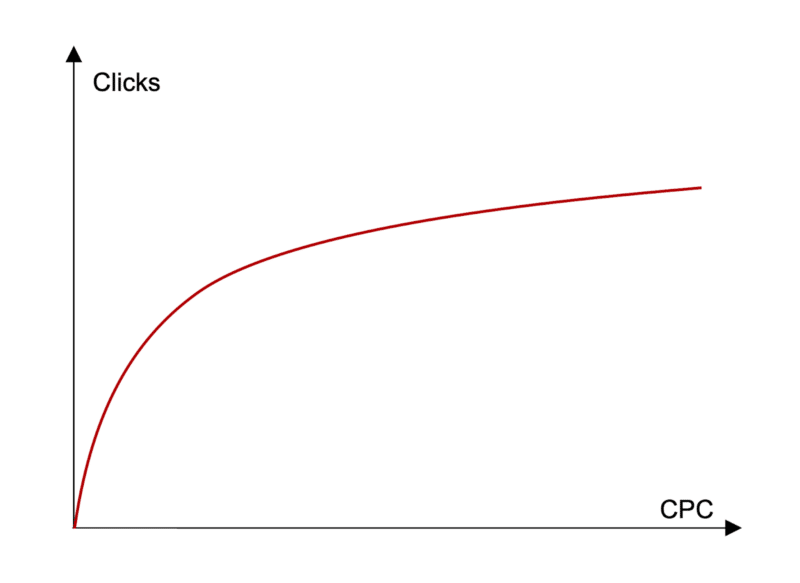
PPC rising clicks and CPCs

The law on diminishing returns is also reflected in the total budget. You can see how these costs can change in the Google Ads Performance Planner, as shown in the illustration below.

Google Ads Performance Planner

In most cases, the relationship will be fairly straightforward for campaigns that are not under or overinvested. To get 10% more traffic, you need to accept a ~10% higher conversion cost or a ~10% lower return on ad spend (ROAS).

This means that Google’s typical price elasticity of supply (the relative ratio of traffic increase to CPC increase) is 1.

Why is this the case? If a vendor increases their margin by 10% and loses 20% of their customers, this operation will result in a loss, and prices will likely be too high.

If a 10% increase in margin only causes 5% of customers to leave, the seller will increase their profits, and previous prices were too low.

The point at which the price is most optimal for the seller is where a 10% increase in margin results in a 10% decrease in the sales volume, making the change neutral for profits. In other words, the sales profits are highest if the price elasticity of demand is 1.

For Google, the sales margin virtually equals advertising revenue because the variable costs of the ad impression and click are negligible.

To maximize their profits, they should maintain a price elasticity of 1 – which explains how the auction algorithm works and why this regularity exists on the market.

Why does it cost so much?

In PPC, the natural consequence of the law of diminishing returns is a non-linear increase in budget to scale the campaign.

With elasticity E=1, which is typical for the market, doubling the traffic and sales volume is associated with doubling the CPC, resulting in a four-fold increase in budget.

PPC increased budget

At other levels of elasticity, these proportions will be different. But it is unrealistic to think that doubling the budget will lead to doubling sales in a given channel.

Marketing and business plans often reflect such expectations, only to fall through later. Expansion is costly, and the truth is even more bitter than this. 

Google and Meta are here to do business

The cost of acquiring an additional click (i.e., the marginal cost per click or CPCm) is almost always higher than the actual CPC. By definition:

Marginal CPC

Also, by definition, the elasticity: 

Elasticity

Therefore:

Elasticity

It means that at E=1, buying additional clicks is twice more expensive than the current cost per click. The same calculations apply to Effective Revenue Share (ERS = Cost / Revenue)

Effective revenue share

Advertisers benefit from investing in advertising as long as the marginal cost is lower than their profit margin (i.e., they get additional profit through advertising).

When the marginal effective revenue share reaches ERSm=1, advertising costs consume the entire revenue. Further, expansion will have negative marginal revenue and the total revenue will start to decrease. Thus, the campaign generates maximum total profit when:

ERSm

That is:

ERS

As ROAS = 1/ERS = ROI + 1, this formula can be written as ROAS = 1 + 1/E or ROI = 1/E. 

A simple formula can define the areas of under and overinvestment and the optimum level.

Law of diminishing returns in PPC

If E = 1 (the typical market elasticity), the maximum total profits from advertising occur when ROI = 100% or ERS = 0.5. 

It means that, on average, advertisers increase their profits until they spend 50% of their profit (without considering fixed costs) on PPC ads. 

Of course, particular advertisers who advertise more or less aggressively may be in a different area of elasticity than E=1. Therefore, the ERS/ROAS/ROI maximizing advertiser profits will be higher or lower. 

For every $1 invested in Google search, U.S. companies earn $2. This is how Google wants to see it, but it also means that companies give half their profits to these tech giants.

There’s no way around it

The laws of economics and the free market put businesses in a situation where Google, Meta and other ad platforms get half their sales margin before fixed cost.

Whether we like it or not, these are the rules of advertising. Understanding how the system works makes it easier to create realistic expansion plans and avoid disappointments.

The post PPC is a tough game – you have to accept it appeared first on Search Engine Land.

Original source: https://searchengineland.com/ppc-tough-game-394477

Bing adds Bing Chat answers to search results

Microsoft Bing has added Bing Chat answers in the Bing Search results in place of some of the answer boxes. We knew this was coming, as Mikhail Parakhin, who leads up Bing Search and Bing Chat, suggested would happen a week ago and now it seems to be here.

What it looks like. Here is a screenshot of one of many queries that triggers the Bing Chat answer in Bing Search:

artificial intelligence

What happens. When you search in any browser in Bing and you see this Bing Chat box come up, you can see the first answer above. But then if you want to click on an additional question in the Chat box or type your own message in that Chat box, it will lead you into Bing Chat.

Bing Chat only works currently in Microsoft Edge and when you are invited into the beta. So your journey with Bing Chat may end there in Bing Search. But yes, Microsoft is showing you a snippet of the power of Bing Chat and hoping you try to get into the beta.

Why we care. Watching how search may adapt over time with the rollout of AI chat features is interesting and also important for publishers, content creators, marketers and SEOs. If Bing will replace featured snippet-like responses with Bing Chat responses, that might impact click-through rates and traffic to your websites.

Here is one example of this happening right now.

Hat tip to David Iwanow for sending this to me.

The post Bing adds Bing Chat answers to search results appeared first on Search Engine Land.

Original source: https://searchengineland.com/bing-adds-bing-chat-answers-to-search-results-394524

Insourcing vs. outsourcing: The pros and cons for content creation

Creating consistently high-quality content on the regular is a tall order for any business. So, how do the most successful get it done?

First, they have a content strategy in place.

After that, it all boils down to whether they insource or outsource that strategy, including planning, ideating, writing/creating, publishing, and promoting.

In other words, who is doing all the work? Who is in the trenches creating that brand’s consistent content presence on their blog, social media or video channels?

As you’ll soon see, neither insourcing nor outsourcing is inherently better. There are pros and cons associated with each option. Let’s look at the definitions and compare them so you can choose the right route for your brand. 

Insourcing vs. outsourcing content: What’s the difference?

  • Insourcing means you use people and resources within your company to create content.
  • Outsourcing means using people and resources outside your company (i.e., hiring an agency or freelancers) to create content.

Insourcing (Using in-house talent and resources)

When you insource content creation, your business must have a content strategy that guides a team of in-house people who create all your brand content. 

These people might belong to a dedicated content marketing team with defined roles like content manager, content writer, social media manager, editor, etc. 

Or, if your resources are limited, you might have everyone inside the business contributing to content creation in some way in addition to their other roles.

Pros of insourcing content creation

Build stronger, smarter teams

Creating content makes your team(s) smarter and better at content, plus a range of skills like researching, writing/communicating, strategizing, analyzing and tracking data, and more. 

The people who create the brand’s content get intimately familiar with the brand itself and all of its parts that matter: 

  • The audience and value proposition.
  • Their overarching differentiator.
  • Their voice and style.
  • The deeper benefits of their products/services.

Save money long-term

The initial investment in insourced, in-house content marketing may be larger, but the savings you’ll enjoy in the long run will make up for it.

Generally, the initial investment would involve skill-building (courses, training) for your team members, tech and tools like SEO and keyword research software, and maybe even resources for hiring another full-time team member (such as a content manager).

How will you save money over time?

Once the skills, expertise, and strategy are in place, your team should be able to produce amazing content that earns real results at triple the rate of traditional marketing while costing 62% less.

You won’t have to funnel more money into content marketing to scale your efforts. You won’t have to waste time searching for competent freelancers to hire or rely on an agency that produces generic content.

That means, in at least 6-12 months, your investment should start paying for itself. 

Content marketing investment
Source: Demand Metric

Enjoy complete control over your content 

If you hire an agency, the amount of content they create for you depends on a contract and an agreed-upon number of content pieces produced per month or week.

While this is great for many reasons, it’s not so great for flexibility. That’s why insourcing earns the advantage here. Your insourced team can pivot with content much more quickly because they won’t be bound by any contract that says X number of blog posts must be produced monthly.

For example, maybe one month, you find it’s necessary to scale back blog posts so you can focus on creating new lead magnets.

Maybe you find a great keyword but need to write an epic, 3,500-word article on it to rank, which would replace two or three shorter posts.

Or maybe you find it would be best to update and republish old content for a month or two. 

You couldn’t quickly pivot and do any of that with an agency. But your in-house team could.


Get the daily newsletter search marketers rely on.

<input type="hidden" name="utmMedium" value="“>
<input type="hidden" name="utmCampaign" value="“>
<input type="hidden" name="utmSource" value="“>
<input type="hidden" name="utmContent" value="“>
<input type="hidden" name="pageLink" value="“>
<input type="hidden" name="ipAddress" value="“>

Processing…Please wait.

function getCookie(cname) {
let name = cname + “=”;
let decodedCookie = decodeURIComponent(document.cookie);
let ca = decodedCookie.split(‘;’);
for(let i = 0; i <ca.length; i++) {
let c = ca[i];
while (c.charAt(0) == ' ') {
c = c.substring(1);
}
if (c.indexOf(name) == 0) {
return c.substring(name.length, c.length);
}
}
return "";
}
document.getElementById('munchkinCookieInline').value = getCookie('_mkto_trk');


Cons of insourcing content creation

You need a solid content strategy in place

To insource content marketing, you need to know what you’re doing. You need someone guiding the ship who can steer it toward success. And that’s impossible without a content strategy in place.

Building a content strategy is no mean feat, either. You can do it, but you’ll need to invest time and money to learn what goes into it and what should come out.

Attempting to insource content without skills, knowledge, or a strategy is a disaster in waiting.

Everyone who touches the content needs a high level of skill

Speaking of skills and knowledge, content marketing, including content creation/production, is a full-time job. 

The sheer expertise you need on your side pushes many businesses to default to outsourcing.

You need, at a minimum:

  • Effective writers/communicators/creators who can connect with your audience through words or visuals, share expertise, and clearly demonstrate the business value and benefits for customers. (Writing is the top outsourced activity for marketing professionals, which means having this skill inside your business is both a differentiator and an advantage.)
  • A smart content manager who can plan, ideate, and implement a content strategy, manage a content schedule, track results, and hit goals.
  • A skilled strategist who can help build the brand’s SEO and online presence.

To be effective, there’s a ton of skill and experience needed in each of these roles – and some businesses can’t justify the up-front investment of either hiring in-house experts or getting training for their teams.

The initial investment can be spendy

Let’s say you run a small business with a team of five people. You’re considering insourcing content marketing, but your team lacks experience and knowledge. To get to a place where you can build, implement, and execute a content strategy, you’ll need a large up-front investment in things like:

  • Courses and/or training on content marketing, strategy, and management.
  • Courses and/or training on content writing.
  • Courses and/or training on SEO.
  • Tools to implement and execute content marketing, like SEO tools, content management software, a content calendar, and more.
  • Potentially, the resources to hire a full-time content writer or content manager.

It can be a lot at once, so many small businesses understandably default to hiring outside expertise to help them implement content marketing.

Let’s look at outsourcing in-depth to see the differences.

Outsourcing (Using external talent and resources, like an agency)

When you outsource content creation, that means you hire outside talent and resources to implement and execute your content strategy. That includes ideating and planning content, writing/creating content, and publishing/distributing content.

One of the most common ways to outsource content is to hire a full-service agency that completely takes over your content marketing from strategy-building to promoting finished pieces.

Additionally, you can hire freelancers to take on specific projects, short-term roles, or one-off content pieces. For instance, you might hire a freelance content writer to create three months’ worth of content for your blog.

So, what are the pros and cons associated with outsourcing?

Pros of outsourcing content creation

Choose the solution that fits your needs

No matter your sophistication with content marketing, there’s an outsourcing option for your needs.

Need the entire content marketing process handled? Hire a reputable agency.

Need just content creation taken care of? Hire a freelancer or an agency, or sign up with a writing platform, depending on your budget.

Most companies (47.06%) hire reputable freelance writers when they outsource, according to a Semrush survey.

Outsourcing content

If you don’t have much time to vet and hire talent, you can also get on a freelance platform where thousands of writers, editors, strategists, videographers, graphic designers, and more converge to look for work and bid on jobs.

Relatively low start-up costs and quick turnaround

The costs to start outsourcing right away are pretty low. Technically, you could find a freelancer with decent skills on LinkedIn, Indeed, or Upwork tomorrow, agree on a flat rate and get your completed content piece within a week.

Easily scale when you’re ready

It’s also relatively easy to scale outsourcing – you just need to pay more money to hire more freelancers, or pay an agency for an ongoing contract. 

It should also be pretty easy to find freelancers, as the job market is glutted with them. (By 2027, the majority of the workforce in the U.S. will be freelance!)

Cons of outsourcing content creation

Inconsistency or unreliability

You know what I’m about to say if you’ve ever hired a freelancer and had a bad experience.

Anyone can call themselves a freelancer and present a fluffed-up resume to impress. That doesn’t mean they can deliver. You’ll often end up with bad content, missed deadlines, or someone who ghosts you after you hire them.

Roughly half of companies outsource content writing, but one in ten stopped outsourcing because the results didn’t measure up.

Your outsourced team will never have the deepest knowledge of your brand 

An outsourced team is constantly in flux, often without your say. If you hire an agency, you may never even speak with the people writing your content, and various people may shuffle in and out of your projects without your knowledge.

That means you’ll never have a creator working with you who knows your brand inside and out, has learned from you and your team, and knows your audience, goals, brand voice, and other factors intimately.

This type of expert has a deep advantage over a freelancer who merely touches your content briefly and then moves on. The long-term hire will produce 10x better content just because they have the chance to learn and grow with your business.

Many writers become subject matter experts over time – about the brand they write for and the industry the brand represents – simply because researching and writing builds their cache of knowledge so effectively. That means the longer a writer works for you, the better they become for your business.

Outsourced creators have little to no motivation to stay loyal to you

When you rely on outside help to create content, especially unvetted freelancers, it’s ultimately a gamble.

Most likely, that freelancer has multiple clients and projects going on at once. They may be freelancing on the side to supplement their full-time job. It’s in their job description to come and go.

That means, when you find a freelancer who’s a great fit, that’s no guarantee they’ll be available to create content for your brand in the future. They have zero motivation to show loyalty to you, unlike the writer or creator you hire (or train) to dedicate themselves to your business and team.

Should you insource or outsource content creation?

Now that you know the difference between insourcing vs. outsourcing content creation, which should you choose?

To sum up, insourcing is better if:

  • You have the resources to make an up-front investment in your content team.
  • You have buy-in from everyone in your organization.
  • Your team already has content marketing knowledge, or you’re prepared to invest in it.
  • You have a content strategy in place or have plans to build one.

And outsourcing is the better choice if:

  • You’re a relatively new business and don’t have the resources yet to invest in an in-house content team.
  • Your team has zero content marketing knowledge.
  • You understand how to hire and work with freelancers effectively.
  • It would be very difficult to convince every level of the organization to invest in insourcing content.

Lastly, if you dream of insourcing content but don’t have the means quite yet, remember that you can always outsource content while you build the resources for insourcing.  

Neither choice is inherently better, but one will be smarter for your business in specific moments of growth, and that can change – so choose wisely.

The post Insourcing vs. outsourcing: The pros and cons for content creation appeared first on Search Engine Land.

Original source: https://searchengineland.com/insourcing-vs-outsourcing-the-pros-and-cons-for-content-creation-394386

Choosing a Criminology College

Home Business Magazine Online

Choosing your college should be a fun activity, but it will be something that will have an impact on the next few years of your life and your future career. First, when choosing a college, you need to know what subjects you want to study. Even if you have yet to decide on this fully, you can begin looking at colleges.

How to Choose Your School

If you have decided on a specific course or major, then choose a college that specializes in the major you have chosen. Making the choice in this order will help you to ensure you choose the school based on what is best for the subject you wish to study.

The best way to do this is to check the school options for the course you wish to study. You can find this by using a simple internet search, such as criminology colleges in the country, state, or territory that you want to study in. This will give you a list of the colleges that offer the course or subject that you want to study.

Alternatively, you can use a website such as authority.org, which gives a wealth of information about colleges nationwide. Included on the website are college information, rankings, and career guides so you can view whatever information you need to help you decide on your college.

Things to Consider

When deciding which college you are going to attend, there are many considerations to make. The importance of each will depend on your priorities. If you have a specific subject you wish to study, then you should filter colleges based on the subject. This is the easiest way to remove colleges you will not want to attend as your course is not available.

If you have yet to choose your subject or major, you will need to filter colleges on other factors. You could choose based on location instead, and if you want to stay close to home, you can search for colleges in your local area. However, if you would like to go to a college close to where your friends are going to be studying, you can search close to where they will be. You can also look at the college they will be attending to check if there are courses you are interested in at that college.

Using the authority.org website can also help you to choose by giving you a summary of specific colleges based on your criteria. You can view a number of statistics to aid you in deciding if a college is the one that you want to study at.

Whichever criteria you choose to use to determine which college you are going to attend, it is important that you give yourself enough time to make the decision. This will allow you to attend campus tours, talk to current students, and apply with enough time. College is an important part of your life, and you will only succeed if the course and college you choose is the right one for you.

The post Choosing a Criminology College appeared first on Home Business Magazine.

Original source: https://homebusinessmag.com/lifestyles/education/choosing-criminology-college/

New Google Analytics item-scoped custom dimensions

Google Analytics has introduced the capability to process item-specific custom parameters from ecommerce events occurring on your website or app. These parameters can be registered as custom dimensions and utilized in exploratory analysis.

What they do. Custom parameters on an item-level grant you the opportunity to gather more data about products on your website or app, extending beyond the standard parameters provided by default. For instance, item-specific custom parameters can be employed to obtain information about a product’s color, size, customer rating, and availability status.

How it works. When establishing a custom dimension or metric, you need to supply the name of the custom event parameter or custom user property that Analytics will link to the new dimension or metric. Subsequently, Analytics fills the newly created dimension or metric with values gathered from the respective event parameter or user property.

Best practices. Prior to creating custom dimensions and metrics, Google recommends utilizing the default dimensions and metrics.

Home Business

For advertisers with a standard property, refrain from generating excessive high-cardinality custom dimensions, as they can adversely affect your reports and lead to data aggregation under the (other) row.

Additionally, it is not considered best practice to register a custom dimension for a parameter already defined as a dimension, such as page and screen dimensions or transaction ID. While this won’t influence cardinality, it will consume part of your custom dimension quota.

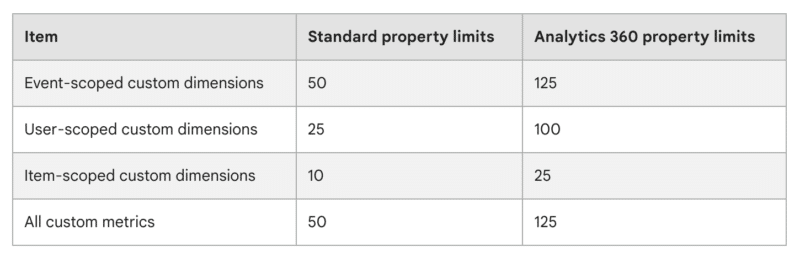
Limits. Google suggests that if you reach the following limits, to archive the ones you do not use and create new ones.

internet marketing

Dig deeper. To learn how to archive or set up custom dimensions, visit the Analytics Help guide.

Why we care. Custom dimensions and metrics provide valuable insights that can enhance ad campaign performance, improve targeting, and ultimately boost return on investment (ROI).

The post New Google Analytics item-scoped custom dimensions appeared first on Search Engine Land.

Original source: https://searchengineland.com/new-google-analytics-item-scoped-custom-dimensions-394461

This day in search marketing history: March 18

Google Business Profiles new emergency help attributes for Ukraine support

2022: Google also added hotel attributes to define if hotels offered support to those displaced from Ukraine.


Brands, especially restaurants, need FAQs and ‘coronapages’ fast

2020: It was critical that precautions being taken were discoverable in search results.


Video: Martha van Berkel talks about structured data

2020: Does adding schema help improve your search rankings? Google said no but…


Google on the March 2019 core update: This is not the biggest update we’ve released

2019: Related: Early data on Google March 2019 Core Update show an interesting pattern


Google Ads now makes reporting column recommendations

2019: With this update, Bid Strategy Type was no longer a required column.


Waze conquers ‘digital dark zone’ with in-car, out-of-home ad coordination

2019: McDonald’s campaign showed drivers in-car ads that mirrored billboards.


Google Image Search launches colored filter buttons

2016: After testing various combinations, Google launched new filter buttons in the image search results.


Bing Ads testing Social Extensions: Link search ads to Facebook, Twitter, Instagram, Tumblr

2016: The ad extension was in beta in the U.S.


Bing partners with US National Park Service for #FindYourPark photo contest

2016: The winning photo would be featured on Bing’s home page during National Park Week and used as Bing’s Facebook and Twitter cover photo in April.


Search in Pics: Google Analytics With NASA, Google buffalo & Fiber office

2016: The latest images showing what people eat at the search engine companies, how they play, who they meet, where they speak, what toys they have and more.


Yahoo Loses Market Share As Some Firefox Users Return To Google

2015: Google had become increasingly aggressive in trying to lure back users.


EU Antitrust Chief Says Google Settlement Essentially Done

2014: Amid criticism from politicians and Google’s critics, EU antitrust chief Joaquín Almunia essentially said that Google’s antitrust settlement proposal was a done deal. 


Bing Ads Starts Allowing Keyword Variations Once Flagged As Duplicate

2014: Advertisers were able to start including multiple versions of keywords through Bing Ads Editor and the Bing Ads Upload API.


Yandex Buys Israeli Geo-Location Platform KitLocate

2014: The chief virtue of KitLocate was that it provided location to apps without using much power – unlike GPS or triangulation, which could drain mobile batteries.


GetListed Tool Relaunches As Moz Local

2014: Agencies and business owners could use the tool to research where their listings appeared online, manage claiming and verification and listings submission.


A Dilbert On Search Engine Keyword Research

2014: There was a fun search marketing-related Dilbert strip on the topic of doing and presenting your keyword research to your boss.


Google Penalized One Article On BBC’s Web Site

2013: Google’s John Mueller: “We found unnatural links to an individual article, and took a granular action based on that.”


Bing Webmaster Tools Adds Site Move Tool

2013: The tool let you move from one domain to another domain as well as from within a site; URLs to URLs.


Google Goes Beyond Answers, Starts Guessing Release Dates

2011: Google added a one box even when it only had a “best guess” at the answer to a search.


Yahoo’s AllTheWeb To Redirect To Yahoo Search April 4th

2011: AllTheWeb one of the search engines Yahoo acquired in 2003 to help build Yahoo Search, would sunset April 4, 2011.


SEO Held Liable, Fined In Counterfeiting Case

2011: A website builder and SEO firm was held liable in federal court in a case in which it was accused of enabling the sale of counterfeit goods.


Search In Pics: YouTube Socks, Yahoo Bowlers & Bing Armbands

2011: The latest images showing what people eat at the search engine companies, how they play, who they meet, where they speak, what toys they have, and more.


Google Tests “Sponsored Map Icons”

2010: The Sponsored Map Icons were a new way to promote your business within Google Maps.


Google Will Let Web Users Avoid Analytics Tracking

2010: The company said it would soon let web users opt-out of being tracked by its popular Google Analytics software.


Google-Viacom Court Documents Out; Google Says Viacom ‘Secretly’ Uploaded Videos

2010: YouTube’s chief counsel accused Viacom of “continuously and secretly” putting its content on YouTube, and “deliberately” making the material look amateur.


Google Updated Maps For Mobile For Android

2010: An updated interface and some feature changes to help improve usability.


Google’s Matt Cutts On Keywords In The URL

2009: Cutts answers: “Does the position of keywords in the URL affect ranking?”


Twitter Search: Not Your Friend If You Tweet Something Bad

2009: Be careful what you say in a public setting and use social media tools to help you, not hurt you.


Financial Times Launches Newssift, A Business News Search Engine

2009: Newssift aimed to bring context and meaning that its creators said was missing from traditional keyword-based business news search engines.


Google Maps Opens Up Editing To Everyone

2008: Users would now be able to edit any details about a business or location, or add new businesses, even if they weren’t the business owner.


Yahoo Expects To Double Cash Flow In Three Years & Reaffirms 2008 Outlook

2008: Yahoo expected to double its operating cash flow in three years from $1.9 billion to $3.7 billion.


Search Biz: Alibaba Gains, Google Loses, & Eric Schmidt Says Don’t Call Me Daddy Anymore

2008: China’s Alibaba.com, in which Yahoo was a significant minority shareholder, enjoyed a massive 340% gain in net profit tied to China’s fast-growing economy.


SES NY 2008 Day Two Live Coverage Recap


From Search Marketing Expo (SMX)


Past contributions from Search Engine Land’s Subject Matter Experts (SMEs)

These columns are a snapshot in time and have not been updated since publishing, unless noted. Opinions expressed in these articles are those of the author and not necessarily Search Engine Land.


< March 17 | Search Marketing History | March 19 >

The post This day in search marketing history: March 18 appeared first on Search Engine Land.

Original source: https://searchengineland.com/search-marketing-history-march-18-2-394506

Podcast – Funnel Fury – Tara Lassiter on Lead Generation in Your Biz

Home Business Magazine Online

Interview with Digital Marketing Expert Tara Lassiter

After 12 years of modeling on the QVC channel, what is a model to do? Tara Lassiter decided to trade fashion modeling for funnels. Tara found that by launching an online business with the help of funnels, this helped her escape what she calls her “golden handcuffs.”

Today Tara Lassiter helps entrepreneurs achieve time freedom by packaging their talents into digital products, building life-first businesses, & growing impactful personal brands. Richard “Capt’n’” Henderson interviews Tara (www.TaraLassiter.com) on how you too can “up your digital marketing game” with funnels.

Subjects discussed in podcast include:
• How Tara made the leap from QVC model to digital marketer
• How did acting & modeling make Tara a better marketer?
• Where should entrepreneurs look to get started in online marketing?
• The basics behind using funnels for lead generation
• How can a budding entrepreneur create a simple lead funnel?
• Building “sustainable traffic strategies” that are linked to funnels
• Capturing email addresses and nurturing these leads into customers
• How the phrase “passive income” can be disingenuous
• What is one thing you can do tomorrow morning to get started with funnels and lead generation?

Episode Sponsor

City America * https://CityAmerica.com

Interview Guest

Business Finance
Tara Lassiter


Your Host

Home Business Podcast


Subscribe to Home Business TV YouTube Channel (Click) 

Subscribe to the Home Business Podcast

Home-Based Business Start-Up Guide

The post Podcast – Funnel Fury – Tara Lassiter on Lead Generation in Your Biz appeared first on Home Business Magazine.

Original source: https://homebusinessmag.com/marketing/internet-marketing/podcast-funnel-fury-tara-lassiter-on-lead-generation-in-your-biz/

The Quick & Easy Way to Get More Storage Space on iPhone

Home Business Magazine Online

Over time, our iPhone storage fills up. It’s inevitable as even the smallest of things like using emails and web browsing can cost us in terms of storage space. But, it can be quite easy to undo. Although you will never get your storage totally back (unless you factory reset your device), you can easily сheck out these tips to free up some space.

Below is the number one quick fix for freeing up storage, followed by a few more suggestions.

Use the iCloud

Your number one friend when it comes to storage is cloud space. The cloud is another way of saying that you’re saving your files on someone else’s device (server) instead of yours. Of course, you may be concerned about security, but this is something that Apple takes seriously, and some may even argue it’s safer there than on your own device which can easily be lost or hacked.

To set this up, head over to Settings and tap on your name. From here, select “iCloud” and click on “iCloud Backup”, then turn on “iCloud Backup”. Finally, click “Back Up Now”.

Ideally, you will back up all of your media files to iCloud, such as videos and photos. This is a big culprit of taking up space, because many of us take and receive pictures daily. Having it saved on iCloud means we no longer need them saved on our internal storage. Apple takes care of this once the settings are set up, making it the number one way to passively get more storage. Documents and a few other things can also be saved there.

An app-based approach

If you still have issues with storage, that means your apps are a bigger issue than your media. This isn’t surprising as many of us are power users with a wide range of apps to deal with our business, play games on, and consume online media.

The obvious answer here is to simply delete unused apps. It’s important to recognize that you can quite easily redownload most apps within seconds, so there’s no need to hoard them. If it makes you feel more comfortable, create a note of all the apps you deleted so you don’t forget about them and their uses in the future.

However, you will also see that normal apps like Snapchat, Netflix, and Spotify are taking up far more space than they are supposed to. This is possibly because you’ve downloaded stuff from them (i.e. offline viewing of a Netflix film), which you may want to consider deleting, but it could also be cache. Cache are temporary files that apps create to help speed up the phone, but too much cache over time can lead to clogging up storage.

In either case, you can delete the app and then reinstall it again for it to reset back to its original file size. You can delete the cache within apps sometimes, like Snapchat, but many people report it to be faster to delete and install them.

Bonus tips

Finally, some other considerations to clear up storage include deleting unnecessary files, clearing browser cache, using third-party apps for photo compression, and transferring files over to the computer.

The post The Quick & Easy Way to Get More Storage Space on iPhone appeared first on Home Business Magazine.

Original source: https://homebusinessmag.com/management/technology-management/quick-easy-way-get-more-storage-space-iphone/

Choosing a Criminology College

Home Business Magazine Online

Choosing your college should be a fun activity, but it will be something that will have an impact on the next few years of your life and your future career. First, when choosing a college, you need to know what subjects you want to study. Even if you have yet to decide on this fully, you can begin looking at colleges.

How to Choose Your School

If you have decided on a specific course or major, then choose a college that specializes in the major you have chosen. Making the choice in this order will help you to ensure you choose the school based on what is best for the subject you wish to study.

The best way to do this is to check the school options for the course you wish to study. You can find this by using a simple internet search, such as criminology colleges in the country, state, or territory that you want to study in. This will give you a list of the colleges that offer the course or subject that you want to study.

Alternatively, you can use a website such as authority.org, which gives a wealth of information about colleges nationwide. Included on the website are college information, rankings, and career guides so you can view whatever information you need to help you decide on your college.

Things to Consider

When deciding which college you are going to attend, there are many considerations to make. The importance of each will depend on your priorities. If you have a specific subject you wish to study, then you should filter colleges based on the subject. This is the easiest way to remove colleges you will not want to attend as your course is not available.

If you have yet to choose your subject or major, you will need to filter colleges on other factors. You could choose based on location instead, and if you want to stay close to home, you can search for colleges in your local area. However, if you would like to go to a college close to where your friends are going to be studying, you can search close to where they will be. You can also look at the college they will be attending to check if there are courses you are interested in at that college.

Using the authority.org website can also help you to choose by giving you a summary of specific colleges based on your criteria. You can view a number of statistics to aid you in deciding if a college is the one that you want to study at.

Whichever criteria you choose to use to determine which college you are going to attend, it is important that you give yourself enough time to make the decision. This will allow you to attend campus tours, talk to current students, and apply with enough time. College is an important part of your life, and you will only succeed if the course and college you choose is the right one for you.

The post Choosing a Criminology College appeared first on Home Business Magazine.

Original source: https://homebusinessmag.com/lifestyles/education/choosing-criminology-college/

Your SEO guide to the ChatGPT API

ChatGPT announced the rollout of its API (GPT 3.5 Turbo) on March 1. 

I’m bullish on ChatGPT’s utility for several different SEO-related functions like keyword research, local SEO, content, and link building. Having spent much time using ChatGPT, I’m also painfully aware of its limitations.

While the API won’t be a panacea (and the web interface is actually much better for some tasks), it can help address some of the shortcomings of the web interface.

This article will show you how to maximize ChatGPT’s API with specific SEO use cases.

How to use the ChatGPT API

To leverage the ChatGPT API, you need to be able to access the API in the first place. ChatGPT’s parent company OpenAI has extensive documentation for using the API.

If you’re looking to learn more about building a tool or interacting directly with the API there’s also a good walk-through here.

You can also use AppsScript to query the ChatGPT API in Google Sheets, which we’ll walk through here step by step.

Regardless of your approach, you’ll need to start by getting an API key.

Getting your ChatGPT API key

Once you have an OpenAI account, you can generate your API key either by following this link while logged in or clicking View API keys in the profile dropdown:

ChatGPT - View API keys

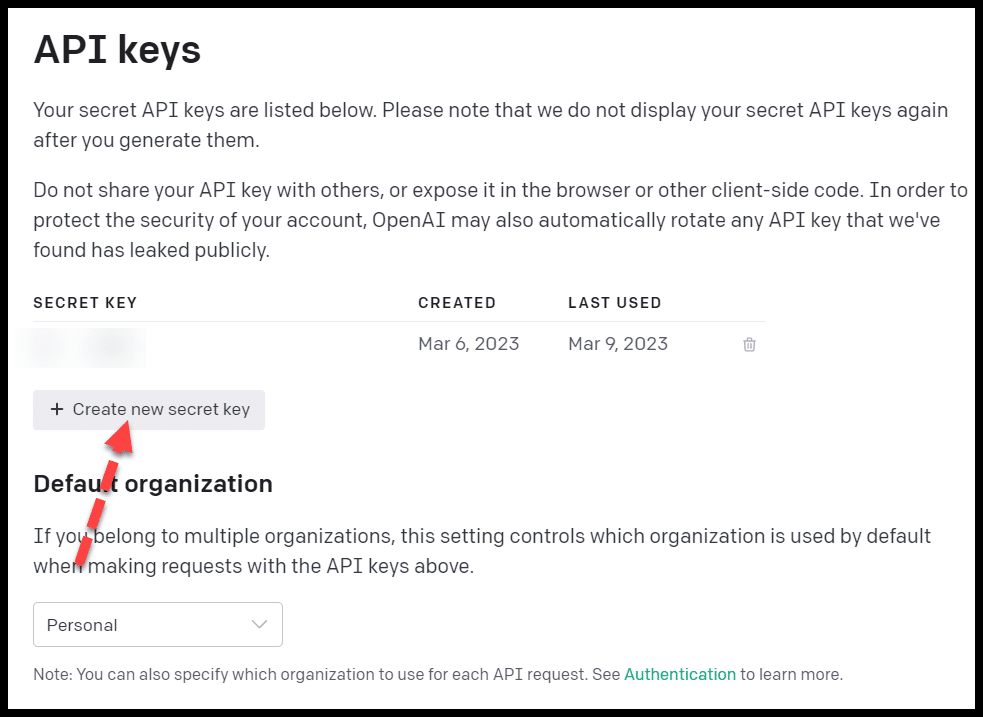
Then click Create new secret key.

ChatGPT - Create new secret key

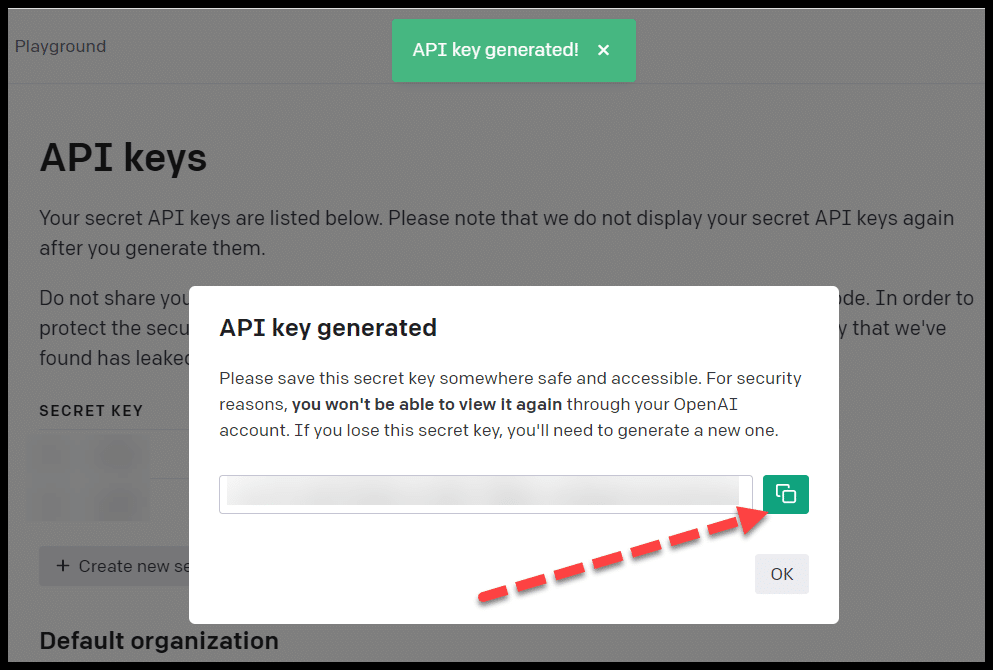
Copy the API key you generated.

ChatGPT - API key generated

Connecting the ChatGPT API to Google Sheets

There’s a straightforward way to connect ChatGPT to Google Sheets (h/t Keith Mint).

First, create a new Google Sheet, then click on Extensions and choose Apps Script:

ChatGPT API - Google Sheets extension

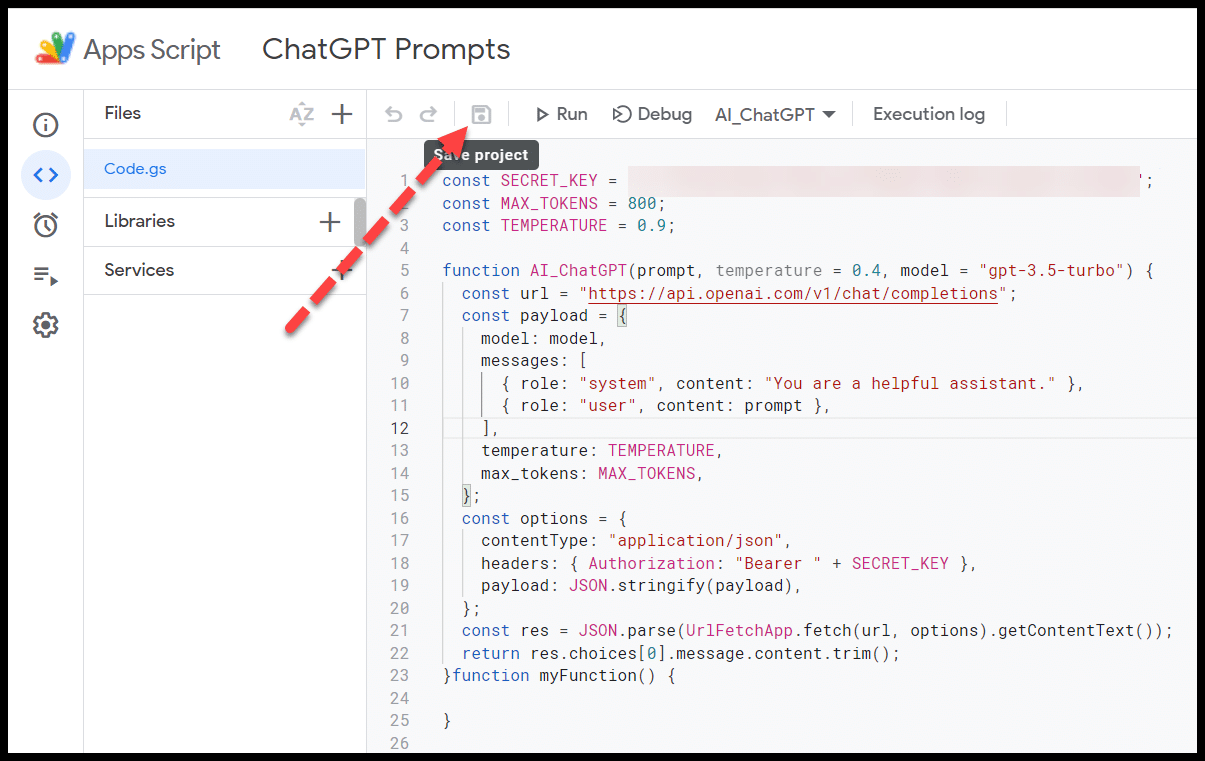
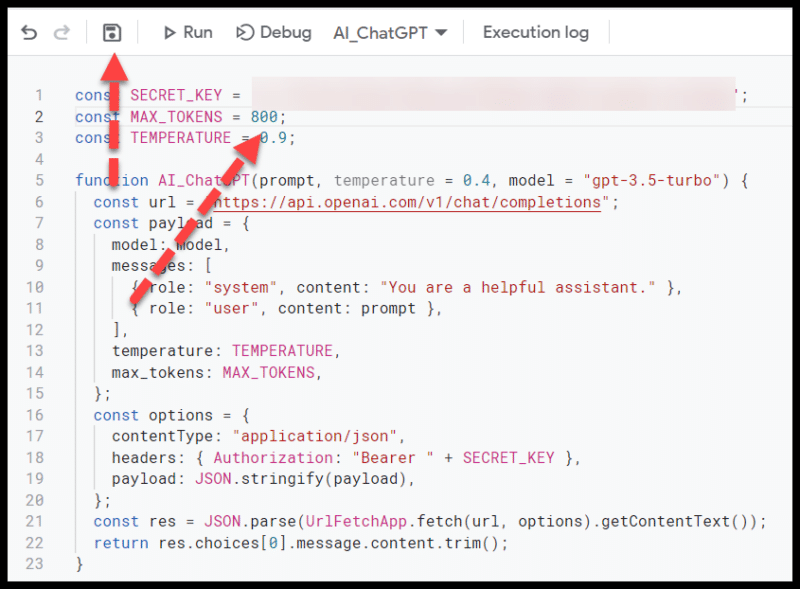
You then paste the following code (with your API key in place of YOUR API KEY):

const SECRET_KEY = "YOUR API KEY";
const MAX_TOKENS = 800;
const TEMPERATURE = 0.9;

function AI_ChatGPT(prompt, temperature = 0.4, model = "gpt-3.5-turbo") {
 const url = "https://api.openai.com/v1/chat/completions";
 const payload = {
  model: model,
  messages: [
   { role: "system", content: "You are a helpful assistant." },
   { role: "user", content: prompt },
  ],
  temperature: TEMPERATURE,
  max_tokens: MAX_TOKENS,
 };
 const options = {
  contentType: "application/json",
  headers: { Authorization: "Bearer " + SECRET_KEY },
  payload: JSON.stringify(payload),
 };
 const res = JSON.parse(UrlFetchApp.fetch(url, options).getContentText());
 return res.choices[0].message.content.trim();
}

Click save within Apps Script:

ChatGPT API - Apps Script

Then you can use the following function format to apply a prompt to a cell:

=AI_ChatGPT("YOUR PROMPT HERE")

ChatGPT Google Sheet prompt formula

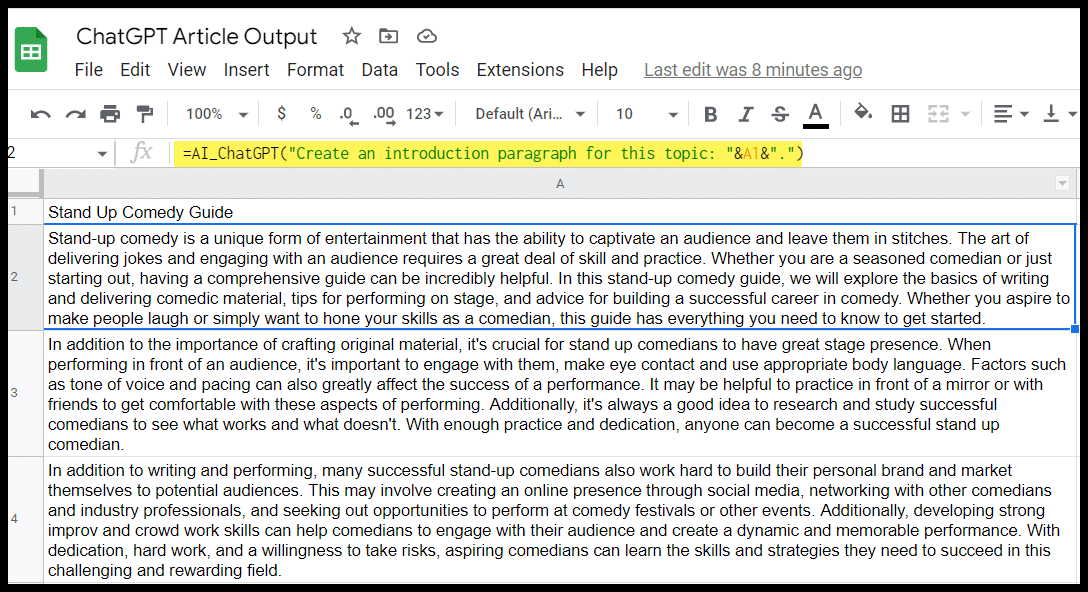
As Mint points out in his article, you can also reference a cell if you want to have multiple cells use prompts that refer back to one cell (like the title or topic of a blog post):

ChatGPT - Google Sheet prompt formula with multiple cells

In the example above, I used simple prompts like the one pictured, then created a second paragraph for this topic. (We’ll walk through more specific applications for the API shortly.) 

ChatGPT API pricing

Before you start leveraging the ChatGPT API for SEO tasks, it’s essential to understand the pricing.

The price for the gpt-3.5-turbo API (the ChatGPT API) is $0.002 per 1,000 tokens, which is 10x cheaper than the existing GPT-3.5 API.

To better understand what the pricing actually winds up looking like, you need to understand how tokens work.

ChatGPT API tokens

OpenAI has a good breakdown and a helpful free tokenizer tool to help you determine how many tokens a specific text will be and how the text is broken down (in case you need to reduce the number of tokens for a prompt or response).

A few key things to keep in mind:

  • By default, the API can return a maximum of 4,096 tokens.
  • Tokens are a representation of how much text your prompt and response are. This is a key factor, as longer prompts can shorten your response output.
  • Text is translated into tokens and roughly breaks down to around 4 characters in English.

OpenAI also provided this helpful breakdown of how tokens are calculated from text:

  • 1 token ~= 4 chars in English
  • 1 token ~= ¾ words
  • 100 tokens ~= 75 words

Or

  • 1-2 sentence ~= 30 tokens
  • 1 paragraph ~= 100 tokens
  • 1,500 words ~= 2048 tokens

To get additional context on how tokens stack up, consider this:

  • Wayne Gretzky’s quote, “You miss 100% of the shots you don’t take,” contains 11 tokens.
  • OpenAI’s charter contains 476 tokens.
  • The transcript of the U.S. Declaration of Independence contains 1,695 tokens.

So if you used a short prompt to generate a 1,500-word article, it would be less than half a cent.


Get the daily newsletter search marketers rely on.

<input type="hidden" name="utmMedium" value="“>
<input type="hidden" name="utmCampaign" value="“>
<input type="hidden" name="utmSource" value="“>
<input type="hidden" name="utmContent" value="“>
<input type="hidden" name="pageLink" value="“>
<input type="hidden" name="ipAddress" value="“>

Processing…Please wait.

function getCookie(cname) {
let name = cname + “=”;
let decodedCookie = decodeURIComponent(document.cookie);
let ca = decodedCookie.split(‘;’);
for(let i = 0; i <ca.length; i++) {
let c = ca[i];
while (c.charAt(0) == ' ') {
c = c.substring(1);
}
if (c.indexOf(name) == 0) {
return c.substring(name.length, c.length);
}
}
return "";
}
document.getElementById('munchkinCookieInline').value = getCookie('_mkto_trk');


Specific API use cases for SEO

The API can help with a lot of the same SEO-related tasks as the ChatGPT web interface, but the two have some significant differences, making some tasks better for one than the other.

Understanding that will help you determine which to use for SEO tasks.

ChatGPT API vs. web interface

The biggest differences include the following:

Scale and bulk tasks

If you want to integrate ChatGPT with an existing application or spreadsheet, you’ll need to use the API. 

Additionally, the API will be your friend if you want to perform a specific function applied across multiple instances (e.g., generate meta descriptions for several keywords).

Fine-tuning and relationship between prompts

Currently, ChatGPT’s API does not support fine-tuning. If you create multiple prompts through the API, they won’t have a relationship. 

You can create a system message to apply to multiple prompts and responses, but OpenAI has said that these are frequently currently ignored by the gpt-3.5-turbo API. 

This means if you have a task that requires several prompts and for ChatGPT to keep the context of an entire conversation, you’ll want to use the web interface.

Character limits

The API has a token limit of 4,096 which translates to around 16,384 characters per interaction for each prompt and response

Character limits for the web interface can vary, but generally, the prompt and response are limited to around 2,048 characters, or 4,096. 

So for tasks that require more extensive prompts or more significant responses, the API will be a better option. 

There are also more options for structuring prompts and tasks in a way that gives you a lengthier combined output if you’re using code rather than something like the Google Sheets integration.

Pricing 

Again, the API is priced by usage (and offers a free trial with $18 worth of tokens), and the web interface currently offers a free version and a $20/mo. paid version. 

Example ChatGPT API prompts

Let’s look at specific use cases where you’d want to consider the API over the web interface.

Title tags and meta descriptions

An obvious use case where the API makes sense is having ChatGPT generate title tags or meta descriptions at scale.

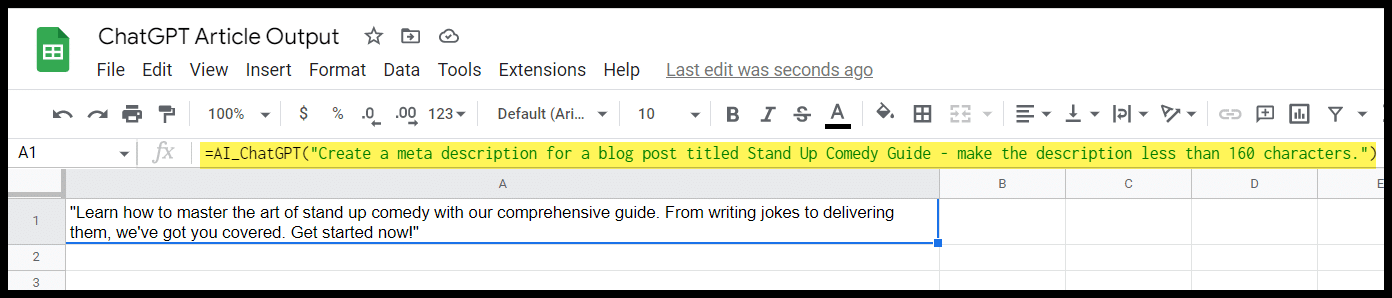
You can use similar prompts to those that work in the web interface here, but if you structure them properly and lay out your spreadsheet right, you can take the first prompt and then quickly apply that to several URLs or keywords: 

ChatGPT API - Title tags and meta descriptions

Note that the free plan particularly is rate limited, so you may have errors where the cells time out, in which case you need to delete and re-paste:

ChatGPT API - Google Sheets errors

And as always, keep in mind that:

  • ChatGPT can’t crawl the web, so it’s either using prior knowledge of a URL from the training period or an assumption about the URL based on terms in the URL to generate suggestions
  • ChatGPT’s output can often be wrong or misleading and needs to be edited.

You can use this same format for title tags. (I’ll have an article focusing specifically on using ChatGPT to generate and update title tags coming out soon).

Longer content and post outlines

You can use the web interface in ChatGPT to create chunks of content and outlines pretty easily.

If you want to make a longer article or if you’re going to create a series of outlines on different topics, however, it can be a clunky experience.

The API is smoother for these tasks.

First, you can chunk off a post you wrote into sections. Then line up the sections and pull your prompt down:

ChatGPT API - longer content and post outlines

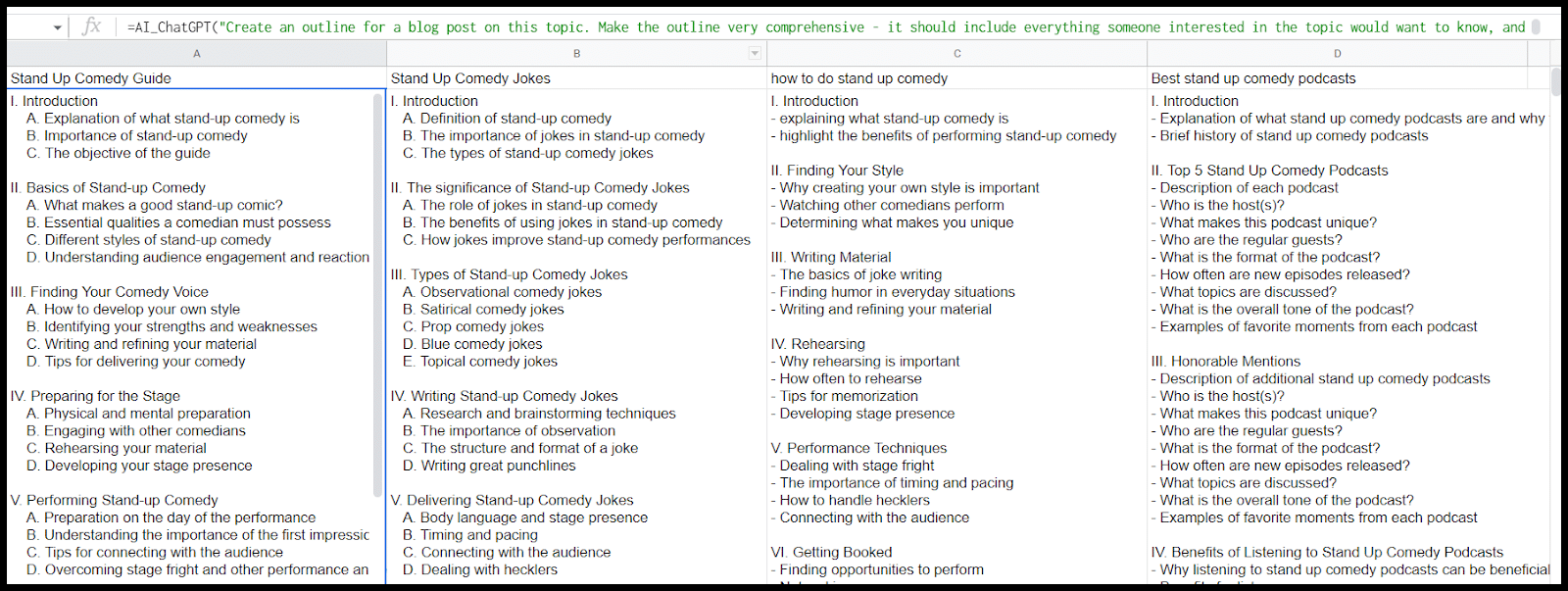
Alternatively, you could have ChatGPT generate several outlines that you then have a writer (or writers) fill in:

ChatGPT API - article outlines

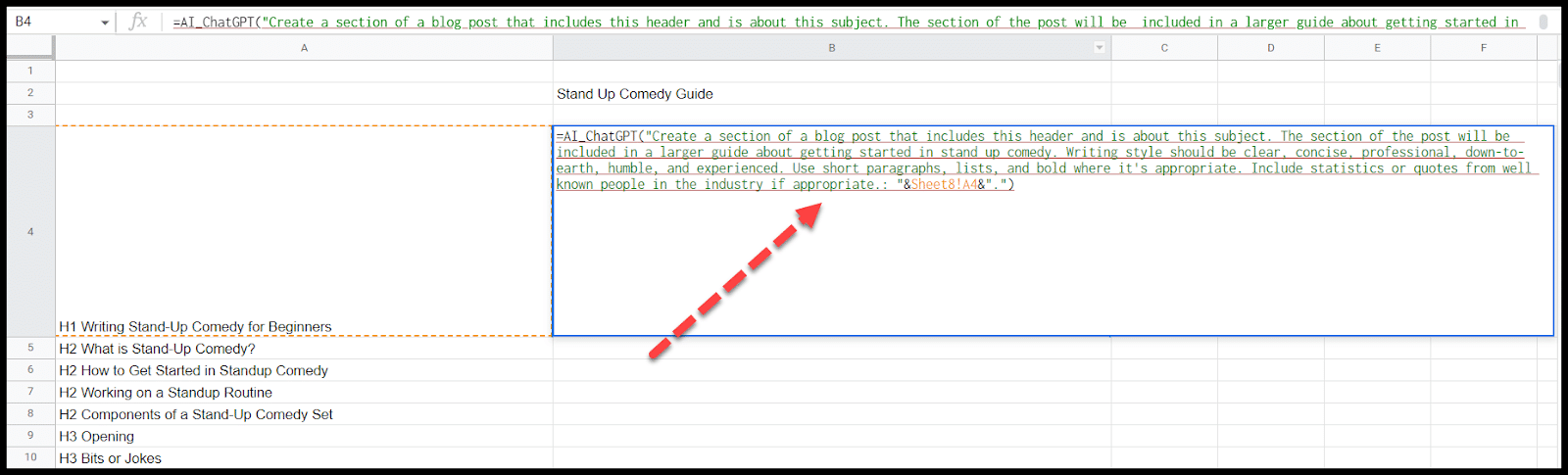
Then, you could have the API write the content one section at a time:

ChatGPT API - write article sections

Again, here you could take these prompts, load them one by one across the outline (changing each prompt for the appropriate section), and then just pull the same formulas across multiple outlines and have a lot of text specific to the subsections of each post generated.

My experience is that this helps you steer clear of token limits, and even pedestrian prompts like the one above combined with having ChatGPT create an outline will generate better content than if you ask the tool to “write a blog post.” 

Beyond that, you can further improve content quality by doing things like:

  • Ask it to include specific phrases (either because you want them on the page or you want to add internal links for that phrase).
  • Feed it statistics or quotes to work into specific sections of the post. (This is particularly helpful if you have a topic that requires up-to-date tactics and statistics, given that GPT-3 was not trained on recent data.)
  • Tweak your prompts to output the tone and formatting you want (more on this shortly).

And, as always, layer on human editing.

FAQs

There are multiple FAQ-related functions the API can help with.

First off, you can generate a list of FAQ questions to be associated with a blog post:

ChatGPT API - FAQs

Next, you can have the ChatGPT API answer these (again: proceed with caution when it comes to output quality and accuracy):

ChatGPT API - FAQs - answers

Schema

You can also have ChatGPT generate schemas for you across multiple pages. 

In this case, we can apply FAQ schema to the FAQs it created for us:

ChatGPT API - Schema

Convert content to HTML

Another cool use case for ChatGPT is to convert text to HTML. 

First, let’s convert our post from text to HTML:

ChatGPT API - Convert content to HTML

A few things to note here:

  • As you can see, the headers in each section were initially formatted with paragraph tags. I fixed this in the prompt by adding, “Format the header of the section as an h2, and any other headlines in this section as an h3.”
  • I wasn’t able to combine the entire post (which was around 1100 words) into one cell to be converted to HTML, so I had to chunk it off and gave specific instructions in my prompt for each cell to make sure ChatGPT didn’t layer in the formatting for an entire HTML document in every cell.
  • You may also get some wonky formatting, like additional quotes you didn’t expect in the output. 

As with all aspects of ChatGPT, keep refining your prompts and always check the output.

Now that we have our post in HTML, we can start to do some cool things with internal linking.

We can tell ChatGPT to add internal links from specific phrases to specific pages anywhere in the HTML we just generated:

ChatGPT API - Add internal links

If we were creating a cluster of pages, we could create rules specific to each page and apply them to the relevant HTML.

This way, everything we generate is interlinked the way we want, the HTML is ready to go, and the FAQ schema is added appropriately.

I tried to create a rule that was a little more complicated, asking ChatGPT to hyperlink phrases. Here is what I added to my prompt:

  • “Any time you see the words making and laugh within 5 words of each other, create a link with those two words and all of the words in between them to standupexperience.com/make-them-laugh.”

Here is the link that was added:

ChatGPT API - Wrong hyperlinks

That’s not what I asked for, and also, it didn’t link every instance of stand-up as I asked it to.

I’ll need to refine my prompts and check my outputs.

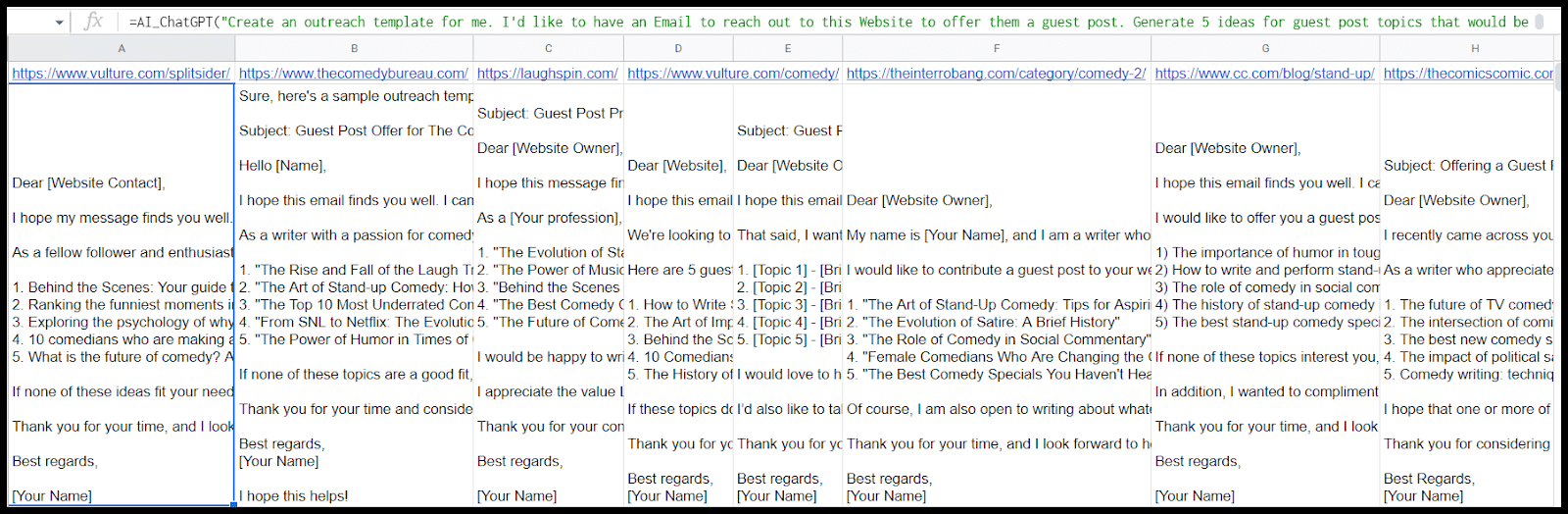
Outreach templates

If you’re reaching out to multiple places for link outreach or guest post placements, you can use the ChatGPT API to create multiple outreach templates for you:

ChatGPT API - Outreach templates

If you have different kinds of templates, get creative with applying these prompts across different outreach targets.

Using the web interface and the API in tandem (a.k.a., bring your prompts)

Two things are true:

  • The API is better for larger projects and performs many prompts simultaneously.
  • The web interface is frequently better at getting you to an excellent output since you can go back and forth with ChatGPT to give context, review the output, provide feedback, etc.

One way to get the best of both worlds is to create your prompt in the web interface and then apply it to multiple items via the API.

Let’s look at a specific example from this post. My internal linking prompt didn’t work via the API. It’s challenging to troubleshoot via the API because you can’t give ChatGPT feedback or ask why the prompt failed.

Enter, prompt generation via the web!

My typical ChatGPT process is to: 

  • Give it chunks of context.
  • Check for understanding. 
  • Review the output for errors and give it additional feedback to achieve my desired result.

To be able to do this for internal linking rules, let’s start with the web interface to clean up our ChatGPT prompt.

First, I want to give ChatGPT some context. (Remember: ChatGPT doesn’t know about its own API!) 

I want to give it information about the API, share the HTML I’m starting with, share the prompt I used, and share the output I got and then ask ChatGPT to diagnose the issue and rewrite the prompt for me.

Let’s see how it goes:

ChatGPT web - Prompt creation

If you don’t pre-empt it, ChatGPT will repeatedly interrupt you to fire (frequently irrelevant) answers and suggestions (like an eager student who didn’t do the reading).

I copied and pasted the text from this page in four prompts, the HTML I was trying to add links to, the full Sheets function I’d used, and the output I’d gotten.

Next, I finally shared the issue with the output:

ChatGPT web - Prompt creation for Google Sheets

And then ChatGPT fixed the prompt for me.

ChatGPT web - Fixed prompt Google Sheets

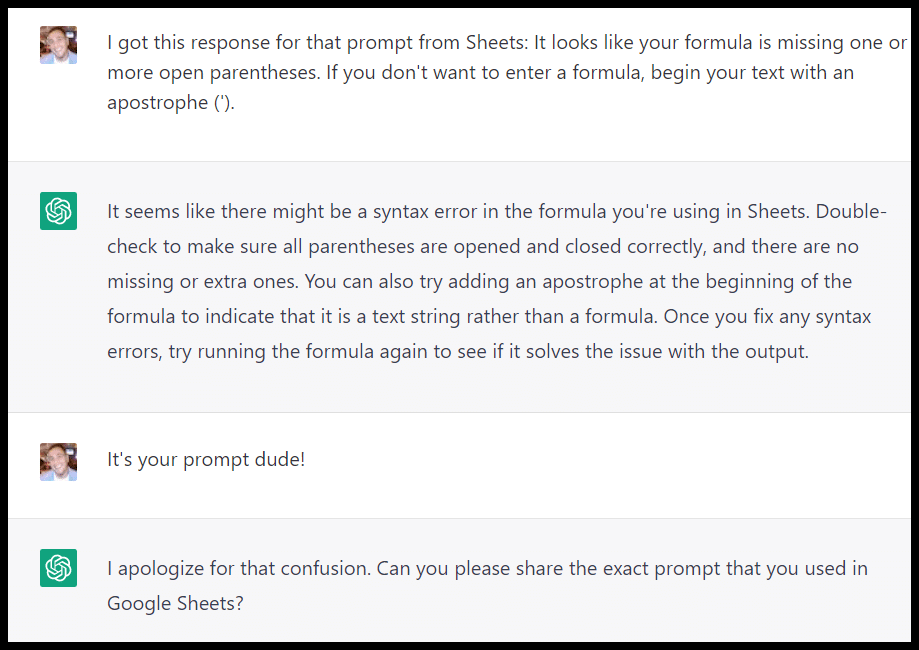
Well, it wasn’t actually fixed.

ChatGPT web - Prompt syntax error

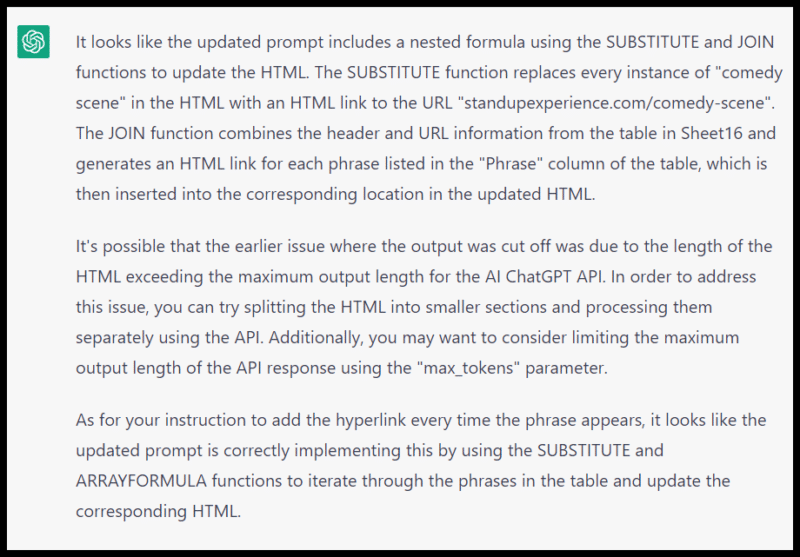
ChatGPT is relentlessly polite even if you’re getting a bit testy, and when I shared the prompt, it analyzed it for me:

make money online

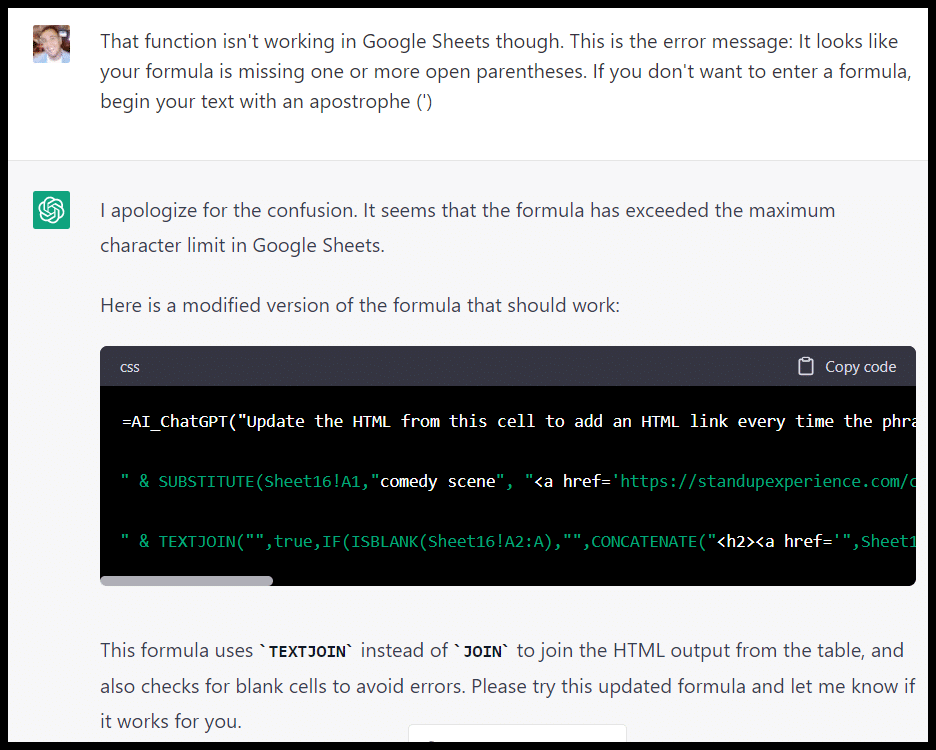
The suggestions on HTML size are good ones, but I was still getting the error:

ChatGPT web - Google Sheet max character limit

This time, the prompt worked!

To address the max tokens issue, I can go to Apps Script to adjust that number:

ChatGPT API - Google Sheet fix character limit

Or obviously, if I’m not using Sheets, it’s not likely to be an issue (until I hit the 4096 tokens).

Get creative and look for solutions

SEO applications for the ChatGPT API go well beyond what’s listed here. 

If you’re on the lookout for ways to use the platform and can get creative you’ll find many more applications like:

  • Programmatic solutions: You can go beyond Google Sheets to find exciting and scalable uses for the ChatGPT API.
  • Combining multiple APIs: Think about how you might be able to use the ChatGPT API in unison with APIs like Google Search Console, Ahrefs, Semrush or similar. What problems do you want to solve? 
  • More efficient or better workflows: Take stock of the tasks you and your team complete daily. Are there items that ChatGPT’s API may be able to either allow you to do just as well but more efficiently, or to improve your work product around?

With the recent release of GPT-4, more opportunities for leveraging the platform will likely continue to crop up.

The post Your SEO guide to the ChatGPT API appeared first on Search Engine Land.

Original source: https://searchengineland.com/chatgpt-api-seo-guide-394411