by Ibi Montesino, Executive Vice President, Distributor and Customer Experience and Chief of Staff, Herbalife Nutrition
The world has learned many lessons from the pandemic. One of the most important is the role that local communities serve in helping to bridge isolation, form relationships, grow businesses, contribute to ending food inequity, and support education. The value of community lies in the connections we form that root us in our neighborhoods. By investing in our communities and being active participants, we build bonds of belonging.
Education
The lifeblood of every community is education. A strong school system creates an educated workforce, but it also helps to ensure the vibrancy of future generations. Education provides students with the life skills and information they need to succeed, especially as we live in an interconnected and technology-rich world. Research has shown that over 40 years, income per capita is 23 percent higher in a country with equal education. Access to education is one of the most potent tools to lessen the impact of poverty and reduce economic inequality.
As a business owner or CEO, one of the most important things you can do for your business is to continue investing in your own continued education. Evidence shows that Education provides entrepreneurs with the cognitive skills to better evaluate and take advantage of entrepreneurial opportunities, increase the level of self-confidence, and reduce perceived risks. This can come from general education, or even just participating in industry-related events and seminars to keep you on top of what’s trending in your field.
Connection
Communities give people a sense of belonging. Being part of a group of neighbors eases isolation, builds bridges, and fosters an understanding of others. By prioritizing connecting with your community, the greater your chances of growing your customer base and in turn, your chances for success. The insights you can learn from your customers is invaluable, whether it’s feedback on your service, what you can improve on, or what you may be able to offer that is new. Even trusted peers or mentors in your own industry can help you navigate challenges that can bloom into lucrative opportunities or efficiencies. Connections strengthen not only our relationships but our health as well. Studies have shown that strong social connections can increase longevity by 50%. Social relationships give people a sense of purpose, deepen ties with their neighbors, and strengthen neighborhoods.
Service
Whether you are an individual, social group, or corporation, giving to others, or even better supporting your own employees, is not only the right thing to do, but it also drives stronger connections with others. Food banks sent out urgent requests for donations to support those who lost their incomes or financial providers during the pandemic. In 2020, it was estimated that one in six children was facing hunger in the United States, and globally, according to Feed the Children, one in nine of our neighbors lacks the food they need to thrive.
Acceptance
Strong communities allow residents to learn from others in their town or city. Working and living alongside other people — many of whom may be outside your social circle — creates moments where a group of strangers comes together to make their community stronger. The result is meeting people of all ages, lifestyles, and careers — and opening our minds and hearts to new ideas and a broader sense of acceptance.
Expand
If you are a businessperson, engagement in your community can also benefit your career. You can connect with local leaders and potential consumers as not just a salesperson but as a neighbor. People can meet in low-pressure environments and learn about one another, building relationships and allowing business owners to share information about their services or products that directly meet that individual’s needs. Working alongside others in your community on a project to build your neighborhood expands your network and increases your chances for business success.
A thriving community takes care of its residents’ education, health, and welfare and creates opportunities for neighbors to know, learn from, and support each other. Relationships fuel people’s sense of belonging and develop new prospects for businesses to flourish. Being a good neighbor means doing what you can to help your community, which is the lifeblood of a thriving economy and the fabric of a nation, thrive.
Common Criteria for Information Technology Security Evaluation (CC) is an internationally accepted and scalable set of cybersecurity certification standards (ISO 15408). Common Criteria certification ensures that the assessments of the relevant IT product were completed to consistently high criteria, in a rigorous, standardized, and repeatable manner. This article provides insight into this topic and presents 7 interesting facts about Common Criteria.
1. Internationally recognized IT security certification
Originally, Common Criteria was developed in collaboration with six countries: Germany, France, the United Kingdom, the Netherlands, Canada, and the United States. Today, Common Criteria are the driving force behind the broadest mutual acceptance of secure IT products available. It is recognized by the 31 CCRA member countries and valued by their Federal and Government entities.
2. CC evaluation process can improve the assessed IT product
The Common Criteria evaluation process enhances an IT product or system by exposing vulnerabilities that may be fixed before introducing it to the market. This also helps to avoid costly post-release updates. Furthermore, Common Criteria certification is an effective tool for keeping the business environment competitive. In order to compete with other well-established cybersecurity solutions that have previously been assessed, CC evaluation and certification are critical for the given IT product.
3. Three essential parties are involved in a Common Criteria certification process
There are three primary parties involved in the Common Criteria evaluation process:
The Certification Body is responsible for issuing Common Criteria certifications.
Sponsors and developers that submit their system or IT product for evaluation. In the case of large companies, this role is often the same.
The independent and authorized laboratory that carries out the assessment.
4. A total of 7 Evaluated Assurance Levels are defined in the Common Criteria
Before starting the assessment procedure, the Sponsor or Developer has to select the Evaluated Assurance Level against which the Common Criteria evaluation will be performed.
There are 7 EAL levels defined in the Common Criteria:
EAL1: Functionally Tested
EAL2: Structurally Tested
EAL3: Methodically Tested and Checked
EAL4: Methodically Designed, Tested, and Reviewed
EAL5: Semi-Formally Designed and Tested
EAL6: Semi-Formally Verified Design and Tested
EAL7: Formally Verified Design and Tested
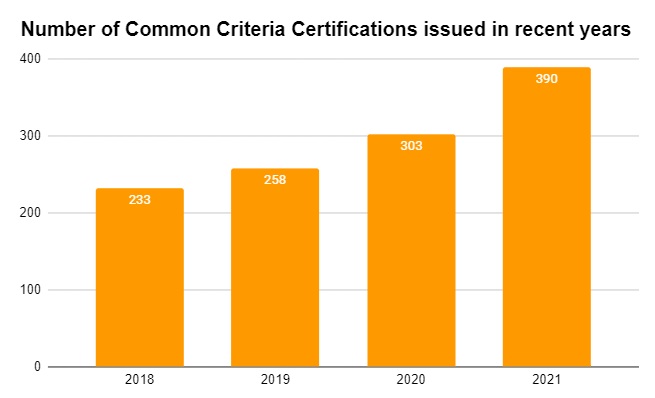
5. There is a slow but steady growth in the number of Common Criteria certifications worldwide
Since 2010, a total of 1645 IT products have been certified, with 589 of them being ICs, smart cards, smart card-related devices, and systems. Other popular product categories include Network and Network-Related Devices (237 Common Criteria certifications) and Multi-Function Devices (233 CC certifications). Aside from these, several Operating Systems, Databases, Access Control Devices, Boundary Protection Devices, and Systems passed the Common Criteria assessment process successfully.
In recent years, the number of issued certifications has increased by an average of 10%.
6. New Zealand became a certificate-consuming country
After many years of the close alliance between Australia and New Zealand in managing the Australasian Certification Authority, New Zealand has opted to give up its authorizing position and remain a certificate-consuming nation in the CCRA. This is to more accurately represent New Zealand’s contribution to the Australasian Information Security Evaluation Program (AISEP) and the CCRA. The AISEP program name has been modified from ‘Australasian’ to ‘Australian’ to better represent the program’s status as a certificate authorizing nation of the CCRA. These modifications took effect in October 2021.
7. EUCC is replacing the European SOGIS mutual recognition agreement
The EUCC cybersecurity system developed by ENISA (the European Union Agency for Cybersecurity) will take the place of the existing European SOGIS mutual recognition agreement (Senior Officers Group for Information Systems). EUCC is a Common Criteria-based certification system that combines the globally acknowledged, proven methodologies of Common Criteria with new concepts to give stakeholders a contemporary and flexible solution, such as patch management for certified systems and products.
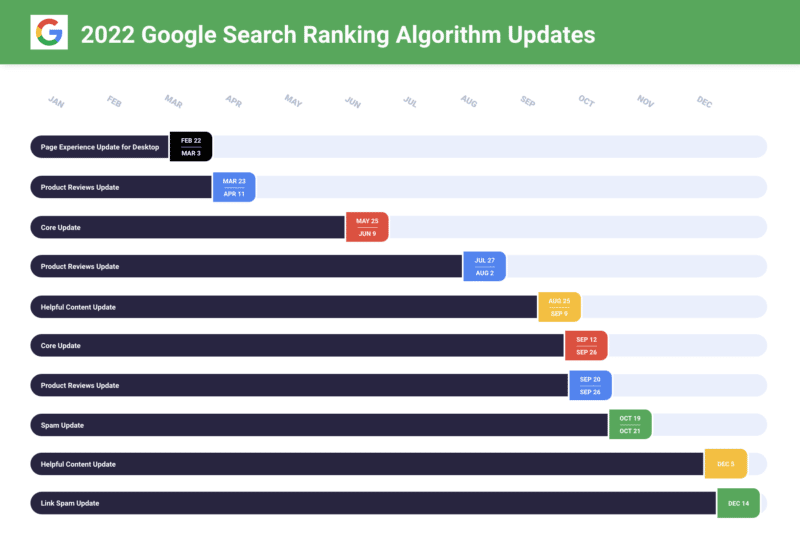
This year had different stresses accompanying the Google algorithm updates, fewer pandemic stresses, and more recession-related stress. We had ten confirmed Google algorithm updates this year, the same number of confirmed algorithm updates we had in 2021. This year, we had a brand new ranking system named the helpful content update, and we had two of them.
Also similar to last year, Google rolled out two big algorithm updates at the end of the year.
Google confirmed algorithm update summary
We whipped up this timeline documenting all the confirmed Google search algorithm updates in 2022, so you can visualize the updates over the year. Please note, the last two updates have not completed yet, when they are finished, I will update this story.
Google’s May and September core updates were big updates
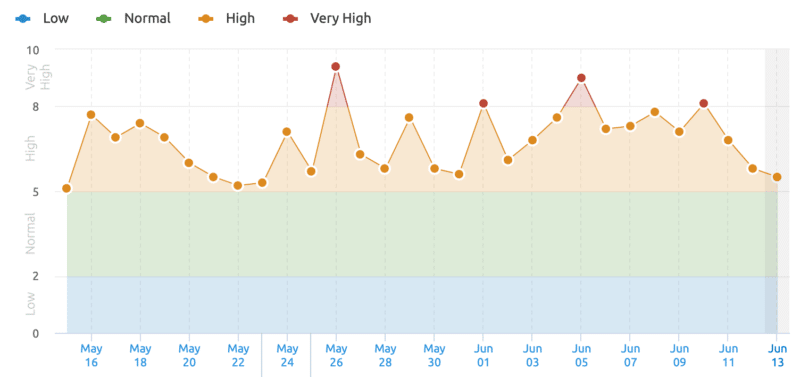
May 2022 core update. On May 25, 2022, Google released the first core update for the 2022 year, the May 2022 core update. That update took 15 days to roll out, ending on June 9, 2022. This update was a big update and rolled out quickly for many queries the data providers track. We did see some “tremors,” shifts in volatility, after the initial update, the largest tremors were around June 5th and that should be the final sets of volatility you would see from the initial broad core update release.
September 2022 core update. On September 12, 2022, Google released the second core update for the 2022 year, the September 2022 core update. That update took two full weeks to roll out, ending on September 26, 2022. This update hit fast, but was less impactful than previous updates. While there was some rank volatility, the consensus was that it was weaker than past Google core updates.
At least we are not expecting any additional core updates by year’s end.
Google’s new two helpful content updates seemed tame
Google released a new algorithm update named the helpful content update, which aim to demote content that is written to rank on search engines and not written to help people.
August 2022 helpful content update. On August 25, 2022, Google released the new helpful content update. The helpful content update will target websites that have a relatively high amount of unsatisfying or unhelpful content, where the content has been written for search engines rather than humans. This update took 15 days to roll out, ending on September 9, 2022. This update did not feel tremendously widespread, but Google did say it was a big update that did not cause a huge shakeup.
December 2022 helpful content update. On December 6, 2022, Google released the second helpful content update, the December 2022 helpful content update. This update is not yet done rolling out but when it is done, I will update this story. (This update took X days to roll out, ending on December X, 2022.) This update also did not feel widespread or all that impactful compared to core updates or product review updates.
Google’s March, July and September product review updates shuffled the shelves
While Google only had two core updates in 2022, it pushed out three product reviews updates in 2022. That is one more product reviews update than in 2021.
March 2022 product reviews update. On March 23, 2022, Google released the first product reviews update for 2022, the March 2022 product reviews update. This update took 19 days to roll out, ending on April 11, 2022. Technically, this was the third product reviews update in history with the first product reviews update was launched on April 8, 2021, and the second was launched on December 1, 2021.
With the third release of the product reviews update, Google said this update “builds on” the work of the first two product review updates to enhance Google’s “ability to identify high quality product reviews.” “This will make it easier for us to get sound purchasing advice in front of users, and to reward creators who are earnest in being helpful,” Alan Kent of Google said.
July 2022 product reviews update. On July 27, 2022, Google released the second product reviews update for 2022, the July 2022 product reviews update. This update only took six days to roll out, ending on August 2, 2022. We saw very limited changes from the tracking tools and honestly, while some sites seemed to get hard by this update, it does not seem there was a lot of SEO community chatter around ranking changes due to this update. In fact, we saw a spike on August 3rd but that was after this update was complete.
September 2022 product reviews update. On September 20, 2022, Google released the third product reviews update for 2022, the September 2022 product reviews update. This update also only took six days to roll out, ending on September 26, 2022. This update did not feel as big as the two previous ones but it also overlapped with a core update.
Google’s spam and link spam updates sparked fear
Like with any spam updates, SEOs and content creators become scared and nervous that their sites or content may be hit.
October 2022 spam update. The first spam update of the year was released on October 19, 2022, the October 2022 spam update. This update took only 48 hours to roll out, ending on October 21, 2022. Google used SpamBrain, a form of artificial intelligence, to better detect spam and not rank it in Google Search. This spam update did not feel huge, but it was targeting spam and not content written by normal people for normal purposes.
December 2022 link spam update. Then on December 14, 2022, Google released a link spam update named the December 2022 link spam update. This update is not yet done but when it finished, I will update this story. (This update took X days to roll out, ending on December X, 2022.) This is the first time Google used SpamBrain AI to detect and neutralize link spam. It did seem to have an impact on links and rankings.
Google’s page experience update for desktop
We only had one-page experience update this year, and it was to bring the page experience signals to desktop. This page experience update for deskop was launched on February 22, 2022, and took nine days to roll out, completed on March 3, 2022. This update will include all the current signals of the mobile version of the page experience update, outside of the page needing to be mobile-friendly. Google said all of the page experience factors for mobile would be included, with the exception of the mobile-friendliness requirement, which is obvious.
Other Google algorithm changes, updates, tweaks or topics
Another busy year for the Google Search team, with over 5,500 changes in 2021 alone, and I suspect that number will be higher for the 2022 year.
We learned that the Panda update eventually evolved into the Coati algorithm, although both are now baked into the core algorithm. We actually learned a lot from speaking with Hyung-Jin Kim, VP Search at Google, at SMX, a lot. Google also started to use MUM in more areas, like for featured snippets and more. And Google also updated its title algorithm for multi-lingual or transliterated pages.
Common Criteria for Information Technology Security Evaluation (CC) is an internationally accepted and scalable set of cybersecurity certification standards (ISO 15408). Common Criteria certification ensures that the assessments of the relevant IT product were completed to consistently high criteria, in a rigorous, standardized, and repeatable manner. This article provides insight into this topic and presents 7 interesting facts about Common Criteria.
1. Internationally recognized IT security certification
Originally, Common Criteria was developed in collaboration with six countries: Germany, France, the United Kingdom, the Netherlands, Canada, and the United States. Today, Common Criteria are the driving force behind the broadest mutual acceptance of secure IT products available. It is recognized by the 31 CCRA member countries and valued by their Federal and Government entities.
2. CC evaluation process can improve the assessed IT product
The Common Criteria evaluation process enhances an IT product or system by exposing vulnerabilities that may be fixed before introducing it to the market. This also helps to avoid costly post-release updates. Furthermore, Common Criteria certification is an effective tool for keeping the business environment competitive. In order to compete with other well-established cybersecurity solutions that have previously been assessed, CC evaluation and certification are critical for the given IT product.
3. Three essential parties are involved in a Common Criteria certification process
There are three primary parties involved in the Common Criteria evaluation process:
The Certification Body is responsible for issuing Common Criteria certifications.
Sponsors and developers that submit their system or IT product for evaluation. In the case of large companies, this role is often the same.
The independent and authorized laboratory that carries out the assessment.
4. A total of 7 Evaluated Assurance Levels are defined in the Common Criteria
Before starting the assessment procedure, the Sponsor or Developer has to select the Evaluated Assurance Level against which the Common Criteria evaluation will be performed.
There are 7 EAL levels defined in the Common Criteria:
EAL1: Functionally Tested
EAL2: Structurally Tested
EAL3: Methodically Tested and Checked
EAL4: Methodically Designed, Tested, and Reviewed
EAL5: Semi-Formally Designed and Tested
EAL6: Semi-Formally Verified Design and Tested
EAL7: Formally Verified Design and Tested
5. There is a slow but steady growth in the number of Common Criteria certifications worldwide
Since 2010, a total of 1645 IT products have been certified, with 589 of them being ICs, smart cards, smart card-related devices, and systems. Other popular product categories include Network and Network-Related Devices (237 Common Criteria certifications) and Multi-Function Devices (233 CC certifications). Aside from these, several Operating Systems, Databases, Access Control Devices, Boundary Protection Devices, and Systems passed the Common Criteria assessment process successfully.
In recent years, the number of issued certifications has increased by an average of 10%.
6. New Zealand became a certificate-consuming country
After many years of the close alliance between Australia and New Zealand in managing the Australasian Certification Authority, New Zealand has opted to give up its authorizing position and remain a certificate-consuming nation in the CCRA. This is to more accurately represent New Zealand’s contribution to the Australasian Information Security Evaluation Program (AISEP) and the CCRA. The AISEP program name has been modified from ‘Australasian’ to ‘Australian’ to better represent the program’s status as a certificate authorizing nation of the CCRA. These modifications took effect in October 2021.
7. EUCC is replacing the European SOGIS mutual recognition agreement
The EUCC cybersecurity system developed by ENISA (the European Union Agency for Cybersecurity) will take the place of the existing European SOGIS mutual recognition agreement (Senior Officers Group for Information Systems). EUCC is a Common Criteria-based certification system that combines the globally acknowledged, proven methodologies of Common Criteria with new concepts to give stakeholders a contemporary and flexible solution, such as patch management for certified systems and products.
This year, consumer prices have risen the most in four decades while the cost of a mortgage has more than doubled. As such, there’s little doubt that, in 2023, many Americans will be forced to rely on credit for everyday purchases and tap the equity in their home for larger ones.
“The cost will vary widely depending on credit scores,” according to Chris Bridges, founder and CEO of fintech VITAL, which will soon issue the first credit card for the content creator economy. “Now is the time for Americans to get serious about their credit health, and VITAL aims to give them a head start.”
Leveraging friends and family
Bridges believes that banking in the age of social media means building a community — not just a brand. “By ‘community,’ we don’t mean people who happen to live in the same neighborhood, or shop at the same stores,” he says. “We envision a global community where members lift each other up, while expanding their own financial horizons and raising their credit scores.”
To that end, VITAL’s platform is based on a revenue share model that reserves 1% of the total community “spend” each month and gives it back to the community in the form of a “referral” game, in which members refer the app to friends and family members. “Your referral score determines how much cash you get every month,” Bridges explains. “The more you share, the higher your score and the larger piece of the 1% cash-back pie you get.”
As consumers become familiar with VITAL’s benefits, Bridges hopes that they will share — a lot. What Bridges calls VITAL’s “cache of rewards” includes not only referral cash but also the chance to earn 2 or 3% cash back on all spending for three-month periods. The company estimates that if one customer refers 10 friends and/or family members, who then refer four of their friends, rewards could exceed $500 per month.
Passively improve your credit health
Once those friends and family members join the VITAL community, they are also classed in credit health, in the form of personalized tips and tools to build their credit score, a process the company refers to as “toning.” Bridges says that the app will celebrate progress along with its members by giving them credit health rewards, including personalized credit analyses, milestone awards, cash awards for smart financial decisions, and cash for credit card increases.
Another essential part of VITAL’s health credit program is what the company promises to not to do. “We have designed a credit card that will raise your credit score, rather than your monthly payments,” Bridges promises. “That’s why our cardholders will never be charged an annual fee, a late fee, or any of those hidden charges that tend to sabotage building credit health. We want to succeed together.”
Gamification meets innovation
Indeed, rather than financial land mines, VITAL’s members can expect gems in the form of fun, gamified incentives. “We think that gamification can get people to make better financial decisions, not just spend more money,” says Bridges, who is also a 15-year fintech veteran and avid tech fan. “By making better decisions, our members improve their credit health even more, which lowers their cost of borrowing and increases their ability to save. Overall, it’s a win/win/win scenario.”
VITAL’s main “credit score” game works by linking members’ bank accounts and credit cards with the VITAL app. As they spend, VITAL’s algorithm analyzes patterns — which it calls “VITAL signs” — and sends suggestions in real-time on how to improve credit health. Bridges promises that gamification makes improving one’s behavior painless, even fun, and everyone who avoids the punishment of a low credit score will feel like a winner.
“The way that these scores are calculated is a closely-guarded secret and the credit bureaus can change their algorithm at any time,” Bridges says. “But because we are gathering so much data, our app can sleuth the credit scoring system in real-time, sending our members actionable information without them having to do any research, all while they are earning rewards. Applying may be the hardest part, but we’ve made that remarkably easy. Unlike many credit cards these days, we want to be inclusive, not exclusive.”
Whether you have a leaky faucet, a water leak in your basement, or are having some plumbing problems in your home, you’ll need to find a plumber to help you. There are a few things you need to know before hiring a plumber.
Pay attention to customer service
Having the best customer service can be a game changer for your business. Not only will you increase customer retention, you will also increase your bottom line. Having a stellar customer service department can also help you make the most of your marketing budget by making it easier to acquire new customers.
A good customer service department will be proactive in handling customer complaints and concerns and will be responsive to inquiries. If possible, the customer should be able to speak to a real person. The customer should also be able to speak to a technician and have the ability to track their progress throughout the day or night.
The best customer service department should also have a website that answers customer questions about their job, provides tips and a FAQ section. It should also have a blog section with interesting posts on plumbing topics of interest to the industry as well as a thriving community of like-minded folks. It’s well worth a look, for sure.
It’s also a good idea to make sure that the plumbing company is active in your community. By doing this, you’ll be more likely to get new customers referred to you by word of mouth. It also helps to keep your local community a healthy place to live and work.
Verify a plumber’s license
Whether you are dealing with an emergency plumbing situation or are looking to hire a plumber for a long-term project, you want to make sure that the person you hire is licensed. An unlicensed contractor can cause major damage to your property and end up making mistakes that could cost you money.
There are several resources you can use to verify a plumber’s license before hiring him. These include the Better Business Bureau, local review sites, and personal referrals. You should also check with the consumer protection agency in your state to see if there have been any complaints against the contractor.
Plumbers have years of training. Before they become licensed, they must complete an apprenticeship program for two to five years. They learn how to pull permits, perform plumbing repairs, and follow state laws. These apprentices work under the supervision of experienced licensed plumbers.
Plumbing contractors must also have liability insurance and a surety bond. This insurance will cover any costs associated with accidents, injuries, or damage to your property. You may also want to ask the contractor to send you a copy of his insurance certificate. This certificate must include commercial general liability coverage and workman’s compensation coverage.
Photo by Kindel Media from Pexels
Determine whether the issue is an emergency or if it can wait a few days
Taking care of your plumbing problems should be a priority. A leaky faucet or broken pipe can be hazardous to your family’s health and safety. It can also lead to a lot of wasted water.
There are many ways to determine whether your problem is an emergency or just something you should take care of later. First, do you know exactly what the problem is? If you do, you might have an idea of the best time to call a plumber. You might also want to try to fix the problem on your own before calling in a professional.
Compare bids
Whether you are shopping for a residential or commercial plumbing contractor, there are many factors to learn more about and consider before you sign on the dotted line. The price of labor is one of the most important factors to consider. This means that you should compare bids and prices to find the best deal possible.
The same goes for the materials and equipment required to complete the job. It may not be the easiest task, but you can make it easier on yourself by comparing bids and prices first. If you are working on a tight budget, you may want to ask the contractor to estimate the amount of time and materials it will take to complete the job.
Excel is a powerful tool that can be used to create and manage databases. It’s also an excellent way to perform complex calculations and generate charts and graphs. If you’re looking for a way to visualize the financial position of your enterprise, Excel can help you do it — even if you don’t have any programming experience at all! In this article, we’ll explore five reasons why Excel is such an effective tool for any kind of business:
1. Create Your Database
A database is a collection of data stored in a particular format. It can be used to store and retrieve data that is relevant to your business, so you can find it when you need it. There are many different types of databases that you can create with Excel, each with its purpose:
A simple database might just contain contact information for customers who have bought from you or subscribed to your newsletter.
A product inventory database will contain more specific information about all the products that are in stock at any given time.
An accounting database could include financial transactions as well as customer details (both historical and current).
There are also many ways to manipulate the data stored in Excel’s databases and you can easily export c# datatable to excel or to PDF with many tools available out there.
2. Easily Manage Your Text Data
To store and manage text data efficiently, use the Excel sheet.
Then you can sort, filter, and search through your text data.
Also, you can convert your text data into meaningful information by using some functions such as Text to Columns or Data Validation.
3. Perform Complex Calculations with Ease
To perform complex calculations, you can use spreadsheet functions. These are special types of formulas that allow your Excel file to do things that would be difficult or impossible to do manually.
For example, if you want to calculate how many years it will take for an investment in a stock to double in value if the stock grows at 5% each year (assuming no dividends are paid), you could use the following formula: =YEARS(C2/PV, I2) where C2 = current price per share; PV = present value; and I2 = annual growth rate. This formula tells Excel that we want it to calculate how long it will take this investment (which has a starting price per share of $100) to double its value under these conditions (where we assume an annual rate of return).
If our goal was simply to find out when this investment would double its value from $100 per share, though — with no other considerations — then we’d need another function: PMT(). PMT() allows us to specify all sorts of payment types over periods ranging from daily payments up to monthly ones over several years; all we need here is one lump sum payment every year until our account doubles its value ($200). So in this case we’d enter “PMT(0%,1%, “C3″,1)”, which stands for “$200 divided by 100%”.
4. Generate Powerful Charts and Graphs
You can also use charts and graphs to visualize data. Charts and graphs are highly visual representations of numerical data, which helps you understand the numbers at a glance. They are quick and easy ways to get a clear picture of important business metrics such as sales, market share, expenses, profits, and more. For example, below is an infographic that shows the advantages of using Excel in your business:
Excel Is a Powerful Database Tool for Any Kind of Business
The same features that make Excel a powerful tool for accountants and office workers also make it useful to a wide range of businesses. The following are some benefits of Excel:
It’s easy to use. When you’re new to Excel, you’ll find it has an intuitive interface and simple commands, which makes learning the software quick and painless.
It is flexible. You can customize the program’s appearance with themes, add macros and create charts from scratch without any coding experience necessary (though if you want more advanced features like pivot tables or Pivot Charts, you might need to learn some VBA). You can also save your work in various formats such as PDFs, Word documents, or even JPEG images so that others can view your data on other platforms besides just PCs!
It’s available on all platforms! Whether they have Macs or PCs at home, they’ll be able to open up their files easily. This means no more messing around with compatibility issues between operating systems!
Conclusion
Excel is a powerful database tool for any kind of business. And now that we’ve looked at some of the benefits it offers, you should be able to see why so many people are using it as their go-to program for data management and analysis. However, if you have any questions about whether or not Excel is right for your company — or just want more information on how it can help improve your workflow — don’t hesitate to reach out to us! We would love to hear from our readers about what they think about these types of programs and how they use them in their everyday lives.
2022 was a wild ride and we’re not just talking about NyQuil chicken or the slap heard ‘round the world at the Oscars. The digital marketing world was inundated with a new Chief twit, old platforms making comebacks (enter Microsoft), and more campaign automation features then we really care for.
As the year comes to a close, let’s take a look at some of the most headline-worthy, controversial, biggest-impacting changes that rocked the PPC world over the last 12 months.
The bigger picture
We asked and you answered. This year marketers told us that although the adoption of Google Ads automation is high, it’s their least favorite part of PPC. The gradual loss of control, as well as forcing automation and broad targeting on marketers, doesn’t give us that warm and fuzzy feeling after all. Who knew?
But automation and economic uncertainty aside, search advertising is thriving and spending in 2023 could hit $112 billion (nearly double the spend in 2019). Google dominates that spend, holding over 56% of ad revenue. Even Black Friday and Cyber Monday hit record numbers this year. So it’s no surprise that digital marketing ranks in the top 3 hottest skills Americans are learning in 2022.
Speaking of skills, our Search Engine Land PPC Award winners were announced. NP Digital was the big winner this year, taking home Agency of the Year along with 2 other awards. Streamline Results took Small Agency of the Year, and Workshop Digital blew us away with Best B2B Search Marketing Initiative. And who can forget Melissa Liu from RPA taking home Search Marketer of the Year. Congrats to all of our winners!
Security concerns and legal woes
Google had to tighten their policies surrounding explicit content after Reuters found illicit ads advertising liquor, sex toys, and high-risk investments. Large brands are even leaving Twitter after finding their ads next to adult, harmful, or violent content. More about Twitter later.
Google security remained in the spotlight when Senator Richard Blumenthal (D-Conn) wrote a letter to CEO Sundar Pichai claiming that Google wasn’t doing enough to crack down on deceptive ads originating from their platform. The claim was citing an investigation from last year claiming that Google advertisers are impersonating government websites and purchasing ads in an effort to scam consumers.
Location data concerns also plagued Google and they were sued by Washington D.C. attorney general Karl Racine. Lawsuits were also filed in additional states.
But Google users concerned about privacy and security may be happy to know that Google updated their My Ad Center features to allow for more control.
TikTok, though making aggressive moves toward a more secure and safe platform, isn’t a stranger to security flaws. The FCC even told (recommended?) that Google and Apple remove it from their app stores for breaching user data. The request claims that U.S. data had been accessed by China and that “TikTok poses an unacceptable national security risk due to its extensive data harvesting being combined with Beijing’s apparently unchecked access to that sensitive data.”
Speaking of TikTok, in an effort to play nice, the social media platform banned political fundraising and started requiring accounts that belong to U.S. government departments, politicians, and political parties to be verified.
We can’t talk about safety and security without talking about Meta. From 12:01 AM PT on Tuesday, November 1, 2022, through 11:59 PM PT on Tuesday, November 8, 2022, no new ads about social issues, elections, or politics were allowed to be published, and most edits will be prohibited. This policy runs every year and is likely in response to the 2016 presidential election.
Hot topics
Russia declared war in Ukraine. In response, Google and Microsoft Bing halted ad sales in Russia. A smart, necessary move to protest Russia’s actions in Ukraine, but they also help search engines avoid brand safety debacles like misinformation campaigns making it through their automated systems and showing to users.
In July Google eased ad restrictions for at-home abortion providers, making it easier for at-home abortion providers to distinguish themselves from other services that try to discourage the practice. Telemedicine providers who mail FDA-approved medications to people looking for at-home abortions previously weren’t allowed to label themselves as abortion providers. But in the aftermath of the Supreme Court overturn of Roe v. Wade, Google has amended its policies.
Gmail, YouTube, Smart Shopping updates; and is Google Search getting worse?
Freakonomics podcast asked us if Google Search was getting worse. What do you think? According to their research, maybe.
Google launches automated vehicle ads and are designed to allow auto advertisers to promote their entire vehicle inventory to potential customers on Google.com. This format includes an image of the vehicle, make, model, price, miles and the advertiser’s name.
Google Analytics 4 enhanced measurement for forms. Google has added an enhanced measurement option for Form interactions. Now you can not only see when a form has been submitted, but you can also see when one has been started by a new user. Score one for lead gen marketers!
Cookies will remain active on Chrome until 2024. In July, Google announced that their Sandbox initiative has been delayed and developers are aiming for a Q3 2023 launch. Google developers also predict that it will start phasing out third-party cookies in the second half of 2024 – not 2023 like originally planned.
Microsoft is making a giant comeback
Microsoft isn’t new to PPC. But over the years it’s become third, fourth, or even fifth string to Google, Meta, twitter, LinkedIn, and even TikTok. But 2022 impressed us with just the sheer volume of new, improved, and updated features that Microsoft released.
One of the biggest announcements this year was the acquisition of AT&T’s Xandr. By joining forces, Microsoft hopes to combine their audience intel and technology with Xandr’s powerful platform. This could allow Microsoft to leverage their audience network and provide additional inventory such as native video and digital TV.
Microsoft even announced plans to double the size of its ad business to $20 billion. I’d say they’re on the right track, since they also launched in 29 more countries in Europe and Africa.
As if this year couldn’t be any more busy, they also won the bid to partner with Netflix for their ad supported tier. The deal gives Microsoft access to a quality streaming video inventory – something they previously lacked.
New launches
Cruise Ads were launched and appear on the right-hand side of the Bing search results and appear alongside mainline text ads. They can trigger for queries such as cruise name, location, length, etc.
Multimedia Ads. The new video and image formats are “infographic-inspired,” meant to “innovate and disrupt web search.”
New ad type for service providers. Professional service ads can also be used to promote regional offices, branches or even national brands that provide relevant services.
Cash back incentives. This is a new ad offering that will incentivize shoppers via a rebate upon purchase. Microsoft will choose the “right amount of cashback for the right ad and right user” allowing for advertisers to gather the best possible return on ad spend.
Crypto exchange ads are now allowed on the platform, with pre-approval of course.
The dreaded auto-apply of recommendations has hit Microsoft, too. In February, auto-apply was out of beta and users started seeing recs being applied to their accounts.
Meta stayed pretty quiet in 2022. With Zuck focusing so much time and resources on the Metaverse, they didn’t launch as many new products or features as Google or Microsoft. That said, there were still a few new developments.
Branded content on Reels was rolled out. Creators can now use the ‘Paid Partnerships with’ label on organic posts, and participating sponsors will be able to easily convert them to Branded Content Ads.
An HUD settlement changed the way meta delivers ads so advertisers will have a tougher time targeting certain interests and demographics for housing ads.
The Media Rating Council (MRC), has just given Facebook’s parent company Meta accreditation for their brand-safety efforts on Facebook In-Stream Video and Instant Articles in desktop, mobile web and mobile in-app.
Facebook live shopping is also going away. Live shopping allowed brands to connect with buyers, but Facebook thinks there’s more value in short-form videos and is shifting its focus to Reels.
Twitter – where do we even begin
Twitter has had an interesting year. It’s not even over and new Chief twit Elon Musk is still making headlines. As always, we try our best to keep you updated with the latest news, as it happens. But Twitter updates are happening faster than we can report, so thanks for sticking around while we try to navigate what’s post-worthy and what’s too ridiculous to even mention.
But despite all the drama, Twitter has released a few new useful tools and features. Let’s take a look.
Twitter tests 3 new ad formats. Twitter is piloting three new ad types – Interactive Text, Product Explorer, and Collection ads. Only a few brands have access to them, but the new ad types will be visible to all U.S. Twitter users (iOS, Android and the web).
Twitter now has podcasts. In August, Twitter introduced podcasts as a way to give listeners more opportunities to connect with podcast creators.
But the longer videos and descriptions wasn’t enough to keep creators happy. In July we reported that TikTok’s history of low Creator Fund payouts were forcing some influencers to leave the platform for good. Some creators claim they’re paid between $0.02 – $0.03 per one thousand video views. Yikes!
Shopping confusion
You would think that TikTok would be doing everything they could to get a leg up on other social and ad platforms. So it was surprising when Meta announced their plans to scale back on shopping, TikTik followed suit with its own announcement to abandon plans to bring shopping into the US. Though, understandably after a disastrous launch in the UK.
But just one month later, TikTok announced three new shopping ad features, including video, catalog, and LIVE ads. So what gives?
For their LIVE feature, they aimed at enhancing the experience and promoting greater brand safety, something that the app has been accused of neglecting in the past.
They did this by introducing:
The introduction of Multi-Guest
Increasing the LIVE minimum age from 16 to 18
Introducing safety reminders for all LIVE guests
I think they were hoping that brands that saw features being cut on Meta would abandon the platform and move to TikTok. But has that happened? We shall see.
And to further compete with Meta, TikTok also launched Photo Mode as well as 7 other photo editing features including:
Edit clips: Stack, trim, and split video clips
Edit sounds: Cut, trim, and set the duration for sounds
Edit and position text: More easily edit, position, and set the duration for text
Add overlays: Add photo and video overlays for picture-in-picture (or video-in-video) stacking
Adjust video speed: Speed or slow the pace of video clips
Frame content: Rotate or zoom in and out of frame of individual clips
Add sound effects. Add musical soundtracks to videos and photo carousels
Look familiar?
Competing with Amazon, too?
But Meta isn’t the only media giant TikTok is going after. In November, they launched TikTok Shop, where users can now make purchases directly through the app. At the time of this publishing, TikTok is currently inviting select U.S. businesses to participate in the initiative. That means live streamers from places where the feature is not live will need to continue directing shoppers to third-party websites.
Apple
Apple is trying its hardest to join the ad game, but unless you’re a publisher or game developer, there aren’t a ton of options for you right now. But nevertheless, Apple made some noteworthy changes and updates this year. Let’s take a look.
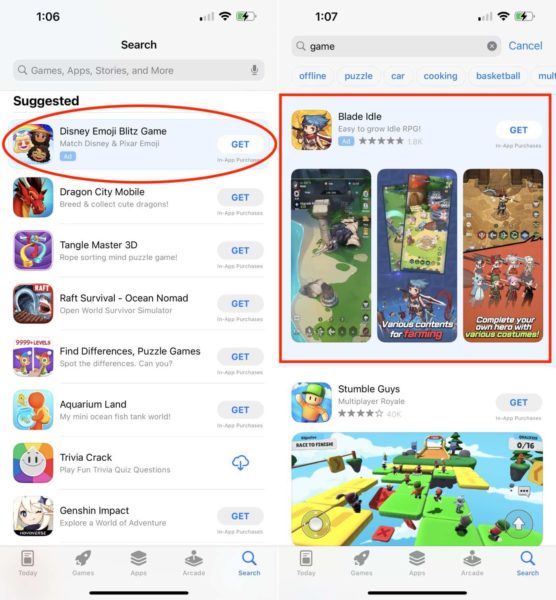
Apple is expanding ads on iPhone and iPad. Display ads are currently shown in the search tab. But soon Apple will expand the ads to the main Today tab as well as in third-party app download pages, according to Bloomberg. For search ads in the app store, developers can pay to have their apps featured in the results when users search terms related to the app.
Apple Search campaigns shifting to cost-per-tap (CPT) pricing model. Starting in June, Apple shifted their model to Cost-per-Tap, or CPT. CPT is Apple’s version of CPC, or cost per click. It is calculated by dividing your total spend by the number of taps your ad received.
Other platforms making headlines
We would be remiss if we didn’t mention that there are plenty of other platforms that made waves in 2022. Although these may not have been big enough to deserve their own category, they definitely deserve mentioning.
Instacart releases a new, streamlined ad creation process. The new ad creation process has advertisers first enter an objective; either reach, engage, or maximize sales. That first initial choice informs the available options and recommendations made downstream in the campaign creation.
Instacart has launched Coupons and Stock Up & Save promotion campaigns in Ad Manager. Instacart advertisers will now have more options to promote their products on the platform. This week, Promotions were launched in the Ad Manager, giving brands access to Coupons, and Stock Up & Save campaigns. Soon, Instacart will improve on the new Promotions offering with Free Gifts, and Buy One, Get One (BOGO).
Walmart
Walmart is expanding their self-service Marketplace platform. Search Brand Amplifier gives products listed in the Walmart marketplace higher visibility by boosting advertised products to the top of search results. Walmart says this benefits newer and smaller brands that haven’t achieved high organic listings within the Walmart platform.
Walmart is now selling ads on TikTok, Roku, and Snap. For the first time ever, Walmart has expanded its ad reach beyond its own ecommerce platform by powering ads on TikTok, Roku, and Snap. They’ll also have the capability to measure any sales that come from those ads.
LinkedIn
A podcast network aimed at professional audiences. The LinkedIn Podcast Network is a pilot program that will include shows about topics such as technology, recruiting and mental health, from external experts as well as its own in-house news team.
LinkedIn announces Business Manager. Finally! The new Business Manager will aim to simplify how marketers keep track of their accounts by offering their Campaign Manager and Pages options easily visible from a central location.
Uber ads are coming, and they’re already raising privacy concerns. Ubers’ new journey ads will be shown in the Uber app at least three times during the riders’ journey. The new feature will let brands place ads using data drawn from riders’ travel history and their precise geographic destinations, according to Uber.
SMX Advanced and SMX Next
We can’t wrap up our 2022 year in review without talking about SMX. We had 2 epic virtual conferences this year with expert speakers discussing topics such as how to leverage automated bidding to finding success with an audience-first strategy. Let’s take a look back.
SMX Advanced
Brad Geddes kicked us off with a keynote on how to audit your Google ads account like a pro.
Christine Zirnheld showed us how to layer on the automation by combining automation options.
Frederick Vallaeys taught us how to create better ads in a world with only RSAs.
Anthony Tedesco showed us how to level up our analytical skills using Excel.
Well that’s a wrap on 2022. What a year it’s been. Looking forward to 2023 I think we’re going to see more automation, a bigger push into GA4 as Universal Analytics gets sunsetted, big moves from Microsoft and other smaller platforms like Walmart and Instacart, and privacy-first strategies as third-party cookies finally retire.
Thailand is one of the most popular destinations for international tourists and expatriates alike. It’s also an increasingly popular destination for students looking to study English in a fun, low-cost environment. With so much excitement about the opportunities for education and tourism in Thailand right now, you might be thinking about opening your English language school there. If so, here are five reasons why it’s a great time to do so:
Tourism is booming in Thailand as the country becomes more attractive as a travel destination.
The tourism industry in Thailand is booming. It’s one of the top 10 most visited countries in the world, with over 30 million international tourists visiting each year. The country has a lot to offer: natural beauty, cultural heritage, and great food (to name just a few).
The quality of English education in Thailand is improving thanks to the government’s efforts to improve English proficiency nationwide.
The quality of English education in Thailand is improving thanks to the government’s efforts to improve English proficiency nationwide. As a result, there are more opportunities for native English speakers to work in Thailand. Many people who teach at schools may have the opportunity to earn a double income from teaching and their own private tutoring business.
Additionally, if you are an individual entrepreneur with some extra time on your hands and enjoy teaching others about something that interests you, opening up your language school could be a good way for you to make money while pursuing your passion.
If you’re looking for another great reason why opening an English language school in Thailand can be beneficial for your overall health and happiness (and pocketbook), here it is: teachers’ salaries here tend to be higher than those paid out by other countries around Southeast Asia (such as China).
Thailand’s popularity as an international student destination continues to grow thanks to its friendly culture, low cost of living and pleasant weather.
For years, Thailand has been one of the best countries to study English in. The country’s popularity as an international student destination continues to grow thanks to its friendly culture, low-cost of living and pleasant weather. Thailand also offers year-round study programs that allow students to learn English at their own pace.
The cost of living in Thailand is relatively low compared with other popular destinations such as Australia or New Zealand (see table below). This makes it easier for people who want to study abroad but don’t have much money or time available on holidays from work because there are no significant financial commitments involved with starting up an English language school here – unlike other places where teachers must invest thousands of dollars upfront before they can even begin teaching their first class!
Thailand has seen great improvements in the number of international students – a growing demand for English language training.
You can see the growing demand for English language training. Thailand has seen great improvements in the number of international students, with a large number of them coming from China and Japan. This is due to a growing demand for English language training, especially among local Thai students who want to improve their skills and prepare themselves for employment opportunities abroad.
If you’re considering opening an English learning center, now is a great time to do so in Thailand.
Now is the best time to open an English language school in Thailand. If you’re considering doing so, here are a few reasons why:
The popularity of Thailand as a travel destination is on the rise. According to a report by Euromonitor International, international tourism arrivals in Thailand grew by 6% annually between 2012 and 2017.
The quality of English education in Thailand is improving thanks to government support for international education initiatives and increased funding for teacher training programs at local universities.
As more people travel outside their home countries and more companies expand internationally, there has been an increase in demand for English language training throughout Southeast Asia since 2008 — especially since 2011 when China’s economy started slowing down (and thus fewer Chinese tourists went abroad). Since then, other countries like Vietnam have also seen growth in their tourism industries because they offer low-cost alternatives with similar amenities (such as hotels) but less crowded beaches than those located closer to Bangkok.
Conclusion
If you’re considering opening an English learning center, now is a great time to do so in Thailand. The country offers many opportunities for businesses looking to make money and connect with customers from around the world. People who want to learn English will continue going to Thailand because of its unique culture and friendly people.
To start your business in Estonia, you can become an electronic resident. This is a modern and effective way of doing business, all conditions have been created in the state for the rapid development of the company. There is a leading infrastructure for the electronic management of the organization. With its help, you can perform administration competently. Its activities are monitored online. As a result, it will be possible to manage from anywhere in the world. The system of income tax that Estonia imposes on e-residents deserves special attention. They get certain tax advantages if they are interested in investing profits in business development.
Advantages of company formation in Estonia
A well-established electronic communication system between the State and business entities.
Estonia offers a simplified legal system for small and medium-sized businesses.
Estonia has one of the world’s lowest levels of corruption and a stable monetary exchange rate.
Tax on retained earnings — 0%, so many often believe Estonia is “offshore.”
This country is not on the blacklist of any country in the world.
Right to obtain a work visa or residence permit in Estonia.
In addition to the company, it is possible to open a bank account remotely on the territory of Estonia, provided that there are partners or communication with the country.
Basic features of company formation in Estonia
All information on Estonian companies, including information on shareholders, board members, beneficiaries, and filed financial statements. You can get an extract of the company for a small fee on the register’s website. It is necessary to renew the rent of the registered office annually and the contact person service on the territory of Estonia if it is provided. The service of a contact person in Estonia is needed in cases where non-residents of Estonia establish the company. The Estonian company must submit annual accounts within 6 months after the end of the financial year, i.e., until 30 June of the year following the accounting year. The first reporting period can last up to 18 months.
E-residency + company solution in Estonia
This option is suitable for an organization that primarily provides intangible services or cooperates remotely. The solution works perfectly in the following areas:
Dropshipping. This category includes companies that will provide services remotely reselling the goods. In this case, they will never see the product and are not owners, although they sell it. The supplier makes the delivery. The services of logistics companies are used for this purpose. The value of products includes value-added tax.
Advising. The scheme is suitable for companies or individuals who are professionals in a specific field and are willing to assist customers. Consultations are carried out on finance, legal issues, business, and healthcare. The list of areas is not exhaustive.
Online sales. This includes organizations that sell online services and physical goods through the Internet.
Creative. This includes all professionals whose professional activity is based on creative thinking. These are designers, artists, architects, writers. The list of professions is not exhaustive.
Residence permit in Estonia at the opening of the company
For a start, let’s see the grounds for obtaining a residence permit in Estonia based on an employment contract and a business basis. The first three grounds for obtaining a residence permit in Estonia are not of much interest to us, and we want to focus your attention on the last two. The fact is that to apply for a residence permit in Estonia based on an employment contract, the employee’s monthly salary for the last five months must be at least EUR 1407 gross (that is, before the deduction of taxes and other mandatory payments).
Accordingly, to follow such a path, it is necessary to have patience and a certain amount of money to pay your own salary and, at the same time, pay taxes in Estonia with an officially employed employee. Moreover, your company must have a salary fund and be registered in Estonia as an employer, which is not always easy for a company registered by a non-resident. There are two options of residence permit Business activity in Estonia which are investment at least EUR 16,000 as an individual entrepreneur in Estonian business and investment at least EUR 65,000 as a shareholder or director of an Estonian company.
Quick company formation in Estonia
You can open a company in Estonia with a virtual legal address in just a few minutes. In Estonia, it is possible to create a company quickly thanks to the virtual office and the contact person service, which is included in this process. The virtual office service is engineered to meet the requirements of electronic residents who want to find an Estonian company online.
In addition, the service is also available to citizens and residents of Estonia who prefer a professional legal address for their company. Thanks to the virtual office, your business receives the actual address in Estonia and some services that potentially need to be performed by your administrative staff in the office. Individuals can get work done at any location while having the company’s address registered in Estonia with high-quality correspondence processing.
All bank cards and legal documents addressed to your company will be sent to you electronically or physically. The Estonian Commercial Code requires electronic residents who are founders of companies to appoint an authorized contact person responsible for receiving official notices.
Registration of virtual office address
Three great methods are available for attaining the virtual office service. The first is to establish a new limited liability company. You need an Estonian personal identification code and a digital identification document to access our client’s personal office and submit applications to the e-business register. If you live outside of Estonia, then a subscription to a virtual office from the company with a contact person service suits you. The annual subscription with a contact person costs 179, or 99€ without a contact person for founders-residents. A 20 per cent tax would also be added under Estonian law. The second method is when there is already an Estonian company formed yet you want to go to the virtual office service. It’s even easier than registering a new company. After subscription, you need to update your company’s legal address and contact person in the Estonian Business Register.
Activating your service
After registering your company, you will receive an invitation letter to activate the virtual office services. It will acquire further information about your company to be able to serve you. The requirement to collect personal data is based on Estonian legislation governing the activities of such licensed service providers. Saving data will automatically take you to the next form, where you can enter the company’s beneficial owners and download the file with their passports.
Taxation
Corporate income tax — 0% is applied when the Estonian company does not distribute the profit at the end of the reporting period, as well as if it is decided to invest the profit in the business or reinvest.
If the company fails to prove the reality of the transaction or the enterprise with which cooperation is carried out, the tax authorities of Estonia refer to offshore — from the amount that the Estonian firm transfers to the account of its «offshore» partner, you will need to pay 20% of the tax. This is because such expenses will be considered unrelated to business activities.
The tax rate of 25% (20/80) applies only to the payment of dividends to non-residents and if the company in Estonia operates on the country’s territory. Taxes on dividends paid income tax paid on distributed dividends in Estonia are paid by a legal entity — the dividend payer. The dividend tax must be paid by the 10th day, the next month after the month. Since the tax is paid only at profit distribution, there is no tax on retained earnings. The first payment of dividends must be formed (paid) and registered in the Commercial Register of the authorised capital.
Also, to pay dividends, it is necessary to submit an annual report for the previous year. In addition to the dividend tax, the company may have other taxes in the process of activities, for example, VAT on the import of services (from a non-negotiable VAT company), tax on unrelated expenses, tax on expenses for which there are no primary documents, tax on services received from low-tax jurisdictions. VAT from the import of services arises when non-resident firms and non-resident IPs receive services such as consulting, IT, electronics. Obligation to register — within 3 days after receiving such service, without waiting for the preparation of the annual report.