Google Ads to discontinue content targeting for YouTube conversion campaigns in 2023

A handful of powerful targeting features will be removed in early 2023 according to a Google Ads help article.

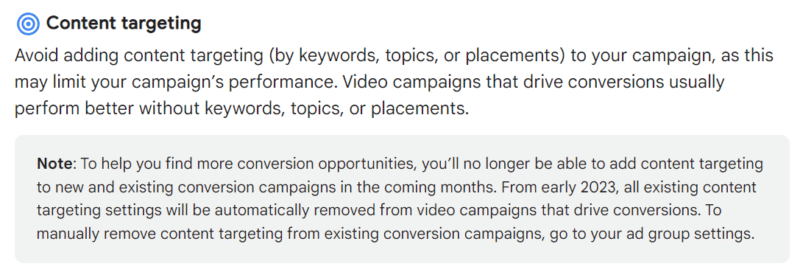
The help article, “Optimize your Video campaign for more conversions” contains a content targeting section that recommends avoiding the addition of content targeting (by keywords, topics or placements) in campaigns.

Furthermore, the article mentions that in early 2023 all existing content targeting settings will be automatically removed “from video campaigns that drive conversions.”
Academy for Ads

A major blow to targeting? These content targeting options are beloved by many advertisers due to the granularity they provide. Placements could target YouTube Channels, specific videos, video lineups, URLs, Apps, or collections.

With the current targeting, advertisers could match ads to channels/videos to deliver more customized messages to audiences. This change will effectively put an end to the hyper-targeting that made YouTube so appealing for ad dollars.

Another major blow is the loss of keyword targeting on the self-proclaimed 2nd largest search engine in the world. The removal of query targeting on a (video) search engine hurts.

While keywords on YouTube haven’t historically been as powerful as traditional search, it has been a way for advertisers to help answer queries with their video content. There is no doubt that advertisers will need to get more creative in order to hit their target audience.

What will happen to existing campaign when the change occurs? Advertisers running YouTube content targeting campaigns that leverage keywords, topics or placements will have the targeting removed. The article states:

“All existing content targeting settings will be automatically removed from video campaigns that drive conversions.”

We’ve reached out to Google for more clarification on this, but if you are running placement/keyword/topic targeting, this could wreak havoc on your campaigns. Stay tuned for this transition date as you won’t want to have all targeted swept from your accounts.

Why we care. A major benefit of YouTube ads has been the powerful targeting options, many of which will now be removed early next year. For performance marketers, the ability to fine-tune ads to channels or videos will no longer exist nor will the use of keywords on the second-largest search engine. These clearly can’t be chalked up to privacy or PII issues, but rather as a fundamental change away from content targeting options on the network.

If you are running ads using content targeting options, you should stay tuned to updates as those targeting settings will be automatically removed from your campaigns. With less targeting, you’ll reach a larger audience and may spend more on less qualified users.

The post Google Ads to discontinue content targeting for YouTube conversion campaigns in 2023 appeared first on Search Engine Land.

Original source: https://searchengineland.com/google-ads-to-discontinue-content-targeting-for-youtube-conversion-campaigns-in-2023-388683
How Latino Entrepreneurs Can Maintain Their Resilience During These Uncertain Times

Home Business Magazine Online

Despite the COVID-19 pandemic, Latino small business owners have maintained their record of entrepreneurial success. The pandemic has negatively affected the finances and operations of small businesses, posing significant challenges for entrepreneurs particularly minorities. However, the entrepreneurial spirit in the Latino community remains strong. In fact, according to a small business report recently released by the White House, Latino entrepreneurs are launching new businesses at the fastest rate in over a decade and 23% faster than before the pandemic.

Characteristics That Enable Hispanics to Persevere as Entrepreneurs

Latino entrepreneurs pride themselves on specific characteristics that contribute to their entrepreneurial spirit and have enabled them to persevere even in uncertain times. They have a strong work ethic that embodies the virtues of hard work, ambition, and creativity. With grandparents or parents who were immigrants, they learned that America is a place where anything is possible. Building a business is a great way to provide stability for family and community.

Hard Work

Hard work is the cornerstone of Latino entrepreneurial success. Many grew up with family members who worked with their hands for a living or woke up before anyone else in the family, to open their shops or restaurants. They learned that one does not leave work unfinished.

Strong Work Ethic

According to a 2017 study, Latinos possess a unique work ethic that has produced a workforce willing to do whatever it takes to attain their goals. These business owners also embodied natural creative instincts and strong determination to create a path when none existed. This enables Latino small business owners to creatively problem solve. It also helps them to adapt to unforeseen market conditions, the latest industry developments, or a sudden revenue loss. Instead of following a business plan that does not account for unexpected challenges, business owners have used their ingenuity to adapt and navigate these tricky new developments. This has proven especially important during these uncertain times.

Risk Taking

Lastly, in addition to being natural entrepreneurs, Latino entrepreneurs in this study were also comfortable taking high risks to achieve their goals. This is a crucial aspect of entrepreneurship. In fact, according to a study commissioned by Herbalife Nutrition and conducted by One Poll earlier this year, 88% of small business owners and employees surveyed believe that to be successful, people can’t be afraid to make mistakes

Challenges Faced by Latino Entrepreneurs

Latinos encompass many attributes that have enabled them to be strong entrepreneurs and demonstrate resilience in continuing to grow organically and open businesses in various industries. However, they still face significant challenges, such as less access to financing and credit. In a December 2021 study, the consulting firm McKinsey found that Latinos had the lowest rate of obtaining bank and financial institution loans to start their businesses compared to other racial and ethnic groups. The study also showed that they rely more on personal finances and receive a tiny fraction of the billions of dollars invested annually by venture capital firms, which inhibits the potential of starting a business and the possibility of bringing on employees and expanding businesses.

Before hiring employees, small businesses need a strong startup base capital and a stable and predictable revenue stream. Crossing that employer threshold is particularly challenging for Latino-owned businesses. A 2018 Stanford report found that for every 100 self-employed Latino business owners, there are only about 16 businesses with employees — almost half the rate of non-Latino businesses. Moreover, the challenge of getting financing is a significant factor.

Resources That Can Help Hispanic Entrepreneurs Succeed

Fortunately, Latino entrepreneurs do not have to confront these obstacles alone. There are several organizations, government agencies, and programs that can provide aspiring Latino small business owners with the support, education, and networking opportunities necessary to start new businesses or enhance their existing ones, such as how to acquire financing. Additionally, many of these valuable resources are easy to access online. These organizations include, but are not limited to the following:

LULAC

LBAN

  • The Latino Business Action Network (LBAN), a San Jose, Calif.-based nonprofit, works closely with Stanford University to fund and manage Hispanic-focused entrepreneurship programs. With a focus on growing businesses through “entrepreneurship research, education, and networks,” LBAN simultaneously teaches entrepreneurs how to scale and mentors them on topics like wealth building. The organization is responsible for more than 600 graduates through the Stanford Latino Entrepreneurship Initiative Education-Scaling Program, who now employ more than 30,000 people through their businesses.

USHCC

  • The U.S. Hispanic Chamber of Commerce (USHCC), founded in 1979, serves as the umbrella organization for more than 200 local Hispanic chambers of commerce and Hispanic business organizations around the U.S. The USHCC works to develop national programs to help Hispanic businesses. It promotes trade between Hispanic businesses in the U.S. and Latin America. Moreover, it provides technical assistance and training to Hispanic entrepreneurs. Additionally, the organization hosts events and programming to help businesses stay connected and informed.

Local Chamber of Commerce

  • Your local chamber of commerce is also a great resource. It provides access to valuable resources, discounts, and relationships that help businesses save money and market their products. Joining a chamber of commerce can boost sales and significantly improve a local business’ visibility and credibility.

Final Notes

The road to entrepreneurship is not easy. It comes with high rates of failure, unknowns, and financial instability, especially in today’s challenging times. However, with the right attitude, effort, support, resources, and tools, overcoming these challenges is possible. The rewards can be worth it. Are you interested in starting your own entrepreneurial journey? Learn more at IAmHerbalifeNutrition.com

The post How Latino Entrepreneurs Can Maintain Their Resilience During These Uncertain Times appeared first on Home Business Magazine.

Original source: https://homebusinessmag.com/success-stories-lifestyles/latino-entrepreneurs-maintain-resilience-uncertain-times/

FASB Topic 842 and the New Lease Accounting Standards – How They’ll Affect You

Home Business Magazine Online

Accountants and business owners alike often bemoan accounting updates ― even if their intentions were to improve how to do things. They can often bring about confusion, mistakes, and frustration. Business owners who do not have their finger on the pulse could easily miss the updates, such as the new lease accounting standards, and continue to do things the old and now defunct way. Surprisingly, accountants can do this, too. It is why you need to double check your accounting for lease arrangements and make sure you are adhering to ASC 842 lease accounting standards and not still processing things under ASC 840.

Some Quick Definitions

We are going to cover some abbreviations in this article. Here is what they stand for:

GAAP

Generally accepted accounting principles. It is the practice that businesses and accountants use to govern the drawing up of accounts in the USA.

ASC 840

The older guidance regarding lease accounting. ASC stands for accounting standards committee.

ASC 842

The newer guidance for lease accounting.

FASB

Financial accounting standards board. It is a private standard setting body whose purpose is to improve and in some cases establish standards for U.S GAAP.

IFRS

International financial reporting standards. They are a set of accounting standards set out by the international accounting standards board

IASB

International accounting standards board.

So, now that we have covered these confusing abbreviations, what is FASB topic 842 and why is it important to you and your business?

What Is ASC 842?

ASC 842 is, simply, the name for the new lease accounting standards set out under U.S. GAAP (generally accepted accounting practice). It covers public and nonpublic companies and supersedes the old ASC 840 guidance that stood in place previously. The FASB and IASB jointly developed ASC 842. Both standards required more transparency for the stakeholders of financial statements. As such, FASB topic 842 provides management and anyone scrutinizing accounts more transparency. They can fully explore the lease arrangements on the balance sheet.

How It Will Affect Your Business

It all comes down to the balance sheet. Under the old guidelines, you could place a few items off the balance sheet. However, the new guidelines are all about increasing transparency, so the amount of allowable off balance sheet transactions reduces severely. You need to make sure you show the right leases on the balance sheet.

What You Should Do

Quite simply, you need to update your accounting practices to cater for ASC 842 if you have not already. ASC 840 is no longer the right form of accounting. Speak to your accountant, and make sure he/she is aware. This is obviously far more important if your business has occupancy with multiple leases. With that said, even if it is just one lease, you still need to account for it properly.

If you draw up your own accounts, make sure you follow these newer lease accounting guidelines to stay compliant. There is, of course, lease accounting software to help you out, or you can look at hiring an accountant.

You should also set up alerts or follow an accountancy blog so that you will know about these changes in the future with plenty of time to implement them. Although some of these changes can be frustrating, at the same time, some of them may benefit you as a business and save you money. Therefore, it is always worth keeping an eye on changes to accounting standards, such as any future lease accounting changes.

The post FASB Topic 842 and the New Lease Accounting Standards – How They’ll Affect You appeared first on Home Business Magazine.

Original source: https://homebusinessmag.com/money/accounting-and-bookkeeping/fasb-topic-asc-842-new-lease-accounting-standards-affect-you/

Google Ads label is now a bold black text Sponsored label

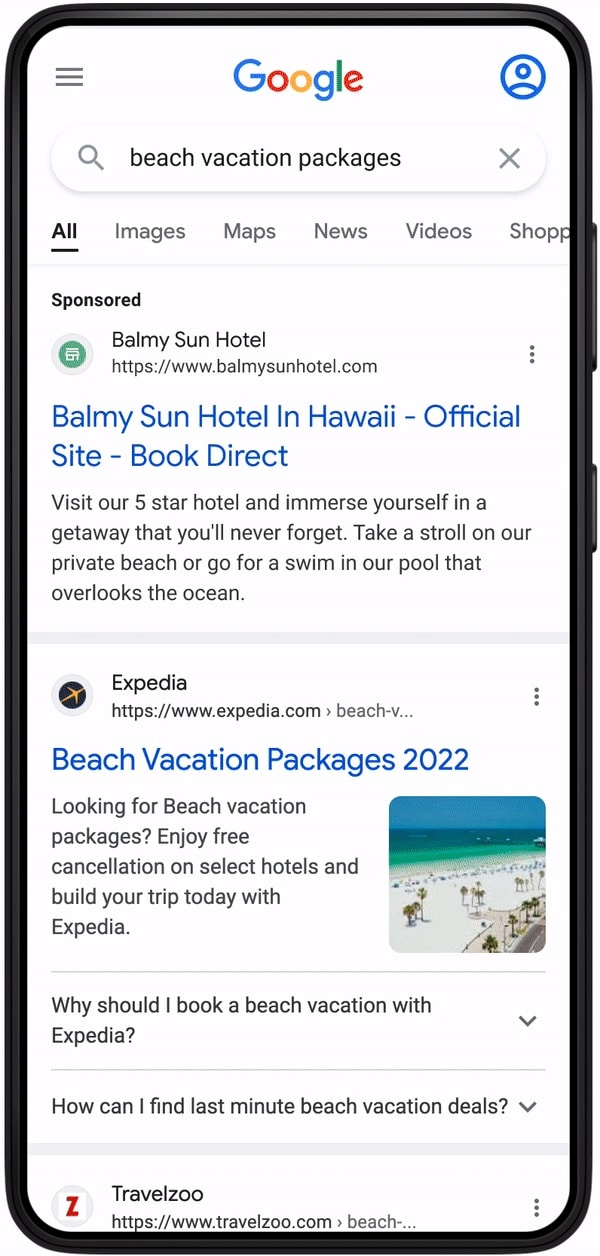
Google is rolling out a new search ad label, replacing the black “Ad” label with a new bold black text “Sponsored” label. This is rolling out in conjunction with the new site names and larger favicons in the mobile search results, Google announced.

What is looks like. Here is a screenshot of the new bold black “Sponsored” text ad label for the Google Ads:

Advertising

Why the change. Google said this is to help “make sense of the information you see is ensuring that ads are clearly labeled.” A more prominent ad label, should do that, the search company said.

The new ad label, labeled “Sponsored,” is now featured on its own line in the top-left corner of Google Search ads.

Some ad label history. We will be updating our visual history of Google ad labels at some point, but for a quick refresher, Google rolled out a new treatment for labeling text ads in mobile search results in May 2019. In January 2020, Google extended that ad labeling and favicon treatment to desktop and quickly faced broad backlash over the further blurring of ads and organic listings, which Google hadn’t seen with the change to mobile. The company almost immediately backtracked and began experimenting with several treatment variations on desktop.

In 2007, Google changed the long-standing shaded background indicating the ads section of the page from blue to yellow. In 2008, it then briefly tried a green background before reverting back to yellow. Google continued to test variations of background colors including bright blue and a light violet. In 2010, violet officially replaced the yellow, but only lasted about a year before yellow reappeared in 2011. In 2013, Google tweaked the yellow to a paler shade, which would close out the era of background shading.

At the end of 2013, Google removed the background shading and began testing a yellow ad label next to each text ad. The yellow “Ad” label rolled out globally in 2014 in a much smaller size than first appeared in the initial testing. In 2016, a new green label marked the first time the color of an ad demarcation matched the color of an element in both the ads and organic listings: the display URL. A year later, Google kept the green, but inverted the treatments so that the font was green with a thin green border on a white background. This past year’s update to the black label does away with the border altogether, further, the display URL is now black to match the “Ad” label.

Note, we also spotted Google testing the Sponsored label many months ago.

Why we care. Google said “this new label and its prominent position continues to meet our high standards for being distinguishable from search results and builds on our existing efforts to make information about paid content clear.”

A more distinguishable ad label may result in changes to your click through rates on your ads, so take notice and track to see if clicks go up or down over a period of time.

The post Google Ads label is now a bold black text Sponsored label appeared first on Search Engine Land.

Original source: https://searchengineland.com/google-ads-label-is-now-a-bold-black-text-sponsored-label-388715

Revenue optimization: 3 ways to get your advertising efforts right

Marketing departments once believed it was a sales issue if the sales team couldn’t work the leads from marketing.

Today, this is no longer the case.

Optimizing for leads or marketing qualified leads (MQLs) is great, but optimizing for what drives pipeline and revenue is better. 

Marketers exist in a new age where it’s no longer satisfactory only to drive leads alone.

With the available technology and data today, we can do much more than identify hand-raisers to help companies spend their marketing dollars more efficiently and drive revenue.

Just because a channel generates leads doesn’t mean those leads bring value later in your sales funnel. 

When you understand where customers are bringing in revenue vs. where they may need more nurturing before converting, you can create a more holistic media strategy to generate qualified leads that will churn out more income than lead volume alone.

Below are three must-haves for revenue optimization.

1. Tight-knit tracking 

Tracking is essential for reasons that go well beyond reporting.

In this new age of artificial intelligence, it’s vital to feed machine learning the data that will make it do what you desire.

Platforms like Google optimize the data you provide, making it a powerful tool or your worst nightmare. 

Accurately tracking your efforts plays a significant role in your advertising strategy’s success.

Integrating third-party data sources, like Snowflake and Salesforce, with your paid media reporting helps decrease the optimization time against a deeper funnel event, such as MQL, sales accepted lead (SAL) and revenue.

Nonetheless, offline conversion tracking in Google is great for seeing what campaigns drive down-funnel metrics like SALs and closed/won leads. If you’re attributing revenue to these conversions, that’s even better. 

If your B2B advertising team is doing lead generation in Google without visibility into where they are going down funnel with offline conversion tracking, they are doing it wrong.


Get the daily newsletter search marketers rely on.

<input type="hidden" name="utmMedium" value="” />
<input type="hidden" name="utmCampaign" value="” />
<input type="hidden" name="utmSource" value="” />
<input type="hidden" name="utmContent" value="” />
<input type="hidden" name="pageLink" value="” />
<input type="hidden" name="ipAddress" value="” />

Processing…Please wait.

function getCookie(cname) {
let name = cname + “=”;
let decodedCookie = decodeURIComponent(document.cookie);
let ca = decodedCookie.split(‘;’);
for(let i = 0; i <ca.length; i++) {
let c = ca[i];
while (c.charAt(0) == ' ') {
c = c.substring(1);
}
if (c.indexOf(name) == 0) {
return c.substring(name.length, c.length);
}
}
return "";
}
document.getElementById('munchkinCookieInline').value = getCookie('_mkto_trk');


2. Understand the customer base 

Marketers should know how users from different channels perform once they are in your sales funnel.

For example, if your average Google search lead value is 4x higher than a lead out of Facebook, how can you use that to prioritize your spending and channel goals?

Understanding your average time to close or how long it takes the lead to turn into revenue will help you only to further optimize toward revenue.

With that said, marketers should avoid reactivity with a down day or week if it can take up to a couple of months for a user to move through the sales funnel.

For example, if it takes two months for a lead to close, you need to give a new campaign or channel at least that long before making abrupt cuts if you aren’t seeing initial revenue. 

Seasonality is also a critical factor to consider. Understand and prioritize the best time of year to capture your high-value users.

Create a plan to warm up those audiences earlier in the year and then nurture them post-initial conversion to move them along the sales funnel.

Targeting the right audience also helps you assign pipeline value to optimize revenue. Having an ideal customer profile (ICP) in mind for your targeting is an underrated piece of the puzzle.

Knowing what kind of people will be buying your product is paramount to getting your advertising efforts right. 

For B2B, you should know their job titles, pain points, tasks and anything that will indicate if your product would make their lives easier. You should also be aware of your sales team’s lead disqualification criteria. 

Will your sales team throw out leads from businesses that don’t meet a revenue threshold?

If so, don’t waste your marketing dollars on those disqualified leads when you can target revenue on other strong advertising channels.

3. Understand the lifetime value of customers 

Teams optimizing for revenue should understand the value of their customers through customer lifetime value.

How can you optimize for revenue if you don’t know who your most valuable customers are? 

Understanding the lifetime value (LTV) of your customer base and your customer acquisition cost (CAC) allows you to perform an LTV:CAC ratio analysis to get the complete picture of how your channel mix is affecting your advertising efforts. 

Say Google is driving significant lead volume but at a .5 LTV:CAC. It might be time to dig a little deeper into Google to see how you can improve Google’s revenue-generating efficiency.

Generally, you’d like to see at least a 3:1 LTV:CAC when measuring this. 

If you are having trouble calculating the LTV of your customers, Hubspot has a great article that can help you with this initial step.

The takeaway

CMOs are asked to demonstrate the value of every dollar put into marketing.

Leads are quickly becoming a metric of a bygone age where marketers could simply pat themselves on the back for a well-done job. 

Today, any metric outside of revenue is a vanity metric to senior and executive leadership outside of marketing, making every dollar to customer acquisition and improving the bottom line. 

Give the platforms the data they need to find the highest-value customers.

By doing so, you’ll empower the optimization of every effort for the success and growth of your organization, giving your CMO a few extra hours of sleep at night.

The post Revenue optimization: 3 ways to get your advertising efforts right appeared first on Search Engine Land.

Original source: https://searchengineland.com/revenue-optimization-advertising-388645

Webinar: How AI unlocks value from your single source of data truth

artificial intelligence

With customers’ increasing demands and expectations, marketers strive to improve the timing and impact and ROI of customer engagements. Achieving this vision remains an uphill battle challenged by the growing number of marketing technologies that generate data silos and complex customer journeys. Marketers work tirelessly with fragmented data sources without a single source of truth.

Join Snowflake’s Lourenco Mello and Julian Forero to discover how the data cloud is the foundation of your data-driven marketing strategy.

Register today for “How AI Unlocks Value from your Single Source of Data Truth,” presented by Snowflake.


Click here to view more Search Engine Land webinars.

The post Webinar: How AI unlocks value from your single source of data truth appeared first on Search Engine Land.

Original source: https://searchengineland.com/webinar-how-ai-unlocks-value-from-your-single-source-of-data-truth-388717

Five Tips on How to Launch a Fashion Brand Online

Home Business Magazine Online

Online fashion brands are now the way to go. People love them, as they can just patronize them wherever they are. Gone are the days when an online fashion brand seems impossible. Yes, you also can now create and launch a fashion brand online successfully. However, you should know that this cannot be done easily. It is a stressful process — especially if you don’t know what you are doing.

Five Tips

Still, there are some useful tips that you should know that can help do this easily. Five of these useful tips are:

1. Set Goals

You will not be able to launch your fashion brand online by just creating it and stopping at that. No, you need to go further by setting goals for your fashion brand. When it comes to setting it up online, people make the mistake of not setting any goals. Usually, this results in them being lazy with their brand. Setting goals will let you know what you want to achieve after a certain period. This can be very good, as it can motivate you to try your best for your fashion brand. Therefore, setting goals is a very useful tip that you should know beforehand.

2. Create a Unique Identity

When it comes to online fashion brands, it is very easy to get lost in the crowd. There are a lot of different ones presently. Also, because it is an online fashion brand, most people may mistake you for others. This is not good for any business. However, if you create a unique identity for your fashion brand, it will be easy to set yourself aside from others.

3. Be Active on Social Media Platforms

Social media platforms are there to help you promote your brands. Thus, you should make the most of them. Create social media pages for your online fashion brand. On social media, news travel very fast. Due to this, a lot of people will know about your fashion brand after a short period. This is what you need for it to become successful.

4. Know Your Competition

There are a lot of different fashion brands online today. However, some of them are located closer to you than others. Also, if you are new to fashion, you should study them. Especially those that are experienced, your competition might end up giving you tips for your fashion brand. Moreover, knowing your competition will let you know what steps to take to be better than them. Thus, knowing your competition can help you in a lot of ways.

5. Do Giveaways

People naturally like anything free or that costs less than normal. As you are launching your fashion brand online, you should do giveaways. Giveaways will make people know and want to patronize you more. They will patronize you because of future giveaways that you might do. However, make sure to offer your giveaways wisely.

Conclusion

Launching your fashion brand online can be a stressful process. However, it gets more stressful when you don’t know what you are doing. So just make use of the tips mentioned above and make everything easier. You can reach out to wordans canada wholesale to help you launch your brand.

The post Five Tips on How to Launch a Fashion Brand Online appeared first on Home Business Magazine.

Original source: https://homebusinessmag.com/businesses/success-tips/five-tips-launch-fashion-brand-online/

Five Options for Funding Home Renovations: Which Should You Choose?

Home Business Magazine Online

Buying a home is a fantastic experience. Living in your own house is even much better. However, home ownership comes with its fair share of expenses. You have to take care of things like home insurance and repairs.

Home renovations or repairs can cost a lot of money. You might find yourself in a situation where you are short of cash, but find an urgent makeover inevitable. Or, you may not find logic in forking out huge sums of cash in one sitting. Fortunately, there are plenty of options where you do not have to deplete your savings instantly.

There are different options you can choose from in the form of home improvement loans to fund your home renovations. Here are a few of the options you can choose from when funding your home renovations.

203K Renovation Loan

A 203(k) renovation loan combines your home renovation and mortgage costs. When applying for this loan, you do not have to worry about sending two different applications or paying different closing costs.

Instead, a single application can finance both the purchase and renovation costs of your home. This is done when buying a home and is one of the best loans for those buying a home that needs renovations such as fixer-uppers.

The 203(k) renovation loan is backed by the government. This means that you get benefits such as low down payments and applications even if you do not have the perfect credit history. Just like most loans, this loan includes mortgage insurance and an upfront payment.

Cash-Out Refinance

Cash-out refinance is a popular funding option for home renovations. It works by allowing homeowners to refinance a new mortgage loan but with a balance bigger than what they currently have. They then keep the balance but pay the existing mortgage.

The amount of money received from this funding option is generated from the equity of your home. It is this money that you can use to fund your home renovations. You can also use this money for anything else since it does not come with rules restricting you to renovations.

A cash-out refinance is the best option for homeowners who want to have their existing loans reset. This allows them to benefit from lower interest rates than their existing mortgages. You can also adjust your mortgage term with cash-out refinance.

Home Equity Line of Credit (HELOC)

A home equity line of credit (HELOC) is best suited for homeowners who want to fund their home renovations without having to refinance their existing mortgages. A HELOC functions like a credit card since it allows you to borrow up to a certain limit.

You can then pay the loan back and borrow again when the need arises. A HELOC comes with adjustable interest rates. This means that interest rates can fall or rise from time to time. The interest is due on your existing balance, not the entire amount of money borrowed.

When getting a HELOC loan, it is important to note that you can borrow any amount, not necessarily the maximum amount of loan that you are allowed to borrow. Borrowing a smaller amount means that your interest charges and payments get lower.

Home Equity Loan (HEL)

You can fund your home renovations by borrowing against the home’s equity. The equity can be calculated by determining the value of your home and then subtracting the balance you have on your mortgage loan.

However, it is important to note that you cannot use a home equity loan to pay for your current mortgage, something you can do with a cash-out refinance. Getting a home equity loan means that you will be making payments for both the loan and your existing mortgage for those who have a mortgage.

A home equity loan is best suited for homeowners who would like to fund a huge home renovation project. It is also good for those who have built plenty of equity in their homes. The loan is disbursed in a lump sum.

Personal Loans

You can also fund your home renovations using personal loans, especially for those with little home equity. Since these loans are not secured, your home will not be used as collateral. You can get these loans more quickly compared to most of the funding options discussed in this article.

Even though personal loans come with fixed or adjustable rates, it is important to note that their interest rates are often higher than those that come with HELOC or HEL loans. However, with a good to excellent credit score, you will be able to get a cheap rate.

The term for personal loans is not as flexible as it is for other loans. It ranges from about two to five years. You will also need to pay closing costs. That notwithstanding, personal loans are more accessible.

Final Thoughts on Funding Home Renovations

So, which option should you choose? Well, when choosing a home renovation funding option, make sure that the one you settle for meets your financial requirements.

The post Five Options for Funding Home Renovations: Which Should You Choose? appeared first on Home Business Magazine.

Original source: https://homebusinessmag.com/money/personal-finance/five-options-funding-home-renovations-which-choose/

Webinar: Deliver highly-personalized experiences with quality data

Business Finance

To achieve the most ROI from your customer data, you need a strong foundation. Creating a precise golden record for each consumer with enriched data, a full contact graph and a full identity graph provides the context your brand needs to differentiate based on CX. Precise data includes both first-party data as well as third-party data to enrich your total understanding of each consumer.

If your brand lacks a pristine golden record for each customer, join John Nash, chief marketing and strategy officer at Redpoint, as he discusses the best steps to get started.

Register today for “Steps to Deliver Highly Personalized Experiences With Quality Data,” presented by Redpoint Global.


Click here to view more Search Engine Land webinars.

The post Webinar: Deliver highly-personalized experiences with quality data appeared first on Search Engine Land.

Original source: https://searchengineland.com/webinar-deliver-highly-personalized-experiences-with-quality-data-388665