<p>Online gaming has become an integral part of modern entertainment, captivating millions of players across the globe. What began as simple, text-based games over dial-up connections has now transformed into a rich, immersive experience connecting people regardless of geography or background. The growth of online gaming is a testament to technological advancement, cultural shifts, and the universal human desire for connection and competition.</p>
<p>Online gaming refers to playing video games via the internet, enabling real-time interaction between players. This form of gaming is incredibly diverse, covering genres such as action, strategy, role-playing, sports, and simulation. Players can either compete against one another or cooperate to achieve common goals. Titles like <em>Fortnite</em>, <em>Call of Duty</em>, <em>World of Warcraft</em>, and <em>Among Us</em> highlight the variety of experiences available, ranging from fast-paced shooters to expansive multiplayer worlds.</p>
<p>One of the defining features of online gaming is its social component. Unlike traditional video games, which often involve playing alone or with people physically nearby, online games allow players to communicate and collaborate with others worldwide. This has helped foster vibrant communities, where friendships are built through shared quests, competitive matches, or simply hanging out in virtual spaces. Platforms such as Discord and Twitch have further enhanced this social experience by enabling live interaction and content sharing.</p>
<p>The rise of esports, the competitive side of online gaming, has further boosted the industry’s popularity. Esports tournaments attract millions of viewers and offer lucrative prize pools, turning skilled players into global celebrities. The professionalization of gaming has led to sponsorship deals, streaming careers, and a new kind of entertainment spectacle. This development has helped change the perception of gaming from a mere pastime to a serious profession.</p>
<p>Despite these positives, online gaming does face challenges. The addictive nature of some games can lead to excessive screen time, affecting mental and physical health. Developers use game design techniques that encourage prolonged play, sometimes blurring the line between engagement and <strong><a href="https://www.sushiipaper.com/">SBOBET</a></strong> dependency. Moreover, online gaming communities occasionally struggle with toxic behavior, including harassment and cheating. Addressing these issues requires a combination of effective moderation, player education, and responsible game design.</p>
<p>Technological innovations have been central to online gaming’s expansion. High-speed internet, powerful graphics processors, and cloud computing have made it possible to deliver rich, seamless multiplayer experiences. Cloud gaming, in particular, promises to reduce hardware barriers by streaming games directly to devices, allowing more players to participate without expensive equipment. Additionally, emerging technologies like virtual reality (VR) and augmented reality (AR) are poised to add new dimensions to online gaming, increasing immersion and interaction.</p>
<p>Online gaming also offers educational benefits. Many games improve cognitive skills such as problem-solving, strategic thinking, and teamwork. Educators are exploring ways to harness these qualities to make learning more engaging and interactive. Game-based learning is an evolving field that could transform traditional education by incorporating the motivational elements of gaming.</p>
<p>In conclusion, online gaming represents much more than entertainment; it’s a dynamic cultural phenomenon that connects millions, drives technological progress, and creates new social and professional opportunities. As the industry continues to innovate and grow, online gaming will undoubtedly remain a powerful force in the digital age—bringing people together through play and shared experiences.…</p>
<p>The post <a href="https://clickbankproads.com/building-your-online-gaming-career-tips-and-tricks/">Building Your Online Gaming Career: Tips and Tricks</a> appeared first on <a href="https://clickbankproads.com"></a>.</p>
The Rise and Impact of Online Gaming in Today’s Digital Era
<p> </p>
<p>Online gaming has transformed the landscape of entertainment in the 21st century, evolving from a niche hobby into a global phenomenon that connects millions of players worldwide. The growth of internet accessibility, advancements in technology, and the emergence of diverse gaming platforms have collectively propelled online gaming into mainstream culture. This article explores the rise of online gaming, its benefits, challenges, and its broader impact on society.</p>
<p><strong>The Evolution of Online Gaming</strong></p>
<p>The origins of online gaming trace back to the early 1990s <a href="https://tipclub.lat/"><strong><span data-sheets-root="1">Cổng game Tipclub</span></strong></a> when multiplayer games began to utilize dial-up internet connections. Titles like “Doom” and “Quake” introduced players to competitive and cooperative gameplay over networks. However, it was not until broadband internet became widespread that online gaming truly flourished. Today, online games range from simple mobile apps to complex, immersive virtual worlds with millions of simultaneous users.</p>
<p>Modern online games include genres such as massively multiplayer online role-playing games (MMORPGs), battle royale shooters, strategy games, and casual social games. Popular titles like “Fortnite,” “World of Warcraft,” and “Among Us” demonstrate the variety and reach of online gaming. These games foster communities, competition, and collaboration on an unprecedented scale.</p>
<p><strong>Benefits of Online Gaming</strong></p>
<p>One of the primary advantages of online gaming is its ability to connect people across the globe. Players can communicate, strategize, and form friendships regardless of geographical boundaries. This social aspect has been especially valuable during times of physical isolation, such as during the COVID-19 pandemic, where gaming became a virtual meeting ground for social interaction.</p>
<p>Additionally, online gaming can improve cognitive skills. Many games require quick reflexes, strategic thinking, and problem-solving abilities. These mental challenges can enhance hand-eye coordination, memory, and multitasking skills. Moreover, the cooperative nature of many games encourages teamwork, leadership, and communication skills.</p>
<p>Online gaming also provides a platform for creativity and self-expression. Players can customize avatars, build virtual worlds, and participate in storytelling, allowing them to express their individuality in unique ways.</p>
<p><strong>Challenges and Concerns</strong></p>
<p>Despite its many benefits, online gaming also presents challenges. One major concern is the potential for addiction. Excessive gaming can lead to neglect of real-life responsibilities and social isolation. Recognizing this, health organizations have started to address gaming disorder as a behavioral condition requiring attention.</p>
<p>Another challenge is the prevalence of toxic behavior within online communities. Harassment, cheating, and bullying can negatively impact players’ experiences. Game developers and platforms continuously work to implement moderation tools and community guidelines to combat these issues.</p>
<p>Security is another important aspect, as online gaming often involves sharing personal data and in-game purchases. Players need to be cautious about phishing scams and protect their accounts from hacking.</p>
<p><strong>The Future of Online Gaming</strong></p>
<p>Looking ahead, online gaming is poised to integrate more advanced technologies such as virtual reality (VR), augmented reality (AR), and artificial intelligence (AI). These innovations will make games even more immersive and interactive. The rise of esports as a competitive sport is also expanding opportunities for professional gamers and audiences alike.</p>
<p>In conclusion, online gaming has reshaped entertainment by creating virtual spaces for social connection, skill development, and creativity. While it faces challenges, the industry continues to innovate and grow, offering exciting possibilities for players worldwide. As technology progresses, online gaming will remain a vital part of digital culture and human interaction.…</p>
<p>The post <a href="https://clickbankproads.com/the-rise-and-impact-of-online-gaming-in-todays-digital-era/">The Rise and Impact of Online Gaming in Today’s Digital Era</a> appeared first on <a href="https://clickbankproads.com"></a>.</p>
Setting Up Servers for Your Home Business

Home Business Magazine Online
Running a successful home business requires more than just great ideas and determination. Behind every thriving operation lies a robust technological foundation that can handle your growing needs, protect your valuable data, and keep your business running smoothly around the clock.
Many entrepreneurs underestimate the importance of proper server infrastructure until they face their first major system failure or security breach. By then, the cost of downtime and lost data often far exceeds the investment required for a well-planned server setup from the start. Make sure you properly prepare by setting up servers for your home business the right way.
Consider Your Technology Needs
Your server requirements depend entirely on your business model and growth projections. A freelance graphic designer may only need a simple file server for backup and storage. At the same time, an e-commerce startup might require multiple servers to handle inventory management, payment processing, and customer databases. Even home-based businesses aren’t too small for a data center if they rely heavily on technology to manage operations or store critical data.
Start by evaluating your current and projected needs. Tower servers work well for basic file sharing and small databases, offering easy maintenance and expansion. Rack-mounted servers provide increased power and density, but they require proper cooling and a suitable rack infrastructure. For businesses expecting rapid growth, blade servers offer maximum performance in minimal space.
Some entrepreneurs choose cloud-based solutions initially, but many find that dedicated on-premise servers provide better control, security, and long-term cost savings. Hybrid approaches combine both local and cloud resources, giving you flexibility while maintaining core operations in-house.
Lock In a Reasonable Budget
Server costs vary dramatically based on your requirements, but planning prevents expensive surprises later.
Factor in ongoing expenses beyond the initial hardware purchase. Software licenses, maintenance contracts, electricity consumption, and eventual upgrades all impact your total cost of ownership. Many businesses find that spending slightly more upfront on quality components saves money over time through reduced downtime and longer equipment lifespans.
Get the Right Servers
Selecting appropriate hardware requires balancing performance, reliability, and cost. Processing power matters most for applications like video editing, data analysis, or running multiple virtual machines. Memory capacity becomes critical when supporting a large number of simultaneous users or extensive databases.
Storage needs also vary significantly by business type. A photography studio requires vast amounts of fast storage for high-resolution images, while a consulting firm might need less capacity but higher reliability for client documents.
Set Up Server Racks
Professional server installation requires proper rack infrastructure, especially as your business grows. Wall-mounted racks work well for companies with limited floor space, while full-height racks provide maximum capacity for larger operations. Consider portable racks if you might relocate your business or need to access equipment from multiple sides for maintenance.
You can also design your own custom server rack configuration to fit your specific space and equipment needs. This customization proves particularly valuable for home businesses where standard rack sizes might not work in converted basements or spare rooms.
Maximize Airflow and Cooling
The importance of proper data center cooling is high. It extends equipment life and prevents costly failures.
Design your rack layout with airflow in mind. Hot-aisle/cold-aisle configurations separate intake and exhaust airflows, improving cooling efficiency. Ensure adequate clearance around equipment for air circulation, and avoid blocking ventilation openings with cables or other equipment.
Room-level cooling might require upgrading your HVAC system or adding dedicated air conditioning units. Calculate heat loads based on your equipment specifications, then add capacity for future expansion. Redundant cooling systems prevent single points of failure that could shut down your entire operation.
Choose an Operating System
Consider your staff’s technical expertise when making this decision. Windows Server requires less specialized knowledge for basic administration, while Linux offers more flexibility but demands greater technical skills. Some businesses run multiple operating systems on different servers to optimize each system for its specific role.
Virtualization platforms, such as VMware or Hyper-V, allow you to run multiple operating systems on a single hardware platform. This approach maximizes hardware utilization and provides flexibility for testing new applications or maintaining legacy systems.
Connect All the Cables
Proper cabling prevents network bottlenecks and simplifies troubleshooting. Label every cable clearly while setting up servers for your home business to avoid confusion during maintenance or expansion.
Power distribution requires careful planning to prevent overloads and ensure redundancy. Uninterruptible Power Supplies (UPS) protect against power fluctuations and provide backup power during outages. Size your UPS system to handle your full server load plus enough runtime to shut down systems safely during extended outages.
Cable management systems keep installations neat and maintainable. Use cable ties, management arms, and dedicated cable channels to organize runs.
Protect Your Data
Implement layered security approaches that combine firewalls, antivirus software, and intrusion detection systems to enhance security. Regular security updates and patches will close vulnerabilities before attackers can exploit them. Consider managed security services if you lack in-house expertise for ongoing monitoring and maintenance.
Backup systems protect against data loss from hardware failures, security breaches, or human error. Implement automated backup schedules that capture changes regularly without impacting business operations. Test restore procedures regularly to ensure backups work when you need them.
Test Everything Works
Performance testing reveals bottlenecks that might not appear during initial setup. Simulate normal business loads plus peak usage scenarios to identify potential problems. Network stress testing ensures your infrastructure can handle growth without degrading performance.
Security testing verifies that your protective measures work correctly. Attempt to access systems from outside your network to confirm that firewalls block inappropriate traffic. Test backup and restore procedures to ensure data protection systems function properly.
Put Maintenance on the Calendar
Schedule routine tasks like software updates, security patches, and hardware cleaning during off-peak hours. Maintain detailed logs of all maintenance activities and system changes.
Monitor system performance continuously to identify trends that might indicate developing problems. Hard drive health, temperature readings, and network utilization patterns often provide early warning signs of impending failures. Proactive replacement of aging components costs less than emergency repairs.
Set Up Your Business Servers Today
Professional server infrastructure transforms home businesses from hobby ventures into serious commercial operations. Your customers expect reliable service, secure data handling, and professional-grade performance—all of which depend on robust server systems.
Take the Next Step Toward Success
Setting up your business servers properly is just one of many critical steps when you start a home business. Whether you’re launching an online store, offering professional services, or exploring new home business ideas for women, having the right technology in place ensures long-term growth and security. Invest in infrastructure now to build a resilient, future-ready foundation for your entrepreneurial journey.
Image Credentials: Wirestock, 1028579071
The post Setting Up Servers for Your Home Business appeared first on Home Business Magazine.
Original source: https://homebusinessmag.com/home-office/computers-and-software/setting-up-servers-home-business/
If You Love Subtle Sparkle These Pendants Are for You

Home Business Magazine Online
Diamond jewelry doesn’t have to be flashy to feel luxurious. Some of the most timeless pieces aren’t big or dramatic – they’re the ones that work quietly in the background, catching the light when you move and adding just enough polish to finish a look.
And that’s where diamond pendants enter the chat.
They’re clean, easy to wear, and surprisingly versatile. So, if you’re building a capsule collection or simply replacing that necklace you never take off, these are the kinds of pieces that stay in rotation – no matter what you’re wearing.
The Solitaire
This one never really goes out of style.
A single diamond on a fine chain is simple, clean, and endlessly wearable. It sits right at the collarbone and works with whatever you’ve got on – a white shirt, a sweater, or something dressy.
Choose a round or oval stone and a setting that lets the diamond shine without too much metal around it. You’ll probably forget you’re even wearing it until someone compliments it. And lab-grown pendants are a perfect way to go if you want a conscious choice, plus they are way more affordable.
It’s a great place to start if you want just one piece that goes with everything.
The Vertical Drop
This one’s all about length. A pendant that hangs straight down – whether it’s a narrow bar, a line of diamonds, or a longer shape – gives your outfit a little movement.
It’s a great option if you like open necklines, or if you just want to break up a simple top. And because it’s longer, it stands out without needing to be bold.
Wear it on its own or layer it with a shorter necklace. Either way, it adds a little something extra without making a fuss.
The Diamond Bar
If you want a little more sparkle without going over the top, a diamond bar pendant does the trick.
It’s usually a slim row of small diamonds in a straight line, sitting flat on your chest. There’s some shine, but nothing too showy. It’s a smart choice for everyday – especially if you’re someone who leans toward simple outfits.
This one pairs well with button-downs or blazers, but it also works with jeans and a T-shirt. It’s neat, easy, and quietly polished.
Shapes with Meaning
You don’t have to go with a round stone. Small shapes like hearts, stars, moons, or initials bring in something personal, without adding bulk or flash.
Look for versions that are small and clean – maybe an outline with pavé diamonds, or a tiny charm with one stone. They still work with other jewelry, and they’re easy to wear every day.
These kinds of pendants add a little detail to your look without being too obvious, and they’re low-key but never boring.
The Floating Diamond
The setting on this one is hidden, so it looks like the diamond is floating on your skin. It’s subtle, a little unexpected, and very easy to wear.
There’s nothing complicated about it. No heavy chain. No bulky clasp. Just a clean line and a little sparkle that moves when you do.
It works especially well with open collars or scoop necks, but it looks great with high necklines too. You don’t need to stack it – the simplicity is what makes it interesting.
The Circle
A small circle pendant, often with tiny diamonds around the edge, is one of those pieces that always looks right.
It’s balanced, soft, and easy to style. It doesn’t draw too much attention, but it never fades into the background either. You can wear it on its own or between other layers – it adapts.
This kind of pendant fits into pretty much any outfit. It works with casual clothes, but it also cleans up well when you need it to.
What to Check Before You Buy
A pendant might look delicate, but it needs to hold up to regular wear. Here’s what to actually look for:
- Chain length matters. For most people, 16 to 18 inches is the sweet spot – short enough to sit near the collarbone, long enough to show under most necklines. If you want options, go for an adjustable chain with at least two length settings.
- Inspect the clasp. Spring-ring clasps are common but can be tricky to handle. Lobster clasps are easier to use and generally more durable – especially if you plan to wear the necklace often.
- Test the chain’s strength. Thin doesn’t have to mean fragile. Look for chains labeled as solid gold or platinum rather than gold-plated. A cable or box chain usually holds up better over time than something ultra-fine like a wheat chain.
- Check how the pendant sits. A well-balanced pendant should lie flat on your chest – not flip or twist constantly. The loop (called the bail) should move smoothly, but not so loose that it slides off when the chain is undone.
- Focus on cut over size. A smaller diamond that’s well-cut will reflect more light than a larger one that’s poorly finished. Don’t obsess over carat weight – look at how the stone actually performs in real lighting.
- Know your lifestyle. If you don’t plan to take it off, choose a low-profile setting that won’t catch on sweaters or hair. If you wear perfume or lotion often, white gold or platinum will hold up better than silver.
These small details add up to something you’ll wear every day and keep for years. And when the fit, finish, and chain all work together, you won’t be adjusting it halfway through the day – it’ll simply stay in place and do its job.
The Piece You’ll Actually Wear
The best pendant doesn’t just sit in a box. It ends up in your regular rotation – the one you put on without thinking, and the one that still looks good when everything else is last-minute.
It’s simple. It works with everything. And it makes your outfit feel finished, even if the rest is just jeans and a white tee.
If that’s the kind of sparkle you’re after, this is where to start.
The post If You Love Subtle Sparkle These Pendants Are for You appeared first on Home Business Magazine.
Original source: https://homebusinessmag.com/lifestyles/success-lifestyles/love-these-subtle-sparkle-pendants/
The Role of Custodians in Securing Crypto Assets

Home Business Magazine Online
Most investors find it challenging to make informed decisions on how to protect their assets. That’s when custodians play a significant role, which is securing crypto assets.
Remember, custodianship in the crypto sphere isn’t straightforward. As a crypto investor, to protect your investments and enhance your overall investment strategy, it is essential to understand the role of custodians in this regard.
Here’s a detailed guide that sheds light on how custodians can secure your crypto assets. So, let’s enumerate each one by one!
1. Understanding Custodial Services
Custodians are specialized financial institutions or companies that facilitate secure storage for safeguarding crypto assets on behalf of individuals and entities. In self-custody options, users are responsible for managing private keys. But that’s not the case in custodial services.
These services employ advanced security measures and protocols to safeguard assets against theft, loss, and unauthorized access, providing users with ultimate peace of mind.
2. Advanced Security Infrastructure
Custodians employ a multi-layered security framework that includes cold storage solutions. Such solutions keep the majority of assets offline, which can significantly reduce the risk of cyberattacks. In addition to this, crypto custody revolves around sophisticated security infrastructure, including:
- encryption techniques,
- multi-signature wallets, and
- biometric access controls.
All of these help ensure that only authorized personnel can access the digital assets, relieving stress and worries regarding potential losses.
3. Regulatory Compliance and Legal Frameworks
Several custodians operate under strict regulatory guidelines and rules. Often, they are required to stick to local and international laws, such as:
- Anti-Money Laundering (AML)
- Know Your Customer (KYC) regulations
Staying compliant enhances the legitimacy of custodial services. Not just that, this also provides clients with an additional layer of protection against fraud and legal issues.
4. Insurance and Risk Management
Another noteworthy role of custodians is offering insurance coverage for the stored assets. They are well-versed in insuring their assets against theft and loss. This insurance coverage aims to provide an added layer of protection for clients’ investments.
What’s more, the risk management strategies they employ help alleviate concerns that investors may have regarding the safety of their crypto holdings.
5. Simplified Access and Asset Management
Beyond the above, custodians can also streamline the process of managing crypto assets. Various user-friendly interfaces and tools are utilized to track holdings, execute trades, and generate reports.
With this ease of access, they allow both individual investors and institutional clients to manage their portfolios more effectively. They won’t have to navigate the complexities of blockchain technology independently, which can often lead to numerous inconveniences.
Hence, the simpler the accessibility and asset management, the more clients or investors can get the most out of their crypto holdings.
Final Verdict
Crypto custodians stay ahead of the curve by incorporating top-notch security measures, enhancing user experiences, innovating to address the traders’ changing needs, and securing their assets.
Next time you invest in or trade with cryptocurrencies, seek out the best custodian service to keep your assets well-managed, risk-free, easily accessible, legitimate, and secure for the long term.
The post The Role of Custodians in Securing Crypto Assets appeared first on Home Business Magazine.
Original source: https://homebusinessmag.com/money/cryptocurrency/role-custodians-securing-crypto-assets/
When the Prototype Isn’t Enough

Home Business Magazine Online
Picture a sleek, humming lab floor where a single engineer watches molten metal transform into a flawless aerospace bracket — layer by microscopic layer. Nearby, a team gathers around a screen displaying a digital twin of the prototype. It’s efficient, precise, promising. There’s a quiet thrill in the air — the kind only new frontiers deliver.
Yet just beyond this circle of innovation sits a boardroom with a stack of insurance paperwork nobody wants to touch. Risk assessments are buried under procurement plans. Regulatory discussions get postponed until the next quarter. And liability? That’s tomorrow’s problem — until tomorrow arrives with a fault, a defect, or a headline nobody wants to see.
The irony is striking: in a world where technology has leapt ahead by decades, our thinking around how to protect it often lags painfully behind. For manufacturers pushing the boundaries of what machines can make, this oversight can be the hidden crack that brings the whole masterpiece down.
The Comfort of Progress — and the Cost of Assuming It’s Enough
Manufacturing, at its best, is a celebration of progress. We pour energy into refining the impossible — faster production, custom parts, on-demand supply chains. Additive manufacturing, in particular, has shattered the old limitations of scale and speed. Yet this same freedom comes with a question many leaders sidestep: what do we do when a new freedom creates new forms of failure?
Most companies don’t plan for it. It’s easy to assume that precision means fewer defects. That connected systems mean greater control. That smart machines can self-correct before anything slips through the cracks. But reality is rarely so neat.
Imagine an automotive part printed overnight to meet an urgent delivery. What if a digital file is corrupted mid-process? What if the raw powder used for printing is stored improperly and degrades? What if that one part fails on the road — and the failure points not just to the product, but to the entire chain of design, material handling, and final assembly? Who pays? Who’s covered? Who takes the blame?
This isn’t abstract worry. In industries where new tech is rolled out before old policies catch up, real-world cases have shown just how tangled claims can become. A single misalignment between prototype and policy can put a small manufacturer out of business — not because the product failed, but because the protection wasn’t built for how the product was made.
And so the same prototype culture that celebrates bold design often treats risk strategy like a footnote. Instead of evolving their insurance frameworks, many firms rely on templates designed for last century’s production lines — not for today’s digitally distributed, highly customized, and rapidly iterated reality. The right business insurance isn’t a cost center; it’s the oxygen that lets the next prototype breathe without fear of collapse.
Why Smart Protection is the Real Competitive Edge
Here’s the shift: risk management isn’t a hindrance to innovation — it’s what makes scaling possible. When done right, hightech protection doesn’t just patch holes when things go wrong; it actively fuels growth.
Modern policies are no longer static, catch-all contracts hidden in the back office. Today’s leaders understand that risk must be as dynamic as the technologies it safeguards. Insurance partners who understand advanced manufacturing know that protecting intellectual property, managing digital supply chains, and safeguarding distributed production require fresh playbooks.
Companies embracing this mindset are designing resilience into the earliest stages of production. They run simulations for not just how a part performs, but how a fault could ripple through contracts, delivery timelines, and reputations. They keep clear records of every iteration, every source file, every material batch — not as bureaucratic red tape, but as proof that when something does fail, the chain of responsibility is clear and defensible.
They also train teams to think in terms of integrated risk. For engineers, that means understanding how a minor design tweak can alter liability. For supply chain managers, it means tracing parts not just geographically but legally — from raw material to final install. For leadership, it means treating protection as an active lever for trust, not an annual box to check.
This clarity has a ripple effect. Investors sleep better. Clients feel safer signing long-term contracts. Expansion into new markets becomes smoother. Reputation remains intact, even when things go wrong — because the company planned for when they inevitably might.
The Quiet Metal Machine — and the Lessons It Tells
Consider the rise of precision metal manufacturing — a sector once thought too expensive or slow for small players to touch. Today, with advanced metal printers, parts that once demanded massive capital outlays can now be produced on-demand, with tolerances that rival aerospace standards.
But the same precision that makes these printers so powerful also exposes how unforgiving the stakes have become. A miscalibrated print head can ruin a six-figure batch. A tiny oversight in powder storage can compromise structural integrity. In sectors like aviation or medical implants, there’s no margin for error — and no insurance room for generic clauses and one-size-fits-all policies.
These machines remind us that the future of manufacturing is both exhilarating and deeply fragile. The question is no longer whether the tech can deliver — but whether our frameworks for accountability, documentation, and protection can match the complexity we’ve invited into our production lines.
Rethink What it Means to Build Something That Lasts
So here’s the quiet truth: the best manufacturing breakthroughs won’t survive without the invisible scaffolding of well-designed protection. Hightech protection doesn’t stifle innovation — it ensures the next idea makes it beyond the prototype, through production, past delivery, and into a future where it can be improved, iterated, and trusted.
For leaders, the challenge is to expand the definition of progress. Building better parts is only half the game. Building smarter policies, clearer chains of responsibility, and adaptive insurance strategies is the half that keeps you in business when your boldest bets are tested by the real world.
Next time you watch a machine conjure metal from powder, ask the tougher question: what keeps this breakthrough from becoming tomorrow’s biggest risk? In that answer is where true resilience lives.
Innovation without protection is simply a prototype waiting to become someone else’s liability. So design the policy with as much care as the product. Make hightech protection part of your competitive advantage — and build knowing you’re prepared for what progress really demands.
The post When the Prototype Isn’t Enough appeared first on Home Business Magazine.
Original source: https://homebusinessmag.com/business-start-up/product-development/when-prototype-isnt-enough/
Building Your Online Gaming Career: Tips and Tricks
<p>Online gaming has become an integral part of modern entertainment, captivating millions of players across the globe. What began as simple, text-based games over dial-up connections has now transformed into a rich, immersive experience connecting people regardless of geography or background. The growth of online gaming is a testament to technological advancement, cultural shifts, and the universal human desire for connection and competition.</p>
<p>Online gaming refers to playing video games via the internet, enabling real-time interaction between players. This form of gaming is incredibly diverse, covering genres such as action, strategy, role-playing, sports, and simulation. Players can either compete against one another or cooperate to achieve common goals. Titles like <em>Fortnite</em>, <em>Call of Duty</em>, <em>World of Warcraft</em>, and <em>Among Us</em> highlight the variety of experiences available, ranging from fast-paced shooters to expansive multiplayer worlds.</p>
<p>One of the defining features of online gaming is its social component. Unlike traditional video games, which often involve playing alone or with people physically nearby, online games allow players to communicate and collaborate with others worldwide. This has helped foster vibrant communities, where friendships are built through shared quests, competitive matches, or simply hanging out in virtual spaces. Platforms such as Discord and Twitch have further enhanced this social experience by enabling live interaction and content sharing.</p>
<p>The rise of esports, the competitive side of online gaming, has further boosted the industry’s popularity. Esports tournaments attract millions of viewers and offer lucrative prize pools, turning skilled players into global celebrities. The professionalization of gaming has led to sponsorship deals, streaming careers, and a new kind of entertainment spectacle. This development has helped change the perception of gaming from a mere pastime to a serious profession.</p>
<p>Despite these positives, online gaming does face challenges. The addictive nature of some games can lead to excessive screen time, affecting mental and physical health. Developers use game design techniques that encourage prolonged play, sometimes blurring the line between engagement and <strong><a href="https://www.sushiipaper.com/">SBOBET</a></strong> dependency. Moreover, online gaming communities occasionally struggle with toxic behavior, including harassment and cheating. Addressing these issues requires a combination of effective moderation, player education, and responsible game design.</p>
<p>Technological innovations have been central to online gaming’s expansion. High-speed internet, powerful graphics processors, and cloud computing have made it possible to deliver rich, seamless multiplayer experiences. Cloud gaming, in particular, promises to reduce hardware barriers by streaming games directly to devices, allowing more players to participate without expensive equipment. Additionally, emerging technologies like virtual reality (VR) and augmented reality (AR) are poised to add new dimensions to online gaming, increasing immersion and interaction.</p>
<p>Online gaming also offers educational benefits. Many games improve cognitive skills such as problem-solving, strategic thinking, and teamwork. Educators are exploring ways to harness these qualities to make learning more engaging and interactive. Game-based learning is an evolving field that could transform traditional education by incorporating the motivational elements of gaming.</p>
<p>In conclusion, online gaming represents much more than entertainment; it’s a dynamic cultural phenomenon that connects millions, drives technological progress, and creates new social and professional opportunities. As the industry continues to innovate and grow, online gaming will undoubtedly remain a powerful force in the digital age—bringing people together through play and shared experiences.…</p>
<p>The post <a href="https://clickbankproads.com/building-your-online-gaming-career-tips-and-tricks/">Building Your Online Gaming Career: Tips and Tricks</a> appeared first on <a href="https://clickbankproads.com"></a>.</p>
The Rise and Impact of Online Gaming in Today’s Digital Era
<p> </p>
<p>Online gaming has transformed the landscape of entertainment in the 21st century, evolving from a niche hobby into a global phenomenon that connects millions of players worldwide. The growth of internet accessibility, advancements in technology, and the emergence of diverse gaming platforms have collectively propelled online gaming into mainstream culture. This article explores the rise of online gaming, its benefits, challenges, and its broader impact on society.</p>
<p><strong>The Evolution of Online Gaming</strong></p>
<p>The origins of online gaming trace back to the early 1990s <a href="https://tipclub.lat/"><strong><span data-sheets-root="1">Cổng game Tipclub</span></strong></a> when multiplayer games began to utilize dial-up internet connections. Titles like “Doom” and “Quake” introduced players to competitive and cooperative gameplay over networks. However, it was not until broadband internet became widespread that online gaming truly flourished. Today, online games range from simple mobile apps to complex, immersive virtual worlds with millions of simultaneous users.</p>
<p>Modern online games include genres such as massively multiplayer online role-playing games (MMORPGs), battle royale shooters, strategy games, and casual social games. Popular titles like “Fortnite,” “World of Warcraft,” and “Among Us” demonstrate the variety and reach of online gaming. These games foster communities, competition, and collaboration on an unprecedented scale.</p>
<p><strong>Benefits of Online Gaming</strong></p>
<p>One of the primary advantages of online gaming is its ability to connect people across the globe. Players can communicate, strategize, and form friendships regardless of geographical boundaries. This social aspect has been especially valuable during times of physical isolation, such as during the COVID-19 pandemic, where gaming became a virtual meeting ground for social interaction.</p>
<p>Additionally, online gaming can improve cognitive skills. Many games require quick reflexes, strategic thinking, and problem-solving abilities. These mental challenges can enhance hand-eye coordination, memory, and multitasking skills. Moreover, the cooperative nature of many games encourages teamwork, leadership, and communication skills.</p>
<p>Online gaming also provides a platform for creativity and self-expression. Players can customize avatars, build virtual worlds, and participate in storytelling, allowing them to express their individuality in unique ways.</p>
<p><strong>Challenges and Concerns</strong></p>
<p>Despite its many benefits, online gaming also presents challenges. One major concern is the potential for addiction. Excessive gaming can lead to neglect of real-life responsibilities and social isolation. Recognizing this, health organizations have started to address gaming disorder as a behavioral condition requiring attention.</p>
<p>Another challenge is the prevalence of toxic behavior within online communities. Harassment, cheating, and bullying can negatively impact players’ experiences. Game developers and platforms continuously work to implement moderation tools and community guidelines to combat these issues.</p>
<p>Security is another important aspect, as online gaming often involves sharing personal data and in-game purchases. Players need to be cautious about phishing scams and protect their accounts from hacking.</p>
<p><strong>The Future of Online Gaming</strong></p>
<p>Looking ahead, online gaming is poised to integrate more advanced technologies such as virtual reality (VR), augmented reality (AR), and artificial intelligence (AI). These innovations will make games even more immersive and interactive. The rise of esports as a competitive sport is also expanding opportunities for professional gamers and audiences alike.</p>
<p>In conclusion, online gaming has reshaped entertainment by creating virtual spaces for social connection, skill development, and creativity. While it faces challenges, the industry continues to innovate and grow, offering exciting possibilities for players worldwide. As technology progresses, online gaming will remain a vital part of digital culture and human interaction.…</p>
<p>The post <a href="https://clickbankproads.com/the-rise-and-impact-of-online-gaming-in-todays-digital-era/">The Rise and Impact of Online Gaming in Today’s Digital Era</a> appeared first on <a href="https://clickbankproads.com"></a>.</p>
Scaling SEO Strategies for Growing Businesses

Home Business Magazine Online
As businesses experience rapid expansion, the need to adapt digital marketing tactics to support this growth becomes not just beneficial, but essential. A growing enterprise faces an evolving digital landscape, increasing competition, and rising customer expectations. Navigating these challenges successfully means developing SEO strategies that are scalable, flexible, and forward-thinking. By focusing on building and refining a robust SEO framework, businesses can ensure that their online presence remains highly visible and effective at every stage of growth. In this context, partnering with enterprise SEO services becomes a strategic differentiator. These experts can help organizations efficiently scale their SEO efforts, ensuring that marketing initiatives align with both market demands and the organization’s operational capacities. Embracing scalable solutions like these not only enables current growth but also lays the groundwork for long-term, sustained success in the competitive digital arena.
This comprehensive guide explores how foundational SEO, innovative content strategies, and advanced technologies can be harnessed to support ambitious business goals in a sustainable way. By delving into actionable steps and proven methodologies, you’ll learn how to build an SEO program that is robust, flexible, and designed to expand seamlessly alongside your organization. Whether your company is just starting to scale or is already experiencing exponential growth, these insights provide the blueprint necessary to keep your SEO initiatives effective and future-proof.
Building a Robust SEO Foundation
A scalable SEO framework begins with a meticulously organized website. Without a strong technical and architectural foundation, attempts to scale SEO efforts will encounter roadblocks—be it broken links, crawl errors, or poor user experiences. The following elements are central to setting up this technical base:
-
Website Structure:
A logical, streamlined site architecture enhances both the user’s journey and a search engine’s ability to crawl your site. By organizing content into clear silos and utilizing effective internal linking, you enable both users and bots to easily navigate your offerings, discover related content, and reinforce topical depth. This facilitates the transfer of authority throughout your site, benefiting high-priority pages as you scale content and target new search opportunities.
-
Mobile Responsiveness:
The ubiquity of smartphones means that a growing proportion of web traffic comes from mobile devices. Google now prioritizes mobile-first indexing, making mobile optimization crucial not just for user experience, but for search rankings as well. Responsive design, intuitive navigation, and adaptive images contribute to better SEO results and a more engaging site for mobile visitors.
-
Fast Load Times:
Page speed has become a decisive ranking factor in search algorithms, directly impacting user satisfaction and conversion rates. As a site grows, optimizing load times by compressing images, leveraging browser caching, and minimizing server response times becomes increasingly important. Fast websites keep visitors engaged, reduce bounce rates, and send positive signals to search engines.
Investing early in these foundational elements pays dividends as your SEO strategy matures. By ensuring technical soundness, you create a stable platform on which a scalable, powerful SEO initiative can flourish, supporting expansion with fewer disruptions and greater efficiency.
Content Clustering and Programmatic SEO
With the growth of a business comes a surge in the amount and variety of content required to address wider audiences and new market segments. Managing this at scale—without sacrificing quality or brand messaging—requires both structure and efficiency. Content clustering and programmatic SEO provide the framework and leverage necessary for success:
Content Clustering
Content clustering organizes articles, guides, and landing pages around central themes, known as pillar pages, with supplemental content clusters supporting them. This approach not only boosts your site’s topical authority but also improves user experience by guiding visitors through well-structured informational paths. For example, a pillar page on “B2B SEO strategies” can serve as the hub, with detailed cluster pages on keyword research, link building for B2B, and advanced conversion optimization techniques. This interconnected structure strengthens internal linking, signals depth and expertise to search engines, and increases the likelihood of capturing additional SERP features and broader keyword rankings. To explore more about organizing content for maximum SEO impact, check out Backlinko’s guide on topic clusters.
Programmatic SEO
Programmatic SEO enables organizations to rapidly scale content production, especially for targeting long-tail keywords, niche audiences, or vast product/service categories. By using templates, structured data, and automation, companies can generate hundreds (or thousands) of optimized landing pages tailored to specific user intents. For example, a SaaS company aiming to attract regional business may use programmatic SEO to launch localized service pages for each metro area, significantly increasing its organic reach without individual manual page creation. The result is enhanced relevancy, greater organic footprint, and sustained traffic increases—such as one company achieving a 38% rise in organic sessions through this approach.
Leveraging AI and Automation
As businesses strive to manage larger and more complex websites, manual SEO activities can quickly turn into operational bottlenecks. This is where AI and automation revolutionize SEO at scale, making advanced tactics accessible and sustainable for growing enterprises:
-
AI-Powered Keyword Research:
State-of-the-art SEO tools equipped with artificial intelligence can analyze vast datasets, reveal high-impact keyword opportunities, identify competitive gaps, and spot emerging trends in real time. This empowers teams to prioritize efforts on targets with the greatest ROI and sustain a competitive advantage as markets evolve.
-
Automated Auditing:
Automated site audits can detect issues—from broken links to duplicate content to slow-loading pages—long before they become significant. These tools provide ongoing diagnostics to ensure your site’s technical foundation stays robust and responsive to best practices as you scale.
-
Content Optimization:
AI-driven software goes beyond keyword stuffing, examining SERP features, analyzing user intent, and comparing on-page elements to recommend meaningful improvements. This intelligent feedback loop supports the continuous refinement of content at scale, making your SEO processes agile, data-driven, and effective.
By automating labor-intensive tasks and unleashing data analytics, your team can shift focus from routine maintenance to strategic growth initiatives. This added agility allows you to capitalize on new trends and search opportunities as they arise—essential for businesses in fast-moving markets.
Regular Audits and Data-Driven Decisions
Achieving and maintaining SEO performance at scale isn’t a one-time effort—it’s a process of ongoing optimization and refinement. To ensure strategies stay relevant and effective, businesses must embrace periodic audits and proactive, data-driven decision-making:
-
Routine Site Audits:
Regular reviews are crucial for identifying technical errors, outdated content, or gaps in your SEO framework. These audits safeguard against overlooked problems that can hinder scalability, while also finding opportunities for optimization and innovation.
-
Analytics and KPIs:
Implementing advanced analytics platforms is vital for monitoring key performance indicators such as traffic quality, user engagement, conversion rates, and keyword movement. By tying KPIs directly to business objectives, organizations can measure the impact of their SEO efforts accurately and transparently, adjusting strategies as conditions demand.
-
Iterative Improvements:
A culture of continuous improvement means using data to guide your SEO roadmap. Experiment, test, measure, and iterate often. This approach fosters adaptability and keeps your marketing strategies agile in the face of ever-changing digital markets.
Empowering your marketing teams with actionable data not only drives sustainable results but also builds organizational confidence, enabling proactive decision-making and strategic alignment as the company continues to expand.
Conclusion
Scaling SEO strategies for growing businesses is a complex, multidimensional process that blends technical expertise, strategic content initiatives, and smart automation. By establishing a sound foundation, embracing advanced content organization, leveraging AI, and adhering to a disciplined cycle of auditing and improvement, businesses can transform their digital presence to reach new markets and achieve lasting growth. Solutions such as enterprise SEO services are invaluable partners in this journey, providing the tools and strategic guidance necessary to compete and thrive. With the right approach and resources, any organization can unlock scalable, sustainable growth and secure a dominant position in today’s dynamic online marketplace.
The post Scaling SEO Strategies for Growing Businesses appeared first on Home Business Magazine.
Original source: https://homebusinessmag.com/businesses/seo/scaling-seo-strategies-growing-businesses/
How to Make Passive Income from Home by Becoming a Decentralized Data Contributor

Home Business Magazine Online
If you’re a budding home-based entrepreneur, we’re guessing you already have a lot on your plate. Scaling a business while staying afloat can be quite a challenge, which is why so many of your colleagues are looking into passive income.
Though the classics like affiliate marketing or renting a spare room are still viable ways to earn a buck, there’s a much simpler way – becoming a data contributor using nothing but the devices you already own.
OORT DataHub is a decentralized AI platform where users can contribute data, such as audio, images, or video, to support the development of AI. Since it works by utilizing the blockchain, anyone with a smartphone can provide data in exchange for rewards, without complex infrastructures or barriers to entry.
If the prospect of forwarding the development of AI and making passive income from your home sounds appealing enough, we’ll show you how to get started with OORT in a few easy steps.
What Is a Decentralized Data Contributor?
In simple terms, a decentralized data contributor is an individual who gathers, shares, and validates data from their private devices through blockchain technology, earning cryptocurrency rewards for their contributions. This is a stark contrast to how traditional data collection works, where a central company maintains full control.
Because there’s no central company, there’s also no middleman. Decentralized data contributors share everything on marketplaces or P2P platforms, all the while receiving fair compensation and retaining ownership of the data they provided.
Traditional data collection can’t keep up with the demand imposed by sophisticated AI models, which is exactly what makes decentralized data contributors a crucial cog in the modern data collection machine. Their role is vital in the proliferation of secure and fair markets where privacy and fairness are front and center, ultimately helping all of us shake off the monopoly held by a handful of tech giants.
How Does The Data Contribution Work? A Simple Walkthrough
Providing data via blockchain seems super high tech, but it’s actually very simple and requires minimal Web3 knowledge. Case in point, the process with OORT DataHub looks like this:
1. Download and Install the DataHub App
Download the OORT Wallet, which is currently available on Android and iOS. Create an account and add preferred networks (such as BNB Chain), simply follow the onscreen prompts to set up an account.
2. Opt in to Share Anonymized Device and Usage Metadata
You’ll have to consent to sharing your device metadata before you start earning. It may seem invasive, but you can actually opt out at any time, and everything you share is completely anonymized thanks to a zero-knowledge model.

3. Earn Tokens or Crypto Rewards for Completing Simple Tasks
From there on, you can complete individual tasks such as completing surveys that help with AI data labellign, or providing high-quality images of everyday objects, thus contributing to the advancement of AI while generating passive income in the form of cryptocurrency.
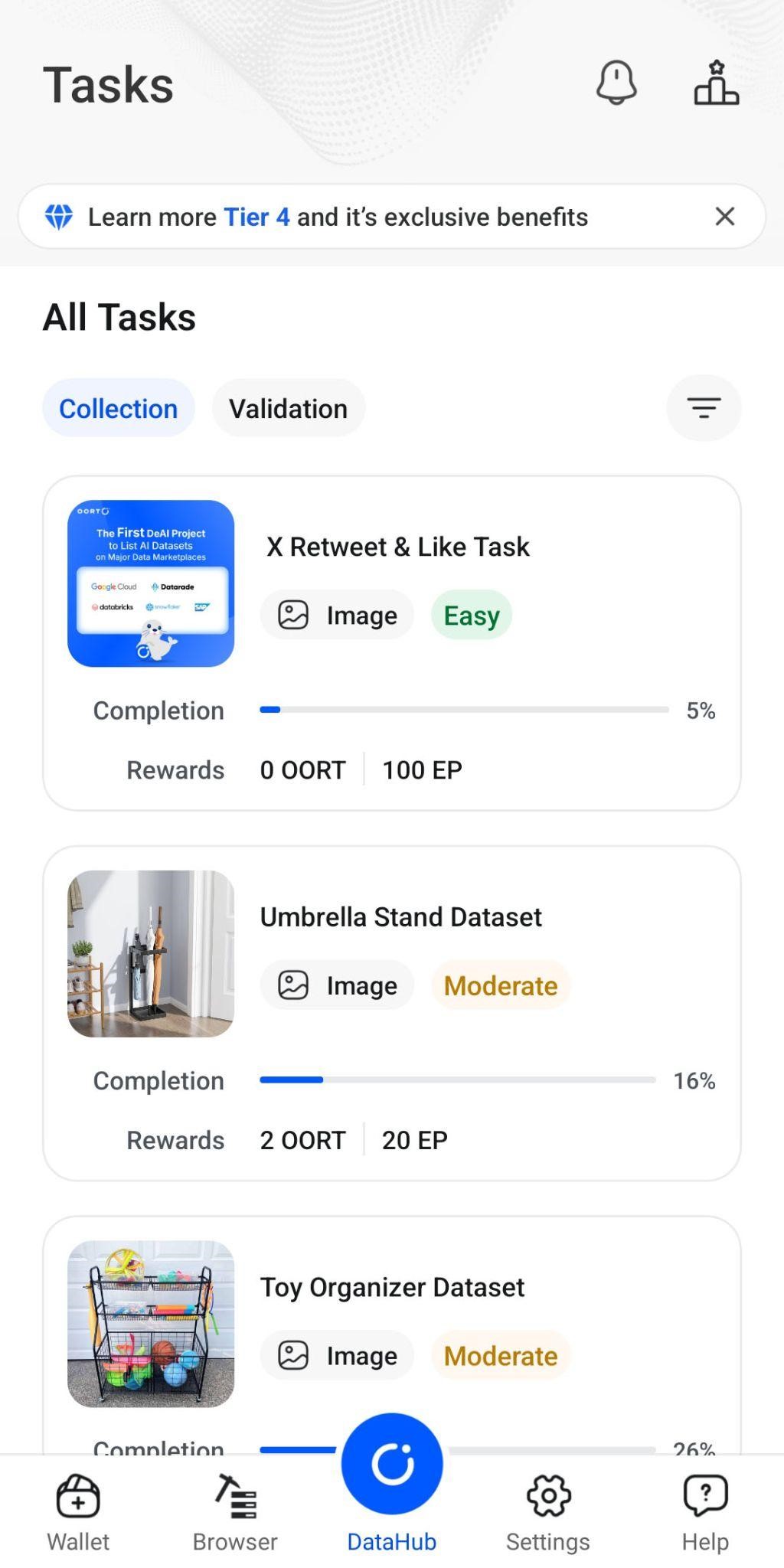
4. Withdraw or Trade Tokens for Cash or Other Cryptocurrencies
The main currency on the platform is $OORT, the native utility token. Once you amass enough of it by passively sharing data or validating and completing tasks), you can simply convert it to other cryptocurrencies or fiat via any decentralized or centralized exchange.

How to Choose the Right Platform?
There are plenty of decentralized projects, such as Ocean Protocol or Vana, that are reinventing the data collection game as we speak. However, although they provide earning opportunities to users and don’t require any external hardware, they’re not as easy to get into as OORT, primarily because marketplaces and liquidity pools bump up the complexity and require a more hands-on approach.
OORT’s aforementioned privacy-first design is also noteworthy, as anonymized data and the ability to opt in and out at any time are imperative, providing full control over your information and maintaining your privacy throughout the process.
Plus, OORT is famous for its referral and incentive programs, where you can complete tasks and invite friends to drastically increase your earnings if you ever find yourself strapped for cash.
Tips for Maximizing Your Passive Income as a Data Contributor
If you find that the rewards you receive from data sharing are simply not enough, nothing is stopping you from running the OORT app on multiple devices.
You can also increase your contribution uptime by making sure you keep all active devices connected to a reliable internet connection at all times.
If that still doesn’t do the trick, you can diversify your income streams by sharing your computing power through OORT, or even by pitching in your unused storage space to the community. The company is rolling out new features constantly, so keeping informed about all the latest additions can help you stay ahead of the curve, potentially earning exclusive awards along the way.
Finally, you can give other platforms a try, even if they may not be as user-friendly as OORT.
Potential Risks and What to Watch Out For
The Web3 industry is exciting, but you should be aware of the dangers that are the side effects of no regulatory oversight. There are plenty of unreliable and borderline scammy platforms out there that promise high rewards but are actually Ponzi schemes in disguise or may misuse your data and sell it to third parties.
This is why you should stick to the tried-and-tested platforms like OORT, which employs a transparent privacy model. If something sounds too good to be true, it probably is, and you should never share your personally identifiable information with a project that doesn’t have the community or the pedigree to back their claims up.
The New Era of Data Contribution Begins
Decentralized contribution is a straightforward way to kickstart a new side hustle without much risk, sure. And while earnings are certainly important, the main draws of community-sourced data are the faster development of new AI technologies and cutting the reliance on private companies.
Getting on board now allows you to become one of the early contributors to a brand new movement that aims to reinvent and democratize AI, which will ultimately benefit everyone.
Fortunately, projects like OORT erase all barriers through their intuitive interfaces, allowing everyone to just download an app and start contributing without much hassle.
The post How to Make Passive Income from Home by Becoming a Decentralized Data Contributor appeared first on Home Business Magazine.
Original source: https://homebusinessmag.com/businesses/business-opportunities/how-make-passive-income-home-becoming-decentralized-data-contributor/