5 Steps to Choose the Right Tax Preparation Software for Your Tax Business

Home Business Magazine Online

Starting a new tax preparation business and overwhelmed by your professional tax software options? Or maybe you’ve been in practice for a while and you’re finding that your “starter” software isn’t cutting it anymore? In either case, you can simplify your search by starting with these five basic criteria that get at the heart of what matters in your tax software selection. Start with the following considerations, and you’ll avoid getting caught up in comparing the minor features of every available software and instead, quickly narrow down your choices to those that work for your business’s needs.

Step 1: Format Matters: Desktop vs Cloud-Based Tax Preparation Software

To help you narrow down your choices, start by deciding between desktop and cloud-based tax software. Each has its advantages, and the choice depends on your specific business requirements. Do you work mostly in the office or from home? Do you keep up with backing up client data regularly and downloading the latest software updates?

Desktop software offers the advantage of being installed on a local computer, providing a sense of control and security. Some desktop-based software supports more types of IRS forms than their cloud-based counterparts (more on form support below!) If you prefer to keep your data stored locally and know that you’ll be diligent with software updates and data backup, this option may be for you.

On the other hand, cloud-based tax preparation software has gained popularity for its convenience and remote accessibility. With the ability to access your data from anywhere with an internet connection, cloud-based solutions let you work from home or on-the-go. This is particularly beneficial for businesses with multiple locations or remote teams.

Step 2: Which Forms Do You Need Supported? 

When you’re just starting out as a tax preparer, it’s easy to assume that any professional tax software will support the IRS forms you need to file your client’s returns. But in reality, many software providers’ baseline packages only include the forms needed for most individual tax returns. If you plan to serve small business owners or individuals with complex tax situations, make sure your tax software supports the relevant forms.

Make a list of the specific forms your tax practice commonly deals with and cross-reference it with the capabilities of the tax preparation software you are considering. You may find that you need to choose upgraded packages or even look into different providers altogether. This proactive approach will save you from potential headaches during the tax season.

Step 3: Consider Your Price Range

Cost is always a consideration, especially for smaller firms or solopreneur tax preparers. When evaluating tax preparation software, make sure to consider not only the upfront cost but also any additional fees, such as per-return charges or hidden costs for support and updates. Some software providers offer tiered pricing plans based on the number of returns processed, while others may offer a flat-rate yearly subscription. For smaller operations, it might make sense to opt for software that offers per-return pricing structures. For any full-time tax preparer, however, an all-inclusive pricing package will almost always be more cost-efficient than a per-return model.

Step 4: Convenience for Your Clients

Any cloud-based tax software will let you work from any place that has an internet connection. But does your software offer your clients the same convenience?

Software that includes a remote tax preparation app for clients gives you an edge in the modern market, letting you cater to clients who prefer not to come into the office. Look for options that allow your clients to securely snap a picture of their documents, send them to you, e-sign documents, and send messages, all through the security of the app. This process is not only simpler than scanning and emailing documents, it’s far more secure.

If the app is capable of automatically uploading your clients’ information into your software or sending them updates on the status of their return, even better! These features not only enhance the client experience but also streamline your workflow, reducing the time spent on administrative tasks.

Step 5: Integration Capabilities

Does the software you’re eyeing integrate with products like audit protection, identity theft protection, and bank products? Even if you aren’t sure that you’ll offer these products to your clients yet, it’s wise to choose software that leaves you the option to do so.

When you’re ready, you can add them to your offerings to diversify your income and help attract a wider client base. When your software is capable of integrating seamlessly with these products, it eliminates the need for manual data entry across multiple platforms, saving significant time and reducing the risk of errors. Whether it’s syncing client data to an application for a refund advance or adding built-in audit protection for clients worried about their return, product integration lets you meet the needs of your clients as efficiently as possible.

The right tax software does more than prepare simple returns. It lets you work the way you want to work, serve the clients you want to serve, and ultimately helps you grow your tax practice. Take the time to research and compare your options in terms of price, form support, and additional features like remote work capabilities and integration with other products. With a little effort upfront, you’ll avoid the headaches of tax software that doesn’t meet your business’s needs and enjoy the efficiency and ease of tax software that does.

The post 5 Steps to Choose the Right Tax Preparation Software for Your Tax Business appeared first on Home Business Magazine.

Original source: https://homebusinessmag.com/money/taxing-times/5-steps-choose-right-tax-preparation-software-tax-business/
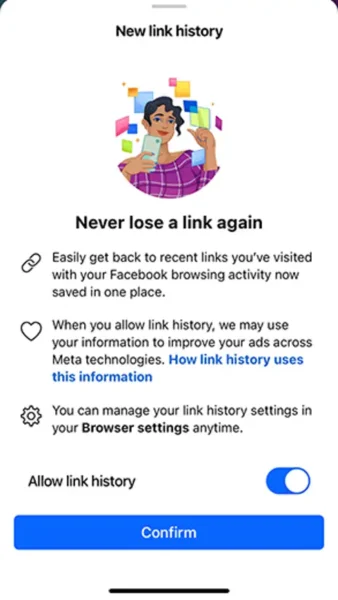
Facebook rolls out ‘Link History’ for all users – and uses data for targeted ads

Facebook has started archiving all users’ link history globally on both Android and iOS devices.

While users have the option to opt out, the feature is turned on by default, allowing Meta to utilize the collected data for targeted advertising.

Why we care. As the digital marketing industry moves towards a cookieless future and stricter privacy laws, targeted advertising, while effective, faces uncertainties. Facebook’s new feature could very well prove to be a loophole for marketers wishing to reach high-value consumers, but the solution could be temporary.

Accessibility. This feature is gradually being introduced and so may not be currently available in your location. Meta hasn’t provided a specific timeline for the rollout of the Link History archive option just yet, but it has confirmed it will be expanding to all mobile users globally.

As of now, this feature is exclusive to mobile and is not available on desktop.

Advertising

How it works. Link History is a feature that keeps track of the websites you’ve visited on the Facebook mobile browser over the last 30 days. If enabled, it stores links you’ve tapped within Facebook’s Mobile Browser for this duration. It’s important to note that links visited in Messenger chats are not included in Link History.

How to turn Link History off. To turn off this feature, follow these steps:

  1. Select any link within the Facebook app to launch Facebook’s Mobile Browser.
  2. Click on the three dots located in the bottom right corner, then select Browser settings.
  3. To enable link history, toggle the switch next to “Allow Link History”, and confirm by tapping “Allow”.
  4. To disable link history, toggle the switch next to “Allow Link History”, and confirm by tapping “Don’t Allow”.

What Facebook is saying. A Facebook spokesperson said:

  • “You can choose to turn link history on or off at any time. When you turn link history off, we will immediately clear your link history and you will no longer be able to see any links that you’ve visited. Additionally, we won’t save your link history or use it to improve your ads across Meta technologies.”
  • “When you turn link history off, it may take Meta up to 90 days to complete the deletion process.”
  • “When link history is on, we may use link history information from Facebook’s Mobile Browser to improve your ads across Meta technologies.”

Get the daily newsletter search marketers rely on.


Deep dive. Read Facebook’s announcement in full for more information.

Original source: https://searchengineland.com/facebook-link-history-targeted-ads-436197

Could happy advertisers be the key to connected TV success? by MNTN

ad server

For years, CTV and linear television have been battling it out for viewership numbers. And it looks like CTV is coming out on top. Seeking more flexibility and lower costs, consumers have cut cords en masse, resulting in CTV viewership surpassing linear.

With ~230 million users in the U.S. alone, CTV offers a clear opportunity for advertisers to reach new audiences. But viewership numbers aren’t the only draw. With an array of results-focused capabilities, CTV has turned television screens into powerful performance advertising engines that brands of today don’t have to go without.

CTV continues to grow in popularity with viewers, and streaming services wisely cater to those customers. But there’s another consumer group they need to keep happy: advertisers. As ad-supported content offerings grow, streaming services and other CTV advertising platforms are developing more sophisticated technologies to meet advertisers’ needs. And though it may not be immediately evident, these technological advances are leading to a better experience for viewers, too.

TV has become a powerful performance channel

Advertisers once used television primarily as an awareness play. This is because viewers used to consistently tune in to their favorite newscast, weekly sitcom or sports broadcast, offering the possibility of reaching millions of eyeballs with one advertisement. But at the same time, this channel was inaccessible for many brands — advertising costs were high and determining when (and even if) an ad would run was difficult, if not outright impossible.

CTV changed this, opening doors to businesses for whom advertising on television had previously been a pipe dream. By providing brands with precision audience targeting, comprehensive reporting and the flexibility to change out ad creative when needed (among other benefits), CTV has transformed television into a performance advertising channel akin to social media and search. And many advertisers are already using it this way.

Studies revealed that while 81% of marketers said they use CTV to raise brand awareness, two-thirds classify it as a performance marketing channel. Additionally, many brands use CTV to drive specific outcomes: over half of respondents said they use the channel specifically to generate measurable web visits, conversions and revenue.

Brands may be using CTV as a performance channel, but some streaming heavyweights have fallen short when it comes to the advertiser-user experience. Netflix suffered when they failed to deliver on advertisement guarantees made when launching their ad-supported tier in late 2022. A year later, Netflix is still working to improve advertisers’ experiences. And they aren’t alone on this front.

CTV adtech is evolving to meet advertisers’ needs

On November 1, 2023, Netflix announced a slew of new features to meet advertisers’ needs better. Beginning in Q1 of 2024, brands who advertise on Netflix can utilize the following:

  • Binge ads: An ad format that lets viewers watch a fourth episode ad-free after watching three consecutive ad-supported episodes.
  • QR codes: Advertisers can include QR codes in their creative to encourage viewer engagement.
  • Sponsorships: Already available to advertisers in the U.S., Netflix’s sponsorships are broken into three categories: title, moment and live. With sponsorships, advertisers can be a part of major content releases (i.e. “titles”), seasonal moments and specific live events.  
  • Refined measurement: Netflix will partner with third-party providers to expand advertiser measurement capabilities and enable campaign verification.

Netflix isn’t the only one working on this. Paramount also recently refreshed its advertising platform. Their new product Conduit, which aggregates Paramount+ and Pluto TV inventory, was built to address issues associated with CTV fragmentation, like the separation of rival brands in ad blocks and accurately tracking ad running frequency.

“The undercurrent here is that there’s a lot of programmatic technology, and these platforms don’t always play super nice together, and we feel as a publisher the buck stops with us to serve a high-quality ad experience,” said Leo O’Connor, Paramount’s senior vice president of advertising, of the update. “If a viewer gets a bad ad break watching one of our shows, they don’t get upset with the ad server. They don’t get upset with the TV manufacturer.”

https://adage.com/article/digital-marketing-ad-tech-news/paramount-ctv-ad-tech-update-conduit-gives-more-programmatic-controls/2525451

MNTN has revamped its adtech, as well. MNTN Next Gen TV was developed to help advertisers and their teams transform television into an even more powerful growth engine. Some of the major updates include enhanced audience building, verified measurement and optimized creative. Performance optimization also got an overhaul; its dedicated product and engineering teams have upgraded MNTN’s performance engine to deliver an unrivaled return on investment. With MNTN Next Gen TV advertisers are already earning, on average, 27% lower cost per acquisition and 38% more site traffic.

Viewer experiences with streaming ads can be inconsistent

Paramount’s O’Connor isn’t wrong in the assumption that bad ad breaks can reflect poorly on the streaming services serving them. And in the early days of ad-supported streaming tiers, the user experience has been inconsistent at best.

Alyssa Boyle, associate editor at AdExchanger, spoke to this first hand when she reviewed Disney+’s new ad-supported tier in February 2023.

“Whether I was watching ‘Hannah Montana’ or the National Geographic show ‘Airport Security’ about cocaine smuggling, the ad experience was pretty much the same,” Boyle said.

She also noted that ad repeats and those of rival brands weren’t uncommon.

“I saw repeat ads from Capital One and a university in Southern New Hampshire, as well as ads for both Huggies and Pampers in back-to-back episodes of ‘The Simpsons.’”

But a better ad-viewing experience could be on its way. In supporting the needs of advertisers, those updates to ad technology could, in turn, address (if not solve) the needs of viewers. For instance, enhanced audience building will help advertisers be more precise about who they serve ads to, ensuring that they consistently target viewers interested in and/or who could benefit from their product. For viewers, this means more ads that are actually relevant to their interests and needs — and fewer that aren’t.

Evolving CTV adtech could signal good things for advertisers and viewers alike

The ongoing rise of ad-supported streaming content paired with the performance capabilities of CTV should be reason enough for advertisers to invest in the channel. If not, the recent CTV adtech updates are helping to solidify the argument. Increasingly sophisticated advertising technologies will allow advertisers to produce top performance results and tap into CTV’s full potential, but they can also make for a better viewing experience — a win for CTV advertisers and users alike.

Original source: https://searchengineland.com/could-happy-advertisers-be-the-key-to-connected-tv-success-435426

Maximizing Efficiency in Construction: A Guide to the Latest Concrete Crushers

Home Business Magazine Online

Efficiency in construction is a pivotal aspect in the modernization of infrastructure and the creation of sustainable developments. Concrete crushers play a crucial role in this domain, offering a solution that optimizes efficiency by reusing materials and reducing waste in construction projects. These crushers have evolved significantly, incorporating advanced technologies to streamline the process of breaking down concrete structures into reusable materials.

How do the latest concrete crushers maximize efficiency?

Boost productivity 

The latest concrete crushers are designed with cutting-edge features that enhance productivity and efficiency on construction sites. These machines have robust crushing mechanisms that efficiently break concrete into smaller, manageable pieces. Innovations in crusher design, such as hydraulic systems and intelligent controls, allow for precise adjustments in crushing parameters, ensuring optimal performance while minimizing energy consumption.

Exploitation of resources

One of the key elements in maximizing efficiency is concrete crusher for a exploitation of resources. Concrete crushers enable the extraction and reuse of concrete from demolished structures, transforming waste material into valuable resources for new construction projects. This recycling process reduces the need for raw materials and minimizes landfill waste, aligning with sustainability goals and environmental regulations.

Versatility 

The versatility of modern concrete crushers contributes significantly to efficiency gains in construction. These machines are adaptable to various job sites and can handle different types of concrete structures, ranging from foundations and slabs to reinforced concrete. Their mobility and compact design enable easy transportation between sites, saving time and resources while maintaining high productivity levels.

Sustainability

Concrete crushers contribute significantly to sustainability by promoting the circular economy. By efficiently breaking down concrete structures, these crushers facilitate the extraction of valuable raw materials, fostering a closed-loop system where recycled concrete can be utilized in new construction projects. This reduces the demand for fresh concrete and minimizes the environmental impact associated with quarrying and production processes.

Acceleration in project timelines

In the realm of construction efficiency, time is a critical factor. The latest concrete crushers are engineered to expedite demolition, allowing construction teams to complete projects within tighter schedules. This acceleration in project timelines enhances efficiency and reduces labor costs and overall project expenses.

Ensures safety and reliability

Efficiency in construction isn’t solely about completing tasks quickly; it’s also about ensuring safety and reliability. Advanced concrete crushers prioritize safety features to protect operators and maintain operational integrity. Automated systems, remote operation capabilities, and reinforced structural designs contribute to safer working environments, reducing the risk of accidents and downtime.

Incorporate advanced features

The latest concrete crushers incorporate advanced features and designs that significantly enhance efficiency. One such innovation is exploiting hydraulic systems, enabling crushers to exert immense force, effectively breaking down concrete structures into manageable pieces. These crushers boast powerful jaws and blades that efficiently crush and pulverize concrete, rendering it suitable for reuse in various construction applications.

Streamline the demolition process

The good thing about employing the latest concrete crushers lies in their ability to streamline demolition. These machines are engineered to pulverize concrete structures swiftly and effectively, reducing the time required for demolition. The utilization of such equipment minimizes manual labor, which not only expedites project timelines but also ensures a safer working environment for construction personnel.

To achieve maximum efficiency, selecting the appropriate concrete crusher based on project requirements is imperative. Factors such as the size of the project, type of concrete, and desired end-product specifications play a pivotal role in determining the most suitable crusher for the job. Whether a jaw crusher, impact crusher, or cone crusher, each type offers unique capabilities that can be optimized for specific applications, ensuring efficiency throughout the construction process.

Wrapping up

The latest concrete crushers are indispensable tools for maximizing efficiency in construction. Their ability to recycle materials, adapt to various job requirements, enhance productivity, and prioritize safety makes them vital assets in modern construction practices. By embracing these innovative technologies, construction companies can achieve higher efficiency, lower costs, and contribute to a more sustainable future.

The post Maximizing Efficiency in Construction: A Guide to the Latest Concrete Crushers appeared first on Home Business Magazine.

Original source: https://homebusinessmag.com/businesses/equipment/maximizing-efficiency-construction-guide-latest-concrete-crushers/

Business Challenges of Your Business Structure — And What to Do When It Grows

Home Business Magazine Online

By Jim Conroy, CEO of The Neat Company

Starting a business requires organizing that business. Whether you’re going to function as a sole proprietorship or a corporation, being in business means keeping books and reporting profits to the IRS. Here are some ways your home business can meet those challenges.

Your business is what you do that people will pay you for. Whether you design websites, work as a contractor or landscaper, run a bakery, or provide dental services, your business structure is central to how you operate and navigate challenges.

Your business structure is who owns the business, who is liable for its actions, and who pays taxes on its profits.

The following chart from the Small Business Administration lays out the basic business structures available to you for operating your business. Except for partnerships, any of these can be a one-person operation.

Business structure Ownership Liability Taxes
Sole proprietorship One person Unlimited personal liability Self-employment tax

Personal tax

Partnerships Two or more people Unlimited personal liability unless structured as a limited partnership Self-employment tax (except for limited partners)

Personal tax

Limited liability company (LLC) One or more people Owners are not personally liable Self-employment tax

Personal tax or corporate tax

Corporation – C Corporation One or more people Owners are not personally liable Corporate tax
Corporation – S Corporation One or more people, but no more than 100, and all must be U.S. citizens Owners are not personally liable Personal tax
Corporation – B Corporation One or more people Owners are not personally liable Corporate tax
Corporation – Nonprofit One or more people Owners are not personally liable Tax-exempt, but corporate profits can’t be distributed

Source: Small Business Administration

However your business is structured, calculating profit or loss for tax purposes is a universal requirement. While some states tax business revenue, the IRS taxes on profit — revenue less expenses. Sole proprietors, in particular, need to ensure that what they do is treated as a business, not a hobby, in order for the IRS to allow their expense deductions.

Sole Proprietorships

Sole proprietorships are often the choice for home businesses or side-hustles. The simplicity of operating as a sole proprietorship is clear-cut – you perform work, get paid, and report your profit or loss directly on your personal tax return using Schedule C and Schedule SE. You’re your own boss and can make decisions and act on them immediately.

However, sole proprietorships come with limitations. Capital may be scarce. This makes it harder to obtain loans, nor can you float an IPO. Unlike corporations, which have multiple bankruptcy options for protection, sole proprietors are personally liable for business debts.

Other Business Structures

Partnerships have the same pass-through taxation as a sole proprietorship, and can benefit from the expertise of each partner. Limited liability corporations (LLCs) can reduce liability concerns, but the tradeoff is more legal oversight and regulation. Corporations further insulate the assets of the corporation’s owners and can usually more easily secure funding. However, they are subject to double taxation: the corporation pays tax, and then the owners pay tax on any share of profits returned to owner as dividends.

Bookkeeping Challenges

Regardless of the structure, bookkeeping becomes increasingly complex as the separation of individual owners from liability increases. Sole proprietors must spend time to track revenue and allowable expenses in order to correctly file taxes. This is true whether you throw all your invoices, receipts, and bank statements on a desk at the end of the year and start organizing them, or handle them on a daily, weekly, or monthly basis. As the business grows, errors become more likely as more tasks must be accomplished and more employees may be involved in recordkeeping.

Growth Challenges

A lot of home businesses exist just to generate income that supplements their salary from working for someone else — the classic side-hustle. But many more want to grow their home-based business into a larger entity that becomes their primary source of income. If that’s you, the challenge is one of both increasing volume and complexity. A business that started on the dining room table may expand to a dedicated home office. If regularly and exclusively used for your business, you can deduct the cost of that space. Growing further to an office, warehouse, or other facility provides additional expense items to track for deductions — or the intricacy of depreciating your business assets. Adding employees involves tracking their salaries, paying taxes you must withhold to the IRS (see IRS Publication 15), and a hodgepodge of forms and deadlines, each furthering the possibility of making an error.

Growth and market changes also underscore the logic for streamlining your processes to prevent them from interfering with actual commerce.

Managing Documents

Time, cost, and accuracy are your challenge regardless of your business structure. You will have tax deadlines to meet. This is not just the IRS deadline on April 15, but local business tax deadlines, often on different dates. If you have employees, you will need to provide withheld tax to the IRS semi-weekly or monthly, accompanied by the required form (usually, but not always, Form 944). Accuracy is essential. Penalties range from 2% to 15% of the taxes you did not deposit on time, in the right amount, or in the right way. And the more your business grows, the more prone it is to blunder from lack of time or green employees.

Basic ways to handle this bookkeeping have been paper ledgers and journals, file cabinets, and spreadsheets, all of which multiply possible error or omissions. One great help for a home business is a document management system (DMS). A DMS can grab relevant data in whatever way works best for you: scanning, uploading computer files, emailing attachments, or smart phone photograph. Through optical character recognition (OCR), it converts any input into digital data. These data are then stored securely in the cloud. Then you — or anyone you provide access — can manipulate the data to track invoices, receipts, related documents, and more. You can even generate reports to gain insight on your business, such as cash flow statements or profit and loss statements.

Your Next Step

The next step in any business is to create more efficient processes that increase its profitability. Up-to-the-moment data enables you to make smart decisions and secure financing when needed. Accurate records support growth from garage to giant. Meeting the challenge of picking the right business structure enabling your business to function well, proactively move forward, and embrace change provides the means for sustained growth.

The post Business Challenges of Your Business Structure — And What to Do When It Grows appeared first on Home Business Magazine.

Original source: https://homebusinessmag.com/business-start-up/legal-structure/business-challenges-business-structure-grows/

Why Testing Your Home for Radon Is So Important

Home Business Magazine Online

By Insoo Park, CEO – Ecosense Inc.

Homeowners typically take a number of steps to safeguard their dwellings. Insurance policies provide for recovery in the case of floods, fires, and other calamities, and home warranties — which function in a way that is similar to insurance — provide relief when major systems and/or appliances fail or pests such as termites cause damage.

Typically, these precautions combine inspections, which are meant to detect and allow for the prevention of problems, with restoration efforts that mitigate damage when problems occur. They give homeowners peace of mind as well as protect their investments, and although their costs can be significant, they are usually considered to be well justified.

Despite the fact radon exposure has serious health ramifications, radon testing is one area that often falls off the radar in terms of safeguarding the home’s occupants. Unfortunately, radon rarely gets attention except when a home is inspected for a real estate transaction, during which time constraints limit the test period to two or three days.

Testing prior to purchase is certainly worthwhile, but the results may fall short of determining one’s potential radon exposure over time. That’s because indoor radon concentrations tend to vary from day to day, week to week, and month to month. The surest way to understand your family’s radon risk is to continuously monitor the radon in your home.

The Dangers of Long-Term Exposure to Radon Gas

According to the World Health Organization, cancer is responsible for 1 out of every 6 deaths globally, making it one of the leading causes of death in the world. The National Cancer Institute identifies lung cancer as the leading cause of cancer deaths in the world, accounting for nearly three times as many deaths as the second most deadly form. Among lung cancer deaths, only cigarette smoking causes more deaths than radon gas.

Radon is a colorless and odorless gas that occurs naturally when the element radium breaks down. Because radium is found in rocks, soil, and water, it is often present in and around homes. As radium releases radon, the gas can be drawn into homes through cracks and other openings in foundations and slabs, where it can accumulate to dangerous levels.

The United States Environmental Protection Agency (EPA) estimates that over 20,000 people die annually in the U.S. from radon-related lung cancer. It is considered especially dangerous because those who are affected by radon show no immediate symptoms.

What is also concerning is not only high levels of radon alone but a strong relationship between prolonged exposure to low levels of radon and lung cancer. The EPA further believes that 1 out of every 15 homes in the U.S. has elevated levels of radon.

The Need for Ongoing Radon Monitoring

When radon testing is conducted during the time constraints of a home purchase, a 48-hour test period under closed-house conditions is typically the best test option available to a homebuyer. However, continuous monitoring over extended time provides a much clearer picture of occupant exposure.

It is not unusual to see large variations in indoor radon concentrations. Frequently, hourly average swings in radon concentrations follow a daily pattern. Additionally, radon levels typically fluctuate as a response to changes in weather or activities happening within the house. In fact, radon levels can be quite different from season to season.

Such fluctuations make it critical that the threat of radon be addressed by long-term monitoring. Monitoring over several months is necessary to provide a true assessment of the potential for health risks. In addition, reliable monitoring devices should be used that can accurately track temporal radon variations.

Overcoming the Challenges to Proper Radon Testing

Ensuring that you have used a reliable monitoring device is the first step to obtaining a clear picture of the radon threat. Passive radon tests commonly use charcoal to absorb air in a space, with an analysis of the charcoal done later in a lab setting. The accuracy of such passive tests has been challenged by recent studies, including a University of Calgary study that showed the tests result in imprecise results as much as 99 percent of the time.

Active radon monitors use electronic sensors to detect alpha particles emitted by radon. The most effective monitors can produce readings in as little as 10 minutes with a high level of sensitivity. The monitors also provide ongoing feedback on any fluctuations that occur in radon levels.

Proper placement of the monitoring device is also critical, which is why readings should be taken in locations where occupants are more likely to be for extended periods of time, such as living rooms, playrooms, or bedrooms. The ideal placement for the monitor is at least 20 inches above the floor, 12 inches from an exterior wall, and 36 inches from exterior windows or doors. Monitors should not be positioned inside closets, cabinets, or crawl spaces.

Mitigating When High Radon Levels Are Detected

Radon is measured in picocuries per liter (pCi/L) and the EPA says that levels of 4 pCi/L or higher should be addressed. Obtaining an accurate reading should involve at least 90 days of monitoring. However, if levels are shown to be 8 pCi/L or higher over a seven-day period, immediate action should be taken.

When high levels are detected, increasing ventilation by opening windows and doors is a temporary measure that can be employed. Monitoring should be continued to see if the increased ventilation lowers levels. Active Soil Depressurization is a mitigation strategy that prevents radon from entering the home by drawing the gas from below the house and venting it into the air where it is diluted to safe levels.

The Value of Radon Monitoring and Mitigation

Long-term exposure to elevated levels of radon gas has been repeatedly demonstrated to increase the risk of lung cancer in humans. It takes years for this form of cancer to develop, with detection of the disease usually only happening when it is in its advanced stages. Ongoing monitoring for radon ensures that elevated levels can be detected and avoided before they result in deadly consequences.

In addition, proper measures to reduce radon exposure have the potential to dramatically impact insurance costs. According to the Cost of Cancer article on Health Payer Intelligence, the average lifetime cost of lung cancer diagnosis and treatment in the U.S. is approximately $282,000 per case. Taking the number at face value results in an estimated annual healthcare cost for radon-induced lung cancer treatment of nearly $10 billion nationally (228,820 new cases/year x 14% x $282,000).

For something that is, to some degree, preventable, that is a big number. As to who pays it, we all do — through the taxes that support Medicare and Medicaid, private insurance premiums, deductibles, co-pays, and charitable contributions. That is why radon monitoring efforts are so important, both for our personal health and the health of the nation.

The post Why Testing Your Home for Radon Is So Important appeared first on Home Business Magazine.

Original source: https://homebusinessmag.com/lifestyles/home-improvement/testing-home-radon-important/

LinkedIn ad prices surge as advertisers’ X boycott continues

LinkedIn ad prices have soared due to a surge in demand reportedly driven by the advertiser boycott of X.

Why we care. If you’re thinking about moving your ad spend away from platforms like X in 2024, LinkedIn could be a solid alternative to consider. Marketers are seeing good returns, but keep in mind it comes with a higher cost, so be sure to check your budget before making the switch.

Ad prices soar. In the past year, the cost of ads on the Microsoft-owned platform has surged by as much as 30% in some cases, reports the Financial Times. Leesha Anderson, the vice-president of digital marketing and social media at Outcast ad agency, told the paper:

  • “This is LinkedIn season. Most have switched over to LinkedIn over the past year . . . A few weeks ago most of our clients were off X. Now they are all off X.”

One media buyer revealed that the cost per 1,000 impressions of an ad was now as much as $300 for premium LinkedIn campaigns. In contrast, running a comparable campaign on Meta’s platforms costs between $10 and $15.

How ad prices are calculated. LinkedIn ad prices are determined by an auction system based on market demand. The greater the demand, the higher the ad price.

ROI. Despite the steep rise in LinkedIn ad prices, marketers are claiming to see substantial returns on their investments. Advertisers are reporting as much as 20% ROI, indicating that for every $100 spent, they are generating profits of $120.

LinkedIn ad revenue. The platform’s annual ad revenue soared by 10.1% year-on-year in 2023 to almost $4 billion, according to Insider Intelligence. The research group now forecasts that growth will soar by an additional 14.1% in 2024.

What Microsoft is saying. Penry Price, LinkedIn’s vice-president of marketing solutions, said that “more brands” are investing their ad spend in LinkedIn because of the platform’s unique targeting capabilities. The platform claims to have twice the buying power of the average web audience, with four out of five members driving business decisions.

Search Engine Land has reached out to Microsoft for additional comment.


Get the daily newsletter search marketers rely on.


Deep dive. Read LinkedIn Ads in 2023 for more information on how the platform has strengthened its position with B2B advertisers. 

Original source: https://searchengineland.com/linkedin-ad-prices-climb-advertisers-boycott-x-436152

The state of SEO in 2024: Are you AI-ready? by Cynthia Ramsaran

Emotional ingredients for SEO success

As search marketers brace themselves for SEO’s next chapter, it’s easy to get caught off guard by disruptions from generative AI advancements like Google’s SGE.

Get ready to step into the future of SEO by joining experts from Conductor as they dive into the ever-evolving landscape of SEO in the age of AI.

Learn more by registering and attending “The State of SEO for 2024: Are you AI-Ready?” presented by Conductor.


Click here to view more Search Engine Land webinars.

Original source: https://searchengineland.com/the-state-of-seo-in-2024-are-you-ai-ready-436174