The enterprise business of SEO: Communicating to the C-suite

Change is the only constant in SEO. At the moment, change is the only constant in the economy. 

Adapting to SEO shifts, reduced paid spending, and the general consensus of having to do more with less have hit marketers hard. 

As C-suite members look to reduce costs and improve efficiencies, SEO has risen to become an essential boardroom agenda item.

SEO is impacting website performance across every type of industry. It provides vital business insights into consumer behavior and intent while helping content get discovered and measured.  

With this in mind, and as we look toward 2023, how SEOs communicate to key stakeholders across their organization will be of the most critical importance. 

Additionally, as competition for digital marketing budgets intensifies, the importance of SEO success and performance must be recognized and rewarded.

As SEO becomes engrained in many parts of a business – from providing insights for sales and product and optimizing content to partnering with digital media teams – it is critical to address the following.

  • “What key metrics matter to the CEO?”
  • “How best do I talk to my CMO and the CFO on budgets?”
  • “When and how should I communicate SEO performance across the organization?”
  • “How do I handle multiple requests for insights from other departments?”

Here are some insights and tips to help you communicate to the C-suite.

SEO in the boardroom: Challenges and opportunities

Conversations at the C-level are constantly pivoting due to changes in the economy, fluctuations in demand and supply, and organizational changes. 

Companies of every size across every industry face the constant challenges of innovating for the future and meeting the demands of tomorrow’s customers. 

Understanding the needs of the customer and their experiences has become the number one focus for every business.

The organic channel is perfect for helping key members of the C-suite to:

  • Stay ahead of market trends with vital business insights.
  • Determine competitive pressures.
  • Identify new opportunities.
  • Glean an overall better understanding of the customer across the whole business.

C-suite conversations are also highly focused on performance. However, it is not about driving performance at all costs. 

Instead, it is about driving performance in the most efficient way possible with the best gross margin possible.

When it comes to the organic channel and SEO, C-level executives appreciate the ROI of the organic channel. 

Organic search drives over 51% of website traffic – a percentage that has held constant for nearly eight years. This is a great starting point when building conversations with C-level executives.

However, the challenge that many SEOs have is twofold:

  • Getting visibility.
  • Getting buy-in through clear reporting and communication. 

And you cannot get one without having the other.


Get the daily newsletter search marketers rely on.

<input type="hidden" name="utmMedium" value="” />
<input type="hidden" name="utmCampaign" value="” />
<input type="hidden" name="utmSource" value="” />
<input type="hidden" name="utmContent" value="” />
<input type="hidden" name="pageLink" value="” />
<input type="hidden" name="ipAddress" value="” />

Processing…Please wait.

function getCookie(cname) {
let name = cname + “=”;
let decodedCookie = decodeURIComponent(document.cookie);
let ca = decodedCookie.split(‘;’);
for(let i = 0; i <ca.length; i++) {
let c = ca[i];
while (c.charAt(0) == ' ') {
c = c.substring(1);
}
if (c.indexOf(name) == 0) {
return c.substring(name.length, c.length);
}
}
return "";
}
document.getElementById('munchkinCookieInline').value = getCookie('_mkto_trk');


Understanding the C-suite and key business metrics that matter

The C-suite drives the company’s business strategy and manages employees. However, not everyone in this position has an equal amount of knowledge about digital marketing techniques.

Some may be more skilled than others in technical skills like coding or designing websites. 

At the same time, another person could specialize in product strategies instead. 

Regardless of their SEO knowledge levels, all members work toward common goals:

  • Results (revenue).
  • Performance metrics (how well we’re doing relative to our competitors).
  • Organizational impact.

Regarding organic search, measures of one campaign’s success do not always translate directly into what members in your organization view as a victory. 

To bridge this gap between communication and understanding for everyone involved, you should begin by establishing how vital SEO is on an individual level with those who can make decisions based on these numbers. 

You can also show them how your efforts are helping promote other digital marketing channels while boosting customer retention rates through more personalized offerings based on understanding the customer experience.

As media budgets are reduced, organizations are being asked to do more with less with more. There has never been a better time to communicate the importance and value of SEO.

Your goal here is to establish that:

  • Search plays a role in our lives, regardless of economic conditions.
  • Unlike other channels, search doesn’t fluctuate with consumer behavior.
  • Good SEO drives the most cost-effective type of revenue.
  • SEO is good for brand awareness, equity, and visibility.
  • SEO provides vital business intelligence at a macro (market) and micro (intent) level.
  • SEO drives the content that fuels other marketing channels and does so more efficiently.
  • SEO insights help the broader business, such as product development and sales.

SEO is an investment that provides compounded interest from short-term wins to long-term incremental gains. 

The time and effort that goes into it are sticky. 

It does not go away and builds over time. It is durable and provides exponential growth.

These are things a C-suite member loves to hear!

Every organization has different hierarchical structures and titles. However, for illustrative purposes, below are a few examples based on a generic enterprise C-level structure.

CEO

The chief executive officer (CEO) is always interested in overall performance. CEOs:

  • Want to understand the contribution SEO makes to the top line of the business and whether the contributions are completed efficiently. 
  • Can make only a limited number of investments to grow the company and need to know that their investment in SEO will pay off. 
  • Want to see the sales numbers and how the company stacks up against its competition.

Metrics that matter: 

  • ROI.
  • Sales.
  • Market share.
  • Share of voice.

CMO

The chief marketing officer (CMO) is interested in the overall demand generation portfolio. Organic search is exciting because of its sheer size. 

Every CMO:

  • Wants to grow traffic and revenue from organic search.
  • Wants to know how well it converts and the role it plays (assists) alongside other marketing channels such as demand generation, event strategy, industry influencers, social, and PR.

Metrics that matter: 

  • Conversion rates.
  • Acquisition costs.
  • ROI compared to other channels.

CFO

The chief financial officer (CFO), like the CEO, is interested in overall performance. 

However, the CFO will also be interested in budgeting and forecasting.

They will want to determine:

  • Where new investments can be made.
  • Where best to allocate SEO budgets and technology spending for the coming year. 

With so many fluctuations in the economy and pressure on budgets, ensuring the CFO understands the why of what you are doing related to the end result is essential. 

Metrics that matter: 

  • Operational costs.
  • Budget efficiency.
  • Forecasts and ROI compared to other channels. 

CTO

A chief technology officer (CTO) is pivotal in modern-day SEO. 

CTOs:

  • Are involved and interested in data, insights, integration, and product development.
  • Must be able to keep up-to-date on all technical advancements to make informed decisions about future products or services for their company’s roadmap.

Metrics that matter: 

  • Site performance.
  • Product development.
  • Adoption 

COO

The chief operating officer (COO) will be interested in:

  • How SEO contributes to other aspects of the business, such as recruitment, branding, sales, retention, and upsells. 
  • Associated costs across the business (such as design).
  • How SEO structures, people, and processes are integrated across the organization.

Metrics that matter:

  • Operational costs.
  • Compliance.
  • Business intelligence.
  • Contribution to cross-functional goals and objectives.
  • Cost savings with automation. 

Collectively, the C-suite wants to know the following:

  • The size of the competition.
  • The value of the market.
  • Their share of voice in the market.
  • The maximum possible return vs. the actual return.

Mastering communication

Remember that your time with the C-suite will be limited. Hence make sure you choose your words wisely and make them count.

To evangelize and elevate your SEO work, remember who you are talking to, and remember to speak their language. 

For example, a CMO would rather hear about revenue than rank because they are more concerned with how well an SEO campaign translates into tangible results for their company’s bottom line.

You should always strive to speak “their language” when communicating effectively – which means understanding how to translate. 

CEOs are less interested in seeing keyword ranking changes (outside of your crucial core terms) and more interested in seeing your share of voice, revenue from organic campaigns, and success within the competitive landscape. 

This offers you the chance to elevate SEO and the importance of your role. Again, language is key to communication.

Here’s how to frame what you say and what it means to the C-suite.

SEO language C-suite language
SEO The organic channel
Algorithm updates Google changes 
Keywords Topics that customers are searching for – intent 
Rank and rank change Where content is performing
Optimizing Attracting and converting customers online
SERP CTR Share of voice for an online search query
Data  Business insights
Share of voice  Versus the competition 

In addition, use reports and visuals that quickly and clearly communicate your progress and the direct benefit to the company.

Elevate SEO by being transparent 

SEOs have a history of making SEO esoteric and exotic, implying that there is a bit of dark magic involved. 

But, unfortunately, that serves neither the SEO nor the executive audience.

Take the opposite approach by:

  • Increasing transparency on progress. SEO usually takes longer than paid channels or even sales to bring in results, but include SEO progress reporting at least monthly in the standard management report vehicles. Also, don’t forget that SEO investments bring compound (interest-like) returns that no other channel can.
  • Being curious but also focused on critical wins. Sales would not share the tactical minutiae of every deal with management – and SEOs should not, either. Instead, they identify repeatable patterns and tell the executives how they will scale it out to other reps and deals.

Communicate SEO’s value to the C-suite

The role of SEO is continually rising. It has become an active participant in business planning and part of many companies’ business intelligence. As a result, alignment with multiple stakeholders is becoming critical. 

Ensure your strategies are sound while creating alignment across various stakeholders across the C-suite as your organization advances. 

Most of the time, SEO teams are expected to do more and provide more value with fewer resources than other areas of the business may have. 

While that speaks to the value and importance of SEO in an organization, it also means you have to be methodical in approaching your work if you’re an SEO in this scenario. 

Use your time to showcase success and manage expectations. Traction takes time, so balance strategies to make incremental gains while focusing on long-term success

Keep elevating your success by building appropriate dashboards and presentations that tie SEO strategy and tactics to business objectives. This will directly help you position and promote your success. 

Continually engage with C-level executives and help them understand the value of SEO and its role.

Use data, AI, and deep learning to share powerful insights, tell content-rich stories, and develop new skill sets that help you understand and adapt to the broader digital and marketing technology landscape.

The ability to communicate effectively in meetings is a crucial part of your success as an SEO. 

Invest some time developing valuable meeting room traits like confident speaking abilities or compelling storytelling so that you can engage with leaders. 

This will allow you to engage with your organization’s leaders and help them understand the value of what you and the organic search channel offer.

The post The enterprise business of SEO: Communicating to the C-suite appeared first on Search Engine Land.

Original source: https://searchengineland.com/enterprise-seo-business-communicating-c-suite-390170

Protect the Environment While Using Green Tech

Home Business Magazine Online

Every year, over 40 million tons of electronic waste are generated worldwide. That’s almost equivalent to dumping 800 laptops in landfills every few seconds. While it’s great that technological advancements have allowed us to create impressive pieces of technology, it means that we’ve created more than what’s actually needed.

In particular, the rate of the manufacturing and production of these items has undoubtedly sped up the effects of global warming. That said, striking a balance between innovation and being environmentally responsible is important. Companies can do a lot to help in this mission. Here is a list of recommendations that can help protect the environment.

#1 Use of Recyclable Items

A million tons of electronic waste is dumped every year. You can use rechargeable batteries instead of alkaline batteries. You can charge USB batteries multiple times. Go for biodegradable products and stop using single-time-use plastic. You can use phone cases, water bottles, or daily-used items that are made of biodegradable substances. Use paper bags instead, or reuse plastic bags as much as possible.

#2 Use of Natural Source of Power

Cut the power consumption by switching to a renewable source of energy i.e., solar energy. You can use solar fans, solar-powered gadgets, solar lights, and solar panels to save electricity. ExpressVPN’s green tech list gives a detailed idea on saving energy and green tech! You can use solar batteries to power your gadgets. Nowadays, effective solar batteries are available that can back up power for a longer duration. So, cloudy weather will not be a problem anymore.

#3 Use of Smart Gadgets to Reduce Power Consumption

You can switch to smart gadgets that can be controlled remotely. Use sensor-based gadgets like LED bulbs, smart thermostats, and smart plugs that can be programmed according to your needs. Such gadgets have power auto cuts and automatically switch off when no one uses them for a longer duration. This will cut the cost of the electricity bill as well as save a lot of energy.

#4 Use of Homegrown Items to Cut Packaging Waste

You can grow your own veggies to consume. You can have your small garden to cater to your basic needs. Use home tools to cultivate them. Thus, this will help you to switch from packaged food and reduce a lot of packaging waste. Community cultivation will reduce plastic packaging and the use of artificial chemicals that harm the environment.

#5 Go for Electric Vehicles

Last but not least, go for electric vehicles like electric bikes, electric cars, and electric cycles. Though they are more expensive than the usual vehicles, they don’t emit high pollution. So, it will benefit the environment in the long run. You can gradually shift to electric cars and use electric chargers instead of using petroleum.

Final Words

Ideally, you have found this article on using green tech and implementing environmentally conscious practices helpful. You can read more amazing articles on the official website of Viebly. Do you have ideas on using green technology and ways to protect the environment? Share your valuable thoughts in the comments. We would love to hear from you.

The post Protect the Environment While Using Green Tech appeared first on Home Business Magazine.

Original source: https://homebusinessmag.com/businesses/go-green/protect-environment-using-green-tech/

The Benefits of Custom Cable Assemblies

Home Business Magazine Online

Whilst standard cable assemblies might get the job done for certain simple installations, they often fail to meet the requirements of more complicated, specific applications. Every set-up and application will be slightly different, meaning custom cable assemblies are often required to provide satisfactory solutions.

Standard cable assemblies can be great, providing you with an easy solution for simple or generic applications. But if your application is unique, or particularly complex, you’ll likely require a custom cable assembly. By relying on out-of-the-box cable assemblies, and forcing them to conform to your requirements, you might encounter certain issues. You might experience a loss of efficiency, or potentially more severe technical issues that could result in damage to equipment, property, and even individuals.

Here’s a list of the numerous benefits of custom cable assemblies, as well as a brief description of what they actually are, and what their typical applications are.

What are custom cable assemblies?

A cable assembly in essence is just a group of cables bound together in a single unit for convenience. A single cable assembly might contain cables of varying lengths, colours and constructions.

Custom cable assemblies are just that: custom-made assemblies for the specific needs of a certain application or business. They’re not only made to order for the individual application but also designed specifically for the industry and purpose -everything from automotive components to medical devices.

Main benefits of custom cable assemblies

Accuracy

Custom cable assemblies can provide optimised and accurate cable setups for applications. This means that applications can run as intended, and without a loss of efficiency due to sub-par cable management. This is particularly vital for sensitive, or precise applications.

Flexibility

With a custom cable assembly, you can make small changes to your cable configurations as the requirements of your application change over time. This might include changes to the number of wires or the lengths of wires within the assemblies. With off-the-shelf cable assemblies, this simply wouldn’t be possible, and you’d have to invest in a whole new assembly if your changing requirements demanded it.

Materials

Investing in custom cable assemblies gives you complete control over the materials that go into the construction of the cables. You can ensure that high-quality materials are used for all wiring, in addition to being able to employ specific insulative materials for cable jackets when required.

Quality assurance

When required, custom cable assemblies can be manufactured using higher quality materials than certain standard solutions. Additionally, custom assemblies can also be tested in their actual usage environment, meaning you can guarantee suitability and functionality. With many standard cable assemblies, you really have no guarantee of suitability until you test them out yourself, especially if your application is unique.

Longevity

Custom assemblies often have a longer lifespan than standard cable assemblies because they aren’t mass-produced. Instead, they’re built specifically to fit your needs and work within your budget constraints while still providing all the functionality required by your application or system specifications. Customising each assembly helps ensure they’ll last longer without needing maintenance repairs later on down the road (which means less downtime).

Performance

Custom cable assemblies are designed, constructed, and tested with the specific usage requirements of your application in mind. This results in a level of performance and reliability which is often superior to that of standard cable assemblies.

Time-saving and ease of setup

You’d be forgiven if you initially thought an off-the-shelf solution was always quicker to set up and install. In many instances you’d be wrong. It can sometimes be very difficult to try and retrofit standard cable assemblies to specific applications, with some attempts being completely futile.

If your application requires it, you’ll save yourself time and money by opting for a custom cable assembly in the first place.

Minimise waste

When you use custom cable assemblies, everything is designed and constructed to the exact specifications of your usage requirements, meaning you’ll have the correct amount of each component, and there will be no trimming, cutting, or waste necessary.

Volumes

However many cables you need for your application, you’ll be able to get them when you work with a custom cable assemblies manufacturer. You won’t have to worry about a manufacturer of standard assemblies running out of stock, or charging you large amounts for high-volume orders.

Applications of custom cable assemblies

With all the benefits of custom cable assemblies, it’s no wonder they’re used for a wide range of critical applications where high performance is vital and technical issues cannot be allowed to interfere with functionality. Here’s a list of industries and applications that rely on custom cable assemblies:

  • Automotive

In the automotive industry, mass usage of custom cable assemblies is required to ensure the efficient assembly of the internal electronics of various vehicle types.

  • Medical

Hospitals and other medical facilities have very specific requirements for their cable assemblies. This ensures all equipment functions as intended and conditions such as temperature and humidity can be maintained at appropriate levels.

  • Artificial intelligence and industry 4.0

Industrial systems require a variety of sensors, scanners, and control systems to operate in accordance with industry 4.0. Custom cable assemblies are required for the efficient integration of these control systems.

  • Renewables and power distribution

Equipment for electricity generation such as wind turbines and solar panels, in addition to systems for power distribution and transmission, require extensive custom cable assemblies

  • Communications and telematics

We live in the information age, and the fast, efficient transmission of data has become an integral part of society. Custom cable assemblies are used to set up networks that facilitate this transfer of information.

  • Military

Ensuring military bases, and all the specialist equipment they contain, remain powered is critical for international security and the confidentiality of information. Custom cable assemblies are used to ensure these systems operate at an optimal capacity and are safeguarded against failure.

Final thoughts from Cornelius Electronics – A leading custom cable assembly manufacturer

If you’re looking for a custom cable assembly manufacturer, Cornelius Electronics asserts that they have you covered. They’ve been providing bespoke cable assembly solutions across a range of industries for over 40 years, and have built up a reputation for their quality of work.

Their team of skilled IPC-trained electricians offers the high-quality installation of custom cable solutions, manufactured at their state-of-the-art production facility, which is located in the UK.

By investing in a custom cable assembly, you may save time, money, and ensure your applications function exactly as intended.

The post The Benefits of Custom Cable Assemblies appeared first on Home Business Magazine.

Original source: https://homebusinessmag.com/businesses/equipment/benefits-custom-cable-assemblies/

Facebook: A content marketing guide

Facebook is the most-used social media platform in the world. It boasts 2.96 billion monthly active users.

Most likely, you’re on Facebook and use it often. But is your business on Facebook?

Not only that, is your business on Facebook and using a content marketing strategy?

If your audience hangs out on the social media giant, you should answer “yes” to all of the above. Because just existing on Facebook isn’t enough. 

If you want to tap into the potential reach you can achieve there, you need a plan. Goals. Consistency. You need to publish the right type of content at the right time.

Let’s look at how to set up your Facebook content marketing.

How Facebook can contribute to your brand’s overarching content marketing strategy

As part of an overarching content marketing strategy, publishing on Facebook can help grow your reach and build brand awareness. It can even drive more traffic to your website and generate leads.

Because of the sheer reach of Facebook, the opportunities for connecting with your audience are far and wide. 

By establishing a brand presence there, you may be able to tap into segments of your audience that don’t exist anywhere else online.

The world's most-used social platforms - October 2022

By the way, you don’t have to spend a penny on Facebook content marketing if you don’t want to (or if you don’t have the budget). 

As long as you have the means to create high-quality content, you can post that content (and distribute other types of content) for free on Facebook.

Initial steps for marketing on Facebook: Create a Facebook Business Page

Before we go any further, first make sure you have a Page set up on Facebook. You can’t market on the platform without one. That includes advertising, by the way.

A “Page” is Facebook-speak for a business profile. These differ significantly from personal profiles, as they offer unique and beneficial features and tools tailored for businesses.

Pages also showcase business-specific information that’s helpful to your audience and customers, like a call-to-action button you can tailor to your brand and what you’d like visitors to do (“Contact Us”, “Call Now”, “Sign Up”, etc.).

Coca-Cola Facebook page

Create your page

To get started creating your Page on Facebook, use this link: facebook.com/pages/create/

You’ll need to fill out some basic information about your business, including your brand name, brand category, and a short bio. Once you have a basic Page created, you can add more detailed information and customize it further to reflect your business.

Creating a page on Facebook

Invite friends, peers, customers, etc. to like your page

Once you have your Page set up, a good first step is to invite your current customers, friends, peers, and whoever else might be interested in liking the page.

On Facebook, a Page like is equivalent to a follow. People who like your page will automatically see your posts in their feeds and be able to follow your activity, including all the content you post.

Sending out like invites is thus a quick way to notify your existing Facebook audience that you’ve established your business in a more official way there.


Get the daily newsletter search marketers rely on.

<input type="hidden" name="utmMedium" value="” />
<input type="hidden" name="utmCampaign" value="” />
<input type="hidden" name="utmSource" value="” />
<input type="hidden" name="utmContent" value="” />
<input type="hidden" name="pageLink" value="” />
<input type="hidden" name="ipAddress" value="” />

Processing…Please wait.

function getCookie(cname) {
let name = cname + “=”;
let decodedCookie = decodeURIComponent(document.cookie);
let ca = decodedCookie.split(‘;’);
for(let i = 0; i <ca.length; i++) {
let c = ca[i];
while (c.charAt(0) == ' ') {
c = c.substring(1);
}
if (c.indexOf(name) == 0) {
return c.substring(name.length, c.length);
}
}
return "";
}
document.getElementById('munchkinCookieInline').value = getCookie('_mkto_trk');


How to create a Facebook content marketing strategy

With your Page set up for your business, you can start planning out your Facebook content marketing strategy.

In general, this should mesh with your overarching content marketing strategy, with your website and blog set as priority #1. 

Why do I not recommend focusing 100% of your content efforts on Facebook?

Why Facebook shouldn’t be your #1 content marketing channel

Because you don’t own your Facebook account – not like you own your website and the content that lives there.

Who does it belong to? Facebook.

In fact, any content you post to their platform is fair game. As soon as you post or share something, your rights to that content become very limited. Meanwhile, Facebook’s rights to that content expand like a balloon:

Facebook terms and services

Building your platform entirely on the borrowed land of social media is a huge gamble. That’s why, even though you’ll spend a good amount of effort publishing content on Facebook, most of it should point back to your site.

For example, every content piece you post on Facebook can include links pointing to:

  • Your blog content.
  • An email newsletter sign-up page.
  • A lead magnet.
  • A specific landing page for a product or service.

TL;DR 

Maintaining a presence on Facebook can and should build awareness around your brand and nurture leads, but it shouldn’t be the main focus of your content marketing

Instead, set Facebook as the second or even third priority in your content plan, and ensure every major piece you publish there points back to your website in some way so you can capture leads.

With that out of the way, now we can get into building your strategy for content marketing on Facebook.

1. Set goals for your Facebook content marketing

What do you hope to achieve by content marketing on Facebook? 

Figure this out before you do anything else. Your goals will drive every action you take as you build out the rest of your plan.

Don’t overcomplicate it, either. Your goals can be extremely simple, such as:

  • Drive more traffic to your website.
  • Build brand awareness.
  • Generate leads.

Then, decide how you’ll track and measure your goal(s). For example, you can use Google Analytics to track what percentage of your website visitors are coming from your Facebook posts or Page over time.

2. Define your Facebook marketing audience

With goals set, next, make sure you understand exactly what your audience looks like on Facebook.

If you’ve already done audience research for your larger marketing strategy, you can rely on that here, too. Just drill down deeper to discover what goals, challenges, preferences, and habits might be particular to the people who find you on Facebook versus other channels.

If you’re starting from square one, look for insights from 1:1 connections with people who fit the mold of your ideal customer. Interview them to discover what makes them tick, the kind of content they need, and how you can help them.

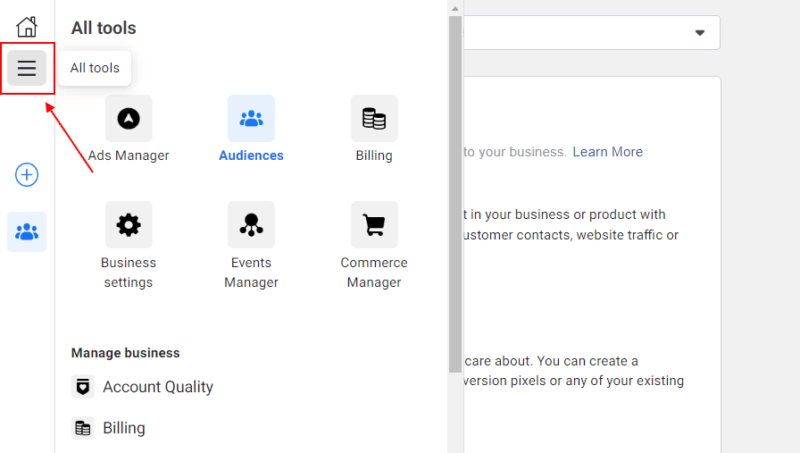
If you have a pool of existing Facebook followers, use the free Audience Insights tool to find out more about them, including demographics and behavioral data. To find it, go to the Ads Manager and click on the menu icon in the left toolbar (“All tools”).

Facebook Ads manager - All tools

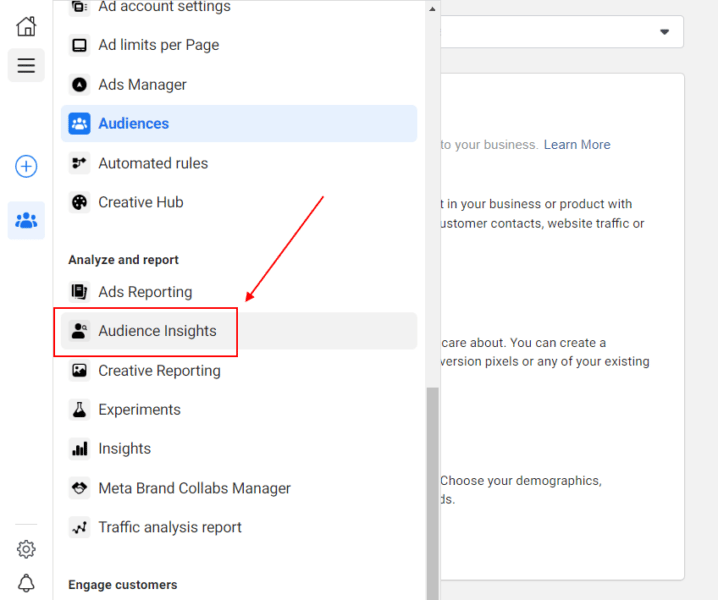
Then scroll down to the Analyze and report section and click Audience Insights.

Facebook Ads manager - Audience Insights

By the way, Facebook has an official tutorial for using Audience Insights if you’re unsure where to start.

3. Decide what you’ll post and how often

Once you know who you’re creating for, you can nail down what types of content you’ll post and how often.

This is important to document because it:

  • Establishes accountability.
  • Keeps your efforts focused.

Let’s start with what you’ll post. To figure it out, consider these questions:

  • What kind of content does my audience crave, and what do they like to see on Facebook?
    • Example: Your audience might like to read in-depth text posts. Maybe they prefer shareable images and infographics. Or perhaps they want bite-sized tips and short videos. Or maybe they enjoy a mixture of all three!
    • If you’re unsure about which content types will land, experiment to see what sticks.
  • What topic areas can I focus on that lean on my expertise and help my audience?
    • Example: You sell content writing services for health food brands. Your content mainly focuses on providing content writing tips and tricks around health, wellness, and cooking.

Next, determine how often you’ll post, including when.

Keep in mind best practices for posting on social media as you decide.

Facebook recommends posting at least once per week, but most experts will tell you to post 1-2 times per day, with a max total of 3-7 posts per week.

Don’t post more often than your brand can handle, however. If you commit to posting too often without the staff, resources, or time to do it, your post quality will tank, which will also tank your reputation.

Lastly, schedule posts for a specific time of day, preferably when your audience is most likely to be browsing Facebook.

You can rely on stats to find optimal post times, or you can simply experiment to see what posting times get the best engagement from your particular audience.

Facebook Global Engagement - days and times

4. Create and follow brand style guidelines

If you’re already posting content on other channels like a blog, you may have brand style guidelines defined at this point. 

If you’re starting from scratch or don’t have any guidelines, however, your next step is to create some.

Brand style guidelines lay out the voice, tone, and personality of your brand. Anyone who creates content for your brand can follow the guidelines and write in your style so your content stays consistent (i.e., it always sounds like the same person is talking/communicating) across channels.

This will help your audience not only remember your brand but also associate your brand with a specific style.

Your brand style guidelines can include:

  • Your preferred brand voice (the personality of your brand).
  • Your preferred tone (how you sound when you write/speak/communicate).
  • Punctuation and grammar preferences (Oxford commas, anyone?).
  • Rules for how to use and refer to your brand name in content.
  • Rules for using visuals in content.
  • Rules for displaying your logo.
  • Rules for writing social media posts, including how to format captions, how to use hashtags, and how to use emojis.
  • Sources of inspiration.

Document them once and keep them updated. This is a tool you can and will use over and over as you create content for all of your channels, not just Facebook.

5. Create a social media calendar

How are you going to keep track of all of your Facebook post topics, including the day/time you’ll publish each one?

How will you stay ahead of creating and posting content, so you’re never last-minute scrambling to get a post ready?

You need a social media calendar.

This handy tool is a must for every content strategy. Whether you use a simple spreadsheet or a more robust tool like Airtable, Trello, MeetEdgar, or CoSchedule, you need a calendar to organize, plan, and track your content pieces, including the day/time they’ll be published.

CoSchedule's Marketing Calendar
CoSchedule’s Marketing Calendar

Depending on your needs and the tool you choose, you can keep one calendar with tabs for each channel, or you can separate your calendars (one for your blog, one for Facebook, etc.).

A good calendar will include weekly and monthly views of your content schedule, so you can see the mix of content you have going out from a bird’s eye view. This helps you ensure you’re posting the right mix of formats with a good array of topics.

More advanced paid tools like MeetEdgar and CoSchedule even have features that let you schedule posts in advance, so you don’t have to worry about posting at the right times.

6. Engage

In the phrase “social media”, the main word is “social.”

That means, to be successful with content marketing on Facebook, you need to not just post, but also engage.

A few tips:

  • Be responsive. Respond as promptly as possible (within reason) to comments, tags, and messages.
  • Have conversations. Don’t be afraid to get more in-depth with your comments. Ask questions, offer ideas, and be friendly.
  • Give customer service. Depending on the business, many customers turn to Facebook to get in touch when they’re having a problem with a product or service. (64% of people would rather send a message than call a business.) Use customer service skills to address these.
  • Share and engage with others’ content. Keep what you share relevant to your audience, but do share, and don’t forget to drop likes and comments.
  • Hire help if necessary. Most brands hire social media managers for a reason: keeping up with all of the above plus posting regularly can be draining, and absolutely a full-time job.  

7. Track and analyze results

Whatever your goals for content marketing on Facebook, you should track your progress toward them by periodically checking out relevant data.

For example, if your goal is to build your brand awareness, you might track Page views and Page likes – both of which you’ll find on Facebook’s built-in Page Insights.

Here you’ll also find a record of all the posts you’ve published, including metrics for each one like reach and engagement. This will be super useful as you’re fine-tuning the content types and topics you post. 

The best Facebook post types for content marketing

For the highest engagement, you’ll probably need to post a mix of content types to Facebook and rotate through them. Here are your best bets.

Text posts

Although a myriad of post types have come to the forefront in recent years (short video! Live video! Stories!), text-only posts are still a strong standby.

This post type enjoys the highest engagement rate (0.13%) of all possible types, including videos.

Text-only posts are best kept short and sweet (short posts get the most views). Use them to share a hot take or ask a question.

Facebook text post

Link posts – you guessed it – include a link to content outside of Facebook.

This type of post is great for sharing your best blog content, a new product or service, a lead magnet, or even an email list sign-up page.

Sprinkle link posts throughout your content calendar to encourage your Facebook audience to visit your website. (If your website/blog is your primary content channel, this is the place where you will convert and capture leads.)

Photo posts

Photo posts feature a single image (or a carousel of images). They can include a short caption or hashtags and are the second-best type of post for engagement on Facebook.

Facebook photo post

Depending on your industry, there are lots of options for sharing photos: beautiful product photography, day-in-the-life snapshots, infographics, quotes, and more.

Videos 

Videos are incredibly engaging and communicate like no other type of media. On Facebook, there are a few different video types you can post:

  • Short videos and reels: This format is Meta’s answer to the popularity of TikTok.
  • Live videos: Stream to your followers, who can watch you and comment/interact in real time.
  • Standard videos: You can also upload longer videos, such as tutorials, interviews, demos, or webinar recordings to Facebook.

Grow your reach with Facebook content marketing

Content marketing on Facebook is a worthy addition to your overarching marketing efforts.

The platform is the most-used social network in the world, hosting billions of users monthly.

If your audience uses Facebook (and they most likely do), you should maintain a consistent presence there with valuable content to engage their interest and nurture their connection.

The key is to focus on your website and blog content first and then use Facebook as a secondary channel to widen your reach.

With smart content strategy, you’ll be able to integrate and manage your Facebook content marketing with your blog content marketing so they connect seamlessly.

Ultimately, customers want to connect with the brands they like on social media. Don’t let that opportunity get away.

The post Facebook: A content marketing guide appeared first on Search Engine Land.

Original source: https://searchengineland.com/facebook-a-content-marketing-guide-389490

Google search retires Web Light, Google’s method to serve faster, lighter pages to people

Google has retired Web Light, Google’s mechanism to serve pages and content faster, using a more lightweight version of that page, to those with slower internet connections. Google said, “while this feature has worked as intended and enabled broader access to the richness of the web, increased affordability of more powerful smartphones has diminished the need for such functionality.”

What was Web Light. Google launched Web Light in 2015 as Google Lite, which was designed to help those with slow mobile connections on their search results page. Google would take the page, remove a lot of the heavier images and media and just show the searcher the text of the page. In 2018, Google even added a Search Console filter to see what pages were being served over Web Light.

Google’s message. As noted above, Google said, “We introduced Web Light to enable us to serve faster, lighter pages to people searching on entry-level devices. While this feature has worked as intended and enabled broader access to the richness of the web, increased affordability of more powerful smartphones has diminished the need for such functionality. We remain committed to evolving and refining the Search experience to meet the changing needs of our users.”

Web light user agent retired. With this news, Google retired the user agent for Web Light named “googleweblight.” So you should no longer see this user agent showing up in your log files.

Documentation removed. Google has also removed the help documentation for web light, so the only way to access the docs is to go to the Wayback Machine.

Why we care. A lot of publishers were not huge fans of Web Light because some felt it resulted in less revenue or no revenue. Plus, publishers do not like when their web pages and content do not look as they expect. In any event, this feature has been retired going forward.

The post Google search retires Web Light, Google’s method to serve faster, lighter pages to people appeared first on Search Engine Land.

Original source: https://searchengineland.com/google-search-retires-web-light-googles-method-to-serve-faster-lighter-pages-to-people-390389

4 Ways to Protect Your Company’s Digital Assets

Home Business Magazine Online

One of the responsibilities of a business is to handle different kinds of valuable information that includes financial information, customer data, and other important company documents. Securing these valuable assets is crucial to the success of a company, especially if you have a business website or a mobile app.

If a hacker were to steal customer information from your site because of lack of proper security measures, your business will become accountable and it may damage your company reputation. On the other hand, ensuring the security of digital assets can positively impact your bottom-line.

With that said, it’s only proper that you take some measures in protecting your digital assets. Take a look at the following strategies on how to do it.

1. Identify and List All Your Digital Assets

Even if you already have the maximum level of security and protection, there’s still a chance that some of your digital assets will either be stolen or exploited. Although you can minimize the damage by addressing the issue right away, it might be a challenging task if it was done discreetly. It is for this reason that you should always make a list of all your digital assets.

Start by identifying all assets then sort them in a particular order so you can easily track where they are stored. It’s critical that all these vital pieces of information should be compiled together and be accessible to update at the same time. By updating them regularly, you can easily spot any abnormality with any of the digital assets and then act fast to fix the issue.

2. Invest in a Secure Cloud Storage Solution

You don’t want your valuable customer or company data to be stolen by hackers. This is the kind of situation you would not want to happen, as it can cause permanent damage to your business’ reputation. As such, you need to invest in a secure cloud storage solution that ensures the protection of your digital assets from hackers.

Cloud storage is an essential tool that provides businesses with two essential benefits: easy data sharing and a secure platform where you can store, manage, and archive all kinds of data. It enables easy collaboration between different teams because the information can be accessed anywhere and anytime. Also, cloud storage solutions employ the best security measures in the platform to ensure the protection of valuable data.

There are tons of cloud storage services to choose from on the internet like Google Drive. But it is strongly recommended that you find the best alternatives for Google Drive that offer better security and advanced features when it comes to protecting your business data.

3. Backup Regularly

Data loss is a major issue when it comes to digital files. It even happens frequently because of different reasons such as human error or negligence that led to the compromise of your data. Of course, hacking is another common issue that you can’t possibly eliminate.

Since there’s no surefire way to prevent data loss, it’s critical that you always backup your company’s important files regularly. This will help ensure that you won’t lose all your digital assets in case something happens.

All you have to do is simply make a copy of the digital files and save them on an external hard drive or on a secure cloud storage platform.

Digital Assets
Depositphotos

4. Limit Access to Digital Assets

As previously mentioned, human error is one of the main reasons why your digital assets could be at risk. Your employees may unintentionally leak valuable company data or they may fall victim to phishing scams.

Although you can train your employees to keep this from happening, educating them about cybersecurity is really not an easy undertaking. Your best option is to simply limit the number of employees who can access your digital assets. For instance, access to all valuable data should only be granted to the employees who truly require it.

Another reason why you should put some restrictions is that your employees may exploit the company’s digital assets for their own good. You can sue them if they use your business’ valuable data for their own profit. But if you had them sign a protective agreement, you may not be able to hold them accountable for such an illegal act.

Final Thoughts

Understanding the importance of digital assets to the success of your business is critical. Despite appearing to be ordinary files, they are the foundation of your firm. With the ever-growing number of cyber-attacks happening each day, it’s essential that you invest in ensuring the security and protection of your company’s digital assets.

The post 4 Ways to Protect Your Company’s Digital Assets appeared first on Home Business Magazine.

Original source: https://homebusinessmag.com/businesses/security/4-ways-protect-companys-digital-assets/

Six Ways to Save Money as a Small Restaurant Owner

Home Business Magazine Online

As a small restaurant owner, you have to be creative and resourceful with your money. The industry is harsh, and it’s essential to save money wherever possible in today’s economy. Owner.com reviews some great ways to save money as a small restaurant owner:

1. Focus on Quality Ingredients

Quality ingredients are a must-have for any restaurant. Buying fresh, local ingredients is essential for success in the industry. Buying locally means fresher, better quality ingredients, and often it’s cheaper than buying from large suppliers. It also supports the community’s agricultural economy and helps reduce your carbon footprint.

Buying seasonal produce is another excellent way to save money. It can be cheaper than buying imported produce and will help ensure that the ingredients you’re using are high quality. It is also easy to keep your menu interesting, changing with the seasons.

2. Invest in Technology

Technology can be expensive, but it can also help you save money in the long run. Investing in restaurant management software to track your inventory and sales can help you identify where you’re losing money so that changes can be made quickly and effectively. This technology also helps streamline processes, helping you to save time and labor costs.

A point-of-sale system is another excellent way to keep track of your restaurant’s finances. It simplifies the checkout process for customers and helps you manage your inventory better by giving you real-time reports of what’s selling and what’s not.

3. Educate Your Staff

Educating your staff on the importance of following proper protocols and procedures in the restaurant can help save money by preventing costly errors or mistakes. Staff education can teach them how to properly control portions, track inventory, identify customer needs, and manage their time efficiently. Training your staff in customer service and food safety areas can also help reduce costs in the long run.

Having a team with clear expectations is essential for running a successful restaurant. By taking the time to train your employees properly, you’ll be able to save money and ensure that your restaurant runs smoothly.

4. Negotiate with Suppliers

Negotiating with restaurant suppliers is an excellent way to save money as a small restaurant owner. Don’t hesitate to ask for discounts or better terms on your orders. You can also look for new suppliers who offer lower prices than your current ones. Before deciding, research different vendors and compare their prices, delivery times, and terms. Building relationships with suppliers is also essential to get the best deals possible.

5. Cut Back on Wasteful Spending

Wasteful spending is a common problem in restaurants, but it’s something that needs to be addressed if you want to save money. There are several ways to cut back on spending, such as reducing portion sizes or ordering in bulk.

You should also be mindful of unnecessary expenses such as overstocking inventory, using too many napkins, or having excessive employee break times. Eliminating these costs can help ensure you’re making the most of your budget.

6. Utilize Online Marketing

Online marketing is a great way to reach more customers without spending too much money. Utilizing social media platforms, websites, and email campaigns are all cost-effective ways to promote your restaurant and get more customers in the door.

Having an online presence on restaurant review sites such as Yelp and TripAdvisor is also essential. This helps to increase your visibility and can help you attract more customers.

Final Thoughts

Running a small restaurant can be expensive, but there are plenty of ways to save money. By following the tips from owner.com reviews, you’ll be able to keep your costs low and ensure that your business is profitable. With proper planning and budgeting, you can ensure your restaurant is as successful as possible.

The post Six Ways to Save Money as a Small Restaurant Owner appeared first on Home Business Magazine.

Original source: https://homebusinessmag.com/money/cutting-costs/six-ways-save-money-small-restaurant-owner/

Google has updated its prohibited practices to include “Linked account suspensions”

Google has a new issue status in Merchant Center.

This new issue status is a clarification of our existing enforcement to provide retailers with better instructions on how to resolve their account issues. This issue status means that a suspended Google Ads account is linked to your Merchant Center account. The Google Ads suspension must be fixed first before your Merchant Center suspension can be reviewed.

Why we care. If you have a suspended Merchant Center account, you’ll need to resolve the issue before you can request a review.

Additional prohibited practices. Google prohibits the following practices from its ad network. You can read their entire help guide here.

  • Abuse of the ad network
  • Irresponsible data collection & use
  • Misrepresentation

Resolving issues. If your products are disapproved, visit the help guide to get your account reinstated.

The post Google has updated its prohibited practices to include “Linked account suspensions” appeared first on Search Engine Land.

Original source: https://searchengineland.com/google-has-updated-its-prohibited-practices-to-include-linked-account-suspensions-390373

Google Question Hub to close down

Google will be shutting down the Google Question Hub on January 15, 2023, about two years after the service launched in the United States and several years after it quietly launched in regions like India.

Shutting down. Google posted a message after you login at questionhub.withgoogle.com that says “As of January 5, 2023, the Question Hub beta will end. If you’d like to retain a copy of your data, you can do so via Google Takeout up until March 6, 2023. After that date, Question Hub user data will be deleted.”

What it looks like. Glenn Gabe posted a screenshot of this on Twitter:

What is Question Hub? Google says “Question Hub is a tool that enables creators to create richer content by leveraging unanswered questions. Question Hub collects these unanswered user questions and surfaces them to bloggers, writers, and content creators like you.”

It is basically a way for Google to enable searchers to tell it that the search results provided are not answering the query. Then, Google takes those questions and feeds them to publishers, who, in turn, can create content that does answer the query.

Content ideas in Search Console. We recently saw Google experiment with a new section in Google Search Console named Content ideas. Content ideas give the content creator, publisher, SEO, webmaster, etc., some tips and advice on what new topics they can write about on their site.

The big question is, will Google move the Question Hub like features into this new Content ideas section in Google Search Console?

Why we care. Creating content ideas can sometimes be a struggle for writers, which may help content creators with that process. With Question Hub going away, there is even more of a reason for Google to add this to Search Console. Hopefully Google will be moving this feature and not completely getting rid of it.

The post Google Question Hub to close down appeared first on Search Engine Land.

Original source: https://searchengineland.com/google-question-hub-to-close-down-390375

Some airport security rules to be scrapped

Reading Time: 2 mins

Airport security liquid and electrical rules are to be relaxed by June 2024. It has been announced that many security rules surrounding liquids and electrical goods will be scrapped.  

The government has set a new deadline of June 2024 for most UK airports to install new, high-tech 3D scanners, which show far more detailed images of baggage. This will change the way liquids and some electrical items such as laptops will be scanned by security. 

The scanners are similar to CT scanners used within hospitals. It has already started to be used within many airports across the United States. These airports include Chicago’s famous O’Hare airport, which has used the technology for a number of years.

The current rules allowing a maximum of 100 millilitres of liquid per container and up to 1,000mls in total will be scrapped. This will be increased to two litres. Additionally, passengers will no longer need to removed electrical items from their bags when passing through security. 

This was meant to come into force previously, however, the pandemic pushed back the deadline for installations of the new technology. When he was Prime Minister, Boris Johnson pledged this would come into force by the end of 2022. Low traveller numbers during lockdowns at the height of the Covid-19 pandemic meant this was futile at the time. 

As it stands, passengers are required to remove electrical items such as mobile phones, tablets and laptops from their hand luggage when going through airport security. They are also limited to 100ml of liquids such as sun cream and shampoo and they must be in a clear plastic bag. 

These rules came into force in November 2006. This was accompanied by a ban of liquids within the plane altogether. This is due to British Police suggesting over 10 plots to blow up planes had been foiled. These plots all consisted of explosives hidden in drinks bottles, hence the ban.

The new legislation is being bought in across the country. It is imperative you check the rules before your journey. This is due to different airports bringing in the new technology at different times. Thus, the rules may be different between airports.

It is suggested that the new rules will make traveling an easier and more stream-lined process for passengers. However, it will also allow greater safety measures to be bought in due to the new expert technology.

Christopher Snelling, policy director at the Airport Operators Association said:

“It is a great step forward for UK air travel, matching the best in class around the world. It will make the journey through the UK’s airports easier and air travel itself more pleasant.”

What are your thoughts on these changes to airport security rules? Leave your comments below! 

The post Some airport security rules to be scrapped appeared first on MoneyMagpie.

Original source: https://www.moneymagpie.com/make-money/some-airport-security-rules-to-be-scrapped