Top 5 Features You Should Look for in a Prospecting Tool

Home Business Magazine Online

Prospecting is an essential tool every salesperson should master. This practice is key to developing the sales pipeline by helping salespeople focus on the right accounts or target customers.

One study found that sales reps mention that prospecting and lead qualification are huge barriers to success. Fifty-one percent of the respondents claim to experience struggles finding these leads regularly.

They can become successful at this by investing in a prospecting tool that will direct them in the right direction when generating leads and securing sales.

Prospecting Tool Features to Look For

When looking for a prospecting tool to invest in, make sure they have the following features:

Sales intelligence

Sales intelligence provides managers and executives with data to gain insights into the selling cycle. It provides the visibility to identify the best-performing salespeople and the worst-performing ones.

A good prospecting tool with a robust sales intelligence feature allows you to view real-time historical data on leads generated by each rep.

CRM integration

Customer relationship management (CRM) allows the sales team to track their business contacts and personalize communication. Integration is critical so team members can view customer data better and synchronize it across all systems. An integrated system maximizes your time and resources. With it, you can export data from one system and use it with other features.

With more time spent on customers, leads can become a solid customer base. As much as 73 percent of customers prefer to engage with businesses using personalization.

Email finder

Email marketing remains an effective way to reach more leads, with 78 percent of marketers getting good results with relevant content. However, looking for valid email addresses of prospects can take time and effort. Make the process easier by using an email finder tool. This allows the sales team to get their target customers’ business or personal email addresses.

Even with the right tools, marketers may still struggle to get the results they want from their email marketing campaigns. Make sure you know the dos and don’ts of cold email marketing so you can get the most out of the automation solutions you have.

Dialer

B2B salespeople still use cold calling to reach out to their customers. However, its effectiveness depends on the technique. Still, having this as part of your arsenal is a good strategy. A dialer is a system that allows you to call leads and prospects. It’s a great way to ensure you’re reaching out to the right people.

Dialers can automate the process and allow team members to document the outcome. This feature is also helpful in sending out broadcast messages, SMS, and push notifications, which can generate leads. You can also use it in other ways. For example, if you know someone who has yet to respond to your email, you can use the dialer to reach potential clients without searching for them manually.

Reporting analytics

Prospecting will only be useful if salespeople get valuable data and insights into their lead-generation techniques. A prospecting tool should have reporting analytics to give the team an understanding of their sales process and areas where they can improve.

The reporting analytics module allows users to analyze their data in various ways, such as:

  • Forecasting sales based on historical trends
  • Reviewing top performers’ profiles and making recommendations for further training/development

Invest in a Feature-Rich Prospecting Tool

Prospecting is always challenging. However, with the right tool, you can use your time more efficiently to nurture leads and eventually convert. Before you choose one, understand what each feature does, and how it will benefit your business.

The post Top 5 Features You Should Look for in a Prospecting Tool appeared first on Home Business Magazine.

Original source: https://homebusinessmag.com/sales/prospecting/top-5-features-should-look-prospecting-tool/

What do SEO platforms do? Do you need one?

Artists

Of all the tactics for driving traffic on the web, search engine optimization (SEO) is perhaps the most powerful, given that 53% of a website’s traffic can typically be attributed to organic search, according to a BrightEdge study. But the practice of SEO has become more complex and it involves more considerations than SEOs enjoyed in the “ten blue links” era.

SEO is not just about content creation and promotion anymore. It also involves improving the user experience and adapting to the evolving ways that search engines display and deliver results across different platforms like voice assistants. However, traditional SEO practices are still relevant. Keyword research, page-level analysis, backlink tracking and acquisition and rank tracking, are still essential for success even in a changing landscape.

SEO platforms offer numerous capabilities that include all of those, as well as competitive intelligence, social signal integration and workflow rights and roles. They also provide more extensive link and site audits or analytics that include predictive scoring systems to identify potential opportunities to improve page performance or link authority. 

MarTech’s “Enterprise SEO Platforms: A Marketer’s Guide” examines the market for SEO platforms and the considerations involved in implementing this software into your business. This free 76-page report includes profiles of 19 leading SEO tools, vendors, pricing information, capabilities comparisons and recommended steps for evaluating and purchasing.

Visit Digital Marketing Depot today and download your copy.

The post What do SEO platforms do? Do you need one? appeared first on Search Engine Land.

Original source: https://searchengineland.com/what-do-seo-platforms-do-do-you-need-one-428318

Google SGE now uses photos and reviews from Google Business Profile listings

Google’s new Search Generative Experience, which began rolling out a few weeks ago, now can use Google Business Profile data to help it create its AI-generated snapshot answer. SGE also uses data “from the reviews, photos and Business Profile details that people have submitted to Google for more than 200 million places in the real world,” Google wrote.

What it looks like. Here is a video showing how Google pulls reviews and photo data from Google Business Profiles and displays them in the AI-generated snapshot answer in the new Search Generative Experience.

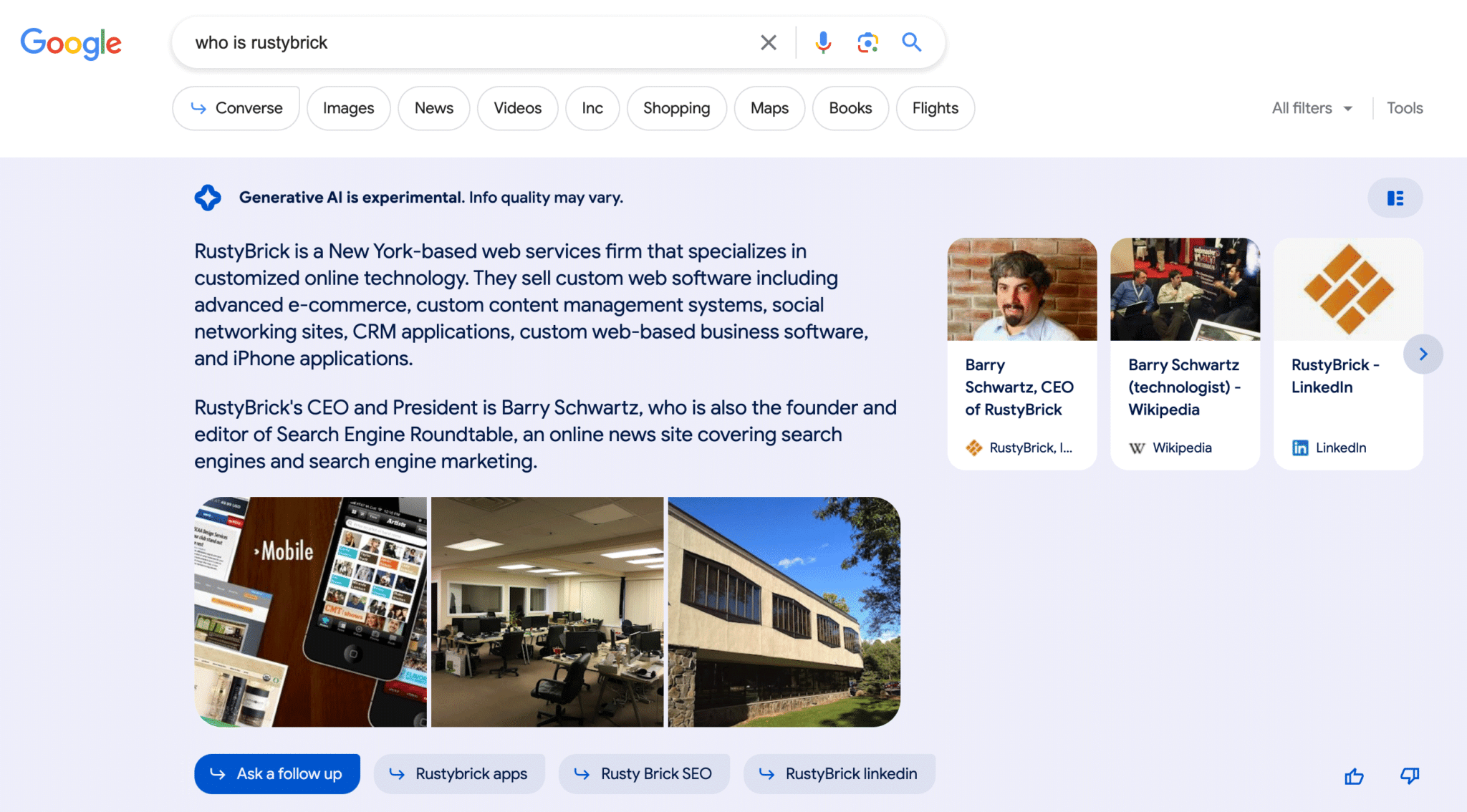
I was even able to replicate it for my own Google Business listing for my company. I asked [who is RustyBrick], and it returns photos directly from my Google Business Profile listing. The images below the text pull directly from the photos I uploaded to my Business Profile in Google.

Alphabet Inc.

Here are more examples I found on Twitter of this in action:

What Google said. Google wrote:

“We’ve added new capabilities to SGE for local and travel searches, so if you ask detailed questions about a place or destination in Search, you’ll see an AI-powered snapshot that brings together the most helpful information available — not only from across the web, but also from the reviews, photos and Business Profile details that people have submitted to Google for more than 200 million places in the real world. And with all these links and resources right at your fingertips, it’s easy to dive deeper on relevant sites and hear perspectives from a wide range of creators.

For example, you might ask if a certain restaurant is good for large groups or whether they’re vegetarian-friendly. Or maybe you want to know when people recommend visiting a particular landmark, so you can avoid the crowds. With this improved experience in SGE, you’ll get useful insights to guide you along the way, so you can spend less time planning and more time enjoying the plans you’ve made.”

Why we care. This gives you yet another reason, if you didn’t have enough reasons, to ensure your photos on your Google Business Profile listings are complete, good quality and representative of what your customers and prospects want to see of your business and organization. Also, ensuring you have good reviews, since SGE can use those, is also important.

This also shows that Google is ready and able to use more and more data sources it has at its disposal within its SGE AI-generates snapshots.

The post Google SGE now uses photos and reviews from Google Business Profile listings appeared first on Search Engine Land.

Original source: https://searchengineland.com/google-sge-now-uses-photos-and-reviews-from-google-business-profile-listings-428320

Top 5 Features You Should Look for in a Prospecting Tool

Home Business Magazine Online

Prospecting is an essential tool every salesperson should master. This practice is key to developing the sales pipeline by helping salespeople focus on the right accounts or target customers.

One study found that sales reps mention that prospecting and lead qualification are huge barriers to success. Fifty-one percent of the respondents claim to experience struggles finding these leads regularly.

They can become successful at this by investing in a prospecting tool that will direct them in the right direction when generating leads and securing sales.

Prospecting Tool Features to Look For

When looking for a prospecting tool to invest in, make sure they have the following features:

Sales intelligence

Sales intelligence provides managers and executives with data to gain insights into the selling cycle. It provides the visibility to identify the best-performing salespeople and the worst-performing ones.

A good prospecting tool with a robust sales intelligence feature allows you to view real-time historical data on leads generated by each rep.

CRM integration

Customer relationship management (CRM) allows the sales team to track their business contacts and personalize communication. Integration is critical so team members can view customer data better and synchronize it across all systems. An integrated system maximizes your time and resources. With it, you can export data from one system and use it with other features.

With more time spent on customers, leads can become a solid customer base. As much as 73 percent of customers prefer to engage with businesses using personalization.

Email finder

Email marketing remains an effective way to reach more leads, with 78 percent of marketers getting good results with relevant content. However, looking for valid email addresses of prospects can take time and effort. Make the process easier by using an email finder tool. This allows the sales team to get their target customers’ business or personal email addresses.

Even with the right tools, marketers may still struggle to get the results they want from their email marketing campaigns. Make sure you know the dos and don’ts of cold email marketing so you can get the most out of the automation solutions you have.

Dialer

B2B salespeople still use cold calling to reach out to their customers. However, its effectiveness depends on the technique. Still, having this as part of your arsenal is a good strategy. A dialer is a system that allows you to call leads and prospects. It’s a great way to ensure you’re reaching out to the right people.

Dialers can automate the process and allow team members to document the outcome. This feature is also helpful in sending out broadcast messages, SMS, and push notifications, which can generate leads. You can also use it in other ways. For example, if you know someone who has yet to respond to your email, you can use the dialer to reach potential clients without searching for them manually.

Reporting analytics

Prospecting will only be useful if salespeople get valuable data and insights into their lead-generation techniques. A prospecting tool should have reporting analytics to give the team an understanding of their sales process and areas where they can improve.

The reporting analytics module allows users to analyze their data in various ways, such as:

  • Forecasting sales based on historical trends
  • Reviewing top performers’ profiles and making recommendations for further training/development

Invest in a Feature-Rich Prospecting Tool

Prospecting is always challenging. However, with the right tool, you can use your time more efficiently to nurture leads and eventually convert. Before you choose one, understand what each feature does, and how it will benefit your business.

The post Top 5 Features You Should Look for in a Prospecting Tool appeared first on Home Business Magazine.

Original source: https://homebusinessmag.com/sales/prospecting/top-5-features-should-look-prospecting-tool/

How higher education is failing at SEO

As academic institutions continue to focus on providing quality education and research, their online visibility is often neglected.

This means that potential students may be unable to find them easily on search engines, leading to missed opportunities for growth and impact.

In the fall of 2022, Search Influence commissioned a study with the research team at UPCEA, the preeminent trade organization for professional, continuing and online (PCO) education. Here’s what we found.

With the millions of dollars spent in higher education digital marketing and advertising, there is very little understanding of search engine optimization and its role in attracting new learners.

With this belief, we commissioned a multi-part study which:

  • Reviewed 100 websites of university professional and continuing education departments.
  • Surveyed marketing leaders and institutional leaders.

In this mini-audit, the UPCEA team reviewed several factors we call SEO readiness. These include common SEO and user experience metrics, such as:

  • Number of unique pages (titles).
  • Unique meta descriptions.
  • Number of inbound links.
  • Domain and page authority.
  • Accessibility.

The UPCEA team surveyed both marketing teams and institutional leadership to understand their perceptions of – and alignment around – their own readiness.

At the risk of telegraphing the punchline, there are some big disparities.

In his introduction to the published research study, Jim Fong, Chief Research Officer at UPCEA, emphasizes the need for innovative practices, models, and credentials tailored to nontraditional and professional audiences, such as stackable degrees, non-credit programs, and micro-credentialing, among others.

Fong points out that reaching new adult learners requires precision, planning, and better prospect and student interfaces. These learners are savvier than previous generations, relying on various sources of information and influencing others through their outcomes.

One critical area of improvement lies in optimizing the degree programs’ “storefront” – the institution’s website – for better user experiences.

While Fong is cautious not to create panic, he believes a greater sense of urgency is needed to address the impending challenges in higher education.

With the labor shortage and a decline in the population of college-age students, universities need to do more to stay relevant to all learners, not just recent high school graduates.

It’s not unusual for individual PCO units in major universities to spend a million dollars or more on digital advertising.

And as we see in the research, those same departments are not even sure their teams are doing SEO.

The state of SEO in higher education

The UPCEA/Search Influence research highlights the perceptions and comprehension of SEO among institutional and marketing leaders. It also points to the potential impact on the SEO preparedness of the institutions involved.

Some key findings from the study:

  • Marketers and institutional leaders see SEO as foundational but admit their units lack an SEO strategy.
  • Institutional leadership often lacks reporting.
  • UPCEA members performed poorly in an SEO audit.

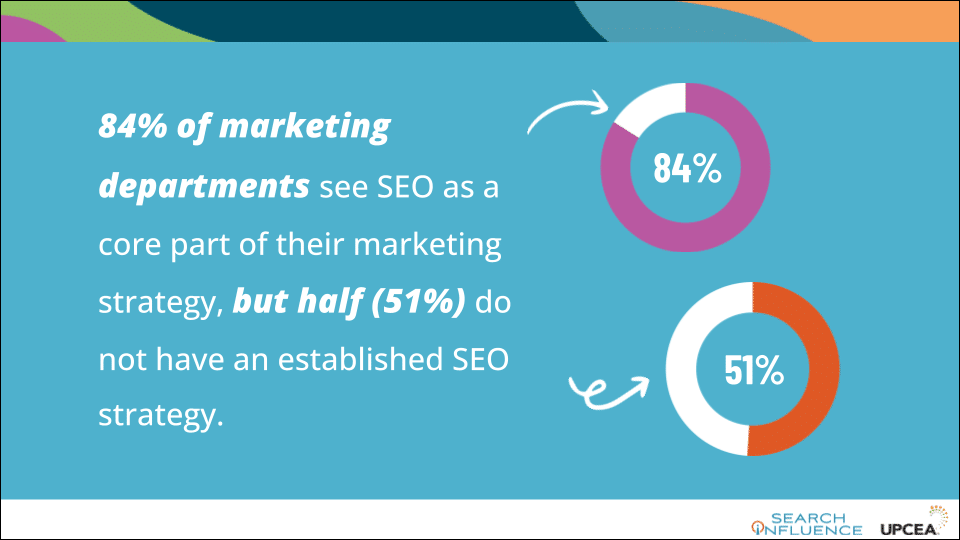
84% of marketing departments see SEO as a core part of their marketing strategy, but half (51%) do not have an established SEO strategy 

The disconnect is pretty striking. When so many see it as valuable, but so few have a strategy, we have to ask ourselves, “Why?”

Some possible reasons are:

  • SEO seems too complex.
  • Digital advertising (and its return) is easier to understand.
  • The ROI of SEO isn’t clear to decision-makers.
Higher ed SEO - Stat 1

I’m often asked when talking to leaders, both academic deans and directors of marketing, if we have case studies on the ROI of SEO.

We do, of course, but it’s still surprising that these senior professionals don’t make the connection.

If they’re willing to pay to be at the top of Google rankings, earning their way, there is imminently more valuable.

The difference between Page 5 (essentially nonexistent) and Page 1 can mean hundreds of additional visits and thousands of dollars in revenue.

Institutional leadership often lacks reporting

Despite the indication that institutional leaders want reporting, a few of them are getting it. 

Higher ed SEO - Stat 2

It’s possible that marketing teams don’t know how to quantify their SEO efforts, or perhaps worse, they don’t know what efforts are being made.

‘SEO readiness’ has room for improvement

Among the more surprising revelations was the number of sites that were not 100% accessibility compliant.

Our testing tool for accessibility, accessiBe’s accessScan, evaluates whether a website is non-compliant, semi-compliant, or compliant. 

A vast majority of institutions (81%) were just semi-compliant. Our clients report this is a hot-button issue for their administrations.

Furthermore, there are several lawyers who perceive it as an area of opportunity for trolling as well.

Higher ed SEO - Stat 3

SEO is essential to drive organic traffic from potential students.

A weak SEO foundation can negatively impact ranking factors and significantly hinder a website’s ability to attract potential students.

We often hear from higher education institutions that they are “doing SEO.” But we wonder – is it being done strategically?

From our experience, a comprehensive digital marketing strategy is critical for schools that want to meet their enrollment goals.

The results of this research demonstrate that SEO is an area of opportunity for many universities.


Get the daily newsletter search marketers rely on.

<input type="hidden" name="utmMedium" value="“>
<input type="hidden" name="utmCampaign" value="“>
<input type="hidden" name="utmSource" value="“>
<input type="hidden" name="utmContent" value="“>
<input type="hidden" name="pageLink" value="“>
<input type="hidden" name="ipAddress" value="“>

Processing…Please wait.

function getCookie(cname) {
let name = cname + “=”;
let decodedCookie = decodeURIComponent(document.cookie);
let ca = decodedCookie.split(‘;’);
for(let i = 0; i <ca.length; i++) {
let c = ca[i];
while (c.charAt(0) == ' ') {
c = c.substring(1);
}
if (c.indexOf(name) == 0) {
return c.substring(name.length, c.length);
}
}
return "";
}
document.getElementById('munchkinCookieInline').value = getCookie('_mkto_trk');


Overcoming challenges and embracing innovation

Although marketing and institutional leaders value SEO as a tactic, only 47% report that their unit has an established SEO plan or strategy. 

Higher ed SEO - Stat 4

This disconnect suggests that, while marketers know SEO’s critical role, they may not have the skills, staff, or resources to develop a strategy. 

Most web traffic comes through organic search, i.e., utilizing popular search engines such as Google.

This means regardless of where prospects are in their student journey, they expect a search engine to answer their questions about the availability of programs, applying, and even enrollment. 

Common challenges for educational institutions implementing SEO strategies

Centralized control of marketing and ‘webcomms’

In many higher education institutions, centralized departments are responsible for many functions.

Like facilities and food service, IT, communications, and marketing often reside at or are directed from the university level rather than in the individual departments.

In some cases, there are individuals or teams charged with marketing at the department level. Often, they are constrained by the brand guides, templates, and technology choices made at the institutional level.

In a minimal number of cases, we have seen individual departments or units allowed to make their own technology choices as long as they stay within the general guidelines of the parent organization. 

Institutional support for IT, marketing and SEO

These centralized teams are beholden not to the individual department but to the university or college. 

While they intend to serve all departments equally, what we have seen is typically one of two conditions: favored programs get more institutional resources, or all programs get basic support. 

With this as the reality, the most likely scenario is that there are not enough human and financial resources in an area (like SEO) that isn’t as tangible as email marketing or advertising.

When an individual department is in control of their marketing and their website, we see it as a great advantage. While they have less institutional support, they also have less institutional oversight and control.

Maintaining and growing knowledge of SEO 

In cases where there are department-specific web support or marketing teams, they are charged with many functions. They are updating faculty bios, course descriptions, social media and more.

They are often generalists without deep knowledge of the technologies they manage. 

It is challenging enough to establish a foundational understanding of SEO, digital ads, email marketing, social media, and website technologies – even more to maintain up-to-date best practices in an ever-changing field.

Most marketing leaders recognize that there is room for improvement in the SEO capabilities of their unit, scoring their knowledge with an average rating of 3.5 out of 5.

Higher education CMS issues

In addition to the institutional challenges to good management of the websites, there are CMS challenges as well.

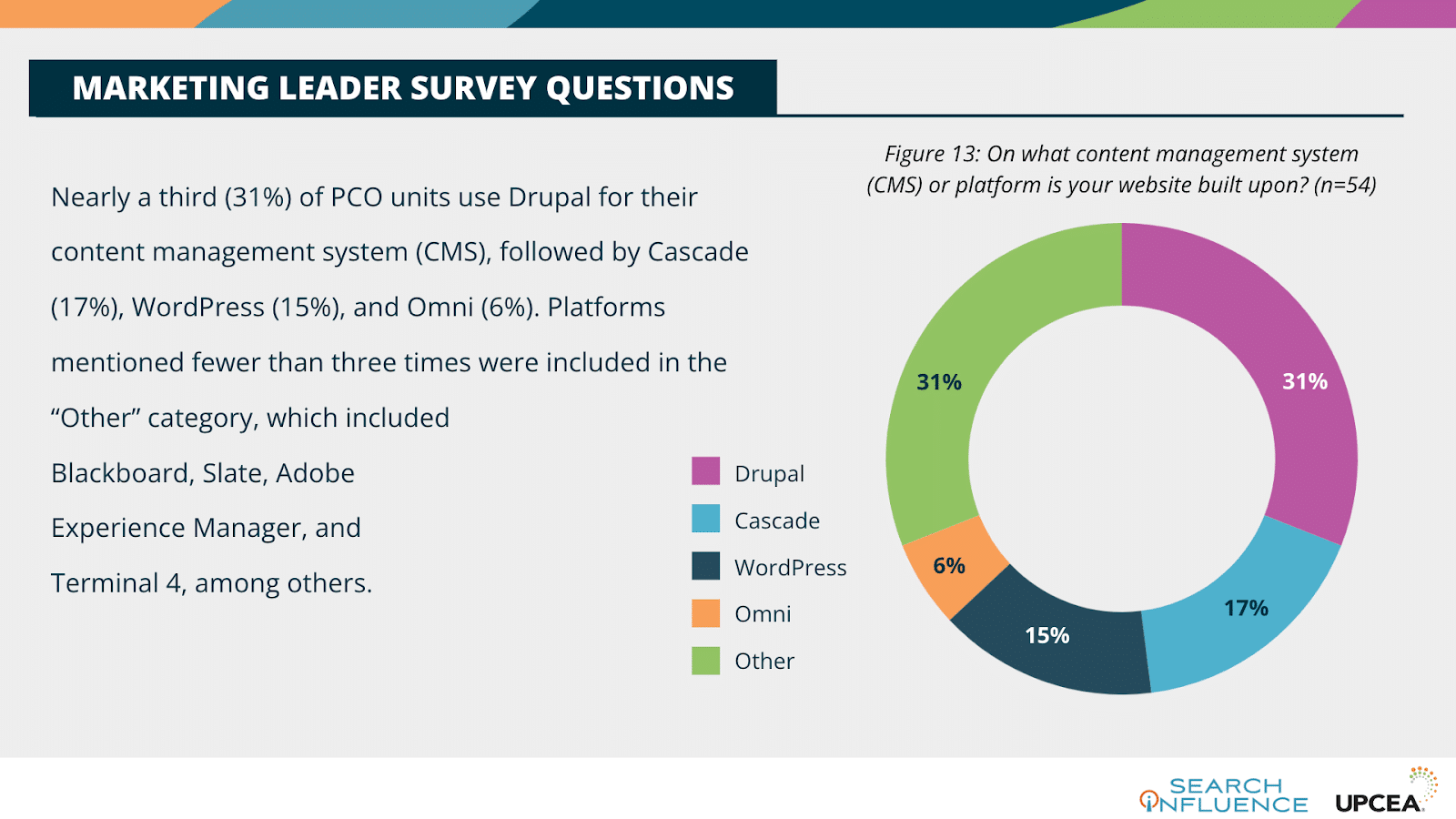
In our study, the most-used CMS platforms for university websites are: 

  • Drupal (31%).
  • Cascade (17%).
  • WordPress (15%)
  • Omni (6%). 

Other platforms mentioned included Blackboard, Slate, Adobe Experience Manager, and Terminal 4, among others.

Higher ed SEO - Stat 4

With so many CMS platforms within these PCO units, content management likely requires more training and support than in more commonly used systems, such as WordPress.

The challenge is pretty clear. Inconsistent support, teams with many roles, centralized command and control, and hard-to-manage systems mean not much will get done, even with the best intentions.

Is there a silver bullet for higher education SEO?

Sadly, there’s none.

In the best case, administrative leadership would come to understand the importance of SEO for higher education. 

Unfortunately, it doesn’t seem those administrators are making the connection between their important work – growth, fund-raising, enrollment, research – and SEO.

For most departments in higher education, SEO is an afterthought.

Best practices for higher education SEO

SEO basics

Without doing a deep dive into the basics of SEO, there are a few things that we know to be true.

Relevance + Authority = Winning in search engines

The shortest version of what good SEO looks like is:

In other words, are you saying the things people are searching for on your pages? 

Do search engines understand that yours is a trustworthy and respected website deserving of their traffic?

Higher ed SEO has an unfair competitive advantage

Given the importance of relevance and trust (surely you’ve heard of E-E-A-T), there are few more trusted websites than those associated with educational institutions.

In Maslow’s Hierarchy of link building, .edu links are right up there with self-actualization. They are the definition of what makes a good backlink. 

They have authority, relevance, trust, and lots and lots of actual user traffic. In academic research, this would be considered an authoritative citation.

Think about it, they publish constantly and much of their content is research people are interested in. 

They get tons of branded searches from prospective students. And they’re responsible for significant contributions to their local economy.

So as an academic unit within a university, your ability to appear for relevant searches is amplified. All you need is great content.

In higher education, content optimization is critical

The great news is that individual units are responsible for one of the most critical factors in university SEO: content.

If I control the content, I can control how it’s optimized. I can often control the formatting, including the use of headings and other on-page optimization elements. I can also likely control what is being linked to from within the content.

So, from our perspective, focusing on content is one of the most important – and realistic – things that any unit within a higher education institution can do for SEO success.

This is not to say they don’t need to be thinking about technical SEO. If there are critical failings within their technical infrastructure, they will have a harder time reaching prospective students.

But, if they can build relevant content and get good links, they’ll be a lot more likely to rank well in search than another site might, given the inherent authority of their university website.

Understanding what good content looks like becomes critical for those marketers working within those university units trying to attract new learners.

Getting started with higher education SEO content

Temet Nosce. As the Greek maxim states, it is important to know oneself.

One of the most important tools a higher education marketer can have is Google Search Console. Obviously, one has to take anything Google says with a grain of salt, but there are some good reasons to start with Search Console.

  • It’s free.
  • The information is pretty easy to understand compared to other tools.
  • It shows you Google’s point of view.

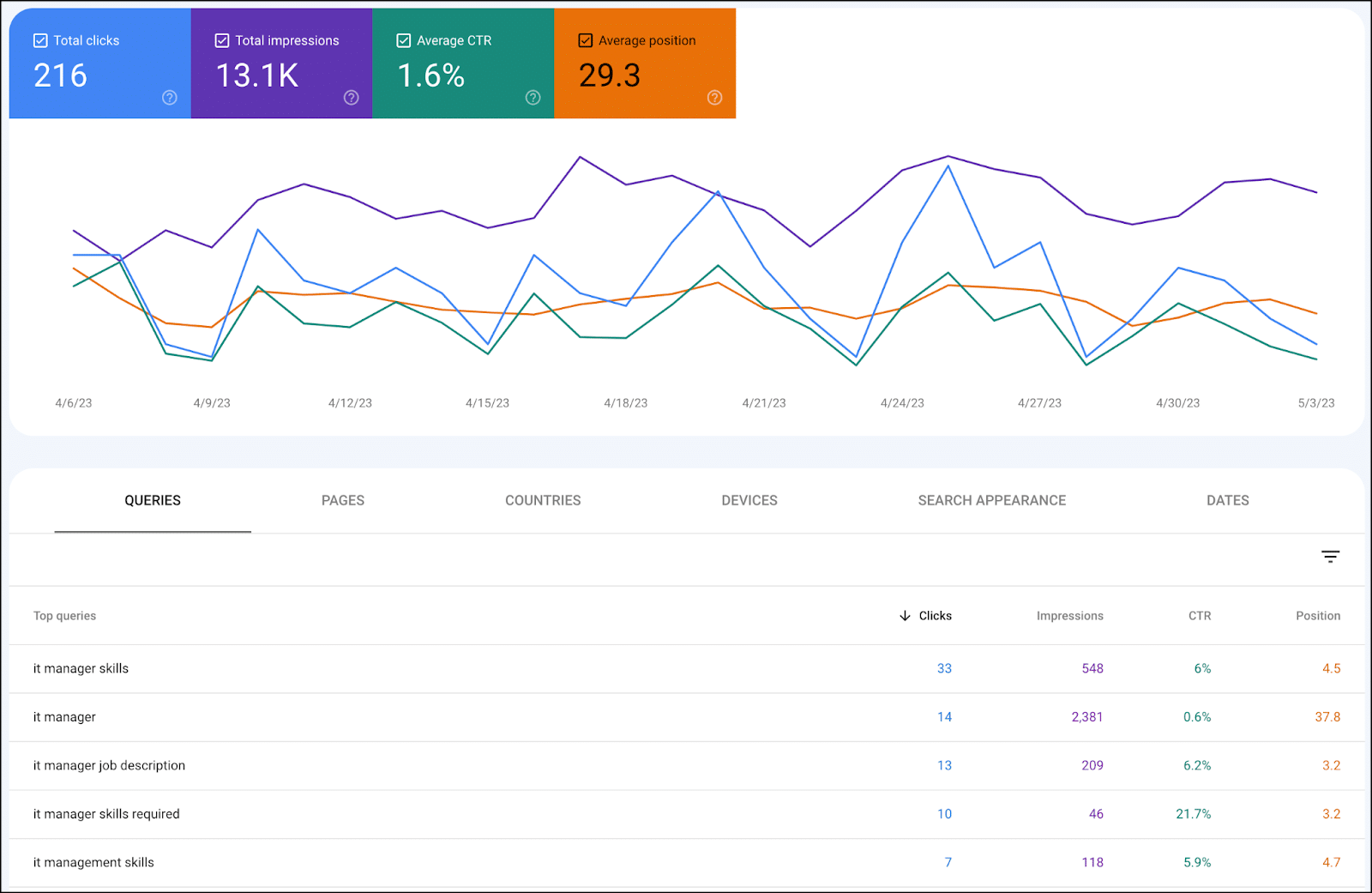
A good starting point for higher ed marketers is to look at what queries their pages already show up for.

GSC-top queries

With Google Search Console, you can see what phrases Google already thinks your website contact is relevant for.

Starting with those queries you’re already doing well for. You can start to think competitively. 

A review of competitive sites can give you some good clues about what you must do to get over the top.

  • Do they have more content?
  • What are the features of that content?
    • More images, more headers, more text, video?
  • Do they have more links?
    • You may need tools for this one.
    • A good free option is the SEOquake extension. You’ll need a free Semrush account that gives you access to many SEO metrics.
Sample edu website audit

With the data from the above investigation, you’re now able to start outlining content.

The best web content is like a persuasive essay. Present the important information and then bring it home with a strong call to action.

In any industry, and especially in higher ed, it’s less about the words and more about the journey.

Just because people are searching for a phrase doesn’t mean that those people are prospective students.

Educating stakeholders on the value of SEO

It’s easy for us to look at a problem and see a marketing solution.

SEO is a foreign language to many, and as this study proves it is still not understood as a great way to drive ROI for higher education.

In the review of your own site, analysis of competing sites, and optimization of your content, you are never done. The key is to develop a system and cadence that work for you.

Whether due to complexity, lack of knowledge, or institutional inertia, SEO is not getting its due in higher ed. There are a lot of considerations outside the control of the folks executing the strategies within higher education marketing.

Our job is to support them. We must provide the best knowledge we can, meet them where they are, and ensure we are not asking them to do things that, in their situations, are “impossible.”

The UPCEA study shows much room for improvement in higher ed SEO. There are some winners in the analysis who still have opportunities for improvement.

By focusing on function and form, higher education marketers can start where they are within their current constraints: 

  • Create great content.
  • Build links, even if they’re just internal.
  • Get better placement in organic search so they will be less dependent on paid advertising.

The post How higher education is failing at SEO appeared first on Search Engine Land.

Original source: https://searchengineland.com/higher-education-failing-seo-428273

Google files lawsuit over fake review scams

Google has filed a lawsuit to dissuade scammers from using Google Maps and Business Profiles to post fake businesses and fake reviews. Google said “bad actors posted more than 350 fraudulent Business Profiles and tried to bolster them with more than 14,000 fake reviews.

The lawsuit. You can find the court document over here that spells out the details of the lawsuit that Google filed. The defendants listed in the lawsuit are Defendants Ethan QiQi Hu; GMBEye; Rafadigital, LLC (“Rafadigital”); and Does 1– 20.

Google said the purpose of the lawsuit is to stop the “complex and misleading scheme to deceive consumers, business owners, and Google by unlawfully manipulating Google’s industry-leading business listing services.”

It goes on to read:

“Over the past two years, Defendants—led primarily by a single individual, Ethan Qiqi Hu—have abused Google products to create fake online listings for businesses that do not exist, and to bolster them with fake reviews from people who do not exist. Defendants sell these listings, and the inquiries from confused consumers who are lured in by them, to individuals and entities looking to promote their businesses on Google platforms. Defendants deceive these small business owners too, making unsubstantiated and impossible claims about their ability to guarantee a favorable position in Google’s search results and implying preferential treatment or access with respect to certain Google processes.”

There is a lot of detail, including screenshots and the alleged methods used by the defendants in the court document.

Google has done this before. In the past, Google has done a number of things to try and stop this kind of fraud, including filing lawsuits. Not just with local, but also with web search.

Why we care. Will this lawsuit put fear into those scammers that have yet to be sued by Google and encourage them to stop their practices? Will this lawsuit lead to less spam and scams in Google Maps and Google Local? Time will tell but it is nice that Google is taking efforts, beyond just removing spam and fake profiles, to target these spammy efforts.

The post Google files lawsuit over fake review scams appeared first on Search Engine Land.

Original source: https://searchengineland.com/google-files-lawsuit-over-fake-review-scams-428365

All About Streamlining Your Company’s Fleet Operations

Home Business Magazine Online

In the era of ever-increasing demand for efficiency, businesses across industries are searching for ways to optimize their operations. For companies with fleet operations, this optimization is not just desirable, it’s essential. With fuel costs, maintenance, vehicle wear-and-tear, and logistical complexities, the cost of running a fleet can be steep.

Streamlining these operations can yield significant savings and drive a company’s success. This article will guide you through various strategies for achieving operational efficiency in your company’s fleet management.

Assessing Your Company’s Fleet Operations: Identifying Areas for Improved Efficiency

Understanding your fleet’s operational dynamics is the first step toward enhanced efficiency. This begins with a comprehensive assessment of your fleet’s operations, identifying key areas where improvement is required. Take into consideration factors like vehicle type, usage, cost of maintenance, fuel consumption, and how your fleet supports your core business operations. This evaluation forms the foundation upon which to build your streamlining strategies.

The assessment phase must also include a thorough analysis of your fleet’s operational data. Fleet data such as routes taken, fuel consumption per route, vehicle idle times, and driver performance can provide invaluable insights into how your fleet is being utilized. Trends in the data can reveal inefficiencies that, when addressed, can lead to significant cost savings.

Once the data analysis is complete, benchmark your current operations against industry standards. These standards could be in areas such as average fuel consumption, cost per mile, maintenance expenses, and overall fleet utilization. Identifying where your company stands in comparison to these benchmarks will highlight gaps and potential areas for improvement.

Understanding your drivers’ behavior is another crucial aspect of fleet operation assessment. Speeding, rapid acceleration, and excessive braking are behaviors that can lead to increased fuel consumption and maintenance costs. Implementing a driver behavior monitoring program can help you identify such behaviors and take corrective actions.

The vehicles themselves must also be considered in your fleet operations assessment. The type, age, and condition of the vehicles in your fleet can significantly impact their efficiency and reliability. Outdated vehicles, for instance, can increase maintenance costs and cause frequent service interruptions. Therefore, a well-planned vehicle replacement program can improve your fleet’s overall efficiency.

Your company’s fleet policies and procedures should be under the microscope. Inefficient practices, lack of compliance enforcement, or outdated policies can create significant operational inefficiencies. Regularly reviewing and updating these policies and procedures can contribute to a more streamlined and efficient fleet operation.

Streamlining Your Company’s Fleet Shipping and Relocation Processes

Shipping and relocation processes represent another area of fleet operations where improvements can yield significant benefits. When managed effectively, these processes can be streamlined to increase efficiency, reduce costs, and minimize disruption to your company’s operations.

The process of shipping cars for company fleets involves several intricate steps, from planning and scheduling to tracking and delivery. The key to streamlining this process lies in optimizing each of these steps. The first step, planning and scheduling, should be done well in advance and take into consideration the needs of the business and potential disruptions to operations.

Next is the transportation process itself. Selecting the right mode of transport based on the vehicles’ size, type, and destination can lead to considerable cost savings. For instance, if you’re shipping multiple vehicles across a long distance, using a car carrier service may be more cost-effective than individual transport.

Tracking the transportation process is another crucial step. Real-time tracking can provide insights into the exact location of the vehicles, any potential delays, and the estimated time of arrival. This helps in better planning and reduces the chances of any business disruptions.

Ensure that the delivery process is smooth and efficient. This includes checking the condition of the vehicles upon arrival, cross-verifying the shipment details, and ensuring timely integration of the vehicles into your operations.

Here are some things to keep in mind when selecting a car shipping company to do business with:

  • Reputation: Always check the reputation of the car transport companies you research. Online reviews and ratings can provide a fair idea about the company’s service quality.
  • Experience: A company with a proven track record in shipping vehicles similar to your fleet would be a better choice.
  • Insurance: Ensure that the company offers sufficient insurance coverage for your vehicles during transit.
  • Transparency: The company should be upfront about all costs involved and provide a detailed quote without any hidden charges.
  • Tracking: The company should provide real-time tracking of your vehicles during transit.

Streamlining Other Fleet Processes and Operations

There are numerous other fleet processes and operations that can be streamlined for increased efficiency. Fleet scheduling is one such process. By optimizing the scheduling of vehicle usage, you can reduce idle time, increase vehicle utilization, and save on costs.

Driver assignment is another process that can be streamlined. Assigning drivers based on their skills, experience, and familiarity with routes can improve efficiency and reduce the risk of accidents or delays.

Fleet maintenance is another critical operation that needs attention. Preventive maintenance programs can help keep vehicles in top shape, reducing the risk of breakdowns and unexpected repair costs. Furthermore, regular maintenance can increase the vehicles’ lifespan, providing long-term cost savings.

Consider streamlining the process of fleet reporting. By automating the generation and distribution of fleet reports, you can save time, reduce errors, and improve decision-making.

Fleet Management Software: Centralizing and Automating Processes

In today’s digital age, fleet management software plays a pivotal role in streamlining fleet operations. These platforms centralize and automate many processes, increasing operational efficiency and providing valuable insights for decision-making.

Fleet management systems allows for real-time tracking of vehicles, enabling managers to monitor routes, identify bottlenecks, and optimize schedules. This real-time visibility improves operational efficiency and can significantly reduce fuel costs.

Additionally, these platforms often come with features for monitoring driver behavior. By collecting data on speeding, hard braking, and idle times, fleet managers can identify inefficient driving practices and provide targeted training to improve fuel economy and vehicle longevity.

On the logistical side, fleet management software can automate complex tasks such as scheduling, dispatching, and route optimization. By automating these processes, companies can minimize human error, save time, and improve service delivery.

Fleet management software also facilitates preventive maintenance by tracking vehicle usage and condition, setting reminders for scheduled maintenance, and alerting managers to potential issues before they become major problems. This not only minimizes downtime but also extends the lifespan of the vehicles.

This software can streamline reporting by automating the collection, analysis, and presentation of fleet data. This provides managers with valuable insights into their operations and supports data-driven decision-making.

Preventive Maintenance Planning: Minimizing Downtime and Costs

Preventive maintenance is a key aspect of fleet operations that, when properly planned and executed, can greatly contribute to streamlining. It involves routine inspection, servicing, and repair of vehicles to prevent potential problems before they occur.

A comprehensive preventive maintenance plan starts with understanding the maintenance needs of each vehicle in your fleet. This includes the manufacturer’s recommended maintenance schedule, the vehicle’s usage pattern, and its overall condition. With this knowledge, you can create a maintenance schedule tailored to each vehicle.

Ensure that maintenance tasks are performed on time and to the necessary standard. This not only minimizes the risk of breakdowns but also extends the lifespan of your vehicles. Regular training for your maintenance staff can ensure they stay up-to-date with the latest best practices.

It’s also important to keep an inventory of essential spare parts. This helps reduce downtime by ensuring that parts are available when needed, eliminating the need to wait for delivery.

Consider using a fleet management software to manage your preventive maintenance program. These platforms can send reminders for scheduled maintenance, track the condition of vehicles, and record maintenance history, helping you stay on top of your fleet’s maintenance needs.

Regularly review and adjust your preventive maintenance plan based on the performance and condition of your vehicles. If a vehicle is breaking down frequently despite regular maintenance, it might be time to consider replacing it.

Don’t overlook the role of your drivers in preventive maintenance. Training them to perform basic checks and report any issues they notice can catch problems early and reduce the risk of major breakdowns.

Streamlining your company’s fleet operations is a multifaceted task that requires strategic planning and continuous improvement. However, the benefits — including cost savings, improved efficiency, and enhanced service delivery — make it a worthwhile endeavor. Whether you’re assessing your operations, streamlining shipping and relocation, implementing fleet management software, or planning preventive maintenance, each step brings you closer to a more streamlined and efficient fleet operation.

Remember, the key to successful streamlining is to adopt a proactive, data-driven approach, and stay committed to ongoing optimization. With these principles, your company’s fleet operations can drive your business forward, providing a competitive edge in today’s fast-paced business environment.

The post All About Streamlining Your Company’s Fleet Operations appeared first on Home Business Magazine.

Original source: https://homebusinessmag.com/management/operations/streamlining-company-fleet-operations/

Change: Plastic-Free Packaging Solutions for Your Business

Home Business Magazine Online

Sustainable Packaging Solutions for Your Business

In today’s consumerism world, being an eco-friendly and sustainable company is becoming increasingly important in attracting and maintaining a large customer base. More than ever, people align themselves with businesses that follow green business practices throughout their supply chain.

This need has pushed factors like eco-friendly packaging to the forefront of consumer demands, as it is the leading cause of landfill waste and single-use plastic. Of course, finding a sustainable alternative for your business needs may involve some trial and error. But with various solutions already proving to be a success, you can transition to green alternatives with confidence and peace of mind.

Biodegradable Packing Peanuts

British cosmetic giants Lush, famous for their eco-friendly, biodegradable and cruelty-free business model, has developed an innovative recyclable packing peanut made from a combination of water and a starch-based substance. As a result, not only can they be disposed of entirely in a nature-friendly manner, but 23% less energy is also needed to produce them.

With major cities like New York banning the use of styrofoam, which is predominantly used for takeaway containers and loose-fill packaging, finding a sustainable alternative is a non-negotiable for businesses operating in these areas.

Mushroom Packaging

Mushroom packaging is created by a process in which agricultural waste is cleaned and grounded into a mixture that is fused together by a collection of mushroom roots, also known as mycelium. This raw material is then able to be moulded into any desired shaped, dried and ultimately used as packaging.

Because agricultural waste cannot be used as a food source for humans or animals, this clever creation allows makers to use an otherwise useless by-product that can be composted at home and naturally degrades faster.

packaging
Photo by Mediamodifier on Unsplash

Green Paper

Polyethene is the material currently used to coat more than half the paper used in global packaging. However, once applied to paper, it is no longer biodegradable, meaning that paper products containing this chemical are sent to landfills upon disposal.

The Miami-based company, J&J Green Paper, has developed a sustainable alternative called JANUS, a biodegradable, recyclable and compostable replacement for polyethene. This has proven to be a game changer throughout the cosmetic, agricultural, packaging and F&B industries. The raw material needed is widely available across the globe, and the application process is identical to that of polythene, meaning the production process transfer can be done with minimal effort and little supply chain disruption.

Corrugated Bubble Wrap

Bubble wrap is a popular packing material thanks to the cushioning support it gives fragile items during shipping as well as the fun of popping the bubbles once you don’t need it anymore. However, it is not an eco-friendly solution as it is wholly plastic-based.

The good news is that several sustainable alternatives are in the development stages, all designed to implement recycled materials and green manufacturing methods. One option gaining popularity is created by using up-cycled cardboard that is changed into a cushioning agent. This is achieved by making small cuts into post-consumer cardboard waste, creating a concertina effect that protects against shocks and bumps.

Organic Textiles

For companies of all sizes, using ecological textile packaging will not only allow you to implement more environmentally friendly business practices, but it will add extra value to your products for your customers. For instance, you can design and implement reusable bags instead of single-use plastic bags, eliminating harmful material and extending the product’s usefulness.

Multiple organic fabrics are already available on the market, including hemp, recycled cotton, tapioca and palm leaves. Because these materials are biodegradable, they will avoid landfills and naturally decompose over time, unlike plastic, which eventually breaks down into microplastics, spoiling food chains and harming the health of both animals and humans.

Seaweed Packaging

Hailed as the next big thing in green packaging solutions, seaweed is a green solution that is manufactured using the gelatinous substance agar, found naturally in various seaweeds and algae. This sustainable raw material can be sourced and collected easily worldwide.

Seaweed packaging is made by extracting the agar from the seaweed and algae. It is then dehydrated and turned into a more suitable material that can be used for different packaging needs. For example, to create a soft cushioning agent, the material is first frozen to form a film-like state before being compressed into a soft, pliable texture.

packaging
Photo by Natalia Arkusha on Unsplash

Closed-loop Distribution Technology

Singapore-based ecoSPIRITS is a clever closed-loop distribution system offering one of the first sustainable packaging solutions to the spirits and liquor industry. According to a study by Deloitte, the company could eliminate 60-90% of carbon dioxide emissions released through the traditional packaging and distribution channels of alcohol.

Their solution cancels the need for bottling alcohol before shipping and instead transports the liquid in bulk to customers and distributors. Once it reaches this market, the liquid is decanted into smaller, reusable bottles called ecoTotes, which are sent on to the necessary establishments, like bars or hotels. From here, they are served to customers through integral tap dispensers. Once the totes are empty, they can be returned for refilling, eliminating single-use glass bottles.

The post Change: Plastic-Free Packaging Solutions for Your Business appeared first on Home Business Magazine.

Original source: https://homebusinessmag.com/businesses/go-green/change-plastic-free-packaging-solutions-business/

7 most common business mistakes new entrepreneurs make

What is it many new businesses all have in common? They tend to all make the same business mistakes when they start out. We thought it would be helpful to list them for you and offer ways to avoid them.

Ask any entrepreneur why they left their corporate life behind and they’ll normally tell you one of three things:

  • To do what they love full time.
  • They want to be their own boss.
  • To live the dream.

They wanted to be free from the shackles of their 9-5 job. Focusing on doing what they really enjoy and excel at. Something that gives them back just as much as they put in.

And that’s exactly how I felt when I left my corporate position in early 2015.

Starry-eyed with a head full of dreams, I started on my entrepreneurial journey with expectations of how this new life would be:

  • Clients would flow to me when I wanted
  • I’d work hard and be rewarded for every risky move I made
  • Every day would be uplifting

Only it wasn’t quite the case.

I was working more hours than I had in my previous job for a start. I was also trying many new things, only to see them fail. I also was seeing my bank balance dwindle with every passing week.

So I spoke to other business owners to see if they could relate. As I started to scratch beneath the surface, I saw that they felt the same. In fact, we had all made the same seven business mistakes.

Business mistakes that were severely hindering our ambitions.

In this article, I’ll outline the seven most common business mistakes, and what you can do to avoid making them.


MISTAKE 1: EXPECTING SUCCESS TOO SOON

business mistakesNo matter the foundations you start off with, nothing ever goes to plan. And expecting your business to be an overnight success is tempting disappointment on a grand scale.

While success in business may take months rather than years, it helps to keep a monthly log of everything you tried, what worked and what didn’t.

At least then, when you assess your progress in six month, you have a clear idea of exactly where you’ve been.


MISTAKE 2: CONSTANT COMPETITION COMPARISON

business mistakesKeeping one eye on your competitors is smart for deciding how you’ll stand out in a crowded market.

However, this becomes toxic when all you do is compare yourself to them, especially if you feel dejected when you read their success stories (and yours don’t follow a similar path).

Alleviate this by cutting off comparison altogether. Unsubscribe from their email lists, stop following them on social media and block updates from the Facebook groups that constantly scream about success stories.

This means you decide when you want to update yourself on their progress, rather than having the information pushed in your face all day.


MISTAKE 3: IGNORING THE STATS

business mistakesMeasuring statistics isn’t something that’s reserved for those making more than six figure incomes.

Even if you have a small email list and aren’t hitting your monthly income goals, measuring what works and what doesn’t is a strong way to start as you mean to go on.

Look at email open rates for different subject lines, identify which activities get the most traffic or make the most money, and keep a monthly log of them.

Then plan to do more of those activities to build your business. As you grow, consider investing in business intelligence software to help you make better informed decisions, improve efficiencies, track goals and growth.


MISTAKE 4: GETTING TOO SOCIAL

business mistakesSocial media’s expertly tailored to speak to one of the most basic of human needs – connection. This is why so many people spend so much time browsing their Twitter feed, scouring Facebook or double-tapping Instagram.

And most entrepreneurs assume time on social media’s time well spent.

The truth is, while social media does help build your brand, it’s an investment for the long term. Currently, if the time you spend on social media sites doesn’t bring a return, then your time isn’t an investment – it’s a waste.

To help structure your day better, spend an hour on social media in total, and stick to those sites where your customers are more likely to be.


MISTAKE 5: SUFFERING FROM SHINY OBJECT SYNDROME

business mistakesShiny object syndrome for entrepreneurs is centred on buying courses.

With a shiny, new course being released by your favourite teacher, it’s easy to get sucked in and assume it’ll have the golden bullet to skyrocket your business (especially when the sales copy’s so convincing).

To decide if it does, take a look at what courses or tools you’ve purchased in the last 12 months. How many of them have genuinely moved your business forward? How many of them have helped you achieve your goals?

I’m guessing not many.

Remedy this by either setting yourself an income goal, after which you can buy something else, or take a 12 month purchasing fast. Then focus your energy on using the courses and tools you already have to meet your goals (before you go on a buying spree again).


MISTAKE 6: WORKING ALONE

business mistakesWorking from home, especially after you spent years working in a busy office, can be the most difficult adjustment to make as a new business owner.

The silence in the room, the lack of water-cooler conversation, the voices in your head. It all takes a toll. Humans are social creatures after all!

While you may not replace old colleagues with new ones, you can explore where you live for viable co-working spaces and café’s to work from a few times a week.

Take this a step further and ask friends who they know that’s also a solo-preneur. Then make plans to meet with these people weekly so you can co-work together. Solidarity!


MISTAKE 7: CONSTANT FREELANCE MODE

When you’re a service provider and first start out, it’s easy to get sucked into the 1-1 client relationships and still exchanging time for money.

business mistakesAlthough this can be fruitful when landing a client that pays higher fees, it can limit financial and creative growth if working with clients is all you do.

Be brave and take half a day a week (or every fortnight if weekly is too much of a stretch) to think of the bigger picture.

How can you turn your services into a revenue-generating product? What joint venture opportunities can you identify? Can you create a course or write a book that teaches your expertise?

We’ve all been there; stuck in our own heads and wondering when the day will come when business becomes fun. We went solo to enjoy what we do!

Know that it may take longer than you planned, and the course of events will change more than you care to admit, but keep at it and you’ll be one step closer to living the dream.


RISK BUSINESS FAILURE IF YOU MISS THIS ONE STEP

business mistakes“If you want to start a business you love, follow your passion”

If I read this advice one more time, I swear I’ll gag.

Mainly because it’s new-age woo-woo theory that makes people hate their jobs, but mostly because it’s completely false.

If I were to follow my passion? I’d be making money by spending all day sprawled on the sofa eating fresh baguettes and watching re-runs of The Gilmore Girls.

That’s never going to happen.

So if following your passion isn’t the thing you’re supposed to do when it comes to starting your own business, then what is?


WHY DO YOU WANT TO START YOUR OWN BUSINESS IN THE FIRST PLACE?

There’s a very popular video by Simon Sinek where he talks about why you do something being more important than what or how you do it.business mistakes

Why?

Because your reason keeps you going.

An emotional connection to this reason means you push through the tough times in business (when you have a difficult client, or when you’re not making money), and makes the great times even better.

Is your reason altruistic? Do you see a gap in the market that your skills can fill? Is there a problem many people have that you’ve found the solution for?

Whatever your reasons for starting, make sure you’re clear on what they are or you may risk business failure. So your first action step is to:

Write down 5 reasons why you want to start a business

business mistakesNow you know the reasons for starting a business, let’s talk about how ambitious you are with the venture.

Cue: images of Richard Branson, Bill Gates and a very short Sir Alan Sugar in a leather chair.

How ambitious you are is entirely up to you.

You can be as humble as having a side-gig to your day job, or as industrious as aiming to have a multi-national business and thousands of employees.


How big do you want to go?

The size of business you create will influence the type of people you ask for advice, the research you do, and the mentors you have. Think about how you want the business to fit into your life.

business mistakesDecide on the type of business you want to build by answering these questions:

I want to run my business from __________ (home, an office, anywhere in the world, Plant Mars (as long as there’s wifi))

I want to have ___ (number) employees

The final goal is to ______ (run my business along my job, sell my business, leave my job for this business full time)

That’s action step 2 ticked.

The last and final action step is to decide the business model you want to run with. What does this mean? It’s all about how you’ll serve your customers, and how you’ll earn money.

Here are some examples for clarity:

  • Personal service: Nanny, web design, writer, coach, personal trainer
  • Product sales: Clothes, jewellery, food, wine, coffee
  • Subscription/membership service: Web hosting, gym/club, group coach
  • Reseller: Affiliate products, Ebay

If you want to be a reseller, for example, you know that your business is reliant on finding the right products to sell to your customers with varying prices.

If it’s a personal service, you know you’ll have a 1-1 relationship with your clients and your earning potential is directly linked to the amount of time you spend.

So we’ve looked at why you want to start a business, and the type of business you want to build and the structure of it.


THE HONEST TRUTH ABOUT WHY YOU HAVEN’T STARTED A BUSINESS YET (THAT NOBODY WILL TELL YOU)

  • Being your own boss.
  • Creating a business around your natural talents.
  • Or simply working from your own home.
  • You’ve wanted this for years, so why you haven’t started a business yet?

Many people dream of having their own business. Whether it’s quitting their job completely, or having a side-business to supplement income from a full-time job.

business mistakesBut why do so many people dream, but not many do?

Working for yourself is one of the most rewarding things you can do. Whether you want to create the next Google or have an extra £500 a month to spend on holidays and going out – there’s no limit to where you can go.

Starting a business isn’t for everyone. I know that a significant percentage of Money Magpie readers want to do it, but they simply haven’t started.

I’m interested in the reasons why. What are we telling ourselves that’s hold us back? What misconceptions do we have that need to be busted?

Let’s take a look at the most popular reasons why people don’t start a business.

Do you see yourself in any of them?


SELF-SABOTAGE

Your thoughts are your enemy … if you allow them to be.

Self-deprecation can lead you to think:

  • I don’t have enough experience for anyone to take me seriously.
  • When I tell my friends and family about my idea, they’re sure to mock me.
  • Why leave my stable job? Even running this business on the side will mean more work than I can cope with.

And on and on your inner voice goes.

Fear will always be there, so rather than suppressing it; learn to embrace it.

Listen to your thoughts and find ways of addressing them so they don’t scare you.

For example, “I don’t have enough experience for anyone to take me seriously” can be addressed with:

  • How can I get more experience in the area I want to do business in?
  • Who else has started a business with no previous experience? What can I learn from them?
  • What kind of business can I start where my lack of experience is a non-issue?


NO LIGHT BULB MOMENT

business mistakes“I want to start a business, but I don’t have an idea”

“Could I make a business work, but with the right idea”

“I have so many ideas, which one of them will work?”

Do any of these questions resonate with you? Truth is ideas are a dime a dozen. But taking those ideas and making one of them profitable? Is one of the biggest reasons why businesses fail.

Not because they didn’t make the business work, but the fact that they didn’t test the idea first.

The only way to know if your idea will sell? Is to sell it to people. Notice to plural (there’s a reason why 1-customer businesses simply aren’t sustainable).


IGNORANCE is bliss

Ignorance is bliss, until you need the knowledge you’re missing.

business mistakesOften the most daunting thing about starting a business is being clueless about how to physically set things up.

I get it, for those that use the internet for Facebook or the occasional gander at what Kim Kardashian is up too, using it to start and run a business can seem daunting.

  • How do I register a domain name and get my website up and running?
  • At what point do I think about that social media thing?
  • How on earth do I build traffic and why doesn’t it involve cars?

These are just some of the thoughts that go around your head when you’re having a technophobe meltdown.

Fortunately, the answers to your questions are a quick Google search away. It really is that simple.

But I won’t leave you at the mercy of Google to answer these questions, we’ll cover all these and more, in up-coming articles.

Stay tuned! (Or do the smart thing and subscribe to updates).


PLAYING ENTREPRENEUR

Have you ever taken any of the following steps but not actually set up your business?

  • business mistakesPrinting business cards
  • Creating an all-purpose website
  • Setting up Facebook, Twitter, and Instagram accounts

Can anyone else sense procrastination?

A business that doesn’t make any money isn’t a business, it’s a hobby. It needs investment and commitment to get the ball rolling.

The beauty of this digital age we’re in? Is that the internet has made it cheaper to start a business now, than at any other point in history.

You don’t need to rent an expensive bricks ‘n’ mortar store to sell your products, your website is your store.

  • Renting a meeting room for clients isn’t necessary, hop on a Skype call.
  • Don’t look for physical office space, you can work virtually.
  • The possibilities of business are endless, thanks to the internet.
  • Because you can be your own boss, you can work from your own home, and you can master your destiny.

Razwana Wahid is the founder of Relentless Movement. A copywriting service for coaches who want to write bold and sell big. She’s the author of the definitive game plan for coaches to brand your business, market your services, and run your coaching practice like a pro.


The post 7 most common business mistakes new entrepreneurs make appeared first on MoneyMagpie.

Original source: https://www.moneymagpie.com/make-money/the-honest-truth-about-why-you-havent-started-a-business-yet-that-nobody-will-tell-you

£1.7 billion in Pension Credit unclaimed

£1.7 billion in Pension Credit unclaimed

This week, UK financial security charity Turn2us today launched its ‘don’t rule it out, find out’ campaign, which urges squeezed pensioners to check if they could receive pension credit. It could be worth an average of £3,500 a year. 

This Pension Credit Awareness Week (12-16 June), the charity urges anyone over 66 on a low income, or their family and friends, to spend just ten minutes on its free online benefits calculator or call its information line on 0808 802 2000 if accessing the internet is not an option. 

The quick, free and confidential online calculator helps people find out if they are eligible for all sorts of state benefits, including pension credit, which is paid in addition to the state pension and is available even if you have savings and own your own home. 

In the past year alone, more than 300,000 people over the state pension age of 66 used the Turn2us benefits calculator to find out what additional support they may be entitled to. One in seven of those (39,235 people) found out they were eligible for Pension Credit which, at an average of £3,500 per person per year, adds up to more than £137million in extra state benefits found by pensioners on low incomes. 

Turn2us director of impact and innovation Michael Clarke says:  

“Research shows lots of pensioners don’t know pension credit exists, and many others rule out finding out as they assume they’re not eligible because of their savings or owning their own home. 

“The reality is a single pensioner getting by on an income of less than £201.05 a week, or a couple with under £306.85 a week, could be eligible even if they’re homeowners with savings of up to £10,000.” 

Known as a ‘gateway benefit’ receiving Pension Credit means you could automatically be eligible for other support, such as free dental care, extra payments to help with heating, rent or mortgage interest and a free TV license (the latter being available if you’re also over 75). 

Last year during Pension Credit Awareness Week, the Department for Work and Pensions (DWP) said that while 1.4 million pensioners in Britain receive it, £1.7bn is still left unclaimed. DWP reports people are put off for a range of reasons, from wrongly thinking they’re not eligible because of savings or owning their own home to not wanting to be seen as needing to claim, or thinking the process will be complicated or confusing. 

Sarah Pennels, their head of financial capability at Royal London, says: 

 “The fact so many pensioners are missing out on Pension Credit in the middle of a cost-of-living crisis is worrying. This benefit provides much needed additional income but also means people qualify for help with rent, council tax and other bills and benefits because Pension Credit is a gateway benefit to other support.”  

If you think you might be eligible – don’t rule it out, find out – by using the Turn2us free online benefits calculator on our website, turn2us.org.uk, or, if you don’t have access to the internet, call the Turn2us information line on: 0808 802 2000, 9.00 am – 5.00 pm Mondays-Fridays. 


The post £1.7 billion in Pension Credit unclaimed appeared first on MoneyMagpie.

Original source: https://www.moneymagpie.com/make-money/1-7-billion-in-pension-credit-unclaimed