Understanding the Financial Advantages of 3PL Warehouse Inventory Management

Home Business Magazine Online

In today’s rapidly evolving commercial environment, businesses must constantly seek out innovative ways to streamline operations and maintain a competitive edge. One such approach lies in leveraging the services of third-party logistics providers (3PLs). In particular, employing 3PLs for warehouse inventory management can offer a host of financial advantages.

3PL Warehouse Inventory

The realm of inventory management with 3PL warehouse services is vast and ripe with opportunities for businesses to tap into. The convenience of having a dedicated team of professionals handle inventory with precision, accuracy, and speed offers peace of mind for businesses. It means they can concentrate on the core areas that need their attention, knowing that their inventory is in capable hands. Moreover, it goes beyond just management—it’s about utilizing resources wisely, making data-driven decisions, and capitalizing on efficiencies that drive financial success. In a world where supply chain disruptions can drastically affect bottom lines, the stability and reliability that 3PL services offer are invaluable assets. As more businesses recognize these financial and operational benefits, the role of 3PLs in inventory management is only set to grow in importance.

Cost-Efficiency and Scalability

3PL warehouse services can provide significant cost savings, one of the most compelling financial benefits.

  1. Reduced Capital Expenditure: Investing in warehouse infrastructure, technology, and staff training can be a substantial financial burden for companies. By using a 3PL warehouse, businesses can reduce these capital expenses, as the 3PL provider takes on the responsibility of maintaining and updating the warehouse infrastructure.
  2. Scalability: With a 3PL, businesses can scale their warehouse space and logistics needs based on demand. This flexibility allows for efficient resource use, avoiding paying for unused space during slower periods and easily expanding capacity during peak seasons.
  3. Operational Cost Savings: 3PLs have specialized knowledge and systems to optimize warehouse operations, leading to decreased operational costs. Efficient inventory management can reduce waste and overstock situations, saving resources and funds.

Risk Mitigation and Enhanced Focus

Utilizing a 3PL warehouse for inventory management can also help mitigate risk and allow businesses to focus on their core competencies, offering long-term financial benefits.

  • Risk Mitigation: Inventory management carries inherent risks, including damage, theft, and obsolescence. 3PL providers have systems in place to minimize these risks, such as advanced security measures and effective inventory rotation strategies. The financial burden associated with these risks is thus transferred to the 3PL.
  • Enhanced Focus: By outsourcing inventory management to a 3PL, businesses can focus on their core operations, like product development, sales, and customer service. This enhanced focus can lead to improved products and services, potentially increasing revenue and profitability.

Investing in Technological Advancements

3PLs typically invest in the latest logistics and inventory management technologies, providing another financial advantage for businesses that use their services.

  • Access to Advanced Technology: With 3PLs, businesses can benefit from cutting-edge warehouse management systems, automation, and data analytics tools without making a significant investment.
  • Improved Accuracy and Efficiency: These technologies can significantly enhance inventory accuracy and operational efficiency, leading to faster order fulfillment, improved customer satisfaction, and ultimately, increased sales.

Strengthening Business Relationships and Increasing Market Reach

Partnering with an experienced 3PL provider can be beneficial in strengthening relationships with suppliers, customers, and other business partners. This advantage often translates to financial gains, contributing to the overall business health.

  • Improved Supplier Relations: A 3PL provider with an established network can negotiate better terms with suppliers, thanks to their volume leverage. These improved relations can lead to cost savings, higher quality service, and potentially advantageous payment terms.
  • Expanded Market Reach: With their extensive logistics networks, 3PLs can facilitate access to markets that might otherwise be challenging or costly to reach. This advantage can lead to increased sales, market share, and revenue growth.

Investing in Sustainability with 3PLs

In the current business environment, sustainability is not only a social responsibility but also a financial strategy. A growing number of consumers prefer to support companies with sustainable practices, and 3PLs can help businesses meet these expectations.

  1. Sustainable Operations: Many 3PLs implement environmentally friendly practices, such as efficient energy use and waste reduction. By leveraging these practices, companies can enhance their sustainability credentials, appealing to a wider customer base.
  2. Cost Savings: Sustainable practices often result in cost savings. For example, efficient energy use and waste reduction can lead to lower operational costs. Similarly, more efficient routing and load optimization can reduce fuel consumption, leading to savings in transportation costs.

In summary, partnering with a 3PL for warehouse inventory management provides numerous financial advantages. From cost efficiency and scalability to risk mitigation, focus enhancement, and access to advanced technology, these services can significantly boost a business’s financial health. Further advantages, such as strengthened business relationships, expanded market reach, and sustainability, reinforce the value of this strategic investment. In the face of growing market complexity and competition, engaging a 3PL can be a key driver for business success.

In Short

The 3PL warehouse inventory management offers multiple financial benefits, from direct cost savings to risk mitigation and increased operational focus. Moreover, these services grant businesses access to advanced technology that can lead to improved efficiency and customer satisfaction, driving increased sales and revenue. Thus, in an increasingly complex and competitive business landscape, investing in 3PL warehouse inventory management can be a strategic move towards achieving financial health and long-term success.

The post Understanding the Financial Advantages of 3PL Warehouse Inventory Management appeared first on Home Business Magazine.

Original source: https://homebusinessmag.com/management/operations/understanding-financial-advantages-3pl-warehouse-inventory-management/

Amazon Prime Day 2023 sets U.S. sales record: $12.7 billion

Amazon Prime Day 2023 broke records to become the retailer’s most successful to date.

The two-day event, which took place on July 11 and 12, saw year-on-year spending shoot up by 6.1% to $12.7 billion in the U.S., according to Adobe Analytics data.

Prime members splashed out on more than 375 million products worldwide and saved over $2.5 billion on Amazon’s discounted deals.

Why we care. Amazon Prime Day is soaring in popularity and with such a high footfall of traffic, it’s an excellent time for marketers to advertise and optimize on the platform for maximum reach. For those advertising on Amazon already, it may be worth considering increasing ad spend. The bi-annual event provides brands with the opportunity to not only strengthen their relationship with existing customers but also reach and attract new ones, which could potentially help drive brand awareness and result in a higher ROI.

What categories reported the biggest increase in sales? Surges in spend were reported across several categories by Adobe. In comparison to average daily sales in June:

  • Appliance sales increased by 52%
  • Toy sales increased by 27%
  • Apparel sales increased by 24%
  • Electronics sales increased by 12%
  • Stationary and office supplies sales increased by 76%

“Prime Day has become one of the biggest e-commerce moments of the year, as consumers latch onto major discounts from a number of different retailers. The record spending shows us that consumers are tapping into their inner bargain hunters, stocking up on specific categories such as electronics and apparel while the discounts remain steep,” said Vivek Pandya, lead analyst at Adobe Digital Insights.


Get the daily newsletter search marketers rely on.

<input type="hidden" name="utmMedium" value="“>
<input type="hidden" name="utmCampaign" value="“>
<input type="hidden" name="utmSource" value="“>
<input type="hidden" name="utmContent" value="“>
<input type="hidden" name="pageLink" value="“>
<input type="hidden" name="ipAddress" value="“>

Processing…Please wait.

function getCookie(cname) {
let name = cname + “=”;
let decodedCookie = decodeURIComponent(document.cookie);
let ca = decodedCookie.split(‘;’);
for(let i = 0; i <ca.length; i++) {
let c = ca[i];
while (c.charAt(0) == ' ') {
c = c.substring(1);
}
if (c.indexOf(name) == 0) {
return c.substring(name.length, c.length);
}
}
return "";
}
document.getElementById('munchkinCookieInline').value = getCookie('_mkto_trk');


What discounts were offered? Amazon offered discounts across all categories of its product portfolio – although not all products were included:

  • Electronics were discounted by up to 16%
  • Apparel was discounted at 13%
  • Toy were discounted by up to 15%
  • Sporting goods were discounted at 9%
  • Furniture was discounted at 7%

Additional findings. In addition to identifying how much customers spent, the Adobe Analytics report also identified how customers are changing their buying process:

  • Buy Now Pay Later (BNPL) orders were up 19.5% year-on-year and accounted for 6.4% of all online orders.
  • BNPL generated $461 million in revenue.
  • BNPL was primarily used for products purchased in apparel, furniture/home and electronics categories
  • Smartphone sales were up 42.7% year on year and drove 43.7% of sales

When is the next Amazon Prime Day? Amazon is yet to confirm if there will definitely be a second Prime Day this year. However, last year, in addition to hosting the two-day sale in July, Amazon also hosted one Oct. 11 and 12.

Retail Media Networks. A new force this year, retail media networks (RMNs) also contributed to Prime Day returns. Traffic referred to retail websites from RMNs increased by more than 70% over last year, according to Salesforce.

  • “Ads on retail media networks caught consumers’ eyes throughout Prime Day. We saw a huge surge in traffic from this emerging media – making it a critical component of the marketing mix,” said Rob Garf, Salesforce’s VP and GM of retail.

Additional reporting on this story from Chris Wood.

The post Amazon Prime Day 2023 sets U.S. sales record: $12.7 billion appeared first on Search Engine Land.

Original source: https://searchengineland.com/amazon-prime-day-best-record-sales-429407

5 Google Analytics 4 ‘flaws’ that you can use to your advantage

Marketers have criticized Google Analytics 4 since it was released in late 2020.

The list of complaints is long – from the move from user tracking to event tracking, to the missing standard reports, and the replacement of bounce rate with engagement rate, to name just a few. 

GA4 is the predominant platform for measuring website performance and user behavior. (This is partly because it is free, and many competitors disappeared over the years as they couldn’t give away their software at no cost.) 

Although some will argue that GA4 falls short in many areas, I believe that many of these perceived flaws are, in fact, true improvements to the product. 

This article explores five main criticisms of GA4 and sheds light on how they actually contribute to its improvement.

1. Data discrepancies and disruptions

One primary concern about GA4 is the potential for data discrepancies and disruptions. This also happened in 2012, when users were forced to change from the original Google Analytics (GA2) to Universal Analytics (GA3, AKA UA).

With each iteration, the method used by any analytics tool for calculating unique users and sessions changes. This is to measure more accurately these critical data points used in virtually all key performance indicators (KPIs).

Critics argue that the new data model and measurement protocol lead to inconsistencies, making relying on GA4 for accurate reporting difficult. This is a flaw in their logic.

By not understanding the differences, they assume it is inaccurate, while the reality is that it is more accurate than UA. 

This is why analytics professionals (like myself) have been advocating for businesses to enable GA4 for well over a year now. This ensures you have a full year of data for meaningful comparisons (comparing GA4 vs. UA with over a year of data).

For various reasons, many organizations waited or didn’t bother to review the configuration until the last minute to ensure correct data collection. They are now faced with a great challenge when conducting period comparative analysis.

Users must embrace this opportunity, revisit their measurement plans and adopt a more comprehensive and holistic approach to data analysis. With GA4, organizations can leverage multiple data sources (through third-party data imports) and integrate them to gain a deeper understanding of their users and their journey, which was nearly impossible with UA. 

2. Learning curve and interface complexity

GA4 introduces a revamped user interface and a different approach to reporting, leading to a steep learning curve for many users.

Any change in a UI is difficult. GA4’s UI has been completely overhauled with no similarities to its predecessor. Critics argue that the complexity of the new interface hinders its adoption and usability. 

This should not be a surprise to any user. Most software upgrades to new versions come with a new UI. With any new UI, there is always a learning curve. 

The redesigned interface reflects a shift toward a more user-centric approach. It empowers all users (marketers and analysts) to explore data in a more intuitive and customizable manner, enabling deeper analysis and uncovering hidden patterns.

The new customizable interface lets you make the GA4 interface truly your own. Remove reports that do not apply to your business. Add custom reports that are tailored to your organization. Organize and group reports into meaningful categories. (No need to learn how Google thinks reports should be named or grouped!)

While the initial learning curve may be daunting, the long-term benefits of improved data interpretation and actionable insights and a fully customizable interface far outweigh this temporary inconvenience.

3. Limited historical data

Another critique of GA4 is its limited compatibility with historical data from UA. Users argue that this limitation hampers the ability to conduct meaningful trend analysis and track long-term performance accurately.

This is not new.

The same attitude was taken when GA migrated to UA. Back in 2012, there wasn’t an option either to port old data into the new measurement logic of UA. This left businesses with comparing apples to oranges (before and after the change) in their data.

Many analytics professionals have long advocated and argued that there was little analytics insight to gain from revisiting data more than a year old and most certainly over two years old. The pandemic’s impact on many businesses makes comparing year-over-year data meaningless, and so does comparing the past months to the same period from three or four years prior. 

Websites and apps have been updated, marketing strategies modernized and the global economy and user preferences have changed. Unless your reporting considers this, simply reporting users, sessions and even sales numbers out of context was and still is meaningless.

Event data retention

The new maximum GA data storage limit of 14 months is disconcerting compared to the previous “unlimited” option. To address this issue, Google has given all accounts a free BigQuery (data warehouse) account. By storing your data here, you still get virtually an unlimited time frame of storage.

Granted, configuring and using BigQuery is not simple. It entails a steep learning curve and time commitment that is beyond many Google Analytics users, especially those without their own data team.

With limited historical data, you must reevaluate your approach to measurement. How are you going to evaluate success? Adopting GA4 enables us to revisit our data collection strategies and redefine KPIs. 

This shift prompts a fresh perspective on data analysis, focusing on real-time and forward-looking insights rather than relying solely on historical trends. Consequently, we can better align strategies with current market dynamics and adapt swiftly to changing consumer behavior.

While digital analytics helps evaluate marketing performance, it is far more effective at generating questions than answering them. Reviewing your analytics for user behavior changes — and then investigating why — yields greater value than simply using it to validate campaign effectiveness.

4. Reduced customization options

GA4 offers a more streamlined approach to event tracking and customization compared to its predecessor.

Critics claim that this reduction in customization options (custom reports only) limits the ability to track specific user actions and tailor analytics to individual business needs. However, this apparent flaw ushers in a new era of efficiency. 

GA4 enables marketers and analysts to focus on the most critical metrics and outcomes by simplifying event tracking. It forces us to reevaluate our tracking requirements and prioritize the metrics that truly matter, leading to more concise and actionable insights.

The reduced customization options promote a more standardized approach to analytics, facilitating benchmarking and industry-wide comparisons.

US vs. GA4

Despite critics’ claims of a reduction in customization, GA4 does offer greater levels of customization to the UI.

You can (using the library feature) completely customize the user interface and add any number of custom reports and report sections.

With a little effort, the entire UI can be customized to your business needs. 

GA4 library

By doing so, commonly required reports become easily accessible.

Reports that were never used can be removed from the UI.

The result is faster access to data yielding greater productivity.

With the growing emphasis on user privacy, GA4’s stricter data collection and consent management mechanisms have drawn criticism. Critics argue that the enhanced privacy measures limit the availability of data for analysis and hinder marketers’ ability to understand their audience fully.

However, this perceived flaw is crucial to building trust and transparency. By embracing privacy-centric practices, businesses can strengthen their relationships with users and establish themselves as ethical data stewards.

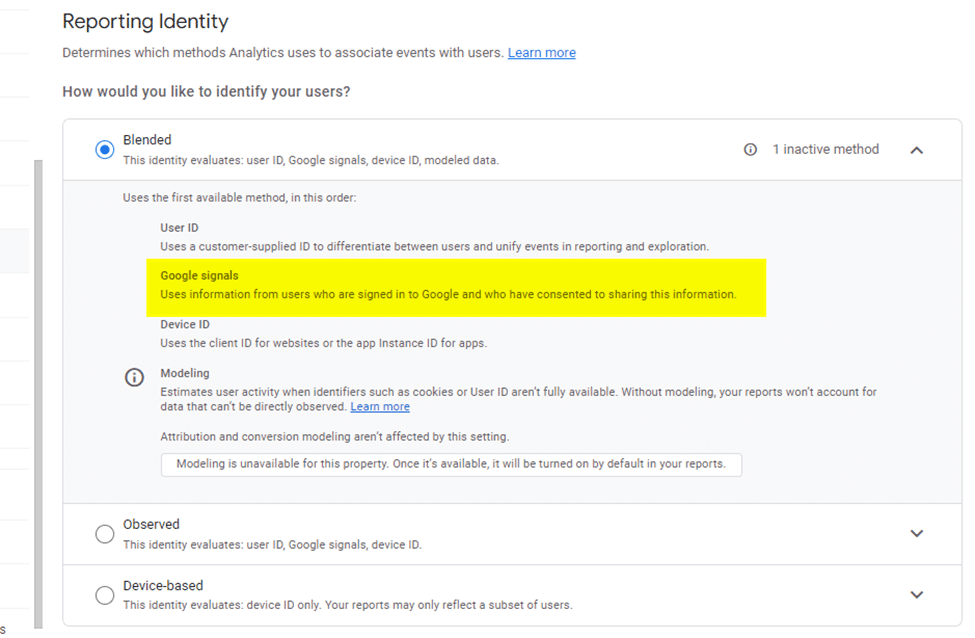
As part of the migration to GA4, website and app privacy policies must be reviewed. For sites that have enabled Google signals as part of the “Reporting Identity” and operate under the legal aspects of GDRP, this review is critical.

Reporting identity - Google signals

Embrace changes in your measurement approach

Once you get past the initial surprise of the new interface and understand why the top five complaints about it are actually positive improvements, you will likely begin to appreciate GA4.

While items are missing from the standard features, there is hope that Google will add these back in a future release. (The annotation tool and ability to save predefined segments from standard reports are missed by users.) 

Although many marketers widely consider the rollout of the GA4 upgrade as “one of the worst ever,” it brings improvements that will likely be embraced by most users within a few months.

The post 5 Google Analytics 4 ‘flaws’ that you can use to your advantage appeared first on Search Engine Land.

Original source: https://searchengineland.com/google-analytics-4-flaws-improvements-429418

Understanding the Financial Advantages of 3PL Warehouse Inventory Management

Home Business Magazine Online

In today’s rapidly evolving commercial environment, businesses must constantly seek out innovative ways to streamline operations and maintain a competitive edge. One such approach lies in leveraging the services of third-party logistics providers (3PLs). In particular, employing 3PLs for warehouse inventory management can offer a host of financial advantages.

3PL Warehouse Inventory

The realm of inventory management with 3PL warehouse services is vast and ripe with opportunities for businesses to tap into. The convenience of having a dedicated team of professionals handle inventory with precision, accuracy, and speed offers peace of mind for businesses. It means they can concentrate on the core areas that need their attention, knowing that their inventory is in capable hands. Moreover, it goes beyond just management—it’s about utilizing resources wisely, making data-driven decisions, and capitalizing on efficiencies that drive financial success. In a world where supply chain disruptions can drastically affect bottom lines, the stability and reliability that 3PL services offer are invaluable assets. As more businesses recognize these financial and operational benefits, the role of 3PLs in inventory management is only set to grow in importance.

Cost-Efficiency and Scalability

3PL warehouse services can provide significant cost savings, one of the most compelling financial benefits.

  1. Reduced Capital Expenditure: Investing in warehouse infrastructure, technology, and staff training can be a substantial financial burden for companies. By using a 3PL warehouse, businesses can reduce these capital expenses, as the 3PL provider takes on the responsibility of maintaining and updating the warehouse infrastructure.
  2. Scalability: With a 3PL, businesses can scale their warehouse space and logistics needs based on demand. This flexibility allows for efficient resource use, avoiding paying for unused space during slower periods and easily expanding capacity during peak seasons.
  3. Operational Cost Savings: 3PLs have specialized knowledge and systems to optimize warehouse operations, leading to decreased operational costs. Efficient inventory management can reduce waste and overstock situations, saving resources and funds.

Risk Mitigation and Enhanced Focus

Utilizing a 3PL warehouse for inventory management can also help mitigate risk and allow businesses to focus on their core competencies, offering long-term financial benefits.

  • Risk Mitigation: Inventory management carries inherent risks, including damage, theft, and obsolescence. 3PL providers have systems in place to minimize these risks, such as advanced security measures and effective inventory rotation strategies. The financial burden associated with these risks is thus transferred to the 3PL.
  • Enhanced Focus: By outsourcing inventory management to a 3PL, businesses can focus on their core operations, like product development, sales, and customer service. This enhanced focus can lead to improved products and services, potentially increasing revenue and profitability.

Investing in Technological Advancements

3PLs typically invest in the latest logistics and inventory management technologies, providing another financial advantage for businesses that use their services.

  • Access to Advanced Technology: With 3PLs, businesses can benefit from cutting-edge warehouse management systems, automation, and data analytics tools without making a significant investment.
  • Improved Accuracy and Efficiency: These technologies can significantly enhance inventory accuracy and operational efficiency, leading to faster order fulfillment, improved customer satisfaction, and ultimately, increased sales.

Strengthening Business Relationships and Increasing Market Reach

Partnering with an experienced 3PL provider can be beneficial in strengthening relationships with suppliers, customers, and other business partners. This advantage often translates to financial gains, contributing to the overall business health.

  • Improved Supplier Relations: A 3PL provider with an established network can negotiate better terms with suppliers, thanks to their volume leverage. These improved relations can lead to cost savings, higher quality service, and potentially advantageous payment terms.
  • Expanded Market Reach: With their extensive logistics networks, 3PLs can facilitate access to markets that might otherwise be challenging or costly to reach. This advantage can lead to increased sales, market share, and revenue growth.

Investing in Sustainability with 3PLs

In the current business environment, sustainability is not only a social responsibility but also a financial strategy. A growing number of consumers prefer to support companies with sustainable practices, and 3PLs can help businesses meet these expectations.

  1. Sustainable Operations: Many 3PLs implement environmentally friendly practices, such as efficient energy use and waste reduction. By leveraging these practices, companies can enhance their sustainability credentials, appealing to a wider customer base.
  2. Cost Savings: Sustainable practices often result in cost savings. For example, efficient energy use and waste reduction can lead to lower operational costs. Similarly, more efficient routing and load optimization can reduce fuel consumption, leading to savings in transportation costs.

In summary, partnering with a 3PL for warehouse inventory management provides numerous financial advantages. From cost efficiency and scalability to risk mitigation, focus enhancement, and access to advanced technology, these services can significantly boost a business’s financial health. Further advantages, such as strengthened business relationships, expanded market reach, and sustainability, reinforce the value of this strategic investment. In the face of growing market complexity and competition, engaging a 3PL can be a key driver for business success.

In Short

The 3PL warehouse inventory management offers multiple financial benefits, from direct cost savings to risk mitigation and increased operational focus. Moreover, these services grant businesses access to advanced technology that can lead to improved efficiency and customer satisfaction, driving increased sales and revenue. Thus, in an increasingly complex and competitive business landscape, investing in 3PL warehouse inventory management can be a strategic move towards achieving financial health and long-term success.

The post Understanding the Financial Advantages of 3PL Warehouse Inventory Management appeared first on Home Business Magazine.

Original source: https://homebusinessmag.com/management/operations/understanding-financial-advantages-3pl-warehouse-inventory-management/

Send a Birthday Sugarwish

Home Business Magazine Online

Are there birthdays coming up for relatives, co-workers, or venders you work with? Are you looking for the right gifts? Then consider sending each the Birthday Sugarwish from Sugarwish.
The Birthday Sugarwish  allows you to send a truly personalized birthday gift of Candy, Popcorn, Cookies (including brand-new Iced Cookie Flavors) or Candles! They’ll enjoy choosing which products they want and picking their favorite flavors. Don’t forget to include one of our special birthday eCards – or you can customize your own!

Birthday Sugarwish Favorites

With the Birthday Sugarwish, your recipients get to choose from Candy, Cookies, Popcorn or Candles and then pick their favorites from that category! The favorites include:
Classic Candies – 90 candy varieties including Birthday Cake Taffy, Jelly Belly’s, Gummy peach rings, Jordan almonds, and Peanut M&Ms.
Tasty Cookies –  Traditional flavors like Chocolate Triple Chip, ooey-gooey Stuffed flavors like Stuffed Birthday Cookie, plus yummy Keto, Gluten-Free and Vegan varieties.
Gourmet Popcorn – Over 50 varieties of freshly popped goodness including Red Velvet, Salt & Vinegar, Loaded Potato, and Cheddar flavors.
Celebratory Candles – Over 25 different scents  to celebrate an occasion, match recipients’ moods,  or just spice up their homes or offices.

Available Sizes

Select from the following sizes:
Mini – $25 offering 2 choices
Small – $35 offering 4 choices
Medium – $46 offering 6 choices
Large – $57 offering 8 choices
X-Large – $79 offering 12 choices

Extras

In addition to the recipients choosing their favorites, the Birthday Sugarwish also includes:
Customizable eCard via text or email
Beautiful gift box
Custom printed gift card
Printed note card with your message
Free U.S. shipping

The post Send a Birthday Sugarwish appeared first on Home Business Magazine.

Original source: https://homebusinessmag.com/businesses/send-a-birthday-sugarwish/