The AI tool explosion in the past year has dramatically impacted digital marketers, especially those in SEO.
Given content creation’s time-consuming and costly nature, marketers have turned to AI for assistance, yielding mixed results
Ethical issues notwithstanding, one question that repeatedly surfaces is, “Can search engines detect my AI content?”
The question is deemed particularly important because if the answer is “no,” it invalidates many other questions about whether and how AI should be used.
A long history of machine-generated content
While the frequency of machine-generated or -assisted content creation is unprecedented, it’s not entirely new and is not always negative.
Breaking stories first is imperative for news websites, and they have long utilized data from various sources, such as stock markets and seismometers, to speed up content creation.
For instance, it’s factually correct to publish a robot article that says:
- “A [magnitude] earthquake was detected in [location, city] at [time]/[date] this morning, the first earthquake since [date of last event]. More news to follow.”
Updates like this are also helpful to the end reader who need to get this information as quickly as possible.
At the other end of the spectrum, we’ve seen many “blackhat” implementations of machine-generated content.
Google has condemned using Markov chains to generate text to low-effort content spinning for many years, under the banner of “automatically generated pages that provide no added value.”
What is particularly interesting, and mostly a point of confusion or a gray area for some, is the meaning of “no added value.”
How can LLMs add value?
The popularity of AI content soared due to the attention garnered by GPTx large language models (LLMs) and the fine-tuned AI chatbot, ChatGPT, which improved conversational interaction.
Without delving into technical details, there are a couple of important points to consider about these tools:
The generated text is based on a probability distribution
- For instance, if you write, “Being an SEO is fun because…,” the LLM is looking at all of the tokens and trying to calculate the next most likely word based on its training set. At a stretch, you can think of it as a really advanced version of your phone’s predictive text.
ChatGPT is a type of generative artificial intelligence
- This means that the output is not predictable. There is a randomized element, and it may respond differently to the same prompt.
When you appreciate these two points, it becomes clear that tools like ChatGPT do not have any traditional knowledge or “know” anything. This shortcoming is the basis for all the errors, or “hallucinations” as they are called.
Numerous documented outputs demonstrate how this approach can generate incorrect results and cause ChatGPT to contradict itself repeatedly.

This raises serious doubts about the consistency of “adding value” with AI-written text, given the possibility of frequent hallucinations.
The root cause lies in how LLMs generate text, which won’t be easily resolved without a new approach.
This is a vital consideration, especially for Your Money, Your Life (YMYL) topics, which can materially harm people’s finances or life if inaccurate.
Major publications like Men’s Health and CNET were caught publishing factually incorrect AI-generated information this year, highlighting the concern.
Publishers are not alone with this issue, as Google has had difficulty reining in its Search Generative Experience (SGE) content with YMYL content.
Despite Google stating it would be careful with generated answers and going as far as to specifically give an example of “won’t show an answer to a question about giving a child Tylenol because it is in the medical space,” the SGE would demonstrably do this by simply asking it the question.
Get the daily newsletter search marketers rely on.
<input type="hidden" name="utmMedium" value="“>
<input type="hidden" name="utmCampaign" value="“>
<input type="hidden" name="utmSource" value="“>
<input type="hidden" name="utmContent" value="“>
<input type="hidden" name="pageLink" value="“>
<input type="hidden" name="ipAddress" value="“>
Processing…Please wait.
function getCookie(cname) {
let name = cname + “=”;
let decodedCookie = decodeURIComponent(document.cookie);
let ca = decodedCookie.split(‘;’);
for(let i = 0; i <ca.length; i++) {
let c = ca[i];
while (c.charAt(0) == ' ') {
c = c.substring(1);
}
if (c.indexOf(name) == 0) {
return c.substring(name.length, c.length);
}
}
return "";
}
document.getElementById('munchkinCookieInline').value = getCookie('_mkto_trk');
Google’s SGE and MUM
It’s clear Google believes there is a place for machine-generated content to answer users’ queries. Google has hinted at this since May 2021, when they announced MUM, their Multitask Unified Model.
One challenge MUM set out to tackle was based on the data that people issue eight queries on average for complex tasks.
In an initial query, the searcher will learn some additional information, prompting related searches and surfacing new webpages to answer those queries.
Google proposed: What if they could take the initial query, anticipate user follow-up questions, and generate the complete answer using their index knowledge?
If it worked, while this approach may be fantastic for the user, it essentially wipes out many “long-tail” or zero-volume keyword strategies that SEOs rely on to get a foothold within the SERPs.
Assuming Google can identify queries suitable for AI-generated answers, many questions could be considered “solved.”
This raises the question…
- Why would Google show a searcher your webpage with a pre-generated answer when they can retain the user within their search ecosystem and generate the answer themselves?
Google has a financial incentive to keep users within its ecosystem. We’ve seen various approaches to achieve this, from featured snippets to letting people search for flights in the SERPs.
Suppose Google considers your generated text does not offer value over and above what it can already provide. In that case, it simply becomes a matter of cost vs. benefit for the search engine.
Can they generate more revenue in the long term by absorbing the expense of generation and making the user wait for an answer versus sending the user quickly and cheaply to a page they know already exists?
Detecting AI content
Along with the explosion of usage of ChatGPT came dozens of “AI content detectors” which allow you to input text content and will output a percentage score – which is where the problem lies.
Although there is some difference in how various detectors label this percentage score, they almost invariably give the same output: the percentage certainty that the entire provided text is AI-generated.
This leads to confusion when the percentage is labeled, for instance, “75% AI / 25% Human.”
Many people will misunderstand this to mean “the text was written 75% by an AI and 25% by a human,” when it means, “I am 75% certain that an AI wrote 100% of this text.”
This misunderstanding has led some to offer advice on how to tweak text input to make it “pass” an AI detector.
For instance, using a double exclamation mark (!!) is a very human characteristic, so adding this to some AI-generated text will result in an AI detector giving a “99%+ human” score.
This is then misinterpreted that you have “fooled” the detector.
But it is an example of the detector working perfectly because the provided passage is no longer 100% generated by AI.
Unfortunately, this misleading conclusion of being able to “fool” AI detectors is also commonly conflated with search engines such as Google not detecting AI content giving website owners a false sense of security.
Google policies and actions on AI content
Google’s statements around AI content have historically been vague enough to give them wiggle room regarding enforcement.
However, updated guidance was published this year in Google Search Central that says explicitly:
“Our focus is on the quality of content, rather than how content is produced.”
Even before this, Google Search Liaison Danny Sullivan jumped in on Twitter conversations to affirm that they “haven’t said AI content is bad.”
Google lists specific examples of how AI can generate helpful content, such as sports scores, weather forecasts, and transcripts.
It’s clear that Google is far more concerned with the output than the means of getting there, doubling down on “to generate content with the primary purpose of manipulating ranking in search results is a violation of our spam policies.”
Combatting SERP manipulation is something Google has many years of experience in, claiming that advances to their systems, such as SpamBrain have made 99% of searches “spam-free”, which would include UGC spam, scraping, cloaking and all various forms of content generation.
Many people have run tests to see how Google reacts to AI content and where they draw the line on quality.
Before the launch of ChatGPT, I created a website of 10,000 pages of content primarily generated by an unsupervised GPT3 model, answering People also ask questions about video games.
With minimal links, the site was quickly indexed and steadily grew, delivering thousands of monthly visitors.
During two Google system updates in 2022, the Helpful Content Update and the later Spam update, Google suddenly and almost completely suppressed the site.
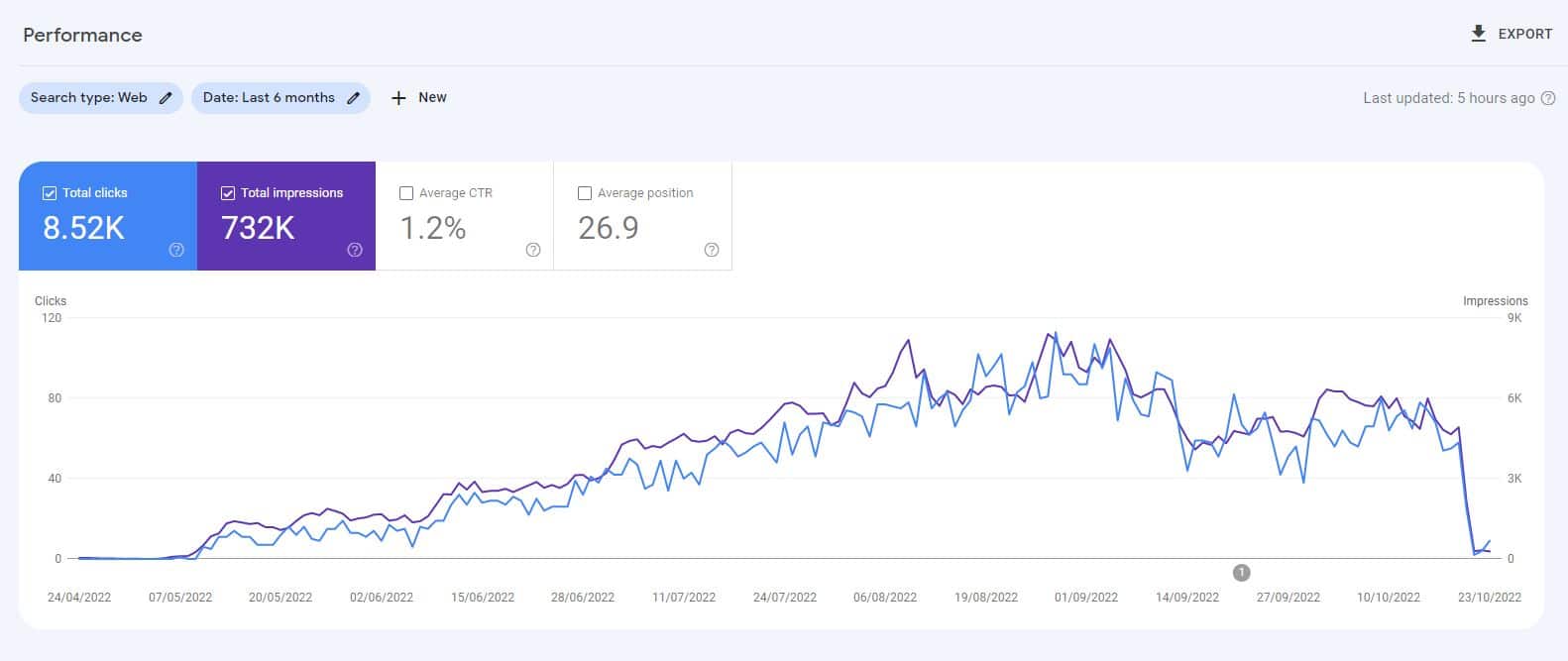
It would be wrong to conclude that “AI content does not work” from such an experiment.
However, this demonstrated to me that at that particular time, Google:
- Was not classifying unsupervised GPT-3 content as “quality.”
- Could detect and remove such results with a raft of other signals.
To get the ultimate answer, you need a better question
Based on Google’s guidelines, what we know about search systems, SEO experiments, and common sense, “Can search engines detect AI content?” is likely the wrong question.
At best, it is a very short-term view to take.
In most topics, LLMs struggle to consistently produce “high-quality” content in terms of factual accuracy and meeting Google’s E-E-A-T criteria, despite having live web access for information beyond their training data.
AI is making significant strides in generating answers for previously content-scarce queries. But as Google aims for loftier long-term goals with SGE, this trend may fade.
The focus is expected to return to longer-form expert content, with Google’s Knowledge systems providing answers to cater to many longtail queries instead of directing users to numerous small sites.
The post Can search engines detect AI content? appeared first on Search Engine Land.
Original source: https://searchengineland.com/can-search-engines-detect-ai-content-430215
This information is critically needed, thanks.
I love what you’ve created here, this is definitely one of my favorite sites to visit.
I think it is a nice point of view. I most often meet people who rather say what they suppose others want to hear. Good and well written! I will come back to your site for sure!
Your resources are well developed.
Hi, do have a e-newsletter? In the event you don’t definately should get on that piece…this web site is pure gold!
I appreciate your work, thanks for all the great blog posts.
Good job for bringing something important to the internet!
I think other website proprietors should take this web site as an model, very clean and great user pleasant style and design .
Thanks pertaining to discussing the following superb written content on your site. I ran into it on the search engines. I will check back again if you publish extra aricles.
Wow, amazing blog layout! How long have you been blogging for? you make blogging look easy. The overall look of your site is wonderful, let alone the content!
Nice blog here! Also your web site loads up very fast! What host are you using? Can I get your affiliate link to your host? I wish my web site loaded up as fast as yours lol
Thanks so much for this, keep up the good work 🙂
Wow, amazing blog layout! How long have you been blogging for? you made blogging look easy. The overall look of your site is great, as well as the content!
I simply could not leave your site before suggesting that I actually enjoyed the usual info a person supply in your visitors? Is going to be back often to inspect new posts
Public policy is key here, and our states need to develop some strategies – – soon.
Sometimes, the sheer magnitude of the information seems overwhelming.
This is something that will need all of our combined efforts to address.
Simply wish to say the frankness in your article is surprising.
I don’t know if it’s just me or if everybody else experiencing issues with your site. It appears as though some of the written text on your content are running off the screen. Can someone else please provide feedback and let me know if this is happening to them as well? This could be a problem with my web browser because I’ve had this happen before. Appreciate it
Thanks for sharing the information. I found the information very useful. That’s a awesome story you posted. I will come back to scan some more.
Spot on with this write-up, I actually assume this website needs far more consideration. I will in all probability be once more to learn rather more, thanks for that info.
Nice read, I just passed this onto a colleague who was doing some research on that. And he just bought me lunch as I found it for him smile Therefore let me rephrase that: Thank you for lunch!
Hey very cool site!! Man .. Beautiful .. Amazing .. I will bookmark your website and take the feeds also…I’m happy to find so many useful information here in the post, we need develop more strategies in this regard, thanks for sharing. . . . . .
You need to really control the comments listed here
Great blog here! Also your site loads up very fast! What web host are you using? Can I get your affiliate link to your host? I wish my website loaded up as fast as yours lol
Hello this is a wonderful write-up. I’m going to e mail this to my friends. I came on this while searching on yahoo I’ll be sure to come back. thanks for sharing.
I appreciate, cause I found just what I was looking for. You’ve ended my four day long hunt! God Bless you man. Have a great day. Bye -.
This is valuable stuff.In my opinion, if all website owners and bloggers developed their content they way you have, the internet will be a lot more useful than ever before.
The post is absolutely fantastic! Lots of great info and inspiration, both of which we all need! Also like to admire the time and effort you put into your website and detailed info you offer! I will bookmark your website!
Are the issues really as complex as they seem?
Makes sense to me.
Some genuinely choice content on this site, bookmarked .
you may have an ideal blog here! would you prefer to make some invite posts on my blog?
Thank you, I have just been searching for information about this topic for ages and yours is the greatest I’ve discovered till now. But, what about the conclusion? Are you sure about the source?
I like your style!
I’m so happy to read this. This is the type of manual that needs to be given and not the random misinformation that’s at the other blogs. Appreciate your sharing this best doc.
I appreciate your work, thanks for all the great blog posts.
I just couldn’t leave your web site prior to suggesting that I really enjoyed the standard info an individual supply to your guests? Is going to be again continuously in order to inspect new posts
Its like you read my mind! You seem to know a lot about this, like you wrote the book in it or something. I think that you can do with some pics to drive the message home a bit, but other than that, this is wonderful blog. A great read. I’ll certainly be back.
Nice piece of info! May I reference part of this on my blog if I post a backlink to this webpage? Thx.
Magnificent beat ! Can I be your apprentice? Just kidding!
I will share you blog with my sis.
This is valuable stuff.In my opinion, if all website owners and bloggers developed their content they way you have, the internet will be a lot more useful than ever before.
When we look at these issues, we know that they are the key ones for our time.
How do I subscribe to your blog? Thanks for your help.
I was suggested this website by my cousin. I am not sure whether this post is written by him as no one else know such detailed about my difficulty. You are wonderful! Thanks!
I have been surfing online more than three hours today, yet I never found anything that grabbed my interest as much as this piece.
Hello there, You have done an incredible job. I will certainly digg it and personally recommend to my friends. I am sure they will be benefited from this site.
This is something that will need all of our combined efforts to address.
I do not even know how I ended up here, but I thought this post was good. I do not know who you are but certainly you are going to a famous blogger if you are not already 😉 Cheers!
very good post, i certainly love this web site, keep on it
Well, I don’t know if that’s going to work for me, but definitely worked for you! 🙂 Excellent post!
Nice to meet you! We are a online retailer since 1988. Welcome to Elivera 1988-2023. EliveraGroup sells online natural cosmetics, beauty products, food supplements. We connect people with products and services in new and unexpected ways.
Its just like you read my thoughts! It’s like reading about my family.
Nice blog. Could someone with little experience do it, and add updates without messing it up? Good information on here, very informative.
What i discover troublesome is to find a weblog that may capture me for a minute however your blog is different. Bravo.
Thank you a lot for sharing this with all folks you actually recognize what you’re speaking about! Bookmarked. Please additionally visit my site =). We can have a hyperlink trade contract among us!
Have you always been concerned about these issues?
Greetings, have tried to subscribe to this websites rss feed but I am having a bit of a problem. Can anyone kindly tell me what to do?’
27-го июля был проведён первый тест эффективности [url=http://www.botmasterru.com/product109120/]XRumer 23 StrongAI[/url] (по сравнению с текущей версией XRumer 19.0.18), который показал двадцатикратный прирост. Столь впечатляющие результаты достигнуты благодаря многократному улучшению пробиваемости уже известных платформ, добавлению поддержки новых платформ, обучению сотням тысяч типов новых тексткапч, внедрению нового GPT-модуля, и множеству других улучшений. По ссылке ниже Вы сможете изучить и скачать детали теста (исходная база, кусок отчёта, статистику и другие подробности)
Спасибо за рефку:
http://www.botmasterru.com/product109120/
sandyterrace.com
Xu 가족이 그의 생일을 축하하기 위해 Daoist Hongfa를 초대하지 않았습니까?