New Orleans – The Soft Ground Dilemma and the Need for Foundation Repair

Home Business Magazine Online

New Orleans, with its rich history, vibrant culture, and unique architecture, is a city that stands out in the American landscape. However, beneath its picturesque streets and historic homes lies a challenge that many homeowners face: the soft ground. This geological characteristic has made foundation repair a common necessity for many homes in the area, often soon after they are built.

The Soft Ground Issue

The ground beneath New Orleans is a complex mix of clay, silt, and organic matter, which has been deposited over thousands of years by the Mississippi River. This soft and compressible soil is prone to settling and shifting, especially when subjected to the weight of a building. As a result, many homes in the city experience foundation problems soon after construction.

Several factors contribute to this:

  • Water Content: The high water table in New Orleans means that the soil is often saturated. This can lead to soil expansion and contraction, which can destabilize foundations.
  • Organic Decay: The organic matter in the soil can decay over time, leading to soil compaction and settlement.
  • External Factors: Events like heavy rainfall, flooding, or nearby construction can exacerbate soil movement and increase the risk of foundation issues.

The Impact on Homes

Foundation settlement can manifest in various ways:

  • Cracks in walls or ceilings
  • Uneven or sloping floors
  • Doors and windows that stick or don’t close properly
  • Gaps between the walls and the floor or ceiling

These issues are not just cosmetic. If left unaddressed, they can lead to more severe structural problems, compromising the safety and value of the home.

The Solution: Foundation Repair and Academy House Leveling

Given the prevalence of foundation issues in New Orleans, homeowners need reliable solutions. This is where companies like Academy House Leveling come into play. Recognizing the unique challenges posed by the city’s soft ground, they offer specialized foundation repair services tailored to the needs of New Orleans homes.

One of the standout features of Academy House Leveling is their commitment to quality and longevity. They offer lifetime warranties on all foundation repair work, giving homeowners peace of mind that their investment is protected. This warranty is a testament to the company’s confidence in its workmanship and the durability of its repairs.

While the soft ground of New Orleans poses challenges for homeowners, solutions are available. With the expertise of companies like Academy House Leveling, residents can ensure the stability and longevity of their homes. A lifetime warranty is more than just a guarantee; it’s a promise of quality and a commitment to the safety and satisfaction of homeowners in this iconic city.

The post New Orleans – The Soft Ground Dilemma and the Need for Foundation Repair appeared first on Home Business Magazine.

Original source: https://homebusinessmag.com/lifestyles/home-improvement/new-orleans-soft-ground-dilemma-need-foundation-repair/

4 top affiliate search partners to consider: A breakdown

Q4 is looming, and many brands are strategizing how to optimize their budgets to get more traffic to their products when buyer intent soars. 

One humble suggestion from this longtime affiliate marketer: TM+ partners (also known as Trademark+ partners or affiliate search partners), who work with brands to bid on brand keywords to drive traffic to coupon or offer sites.

Despite what you may have heard, TM+ models are a no-risk model – the affiliate site pays for the click and gets paid by the brand when the ads lead to conversions. 

To keep the guidelines clearly delineated, brands should give their affiliate partners a list of keywords approved by the search teams, with any other keywords off-limits to the TM+ partner to ensure both parties aren’t bidding against each other. 

I work with a ton of affiliate search partners, but if you’re just getting your feet wet in this initiative, you should start with a short list of targets who can help you get traction. 

This article covers four major partners – why I recommend them, their unique strengths, and when they might not make sense for your brand.

1. PromoCodesForYou

Brands that give PromoCodesForYou (PCFY) bidding rights to a keyword set have more of a chance to get picked up for organic inclusion in the portfolio of sites in Dotdash Meredith, PCFY’s parent company. 

The portfolio is broad and includes publications like:

  • People
  • Travel + Leisure
  • Allrecipes
  • Food & Wine
  • EatingWell
  • InStyle
  • Shape
  • Better Homes & Gardens

Brands looking for added exposure to complement direct-response coupon campaigns have a potential gold mine with a PCFY partnership.

The flip side is that PCFY won’t work with just any brand (specifically, small, lesser-known ones aren’t going to be a fit here). 

Their sweet spot is well-known brands, and their vetting process includes search volume (pulled from Google Ads) with aggressive volume minimums. 

That said, if search volume is low but the brand offers a relatively high average order value, PCFY may be willing to run a test to see if the partnership has some sparks.

2. Offers.com

A relatively close second, Offers.com is a Ziff Davis company with the potential of added organic exposure on its portfolio of sites, which include:

  • Mashable
  • AskMen
  • PCMag
  • Everyday Health
  • BlackFriday.com
  • BestBlackFriday.com
  • TheBlackFriday.com

(The latter three are obviously great and relevant platforms for the holidays, getting over 60 million global sessions during the holiday season). 

Offers.com isn’t as particular as PCFY about partnerships, so it could be an ideal starting point for small brands looking to build on their momentum. 


Get the daily newsletter search marketers rely on.

<input type="hidden" name="utmMedium" value="“>
<input type="hidden" name="utmCampaign" value="“>
<input type="hidden" name="utmSource" value="“>
<input type="hidden" name="utmContent" value="“>
<input type="hidden" name="pageLink" value="“>
<input type="hidden" name="ipAddress" value="“>

Processing…Please wait.

function getCookie(cname) {
let name = cname + “=”;
let decodedCookie = decodeURIComponent(document.cookie);
let ca = decodedCookie.split(‘;’);
for(let i = 0; i <ca.length; i++) {
let c = ca[i];
while (c.charAt(0) == ' ') {
c = c.substring(1);
}
if (c.indexOf(name) == 0) {
return c.substring(name.length, c.length);
}
}
return "";
}
document.getElementById('munchkinCookieInline').value = getCookie('_mkto_trk');


3. Slickdeals 

This is the deal site that’s most frequently leveraged for clients who have a need for inventory liquidation. 

With 69 million unique monthly visitors and a big consumer footprint during the holidays, Slickdeals is great for pushing heavily discounted products.

Working with the site as a TM+ partner means you’ll likely get comped on individual deal submissions, which you usually have to pay for.

Slickdeals is an ideal partner for brands with seasonal catalogs, which usually means there are inventory remnants to clear out for the next season’s line. 

It’s not solely for low-priced or mid-priced products. I’ve seen a discounted watch that retailed for $6,000 sell out in a matter of minutes, and some of our high-end clients have seasonal products that have found a great audience on Slickdeals. 

But if you’re a brand that’s careful about buying in reasonable quantities and have a limited and/or stable collection of products, you can skip this one and research other partners. 

4. CouponCause

CouponCause is different. Its main selling point is a give-back component that encourages consumers to donate their savings to any of a group of partner nonprofits. 

It’s a great partner for calendar events like Giving Tuesday, and it’s a natural fit for socially conscious brands who have built a name around doing good.

CouponCause is much more flexible with brand partners, so SMBs and startup brands looking to get awareness or increase sales velocity often start here. 

Getting started

If you don’t have relationships with any of these partners, you can go through an affiliate agency (using a recommended vetting process) or dig up a list of contacts at the partner and do the outreach yourself. 

Remember that these are partnerships, so you’ll need to create a compelling case for why the platform will benefit from bidding on your brand and product terms. 

It bears repeating that when you do get traction, it’s a good idea to make sure your search team is in the loop since they may have reservations or caveats for the partner to address (as well as keywords they want to protect).

Managed well, TM+ partnerships are an added source of low-risk revenue and exposure that can help you maximize purchase intent in the coming months. 

Even if you’re not sure you can act in time to catch the Q4 wave, start doing the legwork now – good deals are always in season.

The post 4 top affiliate search partners to consider: A breakdown appeared first on Search Engine Land.

Original source: https://searchengineland.com/top-affiliate-search-partners-breakdown-431502

9 disturbing ways to make money

Not too fussed about whether your cash comes crisp and clean, or slightly dingy and disturbing?

Then your best bet for making a quick buck might be investigating those jobs that the majority of people are not brave enough to do.

Of course, we aren’t talking about illegal or immoral things – just unconventional ways to make money.

Here’s a list of our favourites!


1. Selling feet pictures

Making money by selling feet pictures has become an increasingly popular and profitable venture.

This unique market offers a way to generate income without the need for specialised skills or a large investment. For those interested in tapping into this niche, FeetFinder is the ideal platform to get started.

It provides a specialised marketplace that connects sellers directly with buyers who are specifically looking for feet-related content. The platform’s focus on safety and anonymity ensures that all transactions are secure and confidential. With the ability to set your own prices and a growing, targeted user base, FeetFinder elevates the earning potential, making it the go-to platform for this unconventional yet lucrative business.


2. Roadkill cleaners

Dead hedgehog at side of road

There are few things you can count on when embarking on a motorway journey, but two are certain. The traffic will be terrible, and you will have to do some serious swerving to avoid roadkill.

Yes, roadkill is a real problem and animal collisions happen far more often that we would like to admit. The reason that they’re not more noticeable is because it’s someone’s job to clear up the carcasses.

Roadkill collectors find, remove and dispose of the motorway’s unlucky victims and provide a service to the more squeamish among us. Namely, dealing with the tragedies of dead badgers, deer and even dogs.

While roadkill collectors in the UK are unlikely to find a moose or a bison on the side of the road as in the US, they do have to enjoy driving as they spend the majority of their days combing roads for collisions.

While some cleaners are paid per hour they work, others are paid per animal removed.

In Farnham, 2016, the role of a roadkill cleaner was advertised at £7 an hour (it would obviously pay more now), with the proviso that the successful applicant would be able to work in all weather conditions and have a strong stomach.

Look on the bright side: at least you won’t be competing with many people for the job!


3. Google Sensitive content checker

Shocked/Upset young woman looking at something on a laptop

The internet is a minefield and no one knows that better than a Google Sensitive content checker. They spend their working hours trawling through disturbing YouTube videos and blocking the worst from being seen on social media.

Responding to complaints about disturbing content ranging from pornography to extreme violence, content checkers are tasked with removing the material within 24 hours and reporting it to government authorities.

Writing on Buzzfeed.com, one former content checker revealed that he was reviewing over 15,000 images a day from Google platforms including Google Images.

Working at Google for over nine months without any kind of psychological or emotional support, this anonymous techie asserts that he needed to search out serious therapy before he could continue. Even then, Google made him redundant.

This highlighted the need for proper mental health and technical support for those doing such jobs.

It might be worth remembering that your mental well-being is priceless before considering this kind of dirty work.


4. Selling your body

Woman cutting her ponytail off

Having read the above heading, you may be wondering how much you could get for a kidney or a lung. I’m sorry to break it to you, but that kind of thing is not only disturbing, but illegal and also seriously dangerous!

This doesn’t mean you can’t make money selling your body! Here are a few totally legal and potentially lucrative body shop ideas:

Companies such as HairHarvest will pay up to £200 for your flowing locks. WigsUK pay by the ounce, offering between £3-£5 depending on how long your hair is.

It sounds slightly strange, but in 2012 mothers were selling their breast milk at £1 an ounce on Facebook!

Don’t mind a needle? Then trials4us offers £60 per 600 ml of blood (or pay at a proportionate rate). They even cover travel expenses!

Clinics around the UK will also offer money in return for sperm and egg donations and in some places, it also pays well to be a surrogate mother.

While the money might seem nice at first, remember that such work could have potentially life changing consequences so don’t make the decision lightly. Read on here to find out more.


5. Clinical trials

Docotor giving young woman medication

Don’t mind going further than a little haircut for some money? Then look into clinical trials and you can get paid £100 per day for your trouble!

One of the most difficult parts of the process is finding a clinical trial to take part in. What you can do is ask your doctor or a patient organisation if they know of any clinical trials that you may be eligible to join. You can also sign up to some websites such as:

  • UK Clinical Trials Gateway
  • WHO International Clinical Trials
  • Cancer Research UK
  • Multiple Sclerosis Society
  • Parkinson’s UK
  • Arthritis Research UK

Clinical trials are open to those lucky enough to be in full health, and those suffering from a particular disease.

They can actually be a great way to contribute to medical research, and if you take part in one that addresses your particular condition, you could also benefit from a cutting edge new treatment. It doesn’t always have to be disturbing!

However, there is the risk that the treatment can be no different to the standard treatment you normally receive.

It’s also important to remember that clinical trials may be very time consuming. They may also require you to restrict certain aspects of your lifestyle such as alcohol consumption.

While a 13-day trial may translate into £1,300 in total, it may also mean you have to put your day job on hold.

There is also the risk that the drugs used in a clinical trial will have unexpected side effects, so it is important that you are sure of what the compensation mechanisms are if something does go wrong.

Want to find out more? Click here for NHS advice on clinical trials and here for more details from MoneyMagpie.


6. Headstone cleaning

Woman cleaning gravestone

Don’t mind spending time getting to know some ghosts?

Well, headstone cleaning could be for you. As well as being a unique way to make money, it will give you the chance to help grieving families sustain memories of loved ones.

Although cemeteries do a great job of maintaining their sites, headstone cleaners are still needed because they don’t have time to give every grave the attention it needs.

Headstones are made from a variety of materials which all require different cleaning methods.

Limestone, granite and marble are commonly used but older ones made from sandstone may stump you.

Do a little research, however, and you’ll find that there are lots of specialist tools and detergents available to you.

Once you’ve mastered the basics, you can also always expand your service to include flower planting and placement, watering, repainting and basic landscaping.

You could charge per hour or offer a package with tri-annual upkeep visits.

At The Headstone Cleaning Company, for example, prices for a full professional clean start at £80.00, and their annual care starts at £55.00.

It might not be as disturbing a job as you think!


7. Dog food tester

Bowl of dog biscuits

Ever wondered what dog food actually tastes like?

Okay, you probably haven’t – that would be quite disturbing. Would you think otherwise, though, if I told you you could get paid for it?

Sitting in the comfort of your own home, you would have to open a few tins of dog food a day, smell them and sample them.

As quoted in The Guardian, Phillip Wells, the chief taster for Lily’s Kitchen pet food, said: “Although dogs’ palates are different to ours, taste is an important quality check to ensure each different ingredient is perfectly balanced in just the right way.”

He added: “Trying the food is also a good way to pick up on the nuances of the cooking; this works especially well on the dry kibbles!”

Wells revealed that £20,000 was an average starting salary for an entry level job in his department in 2015, but that £50,000 or more was “easily achievable” for a technical director. Obviously salaries will have risen considerably since then.

While you might turn your nose up at your plate if you were offered dog food for dinner, the Animal Feed Regulations 2010 says that the meat is safe for people to eat. It must be derived from animals passed as fit for human consumption.

You never know, you might find out you like it!


8. Dog poop cleaner

Woman picking up dog mess

“Struggling to find time to clean your garden? Feeling the strain of an injury/health issue? Or maybe you’re just tired of the constant family arguments about whose turn it is, whose pet it is, etc?”

So opens PAWServices page on professional poo scooping.

Offering weekly, fortnightly or monthly deals, this canine-loving company will clean up your garden. They will also sanitise and deodorise the area where pets have been making a mess.

If you love dogs and you like getting down and dirty with nature, then this could be the job for you.

Dog poop is a breeding ground for nasty diseases such as Salmonellosis, and is also a nightmare to clean off the carpet. It is one of those services that will never go out of business.

As reported by the Express in 2014, you can make a killing cleaning up after other people’s pets – Tim Stone, 54, managed to earn an incredible £56,000 a year by charging £28 per month for four visits!


9. Make money mourning

Funding a funeral: understanding the costs

Funerals are horrible affairs in many ways, but they do provide one of the most disturbing ways to make money. You can get paid to show up as a professional mourner.

This might sound weird, but professional mourners – or moirologists to give them their official title – have been in practice for well over 2,000 years.

Sometimes people die without many family members or friends left. In this case, people will pay you to come along as a respectful way of ‘making up the numbers’.

It’s a job that’s not for everyone, you’ll be around people at their lowest moments.

Find out more about making money mourning here. 

Any other ideas about how to make money in a strange or disturbing way? Let us know in the comments section below!

Disclaimer: MoneyMagpie is not a licensed financial advisor and therefore information found here including opinions, commentary, suggestions or strategies are for informational, entertainment or educational purposes only. This should not be considered as financial advice. Anyone thinking of investing should conduct their own due diligence.

The post 9 disturbing ways to make money appeared first on MoneyMagpie.

Original source: https://www.moneymagpie.com/make-money/7-disturbing-ways-to-make-money

Make money from your appearance

Whether you like it or not, our looks take up a lot of our time and energy. Rather than see this as a drain on your finances, why not make money from your appearance instead?

Don’t worry, you don’t have to have ‘model looks’ to be able to make money from your appearance. Although, modelling of course is one of your options!

Read on to find out more, or click on one of the links below to go straight to that section…


Become a hand or foot model

All it takes to be a hand or foot model is blemish-free skin and nail beds.

But you will need to check with specific agencies, such as Hired Hands. Body modelling agencies can also work with bottoms and legs for advertising campaigns with jewellery, accessories or retail brands.

Your body parts need to be well maintained. A paper cut on your finger will mean you won’t get the gig!

Body part modelling also uses models as faces for makeup campaigns, so you can even model your eyes or lips alone.

Selling feet pictures

If this form of making money from your appearance is appealing to you, you could also consider the lucrative niche of selling feet pictures. This unique market offers a chance to earn extra income without compromising your privacy or requiring extensive effort. FeetFinder is the optimal platform for this specialized endeavour. It acts as a secure marketplace, linking sellers with an audience specifically interested in purchasing feet-related content.

The platform prioritises user safety and confidentiality, ensuring a secure transaction process. With the freedom to set your own pricing and a dedicated, growing community of buyers, FeetFinder is the ultimate choice for capitalising on this unconventional revenue stream.

Make money from your appearance in TV and film

Make money as a TV extra

There’s plenty of ways to make money from your appearance in TV and film – and who doesn’t want to see their name in lights?

Become a TV or film ‘extra’

Becoming an extra is remarkably easy. You don’t need any professional training, just a few well-lit photos of yourself, and an idea of your measurements, and you’re good to go.

It’s not always glamorous – you’re often working for long hours, with early call times, and wrapping late – but it can be great fun and a good way to make some extra cash.

Usually as an extra you’ll only be needed for a maximum of a couple of days on each production and work is booked on day-by-day requirements.

You can usually expect to make between £80 and £100 a day, but this can increase if you’re needed to work nights or have any interactions with the main cast.

For more information on becoming an extra click here.

Be a body double

Body doubles are models that act in scenes that actors don’t want to do, like nude scenes.

To be cast as a body double you must share the basic physical attributes of the actor, such as height, weight, body type and hair colour.

If you are interested in being a body double, your first step should be to join an agency who can help you find work. For UK-based roles, GBM Casting is a good starting point.

Become a stunt double

Okay, this one isn’t for everyone and won’t happen overnight. But, if you love an adrenaline rush why not try stunt doubling?

You’ll usually need to apply to the British Stunt Register’s Stunt Grading Scheme. You’ll need qualifications and skills across at least six different sporting areas in four of the following groups:

  • Fighting – martial arts or boxing
  • Falling – trampolining or high diving
  • Riding and driving – horse riding, driving cars or riding motorcycles
  • Agility and strength – gymnastics or rock climbing
  • Water – swimming or sub-aqua

Make money modelling

Make money with your appearance as a model

Modelling is the obvious choice when it comes to making money from your appearance. Don’t be put off by the Victoria Secrets runways, though. You don’t have to be Cara Delevingne to make money from modelling.

For most agencies where good looks are essential, requirements are generally height (for women, the shortest height requirement is around 5’6” and for men it is usually 5’10), slim for catalogue modelling, toned and rubenesque for plus size.

‘Character modelling’ is excellent whatever your size if you have interesting or unique features from being very short to having a lot of tattoos or piercings.

Agencies will state on their website how to contact them. Usually, you fill in an online form with your measurement details and attach a photograph.

Rates vary wildly depending on your experience and the client you are working for, but you can make around £40 an hour.

Unfortunately, the industry is rife with scams, so stay alert. Fake photographers and scouts are always taking advantage of wannabe models. Never agree to pay to get a job!

Do your research and don’t be sucked into any scam agencies or studios. Think their client list is too good to be true? It probably is.


Make money from your appearance as a life drawing model

Make money as a life drawing document

‘Life modelling’ is simple. You get your kit off and pose while artists paint you. You can easily make over £10 an hour doing it – if not more.

Before you jump in, however, you need to consider if it is really for you.

  • You’ll have to be comfortable with people staring intensely at you whilst you’re naked! Sessions tend to go on for about three hours, with a couple of breaks, so you’ll have to be ok holding the same position for a while.

It’s not uncommon to be asked to model with someone of the opposite sex.

If you’re happy with all of this, then your first port of call should be local art colleges and education centres. Also keep an eye out for adverts in shop windows, newspapers and online.

Many are currently running sessions on Zoom, so you’ll be able to pose from your own home.

There’s also a great website – The Arts Model Register – which acts as a sort of unofficial modelling union and features jobs from all over the country.

Make money from your appearance as a social media influencer

This will take some commitment and won’t make you thousands straight away, but it can be a great way to make money from your appearance.

If you have a social media following of 1000+ you could class yourself as a ‘micro influencer’.

From here, you can start reaching out to brands to collaborate on partnerships. Not all brands will pay you, but you should at least get some free samples.

As your following grows and you become more established brands might start reaching out to you directly and offering a larger payment.

Developing a niche helps you gain a following and means brands are more likely to want to work with you. To make money from your appearance you could focus on makeup or fashion perhaps.

Try personal training online

This is the perfect option for anyone that loves to keep themselves fit. Personal training allows you to share this passion with others, while making some cash. Of course, it will be easier to get clients if you’re physically fit yourself.

You MUST be legally registered with an insurance company and be fully qualified to protect yourself from claims.

The National Register of Personal Trainers recommends certain companies that offer personal training qualifications.

It is also worth checking out the Register for Exercise Professionals, which offers qualifications and can equip you with all the tools you need to get started.

Become a celebrity lookalike or impersonator

If your friends are always telling you that you look like a certain celebrity, then this could be the job for you. If not, a bit of makeup and some props could have you looking the spitting image of a celebrity in no time.

You’ll need to get into character and take some pictures first, to make sure you resemble the celebrity and to promote your services.

If you’re serious about getting started, check out the agency Lookalikes. You can contact them and they may then take you on and help you get bookings as a lookalike.

Pay can range from £350 upwards for a day’s work. This will normally depend on your character and how popular they are, but will also be down to your location.

To make the top rates you will need to be a very close likeness to a celebrity and maybe even have some special skills, like being able to sing, too.

More ways to make money

If you’re not confident with your appearance, there are plenty of other ways to make money! One of the best approaches is to invest your spare capital in various ways – it’s a long game, but the payoff is worth it (compared to low interest rate savings accounts).

Disclaimer: MoneyMagpie is not a licensed financial advisor and therefore information found here including opinions, commentary, suggestions or strategies are for informational, entertainment or educational purposes only. This should not be considered as financial advice. Anyone thinking of investing should conduct their own due diligence.

The post Make money from your appearance appeared first on MoneyMagpie.

Original source: https://www.moneymagpie.com/make-money/make-money-from-your-appearance

How to Win More RFPs with Professional RFP Response Management

Home Business Magazine Online

Replying to a proposal request, also known as a RFP, can be a challenge for sales teams. As many requests come with a tight turnaround time, it can feel like a constant struggle to submit one proposal before going to work on the next.

Fortunately, there’s a more efficient way of doing things. By zeroing in on particular aspects of the process, you can work with a more streamlined system and have more time to reply to each RFP. Here are five ways that a professional RFP response management system can help you land more RFPs for your company.

Develop Your Own RFP Response Process

When proposals come forward, you need a consistent way of replying to potential RFPs. If you are not efficient, you risk missing deadlines and costing your company business. Worse yet, you could lose data, find your team stressed out, and constantly feel like you are playing catch up. If all this sounds familiar, take a moment, find the “bugs” in your current workflow and idealize what would make your process easier. Conceptualize what could help your team reply to RFPs and other customer requests in a timely and efficient manner. Doing so will help you identify your next steps forward as a business owner.

Start by writing up a checklist of what should occur when an RFP needs responding to. By considering each item on your checklist and requesting feedback from your team, you can end up with an efficient system for dealing with proposals. This will give you specific expectations from your team: they’ll all know what’s expected to happen in each step of the process, as well as better understand their own specific role within it.

Pick Your Opportunities

If you’re a new company especially, you may wish to reply to every likely RFP. After all, you wouldn’t want to miss a business opportunity. But just hold on for a moment. You shouldn’t attempt to bid for all that comes your way. You’re not the right company for all clients. And should you overbid, you may overwhelm your proposal team.

Instead, qualify the opportunities you have to ensure you’re the right company for your prospects. The reverse should also be true. You don’t want to land business that’s not right for you, as you may overpromise or underdeliver. Yes, you could meet your quota in the short term, but it’s not a great long-term strategy if you have an unhappy client on your hands.

Help Out Your SMEs

Subject matter experts (SMEs) play an important role in your RFP response process. However, working with them can provide a challenge. Proposal workers might find themselves chasing them down for information before a deadline, sending an endless amount of emails to try and get the data they need.

SMEs, however, are busy people. They’re sales engineers, product managers, and so on. It isn’t their job to make proposals. It’s yours. And they might dislike being constantly followed up for different versions of the data they’ve already provided you with. By respecting their time, as well as purchasing tools to help your collaboration with them, you can simplify the process for all involved.

Get Your Institutional Data Together

Every organization possesses an abundance of institutional data. However, that data all too often winds up in silos. These data silos occur when an individual or department has data no one else has. If another member of the organization requires that data, they have to go seek that person out to obtain it.

This doesn’t mean there are people intentionally preventing others from obtaining the data. What it does typically mean is that a department has worked on its own and institutional data has been collected there.

Use Automation

Automation can eliminate some of your team’s more tedious and time-consuming tasks. Not everyone is keen on the idea of automation, as they’re concerned it could put their job in danger. But that’s not what automation achieves, particularly in this context.

For example, you might adopt a solution that automates your content collection process through a content library composed of sales data contributed by your company’s SMEs. Your writers can then look up the data they need, with the software providing them with the best matches.

Data silos aren’t a company’s strength. What is a strength is institutional wisdom. When there are silos present, your company may be unaware that the knowledge even exists within it. Therefore, the data can’t be put to use.

By thinking more about your FRP proposal process, you can develop a system to help your sales team confidently and quickly get through more proposals. You can also use tools to help you write powerful proposals to land you more business.

The post How to Win More RFPs with Professional RFP Response Management appeared first on Home Business Magazine.

Original source: https://homebusinessmag.com/management/how-to-guides-management/how-to-win-more-rfps-professional-rfp-response-management/

Ensuring Controlled Unclassified Information (CUI) Security: The Role of Nist 800-171

Home Business Magazine Online

Compliance with the National Institute of Standards and Technology special publication 800-171 is mandatory for specific organizations in the US. These are organizations that process and store sensitive information for the government. Such institutions include universities, contractors in the defense department, and research institutions. NIST 800-171 aims at guiding non-federal agencies in protecting controlled, unclassified information throughout their business interactions with the government.

If your business handles sensitive government information, you must ensure it meets NIST 800-53 standards. You should create a strong system security plan that governs the handling of critical information. In this article, we delve into understanding the role of NIST 800-171 in providing information security.

Let’s get to it.

What Is NIST 800-171, and Why Does It Matter?

NIST 800-171 is a special publication that offers guidelines on protecting sensitive and unclassified information shared between non-federal entities and the U.S. government. It was published by the National Institute of Standards and Technology in June 2015.

If you are looking for a particular contract from the Department of Defense in the US, then your business must have proof of meeting the NIST 800-171 standards. Failure to meet these standards means the business cannot qualify for the contract. The Department of Defense considers the business not secure enough to deal with sensitive information in the government.

What Is the Role of NIST 800-171?

The main purpose of NIST 800-171 is to enhance the security posture of the federal government’s information system. The framework achieves that through the following:

Security Requirements

NIST 800-171 has 14 security requirement families. The families cover different facets of information security that institutions should adhere to. They include:

  • Authentication,
  • Identification,
  • Audit and accountability,
  • Configuration management,
  • Access control,
  • Incident response,
  • Awareness

The families collectively create a holistic approach that addresses important aspects of cyber security.

Protection of CUI

NIST 800-171 protects controlled unclassified information (CUI) from creation to when and how it is stored to how it is transmitted. After that, it gives guidelines on how the information should be destroyed. It has measures that organizations should follow to ensure unauthorized access, maintain confidentiality, and ensure data integrity.

Basic and Derived Security Requirements

There are two groups of security requirements in NIST 800 -171, basic and derived security requirements. Important security controls to be implemented lie under basic requirements. The following are some of the examples of basic security requirements:

  • Putting strong access control and user authentication processes
  • Ensuring regular updating of software to handle the known vulnerabilities
  • The use of encryption to secure the date that is at rest or in transit
  • Working on security awareness and training programs for the employees
  • Having well-outlined incident response processes and reporting mechanisms

On the other hand, derived requirements offer additional detail that must be tailored to the organization’s risk assessment and needs. They are meant for the unique risks experienced by any organization based on their unique nature of business operations. Examples of these requirements include:

  • Executing specific intrusion awareness and prevention procedures for particular threat vectors
  • implementing physical security measures for locations where sensitive data is stored
  • Using multi-factor authentication to access critical systems
  • Creating mechanisms that help prevent data loss for specific CUI types

System and Security Assessment

The framework ensures that organizations conduct regular system and security control assessments. It helps them take note of any weaknesses and vulnerabilities. That way, these organizations can ascertain that their security measures are up-to-date and effective.

Risk Management

The security publication has great emphasis on the relevance of risk management. It instructs organizations to assess risks and implement effective control measures. They should also monitor their security posture and consistently update it to address emerging threats efficiently.

Security Plan and Documentation

The publication requires that organizations develop a system security plan outlining their security measures. There must be proof of ways in which the measures align with the requirements in the NIST SP 800-171. When organizations document their security policies, practices, and procedures, they abide by the rules of transparency and accountability.

Incident Response

The guidelines in the NIST SP 800-171 recommend that all organizations prioritize incident planning and execution. They should have planned what to do when there is a new security threat. It is about detecting, reporting, and responding effectively to security threats.

Continuous Improvement

The publication advocates for continuous improvement. It requires organizations to continuously learn from every security incident they experience and conduct regular assessments to refine the measures they have put in place to safeguard information over time.

The post Ensuring Controlled Unclassified Information (CUI) Security: The Role of Nist 800-171 appeared first on Home Business Magazine.

Original source: https://homebusinessmag.com/businesses/security/ensuring-controlled-unclassified-information-cui-security-role-nist-800-171/

7 Google Ads features to streamline your workflow

If you’re a PPC manager, you likely spend a significant part of your week working on the Google Ads interface. 

Several built-in features can help you work more efficiently, reducing time to access data and speeding up bulk edits so that you can focus on bigger-picture tasks. 

This article will walk you through some examples and how to access them in the web UI. 

1. Saved views

Previously launched as Workspaces, Views allow you to save a set of filters that will carry over as you navigate between campaigns, ad groups, keywords, and other sections of the UI. 

These differ from just saving filters within the data table, which will reset once you go to a different section. They can be helpful when you have multiple campaigns divided up between lines of business, service lines, or geographies to allow quicker access without having to manually apply filters.

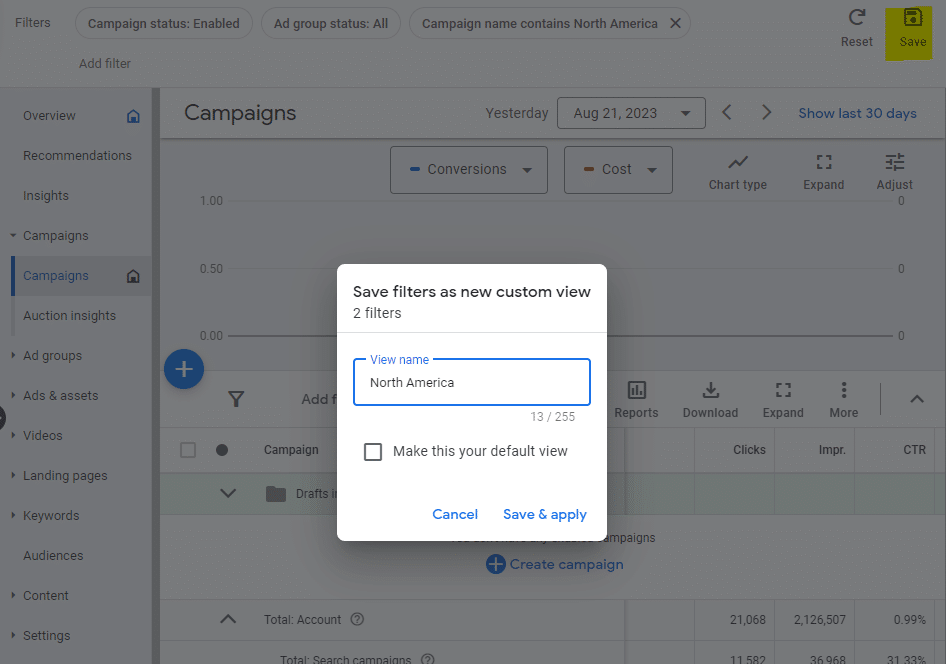
To create a view, apply the filters you’d like from the top bar in the UI and select Save in the upper right. Next, you’ll see a prompt to name and save your view. 

In this example, we’re creating a filter to see all campaigns targeted toward North America. 

Google Ads - Save filters as custom view

In more advanced use cases, you could apply several filters together to narrow down what you’d like to see in a view.

In the future, you can apply saved views by going to the dropdown at the top of the left sidebar, selecting Views from the dropdown, and choosing your desired view to display.

2. Custom columns

With custom columns, you can create unique metrics to view in the UI, allowing for segmenting data beyond what’s available by default or using formulas to define more advanced metrics.

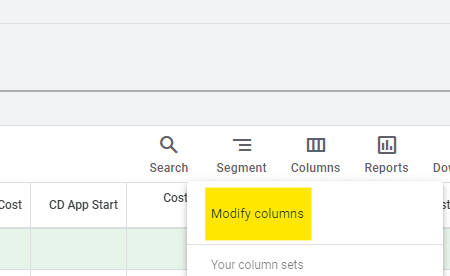
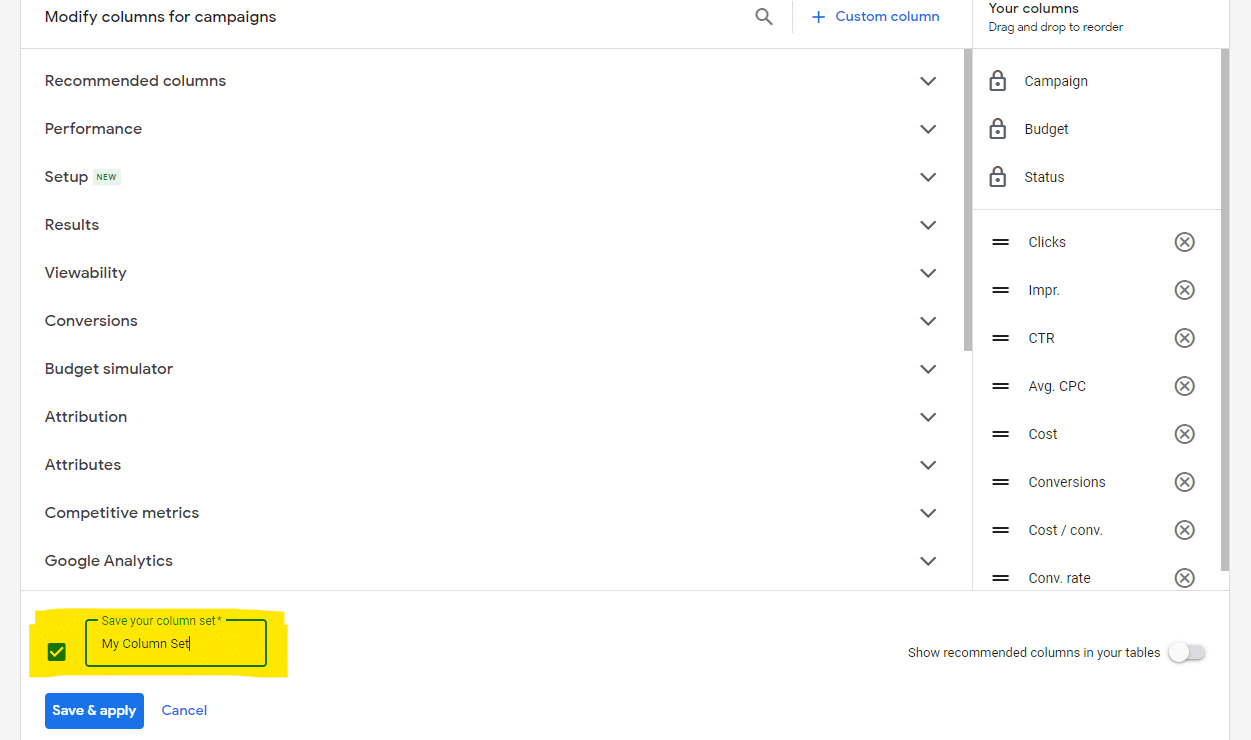
To create a custom column, select the Columns button above the data table in the UI and then choose Modify columns.

Google Ads - Modify columns

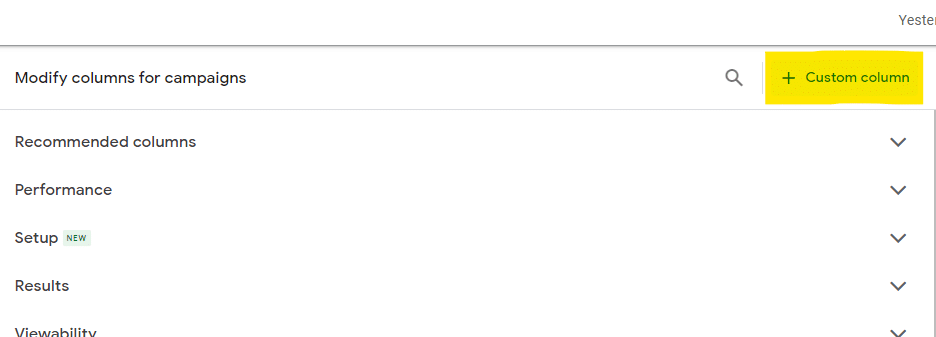
Next, select the + Custom column button in the upper right section of the window that appears.

Google Ads - Add custom column

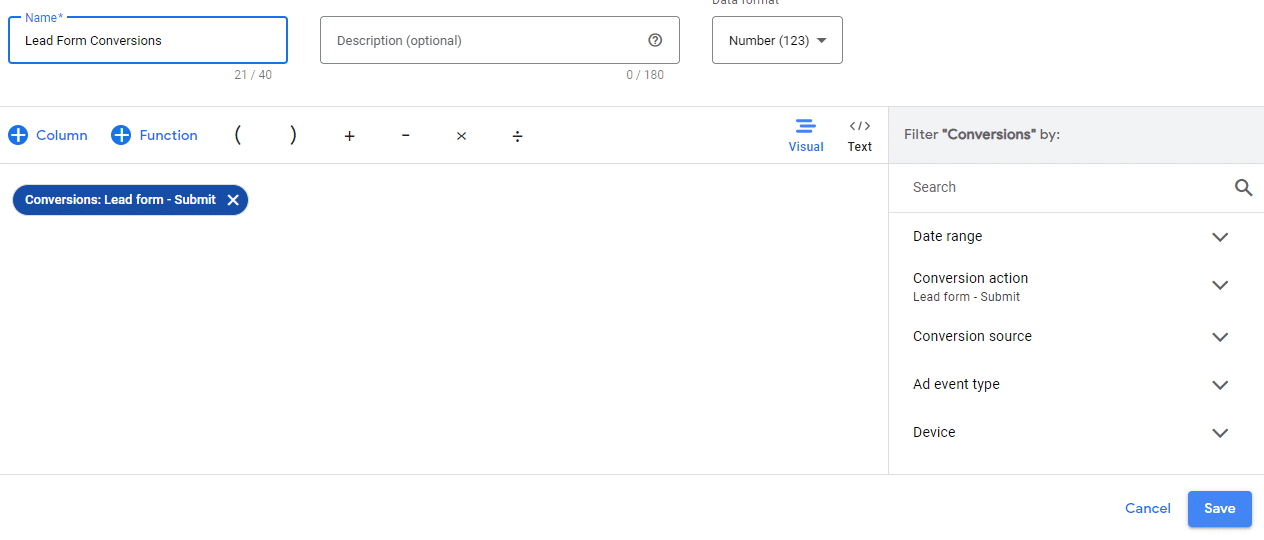
One popular use for custom columns can be to segment to individual conversion actions.

For instance, if you offer both free trial signups and demo registrations, you can create separate columns for each.

To do this, add the Conversions column and then use the right sidebar to filter by Conversion Action to the specific action you’re looking for.

You can even select multiple conversion actions to group together.

Google Ads - Custom column for conversion actions

You can also select Conversion Rate or Cost Per Conversion metrics and filter those to specific actions to see additional metrics narrowed down.

Next, formulas can help to provide more advanced data in the UI. While you can get as complex as you want by incorporating custom logic, there are several more basic formulas to provide useful data. 

For instance, the example below allows you to see the average cost over the past 7-day period vs. the daily budget, allowing you to know how much you’re overspending or underspending. 

Google Ads - Custom column with formula

3. Saved column sets

Often going hand-in-hand with custom columns, you can save a set of columns to quickly view data that’s most relevant to the campaigns you’re reviewing. 

For instance, if you are tracking multiple conversion actions, you can set up a custom column set that breaks out those conversions separately. 

Google Ads - Saved column sets

Saved column sets can also reduce frustration from the sometimes arbitrary default columns that Google Ads chooses to display. 

Once created, you can quickly select a column set from the Columns dropdown instead of manually adding the columns you want each time.


Get the daily newsletter search marketers rely on.

<input type="hidden" name="utmMedium" value="“>
<input type="hidden" name="utmCampaign" value="“>
<input type="hidden" name="utmSource" value="“>
<input type="hidden" name="utmContent" value="“>
<input type="hidden" name="pageLink" value="“>
<input type="hidden" name="ipAddress" value="“>

Processing…Please wait.

function getCookie(cname) {
let name = cname + “=”;
let decodedCookie = decodeURIComponent(document.cookie);
let ca = decodedCookie.split(‘;’);
for(let i = 0; i <ca.length; i++) {
let c = ca[i];
while (c.charAt(0) == ' ') {
c = c.substring(1);
}
if (c.indexOf(name) == 0) {
return c.substring(name.length, c.length);
}
}
return "";
}
document.getElementById('munchkinCookieInline').value = getCookie('_mkto_trk');


4. Policy Manager

If you’ve been managing Google Ads campaigns for some time, you’ve likely run into ad approval issues and had to appeal.

Unfortunately, you don’t receive any notification by default once an appeal is successful, and it’s a pain to have to sift through disapproved and “approved limited” ads in the interface if you are dealing with multiple policy issues simultaneously. 

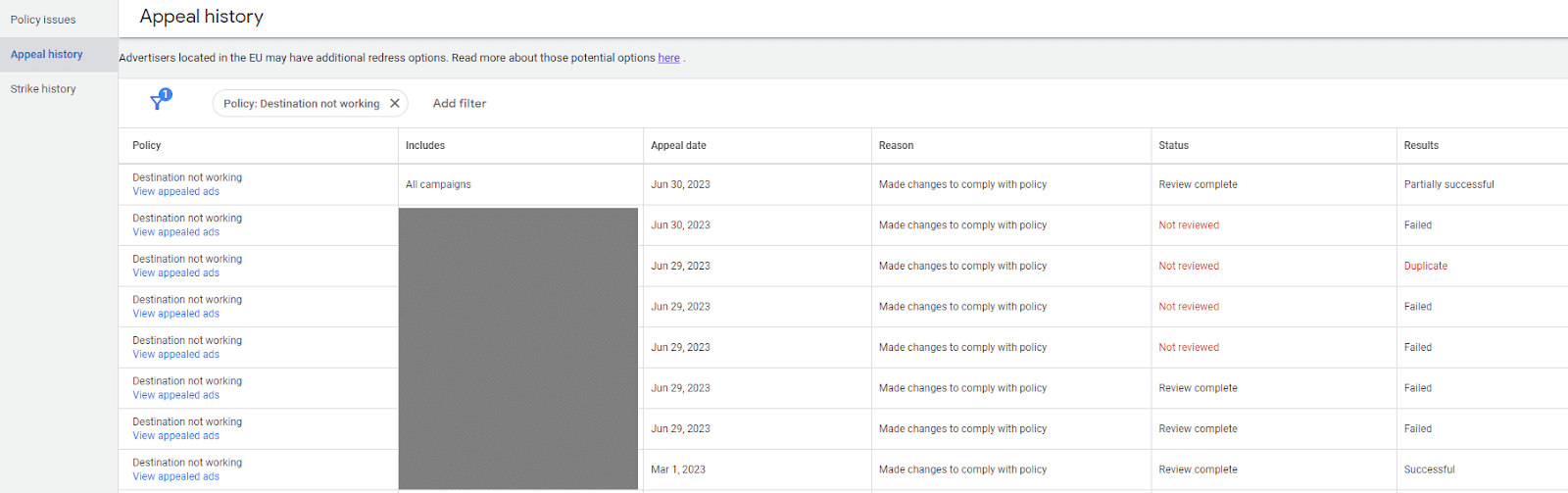
You also want to be careful about appealing the same issue too often, mainly if you’re waiting for a response from the first round of appeals. Thankfully, the Policy Manager offers a centralized place to monitor appeals.

Access this section by navigating to Tools and Settings from the top bar and selecting Policy Manager

On the Policy Issues page, you’ll see a view of current violations, which you can appeal. 

On the Appeal History page, you’ll see the status of appeals you have submitted, including the date and whether it was successful, failed, or is still pending.

Google Ads - Policy Manager

5. Negative keyword and placement exclusion lists

Negative keywords are crucial to control spend and help ensure the relevance of traffic in search campaigns. 

Using negative keyword lists can help you to be able to quickly and efficiently mark unwanted queries across your account instead of having to add them to individual campaigns.

You can create up to 20 negative keyword lists per account. Consider ways to categorize them based on your campaign structure. 

For instance, you may have a catch-all negative list for obviously junky queries that you want to exclude across the board and a brand negative list that you only apply to non-brand campaigns. 

Placement exclusion lists operate similarly but for display and video campaigns. You can select placements, including websites, mobile apps, YouTube channels, and YouTube videos.

Both can be accessed from Tools and Settings via the top navigation bar.

6. Automated rules and scripts

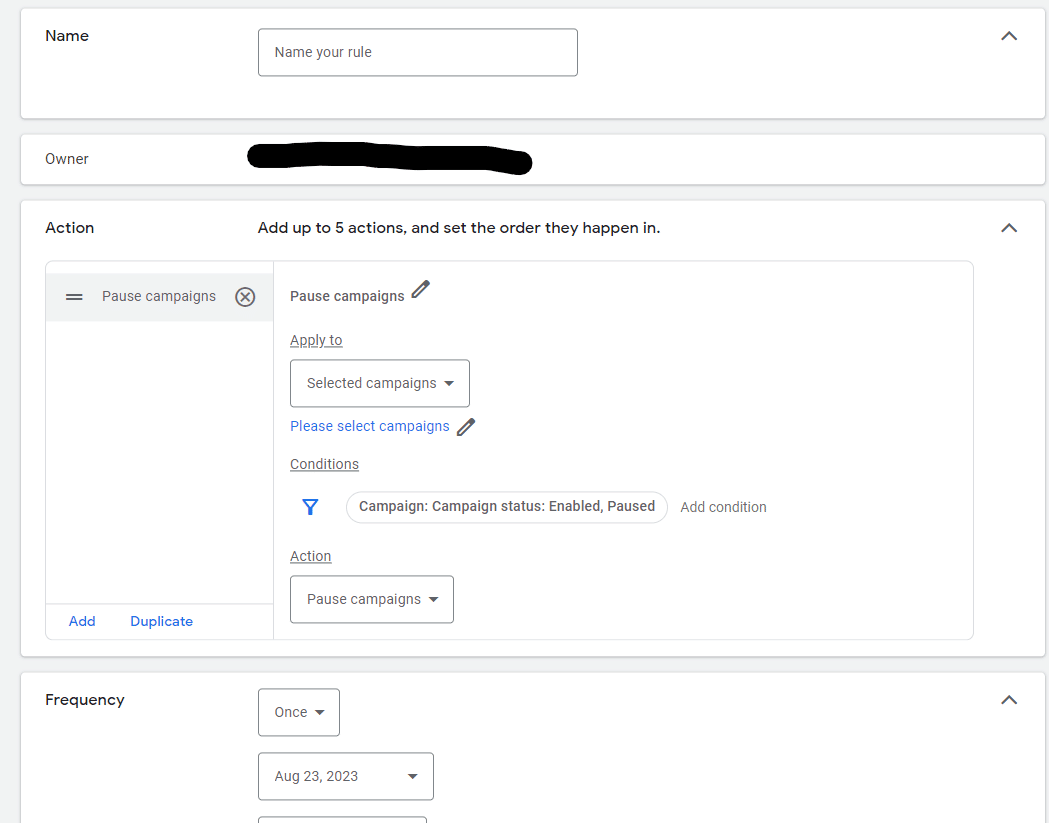
Automated rules are invaluable to set up simple bulk actions and notifications. 

For instance, you may want to automatically pause campaigns over a holiday weekend and re-enable them afterward. 

Google Ads - Automatically pausing campaigns

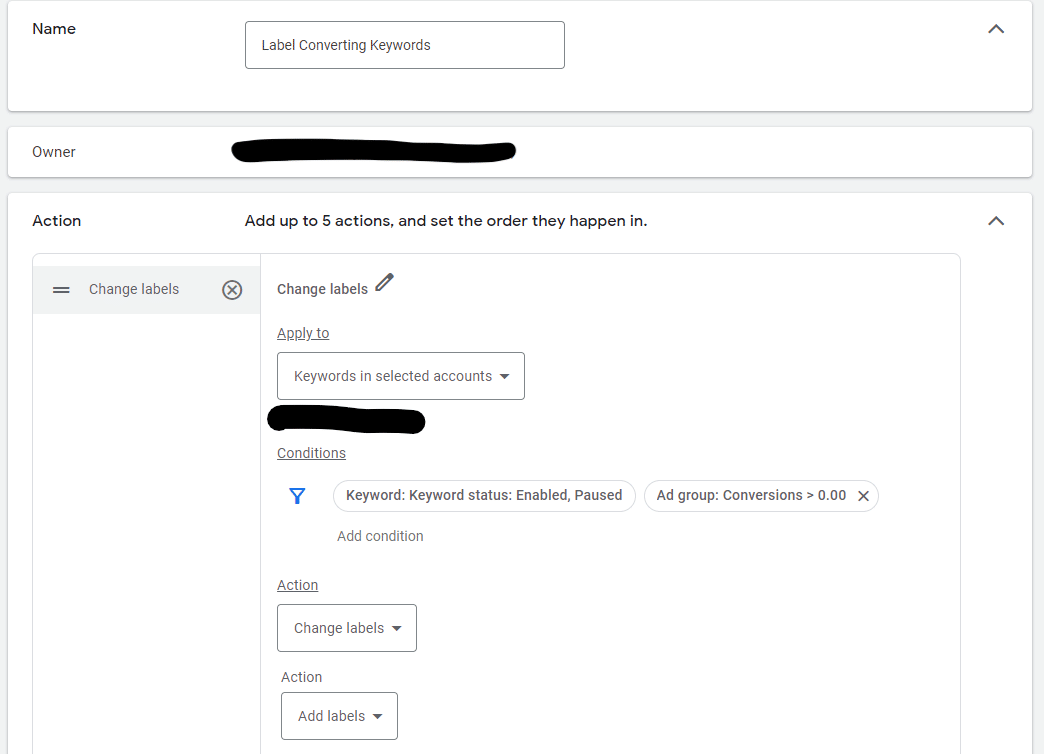
Another use for a rule could be to label keywords once they have received a conversion so you can see which ones have historically converted.

Google Ads - Change labels

You can also use rules to send you notifications, such as when a campaign has spent over $10,000 in a 30-day timeframe.

Google Ads Scripts provides more advanced options for more complex bulk actions and campaign monitoring solutions. 

You don’t necessarily need to know any JavaScript, as many helpful individuals have created ready-to-use scripts that you can copy and paste into the interface. 

7. Asset library

The asset library in Google Ads allows you to see image, video, and text assets you’ve used in ads in one place. Access this section from the Tools and Settings dropdown on the top navigation bar. 

If you’d like to upload images for future use in a responsive display ad, Discovery ad, or image extension, you can add them ahead of time here. 

You can also create folders to organize assets by category and search for individual items.

Additionally, for assets with enough data, you can see top-level audience insights to view those most likely responding.

Start streamlining your Google Ads workflow

We’ve covered several sections of Google Ads that allow you to more easily review custom data, save time accessing reporting, and conduct edits in bulk. 

If you come across features you haven’t tested, take some time to dig into the interface and think about how you could use them for your account. 

  • What custom columns are applicable to your business KPIs? 
  • Are you using negative keyword lists and placement exclusion lists to keep ads from showing up where you don’t want them? 
  • Are there rules that could help you manage campaigns more efficiently or send notifications for anomalies? 

Stay tuned to Google’s support section and announcements, as these features often change in name and location within the UI.

Dig deeper: 5 hidden areas of Google Ads you probably didn’t know about

The post 7 Google Ads features to streamline your workflow appeared first on Search Engine Land.

Original source: https://searchengineland.com/google-ads-features-streamline-workflow-431355

How to avoid decision fatigue in SEO

Decision fatigue refers to the progressive decline in the quality of choices made by an individual, brought on by the sheer volume of decisions one must make. 

Essentially, the brain has a finite reserve of decision-making power, and as one navigates through many choices, this cognitive reserve becomes increasingly depleted. As a result, the quality of decisions made starts to deteriorate.

In SEO, the implications of decision fatigue are particularly salient. SEO professionals are faced with plenty of daily decisions, from selecting the right long-tailed keyphrases to optimize for to dissecting intricate analytics data from websites.

While some of these daily decisions may appear trivial and others vital, it’s crucial to recognize that they all draw from the same cognitive pool. 

The brain isn’t equipped to differentiate between decisions of varying importance. Every choice consumes a portion of your finite decision-making energy.

As this cognitive reserve drains, one becomes increasingly susceptible to judgment, focus and productivity lapses. All outcomes can be particularly detrimental in the specialized field of SEO. 

Consider, for example, the task of diagnosing the reasons for poor website performance. The decisions you make and plans you put in place to make much-needed improvements can be the make-or-break action for that business and its survival.

Beyond the desk

While SEO professionals need to manage decisions in the workplace, it’s important to remember that this doesn’t clock out when you do. 

You’re faced with choices from the moment you wake up to the time you go to sleep. What outfit should you wear? Should you eat Frosted Flakes or Cheerios for breakfast? Should you call your dad on the way to work? 

Though seemingly unimportant, these decisions draw from your finite reserve of decision-making “juice.”

These small choices add up, and before you know it, you may find yourself too mentally drained to make crucial decisions at work or in your personal life. 

Therefore, managing this aspect of your cognitive health can pay dividends in multiple areas of life, including better focus and improved productivity.

Strategies for avoiding decision fatigue

Be more intentional about what decisions you focus on so that you don’t have to worry about the small stuff. 

By adopting the strategies below, you can help preserve your decision-making capability for things that matter.

The power of habit formation

One effective way to manage decision fatigue is to create habits that remove the need in the first place. 

Take, for example, your morning coffee. You don’t deliberate about it; you simply make it because it’s become a daily habit. 

The same goes for actions like brushing your teeth, checking emails or scrolling through Instagram. 

These actions are done almost automatically. You don’t need to think about it. You just do it.

Consider establishing more habits early on in the day whenever possible.

The strength of routine and choice

After forming habits, the next step is to weave them into a routine. A well-structured routine adds predictability to your day, reducing the cognitive load of making decisions.

For instance, if you’ve made it a habit to go for a run in the mornings, include it in your daily routine at a fixed time. 

This removes any deliberation over “if” or “when” to do it. By structuring your day around solid routines, you create a framework that supports automatic behavior.

Another strategy to minimize decision fatigue is to deliberately limit your options. 

A classic example is the wardrobe of many successful people, like Steve Jobs and his iconic black turtleneck.

The power of preparation

Preparation is a pre-emptive strike against decision fatigue. Here are some preparatory measures you can take:

Clothes preparation

Lay out your clothes the night before to avoid the morning dilemma of what to wear. 

This can make your mornings more efficient and leave you less stressed, allowing you to start the day on a strong note.

To-do list preparation

Writing your to-do list the day before can have a similar effect. 

It helps you organize your thoughts and eliminates the need to decide what task to tackle first when you start your workday.

Calendar scheduling and time blocking

Take this one step further by scheduling your calendar in advance and employing time-blocking techniques. Assign specific blocks of time to individual tasks or types of work. 

This method streamlines your decision-making since you only have to follow the pre-established plan, sparing your cognitive load for more significant decisions.


Get the daily newsletter search marketers rely on.

<input type="hidden" name="utmMedium" value="“>
<input type="hidden" name="utmCampaign" value="“>
<input type="hidden" name="utmSource" value="“>
<input type="hidden" name="utmContent" value="“>
<input type="hidden" name="pageLink" value="“>
<input type="hidden" name="ipAddress" value="“>

Processing…Please wait.

function getCookie(cname) {
let name = cname + “=”;
let decodedCookie = decodeURIComponent(document.cookie);
let ca = decodedCookie.split(‘;’);
for(let i = 0; i <ca.length; i++) {
let c = ca[i];
while (c.charAt(0) == ' ') {
c = c.substring(1);
}
if (c.indexOf(name) == 0) {
return c.substring(name.length, c.length);
}
}
return "";
}
document.getElementById('munchkinCookieInline').value = getCookie('_mkto_trk');


Implement systems, processes and SOPs

Having a consistent set of processes, or standard operating procedures (SOPs), can be a lifesaver in the SEO industry. 

It ensures that everyone on the team knows the steps for common tasks, minimizing the number of decisions needed for each project. Automation can also play a significant role in this.

For example, you can use tools that automatically track changes and provide summary updates instead of manually checking keyword rankings. 

Reducing the number of low-level decisions you must make frees up mental energy for more complex strategic decisions.

Prioritize difficult work for high-energy times

One common recommendation for battling decision fatigue is to tackle the most demanding tasks early in the day during your peak energy levels. 

For SEO professionals, this may include complex tasks like strategy planning, running in-depth analytics, or brainstorming content ideas.

As the day progresses, decision fatigue can set in, making it more difficult to focus and make sound judgments. 

Starting with the most challenging work lets you take advantage of your freshest, most decision-capable self.

Incorporate rest periods and varied tasks

Rest is not just about getting adequate sleep. It’s also about giving yourself a break from constant decision-making. 

Don’t jump from one complicated SEO project to another without taking time to recharge. Insert easier, less mentally taxing tasks between your major projects to provide your brain with a respite.

You might opt for more routine tasks like responding to emails, reviewing previously completed work, or updating your task list. This allows your mind to recover, improving your decision-making capability for the next challenging task.

Delegate wisely

Even if you are highly skilled, you can’t – and shouldn’t – make all the decisions yourself. 

Delegate less important decisions to trusted team members to reserve your cognitive load for the decisions that truly require your expertise. 

Empowering your team not only boosts their skills and confidence but also ensures that you are in the best mental state to tackle critical issues.

For example, let junior team members take on tasks like basic keyword research or managing social media updates while you focus on interpreting analytics or developing long-term SEO strategies.

Beating decision fatigue in SEO

The benefits are clear: improved focus, greater productivity, and, most crucially, better decision-making when it matters the most. 

For SEO professionals, where the quality of each decision can directly impact a brand’s visibility and revenue, managing decision fatigue isn’t just advisable – it’s essential.

If you’re in the field of SEO, ignoring decision fatigue is not an option. 

To stay at the top of your game, it’s crucial to understand that it exists and take proactive measures to mitigate its impact.

Doing so will enhance your professional performance and improve the quality of your life outside of work.

The post How to avoid decision fatigue in SEO appeared first on Search Engine Land.

Original source: https://searchengineland.com/decision-fatigue-seo-431418

How Does Live Streaming Work, and What Advantages Does It Have for Your Event? Your Questions Answered

Home Business Magazine Online

In the rapidly evolving landscape of technology, live streaming is emerging as a dynamic tool that has revolutionized the way we all experience different events. Whether it’s a conference, a concert, a webinar, or a product launch, live streaming offers a myriad of advantages that extend far beyond the physical limitations of a venue. But what are the mechanics of live streaming, how does it work, and what are its benefits for your event? Here are the answers to your top questions.

Understanding the mechanics

Live streaming involves broadcasting real-time audio and video content over the internet to a global audience. The process entails capturing the event using cameras and microphones, encoding the data into digital format, and transmitting it to a content delivery network or CDN. The CDN then distributes the content to various servers strategically placed around the world. These servers optimize the delivery to individual viewers, ensuring smooth playback regardless of their geographical location.

The advantages of live streaming your event

1. Global reach and audience engagement

As AV hire, video, and live streaming specialists confirm, live streaming erases geographical boundaries, allowing your event to reach a global audience. Attendees no longer need to be physically present to participate, broadening your event’s impact and fostering engagement with diverse demographics.

2. A cost-effective solution

We are all aware that hosting a physical event involves substantial expenses, including venue rental, travel, accommodation, and logistics. But live streaming significantly reduces these costs while maintaining the potential for widespread audience engagement.

3. Flexibility and convenience

With live streaming, attendees have the flexibility to join the event from their preferred devices – whether it’s a smartphone, tablet, laptop, or desktop computer. This convenience encourages higher attendance rates and provides viewers with the freedom to participate from the comfort of their own spaces.

4. Real-time interaction

Modern live-streaming platforms often feature chat or comment sections, enabling real-time interaction between speakers and viewers. This interactivity bridges the gap between physical and virtual attendance, allowing participants to ask questions, share insights, and engage in discussions.

5. Analytics and data insights

Live streaming platforms often provide analytics tools that offer valuable insights into viewer demographics, engagement levels, and viewing patterns. These data-driven insights can help you tailor your future events to cater to your audience’s preferences.

6. Extended content lifespan

Live-streamed events can be recorded and archived, giving them a longer lifespan beyond the actual broadcast. This means that even those who couldn’t attend in real time can access the content at a later date, enhancing the event’s value and relevance.

Final thoughts

Live streaming has emerged as a powerful tool that transforms the way events are conducted and experienced. Its global reach, cost-effectiveness, convenience, interactivity, and data insights have elevated it to an indispensable part of modern event planning. By harnessing the capabilities of live streaming, event organizers can extend their audience reach, engage participants on a deeper level, and create impactful experiences that transcend geographical limitations. Whether it’s a corporate seminar or a music festival, live streaming brings people together, fostering connections in an increasingly digital world. So, if you’re looking to take your event to the next level, consider embracing the world of live streaming for an unforgettable experience.

The post How Does Live Streaming Work, and What Advantages Does It Have for Your Event? Your Questions Answered appeared first on Home Business Magazine.

Original source: https://homebusinessmag.com/management/technology-management/live-streaming-work-advantages-event-questions-answered/

The Pros and Cons of Utility Deregulation

Home Business Magazine Online

Utility deregulation is a hot-button issue, with strong arguments on both sides. As consumers, we must cut through the noise and understand the potential advantages and disadvantages of this pivotal shift in energy policies. This article aims to demystify utility deregulation and discuss its pros and cons to help consumers better understand this much-debated issue.

Understanding Utility Deregulation

Utility deregulation refers to the process of removing governmental control over energy markets, allowing private companies to compete for consumers’ business. Instead of relying on a single, government-regulated utility provider, energy consumers are free to choose from an array of providers, with each offering different pricing structures, energy sources, and services.

In some states like Texas, this freedom of choice has been implemented through online platforms which aid consumers in finding and comparing energy providers. The Power to Choose Texas initiative is one such example, where residents can explore various energy plans and choose the one that best suits their needs.

The Pros

There are several advantages to utility deregulation that can result in benefits for both consumers and the energy industry as a whole:

  • Competitive Pricing: In a deregulated market, consumers can shop around and select from available energy providers, often leading to competitive pricing based on supply and demand.
  • Innovation: Competition can drive innovation in the energy sector, with providers developing new technologies and services.
  • Efficiency: Deregulation can result in increased overall efficiency as businesses work to streamline processes, reduce costs, and improve customer satisfaction.
  • Customization: Consumers can choose from a variety of service offerings, tailoring energy usage according to personal needs and preferences.

The Cons

However, there are also potential disadvantages that come with utility deregulation. These can include:

  • Market Volatility: Fluctuating prices can be a concern in deregulated markets as supply and demand dictate market rates, which may mean increased prices for consumers during peak demand times.
  • Deregulation Failures: Some deregulation attempts have led to market failures, most notably the 2000-2001 California electricity crisis, which resulted in rolling blackouts and drastically increased energy prices.
  • Consumer Confusion: With a greater number of choices, consumers may find it difficult to make informed decisions regarding energy providers and service offerings.
  • Decreased Reliability: The potential for multiple energy providers operating on an already strained infrastructure could result in increased instances of blackouts and power outages.

Long-term Effects of Utility Deregulation

As utility deregulation continues to evolve, its long-term effects on energy markets and consumers remain uncertain. Deregulated markets are especially susceptible to unforeseen market forces and can be influenced by external factors, such as changes in regional or global energy policies. As a result, it is crucial for governments, regulatory bodies, and energy providers to monitor and adapt to potential shifts in the market.

Utility deregulation may have mixed effects on the adoption of renewable energy. On one hand, consumers may actively seek out providers that offer renewable energy options, thus driving market demand. On the other hand, there’s a risk that traditional energy sources will still dominate the market if they are more economically viable or convenient for providers.

Consumer Perspectives

Consumers play a critical role in the success of utility deregulation. By staying informed about their energy options, advocating for greater transparency within the marketplace, and demanding higher standards from providers, consumers can drive the improvements and innovation necessary for a successful and sustainable deregulated energy market.

Utility deregulation is not unique to the United States. Countries around the world have experimented with various forms of energy market liberalization, with varying degrees of success. As such, a comparative analysis of international case studies can provide valuable insights into the potential risks, benefits, and best practices for deregulated energy markets globally.

Regulatory Oversight

Though utility deregulation aims to reduce governmental control, some level of oversight is still necessary to protect consumers from potential market manipulation and anti-competitive behavior by energy providers. This can be a challenging balance for regulatory bodies to maintain.

Utility deregulation has its potential benefits, such as competitive pricing, increased innovation, and greater efficiency. However, there are legitimate concerns about market volatility, implementation failures, and consumer confusion, among other issues. As consumers, it’s crucial to stay informed about the ever-evolving energy landscape and understand the implications of policies like utility deregulation on our daily lives and energy choices.

The post The Pros and Cons of Utility Deregulation appeared first on Home Business Magazine.

Original source: https://homebusinessmag.com/businesses/go-green/pros-cons-utility-deregulation/