YouTube’s crackdown on ad blockers intensifies

YouTube appears to be ramping up its efforts to crackdown on ad blocks

The platform has reportedly been sending users with ad blockers enabled more aggressive prompts, warning them to either “Allow YouTube ads” or subscribe to YouTube Premium. The notification appears in place of videos or as a pop-up when playing videos on fullscreen.

If the viewer fails to comply, the platform threatens to block video playback after three plays.

Why we care. This is promising news for advertisers in terms of extending your ad’s reach. However, it’s important to consider that pushing ads onto people who have no interest may not yield great results, as they’re less likely to convert into customers.

What does the prompt say? The prompt reads:

  • “Ad blockers violate YouTube’s Terms of Service.”
  • “It looks like you may be using an ad locker. Video playback is blocked unless YouTube is allowlisted or the ad blocker is disabled.:
  • “Ads allow YouTube tp be used by billions worldwide at no charge.:
  • “You can go ad-free with YouTube Premium, and creators still get paid from your subscriptions.:

Here’s a screenshot:

Home Business

Why now? YouTube has said that it is taking more measures against ad blockers to ensure that its content creators are compensated for their work. “YouTube’s ad-supported model supports a diverse ecosystem of creators, and provides billions of people globally access to content for free with ads,” the company said in a statement.

How much is YouTube Premium? YouTube Premium costs $13.99 a month in the US. The price was increased by 17% from $11.99 in June.


Get the daily newsletter search marketers rely on.

<input type="hidden" name="utmMedium" value="“>
<input type="hidden" name="utmCampaign" value="“>
<input type="hidden" name="utmSource" value="“>
<input type="hidden" name="utmContent" value="“>
<input type="hidden" name="pageLink" value="“>
<input type="hidden" name="ipAddress" value="“>

Processing…Please wait.

function getCookie(cname) {
let name = cname + “=”;
let decodedCookie = decodeURIComponent(document.cookie);
let ca = decodedCookie.split(‘;’);
for(let i = 0; i <ca.length; i++) {
let c = ca[i];
while (c.charAt(0) == ' ') {
c = c.substring(1);
}
if (c.indexOf(name) == 0) {
return c.substring(name.length, c.length);
}
}
return "";
}
document.getElementById('munchkinCookieInline').value = getCookie('_mkto_trk');


What has YouTube said? Oluwa Falodun, a spokesperson for Google, previously told The Verge in a statement:

  • “We want to inform viewers thatad blockers violate YouTube’s , and make it easier for them to allow ads on YouTube or try YouTube Premium for an ad free experience.” 
  • “Ad blocker detection is not new, and other publishers regularly ask viewers to disable ad blockers.”
  • “We take disabling playback very seriously, and will only disable playback if viewers ignore repeated requests to allow ads on YouTube.”
  • “In cases when viewers feel they have been falsely flagged as using an ad blocker, they can share this feedback by clicking on the link in the prompt.”

Deep dive. Check out the full discussion on Reddit or read YouTube’s ad policy on the YouTube Advertising hub for more information.

The post YouTube’s crackdown on ad blockers intensifies appeared first on Search Engine Land.

Original source: https://searchengineland.com/youtubes-crackdown-on-ad-blockers-intensifies-432213

Unleash the untapped power of email address intelligence by Cynthia Ramsaran

Home Business

Email is an integral part of our personal and professional lives. We use it to create and log into online accounts, subscribe to new content, communicate across digital platforms and verify our identity. It’s the key to our digital footprint.

But did you know that the intelligence surrounding the simple email address has the potential to fuel more effective data science, improve marketing, increase sales, elevate the customer experience and reinvent analytics initiatives?

Join experts in a live webinar as they dive deep into how you can harness the vast amount of potential surrounding emails to unlock valuable insights, enable personalized marketing campaigns and enhance overall business performance.

Learn more by registering and attending “Unleash the Untapped Power of Email Address Intelligence,” presented by AtData.


Click here to view more Search Engine Land webinars.

The post Unleash the untapped power of email address intelligence appeared first on Search Engine Land.

Original source: https://searchengineland.com/unleash-the-untapped-power-of-email-address-intelligence-432200

How to Choose the Right DevOps Consulting Company

Home Business Magazine Online

DevOps consulting companies can play a vital role in helping organizations adopt and implement DevOps practices. However, with so many different companies to choose from, it can be difficult to know where to start.

In this article, we will discuss the key factors to consider when choosing a DevOps consulting company. We will also provide you with actionable and tested tips on how to evaluate potential partners and make the best decision for your organization.

What to consider when choosing DevOps consulting services

Factor 1: What is the expertise and experience of your DevOps consulting company?

You should partner with a company that has experience and expertise in the DevOps domain. Sounds obvious, but many companies often fail to consider this factor rightly. If the company has many years of experience in Software Development and Quality Assurance services, it doesn’t necessarily mean that they have good DevOps specialists. To make an informed decision, check their DevOps portfolio, discuss the complexity of their projects as well as challenges they encountered along the way. A reputable DevOps company should be able to provide concrete examples of how they managed issues related to automation, continuous delivery and continuous integration.

Don’t forget to ask about the composition of their DevOps department, qualification of their specialists and experience with tools and technologies commonly used in DevOps practices. This information would help you to understand whether the company’s expertise aligns with your project’s needs and requirements.

Factor 2: Does the DevOps consulting company offer customization and flexibility?

Your organization’s DevOps needs might be unique and one-size-fits-all approach might not work well for you. A top-notch DevOps consulting company should understand this and work to customize solutions that align with your distinct requirements. For instance, if your organization primarily operates in a regulated industry like healthcare, the firm should be able to tailor DevOps processes to comply with industry regulations, such as HIPAA in the United States.

Flexibility is equally crucial, as the technology landscape is constantly evolving. A proficient consulting partner should remain adaptable to changes in your organization’s requirements and industry trends. For example, if your organization decides to transition from on-premises infrastructure to the cloud, your chosen partner should be flexible enough to accommodate this shift and adjust your DevOps processes accordingly.

Factor 3: Who are the clients and what is their feedback?

Positive reviews and testimonials indicate that the company has a history of delivering on its promises. Conversely, negative feedback or recurring complaints should raise red flags and prompt you to dig deeper into potential issues.

Consider an example: If a DevOps consulting company has a solid track record in the finance sector and glowing recommendations from financial institutions, it suggests that they possess the skills to handle sensitive data and regulatory requirements effectively.

Furthermore, reaching out to former clients for direct feedback can provide you with candid insights into the consulting firm’s strengths and weaknesses. By asking about their experiences, challenges encountered, and the outcomes achieved, you gain a clearer picture of what to expect from the consulting partnership

How to choose DevOps consulting experts

Step 1. Define your requirements and expectations. Before searching for companies, you should know and understand what you want to achieve with DevOps? Are you looking to improve your speed to market, reduce costs, or improve software quality? Don’t forget to consider your budget. DevOps consulting services can range in price, so it’s important to set a budget before you start your search. Be sure to take into account the cost of services, as well as travel and other expenses. All this will save your time later on.

Step 2. Research, research, research. Just google “DevOps consulting company” and see what you find on the Internet. You will most likely find plenty of different companies to choose from. Select twenty of them that you like the most.

Step 3. Choose the best 5 out of 20. Use the following factors to guide your selection:

  • Years of experience
  • Amount of projects in DevOps domain
  • Amount of DevOps projects in your industry
  • References from previous clients
  • Certifications
  • Experience in automation
  • Size of DevOps department
  • Expertise in different DevOps tools and technologies
  • Cost-optimization offering
  • Monitoring and DevOps metrics
  • Ability to build scalable projects
  • Commitment to continuous learning and improvement
  • Pricing
  • Client-centric approach
  • Flexibility and adaptability
  • Your specific needs and requirements

Step 4. Arrange a meeting with the selected companies. During them discuss in more detail their experience and your project. Get a clear proposal from each company. This should include the scope of work, deliverables, timeline, and cost. You should feel that the company fits you in terms of cooperation, communication and other conditions. Beware of consultants who make promises that sound too good to be true. DevOps is a complex and challenging undertaking, and there is no one-size-fits-all solution. Look for consultants who are honest and realistic about what they can achieve. Based on interviews and proposals, choose the company that fits you the most.

Step 5. Start cooperation and enjoy your choice. If you did everything right, you will reach your DevOps goals and transform your business for the better. However, be ready to face challenges. The projects without problems don’t exist. What matters the most is how your DevOps consulting company faces challenges and finds the right solutions to them.

Comparing the hiring of DevOps consulting with hiring a coach

Think about the following comparison.

Imagine that you’re hiring a coach to help you train for a marathon. You’re interviewing a few candidates, and they’re all telling you the same thing: they’re the best, they’ll get you to the finish line, and they’ll make you a better runner.

But then you meet one coach who tells you something different:

“I can’t guarantee that you’ll finish the marathon,” he says. “But I can guarantee that you’ll be a better runner by the end of our training. You’ll learn how to push yourself harder, you’ll learn how to listen to your body, and you’ll learn how to pace yourself. And if you decide to run the marathon, I’ll be there to support you every step of the way.”

That’s the kind of DevOps consulting company you want to hire. A company that’s honest with you about the challenges ahead, but that’s also committed to helping you succeed.

A company that is not just interested in getting you to the finish line, but also in making you a better runner along the way.

Conclusion

All in all, there is no universal way to find a reliable DevOps consulting company, but following the recommendations mentioned within this article might considerably help.

To sum up, what you need to do is research, choose the pool of companies, and ask them the tough questions, demanding about their experience, their successes, and their failures. Ask about their approach to DevOps and their philosophy. And most importantly, ask yourself if you trust them to help you achieve your goals.

We hope that our article helped you to find a company that will help you take your DevOps journey to the next level.

The post How to Choose the Right DevOps Consulting Company appeared first on Home Business Magazine.

Original source: https://homebusinessmag.com/businesses/how-to-guides-businesses/how-to-choose-right-devops-consulting-company/

The Impact of Globalization on the Virtual Data Room Market and Its Future Prospects

Home Business Magazine Online

Recruitment of foreign talent, multinational corporations, cross-border mergers and acquisitions, digital initial public offerings, remote business operations, virtual data management, and then work-from-home, the 21st century has been the era of globalization. Although globalization can be credited to different factors, it was technology that made it possible for businesses and professionals to explore international markets.

Corporations now find it super easy to ensure digital collaboration between partners, investors, management, and cross-border franchises. They can share or manage unprecedented amounts of data with ease and conduct webinars and online meetings — all thanks to modern-day collaboration tools like virtual data rooms.

Globalization and virtual data rooms

It won’t be wrong to say that it is the technology that has made globalization possible. Otherwise, how would it be possible to connect different business entities operating in different states or countries?

When it comes to globalization in business spheres, virtual dataroom software has played an undeniable role. It has connected businesses and professionals from all parts of the world and made complex business transactions more effortless than ever.

Today, businesses can perform large-scale, international M&A transactions digitally through virtual data rooms. Auditors can access and verify corporate information remotely, and companies can launch their IPOs, while private equities can manage most of their operations through a digital data room.

Here is an introduction to virtual data rooms, VDR market analysis and future prospects, and what type of businesses can benefit from data room technology.

What is a virtual data room?

Virtual or digital data room software is an online document repository with advanced features for data management, digital communication, meeting management, data analysis, and project management.

As data rooms are cloud technology, they are remotely accessible. Businesses use them as virtual workspaces where employees can share or access corporate data and communicate over a single platform. Dealmakers use them as a central platform to connect different parties involved in dealmaking.

“10-15 years ago, nobody would have thought that they would be participating in a merger, acquisition, fundraising, or a real estate transaction from mountains, beaches, and other remote areas. But, thanks to modern-day data room vendors, we have 24/7 access to EVERYTHING happening to our businesses or professions,” says Angleo Dean, CEO of https://datarooms.org/ — an expert community of professionals conducting independent comparisons and reviews of M&A data room providers.

Current trends in virtual data room market and future trends

The global virtual data room market has been valued at $1.48 billion in 2021 and is expected to be a $3.66 billion industry by 2027.

North America (specifically the United States) stands as the biggest, while Asia Pacific is the fastest-growing market for virtual data rooms. The market is divided into four regions — North America, Asia Pacific, Europe, and the rest of the world.

Key players in the data room market include Caplinked, EthosData, Brainloop AG, Intralinks Inc., Ansarada Group Limited, BMC Group Inc., Datasite, iDeals Solutions Group, and Thomson Reuters.

Here are the top trends and prospects in the data room market:

  • More and more businesses are switching to cloud storage technologies as it is one of the best ways to minimize administrative costs. Thus, virtual data rooms are emerging as a top solution for cloud-based data management.
  • Corporations and enterprises are adopting data room technology for intellectual property management, risk management, and asset management. What’s more, data rooms play an important role in regulatory and compliance requirements for businesses operating in different regions.
  • Dealmakers and businesses regularly render data room services for mergers, acquisitions, fundraising, IPOs, joint ventures, strategic partnerships, and private equity acquisitions.
  • The introduction of blockchain-based technologies in virtual data rooms has strengthened security across the IT ecosystem. IT and the telecom sector has started employing data room technology for better communication flow and safer data sharing.
  • Worldwide acceptance of remote working culture has also fueled the need for secure virtual workspaces like data room software. VDRs make sure employees can share, access, and manage data and communicate in a controlled environment.
  • The North American market is mainly pushed by the banking sector, M&A market, and the financial industry for a safe and fast flow of information. These industries are expected to increase the demand for virtual data centers in the years to come.

Businesses that can benefit from virtual data rooms

The above-mentioned factors have played a huge part in data room market growth. What makes VDR technology better than its counterparts is its diversity. That said, a business of any type and size can use data room technology for data management and protection.

For example, the healthcare sector uses data rooms for safeguarding confidential patient data, while pharmaceutical companies use them for clinical trials, biotech licensing, and IPOs/fundraising.

Furthermore, data rooms are regularly used in the legal industry, oil and energy sector, retail businesses, and real estate industry.

Final words

Technologies like virtual data rooms have played a massive role in the globalization of the corporate world. VDR tech simplifies complex dealmaking, streamlines two-way, real-time communication, and makes data sharing safer, faster, and cost-efficient.

Current trends in the virtual data room industry show that the market is dynamic and estimated to grow. This growth is fueled by remote working culture, the introduction of technologies like blockchain and AI, increased reliance on cloud computing, as well as ever-growing popularity of virtual data rooms in industries like healthcare, legal, oil and gas, and real estate.

The post The Impact of Globalization on the Virtual Data Room Market and Its Future Prospects appeared first on Home Business Magazine.

Original source: https://homebusinessmag.com/management/technology-management/impact-globalization-virtual-data-room-market-future-prospects/

8 Mistakes You’re Making Every Time You Need a New Password

Home Business Magazine Online

It’s nearly impossible to try and count how many new passwords you had to make last year. The reason behind this is that you just forget about registering to this random site or e-store, but what if, by doing so, you’ve exposed yourself to malicious online agents?

To stay safe, you must become better at making new passwords.

Sure, the password is not the only thing you need to protect your devices, but it’s a step you can’t move past. With that in mind, here are the top eight mistakes you make every time you need a new password (so you can stop making them).

1. Picking something meaningful

If you pick something meaningful, people will have a much easier job figuring out your password just by thinking about it. Just think about it: all they need to do is figure out the name of your pet, your mom’s maiden name, or your kid’s birthday. Figuring these out is easier than you think.

Also, you need to understand that capitalizing a random letter or adding a random number at the end of your “meaningful” password won’t fix the issue. Random means that it shouldn’t be related to the original concept. It means either something that no one in their right mind would ever imagine could be your password or, even better, a random string of letters, numbers, and symbols.

2. Picking something simple or obvious

Is “123456” a meaningful password? Of course not, but is it a simple one? Yes! Surprisingly enough, it’s so common that the hacker may attempt it even without any tool, just for the sake of it. How common exactly? 23.2 million in the UK apparently use it! Now, what we’re going to say is a bit controversial, but cybersecurity is more than “123456,” if you rely on that, you’ll never be safe.

We understand why people use these simple passwords – they’re lazy or can’t be bothered to create or memorize another unique password. We get that; however, using this excuse is quite disingenuous. After all, if you lay in bed and remembered that you didn’t lock the front door in the middle of the night, would you just go back to bed hoping nothing bad would happen? Of course not! So, why not apply the same principle to cybersecurity?

3. Using the same password as on other platforms

As we’ve already mentioned, people are lazy but are not always aware of the fact. For instance, they may try to develop a great password, but then they’ll believe that this one password is enough, and they’ll use it for every platform.

In theory, this could work. After all, it’s a strong password, which is harder to crack than several weaker ones. The problem is that once it’s cracked, your entire online persona is at risk.

So, it’s not just enough for a password to be strong. Passwords need to be strong and unique. This means you must develop several great passwords, not just be content that you made one. Now, later on, we’ll also discuss why it’s important to change these passwords regularly. If you’re worried about having to come up and memorize dozens of passwords, worry not; we’ll address the solution to this problem in our next segment…

4. Not using tools

Password managers will automate the process from the list, which is just one reason why around a third of people use them. In fact, picking a software which is best for password control is one of the simplest things you can do to boost your online security. You can develop unique, randomized passwords in seconds; you don’t have to memorize or write them down manually, and changing them every 60 days is not that big of a deal.

Most password managers offer a multi-device sync, which means you’re not just protecting the device it’s on but actively protecting your entire online presence. This is one great perk of using password managers that you shouldn’t downplay, even if it’s not your primary objective.

Remember that the majority have a password auditing feature, which means you can apply them retroactively. So, if you habitually set bad passwords in the past, now’s the time to fix this.

5. Using keyboard sequences

Sometimes, you’re making a password that’s so easy to crack, but you’re unaware. This is often the case when using keyboard sequences. Go to the single-player video game you’ve just played and check the name of your last savegame file. Chances are that it’s something like:

  • Asasaada
  • Qwerty
  • Zxcvb

The thing is that these are all natural keyboard sequences that you’re not even aware of using. They’re also incredibly easy to crack. Not only that, but these sequences are something that a hacker might try manually before they entrust it to a cracking tool. Like 123456, qwerty is an incredibly common password, used by 3.8 million people in the UK.

6. Ignoring physical world threats

Writing your password on paper will make it impervious to hackers, which is perhaps why 37% of people do it. But what happens when you lose this piece of paper? What if you have the username or email on this paper (as many people do)? The bottom line is that you can’t ignore these real-world threats.

Then again, losing a piece of paper is not the only potential threat. What if you tell someone who’s not as trustworthy as you assume they are? What if you’re away and can’t log in from your home, so call/text a friend and ask them to log in for you? What if their device doesn’t have an antivirus or an uninstalled keylogger they’re unaware of?

This is like giving a key to your home to someone else. Sure, you may trust them not to be malicious, but can you trust them not to get pickpocketed? How could you?

7. Think that the platform rules are enough

No, password rules are not enough on their own. Sure, a password may insist that you use at least:

  • Eight characters
  • One capital letter
  • One number
  • One symbol

Following that logic, “P@ssword1” would be a great password. However, it’s a terrible password that would be incredibly easy to guess, despite honoring all the rules in the guidelines.

However, this is not the point. The point is that this rule exists to prevent you from taking the path of least resistance. It prevents you from using “password” as your password. It tries to force you to randomize your passwords, but if you’re dead set on not making an effort, you have no one else to blame when your password gets cracked.

Also, sometimes, there will be no rules preventing you from using “password” as a password. This doesn’t mean that it’s ok to make it that easy.

8. Not changing it often enough

You should change your password every 60-90 days. While this is a soft rule and, for the most part, your strong password will remain intact, this is that extra thing you can do to make things secure.

The problem is that it’s a lot of effort. Also, if you have ten accounts (and in practice, you have a lot more), you must change them every 90 days. This would mean you would have at least 40 different passwords yearly. Just think about how hard it is to come up with just one that fulfills all the criteria we’ve discussed earlier.

Fortunately, with the password manager (that we’ve previously discussed), this isn’t that big of a problem.

It doesn’t take more than a minute to come up with a strong password; there’s no excuse

Your password is likely the first and the last line of defense on any platform. Most of the time, people will try to guess it, and if it’s weak enough, they may fail. We’re not even talking about hackers. We’re talking about fake friends, angry exes, and malicious coworkers. At the very least, make it a bit harder.

The post 8 Mistakes You’re Making Every Time You Need a New Password appeared first on Home Business Magazine.

Original source: https://homebusinessmag.com/lifestyles/success-lifestyles/8-mistakes-making-every-time-need-new-password/

Google rolls out automatically created assets to all advertisers

Google has rolled out automatically created assets (ACA) for general availability.

The search engine has also expanded the feature to seven new languages:

  • Dutch
  • French
  • German
  • Italian
  • Japanese
  • Portuguese
  • Spanish

Previously, ACAs were only available for advertisers running campaigns in English in open beta.

What are automatically created assets? Automatically created assets is a campaign-level setting that enhances the relevance of your Search ads by generating custom headlines and descriptions based on your ad’s context.

Why we care. ACAs can boost ad relevance by matching ads and landing pages better, however, it means ceding control to Google’s AI. This might not be suitable for highly regulated industries or brands with strict compliance standards, as you won’t have full control over the ad’s message.

Getting started. To begin using automatically created assets, you have two options:

  • You can opt in from your campaigns’ settings, where you’ll find the relevant setting to enable this feature.
  • Alternatively, keep an eye out for the “Enable automatically created assets” recommendation on the Recommendations page, and simply follow the prompts provided there to get started.

What has Google said? A Google spokesperson said in a statement:

  • “Once enabled, ACAs can improve the Ad Strength of your responsive search ads and show new assets alongside assets you’ve already provided.”
  • “If there are any automatically created assets you’d prefer to stop using, you can remove them from your ads.”
  • “In the coming months, for advertisers with English assets in the US and UK, automatically created assets will start using generative AI to help advertisers create even more assets and make them better tailored to people’s search queries.”

Get the daily newsletter search marketers rely on.

<input type="hidden" name="utmMedium" value="“>
<input type="hidden" name="utmCampaign" value="“>
<input type="hidden" name="utmSource" value="“>
<input type="hidden" name="utmContent" value="“>
<input type="hidden" name="pageLink" value="“>
<input type="hidden" name="ipAddress" value="“>

Processing…Please wait.

function getCookie(cname) {
let name = cname + “=”;
let decodedCookie = decodeURIComponent(document.cookie);
let ca = decodedCookie.split(‘;’);
for(let i = 0; i <ca.length; i++) {
let c = ca[i];
while (c.charAt(0) == ' ') {
c = c.substring(1);
}
if (c.indexOf(name) == 0) {
return c.substring(name.length, c.length);
}
}
return "";
}
document.getElementById('munchkinCookieInline').value = getCookie('_mkto_trk');


Campaign level. Generative AI for ACAs will be implemented at a campaign-level opt-in setting only. It is not available at account level. The advantage here is as you can control which campaigns are powered by AI when testing.

Deep dive. Read Google’s responsive search ad guide for best practices on creating responsive search ads.

The post Google rolls out automatically created assets to all advertisers appeared first on Search Engine Land.

Original source: https://searchengineland.com/google-rolls-out-automatically-created-assets-to-all-advertisers-432224

A guide to multichannel marketing for one-person marketing teams

Being a one-person marketing team can be both exciting and stressful.

You have a high level of control over the company’s creative messaging, which gives you the power to truly launch a brand.

But you’re responsible for building and executing a company’s entire marketing strategy, which can feel overwhelming given the sheer amount of effort it takes to be present in the right places at the right times. 

Whether you’re a solopreneur, the first marketing hire at an early-stage startup, or the sole marketing employee at an emerging business, these tips are for you.

Keep reading to learn how to build a multichannel marketing strategy as a one-person marketing team.

Step 1: Align with executive stakeholders on a business plan

Being efficient as a one-person marketing team is all about precision and scalability.

Adopting an “action first, planning later” mentality may be tempting – especially for early-stage startups – but this approach will only cause more headaches later when you’re forced to make time-consuming changes to a large number of pages or delete entire projects en masse.

You also risk losing revenue if you launch marketing campaigns without understanding your target audience. Your business objectives and the goals you set as milestones toward meeting those objectives will be the north star guiding all your marketing efforts.

Before embarking on your marketing journey, make sure you align with executive stakeholders on these business plan essentials:

  • Mission statement
  • Vision
  • Core values
  • Unique value proposition or selling point
  • Target audience
  • Perceived competitors
  • Business goals and objectives
  • Brand guidelines (including voice and tone)

Step 2: Establish your online presence with your company website

After you’ve outlined your business plan, your next step is to make sure your online presence:

  • Is consistent with your brand guidelines.
  • Speaks to your target audiences.
  • Reflects your brand’s mission, vision, core values and unique value proposition.

Start with the company website.

If you’re just starting out and don’t have the budget to hire a designer, don’t worry about having all the bells and whistles. Many CMS platforms come with built-in templates that can be customized with your brand logo and colors.

The most important part of your website will be the content on its pages. Make sure your site provides an accurate representation of your brand and the products/services you offer.

Your content should speak volumes about your brand or product using as few words as possible. Write in the language of your target audience, not the language you use internally.

Step 3: Identify your audience’s favorite social media platforms and ignore the rest (for now)

As a one-person marketing team, you can’t be everywhere at once no matter how badly you might want to be.

Maintaining an active presence on Facebook, Instagram, TikTok, LinkedIn, X and Pinterest will lead to burnout with minimal results to show for all the additional effort. 

If you haven’t done so as part of your business plan (see step 1), you’ll want to create buyer personas for each of your target audiences and align your marketing efforts to guiding those personas through each stage of their buyer journey.

Identify your personas’ favorite social platforms and focus your efforts only on the platforms with the highest engagement potential.

If your business doesn’t have an established social presence yet, look to your competitors:

  • What channels do they have the most success with, and how do they interact with users on those channels?
  • What are their most successful posts, and what type of content do those posts contain?

Your initial attempts at social media marketing might require a bit of trial and error, but identifying what works and focusing your future efforts on tactics with proven business value will help you grow your following (and revenue) enough to make room for some of your more experimental ideas.

Step 4: Create a multichannel content calendar

Once you have your business’s foundation in place (your website) and have identified your target audience’s favorite social channels, your next step is to scope out your content marketing strategy.

If you’ve ever tried looking for online resources about building a content strategy, you’ve probably read that you should be posting on social media at least once a day every day as a bare minimum.

As a one-person marketing team, posting every day might not be viable, and that’s OK. The key is to post consistently, and to consistently provide value.

Start by posting valuable informational content once or twice a week on the same day(s) each week (finding the best days might require some testing).

A few additional tips for creating a content calendar as a one-person marketing team:

  • Keep a running list of ideas: Maintain a spreadsheet for any content or campaign ideas that may pop into your head throughout the month. On that spreadsheet, add columns for the type of content or campaign you’ll be posting as well as the keyword focus, audience persona, and marketing funnel position the piece of content will be targeting.
  • Adopt a hub and spoke model: Beginning with a few pieces of pillar content (your hub) and expanding on the pillars with related content (your spokes) is a great way to naturally scale a content strategy by providing valuable information related to a topic your audience cares about.
  • Don’t be afraid to reuse content: By human nature, attention is fleeting. The upside to this is that you can repost a piece of evergreen content you wrote three months ago and still gain new engagement. As your content library continues to grow, reposting your most successful pieces of content should become an integral part of your content marketing strategy.
  • Make curated content and integral part of your strategy: Content creation is a full time job in and of itself. As a one-person marketing team, you won’t have the time to consistently write valuable thought leadership. The good news is you don’t need to continuously post your own content to create value for your audience. When done right, curated content can save time, build industry connections, and extend your social reach. (Just don’t forget to give credit to the original creator.)
  • Don’t jump into paid advertising until you have cohesive messaging: Paid advertising is a great way for new businesses to quickly build brand awareness. However, launching an ad campaign with a half-baked landing page or an underdeveloped product runs the risk of leaving users with a bad first impression. Ads may generate brand awareness, but if your brand story or product purpose aren’t clear to new users, you’ll lose money without generating conversions.
  • Leverage your fanbase: Businesses with larger marketing teams or bigger budgets might join an influencer network, but as a one-person marketing team, you’ll probably need to be a bit more creative. Consider asking your current customers to be influencers. Whether you’re a more established brand or an emerging business without a large social following, having real users proselytize about your product will build audience trust and brand awareness.
  • Leverage your coworkers: You may be a one-person marketing team, but expanding your share of voice doesn’t need to be a solo effort. Involve your coworkers from other departments in the process. Have ongoing conversations about what motivates them to do what they do, and make their passions and interests part of your content strategy. Involve them in the sharing process, too. Ask them if they’d be willing to share your posts throughout the week. 
  • Scale your strategy with automation and scheduling: Once you get the ball rolling, invest in a social media management tool like Hootsuite, Buffer, and Loomly. Set aside an hour or two every Friday and schedule your posts for the following week. Create an automated email newsletter and include a few recent pieces of content every month or quarter.
  • Build audience interaction into your strategy: It’s not enough to just post new content on a variety of channels. You’ll also want to set aside time to interact with your followers. Because today’s users expect prompt response times, you should make user interaction a daily practice, even if you only post once or twice a week.

Step 5: Master the art of time management and task prioritization

Ruthlessly prioritizing your time is one of the hardest parts of being a one-person marketing team as you’re often juggling competing demands from different departments.

Yet, expending effort on tasks that don’t clearly align with the business goals you’ve outlined with your executive stakeholders will only lead to problems down the road when you fall behind on your project roadmap.

Organization-wide communication about the tasks you plan to complete, how those tasks will contribute to the business goals, and how long it takes to complete them is vital for operating at peak efficiency.

A few suggestions:

  • Invest in a project management system with built-in time tracking: When you’re just starting out with marketing campaigns and asset creation, gauging how long different tasks take might seem difficult, but continuing to track your time will help you identify trends. You can then block off time to complete these tasks in your calendar and initiate realistic reprioritization discussions with your boss if other projects or emergencies come up that must take precedence over your planned activities. If your company doesn’t have a project management system already, you can start with the free version of ClickUp or Hive.
  • Use hard data to optimize your day: As marketers, we love our data. We optimize our campaigns around it, so why not optimize our days around it? Consider your project management system your virtual assistant, planner, calendar, and to-do list. Obsessively document everything you do and track how long it takes you to do it. At first, this practice may feel counterproductive as it will take time and effort to develop the best system for you, but once you do, you’ll find the time you save by optimizing your day far outweighs the time you spend documenting your tasks. Try to work on your high effort tasks when you have the most energy and save the smaller, less thought-intensive tasks for your low-energy time periods. 
  • Block off “distraction time” each day for conversation and collaboration: Whether it’s a boss who needs frequent status updates or a chatty coworker, encourage anyone who regularly disrupts your workflow to set up regularly recurring meetings with you at a set time and cadence that works with both your schedules. You may need to reinforce your need for uninterrupted “deep work” hours from time to time, but inviting your colleagues to a regular meeting will demonstrate that you care about what they’re saying enough to ensure you can give them your undivided attention. Scheduling regular collaboration meetings is another great way to move projects forward in a more efficient manner.
  • Define what is and isn’t an emergency: If setting up regular meetings with a frequent interruptor isn’t resulting in your desired outcome, your work relationship may be suffering from a miscommunication about what constitutes an emergency. Sit down with the person and come to an agreement on what types of conversations require immediate attention as well as topics and line items that can wait until your next 1:1. If your project requires status updates, come to a mutual agreement on when and how frequently you’ll provide those updates.

Final thoughts

Being a one-person marketing team is an exciting, sometimes stressful opportunity to level up your skill set across a variety of marketing disciplines.

Clear communication and thoughtful planning will make your role feel a lot more manageable.

The post A guide to multichannel marketing for one-person marketing teams appeared first on Search Engine Land.

Original source: https://searchengineland.com/multichannel-marketing-one-person-marketing-teams-431984

Google AdSense adds new tools to make site verification faster and easier

Google AdSense has rolled out two new features to make site ownership verification both faster and easier.

The new site management features are:

  • Real-time site ownership checks: This tool means Google can verify your site ownership in real time whenever you add a new site to AdSense.
  • New site verification method: If you’d rather not display ads on your homepage, this new verification method means you can now just add a meta tag instead of using the AdSense code snippet.

Why we care. Advertisers have previously encountered challenges when attempting to verify site ownership, which not only consumed valuable time but also posed potential financial implications. These new tools are designed to steer you clear of such unnecessary delays, ensuring a smoother process.

Additional improvements. Google AdSense announced that it has also rolled out additional changes to its platform to further help advertisers:

  • Ads.txt improvements: Google AdSense now has a “last crawled data and time” (for example, 17 Aug 2003 16:21) in its “Ads.txt” section, enabling you to see when the platform last checked your ads.txt file. 
  • Check for updates: The platform now features a “Check for updates” button, which allows you to ask AdSense to recheck your ads.txt file.

Get the daily newsletter search marketers rely on.

<input type="hidden" name="utmMedium" value="“>
<input type="hidden" name="utmCampaign" value="“>
<input type="hidden" name="utmSource" value="“>
<input type="hidden" name="utmContent" value="“>
<input type="hidden" name="pageLink" value="“>
<input type="hidden" name="ipAddress" value="“>

Processing…Please wait.

function getCookie(cname) {
let name = cname + “=”;
let decodedCookie = decodeURIComponent(document.cookie);
let ca = decodedCookie.split(‘;’);
for(let i = 0; i <ca.length; i++) {
let c = ca[i];
while (c.charAt(0) == ' ') {
c = c.substring(1);
}
if (c.indexOf(name) == 0) {
return c.substring(name.length, c.length);
}
}
return "";
}
document.getElementById('munchkinCookieInline').value = getCookie('_mkto_trk');


What has Google said? A Google AdSense spokesperson said in a statement:

  • “We’ve made some improvements to site management to make it quicker and easier to verify your site ownership and check your ads.txt status.”

Deep dive. Read Google’s AdSense site list guide or Ads.txt guide for more information.

The post Google AdSense adds new tools to make site verification faster and easier appeared first on Search Engine Land.

Original source: https://searchengineland.com/google-adsense-tools-site-verification-easier-faster-432146

Google quietly increases ad prices to meet targets, claims exec

Google has admitted to quietly tweaking advertising auctions to meet revenue targets.

The search engine “frequently” changes the auctions it uses to sell search ads, increasing the cost of ads and reserve pricing by as much as 5% for the average advertiser.

For some queries, the tech giant may have even raised prices by as much as 10%, according to Google Ad executive, Jerry Dischler at the federal antitrust trial.

Google tends “not to tell advertisers about pricing changes”, he added. 

Why we care. Google’s admission has sent shock waves through the digital marketing community, with some now questioning whether the search engine manipulates Smart Bidding for profit. Digital marketing expert Anthony Higman shared on X:

  • “So I always knew this was the case, but to see it actually stated by the VP of ads is astounding! And what do you think smart bidding is? A smart way for Google to be able to easily manipulate ad prices! SMH.”

Why is Google on trial? Google is on trial for allegedly using underhand tactics to ensure it stays the world’s leading search engine. The U.S. Justice Department claims Google, which owns a 90% market share in search, paid massive sums to companies like Apple to make it the default search engine on products like the iPhone.

What are search ads? Search ads refer to the text and shopping promotions you see displayed at the top of Google’s search results page when users perform queries.

More than 60% of Google’s total revenue is generated by search ads. In 2020, search ads earned the company more than $100 billion, according to Dischler.

Google’s search ad revenue growth has consistently been in the “high teens” since 2012, per documents shown by the Justice Department at the antitrust trial.

Why has Google been tweaking search ad prices? Dischler claimed that staff were “shaking the cushions” to find ways to ensure his team met revenue targets given to Wall Street by Ruth Porat, Google’s Chief Financial Officer. In an email he sent to his team back in May 2019, he wrote:

  • “If we don’t meet quota for the second quarter in a row and we miss the street’s expectations again, which is not what Ruth signalled to the street, so we will get punished pretty bad in the market.”
  • “I care more about revenue than the average person but think we can all agree that for our teams trying to live in high cost areas another $100,000 in stock price loss will not be great for morale, not to mention the huge impact on our sales team.”

When quizzed about this email during the antitrust trial, Dischler said his team’s goal was “to get creative so we could meet our quota.”


Get the daily newsletter search marketers rely on.

<input type="hidden" name="utmMedium" value="“>
<input type="hidden" name="utmCampaign" value="“>
<input type="hidden" name="utmSource" value="“>
<input type="hidden" name="utmContent" value="“>
<input type="hidden" name="pageLink" value="“>
<input type="hidden" name="ipAddress" value="“>

Processing…Please wait.

function getCookie(cname) {
let name = cname + “=”;
let decodedCookie = decodeURIComponent(document.cookie);
let ca = decodedCookie.split(‘;’);
for(let i = 0; i <ca.length; i++) {
let c = ca[i];
while (c.charAt(0) == ' ') {
c = c.substring(1);
}
if (c.indexOf(name) == 0) {
return c.substring(name.length, c.length);
}
}
return "";
}
document.getElementById('munchkinCookieInline').value = getCookie('_mkto_trk');


Why tweaking ad prices matters. If Google can raise ad prices without facing significant competition, it could strengthen the Justice Department’s case that Google holds an illegal monopoly. This is an argument the department can’t use against Google’s search engine itself, as it’s a free product for users. However, they can argue that increased competition could have addressed other issues, such as privacy standards, in the search industry.

Deep dive. Read our Google search antitrust trial updates article for all the latest news from the courtroom.

The post Google quietly increases ad prices to meet targets, claims exec appeared first on Search Engine Land.

Original source: https://searchengineland.com/google-quietly-increases-ad-prices-targets-432155

Microsoft Audience Ads announces new AI bid strategies and market expansion

Microsoft is launching two new automated bid strategies to help “advertisers reach their target audience with minimal effort”:

  • Maximize conversion: Advertisers can use this feature to maximize conversions as much as possible, given the budget.
  • Target CPA: Advertisers can use this feature to maximize conversions as much as possible, given the CPA target and the budget.

The two new offerings are currently in pilot with general roll out planned for October 2023.

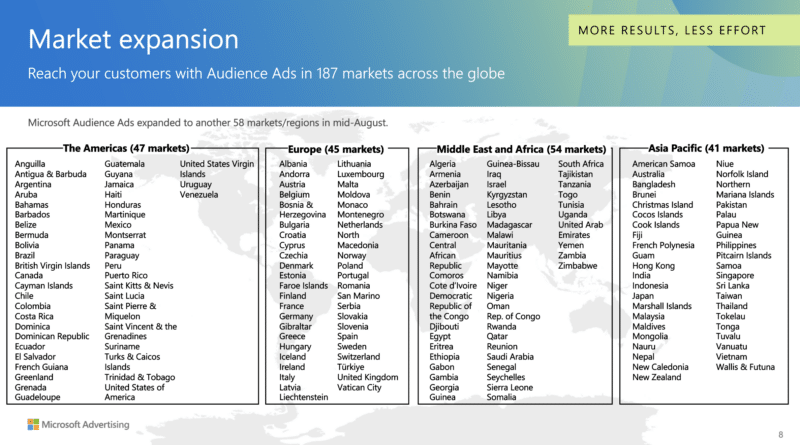
In addition, the tech giant has expanded into 58 new markets, meaning its ads are now served in 187 countries across the globe.

artificial intelligence

Why we care. Automated bidding can save advertisers time and effort, thanks to AI doing the heavy lifting. It takes care of improving your campaign’s performance without you needing to get hands-on. With these particular new bid strategies, you also maintain control as you still have the freedom to set your budget and choose how you want to measure success.

What are Audience Ads? Audience Ads are Microsoft’s native, display ads. These products enable you to target your ideal audience based on Microsoft’s understanding of people’s interests and consumer intent signals. The ads are then served in placements across the web like Microsoft’s MSN, Start, Outlook, and more.

What has Microsoft said? Microsoft Senior Product Marketing Manager Mallory Harwood told Search Engine Land:

  • “We are continuing to invest in more bid strategies for Microsoft Audience Ads to enable advertisers to meet their goals wherever they are across the globe.”
  • “Market expansion has been a huge priority for us across our search and marketing offering. We recently expanded our Audience Ads to 58 new markets, which brings us to 187 countries as of mid August – which is huge and very exciting.”
  • “A couple of years ago, we were only at seven markets – so as you can see, we have been doing a lot of investing very quickly!”

Deep dive. Read Microsoft’s Automated Bidding guidelines for more information.

The post Microsoft Audience Ads announces new AI bid strategies and market expansion appeared first on Search Engine Land.

Original source: https://searchengineland.com/microsoft-audience-ads-automated-bid-strategies-market-expansion-432105