Elon Musk is planning to make X (formerly known as Twitter) a paid-for platform for all users.
In a bid to tackle the issue of rampant bot activity, he unveiled proposals to roll out small monthly subscriptions during a live conversation with Israeli Prime Minister, Benjamin Netanyahu.
Musk did not specify how much the plans would cost or what features would be included at the lowest tier.
However, he did claim that X now has 550 million monthly users that typically post 100 million to 200 million posts a day – although it’s not yet known what proportion of this data is bots versus authentic users.
This marks a 140% increase on the “average monetizable daily active usage” of 229 million reported by Twitter in May 2022, before Musk’s takeover.
Why we care. Transitioning X to a paid platform could be good news for advertisers because it might mean they get a better-quality audience and fewer problems with bots. That could lead to more conversions and a higher ROI. But there’s a downside: some users might ditch X for free alternatives like Threads, which could shrink the platform’s user base and, in turn, reduce the reach of X advertisers.
Get the daily newsletter search marketers rely on.
function getCookie(cname) {
let name = cname + “=”;
let decodedCookie = decodeURIComponent(document.cookie);
let ca = decodedCookie.split(‘;’);
for(let i = 0; i <ca.length; i++) {
let c = ca[i];
while (c.charAt(0) == ' ') {
c = c.substring(1);
}
if (c.indexOf(name) == 0) {
return c.substring(name.length, c.length);
}
}
return "";
}
document.getElementById('munchkinCookieInline').value = getCookie('_mkto_trk');
What has X said? Musk told Prime Minister, Netanyahu:
“The single most important reason that we’re moving to having a small monthly payment for use of the X system is that it’s the only way I can think of to combat vast armies of bots.”
“Because a bot costs a fraction of a penny, or a tenth of a penny, but if somebody even has to pay a few dollars or something, some minor amount, the effective cost of bots is very high, and then you also have to get a new payment method every time you have a new bot.”
“We’re actually going to come out with lower tier pricing. We want it to be just a small amount of money [and] in my view, this is actually the only defense against vast armies of bots.”
Deep dive. Read the X blog for more information about the platform’s latest updates.
Google Ads has launched a new feature to assist advertisers in optimizing their YouTube campaigns
Known as Creative Guidance, this innovative tool is now available through Recommendations and has been integrated into Video Analytics within Google Ads.
Creative Guidance leverages AI to evaluate your content and offer best-practice feedback. For example, if critical information is missing from your video ad, Creative Guidance will notify you, ensuring that your campaigns are as effective as possible.
Why we care. Creative Guidance offers rapid feedback and actionable steps for enhancing video ad performance, ensuring ideal setup and quick optimization to maximize your video ad’s performance.
Creative attributes. Creative guidance can detect if your video ad is missing the following key creative attributes:
Brand logo: Shows a prominent brand logo in the first 5 seconds.
Video duration: Follows the recommended video length based on your marketing objective.
Voice-over: Uses a high-quality, human voice-over.
Aspect ratio: Ad group includes all 3 video orientations, at least (1) horizontal 16:9, (1) vertical 9:16, and (1) square 1:1.
Depending on what’s missing in your video ads, you’ll get suggestions for high-impact improvements as well as links to handy tools that could boost the performance of your campaign.
Google has confirmed that it will be introducing more attributes in the not-too-distant future.
How it works. To access Creative guidance in Google Ads, follow these instructions:
In your Google Ads account, click the Campaigns icon .
Click the Assets drop down in the section menu.
Click “Videos”.
Click the “Analytics” tab next to “Videos”.
Select your video ad in the drop down menu.
In the “Ideas to try” section below the retention curves, you’ll find the creative attributes you’re missing with recommendations on how to take action.
The steps listed above are part of a new Google Ads user experience that is set to launch for all advertisers in 2024.
Get the daily newsletter search marketers rely on.
function getCookie(cname) {
let name = cname + “=”;
let decodedCookie = decodeURIComponent(document.cookie);
let ca = decodedCookie.split(‘;’);
for(let i = 0; i <ca.length; i++) {
let c = ca[i];
while (c.charAt(0) == ' ') {
c = c.substring(1);
}
if (c.indexOf(name) == 0) {
return c.substring(name.length, c.length);
}
}
return "";
}
document.getElementById('munchkinCookieInline').value = getCookie('_mkto_trk');
What has Google said? A spokesperson for Google Ads said in a statement:
“We’ll let you know if your video is missing a best practice. If we have a recommendation or tool to implement a suggestion such as adding a voiceover, we’ll direct you to it.”
“Voiceover has a big impact on YouTube. Thanks to the power of AI, quality voiceovers in 15 languages are accessible directly in Google Ads (both in the asset library and built into the video creation tool) and coming soon to Ads Creative Studio.
“Similarly, if your campaign would benefit from videos in different durations, we’ll guide you to Trim video. Or, if you’re missing a horizontal, square or vertical video, you can easily create one using a variety of high-quality templates.”
“These features empower marketers to take charge of their creative. AI can help turbocharge performance by tuning creative elements across all the different viewing experiences and content that YouTube viewers love.”
The September 2023 Google helpful content update is rolling out as of yesterday at about 4:20 pm ET and while we expect it to continue to roll out for the next two weeks, everyone wants to know what to expect from this update.
Thankfully, Google dropped some clues in its revisions to its search documentation about what has changed with the Google helpful content system.
Let’s dive in.
Improved classifier
When Google announced this update, it mentioned there is an “improved classifier” for the helpful content system. Google wrote, “The September 2023 helpful content update is rolling out with an improved classifier.”
What exactly was improved? That is hard to say but Google did drop more hints.
Hosted third-party content
Google added a new section to its help document on the helpful content update on the topic of hosted third-party content. It reads, “If you host third-party content on your main site or in your subdomains, understand that such content may be included in site-wide signals we generate, such as the helpfulness of content. For this reason, if that content is largely independent of the main site’s purpose or produced without close supervision or the involvement of the primary site, we recommend that it should be blocked from being indexed by Google.”
To be clear, this is not really new advice. In 2019, we reported that Google’s thoughts of hosting third-party content on other sites. “We’ve been asked if third-parties can host content in subdomains or subfolders of another’s domain. It’s not against our guidelines. But as the practice has grown, our systems are being improved to better know when such content is independent of the main site & treat accordingly. Overall, we’d recommend against letting others use subdomains or subfolders with content presented as if it is part of the main site, without close supervision or the involvement of the primary site. Our guidance is if you want the best success with Search, provide value-added content from your own efforts that reflect your own brand.” Google stated in a three-part tweet.
Gary Illyes from the Google Search team added more background on why Google now added this section to the helpful content documentation. “We’ve heard (and also noticed) that some sites “rent out” their subdomains or sometimes even subdirectories to third-parties, typically without any oversight over the content that’s hosted on those new, generally low quality micro-sites that have nothing to do with the parent site. In fact the micro-sites are rarely ever linked from the parent sites, which don’t actually want to endorse these often questionable sites. The only reason the owners of these shady (?) micro-sites rent the sub-spaces is to manipulate search results., he posted on LinkedIn.
Content written by people or machines
Google also removed a few words that clearly reiterated its stance on using AI to help produce content. Google removed the words “written by people” and just wrote “helpful content created for people in search results.”
Here are before and after screenshots:
So humans do not need to fully write the content for that content to be considered helpful according to Google’s helpful content system.
Self-assess your content if hit
If you think this last helpful content update negatively impacted your site, Google said you should self-assess your content. Google added, “If you’re producing helpful content, then you don’t need to do anything; in fact this system may be good for your site, as it is designed to reward helpful content.”
“If you’ve noticed a change in traffic you suspect may be related to this system (such as after a publicly-posted ranking update to the system), then you should self-assess your content and fix or remove any that seems unhelpful,” Google added.
Reviewed by experts
Google updated the creating helpful content document to add “or reviewed” to this line of text “Is this content written or reviewed by an expert or enthusiast who demonstrably knows the topic well?” under the experise questions section.
This again is not new information from Google, Google has been saying it is helpful to have your content reviewed by an expert, if you are not an expert on that topic.
Changing dates of content
One of my personal pet peeves is when sites change the dates or even worse, do not list dates, on their news content. Google added this line “Are you changing the date of pages to make them seem fresh when the content has not substantially changed?” under the avoid creating search engine-first content section.
We see it all the time where sites will make a couple of changes to their content from years ago, update the date, and republish it. This is a common SEO “strategy” that is on Google’s radar.
Adding or removing content for search engines
With the whole CNet debate from a couple of months ago, Google also added this line to that section “Are you adding a lot of new content or removing a lot of older content primarily because you believe it will help your search rankings overall by somehow making your site seem “fresh?” (No, it won’t)”
Be careful when deciding what content to add or remove and think about why are are adding or removing that content.
More to come
In May, Google told us a helpful content system update would be coming this year. Google said this update would enable the helpful content system to “more deeply understand content created from a personal or expert point of view.” Also:
“We’re also improving how we rank results in Search overall, with a greater focus on content with unique expertise and experience,” Google said a few months ago.
But Google said this is not today’s update:
“This work is still continuing and is not part of this particular update. We’ll share more about our work in this area in the future,” Google wrote.
So this is not part of the September 2023 helpful content update.
The H1-B visa program allows companies to sponsor foreign workers who have specialized skills. Especially if you have a job opening that’s hard to fill through the existing labor pool, sponsoring an H1-B applicant is a great way to grow your team. However, there is more to sponsorship than just finding a job opening, getting some applicants, and doing the paperwork. Here is what you need to know about the sponsorship process.
Identifying a Specialty Need
You will need to prove to the government that the work is specialized. Also, the specialized skills inherent to the work must be hard to come by either because of a tight U.S. job market or due to the extreme uniqueness of the job itself. Industries like IT, healthcare, scientific research, academic and engineering employ H1-B visa holders. These tend to be the jobs that appear on the news during reports about tight labor markets.
If you’re unsure whether a job fits the mold, you can compare it to frequently granted applications. H1-B Visas are commonly granted for employees in Information Technology, medical, dental, and educational fields, as well as many other specialized occupations.
Labor Condition Application
Your business will have to document its eligibility to be a sponsor. Likewise, it will have to provide detailed information about the job. You should be prepared to provide financial statements if necessary. Similarly, you will need to provide an assessment of the labor conditions at the business and information about compensation, benefits, complaint processes and prevailing wages in the local area.
Notably, your business must also prove that it isn’t discriminating against U.S. workers. This may include documenting the difficulty your enterprise has had in finding qualified American applicants during previous hiring attempts.
Duration
One of the appealing aspects of the H1-B program is that it has a long duration. The initial grant includes three years of work eligibility for the employee. An additional three-year extension for a total of six years is available, too.
Under special circumstances, the government may grant further extensions in one-year increments. Do note that many H1-B holders will become eligible for green card status before their sponsorship period ends. If you know you have a keeper for your team, your business can be the green card sponsor. This allows the employee to achieve long-term resident alien status or even seek citizenship. Companies that have great track records of helping employees move through the sponsorship system will attract more candidates.
Helping Applicants
A sponsor company can provide significant support to make the process easier for applicants. Many firms offer legal assistance for H1-B applicants. Communicate with the applicant well throughout the process, too. Try to be culturally sensitive, especially if an applicant doesn’t speak English natively. When applicable, provide support for family members who may use dependent visas to come with the applicant to the U.S.
You should also have resources available for the renewal process. Legal support if an extension is delayed or rejected can make a big difference.
If your company requires specialized labor, the H1-B system may be the best way to expand the labor pool. With access to applicants from all over the world, a company can quickly grow its team with qualified and motivated employees.
When you start getting more orders for marketing services than you can fill, it’s time to grow your business. It might even be time to start offering more services.
How? White label SEO agencies allow you to expand your offerings into the SEO space without adding more staff or more office space. With the right white label agency, you can scale up as much as you want and offer your clients low rates on SEO services that you sell to them under your own brand.
Provide More Services Faster, for Less Money
SEO resellers are able to offer their clients fast SEO services at an affordable rate, because white labeling is often a good way to save money. In a number of industries, brands use third-party white label manufacturers to create products they’ll then sell under their label. The manufacturer can use economies of scale to make the products more cheaply without compromising their quality. Customers can get a high-quality product at a lower price. This is done at big box stores, grocery stores, and even at banks, which use white label credit card processors to offer their customers access to credit cards.
A white label SEO agency will likely have more SEO professionals on staff than you can afford to hire. They’ll be able to get more SEO work done faster, so they’ll be able to sell it to you for relatively cheap, compared to the cost of hiring people and providing them with desks, computers, software subscriptions, and office space. You’ll be able to pass that savings onto your client, and they’ll appreciate being able to get access to better SEO services for a more affordable price.
Avoid the Costs of Expansion
Sure, you could hire some SEO staff, move into a bigger office, and start offering your customers SEO services. But SEO resellers avoid the costs of expanding their facilities and taking on new staff. When you think of the tens of thousands you can spend on recruiting and retaining a single staff member, it’s easy to choose a white label SEO provider instead.
SEO reselling makes it possible to grow your business when you don’t have the funds for a big expansion to provide SEO services. Now you can simply sign a contract with a white label SEO agency, and outsource all of your clients’ SEO projects. They’ll never know you didn’t do the work in-house, since you’re selling it under your own brand. You can offer a lot of new services, and you’ll be able to estimate your costs and revenues more easily, too.
Put Your Focus Where It Matters Most
Reselling SEO services doesn’t just save your company money. It saves something even more valuable — time. That’s because your staff will no longer have to worry about doing any SEO work, or about fielding requests from clients curious about SEO work, and explaining why you don’t offer it. If you have some SEO people on staff already, a white label SEO agency can help take some of the load off at busy times or all the time, as necessary.
Your staff will be able to focus more of their time on their own core duties, which is theoretically what they’re best at. They’ll also have more time to put into building client relationships and finding new clients. You won’t expand your client list without putting some work in, and taking SEO services off your company’s plate will help free people up practically and mentally for the important task of bringing in new business.
SEO reselling really couldn’t be easier. You’ll have a contract in place that will outline all the important parts of the relationship, such as the white label license, intellectual property rights, types of deliverables to be produced, and so forth. You’ll give your clients’ orders to the white label agency, and they’ll work together with you to decide what needs doing and what timeline it can be done on. Once you have the finished deliverables, you can just markup the price a little so you get something for your trouble, and resell them to the client.
If you’re ready to grow your marketing business, you need to look into SEO reselling. Even if you have an SEO team already, SEO reselling can help you offer services to more clients while saving money. Whether you just need help with a project or two or want regular, ongoing SEO help, SEO reselling could be what takes your firm to the next level.
Large Language Models (LLMs) remain a hot topic in SEO – especially with the popularity of OpenAI’s ChatGPT and other generative AI tools with user-friendly chat interfaces.
It’s so easy to get excited about the potential of generative AI and what it means for an SEO strategy. But managing client expectations remains critical.
This overarching guide serves to help SEOs educate clients on the potential functionality of LLMs as it applies to SEO from the client perspective. This pragmatic approach will help you set and maintain realistic expectations throughout your SEO projects.
Preliminary steps: Ask the client the right questions
Some clients come to the table operating from info collected in word-of-mouth interactions, social media posts, and headlines rather than a detailed understanding of what AI is and how it works.
As the expert in the room, the SEO maintains the responsibility of naming both the benefits and drawbacks of using AI tools for organic search initiatives.
Asking the right questions before jumping in too far clarifies objectives and serves as a preliminary risk assessment for all parties:
Assess client familiarity
Gauge the client’s knowledge of LLMs (as it pertains to SEO) to ensure effective communication.
If the client brings up the topic, ask leading questions about what inspired the ask – whether it was an intensive course, first-hand experience, or a stakeholder brainchild. The conversation allows SEO to steady the course.
Understand client desires around ROI
Determine what the client hopes to achieve in terms of return on investment (ROI) by using these tools.
Learn about the potential investment in enterprise or developer-owned versions of the tools that can offer more in terms of privacy and/or quality output.
Clarify client objectives
With more context, help the client shape their specific goals for using generative AI in their SEO strategy if unclear.
Empirical testing: Measure feasibility, quality and time commitment
Conduct empirical tests to assess the effectiveness of generative AI for a given task.
To get started, outline the steps involved in conducting empirical tests, such as:
Setting up test environments (which LLMs are being used).
Evaluate the feasibility, quality, and time efficiency of LLMs compared to manual methods.
Ensure that these metrics are directly tied back to any initial objectives set, providing a complete feedback loop in your project management.
Offer a formal point of view (POV) before initiating work
A well-crafted POV document can help set clear expectations for clients.
A typical POV on using LLMs in SEO could include the following sections:
Introduction: Briefly explain the purpose of the POV and its importance in answering the client challenge at hand. Name the problem the client aims to solve and frame the usage of AI as a possible solution.
Competitor/landscape research: Look to competitors to determine how they are integrating AI technologies into their SEO and digital marketing processes. Whether the use case is backend or user-facing, a competitor who is already using the technology offers a glimpse into what looks to be pure hype versus what produces results.
Capabilities: Outline the specific features and benefits of generative Ai based on the client’s ask. Avoid oversharing jargon-ridden details unless necessary. It may be useful to include screenshots of outputs from the tool.
Limitations and risks: Dispel the notion that LLMs are a cure-all solution by explaining their limitations. Note that LLMs are evolving, and today’s hurdles might not apply soon. Conversely, today’s capabilities could be scaled back due to legal or ethical implications. Discuss potential risks associated with using generative AI, such as privacy concerns, data security, or the possibility of generating inappropriate, inaccurate or biased content.
ROI: Provide an estimate of the potential ROI based on the project’s objectives and scope. Consider naming the effort and impact of the work compared to doing it manually.
Creating a comprehensive POV document establishes a solid foundation for managing the client’s perspective and enables all parties to be on the same page before moving forward with the project.
Establish objectives and goals for generative AI and LLM usage
It’s no secret that effective marketing initiatives, SEO and otherwise, are built around clear objectives and goals.
Based on the client’s initial questions and the response to a POV, formulate Specific, Measurable, Achievable, Relevant, and Time-bound (SMART) SEO goals for your project to ensure the usage of LLMs is for a specific purpose.
Define key performance indicators (KPIs): Identify metrics that will be used to evaluate success. Both SEO metrics and product output metrics might be considered based on client goals.
Incorporate objectives and KPIs into an SEO roadmap: Develop a roadmap that outlines how you will achieve your goals.
Incorporate goals into an SEO roadmap
Using the findings from researching and testing the LLM tools, adding sensible deliverables to your SEO roadmap allows you to make necessary adjustments that align with your client’s overall goals and strategies.
Remember that setting and managing expectations is an ongoing process, so be prepared to adapt and adjust your strategy and roadmap as needed due to technological advancements and changes in the legal landscape.
With proper planning and communication, you can help your clients harness the power of LLMs while minimizing potential risks and maintaining a sustainable and ethical approach to SEO.
Look to the future in answering client questions
When addressing client questions about AI and LLMs, consider the future implications of implementing the tools in an SEO strategy.
Stay informed about industry trends and updates to make well-informed decisions about which tactics to employ.
For instance, while ChatGPT and similar tools can quickly generate FAQ and how-to blocks with associated schema, Google recently announced that this feature is being phased out for most sites. This emphasizes the importance of recognizing that the longevity of certain tactics may be uncertain.
In other cases, it is a matter of considering ethical concerns for a suggested SEO strategy using something like ChatGPT.
For example, if a client intends to automate SEO content creation for numerous pages using prompts like “Write a 500–700-word search engine optimized article about Carpet Cleaning in XYZ City” without human supervision, imagine the potential impact on user experience and search engine reactions to similar content across multiple websites.
Pose questions such as:
What happens if everybody does this?
How would consumers react to seeing ten similar generative-text-created blogs on 10 similar websites?
How might Google modify its system if/when this occurs?
This line of thinking can help prevent wasted resources and ensure a more sustainable approach to SEO.
Conclusion
By following the steps outlined in this article, and maintaining open lines of communication with your client, you can foster stronger relationships and ensure the long-term success of your SEO projects.
Google Ads has launched a new feature to assist advertisers in optimizing their YouTube campaigns
Known as Creative Guidance, this innovative tool is now available through Recommendations and has been integrated into Video Analytics within Google Ads.
Creative Guidance leverages AI to evaluate your content and offer best-practice feedback. For example, if critical information is missing from your video ad, Creative Guidance will notify you, ensuring that your campaigns are as effective as possible.
Why we care. Creative Guidance offers rapid feedback and actionable steps for enhancing video ad performance, ensuring ideal setup and quick optimization to maximize your video ad’s performance.
Creative attributes. Creative guidance can detect if your video ad is missing the following key creative attributes:
Brand logo: Shows a prominent brand logo in the first 5 seconds.
Video duration: Follows the recommended video length based on your marketing objective.
Voice-over: Uses a high-quality, human voice-over.
Aspect ratio: Ad group includes all 3 video orientations, at least (1) horizontal 16:9, (1) vertical 9:16, and (1) square 1:1.
Depending on what’s missing in your video ads, you’ll get suggestions for high-impact improvements as well as links to handy tools that could boost the performance of your campaign.
Google has confirmed that it will be introducing more attributes in the not-too-distant future.
How it works. To access Creative guidance in Google Ads, follow these instructions:
In your Google Ads account, click the Campaigns icon .
Click the Assets drop down in the section menu.
Click “Videos”.
Click the “Analytics” tab next to “Videos”.
Select your video ad in the drop down menu.
In the “Ideas to try” section below the retention curves, you’ll find the creative attributes you’re missing with recommendations on how to take action.
The steps listed above are part of a new Google Ads user experience that is set to launch for all advertisers in 2024.
Get the daily newsletter search marketers rely on.
function getCookie(cname) {
let name = cname + “=”;
let decodedCookie = decodeURIComponent(document.cookie);
let ca = decodedCookie.split(‘;’);
for(let i = 0; i <ca.length; i++) {
let c = ca[i];
while (c.charAt(0) == ' ') {
c = c.substring(1);
}
if (c.indexOf(name) == 0) {
return c.substring(name.length, c.length);
}
}
return "";
}
document.getElementById('munchkinCookieInline').value = getCookie('_mkto_trk');
What has Google said? A spokesperson for Google Ads said in a statement:
“We’ll let you know if your video is missing a best practice. If we have a recommendation or tool to implement a suggestion such as adding a voiceover, we’ll direct you to it.”
“Voiceover has a big impact on YouTube. Thanks to the power of AI, quality voiceovers in 15 languages are accessible directly in Google Ads (both in the asset library and built into the video creation tool) and coming soon to Ads Creative Studio.
“Similarly, if your campaign would benefit from videos in different durations, we’ll guide you to Trim video. Or, if you’re missing a horizontal, square or vertical video, you can easily create one using a variety of high-quality templates.”
“These features empower marketers to take charge of their creative. AI can help turbocharge performance by tuning creative elements across all the different viewing experiences and content that YouTube viewers love.”
Large Language Models (LLMs) remain a hot topic in SEO – especially with the popularity of OpenAI’s ChatGPT and other generative AI tools with user-friendly chat interfaces.
It’s so easy to get excited about the potential of generative AI and what it means for an SEO strategy. But managing client expectations remains critical.
This overarching guide serves to help SEOs educate clients on the potential functionality of LLMs as it applies to SEO from the client perspective. This pragmatic approach will help you set and maintain realistic expectations throughout your SEO projects.
Preliminary steps: Ask the client the right questions
Some clients come to the table operating from info collected in word-of-mouth interactions, social media posts, and headlines rather than a detailed understanding of what AI is and how it works.
As the expert in the room, the SEO maintains the responsibility of naming both the benefits and drawbacks of using AI tools for organic search initiatives.
Asking the right questions before jumping in too far clarifies objectives and serves as a preliminary risk assessment for all parties:
Assess client familiarity
Gauge the client’s knowledge of LLMs (as it pertains to SEO) to ensure effective communication.
If the client brings up the topic, ask leading questions about what inspired the ask – whether it was an intensive course, first-hand experience, or a stakeholder brainchild. The conversation allows SEO to steady the course.
Understand client desires around ROI
Determine what the client hopes to achieve in terms of return on investment (ROI) by using these tools.
Learn about the potential investment in enterprise or developer-owned versions of the tools that can offer more in terms of privacy and/or quality output.
Clarify client objectives
With more context, help the client shape their specific goals for using generative AI in their SEO strategy if unclear.
Empirical testing: Measure feasibility, quality and time commitment
Conduct empirical tests to assess the effectiveness of generative AI for a given task.
To get started, outline the steps involved in conducting empirical tests, such as:
Setting up test environments (which LLMs are being used).
Evaluate the feasibility, quality, and time efficiency of LLMs compared to manual methods.
Ensure that these metrics are directly tied back to any initial objectives set, providing a complete feedback loop in your project management.
Offer a formal point of view (POV) before initiating work
A well-crafted POV document can help set clear expectations for clients.
A typical POV on using LLMs in SEO could include the following sections:
Introduction: Briefly explain the purpose of the POV and its importance in answering the client challenge at hand. Name the problem the client aims to solve and frame the usage of AI as a possible solution.
Competitor/landscape research: Look to competitors to determine how they are integrating AI technologies into their SEO and digital marketing processes. Whether the use case is backend or user-facing, a competitor who is already using the technology offers a glimpse into what looks to be pure hype versus what produces results.
Capabilities: Outline the specific features and benefits of generative Ai based on the client’s ask. Avoid oversharing jargon-ridden details unless necessary. It may be useful to include screenshots of outputs from the tool.
Limitations and risks: Dispel the notion that LLMs are a cure-all solution by explaining their limitations. Note that LLMs are evolving, and today’s hurdles might not apply soon. Conversely, today’s capabilities could be scaled back due to legal or ethical implications. Discuss potential risks associated with using generative AI, such as privacy concerns, data security, or the possibility of generating inappropriate, inaccurate or biased content.
ROI: Provide an estimate of the potential ROI based on the project’s objectives and scope. Consider naming the effort and impact of the work compared to doing it manually.
Creating a comprehensive POV document establishes a solid foundation for managing the client’s perspective and enables all parties to be on the same page before moving forward with the project.
Establish objectives and goals for generative AI and LLM usage
It’s no secret that effective marketing initiatives, SEO and otherwise, are built around clear objectives and goals.
Based on the client’s initial questions and the response to a POV, formulate Specific, Measurable, Achievable, Relevant, and Time-bound (SMART) SEO goals for your project to ensure the usage of LLMs is for a specific purpose.
Define key performance indicators (KPIs): Identify metrics that will be used to evaluate success. Both SEO metrics and product output metrics might be considered based on client goals.
Incorporate objectives and KPIs into an SEO roadmap: Develop a roadmap that outlines how you will achieve your goals.
Incorporate goals into an SEO roadmap
Using the findings from researching and testing the LLM tools, adding sensible deliverables to your SEO roadmap allows you to make necessary adjustments that align with your client’s overall goals and strategies.
Remember that setting and managing expectations is an ongoing process, so be prepared to adapt and adjust your strategy and roadmap as needed due to technological advancements and changes in the legal landscape.
With proper planning and communication, you can help your clients harness the power of LLMs while minimizing potential risks and maintaining a sustainable and ethical approach to SEO.
Look to the future in answering client questions
When addressing client questions about AI and LLMs, consider the future implications of implementing the tools in an SEO strategy.
Stay informed about industry trends and updates to make well-informed decisions about which tactics to employ.
For instance, while ChatGPT and similar tools can quickly generate FAQ and how-to blocks with associated schema, Google recently announced that this feature is being phased out for most sites. This emphasizes the importance of recognizing that the longevity of certain tactics may be uncertain.
In other cases, it is a matter of considering ethical concerns for a suggested SEO strategy using something like ChatGPT.
For example, if a client intends to automate SEO content creation for numerous pages using prompts like “Write a 500–700-word search engine optimized article about Carpet Cleaning in XYZ City” without human supervision, imagine the potential impact on user experience and search engine reactions to similar content across multiple websites.
Pose questions such as:
What happens if everybody does this?
How would consumers react to seeing ten similar generative-text-created blogs on 10 similar websites?
How might Google modify its system if/when this occurs?
This line of thinking can help prevent wasted resources and ensure a more sustainable approach to SEO.
Conclusion
By following the steps outlined in this article, and maintaining open lines of communication with your client, you can foster stronger relationships and ensure the long-term success of your SEO projects.
Microsoft has been criticised after publishing an AI-generated obituary for NBA star Brandon Hunter.
The former Boston Celtics and Orlando Magic player passed away suddenly this week, aged 42, after collapsing during a hot yoga class in Orlando, Fla.
Shortly after his passing, fans were shocked to see the father of three described as “useless” in an obituary published on MSN.
The headline read:
“Brandon Hunter useless at 42.”
Why we care. MSN laid off two dozen editorial staff a few years ago with plans to replace the writers with generative AI, the Guardian reported. This case highlights the importance of not relying solely on AI for generating content due to factual inaccuracies and problematic errors, and the need to ensure that all work produced by AI is supervised by humans. Failure to do so could harm your brand’s reputation as well as negatively impacting your search rankings.
Incomprehensible. While the MSN headline was offensive, the rest of the article was incoherent. It read:
“Former NBA participant, Brandon Hunter, who beforehand performed for the Boston Celtics and Orlando Magic, has handed away on the age of 42, as introduced by Ohio male’s basketball coach Jeff Boals on Tuesday.”
“Hunter, initially a extremely regarded high school basketball participant in Cincinnati, achieved vital success as a ahead for the Bobcats.”
Reputational damage. Despite swiftly removing the article from the MSN website, Microsoft was criticized on social media for publishing the offensive content:
What Microsoft is saying. A Microsoft spokesperson told Search Engine Land:
“The accuracy of the content we publish from our partners is important to us, and we continue to enhance our systems to identify and prevent inaccurate information from appearing on our channels. The story in question has been removed.”
However, the company is yet to officially apologize.
Other brands stumbles with AI. We’ve previously reported on a number of brands that have published articles with errors, all of which were lacking in E-E-A-T in different ways:
Men’s Journal published an AI-generated article, What All Men Should Know About Low Testosterone, that contained bad advice and information.
BuzzFeed published 44 terrible “AI-assisted” articles.
Gizmodo published an article on “Star Wars” with numerous factual errors.
I mean, if we think SEO is hard (and it is) imagine if you were trying to build a search engine in a world where:
The users vary dramatically and change their preferences over time.
The technology they access search advances every day.
Competitors nipping at your heels constantly.
On top of that, you’re also dealing with pesky SEOs trying to game your algorithm gain insights into how best to optimize for your visitors.
That’s going to make it a lot harder.
Now imagine if the main technologies you need to lean on to advance came with their own limitations – and, perhaps worse, massive costs.
Well, if you’re one of the writers of the recently published paper, “End-to-End Query Term Weighting” you see this as an opportunity to shine.
What is end-to-end query term weighting?
End-to-end query term weighting refers to a method where the weight of each term in a query is determined as part of the overall model, without relying on manually programmed or traditional term weighting schemes or other independent models.
What does that look like?
Here we see an illustration of one of the key differentiators of the model outlined in the paper (Figure 1, specifically).
On the right side of the standard model (2) we see the same as we do with the proposed model (4), which is the corpus (full set of documents in the index), leading to the documents, leading to the terms.
This illustrates the actual hierarchy into the system, but you can casually think of it in reverse, from the top down. We have terms. We look for documents with those terms. Those documents are in the corpus of all the documents we know about.
To the lower left (1) in the standard Information Retrieval (IR) architecture, you’ll notice that there is no BERT layer. The query used in their illustration (nike running shoes) enters the system, and the weights are computed independently of the model and passed to it.
In the illustration here, the weights are passing equally among the three words in the query. However, it does not have to be that way. It’s simply a default and good illustration.
What is important to understand is that the weights are assigned from outside the model and entered it with the query. We’ll cover why this is important momentarily.
If we look at the term-weight version on the right side, you’ll see that the query “nike running shoes” enters BERT (Term Weighting BERT, or TW-BERT, to be specific) which is used to assign the weights that would be best applied to that query.
From there things follow a similar path for both, a scoring function is applied and documents are ranked. But there’s a key final step with the new model, that is really the point of it all, the ranking loss calculation.
This calculation, which I was referring to above, makes the weights being determined within the model so important. To understand this best, let’s take a quick aside to discuss loss functions, which is important to really understand what’s going on here.
What is a loss function?
In machine learning, a loss function is basically a calculation of how wrong a system is with said system trying to learn to get as close to a zero loss as possible.
Let’s take for example a model designed to determine house prices. If you entered in all the stats of your house and it came up with a value of $250,000, but your house sold for $260,000 the difference would be considered the loss (which is an absolute value).
Across a large number of examples, the model is taught to minimize the loss by assigning different weights to the parameters it is given until it gets the best result. A parameter, in this case, may include things like square feet, bedrooms, yard size, proximity to a school, etc.
Now, back to query term weighting
Looking back at the two examples above, what we need to focus on is the presence of a BERT model to provide the weighting to the terms down-funnel of the ranking loss calculation.
To put it differently, in the traditional models, the weighting of the terms was done independent of the model itself and thus, could not respond to how the overall model performed. It could not learn how to improve in the weightings.
In the proposed system, this changes. The weighting is done from within the model itself and thus, as the model seeks to improve it’s performance and reduce the loss function, it has these extra dials to turn bringing term weighting into the equation. Literally.
ngrams
TW-BERT isn’t designed to operate in terms of words, but rather ngrams.
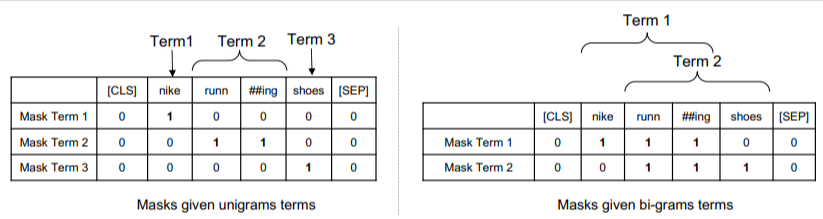
The authors of the paper illustrate well why they use ngrams instead of words when they point out that in the query “nike running shoes” if you simply weight the words then a page with mentions of the words nike, running and shoes could rank well even if it’s discussing “nike running socks” and “skate shoes”.
Traditional IR methods use query statistics and document statistics, and may surface pages with this or similar issues. Past attempts to address this focused on co-occurrence and ordering.
In this model, the ngrams are weighted as words were in our previous example, so we end up with something like:
On the left we see how the query would be weighted as uni-grams (1-word ngrams) and on the right, bi-grams (2-word ngrams).
The system, because the weighting is built into it, can train on all the permutations to determine the best ngrams and also the appropriate weight for each, as opposed to relying only on statistics like frequency.
Zero shot
An important feature of this model is its performance in zero-short tasks. The authors tested in on:
MS MARCO dataset – Microsoft dataset for document and passage ranking
TREC-COVID dataset – COVID articles and studies
Robust04 – News articles
Common Core – Educational articles and blog posts
They only had a small number of evaluation queries and used none for fine-tuning, making this a zero-shot test in that the model was not trained to rank documents on these domains specifically. The results were:
It outperformed in most tasks and performed best on shorter queries (1 to 10 words).
And it’s plug-and-play!
OK, that might be over-simplifying, but the authors write:
“Aligning TW-BERT with search engine scorers minimizes the changes needed to integrate it into existing production applications, whereas existing deep learning based search methods would require further infrastructure optimization and hardware requirements. The learned weights can be easily utilized by standard lexical retrievers and by other retrieval techniques such as query expansion.”
Because TW-BERT is designed to integrate into the current system, integration is far simpler and cheaper than other options.
What this all means for you
With machine learning models, it’s difficult to predict example what you as an SEO can do about it (apart from visible deployments like Bard or ChatGPT).
A permutation of this model will undoubtedly be deployed due to its improvements and ease of deployment (assuming the statements are accurate).
That said, this is a quality-of-life improvement at Google, that will improve rankings and zero-shot results with a low cost.
All we can really rely on is that if implemented, better results will more reliably surface. And that’s good news for SEO professionals.