What You Need to Know About Diamonds

Home Business Magazine Online

There is no doubt that diamonds are one of the most well-known and coveted gemstones. These exquisite gems have fascinated people for centuries with their unique properties and stories that stretch far back in time.

Diamond jewelry is more than just jewelry. They are symbolic, romantic, and the epitome of exclusivity. If you share our fascination with diamonds and want to delve deeper, read on as we guide you through everything you need to know about these brilliant gemstones.

Diamonds are often used in engagement rings. You can find everything you need to know about engagement rings here.

Diamond Cut

WHAT ARE DIAMONDS MADE OF?

Diamonds are formed when carbon is subjected to extreme pressure and high temperatures over millions of years. This formation takes place deep within the Earth, typically at a depth of 150-200 kilometers, where there is a lack of oxygen. After formation, diamonds are transported to the Earth’s crust through kimberlite pipes. Diamonds are natural gemstones.

Diamonds are known as the hardest mineral in the world and are rarely scratched. In fact, it requires the use of other diamonds or, more precisely, diamond dust to cut a diamond. It is precisely this material that is used to cut diamonds.

DIAMOND EVALUATION

Evaluating the quality of diamonds is a complex process that requires expertise and a thorough analysis. A certified diamond evaluation is usually carried out by an independent and recognized gemologist. This expert uses specialized equipment and extensive knowledge of diamonds to determine the quality and value of a diamond. This evaluation takes into account several crucial factors, often referred to as “the Four Cs”: carat weight, color, clarity, and cut. These four elements form the basis for assessing and evaluating the quality and value of a diamond. The result is a comprehensive evaluation report that provides buyers and sellers with a reliable basis for their decisions.

DETERMINE DIAMOND QUALITY USING THE FOUR Cs

The quality and value of diamonds are determined using the Four Cs. When grading diamonds, one looks at Carat (weight), Color, Clarity, and Cut.

At BOLOU, you will meet GIA (Gemological Institute of America) certified specialists, which is a quality stamp for the advice you receive. In addition, they work exclusively with reputable diamond suppliers and always source their diamonds in accordance with international conventions.

CARAT – THE WEIGHT OF THE DIAMOND

Carat is a unit of weight for diamonds, and 1 carat is equivalent to 0.20 grams. The origin of this unit of weight dates back to a time when scales were used to determine the weight of objects. This means that 1 carat weighs the same as 1 seed from the fruit of a carob tree.

The price of a diamond increases with its weight, but this increase is not linear. This is because large diamond crystals are much rarer than small ones, which is reflected in the price.

CLARITY – DIAMOND CLARITY

Clarity is used to determine the purity of a diamond. High-value diamonds are typically characterized by exceptional clarity, where their composition is free of impurities, resulting in a brilliant flow of light. Impurities can also limit the possibilities for cutting.

Diamond clarity is measured on a scale of 12 steps, from flawless to included. At BOLOU, they typically use a minimum of VS1 quality as a starting point.

DIAMOND COLOR

The color of the diamond also plays a role in determining its value.

Although diamonds are typically associated with being transparent, most diamonds are actually slightly brownish or yellowish. Transparent diamonds are the most valuable but can also be found in many special colors known as Fancy Diamonds.

The assessment of a diamond’s color is of great importance, and, therefore, a rating system is naturally used to assess the color of diamonds. In both European and American contexts, a numerical system is used for this purpose.

In the graphic below, you can see an overview of the system. “D-E” is the most valuable color, while “M-Z” is the less valuable.

Natural blue diamonds are the rarest, with only 0.01% of the world’s diamonds said to be blue. The blue color is due to the presence of boron, and they occur in layers of the earth four times deeper than regular diamonds.

Natural red diamonds are also rare, with only 20-30 pieces said to exist in the entire world. Therefore, they are also the most expensive. For example, a 1.56-carat red diamond with the nickname Argyle Phoenix was sold at auction for over 2 million dollars.

Overview of the Value System for Diamonds

Natural blue diamonds are the rarest, with only 0.01% of the world’s diamonds said to be blue. The blue color is due to the presence of boron, and they occur in layers of the earth four times deeper than regular diamonds.

Natural red diamonds are also rare, with only 20-30 pieces said to exist in the entire world. Therefore, they are also the most expensive. For example, a 1.56-carat red diamond with the nickname Argyle Phoenix was sold at auction for over 2 million dollars.

CUT – HOW DIAMONDS ARE CUT

The cut of a diamond is crucial to its appearance. Even a diamond with high clarity and beautiful color will appear dull if the cut is poorly done. A professional cut brings out the best in an exquisite diamond.

BOLOU has specialized in the classic brilliant cut for decades, which is a well-known cutting technique. State-of-the-art tools and professional goldsmiths are capable of designing and creating any imaginable diamond jewelry, which, through uncompromising quality and unique design, will undoubtedly stand out from the crowd.

WHAT IS THE DIFFERENCE BETWEEN BRILLIANTS AND DIAMONDS?

The difference between brilliants and diamonds lies in their terminology and use. A brilliant is a term specifically used to describe a diamond cut in a particular brilliant-cut technique. The brilliant cut is known for enhancing the diamond’s light reflection and creating impressive brilliance. On the other hand, diamonds are a broader category that includes gemstones formed from carbon and can have various cuts and characteristics beyond brilliants.

HOW MUCH DO DIAMONDS COST?

The price of diamonds varies significantly and depends on several factors, including the Four Cs — carat weight, color, clarity, and cut. These factors help determine the quality and, therefore, the price of a diamond.

When considering purchasing a diamond, we recommend ensuring a GIA certificate as a quality stamp, especially if the diamond is larger than 0.30 carats. The GIA certificate is a guarantee that the diamond is of the specified quality and will help you make an informed decision about your purchase.

The price of diamonds can also be affected by other factors, such as the diamond’s shape, the quality of the cut, and any special characteristics like color or rarity. Additionally, market supply and demand can also impact the price of a diamond.

It is important to remember that the price of a diamond is not just a matter of size or carat weight. While larger diamonds generally have a higher price, a smaller diamond with unique color, clarity, and cut can be equally valuable or even more sought after.

The post What You Need to Know About Diamonds appeared first on Home Business Magazine.

Original source: https://homebusinessmag.com/lifestyles/success-lifestyles/need-know-diamonds/

Transforming Commercial and Industrial Spaces with LED Lighting Innovation

Home Business Magazine Online

Any technology that boosts performance, reduces costs, and elevates a company’s brand value in the marketplace is something that cannot be ignored. LED lighting brings all of those benefits and more to companies operating in commercial and industrial spaces. It’s a transformative technology that is becoming the standard for companies focused on creating safe, flexible, and highly functional workspaces.

“LED lighting is a breakthrough technology that brings many benefits to the business world,” says Dara Greaney, Founder and CEO of LEDLightExpert.com. “With minimal investment, it drives innovative lighting solutions that enhance functionality, increase productivity, and support sustainability for commercial and industrial spaces.”

LEDLightExpert.com brings a unique mix of expertise and innovation to clients in commercial and industrial spaces looking for a better lighting strategy. Its services include comprehensive lighting studies, fast and affordable access to quality LED products, and elite customer service on all issues related to LEDs.

“The future of lighting is LED,” Greaney says. “It transforms spaces, elevating the workplace experience and cutting back on operational costs. LEDs are one of the smartest investments companies can make in their facilities and overall business performance.”

The basics of LED lighting

LED lighting uses light-emitting diodes to convert electrical energy to light, providing light that is cooler, less costly, and more controllable than traditional incandescent and fluorescent bulbs. While LEDs were created over 60 years ago, they have recently become the go-to solution for lighting as global initiatives have sought to increase sustainability in the business world and beyond.

Leveraging LEDs to slash operating costs

“The US Department of Energy reports lighting accounts for as much as 20% of commercial electricity costs,” Greaney shares. “LEDs dramatically impact those costs, providing even better lighting than traditional bulbs while using 90% less energy.”

Uni-directional light is one of the keys to the energy savings LEDs provide. Whereas incandescent and fluorescent bulbs throw off light and heat in all directions, LEDs provide a focused beam that wastes less energy.

The uni-directionality of LEDs also allows for a more functional lighting design, as LED fixtures can be easily focused within workspaces to provide the optimal quality and quantity of light.

LEDs also emit much less heat than incandescent and fluorescent bulbs, which saves energy both in the powering of the bulb and in cooling costs.

Replacement costs are another area where LEDs save businesses money. By providing as much as 35,000 hours of light, LEDs achieve a life span four times longer than fluorescent bulbs and 35 times longer than incandescent bulbs.

“In most commercial spaces, lights are used a maximum of 10 hours a day,” Greaney shares. “At that rate, LED bulbs can last for nearly 10 years. Fluorescents used in the same setting will need to be replaced after two to three years, and incandescents won’t last longer than three to four months.”

Boosting workplace performance with LEDs

“The quality of light businesses provide for their workers plays a significant role in improving their productivity,” Greaney explains. “When employees are able to work in a well-lit environment, they find it easier to concentrate, are more alert, and their mood is better. For businesses, that translates into better productivity and higher profits.”

The technology behind LEDs allows for the color temperature of bulbs to be adjusted, which is something that cannot be achieved with traditional bulbs. The same bulb that provides a blue light to boost alertness in work areas can also be adjusted to deliver warmer colors to promote relaxation.

High color rendering is another feature of LEDs that makes them an optimal light source for workspaces. By providing a more accurate representation of colors, LEDs support tasks that require color matching while also reducing eye strain.

“LEDs also enhance safety in the workplace,” Greaney shares. “Because they need to be replaced far less often than traditional bulbs, they keep maintenance teams from the hazardous work that often needs to be done to replace bulbs in commercial and industrial settings.”

Increasing sustainability with LEDs

LEDs are seen as a key player in sustainability efforts, reducing greenhouse gas production by reducing the amount of energy needed to provide lighting.

“Switching to LEDs is one of the easiest and most impactful steps any business can take to support its sustainability efforts,” Greaney says. “It reduces a company’s carbon footprint, cuts back on waste, and keeps dangerous chemicals like mercury that is found in fluorescents out of the environment.”

As companies prioritize sustainability, they also improve their brand reputation. Reports show today’s consumers consider the efforts brands are making in the area of sustainability and are more likely to support those with a good record of implementing sustainable practices and products.

The transformation LED technology brings to commercial and industrial spaces goes far beyond simply providing better lighting. Businesses that invest in LEDs will get a return that includes lower operating costs, increased sustainability, and better workforce performance.

The post Transforming Commercial and Industrial Spaces with LED Lighting Innovation appeared first on Home Business Magazine.

Original source: https://homebusinessmag.com/management/technology-management/transforming-commercial-industrial-spaces-led-lighting-innovation/

Google Search Generative Experience can now create images

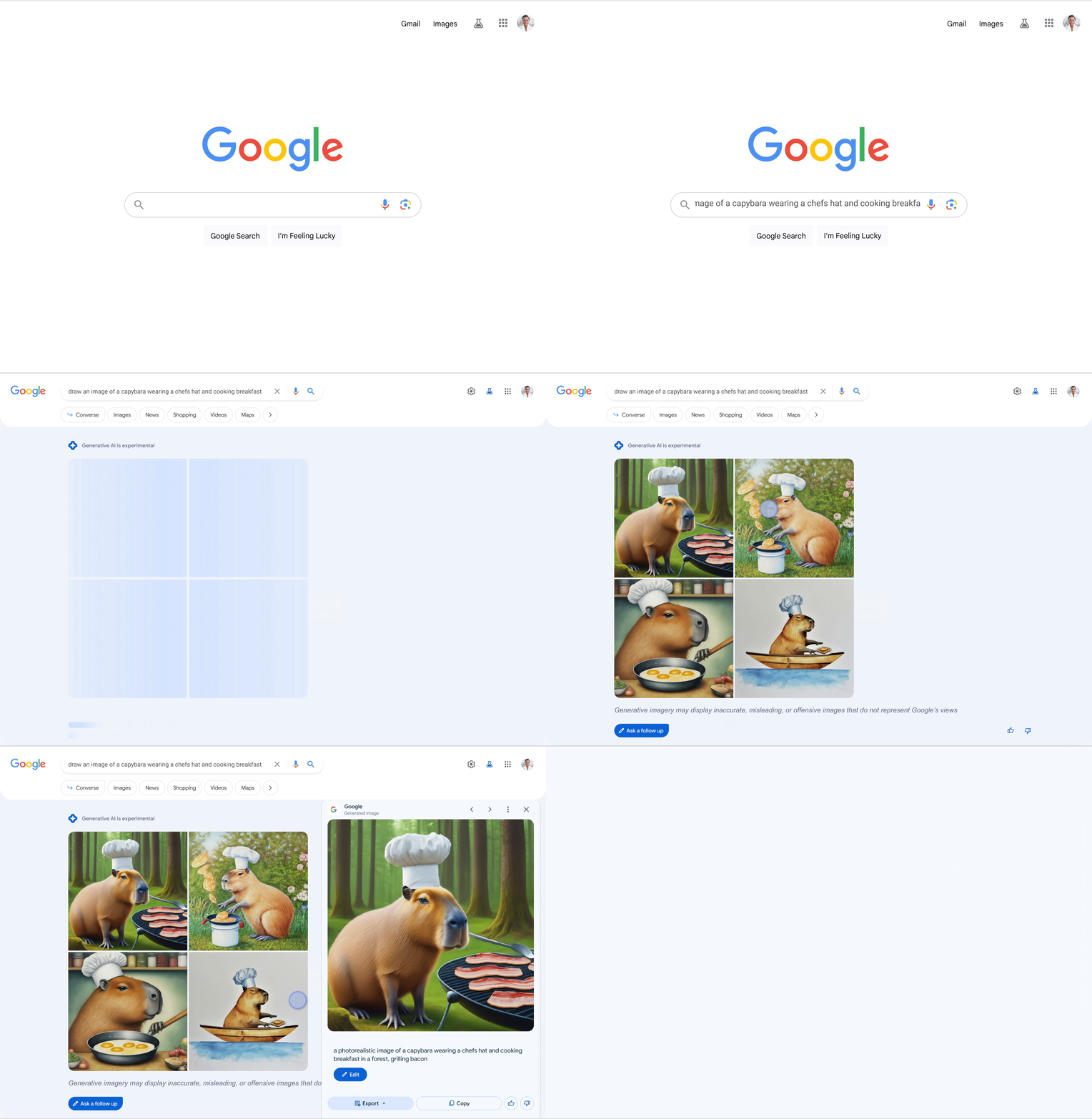
Google Search Generative Experience is now able to generate images, just like other AI-generation tools but in the new experimental search interface. Plus, Google SGE can also provide written drafts, so you can see and change responses sooner.

SGE image creation. Google wrote that today it is “introducing the ability to create images with our generative AI-powered Search experience (SGE).” You can ask Google SGE to “draw a picture of” something and it will provide you with four samples, similar to the other AI-image generation tools. You can click on an image and edit that image further or download it.

How it works. Here is a GIF of it in action:

Alphabet Inc.

Image Search. Google is also testing this directly in Google Image search. If you are opted in to SGE and you use Google Images, you may see this option there as well. “This feature is designed to appear when you’re searching for inspiration, like “minimalist halloween table settings” or “spooky dog house ideas.”,” Google wrote.

artificial intelligence

Image generation in SGE is currently available in English in the United States, to people who opted into the SGE experiment and who are 18 years or older, Google explained.

Drafts. Google SGE also now can write draft responses. Google said, “Sometimes when you’re researching a project or topic in Search, you end up looking for writing ideas and inspiration along the way. To help with these longer-running searches, we’re introducing written drafts in SGE. You’ll be able to make the draft shorter, or change the tone to be more casual.”

Emerging technologies

Why we care. Google keeps enhancing and adding more AI-features to SGE, Bard, as other search engines and AI companies do the same. It is exciting to watch the features continue to expand and grow.

Oh, I used Midjourney, an AI-image creation platform, for the featured image for this story.

The post Google Search Generative Experience can now create images appeared first on Search Engine Land.

Original source: https://searchengineland.com/google-search-generative-experience-can-now-create-images-433200

Google Search officially stops indented results

Google has stopped showing indented results in the Google search listings. Google has historically showed an indented search result under the main result when it was from the same domain but over the past few weeks, Google stopped indenting those results.

What changed. Danny Sullivan, the Google Search Liaison, posted “We stopped doing “indented results” a few weeks ago.” Google stopped the intended results because “especially with continuous scroll, it wasn’t as helpful as in the past,” Sullivan wrote.

Google has been intending search results on and off since at least 2009.

What it looks like. Here is a screenshot of the old indented results from a few months ago:

Alphabet Inc.

Now I see them listed out, without being indented and not in a specific order:

Danny Sullivan

What didn’t change. Google said its “diversity system still works to generally show only two results from the same site in the top results.” So Google has not changed how often Google Search may show the same domain for a single query on the same search results page. Google just won’t intent the result anymore.

Why we care. This change should not impact how many times your content is shown in Google Search, it just will impact how that second listing appears in those search results.

Will that impact your click-through rate in a positive or negative way is yet to be determined.

The post Google Search officially stops indented results appeared first on Search Engine Land.

Original source: https://searchengineland.com/google-search-officially-stops-indented-results-433210

AI-powered marketing in 2024: A playbook for success by Cynthia Ramsaran

Is AI labeling necessary

It’s no secret that B2B marketers have a challenging task in front of them: a niche audience, an often technical offering and tighter budgets than their B2C counterparts. However, a recent survey has found that over 50% of B2B marketers have plans to increase their marketing budget over the next year – and they are looking to AI to help them succeed.

Join MNTN as they walk through how B2B marketers can utilize the rapidly evolving AI technology. 

Learn more by registering and attending “AI-Powered Marketing in 2024: A Playbook for Success,” presented by MNTN.


Click here to view more Search Engine Land webinars.

The post AI-powered marketing in 2024: A playbook for success appeared first on Search Engine Land.

Original source: https://searchengineland.com/ai-powered-marketing-in-2024-a-playbook-for-success-433207

What is RGSP? Google’s Randomized Generalized Second-Price ad auctions explained

The concept of randomized generalized second-price (RGSP) auctions sent shockwaves through the PPC community after the subject took center stage at the Google antitrust trial.

While some digital marketers agreed with Google that the practice provides a better user experience, others sided with the Department of Justice (DOJ), arguing that it makes ad auctions unfair and purely helps line Google’s extremely deep pockets.

But what is RGSP, why does the DOJ think it’s problematic for ad auctions and how exactly does it impact Google’s ad revenue? Here’s everything you need to know.

How does Google pick an ad auction winner?

Dr. Adam Juda, Google’s Vice President of Product Management in Search Ads Quality Systems, explained at the federal antitrust trial:

  • The highest bidder doesn’t automatically win the ad auction.
  • A campaign’s long-term value (LTV) is instead given more weight.
  • This means Google sometimes loses out financially in the short term.

When advertisers bid on keywords, instead of determining an ad auction winner purely by bid amount, Google uses a metric called Ad Rank to decide how and if your campaign should rank. This collective score is calculated by examining:

  • Bid amount
  • Auction-time ad quality (including expected click-through rate, ad relevance and landing page experience)
  • Ad Rank threshold
  • Competitiveness of an auction
  • Context of a search query
  • Expected impact of assets and other ad formats

Your Ad Rank is recalculated every time time your campaign becomes eligible to compete in an auction, meaning your ad’s ranking may vary each time depending on competition, quality and search context.

Campaigns that don’t meet Google’s minimum Ad Rank threshold are automatically eliminated from the auction.

How does Ad Rank work?

Imagine five advertisers competing against each other in an ad auction with the respective Ad Rank scores of 80, 50, 30, 10 and 5. For this particular auction, Google requires a minimum Ad Rank threshold of 40 to rank above organic search results. This means that only the first two campaigns (with scores of 80 and 50) are eligible to show above organic search results.

In this instance, for an ad to be shown below organic search results, Google requires a minimum Ad Rank of 8. This mean that the campaigns with Ad Rank scores of 30 and 10 would qualify.

However, the campaign with the Ad Rank score of 5 does not meet the minimum criteria to appear above or beneath the search results and so will be eliminated from the auction, as shown in the table below:

advertising ecosystem

Why doesn’t the highest bidder win?

If the highest bidder automatically won every Google ad auction, there is a risk the search engine could be left serving poor-quality ads. Poor-quality ads may not be relevant to a searcher’s query, which would likely result in a poor:

  • Click-through rate.
  • Conversion rate.
  • User experience.

This would decrease the overall value of Google’s product.

A Google spokesperson explained in a statement:

  • “Overall, higher quality ads typically lead to lower costs and more advertising success.”
  • “The Google Ads system works best for everybody when the ads we show are relevant and closely match what customers are searching for.”

It is also in Google’s best interest to serve high-quality ads that satisfy user intent because advertisers only pay Google when someone clicks on your ad, visits your site or calls your business.

Issues with Ad Rank

Without RGSP, ad auctions can get “messy,” as Frederick Vallaeys, CEO of Optmyzr, explained in How out-of-order ad promotion works on Google Search here on Search Engine Land.

An ad that meets all minimum criteria required by a Google auction can sometimes still rank below an ad that fails some criteria, he wrote. Vallaeys went further by using an example of an ad auction that had a 4% threshold for predicted CTR. The details of the competing bids are listed in the table below:

advertising platforms

In the example listed above, Ad 2 meets the threshold because its predicted CTR is 5% – 1% higher than the 4% required by Google. However, because Ad 1 has a higher Ad Rank score (30), Ad 2 would rank further down the page to maintain auction fidelity, and only be displayed when Ad 1 is allowed.

  • “This is not a great scenario for advertisers or Google, so they address this by allowing ads to be shown in a different order than what ad rank would normally dictate,” Vallaeys wrote.

This “different order” refers to the concept of RGSP.

What is RGSP and how does it affect auctions?

RGSP is a practice leveraged by Google that picks the winner of an ad auction at random from the top bidders as long as their long-term values (LTVs – a Google calculation that is essentially the same as Ad rank) are close enough.

The top bidder then “pays the price of the bid equal to the next-highest bid plus one cent,” according to Big Tech on Trial.

The Department of Justice argued at the federal antitrust trial that this practice creates an unfair competition for bidding advertisers as the winner of an auction should always be the highest bidder.

Why is RGSP unfair?

Advertisers have two options if they want to avoid their potential winning bid from being demoted at random to runner-up:

  • Improve their campaign’s LTV.
  • Increase their bid amount.

The issue here is that Google hasn’t specified exactly how advertisers can increase their campaign’s LTV, which leaves them with one option if they wish to avoid RGSP – increase their bid amount.

To avoid RGSP, the bid amount would have to be significantly higher than the runner-up (as mentioned before, winners and runners-up can only be swapped via the RGSP process if the LTV and bid amounts are close enough). This has resulted in advertisers having to raise their bid 3.7 times higher, reports This Week In Google Antitrust.

What are the issues with RGSP?

Jay Friedman, CEO of advertising agency Goodway Group, highlighted the reasons RGSP could prove problematic for advertisers:

  • “Imagine you want to buy a ticket to a concert. Not everyone who wants a ticket can get a ticket, so there is an auction. You submit your bid and it’s not a first-price auction (highest bidder wins, pays what they bid,) and not even a second-price auction (highest bidder wins, pays a nominal amount [i.e. $1] over the second-highest biddger.) Instead, the concert venue holds an RGSP – a ‘randomized general second-price auction.’”
  • “Let’s say the the top two bidders submit bids of $100 and $95. In RGSP, the concert venue takes the top two bidders and, ‘as long as the long-term value of each of the bidders to the concert venue is pretty close,’ there is a chance the concert venue randomly swaps the top two bidders and awards the seat to the second highest bidder instead. Sounds like a deal if you randomly get the ticket for $95, and I guess frustrating for the highest bidder.”
  • “EXCEPT – the concert venue tells you there are two ways to make sure you don’t get randomly swapped out as the highest bidder. One, increase your long-term value to the venue. They don’t tell you how to do this and note it may include your behavior, referrals, your bid amounts, bid frequency, ‘and other bidder quality elements.’ You decide that’s pretty vague. The second is to increase your bid! And, as it turns out, you’d have to increase your $100 bid to $370 to get sufficient confidence you wouldn’t be outbid.”

What has the DOJ said about RGSP?

The DOJ has argued at the federal antitrust trial that rather than resulting in higher-quality ads, RGSP is being used by Google to boost ad revenue. In putting forward its case, the department shared an email Juda sent to his team at Google acknowledging the difficulty the search engine would have in selling this practice to advertisers. It read:

  • “[I]f I have to say, ‘[W]e randomly disable you if you don’t bid high enough,’ then I’m going to have another bad year at [Google Marketing Next] ;).”

There was debate at the trial as to what was implied by the use of a winking emoji in Juda’s message.

Does RGSP increase Google’s revenue?

Google vice president and general manager of ads Jerry Dischler testified at the federal antitrust trual that while he was unsure if RGSP resulted in advertisers increasing their ad auction bids, he could confirm that the practice increases Google’s ad revenue.

Dischler went on to tell the court that the search engine “frequently” changes the auctions it uses to sell search ads, increasing the cost of ads and reserve pricing by as much as 5% for the average advertiser. For some queries, the tech giant may have even raised prices by as much as 10%. However, Google tends “not to tell advertisers about pricing changes.”

The Department of Justice shared an email sent by Dischler back in 2018 to highlight the pressure his team were under to meet revenue targets given to Wall Street by Ruth Porat, Google’s Chief Financial Officer. In the documents, he claimed his team were “shaking the cushions” to increase revenue. He wrote:

  • “If we don’t meet quota for the second quarter in a row and we miss the street’s expectations again, which is not what Ruth signalled to the street, so we will get punished pretty bad in the market.”
  • “I care more about revenue than the average person but think we can all agree that for our teams trying to live in high cost areas another $100,000 in stock price loss will not be great for morale, not to mention the huge impact on our sales team.”

Is RGSP new?

Practices like RGSP are not new. In fact, Yahoo! gave an interview to The Register back in 2010 explaining it had been using “squashing” and second price auctions since 2007 to increase revenue. Yahoo!’s then chief economist, Preston McAfee (who now works for Google as a Distinguished Scientist) told the publication at the time:

  • “When someone has a really high ad click probability, they’re very hard to beat, so it’s not a really competitive auction. So that they don’t just win [every auction], we do squashing. This makes the auction more competitive.”
  • “The bidders respond by bidding higher. The one who was destined to lose is now back in the race, so they bid higher trying to displace the number one, and the number one is trying to fend them off so they bid higher too.”
  • “We can make the competition a bit more fierce using squashing, even on keywords where there’s not much bidding.”

McAfee did not confirm how much squashing Yahoo! does but did say it was constantly changing and “resetting the parameters”.

What has Google said about RGSP?

Google uses RGSP to prevent a bias where one winner takes all, Juda said at the federal antitrust trial. Commenting on the practice, he told the court “we flip [the winners of auctions with runners-up], otherwise Amazon always shows up on top,” Bloomberg reported.

Another reason for selecting winners at random is so that advertisers don’t need to worry that they may be bidding too much in ad auctions, which could result in them constantly feeling the need to adjust their bid amounts, according to Google.

With RGSP, the price advertisers pay is determined by the bid amount put forward by the next highest-ranked bid. Juda described this method as “advertiser-friendly.”

How has the PPC community reacted?

The concept of RGSP appears to have divided the paid search community, with many criticizing the lack of transparency around it.

PPC specialist Vincent Norris wrote on LinkedIn:

  • “So much for giving advertisers transparency, right? What does this mean for advertisers? Does ad rank even matter? I personally hope that Google will get more than a fine and a ‘slap on the wrist’ for this.”

Mike Ryan, Head of Ecommerce Insights at Smarter Ecommerce, commented

  • “Is this behavior ethical? No. Whatever the initial motivation, this is auction manipulation that appears to harm Google’s competitor set and yield undue revenues by increasing costs for everyone else.”

Tyler Jordan, digital marketing expert, added:

  • “All digital marketers need to be aware that Google’s bid auction is no longer an auction. A real auction’s outcomes are dictated by supply and demand, but we just learned from the horse’s mouth there are other factors in play.
  • “I’m sure Google is working on making its advertising product more effective – at least for retail advertisers, since that was certainly the focus of Dischler’s quotes. What I’m sure of is that continuing to game its own system at the expense of its customers is not a long-term strategy for success. I’ve got plenty of ideas for ways Google can get better for #b2b advertisers if they’re open to a more honest way forward.”

Google Ads expert Kirk Williams posted:

  • “Google, we genuinely love the product you first introduced. We are the ones who had told clients for years why Search is one of the best marketing channels of all time (what incredible marketing intent there is in a search term!!). Stop the money grab and start rebuilding trust. For the sake of the industry. Please! 🙁 #ppc #googleads #adwords #ecommerce #RGSP.”

However, others have argued that “out-of-order” ranking changes can help improve the user experience, as pointed out by Vallaeys:

  • “While out-of-order promotion changes the typical auction dynamics, Google believes it ultimately improves the search experience, and I tend to agree with that. For advertisers, it highlights the need to focus both on bidding strategically and optimizing for relevance and Quality Score.”

Content marketer Goutham Veerabathini shared this notion, commenting on LinkedIn:

  • “The introduction of randomness might help create a more dynamic and unpredictable auction environment to prevent strategic strict deterministic ranking of bids that gives top position always to only one player who bids the highest after mastering all the other factors.”

Why we care. Fair ad bidding is essential for advertisers to achieve their marketing objectives efficiently, maintain trust in the advertising ecosystem, and foster long-term relationships with advertising platforms and publishers. It contributes to a healthy and competitive marketplace where advertisers can optimize their strategies for better outcomes.

Deep dive. Read our Google antitrust trial updates for all the latest developments.

The post What is RGSP? Google’s Randomized Generalized Second-Price ad auctions explained appeared first on Search Engine Land.

Original source: https://searchengineland.com/google-rgsp-randomized-generalized-second-price-ad-auctions-explained-433053

Money Matters at Home: Tips for Budgeting and Saving

Home Business Magazine Online

It can be difficult attempting to save money. Perhaps you have tried to do so, but unexpected costs continually seem to arise. The need for new tires on the car, braces for the teen, or a new roof for the house can all make saving money seem like a distant priority. Remember that?

The truth is that you may start saving money even if some factors aren’t ideal. Warning: the elusive “right time” will never arrive if you wait for it. It’s ideal to begin saving immediately.

The good news is that there are numerous simple methods available to cut costs and improve your budget. You can quickly and easily begin saving money by implementing the following suggestions.

Methods for Cutting Costs

1. Get Out of Debt First.

The most significant drain on savings is the cost of servicing debt each month. Having debt takes money away from you. It is high time that you pay off your debt. The debt snowball strategy can help you eliminate debt quickly. Here, you’ll settle your bills, beginning with the lowest and working up to the highest.

Don’t worry; changing people’s perspectives is crucial, even when discussing payday loans online. Once you’ve relieved your disposable income of financial strain, you can allocate those funds towards achieving your savings goals.

2. Cut Down on Your Grocery Budget.

After making a monthly budget, most individuals are taken aback by how much money they actually spend at the supermarket. And the typical American household of four spends about $966.1 every month.

Walking up and down the aisles, picking up a package of Oreos here, some bags of chips there, and some fun extras at the checkout is a breeze. Those seemingly insignificant expenditures can build up and cause monthly budget overruns.

You may save money on food by making a weekly menu plan and checking your cupboard and freezer contents before going shopping for the simple reason that there’s no point in buying more of what you already have. Leave the kids at home if you’re serious about not deviating from your to-do list.

3. Spend Extra or Unexpected Income Wisely.

Put that bonus check or inheritance check to good use when money comes your way. And by “good use,” we don’t mean hoarding the proceeds from the sale of your new stamp or storing them in the bank for later use.

Instead of putting that money in the bank, you should use it to pay off your debts, such as your credit card or student loan balances. If you don’t owe anyone money, then you can put that money toward a rainy-day reserve.

4. Get Rid of Recurring Memberships and Subscriptions You Seldom Use.

You may have several subscriptions, such as streaming services (Netflix, Hulu, Spotify), a gym membership, trendy box services, and Amazon Prime. Stop paying for services you rarely use and cancel your subscriptions. Remember to turn off auto-renewal prior to any purchases you make.

If you decide you can’t live without it after canceling your subscription, you can start paying again as long as you have enough room in your new and improved budget.

5. Reduce Energy Costs.

By making some simple adjustments around the house, you can cut down on your monthly electricity costs. You can get started right away by doing things like replacing any leaky pipes, washing your clothes in cold water, installing dimmer switches and LED lightbulbs, and taking shorter showers (we didn’t say fewer).

While investing in new energy-efficient appliances will help you save money on your monthly electricity bill, doing so can be quite a financial burden. You may save up and pay cash for those enhancements over time, though, if you factor them into your monthly budget.

6. Check Your Insurance Rates.

Did you know that having an Endorsed Local Provider (ELP) examine your insurance rates can save you an average of $700? You should have them take a look to see if they can find any savings for you.

7. Start an Investment Strategy.

You can still put your hard-earned money to work for you by making even modest contributions to investing accounts.

If your company matches contributions to your 401(k), you could be getting money for nothing. Consider starting a retirement or investing account.

Conclusion

Changing your behavior is the first step toward better financial health. Some of these adjustments will be less challenging than others, but if you stick with the process, you’ll develop excellent money management skills that will benefit you for the rest of your life.

The post Money Matters at Home: Tips for Budgeting and Saving appeared first on Home Business Magazine.

Original source: https://homebusinessmag.com/money/cutting-costs/money-matters-home-tips-budgeting-saving/

Should Businesses Explore How Blockchain Could Help Them?

Home Business Magazine Online

When Bitcoin was launched in 2009, the prospect of digital currency was no longer theoretical and a very real concept. It rapidly gained interest, and businesses started to test how they could make it work for them. Large corporations, governmental bodies, social enterprises and charities began to use it to improve upon their existing processes and expand upon business models. Here we explore how and why businesses can benefit from blockchain, and how to make it part of their overall strategy.

The first thing that you need to remember is that there are so many options in relation to blockchain networks depending on the project that is being worked on with varying levels of sophistication. There are networks with low barriers to entry that could act as a good test case. Check the Kusama price for something that could be a good starting point.

The Trust Factor

Blockchain creates trust between entities if that has not already been established. By this, we mean that people may work with different businesses that they perhaps wouldn’t have done before without the additional security that blockchain offers in terms of transactions and holding data. With the added encryption and automatic paper trail that the blockchain provides every transaction, there is a better foundation for trust between businesses. Additionally, smart contracts will ensure transactions only are processed if an agreed upon act was carried out first. It could be that a business already has an existing relationship with another, but haven’t yet had to facilitate or complete any transactions, which is where the partnership is really put to the test. Blockchain and Bitcoin are widely recognised and trusted which will give you an edge to other competitors who perhaps aren’t using blockchain.

No Security or Privacy Issues

One of the main advantages of Blockchain and a major reason why businesses should explore it, is that it means that there is less to worry about when it comes to security and privacy. The security offered by Blockchain is enhanced, which means you know your transactional data is safe. All transactions are protected by end-to-end encryption which means that there is no risk of fraud or any kind of illegal activity. It is pretty much impossible to hack into.

It Can Cut Organisational Costs

The great thing about Blockchain is that it can cut costs without you even noticing it. It will automatically make the processing of transactions much more efficient, limiting the amount of time you spend on them. There is less manual labour required when it comes to reports, audits and editing of information or data. The streamlining of these processes will save you time, and in fact money. There will be less middle men required in order to function this part of your business.

Everything Is Faster

In the business world, if there is a faster way of doing things, that’s definitely the preferred method. We all want everything done yesterday. Because there aren’t as many 3rd parties, or intermediaries, everything can be completed much quicker than it would if you were using traditional methods. Depending on the specific transaction, it can be handled in less than seconds. This does however depend on the kind of system that is used.

Transactions Can’t Be Changed

Every transaction that is completed over blockchain is completely visible and transparent. Everything is recorded, so you know every detail about what’s occurred. That level of traceability could be huge for your business Once it has been recorded, it means that nothing can then be changed or edited, giving you again some additional security of knowing nobody can tamper with your data. Once you have been using the system for a significant period of time, you will then have a set of auditable records that you can refer to.

You Can Control Your Data

Data is a valuable commodity in the world of business, and most businesses want to retain control of it. By using a blockchain system, this gives you much more control. You, as a company, can choose which pieces of data you’d like to share and with who. It’s all in your hands. You can also limit the amount of time people can have access to the data, should they only require it for a certain period of time.

Can Be Used as Part of Your Innovation Practices

Many businesses have innovation think tanks where they look at how they can solve problem areas within the company or improve processes. It could be simplifying some of the most standard business practices such as verifying information. If you are on a recruitment drive for example with lots of applicants, it could help you identify whether or not any potential candidates are falsifying their information. There are so many processes that blockchain could simplify for you and help you add to your bottom line.

If you are a business wondering if blockchain can help you and improve the way you operate, hopefully you will now have an idea of some of the advantages of it and how it could be used to grow what you already have.

The post Should Businesses Explore How Blockchain Could Help Them? appeared first on Home Business Magazine.

Original source: https://homebusinessmag.com/money/cryptocurrency/businesses-explore-blockchain-help/

5 reasons Amazon Ads is better than Google Ads for ecommerce

Nine out of 10 ecommerce businesses I’ve come across have run Google Ads at some point, but few have considered Amazon Ads despite the significant opportunities it offers. 

I believe that Amazon Ads has the potential to be far more effective than Google Ads for ecommerce PPC as it offers higher quality traffic, higher conversion rates, easier tracking, more long-term value and more lenient policies. 

In this article, I unpack these advantages and explain why your ecommerce business should be running Amazon Ads over Google Ads. 

Why is Amazon Ads undervalued?

There are several reasons that Amazon Ads has not been as popular as Google Ads, even for ecommerce businesses. Let’s get these out of the way. 

While Google commands the majority of global search engine usage, boasting over 90% market share, a 2021 survey by Jumpshot revealed that Amazon’s search volume comprises 54% of all product-related searches in the United States. 

Google may have a broader reach, but Amazon provides a more relevant targeting opportunity, a nuance often missed by ecommerce advertisers.

Another blocking factor is that Amazon is a stand-alone ecommerce platform. To list a product on Amazon, advertisers are required to invest in the Amazon ecosystem and build a product listing. 

The startup cost and learning curve with Google Ads are lower as traffic can be run directly to your ecommerce website. It’s not widely known that Amazon has a program called Fulfilled by Merchant (FBM), where sellers can fulfill products themselves and not use Amazon’s fulfillment centers. 

While there might be hesitation to join the Amazon marketplace, the advantage in building another sales channel and gaining access to Amazon’s network of customers and their ad platform is huge. 

Lastly, the costs associated with Amazon Ads on face value appear higher than Google Ads. Amazon Ads, like Google Ads, is a CPC platform, which means advertisers are charged for each click on their ads. 

However, Amazon also charges a percentage sale commission for any product sold on their platform. This commission varies depending on the product parameters.

Despite this added commission, Amazon Ads is still likely to be more cost-effective than Google Ads, considering that the CPCs are far lower and the conversion rates far higher on Amazon.

1. Amazon has higher conversion rates

Most U.S. product searches happen on Amazon, resulting in significantly higher conversion rates than Google Ads. 

While Google Ads offers effective targeting capabilities, Amazon’s advantage lies in its product-focused intent. 

Additionally, Amazon provides advertisers with other tools, like advertising products on competitor product listings. 

It’s not uncommon for Amazon listings to have conversion rates of 10 to 15% and beyond. Prime members have even higher conversion rates. Compare this to Google Ads, which usually have conversion rates under 5%. 

Even considering the 15% commissions on products, the ROAS from Amazon Ads are usually more cost-effective than Google Ads.

2. Amazon makes attribution and tracking easier

Google Ads tracking has come a long way with Google Analytics 4 and Google Tag Manager. But even with these advancements, it’s still difficult to master attribution and understand the true value of Google Ads all the way down to a keyword or product listing. 

This is not the case with Amazon Ads. Amazon’s approach is different because all of the product information is housed within the Amazon platform. 

Product information, buyer reviews, influencer videos, long-form content and similar products can all be found on the platform connected to the listing.

Add to that the buyer trust that Amazon provides with its reputation of fast fulfillment and free returns. Most of the research and sale is completed on the platform, and all of this information is retained. 

As an advertiser, it becomes very easy to understand the customer journey from keyword to sale and the revenue value behind each ad campaign and down to keyword and product target. 

Amazon’s Brand Analytics and Ad platform provide ecommerce businesses with a flywheel to constantly improve products and make great marketing decisions. It also means Amazon Ads become highly effective over time, while you may still be guessing at the true performance of Google Ads. 

Dig deeper: Amazon advertising attribution: Here’s how it works


Get the daily newsletter search marketers rely on.

<input type="hidden" name="utmMedium" value="“>
<input type="hidden" name="utmCampaign" value="“>
<input type="hidden" name="utmSource" value="“>
<input type="hidden" name="utmContent" value="“>
<input type="hidden" name="pageLink" value="“>
<input type="hidden" name="ipAddress" value="“>

Processing…Please wait.

function getCookie(cname) {
let name = cname + “=”;
let decodedCookie = decodeURIComponent(document.cookie);
let ca = decodedCookie.split(‘;’);
for(let i = 0; i <ca.length; i++) {
let c = ca[i];
while (c.charAt(0) == ' ') {
c = c.substring(1);
}
if (c.indexOf(name) == 0) {
return c.substring(name.length, c.length);
}
}
return "";
}
document.getElementById('munchkinCookieInline').value = getCookie('_mkto_trk');


3. Amazon Ads drive rankings

When it comes to how ads affect organic rankings, Google and Amazon have distinct policies. The difference creates an interesting opportunity for Amazon advertisers.

Google says that: 

“Investment in paid search has no impact on your organic search ranking. Google maintains a strict separation between our search business and our advertising business.” 

Amazon has the exact opposite policy. While they don’t officially state this, it is common knowledge in the industry that Amazon Sponsored Ads drive organic rankings. 

In practice, Amazon Sponsored Ads drive more buyers to listings and increase sales. Subsequently, sell-through-rates increase and Amazon uses this trust factor to rank products organically for those keywords. 

I’m not judging which policy is better; both make sense in their own way. However, the outcome is that Amazon’s policy enables newer entrants to rank products quickly and get a foothold in the Amazon Marketplace. With Google, investing in SEO can be a slow process.

Dig deeper: Maximizing brand impact with Amazon’s video advertising: A comprehensive guide

4. Amazon Ads builds reviews and long-term value

Similar to the above point, SEO on Google is time-consuming and resource-intensive. Building links and content and optimizing websites to rank on Google takes time and money. 

It’s also unclear exactly what works and what doesn’t. It can sometimes feel like trying to catch a falling knife, with the parameters around SEO constantly in flux. 

On the other hand, we know that investment in Amazon Ads has a value-added effect on Amazon SEO. As discussed above, more ads mean more sales, which means higher sell-through rates and better rankings. 

But also, more ads = more sales = more reviews. Reviews on Amazon are likened to Links to your website on Google. They are the lifeblood of rankings. 

Investing in Ads influences your rankings and is a direct investment in your Amazon presence. These reviews are tangible and real. You don’t get the same effect when you invest in Google Ads, which Google specifically states is a siloed platform.

5. The Amazon marketplace is easier to dominate 

Not only do Amazon ads make it easier to compete, but it is also far easier to dominate the entire marketplace with Amazon than it is with Google Ads.

Consider Google’s policy of “Unfair Advantage.” You cannot advertise two listings for the same keyword. There are only four ad spots, and Google does not want any advertiser to control all the real estate. 

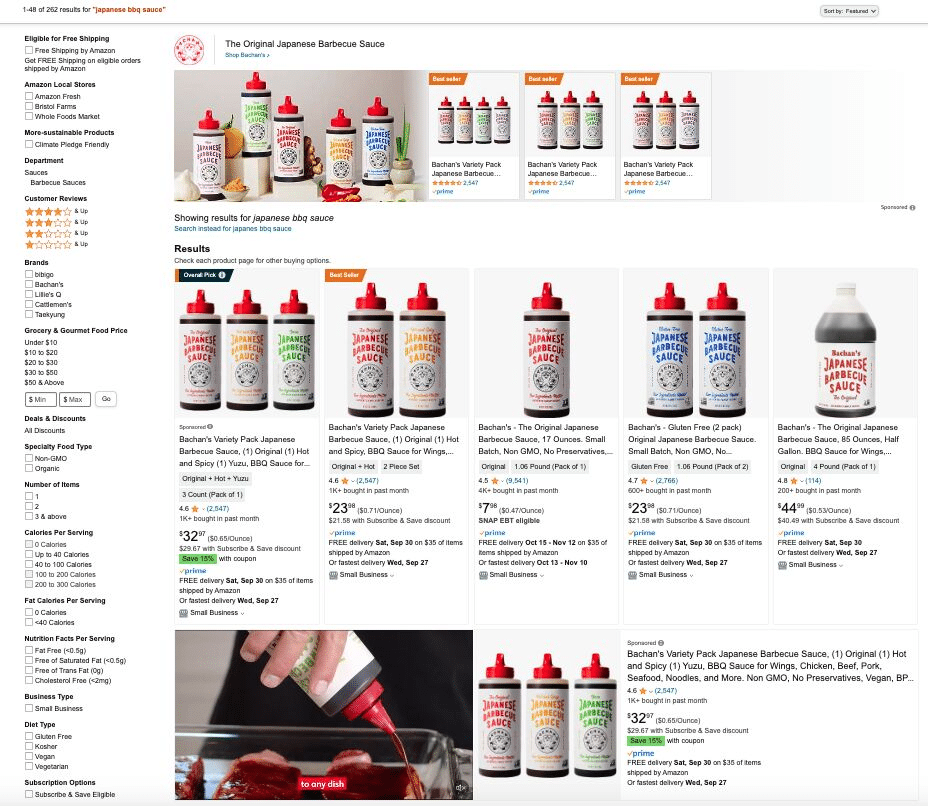
With Amazon, one advertiser can easily dominate a vast amount of real estate on the search results page.

Check out this search for “Japanese BBQ sauce” on Amazon.com. One advertiser controls the whole page:

Japanese BBQ sauce

This kind of dominance of the SERP could never be achieved with Google Ads today.

While there are ways to game this with Google, such as opening multiple accounts, this violates Google’s policy, and if caught, an advertiser risks having all their accounts closed down.

Whereas with Amazon, this allowed and even encouraged. Your ecommerce brand can own the entire SERP if it wants to.

Amazon presents a better opportunity for ecommerce advertisers

While Google has more search volume and can be an effective platform, for a savvy ecommerce business Amazon Ads presents more opportunities. The key reasons in favor of Amazon Ads are: 

  • More product searches than Google Ads.
  • Better ROAS.
  • Better conversion rates.
  • Easier and better tracking.
  • Easier to compete for new businesses.
  • Easier to rank long-term.
  • Ability to dominate the entire SERP.

Dig deeper: Amazon advertising optimizations to crush Q4

The post 5 reasons Amazon Ads is better than Google Ads for ecommerce appeared first on Search Engine Land.

Original source: https://searchengineland.com/amazon-ads-vs-google-ads-ecommerce-433186