Why and When Do You Need Heat Pump Maintenance?

Home Business Magazine Online

Like all other electrical equipment, your heat pump requires regular care and maintenance. If you don’t inspect it regularly, it’ll reduce its lifespan and cause frequent electrical problems.

The best part about today’s heat pumps is that they can conserve energy very efficiently and work at great speeds. In fact, studies have shown that a modern heat pump can reduce electric consumption by 65% as compared to furnaces or baseboard heaters.

So, if you’re not sure when or how to maintain your heat pump, this think-piece can help!

How Does a Heat Pump Work?

It’s important that you understand how a heat pump functions and only then you’ll be able to maintain it efficiently.

Heat pumps collect heat from one area and then spread it to another to help keep a house warm or cool.

When it comes to cooling, heat pumps absorb heat from inside the house and then dissipate it outdoors, quite similar to how air conditioners work. One very important component of heat pumps is the refrigerant, which is a fluid that absorbs heat.

The main idea behind a heat pump is to absorb heat and transfer it efficiently throughout the system, like a refrigerator, since it’s easier to move heat energy that way.

When Should You Repair Your Heat Pumps?

Depending on where you stay, what model of heat pump you have, and how well you’re taking care of it, you’ll have to repair or clean it at least once a month.

Most importantly, remember to follow the guidelines mentioned by the manufacturer. If you overdo the cleaning or repairing, the pump might instead malfunction.

For heat pump installations, you’ll have to get in touch with a company that understands the specific weather conditions that the area experiences. For example, if you are located in Seattle, Washington, you’ll need to know more about heat pump installation in Seattle. You’ll have to get in touch with a company there that understands the specific weather conditions that this area experiences.

Remember, dirty filters or coils can greatly reduce the pump’s speed, as well as accumulation of dirt, debris, or microbial growth.

How to Maintain Your Heat Pump?

Heat pump maintenance is not a herculean task, but only if you know the right tricks to do it.

  • Inspect the ducts, filters, and indoor coil every month for dirt or other obstructions.
  • Checking the duct leakage. In case you find it leaking, you’ll have to seal it yourself or ask a professional for help.
  • Measuring the optimum airflow speed and checking if your heat pump is able to function at the optimum level.
  • Lubricating the motor once every one or two months and regularly inspecting the system belts to check if they are tight enough or not.
  • Verifying the accurate electric control and seeing that the heat is being locked out when the thermostat is set to the cooling mode.
  • Checking if there are any leaky or faulty electrical lines or wires connected to the heat pump. If you do find a stray or faulty wire, immediately call an electrician for help

Tip: It may appear a lot of work to do all that alone; you can also hire an expert who can do it for you – in less time & more efficiently.

Advantages of maintaining your heat pump

Maintenance may look like a labor-intensive & cost-intensive task, but when you look at the advantages that it can offer, it will look like a tiny inconvenience. So, here’s a glimpse for you:

Improved safety

Other than your heating system working well, regular maintenance will ensure that everything is in place and works according to the local safety guidelines.

Cost saving

Regular maintenance for heat pump maintenance prevents you from spending a lot on repairs. If done well, it will maximize the life of your heat pump and even efficiency.

Better air quality

Of course, the main purpose of a clean and well-maintained heat pump is to improve air quality. Your home will be free of allergens, fungus, dust, and other harmful microorganisms that often accumulate on under-maintained heating systems.

Longer lifespan

It, of course, comes as no surprise that maintaining your heat pump is the key to its long life.

Less stress

If you have regular maintenance scheduled, you don’t have to suffer the inconvenience when your heat pump breaks down.

Over to you

So, this was all about heat pump maintenance. If you have more queries, you can always reach out to your nearest heating system professionals.

You can also inquire if they offer scheduled maintenance programs – learn more about them and sign up. Honestly, it may feel like an additional cost currently, but when you see your neighbors paying big repair bills, you will thank your stars!

The post Why and When Do You Need Heat Pump Maintenance? appeared first on Home Business Magazine.

Original source: https://homebusinessmag.com/lifestyles/home-improvement/why-when-need-heat-pump-maintenance/

CPQ and CRM: What Is the Difference?

Home Business Magazine Online

In the digital era, an efficient sales cycle is essential to business success and prosperity. Two key tools that enterprises often consider to optimize sales are CRM and CPQ software. While both have been created to streamline sales, it’s important to understand the distinctions between these two systems.

The Role of CPQ and CRM in Business Processes

CPQ and CRM are crucial for driving sales in a customer-centered world. A custom-tailored CPQ solution can streamline the quoting for sophisticated products and deliver accurate quotes almost instantly. Implementation of a CRM solution facilitates customer interaction management and provides a detailed view of customer relationships. CPQ & CRM integration creates a powerful synergy that enhances workflow efficiency and boosts customer satisfaction.

Sales reps can leverage CRM data to better understand customer needs, and use CPQ tools to provide tailored, precise quotes quickly. This integration not only improves the accuracy and speed of sales transactions but also enhances client engagement and loyalty, driving overall business growth and operational efficiency.

What Is CRM? Key Features and Functionality

CRM (stands for “Customer Relationship Management”) software is primarily focused on managing client data and interactions. It helps sales reps track leads, manage contacts, and monitor the sales pipeline. CRM platforms create a centralized in-house hub for all client-related data, enabling enhanced collaboration and visibility across the organization.

Key features:

  • Contact management
  • Sales management
  • Lead management & marketing automation
  • Customer service management
  • Email & social media integration
  • Security and data privacy

What Is CPQ? Key Features and Functionality

CPQ (an acronym that stands for “Configure, Price, Quote”) software has been specifically designed to streamline the quoting and offer generation process. It allows sales teams to quickly configure complex products or services, generate accurate pricing, and create professional-looking quotes. CPQ solutions can be integrated with CRM systems to provide a seamless experience for sales reps.

Key features:

  • Price management
  • Quote management
  • Contract management
  • Product configuration and catalog management
  • Dashboard and reporting
  • AI-driven analytics

CPQ vs CRM: Key Differences

CPQ and CRM systems, while often used together, serve distinct purposes within an organization.

CRM systems are designed to manage customer relationships; they store and organize customer data, track interactions & sales opportunities, and provide insights into customer behavior and preferences. CRMs are essential for managing the entire customer lifecycle, from lead generation to after-sales support.

CPQ systems are primarily focused on streamlining the sales process by enabling the configuration of complex products, ensuring accurate pricing based on various rules and discounts, and generating detailed quotes swiftly. They handle the intricacies of product customization, pricing strategies, and quote management, which are crucial for efficient and error-free sales transactions.

The key difference lies in their focus: CPQ is sales-centric, aimed at optimizing the quoting process, while CRM is customer-centric, aimed at enhancing customer interactions and relationships. Together, they provide a comprehensive solution for managing both sales processes and customer engagement.

By understanding the unique capabilities of CRM and CPQ, businesses can make informed decisions on which solution, or combination of solutions, best fits their specific needs and helps them achieve their sales and revenue goals.

Benefits of Using Both CRM and CPQ

CPQ and CRM are two powerful tools that can work in tandem to streamline your sales process and drive business growth. By integrating these solutions, you can unlock a level of efficiency and customer insight that will give your organization a significant competitive advantage.

Key benefits of CPQ and CRM integration:

  • Centralized database
  • Guided selling
  • Shorter sales cycle
  • Seamless workflow
  • Better visibility
  • Minimal admin time
  • Additional sales opportunities (up-selling & cross-selling)
  • Improved customer experience
  • Data-based insights for strategic planning

At the heart of this integration is the ability to provide sales reps with a comprehensive view of each customer. CRM systems capture valuable customer data, from contact details to purchase history and communication logs. When combined with a robust CPQ platform, this data can be leveraged to generate accurate, customized quotes that align perfectly with each customer’s unique needs and preferences.

The personalization not only improves the customer experience but also increases the chances of closing the sale.

Moreover, the integration of CPQ and CRM allows for greater visibility and control over the entire sales cycle. Sales managers can track the progress of quotes, monitor pipeline activity, and determine aspects for improvement. The data-based approach enables more informed strategic planning and helps enterprises optimize sales strategies for maximum impact.

Investing in the CPQ and CRM integration is a strategic move that can pay dividends for years to come. By empowering a sales team with the right tools and precious insights, you can streamline operations, grade up the customer experience, and prepare the enterprise for sustained growth and success.

How to Choose the Right CPQ Software?

Choosing the right CPQ tool might be challenging because you have to consider various factors to ensure the solution meets your business needs and integrates well with the existing infrastructure. Here are some steps to guide you in the selection process:

  1. Identify the requirements and challenges, for instance, product complexity, pricing rules, quote accuracy, and the need for automation.
  2. Determine the essential functionality you need.
  3. Ensure the CPQ tool can be integrated into the existing IT landscape.
  4. Look for a user-friendly CPQ solution.
  5. Opt for a CPQ instrument that can scale and adapt to the changing business requirements.
  6. Research potential vendors and assess their reputation in the market. Look for customer reviews, case studies, and testimonials. Besides, consider the level of support and training provided by the vendor.
  7. Consider the total cost and evaluate the potential ROI.
  8. Ensure the CPQ solution adheres to industry standards and data security.

By carefully considering these factors, you can select a CPQ tool that aligns with your corporate goals, enhances your sales, and delivers long-term value.

CLARITY delivers custom-tailored CPQ instruments to address industry-specific demands, streamline routine tasks, and increase revenue. Automation of quote/offer generation optimizes the revenue lifecycle, leads to higher-scale deals, and boosts business growth.

The post CPQ and CRM: What Is the Difference? appeared first on Home Business Magazine.

Original source: https://homebusinessmag.com/home-office/internet-technology/cpq-crm-what-difference/

Google AI Overviews are an evolution, not a revolution

Home Business

After all the huffing and puffing, Google’s SGE-turned-AI Overviews rolled out across 84% of searches – only to be rolled back to 15%.

Temporarily. Most likely. For now. Equally likely to roll out someday soon.

Let’s all take a collective pause and take a deep breath. It’s all gonna be OK.

For all SEO has changed over the past two decades, it actually hasn’t changed all that much.

Here’s why and how to forge ahead in the meantime.

Search cannibalization has already been happening for years – AI Overviews just continue that trend

On the one hand, AI Overviews will create new “losers,” cannibalizing search traffic for certain sites and specific query types.

But on the other, this is nothing new. 

I’d argue it’s more of an evolution of what’s already been happening under the surface for many, many years.  

You see, savvy SEOs have been picking up the “zero-click SERP” phenomenon since at least 2018.

That only accelerated through 2019, into 2022 and today. 

Where AI Overviews are poised to continue displaying automated listings, instant answers and new SERP layouts – all at the expense of the traditional “free” organic 10 blue links.

But all of this predates even 2018. 

Google’s Knowledge Graph already “answered roughly one-third of the 100-billion monthly searches” dating back to mid-2016. And that number ballooned to 500 billion facts by 2020.

Google any black-and-white, concrete query like “European date format” and a searcher sees the actual answer (scraped from the underlying content) within seconds.

Google - European date format

There are literally countless examples of this trend. 

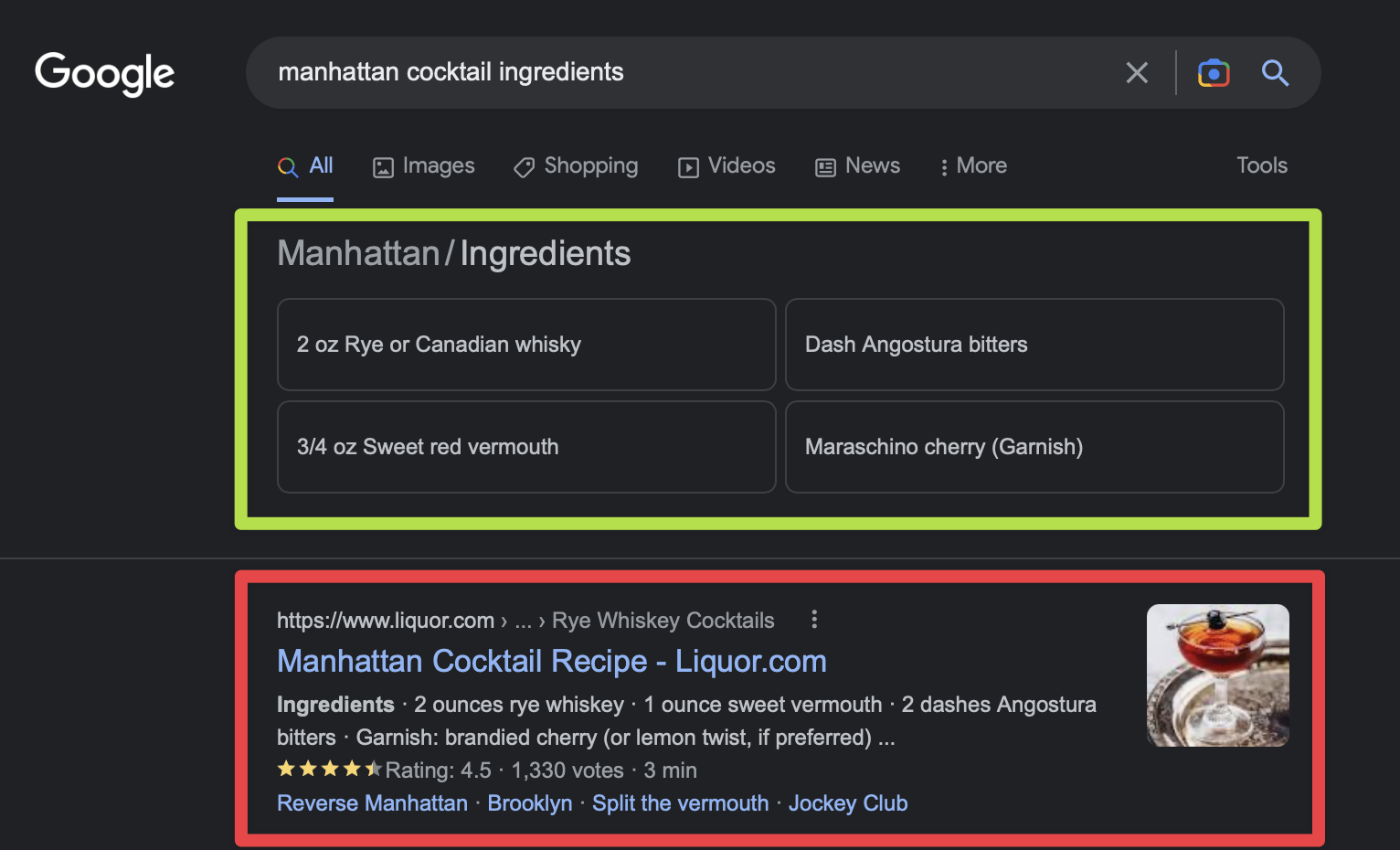
When it’s time to get your drink on after a long Friday of trying to explain AI Overviews to upper management and you’re met with a Manhattan cocktail recipe – instead of needing to click on the publisher who actually helped populate each answer.

Google - Manhattan cocktail ingredients

The point is that AI Overviews simply accelerate a preexisting trend. 

Sure, new developments will continue long into the future, continuing to force SEOs to evolve on a daily basis (or seemingly hourly at this point).

But, the silver lining is that there is still plenty of “blue ocean” to explore. 

While SEO has changed greatly over the past few decades, the underlying fundamentals have remained relatively unchanged.

That’s the only benefit of being old in the SEO space. 

Do you remember when “SEO died” the first few times because of Panda, Penguin and a slew of other stupidly named, animal-based algorithm updates that sent shivers down marketers’ collective spines?

(And how come they gotta name all these after the cutest animals in the zoo?)

C’mon, were any of you really surprised over the last few weeks?

The stuff SEOs have been theorizing for years, like authorship to domain ratings and more – despite “what Google says” – is actually kinda, sorta legit.

SEOs (and digital marketers in general) should create good content for their audience first and not overrely on a single channel.

Oh, and the fact that links still actually matter

Shock! Surprise!

So, if you were actually doing good SEO to begin with – not just publishing AI crap in the last 12 months and expecting instant results – it’s largely business as usual. 

Otherwise, here’s where you start.

Tip 1: Prioritize keywords and topics based on potential ROI over the next 6, 12 and 18+ months

Everyone has access to keyword data. That’s not the issue.

The problem in SEO since Day 1 has always been what you DO with said data.

How you interpret it, how you analyze it and how you make decisions based on it.

This is only more true in a world of AI Overviews continuing to cannibalize top-of-funnel queries.

And it’s why generic data-vomiting keyword research strategies have always been doomed to fail from the start.

Especially now.

For instance, take a look at “international SEO.” 

It is a big, juicy keyword that gets nerdy marketers’ hearts aflutter. 

And yet? For basically everyone out there reading this – potentially as many as 99.99% of you – a complete waste of time.

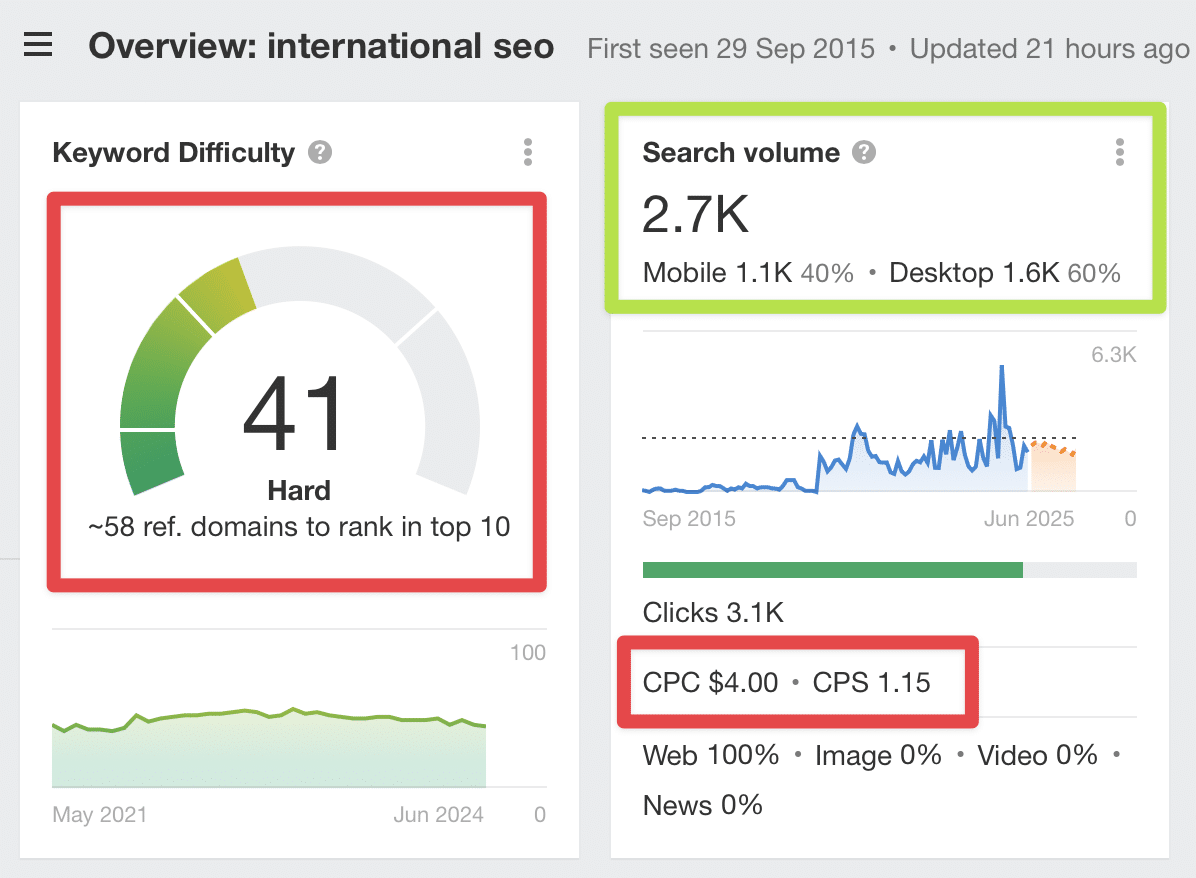
Keyword overview - international SEO

You already know it’s a “difficult” keyword. What most miss is that “Keyword Difficulty” is biased in most, if not all, tools. It essentially refers to the number of external links to each page currently ranking in the top spots.

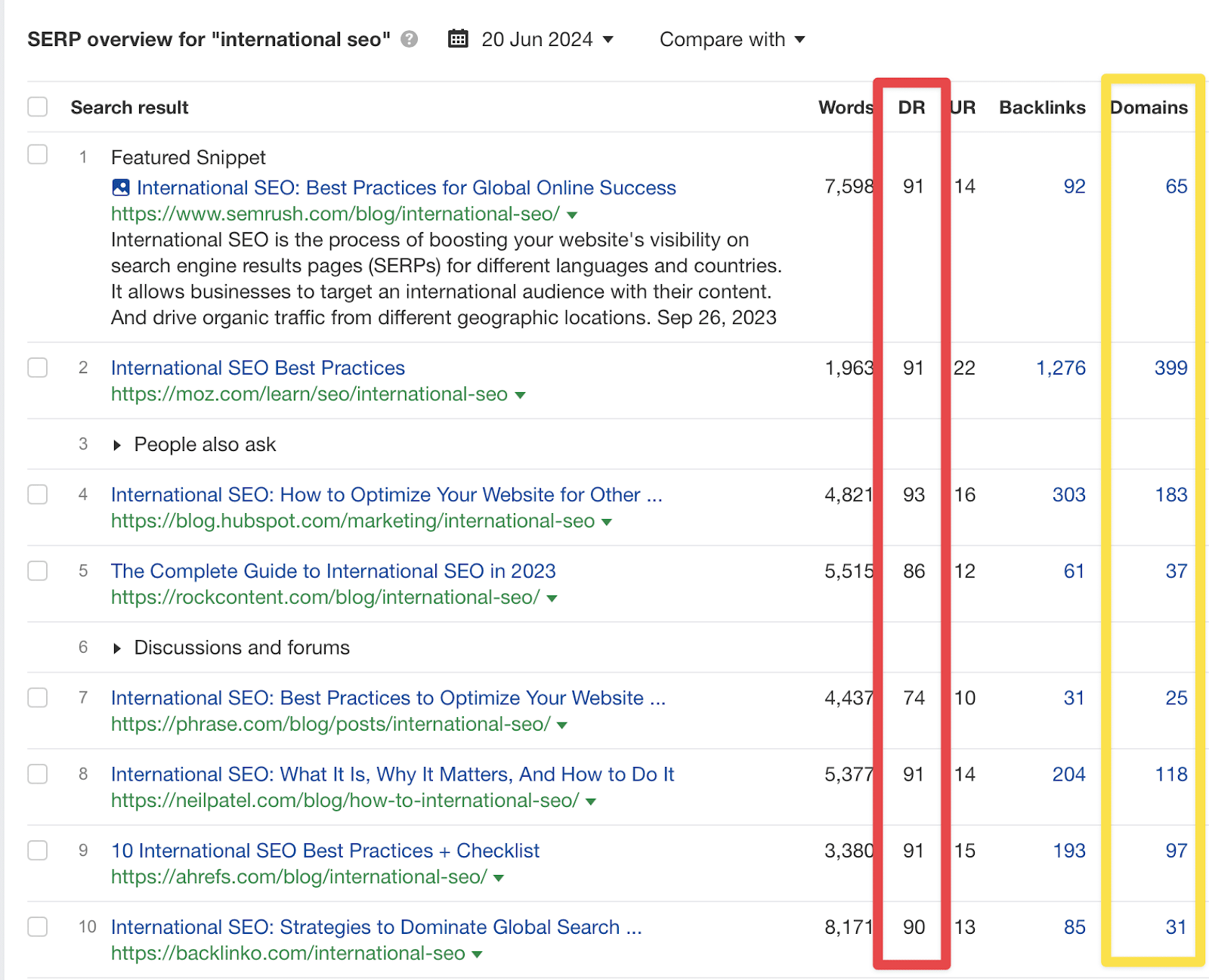
So, “page-level” competitiveness, in other words, is vs. actually taking into account the overall strength of the brands currently ranking.

Take a quick look at the brands ranking:

SERP overview - international SEO

This is in addition to the disappointingly low purchase intent (see the advertising-based CPC estimate as a half-decent proxy).

The point? 

The vast majority of you have no business even creating a single piece of content around this in the first place – unless… 

  • You’re publishing on a DR ~90+ site to begin with. 
  • You have years to wait. 
  • Or you super patient bosses. (Do they even exist?)

None of this has anything to do with what Google is doing with AI Overviews on this query yet, either.

Get the daily newsletter search marketers rely on.


Tip 2: Always start with high customer intent + product relevance, then expand out 

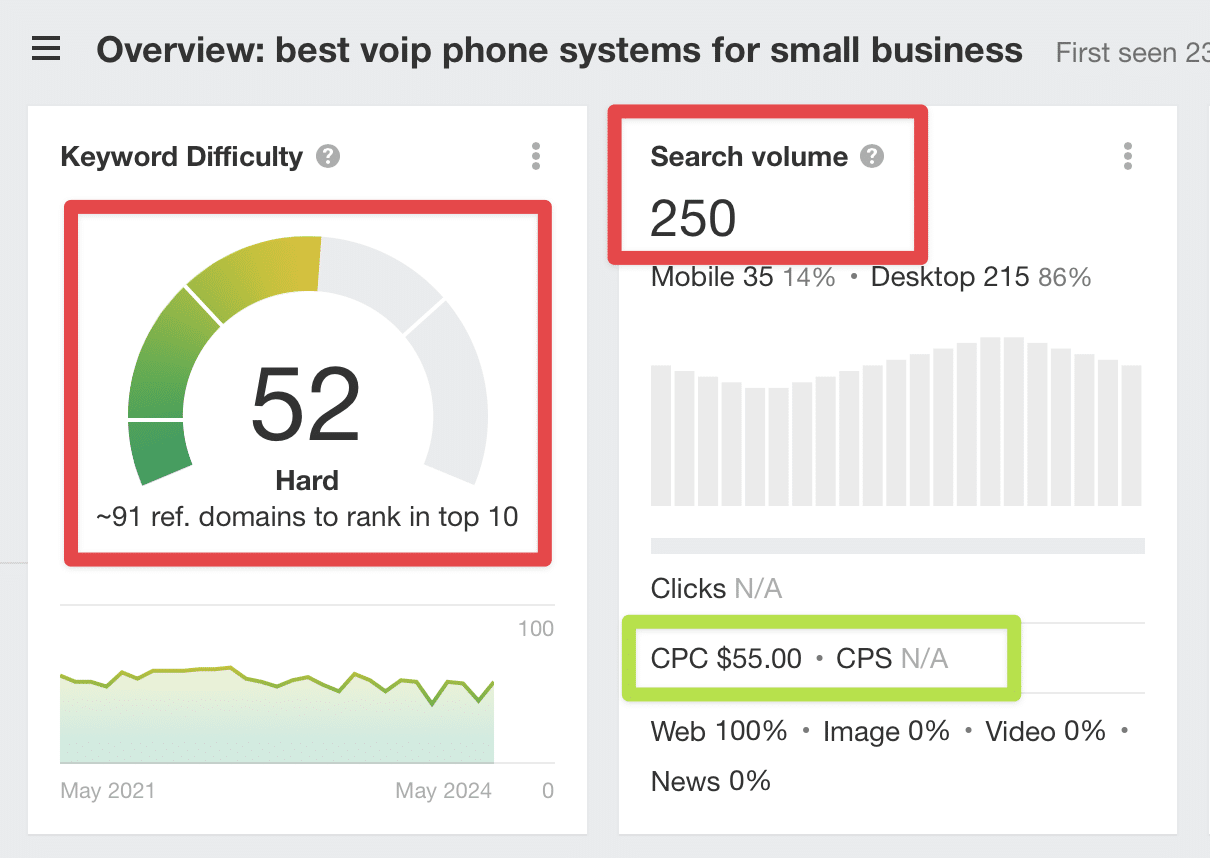
Now, check out this admittedly very difficult query for “best voip phone systems for small business”:

Keyword overview - best voip phone systems for small business

Tough, no doubt. Low-ish volume, too.

However, if it’s highly relevant from a business perspective, it can also be incredibly lucrative due to the high intent.

If you’re on a small-ish site or a shoestring budget, you’ll probably need to Beachhead Principle your way to the top over a series of months (if not 12+). 

However, the point is that this is actually worth the fight. 

This is especially true with B2B SEO and its effect on CPLs, where high purchasing intent is often better than raw volume.

So, if next year’s SEO results rely on your work this year, then you don’t have any real time to waste stressing about things you can control. 

Or publishing on topics you have no business in targeting in the first place.

So instead, keep doubling down on the things that won’t change anytime in the near future, like:

Tip 3: Focus your time, energy and budget on content + queries that are least likely to be disrupted anytime soon 

AI has two implications in the content and SEO world in the foreseeable future:

  • AI Overviews will continue to provide instant answers to black-and-white queries that are already ready to answer.
  • AI in content creation can also similarly create passable-if-uninspiring black-and-white content for similarly concrete queries.

Where AI Overviews and AI content creation, in general, still largely suck is subjectivity. 

It can’t handle any nuance, persuasion, credibility or gray area.

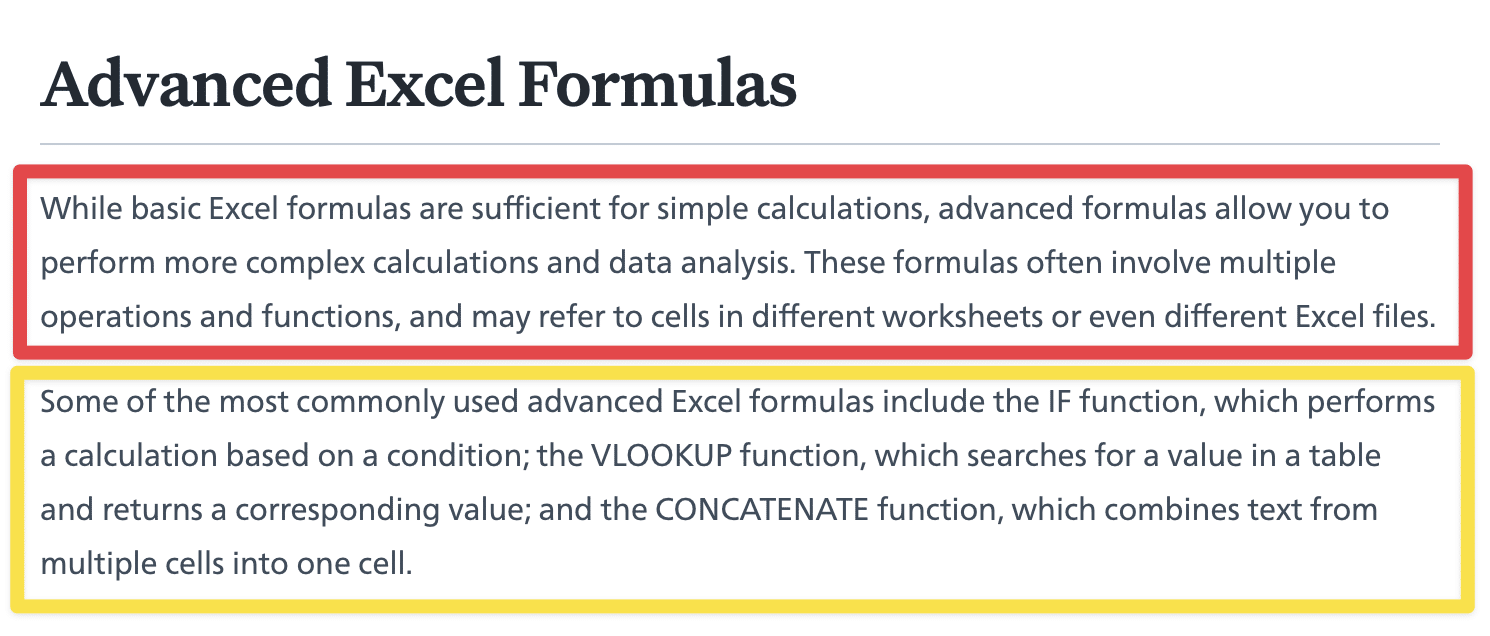
That’s why it can tell you what “advanced Excel formulas” are in theory, but it: 

  • Can’t show you any advanced Excel formulas. 
  • Can’t explain why they matter or how they help you.
  • Can’t display some of the most common advanced Excel formulas for the right type of reader or audience member based on profession.
  • Can’t put them into a usable format like a free template or tool that does the calculations for you.
Advanced Excel formula - AI-generated content

Said another way: 

AI Overviews and AI content will always struggle mightily to handle the middle and bottom-of-the-funnel terms. Or the same ones that actually drive leads and sales.

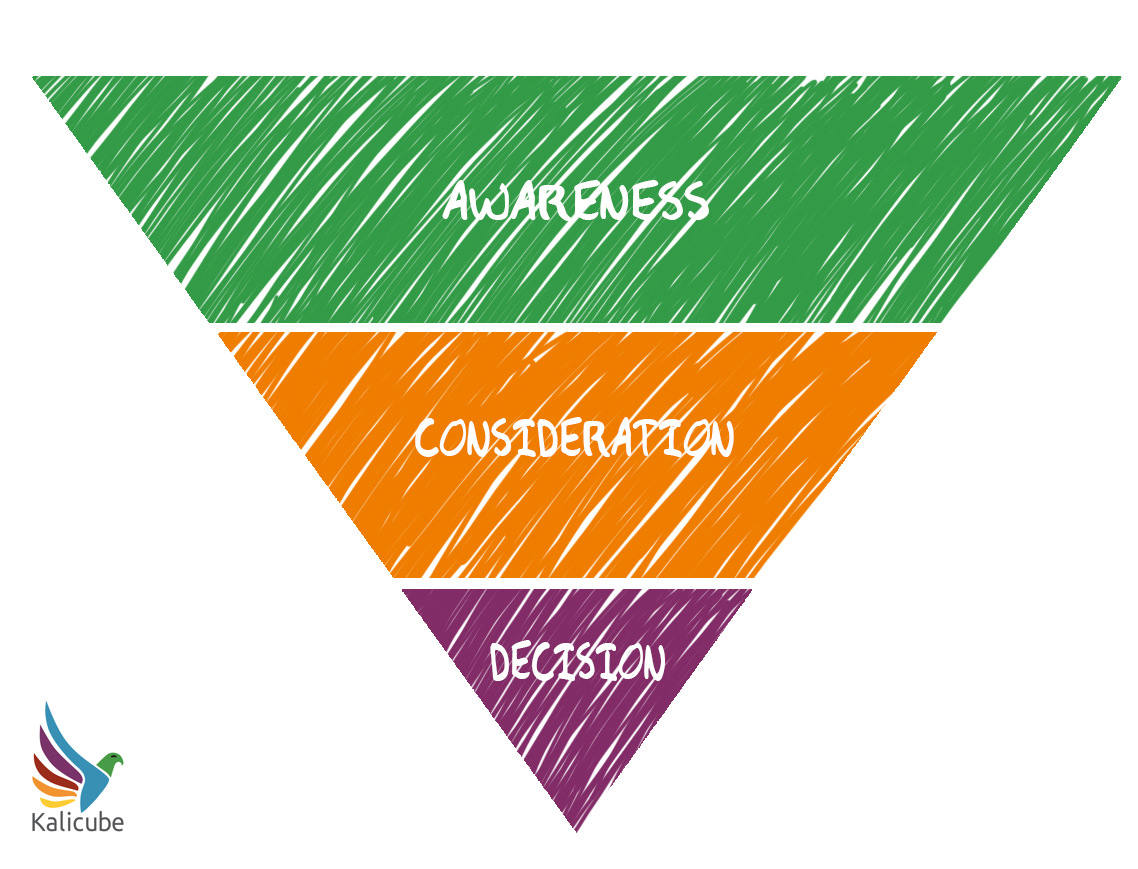
The 3 customer journey stages

Here’s a final example to help drive this point home further.

Quick:

  • What is the “best dive watch”?

Let’s Google it!

Google - best dive watches

The top shopping listings include:

  • A couple of indie automatic watch brands in the ~$700-1400+ range.
  • A couple of quartz movements (boooooo!) in the ~$200-600 range,
  • A couple of smart watches, which, while great for working out, definitely aren’t “dive watches” at all.

What’s missing for the watch nerds out there?

Any actual real dive watches!

No Seikos, no Tudor, no Omegas, no Rolexes. 

Shoot, not even a budget-friendly G-Shock in sight for the hipsters.

In other words, any “smart” watch consumer (read: the kind more willing to spend more on more watches) would know that these are all largely terrible results to that question. 

Go watch a couple of YouTube videos on “best dive watches” and then cross-reference with this list. 

None of these brands or watches would actually make the cut in any real enthusiast’s list of the “best dive watches.”  

Now. Why are these results so terrible?

’Cause this is actually a nuanced topic!

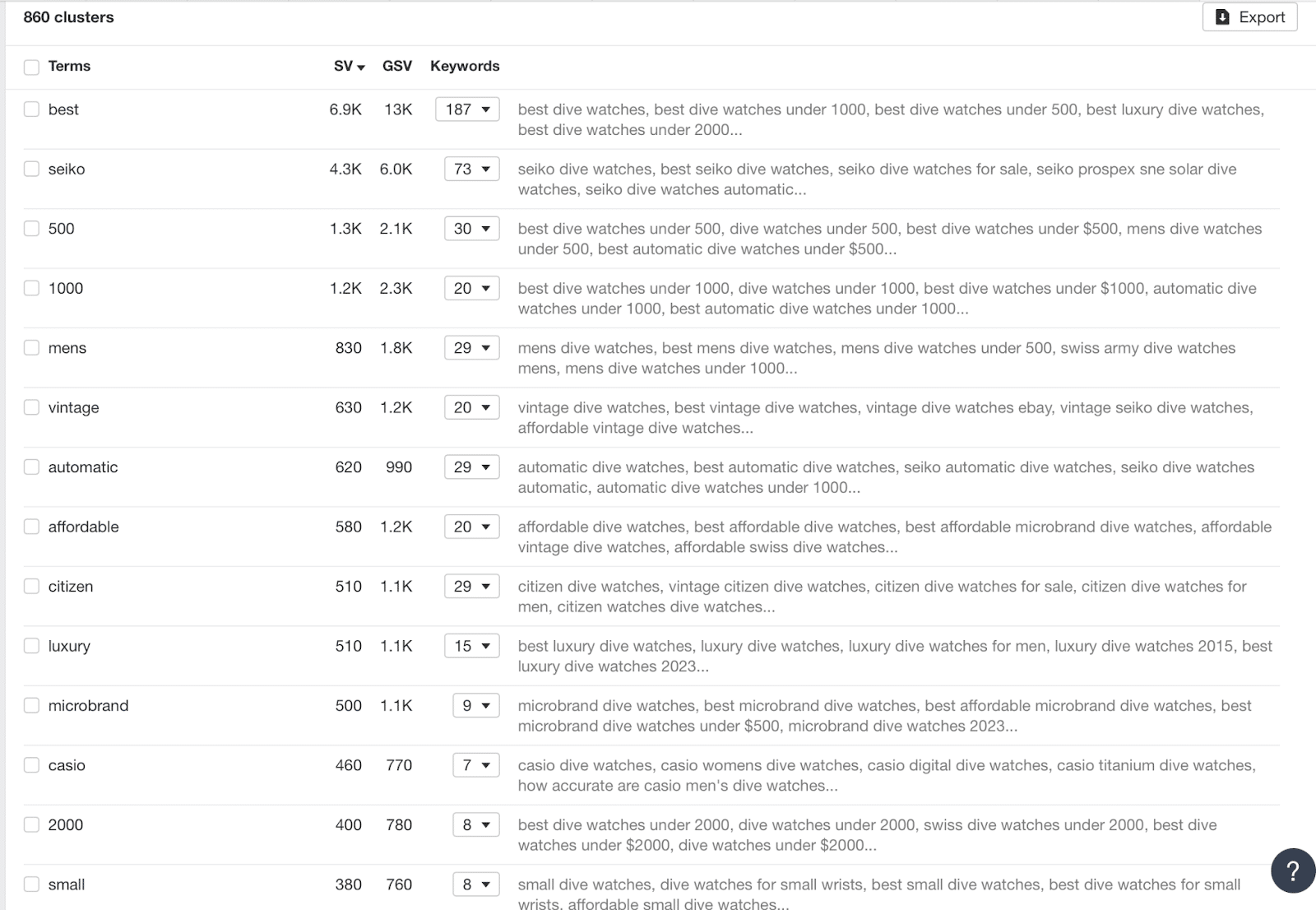
Head over to Ahrefs and you’ll see that there are over 860 (!) potential clusters for “dive watches.”

Translation: Lots of gray area and nuance.

Ahrefs potential clusters for dive watches

There’s tons of volume in the “affordable” and “$500-1,000” arena. 

So, combined with the last two tips: would Rolex target these keywords, for instance, even if they could win top SERP spots? 

Nope. 

‘Cause they’d be flooded with a bunch of traffic with only $1,000 to drop on a watch vs. the ~$10,000+ it would actually take to get your hands on one.

Instead, Tudor or Omega or Rolex would spend more time on the “luxury” cluster, whereas a second-hand market or broker might laser-focus on the “vintage” one. 

Beyond the hype: Adapting your SEO strategies for Google’s AI Overviews

The writing is undoubtedly on the wall.

AI Overviews will evolve the SERP landscape and continue to erode the most easily answerable queries online.

But none of this is new. Or that surprising frankly. 

Because it’s simply the continued acceleration of pre-existing trends that have already been occurring since at least 2016.

So yes, AI Overviews will continue to erode TOFU topics. But, that’s not where the real money is, anyway.

Instead, double down on prioritizing the right keywords at the right time, focusing on queries that bring buyers and not eyeballs, re-creating the typical buyer’s journey for how people shop for your stuff anyway.

Then, just focus on beating what’s in front of you.

It may not be the sexiest strategy. But it’s predictably profitable. 

And that’s ultimately why we should all be in this in the first place. 

Original source: https://searchengineland.com/google-ai-overviews-evolution-revolution-443454

How to use the ‘perfect click’ to optimize for AI-assisted search results

What is the ‘perfect click’ and how to optimize for it

The perfect click refers to a click from a SERP that takes the user directly to the single best webpage or resource that directly solves their problem. 

The ultimate aim of assistive search features like Google’s AI Overviews and Bing’s Copilot is to bring the user down the funnel and get them to the Perfect Click without leaving the search interface (for now, that is a SERP).

Off-SERP assistive engines such as ChatGPT and Perplexity operate from a similar perspective. However, for this article, I will focus on Google’s AI Overviews and Bing Copilot, which are simply assistive engines integrated into the SERPs.

The perfect click is official

Fabrice Canel, Principal Program Manager at Microsoft Bing, has confirmed that they use this concept and term internally and that they are guiding the user on SERP to the ideal bottom-of-the-funnel action – conversion. 

Google hasn’t communicated about this but certainly has the same concept, perhaps by a different name.

A typical three-step marketing acquisition funnel

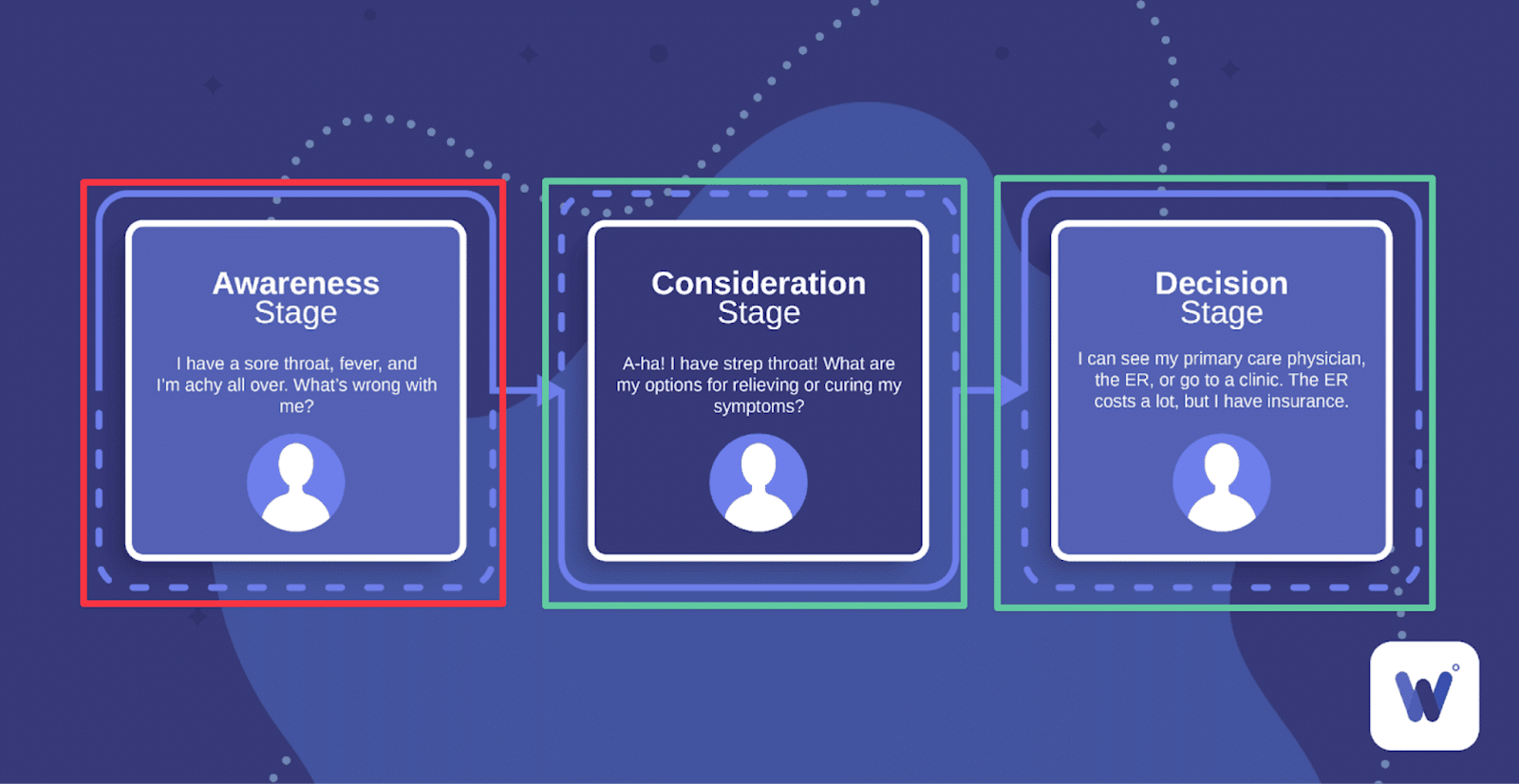
Marketers often represent acquisition as a funnel with three stages:

  • Awareness: Where the target audience becomes aware of a problem they need to solve and research to find the solution to that problem.
  • Consideration: Where the user researches which providers (company or person) offer a viable solution, and narrows down their choices to a select few.
  • Decision: Where the user makes their final choice about the most suitable solution for their problem and the best provider of that solution.
A typical three-step marketing acquisition funnel

Google’s AI Overviews mimics the acquisition funnel

The aim of Google’s AI Overviews and Bing’s Copilot is to guide the user through the funnel from awareness to the final decision. 

The assistive engine does this through a conversation between the human user and the machine. The user asks questions, and the assistive engine answers the question by:

  • Providing answers in the form of summaries from information found around the web. 
  • Making research suggestions based on behavioral data, query pools and information from the web. 
  • Making recommendations about solution providers based on algorithmic evaluations of E-E-A-T (N-E-E-A-T) credibility.

How to build a successful strategy for Google’s AI Overviews 

This strategy is universal. Bing Copilot, ChatGPT, Perplexity and Google Gemini all function the same way, and this approach satisfies the fundamental pillars and ticks all the right boxes.

The secret to optimizing for assistive search engines and assistive SERP features is to understand:

  • How the algorithms find, digest and communicate your content to users in the SERP (traditional SEO).
  • How your content fits into the funnel (marketing).
  • That the “who” behind the content is key (entity optimization).

Only the last point requires skills and strategies that are new. Luckily, it is very simple since it focuses on how well the algorithms understand the website owner (generally a corporation, but sometimes a person) and the content creator (generally a person, but sometimes a corporation).

Focus on the nature of the conversation between the human and the machine 

The human has a single goal: to find the best solution to their problem. The machine is designed to fulfill a single function: guide the human to the best solution to their problem. This is the perfect match.

The human starts this journey with sketchy knowledge of the problem, a very limited understanding of the possible solutions and little or no idea about credible solution providers.

The human is confident that the machine understands the problem, has an encyclopedic knowledge of the possible solutions and can reliably evaluate the credibility of the solution providers.

The machine/algorithm is in control.

The machine is single-minded about the funnel

The algorithms want to guide the human user down the funnel:

  • Provide helpful research information and advice in a way that reduces the time and effort a person needs to invest in research.
  • Identify the providers who can best solve the problem for the human user.
  • Help the human user identify the solution provider they are comfortable with.

You need to become the focus of the conversation between machine and human

As an SEO, you must influence the algorithms to act in your favor and guide their users to you rather than your competitors.

Let’s look at the marketing funnel again, adding what you want the machine to do for you on the left-hand side.

The perfect click in the context of the marketing funnel

Awareness

  • If the human user is unaware of you, you want the assistive engine to introduce you to the conversation. 
  • If the user is aware of you, then you want to ensure it doesn’t lead the user away from you. 
  • The human user is mostly in control at this stage.

Consideration

  • You are in the conversation, and you want the assistive engine to systematically place you first in every list of options and constantly re-introduce you to the conversation. 
  • The human user still feels in control but is unlikely to insist on you as a candidate for consideration if the assistive engine doesn’t naturally keep you in the conversation.

Decision

  • The choice is being narrowed down to one. The perfect click. 
  • The assistive engine (or assistive search feature) is now in control. 
  • You need to ensure that it prioritizes you and doesn’t guide the human user toward your competitor as a better solution provider. 

Get the daily newsletter search marketers rely on.


Steps you can take to become the focus of the conversation between machine and human

To create a situation where the assistive engine algorithms make you the focus of its conversation with human users:

  • First, you must communicate understanding about who you are, what you offer and who you serve. 
  • Second, establish your credibility.
  • Third, ensure that you provide deliverable content that will ensure the assistive engine reliably includes you in the conversation more often than not.
The perfect click

Your aim is to become the ideal candidate for the perfect click 

Assistive engines like ChatGPT and assistive search features like Google’s AI Overviews aim to get the user to the perfect click within their own walled garden. Your aim is that the Perfect Click they choose to present to the user is you. 

There is only one single perfect click. the perfect click is the click that converts. you cannot allow the perfect click to go to your competitor.

To get the perfect click, focus on three pillars in this order of importance: 

  • Understanding (you need to educate it about yourself).
  • Credibility (you need to convince it you are the most legitimate solution provider).
  • Deliverability (you need to provide the educational content that will encourage it to cite you as it guides people to the perfect click).

The key to optimizing for Google’s AI Overviews: Build the traditional marketing funnel

If you look at the illustration of the funnel above, it seems that we are building the funnel upside down. That is a question of perspective. A perspective that many people have 

Google can only start to consider your credibility as a solution if it understands who you are, what you offer and who you serve. 

Once it understands who you are and believes that you are a credible solution provider, it will be enthusiastic about introducing you to the conversation it is having with its human user. 

Your content will only be a candidate for visibility on assistive features of search engines, answer engines and assistive engines if the algorithms understand you, your offer and your credibility.

These engines are designed to guide the human user down the funnel to the best (most credible or recommendable) solution to their problem. 

They need to:

  • Understand who you are (solution provider).
  • Be convinced of your credibility and trustworthiness to deliver that solution.
  • Have access to your branded content so it can deliver a convincing argument for you.

The last point is hugely important since it demonstrates that the assistive engines and their algorithms are delivering your sales pitch for you.

The perfect click as the future of SEO

How can you ensure that the assistive engines and assistive search features reliably and regularly bring the right people to the perfect click?

Tell search engines clearly who you are, what you do, and why you’re trustworthy. Then, provide detailed information so they can consistently recommend you to users and guide potential customers through your sales process, leading them to click directly on your most conversion-ready page.

Original source: https://searchengineland.com/perfect-click-optimize-ai-assisted-search-results-443472

How to make money writing a TV script

Updated 24th June 2024

Do you watch a lot of TV dramas and soaps and fancy your chances of making money writing a TV script?

Well, it’s not an easy task….but it’s not impossible either.

I must repeat, though, that IT IS VERY HARD to make money writing a TV script.

Thousands of people are trying and not getting anywhere. So don’t give up your day job until you are sure you have a commission. To start with, this has to be something you do in your spare time because you love it. If you get there, though, the personal and financial rewards can be huge.

What’s Involved in Writing a TV Script?

Script editors want to know you can produce engaging story ideas.

Pretty obviously you need to

  • have an interest in TV drama and soaps
  • be able to write creatively
  • have a willingness to learn and adapt to write in a way that script editors would be interested in

Ideally, script editors and producers want to know that you can come up with your own clever story ideas.

It helps to have previously published creative writing so that you can prove that you are not an amateur. This could include

  • stories published in magazines
  • a published novel (even if you’ve published it yourself, at least it’s something to show them)
  • having a radio drama broadcast
  • having some radio or TV sketches broadcast

Some people go straight into TV script writing but most start small and work their way up.

It’s also helpful to get some training in creative writing, particularly in screenwriting.

There are adult evening classes for various types of creative writing throughout the country, including film and TV screenwriting. It’s definitely worth doing some of those if you’re serious about it.

Classes will not only provide tools and ideas for writing dramas, but also deadlines for writing the next section of your script and useful feedback as you develop it.

You should also read up on the subject. Again, there are several books on both creative writing generally and on TV script-writing. Good books on script writing include:


How Do I Begin Writing for TV?

Script-writing - the clue is in the name.

Start writing!

Seriously. The only way to get into any writing work is to write…write…write…and keep writing.

Step 1: Story ideas

Before you get caught up in how to write a script, jot down the ideas you have in any order, in any format. Get the thoughts down before the spark dies and you forget what you wanted to say.

In fact, keep a notebook – or electronic device – to write down any ideas, snatches of dialogue, character descriptions and more as you have them.

Come up with skeleton stories – maybe even based on real-life situations you have experienced or heard about – and then work on fleshing them out, thinking up the back-stories for the characters and so on.

Step 2: Research

This is the fun bit: sitting on the sofa! Watch programmes in similar genres to what you are writing about and ask yourself:

  • What works?
  • What doesn’t?
  • How far can you push the boundaries?

You also need to research the production companies that specialise in your genre of script. Finding out who exactly you should send your script to can be difficult but well worth the effort. A good place to start is to look at the end credits of a show you like and see who made it.

Books

Books are a great research tool for script-writing.

Look in the “Writers’ and Artists’ Yearbook” for agents who deal with film scripts.

The BBC’s Writers Room offers advice and guidelines to new writers while ScreenSkills provide details of training in the film and television industry.

Also take a look at our ‘Useful links’ section below.

Something many new screenwriters forget to do, but is essential, is to read scripts. You can find loads of scripts online for free (starting with the Writers Room Library). Read as many as you can get your hands on, because it’ll teach you a lot about how to format a screenplay as well as the type of language you use.

For example, many writers who have written novels and turn to screenplays tend to start out using ”flowery” language in their action lines. But, when you read screenplays, you’ll see that’s not how they are written. A good place to start is to ask yourself: could I see this on screen? Can the actor show me this on screen? This can help you eliminate ‘inner thoughts of characters – a common first-time writer error – or from including backstory that isn’t seen on screen.

An example

For example, a new writer might approach an action paragraph like this:

Marnie sat on the couch, bored and thinking about the time she and Barry stole his mother’s car to joyride to McDonald’s. 

That includes lots of ‘unfilmables’: we don’t SEE that Marnie is thinking of Barry, or their car ride, and how do we know she is bored? Instead, a screenplay might say:

Marnie sits with her feet over the back of the sofa, clicking the end of a pen on and off. She reaches for the phone and dials BARRY.

All of this is action you can physically see on screen, rather than things going on inside a character’s head.

Step 3: Feedback

This is the stage when you need to show your work to other people and getting feedback, preferably within the TV industry. However your family and friends will work just as well to start off with, particularly if they are keen drama-watchers.

This is also where screenwriting classes can be particularly helpful. The class and the teacher can provide informed feedback if you read your script to them during a class.

Don’t be put off by people thinking your script needs work. Even the professionals will go through quite a few drafts until it’s finished. It’s a good idea to link into some online discussions on writer’s networks to gather and share tips and suggestions that can help your script on.

Scribe Lounge is a free online network. It was set up in the middle of the pandemic to create a community for UK screenwriters, but has now expanded internationally. They hold regular online writing classes, a free two-week online screenwriting festival (with past videos available to watch online), and some paid-for – and affordable – writing courses. There is also an active forum where you can meet other writers and share your work.

Step 4: Formatting

Many software programmes provide templates to help with script layout.


The industry does have standards with scripts, but it is by no means an exact science and there are many websites that offer help and even templates for script writing.

Professional writers’ software like Final Draft or free templates can be useful.

There are many free software programs that provide templates to help with script layout and presentation. StudioBinder is a handy resource and has lots of formatting help, including free templates like this Word one.

Make sure to check your script for spelling and grammar mistakes, and include your contact details on the title page.

Timing

Time is an important consideration in script writing.

You must also have a rough timing of your script.

One page usually equals a minute, and you should always have a minimum of ten pages. It’s good to do a group reading to properly judge the length of your script.

A good rule of thumb is that a comedy script is usually half an hour on screen, so should be between 29 – 34 pages. A drama is usually an hour, and that can be between 48 – 60 pages (remember there needs to be time for advert breaks and end credits).

Step 5: Copyright

Once you've written your script, make sure to protect it.

In the UK, once you’ve written your script, it’s already copyrighted. You don’t need to pay for copyright and, in fact, there’s no way to do so on a UK service. You might come across advice to pay for the US Copyright Office, but this isn’t necessary. Your copyright is owned under an international agreement, so it applies wherever someone reads your script.

Stolen ideas don’t happen often. Stolen scripts happen even less. The important thing is you cannot copyright an idea, only the expression of an idea. So, you could tell your friend about your script that includes aliens participating on Masterchef, and they are perfectly entitled to go away and write their own version of it. But if they used your script to make a film without your permission, that’s a stolen script.

You can always send yourself a copy of your script via registered post and leave it unopened. You will also have electronic trails of when you’ve sent your script to people on email, (such as for feedback). If you really want to register with a service, ScriptVault is the only UK service supported by the Writers Guild of Great Britain.

Solicitors can date-stamp and store your work for a fee, and there are legal websites that provide similar services if you feel you need them.

Finding Opportunities

TV commissioners are targeting script-writers from minority groups.

TV commissioners are seeking writers from ethnic minorities, LGBTQIA+ writers and disabled writers to improve the diversity on their shows behind the camera.

If you fall into any of the above categories, keep looking out for openings. There are lots of fellowships, internships, and contests which are great for gaining experience and adding to your CV.

For example, see what the BBC is looking for at the moment in their ‘Opportunities’ section. They regularly have special courses and commissions for specific groups such as black writers, writers from Ireland, writers with a disability and more.

However, if you’re not in an underrepresented group, don’t fret. There are many more opportunities for all writers. Sign up to Script Angel’s newsletter for the latest news and to hear about the best contests (UK and international) to get started in your career.


Do I Need an Agent?

The short answer is: yes. Some writers are lucky to have personal connections to production companies, or have an undeniable script that makes producers pay attention.

However, most TV writers get their work through an agent. Agents ‘sell’ you to opportunities that you wouldn’t hear of otherwise. This might be something called an open writing assignment – where a production company says ‘we need a writer of xyz for a project’ and you get selected to pitch your version of the idea. Or, they will use your script to try and sell it to a production company to make.

Agents are picky and busy. So, don’t query them when you’ve written your first script. Get lots of practice in, take classes, and find ways to boost your CV such as with contest placements. Ideally, you need two really polished (perfect!) scripts ready to show when you start looking for an agent. This shows to them that you’re serious and not a one-trick pony.

You don’t pay agents until you get work. If you have ANY agent saying that they’ll guarantee you work or will produce your script if you pay them a fee, WALK AWAY. Your agent doesn’t get paid until you do. Your fee for your script is paid to the agency, who deduct their commission (usually 10-15%) and then pay you.


How Much Can You Make Writing TV Scripts?

The aim for your script is to turn it into a TV show hit.

You can gain a few ₤100 for an ‘option’ on a TV script or thousands for a script that is syndicated around the world (think Downton Abbey). Meanwhile, a Hollywood film that does very well can earn you millions.

Your aim is for the show to be a hit and get repeated, ideally in other countries as well as Britain. That way you will get royalties for years afterwards.

Coming up with a format is the writer’s dream. This is because, once the initial series is underway, the international rights and remakes mean a steady income for you without you writing any of it! One of the best examples in recent history is Death in Paradise. Writer Robert Thorogood entered his original script into the Red Planet Prize, and not only won but got the series made. It just celebrated it’s 100th episode AND has a spin-off in Beyond Paradise, too.

If you have the talent and the skill, the most important quality you need next is persistence. Just do it.

Useful Links

six_magpie

Sign Up – Newsletter

The post How to make money writing a TV script appeared first on MoneyMagpie.

Original source: https://www.moneymagpie.com/make-money/how-to-make-money-writing-a-tv-script

CPQ and CRM: What Is the Difference?

Home Business Magazine Online

In the digital era, an efficient sales cycle is essential to business success and prosperity. Two key tools that enterprises often consider to optimize sales are CRM and CPQ software. While both have been created to streamline sales, it’s important to understand the distinctions between these two systems.

The Role of CPQ and CRM in Business Processes

CPQ and CRM are crucial for driving sales in a customer-centered world. A custom-tailored CPQ solution can streamline the quoting for sophisticated products and deliver accurate quotes almost instantly. Implementation of a CRM solution facilitates customer interaction management and provides a detailed view of customer relationships. CPQ & CRM integration creates a powerful synergy that enhances workflow efficiency and boosts customer satisfaction.

Sales reps can leverage CRM data to better understand customer needs, and use CPQ tools to provide tailored, precise quotes quickly. This integration not only improves the accuracy and speed of sales transactions but also enhances client engagement and loyalty, driving overall business growth and operational efficiency.

What Is CRM? Key Features and Functionality

CRM (stands for “Customer Relationship Management”) software is primarily focused on managing client data and interactions. It helps sales reps track leads, manage contacts, and monitor the sales pipeline. CRM platforms create a centralized in-house hub for all client-related data, enabling enhanced collaboration and visibility across the organization.

Key features:

  • Contact management
  • Sales management
  • Lead management & marketing automation
  • Customer service management
  • Email & social media integration
  • Security and data privacy

What Is CPQ? Key Features and Functionality

CPQ (an acronym that stands for “Configure, Price, Quote”) software has been specifically designed to streamline the quoting and offer generation process. It allows sales teams to quickly configure complex products or services, generate accurate pricing, and create professional-looking quotes. CPQ solutions can be integrated with CRM systems to provide a seamless experience for sales reps.

Key features:

  • Price management
  • Quote management
  • Contract management
  • Product configuration and catalog management
  • Dashboard and reporting
  • AI-driven analytics

CPQ vs CRM: Key Differences

CPQ and CRM systems, while often used together, serve distinct purposes within an organization.

CRM systems are designed to manage customer relationships; they store and organize customer data, track interactions & sales opportunities, and provide insights into customer behavior and preferences. CRMs are essential for managing the entire customer lifecycle, from lead generation to after-sales support.

CPQ systems are primarily focused on streamlining the sales process by enabling the configuration of complex products, ensuring accurate pricing based on various rules and discounts, and generating detailed quotes swiftly. They handle the intricacies of product customization, pricing strategies, and quote management, which are crucial for efficient and error-free sales transactions.

The key difference lies in their focus: CPQ is sales-centric, aimed at optimizing the quoting process, while CRM is customer-centric, aimed at enhancing customer interactions and relationships. Together, they provide a comprehensive solution for managing both sales processes and customer engagement.

By understanding the unique capabilities of CRM and CPQ, businesses can make informed decisions on which solution, or combination of solutions, best fits their specific needs and helps them achieve their sales and revenue goals.

Benefits of Using Both CRM and CPQ

CPQ and CRM are two powerful tools that can work in tandem to streamline your sales process and drive business growth. By integrating these solutions, you can unlock a level of efficiency and customer insight that will give your organization a significant competitive advantage.

Key benefits of CPQ and CRM integration:

  • Centralized database
  • Guided selling
  • Shorter sales cycle
  • Seamless workflow
  • Better visibility
  • Minimal admin time
  • Additional sales opportunities (up-selling & cross-selling)
  • Improved customer experience
  • Data-based insights for strategic planning

At the heart of this integration is the ability to provide sales reps with a comprehensive view of each customer. CRM systems capture valuable customer data, from contact details to purchase history and communication logs. When combined with a robust CPQ platform, this data can be leveraged to generate accurate, customized quotes that align perfectly with each customer’s unique needs and preferences.

The personalization not only improves the customer experience but also increases the chances of closing the sale.

Moreover, the integration of CPQ and CRM allows for greater visibility and control over the entire sales cycle. Sales managers can track the progress of quotes, monitor pipeline activity, and determine aspects for improvement. The data-based approach enables more informed strategic planning and helps enterprises optimize sales strategies for maximum impact.

Investing in the CPQ and CRM integration is a strategic move that can pay dividends for years to come. By empowering a sales team with the right tools and precious insights, you can streamline operations, grade up the customer experience, and prepare the enterprise for sustained growth and success.

How to Choose the Right CPQ Software?

Choosing the right CPQ tool might be challenging because you have to consider various factors to ensure the solution meets your business needs and integrates well with the existing infrastructure. Here are some steps to guide you in the selection process:

  1. Identify the requirements and challenges, for instance, product complexity, pricing rules, quote accuracy, and the need for automation.
  2. Determine the essential functionality you need.
  3. Ensure the CPQ tool can be integrated into the existing IT landscape.
  4. Look for a user-friendly CPQ solution.
  5. Opt for a CPQ instrument that can scale and adapt to the changing business requirements.
  6. Research potential vendors and assess their reputation in the market. Look for customer reviews, case studies, and testimonials. Besides, consider the level of support and training provided by the vendor.
  7. Consider the total cost and evaluate the potential ROI.
  8. Ensure the CPQ solution adheres to industry standards and data security.

By carefully considering these factors, you can select a CPQ tool that aligns with your corporate goals, enhances your sales, and delivers long-term value.

CLARITY delivers custom-tailored CPQ instruments to address industry-specific demands, streamline routine tasks, and increase revenue. Automation of quote/offer generation optimizes the revenue lifecycle, leads to higher-scale deals, and boosts business growth.

The post CPQ and CRM: What Is the Difference? appeared first on Home Business Magazine.

Original source: https://homebusinessmag.com/home-office/internet-technology/cpq-crm-what-difference/

Google rolls out new shopping tools ahead of summer sales

Google is launching enhanced shopping features to help consumers navigate the upcoming summer sales season, responding to increased interest in online deals.

What’s new:

  1. Updated deals destination:
    • – Shows freshest deals from across retailers in a carousel
    • – Organizes promotions by product categories
    • – Available on mobile and desktop in the U.S.
  1. Membership price display:
    • – Shows regular prices alongside discounted costs for loyalty program members
    • – Currently available for retailers like BestBuy, Petco, and Minted

Why we care. Retail advertisers might need to shift more focus towards promoting deals and special offers to appear in these new features.

Why it matters. With 44% of shoppers saying deal days prompt them to shop more than usual (according to Google/Ipsos Deal Days Survey), these tools aim to help consumers find the best discounts across retailers.

The big picture. These features leverage Google’s Shopping Graph, which contains 45 billion product listings, to provide a centralized shopping experience.

By the numbers.

  • Online searches for “deals” spike in mid-July, surpassing interest in “vacation”
  • 25% of people who regret purchases during big sales say it’s due to finding lower prices later

Between the lines. Google is positioning itself as a one-stop shop for deal-hunting, potentially increasing its importance in the e-commerce ecosystem.

Original source: https://searchengineland.com/google-rolls-out-new-shopping-tools-ahead-of-summer-sales-443538

CPQ and CRM: What Is the Difference?

Home Business Magazine Online

In the digital era, an efficient sales cycle is essential to business success and prosperity. Two key tools that enterprises often consider to optimize sales are CRM and CPQ software. While both have been created to streamline sales, it’s important to understand the distinctions between these two systems.

The Role of CPQ and CRM in Business Processes

CPQ and CRM are crucial for driving sales in a customer-centered world. A custom-tailored CPQ solution can streamline the quoting for sophisticated products and deliver accurate quotes almost instantly. Implementation of a CRM solution facilitates customer interaction management and provides a detailed view of customer relationships. CPQ & CRM integration creates a powerful synergy that enhances workflow efficiency and boosts customer satisfaction.

Sales reps can leverage CRM data to better understand customer needs, and use CPQ tools to provide tailored, precise quotes quickly. This integration not only improves the accuracy and speed of sales transactions but also enhances client engagement and loyalty, driving overall business growth and operational efficiency.

What Is CRM? Key Features and Functionality

CRM (stands for “Customer Relationship Management”) software is primarily focused on managing client data and interactions. It helps sales reps track leads, manage contacts, and monitor the sales pipeline. CRM platforms create a centralized in-house hub for all client-related data, enabling enhanced collaboration and visibility across the organization.

Key features:

  • Contact management
  • Sales management
  • Lead management & marketing automation
  • Customer service management
  • Email & social media integration
  • Security and data privacy

What Is CPQ? Key Features and Functionality

CPQ (an acronym that stands for “Configure, Price, Quote”) software has been specifically designed to streamline the quoting and offer generation process. It allows sales teams to quickly configure complex products or services, generate accurate pricing, and create professional-looking quotes. CPQ solutions can be integrated with CRM systems to provide a seamless experience for sales reps.

Key features:

  • Price management
  • Quote management
  • Contract management
  • Product configuration and catalog management
  • Dashboard and reporting
  • AI-driven analytics

CPQ vs CRM: Key Differences

CPQ and CRM systems, while often used together, serve distinct purposes within an organization.

CRM systems are designed to manage customer relationships; they store and organize customer data, track interactions & sales opportunities, and provide insights into customer behavior and preferences. CRMs are essential for managing the entire customer lifecycle, from lead generation to after-sales support.

CPQ systems are primarily focused on streamlining the sales process by enabling the configuration of complex products, ensuring accurate pricing based on various rules and discounts, and generating detailed quotes swiftly. They handle the intricacies of product customization, pricing strategies, and quote management, which are crucial for efficient and error-free sales transactions.

The key difference lies in their focus: CPQ is sales-centric, aimed at optimizing the quoting process, while CRM is customer-centric, aimed at enhancing customer interactions and relationships. Together, they provide a comprehensive solution for managing both sales processes and customer engagement.

By understanding the unique capabilities of CRM and CPQ, businesses can make informed decisions on which solution, or combination of solutions, best fits their specific needs and helps them achieve their sales and revenue goals.

Benefits of Using Both CRM and CPQ

CPQ and CRM are two powerful tools that can work in tandem to streamline your sales process and drive business growth. By integrating these solutions, you can unlock a level of efficiency and customer insight that will give your organization a significant competitive advantage.

Key benefits of CPQ and CRM integration:

  • Centralized database
  • Guided selling
  • Shorter sales cycle
  • Seamless workflow
  • Better visibility
  • Minimal admin time
  • Additional sales opportunities (up-selling & cross-selling)
  • Improved customer experience
  • Data-based insights for strategic planning

At the heart of this integration is the ability to provide sales reps with a comprehensive view of each customer. CRM systems capture valuable customer data, from contact details to purchase history and communication logs. When combined with a robust CPQ platform, this data can be leveraged to generate accurate, customized quotes that align perfectly with each customer’s unique needs and preferences.

The personalization not only improves the customer experience but also increases the chances of closing the sale.

Moreover, the integration of CPQ and CRM allows for greater visibility and control over the entire sales cycle. Sales managers can track the progress of quotes, monitor pipeline activity, and determine aspects for improvement. The data-based approach enables more informed strategic planning and helps enterprises optimize sales strategies for maximum impact.

Investing in the CPQ and CRM integration is a strategic move that can pay dividends for years to come. By empowering a sales team with the right tools and precious insights, you can streamline operations, grade up the customer experience, and prepare the enterprise for sustained growth and success.

How to Choose the Right CPQ Software?

Choosing the right CPQ tool might be challenging because you have to consider various factors to ensure the solution meets your business needs and integrates well with the existing infrastructure. Here are some steps to guide you in the selection process:

  1. Identify the requirements and challenges, for instance, product complexity, pricing rules, quote accuracy, and the need for automation.
  2. Determine the essential functionality you need.
  3. Ensure the CPQ tool can be integrated into the existing IT landscape.
  4. Look for a user-friendly CPQ solution.
  5. Opt for a CPQ instrument that can scale and adapt to the changing business requirements.
  6. Research potential vendors and assess their reputation in the market. Look for customer reviews, case studies, and testimonials. Besides, consider the level of support and training provided by the vendor.
  7. Consider the total cost and evaluate the potential ROI.
  8. Ensure the CPQ solution adheres to industry standards and data security.

By carefully considering these factors, you can select a CPQ tool that aligns with your corporate goals, enhances your sales, and delivers long-term value.

CLARITY delivers custom-tailored CPQ instruments to address industry-specific demands, streamline routine tasks, and increase revenue. Automation of quote/offer generation optimizes the revenue lifecycle, leads to higher-scale deals, and boosts business growth.

The post CPQ and CRM: What Is the Difference? appeared first on Home Business Magazine.

Original source: https://homebusinessmag.com/home-office/internet-technology/cpq-crm-what-difference/

How to make money writing a TV script

Updated 24th June 2024

Do you watch a lot of TV dramas and soaps and fancy your chances of making money writing a TV script?

Well, it’s not an easy task….but it’s not impossible either.

I must repeat, though, that IT IS VERY HARD to make money writing a TV script.

Thousands of people are trying and not getting anywhere. So don’t give up your day job until you are sure you have a commission. To start with, this has to be something you do in your spare time because you love it. If you get there, though, the personal and financial rewards can be huge.

What’s Involved in Writing a TV Script?

Script editors want to know you can produce engaging story ideas.

Pretty obviously you need to

  • have an interest in TV drama and soaps
  • be able to write creatively
  • have a willingness to learn and adapt to write in a way that script editors would be interested in

Ideally, script editors and producers want to know that you can come up with your own clever story ideas.

It helps to have previously published creative writing so that you can prove that you are not an amateur. This could include

  • stories published in magazines
  • a published novel (even if you’ve published it yourself, at least it’s something to show them)
  • having a radio drama broadcast
  • having some radio or TV sketches broadcast

Some people go straight into TV script writing but most start small and work their way up.

It’s also helpful to get some training in creative writing, particularly in screenwriting.

There are adult evening classes for various types of creative writing throughout the country, including film and TV screenwriting. It’s definitely worth doing some of those if you’re serious about it.

Classes will not only provide tools and ideas for writing dramas, but also deadlines for writing the next section of your script and useful feedback as you develop it.

You should also read up on the subject. Again, there are several books on both creative writing generally and on TV script-writing. Good books on script writing include:


How Do I Begin Writing for TV?

Script-writing - the clue is in the name.

Start writing!

Seriously. The only way to get into any writing work is to write…write…write…and keep writing.

Step 1: Story ideas

Before you get caught up in how to write a script, jot down the ideas you have in any order, in any format. Get the thoughts down before the spark dies and you forget what you wanted to say.

In fact, keep a notebook – or electronic device – to write down any ideas, snatches of dialogue, character descriptions and more as you have them.

Come up with skeleton stories – maybe even based on real-life situations you have experienced or heard about – and then work on fleshing them out, thinking up the back-stories for the characters and so on.

Step 2: Research

This is the fun bit: sitting on the sofa! Watch programmes in similar genres to what you are writing about and ask yourself:

  • What works?
  • What doesn’t?
  • How far can you push the boundaries?

You also need to research the production companies that specialise in your genre of script. Finding out who exactly you should send your script to can be difficult but well worth the effort. A good place to start is to look at the end credits of a show you like and see who made it.

Books

Books are a great research tool for script-writing.

Look in the “Writers’ and Artists’ Yearbook” for agents who deal with film scripts.

The BBC’s Writers Room offers advice and guidelines to new writers while ScreenSkills provide details of training in the film and television industry.

Also take a look at our ‘Useful links’ section below.

Something many new screenwriters forget to do, but is essential, is to read scripts. You can find loads of scripts online for free (starting with the Writers Room Library). Read as many as you can get your hands on, because it’ll teach you a lot about how to format a screenplay as well as the type of language you use.

For example, many writers who have written novels and turn to screenplays tend to start out using ”flowery” language in their action lines. But, when you read screenplays, you’ll see that’s not how they are written. A good place to start is to ask yourself: could I see this on screen? Can the actor show me this on screen? This can help you eliminate ‘inner thoughts of characters – a common first-time writer error – or from including backstory that isn’t seen on screen.

An example

For example, a new writer might approach an action paragraph like this:

Marnie sat on the couch, bored and thinking about the time she and Barry stole his mother’s car to joyride to McDonald’s. 

That includes lots of ‘unfilmables’: we don’t SEE that Marnie is thinking of Barry, or their car ride, and how do we know she is bored? Instead, a screenplay might say:

Marnie sits with her feet over the back of the sofa, clicking the end of a pen on and off. She reaches for the phone and dials BARRY.

All of this is action you can physically see on screen, rather than things going on inside a character’s head.

Step 3: Feedback

This is the stage when you need to show your work to other people and getting feedback, preferably within the TV industry. However your family and friends will work just as well to start off with, particularly if they are keen drama-watchers.

This is also where screenwriting classes can be particularly helpful. The class and the teacher can provide informed feedback if you read your script to them during a class.

Don’t be put off by people thinking your script needs work. Even the professionals will go through quite a few drafts until it’s finished. It’s a good idea to link into some online discussions on writer’s networks to gather and share tips and suggestions that can help your script on.

Scribe Lounge is a free online network. It was set up in the middle of the pandemic to create a community for UK screenwriters, but has now expanded internationally. They hold regular online writing classes, a free two-week online screenwriting festival (with past videos available to watch online), and some paid-for – and affordable – writing courses. There is also an active forum where you can meet other writers and share your work.

Step 4: Formatting

Many software programmes provide templates to help with script layout.


The industry does have standards with scripts, but it is by no means an exact science and there are many websites that offer help and even templates for script writing.

Professional writers’ software like Final Draft or free templates can be useful.

There are many free software programs that provide templates to help with script layout and presentation. StudioBinder is a handy resource and has lots of formatting help, including free templates like this Word one.

Make sure to check your script for spelling and grammar mistakes, and include your contact details on the title page.

Timing

Time is an important consideration in script writing.

You must also have a rough timing of your script.

One page usually equals a minute, and you should always have a minimum of ten pages. It’s good to do a group reading to properly judge the length of your script.

A good rule of thumb is that a comedy script is usually half an hour on screen, so should be between 29 – 34 pages. A drama is usually an hour, and that can be between 48 – 60 pages (remember there needs to be time for advert breaks and end credits).

Step 5: Copyright

Once you've written your script, make sure to protect it.

In the UK, once you’ve written your script, it’s already copyrighted. You don’t need to pay for copyright and, in fact, there’s no way to do so on a UK service. You might come across advice to pay for the US Copyright Office, but this isn’t necessary. Your copyright is owned under an international agreement, so it applies wherever someone reads your script.

Stolen ideas don’t happen often. Stolen scripts happen even less. The important thing is you cannot copyright an idea, only the expression of an idea. So, you could tell your friend about your script that includes aliens participating on Masterchef, and they are perfectly entitled to go away and write their own version of it. But if they used your script to make a film without your permission, that’s a stolen script.

You can always send yourself a copy of your script via registered post and leave it unopened. You will also have electronic trails of when you’ve sent your script to people on email, (such as for feedback). If you really want to register with a service, ScriptVault is the only UK service supported by the Writers Guild of Great Britain.

Solicitors can date-stamp and store your work for a fee, and there are legal websites that provide similar services if you feel you need them.

Finding Opportunities

TV commissioners are targeting script-writers from minority groups.

TV commissioners are seeking writers from ethnic minorities, LGBTQIA+ writers and disabled writers to improve the diversity on their shows behind the camera.

If you fall into any of the above categories, keep looking out for openings. There are lots of fellowships, internships, and contests which are great for gaining experience and adding to your CV.

For example, see what the BBC is looking for at the moment in their ‘Opportunities’ section. They regularly have special courses and commissions for specific groups such as black writers, writers from Ireland, writers with a disability and more.

However, if you’re not in an underrepresented group, don’t fret. There are many more opportunities for all writers. Sign up to Script Angel’s newsletter for the latest news and to hear about the best contests (UK and international) to get started in your career.


Do I Need an Agent?

The short answer is: yes. Some writers are lucky to have personal connections to production companies, or have an undeniable script that makes producers pay attention.

However, most TV writers get their work through an agent. Agents ‘sell’ you to opportunities that you wouldn’t hear of otherwise. This might be something called an open writing assignment – where a production company says ‘we need a writer of xyz for a project’ and you get selected to pitch your version of the idea. Or, they will use your script to try and sell it to a production company to make.

Agents are picky and busy. So, don’t query them when you’ve written your first script. Get lots of practice in, take classes, and find ways to boost your CV such as with contest placements. Ideally, you need two really polished (perfect!) scripts ready to show when you start looking for an agent. This shows to them that you’re serious and not a one-trick pony.

You don’t pay agents until you get work. If you have ANY agent saying that they’ll guarantee you work or will produce your script if you pay them a fee, WALK AWAY. Your agent doesn’t get paid until you do. Your fee for your script is paid to the agency, who deduct their commission (usually 10-15%) and then pay you.


How Much Can You Make Writing TV Scripts?

The aim for your script is to turn it into a TV show hit.

You can gain a few ₤100 for an ‘option’ on a TV script or thousands for a script that is syndicated around the world (think Downton Abbey). Meanwhile, a Hollywood film that does very well can earn you millions.

Your aim is for the show to be a hit and get repeated, ideally in other countries as well as Britain. That way you will get royalties for years afterwards.

Coming up with a format is the writer’s dream. This is because, once the initial series is underway, the international rights and remakes mean a steady income for you without you writing any of it! One of the best examples in recent history is Death in Paradise. Writer Robert Thorogood entered his original script into the Red Planet Prize, and not only won but got the series made. It just celebrated it’s 100th episode AND has a spin-off in Beyond Paradise, too.

If you have the talent and the skill, the most important quality you need next is persistence. Just do it.

Useful Links

six_magpie

Sign Up – Newsletter

The post How to make money writing a TV script appeared first on MoneyMagpie.

Original source: https://www.moneymagpie.com/make-money/how-to-make-money-writing-a-tv-script

Google automates lead credits for Local Services Ads

LSA

Google is rolling out automated Local Services Ads lead credits in July, streamlining the process for advertisers to receive credit for poor-quality leads.

Why it matters. This change aims to save time for advertisers and ensure more equitable distribution of ad credits, particularly benefiting those with limited resources. This will potentially affect advertisers’ budgets, lead quality and overall experience with the platform.

How it works:

  • Google’s machine learning models will automatically review all leads.
  • Invalid leads will be credited without manual disputes.
  • Credits typically are applied within 30 days.

The big picture. Since launching in 2017, Local Services Ads have evolved, but the manual dispute system has become challenging to scale and vulnerable to gaming. 

  • This automation addresses disparities in lead disputing practices among advertisers and aims to improve overall lead quality.

Key changes.

  • No more manual lead disputes are required.
  • “Job type not serviced” and “geo not serviced” leads will no longer be credited.
  • Overall, more leads are expected to be credited on average.

Exceptions. The system won’t apply to healthcare verticals or advertisers in EMEA.

What’s next. Advertisers are encouraged to provide feedback on every lead through the Lead Feedback survey to help improve future lead quality.

Between the lines. This shift reflects Google’s growing capability to use AI for quality control in its advertising products.

Original source: https://searchengineland.com/google-automates-lead-credits-local-services-ads-443468