Why Defective Tools Are A Threat To Home-Based Businesses

Home Business Magazine Online

Running a home-based business will bring its challenges. Many focus on marketing strategy, customer service, and even management of finances, but a far less obvious yet critical issue can do a lot of damage: the tools that the business runs on a daily basis.

Defective tools may directly pose a serious danger to the efficiency, productivity, and, worse, to the overall success of of any home-based business.

Read more to know why they are a threat to home-based businesses.

The Hidden Costs of Defective Equipment

A faulty equipment might seem to be nothing more than an inconvenience. But, the true price of defective tools extends far beyond mere frustration.

For instance, a printer that is not working properly can lead to wasting paper and ink, and more notably, can cause delays in sending out important paperwork to customers. These delays can influence the business’s reputation, resulting in squandered opportunities and lost revenue.

In digital tools, this risk is higher. Defective software can cause data loss, errors in billing, or even security breaches. Just think of what can happen if there is a defective accounting program. It may miscalculate the taxes, inviting plausible litigations, or simply it may lose precious financial records and thus make it impossible to keep track of expenses. Such problems not only drain financial resources but also consume time that could be better utilized in growing the business.

The Danger to Business Owners

For the business owner, using equipment with manufacturing defects can be a daily hazard. Consider a home-based woodworking business that relies on tools such as power saws, drills, and sanders. If any of these tools are defective—such as a saw with a faulty guard or a drill with a malfunctioning trigger—the risk of injury increases dramatically. Table saws that don’t stop when they should or a drill that unexpectedly speeds up can lead to cuts, bruises, or even more severe injuries.

Such injuries can have a direct impact on the business. Not only could the owner be forced to take time off to recover, but they might also face significant medical expenses. In the worst cases, these injuries could even prevent the business owner from continuing their work, leading to a loss of livelihood. When this happens, and you decide to bring the case to the court of law to claim damages, consider seeking help to handle your personal injury case from a reputable lawyer.

Impact on Productivity and Workflow

The success of any business relies heavily on efficiency, especially when it comes to home-based businesses with limited resources. Defective equipment can thwart daily operations by causing the owner to waste extra time troubleshooting issues instead of staying focused on the core work.

Think about a graphic designer working at home with an easily crashed computer. In every instance of a crash, a time disruption occurs; therefore, each crash wastes hours, and in the process, the deadlines are missed. Over time, these small interruptions reduce overall productivity and the quality of the final product.

Besides, working with defective power tools may get so frustrating that it could lead to a lot of harm from burnout. Business owners can be worn down and lose their spunk while struggling with equipment that cannot be depended on at any time, and this can, therefore, lead to the incapacity to maintain the high rides of energy and creativity required to keep a business flourishing.

Risk to Customer Satisfaction

The success of every business thrives on customer satisfaction, but defective power tools can seriously dent this aspect. If a defective tool used to interact with customers is unreliable, it could cause bad communication, missed deadlines, or otherwise inferior service.

For example, a business might miss valuable inquiries from clients or just not follow up with leads in time if it uses an outdated or glitchy CRM system. This may make the clients feel like the business is unprofessional or disorganized and thus take their business elsewhere.

Deposit Photos

In the worst case, a defective tool will lead to the delivery of a defective product or service. For example, an e-commerce platform experiences a glitch in its inventory management. Should the platform, through the glitch, oversell inventory — customers will receive e-mails telling them that their orders cannot be fulfilled. They are likely to be irritated and not come back. This also not only damages the business’s reputation but can seriously hurt the future sales prospects through negative reviews.

Managing Risks

This way, the home-based business entrepreneur can avoid the pitfalls of defective power tools by regularly checking on their tools and replacing or repairing them at the first sign of trouble. Again, periodic maintenance practices, keeping updated software, and using high-class equipment go a long way toward being prepared to avoid the risk related to defective tools.

Besides, it is also important for the reason of backup. For instance, if a main tool fails, then it would be good to have another replacement to help avoid a big disruption. This may involve maintaining an older but reliable computer or having backup copies of important files online.

Final Thoughts

In home-based businesses, defective tools are more than just inconveniences; they present grave risks to productivity, customer satisfaction, and financial stability. Business owners, therefore, should safeguard their businesses and ensure success over time by realizing the dangers of relying on unreliable tools and taking steps to avert these risks. Properly investing in tools and conducting maintenance work along with contingency plans is important to keep away from the expensive effects that defective tools can have.

The post Why Defective Tools Are A Threat To Home-Based Businesses appeared first on Home Business Magazine.

Original source: https://homebusinessmag.com/business-start-up/product-development/why-defective-tools-threat-home-based-businesses/


How to deal with debt with a long-term illness

Are you facing debt with a long-term illness and wondering how you’ll manage your money? Ongoing health issues often mean you end up dealing with unpredictable expenses like travelling to appointments, hospital parking, and prescription charges.

It can be challenging both mentally and physically, and can lead to more stress when you’re already feeling the pressure. These financial extras, as well as time off work and a reduced income, can make falling into debt more likely.

If you’re dealing with a long-term illness and are worried about debt, read our advice on what you can do to deal with your financial situation.


Look at how you can manage your finances

Worried couple working out finances

Create a simple budget to make sure your essential living expenses and care costs are taken into account. You can use our free budget template to get started.

Your budget will help you manage your incomings against your outgoings, so you can concentrate on your health instead of worrying about money. It’s also a good way to discover where you could benefit from saving cash.


Check your Statutory Sick Pay entitlement

Woman receiving a bad diagnosis from the doctor

Some people don’t know that you can get Statutory Sick Pay (SSP) for up to 28 weeks if:

  • You’re in work, but can’t attend because you’re ill
  • You were earning an average of at least £123 per week or more in the two months before you couldn’t work

That means you’ll still get paid a specified amount while you’re off work, paid into your bank account the same way you would usually get your wages.

The current entitlement is £116.75 per week for up to 28 weeks. If you’re struggling to keep up with bills or repayments while off work, this kind of entitlement could ease some of the pressure.

Some employers have their own sick pay schemes, so double check with your HR department what you’re entitled to. If you don’t have an HR department, ask your manager, or check your contract.


Use smart ways to reduce your spending

Unhappy disabled woman

Even if you’re already on a tight budget, there are loads of ways you can cut back and save smartly. Use an Ofgem approved switching service to find better deals on your utility bills, look out for free evening and weekend call offers from your phone provider, and find out how to save money on your TV packages.

When it comes to your food shop, you could switch to own brand products or start shopping at a better value supermarket. Cheaper food doesn’t mean losing out on taste!


Claim an income tax refund

Patient in hospital bed

If you’ve had to stop working due to long-term illness, or have reduced hours because of it, you might be able to get a refund of some of the income tax you’ve paid.

It’s worth contacting HMRC to check if you’re entitled to some money back.


Consider ways to increase your income

Calculator

We’re not talking about getting another job or going back to work when you’re not ready, because your health must come first. If you’re off work long-term because of your illness, or have a low income as a result, there may be some benefits you’re entitled to.

Use the StepChange benefits calculator to check what you could be missing, and look into any pensions, savings or investments you might have. This’ll help to make sure you’ve got as much money coming in as possible.


Try reducing your rent or mortgage payments

Unhappy man such in hospital

If you’re on a low income and renting, you can apply for a council tax discount. If you’ve got a mortgage, contact your lender or insurance provider to see if you have insurance in place that covers your payments while you’re ill.

You might have mortgage payment protection, critical illness cover, or income protection insurance to help you cover payments. However, bear in mind that any insurance pay-out could affect state benefit claims you make.


Get free advice to deal with debt

If you’re struggling to pay your bills, use the Stepchange online Debt Remedy tool here for advice and practical solutions to deal with your debt, or give their advisors a call.

They will talk through your finances and give you free and impartial debt advice, as well as recommend a debt solution tailored to your situation.

Also, sign up to our free debt help emails here. They will support you as you work to pay off your debts and get better.


six_magpie

Sign Up – Newsletter

The post How to deal with debt with a long-term illness appeared first on MoneyMagpie.

Original source: https://www.moneymagpie.com/make-money/how-to-deal-with-debt-with-a-long-term-illness

Innovating Tomorrow: The Spatial Computing Revolution

Home Business Magazine Online

The metaverse has become a bit of a “buzzword” in that many people don’t entirely understand what they’re talking about when it’s mentioned. Generally, people think of the metaverse as a platform for virtual reality (VR) and augmented reality (AR) gaming or perhaps even a virtual world to explore.

However, the true essence of the metaverse is so much more than that. In actuality, the metaverse is a digital realm of endless possibilities, and its awe-inspiring underlying technology, like spatial computing, is to thank for it.

While the metaverse may have initially been envisioned primarily as a platform for entertainment and recreation, technological advancements in recent years have seen it evolve into a more comprehensive tool with powerful and practical applications. Businesses are beginning to realize the potential of metaverse technology to improve and streamline their operations, allowing their employees to conduct aspects of their jobs more safely, efficiently, and affordably.

Understanding spatial computing

The technology that has been the key to the improvement of the metaverse is spatial computing. In the simplest terms, spatial computing revolution allows users to capture, process, and interact with three-dimensional data in a virtual environment. Essentially, it acts as a blend of the physical and digital realms, powering everything from VR and AR to data visualization.

Considering how broad of a technology spatial computing is, the average consumer will have already seen numerous applications of this innovation in their day-to-day lives. For example, spatial computing is an essential part of VR and AR gaming and is responsible for defining how users interact with digital objects within physical environments. Autonomous vehicles also use spatial computing as part of their navigational systems, but now, the metaverse is allowing spatial computing technologies to be used in even more exciting ways. Businesses are implementing spatial computing technologies into their operations to create immersive, interactive digital experiences. For example, spatial computing can be used to create models of real-life products and processes to assist with visualization, training, and other essential aspects of business operations.

The strengths of spatial computing revolution technology and the power of the metaverse perfectly accentuate each other, with each technology’s capabilities making the other stronger. Spatial computing technology is the backbone for many metaverse experiences, allowing users to navigate the virtual world with ease. At the same time, the intuitive interfaces of many metaverse platforms enable users to access spatial computing technology in a much easier-to-use way.

Spatial computing, digital twins, and digital showrooms

One incredible technology at the intersection of spatial computing and the metaverse is the digital twin — a virtual replica of a real-life asset, system, or object. These tools can be used for any number of purposes, including real-time monitoring, predictive maintenance, and performance optimization. Digital twins are an incredibly valuable resource that offers benefits like accelerated product development, reduced cost, and improved lifecycle management.

However, recent innovations have seen digital twins become even more advanced, thanks to the introduction of a concept known as the “inception twin.” What makes an inception twin different from a standard digital twin is that where standard digital twins typically come into existence simultaneously with their real-world counterparts, inception twins are conceived before the physical counterpart — sometimes many years before. Because of this, inception twins will change how machines are conceived and brought into existence.

Inception twins will also allow businesses to practice even greater levels of foresight, precision, and innovation than they would otherwise be able to achieve. Using inception twins, companies can envision, design, and optimize their machines to gain unparalleled insights into their performance, behavior, and potential challenges. Not only does this streamline development, but it also encourages continuous improvement and development and reduces the potential for problems to arise later in the process.

Digital twins also enable the creation of “digital showrooms,” which could revolutionize the sales process. Using digital twins, businesses can immersively and digitally bring their products directly to potential customers’ desktops. With these digital showrooms, potential customers will be able to see and interact with a product from the comfort and convenience of their device with a comparable level of detail to an in-person interaction. The result will be more informed, confident purchasing decisions.

Spatial computing revolution is changing how we understand the metaverse, creating powerful new tools like digital twins and digital showrooms that have the potential to revolutionize the business sector as we know it. This technology is pushing the limits of what’s possible in virtual experiences, providing unprecedented benefits in terms of immersion and interactivity. Businesses that embrace this digital transformation will be well on their way to accelerated growth and success.

The post Innovating Tomorrow: The Spatial Computing Revolution appeared first on Home Business Magazine.

Original source: https://homebusinessmag.com/home-office/office-technology/innovating-tomorrow-spatial-computing-revolution/

Google removes Auction Insights from Looker Studio

Google Ads users no longer have access to Auction Insights fields in new data sources within Looker Studio. Existing data sources will lose this access on Sept. 23.

Why we care. Auction Insights provides critical competitive data, helping advertisers understand their performance relative to competitors in the same auctions. The removal of these fields from Looker Studio will require advertisers to adjust their Looker reports and strategy tools, and revert to getting the competitive metrics they want to see in Google Ads.

Fields impacted. Affected fields include Auction Insight metrics such as Domain, Average Position, Impression Share, Outranking Share and several others critical for competitive analysis.

Action needed: Advertisers should proactively remove these fields from their Looker Studio reports and charts to prevent disruptions. Failing to do so could result in broken reports, impacting the ability to track and optimize ad performance effectively.

Yes but. Advertisers shouldn’t worry here – Google has not said Auction Insights will go away. You can still access all the competitive analysis metrics in Google Ads.

Bottom line: With the removal of Auction Insights from Looker Studio, you will need to find alternative ways to track competitive performance metrics and adjust Google Ads reporting strategies.

Original source: https://searchengineland.com/google-removes-auction-insights-looker-studio-446073

Innovating Tomorrow: The Spatial Computing Revolution

Home Business Magazine Online

The metaverse has become a bit of a “buzzword” in that many people don’t entirely understand what they’re talking about when it’s mentioned. Generally, people think of the metaverse as a platform for virtual reality (VR) and augmented reality (AR) gaming or perhaps even a virtual world to explore.

However, the true essence of the metaverse is so much more than that. In actuality, the metaverse is a digital realm of endless possibilities, and its awe-inspiring underlying technology, like spatial computing, is to thank for it.

While the metaverse may have initially been envisioned primarily as a platform for entertainment and recreation, technological advancements in recent years have seen it evolve into a more comprehensive tool with powerful and practical applications. Businesses are beginning to realize the potential of metaverse technology to improve and streamline their operations, allowing their employees to conduct aspects of their jobs more safely, efficiently, and affordably.

Understanding spatial computing

The technology that has been the key to the improvement of the metaverse is spatial computing. In the simplest terms, spatial computing revolution allows users to capture, process, and interact with three-dimensional data in a virtual environment. Essentially, it acts as a blend of the physical and digital realms, powering everything from VR and AR to data visualization.

Considering how broad of a technology spatial computing is, the average consumer will have already seen numerous applications of this innovation in their day-to-day lives. For example, spatial computing is an essential part of VR and AR gaming and is responsible for defining how users interact with digital objects within physical environments. Autonomous vehicles also use spatial computing as part of their navigational systems, but now, the metaverse is allowing spatial computing technologies to be used in even more exciting ways. Businesses are implementing spatial computing technologies into their operations to create immersive, interactive digital experiences. For example, spatial computing can be used to create models of real-life products and processes to assist with visualization, training, and other essential aspects of business operations.

The strengths of spatial computing revolution technology and the power of the metaverse perfectly accentuate each other, with each technology’s capabilities making the other stronger. Spatial computing technology is the backbone for many metaverse experiences, allowing users to navigate the virtual world with ease. At the same time, the intuitive interfaces of many metaverse platforms enable users to access spatial computing technology in a much easier-to-use way.

Spatial computing, digital twins, and digital showrooms

One incredible technology at the intersection of spatial computing and the metaverse is the digital twin — a virtual replica of a real-life asset, system, or object. These tools can be used for any number of purposes, including real-time monitoring, predictive maintenance, and performance optimization. Digital twins are an incredibly valuable resource that offers benefits like accelerated product development, reduced cost, and improved lifecycle management.

However, recent innovations have seen digital twins become even more advanced, thanks to the introduction of a concept known as the “inception twin.” What makes an inception twin different from a standard digital twin is that where standard digital twins typically come into existence simultaneously with their real-world counterparts, inception twins are conceived before the physical counterpart — sometimes many years before. Because of this, inception twins will change how machines are conceived and brought into existence.

Inception twins will also allow businesses to practice even greater levels of foresight, precision, and innovation than they would otherwise be able to achieve. Using inception twins, companies can envision, design, and optimize their machines to gain unparalleled insights into their performance, behavior, and potential challenges. Not only does this streamline development, but it also encourages continuous improvement and development and reduces the potential for problems to arise later in the process.

Digital twins also enable the creation of “digital showrooms,” which could revolutionize the sales process. Using digital twins, businesses can immersively and digitally bring their products directly to potential customers’ desktops. With these digital showrooms, potential customers will be able to see and interact with a product from the comfort and convenience of their device with a comparable level of detail to an in-person interaction. The result will be more informed, confident purchasing decisions.

Spatial computing revolution is changing how we understand the metaverse, creating powerful new tools like digital twins and digital showrooms that have the potential to revolutionize the business sector as we know it. This technology is pushing the limits of what’s possible in virtual experiences, providing unprecedented benefits in terms of immersion and interactivity. Businesses that embrace this digital transformation will be well on their way to accelerated growth and success.

The post Innovating Tomorrow: The Spatial Computing Revolution appeared first on Home Business Magazine.

Original source: https://homebusinessmag.com/home-office/office-technology/innovating-tomorrow-spatial-computing-revolution/

Survey: Google updates, self-preferencing, AI Overviews are top SEO threats

google-logo-turbulent-waters-1920

Google’s favoritism of certain types of websites – or itself, in the form of search features and AI Overviews – are the biggest threats facing SEO consultants, according to a new survey from Aleyda Solis.

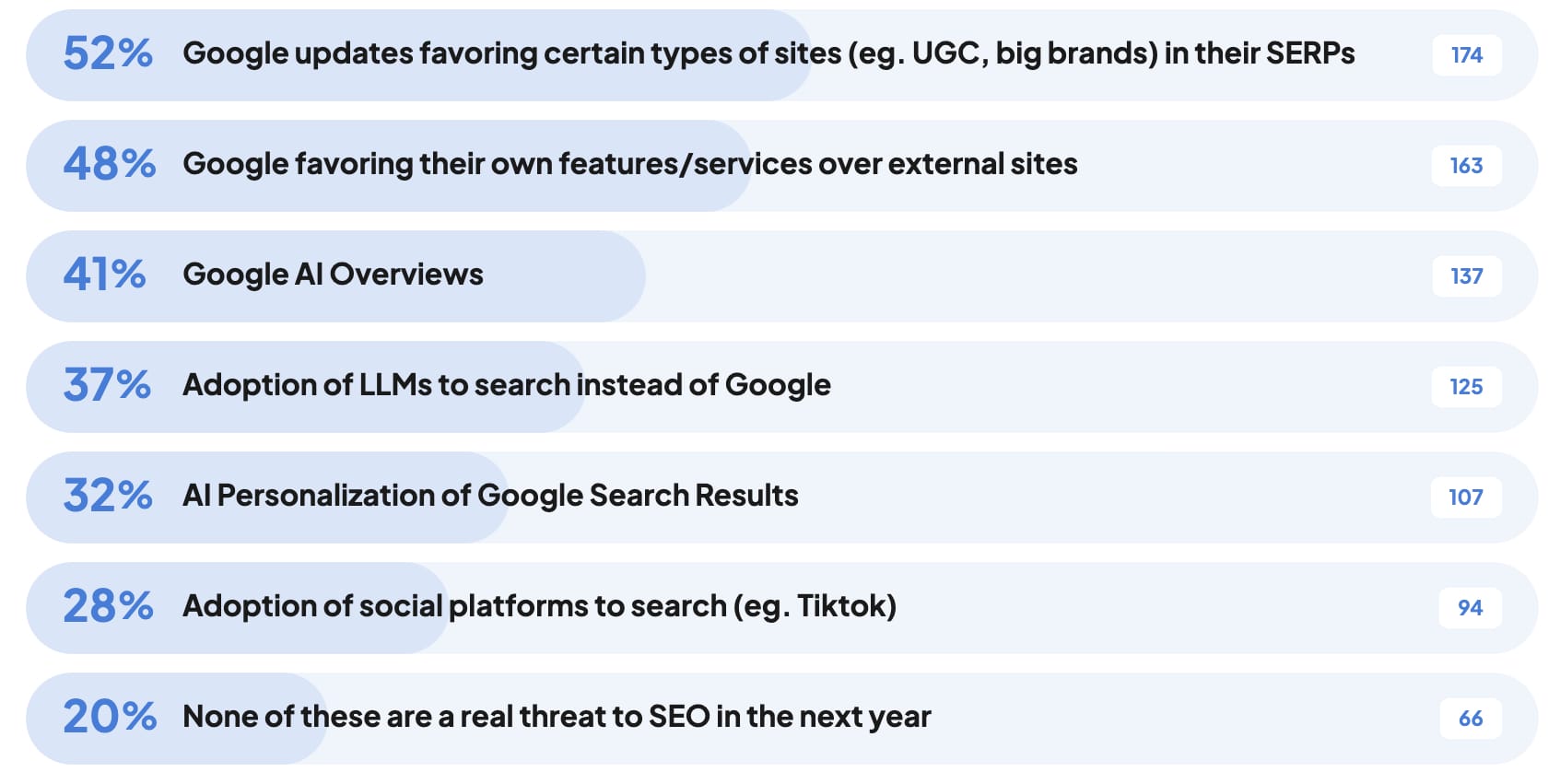
SEO threats in 2024. Google updates that favor certain types of sites (e.g., user-generated content, big brands) in the search results is the biggest threat to SEO consulting efforts, according to 52% of survey respondents.

  • Google favoring its own features/services over external sites was the second biggest threat (48%) while AI Overviews came in third (41%).
  • Other real SEO threats are the adoption of LLMs to search instead of Google (37%); AI personalization of Google Search results (32%) and adoption of social platforms to search (28%).

Counter threats. So how are SEOs combating these threats? Based on responses Solis received, SEOs are focusing on:

Why we care. SEO is more difficult than ever in 2024 – especially for smaller and mid-sized brands and websites. We’re already seeing many threats in 2024 (e.g., Google algorithm updates, more competition and complexity, less resources). But there continue to be many opportunities to reach and influence people during search journeys in today’s fragmented search landscape.

About the survey. The results are based on responses from 337 SEO consultants, collected between July 21 and Aug. 21.

The report. You can read it here: The SEOFOMO State of SEO Consulting – Survey 2024 Results.

Original source: https://searchengineland.com/seo-threats-google-updates-self-preferencing-ai-overviews-survey-446032