SEO year in review 2023: The year of generative AI

The year 2023 was unlike any other I’ve seen in SEO and Search. I say this as someone who has been in this industry since 2007. Many others I spoke to expressed similar sentiments at various points throughout 2023. 

By March, Search Engine Land had published multiple stories that, in any other year, all could have been the story of the year. 

And the news and updates kept coming, day after day, week after week and month after month. Until at last, here we are, with no more year left to go! Although, with how this year has gone, I may be tempting fate – it’s entirely possible that a major Search story will break on Dec. 31.

Search Engine Land has covered all the biggest stories for 17 years, and we did it again in 2023. 

Here’s our look back at the biggest SEO news and updates of 2023. 

Google

Search Generative Experience

The all-new, AI-powered Google Search — officially: Google Search Generative Experience — was announced May 10 after months of speculation and rumors. It was powered by multiple large-language models (LLMs), including PaLM2 and MUM. 

It came with a waitlist (a recurring theme in 2023). Google opened access May 25. Here’s our SGE hands-on and early reactions.

Dig deeper. Test driving Google’s Search Generative Experience

The AI-generated answers are presented in a variety of forms via a snapshot, with links, images, videos and the ability to ask follow-up questions. SGE has received countless feature updates and expanded to 120 more countries, all while its content formats continue to evolve. 

Initially, SGE failed to cite sources in its answers (like Bard). Google began testing SGE links before officially adding links in August.

Leading up to this:

Dig deeper. Google patent describes how the Search Generative Experience works

Bard

Google tried to make it clear — Bard is not Search. This didn’t stop people from confusing Bard with some AI features it teased at the same time (which we later learned was SGE). 

But the arrival of Bard — Google’s answer to ChatGPT — was huge news in the Search world. Bard is Google’s experimental conversational AI service, powered by LaMDA. 

Bard was upgraded to Google’s Gemini model in December. Assistant with Bard, a “personal assistant powered by generative AI,” will soon be added to Google Assistant on iOS and Android.

  • When Bard was introduced, there were no links or citations to the sources used to generate its AI answers, with some seeing this a declaration of war on publishers. Google’s initial explanation was that Bard was “intended to generate original content and not replicate existing content at length.” Citations were added later.
  • Google seemed to rush the Bard announcement (widely considered to be so underwhelming that Google lost $100 million in market value the following day) to Feb. 6 so Google could upstage a Feb. 7 event at which Microsoft announced its new AI-powered version of Bing Search, powered with GPT-4. 
  • A month after announcing Bard, Google opened a waitlist. SEOs who got early access shared early Bard issues, which included hallucinations and getting bad SEO advice that went against Google’s guidelines (e.g., Bard thought buying links is a good idea). Overall, SEOs weren’t impressed with Bard — Google Bard was called disappointing compared to ChatGPT and Bing Chat. 

Dig deeper: ChatGPT vs. Google Bard vs. Bing Chat: Which generative AI solution is best?

AI content

The arrival of generative AI led to brands, including BankRate, CNET and others, experiment with publishing AI-generated content, as we saw in January. This emergence of generative AI-written content reminded us of the old content farms wiped out by Google’s Panda updates.

Google seemed to change its stance on AI content this year, less than a year after warning against AI written content. 

Content that is helpful and created for people first (vs. solely for earning search rankings) was now OK, according to Google’s Danny Sullivan. Google reiterated its stance a month later, with Sullivan saying Google’s focus is “on the quality of content, rather than how content is produced.”

Meanwhile, content creators quickly became concerned about AI answers stealing traffic and revenue:

We also saw bad examples of AI content this year:

Ranking revelations

SEO wasn’t front and center at the U.S. vs. Google antitrust trial, but we learned a lot about how Google actually ranks pages. 

  • How Google Search and ranking works, according to Google’s Pandu Nayak: This is an absolute must-read. Learn how indexing, algorithms, deep learning systems, human raters, click and query data and more shape Google’s Search results, based on Nayak’s testimony.
  • 7 must-see Google Search ranking documents in antitrust trial exhibits: We learn a lot from internal presentations and documents, including Google’s pillars of ranking, what user interaction signals Google looks at (clicks, reads, scrolls, hovers); how Google learns from users and uses that data to improve Search; 18 aspects of search quality and much more.
  • Former Googler: Google ‘using clicks in rankings’: Eric Lehman, a former 17-year employee of Google, said during his testimony: “Pretty much everyone knows we’re using clicks in rankings.” When this was published, we didn’t yet have the full context (provided in the two stories above) around just how much click data was using due to less-than-stellar reporting from people who just don’t understand much about how search works.

Also this year (separate from the antitrust trial), Google’s Gary Illyes told us that links are no longer a “top 3” Google search ranking factor, which is in line with what Google said a year ago and told us would happen nearly a decade ago.

Links clearly still play a role in SEO. However, for Google, links are less important for ranking webpages than in years past.

Hidden gems, personal search and Notes

Google announced a trio of updates in November:

Algorithm updates

Although it felt like an incredibly volatile year, and we were warned to “buckle up” for more, Google only released nine algorithm updates this year – less than the 10 it has released the previous two years. You can read the annual recap of 2023 Google algorithm updates by Barry Schwartz.

Reminder: Our history of Google algorithm updates page features all the latest news and guidance around the latest algorithm updates.

Google shared new link best practices in their SEO and search developer documentation. 

This help document evolved from covering the basics of crawlable links to covering anchor text placements, how to write good anchor text, internal links and external links.

Content pruning

CNET got “exposed” for deleting thousands of pages (a.k.a., content pruning), which is a fairly common advanced SEO practice. CNET wrongly believed that content deprecation “sends a signal to Google that says CNET is fresh, relevant and worthy of being placed higher than our competitors in search results.”

However, Google’s Sullivan wanted to make Google’s stance on this tactic clear:

  • “Are you deleting content from your site because you somehow believe Google doesn’t like ‘old’ content? That’s not a thing! Our guidance doesn’t encourage this. Older content can still be helpful, too.”

Read all about it in Google warns against content pruning as CNET deletes thousands of pages as well as my follow-up guide, Improving or removing content for SEO: How to do it the right way.

In memoriam: Google Analytics UA

We knew the end of Universal Analytics (UA) was inevitable. Google published blog posts, sent us emails, posted reminders on social platforms and showed us an intrusive interstitial every time we logged in. Google even threatened to set up Google Analytics 4 for us if we didn’t. 

While it seemed everybody was talking about AI, GA4’s switch-or-else date — July 1 — eventually came. Despite all the advanced notice, marketers still felt unprepared. Our coverage:

We thought UA would stop processing data. It didn’t. UA properties kept processing data. Ten days later. A month later. Two months later. 

Search Engine Land’s UA property finally stopped processing data on Sept. 8 — 68 days past the date on which we were expecting, and told repeatedly, it would stop. I wonder if there are still any UA properties collecting data as we close out 2023?

10 more Google Search updates and changes

Dig deeper. Inside Google’s massive 2023 E-E-A-T Knowledge Graph update

Microsoft 

New Bing / Bing Chat / Bing Copilot

In January, we learned Microsoft was planning on adding ChatGPT features to Bing. By February, we learned it would be powered by GPT-4, (OpenAI released this model in March) and the new interface was spotted in the wild.

Microsoft revealed the new Bing at an event in February. Here’s our hands-on review from February. 

New Bing earned praise from SEOs (e.g., New Bing is mind-blowingly fast and better than I expected) despite seeming to have multiple personalities (or “confused”) early on and received multiple quality improvements since.

It also came with a waitlist and would only be open to Edge users on desktop initially. Over a million people signed up for the AI-powered Bing over the next 48 hours. 

Dig deeper. Microsoft explains how Bing AI Chat uses ChatGPT and Search with Prometheus

Microsoft’s AI-powered search earned much media attention and created the perception that the company might finally gain ground on its longtime rival, Google. But hype, as it often does, turns out not to be reality.

It looked like Bing made some small gains in search market share by March. We later learned that the new Bing attracted many new Edge users, who then chose Google for Search instead of Bing.

It became clear by May that Microsoft Bing had failed to gain market share. Even clearer after six months of the new Bing — Microsoft disputed the numbers but failed to provide any figures.

By the time Microsoft CEO Satya Nadella spoke at the U.S. vs. Google antitrust trial, he sounded like a defeated man, saying at one point:

  • “Yeah, I mean, look, that’s called exuberance of someone who has like 3% share, that maybe I’ll have 3.5% share.”

In November, Microsoft announced a rebranding of Bing Chat to Copilot. When that change will actually become visible remains to be seen, as Bing still refers to its chat experience from Search as “Bing Chat” or “Chat.”

Dig deeper:

Yandex 

A former Yandex employee allegedly leaked source code, part of which contained 1,922 search ranking factors. This was huge news when it broke, but has almost been forgotten now. 

It turned out that 1,922 figure was low — there were actually 17,854 Yandex ranking factors. See Michael King’s excellent analysis: Yandex scrapes Google and other SEO learnings from the source code leak.

Also, Russia’s largest search engine is now reportedly for sale.

Yahoo

Yahoo started dropping hints in January about its return to competing in the search space. In addition to hiring, a tweet promised Yahoo was going to make search “cool again.”

Now we know Yahoo’s new Search experience will start rolling out in the first few weeks of 2024, Brian Provost, SVP & GM, Yahoo, told me at SMX Next in November.

Neeva

The ad-free search engine, founded in 2019, shut down.

Search Engine Land

SearchBot

We turned Search Engine Land into a chatbot this year. Yes, we trained ChatGPT on our content so you can explore, experiment and learn more about search marketing.

Later in the year, SearchBot got a huge upgrade, including new personas and image generation.

Sign up here for free access.

SMX Advanced and Next

We ran two digital events this year – SMX Advanced in June and SMX Next in November. Both shows were packed full of actionable SEO tips and insights. 

Below are links to our coverage of some SEO session from Advanced:

You can expect to read lots of coverage of SEO sessions from SMX Next over the coming weeks on Search Engine Land.

Plus, congratulations to all the 2023 Search Engine Land Award winners.

Salary & Career Survey

Here’s what you told us:

20 years of Barry Schwartz

Search Engine Land’s own Barry Schwartz has now been covering all things search for 20 years — 17 of those here at Search Engine Land. JR Oaks did a fascinating breakdown of 20 years of search based on Search Engine Roundtable analytics data.

SEO in 2033

What’s next for SEO? More AI. We are only at the dawn of our generative AI journey and AI-driven Search as we enter 2024.

Pichai said this year Google Search will evolve substantively in next 10 years. And 2024 will be one year closer to the type of search that is more “personalized” (hello, Bard Assistant) and “ambiently available to users in radically different ways.” And he promises Google will get SGE right.

DeepMind co-founder Mustafa Suleyman echoed this, saying Google will look much different in 2033 – where conversation is the interface, not a Search box.

If you’ve never seen the 2013 movie “Her,” watch it. Or if you have seen it, watch it again. That could be the general direction Google is heading. The future of AI Search could be:

  • Virtually assisted.
  • Conversational.
  • Predictive.
  • Adaptive — to evolve and understand you.

We aren’t there yet. Learn all you can about how modern search engines work, generative AI, LLMs, retrieval augmented generation and generative engine optimization (GEO) in 2024.

Original source: https://searchengineland.com/seo-2023-recap-436035

Google algorithm updates 2023 in review: Core, reviews, helpful content, spam and beyond

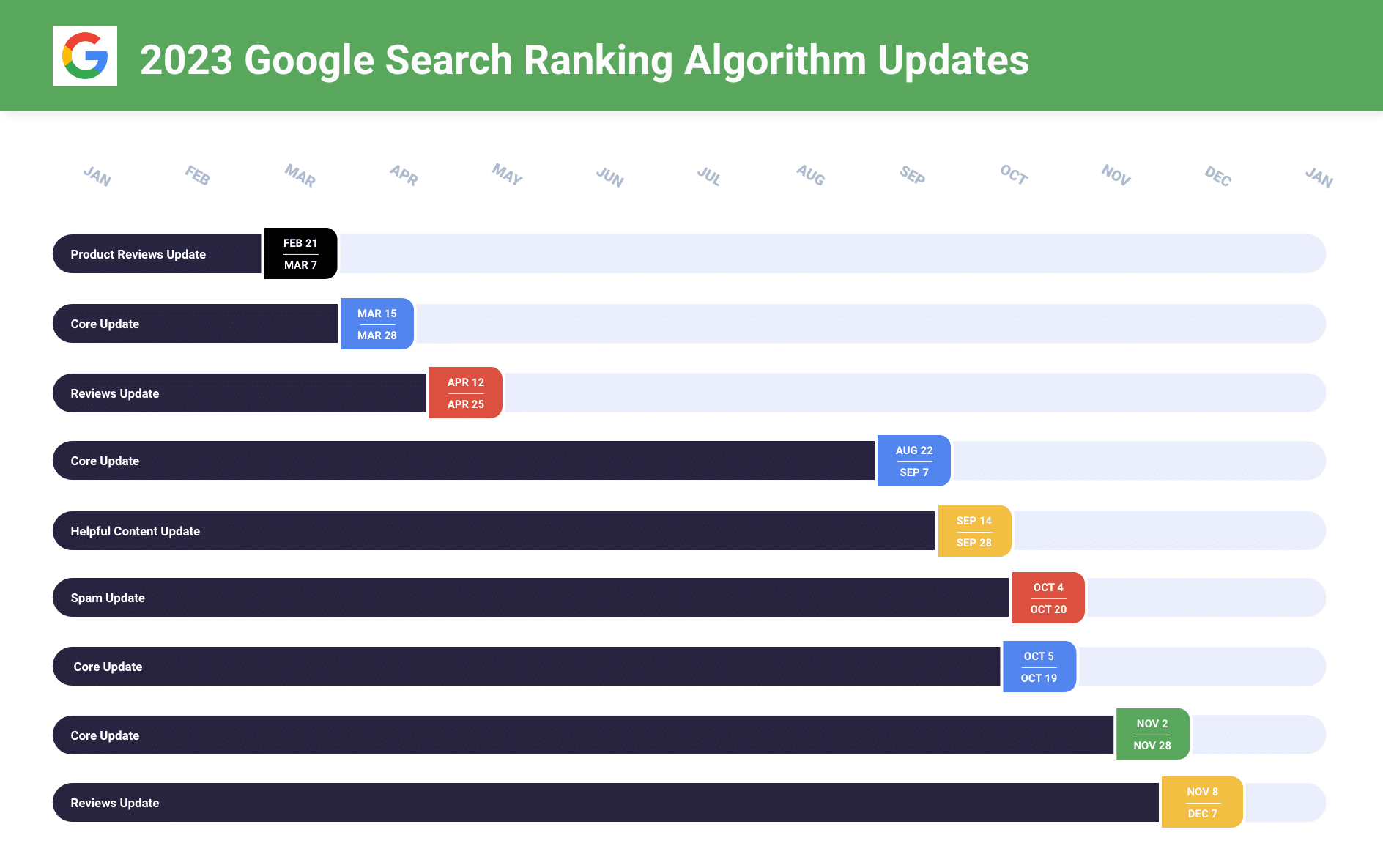
Google launched nine confirmed algorithmic updates in 2023, as well as a new AI search engine, the Search Generative Experience.

In 2022 and 2021, Google had 10 confirmed algorithmic updates. Unless Google rolls out a new update this week, Google would have rolled out one less update in 2023 than it did in 2022 and 2021.

Google confirmed algorithm update summary

We whipped up this timeline documenting all the confirmed Google search algorithm updates in 2023, so you can visualize the updates over the year.

Adversarial information retrieval

Four Google core updates in 2023

Google had a whopping four core updates in 2023, compared to only two in 2022. We had core updates in March, August, October and November.

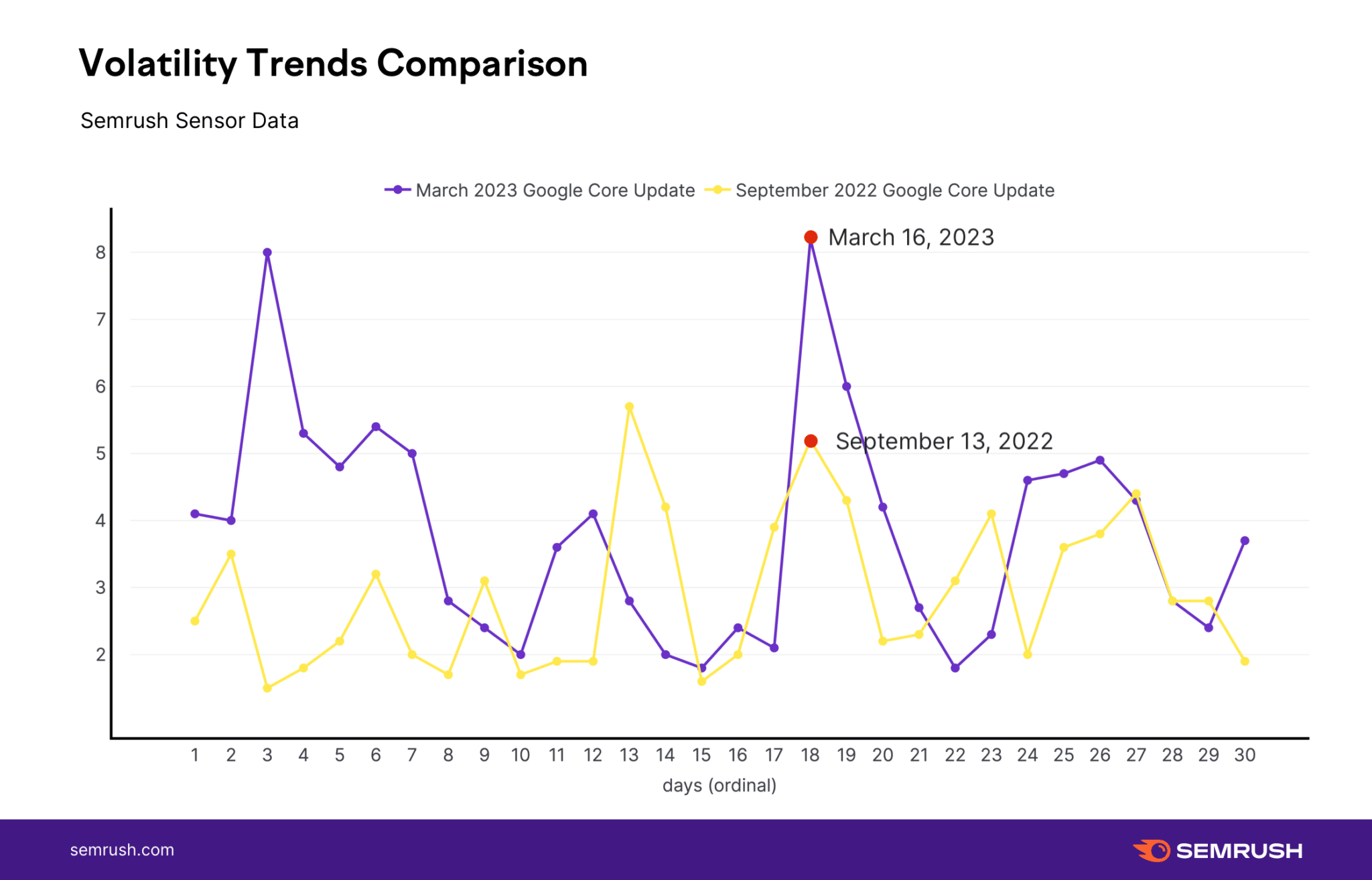
March 2023 core update. The Google March 2023 core update started rolling out March 15, took 13 days to complete, and finished on March 28. Overall, the volatility was about the same as previous core updates according to some data providers.

Here is one chart we shared back then comparing that volatility:

Alphabet Inc.

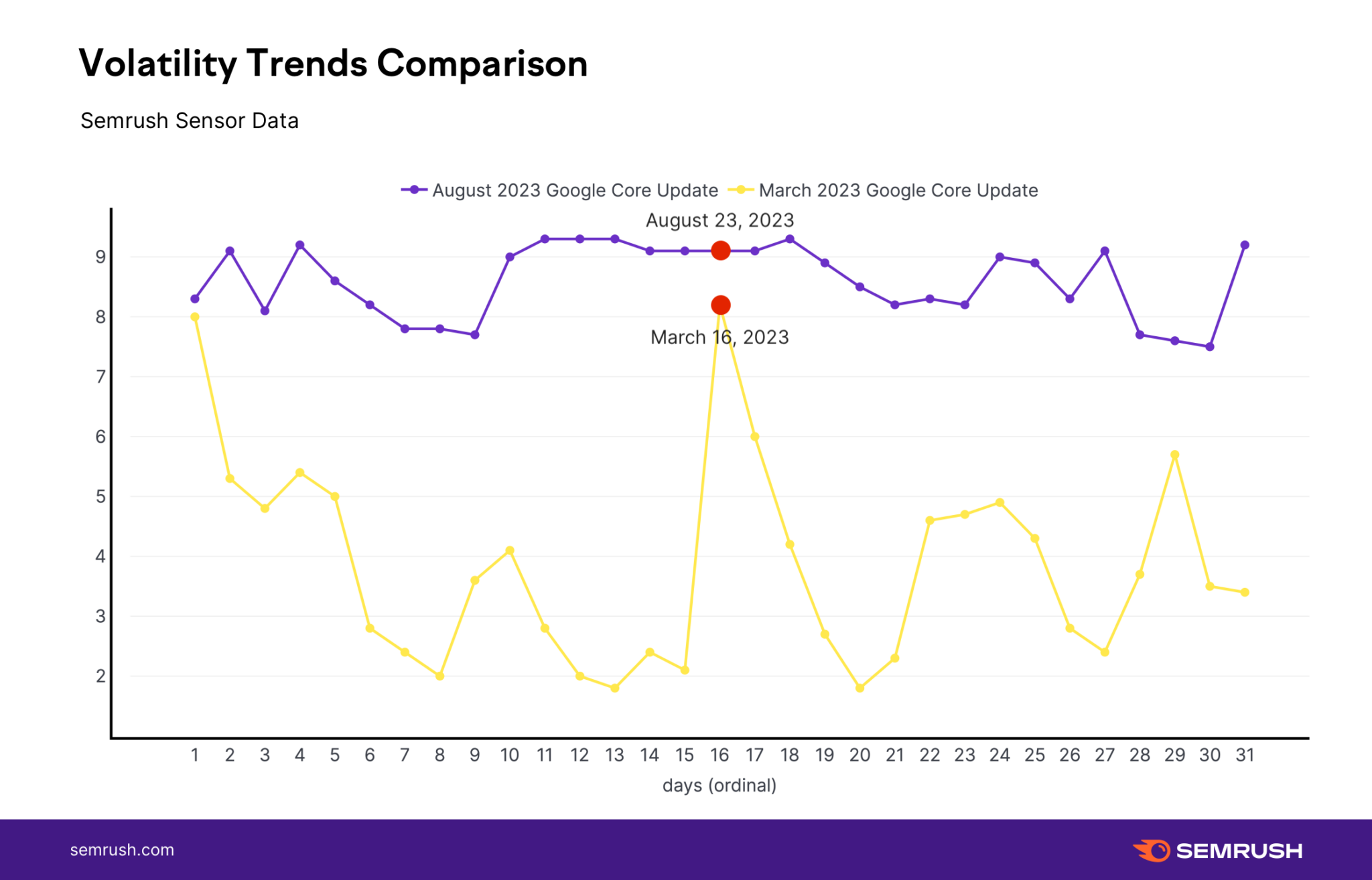
August 2023 core update. The Google August 2023 core update started rolling out August 22, took 16 days to complete, and finished on September 7. Overall, the volatility was generally less than previous updates, feeling more muted than what we expected according to data providers.

Here is one chart we shared back then comparing that volatility:

Google

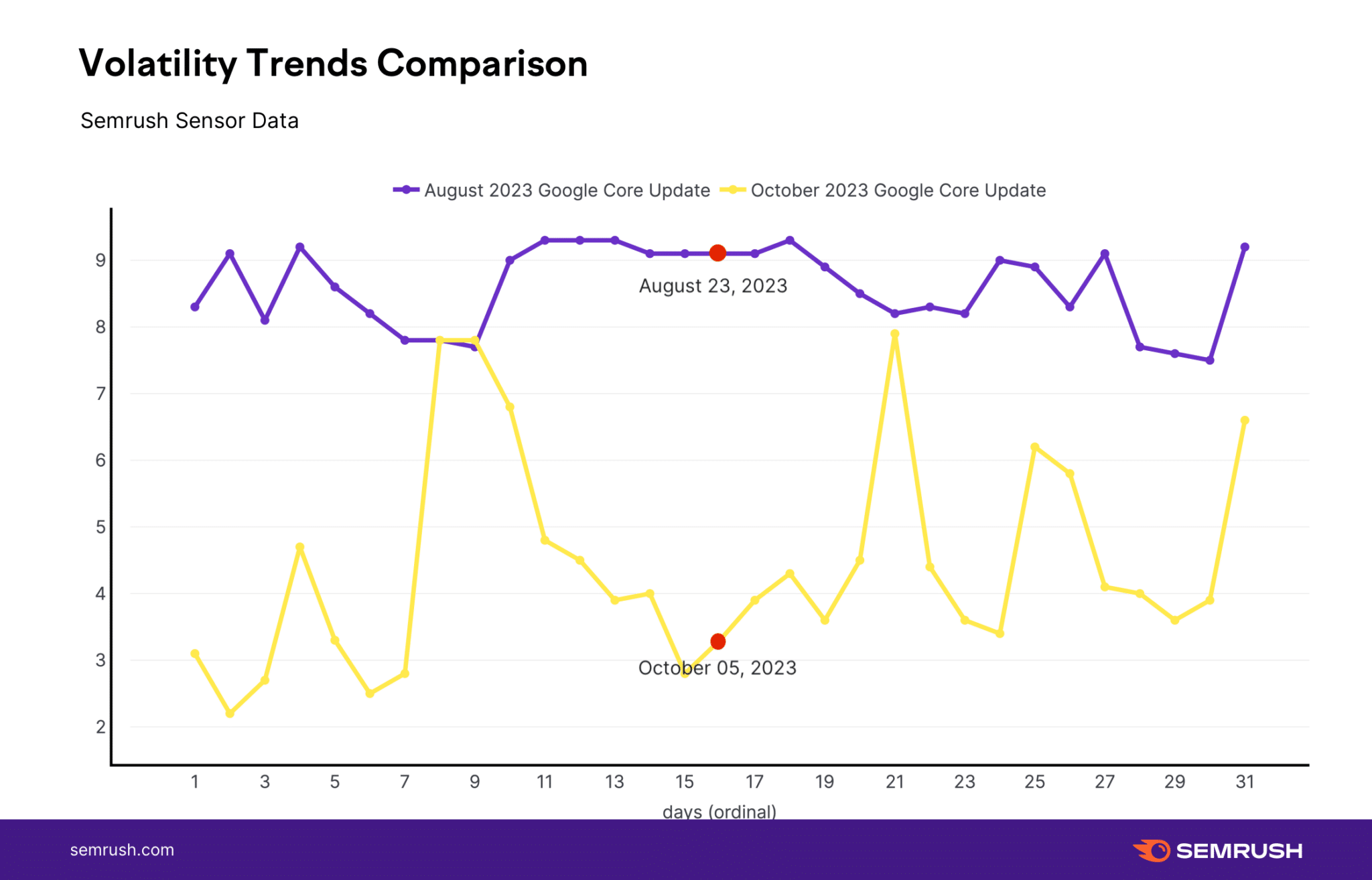
October 2023 core update. The Google October 2023 core update started rolling out Oct. 5, took 14 days to complete, and finished on Oct. 19. Overall, the volatility was hard to measure because it overlapped with the October spam update, but the volatility was felt in a big way, according to several data providers.

Here is one chart we shared back then comparing that volatility:

Google Search

November 2023 core update. The Google November 2023 core update started rolling out on Nov. 2, took 26 days to complete, and finished on Nov. 19. Overall, the volatility was even greater than October spam update, according to data providers. But this update also overlapped with the November reviews update.

Here is one chart we shared back then comparing that volatility:

Home Business

Product reviews update to reviews update

Google renamed the Product reviews update to the reviews update. That’s because Google is now looking at all types of review-related content, not just product review content.

We had three reviews updates this year. The November 2023 reviews update is the last update of its kind that will be confirmed going forward, Google said.

February 2023 product reviews update. The Google February 2023 product reviews update started Feb. 21, took 14 days to complete, and finished on March 7. Overall, the volatility showed that update was more significant that previous product reviews updates, according to some data providers. Also, this was the last product product reviews update before it was renamed the reviews update.

Here is one chart we shared back then comparing that volatility:

internet marketing

April 2023 reviews update. Now we move into the realm of reviews updates with the Google April 2023 reviews update, it started on April 12 and took 13 days to roll out, completing on April 25. again, this update went beyond product reviews and included services and businesses, destinations, media and other review content. Overall, the volatility was more widespread that previous updates, simply because it impacted more categories of review content.

Here is one chart we shared back then comparing that volatility:

Internet search engines

November 2023 reviews update. Now we move into the realm of reviews updates with the Google November 2023 reviews update, it started on Nov. 8 and took 29 days to roll out, completing on Dec. 7. Again, this update went beyond product reviews and included services and businesses, destinations, media and other review content. I was unable to get data that compared the volatility of this update to previous ones because the November core update overlapped with this update and the data was too messy to separate.

Helpful content update that shook the industry

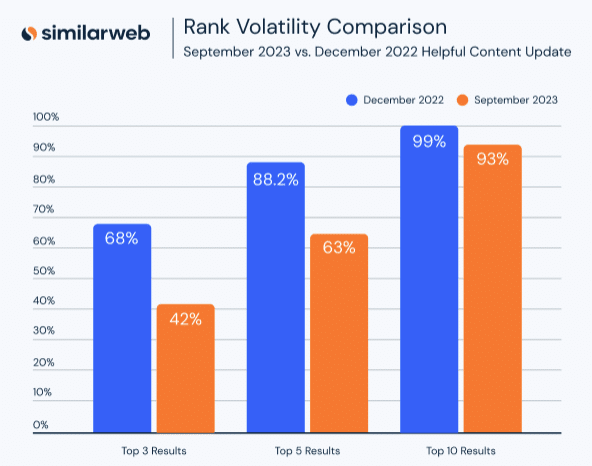
The Google September 2023 helpful content update started on Sept. 14 and took 14 days to roll out, ending on Sept. 28. While we only had one helpful content update in 2023, this update was big. In fact, SEOs are still talking about this update today and how much of an impact it had on their businesses and clients.

The volatility was very big, especially if you zoomed into the SEO chatter (what SEO forums were saying). It seemed like this was the helpful content update we expected Google to launch in 2022 but never did.

I believe this update was felt more within the SEO industry niche, maybe sites designed to rank well in search engines, more so than typical sites that take into account more than just search engines. 

Here is one chart we shared back then comparing that volatility:

last product product

A spam update in the middle

And we had a spam update in the middle of all of these updates, the October 2023 spam update. That spam update started on Oct. 4 and lasted 15 days, ending Oct. 20. Yes, this update overlapped the October 2023 core update, making tracking the volatility of this specific update nearly impossible.

Google said the October 2023 spam update “aims to clean up several types of spam that our community members reported in Turkish, Vietnamese, Indonesian, Hindi, Chinese, and other languages.” Google added that update should “reduce the visible spam in search results, particularly when it comes to cloaking, hacked, auto-generated, and scraped spam.”

Other Google algorithm changes, updates, tweaks or topics

Original source: https://searchengineland.com/google-algorithm-updates-2023-recap-435846

Track These Items to Maximize Your Business Deductions

Home Business Magazine Online

Any home business will have obvious deductions that will be easy to keep track of. Here is a list of some that you may forget about or find troublesome to track. Pay attention to these and reap the tax benefit.

By Jim Conroy, CEO of The Neat Company

When you’re in business, you’ve got to spend money to make money. If you’re in landscaping, you need to buy tools and gas. If you’re designing websites, you’ve got to buy a computer and design software. If you’re a contractor, you need to buy materials and pay labor.

Those expenses are used to help calculate your business profit. Your profit is what the Internal Revenue Service (IRS) will use as the basis for your taxes. It’s simple addition and subtraction: the money you collect less the money you spend on expenses is the profit you’ll be declaring to the IRS. Smaller profit, smaller taxes.

The IRS won’t let you deduct everything you consider an expense. Some expenses are only partly deductible. You may be unable to code without your morning espresso, but you probably won’t be able to deduct the cost of that fancy espresso machine. Exception? If you sell coffee as a line of business. Are you taking a client or potential client to lunch? The IRS will let you deduct 50% of that expense (an expense deduction that will disappear after 2025 per the 2017 Tax Cut and Jobs Act).

You are not obliged to show your documentation to the IRS when you file your taxes. However, the IRS expects you to be able to produce your records if needed (for instance, during an audit).

Basic Tax Deductions

Some deductions are intuitive. If you rent office space, storage space, or fabrication space, those expenses are part of the ordinary cost of doing business, and are deductible. Office equipment (such as your computers, printers, desks, and chairs) and supplies (such as paper and pens) are deductible. Most expenses for a small business or a home business can be found (and documented) in your business checking account. (You do have a business checking account, right?)

Most home businesses are sole proprietorships, with owners filing a personal IRS Form 1040 utilizing Schedule C to describe profit and loss. On its Part II, the IRS lists many deductible expense categories, including:

  • Advertising
  • Car and truck expenses
  • Commissions and fees
  • Contract labor
  • Depletion
  • Depreciation
  • Employee benefits programs
  • Insurance (other than health)
  • Interest
  • Mortgage
  • Legal and professional services
  • Office expense
  • Pension and profit-sharing programs
  • Rent or lease of vehicles, machinery, and equipment
  • Rent or lease of other business property
  • Repairs and maintenance
  • Supplies
  • Taxes and licenses
  • Travel
  • Meals (at 50%)
  • Utilities
  • Wages

In Part III, businesses that manufacture goods (for instance, you make jewelry) or sell at retail (for instance, you’ve got an antique shop) can calculate the cost of goods sold through the inventory method of their choice. Vehicle costs are also deductible in Part IV, but the vehicle must be only used for business and not for personal use.

The most relevant question to our discussion is this one: “Do you have evidence to support your deduction?” If you can’t answer that question with a “yes,” you may not even want to try to deduct those costs. But that’s what this is all about.

Specific Things to Track and How to Track Them

According to IRS Publication 535, “To be deductible, a business expense must be both ordinary and necessary.” If you’re a leatherworker, buying a bolt of leather is ordinary and necessary. If you’re a tennis coach, a bolt of leather probably isn’t.

For the most part, there are no legally required methods of keeping records. All the IRS asks is that your records clearly show your income and your expenses. To do so, you may record your transactions in a journal or a ledger. These can be in paper or book form, or they can be electronic, like a spreadsheet. To organize the documents themselves, again, use a system that works best for you — a desk drawer, a file cabinet, or a digital tool. Capturing copies to a cloud drive can be helpful. So can a document management system (DMS) like one offered by The Neat Company. The best of these will capture data from multiple sources, including your smart phone’s camera, emails and attachments, a scanner, or computer files and documents. The DMS will then use optical character recognition to convert all of these into text that can be manipulated, filed, and stored. Often, they can be categorized for later reference or bookkeeping purposes or shared with a tax accountant. The best part is that they are securely backed up on the cloud and available wherever you are.

Therefore, if you’re a contractor, recording your mileage as you drive from job site to lumber yard to building supply warehouse to job site on a log will work for you. You can’t, however, just record all mileage for your pickup if it also goes to the beach with your kids or out to dinner with your spouse.

The Home Office

If you are claiming the use of part of your home as a home office, you will need to determine whether you want to use the simplified method or actual expenses. The simplified method is deducting a flat $5 per square foot for the actual space dedicated to business use only (up to 300 sq. ft). If you’re claiming the actual expenses, direct expenses are deductible in full. If you’re a traveling carpenter and have made the unfinished portion of your basement into a workshop, insurance, utilities, and general repairs for that portion can be deducted. For instance, if your home including your basement is 1,200 square feet and your workshop takes up 300 square feet, one-fourth of those expenses can be deducted. That means you’ll need copies of your utility bills, your heating bills, your home insurance, and any other related bills in your business tax records.

In the End, Efficiency

Financial precision depends on thorough attention to documenting your business activity. Receipts are the backbone of telling your business story. Make reducing clutter and enhancing accessibility your goal whether you choose to store receipts in a file, in a spreadsheet, or in digital form through smart technology. Tax preparation will be cleaner and audits, should they happen, will be survivable. Decision-making will be simpler, too.

The post Track These Items to Maximize Your Business Deductions appeared first on Home Business Magazine.

Original source: https://homebusinessmag.com/money/taxing-times/track-items-maximize-business-deductions/

Construction’s Global Evolution with Site Capture Technologies

Home Business Magazine Online

The construction industry is undergoing a significant evolution on a global scale with the integration of site capture technologies, a powerful tool that is reshaping building projects across the world. This article explores the various ways in which this technology (reality capture) is revolutionizing the cost-effectiveness of construction practices on an international level.

Reducing Project Overheads Worldwide

Site capture technologies play a pivotal role in reducing project overheads in construction projects across the globe. This reduction is achieved through the technology’s ability to streamline data collection and processing, eliminating the need for extensive manual surveys and measurements. This efficiency not only cuts down on the labor and time required for these tasks but also minimizes errors, regardless of the project’s location. Fewer errors mean less rework, which is a common cause of inflated project costs worldwide.

Additionally, the technology’s capacity to provide detailed and accurate data aids in precise material ordering and utilization, further reducing wastage and unnecessary expenses on a global scale. These aspects collectively contribute to a substantial decrease in overall project costs, making site capture technologies a valuable asset in economic construction management, regardless of where in the world the project is located.

Streamlining Project Management Across Borders

The integration of site capture technologies into construction project management streamlines the entire process, transcending geographical boundaries. This technology enables project managers to oversee project progress more effectively by providing real-time, accurate site data, regardless of where they are located. It facilitates better coordination between different teams and phases of the project, ensuring that all parties are working from the most current information, even if they are continents apart. This level of coordination reduces the risk of delays and miscommunication, enhancing project management efficiency on a global scale.

Furthermore, the ability to access detailed site information remotely enhances the flexibility and responsiveness of the management process, leading to more efficient and timely project completion regardless of the project’s location around the world.

Enhancing Decision Making Globally

Site capture technologies greatly enhance decision-making in construction projects across the world. By providing comprehensive, accurate data about the construction site, stakeholders can make more informed choices about design, resource allocation, and project timelines, no matter where they are situated. This data-driven approach reduces the likelihood of costly mistakes and reworks on a global scale. It also enables quick adaptation to changing conditions or unforeseen challenges, ensuring that decisions are made swiftly and based on the most current information. This ability to make well-informed decisions rapidly is crucial for maintaining project momentum and adhering to budgets and schedules, regardless of the project’s location.

Improving Sustainability and Green Building Practices Worldwide

Site capture technologies play a vital role in advancing sustainability and green building practices within the construction industry, regardless of the project’s global location. This technology enables construction teams to gather precise data on site conditions and environmental factors, which is crucial for making sustainable decisions worldwide.

One of the key aspects of sustainability is minimizing environmental impact. Site capture technologies aid in this by providing insights into the site’s existing conditions, such as terrain, vegetation, and natural resources, regardless of where the project is located. With this information, construction professionals can make informed choices about how to minimize disruption to the natural environment during construction, whether it’s in North America, Europe, Asia, or any other region. They can plan construction activities to avoid sensitive areas or implement erosion control measures effectively, reducing soil erosion and preserving local ecosystems, regardless of the project’s global destination.

Furthermore, site capture technologies contribute to efficient resource management, a fundamental component of green building practices, regardless of where the project is located around the world. By accurately measuring and documenting materials used on-site, they help minimize waste and ensure that resources are used efficiently. This not only reduces costs but also lessens the environmental footprint of construction projects, promoting sustainable practices on a global scale.

Facilitating Global Client Communication and Transparency

The technology enhances communication with clients by providing visual progress reports and realistic project visualizations, regardless of the client’s location anywhere in the world. This transparency builds client trust and satisfaction, fostering better relationships and a clearer understanding of project progress on a global level.

This technology allows for the creation of detailed, visual representations of the project’s progress, providing clients, no matter where they are in the world, with an easily understandable view of the development. This real-time sharing of information fosters a transparent working relationship, where clients are kept informed and can provide timely feedback, regardless of their global location. It also helps in setting realistic expectations, reducing the likelihood of misunderstandings and disputes, and promoting transparency and trust with clients across continents. This enhanced communication and transparency ultimately lead to stronger client relationships and increased satisfaction with the project outcome, no matter where in the world the project is located.

Conclusion: A Global Evolution

The economic advantages of site capture technologies in construction are clear and have a global impact. From reducing labor costs to enhancing overall project management, these technologies are essential for modern, cost-effective building projects worldwide. Their role in promoting sustainability, improving decision-making, and facilitating transparent client communication knows no geographical bounds. Implementing site capture technologies in construction budgeting is a transformative strategy that can lead to more efficient and successful building projects on a worldwide scale, marking a global evolution in the construction industry.

The post Construction’s Global Evolution with Site Capture Technologies appeared first on Home Business Magazine.

Original source: https://homebusinessmag.com/management/technology-management/constructions-global-evolution-site-capture-technologies/

How to Invest in Gold: An Investor’s Guide

Home Business Magazine Online

Gold has been a symbol of wealth and stability for a long time. It is a precious metal that has attracted investors for centuries. In today’s volatile economic landscape, gold remains a popular option for investors as it can act as a safe haven and a hedge against inflation. However, investing in gold can be complex and requires a deep understanding of the options available, a strategic approach to timing, and a comprehensive plan for integrating gold into your broader investment portfolio. This guide provides insights and tips to help novice and experienced investors make informed decisions when investing in gold. We’ll explore how to balance the allure of gold with practical considerations such as market trends, storage, and insurance. Additionally, we’ll shed light on the pivotal role of gold-related financial instruments in diversifying your assets. Whether you’re looking to safeguard your wealth or capitalize on market movements, understanding how to invest in gold could be the golden opportunity you’ve been searching for.

Understanding the Different Forms of Gold Investment

Investors seeking a stable store of value often turn to gold as a traditional safe haven. When considering gold investments, it is crucial to recognize the various instruments available, each with its risk-return profile.

Physical gold, such as coins and bullion, offers tangible assets and is readily available. You can make the purchase yourself in a stationary store or online. However, it is essential to acquire gold from a trustworthy source. That’s why we recommend visiting https://stonexbullion.com/en/gold-bars/, which offers authentic gold bars in various weights. On the other hand, gold exchange-traded funds (ETFs) provide more accessible liquidity and are backed by physical gold, yet they incur management fees. Gold mining stocks and mutual funds also allow investors to gain indirect exposure to the gold market. However, they are subject to the performance of individual companies and broader market forces.

Delving into digital gold, investors can now access gold through online platforms that allow purchasing gold in fractional amounts. This method offers the convenience of buying, selling, and holding gold with a few clicks and often comes with lower transaction costs than physical gold. However, it’s essential to conduct due diligence on the platform’s credibility and the security of the gold holdings. For those with a more speculative bent, gold futures and options present opportunities for leveraged bets on the price movements of gold, though they carry a higher level of risk and complexity.

In conclusion, the decision to invest in gold should be informed by an individual’s investment goals, risk tolerance, and the amount of capital they are willing to allocate. Whether opting for physical gold, stocks, or innovative digital options, investors must weigh the pros and cons of each form. It is advisable to consult with a financial advisor to tailor a gold investment strategy that aligns with one’s overall portfolio objectives. As with any investment, diversification is critical, and gold should be considered part of a broader investment strategy rather than a standalone solution.

Assessing the Pros and Cons of Gold as an Asset 

Diversification is often cited as a critical advantage when adding gold to an investment portfolio. Unlike stocks and bonds, gold typically has a low correlation with these assets, which can help reduce overall portfolio risk. Moreover, gold is renowned as a safe haven during economic uncertainty, often retaining value or even appreciating when other investments falter. However, it’s important to note that gold does not generate income, such as dividends or interest, which can be a drawback for those seeking regular cash flow from their investments.

The intrinsic value of gold is another factor that attracts investors. As a tangible asset, gold has a perceived value that can endure despite fluctuations in currency values or the stock market. This can be particularly appealing during periods of high inflation or currency devaluation, where gold can act as a hedge to preserve purchasing power. On the downside, the price of gold can be highly volatile in the short term, influenced by numerous factors, including geopolitical events, market speculation, and currency strength, which can lead to unpredictable price swings.

Liquidity is a significant pro for gold investment, and it can be quickly bought or sold globally. This ease of transaction benefits investors who need to liquidate assets swiftly. Conversely, the costs associated with buying, storing, and insuring physical gold can be considerable and should be factored into the investment decision. Additionally, gold’s performance is not linked to the success of a business or a government’s economic policy, which can be both a pro and a con. While this means it’s not subject to the same risks as stocks or bonds, it also means that its price is not driven by growth, limiting potential returns compared to other investments.

Strategies for Timing Your Gold Investments

Understanding the market cycles is crucial when considering the timing of gold investments. Historically, gold prices have often moved inversely to stock markets, gaining value during economic uncertainty. Savvy investors monitor economic indicators such as inflation rates, currency values, and interest rate trends to predict shifts in gold pricing. By closely examining these factors, one can make more informed decisions about when to buy or sell gold. Additionally, geopolitical events and market sentiment can significantly impact gold prices, making it essential to stay updated on global news.

Another critical strategy is to employ technical analysis. This involves analyzing past market data, price charts, and various technical indicators to forecast future price movements of gold. While no method guarantees absolute success, patterns such as moving averages, support and resistance levels, and trend lines can provide valuable insights. Investors who master these techniques may be better positioned to time their entry and exit points in the gold market, potentially maximizing their returns.

In conclusion, while timing the market is never an exact science, incorporating a mix of fundamental and technical analysis can lead to more strategic investment decisions. It’s also wise to consider gold as part of a diversified investment portfolio rather than relying on it as a single investment strategy. By doing so, investors can mitigate risks and take advantage of the potential protective hedge that gold offers during economic downturns. Patience and a long-term perspective are often the hallmarks of successful gold investing.

Navigating the Gold Market: Tips for New Investors

When considering investing in gold, it’s essential to understand the different types of gold assets available. During economic uncertainty, investors often seek the safety of physical gold coins and bars.

On the other hand, gold investments, like stocks of mining companies or gold ETFs (Exchange-Traded Funds), provide a more liquid option with different risk-reward profiles. For instance, investing in a gold mining company allows you to benefit from the company’s operational profits, not just the value of gold. However, this exposes you to company-specific risks, such as management performance and production costs.

For new investors, comparing the costs and returns associated with different gold investments is crucial. It is essential to conduct thorough research or seek advice from a financial advisor to design a gold investment strategy that aligns with your financial goals and risk tolerance.

Portfolio Diversification: Integrating Gold into Your Investment Mix

When considering portfolio diversification, including gold can serve as a strategic hedge against inflation and market volatility. Unlike stocks and bonds, gold often maintains its value or even appreciates during economic uncertainty. By allocating a portion of your portfolio to gold, you can reduce overall risk and improve returns over the long term. It is essential to assess your investment goals and risk tolerance to determine the appropriate weight of gold in your portfolio, as this will vary for each investor.

Gold’s unique characteristics make it a compelling choice for diversification. Its historical performance has demonstrated a low correlation with traditional financial assets, which can help stabilize your portfolio during market downturns. Moreover, gold is a tangible asset that can provide security in the face of geopolitical tensions or currency devaluations. To effectively integrate gold into your investment mix, consider various forms such as physical gold, gold ETFs, mining stocks, or mutual funds specializing in precious metals. Each option has its considerations, including liquidity, storage, and management fees, which should be carefully evaluated to align with your investment strategy.

Safeguarding Your Gold Investments: Storage and Insurance Considerations

Securing your gold investments is crucial to protecting their value and ensuring peace of mind. Choosing the right storage option is paramount to shield your assets from theft, loss, or damage. Investors typically have several choices, including:

  • Home safes: A popular choice for small quantities, offering immediate access but requiring robust security measures.
  • Bank safe deposit boxes: These provide enhanced security, though they may come with limited access and potential risks in the event of a bank’s insolvency.
  • Private vaults: Offering the highest security levels, they are ideal for more significant investments and often include insurance options.

Furthermore, insurance coverage is a critical aspect of safeguarding your investment. Verify that your policy is comprehensive, covering all potential risks and reflecting the total value of your gold holdings. Regularly review and adjust your insurance as the market value of your gold changes to maintain adequate coverage.

Selling Your Gold: Best Practices for Liquidating Your Assets

Deciding to sell your gold holdings can be as critical as the initial investment decision. To ensure you receive the best possible return, it’s essential to consider the timing of the sale and the form of gold you own. Physical gold, such as coins or bullion, can be sold to various dealers, but prices vary significantly. For instance, selling to a local dealer might be convenient but could result in a lower payout than larger online dealers or auction sites. It’s advisable to get quotes from multiple sources and understand the current spot price of gold to make an informed decision.

When liquidating gold assets, it’s also essential to consider the tax implications. Capital gains tax may apply, and the rate can depend on how long you’ve held the asset.

The post How to Invest in Gold: An Investor’s Guide appeared first on Home Business Magazine.

Original source: https://homebusinessmag.com/money/how-to-guides-money/how-to-invest-gold-investors-guide/

AI and FinTech Investment Opportunities

Home Business Magazine Online

Artificial Intelligence and Financial Technology are two rapidly evolving sectors. When these sectors converge, they create a unique space for investment. This convergence is driven by AI’s ability to analyze large data sets and FinTech’s focus on innovating financial services. The combination opens doors to smarter, more efficient financial solutions. Investors are now looking at how AI can transform traditional financial models, making them more adaptive, personalized, and efficient.

AI in Financial Services: A New Era of Investment

In the finance sector, artificial intelligence (AI) is being used to analyze large volumes of data, detect patterns, and predict market trends. This technology is not limited to large corporations; startups and medium-sized businesses also utilize AI to enhance their financial operations. The integration of AI in financial services has led to the development of new tools for risk assessment, fraud detection, and customer service.

Banks and investment firms use AI to process complex financial data, enabling more accurate predictions about market behavior. This capability is important for investment strategies, portfolio management, and decision-making processes. AI also plays a significant role in automating tasks such as customer inquiries, which improves efficiency and reduces operational costs.

Impact of AI on Investment Strategies

AI’s impact on investment strategies is profound. It allows for more sophisticated analysis of market conditions, leading to more informed investment decisions. Investment firms use AI algorithms to identify potential investment opportunities and risks, based on market data analysis. These algorithms can process vast amounts of data at speeds unattainable by humans, providing insights that were previously inaccessible.

AI-driven investment tools offer personalized investment advice, catering to individual investor preferences and risk profiles. This personalization is achieved through the analysis of historical data, investment patterns, and market trends. Additionally, AI is used in algorithmic trading, where trades are executed at the best possible prices and timed according to market conditions.

AI and Regulatory Compliance in Finance

Regulatory compliance is a vital aspect of the finance industry. AI aids in complying with regulations by automating the monitoring and reporting processes. It can detect irregularities and potential fraud, helping financial institutions adhere to legal standards and avoid costly penalties.

AI systems are designed to continuously learn and adapt, ensuring that they remain effective as regulations change. This adaptability is particularly important in finance, where regulations frequently evolve. By automating compliance processes, AI reduces the likelihood of human error and increases the efficiency of regulatory reporting.

AI in Personal Finance Management

Personal finance management is another area where AI has a significant impact. AI-powered personal finance applications help individuals manage their expenses, savings, and investments. These applications provide insights into spending habits and offer recommendations for budgeting and saving.

AI in personal finance also extends to credit scoring. Traditional credit scoring methods are being supplemented with AI algorithms that analyze non-traditional data sources to assess creditworthiness. This approach provides a more comprehensive view of an individual’s financial behavior, potentially allowing more people to access credit.

Emerging Trends in AI and FinTech Investments

The finance industry is witnessing a surge in digital investments, particularly in AI and Web 3.0 technologies. Investment funds specializing in these areas are increasingly common, offering investors exposure to cutting-edge financial technologies. For example, Coinvesting is an investment fund that focuses on digital investments, including AI and Web 3.0. This trend reflects a broader shift in the finance sector towards more technologically advanced and data-driven investment strategies. Funds like Coinvesting enable investors to tap into the potential of AI and Web 3.0, which are becoming integral to financial services and operations. As these technologies continue to evolve, they are likely to play a pivotal role in shaping the future of finance, offering new opportunities for innovation and investment.

Future Trends in AI and FinTech

The future of AI in the finance sector is characterized by continued growth and innovation. We can expect to see more advanced AI applications in areas like predictive analytics, risk management, and customer service. The integration of AI in FinTech is also likely to foster new types of financial services and products, further expanding investment opportunities.

As AI technology evolves, its applications in finance will become more sophisticated. This evolution will offer investors new ways to engage with the financial market, potentially leading to higher returns and more efficient financial management.

Conclusion

To sum up, the application of AI in the finance industry presents a variety of investment options. Artificial Intelligence (AI) is changing the banking landscape by improving conventional financial services and developing new financial solutions. Investors who grasp AI’s potential in finance could discover a wide range of opportunities in this dynamic industry.

The post AI and FinTech Investment Opportunities appeared first on Home Business Magazine.

Original source: https://homebusinessmag.com/management/technology-management/ai-fintech-investment-opportunities/

Laser Cutting: A Beneficial Investment for a Range of Businesses

Home Business Magazine Online

Having a business requires so much more than having the means to invest in the needed equipment and facilities; you also need to find strategies and innovative solutions to help you stand out from the competition in an already saturated market landscape. One such strategy and solution is implementing the technological marvel that is plastic laser cutting.

In a world where plastic is seen as a huge problem for the environment, from the perspective of being related to a lot of the global warming issues, utilising the advanced method of cutting this material with laser beams gives you a unique set of advantages. And those are the chances to get unprecedented precision, efficiency, and versatility without increasing waste.

Whatever it is you need in terms of plastic fabrications, whether it’s cutting and shaping panels or designs of your own or engraving artworks, decorations, display units and signage, hiring professional laser cutting services is a smart decision that could assist you with setting your business up for success.

Why Is Laser Cutting Good for a Company?

It’s not surprising that different industries have started making the most of this technology over the years for the numerous benefits it offers, among which:

The Sheer Range of Versatility

Need to create designs and products from various types of plastic instead of just one? Do you require acrylic instead of PETG? There’s no reason to worry, as laser cutting services can cater to a wide range of business needs and preferences, given that laser machines can easily be calibrated to work with and fabricate items of different compositions and thicknesses. The fact that this kind of project doesn’t involve any change in the basic tools also means you shouldn’t fret about any unplanned increase in the costs, as one machine can handle it all.

The Chance for Customisation

Wanting to make your presence known in the market with outstanding products is a surefire way to secure the future of your business and livelihood, and what better way to do this than by counting on the help of laser cutting? The experienced company, which has had years of success in plastic laser creations, can assist you with making your dream projects a reality, abundant in intricate details just as you envisioned them in the first place.

This is true for promotional items as much as it’s true for architectural components and everything in between, as specialised laser cutting companies can cater to individual preferences and design specifications. Wanting to offer unique products has never been this easy! Moreover, you can replicate the item as many times as you want without the need to use moulds as you can expect the same level of quality and exceptional finish with every creation.

The Exceptional Precision

laser machine
Depositphotos

Unlike manual cuts, automated cuts eliminate the chance for errors and damage, resulting in a higher level of accuracy and speed for the laser cutter to make the creations you’re hoping to get. This is true regardless of whether it’s that one product or a series of products. Moreover, the high precision also makes it possible to achieve the most intricate designs and details that may be impossible, or at the very least challenging, to produce manually.

As such, you can count on an exceptional result that offers equal functionality as well as aesthetics with the finest of detail. The ease of cutting, shaping, and detailing in the form of engraving or creating distinct patterns is beneficial for short-run production and the creation of prototypes too. This is crucial, in particular, for businesses that are into the accelerated development of new products to meet growing and changing customer demands.

The Cost-Efficiency

Time is money may not just be a cliché of a quote nowadays, especially if we consider the importance of quick and seamless production for businesses. Accurate and efficient laser cutting has become a critical factor in modern manufacturing over recent years because of the proper use of materials, lower waste generation, reductions in labour costs, as well as the elimination of the necessity to use additional tools.

Let’s also not forget the reduction of faults and damages. This all together leads to overall cost savings and isn’t only to the advantage of businesses but the customers too given that operational efficiency enables maintaining competitive pricing.

The Reduction in Waste

One of the reasons why plastic is a man-made material that’s considered to be the culprit in a range of environmental issues our world is facing nowadays is due to the waste it results in, which takes ages to decompose. When you’ve got services that use a laser cutter to cut acrylic or any other type of plastic as the chosen material, material waste is no longer an issue since the machines use up as much as needed, not more and not less.

This level of control over the material makes it possible to reduce waste no matter how many samples you need to produce. Whatever is left behind as waste can afterwards be recycled and repurposed, leading to overall sustainable business practices that can help you establish your reputation even more, gaining the trust of environmentally conscious customers.

How to Choose a Laser Cutting Company?

When entrusting your creative vision to someone, you need to have a guarantee that they will provide you with the expected results in terms of quality, detailing, quantity, material, and cost. In a competitive market where many are offering laser-cutting plastic services, it’s advisable to consider a few essential aspects before making this investment.

Focus on doing research to find a company that has plenty of experience, looking into reputation, customer reviews, and finished projects. If possible, you could also ask them for samples of projects they’ve already done that are similar to what you want to create.

This would point you to whether or not you can expect to get reliability and professional service. Be sure to look into the other services they offer beyond plastic laser cutting to get an idea of the materials they work with. Maybe they work with timber as much as metals, which could further come in handy with other projects.

Perhaps they only work with materials they fabricate; perhaps they can work with what you have; it’s all in asking the right questions and doing the research before making the business investment move. If you have certain needs as a customer that would help you propel your business or brand forward with intricate and unique designs, it’s also important to check whether the company would be willing to make your design dreams come true.

And the best way to be sure of this is how well they respond with attentiveness. This would give you the guarantee required to have peace of mind that you’re placing your projects in the right hands.

The post Laser Cutting: A Beneficial Investment for a Range of Businesses appeared first on Home Business Magazine.

Original source: https://homebusinessmag.com/businesses/equipment/laser-cutting-beneficial-investment-range-businesses/

Google confirms it is testing ad copy variation in live ads

Google has quietly started testing placing headlines within the ad copy description text in live ads.

Advertisers were not given prior notice about the ad copy variation experiment, and the uncertainty about the potential expansion of this test to more accounts has led to frustration within the community.

Why we care. Changing the rules without informing advertisers can make it harder for them to do their jobs and know what needs to be prioritized. The impact is even more significant for advertisers with smaller budgets, as assessing the changes, especially with responsive search ads, becomes challenging, adding to their workload.

What Google is saying. Google Ads liaison officer Ginny Marvin addressed concerns about ad variations following multiple reports on the topic during a PPC Chat Q&A. She said:

  • “This is a small test and I don’t have anything further to share on this at this time.”
Advertising

Just a small test? Despite Google’s comments, not everyone is convinced that the ad variation experiment is a “small test”. Google Ads expert Anthony Higman told Search Engine Land:

  • “While I understand that Google rolls out tests to the SERPs and paid ads, this test seemed to be more far reaching in that everyone on my team and other people in the PPC community were seeing this in live ads. So this seems like it is one of the larger tests taking place. “
  • “While I understand testing of paid ads, I think we are all just a little over the massive amount of tests and changes that have taken place this year and last.”
  • “This test also seems different to me in that they are altering known elements of a search ad by making ad headlines show as descriptions or almost like “call out” assets in front of ad copy descriptions. This is troublesome because these changes alter the dynamics of ad copy that are well known by all Google advertisers.”

Calls for more transparency. Higman, who first flagged the ad variation test on X, went on to explain how a lack of transparency from Google can impact advertisers:

  • “I think that since this test and other recent tests are changing ad copy dynamics that they need to be mentioned since it can alter planned out and tested ad copy in accounts.”
  • “As others have mentioned, this also can change rules for certain more restrictive ad verticals like legal and medical where ad copy variations need to be approved before rolling out live.”

A move towards full automation? Commenting on the ad variation “small test”, as well as other experiments he’s witnessed within Google Ads recently, Higman claimed that Google appears to be heading towards full automation which could be problematic:

  • “My point with all of these tests and also with the advancement of auto applied assets, recommendations, GBP connected ads, photos and also new asset format variations is that it seems as if everything is a new A/B test with every advertiser using Google ads.”
  • “While this may be beneficial for advertisers with larger budgets, there is no statistical significance that can be gleaned on smaller spend accounts. Also we can no longer see what these changes are doing to our ad data because we don’t know what asset variations are doing to our CTR’s.”
  • “So all of these new tests plus the dwindling ad data and lowered visibility of search query data is just further forcing us towards full automation which will not be a good fit for all advertisers using Google ads.”

Deep dive. Read our guide on How to write compelling ad copy in a Smart Bidding landscape for more information.

Original source: https://searchengineland.com/google-testing-headlines-ad-copy-description-text-live-ads-435872

Unlocking the Potential of Phone Verification API Software in Marketing

Home Business Magazine Online

In the fast-paced world of marketing, staying ahead of the competition requires innovative tools and strategies. One such tool that has gained significant attention in recent years is phone verification API software.

This technology offers a wide range of benefits for marketers looking to enhance their campaigns, improve customer engagement, and boost overall ROI. In this article, we will delve into how phone verification API software can be a game-changer for your marketing efforts.

Enhancing Data Accuracy

One of the fundamental challenges in marketing is ensuring that the data you have on your customers is accurate and up-to-date. Inaccurate contact information can lead to wasted resources and missed opportunities. This is where phone verification API software comes into play. By integrating this technology into your marketing systems, you can instantly validate and verify phone numbers. This ensures that you have access to correct and valid contact information, reducing the likelihood of communication errors and improving the efficiency of your marketing campaigns.

Targeted Marketing Campaigns

Phone verification API software not only validates phone numbers but also provides valuable insights into the type of phone number it is. This means you can distinguish between landline and mobile numbers, and even determine the carrier or location associated with the number. Such insights can be invaluable for marketers looking to run targeted campaigns. For instance, if you’re promoting a mobile app, you can use this data to focus your efforts on mobile numbers, ensuring your marketing messages reach the right audience.

Improved Customer Engagement

Effective customer engagement is a key driver of successful marketing campaigns. Phone verification API software can help in this regard by enabling businesses to personalize their outreach efforts. With verified phone numbers and additional data, you can tailor your messages to suit the preferences and characteristics of your customers. Personalization is known to boost engagement rates, leading to higher conversion rates and increased customer loyalty.

Enhanced Security

In today’s digital landscape, security is paramount. Phone verification API software not only verifies phone numbers but also helps ensure that the right people are accessing your services. It can be used for two-factor authentication (2FA), adding an extra layer of security to your customer accounts and transactions. By incorporating 2FA through phone verification, you can protect your customers from unauthorized access and fraud, building trust and confidence in your brand.

Cost-Efficiency

Marketing budgets can be tight, and every dollar counts. Phone verification API software can help you optimize your marketing spend by reducing the cost of reaching out to invalid or incorrect phone numbers. By weeding out bad data, you can focus your resources on genuine leads, thereby maximizing your ROI. This cost-efficiency is especially important for small and medium-sized businesses looking to make the most of their marketing budgets.

Compliance and Regulations

In an era of strict data protection regulations like GDPR and CCPA, it’s crucial for marketers to ensure compliance. Phone verification API software can assist in this aspect as well. It helps you maintain accurate records and ensures that you have the necessary consent to contact individuals. By following best practices and adhering to regulations, you can avoid legal complications and reputation damage.

Reduced Spam and Fraud

Phone verification API software not only benefits legitimate businesses but also plays a role in reducing spam and fraudulent activities. By verifying phone numbers, you can filter out suspicious or invalid numbers that are often used by spammers and fraudsters. This not only protects your customers from unwanted communications but also safeguards your brand’s reputation.

Integration and Automation

The integration of phone verification API software into your marketing systems is seamless and can be automated for real-time verification. This means you don’t have to manually verify phone numbers, saving you time and effort. Furthermore, it can be integrated into various touchpoints of your customer journey, ensuring a consistent and reliable verification process.

Conclusion

In the world of marketing, data accuracy, personalized engagement, security, compliance, and cost-efficiency are crucial factors for success. Phone verification API software offers a comprehensive solution that addresses these key aspects.

By harnessing the power of this technology, marketers can not only improve their campaigns but also build trust with their customers and enhance their overall brand reputation. As the marketing landscape continues to evolve, integrating phone verification API software into your strategy can be a strategic move that pays off in the long run. It’s time to unlock the potential of this valuable tool and take your marketing efforts to the next level.

The post Unlocking the Potential of Phone Verification API Software in Marketing appeared first on Home Business Magazine.

Original source: https://homebusinessmag.com/business-start-up/marketing-plans/potential-phone-verification-api-software-marketing/