Interview with Leading Advertising CEO Jeff Swartz
Are you ready to learn how Geofencing and other Digital marketing tactics can grow your business? Then let’s say hello to Jeff Swartz, CEO of Ethic Advertising Agency (www.ethic-ads.com). Jeff Swartz is also an advertising entrepreneur, ad tech creator, and Founder of Qujam. Established in 2014, Ethic Advertising delivers hyper-targeted digital advertising solutions. They’re ranked among the 50 best agencies in the U.S
Jeff Swartz is CEO of Ethic Advertising Agency and an expert on Digital Advertising
Subjects discussed in podcast include:
• What exactly is Geofence advertising?
• How can small businesses take advantage of GeoFence technology?
• Good first steps to get started with geofence advertising
• Qujam – the first do-it-yourself Geofence Advertising platform for small businesses.
• What’s the latest on the of foundation of digital marketing – display banner ads?
• Should you do Digital Audio Advertising?
• Advice on Native Advertising
• Using Search Engine Marketing (SEM) to rank higher in search results
• Social media marketing on Facebook, Linked-In and Twitter
• What are good ways to get started with video and video pre-roll
• What is one thing a podcast listener should do tomorrow morning, to improve his or her digital marketing?
Google Ads has confirmed that support is not being phased out.
With the introduction of a paid support service in August, concerns arose among advertisers about the potential withdrawal of the free feature. The perceived decline in customer experience further fuelled the belief that the free support might no longer be a priority.
However, Google Ads has now revealed that big changes are on the horizon with AI expected to play a major role moving forward.
Why we care. Advertisers, particularly those with smaller budgets, rely on support from their Google Ads rep to address campaign issues. Losing this service would make it more challenging to resolve problems affecting campaign performance and, consequently, ad revenue.
What Google is saying. During a live PPC Chat Q&A, Google Ads liaison officer Ginny Marvin addressed concerns about support being phased out. She said:
“I’m very aware of questions and concerns about this topic.”
“Support isn’t being phased out but changes are being made. There have long been challenges on this front, as everyone is likely aware. I’ve talked about this before, but Support was one of the areas I wanted to understand better when I joined.”
“With the scope of inquiries, it’s not an easy solve. That said, I know there are real frustrations about the current state, including chat.”
“I do think Support is an area where LLMs/Google AI will be able to make big strides in improving experiences. That’s not happening yet, but work is underway. Stay tuned.”
Support issues. SMX Next speaker and PPC expert Julie F Bacchini explained that advertisers suspected support was being phased out for several reasons, telling Search Engine Land:
“A lot of people have made comments like this lately, so this seems like an important question to [address]. People think it is being phased out for a few reasons…”
“It has gotten worse and harder to get answers lately.”
“Everything takes longer to get resolved.”
“The pilot program where you can pay for an actual call.”
AI replacing human support? Commenting on Marvin’s explanation as to what support will look like moving forward with AI playing a more significant role, Bacchini added:
“I’m not surprised Google Ads is trying to bring AI into support. I think, like many companies, Google would love to find ways to have AI take over functions.”
“For some low level tasks, it might be fine – but I can’t see AI every totally replacing human support.”
Paid support pilot. Marvin later confirmed that Google Ad’s paid support pilot is still ongoing, however there is no update on this front. In August, the platform’s enhanced customer service feature, which offers one-on-one support tailored to specific customer needs, was rolled out to small businesses as part of a new paid pilot for the first time. Historically, this level of one-on-one support has historically only been offered to Google Ads’ biggest clients.
Get the daily newsletter search marketers rely on.
Google is reportedly planning a major reshuffle of its 30,000-person ad sales unit.
Sean Downey, who is in charge of ad sales to big customers in the Americas, announced plans to restructure the ad sales teams during a department-wide meeting last week, according to The Information.
Downey did not comment on whether the reorganization would include layoffs during the meeting.
Why we care. This news could be perceived as another sign that Google Ads is leaning towards full automation, which may provide disadvantages for some advertisers, particularly those with smaller budgets as they lack the financial resources to monitor and experiment with AI asset and budget variations.
Revenue. In October, Google revealed a 11% year-on-year increase in overall revenue, reaching $76.7 billion in Q3. Notably, ad revenue surged from $54.5 billion to $59.65 billion, marking the highest total in that category in nine quarters. Given the profitable year the company has enjoyed, potential layoffs may come as a surprise.
So why now? The news comes as Google continues to invest in AI and machine learning to facilitate increased ad purchasing, diminishing human involvement. In line with this, Search Engine Land reported earlier today that Google aims to improve support in Google Ads by leveraging AI further.
What Google is saying. A Google spokesperson did not immediately respond to our request for a comment.
First Google mass layoffs. Earlier this year, in January, Google’s CEO Sundar Pichai announced the company would be letting go of 12,000 employees and contractors – approximately 5% of their total workforce – in the company’s first-ever round of mass layoffs. In an email to staff, he said:
“I have some difficult news to share. We’ve decided to reduce our workforce by approximately 12,000 roles. We’ve already sent a separate email to employees in the US who are affected. In other countries, this process will take longer due to local laws and practices.”
It’s important to note that Google has not announced layoffs. Currently, the company has reportedly only confirmed a restructure of the ad sales unit.
Get the daily newsletter search marketers rely on.
I’m certain Google’s focus-on-quality statement made it into many internal SEO decks pitching an AI-generated content strategy. Undoubtedly, Google’s stance provided just enough breathing room to squeak out management approval at many organizations.
The result: Lots of AI-created, low-quality content flooding the web. And some of it initially made it into the company’s search results.
Invisible junk
The “visible web” is the sliver of the web that search engines choose to index and show in search results.
That means Google indexes only 4% of the documents it encounters when crawling the web (400 billion/10 trillion).
Google claims to protect searchers from spam in 99% of query clicks. If that’s even remotely accurate, it’s already eliminating most of the content not worth seeing.
Content is king – and the algorithm is the Emperor’s new clothes
Google claims it’s good at determining the quality of content. But many SEOs and experienced website managers disagree. Most have examples demonstrating inferior content outranking superior content.
Any reputable company investing in content is likely to rank in the top few percent of “good” content on the web. Its competitors are likely to be there, too. Google has already eliminated a ton of lesser candidates for inclusion.
From Google’s point of view, it’s done a fantastic job. 96% of documents didn’t make the index. Some issues are obvious to humans but difficult for a machine to spot.
I’ve seen examples that lead to the conclusion Google is proficient at understanding which pages are “good” and are “bad” from a technical perspective, but relatively ineffective at decerning good content from great content.
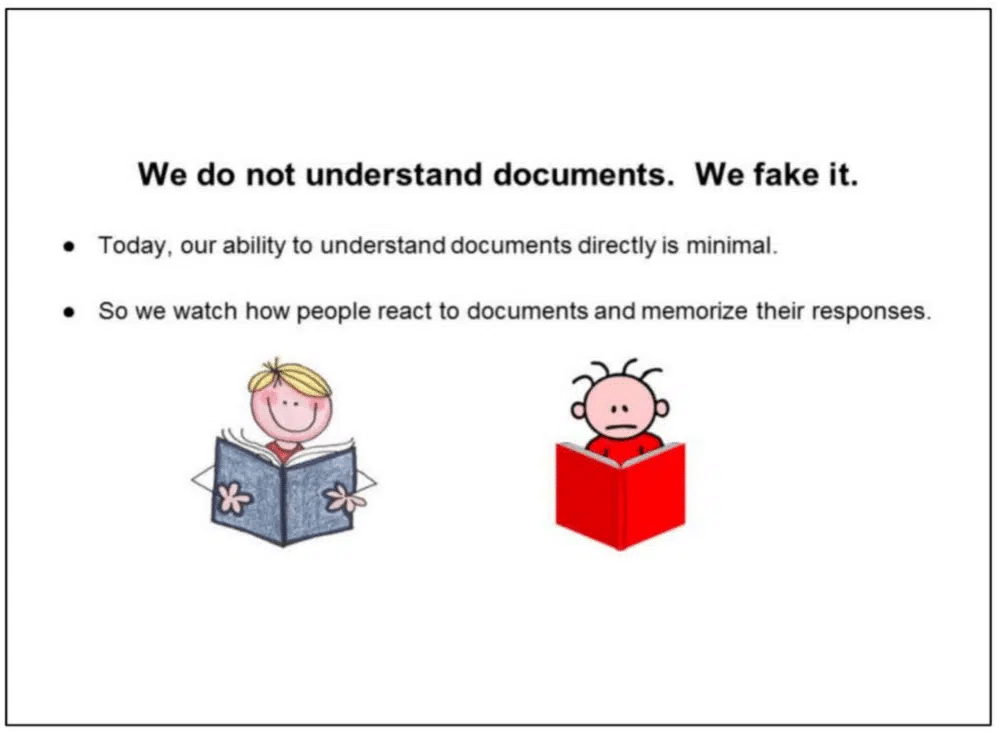
Google admitted as much in DOJ anti-trust exhibits. In a 2016 presentation says: “We do not understand documents. We fake it.”
A slide from a Search all-hands presentation prepared by Eric Lehman
Google relies on user interactions on SERPs to judge content quality
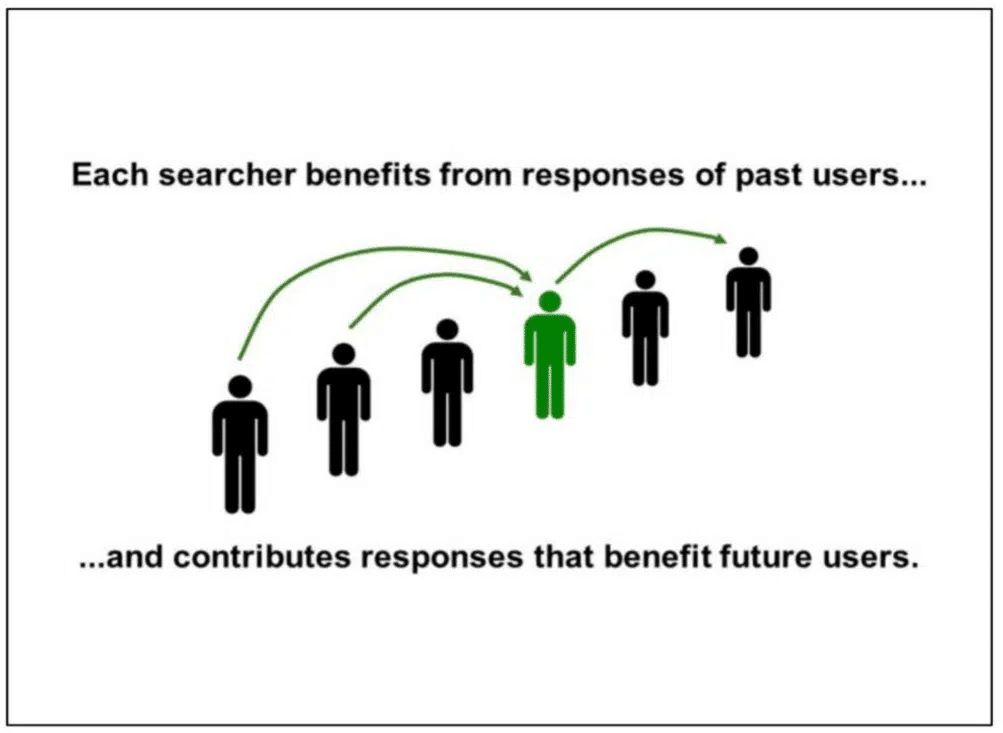
Google has relied on user interactions with SERPs to understand how “good” the contents of a document is. Google explains later the presentation: “Each searcher benefits from the responses of past users… and contributes responses that benefit future users.”
A slide from a Search All Hands presentation prepared by Lehman
The interaction data Google uses to judge quality has always been a hotly debated topic. I believe Google uses interactions almost entirely from their SERPs, not from websites, to make decisions about content quality. Doing so rules out site-measured metrics like bounce rate.
If you’ve been listening closely to the people who know, Google has been fairly transparent that it uses click data to rank content.
Google engineer Paul Haahr presented “How Google Works: A Google Ranking Engineer’s Story,” at SMX West in 2016. Haahr spoke about Google’s SERPs and how the search engine “looks for changes in click patterns.” He added that this user data is “harder to understand than you might expect.”
Haahr’s comment is further reinforced in the “Ranking for Research” presentation slide, which is part of the DOJ exhibits:
A slide from “Ranking for Research” DOJ exhibit
Google’s ability to interpret user data and turn it into something actionable relies on understanding the cause-and-effect relationship between changing variables and their associated outcomes.
The SERPs are the only place Google can use to understand which variables are present. Interactions on websites introduce a vast number of variables beyond Google’s view.
Even if Google could identify and quantify interactions with websites (which would arguably be more difficult than assessing the quality of content), there would be a knock-on effect with the exponential growth of different sets of variables, each requiring minimum traffic thresholds to be met before meaningful conclusions could be made.
Google acknowledges in its documents that “growing UX complexity makes feedback progressively hard to convert into accurate value judgments” when referring to the SERPs.
Get the daily newsletter search marketers rely on.
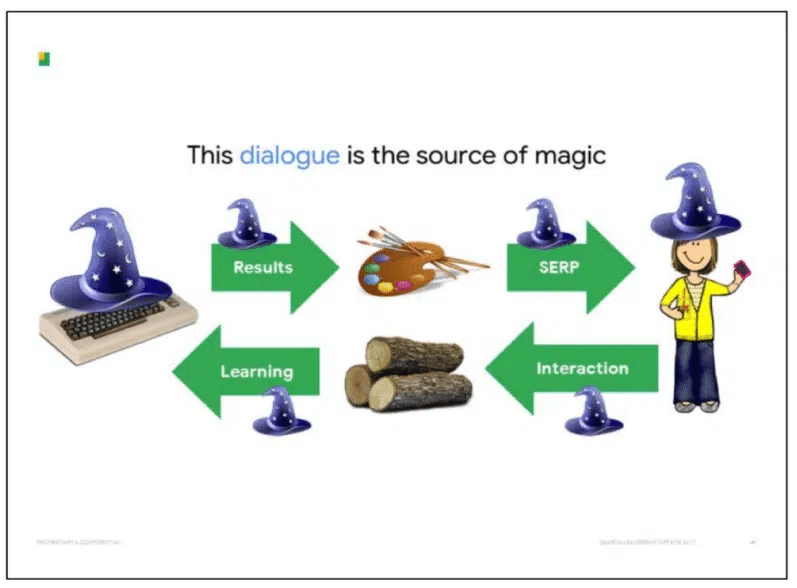
Google says the “dialogue” between SERPs and users is the “source of magic” in how it manages to “fake” the understanding of documents.
A slide from “Logging & Ranking” DOJ exhibit
Outside of what we’ve seen in the DOJ exhibits, clues to how Google uses user interaction in rankings are included in its patents.
One that is particularly interesting to me is the “Site quality score,” which (to grossly oversimplify) looks at relationships such as:
When searchers include brand/navigational terms in their query or when websites include them in their anchors. For instance, a search query or link anchor for “seo news searchengineland” rather than “seo news.”
When users appear to be selecting a specific result within the SERP.
These signals may indicate a site is an exceptionally relevant response to the query. This method of judging quality aligns with Google’s Eric Schmidt saying, “brands are the solution.”
This makes sense in light of studies that show users have a strong bias toward brands.
For instance, when asked to perform a research task such as shopping for a party dress or searching for a cruise holiday, 82% of participants selected a brand they were already familiar with, regardless of where it ranked on the SERP, according to a Red C survey.
Brands and the recall they cause are expensive to create. It makes sense that Google would rely on them in ranking search results.
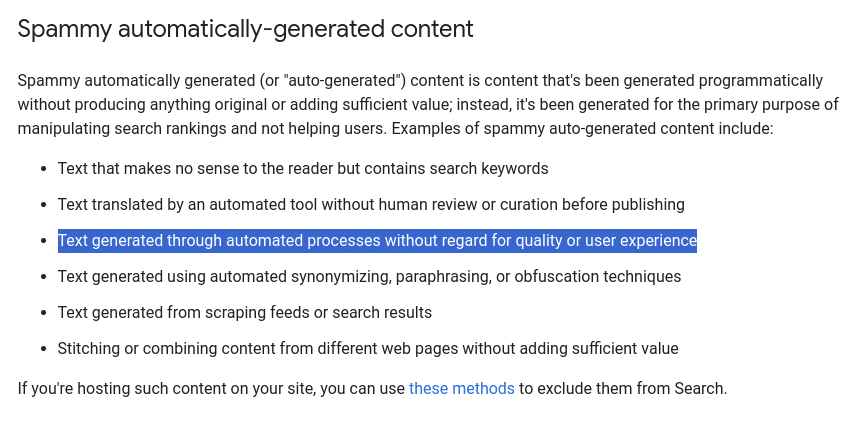
Spam is “Text generated through automated processes without regard for quality or user experience,” according to Google’s definition. I interpret this as anyone using AI systems to produce content without a human QA process.
Arguably, there could be cases where a generative-AI system is trained on proprietary or private data. It could be configured to have more deterministic output to reduce hallucinations and errors. You could argue this is QA before the fact. It’s likely to be a rarely-used tactic.
Everything else I’ll call “spam.”
Generating this kind of spam used to be reserved for those with the technical ability to scrape data, build databases for madLibbing or use PHP to generate text with Markov chains.
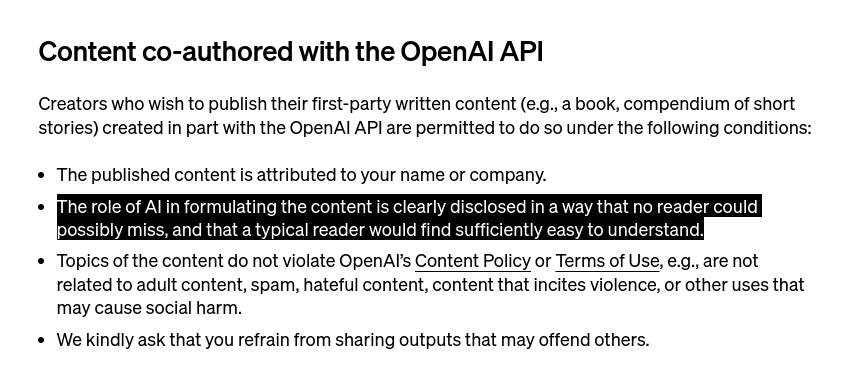
ChatGPT has made spam accessible to the masses with a few prompts and an easy API and OpenAI’s ill-enforced Publication Policy, which states:
“The role of AI in formulating the content is clearly disclosed in a way that no reader could possibly miss, and that a typical reader would find sufficiently easy to understand.”
OpenAI’s Publication Policy
The volume of AI-generated content being published on the web is enormous. A Google Search for “regenerate response -chatgpt -results” displays tens of thousands of pages with AI content generated “manually” (i.e., without using an API).
In many cases QA has been so poor “authors” left in the “regenerate response” from the older versions of ChatGPT during their copy and paste.
Patterns of AI content spam
When GPT-3 hit, I wanted to see how Google would react to unedited AI-generated content, so I set up my first test website.
This is what I did:
Bought a brand new domain and set up a basic WordPress install.
Scraped the top 10,000 games that were selling on Steam.
Fed these games into the AlsoAsked API to get the questions being asked by them.
Used GPT-3 to generate answers to these questions.
Generate FAQPage schema for each question and answer.
Scraped the URL for a YouTube video about the game to embed on the page.
Use the WordPress API to create a page for each game.
There were no ads or other monetization features on the site.
The whole process took a few hours, and I had a new 10,000-page website with some Q&A content about popular video games.
Both Bing and Google ate up the content and, over a period of three months, indexed most pages. At its peak, Google delivered over 100 clicks per day, and Bing even more.
Google Search Console Performance data from this site presented by Lily Ray at PubCon
Results of the test:
After about 4 months, Google decided not to rank some content, resulting in a 25% hit in traffic.
A month later, Google stopped sending traffic.
Bing kept sending traffic for the entire period.
The most interesting thing? Google did not appear to have taken manual action. There was no message in Google Search Console, and the two-step reduction in traffic made me skeptical that there had been any manual intervention.
I’ve seen this pattern repeatedly with pure AI content:
Google indexes the site.
Traffic is delivered quickly with steady gains week on week.
Traffic then peaks, which is followed by a rapid decline.
Another example is the case of Casual.ai. In this “SEO heist,” a competitor’s sitemap was scraped and 1,800+ articles were generated with AI. Traffic followed the same pattern, climbing several months before stalling, then a dip of around 25% followed by a crash that eliminated nearly all traffic.
SISTRIX visibility data for Causal.app
There is some discussion in the SEO community about whether this drop was a manual intervention because of all the press coverage it got. I believe the algorithm was at work.
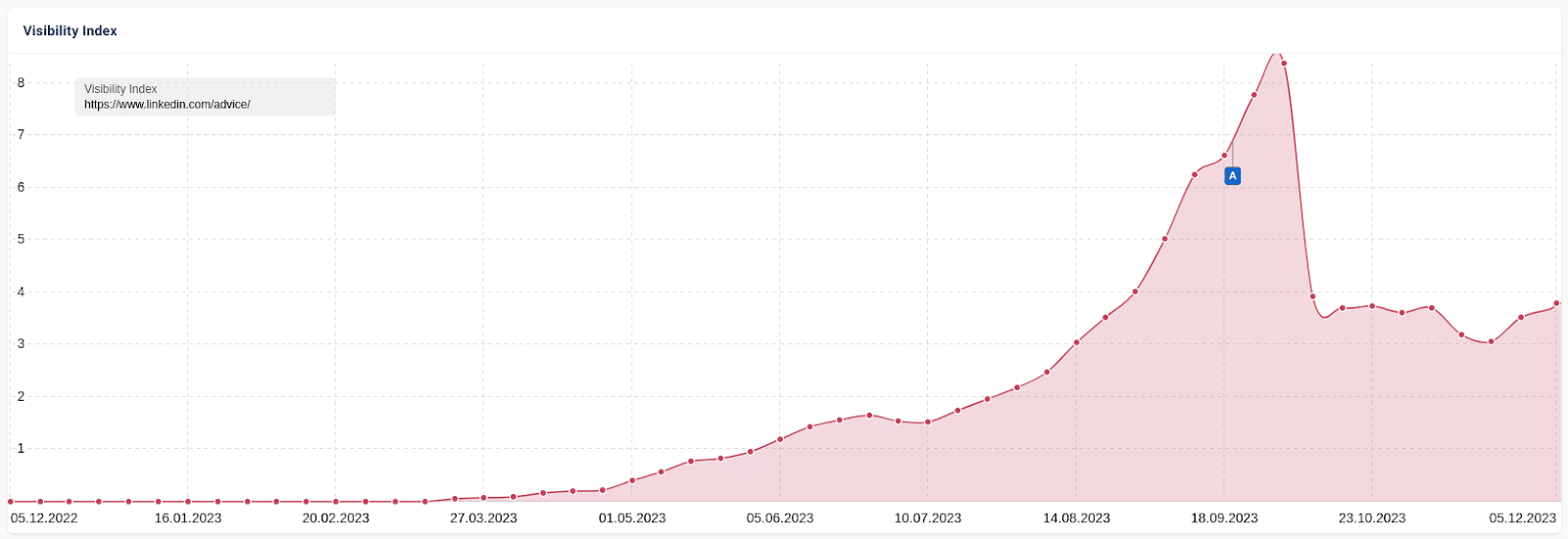
A similar and perhaps more interesting case study involved LinkedIn’s “collaborative” AI articles. These AI-generated articles created by LinkedIn invited users to “collaborate” with fact-checking, corrections and additions. It rewarded “top contributors” with a LinkedIn badge for their efforts.
As with the other cases, traffic rose and then dropped. However, LinkedIn maintained some traffic.
SISTRIX visibility for LinkedIn /advice/ pages
This data indicates that traffic fluctuations result from an algorithm rather than a manual action.
Once edited by a human, some LinkedIn collaborative articles apparently met the definition of useful content. Others were not, in Google’s estimation.
Maybe Google’s got it right in this instance.
If it’s spam, why does it rank at all?
From everything I have seen, ranking is a multi-stage process for Google. Time, expense, and limits on data access prevent the implementation of more complex systems.
While the assessment of documents never stops, I believe there is a lag before Google’s systems detect low-quality content. That’s why you see the pattern repeat: content passes an initial “sniff test,” only to be identified later.
Let’s take a look at some of the evidence for this claim. Earlier in this article, we skimmed over Google’s “Site Quality” patent and how they leverage user interaction data to generate this score for ranking.
When a site is brand new, users haven’t interacted with the content on the SERP. Google can’t access the quality of the content.
Again, to grossly oversimplify, a quality score for new sites is predicted by first obtaining a relative frequency measure for each of a variety of phrases found on the new site.
These measures are then mapped using a previously generated phrase model built from quality scores established from previously scored sites.
Predicting Site Quality patent
If Google were still using this (which I believe they are, at least in a small way), it would mean that many new websites are ranked on a “first guess” basis with a quality metric included in the algorithm. Later, the ranking is refined based on user interaction data.
I have observed, and many colleagues agree, that Google sometimes elevates sites in ranking for what appears to be a “test period.”
Our theory at the time was there was a measurement going on to see if user interaction matched Google’s predictions. If not, traffic fell as quickly as it rose. If it performed well, it continued to enjoy a healthy position on the SERP.
Many of Google’s patents have references to “implicit user feedback,” including this very candid statement:
“A ranking sub-system can include a rank modifier engine that uses implicit user feedback to cause re-ranking of search results in order to improve the final ranking presented to a user.”
It is worth noting that this is an old patent and one of many. Since this patent was published, Google has developed many new solutions, such as:
RankBrain, which has specifically been cited to handle “new” queries for Google.
SpamBrain, one of Google’s main tools for combatting webspam.
Google: Mind the gap
I don’t think anyone outside of those with first-hand engineering knowledge at Google knows exactly how much user/SERP interaction data would be applied to individual sites rather than the overall SERP.
Still, we know that modern systems such as RankBrain are at least partly trained on user click data.
“There are a number of references to moving a set of documents from the ‘green ring to the ‘blue ring.’ These all refer to a document that I have not yet been able to locate. However, based on the testimony it seems to visualize the way Google culls results from a large set to a smaller set where they can then apply further ranking factors.”
This supports my sniff-test theory. If a website passes, it gets moved to a different “ring” for more computationally or time-intensive processing to improve accuracy.
I believe this to be the current situation:
Google’s current ranking systems can’t keep pace with AI-generated content creation and publication.
As gen-AI systems produce grammatically correct and mostly “sensible” content, they pass Google’s “sniff tests” and will rank until further analysis is complete.
Herein lies the problem: the speed at which this content is being created with generative AI means there is an unending queue of sites waiting for Google’s initial evaluation.
An HCU hop to UGC to beat the GPT?
I believe Google knows this is one major challenge they face. If I can indulge in some wild speculation, it’s possible that recent Google updates, such as the helpful content update (HCU), have been applied to compensate for this weakness.
Reddit was already one of the most visited websites. Recent Google changes yielded more than double its search visibility, at the expense of other websites.
My conspiracy theory is that UGC sites, with a few notable exceptions, are some of the least likely places to find mass-produced AI content, because much of the content published on UGC sites is moderated.
While they may not be “perfect” search results, the overall satisfaction of trawling through some raw UGC may be higher than Google consistently ranking whatever ChatGPT last vomited onto the web.
The focus on UGC may be a temporary fix to boost quality; Google can’t tackle AI spam fast enough.
What does Google’s long-term plan look like for AI spam?
Much of the testimony about Google in the DOJ trial came from Eric Lehman, a former 17-year employee who worked there as a software engineer on search quality and ranking.
One recurring theme was Lehman’s claims that Google’s machine learning systems, BERT and MUM, are becoming more important than user data. They are so powerful that it is likely Google will rely more on them than user data in the future.
With slices of user interaction data, search engines have an excellent proxy for which they can make decisions. The limitation is collecting enough data fast enough to keep up with changes, which is why some systems employ other methods.
Suppose Google can build their models using breakthroughs such as BERT to massively improve the accuracy of their first content parsing. In that case, they may be able to close the gap and drastically reduce the time it takes to identify and de-rank spam.
This problem exists and is exploitable. The pressure on Google to address its shortcomings increases as more people search for low-effort, high-results opportunities.
Ironically, when a system becomes effective in combatting a specific type of spam at scale, the system can make itself almost redundant as the opportunity and motivation to take part is diminished.
One of the joys of living in a place where the winters tend to be long and dark is the time it allows for reading. Make a fire in the fireplace, pour yourself a drink and open a good book.
I often do the bulk of my reading for the year between October and March because then it’s outside time (which isn’t to say you can’t read outside).
We live in a time when we’re surrounded by marketing. Everything and everyone seems to be vying for our attention.
If you work in marketing, the idea of reading a book about something you do all day and that surrounds you every waking moment might sound unappealing. Yet, there are still new things to be said and new things to learn about marketing.
As you head into 2024, here are six books to put on your reading list.
The first thing you’ll likely notice is they aren’t all actually about marketing. But marketing is an essential part of every business and every leader must be a marketer to be successful.
1. Impossible to Ignore: Creating Memorable Content to Influence Decisions
The central focus of Dr. Carmen Simon’s book is the creation of memorable presentations, which is an area where many people have just enough knowledge of PowerPoint and Google Slides to be dangerous.
The problem with many of the day-to-day presentations we see in sales and business, in general, is they try to function as both a presentation and a leave-behind. That leaves them packed with information and light on strong visuals and stories, and those are the exact elements that stick in our memories and promote recall.
As evidence that the techniques in the book work, I like to refer to how Simon uses them in the book itself.
Years after first reading “Impossible to Ignore,” I remember her anecdote about standing in line at a store when she was a child in Soviet-era Romania. Food was in short supply, so the workers had to limit the number of people in line. They decided to send home everyone behind the girl who stood out in a bright red coat, which was a young Simon. The combination of strong visuals and a powerful story burned that in my mind.
2. Running with Purpose: How Brooks Outpaced Goliath Competitors to Lead the Pack
Why would a memoir by the CEO of an athletic shoe company make the list? Because marketing, at its essence, is about identifying and creating markets for whatever you’re selling.
When Jim Weber took over as CEO of Brooks, the company was trying to be everything to everyone who wore sneakers. That’s a lot of people in a market with many big brand names.
Weber and team decided to drop a large portion of the market by leaving the “athleisure” business, which consists of the low(ish)-cost sneakers people wear around the house or when they’re doing chores. They decided instead to focus on serious runners.
This one also has a great marketing play involving luxurious portable toilets Brooks brought to major races. To gain entry, runners had to be wearing Brooks footwear.
There’s a lesson on market disruption, too. Remember the craze over five-finger running shoes? Yeah, that was fun.
3. Unreasonable Hospitality: The Remarkable Power of Giving People More Than They Expect
Will Guidara has a unique resumé. Among his roles: restaurant owner, creative agency leader, conference host and the author of four cookbooks.
His specialty is hospitality. One of his guiding beliefs is that hospitality need not be limited to what we think of as the hospitality industry (i.e., restaurants, spas, hotels). Instead, businesses across industries can create experiences that delight customers and drive more business.
As Guidara rose to prominence in the restaurant business in New York City, his business became legendary for providing experiences like sledding in Central Park for a family that had never before experienced snow.
The moments of brilliance and generosity in the book could serve as a lesson for corporations across the business spectrum. Americans have relatively dim views of large corporations and financial institutions in general. They feel much better about small businesses, which are more nimble and structured in a way that makes personal touches possible.
Many marketers will tell you their brand is more than a logo or color palette, it evokes emotions and, most importantly, trust. In “Unreasonable Hospitality,” you get a view of what this truly looks like in practice.
4. The Power of Moments: Why Certain Experiences Have Extraordinary Impact
We can’t remember every detail of every experience. If you’ve ever watched a courtroom drama, you’ve seen this play out.
“So what you’re saying is, you’re not sure if the suspect had a beard or not when you saw him on that misty, moonless night?”
We remember the peaks of our experiences most of all. Sometimes, we remember the valleys of our experiences. Everything else gets labeled as “just not important enough to remember” by our memory.
In “The Power of Moments,” Chip Heath and Dan Heath help readers understand how our minds process and classify experiences. Once you understand how this all works subconsciously, it’s much easier to be deliberate in creating moments that matter for our audiences.
As a blueprint, the book looks at events that weren’t necessarily designed to be memorable, such as a “Signing Day” ceremony for graduating high school seniors where they announced which college they were attending. It then deconstructs the events to see what exactly made them memorable.
5. Humanizing B2B: The new truth in marketing that will transform your brand and your sales
Download a whitepaper. Get calls from sales reps. Receive email after email.
For years, the B2B marketing playbook was pretty boring – even a bit annoying. It’s improved to some extent but still has a long way to go. You probably know the feeling if you have friends who work in B2C marketing.
“Oh, you’re doing a Super Bowl ad? That must be exhausting for you…”
What if it didn’t have to be this way? (Spoiler alert: it doesn’t.)
Instead of being the boring part of marketing, Paul Cash and James Trezona say, B2B should appeal to the emotions of people trying to transform organizations and create change.
They draw heavily on research from The B2B Institute at LinkedIn to make the case that B2B buyers rely on emotions just as much as their B2C counterparts.
That makes a great deal of sense, when you think about it. Because they aren’t actually counterparts. They are the same people, and they don’t take off their B2B hat and put on a B2C hat when they finish their workday.
6. Obviously Awesome: How to Nail Product Positioning So Customers Get It, Buy It, Love It
Part of what I enjoy about April Dunford’s story is that, like me, she never set out to be a marketer. As someone without a formal marketing education, she asked a lot of questions. The answers left her unsatisfied.
“Trust me, it works.”
“Because we’ve always done it that way.”
The result is “Obviously Awesome,” a book that re-thinks product marketing from an outsider’s perspective.
The most difficult part for people trying to turn their product into a story that resonates with customers is where to start. Do you craft a story that starts with your features? Or do you focus first on the customers’ needs? What about differentiation?
Burnout, seeking work life balance, and layoffs are all valid reasons people close the door to their corporate gigs and strike out on their own — but they weren’t mine.
Over the last few years, the corporate world has seen some dramatic shifts, including a mass adoption of remote or hybrid work and a historic boom in new business ventures.
But let’s back up for a moment to 2017, when I joined a big financial technology company. While at the company, I had the chance to work with the global head of social impact and the company’s foundation lead, who taught me so much about the importance of supporting small businesses.
Small businesses are the backbone of our economies. When you support a small business, you’re investing in that person and their community. You’re fostering economic growth and preserving diversity and innovation. You’re prioritizing creativity and craftsmanship. And (in most cases) you’re making a positive difference for the environment.
My experience at this company was transformative. Not only did I gain an appreciation for the small business ecosystem, but I developed a passion to help entrepreneurs thrive (the U.S. Bureau of Labor Statistics estimates that 1 in 5 U.S. businesses fail within their first year of operation).
Today, I’m proud to be an entrepreneur helping other entrepreneurs scale their businesses by aligning their purpose and their passion through integrated marketing and communications (or PR).
Let me take you back to early 2022 and walk you through the top 4 reasons that inspired me to make the leap from my corporate gig into entrepreneurship, and why they might just be your reasons too.
Reason #1: You are too far from the ground work.
Small businesses are deeply rooted in their communities. When you support local businesses, you contribute to the growth and development of your community. Small businesses often sponsor local events, donate to charities, and reinvest in their neighborhoods — so, by supporting them, you help create a sense of community, strengthen social connections, and improve the overall quality of life in your area.
Since I worked for a global company, my team didn’t serve one community — we served the world. This had a major downside: it was impossible to tangibly see the difference I was making in my work or in my community through my professional efforts because I was so far from the ground work.
We all know that giving back is important — and these days, it’s not just a smart business move. Building social capital is critical to reach today’s consumers and build goodwill among employees.
If you are craving that sense of community building that is not present in your corporate day job, it may be time to find something more… just like I did.
Reason #2: You feel inauthentic to yourself, serving a big company with your gifts and time.
Although I knew the corporation I was working for invested in serving small businesses and communities, I didn’t feel like I was directly playing a part in that. Instead, I felt I was increasing its carbon footprint by driving three hours a day multiple times a week to get to the office or indulging in all the amenities it had to offer, including free, constant swag and brown bag lunches that often left food wasted.
Fast forward a few years: through my small business Plum & Parcel, I’m able to work directly with individuals who are running extremely efficient and intentional, low overhead, sustainable companies.
Surrounding yourself with clients who share your vision and values can be incredibly rewarding. It can bring back that sense of authenticity you might be missing in your corporate job.
Reason #3: Working with small businesses can benefit your work in more ways than one: the first being forever relationships.
When you choose to shop or work with small businesses, you are more likely to get to know those individuals on a deeper level.
In my business, I’m building what I like to call ‘forever relationships’ with my colleagues, clients and customers. This is leading to more fulfilling work experiences than at my corporate job, as I can directly see the impact we are having on each other’s lives and we’re building long-lasting connections in the process.
Forever relationships can look like regular get togethers just to catch up, annual holiday cards, and mutual support for each other’s careers — not the ‘you scratch my back, I’ll scratch yours’ transactional mentality all too common in the corporate world.
If you are looking for forever relationships that challenge you, starting your own business might be your next career move.
Reason #4: You see the major professional and personal growth advantage serving small businesses with your own small business can have.
Small businesses have the potential for significant growth and scalability.
When re-launching my business, I realized that if I align myself with like-minded small business owners and entrepreneurs and follow their growth trajectory, I can position my own company’s growth alongside them. As their needs evolved, I can adapt my services and offerings accordingly, capturing more business and revenue opportunities. And, that’s exactly where I’m heading today.
Working with other like-minded small business owners can expand your skills and knowledge across various domains, making you more versatile and marketable. Case in point: I’ve since started my own podcast and created my own online course, bringing integrated marketing communications wisdom to aspiring entrepreneurs all over the globe.
Beyond professional development, you can gain incredible skills around time management and productivity that are absolutely necessary for all aspects of life.
I’ve been off on my own running my business (for the second time) for two years now and while it hasn’t been easy, it’s been one of the best decisions I’ve made.
Ready to make the jump from your corporate gig? Small businesses play a pivotal role in our economy. Join the movement and make your purpose and passions your business.
In today’s homes, basements are no longer relegated to being dark, musty storage spaces. Many homeowners now transform their basements into functional living areas, adding significant value to their properties. Whether it’s a cozy family room, a home theater, or an extra bedroom, a finished basement is a valuable investment. However, protecting this investment from water damage is crucial. In this article, we will explore the special considerations and techniques required for waterproofing a basement that is finished or used as a living space.
Understanding the Risk
Before delving into waterproofing techniques, it’s essential to understand the potential risks associated with a finished basement. Unlike unfinished basements, finished ones have walls, flooring, and furnishings that can be easily damaged by water. Water intrusion can lead to mold growth, structural damage, and the ruin of your investment. Therefore, waterproofing is not an option but a necessity.
When it comes to waterproofing a finished basement, the primary option is interior waterproofing. This method involves addressing water intrusion from within the basement. It includes installing a drainage system, sump pump, and a moisture barrier on the interior walls. Interior waterproofing is less invasive and can be done without excavating around the foundation. However, it may not be as effective as some exterior methods in preventing water from entering the foundation walls in the first place.
Special Considerations for Finished Basements
When waterproofing a finished basement, certain considerations and techniques become crucial:
Moisture-Resistant Materials: Select moisture-resistant building materials for your finished basement. Opt for mold-resistant drywall, water-resistant flooring options, and paint that can withstand humidity. These materials are less susceptible to water damage and mold growth.
Adequate Drainage: Ensure that your basement has an effective drainage system. This involves installing a sump pump and perimeter drains. These systems help collect and divert water away from your living space, reducing the risk of flooding.
Proper Insulation: Insulate your basement properly to control humidity and prevent condensation. Inadequate insulation can lead to moisture problems and reduced energy efficiency. Consult with a professional to determine the right insulation for your basement’s specific needs.
Vapor Barriers: Install vapor barriers on interior walls to prevent moisture from seeping through. These barriers can help control humidity levels in your finished basement, making it a more comfortable and healthy living space.
Regular Maintenance: Finished basements require regular maintenance to ensure that waterproofing systems remain effective. Check your sump pump and drainage systems regularly, and address any issues promptly. Additionally, keep an eye out for signs of water damage or mold and take action if needed.
Professional Guidance
While some aspects of basement waterproofing can be done as DIY projects, it’s often best to seek professional guidance and services, especially when dealing with a finished basement. Waterproofing professionals have the experience and expertise to assess your basement’s unique needs and recommend the most suitable solutions.
The Cost of Waterproofing
The cost of waterproofing a finished basement can vary widely depending on the size of the space, the severity of water issues, and the chosen waterproofing method. However, it’s essential to view this as an investment in protecting the value of your home and ensuring the safety and comfort of your living space.
A finished basement is a valuable addition to any home, but it comes with the responsibility of ensuring it remains dry and free from water damage. Waterproofing a finished basement involves special considerations and techniques to protect your investment. Whether you opt for interior waterproofing methods, use moisture-resistant materials, maintain proper drainage, and consult with professionals when needed, you can enjoy your finished basement for years to come without worrying about water-related issues. This ensures the preservation of the value and integrity of your home.
Christmas cards are a dying social courtesy. With digital communication offering quick and easy alternatives, it’s really no surprise.
For the more sentimental among us, this could be a rather sad state of affairs. However, if you’ve been hanging on to each Christmas card you’ve ever received, and maybe even safeguarding those of previous generations, you could be sitting on top of a miniature goldmine!
As Christmas cards become increasingly novel, so their value grows.
Let’s take a look at ways you can make money from collecting Christmas cards.
Perhaps the best place to start our investigation is to go right back to the very beginning.
Although it may seem like Christmas cards have always been around, they really only date back to the 1800s.
The first ever Christmas card was created in the UK in 1843 by London-based illustrator John Calcott Horsley on behalf of Sir Henry Cole. Horsley designed and hand-coloured the original, after which a total of 1,000 were lithographed. These cards were sold at a shilling each.
The card shows a Christmas dinner with three generations of a family enjoying a Christmas party. The side panels show charitable scenes with people clothing and feeding the poor. Only 12 of the original 1,000 cards still in existence.
The most expensive Christmas cards in the world
Unsurprisingly, both their rarity and historical significance has made these cards extremely valuable.
In November 2001, Horsley’s original hand-coloured Christmas card – the prototype upon which the 1,000 lithographed copies were based – was sold at auction in Devizes for £20,000 and bought by an anonymous bidder. Cole had sent this exact Christmas card to his grandmother. It also holds the Guinness World Record for the most expensive greeting card ever sold at auction.
Of course, this isn’t the only Christmas card that’s ever made its way to auction.
Earlier this year, a group of 15 Christmas card designs by Salvador Dalí were put up for auction. The cards were commissioned by the Spanish pharmaceutical laboratory Hoechst Ibérica between 1959 and 1976. They were expected to raise up to €1m at Artcurial’s Modern and Impressionist Art auction in Paris.
Unsurprisingly, Christmas cards with a royal history also tend to rake in pounds. In 2017, collection of 35 cards sent by the Queen and Duke of Edinburgh over a 40-year period were sold at auction for £1,530.
How to identify valuable Christmas cards
Now, the chances that you have one of Horsley’s original 1,000 lithographed Christmas cards in your possession are slim. And so are the chances that you have any designed by other famous artists or sent by the royal family.
However, this does not mean that your collection is devoid of value.
Here are a few things that could spell big bucks when it comes to old Christmas cards:
Age
Since holiday and birthday cards are considered by most to be nothing more than sentimental ephemera, it’s not unusual for them to end up in the trash once festivities are over. Which means it’s extraordinarily hard to find really, really old Christmas cards.
If, however, you suspect that there might be a couple gathering dust in your storeroom, go have a bit of a rummage.
Obviously, the older the specimen the more valuable it will be.
Condition
Another big determiner of value is how well-preserved the Christmas card in question is. If you have one dating back to 1890, but it’s torn and faded, the likelihood of it bringing in any money is close to zero.
If however, the card has been stored carefully, protected from any possible damage and still looks as pristine as the day it arrived on the mantlepiece, you may just be in luck!
Artwork
What’s on the card? If it’s an original artwork by a moderately to highly successful artist (who knows – maybe your great grandparents were well-connected), the card may just be of interest to collectors.
Another thing to take note of on the cover of the card in question is whether it depicts an historic event or popular character. Examples of the former may include anything alluding to one of the World Wars, while the latter could perhaps come in the form of classic, vintage illustrations of anyone from Santa Clause to Mickey Mouse.
What’s inside
Finally, even if the well-preserved outside is somewhat unremarkable, the inside may be where the magic lies.
If you have a Christmas card with an ink-on-paper celebrity signature, its value is almost sure to shoot up. Of course, there’s also a hierarchy to consider here. If you have one signed by Queen Elizabeth herself, it’s probably quite a bit more valuable than one bearing the signature of your local radio station’s host.
Where to buy and sell
Tickled by the idea of making money from Christmas cards? We suggest you start your career on eBay!
It’s pretty easy to set up an account and you’ll also have full control over your auctions and sales.
Once you have your foot in the door and your collection starts growing, you may want to investigate which auctioneers could help you find the best bidders for your collections.
In the intricate and often unpredictable realm of business litigation, the concept of mass tort lawsuits emerges as a particularly pressing issue for the owners of small businesses. Picture this: you’re selling a product, and out of the blue, it’s linked to health risks, triggering a flurry of lawsuits.
This scenario is at the heart of mass tort lawsuits, where multiple individuals take legal action against one or a few entities. These cases can be especially taxing for small businesses. Let’s dive into the crucial elements of mass tort lawsuits that every small business owner needs to grasp.
1. Getting to Grips with Mass Tort Lawsuits
What It’s All About:
A mass tort lawsuit is when a bunch of people sue one or a few defendants because they’ve been harmed by something they all have in common, like a product or an action. This is different from class-action lawsuits where everyone’s claim is lumped together. Here, each person has their own unique claim and damages.
How It’s Different:
Unlike class actions, where one lawsuit covers a whole group with similar complaints, mass torts treat each case separately, even though they might be handled together for efficiency’s sake.
Real-World Examples:
Think about the asbestos cases, where lots of businesses got sued over health problems linked to asbestos. Small businesses dealing with asbestos-related products found themselves in the middle of these tricky legal situations.
As a business owner it is important to abreast with such cases to better ascertain where you stand, vis a vis, mass tort cases in the US.
2. Financial Implications
The Cost of Defense:
Fighting a mass tort lawsuit can really hit your wallet. You’ve got legal fees, the cost of digging into the case, and then there’s the money you might have to pay in settlements or court decisions.
Insurance Headaches:
Having liability insurance is key, but sometimes these policies don’t cover everything you need for a mass tort. Make sure you really understand what your policy covers and think about getting extra coverage if you need it.
Long-Term Money Matters:
It’s not just about the immediate costs. You’ve got to think about things like higher insurance premiums down the road, ongoing legal bills, and the expense of making changes to your business to avoid future issues.
3. The Importance of Legal Help
Why You Need an Expert:
Mass torts are complex, and you’ll need a lawyer who really knows their stuff. General practice attorneys might not cut it for these kinds of cases.
Finding the Right Lawyer:
Look for a lawyer with a good track record in mass torts. They should be really familiar with the ins and outs of these kinds of cases.
Navigating the Legal Maze:
A good lawyer will help you through the whole process, from dealing with mountains of paperwork to negotiating and maybe even going to trial. They can also work with other defendants to pool resources and strategies.
4. Managing the Risks
Staying Out of Trouble:
To avoid getting into a mass tort, keep a tight ship when it comes to quality control, stick to all the safety rules, and keep up with what’s happening in your industry. There are a lot of steps that can be taken to better deal with the risks of mass torts, but the first and most sensible thing to do is not make yourself a magnet for such lawsuits in the first place.
Sticking to the Rules:
You’ve got to follow industry regulations to the letter. Regular check-ups and advice from legal experts can keep you on the right track.
5. Reputation Matters
Public Image:
Getting caught up in a mass tort lawsuit can make your business look bad. Customers might start associating your brand with the negative aspects of the lawsuit, which can hurt sales and business relationships.
Handling the Story:
It’s important to talk openly and honestly with your customers and stakeholders about your involvement in the lawsuit and what you’re doing about it. Bringing in a PR firm can also help manage how people see your situation.
Wrapping It Up
Facing a mass tort lawsuit is like navigating a complex maze filled with legal, financial, and reputation challenges for small business owners.
Understanding the ins and outs, being ready to defend yourself, and getting specialized legal help are key. While the thought of a mass tort lawsuit is intimidating, being well-informed and prepared can really change the game for your business.
There’s no denying that the healthcare market is undergoing a paradigm shift, especially with the adoption of digital solutions. A growing number of healthcare providers are engaging patients online instead of using traditional advertising methods. As such, in the current consumer-driven healthcare landscape, tapping into the consumer market is not just about offering services; it’s about crafting a narrative that resonates with the needs and desires of the modern patient.
As a healthcare business, your challenge is to navigate the complex web of patient behavior, preferences, and expectations. So you can craft a targeted marketing campaign that will yield results, including increased patient volume and improved brand awareness. Targeted marketing can become your compass towards growing your healthcare business, and these are the ways.
Honing In on Your Target Patients
Delving deeper into the psyche and behavior of the healthcare consumer is akin to peeling back the layers of an onion—each layer offers a new depth of understanding that can empower your team to develop a nuanced marketing approach. Before diving into strategies, it’s crucial to understand who the healthcare consumer is. Today’s healthcare consumers are:
Informed and Empowered
With information at their fingertips, consumers are more knowledgeable about health-related issues. In fact, studies have found that nearly one in ten Americans turns to Google before talking to their physician.
Consider Jane, a 30-year-old working professional. Before even considering a visit to the doctor, Jane researched her symptoms online, read through several health forums, and even took an online assessment. By the time she contacts a healthcare provider, she’s armed with questions and expects clear, concise answers.
Tech-Savvy
Tech-savvy patients use computers, smartphones, and the internet to stay on top of their health. They prefer online resources for medical information, telehealth services, and digital communication with providers.
Take, for example, Mike, a tech enthusiast in his twenties who prefers to book doctor appointments through an app. He will likely engage with a healthcare provider that will give him a seamless digital experience. He tracks his fitness and diet through wearable technology and expects his healthcare provider to integrate this data into his health records.
Value-Conscious
As the healthcare business shifts into a more patient-centric model, there is a growing demand for healthcare services that offer value for money.
For instance, let’s consider Linda, a retired teacher living on a fixed income who is very mindful of her healthcare expenses. She compares prices and is inclined toward healthcare providers with transparent pricing and higher value propositions. A healthcare business that provides clear cost structures and explains the value of its services can easily earn Linda’s trust, and she would likely become a loyal customer.
Seeking Personalization
According to Salesforce research, 66% of consumers want experiences that are tailored to their needs and preferences. This sentiment proves that healthcare marketers can’t get away with a one-size-fits-all marketing approach. Healthcare consumers want to be treated as unique
individuals with their own goals and challenges.
For example, take our next patient persona, Rahul, a 40-year-old with a chronic condition. He doesn’t want generic care; he wants services tailored to his lifestyle and condition. When a healthcare provider uses his health data to personalize his treatment plan, Rahul feels valued and is more likely to remain loyal to that provider.
The Pillars of Targeted Marketing for Healthcare Businesses
Providers must build their marketing strategies based on several foundations to reach and engage with today’s healthcare consumers effectively.
1. Data-Driven Insights
Gone are the days when providers could rely on “gut feelings” or “hunches” to guide their marketing efforts. Today, data-driven insights are non-negotiable when it comes to targeted healthcare marketing because they empower you to understand and anticipate patient needs, preferences, and behaviors. With data analysis, you can tailor your marketing endeavors to address specific health concerns, optimize patient engagement, and improve care outcomes.
This targeted, patient-centric approach ensures your marketing steps are relevant and effective and can lead to better patient satisfaction and loyalty, ultimately driving success for your healthcare business.
2. Segmentation and Personalization
Segmentation and personalization are critical in healthcare marketing as they allow you to custom-fit your communication and services to specific groups, so your marketing message will always be relevant and resonate with your preferred audience. You can accomplish this by dividing your market into segments based on key demographics, including age, condition, income, lifestyle, etc. Then, you can craft personalized marketing messages for each segment.
For example, a dental practice segments its market into families, young professionals, and seniors. They send personalized emails to each group with family discounts, cosmetic dentistry offers for professionals, and gentle care reminders for seniors.
3. Content Marketing
Content marketing is a linchpin in targeted healthcare marketing for several reasons. First, content marketing educates and empowers patients, allowing them to make informed decisions about their health and treatments, leading to better health outcomes. High-quality content also helps establish your practice as an authority and trustworthy resource, making it easy for patients to trust your business. Not to mention, high-quality and valuable content helps with SEO and enhances your online presence.
4. Digital Presence and SEO
Your digital presence and SEO boost targeted healthcare marketing by enhancing your practice’s online visibility. So when a would-be patient searches for health-related information related to your practice, your healthcare website will appear on the first page of the search engines. This targeted visibility attracts high-quality leads, i.e., people actively seeking healthcare solutions.
Effective SEO strategies lead to higher website traffic, more appointments, and, ultimately, a stronger online presence, which is always welcome in such a competitive healthcare market.
5. Digital Reputation and Reviews
Did you know that 90% of patients use online reviews when checking healthcare providers? Patient reviews and testimonials are vital for targeted healthcare marketing because they offer social proof, build credibility, and significantly influence the decisions of modern patients.
Positive reviews can attract people looking for reliable healthcare providers, while addressing negative feedback shows a dedication to improving patient satisfaction.
Patient-Centered Healthcare Marketing
According to Cardinal Healthcare Marketing Agency, targeted marketing for healthcare is not just about selling your services and treatments; it’s about establishing a connection with the consumer—understanding their journey, addressing their concerns, and providing solutions that resonate with them on a deeper level. In conclusion, ensure your healthcare marketing is targeted and relevant.