Refining what it means to provide high-quality search results.
Helping quality raters understand why certain results are more helpful than others.
This level of nuance can help explain why we see certain volatility during core updates (as well as periods outside of announced algorithm updates).
If search quality raters have given Google ample evidence that its results are not meeting user expectations, this can lead to substantial intent shifts during core updates.
Looking at search results for the same query, before and after major Google updates, makes a lot more sense when you understand the granularity with which Google approaches understanding the intent behind a query, and what it means to have high-quality, helpful content.
Here are high-level insights into what has changed in the latest search quality rater guidelines update.
More guidance around rating page quality for forums & Q&A pages
Google added a new block of text to instruct raters on how to rate the quality of forum and Q&A pages, specifically in situations where the discussions are either brand new, or drifting into “combative,” “misleading” or “spammy content.”
A forum page defaults to “medium” if it’s simply a new page that hasn’t had time to collect answers. But older posts without answers should be rated as low quality.
Google mentions “decorum” a few times in this section, indicating that combative discussions that show a lack of respect should be rated as low quality.
This is a good reminder that the quality of comments on a given page can impact the overall quality of that page’s content, assuming Google can crawl and index the content in the comments. Often, comment sections are neglected or unmoderated, and if they become problematic, insulting or disrespectful, this can negatively impact an otherwise good-quality page.
(Page 76)
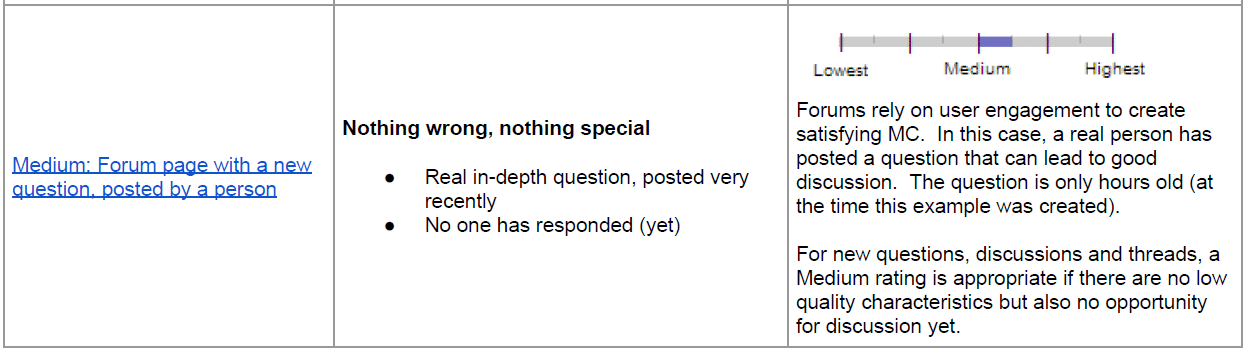
Additionally, the new version of the Search Quality Guidelines includes a visual example of what a “medium” quality forum page looks like on Reddit. The question is only 9 hours old and has no answers, so it defaults to a score of “medium.”
It’s worth noting that Google implies there are no other low-quality characteristics on this page that otherwise could lean the score towards “low quality” for new discussions.
(Page 77)
Below is the example Reddit URL Google used in this case:
A quick addition about the importance of a location to a query
Google added a short snippet about the importance of user location to understanding a query. For searches looking for nearby places, location is important, whereas generic questions like “how does gravity work” have the same answer, regardless of the user’s location.
(Page 84)
Interestingly, Google felt this nuance was worth adding to the Rater Guidelines. While it seems self-explanatory, it’s true that the extent to which a search query has a built in “local intent” can have a major impact on the types of results that would best answer that query.
Expanding on “Minor Interpretations”
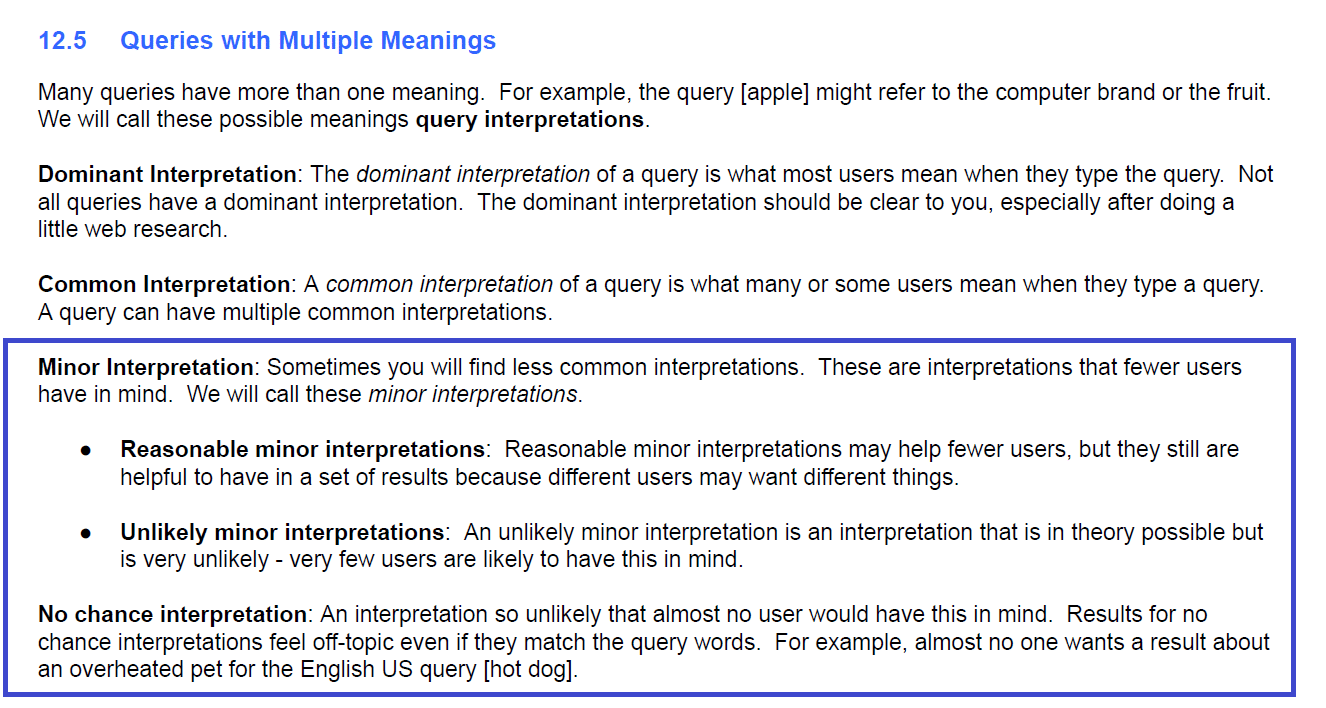
Google added a deeper explanation about its definitions for “Minor interpretations.”
Minor interpretations describe a situation when a query can have multiple meanings, and the minor interpretations are the least likely to be the commonly expected meanings of the query.
Within minor interpretations, Google introduced:
“Reasonable minor interpretations,” which help “fewer users” but are still helpful for search results.
“Unlikely minor interpretations,” which are theoretically possible but highly unlikely.
“No chance interpretations” are interpretations of a query that are incredibly unlikely for the user to be looking for. Google provides the example of an “overheated pet” when the searcher types “hot dog” (although I feel that this interpretation is more plausible than a “no chance” rating!).
(Page 87)
Google also added some new visual examples of how to interpret these definitions. For example, an “unlikely minor interpretation” of the search query “Apple” would be the U.S. city, Apple, Oklahoma.
(Page 88)
Further defining ‘Know Simple’ and ‘Do’ queries
Google added several new examples of what types of queries are not “Know Simple” queries.
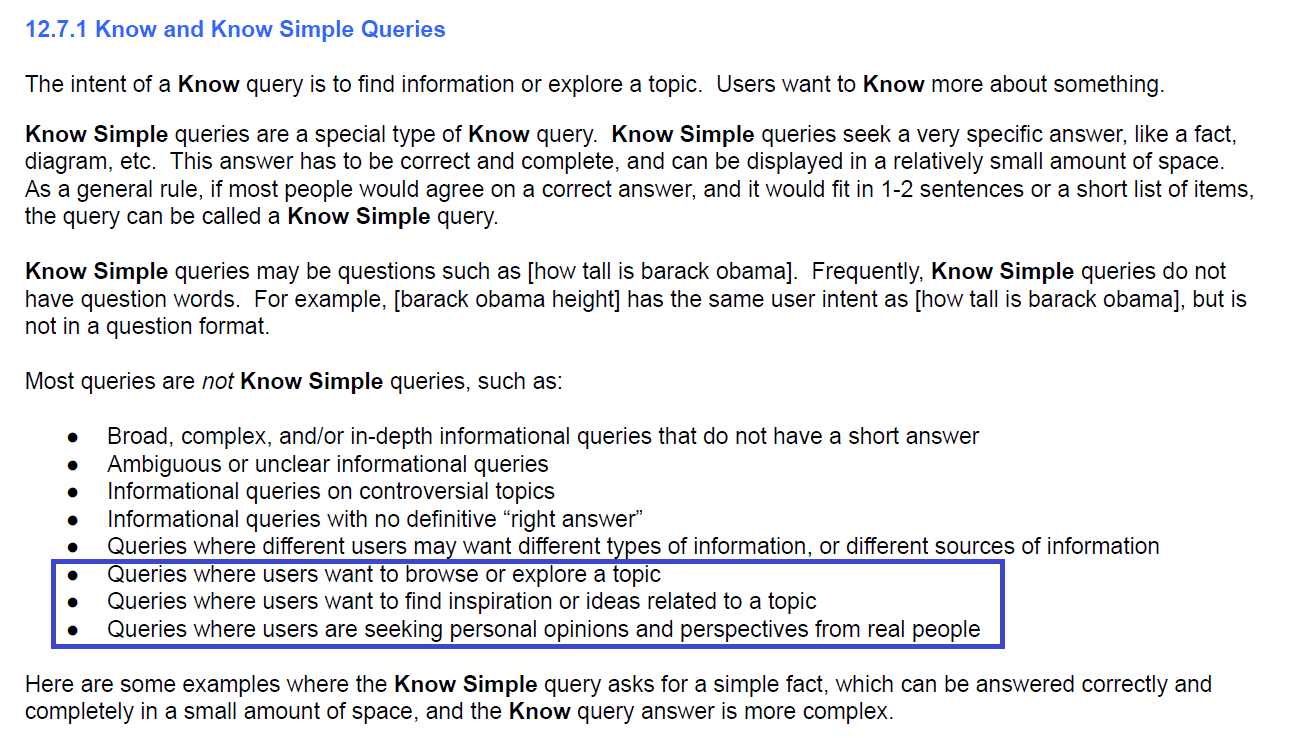
“Know Simple” queries are defined as queries that seek a very specific answer, like a fact or a diagram, that can be answered in a small amount of space, like one or two sentences.
Google added three new examples of queries that are not Know Simple queries: when users want to browse or explore a topic, find inspiration related to a topic, or are seeking personal opinions and perspectives from real people.
(Page 90)
What makes this addition interesting: The language used here is quite similar to the language Google uses when describing the value of SGE (Search Generative Experience). For example, the following language comes from the main SGE page:
“Dive deeper on a topic in a conversational way.”
“Access the high-quality results and perspectives that you expect from Google.”
“I want to know what people think to help me make a decision”
Perhaps – and this is purely speculation – the feedback Google gets from quality raters about whether queries can be classified as “Know Simple” (or not) can help them understand when to trigger SGE.
Along the same lines, Google added two new examples of “Know Simple Queries” and “Know Queries” – the bottom two rows of the below table – to provide additional context about when a query is easily answered or when the answer is more open ended.
(Page 91)
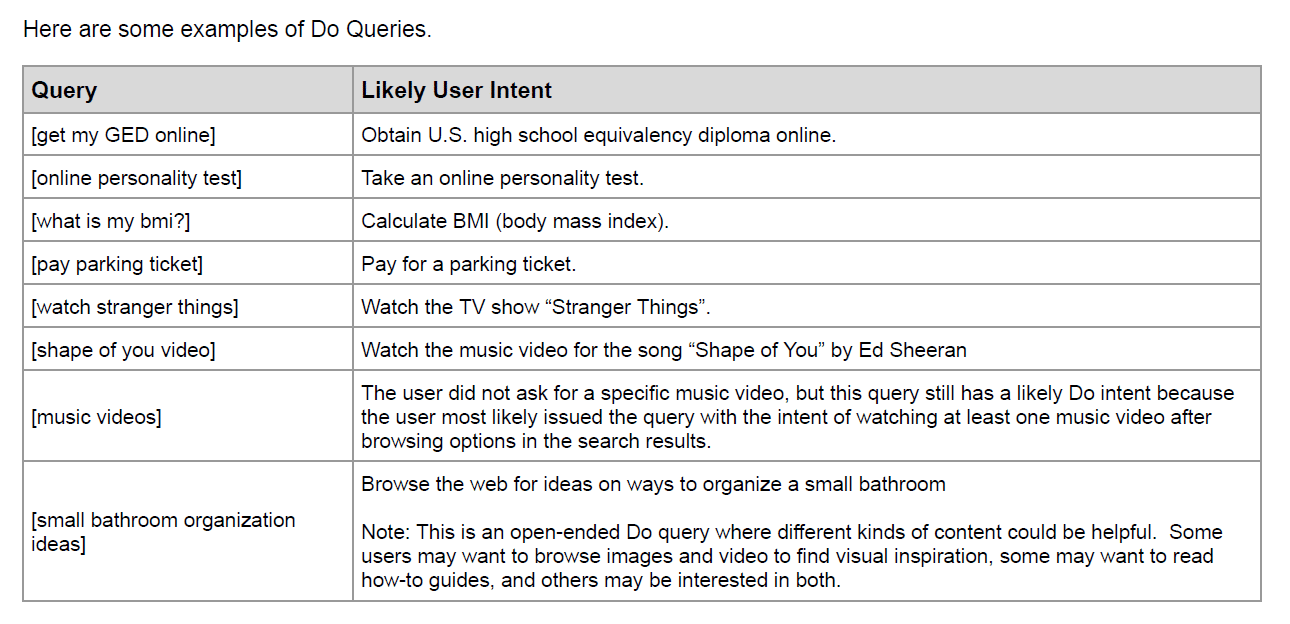
Google also added more examples of “Do” queries to the table below, starting with [shape of you video] and all queries below it. The three new examples represent queries that would be best answered with videos, images or how-to guides.
(Page 91)
Further refining user intent
Google introduced new language around user intent by classifying what is an unlikely user intent for a set of keywords.
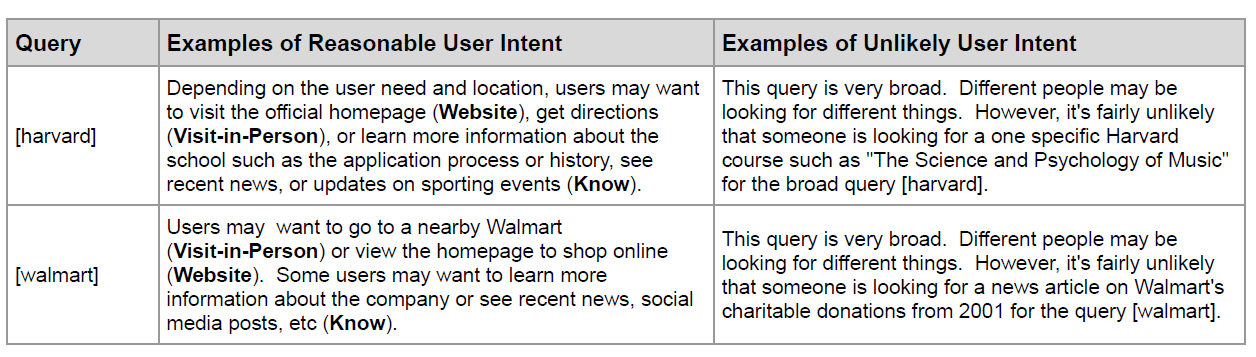
In the table below, Google added a second column to explain unlikely intents for the keywords Harvard and Walmart. This limits the intent of these keywords to a more reasonable user intent, rather than a completely open-ended set of possible answers.
Users searching for “Harvard” could be looking for various details about the university, but are probably not looking for a specific course.
(Page 95)
Examples of Google’s SERP features that highly meet user needs
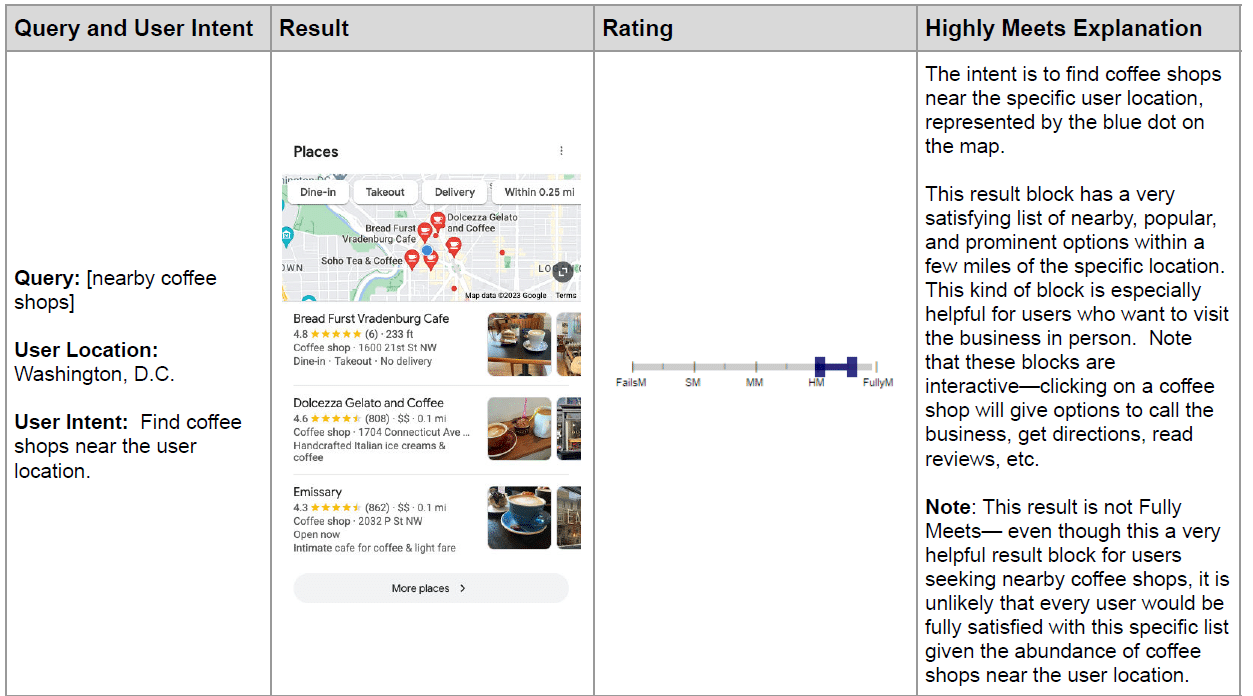
Google provides a table with various examples of search queries, the user’s location, and the user’s intent. It then shows the search result, and rates the extent to which the result met the expectations of the user (“Needs met”).
Google also offers an explanation about why these particular results are ranked as “highly meeting” the expectations of users.
In this new version of the QRG, Google added and adjusted some of the examples in the “Highly Meets (HM)” results, the highest possible rating of meeting user needs “for most queries.”
One example of a new example Google added to this list is one where the user is looking for “nearby coffee shops.” Google provides a screenshot of a Google Maps local pack with three coffee shops listed, and explains why this result highly, but not fully, meets the user’s expectation (it doesn’t list every possible coffee shop).
(Page 114)
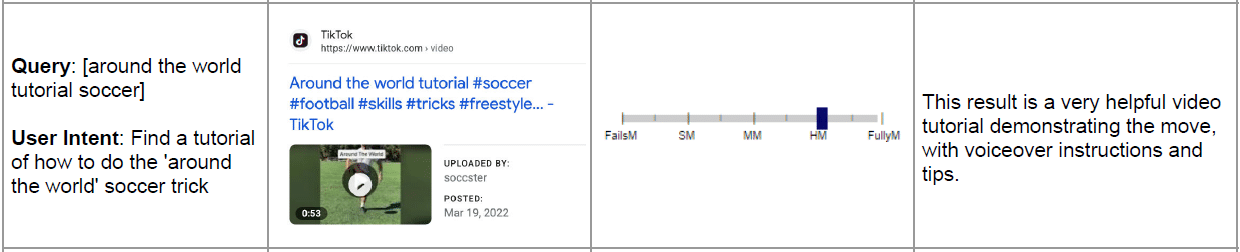
Google even added a TikTok video as an example of a result that highly meets the needs of users looking an “around the world tutorial” for soccer.
These are just some of the new examples, which seem to provide a more modern view of different results, both from external sites as well as Google’s own SERP features.
Crowd-sourced human quality raters have been the mainstay of the algorithmic evaluation process for search engines for decades. Still, a potential sea-change in research and production implementation could be on the horizon.
Recent groundbreaking research by Bing (with some purported commercial implementation already) and a sharp uptick in closely related information retrieval research by others, indicates some big shake-ups are coming.
These shake-ups may have far-reaching consequences for both the armies of quality raters and potentially the frequency of algorithmic updates we see go live, too.
The importance of evaluation
In addition to crawling, indexing, ranking and result serving for search engines is the important process of evaluation.
How well does a current or proposed search result set or experimental design align with the notoriously subjective notion of relevance to a given query, at a given time, for a given search engine user’s contextual information needs?
Since we know relevance and intent for many queries are always changing, and how users prefer to consume information evolves, search result pages also need to change to meet both the searcher’s intent and preferred user interface.
Some changes have predictable, temporal and periodic query intent shifts. For example, in the period approaching Black Friday, many queries typically considered informational might take sweeping commercial intent shifts. Similarly, a transport query like [Liverpool Manchester] might shift to a sports query on local match derby days.
In these instances, an ever-expanding legacy of historical data supports a high probability of what users consider more meaningful results, albeit temporarily. These levels of confidence likely make seasonal or other predictable periodic results and temporary UI design shifting relatively straightforward adjustments for search engines to implement.
However, when it comes to broader notions of evolving “relevance” and “quality,” and for the purposes of experimental design changes too, search engines must know a proposed change in rankings after development by search engineers is truly better and more precise to information needs, than the present results generated.
Evaluation is an important stage in search results evolution and vital to providing confidence in proposed changes – and substantial data for any adjustments (algorithmic tuning) to the proposed “systems,” if required.
Evaluation is where humans “enter the loop” (offline and online) to provide feedback in various ways before roll-outs to production environments.
This is not to say evaluation is not a continuous part of production search. It is. However, an ongoing judgment of existing results and user activity will likely evaluate how well an implemented change continues to fare in production against an acceptable relevance (or satisfaction) based metric range. A metric range based on the initial human judge-submitted relevance evaluations.
In a 2022 paper titled, “The crowd is made of people: Observations from large-scale crowd labelling,” Thomas et al., who are researchers from Bing, allude to the ongoing use of such metric ranges in a production environment when referencing a monitored component of web search “evaluated in part by RBP-based scores, calculated daily over tens of thousands of judge-submitted labels.” (RBP stands for Rank-Biased Precision).
Human-in-the-loop (HITL)
Data labels and labeling
An important point before we continue. I will mention labels and labeling a lot throughout this piece, and a clarification about what is meant by labels and labeling will make the rest of this article much easier to understand:
I will provide you with a couple of real-world examples most people will be familiar with for breadth of audience understanding before continuing:
Have you ever checked a Gmail account and marked something as spam?
Have you ever marked a film on Netflix as “Not for me,” “I like this,” or “love this”?
All of these submitted actions by you create data labels used by search engines or in information retrieval systems. Yes, even Netflix has a huge foundation in information retrieval and a great information retrieval research team tool. (Note that Netflix is both information retrieval with a strong subset of that field, called “recommender systems.”)
By marking “Not for me” on a Netflix film, you submitted a data label. You became a data labeler to help the “system” understand more about what you like (and also what people similar to you like) and to help Netflix train and tune their recommender systems further.
Data labels are all around us. Labels markup data so it can be transformed into mathematical forms for measurement at scale.
Enormous amounts of these labels and “labeling” in the information retrieval and machine learning space are used as training data for machine learning.
“This image has been labeled as a cat.”
“This image has been labeled as a dog… cat… dog… dog… dog… cat,” and so on.
All of the labels help machines learn what a dog or a cat looks like with enough examples of images marked as cats or dogs.
Labeling is not new; it’s been around for centuries, since the first classification of items took place. A label was assigned when something was marked as being in a “subset” or “set of things.”
Anything “classified” has effectively had a label attached to it, and the person who marked the item as belonging to that particular classification is considered the labeler.
But moving forward to recent times, probably the best-known data labeling example is that of reCAPTCHA. Every time we select the little squares on the image grid, we add labels, and we are labelers.
We, as humans, “enter the loop” and provide feedback and data.
With that explanation out of the way, let us move on to the different ways data labels and feedback are acquired, and in particular, feedback for “relevance” to queries to tune algorithms or evaluate experimental design by search engines.
Implicit and explicit evaluation feedback
While Google refers to their evaluation systems in documents meant for the non-technical audience overall as “rigorous testing,” human-in-the-loop evaluations in information retrieval widely happen through implicit or explicit feedback.
Implicit feedback
With implicit feedback, the user isn’t actively aware they provide feedback. The many live search traffic experiments (i.e., tests in the wild) search engines carry out on tiny segments of real users (as small as 0.1%), and subsequent analysis of click data, user scrolling, dwell time and result skipping, fall into the category of implicit feedback.
In addition to live experiments, the ongoing general click, scroll and browse behavior of real search engine users can also constitute implicit feedback and likely feed into “Learning to Rank (LTR) machine learning” click models.
This, in turn, feeds into rationales for proposed algorithmic relevance changes, as non-temporal searcher behavior shifts and world changes lead to unseen queries and new meanings for queries.
There is the age-old SEO debate around whether rankings change immediately before further evaluation from implicit click data. I will not cover that here other than to say there is considerable awareness of the huge bias and noise that comes with raw click data in the information retrieval research space and the huge challenges in its continuous use in live environments. Hence, the many pieces of research work around proposed click models for unbiased learning to rank and learning to rank with bias.
Regardless, it is no secret overall in information retrieval how important click data is for evaluation purposes. There are countless papers and even IR books co-authored by Google research team members, such as “Click Models for Web Search” (Chuklin and De Rijke, 2022).
“We look at a very long list of metrics, such as what people click on, how many queries were done, whether queries were abandoned, how long it took for people to click on a result and so on.”
And so a cycle continues. Detected change needed from Learning to Rank, click model application, engineering, evaluation, detected change needed, click model application, engineering, evaluation, and so forth.
Explicit feedback
In contrast to implicit feedback from unaware search engine users (in live experiments or in general use), explicit feedback is derived from actively aware participants or relevance labelers.
The purpose of this relevance data collection is to mathematically roll it up and adjust overall proposed systems.
A gold standard of relevance labeling – considered near to a ground truth (i.e., the reality of the real world) of intent to query matching – is ultimately sought.
There are various ways in which a gold standard of relevance labeling is gathered. However, a silver standard (less precise than gold but more widely available data) is often acquired (and accepted) and likely used to assist in further tuning.
Explicit feedback takes four main formats. Each has its advantages and disadvantages, largely about relevance labeling quality (compared with gold standard or ground truth) and how scalable the approach is.
Real users in feedback sessions with user feedback teams
Search engine user research teams and real users provided with different contexts in different countries collaborate in user feedback sessions to provide relevance data labels for queries and their intents.
This format likely provides near to a gold standard of relevance. However, the method is not scalable due to its time-consuming nature, and the number of participants could never be anywhere near representative of the wider search population at large.
True subject matter experts / topic experts / professional annotators
True subject matter experts and professional relevance assessors provide relevance for query mappings annotated to their intents in data labeling, including many nuanced cases.
Since these are the authors of the query to intent mappings, they know the exact intent, and this type of labeling is likely considered near to a gold standard. However, this method, similar to the user feedback research teams format, is not scalable due to the sparsity of relevance labels and, again, the time-consuming nature of this process.
This method was more widely used before introducing the more scalable approach of crowd-sourced human quality raters (to follow) in recent times.
Search engines simply ask real users whether something is relevant or helpful
Real search engine users are actively asked whether a search result is helpful (or relevant) by search engines and consciously provide explicit binary feedback in the form of yes or no responses with recent “thumbs up” design changes spotted in the wild.
Crowd-sourced human quality raters
The main source of explicit feedback comes from “the crowd.” Major search engines have huge numbers of crowd-sourced human quality raters provided with some training and handbooks and hired through external contractors working remotely worldwide.
Google alone has a purported 16,000 such quality raters. These crowd-sourced relevance labelers and the programs they are part of are referred to differently by each search engine.
Google refers to its participants as “quality raters” in the Quality Raters Program, with the third-party contractor referring to Google’s web search relevance program as “Project Yukon.”
Bing refers to their participants as simply “judges” in the Human Relevance System (HRS), with third-party contractors referring to Bing’s project as simply “Web Content Assessor.”
Despite these differences, participants’ purposes are primarily the same. The role of the crowd-sourced human quality rater is to provide synthetic relevance labels emulating search engine users across the world as part of explicit algorithmic feedback. Feedback often takes the form of a side-by-side (pairwise) comparison of proposed changes versus either existing systems or alongside other proposed system changes.
Since much of this is considered offline evaluation, it isn’t always live search results that are being compared but also images of results. And it isn’t always a pairwise comparison, either.
These are just some of the many different types of tasks that human quality raters carry out for evaluation, and data labeling, via third-party contractors. The relevance judges likely continuously monitor after the proposed change roll-out to production search, too. (For example, as the aforementioned Bing research paper alludes to.)
Whatever the method of feedback acquisition, human-in-the-loop relevance evaluations (either implicit or explicit) play a significant role before the many algorithmic updates (Google launched over 4,700 changes in 2022 alone, for example), including the now increasingly frequent broad core updates, which ultimately appear to be an overall evaluation of fundamental relevance revisited.
Get the daily newsletter search marketers rely on.
function getCookie(cname) {
let name = cname + “=”;
let decodedCookie = decodeURIComponent(document.cookie);
let ca = decodedCookie.split(‘;’);
for(let i = 0; i <ca.length; i++) {
let c = ca[i];
while (c.charAt(0) == ' ') {
c = c.substring(1);
}
if (c.indexOf(name) == 0) {
return c.substring(name.length, c.length);
}
}
return "";
}
document.getElementById('munchkinCookieInline').value = getCookie('_mkto_trk');
Relevance labeling at a query level and a system level
Despite the blog posts we have seen alerting us to the scary prospect of human quality raters visiting our site via referral traffic analysis, naturally, in systems built for scale, individual results of quality rater evaluations at a page level, or even at an individual rater level have no significance on their own.
Human quality raters do not judge websites or webpages in isolation
Evaluation is a measurement of systems, not web pages – with “systems” meaning the algorithms generating the proposed changes. All of the relevance labels (i.e., “relevant,” “not relevant,” “highly relevant”) provided by labelers roll up to a system level.
“We use responses from raters to evaluate changes, but they don’t directly impact how our search results are ranked.”
In other words, while relevance labeling doesn’t directly impact rankings, aggregated data labeling does provide a means to take an overall (average) measurement of how well a proposed algorithmic change (system) might be, more precisely relevant (when ranked), with lots of reliance on various types of algorithmic averages.
Query-level scores are combined to determine system-level scores. Data from relevance labels is turned into numerical values and then into “average” precision metrics to “tune” the proposed system further before any roll-out to search engine users more broadly.
How far from the expected average precision metrics engineers hoped to achieve with the proposed change is the reality when ‘humans enter the loop’?
While we cannot be entirely sure of the metrics used on aggregated data labels when everything is turned into numerical values for relevance measurement, there are universally recognized information retrieval ranking evaluation metrics in many research papers.
Most authors of such papers are search engine engineers, academics, or both. Production follows research in the information retrieval field, of which all web search is a part.
Such metrics are order-aware evaluation metrics (where the ranked order of relevance matters, and weighting, or “punishing” of the evaluation if the ranked-order is incorrect). These metrics include:
Mean reciprocal rank (MRR).
Rank-biased precision (RBP).
Mean average precision (MAP).
Normalized and un-normalized discounted cumulative gain (NDCG and DCG respectively).
In a 2022 research paper co-authored by a Google research engineer, NDCG and AP (average precision) are referred to as a norm in the evaluation of pairwise ranking results:
“A fundamental step in the offline evaluation of search and recommendation systems is to determine whether a ranking from one system tends to be better than the ranking of a second system. This often involves, given item-level relevance judgments, distilling each ranking into a scalar evaluation metric, such as average precision (AP) or normalized discounted cumulative gain (NDCG). We can then say that one system is preferred to another if its metric values tend to be higher.”
Information on DCG, NDCG, MAP, MRR and their commonality of use in web search evaluation and ranking tuning is widely available.
Victor Lavrenko, a former assistant professor at the University of Edinburgh, also describes one of the more common evaluation metrics, mean average precision, well:
“Mean Average Precision (MAP) is the standard single-number measure for comparing search algorithms. Average precision (AP) is the average of … precision values at all ranks where relevant documents are found. AP values are then averaged over a large set of queries…”
So it’s literally all about the averages judges submit from the curated data labels distilled into a consumable numerical metric versus the predicted averages hoped for after engineering and then tuning the ranking algorithms further.
Quality raters are simply relevance labelers
Quality raters are simply relevance labelers, classifying and feeding a huge pipeline of data, rolled up and turned into numerical scores for:
Aggregation on whether a proposed change is near an acceptable average level of relevance precision or user satisfaction.
Or determining whether the proposed change needs further tuning (or total abandonment).
The sparsity of relevance labeling causes a bottleneck
Regardless of the evaluation metrics used, the initial data is the most important part of the process (the relevance labels) since, without labels, no measurement via evaluation can take place.
A ranking algorithm or proposed change is all very well, but unless “humans enter the loop” and determine whether it is relevant in evaluation, the change likely won’t happen.
For the past couple of decades, in information retrieval widely, the main pipeline of this HITL-labeled relevance data has come from crowd-sourced human quality raters, which replaced the use of the professional (but fewer in numbers) expert annotators as search engines (and their need for speedy iteration) grew.
Feeding yays and nays in turn converted into numbers and averages in order to tune search systems.
But scale (and the need for more and more relevance labeled data) is increasingly problematic, and not just for search engines (even despite these armies of human quality raters).
The scalability and sparsity issue of data labeling presents a global bottleneck and the classic “demand outstrips supply” challenge.
Widespread demand for data labeling has grown phenomenally due to the explosion in machine learning in many industries and markets. Everyone needs lots and lots of data labeling.
Recent research by consulting firm Grand View Research illustrates the huge growth in market demand, reporting:
“The global data collection and labeling market size was valued at $2.22 billion in 2022 and it is expected to expand at a compound annual growth rate of 28.9% from 2023 to 2030, with the market then expected to be worth $13.7 billion.”
This is very problematic. Particularly in increasingly competitive arenas such as AI-driven generative search with the effective training of large language models requiring huge amounts of labeling and annotations of many types.
Authors at Deepmind, in a 2022 paper, state:
“We find current large language models are significantly undertrained, a consequence of the recent focus on scaling language models while keeping the amount of training data constant. …we find for compute-optimal training …for every doubling of model size the number of training tokens should also be doubled.”
When the amount of labels needed grows quicker than the crowd can reliably produce them, a bottleneck in scalability for relevance and quality via rapid evaluation on production roll-outs can occur.
Lack of scalability and sparsity do not fit well with speedy iterative progress
Lack of scalability was an issue when search engines moved away from the industry norm of professional, expert annotators and toward the crowd-sourced human quality raters providing relevance labels, and scale and data sparsity is once again a major issue with the status quo of using the crowd.
Some problems with crowd-sourced human quality raters
In addition to the lack of scale, other issues come with using the crowd. Some of these relate to human nature, human error, ethical considerations and reputational concerns.
While relevance remains largely subjective, crowd-sourced human quality raters are provided with, and tested on, lengthy handbooks, in order to determine relevance.
Google’s publicly available Quality Raters Guide is over 160 pages long, and Bing’s Human Relevance Guidelines is “reported to be over 70 pages long,” per Thomas et al.
Bing is much more coy with their relevance training handbooks. Still, if you root around, as I did when researching this piece, you can find some of the documentation with incredible detail on what relevance means (in this instance for local search), which looks like one of their judging guidelines in the depths online.
Efforts are made in this training to instill a mindset appreciative of the evaluator’s role as a “pseudo” search engine user in their natural locale.
The synthetic user mindset needs to consider many factors when emulating real users with different information needs and expectations.
These needs and expectations depend on several factors beyond simply their locale, including age, race, religion, gender, personal opinion and political affiliation.
The crowd is made of people
Unsurprisingly, humans are not without their failings as relevance data labelers.
Human error needs no explanation at all and bias on the web is a known concern, not just for search engines but more generally in search, machine learning, and AI overall. Hence, the dedicated “responsible AI” field emerges in part to deal with combatting baked-in biases in machine learning and algorithms.
However, findings in the 2022 large-scale study by Thomas et al., Bing researchers, highlight factors leading to reduced precision relevance labeling going beyond simple human error and traditional conscious or unconscious bias.
Even despite the training and handbooks, Bing’s findings, derived from “hundreds of millions of labels, collected from hundreds of thousands of workers as a routine part of search engine development,” underscore some of the less obvious factors, more akin to physiological and cognitive factors and contributing to a reduction in precision quality in relevance labeling tasks, and can be summarised as follows:
Task-switching: Corresponded directly with a decline in quality of relevance labeling, which was significant as only 28% of participants worked on a single task in a session with all others moving between tasks.
Left side bias: In a side-by-side comparison, a result displayed on the left side was more likely to be selected as relevant when compared with results on the right side. Since pair-wise analysis by search engines is widespread, this is concerning.
Anchoring: Played a part in relevance labeling choices, whereby the relevance label assigned on the first result by a labeler is also much more likely to be the relevance label assigned for the second result. This same label selection appeared to have a descending probability of selection in the first 10 evaluated queries in a session. After 10 evaluated queries, the researchers found that the anchoring issue seemed to disappear. In this instance the labeler hooks (anchors) onto the first choice they make and since they have no real notion of relevance or context at that time, the probability of them choosing the same relevance label with the next option is high. This phenomenon disappears as the labeler gathers more information from subsequent pairwise sets to consider.
General fatigue of crowd-workers played a part in reduced precision labeling.
General disagreement between judges on which one of a pairwise result was relevant from the two options. Simply differing opinions and perhaps a lack of true understanding of the context of the intended search engine user.
Time of day and day of week when labeling was carried out by evaluators also plays a role. The researchers noted some related findings which appeared to correlate with spikes in reduced relevance labeling accuracy when regional celebrations were underway, and might have easily been considered simple human error, or noise, if not explored more fully.
The crowd is not perfect at all.
A dark side of the data labeling industry
Then there is the other side of the use of human crowd-sourced labelers, which concerns society as a whole. That of low-paid “ghost workers” in emerging economies employed to label data for search engines and others in the tech and AI industry.
Major online publications increasingly draw attention to this issue with headlines like:
“Millions of Workers Are Training AI Models for Pennies”(Wired, October 2023)
MIT Technology Review’s 2022 headline claims the AI industry benefits from economic catastrophe in non-Western economies to scale data label collection.
Time Magazine’s January 2023 piece reports on OpenAI’s usage of Kenyan workers on less than $2 per hour to make ChatGPT less toxic using labeling services.
And, we have Google’s own third-party quality raters protesting for higher pay as recently as February 2023, with claims of “poverty wages and no benefits.”
Add together all of this with the potential for human error, bias, scalability concerns with the status quo, the subjectivity of “relevance,” the lack of true searcher context at the time of query and the inability to truly determine whether a query has a navigational intent.
And we have not even touched upon the potential minefield of regulations and privacy concerns around implicit feedback.
How to deal with lack of scale and “human issues”?
Enter large language models (LLMs), ChatGPT and increasing use of machine-generated synthetic data.
Is the time right to look at replacing ‘the crowd’?
A 2022 research piece from “Frontiers of Information Access Experimentation for Research and Education” involving several respected information retrieval researchers explores the feasibility of replacing the crowd, illustrating the conversation is well underway.
Clarke et al. state:
“The recent availability of LLMs has opened the possibility to use them to automatically generate relevance assessments in the form of preference judgements. While the idea of automatically generated judgements has been looked at before, new-generation LLMs drive us to re-ask the question of whether human assessors are still necessary.”
However, when considering the current situation, Clarke et al. raise specific concerns around a possible degradation in the quality of relevance labeling in exchange for huge scale potentials:
Concerns about reduced quality in exchange for scale?
“It is a concern that machine-annotated assessments might degrade the quality, while dramatically increasing the number of annotations available.”
The researchers draw parallels between the previous major shift in the information retrieval space away from professional annotators some years before to “the crowd,” continuing:
“Nevertheless, a similar change in terms of data collection paradigm was observed with the increased use of crowd assessor…such annotation tasks were delegated to crowd workers, with a substantial decrease in terms of quality of the annotation, compensated by a huge increase in annotated data.”
They surmise that the feasibility of “over time” a spectrum of balanced machine and human collaboration, or a hybrid approach to relevance labeling for evaluations, may be a way forward.
A wide range of options from 0% machine and 100% human right across to 100% machine and 0% human is explored.
The researchers consider options whereby the human is at the beginning of the workflow providing more detailed query annotations to assist the machine in relevance evaluation, or at the end of the process to check the annotations provided by the machines.
In this paper, the researchers draw attention to the unknown risks that may emerge through the use of LLMs in relevance annotation over human crowd usage, but do concede at some point, there will likely be an industry move toward the replacement of human annotators in favor of LLMs:
“It is yet to be understood what the risks associated with such technology are: it is likely that in the next few years, we will assist in a substantial increase in the usage of LLMs to replace human annotators.”
Things move fast in the world of LLMs
But much progress can take place in a year, and despite these concerns, other researchers are already rolling with the idea of using machines as relevance labelers.
Despite the concerns raised in the Clarke et al. paper around reduced annotation quality should a large-scale move toward machine usage occur, in less than a year, there has been a significant development that impacts production search.
Very recently, Mark Sanderson, a well-respected and established information retrieval researcher, shared a slide from a presentation by Paul Thomas, one of four Bing research engineers presenting their work on the implementation of GPT-4 as relevance labelers rather than humans from the crowd.
The enormity of this recent work by Bing (in terms of the potential change for search research) was emphasized in a tweet by Sanderson. Sanderson described the talk as “incredible,” noting, “Synthetic labels have been a holy grail of retrieval research for decades.”
While sharing the paper and subsequent case study, Thomas also shared Bing is now using GPT-4 for its relevance judgments. So, not just research, but (to an unknown extent) in production search too.
So what has Bing done?
The use of GPT-4 at Bing for relevance labeling
The traditional approach of relevance evaluation typically produces a varied mixture of gold and silver labels when “the crowd” provides judgments from explicit feedback after reading “the guidelines” (Bing’s equivalent of Google’s Quality Raters Guide).
In addition, live tests in the wild utilizing implicit feedback typically generate gold labels (the reality of the real world “human in the loop”), but with a lack of scale and high relative costs.
Bing’s approach utilized GPT-4 LLM machine-learned pseudo-relevance annotators created and trained via prompt engineering. The purpose of these instances is to emulate quality raters to detect relevance based on a carefully selected set of gold standard labels.
This was then rolled out to provide bulk “gold label” annotations more widely via machine learning, reportedly for a fraction of the relative cost of traditional approaches.
The prompt included telling the system that it is a search quality rater whose purpose is to assess whether documents in a set of results are relevant to a query using a label reduced to a binary relevant / not relevant judgment for consistency and to minimize complexity in the research work.
To aggregate evaluations more broadly, Bing sometimes utilized up to five pseudo-relevance labelers via machine learning per prompt.
The approach and impacts for cost, scale and purported accuracy are illustrated below and compared with other traditional explicit feedback approaches, plus implicit online evaluation.
Interestingly, two co-authors are also co-authors in Bing’s research piece, “The Crowd is Made of People,” and undoubtedly are well aware of the challenges of using the crowd.
Source: “Large language models can accurately predict searcher preferences,” Thomas et al., 2023
With these findings, Bing researchers claim:
“To measure agreement with real searchers needs high-quality “gold” labels, but with these we find that models produce better labels than third-party workers, for a fraction of the cost, and these labels let us train notably better rankers.”
Scale and low-cost combined
These findings illustrate machine learning and large language models have the potential to reduce or eliminate bottlenecks in data labeling and, therefore, the evaluation process.
This is a sea-change pointing the way to an enormous step forward in how evaluation before algorithmic updates are undertaken since the potential for scale at a fraction of the cost of “the crowd” is considerable.
It’s not just Bing reporting on the success of machines over humans in relevance labeling tasks, and it’s not just ChatGPT either. Plenty of research into whether human assessors can be replaced in part or wholly by machines is certainly picking up pace in 2022 and 2023 in other research, too.
Others are reporting some success in utilizing machines over humans for relevance labeling, too
In a July 2023 paper, researchers at the University of Zurich found open source large language models (FLAN and HugginChat) outperform human crowd workers (including trained relevance annotators and consistently high-scoring crowd-sourced MTurk human relevance annotators).
Although this work was carried out on tweet analysis rather than search results, their findings were that other open-source large language models were not only better than humans but were almost as good in their relevance labeling as ChatGPT (Alizadeh et al, 2023).
This opens the door to even more potential going forward for large-scale relevance annotations without the need for “the crowd” in its current format.
But what might come next, and what will become of ‘the crowd’ of human quality raters?
Responsible AI importance
Caution is likely overwhelmingly front of mind for search engines. There are other highly important considerations.
Responsible AI, as yet unknown risk with these approaches, baked-in bias detection, and its removal, or at least an awareness and adjustment to bias, to name but a few. LLMs tend to “hallucinate,” and “overfitting” could present problems as well, so monitoring might well consider factors such as these with guardrails built as necessary.
Explainable AI also calls for models to provide an explanation as to why a label or other type of output was deemed relevant, so this is another area where there will likely be further development. Researchers are also exploring ways to create bias awareness in LLM relevance judgments.
Human relevance assessors are monitored continuously anyway, so continual monitoring is already a part of the evaluation process. However, one can presume Bing, and others, would tread much more cautiously with this machine-led approach over the “the crowd” approach. Careful monitoring will also be required to avoid drops in quality in exchange for scalability.
In outlining their approach (illustrated in the image above), Bing shared this process:
Select via gold labels
Generate labels in bulk
Monitor with several methods
“Monitor with several methods” would certainly fit with a clear note of caution.
Next steps?
Bing, and others, will no doubt look to improve upon these new means of gathering annotations and relevance feedback at scale. The door is unlocked to a new agility.
A low-cost, hugely scalable relevance judgment process undoubtedly gives a strong competitive advantage when adjusting search results to meet changing information needs.
As the saying goes, the cat is out of the bag, and one could presume the research will continue to heat up to a frenzy in the information retrieval space (including other search engines) in the short to medium term.
A spectrum of human and machine assessors?
In their 2023 paper “HMC: A Spectrum of Human–Machine-Collaborative Relevance Judgement Frameworks,” Clarke et al. alluded to a feasible approach that might well mean subsequent stages of a move toward replacement of the crowd with machines taking a hybrid or spectrum form.
While a spectrum of human-machine collaboration might increase in favor of machine-learned methods as confidence grows and after careful monitoring, none of this means “the crowd” will leave entirely. The crowd may become much smaller, though, over time.
It seems unlikely that search engines (or IR research at large) would move completely away from using human relevance judges as a guardrail and a sobering sense-check or even to act as judges of the relevance labels generated by machines. Human quality raters also present a more robust means of combating “overfitting.”
Not all search areas are considered equal in terms of their potential impact on the life of searchers. Clarke et al., 2023, stress the importance of a more trusted human judgment in areas such as journalism, and this would fit well with our understanding as SEOs of Your Money or Your Life (YMYL).
The crowd might well just take on other roles depending upon the weighting in a spectrum, possibly moving into more of a supervisory role, or as an exam marker of machine-learned assessors, with exams provided for large language models requiring explanations as to how judgments were made.
Clarke et al. ask: “What weighting between human and LLMs and AI-assisted annotations is ideal?”
What weighting of human to machine is implemented in any spectrum or hybrid approach might depend on how quickly the pace of research picks up. While not entirely comparable, if we look at the herd movement in the research space after the introduction of BERT and transformers, one can presume things will move very quickly indeed.
Furthermore, there is also a massive move toward synthetic data already, so this “direction of travel” fits with that.
“Solutions such as AI-specific data management, synthetic data and data labeling technologies, aim to solve many data challenges, including accessibility, volume, privacy, security, complexity and scope.”
“By 2024, Gartner predicts 60% of data for AI will be synthetic to simulate reality, future scenarios and de-risk AI, up from 1% in 2021.”
Will Google adopt these machine-led evaluation processes?
Given the sea-change to decades-old practices in the evaluation processes widely used by search engines, it would seem unlikely Google would not at least be looking into this very closely or even be striving towards this already.
If the evaluation process has a bottleneck removed via the use of large language models, leading to massively reduced data sparsity for relevance labeling and algorithmic update feedback at lower costs for the same, and the potential for higher quality levels of evaluation too, there is a certain sense in “going there.”
Bing has a significant commercial advantage with this breakthrough, and Google has to stay in and lead, the AI game.
Removals of bottlenecks have the potential to massively increase scale, particularly in non-English languages and into additional markets where labeling might have been more difficult to obtain (for example, the subject matter expert areas or the nuanced queries around more technical topics).
While we know that Google’s Search Generative Experience Beta, despite expanding to 120 countries, is still considered an experiment to learn how people might interact with or find useful, generative AI search experiences, they have already stepped over the “AI line.”
However, Google is still incredibly cautious about using AI in production search.
Who can blame them for all the antitrust and legal cases, plus the prospect of reputational damage and increasing legislation related to user privacy and data protection regulations?
“These technologies come with an extraordinary range of risks and challenges.”
However, Google is not shy about undertaking research into the use of large language models. Heck, BERT came from Google in the first place.
Certainly, Google is exploring the potential use of synthetic query generation for relevance prediction, too. Illustrated in this recent 2023 paper by Google researchers and presented at the SIGIR information retrieval conference.
Since synthetic data in AI/ML reduces other risks that might relate to privacy, security, and the use of user data, simply generating data out of thin air for relevance prediction evaluations may actually be less risky than some of the current practices.
Add to the other factors that could build a case for Google jumping on board with these new machine-driven evaluation processes (to any extent, even if the spectrum is mostly human to begin with):
The research in this space is heating up.
Bing is running with some commercial implementation of machine over people labeling.
SGE needs loads of labels.
There are scale challenges with the status quo.
The increasing spotlight on the use of low-paid workers in the data-labeling industry overall.
Respected information retrieval researchers are asking is now the time to revisit the use of machines over humans in labeling?
Openly discussing evaluation as part of the update process
Google also seems to be talking much more openly of late about “evaluation” too, and how experiments and updates are undertaken following “rigorous testing.” There does seem to be a shift toward opening up the conversation with the wider community.
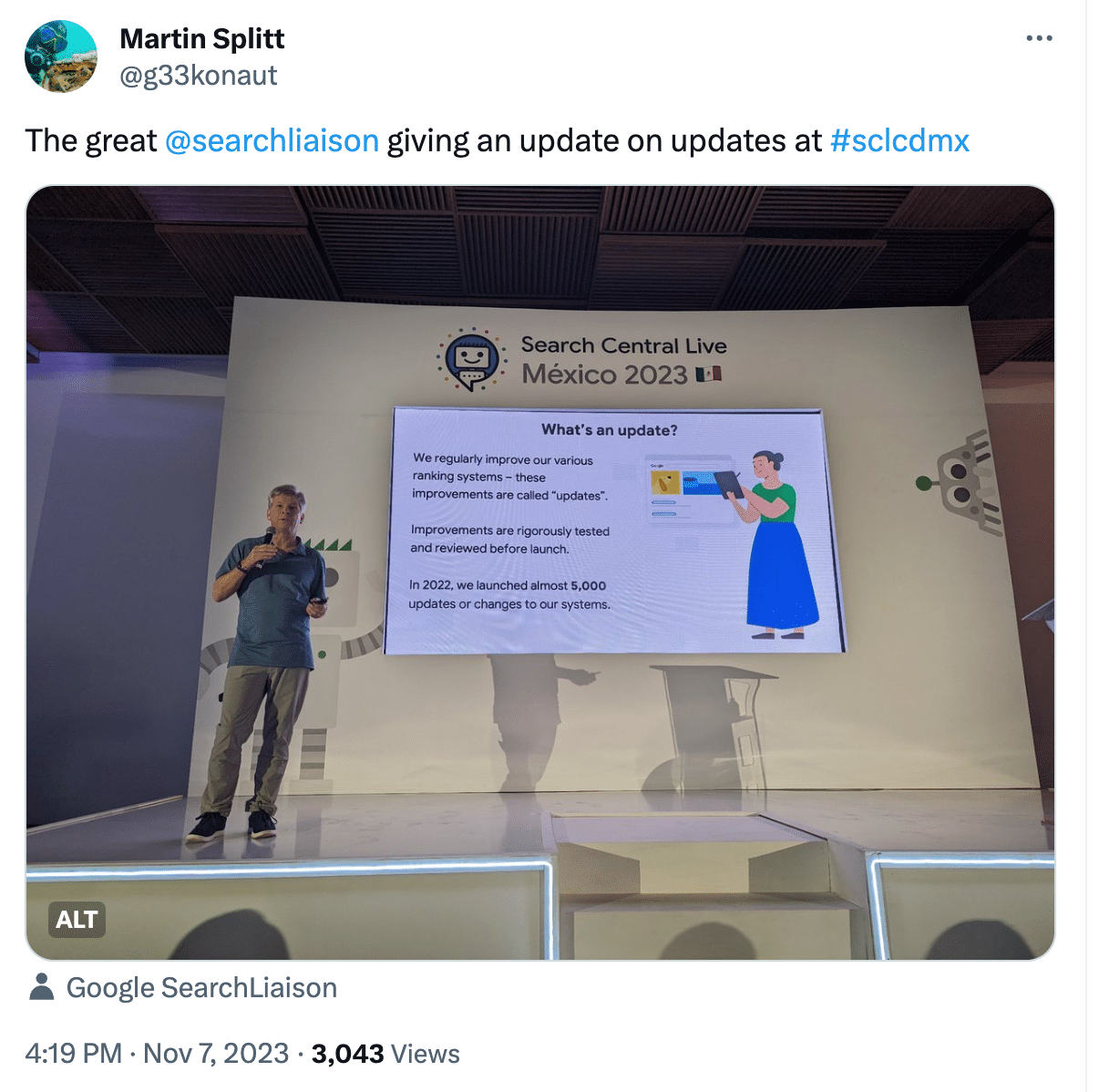
Here’s Danny Sullivan just last week giving an update on updates and “rigorous testing.”
And again, explaining why Google does updates.
Search off The Record recently discussed “Steve,” an imaginary search engine, and how updates to Steve might be implemented based on the judgments of human evaluators, with potential for bias, amongst other points discussed. There was a good amount of discussion around how changes to Steve’s features were tested and so forth.
This all seems to indicate a shift around evaluation unless I am simply imagining this.
In any event, there are already elements of machine learning in the relevance evaluation process, albeit implicit feedback. Indeed, Google recently updated its documentation on “how search works” around detecting relevant content via aggregated and anonymized user interactions.
“We transform that data into signals that help our machine-learned systems better estimate relevance.”
So perhaps following Bing’s lead is not that far a leap to take after all?
What if Google takes this approach?
What might we expect to see if Google embraces a more scalable approach to the evaluation process (huge access to more labels, potentially with higher quality, at lower cost)?
Scale, more scale, agility, and updates
Scale in the evaluation process and speedy iteration of relevance feedback and evaluations pave the way for a much greater frequency of updates, and into many languages and markets.
An evolving, iterative, alignment with true relevance, and algorithmic updates to meet this, could be ahead of us, with less broad sweeping impacts. A more agile approach overall.
Bing takes a much more agile approach in their evaluation process already, and the breakthrough with LLM as relevance labeler makes them even more so.
Fabrice Canel of Bing, in a recent interview, reminded us of the search engine’s constantly evolving evaluation approach where the push out of changes is not as broad sweeping and disruptive as Google’s broad core update or “big” updates. Apparently, at Bing, engineers can ideate, gain feedback quickly, and sometimes roll out changes in as little as a day or so.
All search engines will have compliance and strict review processes, which cannot be conducive to agility and will no doubt build up to a form of process debt over time as organizations age and grow. However, if the relevance evaluation process can be shortened dramatically while largely maintaining quality, this takes away at least one big blocker to algorithmic change management.
We have already seen a big increase in the number of updates this year, with three broad core updates (relevance re-evaluations at scale) between August and November and many other changes concerning spam, helpful content, and reviews in between.
Coincidentally (or probably not), we’re told “to buckle up” because major changes are coming to search. Changes designed to improve relevance and user satisfaction. All the things the crowd traditionally provides relevant feedback on.
So, buckle up. It’s going to be an interesting ride.
If Google takes this route (using machine labeling in favor of the less agile “crowd” approach), expect a lot more updates overall, and likely, many of these updates will be unannounced, too.
We could potentially see an increased broad core update cadence with reduced impacts as agile rolling feedback helps to continually tune “relevance” and “quality” in a faster cycle of Learning to Rank, adjustment, evaluation and rollout.
More frequently than not, B2B buyers are vetting sellers based not only on product specifications, pricing and other traditional factors but on the digital experiences they deliver. Failing to adapt to these rising customer expectations can be costly.
Deloitte Digital conducted a study of more than 500 B2B executives at U.S. companies and discovered that 77% of B2B executives agree that digital transformation is critical to their company’s success.
Join experts from Deloitte Digital, who unveil the research findings and highlight the four trends that lead to stronger customer relationships all around: higher satisfaction, stronger spending, better retention and deeper trust.
Nowadays, mobile apps are a crucial component of customer engagement as well as encouraging the company’s staff and partners. What to choose: native, cross-platform, or hybrid app development has become the subject of the heated debate among mobile app developers. Still, there’s no clear-cut answer as each situation is case-based.
When it comes to developing mobile applications, the choice between native and hybrid approaches is pivotal. Each methodology presents distinct advantages and trade-offs. This comparison aims to delineate the disparities between native and hybrid app development, elucidating the key factors that businesses and developers should consider in making informed decisions for their mobile projects.
Why Choose Native App Development?
Choosing native app development has several advantages, making it a preferred option for many projects. Here are some reasons why one might opt for native app development:
1. Performance:
Native apps are developed specifically for a particular platform (iOS or Android), allowing to leverage the full potential of the device’s hardware and software. This often results in superior performance compared to hybrid or cross-platform alternatives.
2. User Experience:
Native apps offer a seamless and consistent user experience, as they adhere to the design guidelines and UI patterns of the respective platforms (Material Design for Android, Human Interface Guidelines for iOS). This leads to intuitive navigation and familiarity for users.
3. Access to Device Features:
Native development provides direct access to the device’s features and capabilities, such as the camera, GPS, accelerometer, and more. This enables developers to create functionality-rich apps that can take full advantage of the hardware.
4. Optimized for Platform Updates:
Native apps are typically quicker to adopt new features and updates introduced by operating systems. This ensures that the app remains compatible, performs well, and takes advantage of the latest functionalities.
5. Better Security:
Native apps benefit from the security features of the underlying operating system. Additionally, they are subject to stricter app review processes on app stores, reducing the likelihood of malicious software.
6. Offline Functionality:
Native apps can often offer more robust offline capabilities, allowing users to access certain features or content even when they are not connected to the internet.
7. Community and Support:
Both iOS and Android platforms have large and active developer communities. Choosing native development means tapping into these communities for support, libraries, and resources.
8. App Store Optimization (ASO):
Native apps tend to perform better in app store rankings and visibility. Platforms like the Apple App Store and Google Play Store often prioritize native apps, potentially leading to better discoverability.
9. Customization:
Native development allows for high customization, making it easier to tailor the app’s user interface and user experience to match the specific requirements and preferences of the platform and target audience.
10. Reliability and Stability:
Native apps are generally more reliable and stable because they are optimized for the specific platform. This can result in fewer crashes and better overall performance.
While native app development offers these advantages, it’s important to note that it may require separate development efforts for iOS and Android versions, potentially increasing costs and development time. The choice between native depends on factors such as project requirements, budget, and the target audience.
Why Choose Hybrid App Development?
Choosing hybrid app development comes with its own set of advantages, making it a suitable option for certain projects. Here are reasons why one might opt for hybrid app development:
1. Cross-Platform Compatibility:
One of the primary advantages of hybrid development is the ability to write code once and deploy it across multiple platforms (iOS, Android, etc.). This can significantly reduce development time and costs compared to building separate native apps.
2. Cost-Effectiveness:
Hybrid apps can be more cost-effective than native development, as a single codebase can be used for multiple platforms. This is particularly beneficial for businesses with budget constraints or those looking to optimize development resources.
3. Faster Development Time:
Since a single codebase can be reused for different platforms, development time is often shorter for hybrid apps compared to building separate native versions. This can lead to a quicker time-to-market.
4. Easier Maintenance:
Updates and maintenance are streamlined in hybrid development since changes made to the codebase apply to both platforms simultaneously. This makes it easier to roll out bug fixes and new features.
5. Web Technology Stack:
Hybrid apps are typically built using web technologies such as HTML, CSS, and JavaScript. Developers with expertise in web development can leverage their skills to create mobile apps, potentially reducing the need for additional specialized knowledge.
6. Access to Device Features:
Hybrid apps can access certain device features through plugins or frameworks like Apache Cordova and React Native. While not as direct as native access, it allows for a balance between cross-platform development and device capabilities.
7. Uniform User Experience:
Hybrid apps aim to provide a consistent user experience across platforms, maintaining a similar look and feel. This can be advantageous for brand consistency and ensuring a familiar interface for users.
8. Offline Functionality:
Hybrid apps can incorporate offline capabilities, allowing users to access certain features or content without an internet connection. This is achieved through technologies like local storage and caching.
9. Simplified Deployment:
Hybrid apps can be deployed through a single codebase, simplifying the deployment process. Updates and changes can be pushed to both platforms simultaneously, reducing the complexity of the release process.
10. Broader Audience Reach:
Hybrid apps enable businesses to reach a broader audience by offering a consistent experience on both major mobile platforms. This can be particularly beneficial for startups or companies targeting diverse user bases.
11. Adaptability to Business Changes:
Hybrid apps offer flexibility and adaptability, making it easier for businesses to pivot or modify their apps based on changing requirements or feedback without undergoing a complete redevelopment.
While hybrid app development offers these advantages, it’s crucial to consider the specific requirements of the project, including performance needs, access to native features, and user experience expectations. The choice between hybrid and other development approaches depends on factors such as project goals, budget constraints, and the desired balance between cross-platform compatibility and native capabilities.
Are Hybrid Apps the Future?
As mobile apps gain popularity and the demand for mobile app development services increases, companies are looking for different methods to create top-notch apps for clients. The hybrid approach is very appealing to many customers.
Indeed, it all comes from the project requirements. For example, if the company is releasing a new product or service and yet it’s not clear whether people need that, a hybrid approach will come in handy to test this hypothesis. Another example, in case it deals with displaying content and there’s no anticipated interaction with the interface, switching between screens or tabs, and so forth, hybrid app development is a good match.
Conclusion
In conclusion, the choice between native and hybrid app development hinges on a variety of factors, each approach presenting distinct advantages and trade-offs. Native development offers unparalleled performance, seamless access to device features, and a superior user experience tailored to specific platforms. On the other hand, hybrid development offers cost-effectiveness, quicker time-to-market, and the efficiency of a single codebase across multiple platforms.
Ultimately, the decision should be guided by the unique requirements of the project, the target audience, and the overarching business goals. Native development excels in scenarios where optimal performance and full utilization of platform-specific capabilities are critical. Conversely, hybrid development is a compelling choice when cross-platform compatibility, cost efficiency, and faster development cycles take precedence.
Whether opting for native or hybrid development, the key lies in understanding the project’s nuances, aligning the chosen approach with business objectives, and delivering a mobile app that meets the needs and expectations of users. As technology continues to evolve, staying informed about the latest trends and advancements in both native and hybrid development will empower decision-makers to make strategic choices that best suit their specific contexts.
Traditional real estate investment is well-established and offers several advantages. But whether you’re just starting out or have been in the field for years, you might be searching for new, unconventional ways to earn passive income. With the rise of services like NewHomesMate, which simplify the process of finding new homes for sale, investors now have more options at their fingertips.
This article will cover three strategies that can enhance your real estate portfolio through creative investing. So keep reading if you want to learn more about this topic.
House Hacking
House hacking is all about buying a property with several units, living in one, and renting out the rest. The idea is that the rent from your tenants covers your mortgage, meaning you live virtually rent-free. This strategy is gaining popularity, especially for those looking to manage their mortgage payments, property taxes, and maintenance costs. Plus, it’s a great opportunity to build equity in your home at the same time.
Self-Storage Unit Investment
Investing in self-storage units is a unique choice in the real estate world, and it’s getting popular really quickly. Mainly, that’s because it is much simpler than the typical landlord responsibilities like ongoing maintenance or tenant management.
The process involves either purchasing an existing storage facility or building a new one. Once it’s up and running the right property management software can do most of the heavy lifting for you. Imagine managing your investment with just a few taps on your phone!
Here is how it works:
A customer arrives and selects a storage unit;
They sign the lease agreement;
They fill the unit with their belongings.
And that’s the entire process. You’re not constantly chasing rent or handling late-night maintenance issues. This approach to real estate investment is all about minimal hassle and stress.
House Flipping
Imagine taking a house that’s seen better days and turning it into someone’s dream home. That’s the essence of house flipping. Often known as “fix and flip,” this strategy is about buying a property at a lower value, revamping it, and then selling it for a higher price. It’s not just a hobby for many investors; house flipping can be a highly profitable full-time job when done right.
And the most appealing part is that, unlike regular rental management, house flipping is more about the transformation than the long-term care. You’re not entangled in the complexities of tenant management or ongoing maintenance.
Thinking Differently in Real Estate Investment
These new ways of investing in real estate show us that there are many different paths to success. From making over houses in house flipping to the easy management of self-storage units or living almost rent-free through house hacking, each method has its own unique benefits. They’re suited for different kinds of people and can be a great way to make money and grow in the real estate world. As the market changes, so do the ways we can get involved, making it an exciting time to try new things in real estate.
Christmas is a busy time for everyone. People are visiting friends, family and loved ones, taking holidays, having extended breaks at home or even going skiing! People often find they are worried to leave their homes unattended and of course, many people need someone to watch their beloved pets.
No one wants to feel guilty about leaving pets in kennels and boarding houses. Housesitting could be the perfect solution for you, whether you are going away or looking for a new passtime. Petsitters are in high demand too, especially with people wanting someone to take good care of their cats and dogs.
What are the benefits?
There are benefits for both the housesitters and those who hire them!
Peace of mind
Christmas is exciting, yes, but it can also bring lots of stress and pressure. Not only are Christmas preparations expensive, but the cost of living crisis means we are all facing a plethora of extra worries. Not to mention the cold brings the chance of frozen pipes, power cuts and in some cases, extreme weather.
Leaving pets at home is a worry enough, so knowing your furry friend is being looked after by someone who truly cares can be truly reassuring. Plus, knowing your home and treasured possessions are being kept safe is an even greater relief.
Maintaining routines
When a pet returns from time away, they can be out of their routine. For some owners, it can be difficult to get their cats and dogs back in the regular routines of life. Boardin can be disruptive and stressful for both owners and pets, so hiring a house sitter keeps all creatures great and small happy and stress-free.
Home security
Theft increases during the festive season. With the knowledge of new gifts and belongings in the house and people going to visit friends and family, thieves take their chance. Having a homesitter comes with the added benefit of higher security within the home whilst you are away.
Not only can they ensure home security systems are kept in check, but havign someone within the house, turning lights on and off and allowing people to see someone is in the home is a deterrent.
Make and save money
As previously mentioned, the cost of Christmas can be extortionate. Between luxury food, presents, Christmas parties and travelling to see those special to us, the pennies can add up. The price of catteries, kennels and boarding for pets can also increase.
Home and pet sitters who work through Homesitters Ltd can earn around £170 as a couple for a two-week homesit, plus they get reimbursed for mileage at 45p per mile and get a daily food allowance while on assignment. If Homesitters do an assignment over the festive bank holiday days, they will also receive additional pay for each of the 3 bank holiday days.
At this expensive time of year, people welcome the money they make. They often save it for treats such lunches out or holidays. When everyone is feeling the pinch, it’s an enjoyable role that retired people can easily do to boost their finances whilst feeling like having a break.
Google has addressed the most commonly asked questions it receives about automatically-created assets (ACA) and provided some much-needed answers.
Why we care. As more generative AI tools become available to marketers, choosing the right one can be challenging. The confusion about these tools and their proper usage adds to the complexity. Understanding the capabilities of features like ACA can empower marketers to make informed decisions on whether to incorporate them for optimizing their campaign performance.
Google addresses ACA confusion
Ginny Marvin, Product Liaison at Google, used her X account to answer some of the most commonly asked questions her team receives about ACA:
What’s the point of ACA? “When you enable automatically-created assets at the campaign level, it will create headlines and descriptions for your RSAs. The main goals are to help you save time and provide incremental conversion opportunities with more relevant ads.”
How are ACA used? “RSAs can assemble ad combinations that are predicted to perform best using both the assets you’ve provided and automatically generated assets.”
Where does ACA pull content from? “Automatically created assets are generated from your own content, including your landing pages, existing ads and keywords. Tip: Be sure your website is up-to-date when using this feature!”
Where can I see automatically-created assets? “ACA will be labeled as ‘Automatically created’ in the ‘Asset source’ column in ad- and campaign-level asset reporting. You’ll also see when ACAs are included in Combination reports.”
Can I remove ACA? “Yes, you can review & remove assets you don’t want to serve any more. In addition, any automatically created assets with a ‘low’ performance rating get removed, well, automatically.”
Can I test ACA in Campaign Experiments? “Yep! Draft and Experiments are compatible with ACA. You will see automatically created assets on both the test and control arm, however the control side will serve 0 ACA impressions.”
Should I just rely on ACA? “ACA should augment, not replace, your existing assets. Keep the assets you’ve already created and continue to provide as many as you can (up to 15 headlines and 4 descriptions). Note that ACA don’t count toward these asset limits.”
Marketers give their verdict
Thomas Eccel, SMX Next speaker and Senior Performance Marketing Manager at Jung von Matt IMPACT, advised that while ACA can be a great source of inspiration, this feature needs to be closely monitored. He told Search Engine Land:
“RSAs can work in my opinion to get inspiration of which Headlines and Description Google think could be potentially driving conversions for my account.”
“I would not blindly active them on all accounts: do not activate them for accounts with high brand-control or for accounts where only some specific texts and wordings are allowed.”
“If activated I would advise to closely monitor the asset creation and the sense of texts to not find surprises.”
Sarah Stemen, MBA, paid search expert and board member of the Paid Search Association, also shared her findings regarding ACA after experimenting with them in beta:
Risk awareness: “I got client permission before we tested this (whenever you are testing something like this NEVER test this without making the risks very clear to ALL stakeholders, everyone MUST be on the same page).”
Monitor daily: “These are indeed pulled from the website which means if you are running a sale on the website a headline will be pulled! If this is a short term sale you risk this headline or description running until the asset is removed by Google so YOU need to monitor this.””
Headline issue: The platform will generate headlines longer than the rules (I see this as an advantage).”
ACA can be boring: “I know, I know we complain that the automatically created anything is ‘bad’ but during the time we tested this in our account +95% of the assets were harmless. Mostly the assets were boring.”
Human created assets win: “None of the automatically created assets performed better than the human created assets (note when I say perform I mean ‘had more impressions’ because RSA assets don’t perform the ad unit performs).”
Watch for case inconsistencies: “All title case human written assets vs sentence style assets – but again you can remove.”
Get the daily newsletter search marketers rely on.
function getCookie(cname) {
let name = cname + “=”;
let decodedCookie = decodeURIComponent(document.cookie);
let ca = decodedCookie.split(‘;’);
for(let i = 0; i <ca.length; i++) {
let c = ca[i];
while (c.charAt(0) == ' ') {
c = c.substring(1);
}
if (c.indexOf(name) == 0) {
return c.substring(name.length, c.length);
}
}
return "";
}
document.getElementById('munchkinCookieInline').value = getCookie('_mkto_trk');
Language expansion. ACA for responsive search ads was rolled out in September for general availability in eight languages:
Dutch
English
French
German
Italian
Japanese
Portuguese
Spanish
Get the daily newsletter search marketers rely on.
function getCookie(cname) {
let name = cname + “=”;
let decodedCookie = decodeURIComponent(document.cookie);
let ca = decodedCookie.split(‘;’);
for(let i = 0; i <ca.length; i++) {
let c = ca[i];
while (c.charAt(0) == ' ') {
c = c.substring(1);
}
if (c.indexOf(name) == 0) {
return c.substring(name.length, c.length);
}
}
return "";
}
document.getElementById('munchkinCookieInline').value = getCookie('_mkto_trk');
Deep dive. Watch Google’s quick video tutorial on automatically created assets for more information or read Google’s responsive search ad guide for best practices on creating responsive search ads.
Google Ads has stopped supporting Store Sales Direct (SSD) as a standalone product.
The update means that SSD conversion upload requests to the Google Ads API are also no longer supported.
Why we care. If you relied on SSD, Google said to review the Store Sales onboarding guide to understand your eligibility for ongoing store sales measurement. Work with your Google Ads account team to update the feature.
Improving shop sales reports. The update aims to simplify Google Ads’ Store Sales product, providing improved shop sales measurement and reporting data. It impacts businesses falling into:
Error message. Users previously allowlisted for this feature will now receive a NOT_ON_ALLOWLIST_FOR_STORE_SALES_DIRECT error when attempting to upload SSD conversions. However, existing SSD conversions will continue to be available in reports.
Get the daily newsletter search marketers rely on.
function getCookie(cname) {
let name = cname + “=”;
let decodedCookie = decodeURIComponent(document.cookie);
let ca = decodedCookie.split(‘;’);
for(let i = 0; i <ca.length; i++) {
let c = ca[i];
while (c.charAt(0) == ' ') {
c = c.substring(1);
}
if (c.indexOf(name) == 0) {
return c.substring(name.length, c.length);
}
}
return "";
}
document.getElementById('munchkinCookieInline').value = getCookie('_mkto_trk');
When assessing a home’s value, most people think about factors like location, square footage, and the structure’s overall condition. While these are undeniably important aspects, there’s another critical element that often gets overlooked – plumbing. The plumbing system in your home plays a significant role in its overall value, and in this article, we’ll explore the link between plumbing and the positive and negative effects it can have on your home’s value.
The Role of Plumbing in Home Value
Plumbing is often called the “hidden infrastructure” of a home, and it’s not hard to see why. It’s tucked away behind walls and beneath floors, largely out of sight and mind. However, this concealed system is a crucial component of your home’s functionality, and its quality can substantially impact your home’s value.
First and foremost, the state of your plumbing system can be a major factor for potential homebuyers. When buyers are looking for a new home, they want the peace of mind that comes with knowing they won’t face costly plumbing repairs or renovations shortly after moving in. Homes with modern, well-maintained plumbing systems are often more attractive to buyers and can command higher prices.
Plumbing issues can dramatically reduce a home’s value. Leaky pipes, water damage, or an outdated plumbing system can give buyers pause and lead to lower offers. In essence, the better your plumbing, the more you can expect your home to be worth.
Plumbing Upgrades and Home Value
Investing in plumbing upgrades is one of the most effective ways to increase your home’s value. Modern plumbing fixtures and systems not only enhance the functionality of your home but also appeal to potential buyers who appreciate the convenience and efficiency of newer plumbing.
Consider upgrading to low-flow toilets, energy-efficient water heaters, and fixtures with the latest technology. These improvements save you money on utility bills and make your home more attractive to eco-conscious buyers.
Additionally, kitchen and bathroom remodels, including plumbing upgrades, are well-known for providing a strong return on investment. When done correctly, these projects can significantly boost your home’s value and appeal.
Plumbing Issues and Home Value
On the flip side, plumbing problems can be a significant detriment to your home’s value. Issues like leaky pipes, corroded pipes, or an unreliable sewer system can result in costly repairs. Buyers often factor in the potential repair costs when making an offer, leading to lower sale prices or longer times on the market.
In some cases, plumbing issues can even deter potential buyers altogether. A home inspection that uncovers plumbing problems can lead to negotiations and decreased offers, making it vital to address these issues proactively.
During the appraisal process, a qualified appraiser evaluates your home’s worth based on various factors. Plumbing quality and condition are among these factors, and they can significantly impact your home’s appraisal value.
Appraisers take into account the condition of plumbing fixtures, the presence of any leaks or damage, and the overall functionality of the plumbing system. Ensuring your plumbing is in good condition before an appraisal can help your home receive a more favorable valuation.
It’s worth noting that appraisers may also consider recent plumbing upgrades as a positive factor in your home’s value. So, if you’ve invested in modernizing your plumbing system, be sure to provide documentation to the appraiser to support the higher value of your property.
Maintenance and Home Value
Regular plumbing maintenance is essential for preventing costly repairs and preserving and enhancing your home’s value. Simple tasks like fixing leaks promptly, clearing clogged drains, and having routine inspections can extend the life of your plumbing system and prevent minor issues from becoming major problems.
Buyers appreciate homes with a documented history of proper plumbing maintenance, as it gives them confidence that the plumbing is in good condition. Additionally, it can help your home stand out in a competitive real estate market.
Plumbing Certification and Documentation
When it comes to proving the quality of your plumbing system, documentation matters. Having plumbing certifications and records of maintenance and upgrades can instill confidence in potential buyers.
Before listing your home, gather all relevant documentation, such as plumbing inspection reports, receipts for plumbing upgrades, and records of any plumbing work done on the property. Presenting these documents to potential buyers can help justify your asking price and expedite the sale process.
Hiring Professionals for Plumbing Upgrades and Repairs
For homeowners looking to enhance their plumbing system and, consequently, their home’s value, hiring licensed and experienced plumbers is crucial. While some plumbing tasks can be DIY-friendly, complex projects and upgrades should be entrusted to professionals who can ensure the work is done correctly and up to code.
When selecting a professional plumber, do your due diligence. Check for licenses, read reviews, and ask for references. Additionally, be sure to obtain the necessary permits for any plumbing work and schedule inspections as required by local regulations.
Conclusion
In real estate, plumbing isn’t just about pipes and fixtures; it’s a vital element that can significantly impact your home’s value. Understanding the connection between plumbing and home value is essential if you’re looking to sell your home or simply want to preserve its worth.
By investing in plumbing upgrades, promptly addressing plumbing issues, and maintaining your plumbing system, you can enhance your home’s value and attract buyers willing to pay a premium for a well-maintained, modern plumbing system. Remember that a little investment can yield substantial returns when it comes to plumbing and home value.
In the vibrant age of digital evolution, starting a small business from home has never been more feasible. With the right strategies and techniques, entrepreneurs can establish, grow, and promote their businesses right from their home offices.
One vital element to the success of any business, whether brick-and-mortar or home-based, is effective marketing. It’s the cornerstone of visibility and growth. We’ll delve into marketing techniques that small business owners can deploy immediately. Whether you’re renting in NYC, Washington D.C., San Diego, or anywhere else in the US, take your business to the next level, all from the comfort of your workspace at home.
1. Harness the Power of Social Media
The reach and influence of platforms like Instagram, Facebook, and LinkedIn cannot be overstated. These social media monsters offer a direct channel for you to engage with your audience, promote your products, and build unwavering brand loyalty.
Create regular content tailored to your target audience. Use high-quality images and compelling captions, and consider investing in sponsored ads for broader reach.
Pro Tip: Explore platform-specific features. For instance, Instagram Stories can be a great way to showcase behind-the-scenes snippets of your business or promote limited-time offers. Instagram is also always rolling out new features and updates — trying them out is a great way to please the algorithm and get your posts shown to more of your followers.
2. Content Marketing Through Blogging
A blog is a potent tool in the hands of a savvy business owner. Not only does it help to establish authority in your niche, but it also drives organic traffic to your website. Ensure your content is valuable, relevant, and optimized for search engines. Address problems your target audience might be facing and offer solutions.
For instance, if you’re in the real estate niche, a blog post about “The Challenges and Solutions of Renting in NYC” would be a magnet for potential clients looking for rooms or apartments.
3. Email Marketing
Direct communication via email remains a preferred method for many consumers. By building a list of interested parties and potential customers, you can send out newsletters, promotions, or updates directly to their inboxes. Tools like MailChimp or ConvertKit can help automate this process and provide valuable analytics.
Pro Tip: Avoid spammy tactics like inbox flooding. Make sure your emails provide genuine value and include an easy opt-out option to maintain trust.
4. Leverage Referral Programs
Word of mouth remains a dominant force in the world of marketing. By creating an affiliate or referral program, you can incentivize satisfied customers to refer their friends and family. This technique not only expands your reach but also builds a community of brand advocates.
5. SEO (Search Engine Optimization)
Optimizing your website or online store for Google can significantly increase visibility. By ensuring your site’s content is SEO-friendly, you can drive organic traffic without paying a dime on advertising.
Tools like Google’s Keyword Planner, Ahrefs or SEMrush can provide insights into what keywords potential customers might use to find your business.
Pro Tip: SEO is not just about keywords. Ensure your website is mobile-responsive and has fast loading times. The content should be up to scratch — no one will trust a website littered with spelling errors.
6. Engage in Online Networking
Virtual networking events, webinars, and online workshops have gained prominence, especially in recent times. Platforms like Zoom or Microsoft Teams facilitate these gatherings. By participating in (or even hosting) such events, you can establish your brand’s presence and engage with potential clients or collaborators.
7. Collaborative Marketing
Reach out to non-competing businesses in your niche or related industries to collaborate with marketing. Make sure you’re collaborating with companies and businesses with similar values. For instance, if you have a home décor business, you could collaborate with a company specializing in home cleaning services. Joint webinars, shared social media posts, or even bundled promotions can be a great way for both parties to reel in new customers.
8. PPC (Pay-Per-Click) Advertising
While organic reach is excellent, sometimes, a little investment can go a long way. Platforms like Google Ads allow businesses to create targeted ads that appear when specific keywords are searched. While this technique requires an investment, it can yield impressive returns if done correctly.
Pro Tip: Start small, monitor your results, and adjust your strategy accordingly.
9. Explore Video Marketing
Platforms like YouTube or Vimeo offer opportunities to showcase product demos, tutorials, or even customer testimonials. Videos can be more engaging than written content, and, a lot of the time, you can repurpose it across various platforms. For example, you could turn a YouTube video into shorter Instagram reels or TikTok videos.
10. Localized Marketing
Even if you’re operating your business from home, don’t neglect the local community. Use platforms like Google My Business to list your enterprise, encouraging local customers to find you. Even a bakery business run from the comfort of your own kitchen can become a local favorite.
Conclusion
In conclusion, marketing a small business from home might seem challenging, but with the plethora of digital tools and platforms available, it’s more accessible than ever. The key is to remain authentic, consistent, and adaptive to changes. By integrating the techniques mentioned above, business owners can navigate the realm of online marketing, driving growth and establishing a formidable brand presence. Whether you’re just starting or looking to expand, there’s no better time to amplify your marketing endeavors.