What marketers really want to know about GenAI by Cynthia Ramsaran

artificial intelligence

Generative AI has produced a lot of hype, but has the hype translated into application among marketing leaders and practitioners? Most agree that generative AI brings equal parts opportunity and apprehension, but very few answers when it comes to the practice of marketing and the impact it will have on customer experiences.

Join experts as they answer the questions most marketers have about GenAI.

Learn more by registering and attending “Hype Check: What Marketers Really Want to Know About Generative AI,” presented by Zeta.


Click here to view more Search Engine Land webinars.

The post What marketers really want to know about GenAI appeared first on Search Engine Land.

Original source: https://searchengineland.com/what-marketers-really-want-to-know-about-genai-434656

Transformer architecture: An SEO’s guide

As we encounter advanced technologies like ChatGPT and BERT daily, it’s intriguing to delve into the core technology driving them – transformers.

This article aims to simplify transformers, explaining what they are, how they function, why they matter, and how you can incorporate this machine learning approach into your marketing efforts. 

While other guides on transformers exist, this article focuses on providing a straightforward summary of the technology and highlighting its revolutionary impact.

Understanding transformers and natural language processing (NLP)

Attention has been one of the most important elements of natural language processing systems. This sentence alone is quite a mouthful, so let’s unpack it. 

Early neural networks for natural language problems used an encoder RNN (recurrent neural network). 

The results are sent to a decoder RNN – the so-called “sequence to sequence” model, which would encode each part of an input (turning that input into numbers) and then decode and turn that into an output. 

The last part of the encoding (i.e., the last “hidden state”) was the context passed along to the decoder. 

In simple terms, the encoder would put together and create a “context” state from all of the encoded parts of the input and transfer that to the decoder, which would pull apart the parts of the context and decode them. 

Throughout processing, the RNNs would have to update the hidden states based on the inputs and previous inputs. This was quite computationally complex and could be rather inefficient. 

Models couldn’t handle long contexts – and while this is an issue to this day, previously, the text length was even more obvious. The introduction of “attention” allowed the model to pay attention to only the parts of the input it deemed relevant. 

Attention unlocks efficiency

The pivotal paper “Attention is All You Need,” introduced the transformer architecture.

This model abandons the recurrence mechanism used in RNNs and instead processes input data in parallel, significantly improving efficiency. 

Like previous NLP models, it consists of an encoder and a decoder, each comprising multiple layers. 

However, with transformers, each layer has multi-head self-attention mechanisms and fully connected feed-forward networks. 

The encoder’s self-attention mechanism helps the model weigh the importance of each word in a sentence when understanding its meaning.

Pretend the transformer model is a monster:

The “multi-head self-attention mechanism” is like having multiple sets of eyes that simultaneously focus on different words and their connections to understand the sentence’s full context better. 

The “fully connected feed-forward networks” are a series of filters that help refine and clarify each word’s meaning after considering the insights from the attention mechanism. 

In the decoder, the attention mechanism assists in focusing on relevant parts of the input sequence and the previously generated output, which is crucial for producing coherent and contextually relevant translations or text generations.

The transformer’s encoder doesn’t just send a final step of encoding to the decoder; it transmits all hidden states and encodings. 

This rich information allows the decoder to apply attention more effectively. It evaluates associations between these states, assigning and amplifying scores crucial in each decoding step.

attention scores

Attention scores in transformers are calculated using a set of queries, keys and values. Each word in the input sequence is converted into these three vectors. 

The attention score is computed using a query vector and calculating its dot product with all key vectors. 

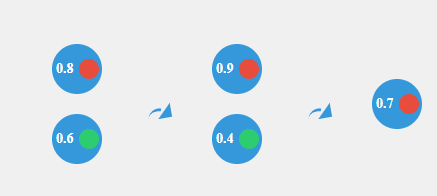
These scores determine how much focus, or “attention,” each word should have on other words. The scores are then scaled down and passed through a softmax function to get a distribution that sums to one.

To balance these attention scores, transformers employ the softmax function, which normalizes these scores to “between zero and one in the positive.” This ensures equitable distribution of attention across words in a sentence.

attention scores - sentence

Instead of examining words individually, the transformer model processes multiple words simultaneously, making it faster and more intelligent. 

If you think about how much of a breakthrough BERT was for search, you can see that the enthusiasm came from BERT being bidirectional and better at context.

Word order

In language tasks, understanding the order of words is crucial. 

The transformer model accounts for this by adding special information called positional encoding to each word’s representation. It’s like placing markers on words to inform the model about their positions in the sentence.

During training, the model compares its translations with correct translations. If they don’t align, it refines its settings to approach the correct results. These are called “loss functions.”

When working with text, the model can select words step by step. It can either opt for the best word each time (greedy decoding) or consider multiple options (beam search) to find the best overall translation.

In transformers, each layer is capable of learning different aspects of the data. 

Typically, the lower layers of the model capture more syntactic aspects of language, such as grammar and word order, because they are closer to the original input text. 

As you move up to higher layers, the model captures more abstract and semantic information, such as the meaning of phrases or sentences and their relationships within the text. 

This hierarchical learning allows transformers to understand both the structure and meaning of the language, contributing to their effectiveness in various NLP tasks.

What is training vs. fine-tuning? 

Training the transformer involves exposing it to numerous translated sentences and adjusting its internal settings (weights) to produce better translations. This process is akin to teaching the model to be a proficient translator by showing many examples of accurate translations.

During training, the program compares its translations with correct translations, allowing it to correct its mistakes and improve its performance. This step can be considered a teacher correcting a student’s errors to facilitate improvement.

The difference between a model’s training set and post-deployment learning is significant. Initially, models learn patterns, language, and tasks from a fixed training set, which is a pre-compiled and vetted dataset. 

After deployment, some models can continue to learn from new data they’re exposed to, but this isn’t an automatic improvement – it requires careful management to ensure the new data is helpful and not harmful or biased.

Transformers vs. RNNs

Transformers differ from recurrent neural networks (RNNs) in that they handle sequences in parallel and use attention mechanisms to weigh the importance of different parts of the input data, making them more efficient and effective for certain tasks.

Transformers are currently considered the best in NLP due to their effectiveness at capturing language context over long sequences, enabling more accurate language understanding and generation.

They are often seen as better than a long short-term memory (LSTM) network (a type of RNN) because they are faster to train and can handle longer sequences more effectively due to their parallel processing and attention mechanisms.

Transformers are used instead of RNNs for tasks where context and the relationship between elements in sequences are paramount.

The parallel processing nature of transformers enables simultaneous computation of attention for all sequence elements. This reduces training time and allows models to scale effectively with larger datasets and model sizes, accommodating the increasing availability of data and computational resources.

Transformers have a versatile architecture that can be adapted beyond NLP. Transformers have expanded into computer vision through vision transformers (ViTs), which treat patches of images as sequences, similar to words in a sentence.

This allows ViT to apply self-attention mechanisms to capture complex relationships between different parts of an image, leading to state-of-the-art performance in image classification tasks.


Get the daily newsletter search marketers rely on.

<input type="hidden" name="utmMedium" value="“>
<input type="hidden" name="utmCampaign" value="“>
<input type="hidden" name="utmSource" value="“>
<input type="hidden" name="utmContent" value="“>
<input type="hidden" name="pageLink" value="“>
<input type="hidden" name="ipAddress" value="“>

Processing…Please wait.

function getCookie(cname) {
let name = cname + “=”;
let decodedCookie = decodeURIComponent(document.cookie);
let ca = decodedCookie.split(‘;’);
for(let i = 0; i <ca.length; i++) {
let c = ca[i];
while (c.charAt(0) == ' ') {
c = c.substring(1);
}
if (c.indexOf(name) == 0) {
return c.substring(name.length, c.length);
}
}
return "";
}
document.getElementById('munchkinCookieInline').value = getCookie('_mkto_trk');


About the models

BERT

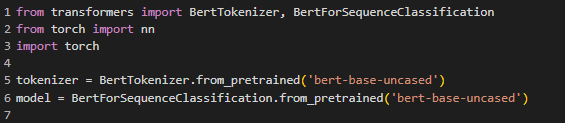
BERT (bidirectional encoder representations from transformers) employs the transformer’s encoder mechanism to understand the context around each word in a sentence. 

Unlike GPT, BERT looks at the context from both directions (bidirectionally), which helps it understand a word’s intended meaning based on the words that come before and after it. 

This is particularly useful for tasks where understanding the context is crucial, such as sentiment analysis or question answering.

BERT

BART

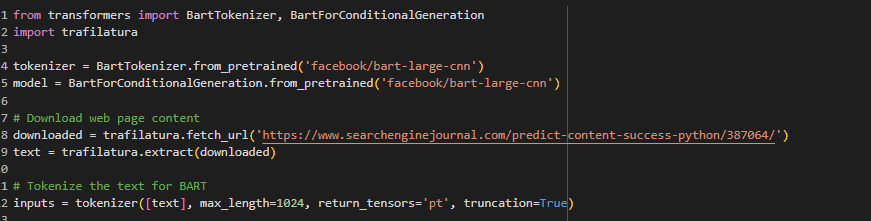
Bidirectional and auto-regressive transformer (BART) combines BERT’s bidirectional encoding capability and the sequential decoding ability of GPT. It is particularly useful for tasks involving understanding and generating text, such as summarization. 

BART first corrupts text with an arbitrary noising function and then learns to reconstruct the original text, which helps it to capture the essence of what the text is about and generate concise summaries.

BERT

GPT

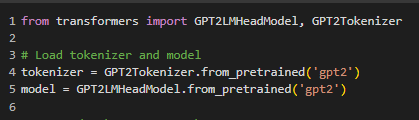
The generative pre-trained transformers (GPT) model uses the transformer’s decoder mechanism to predict the next word in a sequence, making it useful for generating relevant text.

GPT’s architecture allows it to generate not just plausible next words but entire passages and documents that can be contextually coherent over long stretches of text.

This has been the game-changer in machine learning circles, as more recent massive GPT models can mimic people pretty well.

GPT

ChatGPT

ChatGPT, like GPT, is a transformer model specifically designed to handle conversational contexts. It generates responses in a dialogue format, simulating a human-like conversation based on the input it receives.

Breaking down transformers: The key to efficient language processing

When explaining the capabilities of transformer technology to clients, it’s crucial to set realistic expectations. 

While transformers have revolutionized NLP with their ability to understand and generate human-like text, they are not a magic data tree that can replace entire departments or execute tasks flawlessly, as depicted in idealized scenarios.

Dig deeper: How relying on LLMs can lead to SEO disaster

Transformers like BERT and GPT are powerful for specific applications. However, their performance relies heavily on the data quality they were trained on and ongoing fine-tuning. 

RAG (retrieval-augmented generation) can be a more dynamic approach where the model retrieves information from a database to generate responses instead of static fine-tuning on a fixed dataset. 

But this isn’t the fix for all issues with transformers. 

Frequently asked questions

Do models like GPT generate topics? Where does the corpus come from?

Models like GPT don’t self-generate topics; they generate text based on prompts given to them. They can continue a given topic or switch topics based on the input they receive.

In reinforcement learning from human feedback (RLHF), who provides the feedback, and what form does it take?

In RLHF, the feedback is provided by human trainers who rate or correct the model’s outputs. This feedback shapes the model’s future responses to align more closely with human expectations.

Can transformers handle long-range dependencies in text, and if so, how?

Transformers can handle long-range dependencies in text through their self-attention mechanism, which allows each position in a sequence to attend to all other positions within the same sequence, both past and future tokens. 

Unlike RNNs or LSTMs, which process data sequentially and may lose information over long distances, transformers compute attention scores in parallel across all tokens, making them adept at capturing relationships between distant parts of the text.

How do transformers manage context from past and future input in tasks like translation?

In tasks like translation, transformers manage context from past and future input using an encoder-decoder structure. 

  • The encoder processes the entire input sequence, creating a set of representations that include contextual information from the entire sequence. 
  • The decoder then generates the output sequence one token at a time, using both the encoder’s representations and the previously generated tokens to inform the context, allowing it to consider information from both directions.

How does BERT learn to understand the context of words within sentences?

BERT learns to understand the context of words within sentences through its pre-training on two tasks: masked language model (MLM) and next sentence prediction (NSP). 

  • In MLM, some percentage of the input tokens are randomly masked, and the model’s objective is to predict the original value of the masked words based on the context provided by the other non-masked words in the sequence. This task forces BERT to develop a deep understanding of sentence structure and word relationships.
  • In NSP, the model is given pairs of sentences and must predict if the second sentence is the subsequent sentence in the original document. This task teaches BERT to understand the relationship between consecutive sentences, enhancing contextual awareness. Through these pre-training tasks, BERT captures the nuances of language, enabling it to understand context at both the word and sentence levels.

What are marketing applications for machine learning and transformers?

  • Content generation: They can create content, aiding in content marketing strategies.
  • Keyword analysis: Transformers can be employed to understand the context around keywords, helping to optimize web content for search engines.
  • Sentiment analysis: Analyzing customer feedback and online mentions to inform brand strategy and content tone.
  • Market research: Processing large sets of text data to identify trends and insights.
  • Personalized recommendations: Creating personalized content recommendations for users on websites.

Dig deeper: What is generative AI and how does it work?

Key takeaways

  • Transformers allow for parallelization of sequence processing, which significantly speeds up training compared to RNNs and LSTMs.
  • The self-attention mechanism lets the model weigh the importance of each part of the input data differently, enabling it to capture context more effectively. 
  • They can manage relationships between words or subwords in a sequence, even if they are far apart, improving performance on many NLP tasks.

Interested in checking out transformers? Here’s a Google Colab notebook to get you started.

The post Transformer architecture: An SEO’s guide appeared first on Search Engine Land.

Original source: https://searchengineland.com/transformer-architecture-an-seos-guide-434505

Boosting search conversions: 5 behavioral strategies to test

SEO and PPC professionals are all in the business of driving more traffic to websites.

But are you getting the most out of the visitors you already have?

This is a critical question. And, often, the answer is “no.” 

A solid search marketing strategy requires a customer experience plan as its core. Even if customer experience isn’t your direct responsibility, it should be on your radar. 

Traffic alone is a vanity metric. What truly matters is how that traffic navigates the marketing funnel and converts into valuable customers.

So, where do you begin with enhancing customer experience? 

The starting point is ensuring that your users land on the right page for their intent. Correctly mapping user intent to the most fitting page is critical. 

This article introduces a variety of behavioral nudges and ideas to help you extract more value from the traffic your website is already attracting.

Understanding conversion rate optimization

Before delving into these behavioral nudges, let’s quickly set the stage for those less familiar with conversion rate optimization (CRO). 

In essence, CRO is a process where hypotheses are crafted to make website changes to boost conversions. These actions are vital to your business, such as sales or engagement with content.

Once a hypothesis is formed, you can use tools like VWO or Zoho’s PageSense to create and test new versions of landing pages. No coding skills are needed.

The tool then serves the current and test versions of the page to a set percentage of the traffic and monitors the results. The test duration depends on your site traffic and how fast the tool can get reliable results.

When the test ends, if your idea works, implement it live. If not, tweak and retest.

Testing this way eliminates gut feelings and biases, letting you confidently report what works for your audience.

The challenge? Figuring out what to test.

5 behavioral nudges to elevate your traffic conversions

Below are five behavioral nudges for testing and driving more conversions from your traffic.

1. Social proof and herding

Social proof is the concept that the actions and beliefs of others influence people. Herding is the tendency of humans to follow what others are doing. 

Think about your website and the customer journey toward a conversion – how could you ensure these nudges are included to entice your user to complete the action?

When it comes to social proof, users are looking for signals of trust from others. 

Brand logos and testimonials are nice, but how can you ensure this feels as robust as possible? 

Well-known third-party integration review tools are great because they are independent and recognized, helping users feel they can trust the review’s authenticity. 

Herding might come to life on your website in the form of live messaging such as: 

  • “20 other people bought this item today” (for ecommerce).
  • “Join the thousands of leaders, who were just like you, that have increased their business profit from our training” (for B2B).

You may already have some of these features on your website, but do they stand out enough? Are they in the right position to influence the user in deciding whether to convert? 

Some of these changes are as simple as wording changes. A CRO test is often simple and limited to one change. If you change too much, it is impossible to know what worked. 

Dig deeper: Unleashing the potential of Google reviews for local SEO

2. Cognitive load

Cognitive load relates to our working memory and the amount of information we can hold at one moment. 

Which areas in the conversion path require the most cognitive load for your user? 

  • On an ecommerce website, this is often the checkout.
  • For other business types, this could be a lengthy form or application that needs to be completed.

Is there an opportunity to chunk the process steps up instead of having one long form, making it multiple simpler steps? 

Can the user save and come back? Saving your progress is especially important in processes where the user needs to find information they might not know off the top of their head. 

On the flip side, does your website process have too many steps? 

We recently tested simplifying a three-step personalization process on a client’s website to a two-step process, and the results were phenomenal, with 100% certainty and a material spike in revenue. 

You may have heard of “cognitive strain,” which differs from cognitive load.

Cognitive strain relates to the person having to decode what they are looking at, like trying to decipher a picture or content, or doing mental arithmetic to assess something. 

Used at the right point in a journey, this type of cognitive action can be extremely powerful. 

When we make people think or, ideally, make them feel something, they are more likely to remember it.

This is true of positive and negative feelings, so for any poor user experience, cognitive strain can create a memory you wish the user to forget.

Dig deeper: How to avoid decision fatigue in SEO

3. Scarcity and FOMO

Scarcity is when something is rare and exclusive, such as only a certain amount of tickets, spaces or products available. 

Fear of missing out (FOMO) is the urgency factor, which is time-sensitive or about to expire. 

These nudges can be used on their own or together. 

Most of us have probably been there, in a queue online, trying to buy tickets for a concert or an event that you know only has limited numbers. 

You’ve probably also experienced FOMO in a moment like this when a friend messages telling you they’ve been successful and you know it is only a matter of time before the event is sold out. 

Now, this is not something we can all replicate in the same way a famous artist or show can. But we can take learnings and think about how we frame our products and or services. 

I recently spotted a well-respected business trainer offering a one-time-only masterclass course with only 10 spaces available – an exclusive opportunity. The scarcity was real, and she sold out within hours. 

The FOMO of a time-limited sale is true, although this is easily eroded when some websites are always on sale!

Testing where your messaging sits to highlight the urgency, showing a live countdown or percentage complete bar.

There are many ways to grab attention; don’t assume you’ve already nailed it. Test it to see what has the best effect. 


Get the daily newsletter search marketers rely on.

<input type="hidden" name="utmMedium" value="“>
<input type="hidden" name="utmCampaign" value="“>
<input type="hidden" name="utmSource" value="“>
<input type="hidden" name="utmContent" value="“>
<input type="hidden" name="pageLink" value="“>
<input type="hidden" name="ipAddress" value="“>

Processing…Please wait.

function getCookie(cname) {
let name = cname + “=”;
let decodedCookie = decodeURIComponent(document.cookie);
let ca = decodedCookie.split(‘;’);
for(let i = 0; i <ca.length; i++) {
let c = ca[i];
while (c.charAt(0) == ' ') {
c = c.substring(1);
}
if (c.indexOf(name) == 0) {
return c.substring(name.length, c.length);
}
}
return "";
}
document.getElementById('munchkinCookieInline').value = getCookie('_mkto_trk');


4. Loss aversion

Psychologically, the pain of losing something can be twice as impactful as the pleasure of gaining something. 

If your website offers a free trial, a sample product or some way of getting your product or service into the customer’s hands, they will be less likely to want to let go. 

As humans, our natural instinct is to avoid losing things. This instinct comes from our evolutionary history, where early humans focused on minimizing the risk of extinction. 

This mindset is deeply ingrained in us. So, when we’re concerned that something might go wrong or we might lose money, we tend to avoid or delay dealing with it.

Most businesses have options to avoid losses and the resultant unhappy customers, such as free returns or money-back guarantees. 

Messaging like this can be extremely important to help a user feel confident to decide, so it needs to be prominent. 

Testing different phrasing and positioning on the page to display this information and even additional links to more detailed explanations can be really helpful in building trust.  

5. Anchoring

Anchoring involves presenting a reference point before sharing your brand’s price, timescale or unique information. 

Examples include: 

  • Quoting a competitor’s price and then showing their cheaper price. 
  • Saying “most businesses take 12 weeks to deliver, we deliver in four weeks.” 
  • Highlighting that “other manufacturers use X, we use Y because…” 

When you present an anchor, you control the reference point. Otherwise, customers rely on their own knowledge for comparisons. Their reference point may be assumed or well-researched, making feedback uncertain.

Playing with anchoring is a great tool to drive conversions and can work for B2C and B2B. As a concept, this needs to be true to the brand.

Uncovering your anchors may take time if you are not using them already. But once you have them, this is a copy and design play from a testing perspective. 

Some anchors have transcended brands, such as your mattress should be changed every eight years or engagement rings should cost three months of your salary. 

Could your brand or product have an anchor like this that may help increase pricing? 

Other brands offer 100-day trials or even 365-day returns. Making these numbers stand out will help the customer see the value your brand brings. 

For a charity, the anchor could work in two ways.

  • Firstly, the Starbucks effect of having three suggested donation amounts, the most expensive being the anchor, will likely result in the selected middle amount. 
  • But also testing text to explain what that donation can do for the charity, “$10 will buy…” 

This framing may not always resonate with your audience, so test it.

Turning clicks into conversions with behavioral strategies

We’ve discussed five strategies you can use on your website to see if they boost conversions. 

Making the most of your current website traffic is a great way to get support for your search strategy. 

If you can show that your efforts are working and there’s potential for even better results with SEO or paid search, it’s tough for a budget decision-maker in a growing business to reject the idea. 

Begin testing today, and remember, even small changes can have a big impact.

The post Boosting search conversions: 5 behavioral strategies to test appeared first on Search Engine Land.

Original source: https://searchengineland.com/boosting-search-conversions-behavioral-strategies-test-434537

Benefits of Custom E-commerce Development Projects

Home Business Magazine Online

Finding a place under the fierce sun of online shopping, a crowded and saturated beach of good-looking competitors, is not an easy feat in 2023. With numbers counting up to 24 million online stores, you must deliver a high-quality web store with all essential ingredients and something unique.

The online retail is showing no stopping. In fact, by 2040, Nasdaq research thinks 95% of all purchases will be online. So, if you have a product or want to expand your physical store, there is little doubt that you should invest in an e-commerce business model.

Luckily, numerous quality platforms can help you start an online store. However, to create a feature-rich, cutting-edge solution sprinkled with the latest plug-ins and technologies, you should probably consider custom e-commerce development.

Advantages of custom software development

Software development is a bustling industry that offers ready-made solutions like e-commerce development platforms, CRM, ERP, and other products in other niches. Since it’s hard to fit your individual business into finished products seamlessly, you will probably have to hire developers to adjust the off-the-shelf modules. While the final result might be satisfactory, if you want more benefits and to stand out, creating a custom solution might be a better option, especially in a highly competitive e-commerce industry.

Software development companies building your solution will enable a high level of personalization. The product will be created to meet all your needs. You can add features and technologies outside of what ready-made products offer in their packages. Tailor your solution to fit project plans and entertain the target audience.

Initial costs of custom development are higher than off-the-shelf software. However, in the long run, a custom solution doesn’t require costly subscriptions, and recurring expenses are lower and more focused on maintenance. If you choose to create solutions on open-source software, you will avoid paying licensing fees. Simultaneously, off-the-shelf products also need custom development to add new features, and with custom software, you will be better positioned to stay on top of the technology game.

Each software solution comes with a set of security features. In custom development, you can incorporate all of the currently leading solutions and insist on extensive testing to ensure there are no vulnerabilities in the code.

If you choose a development company wisely, you can rely on continuous support and maintenance. A personalized relationship is something you won’t get with off-the-shelf solutions. However, you do need to check the developers you employ. Successful projects and longevity are keys to relying on custom ecommerce development and having peace of mind.

One crucial aspect of an online store is scalability. If your business takes off, you will want an easy way to expand your website and add more product categories and items. Custom development can think of that in the beginning, laying the foundation for future growth.

Another essential feature is integration with third-party solutions. You will want your online shop to integrate with existing company ERP seamlessly or to include advanced payment options.

Magento is one of the favorites if you’re looking for an e-commerce platform that blends into custom software development benefits. An open-source solution with thousands of developers in a broad community that emphasizes scalability, speed, and third-party support.

Why is Magento popular among e-commerce developers?

The battle for every customer is rampaging in the e-commerce industry. To facilitate the countless online stores, businesses can choose from various e-commerce platforms like WooCommerce, Shopify, Magento, and Wix.

As an open-source solution, and because of its longevity in the market, Magento is considered the top choice for custom development. But what makes it so appealing?

Magento has a massive community of developers because it powers online shops for over 15 years. It is estimated that around 300,000 developers globally work with this platform. You can find reliable help, quality plug-ins, and support, which helps the platform stay relevant and competitive.

Online retail increasingly relies on smartphones, with up to 70% of online purchases coming through mobile. Magento has built-in support for HTML5 and responsive design, meaning your website should look good on any screen size. Responsiveness includes flexible grids and layouts, as well as the handling of images.

Security is a major concern for both the Magento e-commerce development company and the client. The platform comes with numerous security options and extensions. You can find strong data encryption through the AES-256 algorithm, session and cookie validation, and CSRF protection. Building on that, you can include ReCAPTCHA and two-factor authentication to improve your security.

Developers will appreciate the Magento platform with predesigned components, elements, and themes. Whether you design a site from scratch or use some of the existing items, Magento offers broad customization options.

Aside from looking good, you will want your online store to perform well and attract traffic. Magento has a comprehensive set of SEO features built into the platform. You can add custom anchor text for navigation links and change the page title and H1 tags. You will also get canonical URLs that help avoid content duplication, and its CMS has advanced options for organic link building. Another thing Magento thrives on is page loading speed, which is essential for SEO and customer experience and retention.

Possible disadvantages of custom development

Custom software development is not ideal for all clients, and if you need a super basic online store with only a few items, you might consider doing it by yourself. Some of the issues you could encounter are high initial costs.

Small companies might be turned off by the cost of hiring a team of developers despite having benefits in the long run. If you’re not experienced and don’t look thoroughly, you might hire the wrong vendor, which could cost you time and resources to get it right.

If you’re in a hurry and must launch an online store quickly, you could also try easy-to-use platforms. Custom development may take months to deliver satisfactory results.

Conclusion

If you want to make your online store competitive and attractive, it should stand out from the crowd. This is not an easy feat, with hundreds of thousands of e-commerce websites. Choosing custom e-commerce development to create unique shopping experiences might be your best choice.

Personalization, adding custom features, and most attractive e-commerce solutions are a few reasons that can help you elevate over competitors. If you choose an open-source platform like Magento, you can build upon already robust SEO, security, and customization options while having speedy page loading and broad third-party solution support.

The post Benefits of Custom E-commerce Development Projects appeared first on Home Business Magazine.

Original source: https://homebusinessmag.com/businesses/ecommerce/benefits-custom-e-commerce-development-projects/

Google says major changes coming to search rankings

Google’s Search Liaison, Danny Sullivan, has reportedly said that major changes are coming to Google’s search rankings in the future. This comes from a talk Sullivan gave at an event last Friday, where he was quoted as saying that these “major changes” are coming and that some may need to “buckle up.”

Danny Sullivan after this story was published replied on X saying, “I was talking about various things people have raised where they want to see our results improve, or where they think “sure, you fixed this but what about….” And that these things all correspond to improvements we have in the works. That there’s so much coming that I don’t want to say buckle up, because those who are making good, people-first content should be fine. But that said, there’s a lot of improvements on the way.”

Quotes. Here are the two sources I found quoting Sullivan as saying, “buckle-up there are major changes coming to search ranking signals…”

Here is some more clarification:

Busy year of algorithm updates. It has been a wild and very volatile year for SEOs with a ton of Google search ranking algorithm updates. Just this past few weeks we had the November 2023 reviews update, November 2023 core update, October 2023 spam update, and the October 2023 Core Update.

Why we care. Are there more big changes coming to Google’s core ranking algorithms in the near term? What will be so “major” that some of us need to “buckle up” and get ready for? How much will these future algorithm updates be even more impactful than the ones we are currently experiencing?

Or maybe these quotes were taken out of context and we don’t need to stress too much about these changes.

The post Google says major changes coming to search rankings appeared first on Search Engine Land.

Original source: https://searchengineland.com/google-says-major-changes-coming-to-search-rankings-434548

Conveying keyword insights to non-SEOs: A visual approach

Explaining keyword research to those unfamiliar with SEO to gain support can be challenging.

Stakeholders often find it difficult to grasp the value of SEO, and at the same time, SEOs struggle to communicate the benefits and contributions effectively.

Fortunately, there are strategies available for SEOs to bridge this gap by employing their keyword research more strategically and effectively. 

This article explores a visual approach for effectively communicating keyword research insights with stakeholders outside the search industry. 

Leveraging unique visuals

Non-SEO-savvy stakeholders may not know much about search keywords but likely understand general marketing concepts like the marketing funnel and audience segments.

You can use this understanding to explore keywords more deeply and create strategies that align with these broader marketing terms.

One critical yet frequently overlooked element here is search intent. 

You can group keywords based on intent and create a bubble chart to visually represent the position of each keyword cluster within the marketing funnel, like the chart below.

Keyword intent clusters

The chart clearly shows the content needed to help searchers at each level of the marketing funnel. Overall, it reveals the necessary content for different stages of the funnel.

But it’s not just limited to that; you can also narrow it down to specific topics or subsets of keywords. This allows for a detailed analysis and a better understanding of the specific types of content needed for each topic.

Taking the above keyword intent visualization and drilling into the “all-weather tires” cluster shows that “Awareness” content should be produced to target these keyword clusters. Unlocking this insight means SEOs can match the searchers’ expectations.

Keyword intent clusters - Awareness

This visualization shows how certain keywords help users move through the marketing funnel, and there are more actions you can take to optimize it further.

Companies often use audience personas or segments in broader marketing efforts. Integrating this knowledge is vital for effective communication, especially with stakeholders focused on paid search, as they commonly associate keywords with audience segments.

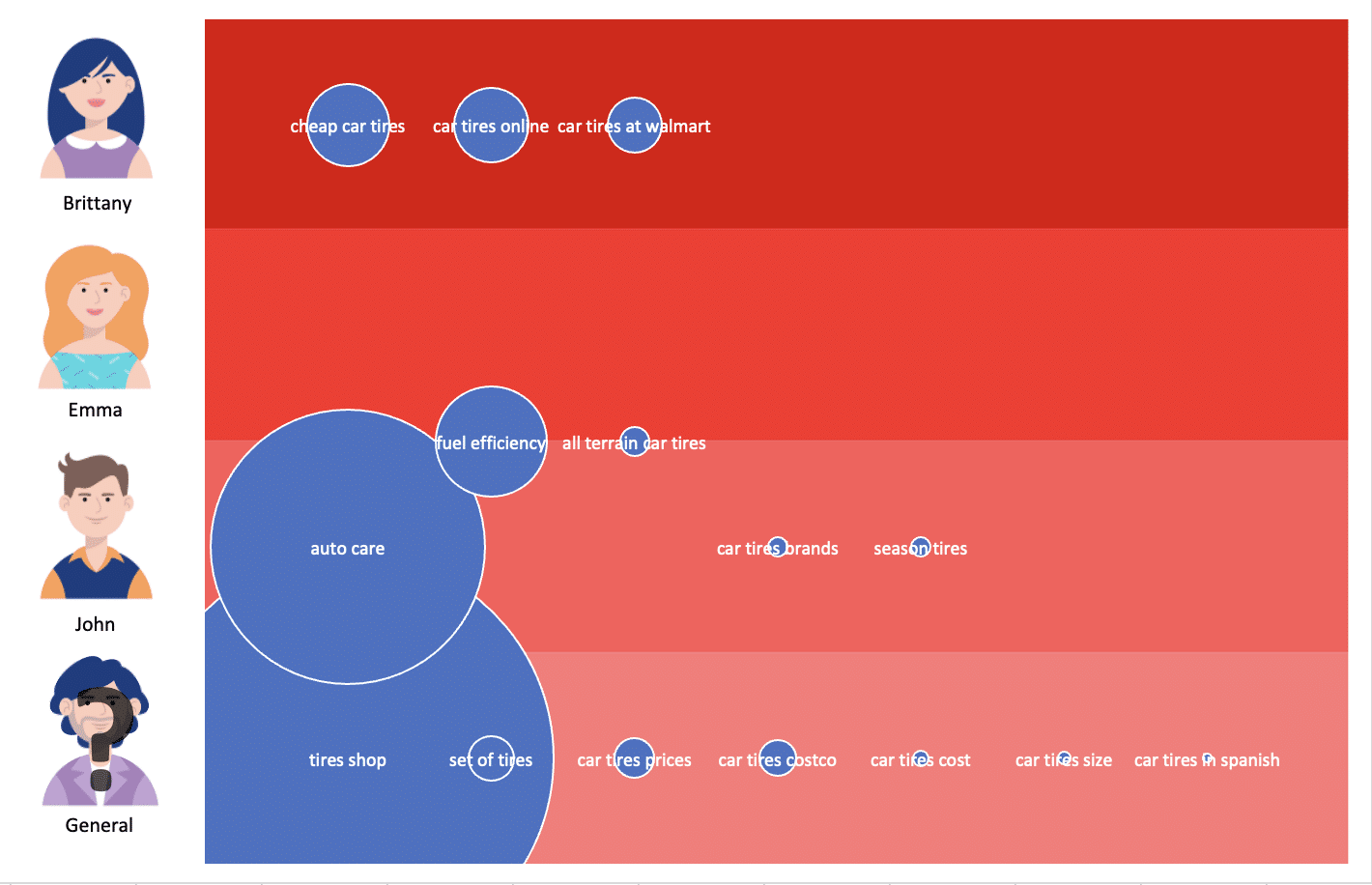
Likewise, by utilizing ChatGPT, SEOs can categorize keyword topics based on audience personas, resulting in a visual representation like the one below:

Categorized keyword topics based on audience personas

This chart displays the size of various topics and indicates which audience segments are most likely to engage with content related to those topics.

With these visuals, you are in a stronger position to develop more effective content strategies and enhance your communication with stakeholders outside the search domain.


Get the daily newsletter search marketers rely on.

<input type="hidden" name="utmMedium" value="“>
<input type="hidden" name="utmCampaign" value="“>
<input type="hidden" name="utmSource" value="“>
<input type="hidden" name="utmContent" value="“>
<input type="hidden" name="pageLink" value="“>
<input type="hidden" name="ipAddress" value="“>

Processing…Please wait.

function getCookie(cname) {
let name = cname + “=”;
let decodedCookie = decodeURIComponent(document.cookie);
let ca = decodedCookie.split(‘;’);
for(let i = 0; i <ca.length; i++) {
let c = ca[i];
while (c.charAt(0) == ' ') {
c = c.substring(1);
}
if (c.indexOf(name) == 0) {
return c.substring(name.length, c.length);
}
}
return "";
}
document.getElementById('munchkinCookieInline').value = getCookie('_mkto_trk');


How to build the visuals

The effectiveness of these two visuals is undeniable, though they require additional effort to develop.

Keyword intent cluster

SEOs can use various approaches to build keyword intent clusters, but I’ll outline the most straightforward and effective method.

To begin, we need more than just keyword data and search volume to craft this visual. Specifically, it will require top 10 organic listings and a keyword intent score.

A keyword intent score can be calculated through various means. I suggest you use a tool you can access that supplies keyword intent. 

When creating my own visuals, I used the DataForSEO API and assigned a score for each SERP feature that appeared on a SERP, then calculated the average score for each keyword. 

This can also be accomplished in a tool like Semrush by transforming the categorical keyword intents into a numerical scale. 

When assigning a value for each intent, select a minimum value representing transactional intent and a maximum value representing informational intent. A blended intent can also be calculated by assigning a value between two intents. 

We can create the intent clusters now that a numerical value has been established for keyword intent. 

By gathering page 1 organic listings data, we leverage Google’s intelligence to create more accurate and relevant keyword clusters.

To create the clusters, compile the organic listings for a keyword into a list and compare it to another keyword list, keeping track of the number of similar pages appearing in each list. 

Upon completing this analysis, we will be in a position to construct a similarity matrix for all the keywords, identical to the example provided below:

keyword matrix

Next, create the clusters and aggregate all of their associated metrics. Through my experimentation, I discovered that establishing a threshold at 4 or 5 similar URLs resulted in the most cohesive clustering.

Once all keyword clusters have been aggregated along with their metrics, it’s time to assemble a bubble chart. The data at this point should closely align with the below:

aggregated keyword clusters

Each cluster in the bubble chart should ideally start with a value of 0 on the x-axis unless you are in the process of fine-tuning the visual to reduce bubble overlap. 

I advise initializing all clusters at 0 and making necessary adjustments to the data once the bubble chart has been generated. 

This fine-tuning step is crucial. Without it, the visual can become unclear and difficult to comprehend. To see the impact of this step, compare the examples below.

fine-tuning funnel visuals

After fine-tuning, the visual is complete and ready to help communicate the value of specific keywords to stakeholders outside the search domain.

Associate topic clusters with audience personas

If you can access your company’s audience personas or segments, use this information to better align with stakeholders.

Integrating topic clusters with audience personas offers insight into the content that targets each audience within a business. These insights enable SEOs to identify content gaps and potential areas for improvement, equipping them with the necessary data to communicate more strategically.

A quick analysis of the chart below clearly reveals that the business is not effectively engaging with “Emma.” Consequently, when determining the direction for future content creation, they might utilize this insight as a valid reason to devise content that resonates more with “Emma.”

Associate topic clusters with audience personas

Similar to the keyword intent cluster visualization, there are various ways to create this chart. I’ll share the simplest method I’ve found.

Start by giving ChatGPT your audience personas and asking it to summarize each. This helps make sure that ChatGPT really understands them. 

Here is an example prompt:

“I have a list of topics that I would like you to categorize based on the audience personas that I will provide and your knowledge of each topic. Before starting, write a paragraph about each persona to ensure you understand them well. Then I will give you the list of topics to categorize. After categorizing the keywords, please return them to me in a table that I can copy and paste into Excel.

Persona 1:
NAME: INSERT PERSONA NAME
DESCRIPTION: INSERT PERSONA DESCRIPTION – RECOMMENDED >100 WORDS
DEMOGRAPHICS:
AGE: …
GENDER: …
LOCATION: …
EDUCATION: …
INCOME: …
FAMILY LIFE: …
STRUGGLES: INSERT LIST OF STRUGGLES/PAIN POINTS
HOBBIES: INSERT LIST OF HOBBIES
VALUES: LIST PERSONAL VALUES OF THIS PERSONA


Persona 2:
[INSERT PERSONA KNOWLEDGE]


Persona 3:
[INSERT PERSONA KNOWLEDGE].”

When creating this prompt, provide ChatGPT with comprehensive details about each persona. This helps it establish the best understanding of the audience personas possible, which can be verified through the summaries. 

After confirming that it has an accurate grasp of the personas, proceed by uploading the list of keyword topics that require categorization.

If all goes well, ChatGPT should generate a table for you that is separated by commas and resembles the following structure:

Topic clustering per audience persona with ChatGPT

Next, simply transfer the output to Excel and utilize the “Text to Columns” feature to split the data effectively.

Once the data has been collected, convert the audiences’ names into values for the bubble chart. So, this is to say that Brittany will now be represented by the number four on the y-axis. 

For topics assigned to two or more audiences, take the average of the audience number.

An example is the topic “fuel efficiency,” which was categorized for John and Emma, so it was assigned 2.5 as an audience value. 

After gathering all necessary data, transform the audience names into numerical values for the bubble chart. 

To illustrate, Brittany will be represented as the number four on the y-axis. For topics assigned to two or more audiences, calculate the mean of the audience numbers.

Take, for instance, the topic “fuel efficiency,” attributed to both John and Emma, resulting in an assigned audience value of 2.5.

Subsequently, count the number of subjects assigned to each audience and allocate a numerical value to each topic, indicating its position on the x-axis. The data should closely resemble the example below:

Topics with assigned numerical values

After gathering all necessary data, SEOs can create a bubble graph using Excel.

They can enhance the graph by incorporating additional visual elements, such as background images or gradients, to delineate segments for each target audience clearly.

Visualizing complex SEO concepts for effective stakeholder communication

Bridging the gap between SEO concepts and stakeholder understanding is challenging but crucial. 

With keyword intent clusters and audience persona charts, SEOs have a streamlined and visual way to convey complex concepts. 

Using the visual aids discussed in this article, you can approach stakeholders with more strategic content insights that align with familiar concepts. 

The post Conveying keyword insights to non-SEOs: A visual approach appeared first on Search Engine Land.

Original source: https://searchengineland.com/keyword-insights-non-seos-visual-approach-434491

Retro Revival: Nostalgia and Vintage Restaurant Furniture

Home Business Magazine Online

In the ever-changing environment of restaurant design, the Retro Revival trend has developed as an engaging and enduring concept that transcends time. The charm of retro restaurant furniture, with its capacity to transport clients to bygone times, is critical in generating memorable dining experiences. This trend isn’t about copying; it’s an immersive journey into the core of design, where the essence of nostalgia pervades every piece.

In this investigation, we look deeply into the psychology of nostalgia, its tremendous impact on customer experiences, and the critical role that retro restaurant furniture plays in establishing the character of these enterprises. We will also explore the difficulties of acquiring, maintaining, and incorporating old artifacts, as well as the obstacles and ethical issues that come with embracing the timeless beauty of the past.

The Power of Nostalgia in Restaurant Design

Nostalgia is a powerful and widely understood feeling that has a tremendous impact on our decisions and perceptions. It ties us to beloved memories, elevating restaurant design above mere aesthetics to become an emotional connection. Restauranteurs create a mood that transcends ordinary aesthetics by tapping into the deep wellsprings of reminiscence. This emotional connection develops loyalty and a sense of belonging, giving customers the impression that they are returning to a beloved moment rather than simply dining out. Nostalgia is more than just a pretty face; it’s a psychological phenomenon that improves the customer experience.

The Retro Revival Trend

The Retro Revival style is a rich tapestry made up of threads from several eras. It does not focus on a single era but rather highlights the finest of all of them. From the glitzy Roaring Twenties to the simplicity and elegance of mid-century modernism, this trend gives new vitality to traditional design motifs. An increasing number of industries and businesses are capitalizing on the trend, recreating and reinterpreting iconic components to create a modern yet timeless allure. Vintage restaurant furniture is essential in replicating the atmosphere of bygone eras, giving authenticity and character that cannot be recreated.

The Allure of Vintage Restaurant Furniture

Vintage commercial-grade restaurant furniture has an inherent appeal derived from the craftsmanship of a bygone era. It’s not only the aged textures and faded colors; it’s the stories these items hold. Each chair or table is a vessel that has stood the test of time and has its own story. Including such items in restaurant design not only creates an environment, but also produces a sense of nostalgia and wonder in diners. Aside from aesthetics, vintage furniture provides versatility, allowing restaurateurs to create varied rooms that appeal to a wide range of customers. Furthermore, it adheres to ecological standards by reviving ancient items rather than adding to environmental stress.

Sourcing Vintage Restaurant Furniture

Finding authentic vintage pieces is an experience that necessitates a keen eye and a love of exploring. Estate sales and auctions frequently reveal hidden gems, providing a window into the past. The joy of discovering one-of-a-kind finds in thrift stores is unparalleled, yet unpredictable. Online markets and specialist dealers cater to a larger audience, making vintage pieces available to collectors all over the world. Reproduction and reinterpreted vintage furniture offer feasible solutions for customers seeking a mix between authenticity and affordability, allowing restaurateurs to generate a nostalgic ambiance without breaking the budget. These many sourcing channels enable restaurateurs to build one-of-a-kind places that capture the soul of the past.

Incorporating Vintage Furniture in Restaurant Design

Incorporating old furniture into restaurant design necessitates a careful mix of retro and modern aesthetics. It is critical to mix and match styles, experiment with colors and materials, and ensure utilitarian factors like comfort and ergonomics. Lighting is essential for highlighting vintage artifacts and boosting the overall feel. Personalization gives a touch of distinction, allowing restaurateurs to instill a feeling of individuality and character in their operations. Each design aspect, from seating arrangements to lighting fixtures, contributes to creating a unified and memorable ambiance for customers.

Maintaining and Caring for Vintage Furniture

The charm of old furniture necessitates attentive maintenance and attention. Regular cleaning, addressing wear and tear promptly, and investing in professional restoration services when necessary are all tips for extending the life of these pieces. Upholstery maintenance, in particular, necessitates delicate handling to maintain both aesthetics and hygiene. By following basic maintenance procedures, restaurateurs can ensure that their vintage furniture continues to enchant customers for years to come, safeguarding the investment value of these one-of-a-kind items.

Sustainability and Ethical Considerations

In the midst of the glamour of vintage furniture, it is critical to analyze its environmental and ethical implications. Sustainable approaches like upcycling and eco-friendly design reduce waste and put less burden on natural resources. Responsible vintage furniture utilization is aided by ethical sourcing procedures, transparent supply chains, and support for local artisans. By emphasizing these factors, restaurateurs can not only create visually appealing venues but also have a positive impact on the environment and local communities. The nostalgic features in restaurant design get depth and meaning through sustainability and ethical sourcing.

Challenges and Potential Drawbacks

While the appeal of vintage restaurant furniture cannot be denied, there are some obstacles to overcome. It is critical to balance nostalgia with functionality and comfort; guests should feel at ease while enjoying the ambiance. Hygiene considerations, particularly with upholstery, necessitate meticulous attention to ensure that vintage pieces satisfy modern hygiene requirements.

Maximizing space in vintage-style restaurants without sacrificing ambiance presents a unique problem that necessitates careful layout planning. Additional considerations for restaurateurs include durability, safety, and accessibility in order to provide a smooth dining experience for all patrons. Taking up the challenges adds levels of complexity and usefulness to the use of historic furniture in restaurant design.

Embracing the Timeless Allure

Vintage commercial restaurant furniture is a tribute to the enduring pull of nostalgia as the Retro Revival movement continues to enchant the culinary world. Restauranteurs may build environments that transcend time by studying the psychology of nostalgia, researching varied sourcing choices, and negotiating the obstacles and ethical considerations.

Embracing the timeless beauty of old furniture is more than just a design choice; it’s an invitation for diners to embark on a nostalgic journey, where the past and present seamlessly collide, producing remarkable dining experiences that stay in clients’ hearts and memories. The marriage of aesthetics, emotions, and functionality results in a symphony of components that characterize the restaurant of the future, steeped in nostalgia for the past.

The post Retro Revival: Nostalgia and Vintage Restaurant Furniture appeared first on Home Business Magazine.

Original source: https://homebusinessmag.com/businesses/business-spotlights/retro-revival-nostalgia-vintage-restaurant-furniture/