Behind the Scenes of BDD Testing: What Really Happens in the Test Automation Process

Home Business Magazine Online

Assuring that the program works as intended and satisfies user expectations, software testing is a crucial stage in the software development lifecycle. Behavior-driven development (BDD) testing is a particularly successful strategy for ensuring that a piece of software acts appropriately from the perspective of the user in the field of software testing. Although the idea of BDD is well known, few people are aware of the inner workings of test automation. Today, we’ll dig into the inner workings of BDD testing, illuminating the complexities and phases that underpin its accomplishment.

Defining Behavior-Driven Development (BDD) Testing

What is BDD testing, you may be wondering — BDD is fundamentally a method of software development that prioritizes user behavior and anticipated results. It centers on the notion of creating scenarios in clear language that explain how a piece of software ought to act in certain circumstances. The “Given-When-Then” pattern is used in these cases, where:

  • Given: Describes the system’s original context or condition.
  • When: Identifies an event or activity that causes a behavior.
  • Next: Specifies the anticipated result or outcome.

BDD scenarios act as a common language that unites technical and non-technical stakeholders, promoting cooperation and ensuring that everyone is aware of the software’s behavior.

The Anatomy of BDD Test Automation

Now, let’s dissect the intricate process of BDD test automation:

1. Scenario Authoring:

Writing a scenario is the first step in the trip. Product managers, business analysts, and testers must work together cross-functionally throughout this phase. They create scenarios together that represent different facets of the behavior of the program. Throughout the development process, these scenarios act as both living records and reference points.

2. Framework Selection:

Picking the appropriate BDD testing framework is essential. Cucumber, SpecFlow, Behave, and other solutions are popular choices. These frameworks offer a systematic setting for converting plain-language scenarios into workable tests.

3. Step Definitions:

The next step after having scenarios is to develop step definitions. Step definitions serve as a link between scenarios written in simple language and the underlying automation code. For each scenario step, they specify what should be done (the “When”) and what to anticipate (the “Then”). Testing professionals and developers work together to create step descriptions.

4. Test Automation:

The scenarios should now be automated. The actual test scripts that will imitate user interactions with the product are written by automation engineers or testers with coding skills. These scripts adhere to the step definitions’ logical explanations. Automated testing guarantees speed and repeatability when confirming program behavior.

5. Execution:

The automation scripts can be run against the software being tested after they are finished. The program is acted upon during execution in accordance with the established scenarios. The automated tests verify if the observed behavior agrees with the anticipated results described in the scenarios.

6. Reporting and Analysis:

BDD testing frameworks frequently include thorough information on how the tests were executed. These reports detail any problems observed during testing as well as which scenarios succeeded and which failed. During the analysis phase, these reports are examined to find errors, regressions, or differences between desired and actual behavior.

7. Debugging and Refinement:

The debugging and refining phase is activated when testing is unsuccessful or problems are found. To identify and fix errors’ underlying causes, testers and developers collaborate. The software is designed in an iterative method to match user expectations.

8. Continuous Integration:

In contemporary software development methodologies, BDD tests are frequently included in CI pipelines. As a result, anytime code modifications are submitted to the version control system, automated tests are automatically run. BDD tests are made to be an essential component of the development process thanks to CI integration.

9. Maintenance and Updates:

BDD tests should change as the software does. Scenarios, step definitions, and automation scripts must be updated to reflect the software’s current status when new features are introduced or old ones are changed. The constant process of maintaining tests helps to keep them useful and efficient.

10. Collaboration and Communication:

Collaboration and communication among team members are essential throughout the whole BDD testing process. BDD scenarios act as a unifying framework that unifies everyone’s perceptions of software behavior. It makes it easier to have talks, get things straight, and share responsibility for quality control.

The Benefits of BDD Test Automation

Now that we’ve unveiled the intricacies of BDD test automation, let’s explore why it’s worth the effort:

  • Clarity and Transparency: BDD scenarios provide a transparent and lucid means of describing and expressing expected behavior. They act as a point of reference for all parties involved, ensuring that there is consensus.
  • Efficiency and Repeatability: Automating the testing process makes it more repeatable and efficient. Regression testing takes less time and effort when performed quickly and reliably using automated tests.
  • Early Issue Detection: BDD tests identify problems before they become serious ones. You can uncover errors and regressions as soon as they happen by describing anticipated behavior in advance and automating testing, which lowers the cost of repairing them.
  • Collaboration and Alignment: BDD promotes cross-functional team cooperation and the alignment of business goals with software behavior. It guarantees that each person’s viewpoint is taken into account during the testing process.
  • Continuous Integration: By including BDD tests in CI pipelines, a continuous testing culture is promoted. Every time a piece of code is changed, tests are automatically executed, giving developers quick feedback and preserving the integrity of the project.

BDD testing automation is a secret weapon that makes sure software functions as users would anticipate it to. It involves a planned process that includes creating step definitions, choosing frameworks, writing scenarios, automating tests, running them, reporting the results, and working together continuously. Software development teams can benefit from BDD testing automation in terms of clarity, efficiency, early issue discovery, cooperation, and a dedication to ongoing quality assurance. Not only testing is important; software delivery that satisfies user needs and promotes business success is as well.

The post Behind the Scenes of BDD Testing: What Really Happens in the Test Automation Process appeared first on Home Business Magazine.

Original source: https://homebusinessmag.com/home-office/computers-and-software/bdd-testing-test-automation-process/


Future-proofing digital experience in AI-first semantic search

The rise of artificial intelligence (AI) and its integration into search engines is reshaping how businesses and consumers interact with digital platforms. 

This article will share specific steps to future-proof your customer experience across various channels and touchpoints. 

Understanding AI-first semantic search 

Semantic search represents a quantum leap in the world of search engines. Unlike traditional keyword-based search, semantic search focuses on comprehending the context and intent behind a user’s query, leading to more accurate and contextually relevant results. 

This is achieved through natural language processing (NLP) and machine learning (ML) techniques, making it an essential aspect of AI-driven search. 

With AI-first semantic search, search engines are no longer confined to merely matching keywords. They can now comprehend the nuances of language, interpret user intent, and provide answers rather than just links. 

This is why brands must adapt and provide a more intuitive and personalized digital experience for users across all channels and touchpoints.

Dig deeper: How to future-proof your digital presence in the era of AI-powered search

Strategies for future-proofing your digital experience

To remain competitive in this AI-first semantic search landscape, businesses must proactively adapt their digital strategies. 

Here are some key strategies and initiatives to consider as you create a roadmap for a future-proof experience in 2024. 

  • Content orchestration: Omnichannel presence and connected customer journey. 
  • Personalization: Tailoring user experiences based on individual preferences and behaviors.
  • Semantic search and embracing entity-rich topical content.
  • Multi-modal search capabilities: Text, voice, image, core business information.
  • Page experience and Core Web Vitals for site speed, responsiveness and visual stability. 
  • Tech stack: Flexible, scalable, customizable, decoupled architecture.
  • Performance optimization: CDN, caching and lazy loading.
  • Technical SEO and structured data.  
  • UI/UX and workflows. 
  • Safe and secure: Governance and compliance. 

Content orchestration

Content-Orchestration-Omnichannel-Presence-Connected-Customer-Journey

Maintaining a consistent and connected customer journey and experience across all channels is ta challenge for most brands.

To achieve this, centralizing core digital assets, brand USP, and essential attributes is crucial. Once this information is centralized and improved, digital platforms like DAM, CMS, and CRM can deliver consistent content across all channels and touchpoints seamlessly. 

Personalization

Personalization-Tailored-User-Experiences

Tailoring experiences based on individual preferences and behaviors enhances user engagement and drives better conversion rates. 

This requires securing, segmenting customer data and personalizing digital journey based on user variables such as location, interest, and demographics. 

Brands must leverage the right CMS, CDP and CRM for personalizing user experiences.


Get the daily newsletter search marketers rely on.

<input type="hidden" name="utmMedium" value="“>
<input type="hidden" name="utmCampaign" value="“>
<input type="hidden" name="utmSource" value="“>
<input type="hidden" name="utmContent" value="“>
<input type="hidden" name="pageLink" value="“>
<input type="hidden" name="ipAddress" value="“>

Processing…Please wait.

function getCookie(cname) {
let name = cname + “=”;
let decodedCookie = decodeURIComponent(document.cookie);
let ca = decodedCookie.split(‘;’);
for(let i = 0; i <ca.length; i++) {
let c = ca[i];
while (c.charAt(0) == ' ') {
c = c.substring(1);
}
if (c.indexOf(name) == 0) {
return c.substring(name.length, c.length);
}
}
return "";
}
document.getElementById('munchkinCookieInline').value = getCookie('_mkto_trk');


Semantic search and entity-rich topical content 

artificial intelligence

Semantic search understands the context and intent behind user queries. 

Businesses must understand the intent behind questions customers are asking and should provide comprehensive answers for the most accurate search results. 

An entity-first strategy for creating content is essential and is a competitive advantage in AI-powered search. Entities, when connected using schema, help in surfacing search results in semantic search. 

By embracing entity-rich content, businesses can provide more relevant and accurate search results. 

Dig deeper: 8 steps to a successful entity-first strategy for SEO and content

Multi-modal search capabilities

cloud solutions

Multimodal search uses various types of information about businesses to provide the most comprehensive search results. 

Google sees big potential in multimodal search, combining text, images, and video to surface the most relevant search results.

Google Lens and Bard play an increasingly important role here, enabling users to search and create content easily by leveraging images, text, videos and all other forms of content. 

To futureproof a digital presence, the most critical step is to ensure core information about your brand is discovered across all channels. 

Adopting a data-driven approach to assess the quality and relevancy of all assets helps in SERP dominance. 

All digital assets such as images, videos, PDFs, forms, and FAQs should use enhanced schema for discovery and use Google NLP and various AI models to score high on quality and relevancy. 

Page experience and Core Web Vitals

Core Web Vitals are a set of user-centric metrics that Google uses to quantify key aspects of user experience in the real world.

Optimizing for Core Web Vitals is critical for ensuring a good page experience. 

Google is set to replace the metric First Input Delay (FID) with Interaction to Next Paint (INP), which irepresentas a more accurate measure of a page’s responsiveness. These changes show that Core Web Vitals remain important user-centered metrics to measure experience. 

Tech stack

A flexible, scalable, customizable, and decoupled architecture ensures that businesses can adapt to customers’ changing needs. 

With the content separated from its presentation, it becomes easier to push the same content to multiple channels (websites, mobile apps, IoT devices, etc.) without duplicating. 

It is important to decouple the presentation layer of your website from the content and data and ensure content and data are stored in separate databases. 

Decoupled CMS and a flexible platform allow businesses to adapt to new technologies and integrations, ensuring brands are always ready at the forefront of digital innovation.  

Performance optimization

Core

Optimizing a website’s performance is crucial for both user experience and business success.

Enhancements in infrastructure, including CDNs, CI/CD and DevOps practices, cloud solutions, microservices architecture, and containerized hosting, contribute to the robustness of the deployed tech stack. 

Lazy loading best practices can drastically reduce load times, ensuring users remain engaged with the website and have a good site experience. 

CDNs store cached versions of your website on multiple servers worldwide, enabling users to access content fast by delivering it from the nearest server based on the user’s geographical location.

Cloud solutions are easy to scale based on the demand of business. 

Technical SEO and structured data

Digital marketing

Delivering quality user experience is an important goal for search. Google tries to predict page quality when crawling any site and has given guidelines for businesses to follow. 

Low-quality content, broken links, wrong URL directives, nonrelevant images, confusing deep site architecture, schema with errors, and site coding practices.

They all impact quality and experience metrics for any website. Most businesses spend time fixing technical foundations rather than investing time in building.

When you have a proper data structure, it helps in the discovery of content and creating a knowledge graph for your business.

A solid technical foundation for websites enables search engines to crawl, index and render content easily. 

UI/UX

Google

An intuitive user interface and efficient workflows are crucial for user retention.

A few essential practices brands must follow include:

  • Keeping site design simple and uncluttered.
  • Maintaining consistent messaging and design.
  • Engaging users by sending notifications and confirmation messages after submitting a form. 

As you begin thinking about futureproofing your experience, ensuring the platform and website are designed for scalability and growth is critical. Our UI-UX workflow must take the user journey, touchpoint, and experience into account.

This includes designing a library of reusable design components to ensure consistency and establishing a design system that includes web-safe fonts, typography, spacing and other elements. It is critical to follow these best practices to ensure a seamless, frictionless and enjoyable experience. 

Safe and secure 

Google Search

Google has offered best practices for developers to ensure website users’ experience is secure and a safe browsing experience. This includes:

  • Using HTTPS.
  • Establishing regular cadence for any security updates on the server and multi-factor authentication.
  • Establishing best practices for securing and encrypting user data and activities
  • Establishing layers of safe and secure infrastructure. 

By following these guidelines and best practices, website owners can provide a safer and more secure web experience for their users, fostering trust and confidence in their platform. 

It is important to set up the process to regularly review security and safety policies, including user activities, log analysis, API failures, alert systems, etc.

As the digital realm continues to evolve, businesses must stay ahead by adopting strategies that ensure a future-proof digital experience. Embracing AI-first semantic search and its associated strategies will be pivotal in achieving this goal. 

The post Future-proofing digital experience in AI-first semantic search appeared first on Search Engine Land.

Original source: https://searchengineland.com/future-proofing-digital-experience-ai-first-semantic-search-432949

How to use AI to refresh old blog content

Unique, quality and intent-focused content remains a key element of any digital marketing strategy. But in today’s rapidly changing landscape, it’s easy for your once-promising blog content to become stale and outdated.

Gone are the days when you’d publish a blog post and forget about it. As the web gets inundated with new content daily, it’s even more crucial to consider your content’s fresh and relevant.

This article explores an AI-assisted process to help you revisit, refresh, and rejuvenate your old blog posts and keep them informative and useful to your users.

Understanding the importance of refreshed content

Search engines tend to prefer fresh and relevant content. When users ask questions, search algorithms aim to give accurate and up-to-date answers. 

And while your old blog post might have valuable insights, some parts could be outdated.

Updating old content improves its value for readers and shows search engines that our content is always current, evolving and rank-worthy.

Dig deeper: Creating new content vs. optimizing old webpages: Which is better for SEO?

The role of AI in a content revamp

Traditional content audits can be time-consuming, particularly with large blog libraries. While blogs help us establish scale and authority, maintaining their long-term effectiveness becomes increasingly challenging.

So, where does AI come into the picture?

There are a number of AI tools that can scan your content, identify outdated information, suggest relevant updates, and even pinpoint where user engagement dropped. 

This isn’t about replacing the human touch but enhancing it. By offering data-driven insights, AI can guide your revamp strategy, ensuring that your efforts are effective and efficient.

For instance, AI-driven tools can:

  • Analyze keyword trends to suggest the inclusion of newer, relevant terms.
  • Identify broken links or outdated references that need replacements.
  • Gauge reader sentiment and feedback, highlighting sections that might benefit from more in-depth explanations or updates.
  • Provide examples of similar content that is performing well to enable you to compare and ultimately improve your own.

Human creativity meets AI efficiency

The essence of good content remains rooted in human creativity and understanding. While you should use AI tools to help speed up the content audit process, it should not be relied on 100%. 

It’s down to that invaluable human understanding to review any suggestions and make a judgment call based on the individual’s SEO expertise and experience. 

AI only provides the data. It’s up to us humans to craft the narrative.

Dig deeper: How to do a content audit as painlessly as possible


Get the daily newsletter search marketers rely on.

<input type="hidden" name="utmMedium" value="“>
<input type="hidden" name="utmCampaign" value="“>
<input type="hidden" name="utmSource" value="“>
<input type="hidden" name="utmContent" value="“>
<input type="hidden" name="pageLink" value="“>
<input type="hidden" name="ipAddress" value="“>

Processing…Please wait.

function getCookie(cname) {
let name = cname + “=”;
let decodedCookie = decodeURIComponent(document.cookie);
let ca = decodedCookie.split(‘;’);
for(let i = 0; i <ca.length; i++) {
let c = ca[i];
while (c.charAt(0) == ' ') {
c = c.substring(1);
}
if (c.indexOf(name) == 0) {
return c.substring(name.length, c.length);
}
}
return "";
}
document.getElementById('munchkinCookieInline').value = getCookie('_mkto_trk');


Rewriting and refreshing old blog posts with AI assistance

Now that we have identified those blogs that need improvement, we have two options: 

  • A refresh.
  • A complete rewrite.

Refreshing existing content

Giving your blog posts a refresh can breathe new life into their performance. 

If you have a blog that drives a lot of traffic already or used to drive traffic but that traffic is starting to fall, then this is the perfect time to give those blog posts a refresh. 

By taking the time to update any factual information and ensure relevancy, you can help to ensure you’re your blog posts continue to attract new visitors.

Here’s a framework you can follow.

Identify outdated information

  • Action: Review the blog post to pinpoint outdated facts, data, references, or perspectives.
  • How AI helps: Advanced AI tools can cross-reference your content with a vast database of current information, highlighting discrepancies or outdated sections in your blog post.

Content enhancement and expansion

  • Action: Look for areas that can benefit from added depth or breadth. This may involve elaborating on points briefly touched upon or introducing new, relevant sub-topics to make the post more comprehensive.
  • How AI helps: By analyzing current top-performing content on similar topics, AI can suggest areas where your post could be enhanced or expanded to match the depth of top-ranking articles.

Tone and style consistency

  • Action: Ensure the entire blog post maintains a consistent tone and style, especially if new sections are added or substantial edits are made.
  • How AI helps: AI-driven writing assistants can evaluate the overall tone and style of a piece, ensuring that any additions or revisions match the original voice of the article.

Semantic analysis

  • Action: Ensure that the message remains consistent and that updates don’t unintentionally change the original meaning of sections.
  • How AI helps: AI tools can understand context and semantics. They can provide insights into whether the revised content maintains its original intent and meaning.

Visual content update

  • Action: If the blog contains outdated diagrams, charts, or images, these must be updated or replaced to align with the refreshed content.
  • How AI helps: AI-driven design tools can enhance images, suggest new visual content, or even generate basic infographics based on the updated text.

Readability and engagement

  • Action: Review the flow of the article. Ensure that the updates haven’t disrupted the readability and that the content remains engaging from start to finish.
  • How AI helps: There are AI tools that can score the readability of content, suggest improvements to enhance flow, and provide metrics on potential user engagement based on text analysis.

Feedback incorporation

  • Action: If users have left comments or feedback on the original post, consider incorporating relevant insights or addressing common questions in the refresh.
  • How AI helps: By analyzing user comments to extract common themes or questions, providing a summarized view of areas the refreshed content should address.

The need for rewriting

If you have a blog post that used to perform but now gets little or no traffic, it might be time for a complete rewrite.

Using AI tools, you can meticulously scan and analyze old content to understand its tone, style, and overall sentiment. This understanding then becomes really useful in guiding the rewriting process.

One of the remarkable strengths of AI lies in tone matching. It ensures that the refreshed piece retains the unique voice of its original – be it professional, casual, humorous, or authoritative. This can be especially useful when rewriting old blog posts originally written by someone else.

Beyond preserving the original tone, AI also excels in identifying areas for content expansion. By staying attuned to current trends and common user queries, AI can suggest where more detail or context might elevate the piece. 

Alternatively, you can feed in these expansion points, and AI can ensure that this is written in a way that fits in with the rest of the blog post.

Dig deeper: 17 tips to improve your AI-assisted content creation process

Balancing AI and human touch when refreshing your content

When using AI to refresh or rewrite content, the goal should be to harness its insights, aid in content expansion, and maintain a concise structure. Yet, the core message, tone, and perspective must remain rooted in human expertise.

To stand out in the crowded marketplace, we must use these tools to enhance our existing content creation process and improve efficiency. 

The optimal content refresh strategy blends AI’s analytical capabilities with the authenticity and depth only a subject matter expert can provide. 

Striking this balance ensures that our blog content remains cutting-edge and relatable, meeting our audience’s needs without losing our unique voice.

The post How to use AI to refresh old blog content appeared first on Search Engine Land.

Original source: https://searchengineland.com/use-ai-refresh-old-blog-content-432945

Google Keyword Planner drops keyword forecasting

Google Ads is no longer maintaining individual and ad group keyword forecasting in Keyword Planner.

Few advertisers were using these features so the platform decided to retire them, according to Ginny Marvin, Google’s Ad Liaison, on X (formerly known as Twitter).

However, campaign-level forecasts and historical keyword-level data are still available.

Why we care. By discontinuing the maintenance of individual and ad group keyword forecasting, advertisers lose access to related insights, including metrics like spend, which could affect how they make informed decisions and optimize advertising strategies effectively.

How Keyword Planner works. Keyword Planner is a tool that can indicate a keyword’s performance potential. Google uses past search data to predict possible future outcomes for a set of keywords based on your budget. These estimates can then be used to help you decide how to group your keywords and set bids.


Get the daily newsletter search marketers rely on.

<input type="hidden" name="utmMedium" value="“>
<input type="hidden" name="utmCampaign" value="“>
<input type="hidden" name="utmSource" value="“>
<input type="hidden" name="utmContent" value="“>
<input type="hidden" name="pageLink" value="“>
<input type="hidden" name="ipAddress" value="“>

Processing…Please wait.

function getCookie(cname) {
let name = cname + “=”;
let decodedCookie = decodeURIComponent(document.cookie);
let ca = decodedCookie.split(‘;’);
for(let i = 0; i <ca.length; i++) {
let c = ca[i];
while (c.charAt(0) == ' ') {
c = c.substring(1);
}
if (c.indexOf(name) == 0) {
return c.substring(name.length, c.length);
}
}
return "";
}
document.getElementById('munchkinCookieInline').value = getCookie('_mkto_trk');


What Google said. Ginny Marvin said on X (formerly known as Twitter):

  • “Few advertisers were using individual & ad group keyword forecasting in Keyword Planner so as of this summer we’re no longer maintaining these forecasts in our system.”
  • “Campaign-level forecasts & historical keyword-level data are still available.”

Deep dive. Read Google’s Keyword Planner guide for more information.

The post Google Keyword Planner drops keyword forecasting appeared first on Search Engine Land.

Original source: https://searchengineland.com/google-keyword-planner-stops-forecasting-individual-ad-group-keywords-432993

Bathroom Cleaning Hacks for a Sparkling Space

Home Business Magazine Online

Maintaining a pristine bathroom doesn’t need to involve complex concoctions or unconventional methods. Sometimes, simple and straightforward approaches yield the best results. According to Cobalt Clean, there’s a way to make your bathroom shine using conventional cleaning methods.

How do I keep my bathroom sparkling clean?

Let’s go over the most important considerations:

1. Daily wipe down

Consistency is the cornerstone of cleanliness. After each use, give surfaces a quick wipe down with a microfiber cloth to prevent a build-up of soap scum and toothpaste splatters. It takes just a minute and will make your weekly cleaning much more manageable.

2. Stock up on basics

Ensure you have the necessary cleaning supplies on hand:

  • All-purpose bathroom cleaner
  • Toilet bowl cleaner
  • Glass cleaner for mirrors
  • Disinfectant wipes or sprays
  • A scrub brush, sponges, and microfiber cloths

3. Start with the toilet

For the toilet, apply the toilet bowl cleaner inside the bowl, focusing on any rings or stains. While it sits and does its work, wipe down the exterior with disinfectant wipes or a cloth sprayed with bathroom cleaner. Then, scrub the bowl with a toilet brush and flush.

4. Tackle the shower and bathtub

Spray the all-purpose bathroom cleaner on the tiles, bathtub, and shower doors. Allow it to sit for a few minutes to dissolve soap scum and mineral deposits. Using a scrub brush or sponge, work in sections to scrub the surfaces. Rinse with water.

5. Clean the sink and countertop

Sinks can quickly accumulate residue from soap and toothpaste. You can simply apply the bathroom cleaner to the sink, faucet, and countertop. Use a sponge to scrub away any grime. Pay special attention to the faucet and handles, which can often be overlooked.

6. Mirrors matter

Spritz your usual glass cleaner on mirrors. Using a microfiber cloth, wipe in a circular motion and then in a downward motion for a streak-free shine. Repeat the process if necessary.

7. Sweep and mop the floor

Sweep the bathroom floor to collect hair and dust. Once that’s done, use a mop dampened with a floor cleaner suitable for your bathroom flooring. Ensure the mop isn’t too wet to prevent water damage or slips.

8. Replace and refresh

Empty the bathroom trash and replace it with a fresh liner. Check the supplies — restock tissues, toilet paper, and towels. A quick tip for a fresh-smelling bathroom is to add a few drops of essential oil on the inside of your toilet paper roll. Every time it spins, a pleasant aroma is released.

9. Regularly wash linens

Bathroom mats, shower curtains, and towels should be washed regularly. They not only collect dirt but also can harbor harmful bacteria and in worst cases, even mold. Ensure you replace and wash them as per the manufacturer’s instructions.

10. Maintain good habits

Make sure to pay attention to keeping up good habits and encourage your family members or roommates to do so as well:

  • Rinse the sink after use.
  • Squeegee the shower walls after each use to reduce water spots and soap scum build-up.
  • Replace towels on their hooks or rods.
  • Keep lids on toiletries and cosmetics, reducing clutter.

Final note

A clean bathroom elevates the entire feel of your home. It’s not just a space for daily rituals; it’s where you prepare for the day ahead and wind down in the evening. With the straightforward cleaning tips outlined above and a touch of regular maintenance, you can easily keep your bathroom in tip-top condition, whether you choose more eco-friendly products or conventional ones. Here’s to a cleaner, more radiant bathroom space!

The post Bathroom Cleaning Hacks for a Sparkling Space appeared first on Home Business Magazine.

Original source: https://homebusinessmag.com/lifestyles/home-improvement/bathroom-cleaning-hacks-sparkling-space/

Tips for a Tidy Home in Minutes

Home Business Magazine Online

Let’s face it: life gets busy. Amidst the hustle and bustle of work, family, and personal commitments, keeping a tidy home can often slide down the priority list. But what if maintaining a clean living space didn’t require hours of dedicated effort?

What if a few minutes each day could make all the difference? For those eager to elevate their living spaces without investing significant time, The Maid Crew of Richmond provides quick tips can turn the dream of a tidy home into an everyday reality.

How do I clean my home quickly?

Let’s go over the most important tips:

1. Set a timer

This age-old trick is simple but effective. Decide on a fixed amount of time—say, 10 minutes. Set a timer and focus solely on tidying up until it goes off. You’ll be amazed at what you can achieve in a short, focused burst.

2. Declutter daily

Start by removing items that don’t belong in a room. Whether it’s a misplaced toy in the living room or dishes in the bedroom, spend a few minutes each day putting things back where they belong. This daily decluttering prevents the accumulation of random items, making spaces appear instantly neater.

3. Wipe surfaces regularly

A clean surface often gives the illusion of a clean room. Keep a microfiber cloth handy to quickly wipe down countertops, tables, and appliances. Doing this routinely takes mere seconds and imparts a fresh look to your spaces.

4. Make your bed

It might sound trivial, but making your bed sets the tone for the entire room. It takes under two minutes, and instantly, the bedroom looks orderly and put together. Plus, coming home to a made bed always feels welcoming.

5. Invest in storage solutions

Using decorative baskets, bins, or trays can be a game-changer. When items have a designated spot, cleaning becomes a matter of placing things into their respective containers. This is especially useful for toys, magazines, or daily essentials like remotes.

6. Follow the “one in, one out” rule

To prevent clutter from accumulating, adopt this simple rule: for every new item you bring into your home, let another item go. This ensures you regularly evaluate what’s necessary and prevents the piling up of unused or outdated items.

7. Utilize commercial breaks

Watching TV? Use the commercial breaks as mini-cleaning sessions. Stand up, stretch, and pick up a few items or do a quick dusting. By the end of an episode, you’ll have made notable progress without really interrupting your relaxation time.

8. Embrace multitasking

While you’re waiting for your morning coffee to brew or your dinner to cook, use those precious minutes to tidy up. Maybe it’s wiping down the kitchen counters, unloading the dishwasher, or sorting the mail. These quick tasks add up and can make a significant difference over time.

9. Create a nightly routine

Before retiring for the night, take 5 minutes to walk through your home. Straighten cushions, put away dishes, or clear any clutter from main areas. Waking up to a tidy space can provide a more positive start to your day.

10. Enlist help

If you live with family or roommates, make tidying a group activity. Delegate small tasks. When everyone spends just a few minutes maintaining shared spaces, the cumulative effort can keep your home looking its best.

Final note

A tidy home isn’t exclusively the domain of those with abundant time or a penchant for cleaning. With strategic habits and a proactive mindset, even the busiest individuals can enjoy an organized and welcoming space. Remember, it’s not about large, time-consuming cleaning sessions but consistent, small actions that yield results. By integrating these short, effective habits into your routine, tidy home in minutes is not just achievable but sustainable. Happy tidying!

The post Tips for a Tidy Home in Minutes appeared first on Home Business Magazine.

Original source: https://homebusinessmag.com/lifestyles/success-lifestyles/tips-tidy-home-minutes/

The marketing’s agency’s guide to customer reviews by Digital Marketing Depot

Online reviews

Successful marketing agencies know that the key to building trust with clients is to own what customers say about a business online.

Whether your clients are struggling with negative or non-existent reviews, or already have a solid online reputation, this guide from GatherUp will help you approach, generate, manage, and make the most of your clients’ online customer reviews over the long term.

Download it and learn how to:

  • Implement an effective review management strategy
  • Track and analyze customer feedback
  • Use reviews to improve SEO and boost client credibility

Visit Digital Marketing Depot to download the Marketing Agency’s Guide to Customer Reviews.

The post The marketing’s agency’s guide to customer reviews appeared first on Search Engine Land.

Original source: https://searchengineland.com/the-marketings-agencys-guide-to-customer-reviews-432944

Google Ads, Search and Chrome bosses plotted to boost ad revenue in emails

Google bosses from its Ads, Chrome and Search departments conspired together to boost ad revenue, according to emails shared at the federal antitrust trial by the US Department of Justice.

The internal emails reveal private exchanges between Jerry Dischler, the Vice President of Google Ads, Prabhakar Raghavan, who heads up Google Search and Chrome, and Anil Sabharwal, Product VP and GM at Google, as well as other senior leaders

Within those conversations, the Google bosses discussed increasing search queries on Chrome to improve ad revenue – which accounts for more than 80% of Alphabet’s revenue.

Why we care. Search marketers have long speculated that Google intentionally complicates SEO to boost ad sales revenue. Despite denials from Google search leaders like John Mueller, this email exchange seems to indicate otherwise, indicating potential unfair impacts on SEO campaign performance.

What do the published emails say? In the email exchange, Google Ads VP Dischler says:

  • “The Search team is working together with us to accelerate a launch of a new mobile layout by the end of May that will be very revenue positive (exact numbers still moving), but that still won’t be enough.”
  • “Our best shot at making the quarter is if we get an injection of at least [redacted]% , queries ASAP from Chrome.”
  • “The question we are all faced with is how badly do we want to hit our number this quarter? We need to make this choice ASAP. I care more about revenue than the average person but think we can all agree that for all of our teams trying to live in high cost areas another [redacted] in stock price loss will not be great for morale, not to mention the huge impact on our sales team.”

The request for more searches via Chrome to boost ad revenue came after the Google Ads team were already quietly manipulating ad prices to hit revenue targets.

More tweaks. Dischler goes on to propose making more tweaks to push ad revenue even further. He wrote in the email:

  • “Do we think it’s worth reconsidering a rollback? Or are there very scrappy tactical tweaks we can launch with holdback that we know will increase search queries?”
  • “For example, we can we increase vertical space between the search bar/icons/feed onnew tab to make search more prominent? Are there other ranking tweaks we can push out very quickly? Are there other entry points we haven’t focused on that we could push on soon?”

Get the daily newsletter search marketers rely on.

<input type="hidden" name="utmMedium" value="“>
<input type="hidden" name="utmCampaign" value="“>
<input type="hidden" name="utmSource" value="“>
<input type="hidden" name="utmContent" value="“>
<input type="hidden" name="pageLink" value="“>
<input type="hidden" name="ipAddress" value="“>

Processing…Please wait.

function getCookie(cname) {
let name = cname + “=”;
let decodedCookie = decodeURIComponent(document.cookie);
let ca = decodedCookie.split(‘;’);
for(let i = 0; i <ca.length; i++) {
let c = ca[i];
while (c.charAt(0) == ' ') {
c = c.substring(1);
}
if (c.indexOf(name) == 0) {
return c.substring(name.length, c.length);
}
}
return "";
}
document.getElementById('munchkinCookieInline').value = getCookie('_mkto_trk');


What did John Mueller say? On 8 May 2015, Mueller was asked by a marketer if Google makes SEO harder to boost ad revenue. Responding in a Google Hangout, he said:

  • “This is definitely not true. This is something where we have a very, very strong firewall essentially between the paid side of Google and the organic search side.”
  • “And that’s not something that we would kind of connect, where we would say we would make algorithms that make the search results worse so that people go and click on ads more.”
  • “It’s something where we’re not artificially trying to make it more complicated or harder or the search results worse so that people click on ads. So, that’s something where on the one hand, we really have the strong separation between the two sides.
  • On the other hand, we really need to keep that upright, so that we can make sure our search results are really as neutral as possible, as high quality as possible and really provide what users want.”

Deep dive. Read the email exchange in full for more information and check out our Google antitrust trial updates for all the latest developments from the courtroom.

The post Google Ads, Search and Chrome bosses plotted to boost ad revenue in emails appeared first on Search Engine Land.

Original source: https://searchengineland.com/google-ads-search-and-chrome-bosses-plotted-to-boost-ad-revenue-in-emails-432940

Reddit expands its learning hub with new features, courses and certifications

Reddit has updated its on-demand learning hub with new features, courses and certifications.

The platform has rolled out a new “Boost 2.0 Certification Program” as a second module in its Fundamentals training course to teach advertisers how to drive maximum campaign success.

Reddit designed the new courses to help advertises level up their knowledge of its ad offering and develop a deeper understanding of its:

  • Audiences
  • Unique targeting capabilities
  • Ad formats

Why we care. These free training sessions offer advertisers insider knowledge directly from Reddit’s team on best practices on the platform, revealing how to fully leverage Reddit Ads for maxmum campaign performance.

What’s new? The Boost Certification Program injects up to three hours of additional educational content to the Reddit Fundamental training course. The new modules include:

  • Measurement on Reddit: This module will focus on Reddit’s first and third-party measurement tools, as well as how to measure the overall performance of campaigns.
  • Auction Fundamentals: This chapter teaches how to choose a winning bid, strategies for budget allocation, and aims to provide a deeper understanding of the factors influencing campaign performance.
  • Optimize Performance: Reddit uses this module to provide guidance on how to leverage data to improve campaign results, make ad group-level adjustments to drive results, and implement best practices to optimize ads. 
  • Hack Your Creative: This module highlights unique creative techniques you can use to engage with Reddit’s 100,000+ communities.
  • Find Your People: Navigating Reddit Communities: Features strategies for advertisers to actively engage with Reddit communities and customize their ads to provide added value. 
  • Launch Mode: Testing Formulas: Analyze winning strategies to help your brand identify creatives and messaging that will drive campaign results on Reddit. 

Upon completion. Participants who complete the course will be awarded an official Reddit Ads Formula certification, as well as the option to make a Reddit-funded donation to a charity, via the platform’s Karma Kash initiative.

Why now? Reddit has expanded its training course in response to increased demand from clients who want to take their Reddit education further. The platform’s previous courses had an overall satisfaction rating of 4.5 out of 5, with 87% of participants reporting having a better understanding of Reddit’s ad offerings as a result of their participation.


Get the daily newsletter search marketers rely on.

<input type="hidden" name="utmMedium" value="“>
<input type="hidden" name="utmCampaign" value="“>
<input type="hidden" name="utmSource" value="“>
<input type="hidden" name="utmContent" value="“>
<input type="hidden" name="pageLink" value="“>
<input type="hidden" name="ipAddress" value="“>

Processing…Please wait.

function getCookie(cname) {
let name = cname + “=”;
let decodedCookie = decodeURIComponent(document.cookie);
let ca = decodedCookie.split(‘;’);
for(let i = 0; i <ca.length; i++) {
let c = ca[i];
while (c.charAt(0) == ' ') {
c = c.substring(1);
}
if (c.indexOf(name) == 0) {
return c.substring(name.length, c.length);
}
}
return "";
}
document.getElementById('munchkinCookieInline').value = getCookie('_mkto_trk');


What has Reddit said? Reddit’s Chief Revenue Officer, Harold Klaje, said:

  • “Reddit Ads Formula has been key to educating the market on Reddit’s unique value proposition and these new certifications are in direct response to our partners wanting to deepen their expertise and understanding of Reddit.”
  • “We know how beneficial this program can be for advertisers as they elevate their campaigns to be more strategic and impactful, so it’s exciting to evolve the program and bring more partners along on our journey.”

Deep dive. Check out the Reddit’s free Ad Formula training program for more information.

The post Reddit expands its learning hub with new features, courses and certifications appeared first on Search Engine Land.

Original source: https://searchengineland.com/reddit-learning-hub-new-courses-certifications-432902

Google having issues indexing new content for the past few hours

Google may be having some issues indexing and/or serving new content in Google Search. There have been reports from various news publishers about these issues starting at about 2pm ET today.

Google statement. Google’s Search Liaison Danny Sullivan said, “I’ve heard some sporadic reports, and we’re checking on these.”

40 minutes after publishing this article, Google confirmed the issue as an indexing issue with new content. Google wrote, “There’s an ongoing issue that’s delaying the indexing of newly published content. We’re working on identifying the root cause. You can monitor progress here on the Google Search Status Dashboard.”

Reports. Edward Hyatt, the Director of Newsroom SEO at the Wall Street Journal, wrote, “Indexing of new content in Search looks like it dropped around 2-3pm.”

We will continue to monitor the potential issues and keep you posted in this story if there are any confirmed issues with Google Search index and serving.

I am seeing content being indexed and served by Google Search in the past hour or so, but Edward Hyatt added, “t’s still crawling existing content but not new URLS unfortunately..”

A site command for content within the past hour does show this:

Alphabet Inc.

However, as I continue to monitor this query, it does seem like newer content is coming in and out of these search results. I am also monitoring other news sites that continuously publish content and I am seeing similar issues. So it does appear that there are some issues with Google serving new content.

Why we care. If you are publishing new content since 2pm ET you may be seeing less traffic from Google Search. It is unclear how widespread the issues are and how much this is impacting publishers.

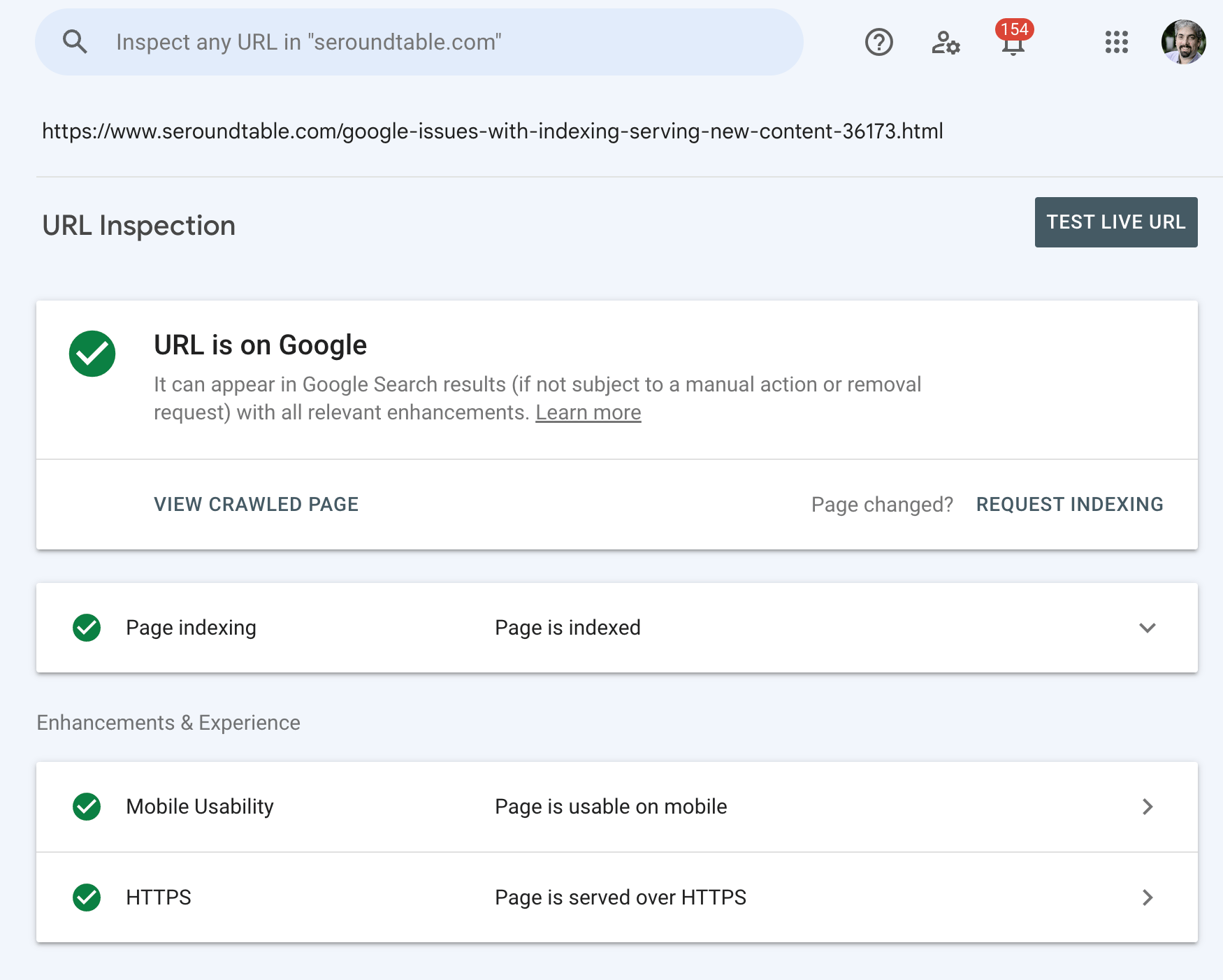
Postscript. There does seem to be issues with Google Search surfacing new content but it does not seem to be indexing-related but rather serving-related. Here is a new piece of content that shows as being indexed by Google Search Console:

Danny Sullivan

But it is not currently being served by Google Search:

Director of Newsroom SEO

But Google has said this is a confirmed indexing issue with new content.

The post Google having issues indexing new content for the past few hours appeared first on Search Engine Land.

Original source: https://searchengineland.com/google-may-be-having-issues-indexing-new-content-for-the-past-few-hours-432966